
In modern sheet metal manufacturing, the demand for larger panels, heavier progressive dies, tighter dimensional tolerances, and more stable production cycles has made the closed-type double-point press a core machine for many high-volume stamping environments. The BLPE-250 Robust Wide-Bed Closed-Type Double-Point Press is designed for manufacturers that require a combination of strength, bed width, die capacity, off-center load resistance, and repeatable forming accuracy. With a nominal capacity of 2500 kN, a wide 2800 mm distance between columns, and a 2500 x 1000 mm worktable, this press is built for large-format forming tasks that exceed the practical limits of smaller open-type machines.
The BLPE-250 belongs to the closed-type double-point press category, a press configuration valued for its high structural rigidity and excellent slide stability. Unlike open-type presses, which are often preferred for smaller components and convenient accessibility, a closed-type press uses a frame structure that better resists deformation during heavy stamping operations. The double-point drive further improves load distribution across the slide, making the machine suitable for wide dies, progressive dies, and production lines where eccentric loading can otherwise reduce accuracy and shorten tooling life.
For manufacturers producing automotive components, appliance panels, electrical hardware, metal enclosures, structural sheet metal parts, brackets, reinforcement parts, and large stamped blanks, the BLPE-250 provides a powerful balance between production capacity and precision. Its 22 kW main motor supports dependable press operation, while the maximum die height of up to 605 mm expands compatibility with larger and more complex tooling. The machine is not merely a power source; it is an integrated forming platform intended to support long-term industrial productivity.
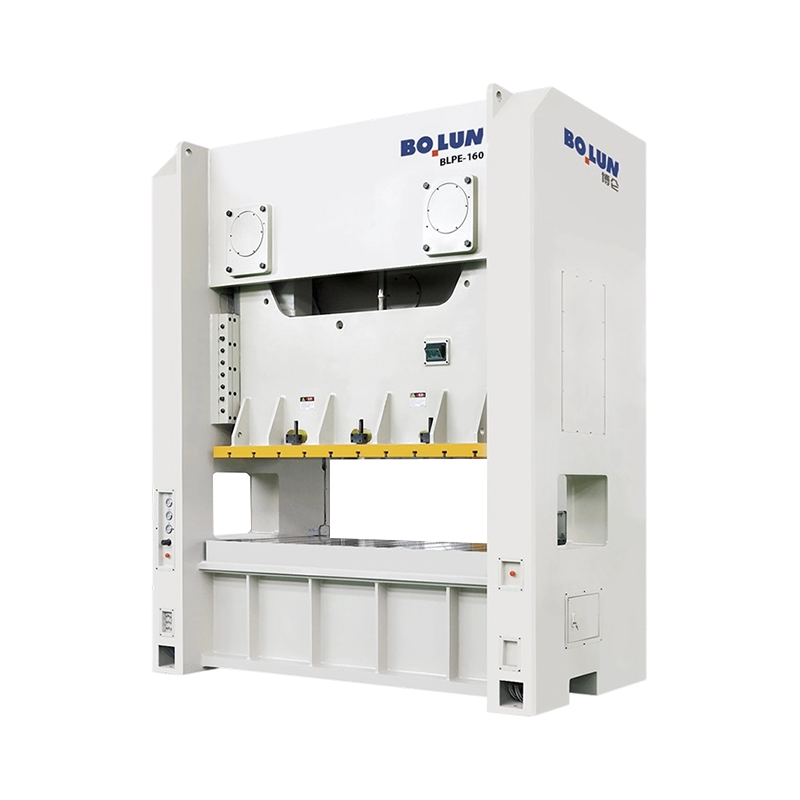
BLPE-250 Robust Wide-Bed Closed-Type Double-Point Press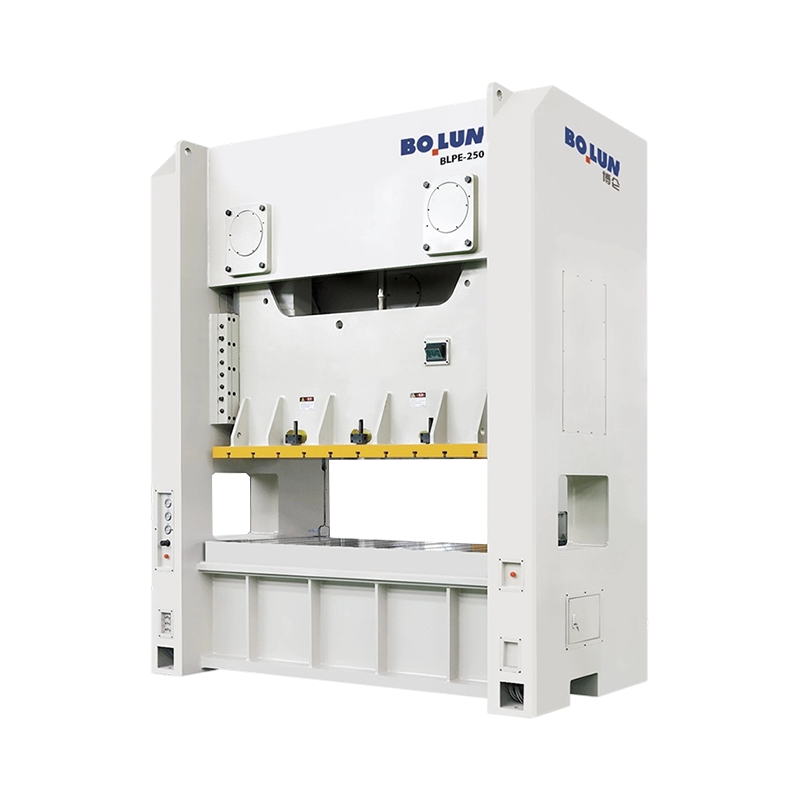
The BLPE-250 is positioned as a heavy-duty wide-bed press for manufacturers that need more than standard capacity. Its nominal 2500 kN output makes it suitable for medium-to-large sheet metal forming processes where strength, precision, and operational stability are equally important. In many factories, the transition from smaller press equipment to a closed-type double-point press is driven by several factors: larger part geometry, heavier tooling, stricter tolerances, higher production speed requirements, and the need to reduce downtime caused by machine deflection or uneven load distribution.
Because the machine provides a 2800 mm distance between columns, it offers excellent clearance for large dies and long workpieces. This feature is especially important in progressive stamping, transfer operations, and wide-panel forming. A press with insufficient column spacing can restrict die design and limit the manufacturer’s ability to accept larger production projects. By offering generous structural clearance, the BLPE-250 supports flexible die layouts and allows manufacturers to expand their production capabilities without immediately moving to a much larger and more expensive press model.
The 2500 x 1000 mm worktable is another key advantage. In actual production, the worktable is the foundation on which tooling accuracy depends. A large, strong worktable allows wide dies to be mounted securely and helps maintain stable working conditions during repetitive stamping cycles. The 170 mm table thickness listed for this model reflects the machine’s heavy-duty orientation and supports improved resistance to vibration and deformation. For manufacturers that value stable die alignment and repeatability, worktable strength is a major factor in long-term production quality.
Compared with many competing machines in the same capacity range, the BLPE-250 emphasizes wide-bed usability, robust structure, and practical compatibility with large tooling. Some presses may offer similar nominal capacity but have narrower column spacing or smaller table size, which can limit their application range. Others may provide adequate bed dimensions but lack the balanced slide guidance and structural rigidity required for precision under off-center loading. The BLPE-250 addresses these concerns by combining capacity, width, die height, and frame rigidity in one platform.
The following table summarizes the key technical data for the BLPE-250 closed-type double-point press. These specifications highlight why the machine is suitable for heavy-duty sheet metal forming and large die applications.
| Item | Specification | Production Significance |
| Model | BLPE-250 | Closed-type double-point press for large-format stamping |
| Nominal Capacity | 2500 kN | Supports heavy sheet metal forming and demanding die operations |
| Nominal Pressure Stroke | 7 mm / 3 mm configuration data | Provides forming force near the working stroke area |
| Slide Stroke | 280 mm / 170 mm configuration data | Allows suitable stroke selection for different forming processes |
| Strokes per Minute | 20-40 / 30-60 S.P.M. configuration data | Balances output speed with forming stability |
| Maximum Die Height | 550 mm / 605 mm configuration data | Accommodates larger and taller tooling |
| Die Height Adjustment | 120 mm | Improves tooling setup flexibility |
| Worktable Size | 2500 x 1000 x 170 mm | Supports wide dies and large workpieces |
| Slide Bottom Size | 2300 x 900 x 95 mm | Provides strong slide interface for tooling |
| Distance Between Columns | 2800 mm | Offers wide clearance for large-format dies |
| Height of Working Face | 1100 mm | Supports ergonomic and line integration needs |
| Side Opening | 900 x 600 mm | Improves accessibility and material handling flexibility |
| Main Motor | 22 kW x 4P | Provides reliable power for repeated production cycles |
| Air Pressure | 0.55 MPa | Supports pneumatic system operation |
| Punch Accuracy | GB/JIS Class 1 | Indicates precision performance suitable for quality manufacturing |
| Overall Dimension | 2799 x 3600 x 4593 mm | Provides a reference for factory layout planning |
The closed-type frame is one of the most important reasons manufacturers choose this type of press for demanding stamping work. In an open-type power press, the C-frame structure provides convenient access from multiple sides but can be more susceptible to deflection under heavy load. This deflection may be acceptable for smaller parts or lighter forming operations, but it becomes a serious limitation when dies are large, forces are high, and tolerances are strict.
The BLPE-250 uses a closed-type high-rigidity frame to reduce deformation during pressing. The frame surrounds the working area in a more balanced way, allowing forming forces to be absorbed through a stronger structural loop. This improves alignment between the slide and the worktable, which directly affects part consistency and die life. In production, even small deviations in slide parallelism can cause uneven wear, burr formation, dimensional drift, and increased maintenance cost. A rigid frame helps minimize these risks.
Competitor machines with lighter frames may initially appear attractive because of lower cost or smaller footprint, but their limitations often become visible under continuous production conditions. When a press runs thousands or millions of cycles, frame stiffness is not a theoretical advantage; it becomes a practical factor in part quality, tooling cost, and downtime. The BLPE-250 is engineered as a heavy-duty platform that prioritizes long-term stability, making it suitable for factories that value predictable output and reduced process variation.
Another advantage of the closed-type design is its suitability for off-center loading. In wide dies, the forming load is not always perfectly centered. Some stations in a progressive die may perform piercing, bending, drawing, or trimming at different positions across the die width. This creates uneven load distribution. A weaker structure may twist or deflect, causing misalignment between the upper and lower tooling. The BLPE-250’s closed frame and double-point drive help maintain stability even when loading is not perfectly symmetrical.
The double-point drive is a defining feature of this press category. Instead of applying force through a single central point, a double-point press distributes motion and force through two drive points across the slide. This design is especially beneficial for wide-bed presses because it improves slide balance and reduces the tendency for tilting under uneven loads.
For large progressive dies, double-point drive technology can provide a major production advantage. Progressive dies often contain multiple stations, each performing a different operation on the strip as it advances. At any given moment, force may be concentrated more heavily on one side of the die. If the slide is not properly supported and driven, this eccentric load can create angular deflection. The result may be inconsistent forming depth, premature tool wear, or scrap parts. The BLPE-250’s double-point configuration helps keep the slide movement stable and synchronized.
Compared with single-point presses in similar capacity ranges, the BLPE-250 is better suited for wide tooling because its force distribution matches the geometry of the die. A single-point press may be highly effective for smaller or centrally loaded tools, but wide dies benefit from broader driving support. This makes the BLPE-250 a practical solution for manufacturers that process long parts, multiple-cavity dies, or progressive tooling with uneven forming loads.
The double-point system also supports better die protection. When the slide remains more parallel during the stroke, the die experiences more uniform contact conditions. This reduces the risk of localized impact, edge loading, and uneven wear. In high-volume stamping, extending die life can generate significant savings. Tool maintenance, sharpening, regrinding, adjustment, and replacement all create cost and downtime. A stable press helps protect the tooling investment.
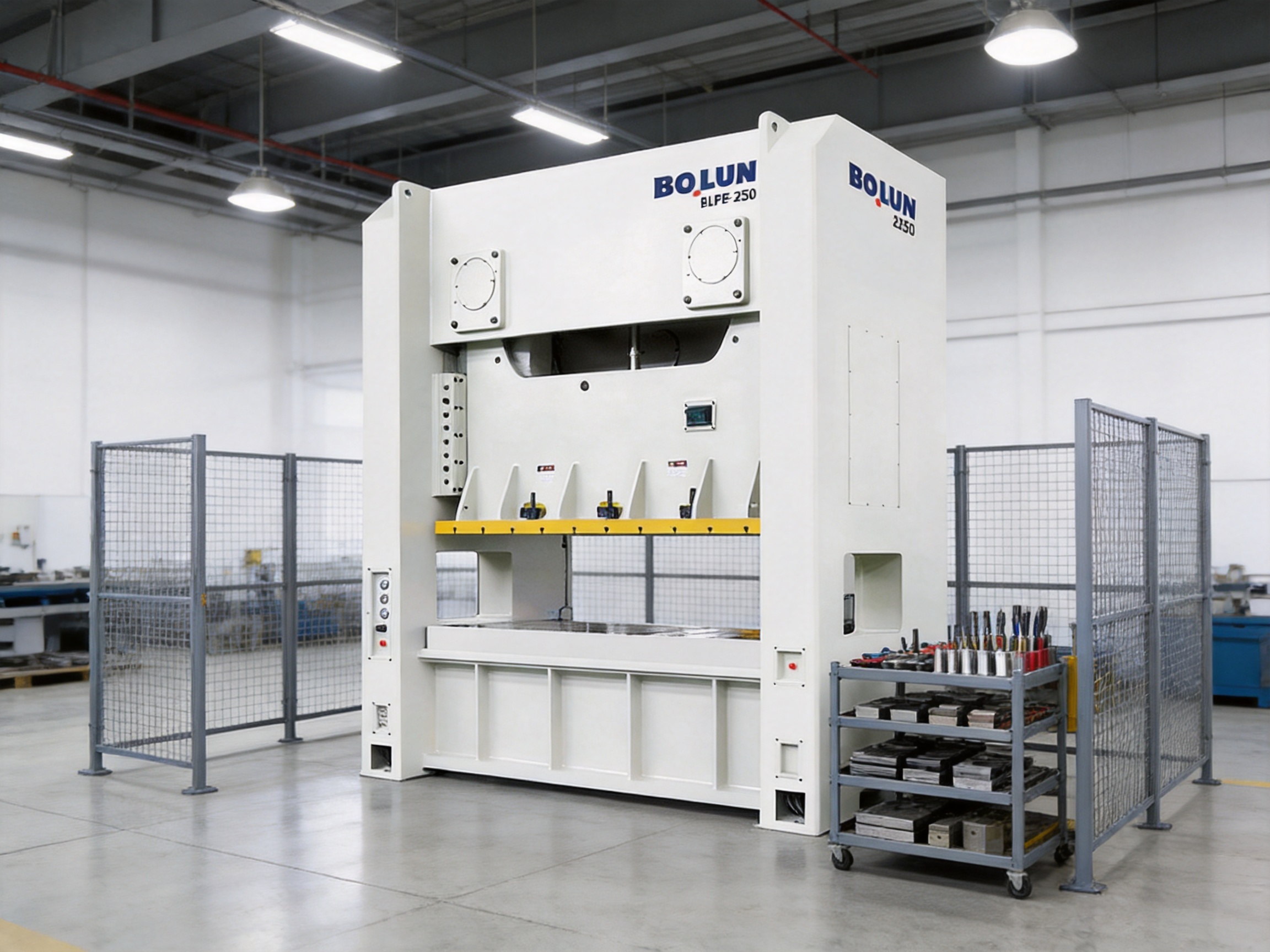
The BLPE-250’s wide-bed design is one of its strongest selling points. With 2800 mm between columns and a 2500 x 1000 mm worktable, the machine gives manufacturers the space required for large dies and broad workpieces. This is a clear advantage over smaller closed-type presses that may have sufficient tonnage but limited die space. In stamping, capacity alone does not determine whether a press can handle a job. Die size, feed direction, strip width, part layout, and material handling requirements are equally important.
A wide-bed press helps manufacturers design more efficient dies. For example, a progressive die may incorporate more stations within one tool, reducing the number of separate operations required. A larger die can also include multiple cavities to increase output per stroke. When the press bed is too small, engineers may need to divide the process into separate tools or machines, which increases handling, floor space, labor, and quality control complexity. The BLPE-250 provides the physical foundation for more integrated tooling strategies.
The wide bed is also valuable for applications involving panels and structural components. Appliance parts, cabinet panels, reinforcement brackets, automotive inner parts, and electrical box components may require broad support during forming. Insufficient table area can lead to unstable tooling support or limit the size of fixtures and automation accessories. The BLPE-250’s bed dimensions support more secure tooling installation and more flexible production planning.
In comparison with competitors that focus mainly on compact machine design, the BLPE-250 offers a more production-oriented layout for large-format work. While a smaller footprint can be beneficial in crowded workshops, the real measure of press value is whether it can reliably complete the required job. For factories producing large parts, a press that is too narrow can become a bottleneck. The BLPE-250 reduces this bottleneck by combining capacity and bed width in a balanced machine design.
The BLPE-250 provides a maximum die height of up to 605 mm in its configuration data, making it suitable for taller tooling assemblies. Die height is an important specification because it determines what kinds of tools can be installed and how much vertical space is available for complex forming mechanisms. In modern stamping, dies may include guide systems, nitrogen springs, cams, lifters, sensors, strip guides, and safety components. These features often increase die height.
A press with limited die height can restrict tooling design. Engineers may be forced to simplify the die, reduce functional stations, or compromise the layout. In contrast, a press with generous die height allows more sophisticated tooling solutions. The BLPE-250’s die height capability supports complex progressive dies and forming dies used in higher-value manufacturing.
The 120 mm die height adjustment further enhances flexibility. Different dies require different shut heights, and fast adjustment is necessary for efficient changeover. A machine that can accommodate multiple die sets with reliable adjustment helps manufacturers respond to changing production schedules. In job shops, contract manufacturing environments, and multi-product stamping facilities, setup flexibility can be as important as raw pressing force.
The BLPE-250 also supports heavier tooling through its strong slide bottom and robust worktable. Tooling weight and die rigidity are major concerns in heavy stamping. The press must not only deliver force but also carry the die securely. A stable interface between the slide, die, and table reduces vibration and alignment drift. This improves repeatability from the first stroke to the last stroke of a production batch.
The BLPE-250 is specified with GB/JIS Class 1 punch accuracy, indicating that it is designed for precision-oriented stamping. Accuracy is not determined by one component alone. It is the result of frame rigidity, slide guidance, drive synchronization, machining quality, assembly precision, lubrication, and long-term wear resistance. In stamping production, accuracy affects part dimensions, edge quality, hole position, bend consistency, and assembly performance.
When a press maintains precise slide motion, the die can perform as designed. This is especially important for parts that must fit into larger assemblies. Automotive and appliance components often require consistent geometry because downstream welding, fastening, painting, and assembly processes depend on dimensional repeatability. If stamped parts vary too much, the cost of correction may appear later in the production chain.
Compared with lower-precision competitors, the BLPE-250 offers an advantage by supporting more stable forming conditions. A press that lacks precision may still produce acceptable parts at the beginning of a run, but quality may drift as speed increases, temperature changes, or loading varies. The BLPE-250’s heavy-duty structure and precision design help reduce these variations.
High punch accuracy also improves material utilization. Poor alignment can create burrs, misfeeds, edge cracking, or out-of-tolerance features that lead to scrap. Material cost is a major factor in sheet metal production, especially when processing high-strength steel, stainless steel, aluminum alloys, or coated sheet. By supporting consistent die action, the press helps reduce scrap and improve overall manufacturing efficiency.
The BLPE-250 is equipped with a 22 kW main motor, supporting reliable operation for heavy-duty stamping cycles. Motor power is critical because a press must not only reach nominal capacity but also maintain stable performance across repeated strokes. In continuous production, insufficient power can lead to speed instability, reduced productivity, and increased mechanical stress.
The listed stroke speed range provides flexibility for different forming requirements. Some operations require slower, more controlled motion to protect the material and die, while others benefit from higher strokes per minute to increase output. The BLPE-250’s operating range allows manufacturers to match press speed to process requirements rather than forcing every job into a fixed production rhythm.
Production stability is also influenced by the balance device and the overall mechanical design. The BLPE-250 is described as maintaining accuracy under off-center loads thanks to its robust balance device and closed-type high-rigidity frame. This is a practical advantage in real stamping environments where loading conditions change from die to die. A strong balance system helps stabilize slide movement, reduce vibration, and improve forming consistency.
Competitor machines with less robust balancing may show slide instability during high-speed or eccentric operations. This can cause abnormal noise, accelerated wear, or poor part quality. The BLPE-250 is built to provide a stable operating platform, which is especially important for customers seeking long-term return on equipment investment.
Open-type power presses remain useful in many manufacturing environments, particularly where accessibility, compactness, and lower forming loads are priorities. However, for large-format, high-precision, heavy-duty stamping, the closed-type double-point design of the BLPE-250 provides clear advantages.
First, the closed-type frame offers superior resistance to deflection. In open-type presses, the frame can open slightly under load, creating angular deviation between the slide and table. This effect may be small, but in precision stamping it can be enough to reduce part consistency. The BLPE-250’s frame structure resists this tendency and maintains better alignment.
Second, the double-point drive is better for wide dies. Open-type presses are often single-point machines and may not provide the same slide stability across a wide bed. For narrow tools, this may not be a problem. For wide progressive dies, it becomes a major limitation. The BLPE-250 distributes force more evenly, making it more appropriate for broad tooling.
Third, the wide-bed closed-type format allows the use of larger and heavier dies. The 2500 x 1000 mm worktable and 2800 mm column spacing provide room for tooling that would be impractical on many open-type presses. This expands production capability and supports more advanced die design.
Fourth, the BLPE-250 is better suited for long-term high-volume production. Its rigidity, precision, and heavy-duty structure reduce the risk of quality drift and mechanical fatigue. Although open-type presses may offer lower initial cost, the total cost of ownership can favor a closed-type press when production requirements are demanding.
Within the closed-type press market, not all machines provide the same combination of capacity, width, die height, and manufacturing quality. The BLPE-250 stands out because it is designed as a robust wide-bed model rather than a narrow standard-capacity press. Its 2800 mm column distance gives it an advantage for large dies, while the 2500 kN nominal capacity provides the force required for demanding forming tasks.
Some competing presses may emphasize capacity but lack sufficient bed width. This can force customers to choose a larger tonnage machine simply to obtain enough die space, increasing capital cost and energy consumption. The BLPE-250 helps avoid this mismatch by offering generous working dimensions in the 2500 kN class.
Other competitors may provide wide bed dimensions but use lighter construction. A wide press must be rigid across its full span. If the frame, slide, or table lacks sufficient strength, the wider geometry can actually increase the risk of deflection. The BLPE-250 combines width with a closed-type high-rigidity frame, giving customers both space and stability.
The machine also benefits from the manufacturing strength of Zhejiang Bolun High-Precision Machinery Co., Ltd., a company with deep roots in machinery manufacturing and a strong focus on high-precision forming equipment. The company integrates research and development, design, production, sales, and service, allowing it to control product quality from initial engineering through final machine inspection. This full-chain capability is an important differentiator in a market where some suppliers rely heavily on outsourced design or inconsistent production processes.
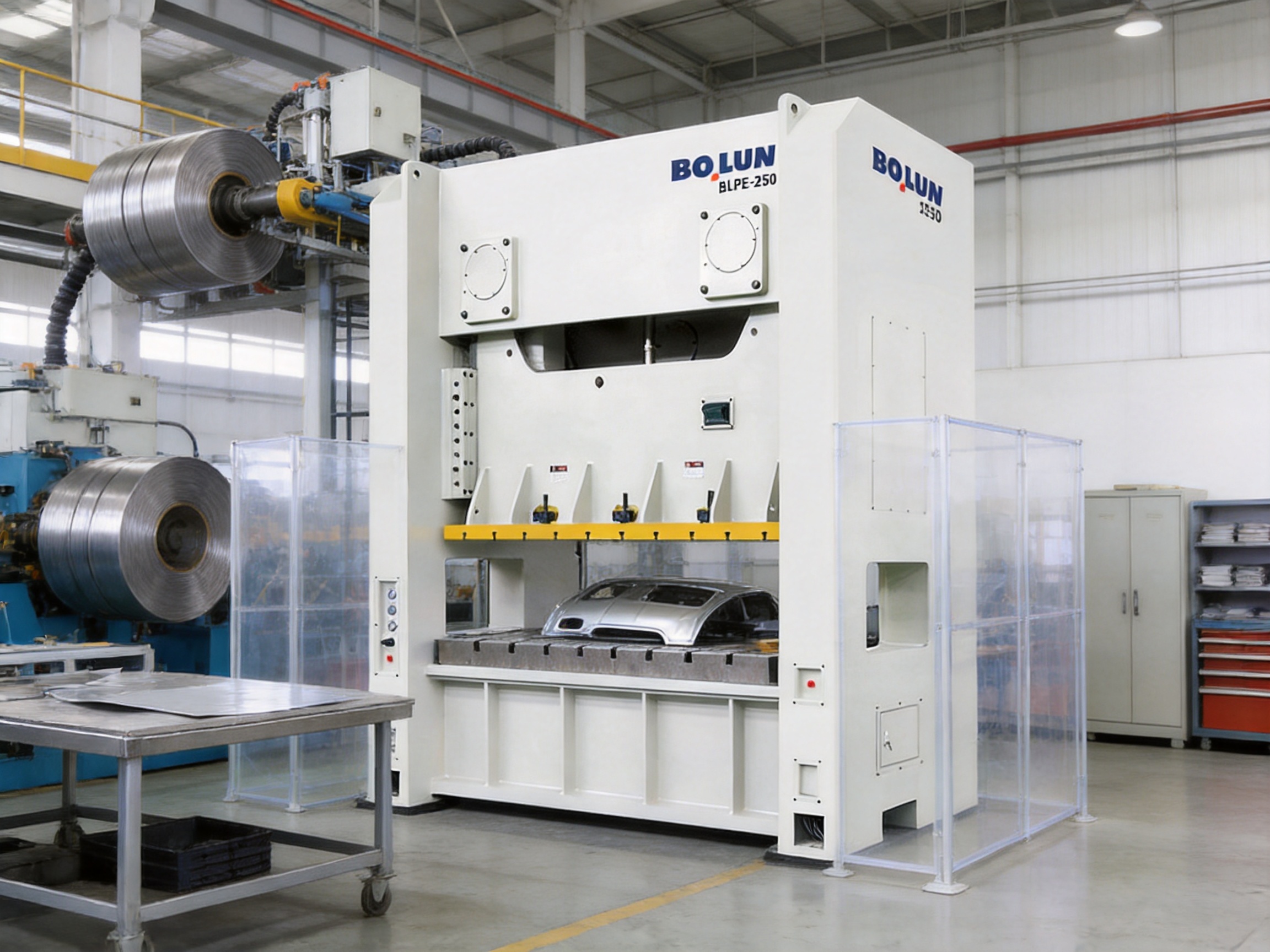
A press is only as reliable as the manufacturing system behind it. Zhejiang Bolun High-Precision Machinery Co., Ltd. is located in Zhejiang, a major center of precision manufacturing in China. With approximately two decades of experience in the machinery manufacturing industry, the company has developed a mature production management system and technical foundation for high-precision forming equipment.
The company integrates research and development, mechanical design, production, sales, and service. This integrated structure gives it stronger control over product performance. Instead of treating machine production as a simple assembly process, the company manages each stage from design concept to final inspection. This approach helps ensure that frame rigidity, component fit, machining accuracy, and operational reliability are aligned with customer requirements.
Advanced manufacturing begins with engineering design. The company relies on a capable design team that can provide one-stop design and manufacturing services, including non-standard customization for special specifications and functions. This is important because many customers do not operate under identical production conditions. Material type, part shape, die size, automation requirements, factory layout, and productivity targets vary widely. A supplier with customization capability can help customers select or adapt equipment more effectively.
The company also emphasizes precision processing equipment and a mature industrial environment. For a closed-type double-point press, machining accuracy of the frame, slide, guide surfaces, connecting components, and table interfaces is essential. If these areas are not processed accurately, the machine may not achieve its intended alignment or long-term precision. By investing in precision manufacturing capability, the company strengthens the foundation of product reliability.
Quality control is one of the most important aspects of press manufacturing. A power press operates under repeated high-force cycles, so small production defects can become serious problems over time. The company has established a finished product inspection system that exceeds ordinary industry standards, performing rigorous quality control on processes and components to ensure stable precision and long service life under high-intensity operating conditions.
This inspection philosophy is especially relevant for the BLPE-250. Because it is intended for large dies and heavy-duty production, every structural and mechanical element must be verified for reliability. Frame integrity, slide movement, motor operation, die height adjustment, pneumatic system performance, lubrication, noise, vibration, and precision accuracy all influence the customer’s experience. A careful inspection process reduces the likelihood of problems after installation.
Many machine users focus on visible specifications such as tonnage, table size, or motor power. While these are important, hidden quality factors often determine long-term value. Surface machining quality, assembly fit, bearing alignment, guide clearance, electrical system reliability, and lubrication routing may not be obvious from a catalog, but they affect uptime and part quality. The company’s quality-first philosophy helps address these hidden factors.
Compared with suppliers that compete mainly on price, Zhejiang Bolun High-Precision Machinery Co., Ltd. emphasizes stable precision, long service life, and customer-oriented support. This approach is important for buyers evaluating total cost of ownership. A lower-cost press that requires frequent adjustment, produces inconsistent parts, or causes tooling damage may become more expensive over time than a better-built machine.
The company’s development is driven by technological innovation. Its “Technology First” strategy reflects an understanding that modern press users require more than basic mechanical force. They need equipment that supports automation, digital control, stable precision, energy efficiency, safety, and flexible manufacturing. The BLPE-250 is part of this broader direction toward high-end forming equipment.
A full-chain production system helps the company respond to technical challenges more efficiently. When design, production, assembly, and service teams work within one coordinated system, feedback from customers can be translated into product improvements. This is valuable in the press industry because real-world stamping conditions are complex. Material changes, die design innovations, and automation requirements constantly create new demands.
Non-standard customization is another important strength. Many competitors offer standard machines with limited modification options. That approach may be sufficient for simple applications, but customers with special production needs often require adapted stroke parameters, table layouts, feeding arrangements, safety systems, or integration interfaces. The company’s ability to design and manufacture special specifications allows it to serve customers with more complex requirements.
International management perspective also enhances competitiveness. The company actively adopts advanced production management experience and combines it with China’s manufacturing environment. This combination supports efficient production, disciplined quality control, and practical cost performance. For global customers, the result is a machine that aims to deliver advanced capability while remaining commercially competitive.
A heavy-duty press purchase is not a simple equipment transaction. It is a long-term production investment. Customers need support before purchase, during installation, and after commissioning. Zhejiang Bolun High-Precision Machinery Co., Ltd. provides a service system covering pre-sales consultation, in-sales support, and after-sales guarantees. This service orientation helps customers select suitable equipment, prepare factory conditions, manage installation, and maintain performance after the machine enters production.
Pre-sales consultation is important because selecting the right press requires more than matching tonnage. Engineers must evaluate die size, material thickness, forming process, production speed, automation requirements, part accuracy, and future expansion plans. A machine such as the BLPE-250 may be ideal for customers needing wide-bed capacity and off-center load stability, while other applications may require different models. Professional consultation reduces selection risk.
In-sales support helps ensure that the machine configuration meets the customer’s actual production conditions. This may include discussions about tooling, die height, feeding equipment, safety systems, foundation requirements, electrical specifications, and line layout. The more carefully these details are handled before delivery, the smoother the installation and commissioning process will be.
After-sales support is essential because production equipment must remain reliable over many years. Maintenance guidance, spare parts support, troubleshooting, and technical communication help customers protect their investment. A manufacturer that understands both machine design and field operation can provide more practical support than a supplier focused only on shipment.
The BLPE-250 can be applied in a wide range of sheet metal forming scenarios. In automotive component production, it can support the forming of reinforcement parts, brackets, panels, and structural elements that require stable dimensions and repeatable quality. Automotive suppliers often operate under strict delivery schedules and quality standards, making press reliability a major requirement.
In appliance manufacturing, the machine can be used for large panels, frames, covers, and internal structural components. Appliance parts often require clean surfaces and consistent geometry because they influence both function and appearance. The stable slide motion and wide worktable of the BLPE-250 help support these requirements.
In electrical equipment manufacturing, sheet metal enclosures, control cabinet parts, mounting plates, and structural hardware may require wide dies and accurate hole positions. A press with good rigidity and large die capacity can improve the efficiency of producing such components, especially when progressive dies are used.
In general industrial stamping, the BLPE-250 is suitable for contract manufacturers serving multiple industries. Its combination of capacity, wide bed, die height, and precision makes it flexible enough for varied production tasks. This flexibility helps job shops accept a broader range of orders and improve equipment utilization.
The economic value of the BLPE-250 comes from several areas. First, it can improve productivity by supporting larger dies and more integrated stamping processes. A wide progressive die may complete multiple forming stages in one press line, reducing secondary operations and manual handling. This increases output and reduces labor cost.
Second, the machine can reduce scrap by maintaining stable accuracy. Scrap reduction is especially valuable when processing expensive materials. Even a small improvement in yield can generate significant savings over long production runs. By supporting die alignment and consistent forming, the BLPE-250 helps control material waste.
Third, the machine can extend tooling life. A rigid frame and balanced slide motion reduce abnormal die wear. Tooling is often one of the largest investments in stamping production, and downtime for die repair can interrupt delivery schedules. A press that protects tooling provides value beyond its own mechanical performance.
Fourth, the machine can reduce maintenance frequency associated with overload, misalignment, and vibration. Heavy-duty construction does not eliminate maintenance, but it creates a stronger basis for reliable operation. Proper lubrication, inspection, and operator discipline remain essential, but a robust machine design reduces unnecessary stress on critical components.
Fifth, the BLPE-250 helps manufacturers expand production capability without immediately moving to a much higher tonnage class. Because it offers wide-bed dimensions and strong die compatibility within the 2500 kN category, it may provide the right balance of investment and performance for many medium-to-large stamping applications.
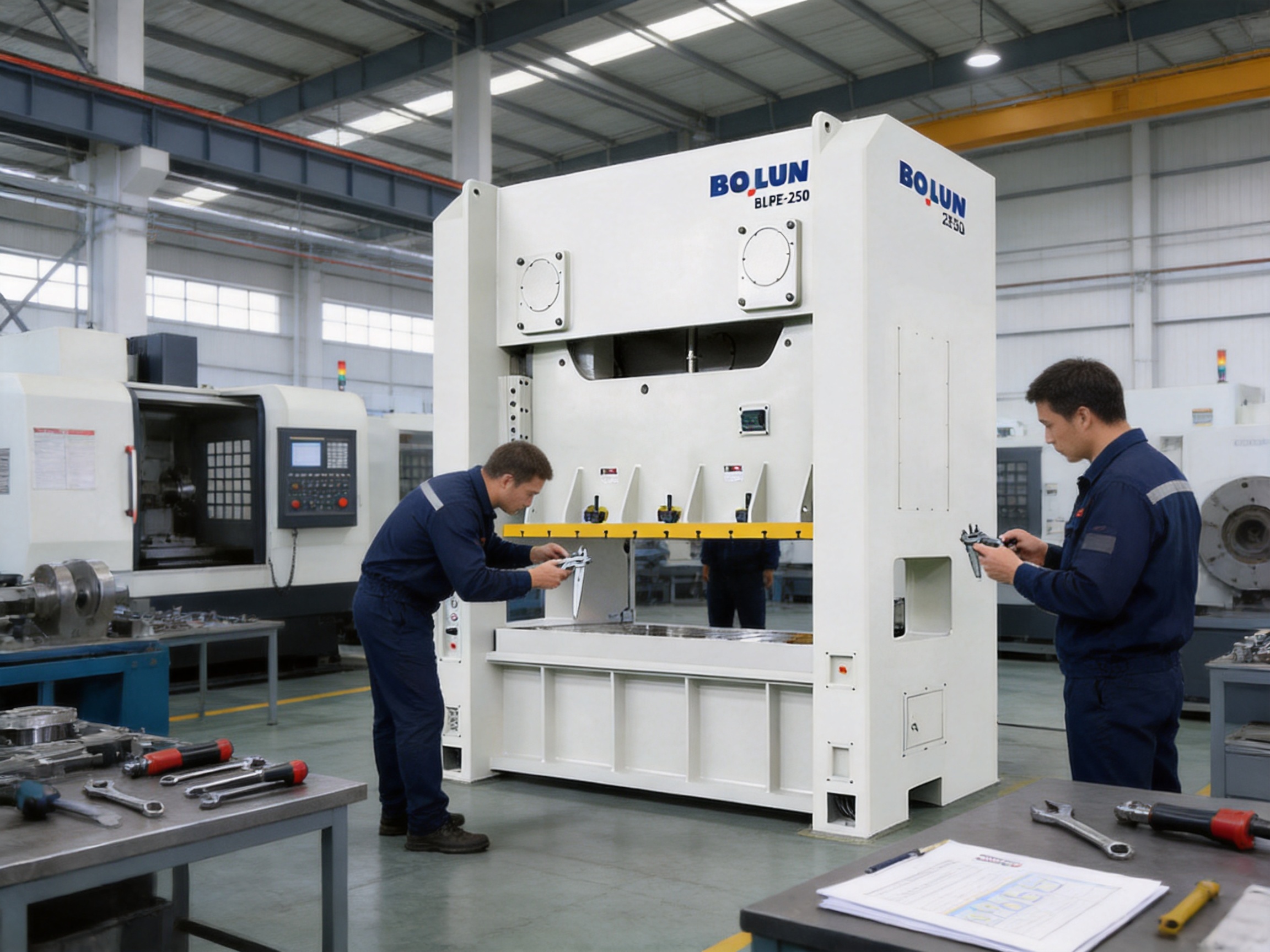
Safety is a critical concern in all press operations. A machine with high forming force must be integrated with appropriate guarding, controls, feeding systems, die protection, and operator procedures. While the BLPE-250 provides the mechanical foundation for heavy-duty stamping, safe production depends on correct installation, training, maintenance, and compliance with applicable workplace standards.
The machine’s side opening of 900 x 600 mm supports accessibility for material handling and maintenance. However, access points must be managed carefully to prevent unsafe operation. In automated lines, feeding equipment, conveyors, robots, or transfer systems may be integrated to reduce manual handling and improve repeatability. The press layout should be planned with safe access, maintenance clearance, and efficient material flow in mind.
The working face height of 1100 mm provides a reference for line integration and ergonomic planning. When combined with feeding systems, coil lines, straighteners, or transfer devices, the working height affects material path alignment. Proper alignment reduces feeding problems and improves production stability.
Foundation planning is also important. A heavy-duty closed-type press requires a stable installation base to support machine weight, dynamic loads, and vibration control. Customers should consider floor strength, leveling, anchoring, and surrounding equipment layout. A well-installed press performs better and maintains accuracy longer.
Manufacturers often reach a point where existing press equipment limits growth. The limitation may be insufficient tonnage, narrow bed size, poor accuracy, slow production speed, or inability to handle modern tooling. The BLPE-250 addresses these limitations by providing a strong, wide, and precise platform for more advanced stamping work.
For companies moving from smaller presses into larger production, the BLPE-250 provides a practical upgrade path. It offers significant capacity without reaching the size and cost of extremely large press systems. Its 2500 kN rating is powerful enough for many industrial applications, while its wide bed expands tooling possibilities. This makes it suitable for manufacturers that want to accept larger orders or improve efficiency with progressive dies.
For established manufacturers, the machine can strengthen production reliability. Even if a factory already owns multiple presses, adding a rigid wide-bed double-point press can improve scheduling flexibility. Jobs that previously required workarounds, multiple operations, or outsourcing may be brought in-house. This increases control over quality, timing, and cost.
The company behind the machine further enhances its value. Zhejiang Bolun High-Precision Machinery Co., Ltd. combines industry experience, technical innovation, advanced production management, customization capability, and strict inspection. These strengths reduce procurement risk and support long-term cooperation.
The BLPE-250 is a closed-type double-point power press designed for large-format sheet metal forming. It uses a rigid closed frame and double-point drive system to provide stable slide movement, strong load resistance, and reliable accuracy during heavy-duty stamping operations.
The nominal capacity is 2500 kN. This capacity makes the machine suitable for medium-to-large industrial forming tasks, including progressive stamping, panel forming, structural part production, and other demanding sheet metal applications.
The 2800 mm column distance provides wide clearance for large dies and broad workpieces. This allows manufacturers to use larger progressive dies, wider strip layouts, and more flexible tooling designs than would be possible on narrower presses.
The worktable size is 2500 x 1000 x 170 mm. This large and thick worktable supports wide tooling, improves mounting stability, and helps maintain die alignment during repeated stamping cycles.
A closed-type press has a more rigid frame structure that surrounds the working area, helping resist deformation under high load. An open-type press provides easier access but is generally less resistant to deflection. For large dies, heavy loads, and precision requirements, the closed-type design provides better stability.
The double-point drive distributes force across the slide through two driving points. This improves slide balance, reduces tilting under off-center loads, and makes the press more suitable for wide dies and progressive stamping applications.
The BLPE-250 configuration data includes a maximum die height of up to 605 mm. This provides flexibility for larger and more complex tooling assemblies, including progressive dies with guide systems, lifters, cams, and other functional components.
The press can be used in automotive component manufacturing, appliance production, electrical equipment manufacturing, metal enclosure production, general industrial stamping, and contract sheet metal forming. It is especially useful where wide dies and stable accuracy are required.
The rigid closed-type frame and balanced double-point slide motion help maintain alignment between the upper and lower dies. This reduces uneven contact, abnormal loading, and localized wear, helping extend tooling life in high-volume production.
A press requires precision design, accurate machining, disciplined assembly, and strict inspection. Zhejiang Bolun High-Precision Machinery Co., Ltd. integrates research and development, design, production, sales, and service, giving it strong control over machine quality and long-term reliability.
The BLPE-250 Robust Wide-Bed Closed-Type Double-Point Press is a heavy-duty forming solution designed for manufacturers that require strength, width, precision, and production stability. Its 2500 kN nominal capacity, 2800 mm distance between columns, 2500 x 1000 mm worktable, maximum die height of up to 605 mm, and 22 kW main motor make it a strong platform for large-format stamping and progressive die applications.
Its closed-type high-rigidity frame provides a clear advantage over open-type presses when dealing with heavy loads and strict accuracy requirements. Its double-point drive improves slide stability and makes the machine suitable for wide dies and off-center forming conditions. Its generous tooling space helps manufacturers expand production capability, improve die design flexibility, and reduce process limitations.
Beyond the machine itself, the manufacturing strength of Zhejiang Bolun High-Precision Machinery Co., Ltd. adds important value. With two decades of machinery manufacturing experience, a full-chain production system, non-standard customization capability, advanced precision processing equipment, strict inspection standards, and customer-oriented service, the company provides more than a product; it provides a complete forming equipment solution.
For manufacturers seeking to improve stamping efficiency, increase part size capability, protect tooling investment, and achieve stable long-term production, the BLPE-250 represents a practical and competitive choice. It combines robust mechanical engineering with advanced manufacturing support, making it well suited for the future of high-precision sheet metal forming.
Altan, T., and Tekkaya, A. E. Sheet Metal Forming: Processes and Applications. ASM International.
Boljanovic, V. Sheet Metal Forming Processes and Die Design. Industrial Press.
Kalpakjian, S., and Schmid, S. R. Manufacturing Engineering and Technology. Pearson.
Schuler Group. Metal Forming Handbook. Springer.
Society of Manufacturing Engineers. Tool and Manufacturing Engineers Handbook: Forming. SME.


What Is a Power Press? A power press — also called a stamping press or punch pr...
In the fields of metal forming, sheet metal fabrication, blanking, and punching,...
Moscow & St. Petersburg Trade Mission Yields Strong Market Insights and Surg...
As the manufacturing industry moves steadily toward automation and smart product...
In modern manufacturing, cold forging is widely used in the automotive, aerospac...
Manufacturing & Metalworking A direct, practical look at how mechanical pre...
Contact Us

bolunpress@gmail.com

+86-575-83362228

+86-15158259588

+86-575-83362999

+86-15158259588

Hangzhou Office Add: No. 332 Wangjiang East Road, Shangcheng District

No.1 Linjiang Road East, Xiaren, Jinting Town, Shengzhou City, Zhejiang Province, China
Ready to Begin?
Get in Touch

Now!

ZHEJIANG BOLUN
 English
 中文简体
中文简体