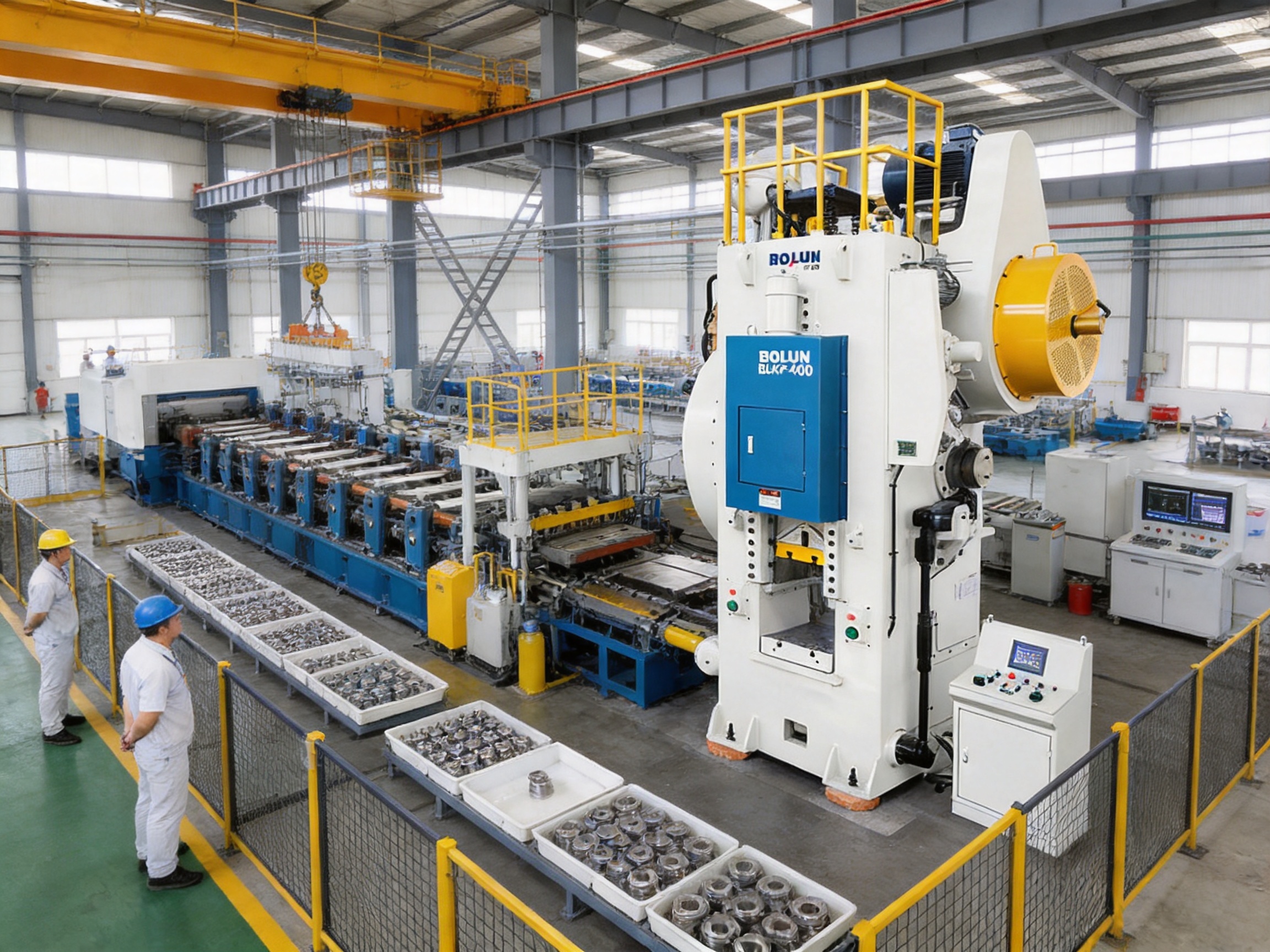
Cold forging requires a forming machine that can deliver extremely high force, repeatable motion, controlled energy transfer, and stable die support over long production cycles. Components made through upsetting, coining, sizing, extrusion, heading, and related forming operations must achieve the required geometry and material density without excessive cracking, dimensional variation, or premature die wear. For these demanding applications, the BLKP-400 versatile balanced-stroke cold forging toggle type power press provides a specialized solution built around a 4000 kN nominal capacity, a knuckle-joint transmission mechanism, and a work area designed for substantial multi-station tooling.
The machine is intended for manufacturers that need more than a general-purpose stamping press. Its toggle-type mechanism is optimized for cold forming, where the relationship between force, slide position, dwell behavior, and material flow directly affects product quality. A selectable slide stroke of 160 mm or 180 mm allows users to configure the press for different tooling arrangements and production requirements. The machine also offers a 550 × 660 mm worktable, a 400 × 500 mm slide bottom, electric slide adjustment, and hydraulic locking to support stable die installation and repeatable operation.
At the heart of the equipment is a balanced-stroke design that helps distribute forming loads through the frame and drive system. This design is particularly valuable when the press is used for parts requiring controlled deformation and consistent forming pressure. Instead of relying only on speed or maximum tonnage, the BLKP-400 combines mechanical leverage, controlled slide travel, rigid working components, and production-oriented adjustment features.
This article examines the press in detail, including its working principle, technical capabilities, cold forging applications, operating advantages, manufacturing strengths, maintenance considerations, and purchasing factors. It also explains why a purpose-built toggle press can provide important advantages compared with conventional eccentric, crank, or less specialized forming equipment.
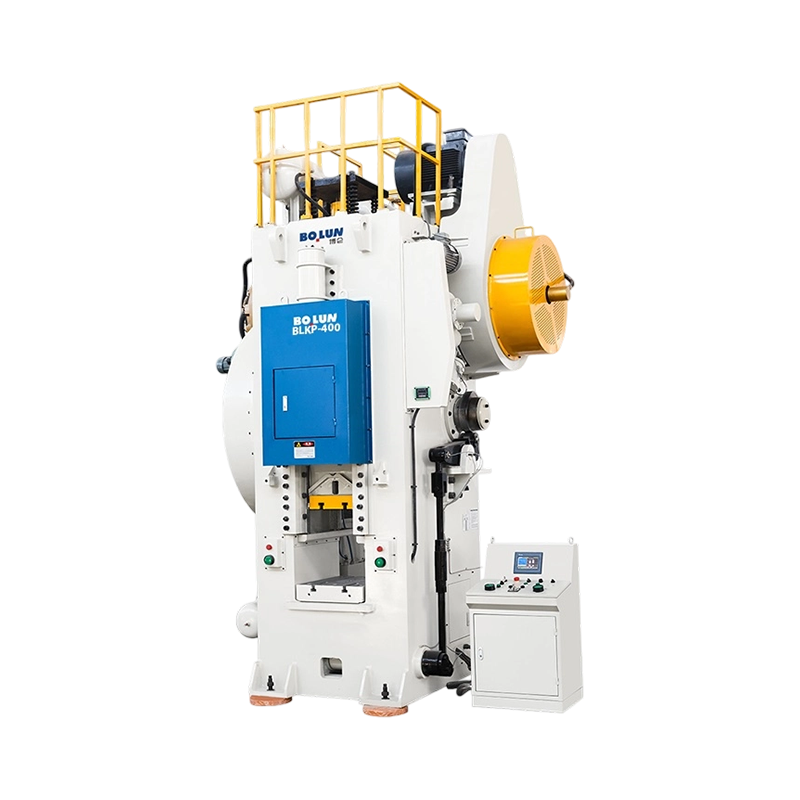
BLKP-400 Versatile Balanced-Stroke Cold Forging Toggle Type Power Press
The BLKP-400 is a cold forging toggle type power press with a nominal capacity of 4000 kN. In practical terms, this places the machine in a heavy-duty forming class suitable for substantial ferrous and non-ferrous components, depending on the material grade, part geometry, die design, lubrication system, and forming sequence. The press is not limited to one operation. It can support upsetting, coining, sizing, heading-related processes, and other cold forming tasks in which high compressive force and controlled slide movement are required.
The press offers two slide stroke options: 160 mm and 180 mm. This flexibility is useful because cold forging dies differ significantly in height, station layout, transfer requirements, and required material displacement. A shorter stroke can help improve cycle efficiency in tooling that does not require extensive vertical travel, while the longer option can accommodate more demanding die arrangements or part geometries.
The listed nominal pressure stroke is 6 mm. This specification identifies the range around the bottom portion of the slide movement where the press develops its nominal rated capacity. This is an important characteristic of toggle-type equipment. The mechanism is designed to generate high force near the forming position, where the workpiece is compressed or shaped. Users should therefore select the stroke, die height, and forming process so that the actual operation remains within the machine’s rated force and energy conditions.
With a worktable measuring 550 × 660 × 120 mm, the BLKP-400 provides a substantial platform for dies, bolster arrangements, guides, inserts, and auxiliary tooling. The slide bottom measures 400 × 500 mm, giving designers a practical mounting area for upper die components. The maximum die height is listed as 400 mm, while the maximum die weight is 800 kg. These specifications support a wide range of cold forging tooling, including multi-station dies, compound dies, progressive arrangements, and specialized forming assemblies.
The main motor is specified as 50 kW with four poles. The press also includes a 0.55 MPa air pressure requirement, a 150 kN mold pad capacity, and a 60 mm ram stroke. These supporting systems contribute to the overall forming process by assisting with workpiece ejection, die operation, material positioning, or related tooling functions, subject to the final machine configuration.
A toggle-type press uses a linkage system to convert rotary motor power into controlled reciprocating slide movement. As the toggle links approach a nearly aligned position near the bottom of the stroke, the mechanism produces a significant mechanical advantage. This allows the press to apply very high forming force over a relatively short portion of the slide travel.
Cold forging often benefits from this operating principle because the material must be displaced under compressive loading rather than removed by cutting or heated until it becomes highly plastic. The workpiece may require a substantial increase in diameter, a reduction in length, a shaped head, a defined surface profile, or a precise final dimension. The press must apply force at the correct position and maintain mechanical stability while the material flows into the die cavity.
The BLKP-400’s knuckle-joint mechanism is designed to improve control near the forming zone. Compared with a simple mechanism that applies a more uniform motion profile throughout the stroke, a toggle system can provide slower movement and higher force near the bottom position. This characteristic may improve filling of complex cavities, support coining operations, and help stabilize final sizing.
The controlled motion can also reduce the risk of abrupt impact between the tooling and workpiece. A properly adjusted toggle press allows the die to engage progressively, form the material under high compressive pressure, and return with an appropriate withdrawal speed. The result is a working cycle that is better matched to the requirements of cold deformation.
Another benefit is the potential improvement in material flow. In cold forging, uneven flow can create laps, folds, underfill, internal stress concentrations, or dimensional imbalance. A controlled forming profile gives the designer more opportunity to manage how material moves through the die. The mechanism does not replace good die engineering, lubrication, or process control, but it provides a strong mechanical foundation for those elements.
A balanced-stroke design helps distribute the working force through the press structure. During high-load forming, unbalanced loading can cause deflection of the slide, table, frame, or die set. Even small elastic changes may influence parallelism, part dimensions, tool wear, and surface quality. A balanced configuration is therefore valuable when the same part must be produced repeatedly over thousands or millions of cycles.
Load balance is particularly important for multi-station tooling. In a multi-station die, several forming events may occur during one cycle or across sequential positions. The press must maintain sufficient rigidity and alignment so that each station receives predictable force. The BLKP-400 is designed to support this type of production environment through its heavy-duty structure, substantial table area, and toggle-based force application.
| Specification | BLKP-400 Value |
| Machine type | Cold forging toggle type power press |
| Nominal capacity | 4000 kN |
| Nominal pressure stroke | 6 mm |
| Available slide stroke | 160 mm or 180 mm |
| Production speed | 30–50 strokes per minute |
| Maximum die height | 400 mm |
| Maximum die weight | 800 kg |
| Worktable size | 550 × 660 × 120 mm |
| Slide bottom size | 400 × 500 mm |
| Working face height | 820 mm |
| Die height adjustment | 15 mm |
| Air pressure | 0.55 MPa |
| Main motor | 50 kW × 4 poles |
| Mold pad capacity | 150 kN |
| Ram stroke | 60 mm |
The specifications above describe the principal configuration associated with the BLKP-400. Because cold forging systems are often customized for particular dies, feeding systems, ejection arrangements, electrical standards, safety requirements, and automation packages, buyers should confirm the final technical data before ordering. The actual productivity of a complete line will depend on the material, blank preparation, lubrication, loading and unloading method, die life, inspection requirements, and operator workflow.
The BLKP-400 is listed with a production range of 30–50 strokes per minute. This range gives manufacturers room to balance output with forming complexity. A high-speed setting may be appropriate for a stable, repeatable operation with well-established lubrication and feeding conditions. A lower speed may be preferable for deep deformation, complex coining, difficult materials, larger blanks, or tooling that requires additional time for controlled filling and release.
Press speed should not be evaluated as an isolated number. The most productive machine is the one that maintains a high percentage of acceptable parts while protecting dies and minimizing unplanned downtime. A press operating at a slightly lower speed but producing consistent components may deliver better overall output than a faster machine that causes frequent tool adjustments, cracks, misfeeds, or dimensional corrections.
The two available slide stroke options provide another level of flexibility. A 160 mm stroke can be suitable for compact tooling and processes that require limited vertical movement. The 180 mm stroke may benefit applications with larger die openings, greater material displacement, or more demanding transfer conditions. Selecting the correct stroke can help reduce unnecessary movement and improve cycle timing.
The electric slide adjustment system provides controlled positioning of the slide for die setup. Hydraulic locking then helps secure the selected position during operation. This combination is useful when the press is used with tooling that must be adjusted accurately and held firmly under high load. Stable adjustment reduces the risk of unintended movement, improves repeatability, and supports faster changeover between compatible die sets.
Upsetting increases the cross-sectional area of a workpiece while reducing its length. It is widely used to form heads, collars, flanges, shoulders, and other enlarged sections on bolts, rivets, pins, shafts, and fasteners. The 4000 kN capacity of the BLKP-400 provides substantial force for upsetting operations, although the exact capacity depends on blank dimensions, material strength, lubrication, die geometry, and the forming position.
The controlled bottom-stroke behavior of the toggle mechanism can help maintain consistent compression during the final stage of upsetting. This is important when the finished head or shoulder must meet close dimensional requirements. Proper alignment between the upper and lower tooling is also essential to prevent eccentric loading and uneven material flow.
Coining forces material into a die cavity to create sharp features, defined surfaces, identification marks, splines, grooves, or fine dimensional details. It requires high localized pressure and stable die support. The BLKP-400’s rated force and knuckle-joint mechanism make it suitable for coining operations where the press must apply concentrated force near the end of the stroke.
Because coining loads can be severe, tool design and material selection must be carefully coordinated. Die inserts should be properly supported, and the press should not be operated beyond its rated force or working envelope. A rigid press structure helps protect dimensional consistency, but it must be paired with correct die hardness, surface treatment, lubrication, and maintenance.
Sizing corrects dimensions after an earlier forming operation. It can improve diameter, length, flatness, concentricity, or surface definition. Sizing loads are often lower than the maximum loads used for major deformation, but the process still requires accurate alignment and repeatable slide positioning. The BLKP-400’s electric adjustment and hydraulic locking features can help establish stable die conditions for this type of finishing operation.
Multi-station cold forging uses a sequence of forming steps to produce a complex component from a cut blank. Each station performs a controlled operation, such as upsetting, forward extrusion, backward extrusion, piercing, trimming, sizing, or coining. By dividing deformation across stations, manufacturers can achieve complex shapes while controlling work hardening and reducing the load imposed on any individual forming step.
The 550 × 660 mm table and 400 × 500 mm slide bottom offer useful mounting space for multi-station tooling. The maximum die height of 400 mm and maximum die weight of 800 kg also provide a practical basis for substantial die assemblies. Final suitability must be assessed by reviewing the complete die envelope, transfer mechanism, blank dimensions, and required access for installation and maintenance.
A conventional crank or eccentric press can provide effective high-speed stamping, but its force characteristics may not always be ideal for heavy cold forging. Toggle mechanisms are designed to concentrate mechanical advantage near the bottom of the stroke. This allows the press to deliver strong forming force where it is most needed, particularly during final filling, coining, and sizing.
This does not mean that every toggle press is automatically superior for every application. High-speed blanking, shallow stamping, and processes requiring long continuous motion may favor another machine type. However, for demanding cold forming operations where high force and controlled end-of-stroke movement are central requirements, the toggle configuration offers a strong technical advantage.
Cold forging quality depends heavily on material flow. If the material is forced too quickly or unevenly into the die cavity, defects may occur. A controlled toggle movement can support smoother deformation and more predictable filling. This may help improve the consistency of finished parts, particularly when the tooling includes narrow sections, sharp transitions, or detailed surface features.
Efficient force application is not simply a matter of installing a larger motor. The transmission system must convert motor energy into useful forming work at the correct point in the cycle. By producing high mechanical advantage near the forming position, a toggle mechanism can reduce the need to rely solely on high motor power or excessive flywheel energy. This can contribute to a more efficient forming process when the press is correctly matched to the application.
Heavy cold forging dies require a press with adequate table strength, slide support, frame rigidity, and adjustment control. The BLKP-400’s 800 kg maximum die weight and 550 × 660 mm table are important advantages for manufacturers working with large or multi-station dies. The hydraulic locking system further supports stable die-height retention during production.
Although designed for cold forging, the press can support several related forming operations. This makes it more versatile than equipment dedicated to only one part family or one deformation method. A manufacturer may use the same machine for upsetting one product line, coining another, and sizing or calibration work on a third, provided that each application falls within the rated specifications and tooling requirements.
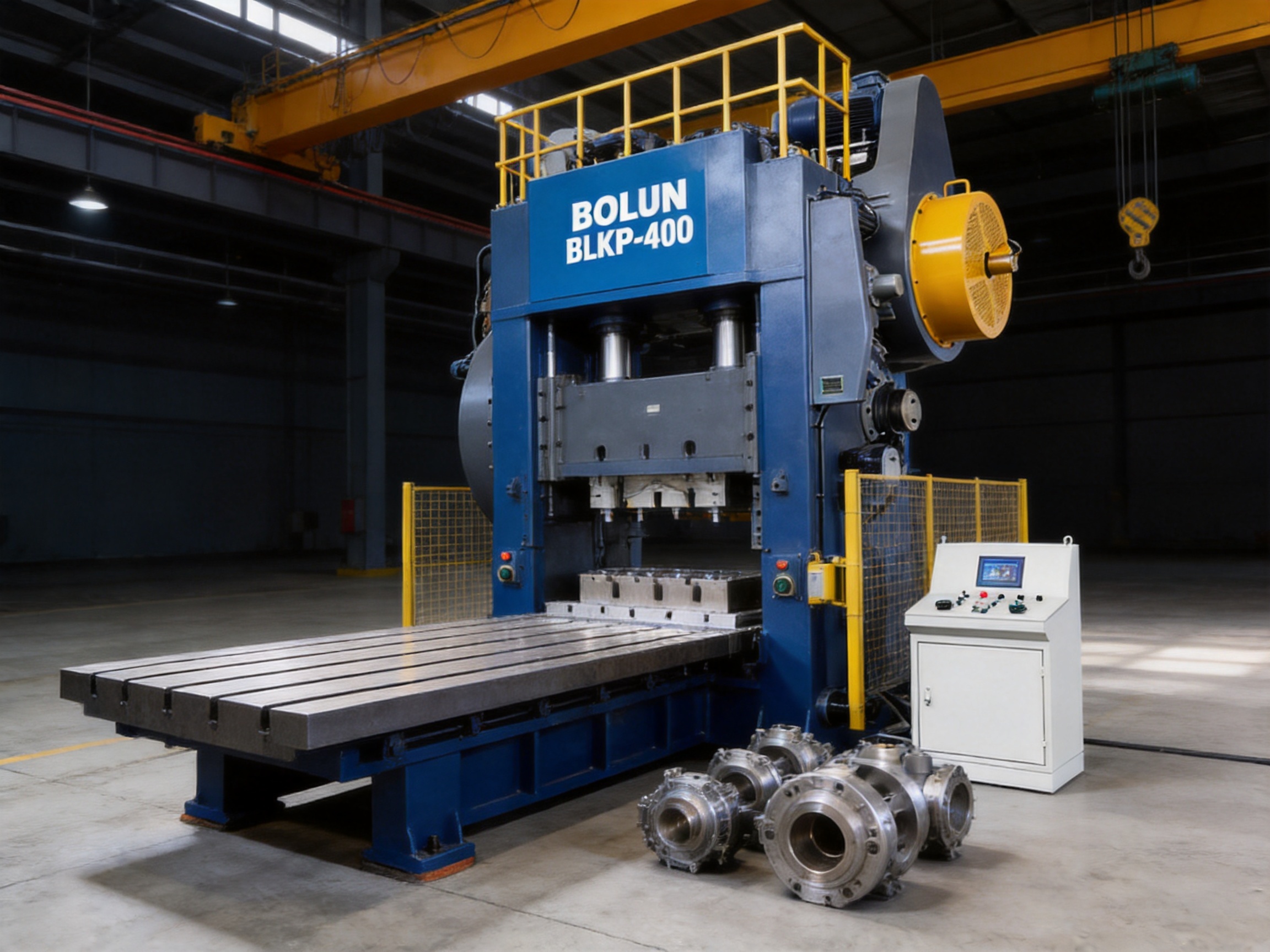
The performance of a heavy-duty power press depends on much more than its published tonnage. Manufacturing quality affects frame stability, guide accuracy, transmission life, die alignment, vibration control, and long-term repeatability. The equipment supplier behind the BLKP-400 integrates research and development, design, production, sales, and service within one industrial organization. This integrated structure supports closer coordination between engineering decisions and final assembly.
The company has developed its machinery expertise over approximately two decades and focuses on forging and casting equipment, precision forming machinery, and related industrial solutions. Its manufacturing philosophy emphasizes technology, process control, customization, and full-chain production. This is particularly relevant for cold forging customers because press requirements often vary according to workpiece dimensions, die architecture, production volume, automation level, and local standards.
Large forming machines require accurately processed structural and mechanical components. The worktable, slide, toggle links, pins, guides, and mounting surfaces must maintain their dimensional relationships under high loads. Advanced precision processing equipment allows the manufacturer to produce and inspect critical parts with greater consistency than would be possible through loosely controlled fabrication.
Precision machining is especially important for the toggle mechanism. Linkage components must work together with controlled clearances and proper surface contact. Pins and bearing areas must withstand repeated high-load cycles. If these components are poorly manufactured or inadequately inspected, wear can develop quickly and the press may lose alignment or produce inconsistent results.
Final assembly is the stage where individual components become a complete forming system. Mechanical alignment, lubrication circuits, hydraulic locking, electrical controls, pneumatic connections, safety devices, and adjustment systems must operate together. An integrated assembly process helps ensure that the machine is evaluated as a complete unit rather than as a collection of unrelated components.
For the BLKP-400, integrated assembly is important because the nominal capacity depends on the coordinated performance of the frame, drive system, toggle mechanism, slide, table, and control functions. Proper assembly also supports stable operation at the listed 30–50 strokes per minute range.
Cold forging production frequently involves non-standard requirements. A customer may need a special die height, a particular feeding direction, an automatic transfer system, additional ejection control, a modified working height, different electrical specifications, or integration with inspection equipment. A manufacturer with in-house design and customization capabilities can address these requirements more efficiently than a supplier offering only fixed catalog equipment.
Customization should nevertheless be managed through formal engineering review. Any change to stroke, speed, die weight, frame dimensions, automation, or auxiliary systems can influence the machine’s force distribution and operating limits. The final design should be confirmed through drawings, load calculations, safety assessment, and acceptance testing.
Heavy forming machinery must undergo rigorous inspection before shipment. Typical inspection areas include dimensional accuracy, slide parallelism, die-height adjustment, operating noise, vibration, hydraulic locking performance, lubrication behavior, safety interlocks, electrical functions, and no-load or test-load operation. Finished product inspection is most effective when it covers both individual components and the assembled machine.
A strong inspection system supports long service life by identifying problems before installation at the customer’s factory. It also helps establish baseline performance data that can be used for future maintenance and troubleshooting.
The BLKP-400 can create value at several stages of production. During setup, the electric slide adjustment system can reduce manual adjustment work and support more precise positioning. Hydraulic locking helps hold the selected position during high-load operation. During production, the toggle mechanism provides controlled force application, while the broad table and substantial die capacity support complex tooling. During maintenance, a well-organized machine structure and documented inspection process can simplify service planning.
Product consistency is one of the most important benefits. Cold forging customers often supply components to automotive, motorcycle, machinery, electrical, construction, and general industrial markets. These sectors may require tight dimensional control, high surface quality, reliable mechanical properties, and stable batch-to-batch production. A press that maintains repeatable slide movement and die alignment can help reduce variation throughout the manufacturing process.
Material utilization is another advantage of cold forging. Because the process forms the workpiece close to its final shape, it can reduce the amount of material removed compared with machining from a larger billet. The BLKP-400 helps manufacturers take advantage of this principle by providing the force and controlled movement required to shape material efficiently. Actual savings depend on part geometry, blank design, flash control, and the number of forming stations.
Production efficiency can also improve when one press supports several operations. Instead of using separate machines for every stage, a manufacturer may perform a series of compatible forming processes through carefully designed tooling. This can reduce handling, shorten material travel, and simplify production planning. It may also lower the number of intermediate storage steps between operations.
The performance of a cold forging press is inseparable from die design. Engineers must consider material volume, reduction ratio, corner radii, extrusion length, cavity filling, stress concentration, tool support, and ejection. The 4000 kN rating should not be treated as a universal allowance for any die. The actual forming load should be calculated from the workpiece material, deformation area, friction conditions, and process sequence.
Die components should be mounted so that loads remain as centered as possible. Eccentric loading can increase wear on the slide, table, guides, and toggle components. It may also cause uneven part dimensions. Where an asymmetric part is unavoidable, the tooling should be engineered to manage the resulting load distribution.
Blank diameter, length, cut-face quality, surface condition, and hardness all influence cold forging performance. A poor blank can create imbalance during forming, increase die stress, or cause surface defects. The blanking process should therefore be controlled as carefully as the press operation. For some materials, annealing or other conditioning may be required before forming.
Lubrication reduces friction between the workpiece and die surfaces, supports material flow, lowers forming load, and extends tool life. Inadequate lubrication may result in galling, scoring, cracking, heat accumulation, or difficult ejection. The lubricant must be compatible with the material, forming pressure, production speed, cleaning process, and environmental requirements.
The press provides the mechanical force, but the lubrication system and process parameters determine how effectively that force is converted into stable deformation. Operators should monitor lubricant concentration, coverage, contamination, and application timing as part of routine process control.
The listed die height adjustment is 15 mm. This range should be evaluated against the actual tooling stack, shut height, insert arrangement, and required clearance. The electric adjustment system can assist with setup, but operators must still verify die alignment and shut-height conditions before production. Hydraulic locking should be confirmed after adjustment to ensure that the slide remains secure under load.
The mold pad capacity is listed as 150 kN, with a 60 mm ram stroke. These features can support controlled ejection or auxiliary forming functions depending on the tooling configuration. The actual application must be reviewed carefully because ejection force, timing, and travel influence both part release and die life. Improperly timed ejection can damage the workpiece or cause interference during transfer.
A 4000 kN press must be operated under strict safety procedures. The work area should include suitable guarding, emergency stop functions, interlocks, and clear access controls. Operators should never enter the die space while the machine is energized or capable of movement. Die installation and removal should use lifting equipment rated for the maximum tooling weight, with particular attention to the listed 800 kg maximum die weight.
Before starting production, personnel should check lubrication, air pressure, hydraulic locking, fasteners, die alignment, electrical controls, and the condition of guards. The specified air pressure is 0.55 MPa, but the complete pneumatic system should be verified for clean and stable supply. Pressure fluctuations may affect auxiliary functions or automatic tooling.
Routine maintenance should include inspection of toggle links, pins, bearings, guides, slide surfaces, drive components, hydraulic elements, pneumatic lines, and electrical cabinets. Lubricant should be applied according to the manufacturer’s schedule and specification. Excessive clearance, unusual noise, rising temperature, vibration, oil leakage, or changes in forming quality should be treated as early warning signs rather than postponed until a breakdown occurs.
Preventive maintenance is especially valuable in high-volume cold forging. The cost of a planned inspection is generally much lower than the cost of an unplanned stop involving damaged tooling, replacement components, lost production, and delayed deliveries. Maintenance records should include operating hours, stroke settings, die changes, lubrication service, adjustment history, and any abnormal observations.
Reliability also depends on correct loading. The press should not be used beyond its nominal force, die weight, speed, stroke, or working envelope. The actual force and energy requirements of every new part should be assessed before production approval. This is particularly important when changing material grades or introducing a new multi-station die.
Installation begins with a suitable foundation capable of supporting the machine and absorbing operating forces. The installation site should provide adequate floor capacity, service access, ventilation, lighting, lifting clearance, and space for material handling. The working face height of 820 mm should be considered when designing operator access, feeding equipment, and inspection stations.
After positioning, the press should be leveled and aligned according to the manufacturer’s installation instructions. Electrical power, compressed air, lubrication systems, and any hydraulic connections must be installed using correctly rated components. Grounding and protection devices should comply with local regulations and plant standards.
Commissioning should proceed gradually. Initial checks may be performed without tooling to verify motor rotation, slide movement, adjustment operation, locking function, lubrication, and safety circuits. The next stage can involve tooling installation and slow-speed dry cycling. Trial forming should begin with conservative process parameters before moving toward the intended production range.
Acceptance testing should confirm the machine’s basic functions and the customer’s agreed specifications. Depending on the contract, tests may include stroke verification, speed verification, slide parallelism, die-height adjustment, no-load noise, safety response, hydraulic locking, and sample-part evaluation. A clear commissioning record helps establish a reference point for future service.
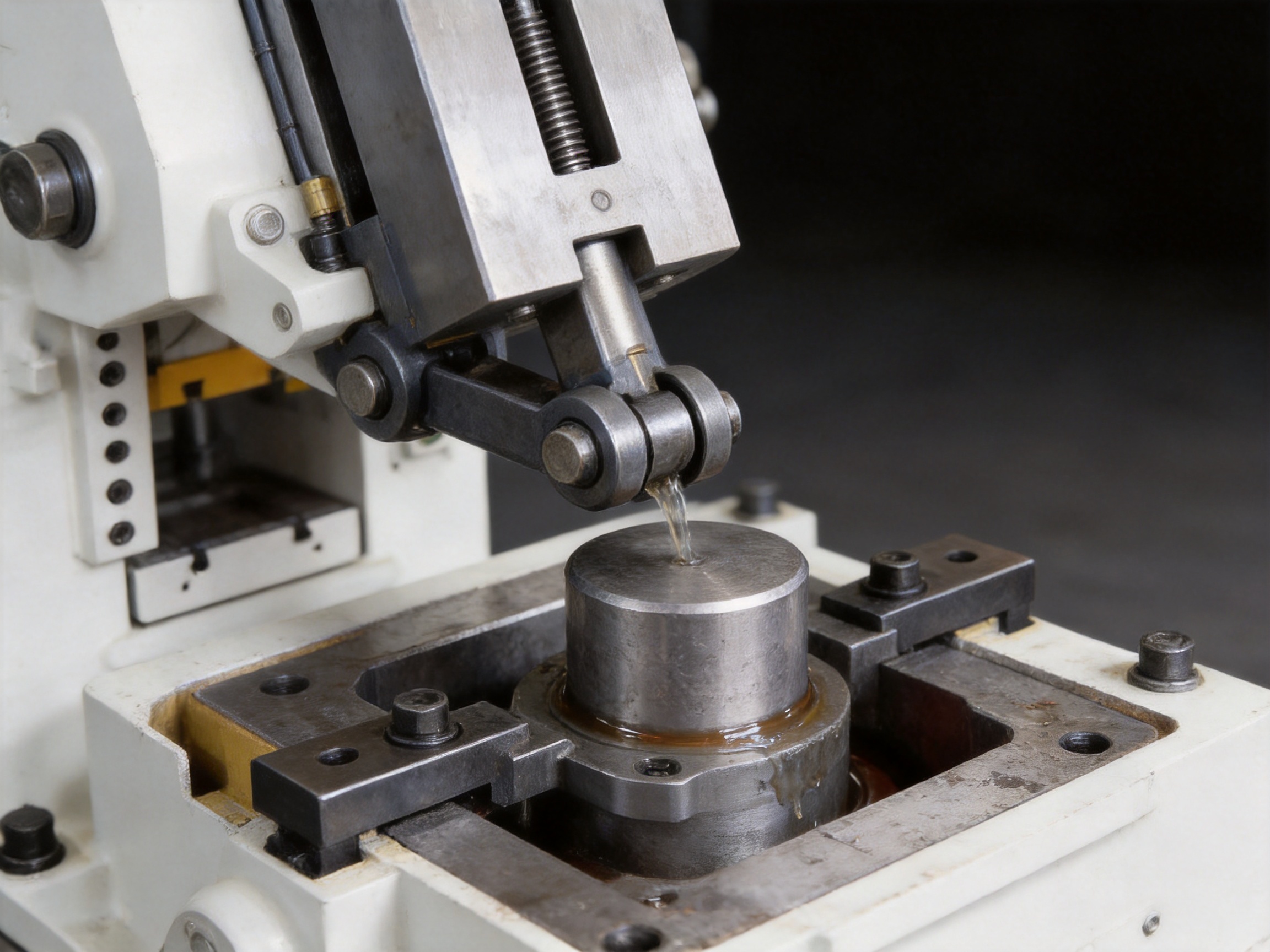
Mechanical crank presses are widely used for stamping and forming. They can offer high operating speeds and a familiar design, but their force profile and bottom-stroke behavior may be less specialized for certain cold forging operations. A toggle press is often preferred when high force near the bottom of the stroke, controlled material flow, and stable sizing are more important than maximum free-running speed.
Eccentric presses can provide flexibility in stroke and speed, but the relationship between slide position and available force must be closely considered. For high-load coining or precision sizing, a toggle mechanism can offer more concentrated mechanical advantage and reduced movement near the forming position.
Hydraulic presses provide adjustable force and stroke control and can be highly flexible for low-volume or specialized forming. However, they may operate at lower cycle rates and can introduce concerns related to hydraulic heat, sealing, and energy efficiency. A mechanical toggle press is often advantageous when high-volume production and repeatable cycle timing are required.
Screw presses can deliver strong forming energy and are suitable for selected forging applications. Their impact behavior, energy control, tooling requirements, and production characteristics differ from those of a toggle press. The best choice depends on the workpiece, material, required output, tooling concept, and quality targets.
The BLKP-400 occupies a practical position for manufacturers that need high mechanical force, controlled end-of-stroke forming, and production speeds of up to 50 strokes per minute. Its value is strongest when the machine is paired with tooling and process conditions that take advantage of the toggle mechanism.
Purchasing a high-capacity press is a long-term industrial decision. The machine must be supported through design review, factory acceptance, installation, operator training, spare-parts planning, and after-sales service. A supplier that integrates engineering, manufacturing, inspection, and service can provide more consistent communication throughout the equipment lifecycle.
Zhejiang Bolun High-Precision Machinery Co., Ltd. emphasizes research and development, precision manufacturing, customization, quality inspection, and customer-oriented service. Its production approach covers basic design, core component development, machining, assembly, and final inspection. This integrated capability is useful when customers require a machine configured for special die dimensions, automation, local electrical standards, or unusual forming requirements.
The company’s stated quality philosophy focuses on inspection at every process and component level. For large forming equipment, this approach helps control the factors that influence stability and service life. It also supports a more reliable transition from machine delivery to production operation.
Technical support should include application review rather than only product quotation. Before confirming a BLKP-400, customers should provide part drawings, material information, blank dimensions, target output, forming sequence, die layout, automation requirements, and applicable safety standards. This information allows the supplier to evaluate whether the press capacity, stroke, speed, worktable, die height, and auxiliary functions match the intended process.
When evaluating the BLKP-400 for a production project, buyers should first confirm the required nominal capacity. The calculated forming force should include appropriate safety margins and should remain within the machine’s rated operating conditions. Customers should also determine whether the 160 mm or 180 mm stroke is better suited to their die and transfer system.
The die envelope must be checked carefully. This includes die height, die weight, table size, slide bottom size, mounting holes, transfer clearance, blank access, and maintenance access. The listed maximum die weight is 800 kg, but the distribution of that weight and the location of the center of gravity should also be reviewed.
Electrical and utility requirements should be confirmed in writing. The listed main motor is 50 kW × 4 poles, while the air pressure requirement is 0.55 MPa. Plant power supply, compressed-air quality, grounding, control voltage, environmental conditions, and local compliance requirements may require additional configuration.
Buyers should ask for a detailed scope of supply. Important items may include the main press, control cabinet, die-height adjustment system, hydraulic locking system, lubrication equipment, pneumatic accessories, safety guarding, operating manuals, foundation drawings, spare parts, commissioning support, and operator training. Any included or excluded auxiliary equipment should be clearly identified.
Finally, customers should discuss after-sales response, recommended spare parts, preventive maintenance intervals, remote technical assistance, service coverage, and warranty terms. These factors can have a major influence on the total cost of ownership over the machine’s working life.
The BLKP-400 has a nominal capacity of 4000 kN. The actual usable forming capacity depends on the slide position, nominal pressure stroke, material, tooling, forming operation, and machine operating conditions. The listed nominal pressure stroke is 6 mm.
The press is suitable for applications such as upsetting, coining, sizing, calibration, heading-related forming, and multi-station cold forging. Final suitability depends on the workpiece dimensions, material strength, die design, forming load, and production sequence.
The BLKP-400 is available with a 160 mm or 180 mm slide stroke. The correct selection should be based on die height, material transfer, forming depth, workpiece geometry, and desired cycle characteristics.
The listed speed range is 30–50 strokes per minute. Actual production speed should be determined through process trials because material, lubrication, tooling complexity, forming load, and automation can affect the appropriate operating rate.
The worktable measures 550 × 660 × 120 mm, and the slide bottom measures 400 × 500 mm. These dimensions should be compared with the customer’s die base, inserts, mounting pattern, and transfer equipment before purchase.
The listed maximum die weight is 800 kg. The complete tooling assembly should also be reviewed for center of gravity, lifting points, installation method, and load distribution.
The toggle mechanism provides high mechanical advantage near the bottom of the stroke. This supports strong forming force, controlled material flow, coining, sizing, and stable final shaping. It is particularly useful when high pressure is required over a short forming zone.
Yes. The listed die-height adjustment is 15 mm. The press uses an electric slide adjustment system with hydraulic locking to support accurate setup and secure positioning during operation.
The main motor is specified as 50 kW with four poles. The listed air pressure requirement is 0.55 MPa. Final utility requirements should be confirmed against the delivered machine configuration and the customer’s plant conditions.
Customization may be available for special die dimensions, automation, electrical standards, feeding systems, ejection arrangements, safety systems, and other non-standard requirements. Such changes should be reviewed and approved through formal technical documentation.
The machine can be integrated into an automated production line when the feeding, transfer, ejection, lubrication, sensing, and safety systems are properly engineered. The suitability of a specific automation package depends on the part, die layout, cycle time, and factory requirements.
Customers should provide part drawings, material grade, blank size, target output, forming sequence, die dimensions, required stroke, expected forming force, automation needs, electrical standards, and relevant safety requirements. More complete information allows a more accurate application review.
The BLKP-400 versatile balanced-stroke cold forging toggle type power press is designed for manufacturers that require high forming force, controlled mechanical motion, stable die support, and production flexibility. Its 4000 kN nominal capacity, 160 mm or 180 mm stroke options, 30–50 strokes per minute operating range, and knuckle-joint mechanism make it well suited to demanding cold forging operations.
The machine’s advantages extend beyond force capacity. The toggle transmission concentrates mechanical advantage near the forming zone, supporting material flow and high-pressure finishing operations. The 550 × 660 mm worktable and 400 × 500 mm slide bottom provide a practical platform for substantial tooling. Electric slide adjustment and hydraulic locking improve setup control, while the 800 kg maximum die weight and 400 mm maximum die height support complex multi-station arrangements.
Its effectiveness is reinforced by the manufacturing capabilities of Zhejiang Bolun High-Precision Machinery Co., Ltd. The company combines engineering, precision processing, assembly, inspection, customization, and service within an integrated production system. This approach helps address the demanding technical requirements associated with high-capacity forming machinery.
For the best result, the press should be selected as part of a complete process solution. Die design, blank preparation, lubrication, material properties, automation, safety, maintenance, and operator training all influence final performance. When these factors are properly coordinated, the BLKP-400 can provide a reliable foundation for efficient, repeatable, and high-quality cold forging production.
1. General principles of cold forging, upsetting, extrusion, coining, and sizing process design.
2. Mechanical press engineering practices for crank, eccentric, and toggle-type power presses.
3. Industrial guidelines for die design, material flow control, lubrication, and tool-life management in cold forming.
4. Machinery safety principles for mechanical power presses, die installation, guarding, and operator protection.
5. Manufacturer-provided technical data for the BLKP-400 cold forging toggle type power press.
6. Manufacturer information concerning precision machining, integrated assembly, quality inspection, customization, and after-sales service.


When you are planning to produce medium or small metal parts in high volumes, t...
A mid-size fastener manufacturer recently faced a familiar problem: its CNC lat...
A buyer comparing a 45-ton open-gap press for a bracket line often receives two...
Two presses can both carry a 200-tonne nameplate and still produce very differe...
What Is a Power Press? A power press — also called a stamping press or punch pr...
Start With the Purchase Decision, Not the Definitions A procurement engineer co...
Contact Us

topbolun@gmail.com

+86-575-83362228

+86-13735238388
+86-18667502750

+86-575-83362999

+8618667502750

No.1 Linjiang Road East, Xiaren, Jinting Town, Shengzhou City, Zhejiang Province, China
Ready to Begin?
Get in Touch

Now!

ZHEJIANG BOLUN
 English
 中文简体