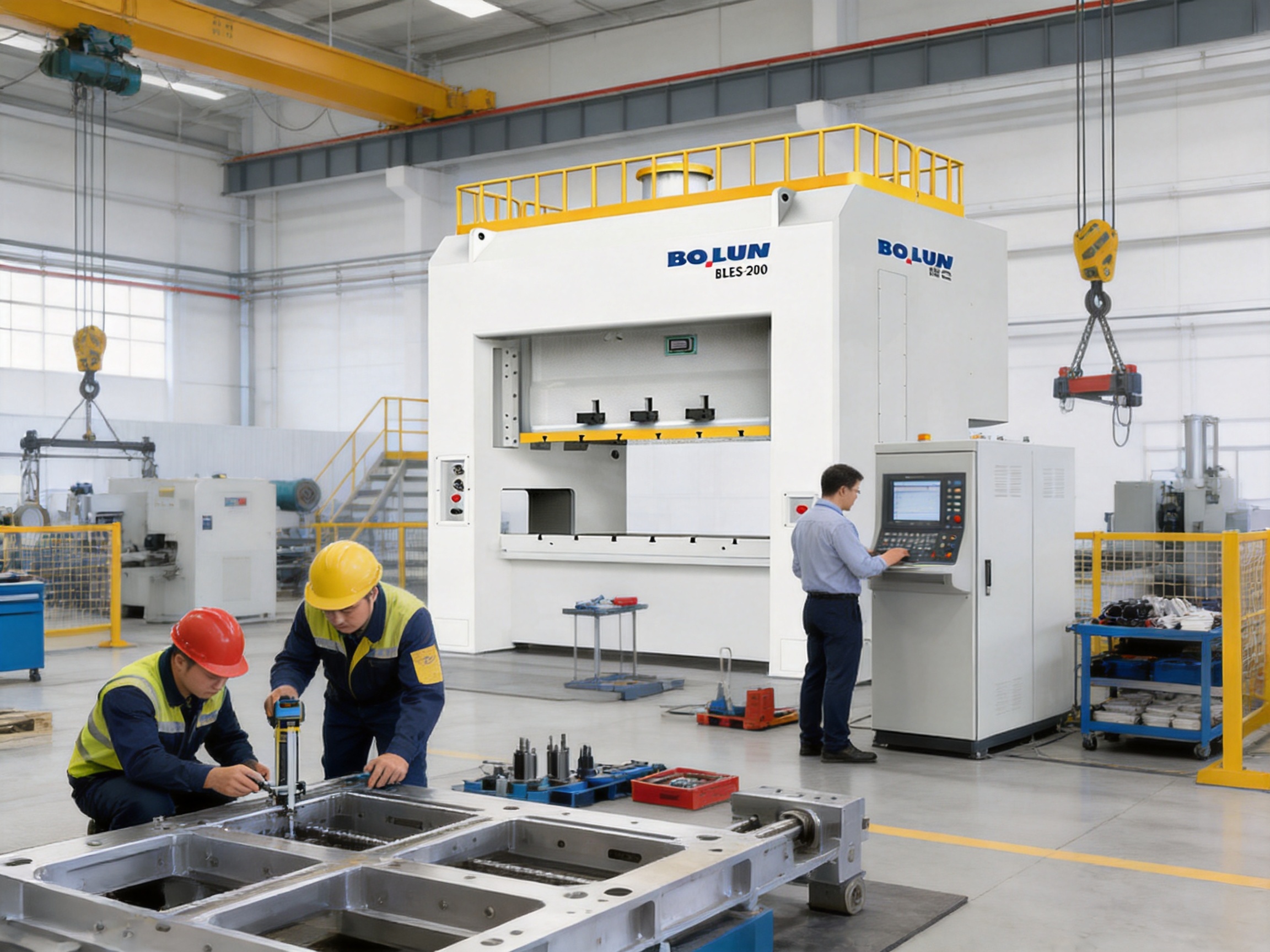
Modern metal-forming operations require more than high nominal capacity. Manufacturers increasingly need equipment that combines structural rigidity, programmable motion, tooling flexibility, dimensional consistency, efficient production, and dependable long-term service. These requirements become especially important when forming large components, complex profiles, high-strength materials, and parts that require multiple operations within one production cycle.
The BLES-200 versatile dynamic-stroke closed-frame double-point servo power press is designed for this demanding manufacturing environment. With a nominal capacity of 2000 kN, a 250 mm slide stroke, a 2200 × 940 mm worktable, and a 900 × 600 mm side opening, the machine provides a balanced combination of force, working space, motion flexibility, and process control. Its closed-frame double-point construction supports stable load distribution, while its servo control system allows the slide movement to be adjusted for different forming requirements.
This configuration makes the press suitable for precision stamping, progressive-die production, deep forming, bending, drawing, embossing, calibration, and other operations that benefit from controllable slide motion. The machine is also appropriate for applications in which a conventional fixed-speed mechanical press may not provide enough flexibility to manage material flow, reduce forming defects, or optimize die performance.
Beyond the individual machine specifications, the value of this press is connected to the manufacturing capabilities behind it. The equipment is produced by Zhejiang Bolun High-Precision Machinery Co., Ltd., a Chinese machinery manufacturer with experience in precision forming equipment, engineering development, component processing, assembly, inspection, customization, and technical service. Its integrated production approach allows the press to be developed as part of a complete engineering solution rather than as an isolated piece of workshop equipment.
The BLES-200 is a closed-frame double-point servo power press with a nominal capacity of 2000 kN. The machine is designed to deliver controlled forming force across a relatively large working area while maintaining structural stability. The closed-frame design helps resist deformation of the frame during loading, and the double-point drive arrangement supports balanced slide movement across the die area.
Its 250 mm slide stroke gives the machine sufficient vertical travel for a broad range of stamping and forming applications. The stroke is long enough to accommodate many complex die arrangements while remaining appropriate for production work that requires repeatable cycling. The press is rated at approximately 50 strokes per minute under the listed operating configuration, providing a useful balance between productivity and controlled forming performance.
The machine’s continuous working energy is listed at 14,000 J. This value indicates the press’s ability to support demanding forming operations while maintaining stable energy delivery during continuous production. In practical terms, the energy rating is important for applications in which the forming load is substantial, the material is resistant to deformation, or the die requires consistent energy over repeated cycles.
A maximum die height of 500 mm and a die-height adjustment range of 120 mm give users flexibility when installing different dies. The 2200 × 940 mm worktable provides a generous mounting area, while the 1850 × 750 mm slide-bottom size offers a suitable upper mounting surface for large and multi-stage tooling. The 900 × 600 mm side opening increases access for die installation, maintenance, material handling, and tooling arrangements that require lateral clearance.
The press uses a one-piece structural configuration for the BLES-200 model. This arrangement supports rigidity and simplifies the load path through the frame. The design is intended to provide reliable performance under repeated forming loads, helping users maintain stable alignment and consistent part quality throughout extended production cycles.
The following table summarizes the primary listed specifications for the BLES-200 model.
| Specification | BLES-200 Value |
|---|---|
| Press type | Closed-frame double-point servo power press |
| Nominal capacity | 2000 kN |
| Nominal pressure stroke | 6 mm |
| Continuous working energy | 14,000 J |
| Slide stroke | 250 mm |
| Approximate strokes per minute | 50 S.P.M. |
| Maximum die height | 500 mm |
| Die-height adjustment | 120 mm |
| Side opening | 900 × 600 mm |
| Worktable size | 2200 × 940 mm |
| Slide-bottom size | 1850 × 750 mm |
| Punch accuracy | JIS B 6402 Level 1 |
| Air pressure | 0.55 MPa |
| Frame structure | One-piece |
Specifications should always be reviewed together with the selected die, material, lubrication system, feeding equipment, operating mode, and required production cycle. The listed values provide the basic machine capability, while actual production performance depends on the complete forming process.
Frame rigidity is one of the most important characteristics of a high-capacity power press. During forming, the press frame is exposed to substantial forces. If the frame deflects excessively, the result may be uneven load distribution, premature die wear, dimensional variation, poor material flow, or progressive damage to machine components.
The closed-frame construction of the BLES-200 creates a continuous structural loop around the working area. Compared with more open structural arrangements, a closed frame can provide a more direct and stable route for forming forces. This helps reduce unwanted deformation and supports the alignment between the slide, die, and worktable.
The one-piece design used for the BLES-200 also contributes to structural continuity. A one-piece frame can reduce the number of major interfaces within the load-bearing structure. When properly engineered, machined, assembled, and inspected, this arrangement helps improve repeatability and supports reliable operation under continuous production conditions.
Structural rigidity is especially valuable for large dies and operations in which the material is not evenly distributed across the working area. The 2200 mm table length provides room for substantial tooling, but the value of that space depends on the press’s ability to maintain stable movement across the die. The double-point configuration addresses this requirement by supporting the slide at two drive locations rather than relying on a single central force point.
For customers comparing machines, the advantage is not simply a larger frame or a higher capacity number. A press should maintain its working geometry while the forming load is applied. The combination of closed-frame construction, double-point support, and precision slide guidance helps the BLES-200 provide a stable platform for tooling and process control.
A double-point press uses two force application points to drive the slide. This arrangement is particularly useful for wide dies and components that require balanced loading across the working area. By distributing the drive force, the machine can reduce the tendency of the slide to tilt or twist during forming.
Slide balance has a direct influence on tool life and part consistency. If one side of a slide moves differently from the other, the die may experience uneven contact, localized wear, inconsistent clearance, and nonuniform material flow. These problems can be difficult to correct after they appear in production. A balanced double-point design helps create a more consistent relationship between the upper and lower die throughout the stroke.
The BLES-200’s 1850 × 750 mm slide-bottom size is appropriate for tooling that uses a broad mounting area. This allows designers to distribute die components effectively and to use larger plates, guides, inserts, and forming elements where required. The double-point arrangement complements this space by supporting the wider tool footprint.
Compared with a single-point press of similar capacity, a double-point configuration can offer practical advantages when the workpiece is wide, the die has multiple active areas, or the forming load is distributed across a large surface. It can also be advantageous for progressive operations in which the die includes several stations working at the same time.
Balanced slide movement does not eliminate the need for correct die design, proper installation, and regular maintenance. However, it provides a stronger mechanical foundation for those activities. When combined with accurate setup procedures and suitable tooling, the structure can contribute to longer die life, more predictable production, and lower correction requirements.
The servo control system is one of the most important features of the BLES-200. A conventional mechanical press often operates with a relatively fixed motion profile. Although fixed-speed operation can be effective for straightforward stamping, it may be less suitable for complex forming processes in which the material must move gradually, pause under pressure, or follow a carefully controlled slide path.
Servo technology allows the slide movement to be programmed according to the needs of the process. Operators and process engineers can adjust speed, deceleration, dwell position, return movement, and other motion characteristics within the machine’s control capability. This flexibility allows the press to be adapted to different materials and tooling conditions without changing the fundamental mechanical structure.
For deep forming, a controlled slide speed can help manage material flow and reduce the risk of tearing or wrinkling. For high-strength materials, slower movement through critical sections may provide more time for the material to conform to the die. For embossing or calibration, a dwell period can help improve feature definition and dimensional stability. For conventional stamping, a faster approach and return movement may help improve output.
Programmable motion also makes it possible to develop different recipes for different products. A manufacturer producing several components on the same press can store and recall appropriate process parameters, reducing setup time and improving repeatability between production orders. This is particularly useful for job shops, contract manufacturers, and factories that handle frequent die changes.
Servo control can also support tooling development. During the initial trial of a new die, engineers may test different speeds and dwell positions to identify a better forming window. This can reduce the need for extensive mechanical modification during the tryout stage. The press becomes not only a production machine but also a process-development platform.
It is important to recognize that programmable motion does not replace engineering judgment. Material grade, thickness, lubrication, die radius, blank-holder force, clearance, and feeding accuracy remain critical. The advantage of the servo system is that it gives engineers more control variables with which to optimize these factors.
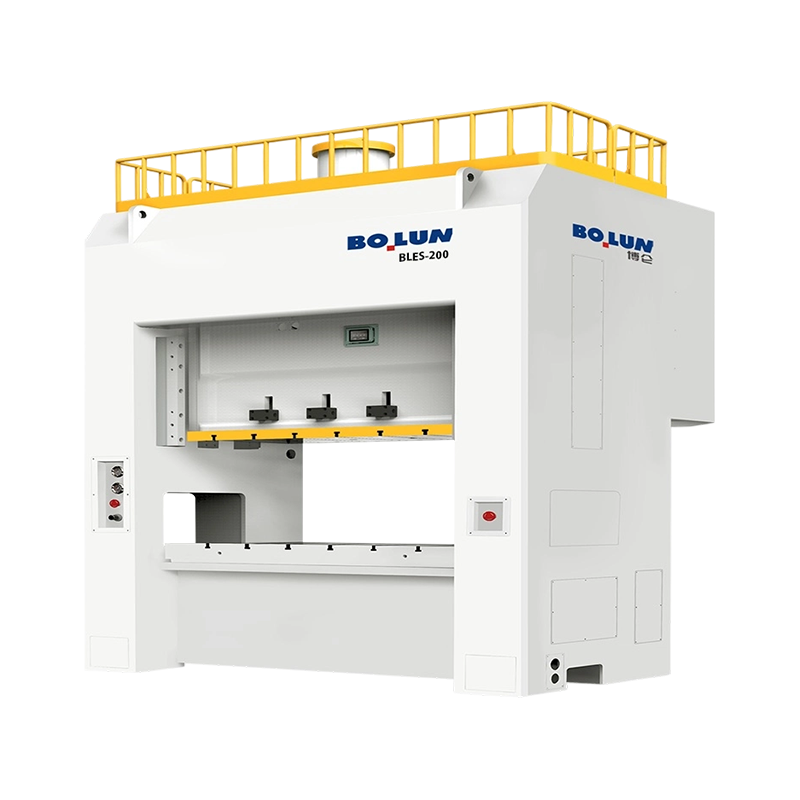
BLES-200 Versatile Dynamic-Stroke Closed-Frame Double-Point Servo Power Press
The BLES-200 is designed for applications that require more working space than a compact stamping press can provide. Its 2200 × 940 mm worktable gives die designers considerable room for component layout, guide systems, forming stations, sensors, and material handling features.
The 900 × 600 mm side opening is another important feature. Side access can simplify die installation and removal, especially when a die is large, heavy, or equipped with external components. It may also support lateral material transfer, custom feeding arrangements, maintenance access, and tooling configurations that extend beyond a narrow press throat.
Large working dimensions are valuable for manufacturers producing automotive components, appliance panels, structural parts, electrical enclosures, furniture hardware, transportation components, and other products that require extensive tooling. A larger table can also allow more operations to be integrated into one die, which may reduce the need for multiple machines or secondary handling steps.
The maximum die height of 500 mm and adjustment range of 120 mm provide flexibility for different die constructions. Users can accommodate tools with varying shut heights while maintaining the required relationship between the upper and lower die. This can be particularly useful when a factory operates several dies with different configurations.
Tooling flexibility can contribute to better overall equipment utilization. A press that accepts a wider range of dies can serve more product families and reduce idle time between jobs. It can also make it easier for a manufacturer to expand its product range without immediately investing in a separate press for every forming category.
The 2000 kN nominal capacity places the BLES-200 in a class suitable for substantial forming operations. Capacity must be evaluated against the actual force requirements of the part and die, but a higher-capacity machine gives users greater room for demanding materials, larger projected areas, complex geometries, and multi-stage tool designs.
The listed 14,000 J continuous working energy is relevant to production environments in which the press must perform repeated cycles without unstable energy delivery. Consistency is essential when manufacturing parts with tight dimensional requirements or when working with materials that respond sensitively to changes in forming conditions.
When selecting a press, users should not choose capacity based only on the maximum calculated forming force. A suitable safety margin is needed to account for material variation, friction, die wear, temperature, lubrication, and future production requirements. The BLES-200 gives manufacturers a platform that can support current production while allowing some capacity for new products and more challenging materials.
The approximately 50 strokes-per-minute rating provides a practical production speed for a press of this size and capacity. In servo applications, the actual cycle rate may vary depending on the programmed stroke profile, dwell requirements, feeding system, die design, and part transfer method. A slower optimized cycle can sometimes provide greater overall productivity if it significantly reduces scrap, rework, die maintenance, or process interruptions.
This is one of the important differences between nominal speed and productive speed. A press running at the highest theoretical rate is not necessarily the most efficient machine if it produces more defects or places excessive stress on the die. Servo control allows manufacturers to select a motion profile that balances output with quality and equipment life.
The product information lists punch accuracy according to JIS B 6402 Level 1. This indicates that the machine is designed around a recognized precision standard for press performance. Accuracy is supported not by one feature alone but by the combined quality of the frame, slide guidance, drive system, machining, assembly, adjustment, and inspection procedures.
In production, repeatability is often more important than a one-time measurement. The press must maintain its performance over thousands of cycles, during tool changes, and across different operating conditions. Stable guidance and balanced slide movement help reduce variation from one cycle to the next.
Precision also affects die maintenance. When the slide and worktable remain properly aligned, the die can operate with more consistent clearance. This can reduce abnormal contact between die components, minimize edge wear, and support longer intervals between corrective maintenance activities.
Part quality is influenced by many factors outside the press, including material consistency, blank accuracy, lubrication, die condition, feeder alignment, and operator procedures. Nevertheless, a precision press provides a reliable foundation on which these process elements can be controlled.
Manufacturers seeking to improve quality should consider the press as part of a complete production system. The machine, die, feeder, sensors, lubrication equipment, inspection method, and production software should all be evaluated together. The BLES-200’s programmable servo capabilities can make it easier to coordinate the forming movement with these supporting systems.
The BLES-200 can support a broad range of applications because it combines relatively high capacity, a large work area, balanced double-point motion, and programmable slide control. The specific application should be confirmed through force calculations, material trials, die evaluation, and customer engineering review.
Automotive and transportation parts often require large dies, repeatable forming, and stable dimensional control. The press may be used for brackets, structural panels, reinforcements, chassis-related components, seat parts, and other formed products. Servo motion can help process high-strength steels and other materials that require carefully managed forming conditions.
Appliance panels, electrical cabinets, control boxes, and equipment housings often require large blanks, multiple forming steps, embossing, bending, and trimming. The wide worktable and side opening can simplify die design and installation. Programmable movement can help control panel appearance and reduce marking or distortion.
Industrial machinery manufacturers may use the press for covers, mounting plates, guards, brackets, support components, and formed structural parts. Since these product families often vary in size and geometry, a flexible servo press can support shorter production runs and frequent changes in tooling.
Metal furniture parts, cabinet components, shelving hardware, hinges, supports, and other products may require a combination of stamping, bending, piercing, and forming. A high-capacity double-point press can accommodate dies with several integrated stations, helping reduce secondary operations.
Components used in energy systems, electrical distribution, infrastructure, and industrial installations may require durable materials and consistent forming quality. The machine’s force capacity and rigid frame can support heavy-gauge forming applications when the die and process are properly engineered.
The BLES-200 offers several practical advantages compared with a conventional fixed-motion press of similar general size. The first is motion flexibility. A conventional press may provide limited control over the slide path, while the servo system allows the process to be tuned for different materials and products.
The second advantage is the double-point arrangement. A single-point press may be adequate for narrow or centrally loaded dies, but wide dies can benefit from two force application points. Balanced support helps reduce slide tilting and can improve the working relationship between the die halves.
The third advantage is the closed-frame structure. A rigid closed frame can provide better resistance to deformation than less rigid designs, particularly under high forming loads. This can support better precision, more stable die clearance, and improved long-term performance.
The fourth advantage is tooling flexibility. The large table, broad slide bottom, substantial die-height capacity, and side opening make the machine suitable for a wider variety of tooling arrangements. A manufacturer may be able to consolidate more product families on one press rather than assigning every large or complex part to a specialized machine.
The fifth advantage is process optimization. Servo motion allows production engineers to adjust the relationship between speed, dwell, material flow, and part quality. This can be valuable when the goal is not simply to produce a part but to reduce scrap, improve surface quality, extend die life, and stabilize production.
These advantages should be considered in relation to the total cost of ownership. A press with a higher initial investment may provide better value if it reduces tooling adjustments, improves first-pass yield, supports more products, and lowers maintenance-related downtime. The correct comparison should therefore include productivity, quality, flexibility, energy use, serviceability, and expected service life.
The performance of a large precision press depends heavily on the quality of its manufacturing process. A machine may have attractive specifications, but those specifications must be translated into actual structural accuracy, reliable assembly, and stable operation. The manufacturer’s integrated capabilities are therefore an important part of the product value.
Zhejiang Bolun High-Precision Machinery Co., Ltd. integrates research and development, engineering design, production, sales, and service. This integrated structure allows technical information to move between departments during the product life cycle. Feedback from design, machining, assembly, installation, and customer service can be used to improve future machines and support customized solutions.
The company has developed its capabilities in Zhejiang, a region recognized for manufacturing activity, engineering resources, and industrial supply chains. Its experience covers forging and casting machinery, precision forming equipment, and related machine-tool solutions. This background supports an understanding of the mechanical, structural, electrical, and process requirements associated with high-capacity presses.
Engineering begins with the relationship between the required forming process and the machine structure. Designers must consider nominal force, working energy, slide travel, die dimensions, frame rigidity, guidance, drive balance, adjustment mechanisms, safety systems, and maintainability. For a servo press, the control architecture and motion profile must also be coordinated with the mechanical design.
The manufacturer’s design team can provide standard equipment as well as solutions for products with special specifications or functions. Non-standard customization may include changes to the table, slide, feeding interface, automation arrangement, control functions, safety configuration, or tooling support system.
Large press components require careful machining because small dimensional errors can affect alignment and long-term performance. The frame, slide, worktable, guides, drive components, and mounting surfaces must be processed according to engineering requirements. Precision machining helps ensure that the assembled machine achieves the intended geometry.
Machining quality is particularly important for a double-point press. The two drive points and slide guidance must work together to maintain balanced movement. Errors in parallelism, flatness, or alignment may create uneven loading. A controlled machining process reduces these risks before the machine reaches the assembly stage.
Assembly is more than the physical connection of components. It includes alignment, clearance adjustment, lubrication preparation, electrical integration, servo configuration, testing, and functional verification. Skilled technicians must ensure that the slide moves smoothly, the drive points remain coordinated, and the control system responds correctly to programmed instructions.
For a servo machine, commissioning may include checking acceleration, deceleration, dwell positions, return movement, emergency stops, overload protection, and operating modes. These checks help confirm that the mechanical and electrical systems function as an integrated unit.
The company states that it maintains a finished-product inspection system designed to exceed basic industry requirements. Quality control covers components and production stages rather than relying only on a final visual check. This approach can include dimensional inspection, assembly verification, functional testing, precision evaluation, and performance confirmation.
Process-based inspection is valuable because defects are easier and less expensive to correct near their source. If a machined surface, guide component, or assembly alignment is found to be outside the required condition, it can be addressed before the complete machine is commissioned.
Technical support begins before the sale. Application discussions can help determine whether the press capacity, worktable, stroke, die height, speed, and control system are suitable for the intended product. During installation and commissioning, support can help users establish correct operating procedures and maintenance routines.
After-sales service may include troubleshooting, replacement parts, technical guidance, process consultation, and equipment upgrades. A customer-oriented service system is particularly important for industrial machinery because the value of a press is realized over years of production rather than at the moment of delivery.
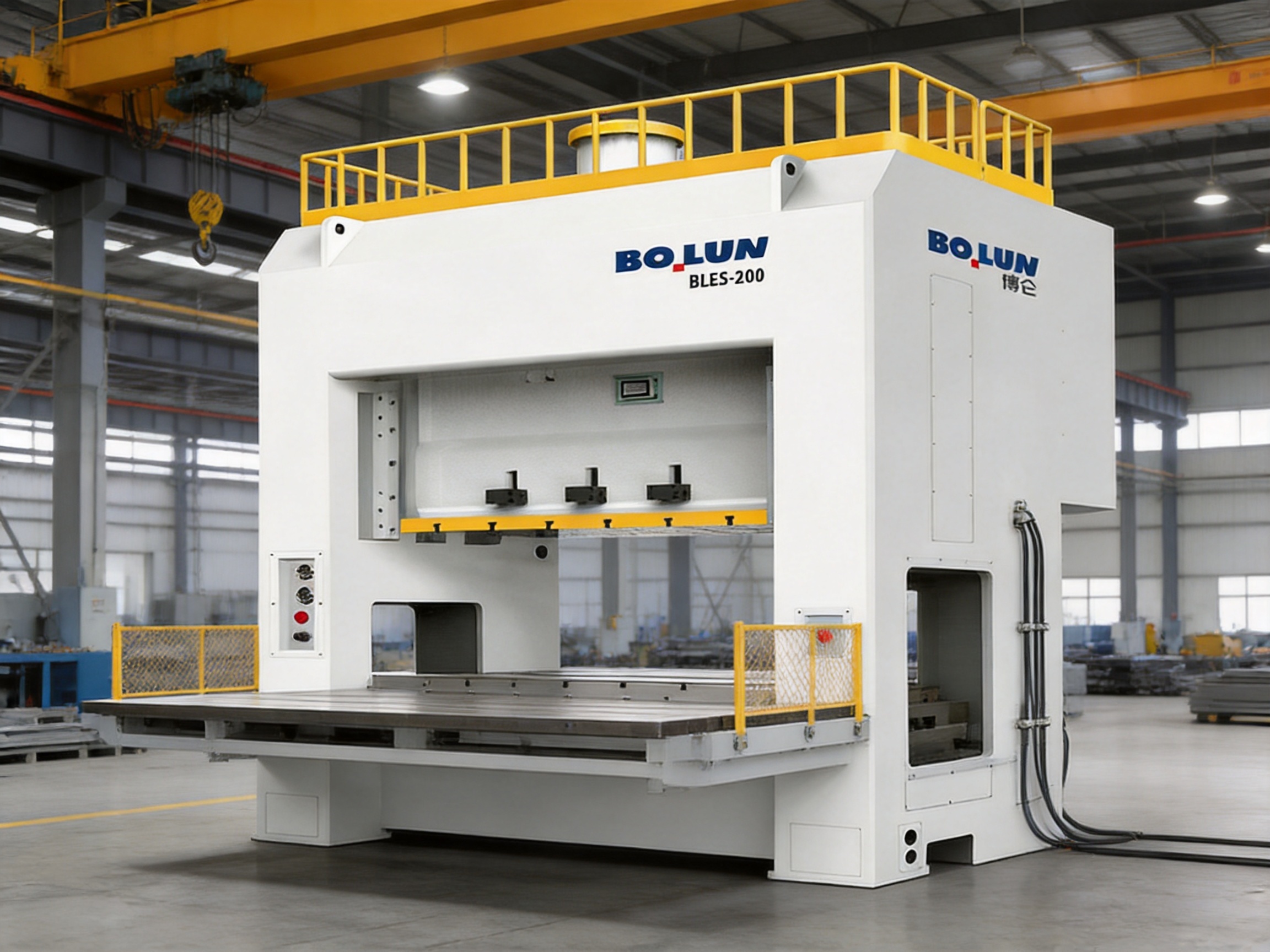
Energy and productivity should be evaluated together. A faster press is not necessarily more productive if it produces more defective parts or causes frequent tool maintenance. Likewise, a machine with advanced motion control can deliver better value when the control functions are used to stabilize production rather than simply increase speed.
The BLES-200’s servo system can support efficient operation by allowing the slide movement to match the requirements of each product. For simple operations, the machine may use a comparatively efficient high-speed profile. For difficult forming, it can use slower movement in critical areas and a dwell period where necessary. This flexibility helps avoid applying the same motion profile to every job.
Reduced scrap is an important part of operating value. Material costs can represent a significant portion of total production cost, particularly for high-strength steels, stainless steels, aluminum alloys, and other specialized materials. Better control of forming speed and dwell may help reduce tearing, wrinkles, springback-related defects, and incomplete forming.
Tool life also affects total cost. A balanced slide and stable frame can reduce uneven loading and abnormal wear. When die components remain in better condition, manufacturers may benefit from fewer unplanned stoppages, more predictable maintenance, and longer intervals between major repairs.
Servo control can also support production planning. Different motion recipes can be prepared for different tools, allowing repeatable setup across shifts and production locations. This can reduce dependence on individual operator experience and improve the consistency of manufacturing instructions.
The press should be integrated into the factory according to its foundation, utilities, material flow, safety requirements, and maintenance access. The listed air pressure is 0.55 MPa, but the complete installation must also account for electrical supply, grounding, ventilation, lubrication, control networking, and auxiliary equipment.
Die installation should be planned around the 2200 × 940 mm worktable, 1850 × 750 mm slide bottom, maximum die height, and available adjustment range. The die must be securely mounted and aligned so that the forming loads are distributed as intended. Incorrect installation can compromise even a highly rigid machine.
When automation is used, the press may be connected to a feeder, transfer system, destacker, lubrication unit, inspection device, or conveyor. The servo control system can provide a useful foundation for coordinating the slide cycle with feeding and transfer movements. However, all equipment must be commissioned together to confirm timing, access, guarding, and emergency-stop functions.
Material handling should be considered during layout design. The side opening can provide useful access, but operators and maintenance personnel still require clear and safe paths around the machine. Die carts, lifting devices, and storage areas should be positioned so that changeovers can be performed efficiently and safely.
Regular maintenance is essential for preserving the performance of a high-capacity servo press. Maintenance planning should include lubrication, inspection of guides and drive components, checking of fasteners, monitoring of unusual vibration or noise, cleaning of sensors, verification of safety devices, and review of control-system alarms.
Because the machine operates under repeated forming loads, early detection of abnormal conditions is important. Changes in noise, slide movement, temperature, lubrication consumption, or part quality may indicate developing issues. Operators and maintenance technicians should record these observations and follow a structured response procedure.
Die condition must be monitored together with press condition. A damaged or poorly maintained die can create unusual forces that affect the machine. Similarly, a press alignment issue can damage the die. Coordinated maintenance of both assets helps protect the complete production system.
Servo systems also benefit from disciplined parameter management. Approved motion recipes should be documented and protected from unauthorized changes. When a process is optimized, its settings should be recorded with the die and product information so that the same conditions can be restored during future production.
The manufacturer’s service capability can support customers in establishing maintenance procedures, troubleshooting issues, and obtaining technical assistance. Proper maintenance does not merely protect the original investment; it helps preserve production precision and reduce the risk of unexpected downtime.
A 2000 kN press contains substantial stored mechanical energy and must be operated only with appropriate safeguards, training, and procedures. The machine should be installed and used according to applicable local regulations, technical documentation, and workplace safety requirements.
Safety considerations include guarding, emergency stops, two-hand controls or other approved control methods, die protection, overload protection, access control, safe die change procedures, lockout and tagout, and regular inspection of protective devices. Operators should understand the press operating modes and should never bypass safety systems to accelerate production.
Servo motion provides flexibility, but programmable movement must be treated as a controlled industrial function. Changes to speed, dwell, or stroke parameters should be authorized, tested, and documented. Maintenance personnel must isolate all relevant energy sources before entering the die area or performing service work.
Safe production is also productive production. Proper safety procedures reduce unplanned stoppages, prevent equipment damage, and protect the skilled personnel required to operate and maintain the press.
Before purchasing or specifying the BLES-200, users should prepare a complete application profile. This should include material type, thickness, blank dimensions, part geometry, required forming operations, calculated force, energy requirements, die dimensions, desired production rate, automation method, quality targets, and expected annual volume.
Die engineers should confirm that the tool fits within the table and slide dimensions and that its shut height is compatible with the available die-height range. The forming force should be evaluated across the complete stroke, not only at one point. If the part involves drawing or other demanding operations, material flow and blank-holder requirements should be included in the analysis.
Production teams should also consider the required motion profile. If the part benefits from a dwell period, controlled forming speed, or multiple movement stages, these requirements should be defined during the technical review. Trial forming may be appropriate for difficult materials or new product geometries.
Factory planners should evaluate foundation requirements, transportation access, crane capacity, electrical supply, air supply, die storage, maintenance clearance, and integration with upstream and downstream processes. A complete project review helps ensure that the machine’s capabilities are fully utilized after installation.
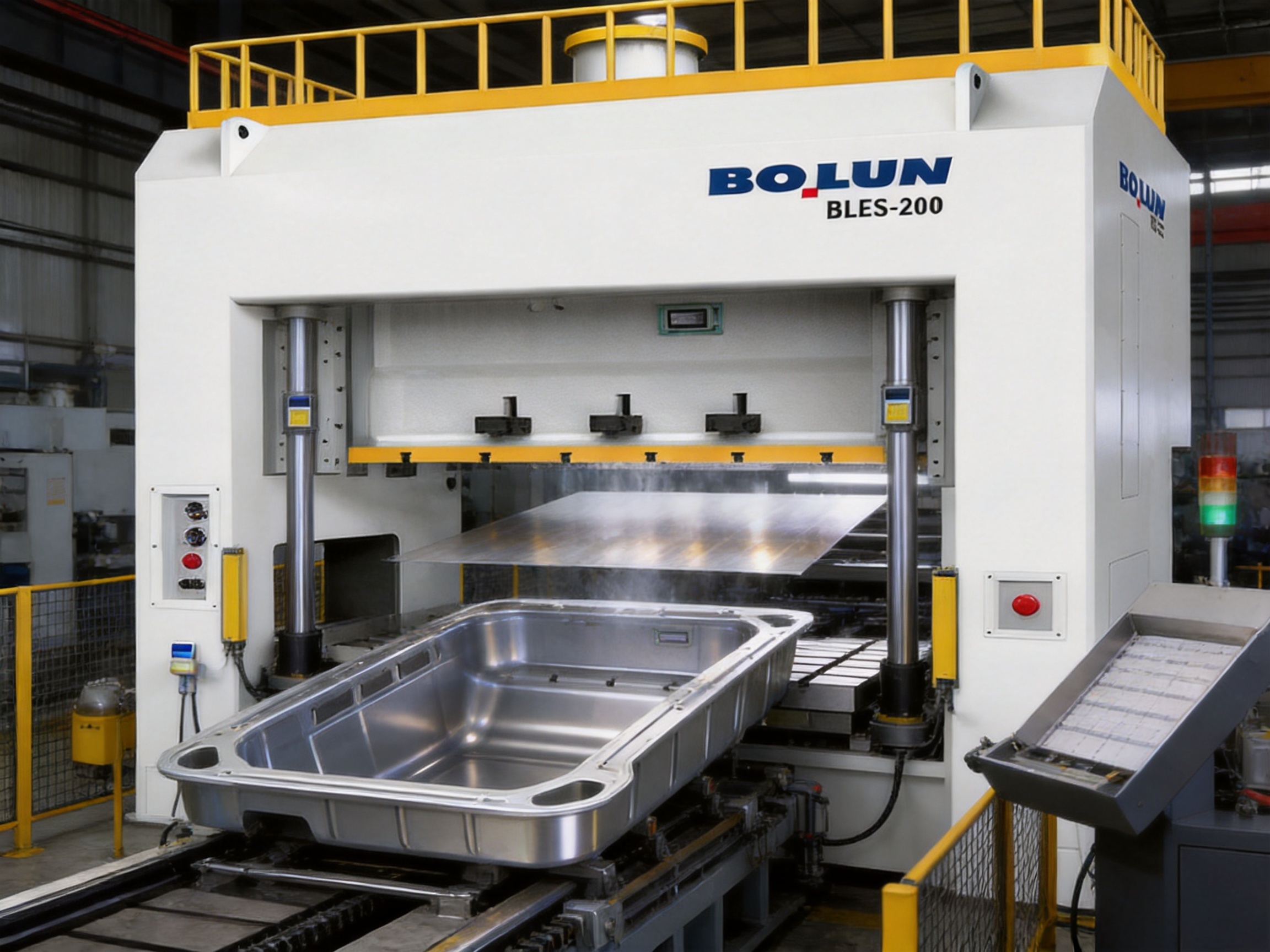
The BLES-200 is a closed-frame double-point servo power press with a nominal capacity of 2000 kN. It is designed for precision forming, stamping, drawing, bending, embossing, calibration, and related metal-forming operations.
The slide stroke is 250 mm. This provides sufficient travel for many complex dies and forming processes while supporting a production speed of approximately 50 strokes per minute under the listed configuration.
The worktable measures 2200 × 940 mm. The slide-bottom size is 1850 × 750 mm, allowing the press to accommodate relatively large and multi-station dies.
The double-point design applies drive force at two locations on the slide. This helps balance slide movement across a wide die, reduces the risk of tilting, and supports more uniform load distribution during forming.
The servo system allows the slide speed, movement profile, and dwell positions to be programmed for different products. This can help manage material flow, improve forming quality, reduce defects, and adapt the press to a wider range of materials and tooling conditions.
Yes. The large worktable, broad slide-bottom area, 500 mm maximum die height, 120 mm die-height adjustment, and 900 × 600 mm side opening provide flexibility for large and complex tooling. Final compatibility should be confirmed through a die and application review.
The listed continuous working energy is 14,000 J. This supports demanding forming applications and repeated production cycles when the process is correctly matched to the machine and tooling.
The listed punch accuracy is JIS B 6402 Level 1. Actual production results also depend on die quality, material consistency, setup accuracy, lubrication, feeding, and maintenance.
Potential applications include automotive and transportation components, appliance panels, electrical enclosures, industrial equipment parts, metal furniture, hardware, structural components, and other products requiring high-capacity precision forming.
The manufacturer provides design and manufacturing services for products with special specifications and functions. Customization should be discussed during the technical review so that the machine, tooling, automation, control system, and safety requirements can be evaluated together.
Users should review material type and thickness, forming force, energy, die dimensions, stroke, speed, production volume, automation requirements, foundation, utilities, safety systems, maintenance access, and long-term service expectations.
The BLES-200 combines the structural benefits of a closed-frame double-point press with the flexibility of servo motion control. Its 2000 kN nominal capacity, 250 mm slide stroke, 14,000 J continuous working energy, large worktable, broad side opening, and programmable movement make it suitable for demanding precision-forming applications.
The machine’s key advantages are connected to one another. The closed frame supports rigidity, the double-point configuration promotes balanced slide movement, the large working area accommodates substantial tooling, and the servo system provides motion flexibility for different materials and processes. Together, these features create a platform that can support improved part quality, more efficient die development, greater tooling versatility, and more stable production.
The value of the press is further strengthened by the manufacturer’s integrated capabilities in research and development, precision machining, assembly, inspection, customization, and service. A complete manufacturing and support structure helps convert technical specifications into dependable equipment performance over the machine’s working life.
For manufacturers seeking a versatile high-capacity press for complex forming, the BLES-200 represents a balanced solution. It is not limited to a single stamping application. Instead, it provides a foundation for flexible production, process optimization, and future expansion in industries where precision, structural stability, and reliable forming performance are essential.
1. Product technical information for the BLES-200 closed-frame double-point servo power press.
2. JIS B 6402, accuracy and testing principles for mechanical presses.
3. General engineering principles for mechanical press frame rigidity, slide guidance, and die alignment.
4. Industrial servo press application practices for controlled forming speed and dwell movement.
5. General guidelines for metal-forming process planning, die installation, maintenance, and machine safety.


Two presses can both carry a 200-tonne nameplate and still produce very differe...
A buyer comparing a 45-ton open-gap press for a bracket line often receives two...
What Is a Power Press? A power press — also called a stamping press or punch pr...
A tooling engineer quotes a new bracket program and specifies a 160-ton press. ...
When you are planning to produce medium or small metal parts in high volumes, t...
A fastener plant in Taizhou receives a request from an automotive tier-one supp...
Contact Us

topbolun@gmail.com

+86-575-83362228

+86-13735238388
+86-18667502750

+86-575-83362999

+8618667502750

No.1 Linjiang Road East, Xiaren, Jinting Town, Shengzhou City, Zhejiang Province, China
Ready to Begin?
Get in Touch

Now!

ZHEJIANG BOLUN
 English
 中文简体