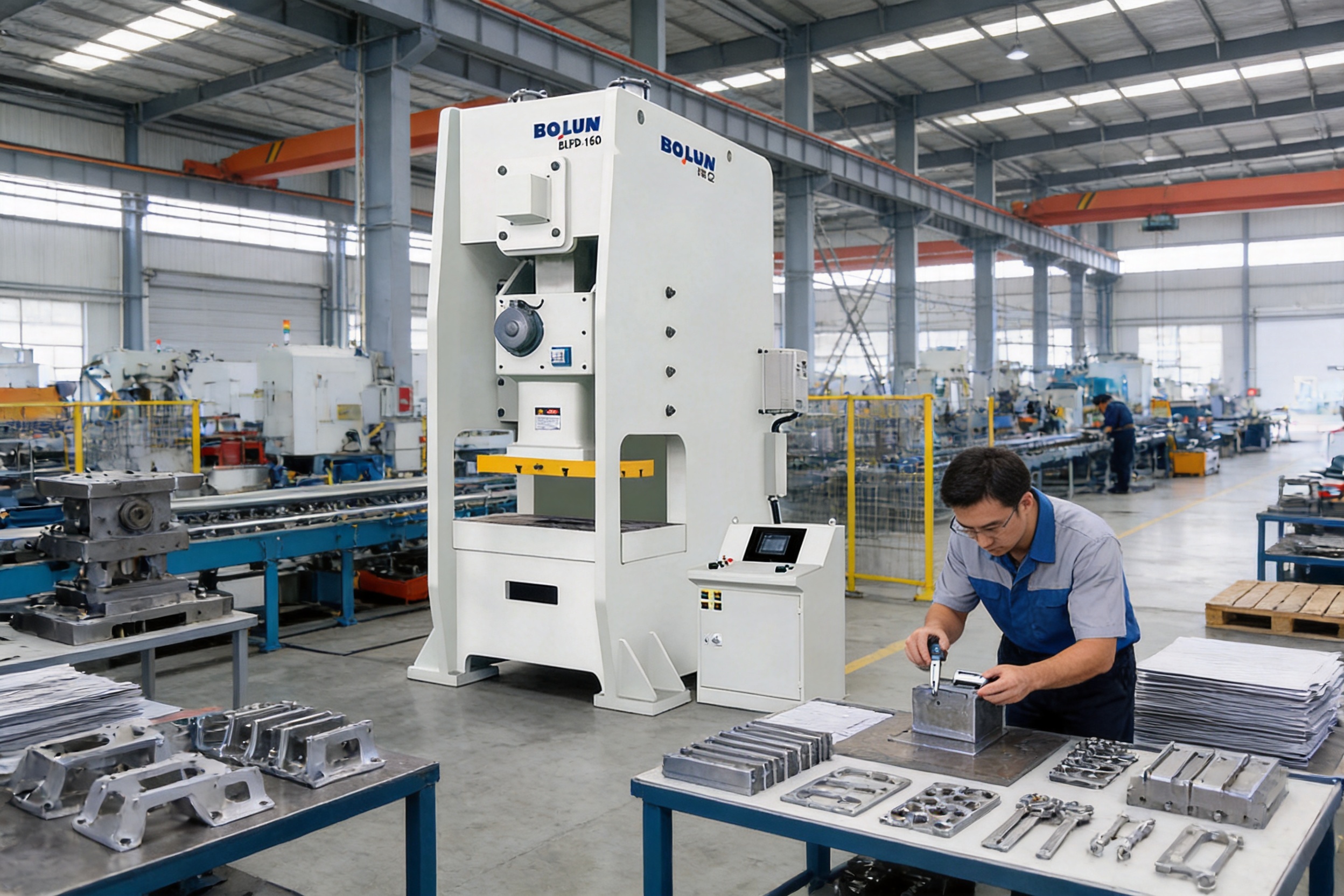
Modern stamping operations require more than simply applying force to a workpiece. Manufacturers need a press that can deliver repeatable pressure, maintain alignment under demanding loads, accommodate different tooling arrangements, and support efficient die changes. The BLPD-160 Versatile Balanced-Stability Semi-Closed Single-Point Power Press is designed around these requirements. With a nominal capacity of 1,600 kN, a rigid 16.8-ton frame, a 200 mm slide stroke, and a 980 × 800 mm worktable, it is positioned for demanding drawing, forming, blanking, and general stamping applications.
The machine combines a semi-closed single-point construction with a robust mechanical drive system, electric slide adjustment, digital die height indication, and a high-torque 15 kW main motor. These features create a practical balance between structural rigidity, tooling flexibility, operating convenience, and production consistency. For manufacturers that need a powerful industrial press without moving directly to a larger and more complex press line, the BLPD-160 offers a capable middle-to-heavy-duty solution.
This article examines the machine’s construction, performance characteristics, control-related advantages, tooling compatibility, manufacturing strengths, maintenance considerations, and potential applications. It also explains how the press compares with alternative machine categories and why production companies may consider it for long-term forming operations.
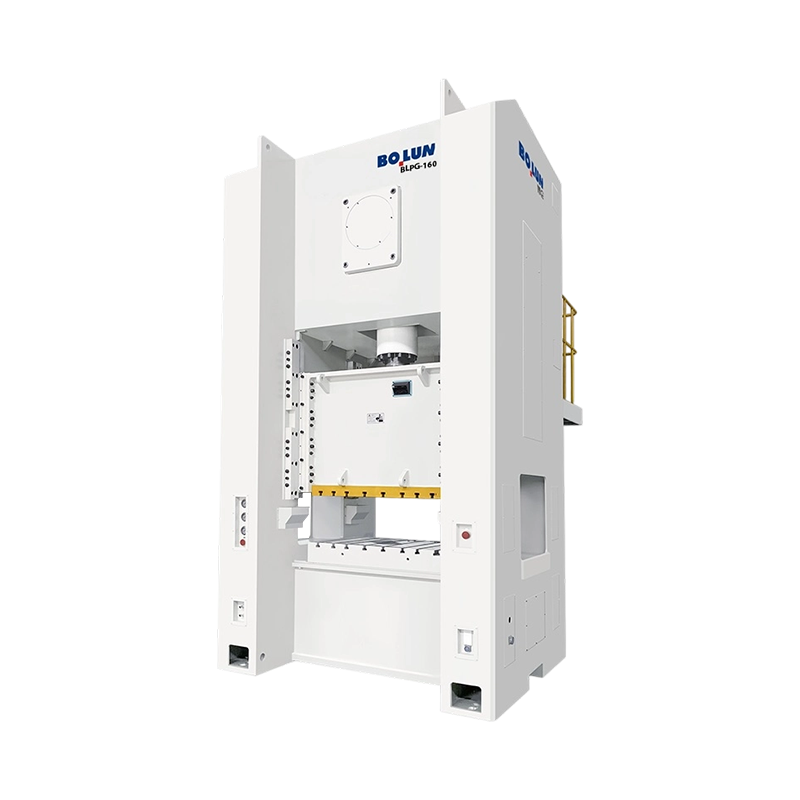
The BLPD-160 is a semi-closed single-point power press developed for high-load metal forming. Its 1,600 kN nominal capacity gives it sufficient force for a broad range of medium and relatively large stamping components. The 200 mm slide stroke provides useful vertical travel for drawing and forming dies, while the 980 × 800 mm worktable offers a practical tooling area for many industrial applications.
A single-point drive transfers the press force through a central connection to the slide. This arrangement is widely used when balanced force distribution and reliable slide guidance are important. The semi-closed frame provides a practical compromise between accessibility and rigidity. Compared with a fully open frame, it offers improved support around the working zone. Compared with a fully closed four-column structure, it may provide easier access for loading, unloading, and die handling in applications where complete enclosure is not necessary.
The BLPD-160 is available within a broader BLPD press family. The supplied technical series includes models from 800 kN to 6,300 kN. The BLPD-160 occupies the 1,600 kN position in this range, making it suitable for companies that require more capacity than a small general-purpose press but do not necessarily need the footprint, investment, or energy demand of a very large press.
Key product characteristics include:
• Nominal capacity: 1,600 kN
• Press weight: approximately 16.8 tons
• Slide stroke: 200 mm
• Strokes per minute: 20–50 for the V configuration and 40–70 for the H configuration
• Maximum die height: 460 mm for the V configuration and 510 mm for the H configuration
• Die height adjustment: 100 mm
• Worktable size: 980 × 800 × 140 mm
• Slide bottom size: 850 × 550 × 90 mm
• Main motor: 15 kW, four-pole configuration
• Air pressure: 0.55 MPa
• Punch accuracy: GB/JIS Class 1
• Mold pad capacity: 100 kN
• Ram stroke: 80 mm
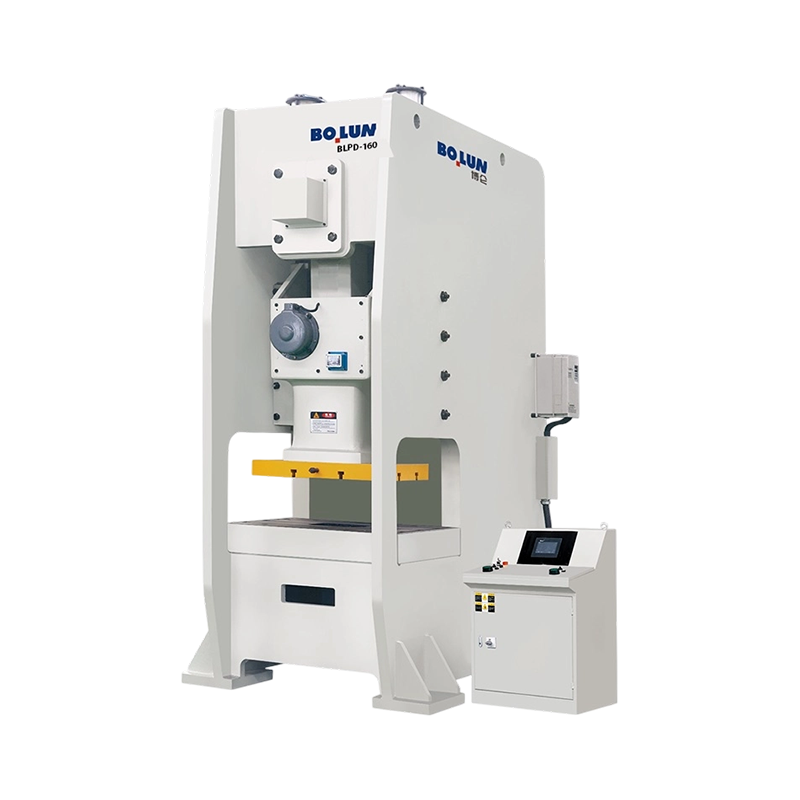
BLPD-160 Versatile Balanced-Stability Semi-Closed Single-Point Power Press
The frame is one of the most important elements in any mechanical power press. During forming, the machine experiences high compressive forces, impact loads, vibration, and repeated cyclic stress. If the frame deflects excessively, the result can include uneven material flow, inaccurate dimensions, premature die wear, and inconsistent product quality.
The semi-closed structure of the BLPD-160 is designed to improve load support around the working area while retaining practical access for tooling and material handling. The machine’s approximately 16.8-ton press weight contributes to a stable foundation for heavy-load operation. A heavier, rigidly constructed press generally has greater resistance to vibration and unwanted movement than a lightweight machine operating at the same nominal capacity.
This stability is particularly valuable in drawing and forming applications. These processes often require controlled material flow rather than a single brief cutting action. Small changes in slide alignment, frame deflection, or die seating can influence wall thickness, surface quality, wrinkles, cracks, and final dimensions. A stable frame helps the tool operate within its intended working conditions.
The single-point design applies the main slide force through a central connection. This configuration is well suited to dies that are properly centered and balanced on the table. When the tooling is installed correctly, the central force path supports uniform movement of the slide and helps reduce uneven loading between the left and right sides of the machine.
Single-point power presses are common in applications requiring versatile stamping performance. They can support blanking, shallow drawing, forming, bending, embossing, and other operations, provided that the tooling and process parameters are matched to the machine’s capacity. The BLPD-160’s worktable and slide dimensions give tooling designers a useful working envelope for medium and large dies.
As with any single-point press, correct die positioning is essential. Off-center loading should be avoided unless it has been specifically evaluated by the tooling and production team. Proper die alignment, balanced material distribution, suitable lubrication, and correct tonnage selection all contribute to safe and consistent operation.
Production presses are rarely judged only by their maximum force. They must also maintain performance over thousands or millions of cycles. The BLPD-160 is designed to provide stable precision under repeated heavy-load conditions. Its rigid construction, mechanical drive, and substantial machine mass support consistent operation when the press is used within its rated working range.
Continuous production also places demands on the crank mechanism, slide guidance, bearings, lubrication system, electrical controls, and frame joints. A well-integrated manufacturing process is therefore essential. Dimensional accuracy in machined components, correct assembly procedures, and comprehensive inspection all influence the press’s long-term performance.
The BLPD-160 provides a nominal capacity of 1,600 kN. This capacity gives manufacturers the force required for many medium-to-heavy stamping operations. The actual suitability of the machine depends on the material type, material thickness, tool design, forming depth, force curve, blank size, and required production speed.
Nominal capacity should not be interpreted as unlimited force available at every point of the slide stroke. Mechanical presses typically reach their rated capacity near the bottom of the stroke, where the crank mechanism provides maximum mechanical advantage. Engineers should therefore calculate the required tonnage and tonnage position for each die. Operating the press within its rated capacity and force envelope helps protect the machine and tooling.
At 1,600 kN, the machine can serve sectors such as automotive component production, appliance manufacturing, electrical enclosure production, hardware stamping, agricultural equipment, furniture hardware, and general metal fabrication. It may be used for steel, stainless steel, aluminum, and other suitable materials, subject to process validation and tooling requirements.
The 200 mm slide stroke is an important advantage for forming applications. A longer stroke provides more vertical travel for the die, helping accommodate deeper forming operations, higher tooling arrangements, and processes that require additional clearance between the slide and table.
Stroke length also affects production speed, material handling, and die design. A longer stroke can increase the available working distance but may influence the maximum cycle rate compared with a shorter-stroke configuration. The BLPD-160 balances these factors with a speed range of 20–50 strokes per minute in the V configuration and 40–70 strokes per minute in the H configuration, according to the supplied specifications.
The appropriate speed depends on the operation. Drawing and complex forming often require a controlled, moderate speed to support material flow and reduce defects. Blanking and simpler forming operations may be suitable for higher speeds when the die, feeder, material, lubrication, and safety systems are properly configured.
The 980 × 800 × 140 mm worktable offers sufficient area for a wide range of industrial dies. The 140 mm table thickness provides a substantial mounting platform, while the 850 × 550 × 90 mm slide bottom offers a suitable interface for dies designed within the machine’s working envelope.
Tooling engineers should consider the complete die footprint, guide post position, bolster arrangement, mounting holes, shut height, feed direction, scrap discharge, and required access. The worktable size should not be viewed in isolation. Effective die compatibility depends on the relationship between the table, slide, die height, stroke, and column spacing.
The distance between columns is approximately 930 mm for the BLPD-160 configurations listed in the technical table. This provides useful lateral clearance for dies and workpieces while preserving a compact arrangement relative to larger closed-type presses.
The machine provides a maximum die height of 460 mm in the V configuration and 510 mm in the H configuration, with 100 mm of die height adjustment. The difference between configurations allows users to select a press arrangement that better matches the required production speed and tooling height.
Die height is a fundamental setup parameter. It determines the relationship between the upper and lower sections of the die when the slide is at its upper position or bottom position, depending on the machine’s adjustment convention. An accurate die height setting is necessary to achieve the correct forming depth, prevent overloading, maintain product dimensions, and avoid tool damage.
The electric slide adjustment system makes this setup process faster and more convenient than manual adjustment. Operators can make controlled changes to the slide position and use the digital die height indicator to monitor the setting. This is especially beneficial when different dies are used during the same production shift.
Manual setup time can have a direct effect on production efficiency. Every minute spent adjusting the slide, checking shut height, or correcting tooling position reduces available production time. The BLPD-160’s electric slide adjustment system supports faster die setup and more repeatable changeovers.
Electric adjustment also reduces the physical effort required from operators. Instead of relying entirely on manual mechanisms, the user can make controlled adjustments through the machine’s operating system. This supports better ergonomics and can reduce the likelihood of inconsistent settings caused by rushed or difficult manual operation.
For manufacturers operating several dies, the adjustment system can simplify production scheduling. Operators can record validated setup values for each tool, then use those values as a starting point during future changeovers. The exact procedure should follow the machine’s operating instructions and the company’s setup verification standards.
A digital die height indicator gives operators a direct reference for the current slide or die height setting. This is more convenient than relying only on mechanical scales or estimated adjustment positions. A clear digital reading helps reduce setup errors and supports communication between production, tooling, and quality teams.
Digital indication is particularly useful when a company uses standardized setup sheets. A tooling record may include the die identifier, target die height, stroke setting, speed range, lubrication requirements, feed position, and quality checkpoints. The operator can compare the actual machine setting with the documented target before beginning production.
While a digital indicator improves convenience, it should be used as part of a complete setup verification process. Operators should still confirm die seating, fastener security, slide parallelism, material feed, sensors, guarding, and test-piece quality before full-speed production begins.
The combination of a semi-closed frame, accessible work area, electric adjustment, and digital indication is valuable for job shops and contract manufacturers. These businesses often produce multiple part numbers and may change tooling more frequently than high-volume dedicated lines.
Shorter changeovers can improve equipment utilization without requiring a major increase in machine speed. The benefit is not only higher output. Frequent, repeatable setup procedures can also reduce startup scrap, improve first-piece approval, and make production planning more predictable.
The BLPD-160 is equipped with a 15 kW, four-pole main motor. This high-torque drive provides the mechanical energy required for repeated slide movement and forming operations. The motor rating is appropriate for a 1,600 kN press in the supplied product configuration.
Motor power supports the press cycle, but actual energy demand varies with stroke rate, forming load, material, die design, clutch and brake behavior, and production conditions. Efficient operation depends on selecting a suitable speed rather than running every job at the highest available rate. A controlled operating speed can improve part quality and reduce unnecessary mechanical stress.
The technical information identifies V and H configurations for several models in the BLPD series. For the BLPD-160, the listed V configuration provides 20–50 strokes per minute, while the H configuration provides 40–70 strokes per minute. The V configuration has a 200 mm slide stroke and a maximum die height of 460 mm. The H configuration has a 90 mm slide stroke and a maximum die height of 510 mm.
These configurations serve different production priorities. The V arrangement, with its longer stroke, is more suitable when forming depth and vertical travel are important. The H arrangement, with its shorter stroke and higher speed range, may be attractive for faster operations where the tooling requires less slide travel. The correct selection should be based on the actual process rather than speed alone.
Manufacturers should confirm the final configuration, accessories, electrical standards, guarding, automation interface, and tooling requirements before placing an order. The configuration shown in the product information should be treated as the basis for technical discussion and application review.
The BLPD-160 includes a mold pad capacity of 100 kN, an 80 mm ram stroke, and an effective cushion area of 650 × 420 mm. These features can support forming operations that benefit from controlled force beneath the workpiece. A die cushion or mold pad may assist with blank holding, reverse forming, material control, and improved part shape in suitable applications.
The cushion system must be matched to the die design and process requirements. The required force, stroke, timing, pressure, and contact area vary significantly between applications. Engineers should verify the actual force curve and operating method before using the cushion for a particular drawing operation.
Smaller open-type presses are often valued for compactness, lower initial investment, and easy access. They can be effective for light blanking, bending, and small components. However, they may have less capacity, a smaller table, lower frame mass, and reduced working clearance than the BLPD-160.
The BLPD-160 offers a more substantial platform for demanding dies and heavier materials. Its 1,600 kN capacity and 16.8-ton structure provide a higher operating range for manufacturers that have outgrown small presses. The trade-off is a larger footprint, higher investment, and the need for more robust foundation and material-handling arrangements.
Fully closed-type presses can provide excellent rigidity and balanced support for large dies, especially in applications involving high loads, progressive tooling, or wide workpieces. They are often selected for high-volume production and specialized forming lines.
The semi-closed BLPD-160 is positioned as a more flexible alternative for users that need strong structural support but also value access and adaptability. It may be easier to integrate into general-purpose production areas, and its configuration can be appropriate for a wider range of job-shop or mixed-production work. For applications requiring exceptionally wide tooling, multi-point force distribution, or specialized transfer automation, a larger closed-type press may be more appropriate.
Hydraulic presses provide adjustable pressure, controllable slide speed, and the ability to hold force at a position. These qualities can be highly valuable for deep drawing, compression forming, and processes requiring long dwell times.
A mechanical power press such as the BLPD-160 offers different strengths. It is designed for repeated cyclic operation and can provide efficient production for blanking, bending, forming, and drawing operations that benefit from a defined mechanical stroke. The mechanical drive is especially attractive when consistent cycle timing and relatively high production output are priorities.
The choice between mechanical and hydraulic technology depends on the process. Manufacturers should evaluate force requirements, stroke profile, production volume, part geometry, cycle time, energy consumption, and maintenance capabilities before selecting the press type.
The strongest competitive advantages of the BLPD-160 are its balance of force, working area, structural stability, setup convenience, and configuration flexibility. Rather than focusing on one specification alone, the machine combines several features that influence total production performance:
• A 1,600 kN capacity for demanding forming work.
• A substantial 16.8-ton structure that supports stable operation.
• A 200 mm stroke option for deeper forming applications.
• A 980 × 800 mm worktable for versatile tooling.
• Electric slide adjustment for more efficient setup.
• Digital die height indication for repeatable adjustment.
• A 15 kW high-torque motor for continuous mechanical operation.
• A 100 kN mold pad capacity for suitable cushion-assisted processes.
• GB/JIS Class 1 punch accuracy according to the supplied specification.
These advantages do not eliminate the need for proper application engineering. Instead, they create a strong platform from which manufacturers can build reliable stamping processes.
| Specification | BLPD-160 V | BLPD-160 H |
|---|---|---|
| Nominal capacity | 1,600 kN | 1,600 kN |
| Nominal pressure stroke | 6 mm | 3 mm |
| Slide stroke | 200 mm | 90 mm |
| Strokes per minute | 20–50 S.P.M. | 40–70 S.P.M. |
| Maximum die height | 460 mm | 510 mm |
| Die height adjustment | 100 mm | 100 mm |
| Worktable size | 980 × 800 × 140 mm | 980 × 800 × 140 mm |
| Slide bottom size | 850 × 550 × 90 mm | 850 × 550 × 90 mm |
| Working face height | 900 mm | 900 mm |
| Distance between columns | 930 mm | 930 mm |
| Main motor | 15 kW × 4 poles | 15 kW × 4 poles |
| Die height adjustment motor | 1.1 kW | 1.1 kW |
| Air pressure | 0.55 MPa | 0.55 MPa |
| Punch accuracy | GB/JIS Class 1 | GB/JIS Class 1 |
| Press weight | Approximately 16.8 tons | Approximately 16.8 tons |
| Mold pad capacity | 100 kN | 100 kN |
| Ram stroke | 80 mm | 80 mm |
| Effective cushion area | 650 × 420 mm | 650 × 420 mm |
Zhejiang Bolun High-Precision Machinery Co., Ltd. integrates research and development, mechanical design, manufacturing, sales, and service. This integrated structure is important for power press production because performance depends on the coordination of many disciplines. Frame design, drive calculations, machining accuracy, electrical controls, lubrication, safety systems, and final assembly must work together.
An integrated manufacturer can review the machine as a complete production system rather than as a collection of unrelated components. This helps maintain consistency between the original design and the finished machine. It can also support faster technical communication when customers require a special specification, unusual tooling interface, customized automation, or a non-standard operating condition.
Power press performance is strongly influenced by the accuracy of machined surfaces and assembled components. Critical areas may include slide guide surfaces, crankshaft seats, bearing locations, connecting mechanisms, table surfaces, die mounting interfaces, and adjustment mechanisms. Accurate processing supports proper alignment and reduces uneven wear.
Assembly quality is equally important. A press must be assembled with correct clearances, fastening torque, lubrication, alignment, electrical connections, and safety interlocks. The manufacturer’s production system includes precision processing equipment and a complete manufacturing environment covering design, core component development, machining, assembly, and inspection.
The company describes a finished-product inspection system intended to exceed ordinary industry expectations. Quality control should begin with incoming materials and components, continue through machining and assembly, and conclude with functional and performance checks on the completed press.
For a machine such as the BLPD-160, relevant inspection areas may include frame dimensions, table flatness, slide movement, die height adjustment, brake and clutch response, lubrication performance, electrical control functions, air system operation, machine noise, vibration, and punch accuracy. The precise inspection program depends on the final machine configuration and applicable standards.
A disciplined inspection system benefits customers in several ways. It reduces the risk of hidden assembly problems, supports repeatable commissioning, improves documentation, and provides a stronger foundation for long service life. It also helps ensure that the machine delivered to the customer reflects the intended engineering design.
Stamping operations vary widely. Some customers require different electrical standards, special guarding, automatic feeding, transfer systems, die cushions, blank detection, programmable controls, or customized table arrangements. A manufacturer with non-standard design capability can adapt the press to the actual production environment.
Customization should be handled through a structured technical review. The customer and manufacturer should confirm material dimensions, tooling specifications, cycle requirements, automation interfaces, safety expectations, factory utilities, installation conditions, and inspection criteria. Proper review prevents a machine from being customized around incomplete or conflicting information.
The BLPD-160 can be considered for suitable automotive stamping components such as brackets, reinforcement parts, support plates, covers, and formed structural details. Automotive applications often require repeatable dimensions, controlled material flow, and stable operation over extended production cycles.
For each component, engineers must verify blank size, material grade, thickness, forming depth, required tonnage, die cushion force, and production rate. The machine’s capacity and working dimensions may suit many medium-sized automotive tools, while larger body panels may require a larger multi-point or transfer press.
Appliance manufacturers and electrical equipment producers use stamping processes to make panels, brackets, housings, covers, and internal support parts. These components may require blanking, piercing, bending, shallow drawing, and embossing in one or more operations.
The BLPD-160’s table size, die height adjustment, and accessible semi-closed structure can support a variety of tools used in this sector. Digital die height indication is especially helpful when different enclosure components are produced on the same machine.
General hardware producers often manufacture parts in varied batches. Their priorities may include flexibility, quick setup, reliable force, and the ability to accommodate different die sizes. The BLPD-160 is well suited to this type of mixed production when the tooling is correctly matched to the machine.
Potential products include industrial brackets, hinges, mounting plates, hardware fittings, machinery covers, structural supports, and formed metal assemblies. The machine can serve both dedicated production and job-shop environments, provided the production team follows proper setup, maintenance, and safety procedures.
Agricultural machinery and industrial equipment frequently require formed steel parts with substantial thickness and strength. Components may include guards, mounting brackets, reinforcement members, covers, and support structures.
The BLPD-160’s high nominal capacity and rigid structure can provide a useful foundation for these applications. However, material strength and thickness must be included in the tonnage calculation. High-strength materials may require significantly more forming force than mild steel of the same thickness.
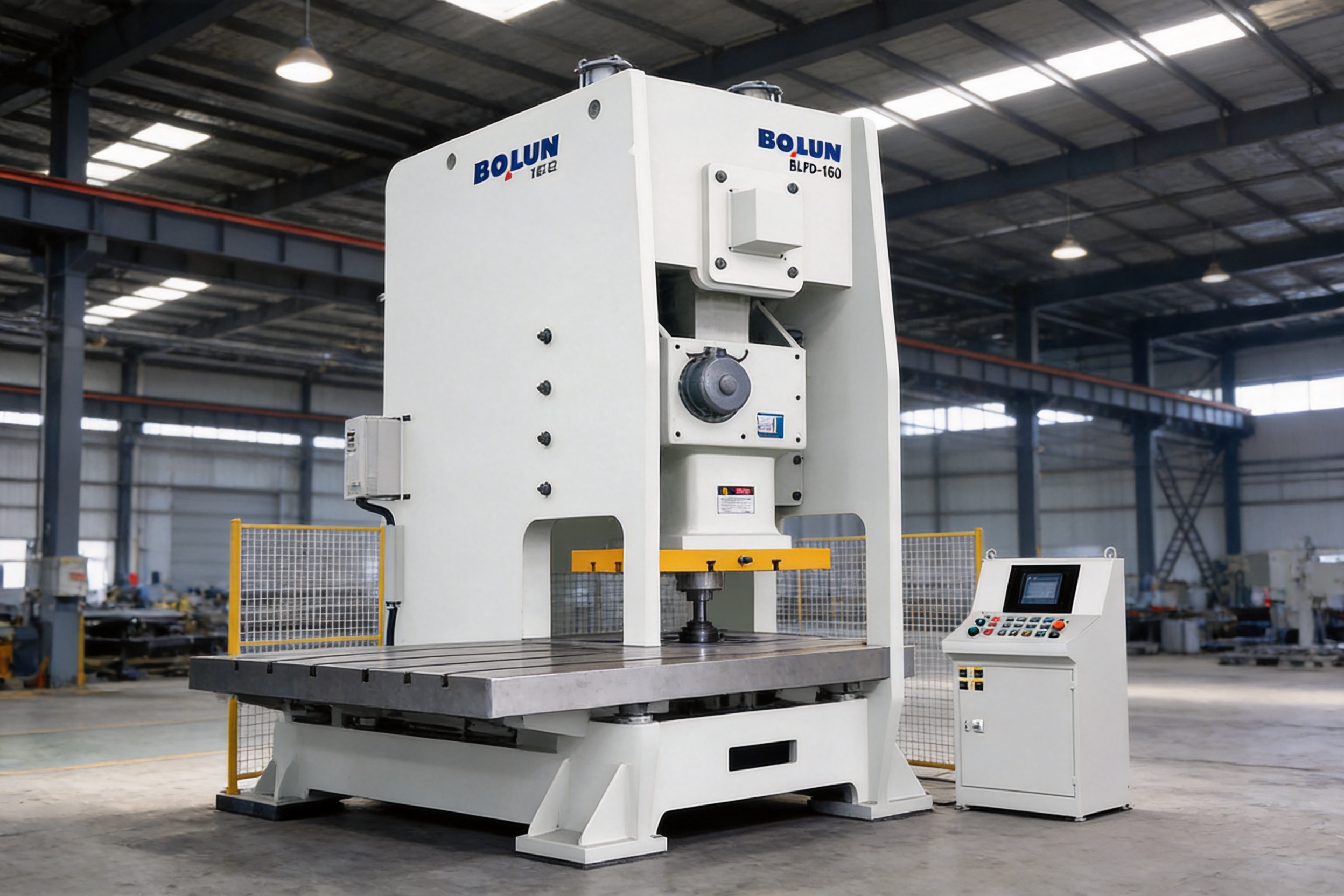
Productivity is not simply the number of strokes per minute. It also includes setup time, first-piece approval, scrap rate, unplanned downtime, tooling life, operator effort, and maintenance efficiency. The BLPD-160 supports productivity by combining an appropriate speed range with repeatable setup features and a stable mechanical platform.
When the machine is correctly installed and operated, consistent slide movement and die height control can reduce variation between production runs. The ability to document and repeat machine settings may also help different operators achieve similar results.
Preventive maintenance is essential for preserving press accuracy and safety. Maintenance personnel should follow the manufacturer’s recommendations for lubrication intervals, inspection points, fastener checks, brake and clutch evaluation, electrical cabinet inspection, air system maintenance, and die adjustment mechanisms.
Routine checks may include:
• Inspecting lubrication levels and confirming oil delivery.
• Checking for abnormal vibration, noise, heat, or leakage.
• Inspecting slide guides and moving connections for wear.
• Verifying brake and clutch response.
• Checking die height adjustment operation and digital indication.
• Inspecting pneumatic lines, valves, and pressure stability.
• Confirming guards, emergency stops, interlocks, and sensors are functional.
• Checking table and slide mounting surfaces for damage or contamination.
• Recording maintenance findings for trend analysis.
Maintenance should be performed by qualified personnel with the machine isolated according to appropriate lockout and safety procedures. A press should never be serviced while unexpected movement or stored energy remains possible.
Tooling condition has a direct effect on press life. Dull punches, damaged die components, poor alignment, insufficient lubrication, and incorrect shut height can increase loads and cause avoidable damage. Operators should inspect tools before installation and confirm that the die is securely mounted and correctly centered.
Overload protection, where included in the final configuration, should not be treated as a substitute for correct process engineering. Tonnage calculations, material testing, die tryout, and controlled first-piece inspection remain essential. The machine should be operated within its rated capacity and intended force range.
A press of this size requires careful site preparation. The BLPD-160’s overall dimensions are listed as approximately 1,600 × 2,200 × 3,500 mm for the V configuration and the same dimensions for the H configuration in the supplied information. The actual shipping and installation arrangement should be confirmed with the manufacturer because accessories, guarding, electrical cabinets, feeders, and service clearances may change the total space requirement.
Before delivery, the customer should prepare a suitable foundation, lifting plan, electrical supply, compressed-air supply, lighting, ventilation, material flow route, and maintenance access. The listed air pressure is 0.55 MPa. The customer should verify that the plant’s air system can provide the required pressure and volume under actual operating conditions.
Commissioning should include leveling, anchoring, electrical connection, air connection, lubrication verification, no-load testing, low-speed testing, adjustment verification, safety function testing, and die trial. Production should begin only after the machine has passed the agreed acceptance checks.
Training is also important. Operators should understand the control system, die adjustment procedure, safe operating modes, emergency stop functions, inspection requirements, and permitted operating limits. Maintenance personnel should receive information about lubrication, wear points, electrical systems, pneumatic systems, and troubleshooting procedures.
Manufacturers compete on cost, quality, delivery time, and production flexibility. A press must therefore contribute to more than force. It should help the factory produce consistent parts, reduce avoidable setup delays, accommodate changing orders, and remain serviceable over many years.
The BLPD-160 addresses these objectives through a balanced package. Its force rating supports substantial forming work, while its worktable and die height range provide tooling flexibility. The semi-closed frame offers a practical structure for general industrial use. Electric adjustment and digital indication help improve changeover repeatability. The 15 kW motor and heavy frame support continuous production when the machine is correctly applied.
Compared with purchasing a press that is too small, the BLPD-160 offers additional capacity for future work and more demanding materials. Compared with immediately selecting a much larger press, it may provide a more economical and space-conscious solution for companies whose products fit within its working envelope. This balance can be particularly valuable for manufacturers expanding their stamping capabilities in stages.
The machine’s value also depends on the strength of the manufacturer behind it. Zhejiang Bolun High-Precision Machinery Co., Ltd. brings experience in precision machinery manufacturing, integrated engineering, custom design, production management, quality inspection, and customer service. Its stated strategy emphasizes technology, full-chain production, customization, and long-term quality control.
For international customers, supplier support is an important part of equipment selection. Technical consultation before purchase, documentation, installation assistance, spare-parts planning, operator training, and after-sales service can influence the real cost of ownership. A technically capable press becomes more valuable when the supplier can support its complete service life.
The nominal capacity is 1,600 kN. The suitable operating range depends on the die, material, forming process, and position of the load during the slide stroke. Production engineers should calculate required tonnage before using a new tool.
The listed V configuration has a 200 mm slide stroke and a speed range of 20–50 strokes per minute. The H configuration has a 90 mm slide stroke and a speed range of 40–70 strokes per minute. The V configuration is more suitable when longer travel is required, while the H configuration may be preferred for faster operations with shorter tooling travel.
Yes, it is designed for stable drawing and forming operations. Suitability depends on drawing depth, material properties, blank size, die design, cushion requirements, lubrication, and calculated forming force. Complex or deep drawing applications should be evaluated by tooling engineers before production.
The worktable is listed as 980 × 800 × 140 mm. Die dimensions, mounting requirements, column clearance, feed direction, and safety access must also be considered when confirming compatibility.
It allows the slide position to be adjusted more conveniently and consistently than with a purely manual system. This can reduce setup effort and support faster changeovers between dies. The digital die height indicator provides a clear reference for the adjustment value.
The BLPD-160 uses a 15 kW, four-pole main motor. The supplied specifications also list a 1.1 kW die height adjustment motor.
The listed press weight is approximately 16.8 tons. The actual shipping weight may vary depending on accessories, guarding, electrical equipment, and optional systems.
Potential users include automotive component manufacturers, appliance producers, electrical enclosure manufacturers, general hardware companies, agricultural equipment suppliers, industrial fabricators, and job shops requiring medium-to-heavy stamping capability.
The supplied technical information lists an air pressure of 0.55 MPa. The customer should confirm required air volume, connection details, filtration, and plant capacity with the manufacturer before installation.
Users should review material type and thickness, die dimensions, required tonnage, tonnage position, stroke, speed, die height, cushion requirements, worktable size, automation needs, factory space, foundation, electrical supply, compressed air, safety systems, and expected production volume.
The BLPD-160 is a mechanical power press designed for repeated cyclic stamping. A hydraulic press may offer more flexible force and speed control for certain deep drawing or holding operations. The preferred technology depends on the workpiece, tooling, cycle requirements, and production objectives.
The manufacturer provides non-standard design and manufacturing services for products with special specifications and functions. Customization should be discussed during the technical review so that tooling, automation, electrical, guarding, and production requirements are clearly defined.
The BLPD-160 is a strong candidate for manufacturers seeking a versatile, stable, and production-oriented single-point power press. Its 1,600 kN capacity, 16.8-ton frame, 200 mm stroke option, 980 × 800 mm worktable, 15 kW motor, and 100 kN mold pad capacity give it a broad operating range. Electric slide adjustment and digital die height indication add practical value by supporting faster and more repeatable setup.
Its semi-closed construction is particularly attractive for companies that want improved structural support without giving up convenient access to the working area. The available V and H configurations allow the machine to be matched more closely to either longer forming travel or higher-speed production requirements.
The machine’s performance should always be evaluated against the specific application. Correct tonnage calculation, die design, installation, operator training, preventive maintenance, and safety management are essential. When these elements are properly controlled, the BLPD-160 can provide a dependable platform for drawing, forming, blanking, bending, and other industrial stamping operations.
Supported by an integrated manufacturing system, precision processing capability, customization experience, and quality-focused production management, the press represents a balanced solution for manufacturers developing or expanding their metal-forming capacity.
1. Zhejiang Bolun High-Precision Machinery Co., Ltd., BLPD Series Technical Specification Data.
2. Zhejiang Bolun High-Precision Machinery Co., Ltd., Product Information for the BLPD-160 Semi-Closed Single-Point Power Press.
3. General Principles of Mechanical Power Press Design and Operation.
4. Industrial Metal Forming and Stamping Process Engineering Guidelines.
5. Pressworking Technology: Fundamentals of Blanking, Bending, and Drawing.
6. Machinery Safety Practices for Mechanical Power Presses.
7. Quality Control Principles for Precision Machine Tool Manufacturing.


Two presses can both carry a 200-tonne nameplate and still produce very differe...
A tooling engineer quotes a new bracket program and specifies a 160-ton press. ...
A buyer comparing a 45-ton open-gap press for a bracket line often receives two...
What Is a Power Press? A power press — also called a stamping press or punch pr...
A fastener plant in Taizhou receives a request from an automotive tier-one supp...
Put a 160-ton open-frame press and a 160-ton closed-frame press side by side an...
Contact Us

topbolun@gmail.com

+86-575-83362228

+86-13735238388
+86-18667502750

+86-575-83362999

+8618667502750

No.1 Linjiang Road East, Xiaren, Jinting Town, Shengzhou City, Zhejiang Province, China
Ready to Begin?
Get in Touch

Now!

ZHEJIANG BOLUN
 English
 中文简体