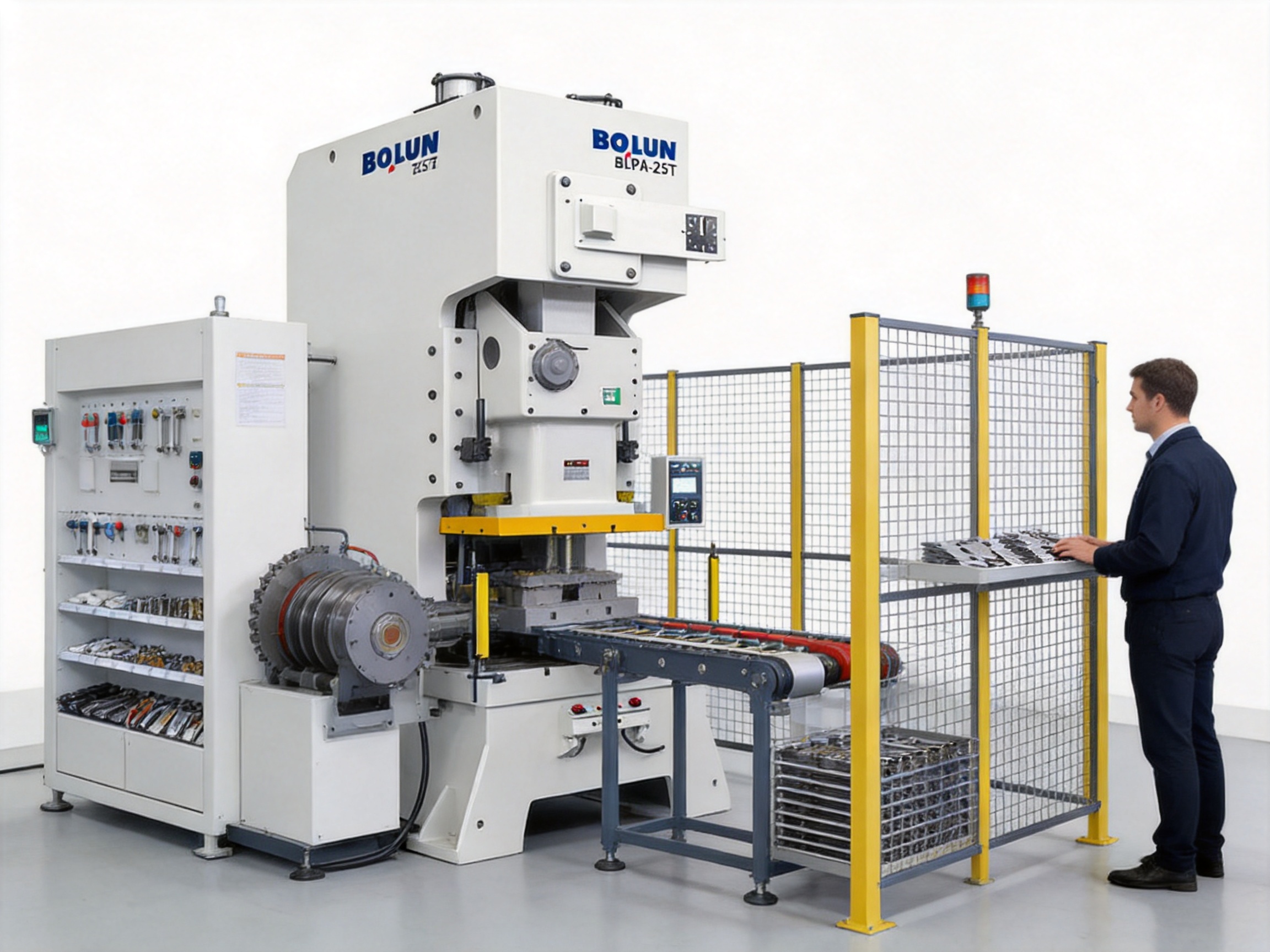
Modern stamping operations require more than nominal tonnage. Manufacturers need a press that combines structural rigidity, reliable motion control, repeatable stopping performance, convenient die adjustment, practical installation dimensions, and dependable protection against overload. The BLPA-25 Compact Precision Open-Type Single-Point Power Press is designed around these requirements. With a nominal capacity of 250 kN, it occupies an important position between light-duty and medium-duty stamping equipment, offering a balanced solution for manufacturers producing small and medium-sized precision components.
The machine is intended for high-efficiency stamping and forming applications in which dimensional consistency, production speed, and stable operation are essential. Its open-type construction provides useful access to the working area, while its single-point slide drive supports a straightforward and robust press arrangement. A heat-treated steel-plate frame provides a rigid foundation for repeated loading, and the dry clutch-brake system, dual solenoid valve, and hydraulic overload protector work together to support controlled operation and equipment safety.
For manufacturers comparing compact power presses, the BLPA-25 stands out because it combines precision-oriented features with practical operation. It is not simply a high-capacity machine reduced in size. Its configuration is suited to applications where a compact footprint, relatively high stroke rate, dependable die setup, and accessible tooling area can directly influence productivity. It can be applied to blanking, piercing, bending, shallow forming, embossing, and other sheet-metal operations when the tooling and process requirements are properly matched to the press.
The BLPA-25 belongs to the open-type single-point power press category. This type of press is widely used for components that can be loaded, unloaded, or transferred from the front and sides of the working zone. The open frame allows operators and automation systems to reach the die area with fewer physical restrictions than a closed-frame press. This design is particularly valuable for small parts, progressive dies, transfer-assisted operations, and production lines that require fast access for tooling maintenance.
A 250 kN nominal capacity gives the machine sufficient forming force for many general industrial stamping applications while maintaining a compact configuration. The actual suitability of the press depends on the required cutting force, forming force, material grade, sheet thickness, die design, pressure-point location, and production cycle. Nevertheless, the BLPA-25 provides a practical capacity range for manufacturers that need more capability than a small benchtop or light production press but do not require the size and investment associated with heavy-duty high-tonnage equipment.
The machine is especially appropriate for small-scale precision components. Typical product categories may include electrical terminals, appliance brackets, connector components, hardware parts, small automotive fittings, metal clips, stamped covers, and other formed sheet-metal products. Where the process calls for frequent die changes, controlled slide movement, and repeatable cycling, the BLPA-25 can provide a well-balanced production platform.
Its compact design can also benefit factories with limited floor space. A smaller press does not eliminate the need for proper access, guarding, material handling, and maintenance clearance, but it can simplify plant layout compared with larger presses. The published overall dimensions for the BLPA-25 are approximately 1,280 × 850 × 2,200 mm, while the listed machine weight is approximately 2.0 tons. These values give production planners useful preliminary information for transportation, foundation preparation, workshop arrangement, and installation planning.
Press precision begins with the frame. During stamping, the machine experiences repeated impact and compressive loading. If the frame, slide, or connecting structure deforms excessively, the result can be uneven clearance, inconsistent forming, accelerated die wear, poor part quality, and increased noise or vibration. The BLPA-25 uses a high-rigidity frame made from steel plates that undergo rigorous heat treatment to reduce internal stress.
Stress relief is an important manufacturing step for welded and fabricated press frames. Steel plates and welded assemblies can retain residual stresses after cutting, forming, and welding. If these stresses are not properly controlled, they may gradually release during machining or operation, causing distortion and affecting alignment. Heat treatment helps stabilize the frame before precision machining and final assembly. The result is a more dependable structural base for the slide guides, worktable, drive components, and die area.
Frame rigidity also contributes to long-term precision. A rigid structure helps maintain the relationship between the upper and lower die surfaces as the machine cycles. This does not mean that every stamping process will have identical results without correct tooling or maintenance. Instead, it means the press is designed to minimize one major source of variation: structural movement under load.
Compared with less rigid compact presses, a carefully stress-relieved frame can provide better resistance to deflection and vibration during repeated production. This is particularly useful for fine blanking-like operations, precision piercing, progressive stamping, and forming work in which even small changes in alignment can affect the finished component.
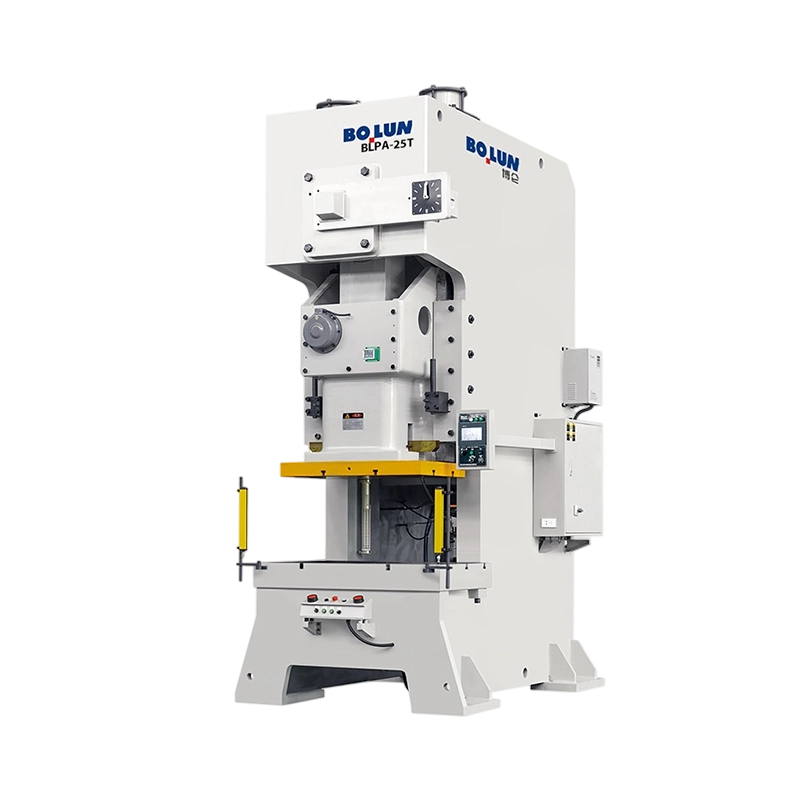
BLPA-25 Compact Precision Open-Type Single-Point Power Press
The slide is the primary moving member of the press, and its movement determines how the upper die approaches, contacts, and separates from the workpiece. The BLPA-25 is equipped with a dry clutch-brake system designed to provide responsive engagement and stopping. A sensitive clutch-brake arrangement helps the operator control the operating cycle while supporting accurate slide positioning during stopping.
In a production environment, stopping performance is important for several reasons. It affects operator safety, die inspection, setup efficiency, and the ability to respond to abnormal conditions. A press that stops predictably is easier to manage during die installation, trial production, adjustment, and troubleshooting. The dry clutch-brake system is supported by a dual solenoid valve, which contributes to reliable pneumatic control of the clutch and brake functions.
The dual solenoid valve configuration provides a control arrangement intended to improve operational dependability. In practical terms, the clutch and brake system must respond consistently to control signals and maintain an appropriate operating state throughout the cycle. The precise behavior of the press still depends on the complete electrical and pneumatic system, maintenance practices, and safety circuit configuration, but the integrated design creates a strong foundation for controlled operation.
The BLPA-25 also incorporates a hydraulic overload protector. Stamping dies can encounter unexpected conditions, including material double-feeding, excessive material thickness, improper die adjustment, foreign objects, or an incorrect press setting. Without overload protection, these conditions may damage the die, slide, crank mechanism, or frame. A hydraulic overload protector is designed to release or limit excessive force, helping reduce the risk of serious mechanical damage.
Overload protection is not a substitute for correct process engineering. Operators should still verify die clearance, material specifications, feed timing, lubrication, shut height, and rated load conditions. However, the protector provides an additional layer of defense when abnormal loading occurs. This is a valuable advantage over basic presses that may rely only on operator awareness or mechanical fuses with less convenient recovery characteristics.
The listed worktable size for the BLPA-25 is 680 × 300 × 70 mm, and the slide bottom size is 300 × 220 × 50 mm. These dimensions help define the practical tooling envelope. Before selecting a die, engineers should compare the die base dimensions, mounting holes, guide-post arrangement, material feed direction, and required working clearance with the press table and slide dimensions.
The throat depth is listed as 155 mm, and the distance between columns is listed as 418 mm for the BLPA-25 configuration. Throat depth affects how far a workpiece or die can extend into the press from the front of the frame. A larger throat depth can be useful for wider parts, but it may also influence structural behavior under load. The BLPA-25’s dimensions are appropriate for many compact stamping tools and small-component production systems.
The shank-hole diameter is listed as 38.1 mm. This dimension is relevant when using dies with a matching shank or when adapting tooling through an appropriate mounting arrangement. Tooling engineers should confirm the shank design, die height, mounting method, and load distribution before installation. Proper die seating is essential for preventing uneven loading and for protecting both the tooling and the press.
The product information describes a maximum die height of up to 260 mm and highlights the manual slide adjustment device. The detailed model table lists BLPA-25 vertical and horizontal configurations with maximum die heights of 195 mm and 215 mm, respectively. Because press specifications can vary by configuration, production planners should confirm the exact variant, die-height definition, and available adjustment range with the manufacturer before final tooling selection.
The listed die-height adjustment range for the BLPA-25 is 50 mm. A manual adjustment device provides a direct and economical method for setting the slide relative to the die. It is especially suitable for operations in which tooling is changed periodically but not continuously throughout every production shift. Manual adjustment can also reduce the complexity of the system and simplify routine setup for appropriately trained operators.
The BLPA-25 is listed with a nominal capacity of 250 kN. The corresponding nominal pressure stroke is shown as 3.2 mm for the vertical configuration and 1.6 mm for the horizontal configuration. These values indicate the point in the slide stroke at which the press can deliver its rated nominal force. A press should not be selected solely by comparing maximum tonnage. The force curve, material behavior, die design, and position of peak load must all be considered.
The model table presents two configuration options, identified as V and H. For the BLPA-25, the vertical configuration is listed with a speed-changing range of 60 to 140 strokes per minute and a stable speed of 110 strokes per minute. The horizontal configuration is listed with a speed-changing range of 130 to 200 strokes per minute and a stable speed of 110 strokes per minute. The slide strokes are listed as 70 mm for V and 30 mm for H.
These two options allow the machine to address different production priorities. The longer 70 mm stroke can provide more travel for certain forming and feeding arrangements, while the shorter 30 mm stroke and higher available speed range can be beneficial for faster repetitive operations with suitable tooling. The choice should be based on the required forming depth, die opening, feed pitch, material handling system, and target output.
| Specification | BLPA-25 V | BLPA-25 H |
| Nominal capacity | 250 kN | 250 kN |
| Nominal pressure stroke | 3.2 mm | 1.6 mm |
| Speed-changing range | 60–140 strokes/minute | 130–200 strokes/minute |
| Stable speed | 110 strokes/minute | 110 strokes/minute |
| Slide stroke | 70 mm | 30 mm |
| Maximum die height listed in model table | 195 mm | 215 mm |
| Die-height adjustment | 50 mm | 50 mm |
| Worktable size | 680 × 300 × 70 mm | 680 × 300 × 70 mm |
| Slide bottom size | 300 × 220 × 50 mm | 300 × 220 × 50 mm |
| Throat depth | 155 mm | 155 mm |
| Distance between columns | 418 mm | 418 mm |
| Main motor | 3.7 kW × 4 pole | 3.7 kW × 4 pole |
| Approximate machine weight | 2.0 tons | 2.0 tons |
The table should be used as a preliminary selection reference rather than a substitute for a final technical review. Variations may occur according to voltage, control system, customer-specific options, regional standards, safety equipment, and production configuration. Confirmed technical documentation should govern purchasing, installation, and process validation.
When comparing the BLPA-25 with conventional low-cost presses, buyers should examine the total operating value rather than only the initial purchase price. A basic machine may provide a nominal force rating but offer limited information about frame treatment, clutch-brake response, overload protection, die adjustment, or precision classification. These omissions can become costly when the press is used for continuous production.
One advantage of the BLPA-25 is its combination of a rigid, stress-relieved frame and a precision-oriented control arrangement. This combination addresses both static and dynamic aspects of stamping. The frame supports alignment under load, while the clutch-brake and control valves support repeatable cycling and stopping. A press that addresses both areas can provide a more stable platform than a machine designed primarily around low acquisition cost.
The hydraulic overload protector is another important differentiator. In production, die damage can exceed the cost of a single machine component because it may also cause material loss, long repair delays, and missed delivery schedules. Overload protection helps manage the consequences of unexpected force. It is especially useful for manufacturers operating progressive dies or tools with relatively high replacement costs.
The BLPA-25 also offers a practical balance between speed and working stroke. Some compact presses are optimized for speed but have limited stroke length, while other machines provide a longer stroke but operate too slowly for high-output work. By offering V and H configurations, the BLPA-25 enables users to select a configuration that better matches the process. This flexibility can improve productivity without forcing the buyer into a much larger machine.
Manual slide adjustment is a further benefit in applications that require straightforward and economical setup. While motorized adjustment may be preferred for frequent automated die changes, manual adjustment can be advantageous when it reduces system complexity, lowers maintenance requirements, and gives operators direct control of the setup procedure. For many small and medium-sized stamping shops, this is an appropriate balance between capability and investment.
The machine’s listed precision classification of GB(JIS) 1 class provides an additional indication of its intended quality level. Precision classification alone does not guarantee finished-part accuracy, because die quality, material consistency, lubrication, feed accuracy, and operator practice are also important. However, it establishes a more demanding design and inspection objective than an unspecified general-purpose press.
The manufacturer’s production capabilities are based on a full-chain approach that includes research and development, design, component development, precision processing, assembly, inspection, sales, and service. This integrated structure is significant for a precision press because performance depends on the interaction of many subsystems. Frame geometry, drive transmission, slide guidance, clutch-brake behavior, hydraulic protection, electrical control, and final alignment must work together.
A company with internal design and manufacturing capabilities can respond more effectively to technical requirements than a supplier that only assembles externally sourced equipment. Integrated engineering makes it easier to review modifications, control interfaces between components, and maintain consistent production standards. It also supports non-standard customization for customers requiring special dimensions, functions, automation interfaces, or process adaptations.
The production process begins with engineering analysis and product design. Engineers must evaluate the intended load range, frame structure, crank and slide movement, die space, operating speed, safety requirements, and service conditions. For precision machinery, design decisions must account for both maximum load and repeated cyclic loading. A press used for thousands or millions of cycles requires attention to fatigue resistance, lubrication paths, bearing selection, vibration control, and maintainability.
Steel plate preparation and frame fabrication are critical stages. Material quality, cutting accuracy, welding sequence, and dimensional control all affect the completed structure. Controlled welding procedures help minimize distortion, while heat treatment helps relieve residual stress. Once the frame has stabilized, precision machining can establish the required mounting surfaces, guide locations, table planes, and component interfaces.
Precision machining is particularly important for the worktable and slide-related surfaces. If the table is not sufficiently flat or if the slide mounting and guidance surfaces are not correctly aligned, die parallelism may suffer. Such errors can produce uneven clearance, premature die wear, edge chipping, incomplete forming, or variation in part dimensions. A modern press manufacturer therefore needs appropriate machining equipment, inspection tools, process documentation, and qualified technicians.
The company describes its manufacturing environment as covering basic design, core component development, processing, and final machine assembly. This breadth supports better control over the complete equipment lifecycle. It also creates a foundation for continuous improvement because production feedback can be communicated directly to design and process teams.
Final assembly is more than the installation of individual components. Assemblers must verify the relationship between the frame, drive system, slide, clutch-brake, hydraulic overload protector, electrical cabinet, pneumatic system, and guarding. Correct assembly affects noise, vibration, stopping behavior, lubrication, and service life. A press that is assembled with careful alignment and documented inspection is more likely to deliver stable performance after installation.
Quality control extends beyond a final visual check. The manufacturer states that it operates a finished-product inspection system intended to exceed ordinary industry requirements. Such a system may include dimensional verification, functional testing, no-load cycling, clutch-brake testing, overload protection checks, electrical inspection, pneumatic pressure verification, and evaluation of operating noise and vibration. The exact inspection scope should be confirmed in the machine acceptance documentation.
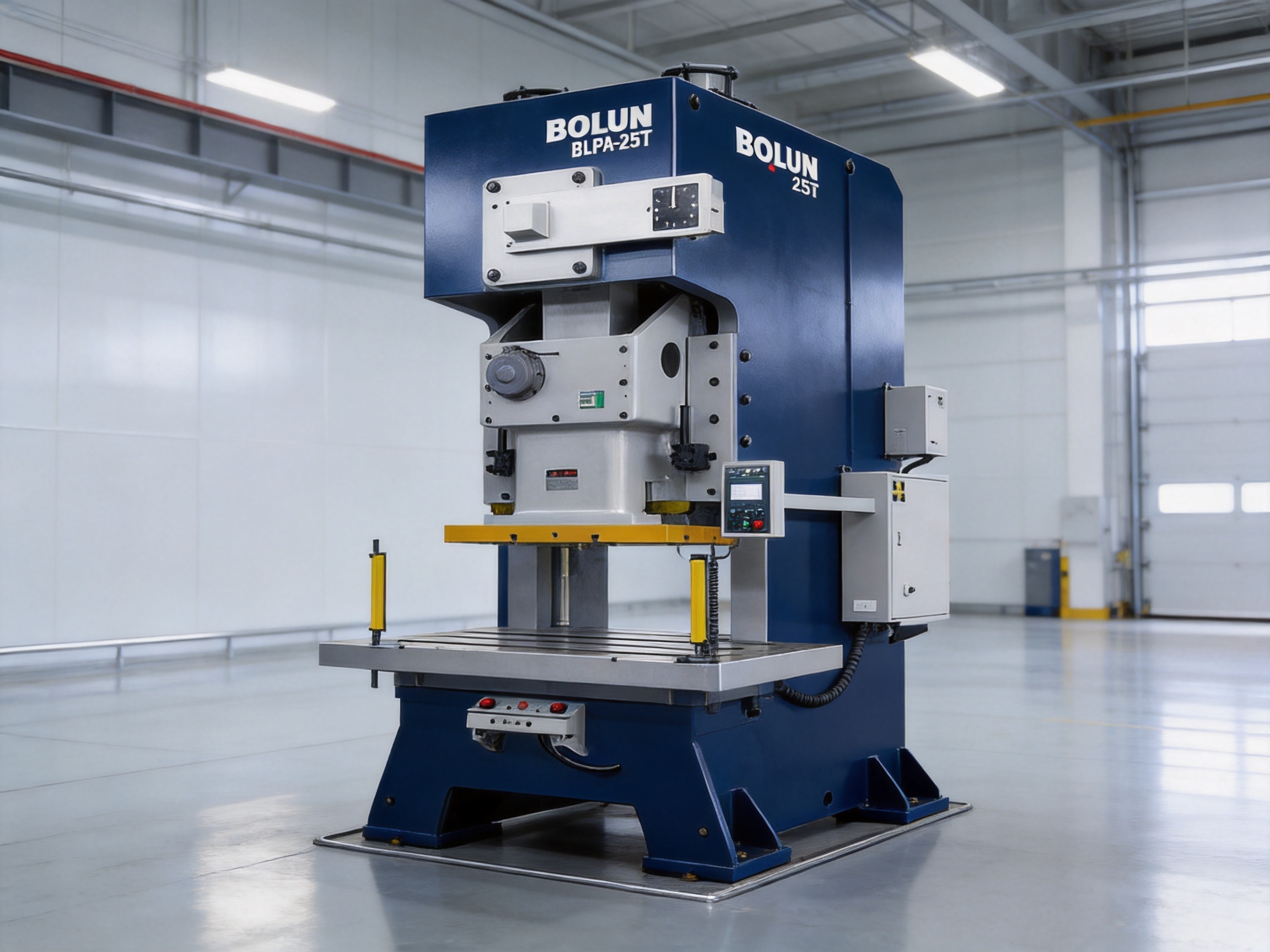
Precision in stamping is a system result. The press, die, material, feed equipment, lubrication, sensors, and operator procedures all contribute to final product quality. The BLPA-25 is designed to provide a stable mechanical and control foundation within that system. Its stress-relieved frame helps support structural stability, while its precision classification and controlled slide operation are intended to support repeatable stamping conditions.
Reliable equipment contributes to lower total cost of ownership. If a press experiences frequent stoppages, inconsistent stopping, uncontrolled overload events, or gradual alignment problems, the direct repair expense is only part of the impact. Additional costs may include scrapped parts, die repairs, production rescheduling, overtime, customer claims, and reduced confidence in the manufacturing line.
A robust press can help reduce these risks when it is correctly installed and maintained. The BLPA-25’s hydraulic overload protector offers protection during abnormal loading, and its clutch-brake system supports controlled cycles. The compact design can simplify access to the operating area and reduce the scale of supporting infrastructure compared with a much larger press.
Maintenance remains essential. Operators should follow the manufacturer’s lubrication schedule, inspect clutch-brake components, monitor pneumatic pressure, check hydraulic protection devices, examine fasteners, clean the die area, and verify electrical safety circuits. The worktable and slide should be kept free from chips and debris that could affect die seating. Preventive maintenance is especially important for precision stamping because small changes in guide clearance or stopping behavior can become visible as product variation.
Long-term value also depends on spare-parts support and technical service. The manufacturer describes a customer-oriented service system covering pre-sales consultation, in-sales support, and after-sales guarantees. These services can assist with model selection, tooling compatibility, installation, commissioning, operator training, troubleshooting, and future process expansion. For international buyers, the availability of responsive technical communication is an important part of equipment value.
The BLPA-25 can support a wide range of stamping operations when the required force and die dimensions fall within its operating envelope. Blanking applications use the press to cut profiles from sheet material. Piercing applications create holes or slots. Bending and forming operations reshape material through controlled die movement. Embossing can add ribs, grooves, identification features, or localized strengthening patterns.
Electrical and electronic component manufacturers may use a compact precision press for terminals, contact pieces, shielding components, clips, and small brackets. These parts often require repeatable dimensions, clean edges, and stable high-volume production. The open working area can also be helpful when material is fed from a coil through a compact feeder or when parts are collected by a simple automation system.
Hardware manufacturers may use the press for washers, clips, small hinges, brackets, fasteners, and formed fittings. In these applications, production speed and die life can be as important as peak force. The V and H configuration options make it possible to consider different stroke and speed requirements according to the part geometry.
Appliance and consumer-product manufacturers can apply the press to small reinforcement plates, mounting pieces, covers, and internal supports. The compact footprint can be useful in facilities where multiple presses are arranged in cells. A correctly planned cell can combine the press with a decoiler, straightener, feeder, inspection station, and collection system.
Automotive suppliers may use the machine for smaller stamped components, clips, sensor brackets, interior hardware, and other non-structural parts. Automotive production typically requires strong process documentation and traceability. In such environments, the press can be integrated into a controlled production process with die maintenance records, first-piece inspection, statistical process monitoring, and scheduled preventive maintenance.
Small contract manufacturers may also benefit from the BLPA-25 because it can handle varied tooling without requiring the investment associated with a large high-tonnage press. Its manual die-height adjustment can be useful for job-shop environments in which different parts are produced in batches. The press can serve as a flexible production asset for customers that value changeover simplicity and broad application coverage.
Successful performance begins before the machine arrives. The installation site should be evaluated for floor strength, access routes, lifting capacity, electrical supply, compressed-air quality, ventilation, lighting, and operator clearance. The published overall dimensions and machine weight provide initial planning data, but the final installation layout should include space for maintenance and die handling.
The specified air pressure is listed as 0.55 MPa. The facility should provide clean, dry, stable compressed air at the required flow rate. Moisture, oil contamination, pressure fluctuations, or inadequate filtration can affect pneumatic valves and clutch-brake performance. Appropriate air preparation equipment and a clearly accessible shutoff valve should be included in the installation plan.
Electrical requirements should be confirmed before shipment because voltage, frequency, control standards, and safety interfaces may vary by country or customer site. The main motor for the BLPA-25 is listed as 3.7 kW with a four-pole configuration. This does not by itself define the complete electrical installation requirement. Buyers should obtain the approved electrical schematic, motor data, control voltage, protection requirements, grounding instructions, and recommended upstream disconnect specifications.
Die installation should be performed by trained personnel using approved lifting and securing methods. The die must be centered and firmly mounted on the worktable. The upper die should be correctly connected to the slide, and the slide height should be adjusted gradually. Before production cycling, the operator should verify the die opening, feed alignment, material path, lubrication, sensors, emergency stops, and guarding.
Trial production should begin at a conservative speed. The team should inspect the first parts for burrs, cracks, wrinkles, dimensional errors, incomplete forming, and evidence of uneven loading. Speed can then be increased only after the tooling and process demonstrate stable operation. The nominal speed range is a capability reference, not a recommendation that every die should run at the maximum rate.
The open-type design can be integrated with different levels of automation. Manual loading may be sufficient for low-volume or frequently changing work. A mechanical or electronic feeder may be suitable for coil-fed production. Simple part ejectors, conveyors, sensors, and collection systems can increase productivity while reducing repetitive handling.
When adding automation, the press cycle, slide position, feed pitch, die opening, and safety circuits must be coordinated. A feeder must not advance material while the die is closed. Sensors should confirm material position and, where appropriate, detect double feeding or misfeeding. The press control system and auxiliary equipment should be designed so that an abnormal signal places the system in a safe state.
The BLPA-25’s compact dimensions can make it suitable for modular production cells. A cell may include material preparation, stamping, part separation, inspection, and packaging. Such an arrangement can reduce work-in-process handling and improve production visibility. The machine’s value is therefore not limited to its stand-alone cycle speed; it can also contribute to a broader manufacturing system.
For customers planning future automation, it is important to discuss interface requirements at the quotation stage. Relevant topics include feeder mounting, electrical signals, emergency-stop integration, stroke-position outputs, die sensors, light curtains, two-hand controls, guarding, and communication with supervisory equipment. Early planning avoids expensive modifications after installation.
Buyers comparing the BLPA-25 with competing open-type power presses should evaluate several categories. The first is structural design. Ask whether the frame is stress relieved, how critical surfaces are machined, what inspection standards are applied, and how parallelism is verified. A nominal tonnage number without structural information is not enough to predict long-term stamping behavior.
The second category is motion and stopping control. Compare the clutch-brake system, valve arrangement, stopping repeatability, response to emergency commands, and available safety functions. Reliable stopping can improve setup efficiency and reduce risk during abnormal events.
The third category is overload protection. Determine whether the press includes hydraulic or other protection, how quickly the system can be reset, and what maintenance is required. Overload protection is particularly important when expensive dies or automated feeding systems are involved.
The fourth category is die compatibility. Check table dimensions, slide dimensions, throat depth, column spacing, shank-hole diameter, die-height range, stroke, and available adjustment. A press that appears attractive on price may become unsuitable if existing tooling requires extensive modification.
The fifth category is service and manufacturing capability. Consider the supplier’s engineering depth, inspection system, spare-parts support, customization capability, commissioning service, and response time. Equipment performance is influenced by the supplier’s ability to support the machine throughout its operating life.
On these criteria, the BLPA-25 offers a balanced proposition. It combines a compact open frame with a 250 kN capacity, stress-relieved steel-plate construction, dry clutch-brake control, dual solenoid valve operation, hydraulic overload protection, manual slide adjustment, and a precision-oriented design target. This combination makes it a strong candidate for manufacturers seeking dependable performance without moving immediately to a larger and more expensive press category.
Zhejiang Bolun High-Precision Machinery Co., Ltd. is located in Zhejiang, an important center of China’s manufacturing industry. The company has approximately two decades of experience in machinery manufacturing and focuses on high-precision forming equipment, forging machinery, and casting machinery. Its activities include research and development, design, production, sales, and service.
The company’s stated manufacturing philosophy emphasizes technology, full-chain production, non-standard customization, and international management practices. These strengths are relevant to buyers that require more than an off-the-shelf machine. Special working dimensions, customized functions, automation integration, and unusual process requirements may require coordinated design changes across mechanical, hydraulic, pneumatic, and electrical systems.
The company reports investment in advanced precision-processing equipment and a mature industrial environment. Such resources support the manufacture of components requiring controlled dimensions and surface quality. They also help reduce reliance on uncontrolled outsourcing for critical elements of the machine. Internal capabilities can improve communication between design engineers, production technicians, quality inspectors, and service personnel.
Quality management is presented as a central operating principle. The company states that it performs rigorous inspection on processes and components to support stable precision and long service life under demanding operating conditions. For international customers, this quality focus should be supported by formal inspection records, machine acceptance standards, dimensional reports, test procedures, and traceable documentation.
The organization also describes a service structure covering pre-sales consultation, in-sales support, and after-sales assistance. This is important because the correct press selection depends on the customer’s actual material, tooling, output, and automation requirements. Technical consultation before purchase can prevent capacity mismatches, while commissioning and training can help operators reach stable production more quickly.
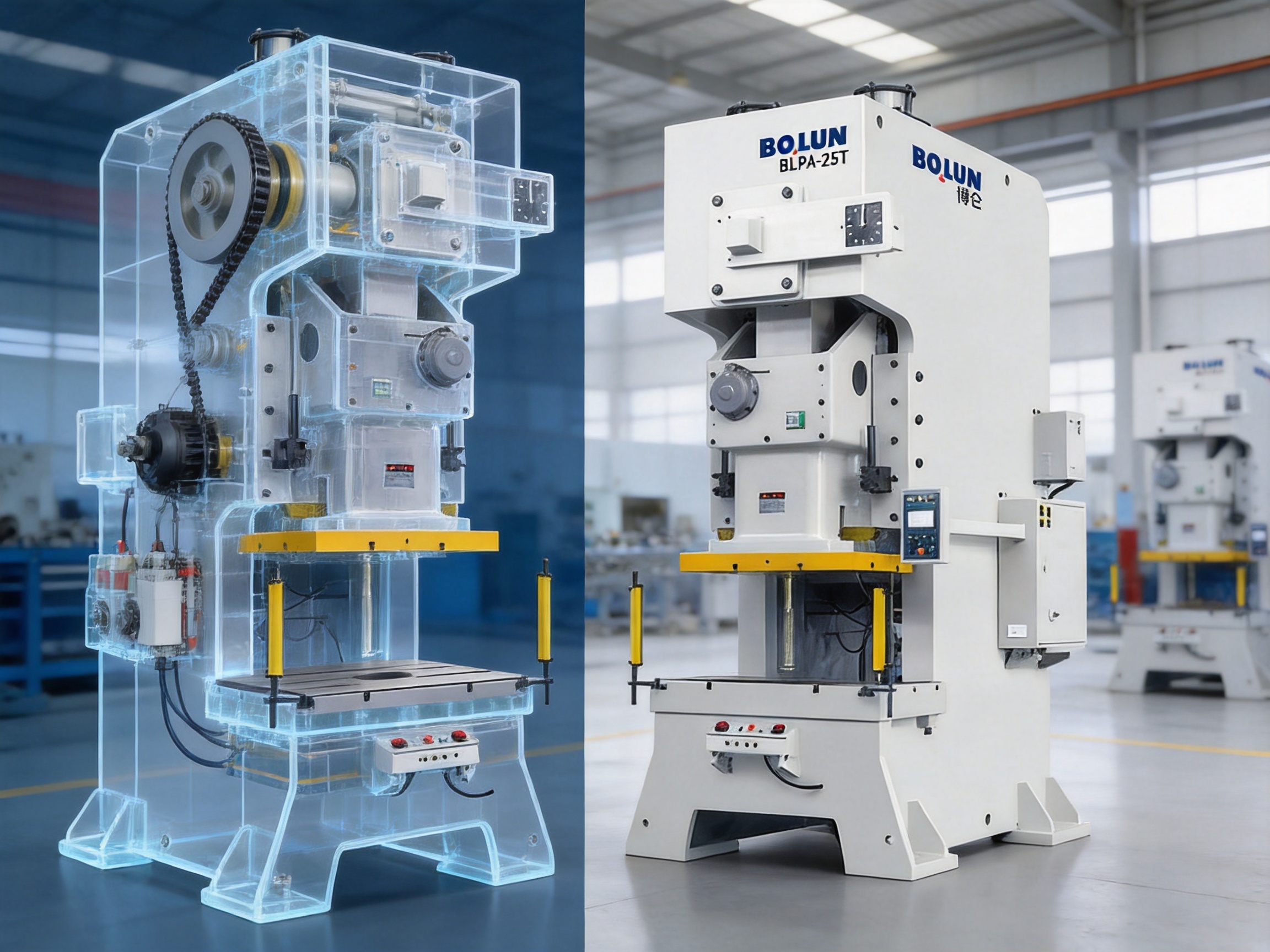
Operators should begin each shift with a visual inspection of the machine, die area, guards, controls, lubrication points, air lines, and hydraulic protection system. Loose fasteners, damaged cables, oil leakage, unusual noise, or abnormal air pressure should be addressed before production begins. No machine should be operated when a safety function is bypassed or when the cause of an abnormal condition is unknown.
Before installing a die, isolate the machine according to the approved lockout and maintenance procedure. Confirm that the die is within the press capacity and that the die height, shank, mounting pattern, and working dimensions are compatible. Use suitable lifting equipment and never position hands beneath an unsupported die or slide.
During setup, adjust the slide gradually and verify the relationship between the upper and lower die. Run the machine in an approved setup mode where available, and check for interference at low speed. Confirm that material feeds correctly and that the part exits without obstruction. Only after these checks should the press be placed into normal production operation.
During production, monitor part quality, noise, vibration, stroke behavior, material feed, and die temperature. A gradual increase in burr height, dimensional variation, or abnormal sound may indicate die wear, misalignment, inadequate lubrication, or a developing mechanical problem. Early detection can prevent extensive damage.
At the end of a production run, remove scrap and material safely, clean the worktable, inspect the die, and record any issues for the next shift. Maintenance records should include cycle counts where available, lubrication activities, component replacements, overload events, and changes in tooling or material. These records support preventive maintenance and help identify recurring process problems.
A compact press can contribute to more efficient use of factory space. The BLPA-25 is designed for a relatively small working envelope while offering a 250 kN nominal capacity. This can allow manufacturers to increase capacity within an existing workshop without immediately expanding the building or rearranging large sections of the production floor.
The machine’s 3.7 kW main motor is appropriate to its compact capacity class. Actual energy consumption depends on stroke rate, load, idle time, motor efficiency, control strategy, and auxiliary equipment. Efficient production planning can reduce unnecessary idle operation and improve the energy used per finished part.
Long service life also has an environmental and economic dimension. A durable press that remains accurate and maintainable for many years reduces the need for premature replacement. Stable operation can reduce scrap and rework, while overload protection can help prevent major damage to both the machine and dies. These benefits depend on responsible use, proper maintenance, and suitable process design.
The BLPA-25 is a compact precision open-type single-point power press. It is designed for stamping and forming small and medium-sized sheet-metal components and has a nominal capacity of 250 kN.
Its main advantages include a rigid heat-treated steel-plate frame, a sensitive dry clutch-brake system, a dual solenoid valve, a hydraulic overload protector, manual slide adjustment, practical die space, and configuration options for different stroke and speed requirements.
The rated nominal capacity is 250 kN. The press should be selected according to the complete force requirements of the material and die, including the position of peak load and the required safety margin.
The published model table identifies vertical and horizontal configurations as V and H. The V version is listed with a 70 mm slide stroke, while the H version is listed with a 30 mm slide stroke. Their speed ranges and nominal pressure stroke values also differ.
The BLPA-25 V configuration is listed with a speed-changing range of 60 to 140 strokes per minute, while the H configuration is listed with a range of 130 to 200 strokes per minute. Both are listed with a stable speed of 110 strokes per minute. Actual production speed depends on the die, material, feed system, and process requirements.
Yes. The product description specifies a hydraulic overload protector. It is intended to help limit damage caused by abnormal loading, although correct die setup and process control remain essential.
The product description specifies a manual slide adjustment device. The model table lists a die-height adjustment range of 50 mm for the BLPA-25.
The listed worktable size is 680 × 300 × 70 mm. The slide bottom size is listed as 300 × 220 × 50 mm. Tooling compatibility should be confirmed before purchase.
The listed throat depth is 155 mm, and the distance between columns is listed as 418 mm for the BLPA-25 configuration.
The published specification lists an air pressure of 0.55 MPa. The installation should provide clean and stable compressed air with suitable filtration and drainage.
The general product description refers to a maximum die height of up to 260 mm, while the detailed model table lists 195 mm for the V configuration and 215 mm for the H configuration. Buyers should confirm the exact machine variant and the manufacturer’s definition of die height before finalizing tooling.
It can be considered for integration with feeders, sensors, conveyors, part ejectors, and other automation equipment. The required interfaces and safety circuits should be reviewed with the manufacturer before ordering.
Potential industries include electrical and electronic components, appliance parts, hardware, automotive components, small brackets, terminals, clips, covers, and general sheet-metal manufacturing.
Maintenance should include lubrication, clutch-brake inspection, pneumatic and hydraulic checks, fastener verification, electrical safety inspection, cleaning of the table and die area, and regular review of alignment and operating performance. The manufacturer’s maintenance instructions should take priority.
Heat treatment helps reduce residual stress in the steel-plate frame after fabrication. This supports dimensional stability and reduces the risk of distortion that could affect alignment and long-term precision.
The BLPA-25 Compact Precision Open-Type Single-Point Power Press is engineered for manufacturers that require reliable stamping performance in a compact production format. Its 250 kN nominal capacity, rigid stress-relieved frame, dry clutch-brake system, dual solenoid valve, hydraulic overload protection, manual slide adjustment, and practical tooling dimensions provide a balanced combination of productivity, control, and maintainability.
Its competitive value comes from the way these features work together. The machine is designed not only to deliver force but also to support repeatable movement, predictable stopping, die protection, convenient setup, and long-term structural stability. The availability of V and H configurations allows users to align stroke and speed characteristics with the needs of different stamping processes.
The manufacturer strengthens this product proposition through integrated capabilities in research and development, precision processing, assembly, inspection, customization, and service. For customers seeking a dependable precision press supplier, these capabilities can be as important as the machine’s published specifications. Proper selection, installation, tooling, training, and preventive maintenance will allow the BLPA-25 to deliver its best performance in demanding industrial environments.
1. Product technical specification for the BLPA series open-type single-point power press.
2. Manufacturer-provided information on BLPA-25 construction, operation, and application.
3. General engineering principles for mechanical stamping press design and frame rigidity.
4. Industrial guidance on clutch-brake systems, hydraulic overload protection, and press safety.
5. General practices for sheet-metal die selection, press capacity calculation, and tooling setup.
6. Manufacturer information concerning precision machining, heat treatment, quality inspection, and after-sales service.


A buyer comparing a 45-ton open-gap press for a bracket line often receives two...
What Is a Power Press? A power press — also called a stamping press or punch pr...
Understanding Mechanical Power Presses and Their Essential Functions A mechani...
In the fields of metal forming, sheet metal fabrication, blanking, and punching,...
Two presses can both carry a 200-tonne nameplate and still produce very differe...
Start With the Purchase Decision, Not the Definitions A procurement engineer co...
Contact Us

topbolun@gmail.com

+86-575-83362228

+86-13735238388
+86-18667502750

+86-575-83362999

+8618667502750

No.1 Linjiang Road East, Xiaren, Jinting Town, Shengzhou City, Zhejiang Province, China
Ready to Begin?
Get in Touch

Now!

ZHEJIANG BOLUN
 English
 中文简体