
In modern metal forming, manufacturers are under constant pressure to produce larger, more complex, and more accurate sheet metal parts while reducing cycle variation, setup time, energy waste, and maintenance burden. The BLES-250 High-Energy Stable-Bed Closed-Frame Double-Point Servo Power Press is designed for this demanding environment. With a nominal capacity of 2500 kN, working energy of 25,200 J, a 280 mm stroke, a 2500 × 1000 mm worktable, and a 2200 × 900 mm slide bottom, this press targets high-tonnage stamping, deep drawing, large die applications, and precision forming tasks where rigidity, energy availability, and process stability are essential.
The machine belongs to the closed-type power press category and is specifically configured as a closed-frame double-point servo press. This configuration gives it a clear advantage in applications where an open-type press may not provide sufficient structural stiffness or load symmetry. Its closed-frame design supports stable force transmission, while the double-point drive helps maintain slide balance across a broad die area. Combined with a high-torque direct-drive servo system, CNC touch-screen control, and hand-wheel fine adjustment, the BLES-250 is positioned as a production-grade solution for automotive panels, appliance housings, structural sheet metal components, and other industrial stamping parts requiring both power and precision.
BLES-250 High-Energy Stable-Bed Closed-Frame Double-Point Servo Power Press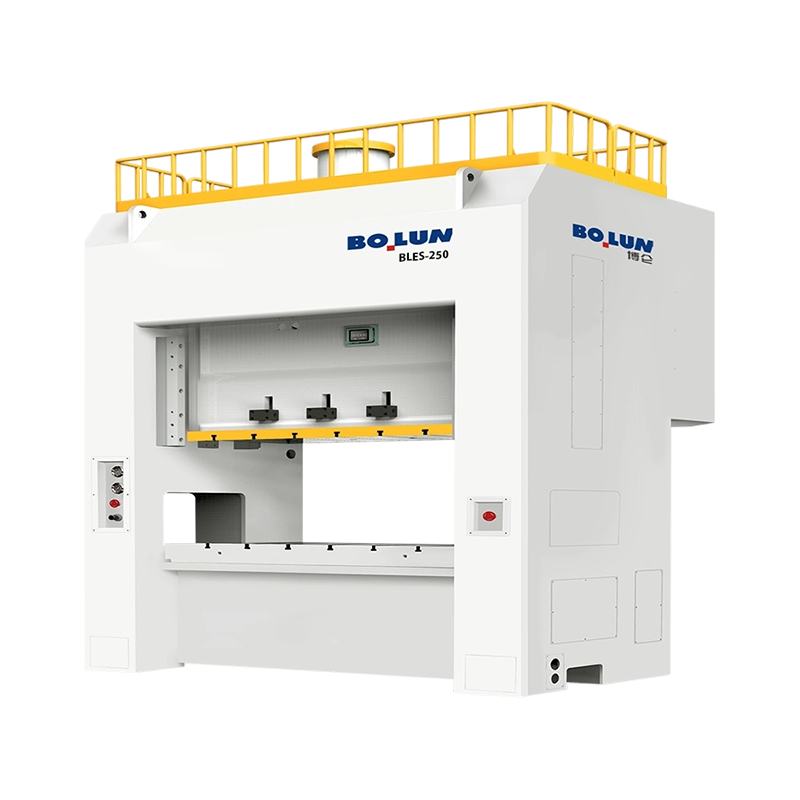
The BLES-250 is a high-energy stable-bed closed-frame double-point servo power press developed for manufacturers that require consistent forming force, high rigidity, and flexible process control. Its nominal capacity of 2500 kN makes it suitable for heavy forming operations, while its 25,200 J working energy provides the forming reserve required for deep drawing and large-area deformation. In practical production, energy is not merely a specification; it determines how reliably a press can complete demanding forming strokes without sacrificing consistency, surface quality, or dimensional repeatability.
The stable-bed structure gives the machine a solid foundation for continuous high-load operation. In stamping operations, deflection is one of the most important factors affecting part accuracy, die life, and process repeatability. A press that deflects excessively under load can produce parts with uneven thickness, inconsistent draw depth, poor edge quality, or dimensional deviation. The BLES-250 addresses this issue through a closed-frame construction that distributes stress through a rigid frame rather than allowing the machine throat to open under load, which is a common limitation in open-type designs.
The double-point system is another core feature. Large dies often require force to be applied across a wide area. A single-point press may be suitable for compact tooling, but when the die becomes wide or when forming loads are distributed unevenly, slide tilt can become a major concern. The double-point configuration improves slide stability, allowing the machine to maintain better parallelism between the slide and the worktable during operation. This is especially important for large body panels, appliance panels, deep-drawn enclosures, and wide structural parts.
The specifications of the BLES-250 reveal its intended position as a robust, high-energy press for serious industrial production. The machine is not designed as a light-duty workshop press; it is built for high-tonnage, high-precision, and continuous manufacturing tasks. The following table summarizes the key product information provided for this model.
| Item | Specification | Production Significance |
|---|---|---|
| Product Model | BLES-250 | High-energy closed-frame double-point servo press platform |
| Nominal Capacity | 2500 kN | Suitable for heavy stamping, large dies, and deep drawing |
| Working Energy | 25,200 J | Provides strong energy reserve for demanding forming operations |
| Stroke | 280 mm | Supports deep drawing and complex forming processes |
| Worktable Size | 2500 × 1000 mm | Accommodates large dies and wide sheet metal parts |
| Slide Bottom Size | 2200 × 900 mm | Improves compatibility with large tooling and distributed forming loads |
| Frame Type | Closed-frame stable-bed structure | Enhances rigidity, stability, and load distribution |
| Drive Type | High-torque direct-drive servo system | Enables flexible motion control and stable forming force |
| Control System | CNC touch-screen control with hand-wheel fine adjustment | Improves setup accuracy, operation convenience, and process repeatability |
| Main Applications | Automotive panels, appliance housings, structural sheet metal parts | Targets large-scale precision stamping and deep-drawing production |
A closed-frame press is often selected when production requires high rigidity, accurate slide guidance, and reliable force distribution. In contrast, open-type presses are convenient for loading and unloading, and they are widely used in smaller stamping applications. However, open-type frames can be more susceptible to angular deflection under heavy load. For large or high-force forming, this deflection can compromise part accuracy and shorten die life.
The BLES-250 uses a closed-frame structure to reduce these risks. The frame surrounds the working area and provides a more balanced path for forming loads. When the slide applies force to the workpiece, the closed frame resists deformation more effectively, helping maintain alignment between the upper and lower dies. This stable geometry is especially valuable in deep drawing, where material flow must be controlled carefully throughout the forming stroke.
Compared with a conventional open-type press of similar capacity, a closed-frame double-point press offers stronger resistance to off-center loading. This becomes important when forming parts that do not load the die evenly across the full working area. In real production, even well-designed tooling can create localized forces. A rigid closed-frame design helps reduce the negative effects of these forces, improving repeatability from the first part to the final part of a production batch.
For manufacturers of automotive or appliance parts, consistent geometry is not optional. A small dimensional deviation in one stamped component can create assembly problems later in the production chain. By improving structural rigidity and slide stability, the BLES-250 helps manufacturers reduce downstream rework, improve part fit, and maintain tighter production control.
The double-point configuration is one of the defining advantages of this press. In a double-point press, the slide is driven through two force points rather than one central point. This is important because the BLES-250 is designed with a large worktable and a wide slide bottom. Large dies require force to be distributed across a broad area, and the double-point structure supports that requirement more effectively than a single-point arrangement.
When a wide die is used in a single-point press, the slide may experience uneven loading, especially if the forming force is concentrated on one side. Over time, this can increase wear on guides, affect die alignment, and create inconsistent part quality. The double-point structure improves resistance to tilt and helps keep the slide moving in a controlled, balanced manner.
This advantage becomes especially clear in deep drawing. During drawing, material flows from the blank holder region into the die cavity. If slide motion is not stable, material flow may become uneven, creating wrinkles, tearing, surface defects, or inconsistent wall thickness. A stable double-point system supports more uniform pressure and better control of the forming process.
For large appliance housings, structural panels, and automotive sheet metal parts, die size often increases along with part complexity. The BLES-250’s 2500 × 1000 mm worktable and 2200 × 900 mm slide bottom provide the physical space needed for these dies, while the double-point system helps ensure that the press can use that space effectively. In other words, the machine is not merely large; it is structurally designed to perform accurately at large scale.
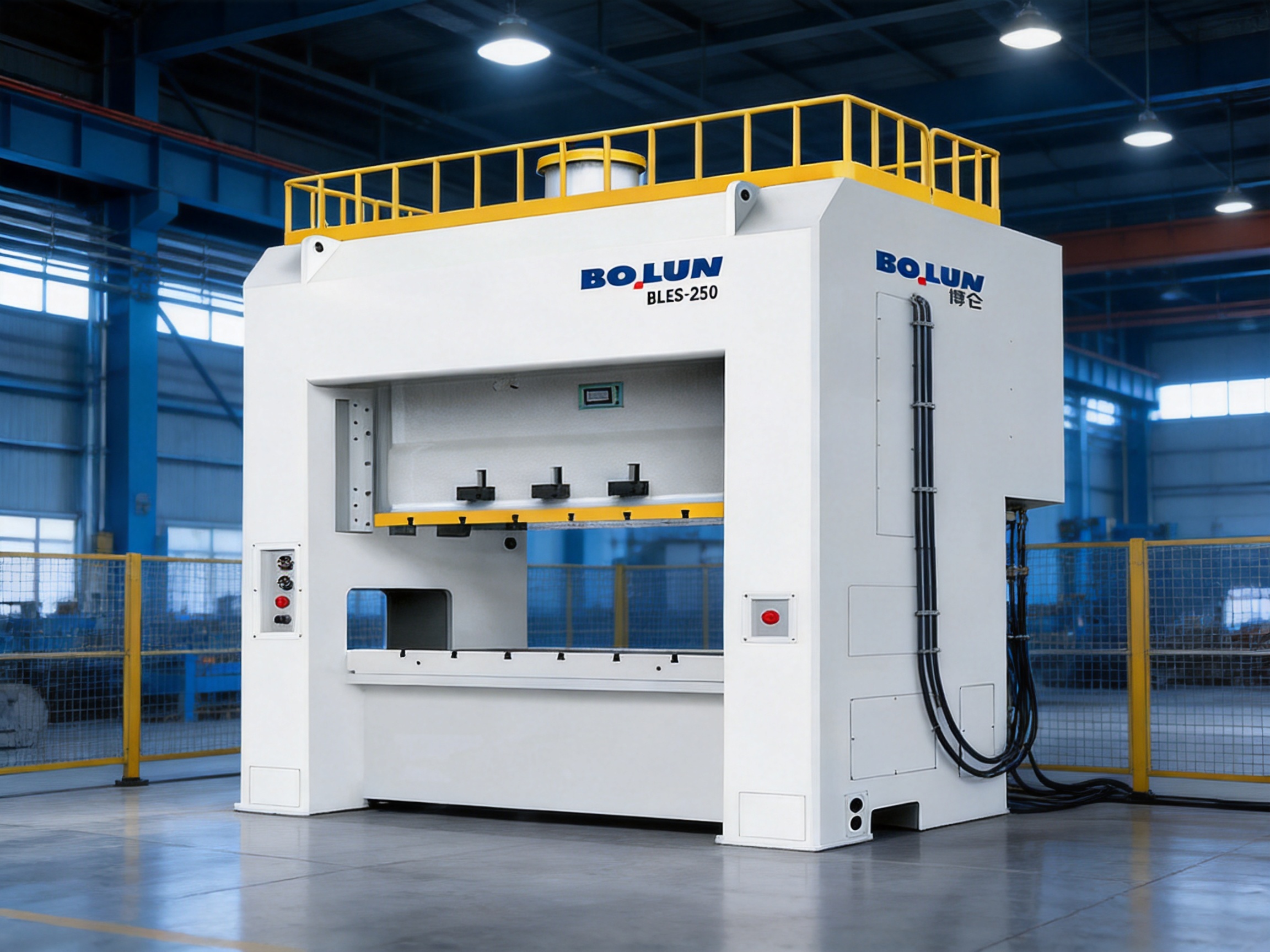
The high-torque direct-drive servo system is another major advantage of the BLES-250. Traditional mechanical presses are often limited by fixed motion characteristics. They can be fast and productive, but the slide motion is usually tied to the mechanical drive mechanism. Servo presses change this relationship by allowing the slide motion to be controlled more flexibly through servo-driven motion profiles.
In practical manufacturing, this means the press can be better adapted to the forming process. Different materials, thicknesses, and part geometries may require different slide speeds or dwell characteristics. A servo system can support more controlled motion during critical forming stages, helping improve material flow, reduce impact, and enhance forming quality.
For deep drawing, the ability to manage slide speed is particularly important. Excessive speed at the wrong stage can lead to tearing or surface defects, while too slow a process may reduce productivity. Servo control allows manufacturers to seek a better balance between forming quality and production efficiency. This flexibility is a significant advantage compared with many conventional presses that offer less control over slide motion.
The direct-drive nature of the servo system also supports stable power transmission. A high-torque direct-drive arrangement reduces reliance on complex intermediate mechanisms, helping improve response and control. While mechanical simplicity does not eliminate the need for maintenance, it can contribute to predictable operation and improved controllability.
In competitive production environments, servo technology can also support faster die setup and process development. Instead of changing mechanical components to alter motion behavior, operators and engineers can use the control system to adjust process parameters. This makes the press more adaptable when production changes frequently or when manufacturers handle multiple product families on the same equipment.
Nominal capacity alone does not fully define press capability. A press may have a high rated tonnage but insufficient energy for certain deep-drawing operations. The BLES-250 provides 25,200 J of working energy, giving it a strong forming reserve for difficult operations. This energy is particularly important when the forming stroke is long, when material deformation is severe, or when large parts require sustained force through a significant portion of the stroke.
Deep drawing differs from simple blanking or shallow forming. The material must flow, stretch, and reshape without failure. The press must not only reach peak force; it must maintain effective forming performance throughout the required stroke. The BLES-250’s energy capacity supports this requirement, making it suitable for parts such as large housings, drawn panels, and structural components.
Compared with lower-energy presses, the BLES-250 is better suited to applications where force demand remains high during forming. Inadequate working energy can cause speed loss, unstable forming behavior, or reduced production reliability. By providing a higher energy reserve, the press supports stable operation in heavy-duty applications.
For manufacturers, this can translate into fewer process interruptions and better confidence when developing new parts. When a press has sufficient energy margin, engineers have more room to optimize forming without operating at the edge of machine capability. This contributes to better long-term productivity and may reduce the risk of overload-related problems.
The BLES-250 provides a 2500 × 1000 mm worktable and a 2200 × 900 mm slide bottom. These dimensions are important for production sectors that rely on large dies. Automotive panels, appliance shells, and structural sheet metal parts often require wide tooling layouts, multiple forming stations, or large blank sizes. A press with insufficient table area may limit die design or force manufacturers to divide operations into additional steps.
A larger working area gives tooling engineers more freedom. They can design dies with adequate support, integrate auxiliary forming features, and manage material flow more effectively. The wide slide bottom helps distribute force across the upper die, supporting stable engagement with the lower die. This improves the machine’s suitability for forming parts with large projected areas.
The worktable size also supports production flexibility. A manufacturer may use the same press for different product types, from automotive reinforcement components to appliance covers. The ability to accommodate a range of die sizes helps improve equipment utilization and supports long-term return on investment.
In comparison with smaller presses or presses with limited slide area, the BLES-250 reduces constraints on part and die design. This does not mean every large die can be installed without engineering verification, but it does mean the machine is designed with industrial-scale forming needs in mind.
Modern stamping production requires more than mechanical strength. Operators need clear control interfaces, accurate adjustment, process repeatability, and efficient setup. The BLES-250 includes CNC touch-screen control and hand-wheel fine adjustment to support these needs. This combination allows operators to manage process settings while also performing precise mechanical setup tasks.
A touch-screen control interface improves usability by presenting machine information in a structured and accessible form. Operators can monitor parameters, adjust settings, and manage production operation with greater clarity. In plants where multiple operators or shifts use the same equipment, intuitive control can reduce training burden and improve consistency.
The hand-wheel fine adjustment feature is valuable during die setup and trial production. Fine adjustment allows operators to make controlled changes when aligning dies, setting shut height, or optimizing forming conditions. In high-precision stamping, small adjustments can produce meaningful differences in part quality. A press that supports accurate setup helps reduce trial time and material waste.
Compared with older presses that rely heavily on manual adjustment and less integrated control systems, the BLES-250 provides a more modern operating experience. This supports better process documentation and repeatability, especially when combined with disciplined production management and quality inspection procedures.
The automotive industry is one of the most demanding markets for stamping equipment. Parts must meet strict dimensional requirements, surface standards, and structural performance expectations. The BLES-250 is suitable for automotive body panels, reinforcement parts, brackets, and large sheet metal components requiring stable high-tonnage forming.
Automotive panels often have wide surfaces and complex curves. Forming these parts requires controlled material flow and stable slide motion. The closed-frame double-point design of the BLES-250 supports these needs by improving rigidity and reducing slide tilt. The servo system further assists by allowing more controlled motion during sensitive forming stages.
In automotive production, die costs are high and downtime is expensive. A rigid and stable press helps protect tooling by maintaining alignment and reducing abnormal load conditions. When the machine structure is stable, dies are less likely to experience uneven wear caused by press deflection or slide imbalance. This can contribute to longer die service life and more predictable maintenance planning.
As vehicle designs continue to evolve, manufacturers often work with different material grades and complex geometries. Servo press flexibility is useful in this context because motion profiles can be adjusted to support different forming requirements. This gives the BLES-250 value not only as a production press but also as a platform for process optimization.
Large appliance housings, covers, panels, and structural enclosures often require deep drawing or large-area forming. These parts may not have the same safety-critical requirements as automotive structural components, but they still demand consistent dimensions, clean surfaces, and efficient production. The BLES-250’s worktable size and energy capacity make it suitable for these applications.
Appliance panels frequently require smooth visible surfaces. Poor slide stability, uneven pressure, or uncontrolled forming can produce defects that are difficult to correct after stamping. The rigidity of the closed frame and the control flexibility of the servo system help reduce these risks. Manufacturers can adjust forming speed to protect surface quality and improve material flow.
For industrial sheet metal parts, the machine can handle large blanks and heavy forming loads. Structural parts may require precise bending, forming, or drawing operations, and the BLES-250 provides the capacity and working area needed for such work. Its large slide bottom also supports dies that distribute forming force across a wide surface.
Compared with smaller or less rigid presses, the BLES-250 gives manufacturers greater confidence when processing large and complex parts. It can reduce the need to outsource heavy forming work or divide production into multiple forming steps, depending on the part design and process plan.
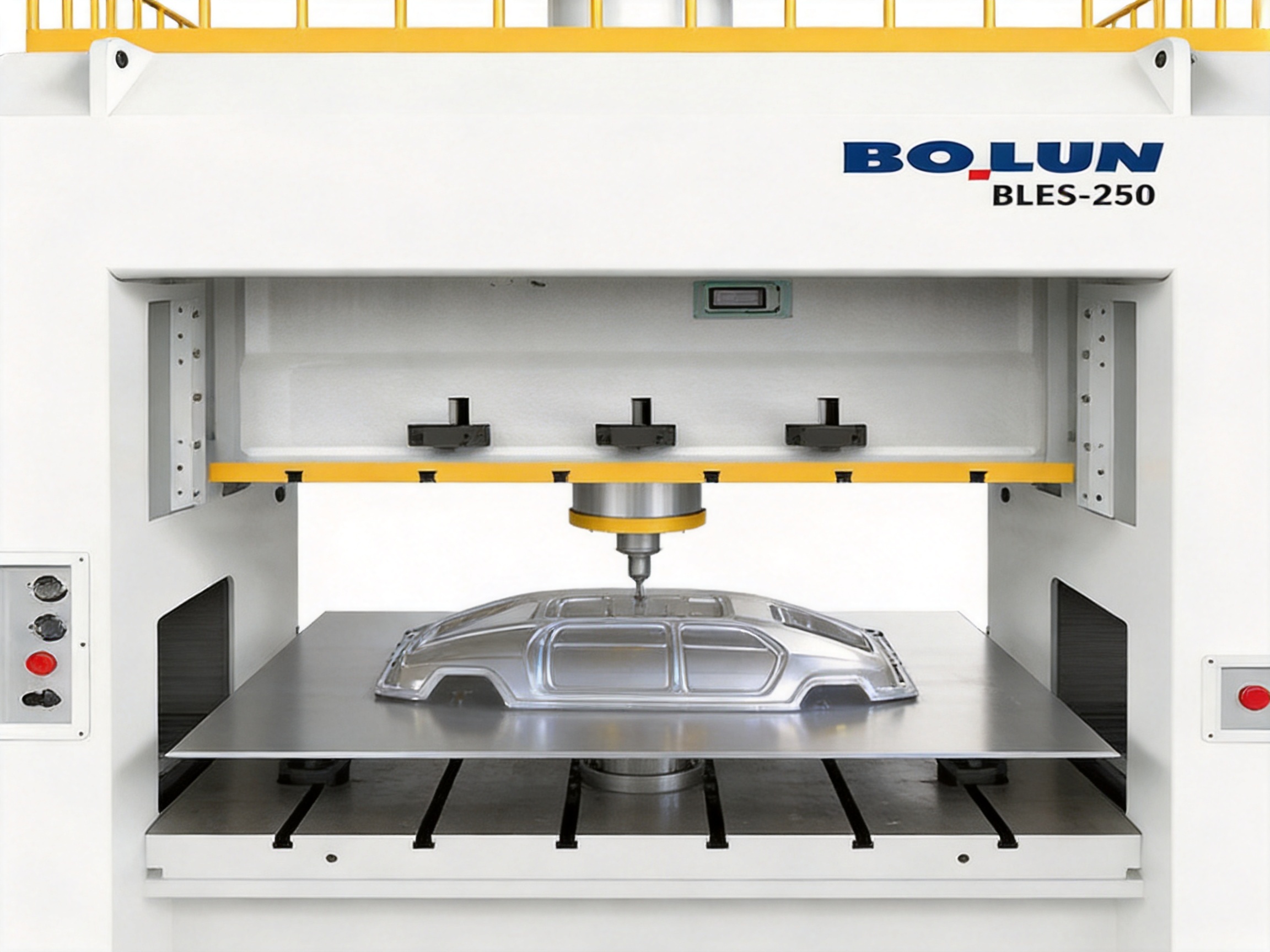
The BLES-250 offers several advantages over many conventional mechanical presses, open-type presses, and lower-energy stamping machines. Its main advantage is the combination of high capacity, high working energy, closed-frame rigidity, double-point stability, and servo control. Many presses may offer one or two of these features, but the value of the BLES-250 comes from integrating them into a production-oriented platform.
Compared with open-type presses, the closed-frame structure provides better resistance to deformation under heavy load. This is important for maintaining part accuracy and protecting tooling. Open-type presses remain useful for many applications, but for large high-tonnage work, a closed-frame press is often the more appropriate choice.
Compared with single-point presses, the double-point arrangement better supports wide dies and distributed loads. This is particularly important when working with large panels or tooling that does not load evenly at the center. Reduced slide tilt helps improve die alignment and forming consistency.
Compared with traditional fixed-motion presses, the servo system provides greater process flexibility. Operators and engineers can adjust slide motion to suit specific forming requirements, supporting quality improvement and process optimization. This flexibility is especially valuable for deep drawing, where material behavior can be sensitive to speed and pressure timing.
Compared with lower-energy presses, the BLES-250 provides a stronger energy reserve for heavy forming. This can improve reliability in applications where the press must sustain forming work over a longer stroke. The 25,200 J working energy helps position the machine for demanding industrial operations.
The performance of a power press depends not only on its design concept but also on the manufacturing capability behind it. Zhejiang Bolun High-Precision Machinery Co., Ltd. is located in Zhejiang, one of China’s important precision manufacturing regions. With two decades of experience in machinery manufacturing, the company has developed into an integrated enterprise covering research and development, design, production, sales, and service.
This integrated structure is important for high-precision forming equipment. A press such as the BLES-250 requires accurate design, reliable component processing, controlled assembly, and rigorous inspection. When these functions are coordinated within one manufacturing system, the company can better manage quality from early engineering through final delivery.
The company emphasizes a full-chain production system. This means that attention is given to each stage, including basic design, core component development, precision machining, assembly, inspection, and service support. For customers, this reduces the risk of fragmented responsibility and helps ensure that technical decisions are aligned throughout the machine’s development and manufacturing process.
Another strength is non-standard customization capability. Stamping customers often have different production conditions, die requirements, automation needs, and plant layouts. A press manufacturer with customization ability can better adapt the machine configuration to the customer’s actual process. This is especially valuable for high-tonnage equipment, where investment decisions must match long-term production goals.
High-precision machinery depends on accurate processing. The company owns advanced precision processing equipment and operates within a mature industrial environment. This supports the manufacture of key press components that must meet strict geometric and dimensional requirements. In a closed-frame servo press, the accuracy of frame processing, slide guidance, table surface, and drive component installation all influence final machine performance.
The assembly process is equally important. Even well-machined components can fail to achieve expected performance if assembly is not carefully controlled. Press assembly requires attention to alignment, fit, lubrication paths, guide accuracy, and drive synchronization. A mature production management system supports consistency in these tasks.
For the BLES-250, assembly discipline directly supports the machine’s advantages. The closed-frame structure must be accurately manufactured and assembled to deliver rigidity. The double-point mechanism must be aligned to maintain slide balance. The servo drive system must be integrated with the control system to provide reliable motion control. Each of these elements depends on coordinated manufacturing capability.
Compared with suppliers that rely heavily on outsourced or loosely coordinated production, an integrated manufacturing process can improve traceability and problem-solving efficiency. If a technical issue arises, engineering, production, and service teams can work from a shared understanding of the machine’s design and manufacturing history.
Quality is a central factor in the value of high-tonnage stamping equipment. A power press is expected to operate under repeated heavy loads for many years. Small errors in manufacturing or assembly can become serious problems after thousands or millions of cycles. Zhejiang Bolun High-Precision Machinery Co., Ltd. has established a finished product inspection system that exceeds basic industry expectations, with rigorous quality control applied to processes and components.
This inspection approach is essential for machines such as the BLES-250. Key quality concerns include frame rigidity, slide parallelism, table accuracy, drive stability, control response, and safety-related functions. By inspecting both components and completed machines, the company seeks to ensure stable precision and long service life under high-intensity operating conditions.
Quality control also supports customer confidence. High-tonnage presses represent significant capital investment. Customers need assurance that the machine will meet production requirements and maintain performance over time. A disciplined inspection system helps reduce uncertainty and supports reliable operation after installation.
In competitive terms, quality control is one of the most meaningful differentiators. A press may look similar to competing machines in external appearance, but long-term performance depends on details such as machining accuracy, material selection, heat treatment, assembly quality, lubrication design, and inspection discipline. The BLES-250 benefits from a manufacturing philosophy that treats quality as the lifeline of the enterprise.
Modern manufacturers increasingly require equipment that matches their exact production needs. Standard machines are useful, but large stamping projects often involve special die dimensions, automation interfaces, feeding systems, safety devices, or process requirements. The company’s design team provides one-stop design and manufacturing services for products with special specifications and functions, which is an important advantage for customers evaluating the BLES-250 platform.
Customization can include adjustments to machine configuration, control functions, production line integration, or tooling-related interfaces. The ability to discuss these requirements with an experienced manufacturer helps customers avoid mismatches between machine capability and production reality. This is especially important for automotive, appliance, and industrial component producers that may run complex parts and require reliable integration into existing production systems.
Engineering support also helps during process planning. A press is part of a broader production ecosystem that may include coil feeding, blanking, transfer systems, die handling, lubrication, part removal, and inspection. A manufacturer with R&D, design, production, sales, and service capabilities can provide more complete guidance than a supplier focused only on equipment delivery.
For buyers comparing suppliers, customization capability should be considered alongside price. A lower-cost machine that does not match production needs may create long-term inefficiency. A properly configured machine can improve utilization, reduce process limitations, and support future production expansion.
The BLES-250 is designed to support efficient production through stability, control, and adaptability. Efficiency in stamping is not measured only by strokes per minute. It also includes setup time, scrap rate, die life, maintenance needs, process consistency, and the ability to run different parts without excessive modification. The servo control system, fine adjustment capability, and large working area all contribute to operational value.
In high-tonnage stamping, scrap is expensive. Large blanks consume significant material, and rejected parts may represent substantial cost. By supporting stable forming and accurate setup, the BLES-250 can help reduce process variation that leads to scrap. Its structural rigidity and double-point slide stability help maintain consistent die conditions, while servo control allows forming parameters to be refined.
Maintenance efficiency is another consideration. A machine designed and manufactured with attention to component quality, alignment, and inspection can provide more predictable service. Predictability allows maintenance teams to plan rather than react. This can reduce unplanned downtime and improve overall equipment effectiveness.
Energy and process control are also part of production value. Servo presses are often valued for their ability to optimize motion and reduce unnecessary mechanical action in certain applications. While actual energy performance depends on process conditions and plant operation, servo technology gives manufacturers more control over how energy is applied during the forming cycle.
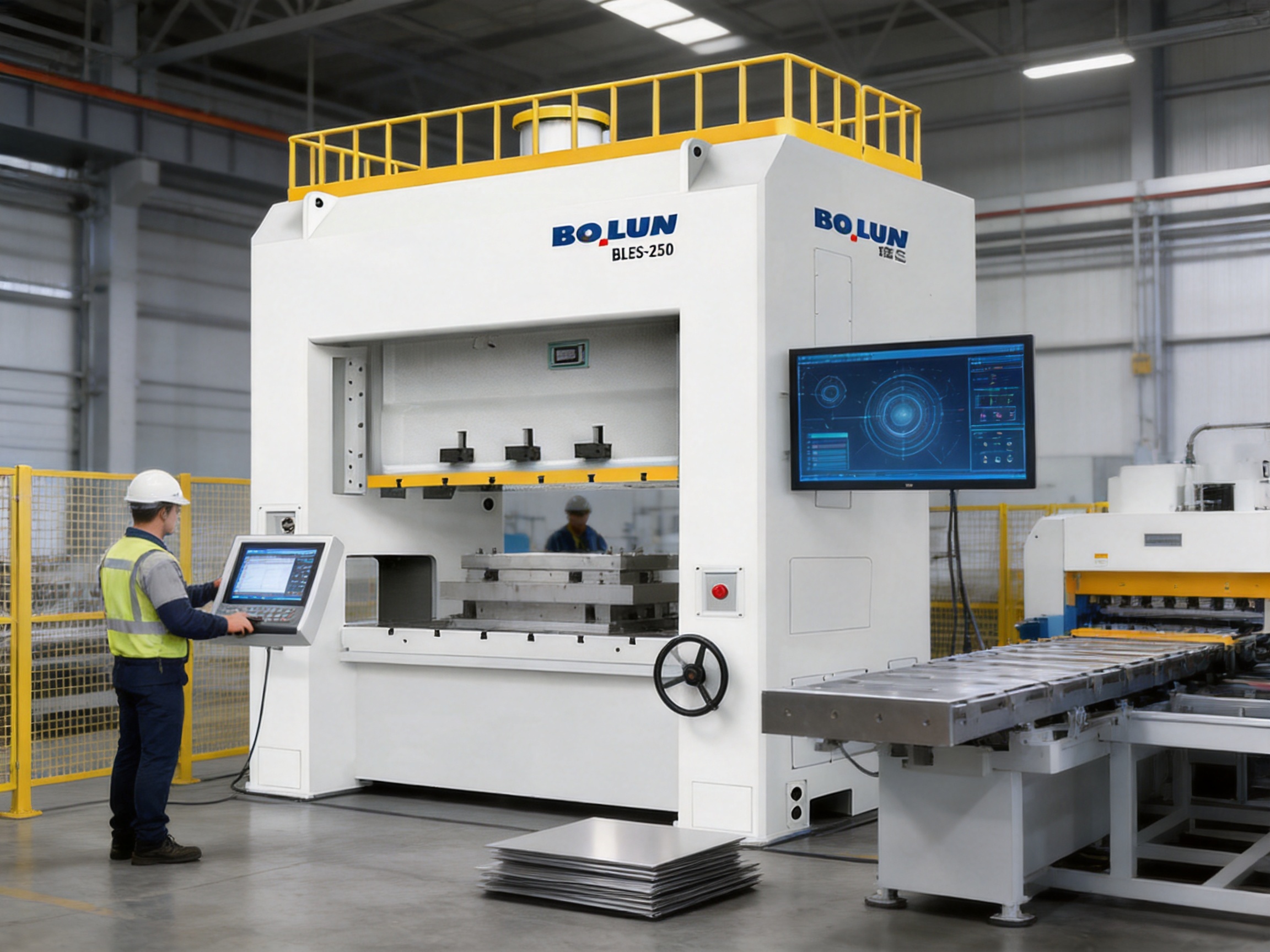
The future of stamping is increasingly intelligent, digital, and data-driven. Manufacturers want presses that can support process monitoring, parameter management, repeatable setup, and integration into production systems. The BLES-250’s CNC touch-screen control provides a foundation for more controlled and modern operation compared with older mechanical systems.
Digital control supports repeatability. When production parameters can be stored, reviewed, and adjusted through a control interface, manufacturers can reduce dependence on operator memory and informal setup habits. This is important for plants that run multiple shifts or produce several part families.
Servo control also supports process development. Engineers can experiment with slide motion profiles and forming conditions, then apply proven settings to production. This helps shorten the path from trial to stable production. For companies introducing new stamped products, this flexibility can be a significant advantage.
Zhejiang Bolun High-Precision Machinery Co., Ltd. has stated a direction toward intelligent and digital stamping equipment. This aligns with global manufacturing trends, where customers increasingly expect machines to provide not only mechanical force but also process intelligence, operational transparency, and integration capability.
After-sales service is an important part of equipment value. A high-tonnage press requires installation support, commissioning guidance, operator training, maintenance advice, and spare parts planning. The company provides a customer-oriented service system covering pre-sales consultation, in-sales support, and after-sales guarantees.
Pre-sales consultation helps customers evaluate whether the BLES-250 is appropriate for their production requirements. This stage may involve discussion of part size, material, die layout, required force, stroke needs, automation plans, and factory conditions. Proper evaluation reduces the risk of selecting a machine that is either underpowered or unnecessarily oversized.
In-sales support helps manage the project during production and delivery. High-tonnage equipment requires coordination between manufacturer and customer, especially regarding foundation requirements, installation planning, transportation, and commissioning preparation. Clear communication helps reduce delays and installation difficulties.
After-sales support helps customers maintain performance after the machine enters production. For a press such as the BLES-250, ongoing support may include troubleshooting, maintenance recommendations, adjustment guidance, and technical consultation. This service capability strengthens the long-term value of the machine.
When evaluating the BLES-250, manufacturers should consider their current and future production needs. The machine is best suited for operations requiring high force, high energy, a large working area, and strong process control. If a company primarily produces small parts with light forming loads, a smaller or open-type press may be more economical. However, for large panels, deep-drawn parts, and high-tonnage forming, the BLES-250 offers a strong combination of features.
Potential buyers should review die dimensions, forming force calculations, material types, blank sizes, required stroke, production volume, automation requirements, and quality expectations. The 2500 kN nominal capacity and 25,200 J working energy provide substantial capability, but every stamping process should be validated through engineering analysis.
Buyers should also consider long-term flexibility. A press with a larger working area and servo control may support future product changes better than a narrowly specified machine. The BLES-250’s combination of table size, slide size, stroke, and servo flexibility makes it suitable for manufacturers seeking a platform that can handle multiple demanding applications.
Supplier capability is another key factor. A high-quality press requires more than assembly; it requires design competence, precision processing, quality inspection, and service support. The manufacturing strengths of Zhejiang Bolun High-Precision Machinery Co., Ltd. are therefore directly relevant to purchasing decisions.
The BLES-250 is a high-energy stable-bed closed-frame double-point servo power press. It belongs to the closed-type power press category and is designed for deep drawing, large-scale precision stamping, and high-tonnage industrial sheet metal forming.
The machine has a nominal capacity of 2500 kN. This capacity makes it suitable for heavy forming operations, large dies, and demanding stamping applications in industries such as automotive manufacturing, appliance production, and industrial sheet metal fabrication.
The closed-frame structure improves rigidity and load distribution. It helps reduce frame deflection under heavy loads, supports better die alignment, and improves consistency during continuous production. This is especially useful for deep drawing and large-area stamping.
The double-point design improves slide balance across a wide working area. It is especially valuable when using large dies or when forming loads are distributed unevenly. Better slide stability helps improve part accuracy and reduce abnormal die wear.
The high-torque direct-drive servo system enables flexible slide motion control. This allows operators and engineers to adjust forming speed and motion characteristics according to the process, improving deep-drawing stability, surface quality, and production flexibility.
The BLES-250 is suitable for automotive body panels, appliance housings, structural sheet metal parts, large enclosures, reinforcement components, and other industrial stamped parts requiring high force, stable forming, and large die space.
The press provides 25,200 J of working energy. This energy reserve supports demanding forming processes, especially deep drawing applications where force must be maintained through a longer forming stroke.
The worktable measures 2500 × 1000 mm, and the slide bottom measures 2200 × 900 mm. These dimensions provide generous space for large dies and complex forming tools.
The machine includes CNC touch-screen control and hand-wheel fine adjustment. The touch-screen interface supports clear parameter management, while fine adjustment helps operators optimize die setup and forming conditions.
A high-tonnage servo press requires precise engineering, accurate machining, disciplined assembly, rigorous inspection, and reliable after-sales support. The manufacturer’s integrated capabilities in R&D, design, production, sales, and service help ensure that the machine performs reliably in demanding industrial environments.
The BLES-250 High-Energy Stable-Bed Closed-Frame Double-Point Servo Power Press is designed for manufacturers that require strength, stability, precision, and flexibility in heavy sheet metal forming. Its 2500 kN nominal capacity, 25,200 J working energy, 280 mm stroke, large worktable, and wide slide bottom make it suitable for deep drawing and large-scale stamping. Its closed-frame structure improves rigidity, while the double-point system supports balanced force distribution across large dies. The high-torque direct-drive servo system adds process flexibility that conventional fixed-motion presses often cannot provide.
Beyond the machine itself, the manufacturing capability behind the product adds important value. Zhejiang Bolun High-Precision Machinery Co., Ltd. combines two decades of machinery manufacturing experience with integrated R&D, design, production, quality control, customization, and service support. Its emphasis on precision processing, rigorous inspection, and customer-oriented solutions strengthens the reliability and practical value of the BLES-250.
For automotive panel production, appliance housing forming, structural sheet metal manufacturing, and other high-tonnage stamping applications, the BLES-250 offers a strong balance of capacity, energy, rigidity, control, and production adaptability. It is not simply a large press; it is a modern servo forming platform developed for demanding industrial environments where stable quality, efficient setup, and long-term reliability matter.
Altan, T., Tekkaya, A. E., and Sheet Metal Forming Research Literature. Sheet Metal Forming: Processes and Applications.
Boljanovic, V. Sheet Metal Forming Processes and Die Design.
ASM International. ASM Handbook: Forming and Forging.
Schuler Group Technical Literature. Metal Forming Handbook.
Society of Manufacturing Engineers. Fundamentals of Tool Design.
International Standards and Industrial Practice References for Mechanical Press Safety, Stamping Accuracy, and Servo Press Application.


Power Press Technology Overview: From Fundamentals to Equipment Selection In the...
What Is a Power Press? A power press — also called a stamping press or punch pr...
In the fields of metal forming, sheet metal fabrication, blanking, and punching,...
ZHEJIANG BOLUN INTELLIGENT EQUIPMENT IMPORT & EXPORT TRADING proudly showcas...
As the manufacturing industry moves steadily toward automation and smart product...
In modern manufacturing, cold forging is widely used in the automotive, aerospac...
Contact Us

bolunpress@gmail.com

+86-575-83362228

+86-15158259588

+86-575-83362999

+86-15158259588

Hangzhou Office Add: No. 332 Wangjiang East Road, Shangcheng District

No.1 Linjiang Road East, Xiaren, Jinting Town, Shengzhou City, Zhejiang Province, China
Ready to Begin?
Get in Touch

Now!

ZHEJIANG BOLUN
 English
 中文简体
中文简体