
Modern metal forming is no longer defined only by tonnage. In automotive manufacturing, home appliance production, thick-gauge sheet forming, structural part fabrication, and precision stamping, manufacturers need equipment that can deliver high force, stable energy, intelligent motion control, reliable safety, and long-term geometric accuracy. The BLES-315 Industrial Powerhouse Closed-Frame Double-Point Servo Power Press is designed for this demanding environment. With a nominal capacity of 3000 kN, working energy of 30,000 J, a 300 mm slide stroke, and a maximum die height of 550 mm, it is positioned as a heavy-duty forming solution for large deformation depth, controlled material flow, and high-precision production.
This machine belongs to the closed-type power press category and adopts a closed-frame, double-point servo configuration. Compared with open-type presses, the closed-frame structure provides superior rigidity and more balanced load distribution. Compared with conventional mechanical presses, servo control enables more flexible slide motion, better forming control, and improved process adaptability. Compared with many standard closed-type presses, the combination of high structural stiffness, servo-driven forming characteristics, hydraulic overload protection, and a safety loss-of-power brake system gives this press a strong advantage in high-tonnage, low-speed, continuous production scenarios.
Zhejiang Bolun High-Precision Machinery Co., Ltd. manufactures this press with a focus on precision, stability, customization, and practical industrial durability. The company integrates research and development, design, production, sales, and service, allowing the machine to be supported by a full-chain manufacturing system rather than by isolated assembly alone. This integrated capability is especially important for a press of this class, because the performance of a heavy-duty servo press depends not only on component selection but also on frame machining, drive alignment, slide guidance accuracy, inspection discipline, and application engineering.
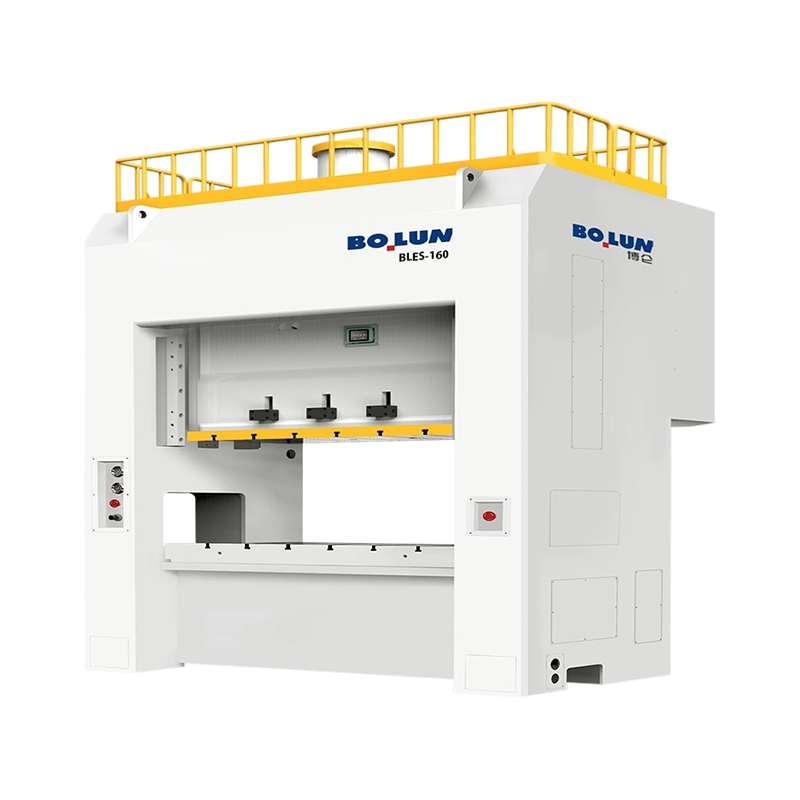
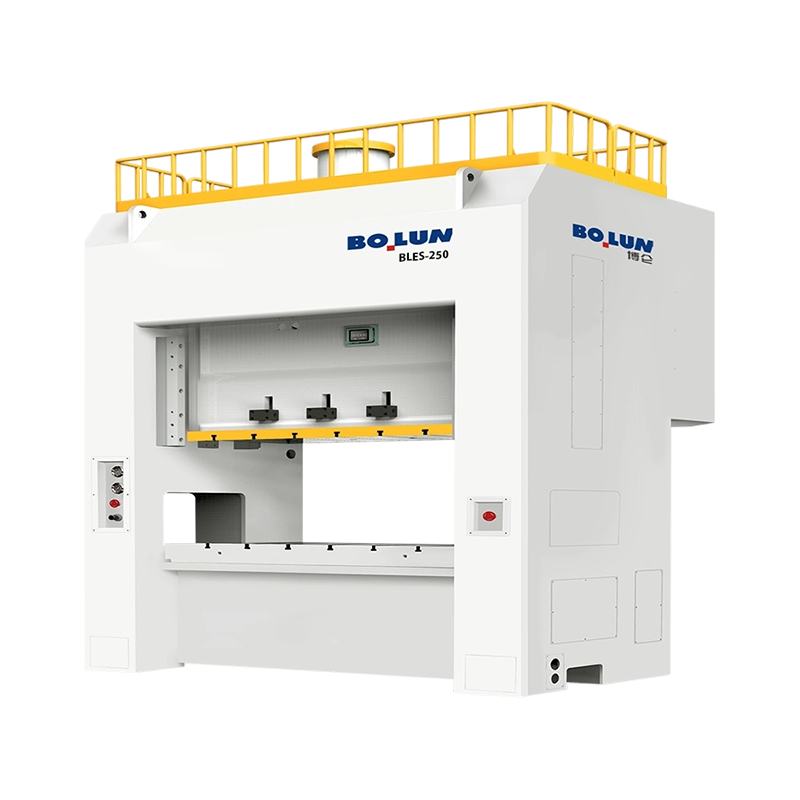
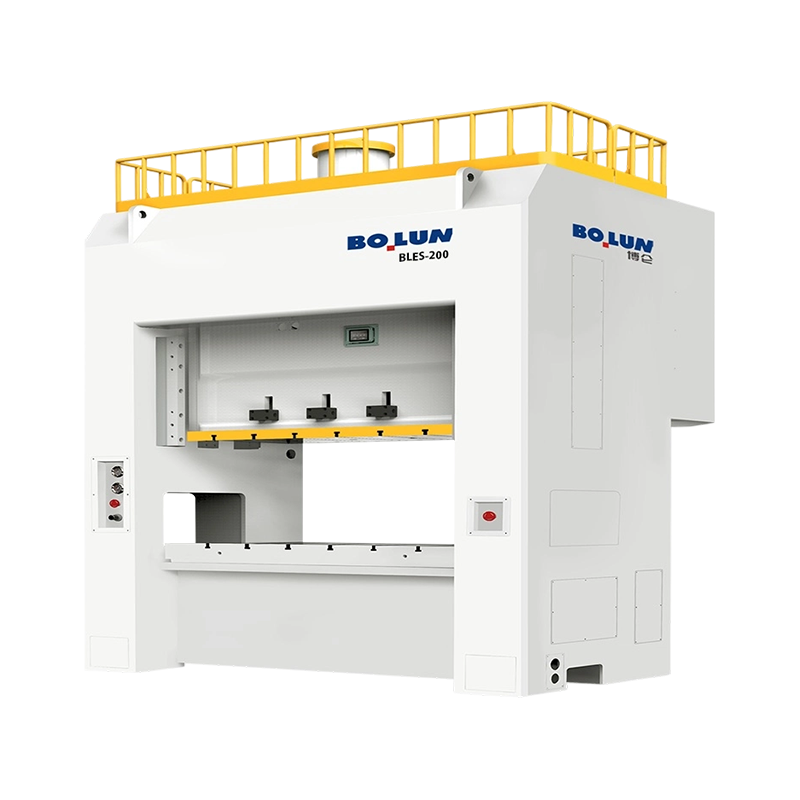
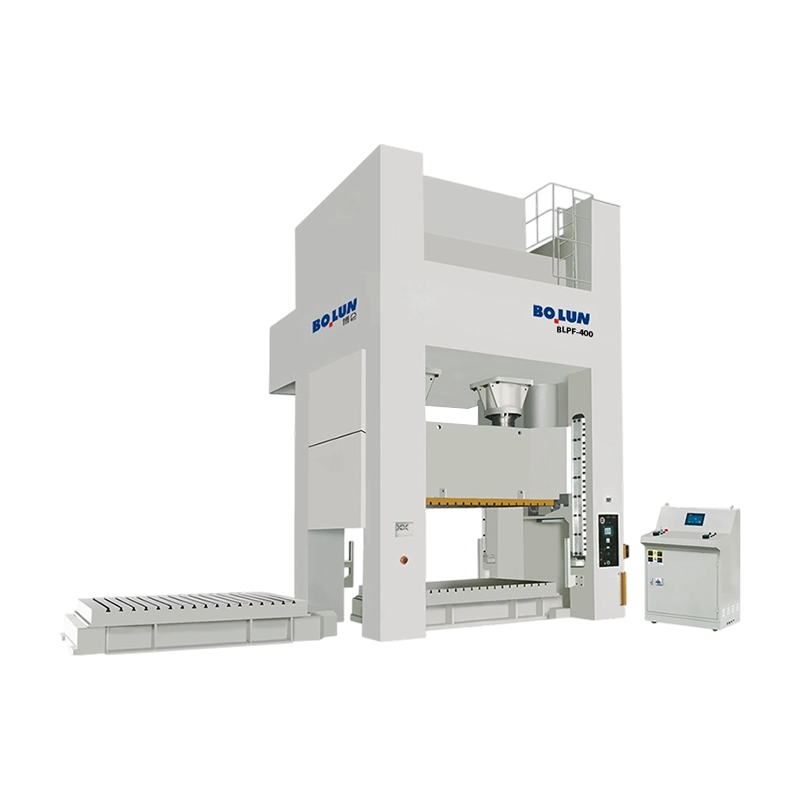
BLES-315 Industrial Powerhouse Closed-Frame Double-Point Servo Power Press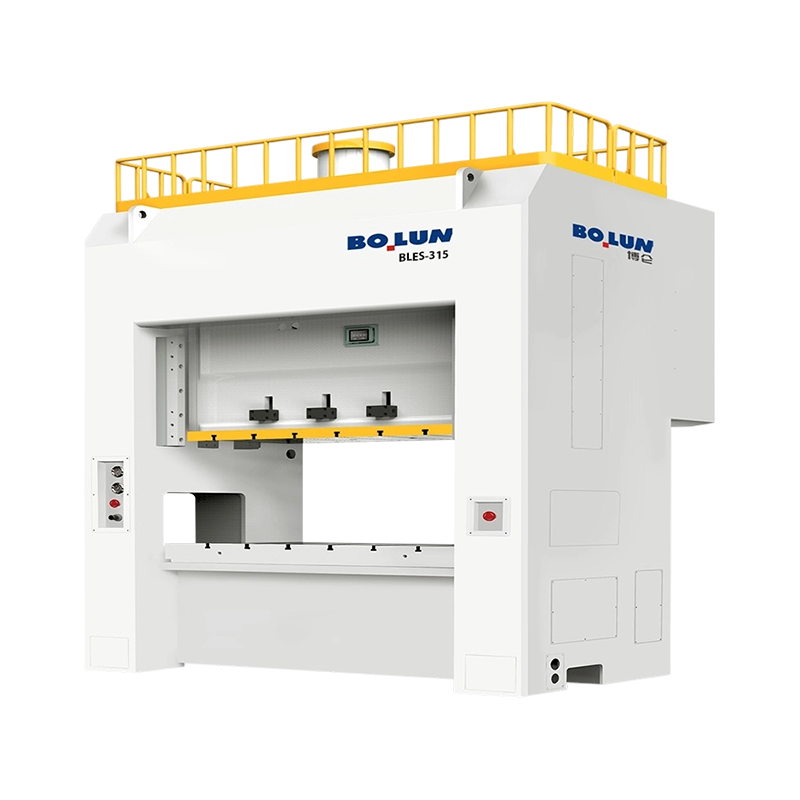
Power presses can generally be divided into open-type power presses, closed-type power presses, and other specialized power presses. Open-type presses are widely used for lighter stamping operations because their C-frame structure allows convenient access to the die area. However, when forming large parts or applying high loads, open-type presses can experience greater frame deflection and angular deformation. This can reduce die life, affect product consistency, and create difficulties in maintaining precision over long production cycles.
The BLES-315 closed-frame double-point servo power press addresses these limitations by using a closed-frame structure, also commonly called a straight-side or closed-frame configuration. In this structure, the load path is more symmetrical, and the frame surrounds the working area more completely. This helps control deformation during high-load forming. For manufacturers producing automotive structural components, thick-gauge sheet metal parts, and large appliance panels, this structural advantage is not theoretical; it directly affects dimensional accuracy, die protection, and production stability.
The double-point configuration is another important feature. Instead of applying force through a single central point, the press uses two points to drive and support the slide. For larger dies and wide workpieces, this helps maintain slide parallelism and reduces uneven loading. In practical production, uneven slide force can lead to premature die wear, burr formation, inconsistent part geometry, or even die damage. A double-point system is therefore highly valuable in applications requiring wide die sets or complex forming operations.
The servo drive concept further elevates the machine beyond traditional mechanical press limitations. A conventional press often depends on a fixed crank motion and flywheel energy. While such machines can be efficient for repetitive stamping, they are less flexible when a process requires slower forming speed, dwell near bottom dead center, optimized return speed, or motion adjustment for different materials. Servo control allows the slide movement to be programmed according to the process, enabling manufacturers to improve forming quality, reduce noise and vibration, enhance energy use, and adapt to a wider range of production tasks.
Technical parameters are meaningful only when they are connected to production results. The BLES-315 press provides a nominal capacity of 3000 kN, giving it the strength required for heavy-duty forming operations. The 30,000 J working energy supports high-load forming with sufficient energy reserve, especially in processes where material resistance increases sharply during deformation. A 300 mm slide stroke gives the machine a useful forming range for deeper parts, while the 550 mm maximum die height accommodates larger tooling and more complex forming arrangements.
| Parameter | Value | Production Significance |
|---|---|---|
| Press Type | Closed-frame double-point servo power press | Provides high rigidity, balanced loading, and programmable forming motion |
| Nominal Capacity | 3000 kN | Supports heavy-duty stamping, forging-related forming, and thick-gauge sheet applications |
| Working Energy | 30,000 J | Enables controlled deformation of demanding materials and larger components |
| Slide Stroke | 300 mm | Allows deeper forming and greater process flexibility |
| Maximum Die Height | 550 mm | Accommodates large dies and complex tooling systems |
| Frame Concept | High-rigidity closed frame | Improves load distribution and helps maintain accuracy under heavy pressure |
| Protection System | Hydraulic overload protection | Reduces risk of equipment and die damage during abnormal load conditions |
| Safety System | Loss-of-power brake system | Improves operational safety and reliability during power interruptions |
The 3000 kN capacity is particularly relevant for manufacturers forming structural parts that require large force but also need consistent geometry. In automotive production, for example, components may include reinforcing plates, brackets, inner structural sections, and other load-bearing sheet metal parts. These parts are often made from higher-strength materials, which resist forming and place greater demands on press rigidity and energy output. A lower-rigidity press may reach the required force on paper but fail to maintain proper forming conditions across the die surface.
The 30,000 J working energy is equally important. Energy determines how effectively the press can continue forming through the material’s resistance during the working portion of the stroke. For thick-gauge sheet metal or large panels, insufficient energy can cause speed loss, incomplete forming, or unstable forming quality. With high energy output, the BLES-315 can help maintain controlled material flow, particularly during deep forming or operations requiring low-speed, high-load contact.
The 300 mm slide stroke supports larger forming depth. In many industrial applications, shallow stroke machines limit tool design and restrict the types of parts that can be produced. A longer stroke provides more room for forming, drawing, loading, unloading, and automation integration. The 550 mm maximum die height is also significant for manufacturers using large die sets, transfer tooling, progressive tools with taller structures, or special forming equipment integrated into the die area.
One of the most important advantages of the BLES-315 press is its closed-frame rigidity. In metal forming, the press is not simply a force generator; it is a precision structure that must resist deformation. If the frame bends, twists, or opens under load, the die alignment changes. Even a small change in alignment can influence part tolerance, edge quality, tool wear, and repeatability. This is why closed-frame presses are generally preferred for high-tonnage and precision forming operations.
Compared with open-type power presses, the closed-frame configuration offers a stronger and more stable load path. Open-type presses provide excellent accessibility, but their frame shape can produce larger deflection when force is applied. For lighter parts, this may be acceptable. For large-scale precision forming, it becomes a limitation. The BLES-315 is designed for applications where force stability and geometric control are more important than open-front convenience.
Compared with some conventional closed-type presses, the BLES-315 emphasizes high-rigidity construction for heavy-duty forming. A press may be classified as closed-type, but its real production value depends on frame design, material quality, machining accuracy, assembly control, and inspection. The straight-side frame of the BLES-315 is intended to distribute load evenly under high-tonnage and low-speed forming conditions. This matters in processes where the slide remains under heavy pressure for longer periods, such as deep forming or difficult material deformation.
Rigidity also contributes to die life. Dies are expensive production assets. When press deformation causes uneven contact, die inserts, guide components, cutting edges, and forming surfaces may experience abnormal stress. Over time, this leads to increased maintenance cost and production downtime. By providing a more stable forming platform, a high-rigidity closed-frame press helps manufacturers protect their tooling investment.
Another benefit is part consistency. In high-volume production, the first good part is not enough. A factory needs thousands or millions of parts to remain within tolerance. Stable frame behavior, accurate slide movement, and balanced force application all contribute to repeatability. The BLES-315 is therefore not only a machine for generating high force but also a platform for maintaining process discipline.
The double-point structure is a key differentiator for manufacturers working with wide dies or broad workpieces. In a single-point press, the force is concentrated through one central drive point. This can be suitable for smaller tools or centrally loaded operations. However, when the die is large or the forming load is distributed across a wide area, a single-point system may be less effective at maintaining slide balance.
The BLES-315 uses a double-point arrangement to improve load distribution across the slide. This supports better slide parallelism during forming and helps reduce the risk of one side of the die receiving more load than the other. In real production, uneven loading can produce serious issues: one side of a panel may form correctly while the other side shows wrinkles, thinning, springback differences, or dimensional deviation. A double-point press helps reduce these risks by supporting a more uniform forming environment.
This feature is especially useful in automotive structural components and large appliance panels. These parts often require broad die surfaces and consistent pressure across multiple forming zones. When the press slide remains more parallel, the die can perform as designed. This improves forming accuracy and reduces the need for corrective die tuning.
Compared with competitor presses that use simpler drive structures for similar nominal capacities, the double-point design gives the BLES-315 stronger suitability for large-scale precision forming. It is not merely about increasing tonnage; it is about applying that tonnage in a controlled and balanced way. For factories seeking lower scrap rates and longer die service life, this is a major advantage.
Double-point systems also support automation readiness. When transfer systems, robotic loading, or automated blank feeding are used, the die area must maintain consistent clearance and predictable motion. A stable slide and balanced drive system help ensure that automation equipment can operate reliably without frequent adjustment caused by forming instability.
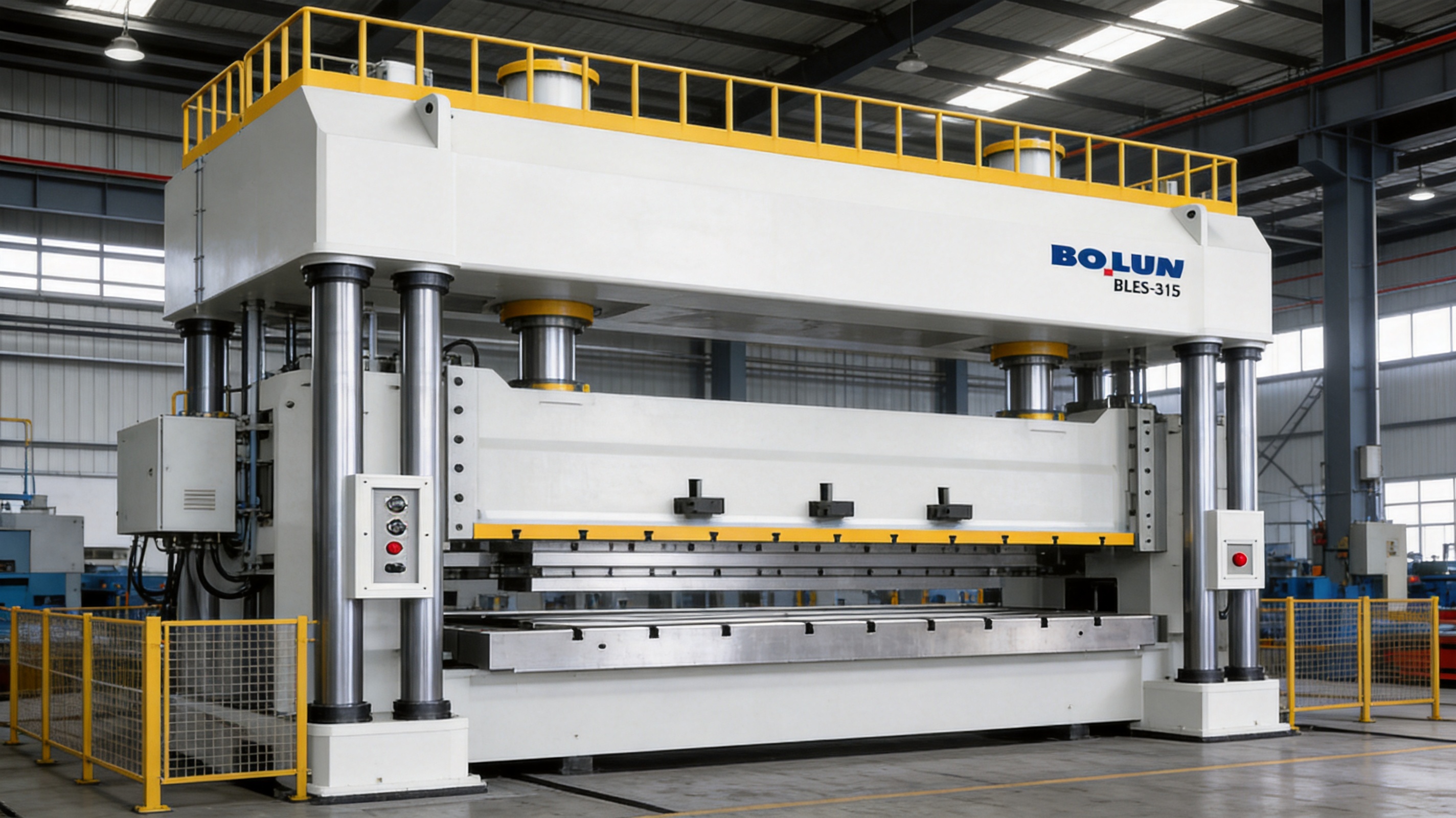
The servo nature of the BLES-315 gives it an important advantage over many traditional mechanical presses. Conventional presses typically operate with a fixed slide motion determined by the crank mechanism and flywheel system. While this arrangement is proven and efficient for many standard stamping tasks, it offers limited flexibility. When materials become more difficult to form or when part geometry becomes more complex, fixed motion can restrict process optimization.
A servo power press allows the slide motion to be controlled more intelligently. Depending on the production requirement, the slide can move quickly during approach, slow down during forming, dwell near the bottom of the stroke, and return quickly after forming. This ability to adjust motion helps manufacturers improve material flow and reduce defects. For deep forming, slower contact speed can reduce tearing and improve surface quality. For complex parts, dwell control may allow the material to settle more evenly in the die cavity. For high-efficiency production, fast non-working movement can reduce cycle time while maintaining careful forming speed where it matters most.
Servo control also supports process development. When a factory introduces a new part, engineers often need to test different forming speeds and motion curves. A conventional mechanical press may require compromises because the motion cannot be easily changed. A servo press gives engineers more freedom to match the press movement to the material and die design. This can shorten process validation time and improve first-run quality.
Energy management is another advantage. Traditional flywheel presses store rotating energy continuously, and their energy use may be less adaptable to actual forming demand. Servo systems can offer more efficient energy use depending on the operating mode and production schedule. In factories focused on intelligent manufacturing, lower unnecessary energy consumption and better control of machine movement are increasingly important.
Noise and vibration may also be reduced through optimized servo motion. Sudden impact and high-speed forming can create vibration that affects not only the machine but also the surrounding production environment. By controlling the slide speed during contact, a servo press can help create a smoother forming process. This supports machine longevity, die protection, and operator comfort.
The BLES-315 delivers 30,000 J of working energy, which is especially valuable in heavy-duty forming. In metal forming, force is only one part of the equation. The press must also provide enough energy through the working portion of the stroke. If energy is insufficient, the slide may slow excessively, forming may become unstable, or the part may not reach the intended shape.
Controlled material flow is essential when producing large appliance panels, automotive structural parts, and thick-gauge components. Materials do not simply move because force is applied. They stretch, compress, bend, and flow according to die geometry, blank holder force, lubrication, forming speed, and material characteristics. A press with sufficient energy and controllable motion gives engineers a better foundation for managing this behavior.
For thick-gauge sheet metal, the resistance to deformation is high. The machine must maintain enough energy to complete the forming operation without unstable speed changes. For large panels, the material may need to flow across a broad surface area, which requires consistent pressure and controlled motion. For deeper forms, the press must support the material through a longer deformation path. The BLES-315 is designed with these demands in mind.
Compared with presses that offer similar tonnage but lower working energy, this machine can provide greater confidence in demanding forming operations. A press with insufficient energy may appear adequate in specification sheets but show limitations during real production. The combination of 3000 kN capacity and 30,000 J working energy makes the BLES-315 suitable for operations where both strength and sustained forming capability are required.
High-capacity forming equipment must combine productivity with safety. The BLES-315 includes hydraulic overload protection and a safety loss-of-power brake system, both of which are essential for industrial reliability. In heavy-duty production, abnormal conditions can occur due to material thickness variation, incorrect blank placement, die obstruction, lubrication failure, or process error. Without effective protection, an overload can damage the press, die, or drive system.
Hydraulic overload protection helps reduce the risk of serious damage when forming loads exceed safe limits. This is particularly important for expensive tooling and high-tonnage equipment. When a press is used in continuous production, downtime caused by overload damage can be costly. A protection system does not eliminate the need for proper process control, but it provides an important safeguard against abnormal events.
The safety loss-of-power brake system enhances operational reliability. If electrical power is interrupted or a serious control issue occurs, the brake system is intended to bring the machine into a safe state. In industrial environments, power instability or unexpected shutdowns can create safety risks if moving components are not properly controlled. A reliable brake system helps protect operators, tooling, and equipment.
Compared with lower-level machines that focus mainly on forming force, the BLES-315 is designed with production continuity and risk control in mind. This is important for manufacturers that run multiple shifts or supply demanding customers. A press is not valuable only when it is operating under ideal conditions; it must also respond safely when conditions are abnormal.
The BLES-315 is suitable for several demanding application fields. Its combination of closed-frame rigidity, double-point slide support, servo motion, high working energy, and long stroke makes it well suited for heavy-duty forming, large-scale precision forming, and controlled deformation processes.
Automotive manufacturing increasingly uses stronger materials and more complex structures to improve safety, reduce weight, and enhance durability. Structural components often require stable forming force, accurate die alignment, and controlled material flow. The BLES-315 can support the production of reinforcement parts, brackets, frame-related sheet components, and other structural elements that require both strength and precision.
Home appliance panels require surface quality, dimensional consistency, and stable forming over large areas. Uneven press loading can lead to visible defects, inconsistent edges, or assembly problems. The double-point closed-frame structure of the BLES-315 helps maintain uniform forming conditions across wide panels, while servo motion can reduce impact and improve surface results.
Thick-gauge metal forming places heavy demands on energy, rigidity, and tool protection. A press must not only reach the required force but also maintain stable movement through the working stroke. The BLES-315’s 30,000 J working energy and high-rigidity structure make it suitable for these applications.
The 300 mm slide stroke and 550 mm maximum die height are helpful for deep forming applications. Deep forming requires sufficient space, controlled speed, and stable pressure. Servo motion provides the ability to slow the slide during the most critical forming portion, helping reduce tearing, wrinkles, and uneven material distribution.
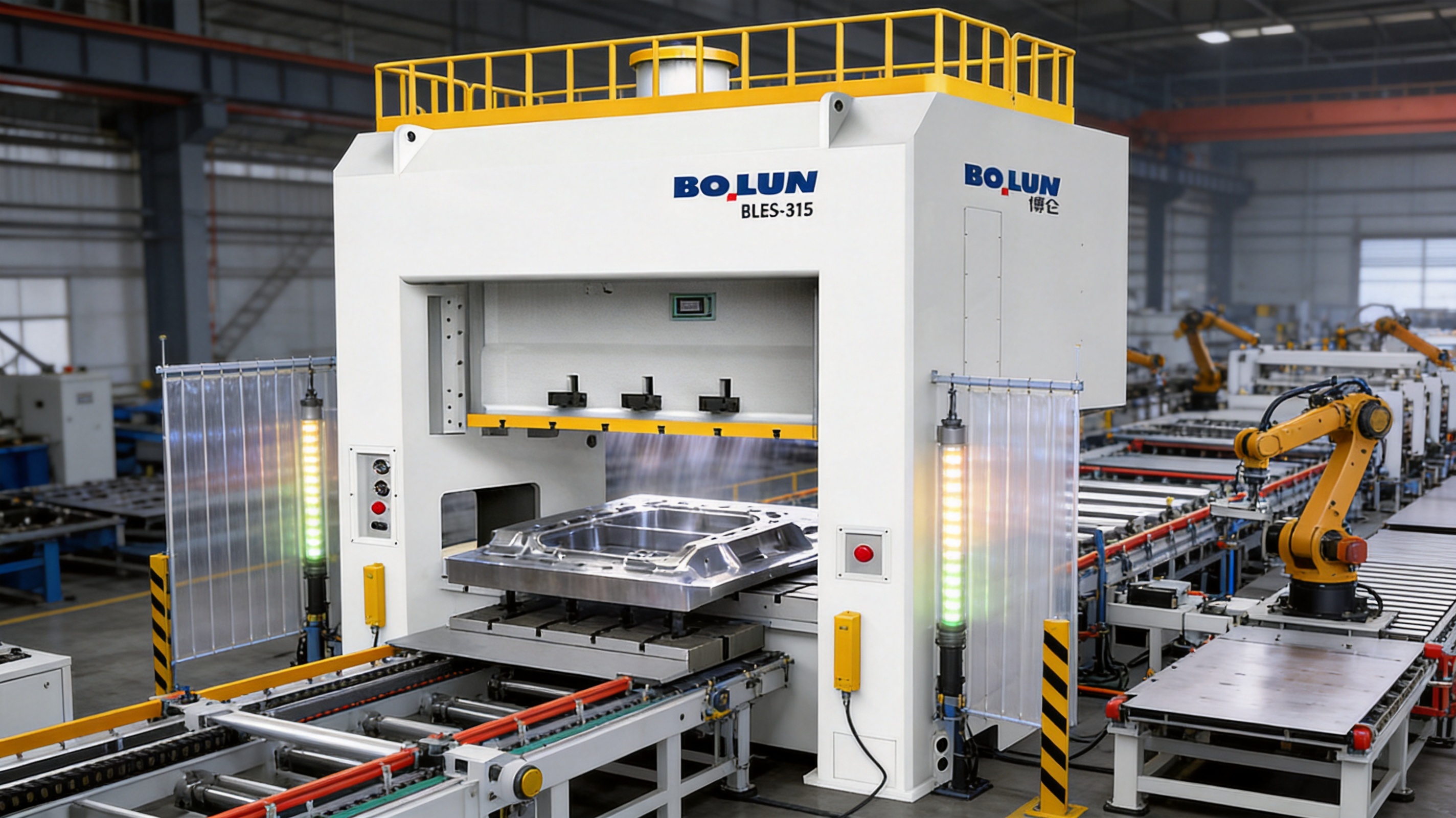
The competitive strength of the BLES-315 can be understood by comparing it with several common alternatives: open-type presses, traditional flywheel mechanical presses, lower-rigidity closed-frame presses, and non-customized standard machines.
Open-type presses are accessible and convenient, but they are not always ideal for heavy-duty precision forming. Their frame geometry can be more vulnerable to deflection under high loads. The BLES-315 closed-frame design offers better rigidity and more stable load distribution, making it more suitable for large and high-force forming operations. For manufacturers concerned with part accuracy and die longevity, this is a major advantage.
Traditional mechanical presses are efficient for high-speed repetitive stamping, but their fixed motion limits process flexibility. The BLES-315 servo system allows optimized slide movement, including slower forming speed and faster return movement. This improves adaptability for different materials, die structures, and forming depths. In production environments where part types change or materials vary, servo flexibility can reduce process limitations.
Not all closed-frame presses deliver the same forming stability. The BLES-315 emphasizes a high-rigidity straight-side frame, double-point support, and heavy-duty forming capability. Presses with weaker frames may experience greater deformation, especially during off-center or wide-area loading. This can affect part quality and tool life. The BLES-315 is designed to support stable load distribution even under high-tonnage and low-speed forming conditions.
Many factories require more than a standard press. They may need special die height, automation interfaces, material handling adaptation, safety integration, or process-specific configuration. Zhejiang Bolun High-Precision Machinery Co., Ltd. has non-standard customization capability supported by its design and manufacturing team. This makes the BLES-315 platform more adaptable to real production needs than machines offered only as fixed standard models.
A high-performance press depends heavily on the manufacturer’s production system. Zhejiang Bolun High-Precision Machinery Co., Ltd. is located in Zhejiang, a region known for precision manufacturing and industrial machinery development. With approximately two decades of experience in machinery manufacturing, the company has developed a mature system integrating research and development, design, production, sales, and service.
This integrated structure creates several advantages. First, design and production teams can coordinate closely, ensuring that engineering concepts are practical for manufacturing and assembly. Second, the company can respond to special customer requirements with non-standard customization. Third, quality control can be applied throughout the process rather than only at final inspection. Fourth, after-sales service can be supported by direct knowledge of the machine’s design and manufacturing details.
The company’s manufacturing philosophy emphasizes technology, quality, and long-term reliability. Advanced precision processing equipment supports the machining of critical components, while a mature industrial environment allows the company to manage production from basic design to core component development and final assembly. For a closed-frame double-point servo press, this full-chain capability is extremely important because performance depends on the precise relationship between frame, slide, drive system, guide system, overload protection, and control system.
Frame manufacturing is especially critical. Large press frames must be produced with attention to material stability, stress management, machining accuracy, and geometric control. If the frame is not properly processed, the machine may show alignment errors or deformation under load. By applying rigorous production management and inspection methods, the manufacturer aims to ensure that each press maintains stable precision under high-intensity operating conditions.
Assembly is another key stage. The double-point drive must be aligned carefully to ensure balanced slide motion. Slide guides must be adjusted for smooth movement and accurate guidance. Servo drive components must be integrated with the machine structure and control system. Hydraulic overload protection and braking systems must be tested for correct response. These operations require experienced technicians and disciplined inspection procedures.
Quality is a central part of the manufacturer’s approach. The company has established a finished product inspection system that exceeds basic industry standards, applying rigorous quality control to processes and components. For a machine such as the BLES-315, this is essential because even minor manufacturing or assembly errors can influence long-term forming accuracy.
Inspection should not be treated as a final formality. In high-precision equipment manufacturing, quality must be built into each stage. Material selection, machining, dimensional inspection, assembly alignment, slide movement testing, safety verification, and load-related checks all contribute to final performance. A manufacturer that controls only the final appearance of a machine cannot guarantee stable production performance. The value of Bolun’s system lies in its process-wide approach.
For customers, strong quality control means reduced installation risk, more stable commissioning, and better long-term confidence. A press that arrives with accurate geometry and properly tested systems can enter production more smoothly. In contrast, machines with inconsistent manufacturing quality may require extended adjustment, causing delays and uncertainty.
Long service life is another result of quality discipline. Heavy-duty forming equipment experiences repeated loads, vibration, and mechanical stress. Components must be manufactured and assembled to withstand these conditions. Precision machining, proper fit, reliable protection systems, and careful inspection all support durability. This is particularly important for factories operating continuous shifts, where equipment downtime has a direct financial impact.
One of the strongest advantages offered by Zhejiang Bolun High-Precision Machinery Co., Ltd. is non-standard customization. Many manufacturers do not need only a catalog machine; they need a forming solution that matches their part geometry, material, production volume, tooling, automation plan, and factory layout. A press supplier with design and manufacturing capability can help adapt equipment to those real-world requirements.
The company’s design team provides one-stop design and manufacturing services for products with special specifications and functions. This capability is valuable for industries where part designs change frequently or where special processes are required. For example, a customer may require integration with coil feeding equipment, robotic handling, transfer systems, die cushions, monitoring systems, or safety devices. A manufacturer with strong engineering capability can evaluate these requirements during machine configuration rather than forcing the customer to solve compatibility issues later.
Customization also supports long-term productivity. A press that is properly matched to the customer’s process can improve cycle efficiency, reduce scrap, simplify maintenance, and support future upgrades. While a lower-cost standard machine may appear attractive initially, it can become expensive if it fails to match production requirements. The BLES-315 platform, supported by the manufacturer’s engineering capabilities, can be configured as part of a more complete production solution.
The global machinery industry is moving toward intelligent and digital production. Press equipment is increasingly expected to provide not only mechanical force but also process data, controllable motion, automation compatibility, and reliable safety integration. Servo presses are naturally aligned with this trend because their motion can be programmed, monitored, and optimized.
The BLES-315 supports this direction by offering servo-controlled forming rather than fixed mechanical motion alone. In modern production, engineers need to adjust forming curves, monitor process conditions, and improve energy efficiency. Servo technology makes the press more adaptable to these goals. When combined with proper factory-level systems, a servo press can contribute to better production transparency and process control.
Zhejiang Bolun High-Precision Machinery Co., Ltd. has stated its intention to deepen development in high-end, precision, and advanced manufacturing fields, with increased investment in intelligent and digital stamping equipment. This strategic direction is important for customers planning long-term production. A press supplier that understands digital manufacturing trends can provide equipment that is better suited for future integration and upgrades.
For manufacturers, investing in servo press technology is not only about today’s parts. It is also about preparing for materials and designs that may become more demanding in the future. As automotive, appliance, and industrial products evolve, forming processes will require more control, more repeatability, and more data-based optimization. The BLES-315 provides a strong foundation for that transition.
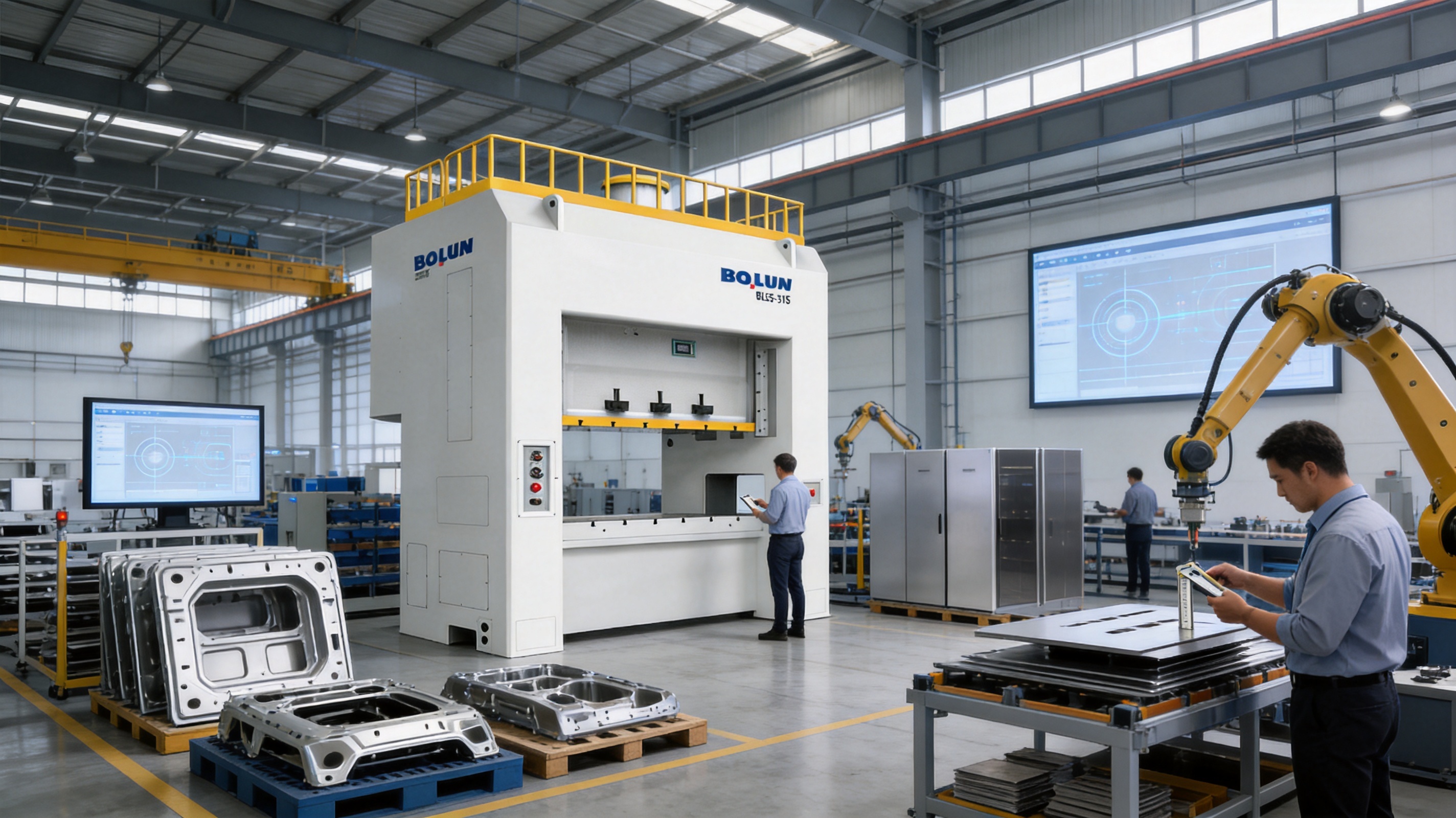
In real factories, equipment value is measured by stable output. A press must operate day after day under high load while maintaining precision and safety. The BLES-315 is designed for continuous production environments where reliability is essential. Its high-rigidity frame, hydraulic overload protection, safety braking system, and servo motion control all contribute to dependable operation.
Continuous production creates repeated stress on the machine. If the frame lacks rigidity, precision can gradually deteriorate. If protection systems are inadequate, a single overload event can cause major damage. If slide motion is harsh or uncontrolled, die wear can accelerate. If maintenance access and service support are weak, downtime can increase. The BLES-315 addresses these concerns through a combination of structural strength, intelligent motion, and protection features.
Reliability also depends on the manufacturer’s service philosophy. Zhejiang Bolun High-Precision Machinery Co., Ltd. provides a customer-oriented service system covering pre-sales consultation, in-sales support, and after-sales guarantees. Pre-sales consultation helps customers select appropriate equipment and configuration. In-sales support helps ensure that production requirements are understood during manufacturing and delivery. After-sales service supports installation, commissioning, troubleshooting, and long-term use.
For customers purchasing high-value equipment, this service chain is significant. A press is not a disposable machine; it is a long-term production asset. The supplier’s ability to provide technical support, spare parts guidance, and process advice can strongly influence the machine’s lifetime value.
The economic value of the BLES-315 comes from several sources. First, its servo flexibility can help reduce trial-and-error during process setup. Engineers can adjust slide motion to improve forming results without requiring major mechanical changes. Second, its rigidity and double-point structure can reduce scrap caused by uneven forming or poor repeatability. Third, its protection systems can help prevent expensive damage to dies and the press itself. Fourth, its ability to handle large and demanding parts can expand a factory’s production capability.
Return on investment should be evaluated not only by purchase price but also by productivity, part quality, maintenance cost, die life, energy behavior, flexibility, and downtime reduction. A lower-cost machine may become expensive if it produces higher scrap rates, requires frequent adjustment, damages tooling, or cannot handle future part requirements. A well-designed servo closed-frame press can provide stronger long-term value by improving stability and adaptability.
The BLES-315 is particularly valuable for manufacturers that produce medium-to-large parts where quality consistency is essential. In such applications, the cost of scrap, rework, die maintenance, and production delays can be substantial. By providing stable forming conditions and controllable slide movement, the press helps address these hidden costs.
Another economic advantage is process consolidation. A machine with higher energy, longer stroke, and greater die height may be able to handle jobs that would otherwise require different equipment or more complex production planning. This can improve factory flexibility and equipment utilization.
When evaluating the BLES-315 for a production line, buyers should consider part size, material thickness, forming force, die dimensions, stroke requirements, automation plans, and quality targets. The 3000 kN capacity and 30,000 J working energy make the press suitable for heavy-duty applications, but proper selection should always be based on actual forming calculations and tooling requirements.
Buyers should also consider the advantages of servo motion. If the production process involves difficult materials, deep drawing, large deformation, surface-sensitive parts, or frequent product changes, servo control can provide meaningful benefits. If the process is a simple high-speed operation with very limited variation, a traditional press may sometimes be sufficient. However, for manufacturers seeking future flexibility, servo technology offers a broader process window.
Die height and stroke should be matched carefully. The BLES-315 offers a 550 mm maximum die height and 300 mm slide stroke, which are beneficial for larger tooling and deep forming. Customers should review the full die design, including shut height, feeding clearance, ejection requirements, and automation space.
Service and customization should also be part of the purchasing decision. A supplier with full-chain manufacturing and design capability can help avoid mismatches between machine and process. Zhejiang Bolun High-Precision Machinery Co., Ltd. offers integrated support, which is valuable when customers require special configurations or long-term technical collaboration.
The BLES-315 is a closed-frame double-point servo power press. It belongs to the closed-type power press category and is designed for heavy-duty precision forming, large parts, and demanding sheet metal applications.
The press has a nominal capacity of 3000 kN, making it suitable for high-force forming operations involving automotive structural parts, thick-gauge sheet metal, and large appliance components.
The closed-frame structure provides higher rigidity and more balanced load distribution than open-type press designs. This helps maintain die alignment, reduce frame deformation, improve part accuracy, and extend die life during high-load production.
The double-point configuration supports the slide at two drive points, improving slide balance and parallelism. This is especially valuable for wide dies and large parts because it helps distribute forming force more evenly.
Servo control allows programmable slide motion. The press can move quickly during non-working travel, slow down during forming, dwell near the bottom of the stroke, and return efficiently. This helps improve material flow, reduce defects, and adapt to different forming processes.
The press is suitable for automotive structural components, large appliance panels, thick-gauge sheet metal parts, deep forming processes, and other heavy-duty precision forming applications requiring stable force and controlled motion.
The machine includes hydraulic overload protection and a safety loss-of-power brake system. These features help protect the press, tooling, and operators during abnormal load conditions or power interruptions.
A traditional mechanical press often has fixed slide motion, while this servo press provides adjustable motion profiles. This gives manufacturers greater process flexibility, improved control over forming speed, potential energy advantages, and better adaptability for complex parts.
Zhejiang Bolun High-Precision Machinery Co., Ltd. integrates research and development, design, production, sales, and service. The company has advanced precision processing equipment, non-standard customization capability, rigorous inspection systems, and experience in high-precision forming equipment manufacturing.
Yes. The manufacturer provides one-stop design and manufacturing services for special specifications and functions, helping customers match the press to tooling, automation, material handling, and production requirements.
The BLES-315 Industrial Powerhouse Closed-Frame Double-Point Servo Power Press is designed for manufacturers that need more than basic stamping force. It combines 3000 kN nominal capacity, 30,000 J working energy, a 300 mm slide stroke, and a 550 mm maximum die height with a high-rigidity closed frame, double-point slide support, servo motion control, hydraulic overload protection, and safety braking. These features make it a strong solution for heavy-duty forming, large-scale precision manufacturing, and applications requiring controlled material flow.
Its advantages over competitors are rooted in structure, control, and manufacturing quality. Compared with open-type presses, it provides superior rigidity. Compared with traditional mechanical presses, it offers programmable forming motion. Compared with lower-rigidity closed-frame machines, it provides stronger stability for large dies and demanding loads. Compared with standardized press suppliers, it is supported by a manufacturer with full-chain production capability and non-standard customization strength.
Zhejiang Bolun High-Precision Machinery Co., Ltd. supports the machine with two decades of machinery manufacturing experience, advanced precision processing, integrated design and production, strict quality inspection, and customer-oriented service. For factories producing automotive structural parts, appliance panels, thick-gauge sheet metal components, and deep-formed parts, the BLES-315 offers a powerful combination of force, accuracy, flexibility, and reliability.
As manufacturing continues to move toward high precision, intelligent control, and digital production, servo closed-frame presses will become increasingly important. The BLES-315 is well aligned with this direction. It is not merely a press for today’s forming requirements; it is a production platform designed to help manufacturers improve quality, protect tooling, support process innovation, and build long-term competitiveness.
Altan, T., and Tekkaya, A. E. Sheet Metal Forming: Processes and Applications. ASM International.
Schuler GmbH. Metal Forming Handbook. Springer.
Kalpakjian, S., and Schmid, S. R. Manufacturing Engineering and Technology. Pearson.
Boljanovic, V. Sheet Metal Forming Processes and Die Design. Industrial Press.
Groover, M. P. Fundamentals of Modern Manufacturing: Materials, Processes, and Systems. Wiley.
International standards and industrial practices related to mechanical power presses, servo press systems, machine tool safety, and metal forming equipment inspection.


What Is a Power Press? A power press — also called a stamping press or punch pr...
Power press machines are classified in two main ways: by frame construction, w...
Understanding Mechanical Power Presses and Their Essential Functions A mechani...
In the fields of metal forming, sheet metal fabrication, blanking, and punching,...
As the manufacturing industry moves steadily toward automation and smart product...
In modern manufacturing, cold forging is widely used in the automotive, aerospac...
Contact Us

bolunpress@gmail.com

+86-575-83362228

+86-15158259588

+86-575-83362999

+86-15158259588

Hangzhou Office Add: No. 332 Wangjiang East Road, Shangcheng District

No.1 Linjiang Road East, Xiaren, Jinting Town, Shengzhou City, Zhejiang Province, China
Ready to Begin?
Get in Touch

Now!

ZHEJIANG BOLUN
 English
 中文简体
中文简体