
Modern stamping operations require more than nominal pressing force. A production press must combine structural rigidity, accurate slide guidance, reliable overload protection, flexible speed control, sufficient die space, and a working environment that supports safe, repeatable production. These requirements become especially important when manufacturers process large automotive panels, structural components, hardware parts, appliance components, and other formed products that place substantial loads on the machine frame and tooling.
The BLPC-250 is a heavy-duty open-type double-point power press developed for demanding industrial forming applications. With a nominal capacity of 2,500 kN, a listed press weight of 44 tons, a spacious 2,700 × 900 mm worktable, and a maximum die height of 605 mm in the relevant configuration, the machine is designed to provide the working envelope and structural strength required by large-scale stamping lines. Its double-point slide arrangement supports balanced loading across wide dies, while its open-type construction provides practical access for tooling, loading, unloading, inspection, and maintenance.
The machine combines a high-rigidity frame with an inverter-adjustable main drive, touch-screen operation, hydraulic overload protection, and photo-electronic safety equipment. These features support a production philosophy centered on stable forming, controlled operation, operator protection, and efficient integration into modern manufacturing environments.
This article examines the BLPC-250’s engineering characteristics, production advantages, technical specifications, safety features, manufacturing background, maintenance considerations, and suitability for different industrial applications. It also explains why a heavy-duty open-type double-point configuration can offer important advantages over conventional single-point presses and less rigid machines when large dies, wide workpieces, and demanding production cycles are involved.
A power press converts mechanical energy into controlled forming force. The ram or slide moves a punch toward a die, allowing sheet metal or other workpiece materials to be cut, bent, drawn, embossed, coined, or formed. Although the operating principle is straightforward, industrial stamping quality depends on the coordinated performance of many systems, including the frame, crankshaft, connecting rods, slide, guides, drive motor, clutch and brake system, control system, tooling interface, and safety devices.
Large components create special challenges. A wide die may distribute force across a long slide, but any uneven loading can produce deflection, angular error, tooling wear, or inconsistent part geometry. A machine that lacks sufficient rigidity may experience excessive vibration or elastic deformation. These issues can increase scrap rates and reduce die life, especially when the production process operates continuously and at high loads.
The BLPC-250 addresses these challenges through a broad double-point slide and a massive machine structure. Its 2,500 kN nominal capacity places it in a class suitable for substantial forming and blanking operations. The 44-ton press weight is also significant because a heavier structure generally provides a stronger foundation for absorbing working forces and reducing unwanted movement during the press cycle.
Industrial users often evaluate a press according to more than force alone. The following factors are equally important:
• The available die height and adjustment range.
• The size and load-bearing capability of the worktable.
• The dimensions of the slide bottom and tooling interface.
• The throat depth and distance between columns.
• The available stroke length and operating speed range.
• The accuracy of slide movement and repeatability of the process.
• The response of the overload protection system.
• The accessibility of the work area.
• The quality of the electrical and mechanical control systems.
• The manufacturer’s ability to customize and support the equipment.
By offering a combination of high capacity, a large work area, a long stroke, and advanced control and safety functions, the BLPC-250 is positioned as a production machine rather than a basic general-purpose press.
The BLPC-250 is an open-type double-point power press with a nominal capacity of 2,500 kN. The term “open-type” refers to the accessible front and side working area associated with a gap-frame or open-frame structure. This layout is useful when operators need practical access to the die area or when the press must be integrated with transfer systems, feeding equipment, conveyors, or manual loading stations.
The double-point design uses two connection points between the drive mechanism and the slide. Compared with a single-point arrangement, this configuration distributes the pressing load more evenly over a wider tooling area. It is particularly suitable for long dies and wide workpieces, where off-center loading can create unfavorable twisting forces on a single central connection.
The BLPC-250 is identified in the supplied product information as a robust heavy-duty model for complex automotive and hardware production lines. Its main dimensions and capacity support the use of larger dies than those typically associated with smaller open-type presses. The listed worktable measures 2,700 × 900 mm, while the slide bottom measures 2,300 × 700 mm. These dimensions provide a broad mounting area for large tooling assemblies.
The maximum die height is listed as 605 mm for the relevant BLPC-250 configuration, with a die height adjustment range of 120 mm. This gives tooling engineers flexibility when setting up dies with different closed heights, cushion arrangements, guide systems, and component geometries. A generous die height is also beneficial when a process requires a larger die set, multiple forming stations, or integrated material-handling features.
The machine has a listed throat depth of 455 mm and a distance between columns of 2,239 mm. These measurements are important when evaluating whether a die, blank, or finished part can be placed comfortably within the working area. In practical terms, the wide column spacing and deep throat improve accessibility and reduce the likelihood that large workpieces will interfere with the press structure during loading and unloading.
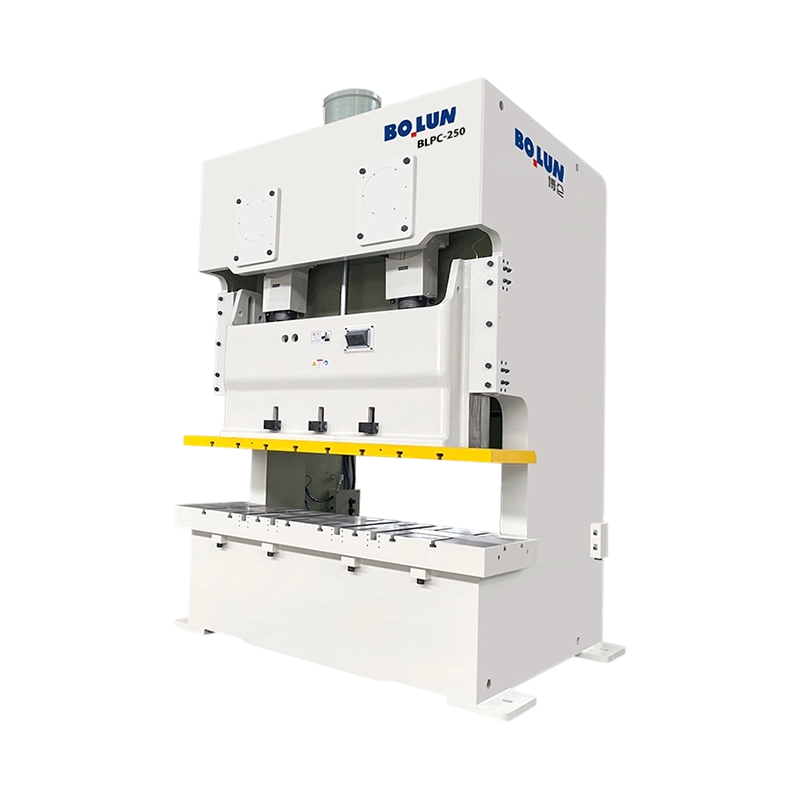
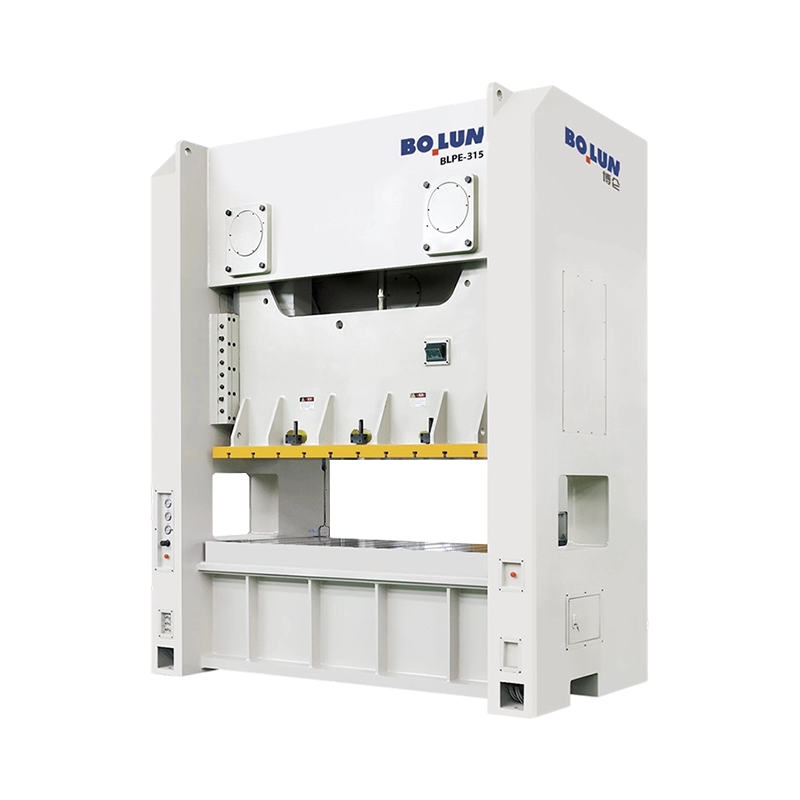
BLPC-250 Robust Heavy-Duty Open-Type Double-Point Power Press
Nominal capacity is one of the first specifications considered when selecting a power press. At 2,500 kN, the BLPC-250 provides approximately 254.9 metric tons-force of nominal pressing capacity. This makes it suitable for applications that require considerably more force than medium-duty stamping machines can provide.
However, capacity must be considered together with structural rigidity. A press with high nominal force but insufficient stiffness may not deliver stable production results under real operating conditions. Frame deflection, slide inclination, and vibration can influence the finished part, the life of the die, and the condition of the machine itself. The BLPC-250’s 44-ton mass and heavy-duty frame are intended to provide a rigid platform capable of supporting high-load production.
A high-rigidity frame offers several practical benefits:
• It helps control deformation during pressing.
• It supports more consistent die alignment.
• It reduces the risk of excessive vibration during high-load cycles.
• It can help extend the working life of tooling.
• It provides a stable foundation for automation and transfer equipment.
• It improves operator confidence when processing large or difficult workpieces.
The double-point arrangement complements this frame design. When the applied load is spread across two points, the slide can better support a wide die than a narrow single-point slide. This does not eliminate the need for correct die design, balanced loading, and appropriate operating conditions, but it provides a more suitable mechanical platform for large-format stamping.
Compared with a smaller or lighter single-point press, the BLPC-250 offers a clear advantage when the die is wide, the forming load is substantial, or the process involves uneven loading across the working area. The machine is also better suited to production environments where tooling must be changed less frequently because several operations can be combined into a larger die set.
The 2,700 × 900 mm worktable is one of the BLPC-250’s most important production features. A large table allows manufacturers to install wider dies, larger blank holders, multi-station tooling, and integrated feeding or transfer components. It also provides greater flexibility when producing large panels and structural parts.
The worktable thickness is listed as 170 mm. This substantial table construction supports the use of heavy dies and helps create a stable connection between the tooling and the press frame. The slide bottom measures 2,300 × 700 mm, providing a corresponding mounting surface for the upper die assembly.
When selecting a press for a specific die, users should evaluate the complete tooling package rather than comparing table dimensions alone. Important considerations include:
• The die’s overall length, width, and height.
• The die’s total weight.
• The location and size of mounting slots or holes.
• The required shut height.
• The force distribution across the die.
• The position of material-feeding and discharge equipment.
• The available space for sensors, cushions, and safety guards.
The BLPC-250’s large working envelope gives production engineers greater freedom when designing or selecting tooling. The machine can accommodate dies that would be impractical on a smaller press, while its open configuration makes it easier to inspect the die and access the work area during setup.
Its maximum die height and adjustment system are particularly valuable for complex tooling. Dies with integrated pilots, lifters, pressure pads, blank holders, or multiple forming sections may require more vertical space than simple cutting dies. A 120 mm adjustment range can help compensate for differences among tooling sets and support more efficient changeover planning.
The BLPC-250 has a listed slide stroke of 280 mm in the vertical configuration and 170 mm in the horizontal configuration shown in the technical family table. The product presentation highlights the 605 mm maximum die height associated with the relevant configuration. The model family also lists operating speed ranges of 20–35 strokes per minute for the vertical configuration and 30–60 strokes per minute for the horizontal configuration.
Stroke length and speed must be matched to the forming process. A longer stroke can provide additional clearance for loading, unloading, deep forming, and the return of formed parts. A higher speed can increase output in suitable blanking or shallow-forming operations, but speed should never be selected without considering material behavior, die design, lubrication, press loading, and operator safety.
The inverter-adjustable main drive provides an important advantage over a fixed-speed system. Variable speed allows operators and process engineers to select a more appropriate operating rate for different products. For example, a slower speed may be preferred for deep forming, difficult materials, or operations requiring more controlled material flow. A faster setting may be suitable for repetitive blanking or simpler forming cycles where the tooling and material permit higher productivity.
The supplied product description identifies an advanced touch-screen interface and inverter speed adjustment as key features. The technical family table lists the BLPC-250 main motor as 22 kW ×4, while the product presentation also references a 5.5 kW main motor control detail. Because electrical configurations can vary according to machine version, voltage, customer requirements, and control architecture, final motor and inverter specifications should be confirmed in the technical quotation and approved machine documentation.
This clarification is important for responsible equipment selection. A professional manufacturer should provide a configuration-specific electrical schematic, motor data, control-system specification, and installation requirement before delivery. Such documentation allows the buyer to verify power supply compatibility, line capacity, control integration, and maintenance requirements.
| Parameter | BLPC-250 Listed Value | Production Significance |
| Nominal capacity | 2,500 kN | Supports demanding stamping and forming operations |
| Press weight | 44 tons | Provides a substantial, stable machine foundation |
| Maximum die height | 605 mm | Accommodates large and complex die assemblies |
| Die height adjustment | 120 mm | Allows setup flexibility for different tooling sets |
| Throat depth | 455 mm | Improves working access for larger blanks and parts |
| Worktable size | 2,700 × 900 × 170 mm | Supports wide dies and large-format production |
| Slide bottom size | 2,300 × 700 × 95 mm | Provides a broad upper tooling mounting area |
| Distance between columns | 2,239 mm | Supports wide tooling and part accessibility |
| Motor listing | 22 kW ×4 in family table | Provides drive power for heavy-duty operation |
| Die height adjustment motor | 1.5 kW | Supports powered setup adjustment |
| Air pressure | 0.55 MPa | Defines the listed pneumatic supply requirement |
| Ram stroke | 100 mm | Supports cushion operation where equipped |
| Mold pad capacity | 140 kN ×2 | Provides distributed lower support capacity |
| Overall dimensions | 2,545 × 3,000 × 4,304 mm | Must be considered during plant planning |
The double-point configuration is a central reason to select the BLPC-250 for wide and heavy tooling. In a single-point press, the slide is connected to the drive at one central location. This design is effective for many applications, but it can be more sensitive to off-center loading and may require careful control of die balance when the tooling is wide.
A double-point press connects the slide to the drive through two points. The arrangement helps distribute the working force across the slide and die. It is especially useful when the die has two primary forming areas or when the workpiece extends across a broad section of the table.
Potential advantages include:
• Improved support for wide dies.
• Better load distribution across the slide.
• Reduced sensitivity to certain off-center loading conditions.
• Greater suitability for large automotive and hardware components.
• More stable operation when the die contains multiple working zones.
• Better compatibility with large-format transfer or feeding layouts.
These benefits should be understood as design advantages rather than guarantees of a particular result. Actual performance depends on die engineering, material selection, lubrication, setup accuracy, machine adjustment, and compliance with operating limits. Nevertheless, the double-point architecture gives the BLPC-250 a meaningful advantage over conventional narrow single-point presses when the application involves large dies or distributed forming loads.
The machine’s open-type construction is another competitive strength. An enclosed straight-side press may provide very high rigidity, but an open-type machine can offer easier access and a more flexible working arrangement. For manufacturers that regularly change dies, manually inspect components, or integrate side loading and unloading equipment, accessibility can have a direct effect on setup time and production efficiency.
The BLPC-250 therefore occupies a useful position between general-purpose open presses and larger enclosed production presses. It combines the accessibility of an open frame with the load distribution of a double-point mechanism and the capacity of a heavy industrial machine.
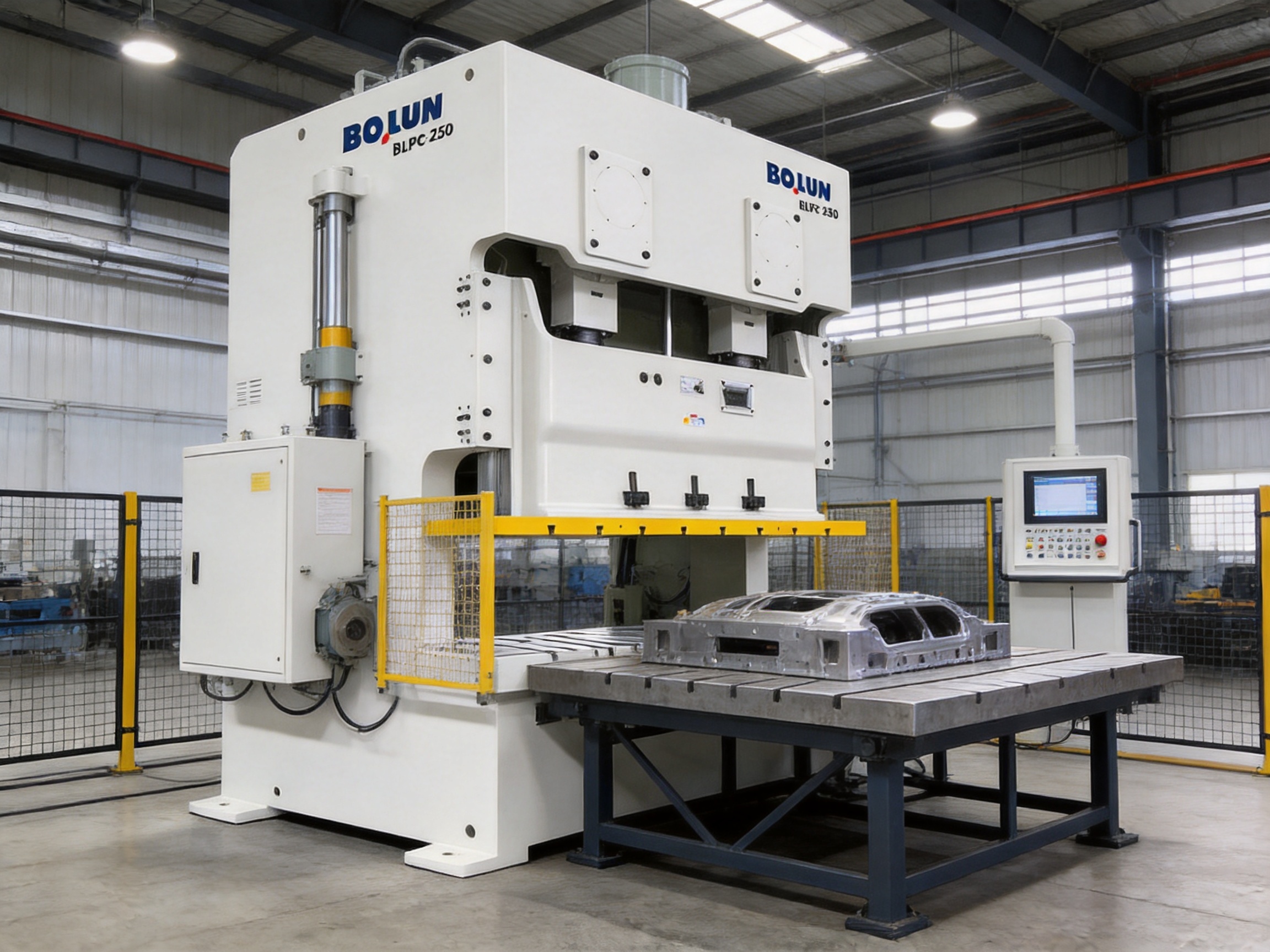
Overload protection is essential in a high-capacity stamping press. Excessive force may occur because of an incorrect shut height, an improperly positioned blank, a foreign object in the die, a tooling adjustment error, or a sudden change in material thickness. Without effective protection, an overload can damage the die, crankshaft, connecting components, slide, or frame.
The BLPC-250 incorporates hydraulic overload protection. This system is intended to respond when the press load exceeds the permitted operating condition, helping protect critical mechanical components and expensive tooling. Hydraulic protection is especially valuable in heavy-duty applications because the potential cost of damage increases with machine capacity and die complexity.
Overload protection should not be treated as permission to operate beyond rated limits. Operators must still verify die height, material specifications, lubrication, pressure distribution, and machine settings before production. The protection system is a safeguard, not a substitute for correct process engineering.
Recommended practices include:
• Confirming that the required forming force is within the press rating.
• Checking that the force is distributed appropriately across the die.
• Inspecting the die for obstructions before starting the press.
• Verifying the shut height and slide adjustment.
• Maintaining the hydraulic system according to the manufacturer’s instructions.
• Testing overload protection during scheduled maintenance.
• Recording and investigating repeated overload events.
When combined with a rigid frame and double-point slide, hydraulic overload protection helps create a more resilient production system. It can reduce the severity of unexpected incidents and support longer service life for both the press and tooling.
Ease of operation has a direct influence on production quality. A control system should allow authorized users to adjust the machine efficiently while presenting clear information about operating status, speed, settings, alarms, and safety conditions.
The BLPC-250 is described as incorporating a touch-screen interface. A touch-screen control panel can simplify interaction with the press by organizing operating commands and machine information in a visual format. Depending on the final configuration, the interface may be used for speed selection, operating mode selection, setup adjustment, alarm display, and production monitoring.
The inverter-based speed adjustment system allows the press speed to be adapted to the job. This flexibility can help manufacturers use one machine for a wider range of products. Instead of operating every die at one fixed speed, the process can be adjusted to balance output, material flow, part quality, tooling life, and operator requirements.
For example, a lower speed may be beneficial when:
• The material requires more controlled forming.
• The die has a complex sequence of forming operations.
• The workpiece is large or difficult to remove.
• The process generates significant vibration or noise.
• Tooling protection is a priority during initial production trials.
A higher speed may be appropriate when:
• The operation is primarily blanking or shallow forming.
• The material and die have been fully validated.
• Automated feeding and discharge are synchronized.
• The press remains within its rated load and operating envelope.
Inverter control also supports more gradual commissioning. A new die can be tested at a conservative speed before the process is optimized for production output. This approach can help identify alignment, feeding, lubrication, and part-ejection issues before the machine is placed into full-rate operation.
High-capacity presses require safety systems that are appropriate to the machine’s speed, force, and working area. The BLPC-250 is equipped with highly sensitive photo-electronic safety devices designed to help monitor access to hazardous areas around the die space.
Photo-electronic protection generally uses light-based detection to identify an interruption in a protected field. If an operator or object enters the monitored area during a dangerous condition, the safety circuit can initiate a stop or prevent the press from cycling, depending on the approved control logic and operating mode.
These devices are particularly valuable on an open-type press because the accessible working area can be approached from the front or sides. They can support safe operation during manual loading, unloading, setup, inspection, and die adjustment. However, no single safety device is sufficient by itself. Safe operation also requires guarding, emergency-stop functions, correct control procedures, training, lockout and isolation practices, and regular inspection.
A complete safety program should address:
• Installation and alignment of photo-electronic devices.
• Functional testing before each production shift when required.
• Emergency-stop accessibility.
• Safe setup and die-change procedures.
• Restricted access during automatic operation.
• Operator training and authorization.
• Periodic verification of the safety circuit.
• Prevention of bypassing or unauthorized modification.
Manufacturers should also confirm the applicable regional safety requirements before commissioning the machine. Electrical standards, guarding rules, risk-assessment procedures, and press safety regulations vary by market. The final machine configuration should be reviewed and approved according to the buyer’s local requirements.
The technical information lists a mold pad capacity of 140 kN ×2, a ram stroke of 100 mm, and an effective cushion area of 640 × 470 mm ×2 groups for the BLPC-250. These specifications indicate a distributed lower support arrangement that can be used for suitable forming processes requiring controlled support from below.
A cushion system can assist with blank holding, reverse forming, part ejection, and material control. In drawing operations, the cushion force helps manage the movement of the blank and can reduce wrinkling or uncontrolled material flow. In other operations, it can help return the formed component after the press stroke.
The two-group arrangement is consistent with the machine’s wide double-point design and can provide more balanced support across a large die. Tooling engineers must match the cushion configuration to the actual die design. The required force, stroke, timing, contact area, and pressure distribution should be calculated and verified during the die-development process.
As with every press accessory, the cushion should be inspected regularly. Hydraulic or mechanical components, seals, guide elements, connection points, and control functions must remain in good condition. Uneven cushion behavior can affect part quality and place unwanted loads on the die or slide.
The supplied technical table identifies punch accuracy as Level 1GB, with a reference to JIS Class 1. This information indicates that the machine is intended for precision-oriented industrial pressing, although the exact applicable standard, test method, acceptance criteria, and measured values should be confirmed in the formal technical documentation.
Press accuracy is influenced by several factors:
• Frame stiffness.
• Slide guide quality.
• Parallelism between the slide and worktable.
• Crankshaft and connection tolerances.
• Die installation accuracy.
• Lubrication and temperature conditions.
• Material consistency.
• Correct speed and pressure selection.
• Maintenance condition.
A precision press cannot compensate for a poorly designed or incorrectly installed die. For this reason, machine accuracy and tooling accuracy must be managed as one production system. The BLPC-250’s large and rigid structure provides a strong foundation, but the buyer should establish a complete setup and inspection program to achieve the desired part tolerances.
Stable operation can reduce variation between production batches. This is particularly important for automotive and hardware suppliers, where components may need to fit with other stamped, machined, welded, or assembled parts. Consistent press performance also helps reduce adjustment time and supports more predictable die-maintenance intervals.
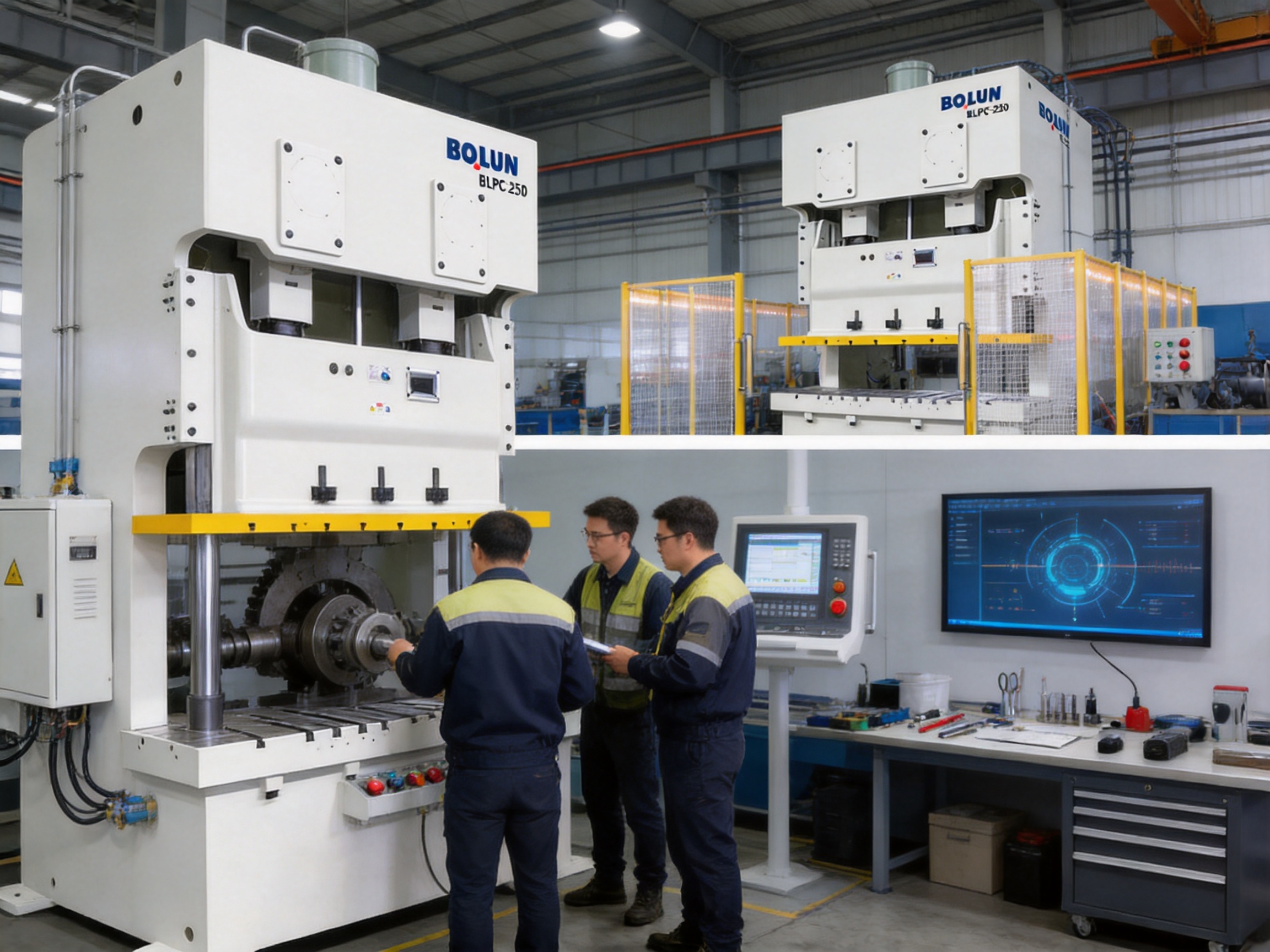
The BLPC-250 is suitable for a broad range of heavy stamping applications, subject to die design and material requirements. Its high capacity and large work area make it particularly relevant to the following sectors.
Automotive manufacturing frequently requires large structural stampings, brackets, reinforcement components, body-related parts, and hardware assemblies. These components may require wide dies, substantial forming force, and stable repeated operation. The BLPC-250’s double-point structure can support tooling that spans a broad section of the worktable.
Automotive production also benefits from the machine’s compatibility with automated feeding and transfer systems. The open working area can simplify the integration of material handling, although the final automation layout must be designed around the press’s safety system, stroke, speed, die height, and available access points.
Heavy hardware components may involve blanking, bending, embossing, forming, or multiple operations in one die. The BLPC-250 provides sufficient working space for larger hardware dies and can be configured for different production rates through inverter speed adjustment.
For hardware manufacturers producing several product families, setup flexibility is important. The die height adjustment system and broad worktable can reduce the limitations associated with a narrow machine platform. Proper tooling organization and standardized setup procedures can further improve changeover efficiency.
Appliance housings, structural panels, support plates, and equipment covers often require large blanks and wide tooling. An open-type double-point machine can provide convenient access for loading and unloading these parts. The large slide and table dimensions also give designers more freedom when developing forming sequences.
Electrical cabinets, equipment frames, mounting plates, and energy-system components may require accurate holes, bends, flanges, and formed sections. The machine can be considered for such work where the required force and die dimensions fall within its rated capacity.
Manufacturers serving multiple industrial markets may use the BLPC-250 for a combination of blanking, bending, shallow drawing, embossing, and forming operations. Its adjustable speed and extensive working envelope allow the press to support a varied production portfolio, provided that each process is properly validated.
The performance of a heavy-duty press depends heavily on the manufacturer’s production capabilities. A machine with a strong specification must be supported by accurate machining, controlled assembly, systematic inspection, and experienced engineering personnel.
The manufacturer described in the supplied materials has approximately two decades of experience in machinery manufacturing and integrates research and development, design, production, sales, and service. This integrated structure can improve communication between product engineering and manufacturing teams. It also allows customer requirements to be addressed across the full equipment life cycle, from initial specification through commissioning and after-sales support.
Several manufacturing strengths are highlighted in the company information.
An in-house design and development capability allows the manufacturer to refine press structures, control systems, safety configurations, and customer-specific functions. This is important because industrial stamping applications often differ in die size, material, speed, automation, power supply, and plant layout.
Engineering experience is particularly valuable when customers require non-standard specifications. A manufacturer that understands both mechanical and electrical systems can evaluate the interaction among frame design, drive capacity, slide stroke, die adjustment, cushion requirements, feeding equipment, and safety controls.
The company information states that the manufacturer owns advanced precision processing equipment and maintains an industrial environment covering basic design, core component development, machining, and final assembly. For a large press, this full-chain capability can help improve dimensional consistency among major components.
Large frames, tables, slides, shafts, guide components, and connection parts must be produced and assembled with appropriate accuracy. The quality of machining directly influences slide movement, alignment, parallelism, noise, vibration, and long-term wear. Precision processing is therefore not merely a cosmetic benefit; it is part of the press’s functional reliability.
Stamping lines are rarely identical. A buyer may require a particular table size, die height, electrical standard, automation interface, cushion arrangement, safety enclosure, or control language. The manufacturer’s stated non-standard customization capability can be an advantage when the standard machine must be adapted to an existing production line.
Customization should be managed through a formal technical review. The buyer and manufacturer should jointly confirm the intended material, forming process, die weight, required cycle rate, press capacity, power supply, factory conditions, automation requirements, and safety expectations. A clear technical agreement helps prevent misunderstandings during production and installation.
The company describes a finished-product inspection system that covers processes and components. A strong quality program for a power press should include incoming component inspection, machining verification, weld and frame inspection where applicable, assembly checks, lubrication checks, electrical testing, safety-device testing, no-load running, load testing, and final dimensional or functional acceptance.
Quality control is especially important for heavy equipment because errors can be difficult and expensive to correct after installation. Factory inspection before shipment provides an opportunity to verify basic machine functions and documentation while the manufacturer’s technical team is present.
Industrial customers evaluate machinery over its entire operating life, not just at the time of purchase. Pre-sales consultation, installation assistance, operator training, spare-parts support, troubleshooting, and after-sales service all contribute to the total value of the machine.
The supplied company information describes a service system covering pre-sales, in-sales, and after-sales stages. This approach is valuable for international buyers that may require assistance with plant preparation, transport planning, commissioning, maintenance schedules, and production optimization.
A reliable press is the result of many controlled production stages. Although exact procedures vary according to the final design, a professional manufacturing process normally begins with engineering review and proceeds through material preparation, component production, assembly, testing, and delivery.
The process starts with confirming the machine model, capacity, stroke, die height, table dimensions, motor configuration, control functions, safety equipment, cushion requirements, and customer-specific options. Drawings and specifications should be reviewed before production begins.
The frame and major structural members must be manufactured according to approved drawings and material requirements. Large structural parts require careful control of dimensions, joining, stress relief, machining references, and surface condition. The objective is to create a stable structure capable of maintaining alignment during heavy operation.
Critical mounting surfaces, guide areas, table surfaces, shaft seats, and connection interfaces must be machined accurately. The manufacturer’s stated precision-processing capability is important at this stage. Proper machining reduces the need for corrective adjustment during final assembly and supports stable long-term operation.
The crankshaft, connecting components, slide, guides, drive system, adjustment mechanism, and related parts are assembled in a controlled sequence. Clearances, lubrication points, fastening torque, alignment, and movement must be checked. The double-point connection requires particular attention because the two sides must work together accurately.
Hydraulic overload protection and cushion-related systems are installed and tested according to the approved configuration. Pneumatic components must be checked against the listed air pressure requirement of 0.55 MPa. Hoses, valves, seals, regulators, and pressure indicators should be inspected for leakage and correct operation.
The touch-screen interface, inverter, motor controls, sensors, safety circuits, emergency-stop functions, and operator controls are wired and tested. Electrical cabinets should be inspected for correct labeling, cable routing, grounding, component protection, and compatibility with the customer’s power supply.
Before shipment, the machine should undergo no-load operation, speed adjustment, slide movement checks, die height adjustment checks, safety-device testing, overload-system verification, and inspection of unusual noise or vibration. Where required, customer acceptance tests can be conducted using defined criteria.
A 44-ton press requires careful logistics and plant preparation. Before delivery, the buyer should confirm the foundation design, floor loading, access route, lifting capacity, ceiling height, power supply, compressed-air supply, ventilation, lighting, and space for die storage and maintenance.
The listed overall dimensions are approximately 2,545 × 3,000 × 4,304 mm. These dimensions should be treated as planning values, while the final shipping and installation drawings should be used for construction and layout decisions. Additional space is required around the press for operator access, electrical cabinets, maintenance, material handling, and safety guarding.
Commissioning should be performed by qualified personnel. The process generally includes:
• Positioning and leveling the press.
• Connecting electrical, pneumatic, and hydraulic services.
• Checking lubrication systems.
• Verifying the direction and function of the main drive.
• Testing the slide at low speed.
• Confirming die height adjustment.
• Testing safety devices and emergency stops.
• Installing and aligning the die.
• Checking cushion or mold-pad operation.
• Conducting trial production with approved material.
Production should begin conservatively. The first cycles should be performed at a controlled speed with careful observation of noise, vibration, material movement, die clearance, part ejection, and safety-device status. Once the process is stable, the operating speed can be optimized.
Preventive maintenance is essential for preserving the accuracy and reliability of a heavy-duty press. A maintenance program should be based on operating hours, cycle count, load conditions, environmental conditions, and manufacturer recommendations.
Operators should inspect the machine for unusual noise, oil leakage, loose components, abnormal vibration, visible damage, and safety-system faults. Lubrication levels, air pressure, control-panel alarms, and the general condition of the die area should also be reviewed.
Scheduled inspections should examine slide guides, connecting points, fasteners, drive components, die-height adjustment mechanisms, table surfaces, cushion connections, and protective covers. Wear or looseness should be addressed before it affects accuracy or creates a safety risk.
Hydraulic overload protection and cushion systems require clean fluid, correct pressure, and leak-free connections. Pneumatic systems should be checked for moisture, contamination, pressure stability, and valve performance. Filters and regulators should be serviced according to the maintenance plan.
Photo-electronic devices, emergency stops, interlocks, sensors, and control functions must be tested regularly. Safety devices should never be bypassed. Any malfunction should result in the machine being removed from service until the fault is corrected by authorized personnel.
Over time, manufacturers may verify slide parallelism, table condition, die-height repeatability, guide clearance, and other accuracy-related parameters. Establishing baseline measurements during commissioning makes it easier to identify changes during the machine’s service life.
The BLPC-250 should be selected when the application requires its specific combination of force, working area, die height, and double-point support. A smaller press may be more economical for light or narrow components, but it may not provide sufficient capacity or tooling space for large dies. Selecting a machine that is too small can result in frequent overload events, excessive wear, limited production flexibility, and reduced tool life.
A single-point press may be suitable for centered, relatively narrow dies. However, when the tooling is wide or the load is distributed across two major forming zones, a double-point machine may provide a more appropriate mechanical arrangement. The BLPC-250’s wide slide, broad table, and 2,239 mm column spacing support applications where a narrower machine would impose more severe layout and loading limitations.
Compared with an enclosed press, the open-type design may provide easier access and simpler integration for some production lines. The trade-off is that the application must be evaluated carefully to confirm that the required rigidity, force distribution, guarding, and process control are appropriate. The BLPC-250’s heavy structure and double-point mechanism are intended to address the demanding side of this balance.
Before purchasing a heavy-duty power press, buyers should provide the manufacturer with complete application information. The following checklist can support a more accurate technical proposal:
• Material type, thickness, width, and mechanical properties.
• Required forming, blanking, bending, or drawing operations.
• Estimated maximum and average forming force.
• Die dimensions, weight, shut height, and mounting layout.
• Required stroke and production speed.
• Desired automation and material-handling method.
• Required cushion force and stroke.
• Factory electrical voltage and frequency.
• Available compressed-air pressure and flow.
• Applicable local safety and compliance requirements.
• Available foundation, floor space, lifting equipment, and access routes.
• Preferred operator language and control interface.
• Spare-parts and service expectations.
Providing this information early helps the manufacturer determine whether the standard BLPC-250 configuration is suitable or whether modifications are necessary. It also enables more accurate estimation of installation requirements, delivery schedule, automation interfaces, and total project cost.
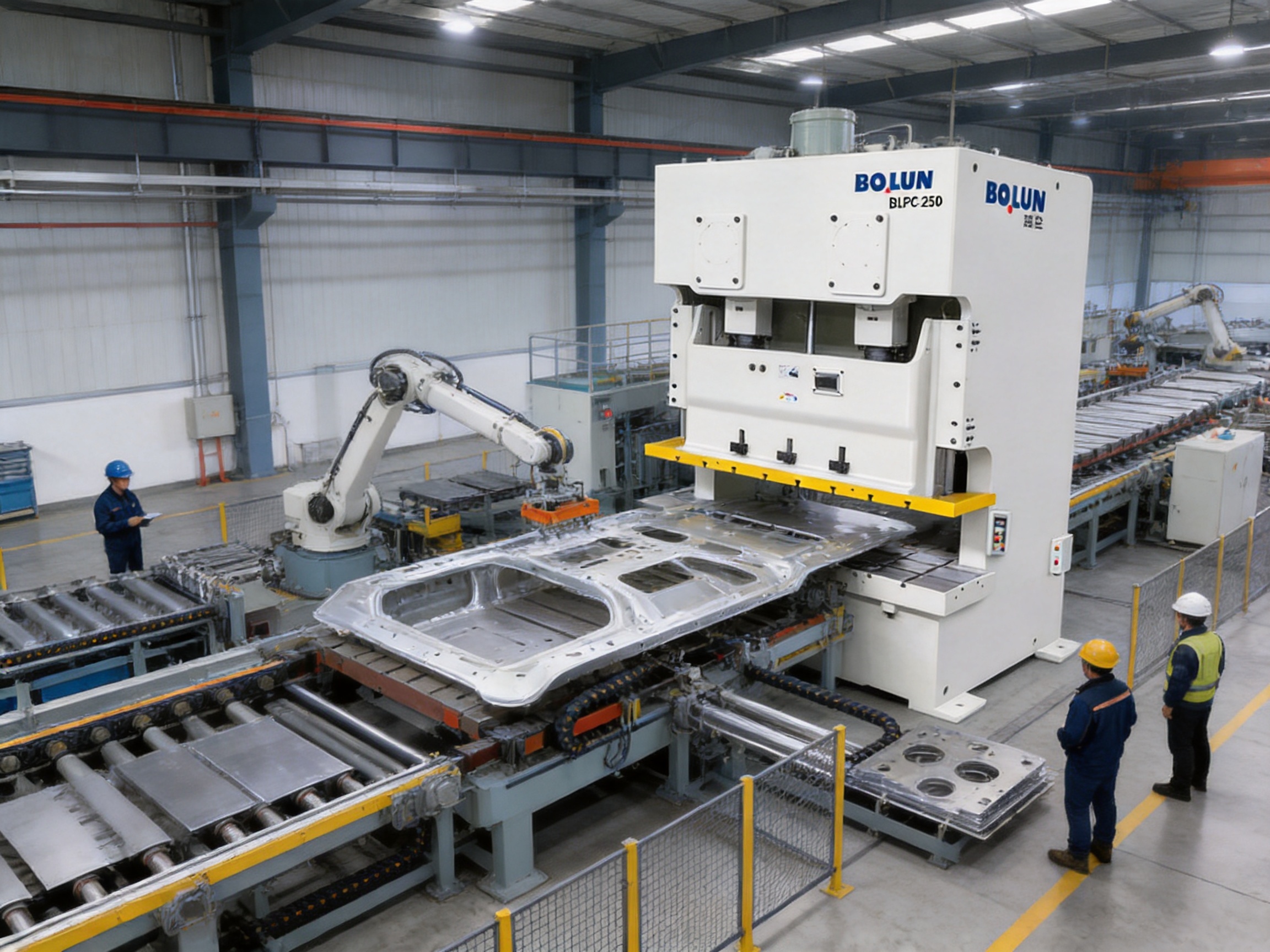
The BLPC-250 is an open-type double-point power press designed for heavy industrial stamping and forming. It has a listed nominal capacity of 2,500 kN and is intended for applications involving large dies, wide workpieces, and demanding production conditions.
The double-point structure distributes the drive connection across two locations on the slide. This provides better support for wide dies and can reduce sensitivity to certain off-center loading conditions compared with a single-point press.
The supplied product information lists a maximum die height of 605 mm for the relevant BLPC-250 configuration. The die height adjustment range is listed as 120 mm. Final values should be confirmed in the configuration-specific technical documents.
The listed worktable size is 2,700 × 900 × 170 mm. This provides a broad working surface for large dies and components.
The BLPC-250 is listed with a press weight of 44 tons. Buyers must use the final shipping and foundation drawings for transportation, lifting, and installation planning.
Yes. The product description identifies inverter-based speed adjustment. Adjustable speed allows the press to be matched more closely to the material, tooling, forming process, and production target.
The product information highlights hydraulic overload protection and highly sensitive photo-electronic safety devices. These features should be used together with appropriate guarding, emergency-stop systems, operator training, risk assessment, and local safety procedures.
It is suitable for consideration in automotive stamping applications that fall within its capacity, stroke, die dimensions, and operating limits. The final suitability depends on the component, material, die design, force calculation, automation requirements, and required tolerances.
The technical data lists a mold pad capacity of 140 kN ×2, a 100 mm ram stroke, and an effective cushion area of 640 × 470 mm ×2 groups. The exact cushion function and configuration should be confirmed against the approved machine and die specifications.
Buyers should confirm the exact electrical configuration, motor and inverter ratings, operating speed range, safety standard, die dimensions, cushion requirements, foundation information, automation interface, control language, delivery scope, and acceptance criteria.
A large power press requires proper installation, commissioning, training, maintenance, and technical service. A manufacturer with integrated design, production, inspection, and service capabilities can provide more coordinated support throughout the equipment life cycle.
The BLPC-250 is a substantial open-type double-point power press developed for manufacturers that require high capacity, wide tooling support, structural stability, and production flexibility. Its 2,500 kN nominal force, 44-ton machine mass, 2,700 × 900 mm worktable, 605 mm maximum die height, broad slide bottom, and 2,239 mm column spacing make it suitable for large and demanding stamping applications.
Its advantages over smaller or single-point machines include stronger support for wide dies, more balanced load distribution, greater tooling capacity, and improved accessibility for setup and production. The inverter-adjustable drive and touch-screen interface provide operating flexibility, while hydraulic overload protection helps protect the machine and tooling from unexpected excessive loads. Photo-electronic safety devices add an important layer of protection for the accessible open-type working area.
The value of the machine also depends on the manufacturing capabilities behind it. The supplied company information emphasizes integrated research and development, precision processing, non-standard customization, full-process quality control, and customer-oriented service. These strengths are important when a press must be adapted to a specialized die, an automated line, a particular power supply, or a demanding production environment.
For prospective buyers, the most important step is to match the machine configuration with the actual forming process. Force calculations, die dimensions, material characteristics, speed requirements, cushion needs, safety obligations, and plant conditions should all be reviewed before purchase. With correct application engineering, installation, and maintenance, the BLPC-250 can serve as a strong foundation for efficient, repeatable, and heavy-duty industrial stamping.
1. Product technical information for the BLPC-250 open-type double-point power press, including capacity, dimensions, stroke, speed, die height, table size, motor data, cushion data, and safety features.
2. Manufacturer-provided company information concerning research and development, precision processing, customization, quality control, production management, and customer service.
3. General principles of mechanical power press design, including frame rigidity, slide guidance, load distribution, die height adjustment, and drive-system operation.
4. General industrial guidance for metal stamping process planning, die selection, overload prevention, preventive maintenance, and production safety.
5. General principles of photo-electronic safeguarding, emergency-stop systems, machine guarding, operator training, and risk assessment for industrial presses.


Understanding Mechanical Power Presses and Their Essential Functions A mechani...
What Is a Power Press? A power press — also called a stamping press or punch pr...
In the fields of metal forming, sheet metal fabrication, blanking, and punching,...
Power press machines are classified in two main ways: by frame construction, w...
As the manufacturing industry moves steadily toward automation and smart product...
In modern manufacturing, cold forging is widely used in the automotive, aerospac...
Contact Us

bolunpress@gmail.com

+86-575-83362228

+86-15158259588

+86-575-83362999

+86-15158259588

Hangzhou Office Add: No. 332 Wangjiang East Road, Shangcheng District

No.1 Linjiang Road East, Xiaren, Jinting Town, Shengzhou City, Zhejiang Province, China
Ready to Begin?
Get in Touch

Now!

ZHEJIANG BOLUN
 English
 中文简体
中文简体