
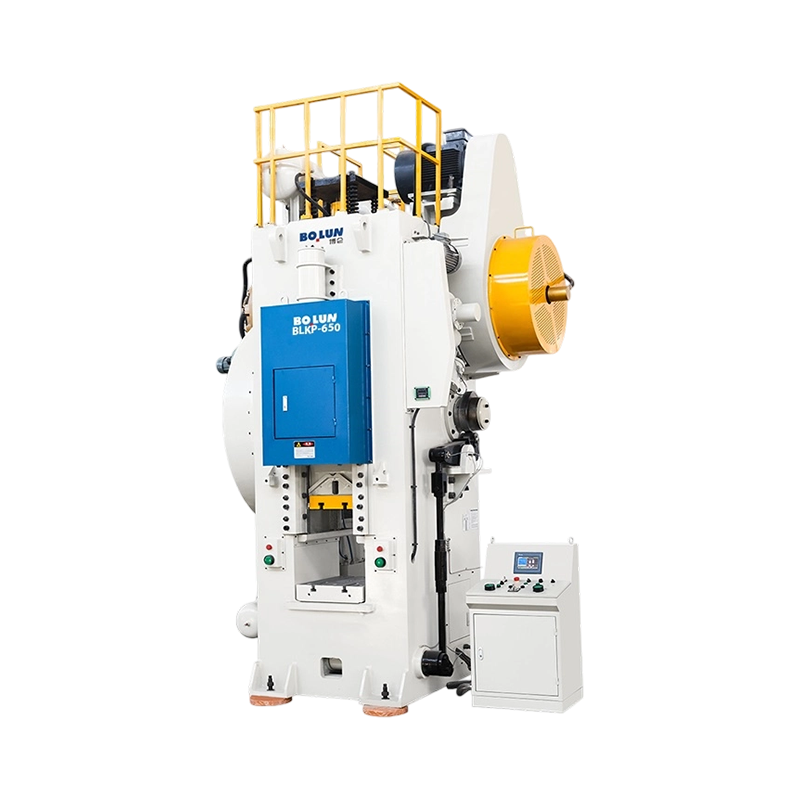
The BLKP-850 is an industrial-strength cold forging toggle type power press designed for demanding metal-forming operations that require high forming force, controlled motion, structural rigidity, and dependable production performance. With a nominal capacity of 8,500 kN, this press is positioned for high-load applications in automotive component manufacturing, heavy machinery production, fastener forming, and other industrial processes involving difficult-to-deform materials.
Cold forging places exceptional demands on a forming machine. The press must generate substantial force without sacrificing stability. It must also control the movement of the slide, support heavy dies, withstand repeated loading, and maintain reliable operation through long production cycles. The BLKP-850 addresses these requirements through a heavy-duty frame, a toggle mechanism, a thickened worktable and bolster, an integrated lubrication system, and a photoelectric safety system.
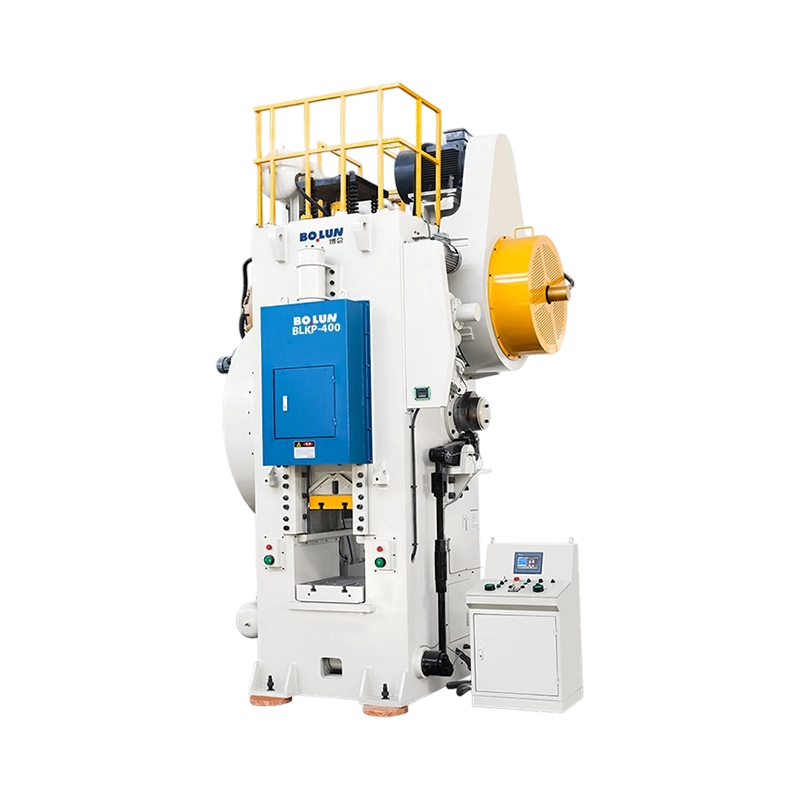
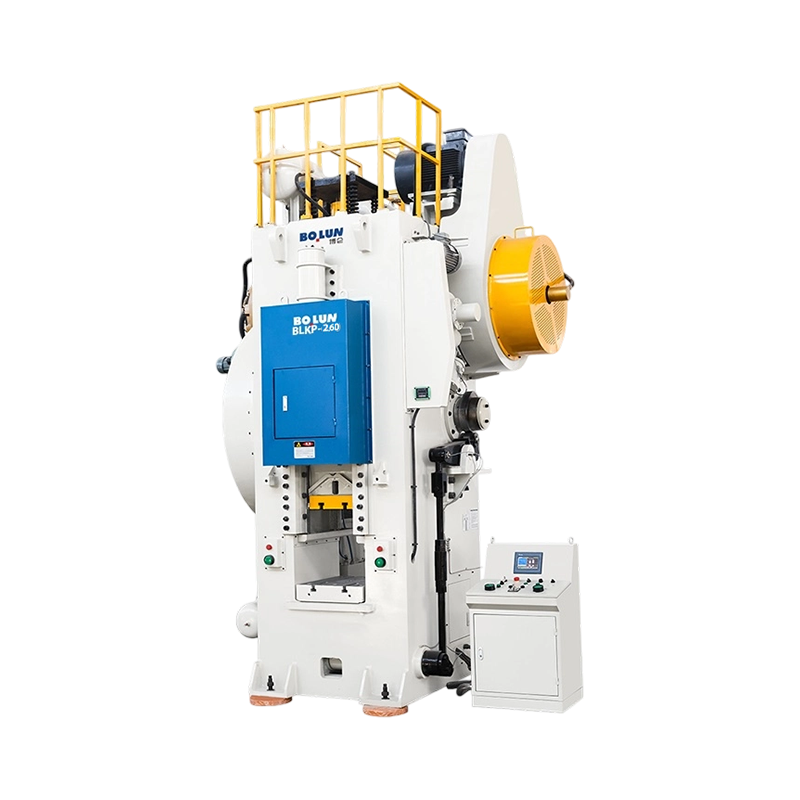
Unlike a general-purpose press intended for lighter stamping work, the BLKP-850 is configured around the requirements of high-pressure forming. Its 600 × 700 mm worktable, 180 mm bolster thickness, 180 mm slide stroke, and 75 kW main motor provide a foundation for substantial tooling and demanding production conditions. The machine is also part of a broader range of toggle type cold forging presses, allowing manufacturers to select capacity and dimensions according to their material, die, and output requirements.
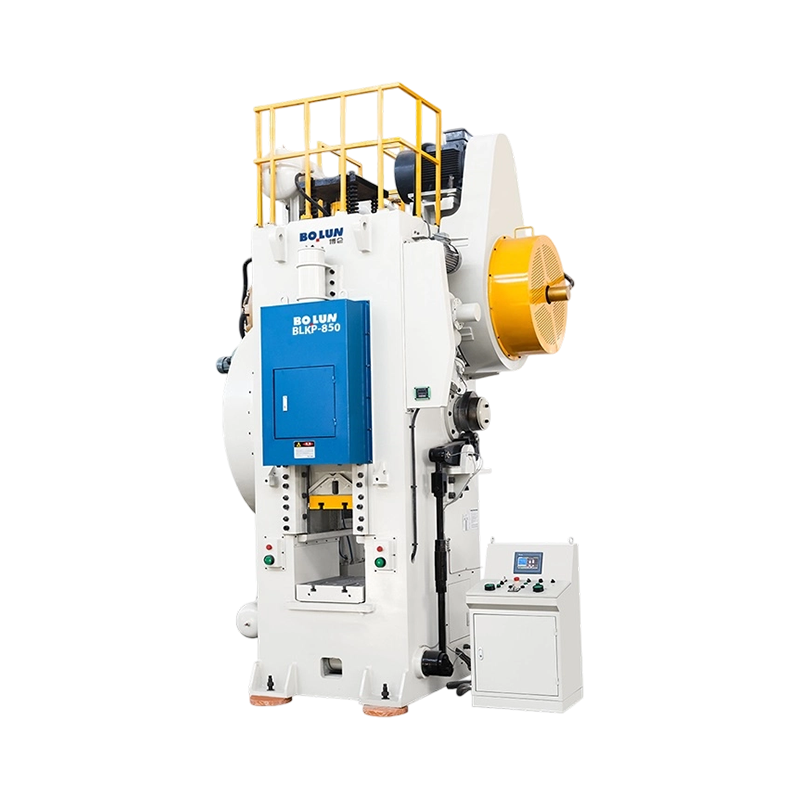
BLKP-850 Industrial Strength Heavy-Duty Cold Forging Toggle Type Power Press
Cold forging is a metal-forming process in which metal is shaped at or near room temperature. Unlike hot forging, the process does not rely on heating the workpiece to reduce its resistance to deformation. Instead, the material is formed by applying carefully controlled mechanical force through dies and tooling.
This method can produce components with excellent dimensional consistency, efficient material utilization, and improved surface quality. It is frequently used for parts such as automotive fasteners, shafts, gear blanks, bearing components, joint elements, industrial hardware, and other precision-formed products. However, cold forging requires a press with sufficient capacity and a motion profile that can deliver high force at the correct stage of the stroke.
A toggle mechanism is particularly valuable in this type of application. A toggle press uses linked mechanical members to convert the movement of the drive system into a controlled slide motion. As the toggle approaches its working position, the mechanism provides a high mechanical advantage and supports powerful forming near the bottom of the stroke.
The BLKP-850 has a nominal pressure stroke of 8 mm. This specification identifies the working portion of the motion in which the press delivers its rated forming pressure. A relatively short nominal pressure stroke is well suited to operations that require very high force over a controlled portion of the slide movement. The 180 mm slide stroke provides the necessary overall movement for loading, forming, and part removal while preserving the high-force characteristics of the toggle mechanism.
Compared with a conventional press that may be optimized primarily for general stamping, the toggle configuration can provide more controlled low-speed forming in the critical part of the cycle. This can help reduce abrupt loading, improve the handling of resistant materials, and support more predictable die engagement. The exact result depends on the tooling, material, lubrication, and production parameters, but the mechanical principle is well matched to high-load cold forging.
The following table summarizes the principal technical information available for the BLKP-850 model. Final machine configuration, tooling arrangement, electrical specifications, and auxiliary equipment should be confirmed with the manufacturer before ordering.
| Specification | BLKP-850 Value |
|---|---|
| Machine type | Cold forging toggle type power press |
| Nominal capacity | 8,500 kN |
| Nominal pressure stroke | 8 mm |
| Slide stroke | 180 mm |
| Strokes per minute | Approximately 25–40 S.P.M., depending on configuration |
| Maximum die height | 500 mm |
| Maximum die weight | 1,200 kg |
| Worktable size | 600 × 700 × 180 mm |
| Slide bottom size | 450 × 550 mm |
| Height of working face | 1,300 mm |
| Die height adjustment | 15 mm |
| Air pressure | 0.55 MPa |
| Main motor | 75 kW × 4 |
| Mold pad capacity | 300 kN |
| Ram stroke | 70 mm |
The BLKP-850 specification set shows that the machine is designed as a substantial production press rather than a small workshop unit. Its rated capacity of 8,500 kN places it in a class suitable for high-force forming operations where a lower-capacity press could experience overload, unstable operation, or insufficient process margin.
The maximum die height of 500 mm gives manufacturers room to install relatively large and complex die assemblies. The stated maximum die weight of 1,200 kg also indicates that the machine structure and working area are intended to accommodate heavy tooling. These values are important when planning multi-stage cold forging processes, transfer tooling, compound dies, or tooling systems with integrated ejectors and inserts.
The most prominent characteristic of the BLKP-850 is its 8,500 kN nominal capacity. In practical terms, this gives the machine the force reserve required for difficult forming operations in which the workpiece has high deformation resistance or a large cross-sectional area.
Cold forging loads can rise rapidly as the material fills the die cavity. The required force depends on material strength, part geometry, reduction ratio, friction, lubrication, die design, forming speed, and the distribution of deformation across one or more stations. A press selected too close to the calculated process load may be vulnerable to overload during normal variations in material or tooling conditions.
A high-capacity machine provides a larger operating margin. This does not mean that the press should be used beyond its rated limits. Rather, it allows the production engineer to design a process with appropriate reserve capacity and to accommodate reasonable variations in material condition and tooling wear. The BLKP-850 is therefore suitable for manufacturers that need to form large, high-strength, or highly compact components without moving immediately into the largest press class.
The capacity also supports future production flexibility. A manufacturer may begin with one component family and later introduce parts with greater forming resistance or a larger projected area. A press with strong capacity reserves can often support such development more effectively than a machine selected only for the first part’s minimum calculated force.
In comparison with lighter conventional power presses, the BLKP-850 offers a substantially greater force level and a structure intended for high-load work. In comparison with a much larger press, it may provide a more balanced combination of capacity, working area, motor power, and production footprint for manufacturers whose requirements fall within the 8,500 kN range.
High-force forming places stress not only on the drive mechanism but also on the frame, bolster, slide, tooling supports, and foundation. A press may have a high nominal capacity on paper, but consistent production depends on how effectively the structure controls deflection and vibration during actual forming.
The BLKP-850 is built around an ultra-rigid industrial frame. The purpose of this construction is to maintain alignment and support the forming load through the press body. Structural rigidity contributes to several important production objectives: stable die engagement, repeatable part geometry, reduced vibration, controlled tooling stress, and improved confidence during continuous operation.
The worktable measures 600 × 700 mm and incorporates a 180 mm thickened bolster. A thick bolster provides a substantial support surface between the die and the press frame. It helps distribute the forming force and creates a stable platform for heavy tooling. This is especially important in cold forging, where concentrated loads can be significant and where minor movement may affect die life or component consistency.
The slide bottom size is 450 × 550 mm. This dimension must be considered together with the worktable size, die height, die weight, and tooling layout when planning a production line. The combination gives engineers a defined working envelope for die mounting and helps determine whether a particular multi-station or compound tooling arrangement is appropriate.
Structural stability also has a direct relationship with maintenance. Excessive movement, impact, or vibration can accelerate wear in dies, guides, connections, and drive components. By using a rigid frame and substantial support members, the press is designed to reduce unnecessary mechanical disturbance during repeated high-force cycles.
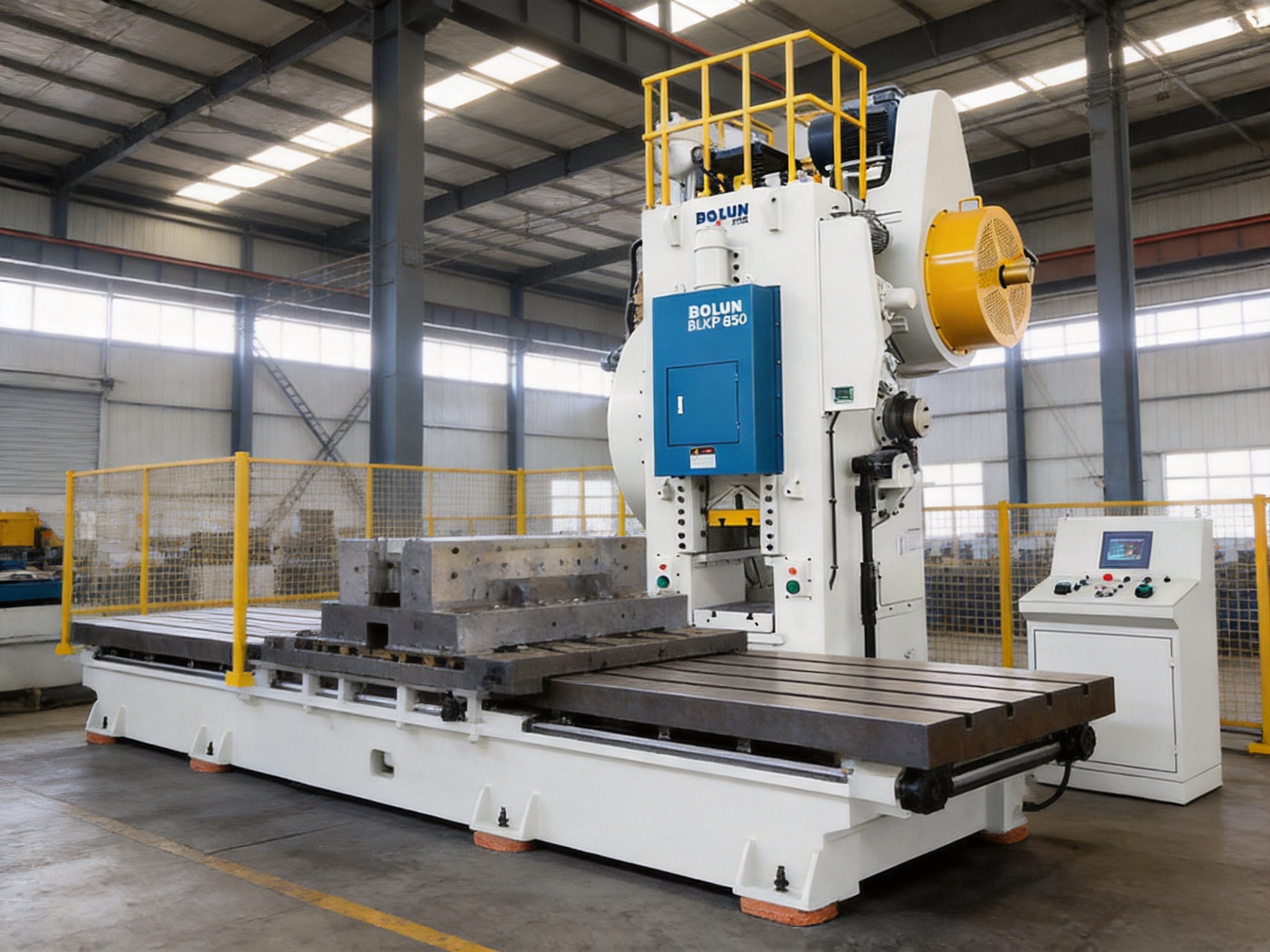
The toggle mechanism is central to the BLKP-850’s operating concept. In a toggle press, the linkage geometry changes throughout the stroke. The mechanism can move the slide through the non-working portion of the cycle and then provide high mechanical advantage as the slide approaches the forming position.
This characteristic is valuable when a workpiece must be compressed, upset, extruded, or otherwise forced into a die cavity under heavy load. The controlled low-speed forming action can improve the transition into the material and reduce the tendency for sudden impact. A smoother forming approach may also help tooling designers manage material flow and reduce unnecessary shock loading.
The 180 mm slide stroke provides enough movement for die opening, workpiece transfer, and part removal in many industrial configurations. At the same time, the 8 mm nominal pressure stroke identifies a focused high-force zone rather than a requirement to apply maximum pressure throughout the entire 180 mm movement.
This separation between overall slide movement and nominal pressure stroke can improve process efficiency. The slide can travel through the open portion of the cycle at a practical production speed, while the forming stage is handled with the controlled mechanical advantage associated with the toggle arrangement. The actual strokes-per-minute setting must be selected according to the part, tooling, material, lubrication, and machine configuration.
Toggle presses can also be advantageous where bottom-position control and repeatable die closure are important. The final movement of the linkage can support a firm forming position, which may help the tool produce consistent dimensions. As with all mechanical presses, correct die setup, slide adjustment, and load distribution remain essential to achieving the expected result.
The automotive industry uses cold forging for many components that require high strength, repeatable dimensions, and efficient material utilization. Examples can include fasteners, steering and suspension elements, gear-related blanks, drivetrain parts, and other formed components. The BLKP-850’s capacity and working envelope make it suitable for selected high-load automotive applications, particularly where the component requires substantial force or a heavy die set.
Automotive production also places emphasis on cycle consistency and equipment availability. A machine used in this environment must support stable operation across long shifts and repeated production campaigns. The rigid structure, toggle motion, lubrication system, and safety features are relevant to these requirements.
Heavy machinery components often use larger material sections or stronger alloys than small consumer products. Forming these parts can require high force and robust tooling support. The BLKP-850 provides a platform for manufacturing selected construction equipment, agricultural machinery, industrial transmission, and general mechanical components.
The 1,200 kg maximum die weight and 500 mm maximum die height are particularly relevant when large tooling assemblies are involved. Production engineers should evaluate the complete tooling package, including inserts, lifters, transfer components, ejectors, and any automation equipment, before confirming compatibility.
Cold forging is widely used for bolts, special fasteners, pins, sleeves, and other hardware products. Complex fasteners may require multiple forming stages, controlled material flow, and accurately aligned dies. A high-capacity toggle press can support operations where a standard press lacks the required force or structural margin.
The machine may also be considered for parts that need high productivity without the material waste associated with extensive machining. When a suitable die design is available, cold forging can produce near-net-shape components and reduce downstream operations.
Some steels, alloy grades, and specialized industrial materials present greater resistance to deformation. They may require careful lubrication, preform design, intermediate annealing, or a staged forming sequence. The BLKP-850’s controlled forming motion and high nominal capacity make it a candidate for such processes, subject to validation through engineering trials.
Material selection must always be coordinated with the die designer and process engineer. A high-capacity press alone cannot eliminate the need for proper material preparation, heat treatment planning, surface conditioning, or forming simulation.
The BLKP-850 offers several potential advantages over general-purpose presses when the production requirement involves high-load cold forging.
First, its 8,500 kN nominal capacity provides a higher force level than presses intended for lighter stamping and forming. This can support larger parts, stronger materials, and more demanding die geometries.
Second, the toggle mechanism is designed for controlled high-force forming. A conventional crank press may provide excellent performance in many stamping operations, but the toggle configuration can be particularly suitable when the process benefits from low-speed movement and high mechanical advantage near the forming position.
Third, the 180 mm thickened bolster supports the die with a substantial working platform. A lighter table may be adequate for small tools, but heavy cold forging dies benefit from strong support and load distribution.
Fourth, the machine supports relatively heavy tooling. The maximum die weight of 1,200 kg gives production planners a clear reference when evaluating tooling systems and line integration requirements.
Fifth, the BLKP-850 includes recursive lubrication and a photoelectric safety system as part of its stated configuration. Lubrication supports the movement and service life of mechanical components, while photoelectric protection helps monitor the operator-access area and contributes to safer operation when correctly installed and maintained.
These advantages should be evaluated against the actual process rather than treated as universal claims. The best machine for a given product depends on the required force, die dimensions, material, cycle rate, automation, precision targets, and plant conditions. The BLKP-850 is strongest where its heavy-duty capacity and toggle motion match the process profile.
Cold forging presses operate under repeated mechanical loads. Linkages, bearings, guides, drive elements, and other moving parts require appropriate lubrication to limit friction and wear. The BLKP-850 incorporates a recursive lubrication system to support stable operation during continuous production cycles.
A properly designed lubrication system can help distribute lubricant to designated machine points at regular intervals. This reduces dependence on irregular manual application and helps maintain consistent lubrication conditions. It may also make preventive maintenance easier by giving technicians a defined system to inspect, refill, and monitor.
Lubrication performance depends on more than the presence of a system. The correct lubricant, supply pressure, line condition, filter status, temperature, and service interval must all be controlled. Operators should follow the manufacturer’s maintenance instructions and investigate abnormal noise, temperature rise, leakage, or movement as soon as it appears.
Reliable lubrication supports both equipment life and production quality. Excessive friction can increase energy loss and heat, while insufficient lubrication can accelerate wear in high-load joints. In a heavy-duty cold forging environment, even small maintenance issues can become more serious because each cycle introduces substantial mechanical force.
The BLKP-850 is equipped with a photoelectric safety system. Photoelectric protection devices use light-based detection to identify intrusion into a protected area. When correctly integrated with the press control system, they can help prevent an operating cycle when an operator or object enters the monitored zone.
This type of protection is especially relevant to power press applications because the slide and die area contain significant mechanical hazards. The system should be installed according to the applicable safety requirements and used together with guarding, emergency stops, appropriate control logic, lockout procedures, and operator training.
Safety equipment is most effective when it is treated as part of a complete risk-control program. Operators should understand the protected area, reset procedures, abnormal conditions, and restrictions on bypassing safety devices. Maintenance personnel should inspect alignment, response, wiring, and functional operation at defined intervals.
The photoelectric system contributes to safer daily operation, but it does not replace safe die handling, proper setup, preventive maintenance, or compliance with local regulations. Before commissioning the machine, the purchaser should complete a site-specific risk assessment and confirm that the final configuration meets the requirements of the intended country and application.
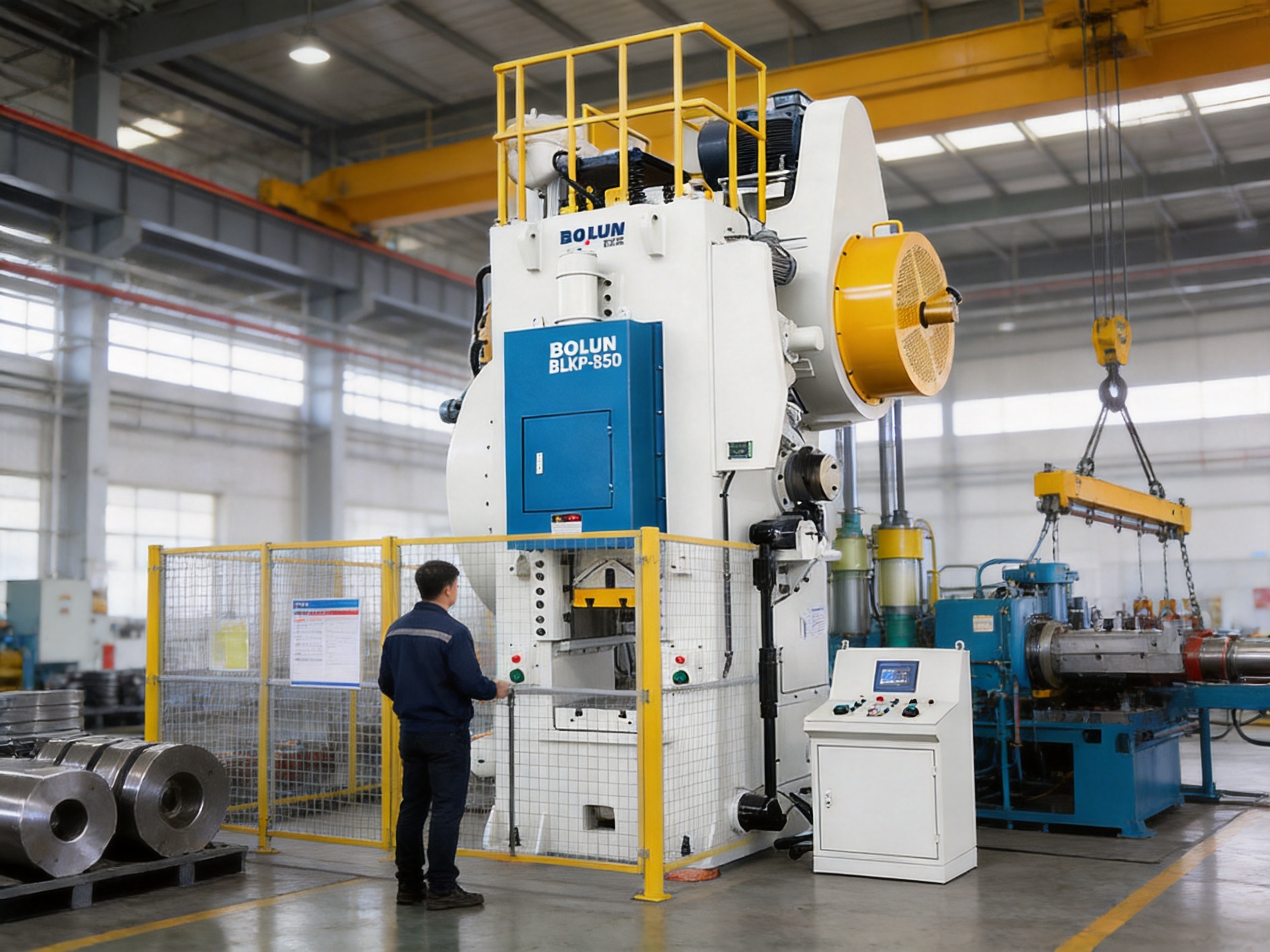
The BLKP-850 is produced by Zhejiang Bolun High-Precision Machinery Co., Ltd., a Chinese machinery manufacturer focused on precision forming equipment, forging machinery, and industrial press solutions. The company describes its experience as extending across approximately two decades of machinery manufacturing development.
The company integrates research and development, design, production, sales, and service. This integrated structure can be valuable for complex industrial machinery because the press design, component selection, assembly process, commissioning procedure, and after-sales support are connected within one organization.
High-capacity presses require more than a single successful design drawing. They depend on the coordinated production of the frame, drive mechanism, slide, bolster, control system, lubrication system, and safety equipment. An integrated manufacturer can evaluate these areas as a complete machine rather than treating them as unrelated components.
Bolun emphasizes a full-chain production system covering basic design, core component development, precision processing, and final assembly. Such a system supports process consistency and gives the manufacturer greater control over critical dimensions, interfaces, and assembly relationships.
The company also reports investment in advanced precision-processing equipment and a mature industrial production environment. For a machine such as the BLKP-850, precision processing is important in the manufacture of guide surfaces, connecting elements, mounting faces, and other components that influence alignment and movement. The actual quality of each machine still depends on inspection, process control, and final commissioning, but manufacturing capability is a fundamental part of press performance.
Cold forging applications are rarely identical. A customer may require a particular die height, special ejector arrangement, custom automation interface, modified working height, or different electrical configuration. For this reason, press suppliers must be able to provide more than a standard catalog product.
Bolun states that it provides non-standard customization and one-stop design and manufacturing services for products with special specifications and functions. This capability can be useful when a customer’s process cannot be accommodated by a standard machine arrangement.
Customization may involve the working table, tooling interface, transfer system, control functions, lubrication arrangement, safety enclosure, or integration with upstream and downstream equipment. Each modification should be evaluated carefully because changing one part of a high-force system may affect load distribution, cycle timing, guarding, maintenance access, or overall machine stability.
Engineering support is also important during the initial machine-selection process. The purchaser should provide information about material grade, blank dimensions, target part geometry, required forming stages, estimated forming force, die dimensions, production rate, automation requirements, and plant utilities. This allows the supplier to verify that the BLKP-850 is appropriate rather than relying only on nominal capacity.
For large industrial equipment, service begins before delivery. Technical discussions concerning foundation requirements, transport access, installation space, electrical supply, compressed air, lubrication, commissioning, and operator training can reduce delays during project startup.
Bolun identifies quality as a central principle of its manufacturing approach and describes a finished-product inspection system intended to control each process and component. For a heavy-duty press, quality control should cover material traceability, machining accuracy, assembly clearances, hydraulic or pneumatic functions where applicable, electrical control performance, safety-device response, lubrication delivery, and no-load and loaded operation.
Inspection should not be limited to the final appearance of the machine. Critical structural components require dimensional verification and, where appropriate, inspection methods suited to the material and manufacturing process. Moving components must be checked for alignment, smooth operation, and correct adjustment. Control and safety systems require functional testing under realistic operating conditions.
During final commissioning, the machine should be evaluated for abnormal vibration, noise, temperature, lubrication behavior, slide movement, die-height adjustment, ram operation, and control response. The buyer should receive operating instructions, maintenance requirements, recommended spare parts, and relevant inspection records according to the agreed supply scope.
Long service life depends on both manufacturing quality and customer maintenance. Even a well-built press can suffer premature wear if it is overloaded, poorly lubricated, incorrectly aligned, or operated with unsuitable tooling. A quality-centered manufacturer therefore adds value through documentation, training, technical response, and continuing service.
Tooling selection is one of the most important stages in planning a cold forging line. The die must withstand the forming load, manage material flow, maintain alignment, and release the finished component without damage. The tooling dimensions must also remain within the press envelope.
The BLKP-850 provides a maximum die height of 500 mm and a maximum die weight of 1,200 kg according to the supplied specification. These values should be considered together with the 600 × 700 mm worktable, 450 × 550 mm slide bottom, and available die-height adjustment.
The 15 mm die-height adjustment allows fine positioning within the stated range. Correct adjustment is essential for achieving the intended relationship between the upper die, lower die, slide, ejector, and workpiece. Setup personnel should verify that the selected die does not create excessive interference or insufficient clearance during the full cycle.
The mold pad capacity is listed as 300 kN, while the ram stroke is 70 mm. These specifications may be relevant to lower tooling support and ejection arrangements. The precise function and configuration of the mold pad and ram should be confirmed in the technical documentation for the ordered machine.
Tooling designers should also consider die pre-stress, insert materials, lubrication, cooling where necessary, part ejection, scrap removal, and access for inspection. A press with high capacity can only deliver reliable results when the die system is designed for the corresponding load and cycle.
The available specification indicates a strokes-per-minute range of approximately 25–40 S.P.M. for the BLKP-850, depending on the applicable configuration. The actual production rate should be selected according to forming load, die complexity, material behavior, lubrication, automation, and required component quality.
Maximum speed is not always the same as maximum productivity. A production line must consider loading, transfer, ejection, inspection, die cooling if required, and downstream operations. Running at a moderate speed may improve die life and reduce rejected parts when the component is difficult to form.
For automotive and heavy machinery parts, production planning often involves long campaigns and demanding quality requirements. A stable cycle at a sustainable rate may provide better overall output than an aggressive speed setting that increases tool wear or causes frequent stoppages.
The BLKP-850’s toggle action may support a useful balance between rapid slide travel in the open portion of the cycle and controlled motion during forming. Process engineers should confirm the ideal speed through trial production and monitor load, temperature, vibration, part dimensions, surface condition, and die wear.
A press with an 8,500 kN nominal capacity requires careful preparation before installation. The plant must provide a suitable foundation designed for the machine’s mass, operating forces, vibration characteristics, and local building conditions. Foundation drawings and loading information should be reviewed by qualified engineering personnel.
Transport planning is also important. The purchaser should evaluate the route from the unloading point to the installation location, including door height, floor loading, lifting equipment, turning radius, and access for future maintenance. The machine’s working height and surrounding clearance should be considered together with die handling and automation equipment.
The listed air pressure is 0.55 MPa. The plant air system should be capable of delivering the required pressure and flow under operating conditions, with suitable filtration and moisture control. Electrical supply requirements should be confirmed from the final machine documentation, including voltage, frequency, protection, cable sizing, and control-panel requirements.
Commissioning should include mechanical inspection, alignment verification, lubrication checks, safety-system testing, control-system setup, die-height adjustment, no-load cycling, and progressive loaded trials. Operators should be trained in normal operation, setup, emergency procedures, daily inspection, and basic fault reporting.
A structured commissioning process helps identify installation issues before full production begins. It also establishes baseline information for future maintenance, such as normal sound, temperature, vibration, cycle timing, and lubrication behavior.
Preventive maintenance is essential for any high-load mechanical press. Daily inspections should include checking lubrication levels, visible leakage, unusual noise, loose fasteners, safety-device condition, worktable cleanliness, and signs of abnormal wear. The operator should record any irregularity rather than continuing operation until a minor problem becomes a major failure.
Periodic maintenance should cover the toggle linkage, guides, drive components, bearings, fasteners, electrical connections, air system, safety devices, and die-height adjustment mechanism. The intervals should follow the manufacturer’s recommendations and may need to be shortened in dusty, humid, hot, or exceptionally high-cycle environments.
Lubricant condition should be monitored as part of the maintenance program. Contamination, incorrect viscosity, blocked lines, or poor delivery can reduce the effectiveness of the system. Maintenance personnel should verify that lubricant reaches the intended points and that the system produces the expected response.
Tooling maintenance is equally important. Dies should be inspected for cracks, chipping, galling, wear, and changes in part dimensions. Worn tooling can increase forming loads and place additional stress on the press. Replacing or repairing dies at the correct time protects both product quality and machine reliability.
Maintenance records should include operating hours, strokes, lubrication activity, component replacements, safety inspections, and fault history. These records help identify trends and support better planning of spare parts and service work.
Cold forging can contribute to material efficiency because it forms components with limited material removal compared with machining from oversized bar or billet stock. When the process is correctly designed, the resulting near-net-shape part can reduce scrap, shorten machining time, and improve throughput.
The BLKP-850 supports this type of manufacturing strategy by providing the force and tooling envelope required for substantial cold forming. Material efficiency is not automatic, however. It depends on accurate blank preparation, effective die design, controlled lubrication, correct process sequencing, and consistent machine operation.
Energy efficiency also depends on production conditions. The 75 kW × 4 main motor specification indicates a substantial drive system intended for heavy-duty work. Operating the press at a suitable speed, preventing unnecessary idle running, maintaining lubrication, and keeping the mechanical system correctly adjusted can help reduce avoidable energy losses.
Manufacturers may also improve overall resource efficiency by monitoring die life, reducing rejected parts, maintaining stable process parameters, and using preventive maintenance to avoid unplanned breakdowns. These measures improve both environmental performance and production economics.
The BLKP-850 competes most effectively in applications where a manufacturer needs a combination of high capacity, controlled toggle forming, heavy tooling support, and industrial durability.
Its first competitive advantage is scale. An 8,500 kN nominal capacity gives the machine the ability to address applications beyond the practical range of small and medium presses. This provides a path for manufacturers producing larger or stronger components.
Its second advantage is motion control. The toggle mechanism is well suited to processes that benefit from high mechanical advantage and controlled low-speed forming. This can be a meaningful difference when compared with equipment designed primarily for rapid, general-purpose stamping.
Its third advantage is structural support. The 180 mm thickened bolster and rigid frame are appropriate for substantial dies and concentrated forming loads. Stable support can contribute to tooling performance, repeatability, and long-term machine service.
Its fourth advantage is production readiness. Recursive lubrication, photoelectric safety protection, die-height adjustment, mold pad capacity, and ram movement are integrated into the machine concept. These features help address the practical requirements of continuous industrial operation.
Its fifth advantage is manufacturer support. Bolun’s stated capabilities in research and development, precision processing, customization, quality inspection, and service allow the machine to be evaluated as part of a complete forming solution rather than as an isolated piece of equipment.
Purchasers should compare competing presses using equivalent criteria: nominal and working capacity, pressure-stroke definition, slide motion, die weight, worktable dimensions, structural design, motor power, safety systems, maintenance support, customization capability, commissioning scope, and total cost of ownership. A direct comparison based only on tonnage may overlook important differences in process suitability.
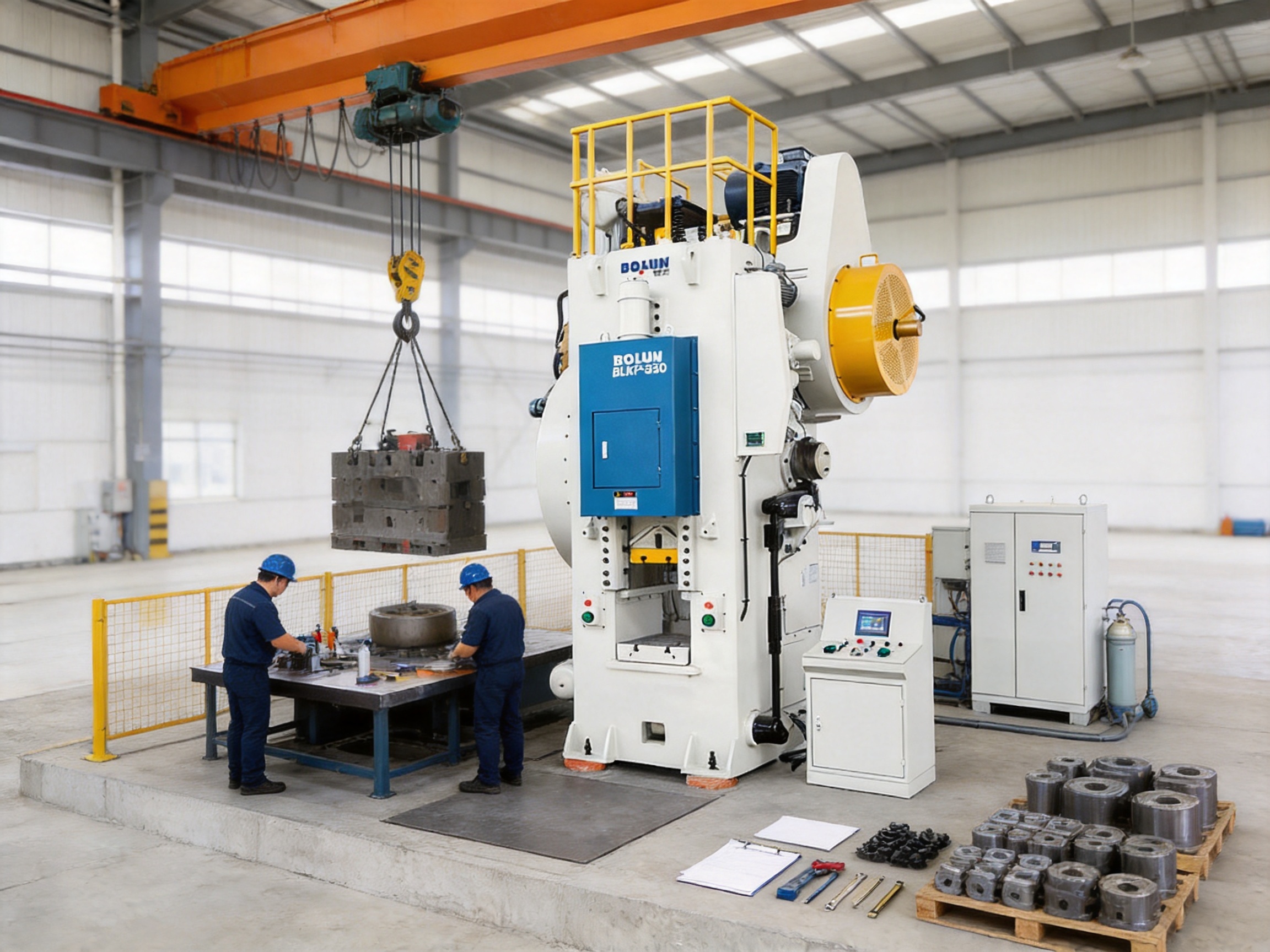
Before purchasing the BLKP-850, the customer should prepare a complete technical brief. This brief should identify the material, blank dimensions, finished-part dimensions, forming sequence, estimated force, die size, die weight, desired production rate, tolerance requirements, automation method, and environmental conditions.
The supplier can then review whether the nominal capacity and pressure stroke are appropriate. It is also important to clarify whether the stated strokes-per-minute range applies to the intended operating configuration and whether special tooling or automation will change the available speed.
The buyer should request confirmation of the final machine layout, foundation loads, electrical requirements, air consumption, lubrication requirements, safety arrangement, die-mounting details, and spare-parts recommendations. If the machine will be integrated into an automated line, interface specifications should be agreed before manufacturing begins.
Where possible, a forming trial or engineering review should be completed for representative parts. This can help confirm material flow, required force, die filling, ejection, surface quality, and cycle stability. It may also reveal the need for preforming, intermediate treatment, additional lubrication, or a different tooling sequence.
A well-defined acceptance procedure should be included in the purchase agreement. It can cover unloaded operation, safety-system response, slide movement, pressure performance, loaded production trials, part quality, noise, vibration, and documentation. Clear acceptance criteria reduce uncertainty for both purchaser and supplier.
Zhejiang Bolun High-Precision Machinery Co., Ltd. is based in Zhejiang Province, China, a region with a strong industrial manufacturing and machinery supply base. The company’s stated business scope includes the integration of equipment research and development, design, manufacturing, sales, and service.
The company presents technology as a central development strategy and emphasizes precision processing, core component development, industrial assembly, and customization. These capabilities are relevant to the production of high-capacity presses because performance depends on the interaction of many precision-manufactured parts.
Bolun also describes a customer-oriented service system covering consultation before purchase, support during the sales and installation process, and after-sales assistance. For customers operating in international markets, communication regarding installation, spare parts, training, troubleshooting, and maintenance is an important part of the supplier evaluation.
The company’s stated quality philosophy focuses on stable precision and service life under high-intensity conditions. This aligns with the intended application of the BLKP-850, which is designed for demanding industrial forming rather than occasional light-duty use.
Customers should nevertheless confirm the exact service package, warranty terms, documentation language, response arrangements, spare-parts availability, and remote or on-site support included with their order. These details are essential when the press is part of a production line where downtime has a significant economic impact.
The BLKP-850 is a cold forging toggle type power press. It is designed for high-load metal forming and is suitable for selected automotive, heavy machinery, fastener, and industrial component applications.
The nominal capacity is 8,500 kN. This capacity places the press in a heavy-duty class suitable for demanding forming operations, provided that the tooling and process are designed within the machine’s rated limits.
The nominal pressure stroke is 8 mm. This represents the specified working stroke associated with the rated forming pressure. The overall slide stroke is 180 mm.
A toggle mechanism provides high mechanical advantage near the forming position and supports controlled low-speed movement during the critical portion of the cycle. This can be beneficial for forming materials that require substantial pressure and careful control of material flow.
The worktable size is 600 × 700 mm, with a listed thickness or bolster dimension of 180 mm. The slide bottom size is 450 × 550 mm.
The listed maximum die weight is 1,200 kg. The complete tooling arrangement should be reviewed to ensure that the die, inserts, transfer parts, and accessories remain within the permitted limits.
The maximum die height is listed as 500 mm. The machine also provides 15 mm of die-height adjustment for fine positioning within the applicable setup range.
The supplied specification lists a main motor rating of 75 kW × 4. Final electrical details should be confirmed in the machine’s purchase and technical documentation.
The stated configuration includes a photoelectric safety system. It should be used together with proper guarding, emergency stops, safe setup practices, operator training, and compliance with applicable regulations.
The machine description states that recursive lubrication is integrated. The purchaser should confirm the lubricant type, delivery points, inspection method, service interval, and maintenance procedure before commissioning.
The press can be evaluated for automated production, but suitability depends on the part, die, transfer system, loading method, ejection system, and required cycle rate. Automation interfaces should be discussed with the manufacturer during the design stage.
The manufacturer states that it provides non-standard customization and design services for products with special specifications and functions. Custom requirements should be defined in detail because they may affect the frame, tooling interface, controls, safety system, or installation conditions.
The buyer should confirm forming force, material, part dimensions, die size, die weight, production rate, slide stroke, pressure stroke, machine layout, foundation, electrical supply, air pressure, safety requirements, commissioning scope, spare parts, training, warranty, and after-sales support.
The BLKP-850 is a heavy-duty cold forging toggle type power press developed for industrial forming applications that demand high force, controlled motion, rigid support, and dependable operation. Its 8,500 kN nominal capacity provides substantial forming capability, while the toggle mechanism supports high mechanical advantage and controlled low-speed forming near the working position.
The 600 × 700 mm worktable, 180 mm thickened bolster, 500 mm maximum die height, and 1,200 kg maximum die weight give manufacturers a practical platform for large and heavy tooling. The 180 mm slide stroke, 8 mm nominal pressure stroke, 75 kW × 4 main motor, 300 kN mold pad capacity, and 70 mm ram stroke further define a machine intended for serious production work.
Integrated recursive lubrication and photoelectric safety protection support the requirements of continuous industrial operation. At the manufacturing level, the supplier’s stated strengths in research and development, precision processing, customization, quality inspection, assembly, and service provide a foundation for delivering complete forming solutions.
For manufacturers comparing high-capacity presses, the BLKP-850 should be assessed not only by its nominal force but also by its motion profile, structural rigidity, tooling compatibility, maintenance system, safety arrangement, customization potential, and total lifecycle support. When these characteristics match the forming process, the machine can serve as a strong production platform for automotive, heavy machinery, fastener, and other high-load cold forging applications.
1. Product technical information supplied for the BLKP-850 Cold Forging Toggle Type Power Press.
2. Product range information for BLKP-series toggle type power presses, including capacity, stroke, worktable, die-height, motor, and tooling data.
3. General engineering principles of cold forging, mechanical press operation, toggle mechanisms, die design, lubrication, and industrial press safety.
4. Manufacturer-provided company information concerning research and development, precision manufacturing, customization, quality control, assembly, and customer service.
5. General industrial guidance for power press installation, preventive maintenance, tooling selection, operator training, and production-line commissioning.


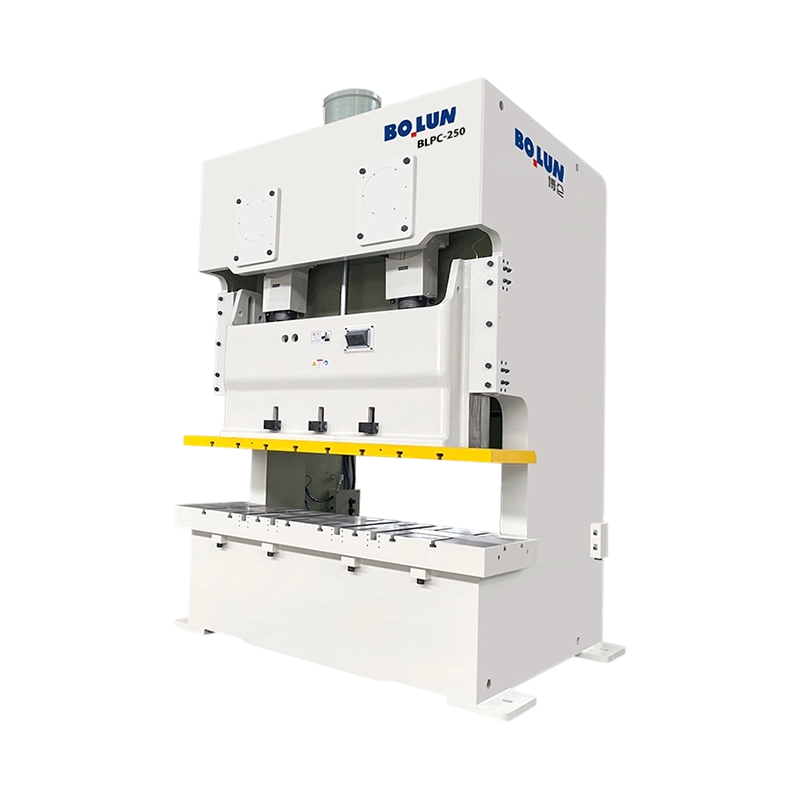
What Is a Power Press? A power press — also called a stamping press or punch pr...
Power press machines are classified in two main ways: by frame construction, w...
Understanding Mechanical Power Presses and Their Essential Functions A mechani...
A cold forging die rarely announces its failure in advance. One day the press r...
In the fields of metal forming, sheet metal fabrication, blanking, and punching,...
As the manufacturing industry moves steadily toward automation and smart product...
Contact Us

bolunpress@gmail.com

+86-575-83362228

+86-15158259588

+86-575-83362999

+86-15158259588

Hangzhou Office Add: No. 332 Wangjiang East Road, Shangcheng District

No.1 Linjiang Road East, Xiaren, Jinting Town, Shengzhou City, Zhejiang Province, China
Ready to Begin?
Get in Touch

Now!

ZHEJIANG BOLUN
 English
 中文简体
中文简体