Modern manufacturing increasingly depends on forming equipment that can combine very high force, stable motion, broad working dimensions, dependable control, and repeatable production quality. Large automotive body structures, heavy appliance panels, industrial enclosures, structural assemblies, and other oversized components place demanding requirements on a power press. These applications cannot be handled efficiently by equipment designed only for small or medium-size parts. They require a machine with sufficient nominal capacity, a rigid load-bearing structure, a large die area, carefully controlled slide movement, and a production system capable of maintaining accuracy during continuous operation.
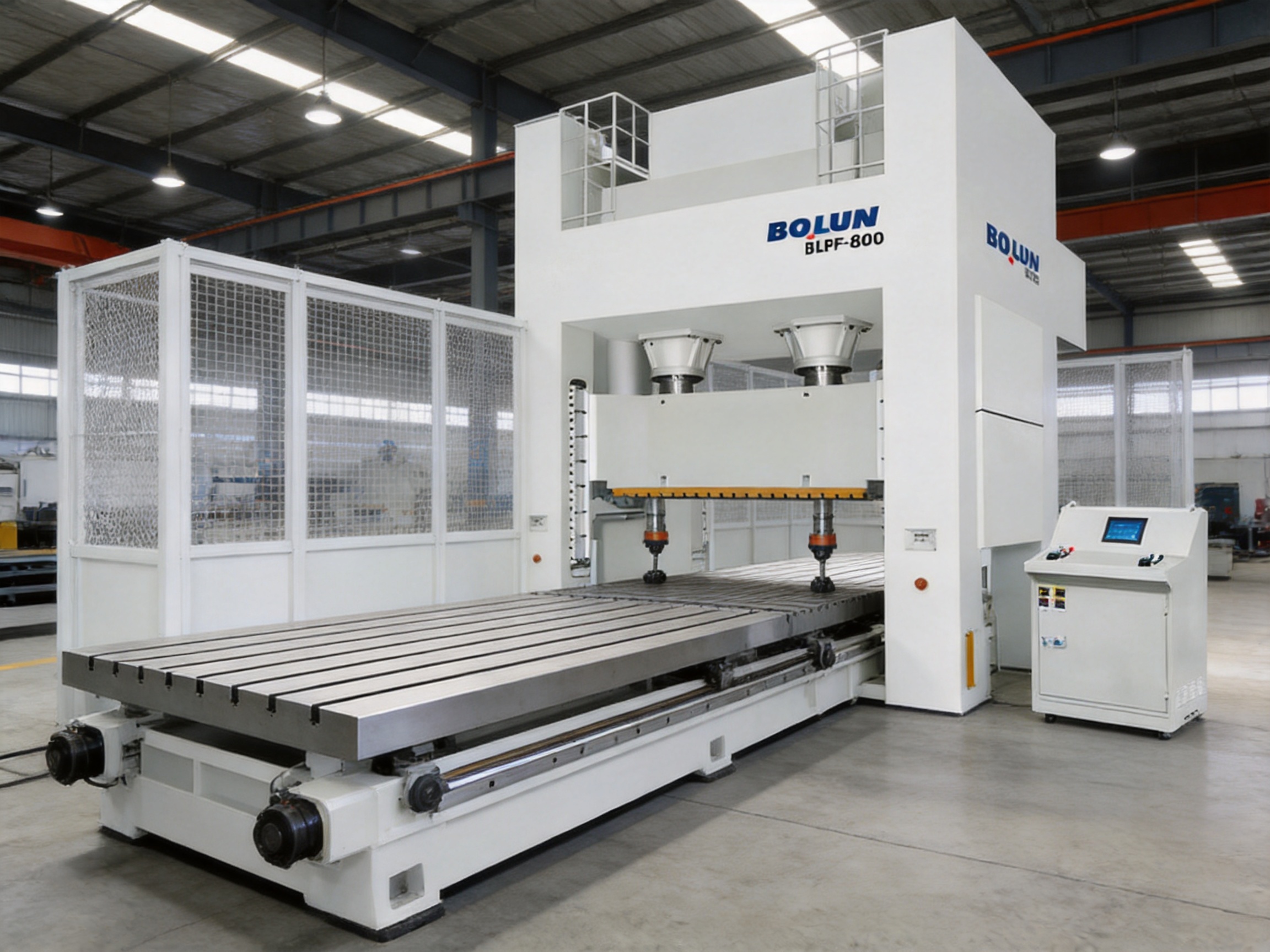
The BLPF-800 Ultra-High-Tonnage Industrial Closed-Type Double-Point Eccentric Gear Power Press is designed for this class of work. With a nominal capacity of 8,000 kN, a 3,600 × 1,400 mm worktable, a 400 mm slide stroke, and a cushion capacity of 1,200 kN, it is intended for large-scale stamping, deep drawing, and structural forming. Its closed-type frame and double-point drive arrangement support balanced force distribution across the working area, while the eccentric gear transmission provides a practical solution for heavy-duty mechanical pressing.
This press is not simply a larger version of a general-purpose power press. Its dimensions, structural design, transmission system, cushion capability, and control features are coordinated for demanding forming operations. The result is a production platform that can support large dies, high material loads, long production cycles, and applications where both forming force and process stability are essential.
The central specification of the BLPF-800 is its 8,000 kN nominal capacity. This capacity places the machine in the ultra-high-tonnage segment of mechanical power presses and allows it to process large workpieces that would exceed the practical limits of lighter equipment. High nominal capacity is especially important when a component includes deep drawn sections, reinforced contours, multiple formed features, or a broad working area that distributes load over a large die surface.
In practical production, the required press capacity is affected by material type, thickness, tensile strength, forming method, blank shape, draw depth, die geometry, friction, and the distribution of forming operations. A press must therefore provide more than an adequate peak force. It must maintain structural rigidity and controlled movement while the die experiences changing loads. The BLPF-800 is developed around this requirement, combining a heavy closed-type frame with a double-point eccentric gear drive.
The closed-type configuration provides a fully enclosed load path between the upper and lower structural sections of the machine. Compared with an open-gap structure, a closed frame is generally better suited to high-load applications where frame deflection and torsional movement must be carefully controlled. The design helps maintain the relationship between the slide, die, and worktable, particularly when large tools apply substantial force over a broad area.
The double-point arrangement further supports balanced operation. Instead of relying on a single central drive point, the slide is actuated through two separated drive locations. This configuration helps distribute the working force across the width of the slide and reduces the tendency for uneven loading when a large die contains off-center forming features. For manufacturers producing wide panels or complex structural components, balanced slide movement can contribute to longer die life, more consistent forming results, and more stable machine operation.
The following specifications summarize the principal configuration of the BLPF-800. Actual production suitability should always be confirmed through a detailed review of the material, die, blank, forming sequence, and required operating conditions.
| Specification | BLPF-800 Value |
|---|---|
| Press type | Closed-type double-point eccentric gear power press |
| Nominal capacity | 8,000 kN |
| Nominal pressure stroke | 10 mm |
| Slide stroke | 400 mm |
| Strokes per minute | 15–25 S.P.M. |
| Maximum die height | 850 mm |
| Die height adjustment | 300 mm |
| Worktable size | 3,600 × 1,400 mm |
| Slide bottom size | 3,300 × 1,400 mm |
| Height of working face | 850 mm |
| Distance between columns | 4,050 mm |
| Main motor configuration | 75 kW × 4 |
| Air pressure | 0.55 MPa |
| Cushion capacity | 1,200 kN |
| Cushion working stroke | 140 mm |
| Press structure classification | GB/JIS 1 class |
The specification set shows that the machine has been designed around large tooling and high-load forming rather than only maximum force. The generous working table, broad slide bottom, high die-height range, and substantial cushion system are important parts of the overall production capability. A high-tonnage press with insufficient die space or limited adjustment would not provide the same practical value.
The BLPF-800 includes a 3,600 × 1,400 mm worktable and a 3,300 × 1,400 mm slide bottom. These dimensions give manufacturers room to install wide and long dies used in automotive, appliance, transportation, construction, and heavy industrial applications. Large tooling can incorporate several forming stages, trimming functions, piercing operations, draw beads, pressure pads, or integrated sensing systems. Sufficient die space is therefore essential for reducing the need to divide a component into smaller operations.
A larger die area can improve production planning in several ways. It may allow multiple operations to be integrated into a compound or progressive arrangement, depending on the component and process. It can also reduce the number of intermediate transfers, which may lower handling requirements and improve dimensional consistency. In addition, a wide working area gives tool designers greater freedom to position features and balance forming loads.
The 4,050 mm distance between columns provides a broad opening for die installation and workpiece handling. This is particularly valuable when the workpiece is large, when a die includes substantial side structures, or when automated loading and unloading equipment must access the working area. The 850 mm working-face height can also support ergonomic access and integration with material-handling systems, subject to the final line layout.
Die height is another important consideration. The BLPF-800 provides a maximum die height of 850 mm and a die-height adjustment range of 300 mm. This range allows the machine to accommodate tooling with different construction heights and to adjust the working relationship between the upper and lower die sections. Flexible adjustment is important when a factory uses the same press for several product families or when tools vary in pad configuration, draw depth, and auxiliary equipment.
High-tonnage forming generates significant mechanical loads. These loads do not remain constant throughout the stroke. They may rise sharply near the bottom of the stroke, shift from one side of the die to the other, or vary according to material flow and local geometry. A press frame must resist these forces while preserving the alignment of the slide and worktable.
The closed-type construction of the BLPF-800 is intended to provide a rigid structural foundation for heavy forming. A closed frame can help reduce unwanted opening and deformation compared with less rigid configurations. This is especially relevant when the die is large and the forming force is distributed across a wide working area. Maintaining a stable relationship between the die halves supports repeatable clearance, uniform material flow, and controlled tool contact.
Structural rigidity also has a direct relationship with die performance. Excessive deflection can create uneven clearances, localized wear, burr formation, dimensional variation, and inconsistent drawing behavior. By using a high-rigidity frame concept, the BLPF-800 is positioned to support demanding dies over long production periods. The press structure classification of GB/JIS 1 class further indicates that the machine is designed according to a high level of structural and manufacturing expectations.
For buyers comparing ultra-high-tonnage presses, frame design should be evaluated together with nominal capacity. Two machines with similar force ratings may behave differently if their frame stiffness, slide guidance, drive arrangement, or manufacturing accuracy differ. The BLPF-800’s value lies in the combination of capacity and structural design, not in the force rating alone.
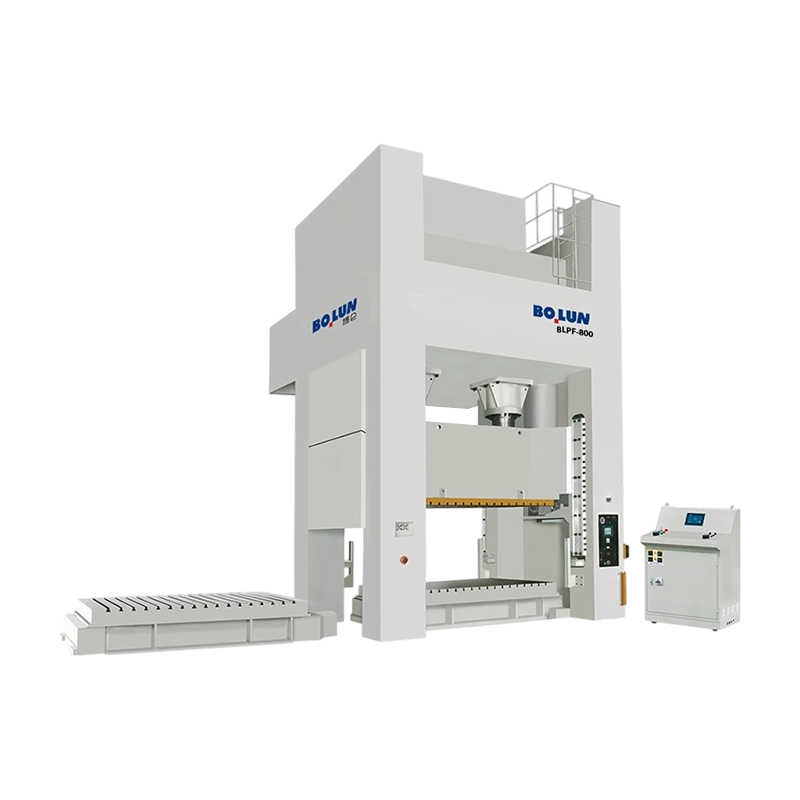
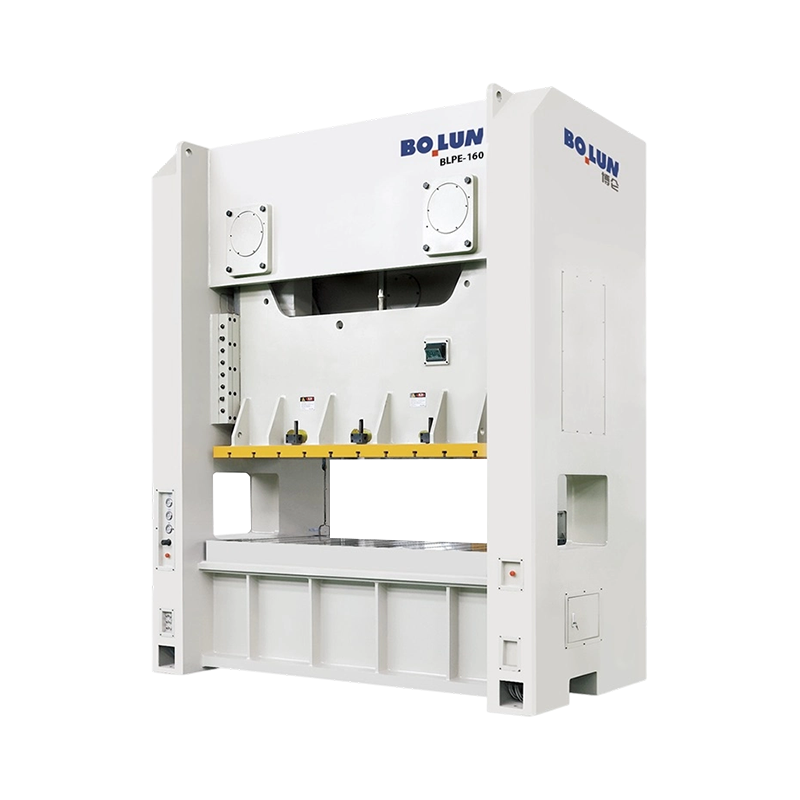
BLPF-800 Ultra-High Tonnage Industrial Closed-Type Double-Point eccentric gear Power Press
The eccentric gear transmission is a defining feature of the BLPF-800. Mechanical presses based on eccentric or crank-related transmission systems convert rotary motor power into controlled reciprocating slide movement. In a heavy-duty machine, the transmission must withstand repeated cycles, transmit high torque, and maintain stable motion under changing loads.
The double-point arrangement connects the transmission system to two points on the slide. This helps distribute the force across the working width and can reduce the risk of slide tilting during off-center loading. Large dies frequently contain asymmetric features, and production conditions may not always produce perfectly uniform force distribution. A double-point drive is therefore advantageous for applications in which balanced movement is essential.
The eccentric gear system also supports a defined working stroke and repeatable motion profile. The BLPF-800 has a 400 mm slide stroke, allowing the machine to accommodate substantial die opening requirements and forming depths. The 15–25 strokes-per-minute range provides a practical balance between productivity and the controlled motion required for large, high-load components. The best operating speed depends on the material, die design, forming process, lubrication, part geometry, and required quality level.
Compared with equipment designed primarily for high-speed, light-load stamping, an ultra-high-tonnage eccentric gear press is optimized for force, stability, and controlled forming. This makes it suitable for operations where the production objective is not simply to achieve the highest cycle rate, but to form a large and technically demanding part accurately and consistently.
The transmission system should also be considered in terms of serviceability. Mechanical power presses are often selected for their predictable operating principles and long-term maintainability. With a properly managed lubrication program, regular inspection, correct die setup, and appropriate load control, the eccentric gear transmission can support sustained industrial production. Preventive maintenance remains essential, especially in applications involving high force, frequent cycling, and large dies.
The BLPF-800 is listed with a main motor configuration of 75 kW × 4. This multi-motor arrangement provides the drive power required for the machine’s high-capacity transmission system. Dividing the drive across multiple motor units can support a balanced power input and allow the machine to manage the substantial energy requirements associated with moving a large slide and forming heavy components.
Power delivery in a large mechanical press must be evaluated in relation to the complete operating cycle. The machine must accelerate the slide, manage the return movement, overcome friction and mechanical resistance, and deliver forming energy at the appropriate point in the stroke. A suitable motor and transmission configuration helps maintain stable performance without placing excessive stress on individual drive components.
For production managers, the motor configuration also has implications for electrical planning, energy management, and maintenance. The plant should provide an appropriate power supply, protection system, ventilation arrangement, and service access. Operating conditions should be reviewed during installation so that the press can work reliably under the intended load and speed range.
Deep drawing and complex forming often require controlled support from below the workpiece. Without appropriate cushion force, the material may wrinkle, tear, shift, or develop inconsistent wall thickness. The BLPF-800 provides a 1,200 kN cushion capacity with a 140 mm cushion working stroke, giving it the capability to support demanding forming operations in which material flow must be controlled during the press cycle.
The cushion system applies force beneath the blank holder, die, or lower tooling components, depending on the die design. Its function can include controlling flange movement, supporting a pressure pad, managing draw-in, and stabilizing the workpiece during forming. By adjusting the cushion force and stroke according to the process, manufacturers can improve the balance between material flow and restraint.
A 1,200 kN cushion capacity is particularly relevant for large panels and structural parts. As component size increases, the blank area and potential material movement also increase. A cushion with insufficient capacity may fail to control the blank effectively, while excessive or poorly adjusted cushion force can restrict material flow and cause tearing. The BLPF-800 gives process engineers a substantial working range for developing a suitable forming window.
The 140 mm cushion stroke is also important. Cushion travel must correspond with the die’s movement, pressure-pad requirements, and desired material-flow behavior. A suitable stroke allows the cushion to follow the forming sequence rather than acting as a fixed support. During commissioning, the actual cushion settings should be established through die trials and verified against part quality, draw depth, surface appearance, and tool behavior.
In comparison with high-tonnage presses that provide only limited or optional lower-die support, the integrated cushion capacity of the BLPF-800 makes the machine more versatile for deep drawing and complex forming. It can be used not only for straightforward blanking or shallow forming, but also for processes in which controlled pressure from below is central to the result.
Large mechanical presses require clear operator interaction and dependable protection systems. The BLPF-800 includes an integrated control system with a touch-screen interface and an anti-overrun safety device. These features are intended to improve visibility of operating conditions, simplify machine interaction, and help prevent unsafe or uncontrolled movement.
A touch-screen interface can provide access to operating parameters, machine status, alarms, adjustment functions, and production settings. On a high-capacity press, clear information is especially important because the machine includes multiple drive components, a large slide, a cushion system, and substantial stored mechanical energy. Operators and maintenance personnel need to understand the current condition of the machine before starting, adjusting, or servicing it.
The control system can also support repeatability by allowing approved settings to be recorded and used during subsequent production runs. Depending on the final configuration, production personnel may monitor stroke rate, die-height adjustment, cushion behavior, operating mode, and safety status. Consistent setup reduces the risk of variation caused by manual adjustment and can shorten changeover time between compatible tools.
The anti-overrun safety device provides an additional safeguard against excessive or uncontrolled machine movement. Safety systems must be considered part of the press design rather than an accessory added after installation. They should work together with guarding, emergency stops, operating controls, die protection, maintenance procedures, and site-specific risk assessments.
Manufacturers should always complete a full safety review before commissioning the machine. Operators must receive training in normal operation, setup, die change, fault response, lockout procedures, and emergency actions. The machine’s safety functions should be inspected regularly, and no safety device should be bypassed or modified without authorization from qualified technical personnel.
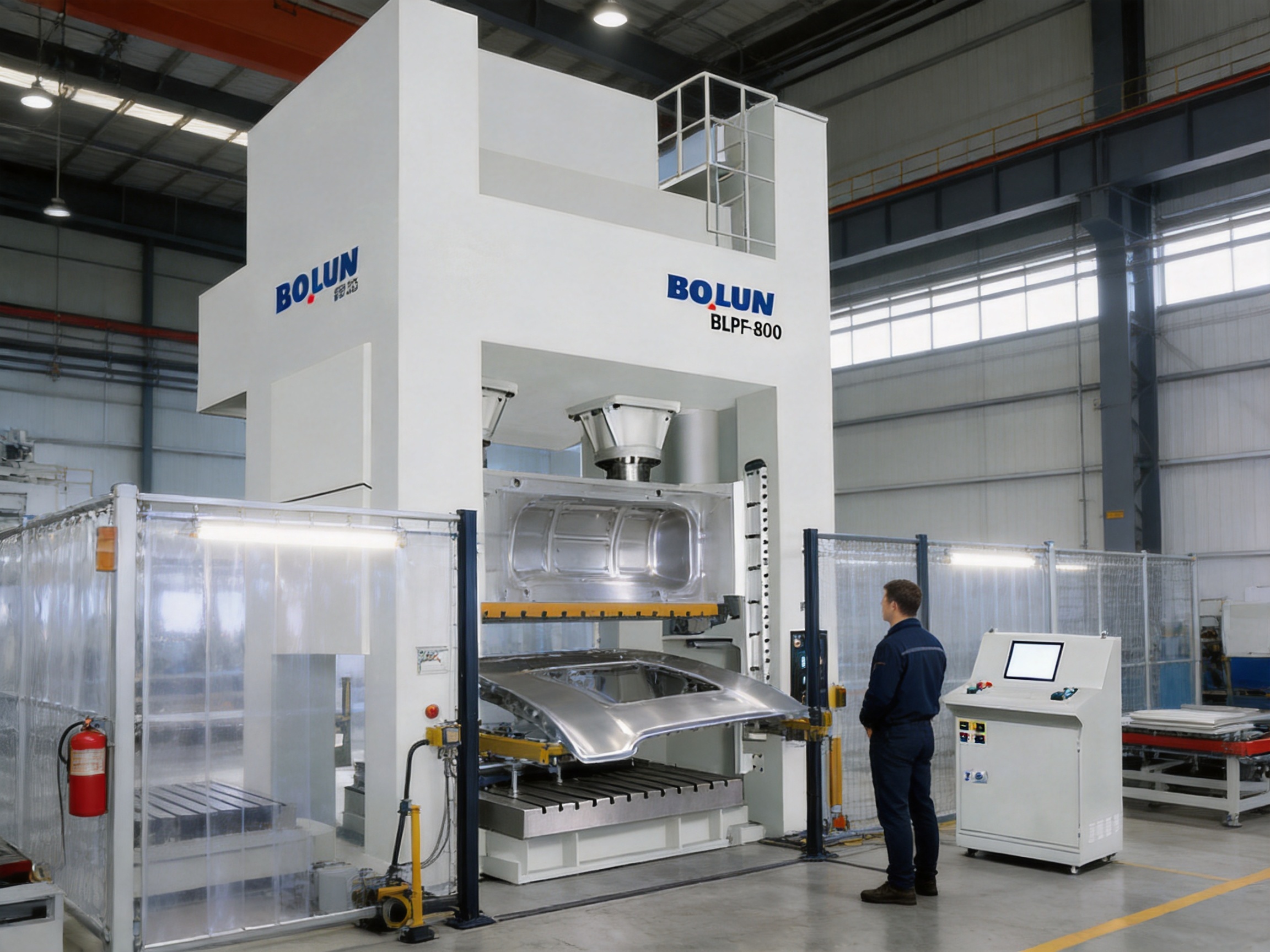
Automotive manufacturing is one of the most demanding applications for large mechanical presses. Body-side panels, floor structures, reinforcement members, door components, hood and trunk panels, roof parts, and other large stampings require broad dies, consistent material flow, and reliable dimensional control. These components may combine large surface areas with deep contours, local ribs, holes, flanges, and reinforcing geometry.
The BLPF-800 is well suited to this environment because its worktable and slide dimensions support large automotive dies. The 8,000 kN capacity provides the force required for substantial forming operations, while the double-point drive helps manage wide dies and uneven loading. The cushion system supports controlled drawing and pressure-pad action, which can be important for visible exterior panels and structural parts.
Automotive production also values repeatability. A press must deliver consistent stroke behavior and stable die alignment over many cycles. Variations in slide movement or frame deflection can affect panel dimensions, flange quality, springback behavior, and downstream assembly. A rigid closed-type structure and controlled transmission contribute to the stable conditions required by automotive tooling.
Another advantage is process consolidation. When a large press can accommodate a complex die, manufacturers may reduce the number of forming stages or intermediate handling steps. Consolidation can lower floor-space requirements, reduce transfer time, and simplify production flow. The exact benefit depends on part geometry and tooling strategy, but the BLPF-800 provides the capacity and working area needed for this type of planning.
Large home-appliance components often require deep drawing, broad surfaces, and clean visible finishes. Washing-machine cabinets, refrigerator panels, oven bodies, air-conditioning components, and other enclosures may be produced from sheet materials that must flow smoothly into deep or irregular shapes. Surface defects, wrinkles, tearing, and dimensional variation can create high rejection rates, making stable pressing conditions essential.
The BLPF-800’s cushion system can help control material during these operations, while the broad table allows the use of dies with pressure pads and complex forming surfaces. The machine’s capacity also supports thicker materials and larger components than those typically processed on smaller appliance presses.
In heavy industry, the press may be used for structural frames, industrial covers, transportation components, equipment housings, reinforcement plates, and formed sections used in construction or infrastructure machinery. These products may not require the same cosmetic surface standards as automotive exterior panels, but they often demand high force, accurate geometry, and reliable production under demanding conditions.
The machine can also support general large-scale stamping, where operations may include blanking, bending, embossing, piercing, shallow drawing, and structural forming. The suitability of a particular process should be confirmed through engineering analysis and die trials. Nevertheless, the combination of force, die space, stroke, cushion capability, and control makes the BLPF-800 a flexible platform for heavy sheet-metal production.
When evaluating the BLPF-800 against smaller presses, the most obvious difference is nominal capacity. A 4,000 or 5,000 kN press may be appropriate for medium-sized components, but it may not provide sufficient reserve for large deep-drawing operations or broad structural parts. Attempting to run a demanding die on an undersized machine can increase overload risk, reduce tool life, and compromise product quality.
The second difference is working area. Smaller equipment may have adequate force but insufficient table length, width, die height, or column spacing. This can force manufacturers to redesign the die, divide the component into multiple operations, or use additional equipment. The BLPF-800’s 3,600 × 1,400 mm worktable and 4,050 mm column distance provide more practical room for large tooling.
The double-point drive is another differentiator. A single-point press can be effective for many applications, but large or asymmetric dies may generate off-center forces that challenge slide balance. The double-point configuration of the BLPF-800 is intended to improve load distribution across the working area, making it more appropriate for wide tooling and uneven forming conditions.
The cushion capacity also distinguishes the machine from presses designed mainly for blanking or shallow bending. With 1,200 kN available at the cushion, the BLPF-800 can support processes that require stronger control of material flow. This expands the range of parts that can be considered for production on the machine.
Compared with equipment that emphasizes maximum speed, the BLPF-800 is optimized for high-force, large-format forming at 15–25 strokes per minute. For many heavy components, stable forming and reduced rejection are more valuable than an extremely high cycle rate. The appropriate comparison should therefore consider total production cost, part quality, die life, setup flexibility, maintenance, and process capability rather than strokes per minute alone.
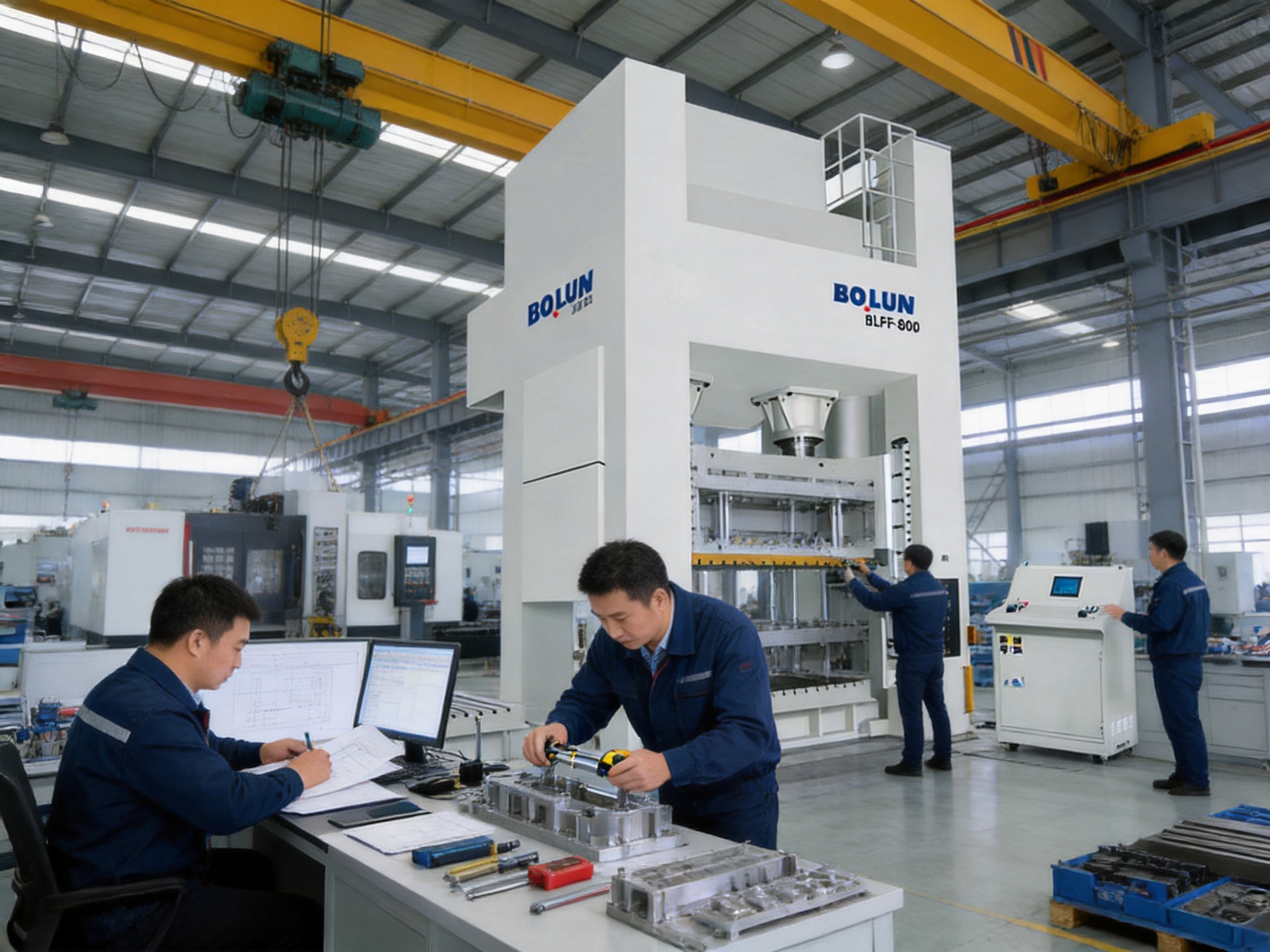
Zhejiang Bolun High-Precision Machinery Co., Ltd. is presented as an integrated manufacturer engaged in research and development, design, production, sales, and service. This structure is important for high-capacity forming equipment because the quality of the finished press depends on coordination across many disciplines. Mechanical design, structural analysis, machining, assembly, electrical control, testing, installation, and after-sales support must work together.
The company has approximately two decades of experience in machinery manufacturing and has developed capabilities in forging and casting machinery. Its manufacturing approach includes precision processing equipment, core component development, final machine assembly, and finished-product inspection. Such a full-chain production model can provide greater control over critical dimensions and reduce dependence on disconnected external processes.
For an ultra-high-tonnage press, the manufacturing process begins well before final assembly. The frame and major structural components must be engineered to withstand repeated high loads. Design teams need to consider force paths, deflection, stress concentration, guide accuracy, drive alignment, maintenance access, and the integration of the cushion and control systems. A strong engineering foundation helps ensure that the machine is not merely powerful, but also stable and serviceable.
Precision machining is central to the performance of the slide, worktable, transmission components, guides, mounting surfaces, and other critical parts. Large components require specialized equipment and careful process planning. Machining accuracy affects alignment, parallelism, gear engagement, bearing installation, die seating, and the repeatability of the press cycle. The manufacturer’s emphasis on advanced precision processing supports the goal of producing equipment suitable for demanding industrial applications.
Final assembly is equally important. Even accurately manufactured components can perform poorly if they are assembled without appropriate alignment, adjustment, lubrication, and inspection. A large double-point press requires the drive points, slide, guides, gears, shafts, cushion components, and control elements to operate as one coordinated system. Assembly technicians must verify the relationship between these components before the press is released for shipment.
Quality control for a high-tonnage press should cover material selection, component machining, assembly accuracy, functional testing, and final inspection. The company describes a finished-product inspection system that applies rigorous checks to processes and components. This approach is significant because the operating environment of an 8,000 kN press leaves little room for weaknesses in structural or transmission parts.
Inspection may include dimensional verification of large structural components, checking of machined surfaces, confirmation of gear and shaft alignment, examination of slide movement, testing of die-height adjustment, and verification of cushion performance. Electrical and control functions should also be checked to ensure that operators receive accurate status information and that protective systems respond appropriately.
Quality assurance should continue after delivery. Installation conditions, foundation quality, electrical supply, lubrication, die setup, operating speed, and maintenance practices all influence long-term performance. A professionally manufactured machine can only deliver its intended capability when it is installed and operated according to appropriate procedures. The supplier’s pre-sales consultation, in-sales support, and after-sales service are therefore important parts of the complete equipment value.
For international buyers, supplier evaluation should include more than a review of the product brochure. Buyers may request technical drawings, foundation requirements, electrical specifications, machine acceptance criteria, testing procedures, spare-parts recommendations, training plans, and service response arrangements. A manufacturer able to provide integrated technical support can help reduce commissioning risk and accelerate production startup.
Different industries and components require different press configurations. A standard specification may provide the foundation, but customers may need adjustments to controls, die interfaces, automation connections, safety guarding, transfer systems, cushion settings, electrical standards, or auxiliary equipment. The company’s stated non-standard customization capabilities can be valuable for factories that need a press integrated into an existing production line.
Customization should begin with a detailed process review. Engineers need information about the material, blank size, thickness range, part dimensions, required operations, die weight, production volume, target cycle rate, loading method, unloading method, and available plant utilities. These details help determine whether the standard BLPF-800 configuration is suitable or whether additional functions should be incorporated.
Possible project considerations include automated blank feeding, robotic loading, part extraction, die protection, programmable cushion control, production data collection, safety-light integration, and communication with factory management systems. The exact options depend on the customer’s requirements and the machine’s final engineering scope.
Customization should not compromise the core structural and safety principles of the press. Any modification must be reviewed for its effect on load distribution, machine balance, operating sequence, maintenance, and compliance with applicable standards. A coordinated manufacturer can evaluate these factors during the design stage rather than leaving the customer to combine unrelated systems after delivery.
Because the BLPF-800 is an ultra-high-tonnage machine, installation requires careful preparation. The foundation must support the machine’s weight and operating loads, and the site must provide sufficient clearance for transportation, assembly, die handling, maintenance, and operator access. Utilities such as electrical power and compressed air should be prepared according to the final technical documentation.
Before installation, the customer should confirm the route from the receiving area to the press location. Door dimensions, ceiling height, floor loading, lifting capacity, and access for specialized transport equipment should all be reviewed. The press may require staged assembly, alignment, and commissioning by qualified technicians.
After mechanical installation, the machine should be leveled and aligned. The slide movement, die-height adjustment, cushion operation, motor system, lubrication system, control interface, and safety devices should be tested systematically. No production die should be installed until the machine has completed its basic commissioning checks.
Die commissioning should begin at a controlled speed with conservative settings. Engineers can then evaluate material flow, cushion force, die clearance, forming depth, part dimensions, and machine behavior. Gradual optimization helps identify process issues before full-rate production begins. Records of successful settings should be retained for future changeovers and repeat orders.
High-tonnage equipment requires a disciplined maintenance program. The eccentric gear transmission, bearings, guides, slide connections, cushion components, motors, electrical cabinets, and safety devices should be inspected at planned intervals. Lubrication must be maintained according to the manufacturer’s recommendations, with attention to the type, quantity, cleanliness, and application frequency of lubricants.
Operators should monitor unusual noise, vibration, temperature, leakage, movement irregularity, or changes in forming quality. Early signs of abnormal operation can indicate wear, misalignment, lubrication problems, loose connections, or die-related overload. Addressing these signs promptly can prevent more serious damage and reduce unplanned downtime.
Die maintenance is also directly related to press reliability. Damaged or improperly adjusted tooling can create uneven loading, excessive shock, poor material flow, and abnormal stress on the slide and transmission. Dies should be inspected, cleaned, lubricated where appropriate, and installed with verified alignment. Press protection settings should be used to help prevent avoidable overloads and collisions.
Maintenance personnel should follow lockout and isolation procedures before entering the die area or working on the machine. The press contains significant stored energy, and safe servicing requires the correct technical procedures, tools, and authorization. Regular inspection of guarding, emergency stops, anti-overrun protection, and other safety functions should form part of the maintenance schedule.
The purchase price of a press is only one part of its total value. Manufacturers should evaluate how the machine affects production capacity, die utilization, labor requirements, scrap, energy consumption, maintenance, floor space, and delivery performance. A machine with higher initial investment may provide better long-term economics if it reduces the need for multiple smaller presses or minimizes secondary forming operations.
The BLPF-800 can support production consolidation by allowing large and complex components to be processed on one high-capacity platform. This may reduce transfers between machines and limit the number of intermediate fixtures. Fewer transfers can improve production flow and reduce the opportunities for handling damage or positioning errors.
Stable forming can also influence material utilization. When a process is properly controlled, manufacturers may reduce defects caused by wrinkles, tears, uneven drawing, and dimensional errors. Improved die life and lower rejection rates contribute to the overall return on investment. These benefits depend on correct process engineering, but the press provides the structural and functional basis required to pursue them.
The machine’s 15–25 S.P.M. operating range is appropriate for many heavy forming applications. While it may not match the speed of a light-duty stamping press, its productivity should be assessed according to the size and complexity of the part. Producing a large component in fewer operations can be more efficient than running several smaller presses at higher individual speeds.
Press selection should begin with the forming process rather than the machine model. Engineers should calculate the required blanking, bending, drawing, and forming forces. They should also consider the pressure curve, peak load position, die size, material characteristics, cushion requirements, and production cycle. The selected press should provide appropriate capacity without relying on operation at the extreme edge of its rating.
Die dimensions must be compared with the press worktable and slide bottom. The die should fit within the available area with suitable margins for mounting, alignment, clamping, and maintenance. Die height, shut height, stroke, and adjustment range should also be checked. If the die includes a pressure pad or lower cushion, the cushion stroke and capacity must match the tool design.
Off-center loading is another important issue. Large components may create uneven forces even when the die appears visually centered. The double-point configuration of the BLPF-800 can be advantageous in such cases, but the tooling and process should still be designed to distribute loads appropriately. Detailed engineering review is recommended for dies with highly asymmetric forming features.
Automation and material handling should be evaluated at the same time. The opening between columns, working-face height, die-change method, and access around the machine influence how blanks and finished parts move through the line. Early coordination between the press supplier, die maker, automation provider, and factory engineering team can reduce integration problems.
The manufacturer describes its development philosophy as technology-led, with emphasis on research, design, precision processing, customization, and service. This philosophy is relevant to a machine such as the BLPF-800 because ultra-high-tonnage equipment cannot be optimized through one isolated feature. The press must be treated as a complete forming system.
A complete system approach includes structural engineering, transmission design, slide guidance, cushion technology, controls, safety, manufacturing quality, installation, and customer support. Improvements in one area can be lost if another area is neglected. For example, a powerful motor does not compensate for poor alignment, and a large worktable does not guarantee stable forming if the frame lacks rigidity.
The company’s stated ability to provide one-stop design and manufacturing services may help customers address special production requirements through a single technical channel. This can be especially useful for overseas projects involving non-standard dimensions, special electrical requirements, customized automation, or integration with existing equipment.
Bolun’s company information also emphasizes a quality-focused management system and a long-term commitment to high-end, precision, and advanced manufacturing. For buyers, these statements should be supported through technical documentation, factory audits, inspection records, reference installations, and clearly defined acceptance procedures. A transparent engineering and quality process gives customers greater confidence when investing in large capital equipment.
A successful BLPF-800 project normally begins with application analysis. The customer provides part drawings, material information, blank dimensions, production targets, die concepts, and factory conditions. The supplier then reviews the required force, working dimensions, cushion behavior, cycle rate, die height, automation interface, and safety requirements.
The next stage is technical confirmation. The final press configuration, utility requirements, foundation information, control functions, acceptance criteria, and delivery scope should be documented. If the machine is customized, all special functions should be identified clearly, including responsibility for related tooling, automation, software, and site installation.
Manufacturing then proceeds through component preparation, precision machining, assembly, electrical integration, inspection, and testing. Customers may choose to review progress through drawings, inspection reports, video inspections, or an in-person factory acceptance test, depending on the project arrangement.
After shipment, installation and commissioning should be coordinated with the customer’s production and maintenance teams. Training should cover machine operation, setup, die changes, adjustment, safety, troubleshooting, and routine service. A structured handover helps the factory move from installation to stable production more efficiently.
The nominal capacity is 8,000 kN. This places the machine in the ultra-high-tonnage category and makes it suitable for large stamping, deep drawing, and structural forming applications. The actual usable capacity for a specific operation depends on the force curve, die design, material, stroke position, and operating conditions.
Closed-type refers to the enclosed, rigid press-frame configuration used to support high forming loads. Double-point means that the slide is driven through two separated drive points rather than one central point. This arrangement is intended to improve force distribution and slide stability across wide dies.
The BLPF-800 uses an eccentric gear transmission. This mechanical transmission converts motor rotation into controlled reciprocating slide movement and is designed for heavy-duty forming. Correct lubrication, alignment, inspection, and maintenance are essential for long-term performance.
The worktable measures 3,600 × 1,400 mm. The slide bottom measures 3,300 × 1,400 mm. These dimensions allow the machine to accommodate large dies used for automotive panels, appliance components, structural parts, and other oversized products.
The slide stroke is 400 mm. This stroke provides substantial die-opening and forming travel for large components. The suitable stroke setting and operating speed depend on the die, material, forming depth, and production process.
The listed operating range is 15–25 strokes per minute. Heavy forming processes often operate at a speed selected for stable material flow, acceptable tool loading, product quality, and safe production rather than maximum speed alone.
The cushion capacity is 1,200 kN, with a 140 mm working stroke. The cushion supports pressure-pad and deep-drawing operations by helping control material flow from beneath the workpiece. Final cushion settings should be established through process engineering and die trials.
The specification lists a main motor configuration of 75 kW × 4. This multi-motor arrangement supplies the power required by the high-capacity transmission system. Electrical installation details should be confirmed in the final technical documentation.
Typical applications include automotive body and structural components, home-appliance panels and cabinets, heavy industrial enclosures, transportation parts, construction machinery components, large structural stampings, deep-drawn parts, and general heavy sheet-metal forming.
The manufacturer states that it provides non-standard customization and one-stop design and manufacturing services. Potential project-specific areas may include control functions, die interfaces, automation connections, safety arrangements, electrical standards, and auxiliary equipment. The final scope should be confirmed through a formal technical review.
Buyers should review the required forming force, die dimensions, material range, stroke, die height, cushion requirements, production speed, automation plan, foundation, electrical supply, compressed air, safety standards, installation scope, spare parts, training, and after-sales service arrangements.
It can support high-volume industrial production when the part, die, material, operating speed, maintenance program, and automation system are properly matched. Production volume should be evaluated together with part complexity and cycle requirements. A controlled and repeatable forming process is often more important than maximum nominal speed.
The BLPF-800 Ultra-High-Tonnage Industrial Closed-Type Double-Point Eccentric Gear Power Press is engineered for manufacturers that require substantial forming force, broad die capacity, controlled material flow, and stable operation. Its 8,000 kN nominal capacity, 3,600 × 1,400 mm worktable, 400 mm slide stroke, 1,200 kN cushion capacity, and double-point eccentric gear transmission create a strong foundation for large-scale forming.
Its advantages over smaller or less rigid presses are found in the complete system: a closed-type high-rigidity frame, balanced double-point drive, large working dimensions, flexible die-height adjustment, substantial cushion support, integrated touch-screen control, and anti-overrun safety protection. These features make it suitable for automotive, appliance, and heavy industrial applications where part size, forming depth, and structural demands exceed the practical range of conventional equipment.
The manufacturing strengths described by Zhejiang Bolun High-Precision Machinery Co., Ltd. add further value to the machine proposition. Integrated research and development, precision machining, assembly, quality inspection, customization, and service support can help customers manage the technical complexity of an ultra-high-tonnage press project. For companies seeking to improve large-part production, consolidate forming operations, and build a dependable industrial stamping line, the BLPF-800 provides a capable and adaptable equipment platform.
1. General principles of mechanical power press design and industrial forming equipment selection.
2. Fundamentals of sheet-metal stamping, bending, blanking, and deep-drawing process engineering.
3. Industrial press safety practices, machine guarding, emergency protection, and lockout procedures.
4. Engineering considerations for closed-type press frames, slide guidance, and high-load structural design.
5. Practical guidelines for die design, cushion-force control, material flow, and deep-drawing quality.
6. Manufacturer-provided BLPF series technical specifications and product information.
7. Manufacturer-provided company information concerning research, development, precision manufacturing, quality control, customization, and service.
8. General GB and JIS principles applicable to the classification and quality evaluation of industrial press structures.


Two presses can both carry a 200-tonne nameplate and still produce very differe...
What Is a Power Press? A power press — also called a stamping press or punch pr...
A fastener plant in Taizhou receives a request from an automotive tier-one supp...
A production manager at a mid-size metal component plant recently faced a probl...
A buyer comparing a 45-ton open-gap press for a bracket line often receives two...
Start With the Purchase Decision, Not the Definitions A procurement engineer co...
Contact Us

topbolun@gmail.com

+86-575-83362228

+86-13735238388
+86-18667502750

+86-575-83362999

+8618667502750

No.1 Linjiang Road East, Xiaren, Jinting Town, Shengzhou City, Zhejiang Province, China
Ready to Begin?
Get in Touch

Now!

ZHEJIANG BOLUN
 English
 中文简体