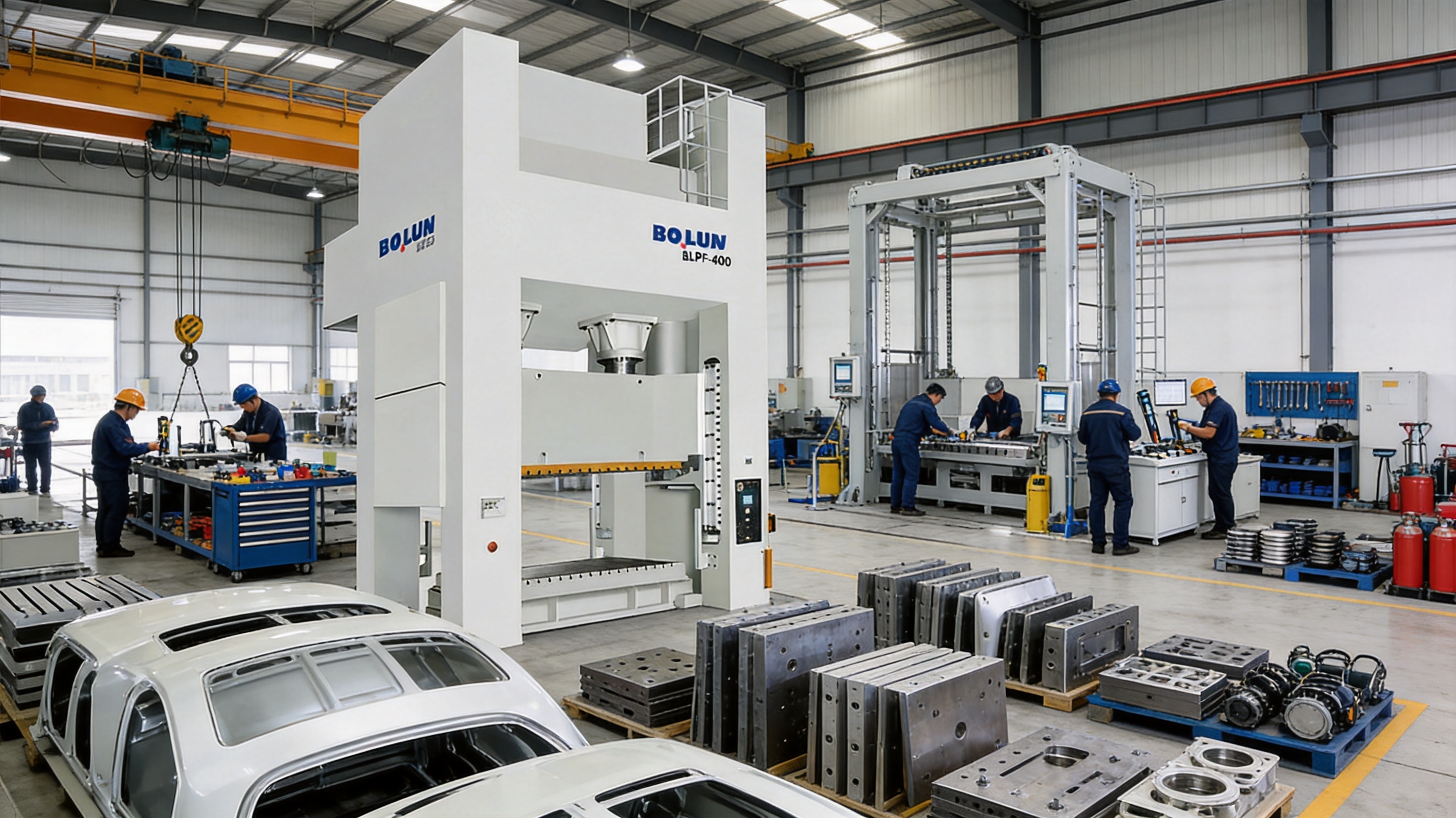
Modern stamping operations require more than high nominal force. A production press must combine structural rigidity, controlled motion, repeatable accuracy, die compatibility, operator protection, energy-efficient power transmission, and dependable service support. These requirements become increasingly demanding when manufacturers process large panels, automotive components, hardware parts, structural sections, and other medium-to-large workpieces. The BLPF-400 Precision-Stable Closed-Type Double-Point Eccentric Gear Power Press is designed for this demanding segment, providing a nominal capacity of 4,000 kN in a large-format, high-rigidity stamping platform.
As the entry-level model in a heavy-tonnage series that also includes 5,000, 6,300, 8,000, 10,000, and 12,500 kN versions, the BLPF-400 combines the accessibility of a standardized production machine with the performance expectations of an industrial precision press. Its closed-type double-point construction, eccentric gear drive, hydraulic overload protection, dry clutch brake, adjustable die height, die cushion, and large work area make it suitable for demanding forming and stamping applications.
The machine is intended for manufacturers that need consistent production results rather than occasional low-volume pressing. It is particularly relevant to automotive suppliers, hardware manufacturers, appliance component producers, metal-forming specialists, and general industrial fabricators. Its configuration supports large dies and broad sheet-metal components while its high-rigidity frame helps preserve alignment under substantial forming loads.
The BLPF-400 is a closed-type double-point eccentric gear power press with a nominal capacity of 4,000 kN. In practical terms, this places it in the heavy-duty category for stamping and forming work. The press is built around a rigid frame and a double-point slide drive. This arrangement helps distribute the working force across the slide, reducing the tendency toward uneven loading that may occur when a large or asymmetrical die is driven from a single central point.
The press has a worktable measuring 2,800 x 1,100 mm and a slide bottom measuring 2,500 x 1,100 mm. These dimensions create a substantial working envelope for large dies and components. The maximum die height is 650 mm, with a die-height adjustment range of 250 mm. The slide stroke is 300 mm, and the stated operating range is 15 to 30 strokes per minute. This combination allows users to select a production speed appropriate to the material, die design, forming depth, lubrication conditions, and required process stability.
The BLPF-400 also includes a 500 kN cushion with a 120 mm working stroke. A die cushion can support drawing, forming, blank holding, and controlled material flow. In deep-drawing or complex forming applications, the cushion is not simply an accessory; it can be an essential part of the process because it helps regulate the sheet as it moves through the die. The press therefore offers capabilities beyond basic blanking or straightforward punching.
| Specification | BLPF-400 Value | Industrial Significance |
| Press type | Closed-type double-point eccentric gear power press | Supports large dies and balanced slide loading |
| Nominal capacity | 4,000 kN | Suitable for heavy-duty stamping and forming |
| Nominal pressure stroke | 9 mm | Defines the rated force position in the slide cycle |
| Slide stroke | 300 mm | Provides substantial forming and die-opening travel |
| Strokes per minute | 15–30 S.P.M. | Allows adjustment for process and productivity requirements |
| Maximum die height | 650 mm | Accommodates tall or complex die assemblies |
| Die-height adjustment | 250 mm | Supports setup flexibility and die matching |
| Worktable size | 2,800 x 1,100 mm | Provides a broad die mounting surface |
| Slide bottom size | 2,500 x 1,100 mm | Offers extensive upper-die support |
| Working-face height | 750 mm | Establishes the working level for installation and operation |
| Distance between columns | 3,250 mm | Creates a wide opening for large tooling and workpieces |
| Main motor | 37 kW x 4 poles | Provides drive power for heavy-duty operation |
| Air pressure | 0.55 MPa | Defines the stated pneumatic operating requirement |
| Cushion capacity | 500 kN | Supports controlled forming and material retention |
| Cushion working stroke | 120 mm | Provides useful motion for forming and drawing operations |
| Press accuracy classification | GB/JIS Class 1 stated | Indicates a high precision target for the press structure |
A closed-type press frame is valuable when the application involves high forming loads and large dies. Compared with a more open structural arrangement, the closed frame creates a continuous load path through the uprights, crown, and bed. This configuration is intended to improve resistance to deformation during pressing. Maintaining the geometry of the frame is important because excessive deflection can influence die alignment, part dimensions, material flow, tool wear, and the consistency of the finished product.
The BLPF-400 uses a double-point drive arrangement. Rather than transmitting the slide motion through one central connection alone, the drive acts at two points across the slide. This supports more balanced force distribution, particularly when the die is broad or when the forming load is not perfectly centered. Balanced drive geometry can help reduce angular movement, uneven guide loading, and localized stress on the die set.
Double-point construction is especially useful for large panels and wide components. When a wide die is powered from a single point, the slide may be more vulnerable to tilting or uneven contact if conditions are not carefully controlled. A double-point design addresses this challenge by supporting the slide across a wider span. The result is a more suitable platform for large-format stamping, progressive tooling, transfer operations, and forming dies with multiple working stations.
The stated GB/JIS Class 1 precision classification further emphasizes the machine’s positioning within the precision press segment. Actual production results depend on foundation quality, installation, leveling, die condition, lubrication, material properties, maintenance, and operating practices. Nevertheless, a high-precision structural target provides an important foundation for repeatable manufacturing and helps users select a press that is appropriate for tight process requirements.
The eccentric gear drive system is one of the defining features of the BLPF-400. A gear-driven eccentric mechanism converts motor rotation into controlled reciprocating slide motion. This type of transmission is widely associated with high-load mechanical pressing because it can deliver substantial torque and maintain a robust power path between the main motor and the slide.
For heavy stamping, the drive system must handle repeated loads without creating excessive motion instability. The eccentric gear arrangement is designed to provide uniform movement through the press cycle and to transmit force efficiently to the slide. This is useful when the process involves substantial material deformation, large dies, or a high number of production cycles.
The nominal pressure stroke is listed as 9 mm for the BLPF-400. This specification identifies the point in the stroke where the press reaches its rated nominal capacity. Press users should therefore calculate forming force according to the actual load curve, material thickness, die geometry, blank size, friction, and operation type rather than treating the nominal capacity as an unrestricted force available at every position of the slide stroke.
With a 300 mm slide stroke, the press provides significant vertical travel for die opening, material positioning, part removal, and complex forming sequences. The large stroke can be advantageous when using deep dies or when a process requires generous access between the upper and lower die sections. Production engineers should match the selected stroke and operating speed to the specific tooling requirements because a deeper stroke does not automatically produce a better result for every application.
Press precision is not determined solely by a control system or a nominal dimensional rating. The mechanical frame must remain sufficiently stable while the machine is applying thousands of kilonewtons of force. The BLPF-400 is described as using a high-rigidity frame intended to maintain precision during heavy loading.
A rigid frame can provide several benefits. It can reduce elastic deflection, support more stable die alignment, help control the relationship between the slide and worktable, and reduce variation in the finished part. It may also lessen uneven stress on die components. When the frame, slide, guides, and die are properly aligned, the load is more evenly distributed across the tooling surfaces.
For automotive and hardware applications, consistency is often more valuable than isolated peak performance. A press that produces one acceptable sample but varies during a long production run creates scrap, rework, inspection costs, and delivery risk. The BLPF-400 is therefore positioned as a precision-stable machine designed to support repeatable production conditions over extended operating periods.
Frame rigidity also influences the useful life of dies and wear components. Excessive movement or angular displacement can create localized contact, uneven clearance, and abnormal loading. Over time, these conditions may contribute to premature die wear, galling, cracking, or dimensional drift. A stable press structure helps the tooling perform closer to its intended design conditions.
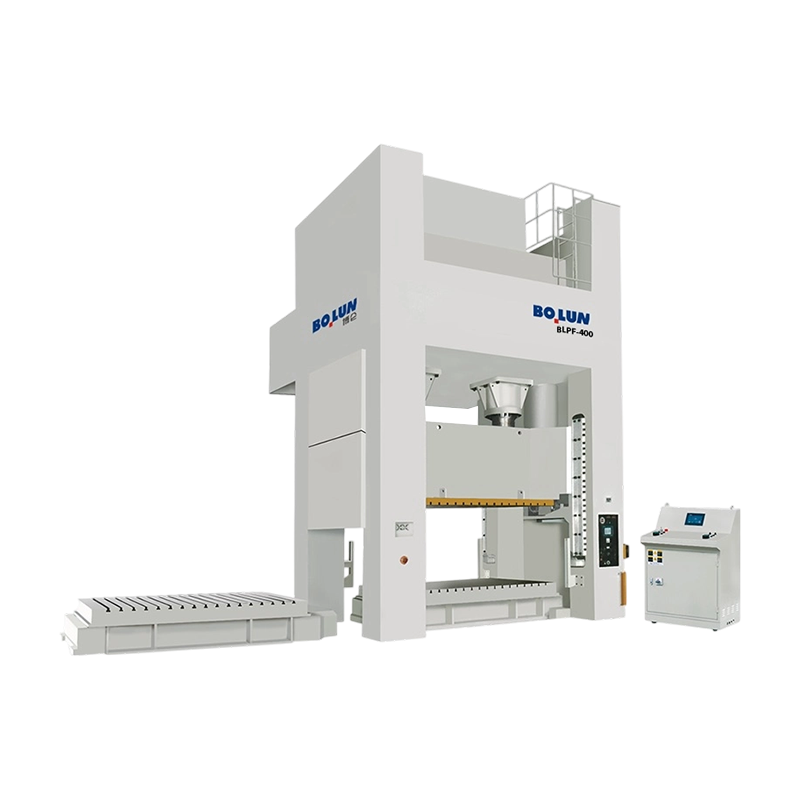
BLPF-400 Precision-Stable Closed-Type Double-Point eccentric gear Power Press
The 2,800 x 1,100 mm worktable is a central advantage of the BLPF-400. A large table allows manufacturers to install broad dies and to manage components with substantial plan dimensions. The 2,500 x 1,100 mm slide bottom provides corresponding upper-die support, creating a wide working surface for large stamping tools.
The distance between columns is specified as 3,250 mm. This broad opening is important for workpiece access, die installation, material handling, and the movement of large components into and out of the pressing area. In many industrial applications, the physical size of a machine is determined not only by its force capacity but also by whether it can accept the required tooling and production material without interference.
The maximum die height is 650 mm, with 250 mm of die-height adjustment. This adjustment range allows the press to be configured for different die stacks and production tools. It can support setup optimization by helping operators position the die at an appropriate working height within the machine’s rated range.
When selecting tooling for the BLPF-400, users should consider die weight, center of gravity, bolster and slide load distribution, clamping arrangements, shut height, feed-line elevation, material transfer clearance, cushion requirements, and the actual force curve of the operation. The machine’s large work area creates opportunities, but every die must still be engineered and verified for the complete press system.
The working-face height is listed as 750 mm. This dimension contributes to installation planning, operator access, transfer equipment design, and factory layout. It should be considered together with the height of the foundation, coil line, feeder, conveyors, safety guarding, die carts, and maintenance access areas.
The BLPF-400 is equipped with a highly sensitive dry clutch brake. In a mechanical power press, the clutch transmits drive power to the eccentric mechanism, while the brake stops or holds the slide according to the operating command. Responsiveness and repeatability in this system are important for production control and safe machine operation.
A sensitive clutch brake can support accurate stop control, reliable single-stroke operation, and predictable cycling. This is relevant when an operator needs to position material, inspect a part, adjust a die, or perform a controlled setup procedure. In automated production, repeatable cycling also helps coordinate the press with feeders, transfer systems, sensors, and part-removal equipment.
The clutch and brake system must be maintained as a critical mechanical and safety-related assembly. Friction components, air supply quality, pressure stability, adjustment, response time, and control circuitry all influence performance. Users should follow the manufacturer’s maintenance instructions and applicable local safety standards rather than relying only on the nominal specification.
The stated air pressure requirement is 0.55 MPa. The factory pneumatic system should be capable of delivering the required pressure and flow under actual operating conditions. Air quality is also important. Moisture, contamination, pressure fluctuation, and inadequate filtration can affect clutch-brake behavior and shorten the service life of pneumatic components.
Heavy stamping operations can experience overloads caused by incorrect material thickness, misfeeds, double blanks, improper die adjustment, foreign objects, die damage, or unexpected material behavior. The BLPF-400 incorporates a hydraulic overload protector to provide an additional layer of protection for the press and tooling.
Hydraulic overload protection is designed to respond when the pressing load exceeds a defined limit. By relieving or absorbing excessive pressure, the system can help reduce the risk of severe damage to the frame, slide, crank or eccentric components, guides, and die. It can also shorten recovery time after an overload event compared with systems that require extensive mechanical replacement.
Overload protection does not replace correct die design, material control, preventive maintenance, or operator training. It should be treated as a protective measure rather than permission to operate continuously beyond the press’s rated capacity. The forming load must remain within the machine’s working envelope, and the die must be designed for the selected operation.
For production managers, the overload system can improve risk management. Tooling represents a significant investment, and a single overload event may interrupt production, damage a die, or create a long maintenance delay. A responsive protection system helps protect both the machine and the production schedule when abnormal conditions occur.
The BLPF-400 provides a 500 kN die cushion with a 120 mm working stroke. The cushion supports controlled action beneath the workpiece or lower die area. It can be used to manage blank-holder force, support material flow, reduce wrinkling, and improve the consistency of drawn or formed components.
In a drawing operation, the sheet must move into the die cavity at a controlled rate. If the blank-holder force is too low, wrinkles may form. If it is too high, the material may split or require excessive forming force. A properly adjusted cushion gives the process engineer a means of controlling this balance.
The cushion can also be useful in forming operations where the material needs positive support during the early or late stages of the stroke. Its 120 mm working stroke provides a meaningful range for die motion and forming control. The actual usable capacity depends on the process, cushion position, load curve, tooling arrangement, and machine configuration.
When developing a new tool, engineers should calculate the required cushion force and stroke based on material grade, thickness, blank geometry, draw depth, corner radius, lubrication, and desired production rate. The 500 kN capacity should be evaluated against the actual process rather than assumed to be universally suitable for every drawing application.
Many basic mechanical presses are designed for simpler operations and smaller dies. They may offer lower acquisition costs, but they can become limiting when manufacturers need large tooling, wide material, deep forming, high force, or tight dimensional control. The BLPF-400 addresses these requirements through its combination of force capacity, double-point construction, broad work area, frame rigidity, and process-support features.
Compared with a single-point press of similar general capacity, the double-point configuration can be more suitable for wide dies and off-center load conditions. It is intended to distribute the load across the slide and reduce the mechanical disadvantages associated with a concentrated drive point. This can be particularly valuable in large-panel stamping and multi-station tooling.
Compared with a lower-capacity press, the 4,000 kN rating provides a larger operating reserve for demanding components. A suitable reserve can help prevent operation at the extreme limit of the machine’s capacity, although process calculations must always confirm that the press and die are correctly matched.
Compared with an inadequately rigid frame, the high-rigidity structure is intended to preserve alignment under load. This can contribute to more consistent part dimensions, more uniform die wear, and a longer useful life for tooling. Precision is especially important when the finished components must fit with other assemblies or meet demanding appearance requirements.
Compared with a machine without integrated overload protection or cushion capability, the BLPF-400 provides more process support. The hydraulic overload protector helps manage abnormal loading, while the die cushion supports controlled material flow. These functions can reduce production risk and expand the range of operations that the press can perform.
Compared with a press lacking a broad adjustment range, the 250 mm die-height adjustment supports greater tooling flexibility. Users can work with different die stacks and optimize the setup without being limited to a single fixed configuration. This can improve asset utilization when multiple product families share the same press.
The BLPF-400 is well suited to automotive suppliers producing large stamped panels, brackets, reinforcements, structural components, and formed hardware. Automotive production often requires consistent dimensions, stable tooling behavior, repeatable cycle control, and the ability to process high-strength or relatively thick sheet materials.
Large automotive dies may require broad table dimensions and a wide column opening. The double-point slide drive is appropriate for tooling in which force distribution across a wide working area is important. The die cushion can support forming and drawing operations, while the overload protector adds protection against misfeeds and abnormal loading.
Hardware manufacturers may use a heavy-duty press for brackets, frames, covers, supports, fittings, and structural metal parts. These products can vary considerably in size and forming complexity. The BLPF-400’s adjustable die height and broad working envelope make it possible to configure the machine for different tools and product families.
For medium-to-large hardware components, a stable press can help maintain hole position, bend angle, formed height, and overall geometry. Consistent slide movement also helps reduce variation between production batches when the material and tooling are controlled properly.
Appliance and electrical equipment manufacturers often produce cabinets, panels, supports, mounting parts, and reinforcement components. Such products can require broad dies and relatively large sheet blanks. The BLPF-400 offers a worktable and column spacing suitable for many large-format applications.
In visible components, surface quality and dimensional repeatability are essential. Stable motion and controlled material flow can help reduce wrinkles, uneven forming, and die marks. The final result still depends on die polishing, lubrication, material quality, and process parameters, but the press provides an appropriate mechanical foundation.
Industrial machinery manufacturers may require large pressed components in relatively low or medium volumes. In these situations, flexibility is important because one machine may be expected to handle multiple dies and product types. The BLPF-400’s adjustment range, large bed, high capacity, and cushion capability support a versatile production strategy.
Manufacturers can use the press for blanking, bending, shallow drawing, deep forming within the engineered process window, embossing, shaping, and compound operations. The correct application depends on force calculations, die construction, material properties, and the machine’s detailed configuration.
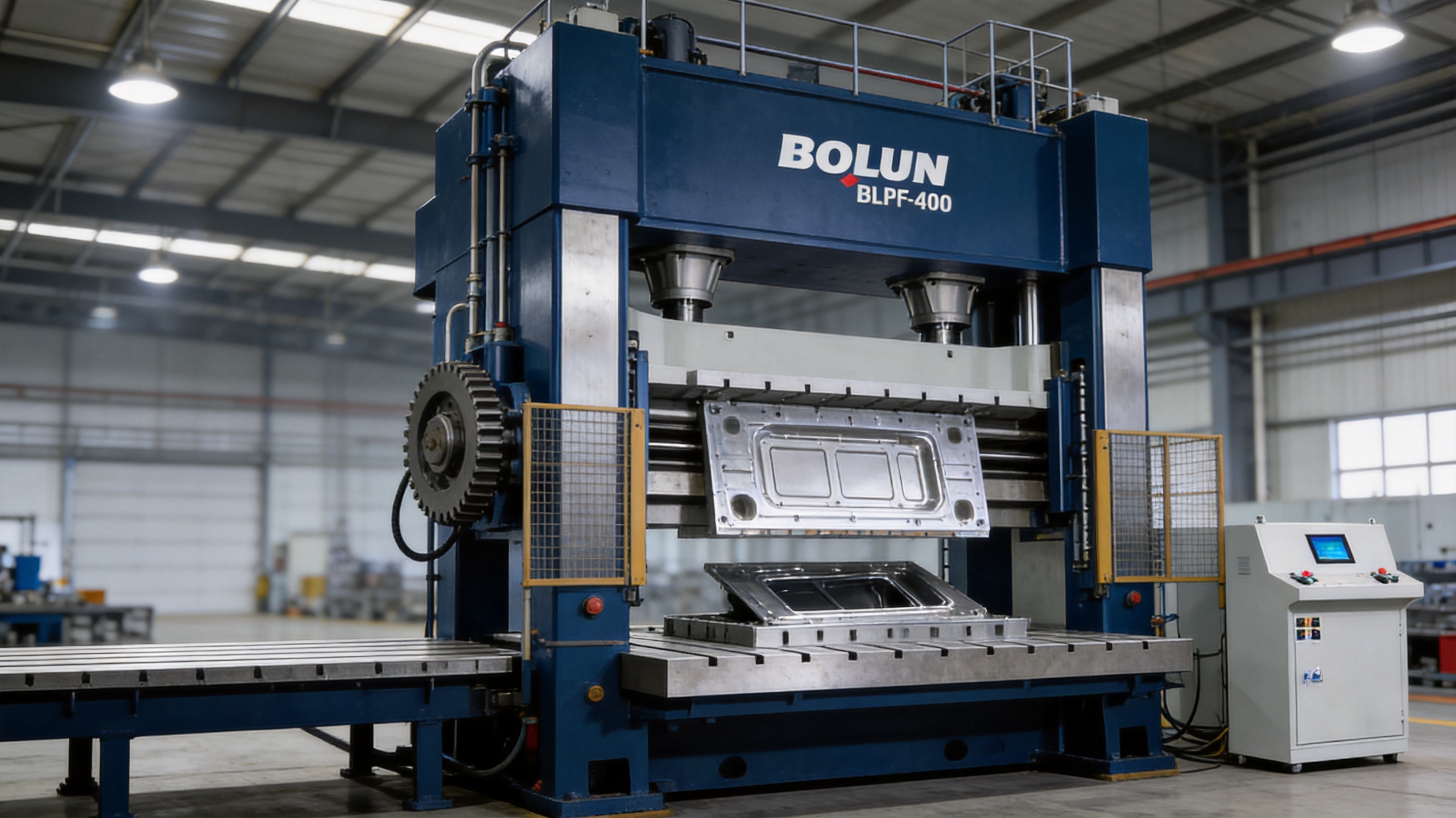
The manufacturer, Zhejiang Bolun High-Precision Machinery Co., Ltd., has developed its business around precision forming equipment and industrial machine tools. Its stated capabilities cover research and development, engineering design, production, sales, and service. This integrated structure is important for a large press because successful delivery involves more than assembling a frame and motor.
A heavy-duty press requires coordinated work across structural engineering, transmission design, machining, hydraulics, pneumatics, electrical control, assembly, testing, and after-sales support. When these functions are managed within an integrated manufacturing system, the supplier can maintain closer control over product consistency and respond more effectively to customized requirements.
The company reports two decades of experience in machinery manufacturing. Such experience can contribute to practical knowledge of press structures, forming processes, production difficulties, maintenance needs, and customer applications. Experience is most valuable when it is converted into documented processes, engineering standards, inspection procedures, and continuous improvement.
The company emphasizes technology-first development and maintains a design team capable of supporting standard and non-standard equipment requirements. For customers, this can be significant when a press must be adapted to a special die, unusual material, automated line, customized cushion arrangement, specific safety requirement, or particular factory layout.
Engineering customization should begin with a clear review of the production task. The supplier and customer need to define the part geometry, material grade, thickness range, forming method, required output, die dimensions, force curve, stroke requirements, automation method, safety system, and facility conditions. A structured design review helps reduce the risk of selecting a machine that is nominally powerful but unsuitable for the actual process.
The manufacturer states that it operates advanced precision-processing equipment and covers the production chain from basic design and core component development to final assembly. Precision machining is particularly important for a large press because guide surfaces, mounting faces, gear components, shaft seats, and structural interfaces must meet the intended geometry.
Accurate machining can support proper alignment during assembly. Consistent component dimensions can also make maintenance more predictable and help reduce the need for excessive field adjustment. For high-load equipment, the quality of the machining and assembly interface can influence long-term performance just as much as the initial design concept.
The manufacturer describes a finished-product inspection system that applies quality controls to processes and components. For a machine such as the BLPF-400, inspection should cover the frame, slide movement, die-height adjustment, drive system, clutch brake, hydraulic overload protector, pneumatic circuit, cushion, electrical controls, lubrication, and safety functions.
Final testing should verify that the press operates smoothly and that the stated specifications are supported by actual machine behavior. Buyers should request the inspection and acceptance criteria applicable to their order. Depending on the application, acceptance may include dimensional checks, slide parallelism, worktable flatness, pressure verification, dry-cycle testing, load testing, noise evaluation, and safety-function validation.
An integrated production system can improve coordination between engineering, purchasing, manufacturing, assembly, quality assurance, and service. This matters when the equipment is large, technically complex, and configured for a particular customer’s production line.
Full-chain management can also support traceability. Records for major components, machining stages, assembly inspections, hydraulic tests, electrical checks, and final acceptance provide useful information for future maintenance and technical support. Buyers should consider the supplier’s documentation practices as part of the overall machine value.
Reliability in a heavy power press is the result of many factors working together. The frame must be appropriately designed, the drive system must be correctly manufactured and lubricated, the clutch brake must respond consistently, the hydraulic and pneumatic systems must remain clean and stable, and the control and safety circuits must be maintained.
The BLPF-400’s value should therefore be assessed over its expected production life rather than by purchase price alone. A press that maintains stable accuracy can reduce scrap and rework. A machine with suitable overload protection can reduce the consequences of process errors. A press that accepts multiple dies can improve factory flexibility. Reliable service support can reduce downtime and simplify long-term ownership.
Preventive maintenance remains essential. Operators and maintenance personnel should inspect lubrication, fasteners, air pressure, hydraulic conditions, clutch-brake performance, guide clearances, cushion operation, electrical connections, and safety devices according to a documented schedule. Early detection of abnormal noise, temperature, vibration, leakage, or slide behavior can prevent more serious failures.
Tooling maintenance is equally important. A precision press cannot compensate for damaged, poorly aligned, inadequately lubricated, or improperly installed dies. The best results are achieved when press maintenance, die maintenance, material control, and process monitoring are managed as one production system.
A 4,000 kN press requires careful installation planning. The foundation must be designed for the machine’s weight, dynamic loads, operating conditions, and local construction requirements. The machine should be leveled and aligned according to the manufacturer’s procedures. Foundation settlement or inaccurate leveling can affect slide alignment, die performance, vibration, and long-term precision.
Factory layout should allow sufficient space around the press for die installation, maintenance, inspection, material handling, and emergency access. The 3,250 mm column spacing and large table dimensions should be incorporated into the layout model before delivery. The installation plan should also account for transport routes, lifting equipment, door openings, ceiling height, and the final location of auxiliary systems.
The pneumatic supply should meet the stated 0.55 MPa requirement and provide adequate flow during repeated clutch-brake operation. The air line should be filtered and protected from excessive moisture. Electrical power, grounding, control interfaces, hydraulic connections, lubrication systems, and safety guarding should be prepared before commissioning.
Commissioning should proceed in stages. The first stage may include visual inspection, lubrication confirmation, manual or low-speed movement, and verification of utility connections. The next stage can include dry cycling, clutch-brake testing, die-height adjustment, cushion operation, and safety-function checks. Production trials should use approved tooling and controlled material before full-rate operation begins.
The BLPF-400 can serve as the main forming unit in a larger production system. Depending on the product, it may be integrated with feeders, transfer devices, decoilers, straighteners, conveyors, sensors, lubrication systems, part-removal equipment, and quality-monitoring devices.
When integrating the press with automation, engineers must coordinate stroke timing, press speed, feed length, die opening, transfer clearance, material detection, emergency stops, and restart logic. The clutch-brake response and operating range of 15 to 30 strokes per minute should be considered when calculating line takt time.
Automation can improve productivity and reduce manual handling, but it also increases the importance of system-level safety. The press, feeder, transfer mechanism, sensors, guarding, and control system must operate as a coordinated safety architecture. Interlocks, presence sensing, access control, and emergency-stop functions should be designed and validated in accordance with applicable regulations.
For high-volume production, process monitoring can provide additional benefits. Sensors may be used to detect missing material, double blanks, excessive load, incorrect feed position, die obstruction, or abnormal slide behavior. These systems do not replace the hydraulic overload protector, but they can help identify process deviations earlier.
Nominal capacity is only one part of press selection. Engineers should calculate the required force for blanking, bending, drawing, forming, piercing, and any combined operation. The force curve should be compared with the press’s rated capacity at the relevant position in the stroke. The die’s load distribution and the possibility of off-center loading should also be assessed.
Worktable size and slide dimensions must be large enough for the die, clamps, guides, sensors, and auxiliary equipment. The maximum die height and adjustment range must match the complete die stack. The slide stroke must provide sufficient travel for forming and part removal. The column opening must allow safe access for the largest workpiece and tooling assembly.
Production rate is another important factor. The stated 15 to 30 strokes per minute provides a working range, but the appropriate speed depends on forming depth, material behavior, lubrication, die cooling, feeding system, and quality requirements. A lower speed may be preferable for deep forming or complex parts, while a higher speed may be suitable for simpler operations after validation.
The cushion capacity and stroke should be compared with the requirements of drawing or forming dies. If the process requires a specialized cushion curve, variable pressure, or advanced servo control, the customer should confirm the available configuration before ordering.
Finally, users should evaluate service, spare parts, documentation, training, installation support, and communication. A press is a long-term production asset, so technical support can influence its total cost of ownership as much as the original machine configuration.
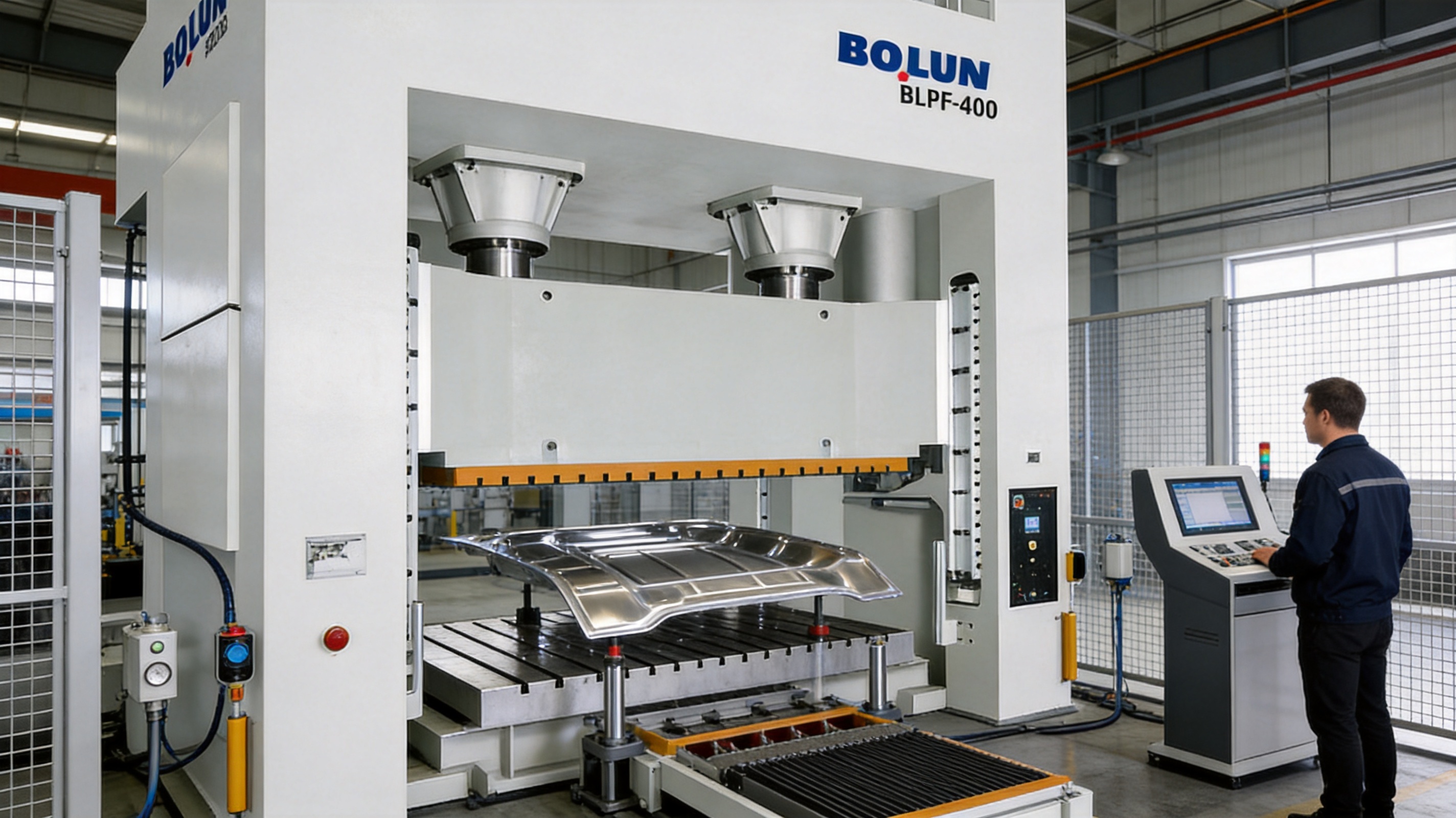
Heavy mechanical presses must be operated only by trained personnel using approved procedures. The BLPF-400’s clutch brake and overload protection contribute to operational safety, but they do not eliminate the need for guarding, interlocks, emergency stops, safe die design, lockout procedures, and regular inspection.
Before operation, the operator should verify that the die is correctly installed, the work area is clear, the material path is unobstructed, the air pressure is within the required range, and all safety devices are functioning. Any unusual noise, vibration, leakage, stopping behavior, or inconsistent slide movement should be reported and investigated before production continues.
Die changes and maintenance should be performed under controlled conditions. Energy sources must be isolated according to the facility’s lockout and verification procedures. No person should enter a hazardous area or place hands near the die space unless the machine has been properly secured.
Training should cover normal operation, single-stroke and continuous modes where applicable, emergency response, die setup, material loading, overload events, inspection routines, and communication with maintenance personnel. Safe operation protects employees, tooling, equipment, and production schedules.
A planned maintenance program should be divided into daily, weekly, monthly, and periodic tasks. Daily checks may include lubrication status, air pressure, visible hydraulic leakage, abnormal sounds, clutch-brake response, safety devices, and general cleanliness around the press.
Weekly or scheduled inspections may include fastener checks, pneumatic filters, cushion performance, die-height adjustment, guide condition, electrical cabinets, cable routing, and the condition of guards and access doors. The exact interval should reflect operating hours, production load, environment, and manufacturer recommendations.
Periodic maintenance should include detailed inspection of the eccentric gear drive, bearings, shafts, guide surfaces, hydraulic overload system, cushion components, clutch-brake friction elements, and control components. Wear limits should be documented so that parts can be replaced before they cause dimensional instability or unplanned downtime.
Maintenance records should identify the date, machine hours, work performed, parts replaced, measured conditions, and responsible personnel. Trend information can help the factory identify recurring issues and improve preventive maintenance intervals.
The BLPF-400 can provide economic value in several ways. Its 4,000 kN capacity allows manufacturers to bring demanding forming operations in-house rather than outsourcing them or dividing them among smaller presses. Its large work area can support broad dies and reduce the need for repeated product splitting or secondary operations.
The double-point configuration can be advantageous for large tooling and may contribute to more uniform die loading. The rigid structure and stated precision classification support consistent production, while the hydraulic overload protector can reduce the potential cost of certain overload incidents.
The die cushion expands the range of feasible forming operations. Instead of limiting the press to simple punching, users may be able to manufacture drawn and formed components with better control of material flow. The die-height adjustment also allows one press to serve multiple product families, helping improve equipment utilization.
Economic benefits depend on correct application engineering. Productivity should be measured through good parts per hour, uptime, tooling life, changeover time, energy use, maintenance cost, and total ownership cost. A press that is technically capable but poorly matched to the production process will not deliver its full potential.
The BLPF-400 is a closed-type double-point eccentric gear power press with a nominal capacity of 4,000 kN. It is designed for heavy-duty stamping, forming, blanking, bending, and drawing applications that require a large work area and stable force transmission.
The double-point design supports force transmission at two locations across the slide. This is intended to improve load distribution and make the press more suitable for wide dies, large panels, and applications where off-center or distributed loading may occur.
The slide stroke is 300 mm. This provides substantial travel for die opening, material positioning, forming, and part removal. The correct stroke and speed must be selected according to the actual die and process.
The stated operating range is 15 to 30 strokes per minute. The appropriate speed depends on the material, die design, forming depth, lubrication, automation system, and required quality level.
The worktable measures 2,800 x 1,100 mm. The slide bottom measures 2,500 x 1,100 mm. These dimensions are intended to accommodate broad dies and large-format components.
Yes. The BLPF-400 has a maximum die height of 650 mm and a die-height adjustment range of 250 mm. This helps users configure the press for different tooling arrangements within the rated operating limits.
The 500 kN die cushion with a 120 mm working stroke supports controlled material flow during drawing and forming. It can assist with blank holding, wrinkle prevention, forming stability, and controlled movement of the workpiece.
The hydraulic overload protector is designed to reduce the risk of serious machine or die damage when an abnormal load occurs. It is an additional protection system and does not replace correct force calculations, die design, maintenance, or safe operating procedures.
The stated air pressure is 0.55 MPa. The factory air system should provide stable pressure and sufficient flow, with appropriate filtration and moisture control.
Potential applications include automotive components, hardware, appliance parts, electrical equipment components, industrial machinery parts, structural metal products, and other medium-to-large precision-stamping applications.
It can be considered for integration with feeders, transfer systems, conveyors, sensors, lubrication systems, and part-removal equipment. The final configuration must be engineered around stroke timing, tooling, material handling, controls, guarding, and applicable safety requirements.
Customers should confirm the required forming force, force position, stroke, speed, die dimensions, die weight, die height, cushion requirements, material range, automation method, utilities, foundation, safety configuration, inspection standards, spare parts, installation support, and acceptance criteria.
Frame rigidity helps the machine resist deformation during pressing. This supports die alignment, dimensional consistency, reduced uneven tool loading, and stable production performance under heavy loads.
Maintenance should include lubrication, inspection of the eccentric gear drive, clutch brake, hydraulic overload system, pneumatic circuit, cushion, slide guides, die-height adjustment, electrical controls, fasteners, safety devices, and signs of leakage or abnormal vibration. The exact schedule should follow the manufacturer’s instructions and actual production conditions.
The BLPF-400 Precision-Stable Closed-Type Double-Point Eccentric Gear Power Press is designed for manufacturers that need substantial forming force, a large working envelope, stable slide movement, and reliable protection for heavy-duty production. Its 4,000 kN capacity, 300 mm slide stroke, 2,800 x 1,100 mm worktable, double-point drive, eccentric gear transmission, high-rigidity frame, dry clutch brake, hydraulic overload protector, and 500 kN die cushion create a capable platform for large and complex stamping work.
Its principal advantages over more basic press platforms are the combination of balanced double-point loading, structural stability, broad tooling accommodation, process flexibility, and integrated protective features. These characteristics make it relevant to automotive, hardware, appliance, electrical, and general industrial applications.
The machine’s value is strengthened by the manufacturer’s stated experience in precision machinery, integrated research and development, advanced processing capabilities, full-chain production management, customization support, inspection systems, and customer-oriented service. For a heavy industrial press, these manufacturing and service strengths are important because performance depends on the entire equipment lifecycle rather than on a single specification.
When correctly selected, installed, commissioned, and maintained, the BLPF-400 can support stable production of medium-to-large precision components. Its strongest role is as a dependable forming platform for factories that require more force and working space than standard presses can provide while still demanding repeatable accuracy, tooling flexibility, and controlled operation.
1. Manufacturer-provided BLPF Series Basic Technical Data, including capacity, stroke, speed, die-height, worktable, motor, cushion, and precision specifications.
2. Manufacturer-provided product description for the BLPF-400 Precision-Stable Closed-Type Double-Point Eccentric Gear Power Press.
3. General principles of mechanical power press design, eccentric gear transmission, slide guidance, and double-point load distribution.
4. General engineering practices for sheet-metal stamping, drawing, blank holding, die cushioning, and forming-force evaluation.
5. General industrial guidance for power press installation, preventive maintenance, machine guarding, energy isolation, and operator training.
6. Manufacturer-provided corporate information concerning precision machinery research and development, integrated manufacturing, quality inspection, customization, and technical service.


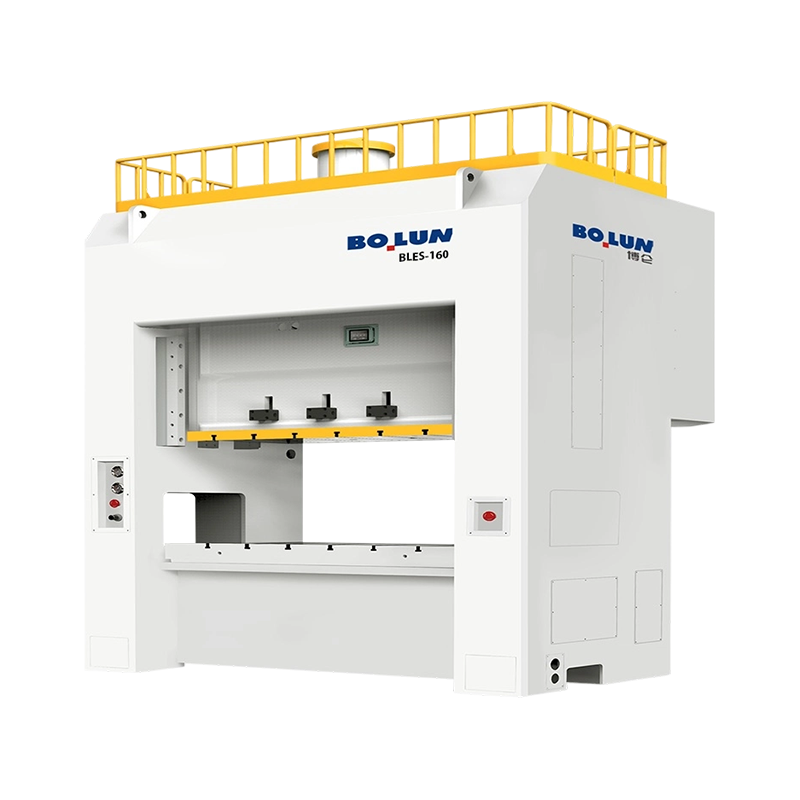
Two presses can both carry a 200-tonne nameplate and still produce very differe...
What Is a Power Press? A power press — also called a stamping press or punch pr...
A buyer comparing a 45-ton open-gap press for a bracket line often receives two...
Start With the Purchase Decision, Not the Definitions A procurement engineer co...
Power press machines are classified in two main ways: by frame construction, w...
Understanding Mechanical Power Presses and Their Essential Functions A mechani...
Contact Us

topbolun@gmail.com

+86-575-83362228

+86-13735238388
+86-18667502750

+86-575-83362999

+8618667502750

No.1 Linjiang Road East, Xiaren, Jinting Town, Shengzhou City, Zhejiang Province, China
Ready to Begin?
Get in Touch

Now!

ZHEJIANG BOLUN
 English
 中文简体