Modern metal-forming operations require more than raw pressing force. Manufacturers need equipment that combines dependable tonnage, repeatable accuracy, efficient production cycles, convenient operation, and the flexibility to process different materials and component geometries. The BLPA-35 Versatile High-Stability Open-Type Single-Point Power Press is designed to answer these requirements in a compact and adaptable production platform.
With a nominal capacity of 350 kN, the BLPA-35 occupies an important position between lighter-duty presses and larger industrial machines. It is powerful enough for a broad range of stamping, blanking, bending, shallow drawing, punching, embossing, and forming applications, while remaining more accessible and economical than a significantly larger press. Its open-type frame provides convenient access to the working area, making die installation, part handling, inspection, and maintenance more efficient.
The machine is engineered around structural stability, controlled motion, and operator flexibility. A rigid frame helps distribute working loads across the main structural components, reducing deformation and vibration during operation. The main motor can be paired with an inverter for adjustable speed control, while the touch screen interface gives operators a more direct method of managing operating parameters. An electronic rotary cam switch provides accurate timing for auxiliary systems and supports the coordination of feeding, transfer, lubrication, and other production functions.
These characteristics make the BLPA-35 suitable for manufacturers that need a versatile press capable of supporting both short-run and continuous production. It can be configured for different stroke types and operating speeds, allowing production teams to balance productivity, material behavior, tool requirements, and finished-part quality.
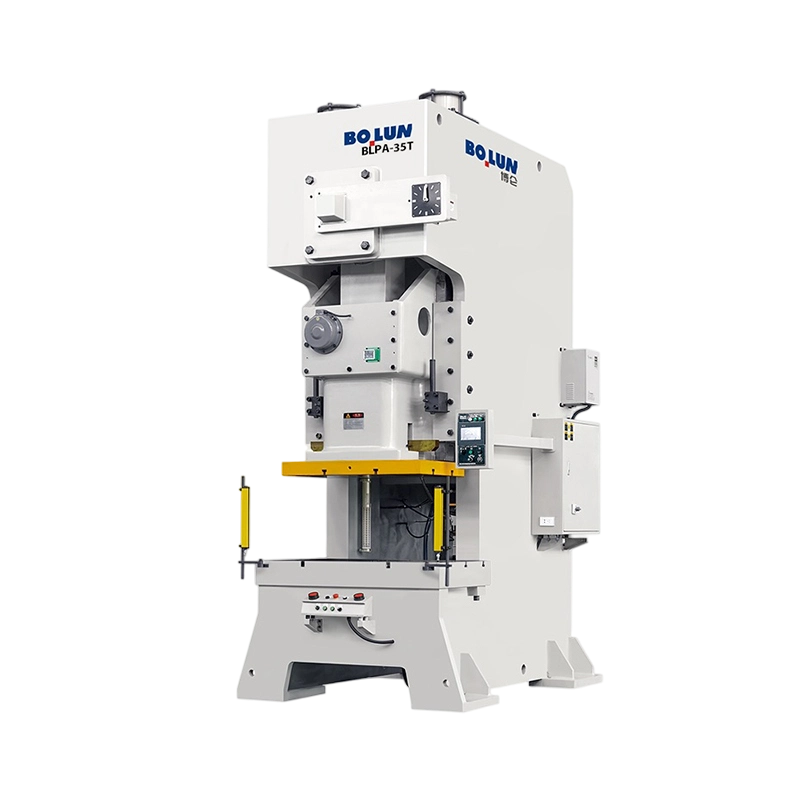
BLPA-35 Versatile High-Stability Open-Type Single-Point Power Press
The BLPA-35 is positioned as a high-stability open-type single-point power press for users seeking a practical combination of capacity and flexibility. The 350 kN nominal capacity provides a substantial working range without requiring the floor space, investment, and operating infrastructure associated with a much larger press. This makes the machine especially relevant for general stamping workshops, appliance component manufacturers, automotive part suppliers, electrical equipment producers, hardware factories, and precision metal-forming subcontractors.
In many production environments, a press must handle several jobs rather than one dedicated operation. A machine that is optimized for only one die or one material may create scheduling difficulties and limit equipment utilization. The BLPA-35 addresses this challenge through adjustable operating speed, a relatively generous worktable, accessible open-side construction, and a die-height adjustment system. These features allow the same machine to support different tooling arrangements and production processes.
The machine also bridges a practical gap between light and medium-duty forging and stamping equipment. Smaller presses may lack sufficient capacity for thicker sheet, high-strength materials, or larger dies. Larger presses can provide excess capacity but may increase energy consumption, installation requirements, tooling costs, and production overhead. By providing 350 kN of nominal force in a balanced configuration, the BLPA-35 can deliver an efficient match for applications that fall between these two equipment categories.
Its value is not based solely on tonnage. Press performance depends on how effectively the machine maintains alignment, absorbs dynamic loads, controls the slide, and communicates with auxiliary equipment. The BLPA-35 therefore combines mechanical design with electronic control features to create a more coordinated forming system. This combination supports stable operation, repeatable production, and easier adaptation to changing manufacturing requirements.
The rated nominal capacity of the BLPA-35 is 350 kN. This capacity gives the press the ability to perform a wide range of operations when the tooling, material thickness, process geometry, and force requirements are properly matched. Typical applications include sheet-metal blanking, piercing, bending, shallow forming, embossing, flattening, coining within suitable limits, and progressive-die operations requiring controlled repeated strokes.
Actual press selection should always be based on calculated forming force rather than nominal capacity alone. The required force depends on material tensile strength, shear strength, thickness, cutting perimeter, bend radius, forming depth, friction, tooling condition, and the location of the load in relation to the press centerline. A properly engineered process leaves an appropriate safety margin below the rated capacity and avoids repeated overloads.
For blanking and punching, the 350 kN rating can support medium-sized operations when the cutting perimeter and material properties are within the press limits. For bending and forming, the appropriate load depends on the shape of the component and the method used by the die. The BLPA-35 is particularly useful when the production mix includes several moderately demanding operations rather than one extremely high-force operation.
The press can also support components that require reliable repeatability from stroke to stroke. Stable structural behavior helps maintain a consistent relationship between the upper and lower sections of the die. This is important for maintaining dimensional accuracy, minimizing burr variation, and protecting expensive tooling from uneven loading.
One of the most important advantages of the BLPA-35 is its emphasis on rigidity and balanced load distribution. During pressing, the frame, slide, crank mechanism, connecting components, worktable, and die all experience dynamic forces. If the structure lacks stiffness, these loads can produce vibration, deflection, noise, uneven die contact, and premature wear.
The BLPA-35 is designed to distribute working loads across its principal structural components. This balanced approach helps reduce localized stress concentrations and supports stable slide movement. A stable frame is especially valuable during high-speed operation, where repeated acceleration and deceleration can magnify the effects of looseness, imbalance, and structural flexibility.
Reduced vibration brings several practical benefits. It can improve the working environment by reducing noise and machine movement. It can also help preserve die alignment, extend tool life, reduce the risk of inconsistent part quality, and protect electrical and mechanical components from unnecessary shock. For operations involving small clearances or precision tooling, structural stability is a key factor in maintaining production consistency.
Compared with less rigid entry-level presses, a stable machine can provide better performance under continuous production conditions. Some low-cost presses may achieve an attractive initial purchase price but experience greater vibration or frame deflection when operated near their limits. Such behavior can lead to higher maintenance costs, more frequent die adjustments, greater scrap rates, and shorter tooling life. The BLPA-35 is designed to provide a more dependable balance between initial investment and long-term production value.
Structural performance also influences how effectively operators can use the available capacity. A press that remains stable under load gives production engineers greater confidence when optimizing stroke rate, die clearance, and material feed. This does not remove the need for correct process engineering, but it creates a more reliable foundation for it.
The open-type frame provides access to the working area from the front and sides. This arrangement is valuable for manual loading, unloading, inspection, die setup, and integration with feeding equipment. Operators can observe the forming zone more easily, while maintenance personnel can reach key areas without the restrictions associated with a fully enclosed construction.
Open access is particularly useful for manufacturers with varied production requirements. Dies can be installed and removed with greater convenience, and small parts can be handled efficiently during short production runs. The configuration also supports the addition of automatic or semi-automatic feeding systems, depending on the application and safety design.
The BLPA-35 worktable is listed at 800 by 400 millimeters with a table thickness of 70 millimeters for the relevant model configuration. This provides a practical working platform for a broad selection of dies. The slide bottom size is listed at 360 by 250 millimeters with a thickness of 50 millimeters, giving tooling designers a clear mounting area for compatible upper tooling.
The distance between columns is approximately 488 millimeters in the listed BLPA-35 configuration. This clearance allows the press to accommodate dies and workpieces within the specified dimensional limits. The throat depth is listed at approximately 205 millimeters for the table configuration, while product information also identifies a deeper throat capability of up to approximately 230 millimeters depending on the applicable configuration. Buyers should confirm the final throat dimension and tooling envelope before ordering.
Open-type construction does not mean reduced precision. When combined with a properly engineered frame, accurate slide guidance, correct die installation, and disciplined maintenance, an open press can provide strong repeatability while maintaining excellent accessibility.
The BLPA-35 incorporates a main motor paired with an inverter to provide adjustable speed control. This is an important advantage over fixed-speed equipment because different materials and forming operations respond differently to press speed. A single operating speed may be acceptable for one application but unsuitable for another.
For the listed vertical configuration of the BLPA-35, the speed-changing range is approximately 110 to 180 strokes per minute, while the stable-speed value is approximately 85 strokes per minute. The horizontal configuration is listed with a speed-changing range of approximately 40 to 120 strokes per minute. The exact operating range depends on the selected stroke arrangement, machine configuration, tooling requirements, material, and production conditions.
Higher speeds can increase output for suitable operations, particularly when the die has been designed for rapid cycling and the material feed is properly synchronized. Lower speeds may be preferable for deeper forming, more demanding materials, complex transfer movements, or operations that require additional time for material stabilization and part release.
Variable-speed control can also reduce the need to use separate machines for different product families. A production manager may use a faster setting for simple blanking and a slower setting for bending or forming. This flexibility supports better utilization of the press and can simplify production planning.
Speed adjustment should always be applied within the limits established by the die, material, lubrication method, feed system, guarding, and machine control system. The inverter improves control, but it does not replace process validation. Operators should monitor vibration, noise, temperature, part quality, and tool behavior when changing operating speed.
The touch screen interface gives operators a clearer way to interact with machine functions and operating parameters. A modern interface can improve accessibility by organizing settings, operating modes, alarms, and production information in a visual format. This is particularly valuable in environments where multiple operators use the same press or where production changeovers occur frequently.
Compared with older control arrangements that rely exclusively on individual switches and mechanical controls, a touch screen can make operating conditions easier to review. It can support more systematic setup procedures, reduce the possibility of incorrect manual adjustments, and help operators identify abnormal conditions more quickly.
The interface may be used in conjunction with control functions such as speed management, operating mode selection, stroke control, counter settings, fault indication, and auxiliary equipment coordination. The exact functions depend on the machine configuration and control package supplied with the press.
Effective operator control is also connected to safety. A clearly organized interface can help separate setup, inching, single-stroke, and continuous operating modes. It can provide visible status information and support a consistent sequence for starting, stopping, and resetting the machine. Safety functions must still be implemented through appropriate guarding, emergency stops, interlocks, and control architecture in accordance with applicable regulations.
The electronic rotary cam switch is designed to provide accurate timing for auxiliary equipment. In a stamping line, the press must often coordinate with feeders, part ejectors, lubrication systems, sensors, transfer devices, and other accessories. If these devices operate at the wrong point in the cycle, they can interfere with the die, damage components, or reduce production stability.
Electronic cam control allows auxiliary actions to be linked to the angular position of the press cycle. This provides more precise timing than a simple independent timer because the event remains associated with the actual mechanical position of the crank or drive system. The result is improved coordination between slide movement and peripheral equipment.
Accurate cam timing is especially important in automatic production. The feeder must deliver material at the correct moment, the part ejector must clear the work area without interfering with the next stroke, and the lubrication system must operate at a suitable point in the cycle. By supporting this synchronization, the rotary cam switch helps create a more reliable production sequence.
It also provides flexibility when changing dies or production programs. Auxiliary timing can be adjusted to suit different tool designs, feed lengths, and operating speeds. This can reduce the amount of mechanical modification needed when the press is used for multiple product families.
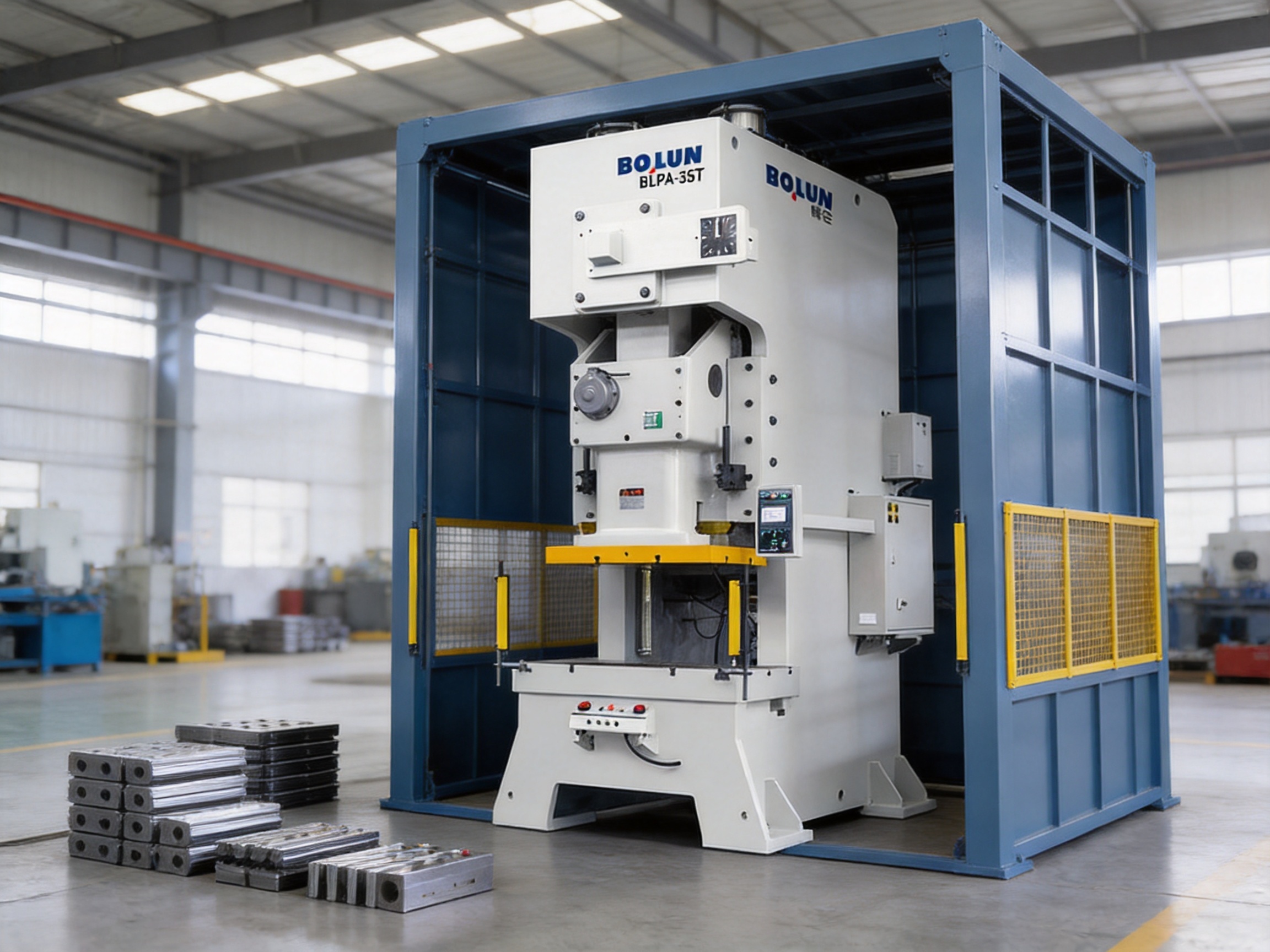
The following table summarizes principal specifications for the BLPA-35 based on the supplied product information. Final technical values should be confirmed against the quotation, machine configuration, electrical standard, selected options, and acceptance documentation.
| Specification | BLPA-35 V | BLPA-35 H |
|---|---|---|
| Nominal capacity | 350 kN | 350 kN |
| Nominal pressure stroke | 1.6 mm | 3.2 mm |
| Speed-changing range | 110–180 strokes per minute | 40–120 strokes per minute |
| Stable speed | 85 strokes per minute | 85 strokes per minute |
| Slide stroke | 40 mm | 70 mm |
| Maximum die height | 235 mm | 220 mm |
| Die-height adjustment | 55 mm | 55 mm |
| Worktable size | 800 × 400 × 70 mm | 800 × 400 × 70 mm |
| Slide bottom size | 360 × 250 × 50 mm | 360 × 250 × 50 mm |
| Throat depth | 205 mm | 205 mm |
| Distance between columns | 488 mm | 488 mm |
| Working-face height | 790 mm | 790 mm |
| Shank-hole diameter | 38.1 mm | 38.1 mm |
| Main motor | 3.7 kW × 4 pole | 3.7 kW × 4 pole |
| Air pressure | 0.55 MPa | 0.55 MPa |
| Overall dimensions | Approximately 1380 × 900 × 2400 mm | Approximately 1380 × 900 × 2400 mm |
| Press weight | Approximately 3 tons | Approximately 3 tons |
| Press precision | GB/JIS Class 1 | GB/JIS Class 1 |
The vertical and horizontal designations shown in the supplied data represent different stroke and operating arrangements rather than different nominal capacities. The vertical version is suited to applications requiring a shorter slide stroke and higher cycle rate, while the horizontal version provides a longer stroke and a lower speed range for applications with different forming or tooling requirements.
When comparing the BLPA-35 with competing power presses, buyers should evaluate the complete operating system rather than focusing only on the nominal tonnage. Two presses with similar force ratings may differ substantially in rigidity, speed control, die accessibility, control integration, precision, serviceability, and lifecycle cost.
A common limitation of basic fixed-speed presses is their lack of process adaptability. Fixed-speed operation can be sufficient for simple work, but it becomes less suitable when a manufacturer processes different materials or changes between blanking, bending, and forming operations. The BLPA-35 offers adjustable speed through an inverter, allowing production teams to select a more suitable operating condition for each job.
Another difference is the level of operator interaction. Conventional presses may rely on a relatively simple control panel with limited information. The BLPA-35 uses a touch screen interface that can make setup and operation more intuitive. Better visibility of settings and alarms can reduce changeover errors and improve communication between operators, maintenance personnel, and production supervisors.
Structural behavior is another important comparison point. A press with insufficient rigidity may produce excessive vibration or deflection when operated near its capacity. This can negatively affect die life and part quality. The BLPA-35 emphasizes balanced load distribution and high stability, giving it an advantage for production environments where repeatability and tooling protection are important.
The electronic rotary cam switch also gives the BLPA-35 an advantage in automated or semi-automated applications. Auxiliary equipment can be timed in relation to the press cycle, helping reduce interference and improving production coordination. A competing machine without equivalent timing control may require additional external controls or more complex integration work.
The open-type design provides another practical benefit. Fully enclosed or less accessible equipment may offer particular advantages in specialized applications, but an open press is often more convenient for general-purpose work, manual loading, die changes, inspection, and maintenance. For factories that frequently change products, accessibility can have a direct effect on total productivity.
These advantages do not mean that the BLPA-35 is automatically the correct choice for every application. Very high-force deep drawing, unusually large dies, or specialized transfer operations may require another type of press. However, for medium-capacity general stamping and forming, the BLPA-35 provides a well-balanced alternative that combines useful capacity, control flexibility, and production accessibility.
The manufacturer, Zhejiang Bolun High-Precision Machinery Co., Ltd., is described as an integrated machinery enterprise with capabilities covering research and development, design, production, sales, and service. This integrated structure is important because press quality depends on coordination between design engineering, material selection, machining, assembly, testing, and after-sales support.
A manufacturer with in-house or closely coordinated engineering capabilities can respond more effectively to application-specific requirements. Different users may need variations in electrical standards, safety guarding, feeding interfaces, die cushions, automation, operating language, or working dimensions. The supplied company information emphasizes non-standard customization and one-stop design and manufacturing services, which can be valuable for customers with specialized production needs.
The company also identifies precision processing equipment and a mature industrial environment as important parts of its production system. Precision machining is essential for manufacturing frame components, slide guides, shafts, crank mechanisms, worktables, and other parts that must maintain correct geometry. Machining accuracy directly affects alignment, movement, contact patterns, and long-term wear.
Manufacturing a high-quality power press requires more than assembling purchased parts. The frame must be designed to withstand repeated cyclic loads. Moving components must be balanced and properly fitted. Bearing seats, guide surfaces, mounting locations, and drive components must be produced to controlled dimensions. Assembly procedures must ensure correct clearances, lubrication, alignment, and fastening.
Bolun’s stated quality approach includes inspection of finished products and rigorous control of processes and components. Such inspection is important because defects that are not visible during a basic no-load test may become apparent only under operating force. Verification should therefore include mechanical movement, control functions, operating speed, safety functions, alignment, noise, vibration, and performance under representative conditions.
The company’s emphasis on technology and digital stamping equipment also supports the development of more adaptable machine platforms. As manufacturers increasingly connect presses with sensors, feeders, production monitoring systems, and factory information networks, the ability to integrate electronic control and auxiliary equipment becomes more important.
The manufacturing process for a press such as the BLPA-35 can be divided into several major stages: engineering design, raw-material preparation, frame manufacturing, precision machining, component assembly, electrical integration, testing, and final inspection. Each stage contributes to the final performance of the machine.
Design begins with determining the required capacity, stroke, speed range, die space, frame geometry, drive arrangement, and control architecture. Engineers must consider how forces travel through the frame and how components behave during repeated cycles. The design should also address service access, lubrication, guarding, noise, vibration, and compatibility with accessories.
Computer-aided design and engineering analysis can help evaluate component geometry and identify areas where stress or deflection may become excessive. The objective is not simply to make every component larger. Excess material can increase weight and cost without proportionate benefit. Good engineering seeks an efficient balance between strength, stiffness, manufacturability, and serviceability.
The frame and major structural components form the foundation of the press. Their manufacturing quality affects the alignment of the worktable, slide, guides, and drive system. Welding, casting, or fabrication methods must be selected according to the design and production requirements. Where welded structures are used, welding procedures, stress relief, dimensional control, and inspection are important.
After the primary structure is produced, surfaces may require machining to establish accurate mounting and guide references. The working face of the table must provide a stable foundation for die installation. Mounting holes, slots, guide locations, and reference surfaces must be positioned accurately so that tooling can be installed consistently.
Precision machining creates the functional geometry required for reliable movement and load transfer. Shafts, crank components, guide surfaces, bearing seats, connecting parts, and mounting interfaces must be manufactured within appropriate tolerances. Modern processing equipment can improve repeatability and reduce variation between machines.
Machining quality should be supported by measurement and inspection. Dimensional checks, surface-finish verification, geometric measurements, and fit inspections help ensure that components meet design requirements before assembly. This is particularly important for parts that influence slide parallelism, die alignment, and drive smoothness.
Assembly converts individual components into a working mechanical system. Technicians must install bearings, shafts, guides, connecting rods, drive components, lubrication lines, guards, and other parts in the correct sequence. Clearances and preload conditions must be controlled carefully.
Alignment is especially important in an open-type power press because uneven loading can affect the slide, die, frame, and worktable. Assembly technicians should verify the relationship between the slide and table, check the movement of the slide through its stroke, confirm that the drive operates smoothly, and inspect for abnormal contact or resistance.
The control system is integrated after the mechanical system has been prepared. The inverter, motor controls, touch screen, electronic cam switch, sensors, emergency-stop circuits, and auxiliary interfaces must work together. Wiring should be organized for reliability and service access, while electrical components should be protected against the industrial environment.
Control testing should include operating-mode selection, start and stop functions, speed adjustment, fault response, emergency stopping, reset logic, and auxiliary timing. A complete test confirms that the machine does not merely run, but responds predictably under different operating conditions.
Final testing may include no-load operation, speed verification, slide-motion inspection, noise and vibration observation, die-height adjustment, control-system verification, and precision checks. Where appropriate, the press should also be evaluated under representative production conditions.
A complete manufacturing and quality system reduces the risk that a machine will perform well during initial commissioning but deteriorate rapidly in service. Consistent processes, documented inspection, and proper acceptance procedures help protect the customer’s investment.
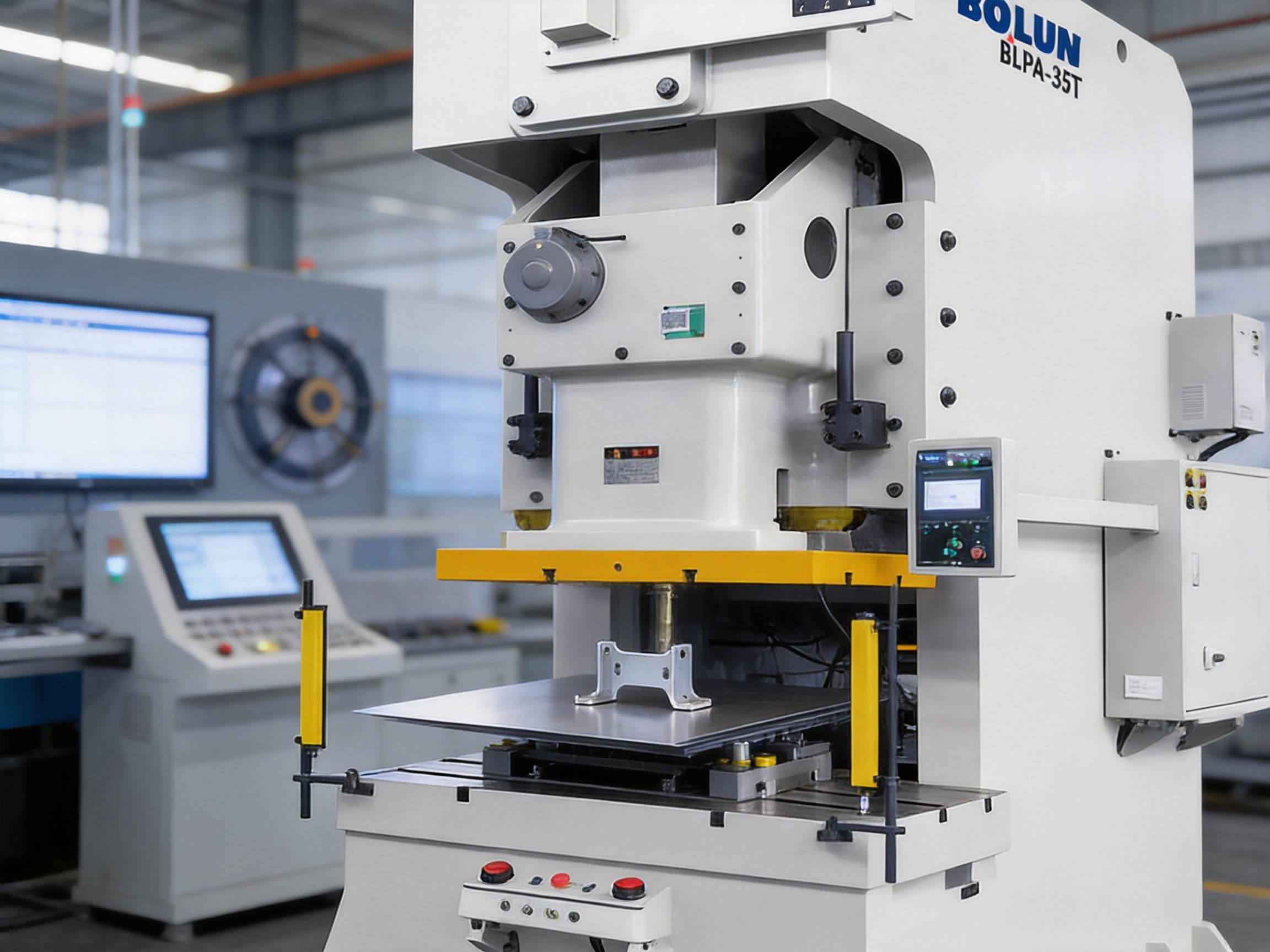
The supplied information identifies the press precision as GB/JIS Class 1. This classification indicates a defined level of press accuracy under the applicable testing conditions. In practical production, however, achieved part quality depends on more than the press classification. Die design, material consistency, lubrication, feeding accuracy, clearance, operator setup, and maintenance all contribute to the final result.
A stable press provides a better basis for precision production because it reduces unwanted movement and variation. If the slide remains properly guided and the table maintains a stable relationship with the tooling, the die can operate more consistently. This can help control burr height, bend angle, feature location, and part-to-part dimensional variation.
Tool protection is also a major benefit. Dies are expensive assets, and premature damage can disrupt production. Uneven loading, excessive vibration, incorrect die height, mistimed feeding, or inadequate lubrication can create serious problems. The BLPA-35’s adjustable control features and stable structure can help reduce these risks when used with correct setup procedures.
Operators should inspect the die before installation, confirm the required shut height, verify the feed path, check the stroke setting, and run the press at a controlled speed during initial trials. Any unusual sound, resistance, material movement, or part defect should be investigated before continuous production begins.
The BLPA-35 offers a maximum die height of approximately 235 millimeters in the listed vertical configuration and approximately 220 millimeters in the horizontal configuration. The die-height adjustment is approximately 55 millimeters. These dimensions provide useful flexibility for different tooling arrangements, but die compatibility must be confirmed using the complete die drawing and press installation requirements.
The worktable and slide dimensions establish the practical mounting envelope. Tool designers should consider die length, width, height, guide-post position, shank size, fastening method, feed direction, clearance, and the location of the working force. The listed shank-hole diameter is 38.1 millimeters for the BLPA-35 configuration.
A properly selected die should not exceed the allowable load, eccentric-load limits, or dimensional capacity of the press. The center of the working force should be managed carefully. Large off-center loads can produce uneven stress and may affect slide guidance or frame performance even when the total force is below the nominal rating.
Die-height adjustment allows operators to establish the correct relationship between the upper and lower die sections. Accurate adjustment is important for protecting the tooling and producing consistent parts. The adjustment mechanism should be used according to the manufacturer’s procedures, with the machine isolated when required and all mechanical locking or securing steps completed correctly.
The BLPA-35 can serve as the central machine in a semi-automatic or automated stamping cell. Depending on the product and die, auxiliary equipment may include a decoiler, straightener, servo feeder, pneumatic feeder, transfer mechanism, lubrication system, scrap conveyor, part ejector, or inspection device.
The electronic rotary cam switch supports the timing relationship between the press and these auxiliary systems. For example, a feeder can be programmed to advance material during a safe portion of the press cycle, stop before the die closes, and remain clear during forming. An ejector can be activated after the slide reaches a suitable position, while lubrication can be applied at a controlled point in the cycle.
Automation can increase output and reduce manual handling, but it also raises the importance of safety validation. Every auxiliary device must be integrated so that a fault does not create an unexpected press cycle or allow a person to enter a hazardous area. Sensors, interlocks, emergency stops, and protective guarding should be selected and validated according to the complete production-cell risk assessment.
The press’s adjustable speed is also useful in automation. A feeder may operate reliably at one speed range while a deep or complex die requires another. The ability to adjust the press can help the entire cell operate within a stable window rather than forcing all processes to accommodate one fixed cycle rate.
Productivity should be evaluated by considering output, uptime, quality, changeover time, maintenance, and energy use together. A press with a high theoretical speed may not deliver the best practical output if it produces excessive scrap, causes frequent die adjustments, or requires lengthy repairs.
The BLPA-35’s speed flexibility allows users to select a suitable balance between cycle rate and process stability. Simple parts may be produced at a higher speed, while demanding operations can run more slowly to protect the tool and maintain quality. This can improve effective productivity across a mixed production schedule.
The machine’s approximately three-ton weight and listed overall dimensions of about 1380 by 900 by 2400 millimeters provide a practical installation scale for many workshops. Site planning must still account for foundation requirements, access for delivery and maintenance, electrical supply, compressed air, ventilation, material flow, and safety clearances.
Lifecycle value is also influenced by spare-parts availability, technical support, operator training, and maintenance documentation. The manufacturer’s stated service system covers pre-sales consultation, in-sales support, and after-sales assistance. These services can help customers select suitable configurations, commission the machine, resolve operating issues, and maintain performance over time.
Regular maintenance is essential for preserving the performance of any power press. Operators should follow the recommended lubrication schedule, inspect fasteners, monitor guide and bearing conditions, clean the work area, and check electrical and pneumatic systems. Maintenance intervals should be adjusted according to operating hours, load, environment, and production intensity.
Lubrication is particularly important for moving components and bearing surfaces. Insufficient lubrication can increase friction, temperature, and wear, while excessive or contaminated lubricant can create other problems. The correct lubricant and application method should be used according to the machine documentation.
Operators should also monitor changes in noise and vibration. A gradual increase may indicate looseness, bearing wear, drive imbalance, guide deterioration, or another developing issue. Early detection can prevent a minor defect from becoming a major failure.
Electrical maintenance includes checking wiring, control cabinets, inverter ventilation, sensors, emergency-stop circuits, and interface functions. Pneumatic systems should be maintained at the specified air pressure, listed as 0.55 MPa in the supplied data. Air quality, drainage, filtration, and leakage control can affect the reliability of pneumatic components.
Maintenance must be performed by qualified personnel using appropriate lockout and isolation procedures. The ability to access an open-type press conveniently should never be treated as permission to enter the working area while the machine is energized or capable of cycling.
The BLPA-35 can support the production of brackets, clips, reinforcements, shields, mounts, and other medium-sized sheet-metal components. Its stable structure and adjustable speed are useful where dimensional repeatability and consistent tool operation are required.
Electrical cabinets, appliance housings, terminals, connectors, brackets, and reinforcement pieces often require punching, bending, embossing, and forming. The open work area makes it convenient to perform frequent die changes and inspections in this type of mixed production environment.
Hardware manufacturers may use the machine for hinges, fasteners, fittings, plates, handles, and other formed products. The press can support both manual production and integration with feeding equipment, allowing manufacturers to scale production as demand changes.
Manufacturers of pumps, motors, agricultural equipment, construction equipment, and industrial machinery can use a 350 kN press for medium-sized brackets, covers, support plates, and formed structural components. The machine’s capacity and worktable size provide flexibility for a broad range of tooling.
Job shops require machines that can adapt quickly to different customer requirements. The BLPA-35 is well suited to this environment because its adjustable speed, open access, die-height adjustment, and control features support varied production work without requiring a dedicated press for every operation.
Before purchasing, the customer should prepare a complete application profile. This should include material type, thickness, tensile strength, part dimensions, forming method, required production rate, die dimensions, feeder requirements, electrical standard, available floor space, and expected working hours.
The required press force should be calculated for each major operation. If several operations will be performed in one die, the maximum combined force and its timing should be considered. The customer should also evaluate whether the load is centered and whether the selected speed is compatible with the material and tooling.
During commissioning, the machine should first be inspected for shipping damage, correct installation, proper leveling, electrical connection, air connection, lubrication, and safety-system operation. The die should be mounted carefully, and the initial cycle should be performed at a controlled speed.
Production trials should evaluate part dimensions, burrs, surface marks, die behavior, feed accuracy, vibration, noise, temperature, and cycle stability. If the process is automated, the complete interaction between press, feeder, sensors, and auxiliary systems should be tested before unattended operation.
Documentation should record the approved die height, stroke, speed, feed settings, lubrication conditions, inspection standards, and maintenance requirements for each product. This creates a repeatable operating method and reduces dependence on individual operator experience.
Working with an integrated press manufacturer can simplify the relationship between machine design, customization, production, and service. Instead of coordinating several unrelated suppliers, the customer can discuss the required application with a company that understands the machine’s mechanical and control systems together.
This can be especially valuable when the customer requires a customized worktable, modified stroke, special guarding, automation interfaces, different electrical standards, or a dedicated auxiliary system. The manufacturer’s stated non-standard design capability supports the development of solutions that are closer to the actual production requirement.
Integrated manufacturing can also improve accountability. When design, production, testing, and service are coordinated, technical questions can be directed to a team with access to the relevant machine information. This may reduce delays during installation and troubleshooting.
The manufacturer’s two decades of industry experience, according to the supplied company information, provide a foundation for understanding common press applications and production challenges. Its stated focus on research and development, quality control, precision processing, and customer service supports the long-term value of the BLPA-35 platform.
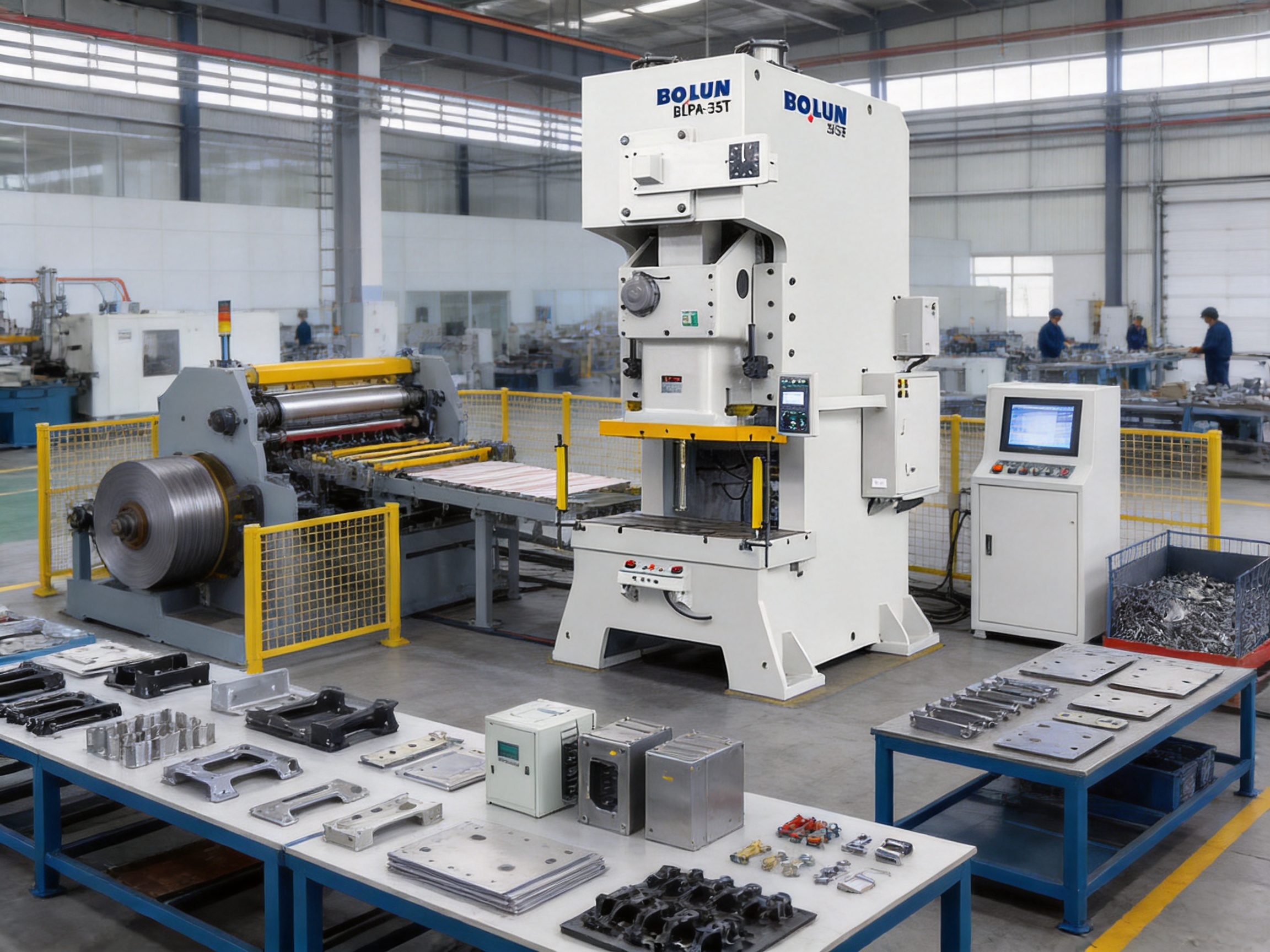
The BLPA-35 has a nominal capacity of 350 kN. This capacity is suitable for many medium-duty stamping, blanking, bending, shallow-forming, and punching applications when the process force and tooling are correctly calculated.
The supplied data lists approximately 110 to 180 strokes per minute for the vertical configuration and approximately 40 to 120 strokes per minute for the horizontal configuration. The listed stable speed is approximately 85 strokes per minute. The applicable range depends on the selected configuration, stroke, material, die, and production conditions.
Yes. The machine uses a main motor paired with an inverter for adjustable speed control. This allows operators to select a suitable speed for different materials, die designs, and forming operations.
The touch screen provides a visual interface for operating and monitoring the machine. Depending on the supplied control configuration, it may support operating-mode selection, speed management, alarm indication, production settings, and auxiliary control functions.
The electronic rotary cam switch coordinates auxiliary equipment with the press cycle. It can help control the timing of feeders, ejectors, lubrication systems, sensors, and other accessories according to the angular position of the press drive.
The listed BLPA-35 worktable size is approximately 800 by 400 by 70 millimeters. The slide bottom size is approximately 360 by 250 by 50 millimeters. Tooling compatibility should be confirmed using complete die drawings and the final machine configuration.
The supplied table lists a throat depth of approximately 205 millimeters for the BLPA-35 configuration. The product description also references a throat depth of up to approximately 230 millimeters depending on the applicable configuration. Buyers should confirm the final value in the technical quotation.
Yes. The press can be integrated with suitable feeding and auxiliary systems. The electronic cam switch and adjustable speed can support coordination, but the feeder, die, sensors, guarding, and control logic must be engineered as a complete system.
The BLPA-35 provides greater process flexibility because its inverter allows the operating speed to be adjusted. This can be beneficial when the same press is used for different materials, die designs, and production requirements.
Rigidity helps limit vibration and deflection during pressing. This supports more consistent die alignment, part quality, tool life, and operating stability, particularly during repeated or higher-speed cycles.
The supplied information identifies the press precision as GB/JIS Class 1. Actual production accuracy also depends on the die, material, feeding system, setup, maintenance, and operating conditions.
The listed air pressure is 0.55 MPa. The customer should confirm air consumption, air-quality requirements, connection details, and any optional pneumatic equipment before installation.
The BLPA-35 can serve automotive components, electrical products, appliances, hardware, industrial equipment, general sheet-metal production, and contract stamping applications. Its suitability depends on the specific material, part geometry, force requirement, and die design.
Customers should confirm the exact vertical or horizontal configuration, nominal pressure stroke, slide stroke, speed range, die height, throat depth, worktable dimensions, electrical requirements, safety guarding, automation interfaces, foundation conditions, and after-sales service arrangements.
The BLPA-35 Versatile High-Stability Open-Type Single-Point Power Press provides a balanced solution for manufacturers that require medium-duty forming capacity, flexible operation, and reliable structural performance. Its 350 kN nominal capacity fills an important space between light-duty and larger industrial presses, making it suitable for a wide range of general stamping and forming applications.
Its main advantages include a stable open-type structure, balanced load distribution, adjustable speed through an inverter, a touch screen operating interface, electronic rotary cam timing, practical die space, and compatibility with manual, semi-automatic, and automated production. These features help the machine adapt to changing product requirements while supporting repeatable production and efficient die utilization.
The value of the press is strengthened by the manufacturer’s stated capabilities in research and development, precision processing, customization, quality control, assembly, and service. A well-engineered machine supported by an integrated manufacturing and service system can provide benefits that extend beyond the initial purchase, including lower setup risk, improved tool protection, easier maintenance, and more dependable long-term production.
For customers seeking a flexible 350 kN press, the BLPA-35 should be evaluated through a complete application review. When its capacity, stroke, speed, tooling, material, and automation requirements are properly matched, it can serve as a productive and dependable foundation for modern metal-forming operations.
1. Supplied BLPA-35 product specification table and technical data.
2. Supplied product description for the BLPA-35 Versatile High-Stability Open-Type Single-Point Power Press.
3. General principles of mechanical power press design, operation, and maintenance.
4. General guidelines for sheet-metal stamping force calculation and die selection.
5. General industrial practices for press-machine safety, guarding, emergency stops, and lockout procedures.
6. General quality-control practices for precision machining, machine-tool assembly, and finished-equipment inspection.


A buyer comparing a 45-ton open-gap press for a bracket line often receives two...
What Is a Power Press? A power press — also called a stamping press or punch pr...
Understanding Mechanical Power Presses and Their Essential Functions A mechani...
In the fields of metal forming, sheet metal fabrication, blanking, and punching,...
Two presses can both carry a 200-tonne nameplate and still produce very differe...
Start With the Purchase Decision, Not the Definitions A procurement engineer co...
Contact Us

topbolun@gmail.com

+86-575-83362228

+86-13735238388
+86-18667502750

+86-575-83362999

+8618667502750

No.1 Linjiang Road East, Xiaren, Jinting Town, Shengzhou City, Zhejiang Province, China
Ready to Begin?
Get in Touch

Now!

ZHEJIANG BOLUN
 English
 中文简体