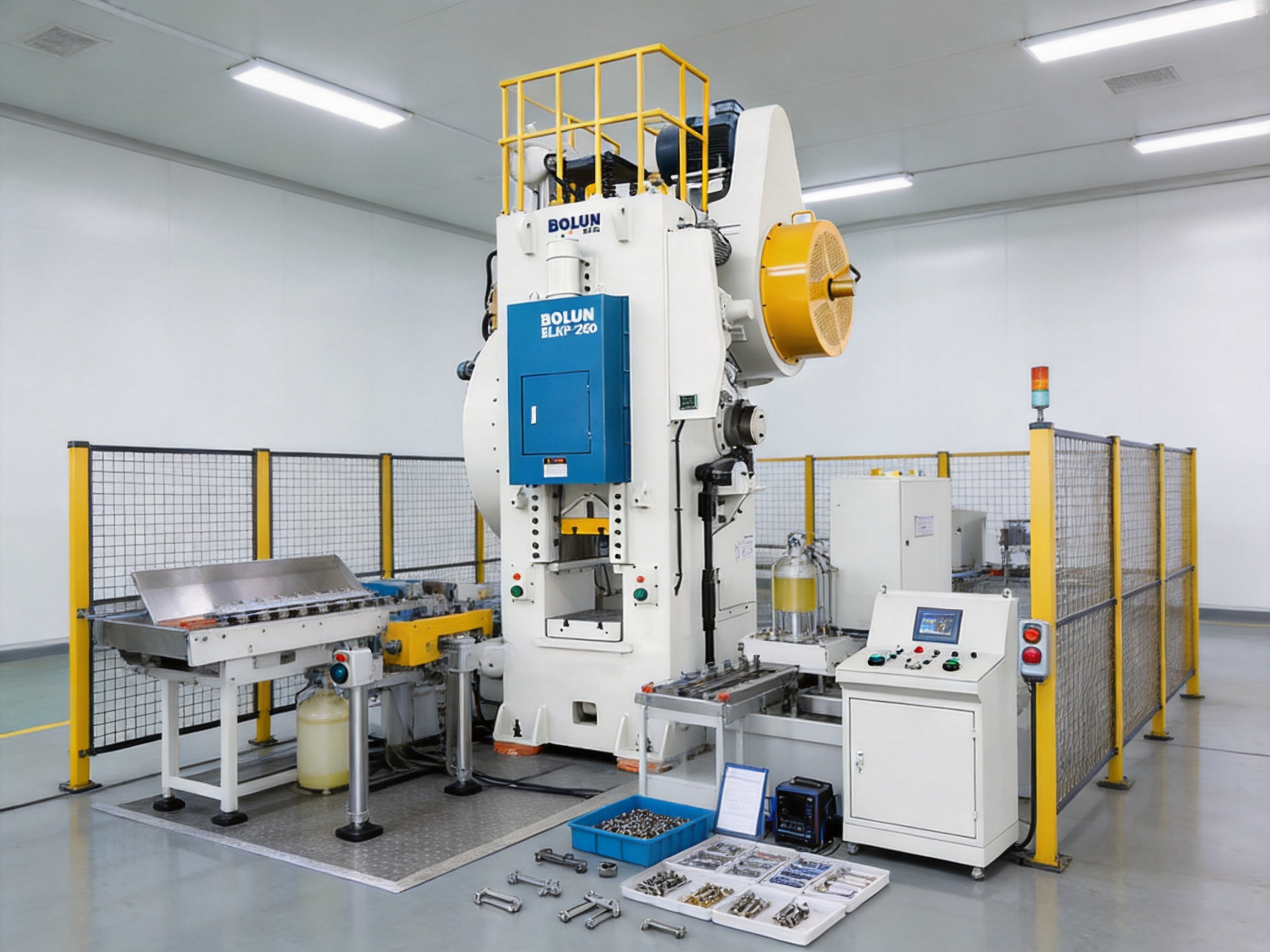
Precision cold forging demands more than high nominal force. A successful production press must deliver force at the correct point in the forming cycle, maintain stable motion, protect dies from excessive shock, support rapid production, and provide the control accuracy needed for repeatable small components. The BLKP-260 Agile Precision Cold Forging Toggle Type Power Press is designed around these requirements, combining a 2600 kN nominal capacity with toggle-linkage motion, variable-speed operation, programmable control, and a compact working area suitable for precision metal forming.
Developed for demanding cold forging and precision forming applications, the BLKP-260 is suitable for electronics hardware, small industrial components, precision fasteners, connectors, brackets, and other products manufactured from metal blanks. Its configuration is intended to help manufacturers improve dimensional consistency, surface quality, die life, material utilization, and production efficiency when compared with conventional cutting or less specialized forming methods.
The machine belongs to a broader range of toggle-type cold forging presses that includes capacities from 2600 kN to 20000 kN. Within this range, the BLKP-260 provides a practical balance between forming power, production speed, floor-space requirements, and tooling flexibility. It is especially appropriate for manufacturers that need substantial forming force without moving immediately to a larger, more energy-intensive industrial press.
The principal mechanical advantage of the BLKP-260 is its toggle-type slide drive. In a conventional crank press, slide velocity and force characteristics are strongly influenced by the crank geometry. A toggle mechanism uses linked motion to modify the slide behavior throughout the stroke. As the slide approaches bottom dead center, its speed is reduced and the mechanical advantage of the linkage increases.
This controlled deceleration is highly valuable in cold forging. Small parts often require a carefully managed deformation sequence rather than a sudden impact. The reduced slide speed near the forming position allows the material to flow more steadily into the die cavity. It also helps reduce unnecessary shock loads on the die, punch, slide, and frame.
For precision components, the final portion of the stroke is often the most important. It is where the workpiece reaches its final shape, where dimensional deviations become visible, and where the tooling experiences the highest forming resistance. The toggle mechanism concentrates controlled movement and mechanical advantage in this critical area. As a result, the press can support stable forming behavior while maintaining a productive stroke rate.
The toggle drive is particularly appropriate for shallow and medium-depth cold forging operations, upsetting, coining, heading, precision embossing, sizing, and other processes requiring controlled force application. The exact process suitability depends on material, blank geometry, tooling design, lubrication, and forming ratio, but the press architecture provides a strong foundation for these applications.
The BLKP-260 provides a nominal capacity of 2600 kN. This force level gives manufacturers considerable forming capability for small and medium-sized precision components while keeping the equipment more compact than larger presses in the same product family.
Nominal capacity should not be interpreted as unrestricted force available at every point of the stroke. In practical forming, the relationship between the nominal pressure stroke, die height, material resistance, tooling configuration, and forming speed must be considered. The BLKP-260 has a nominal pressure stroke of 4 mm, which indicates that the rated capacity is associated with a defined position near the bottom of the slide stroke.
Understanding this relationship helps production engineers select the appropriate tooling and process sequence. The press can deliver high forming force where it is most useful, while the full slide stroke of 120 mm provides sufficient movement for loading, blank transfer, ejection, and die clearance in many small-part applications.
The 2600 kN capacity also provides a useful margin for operations that require more than simple stamping. Cold forging can involve significant material displacement, friction, work hardening, and localized pressure. A press with adequate capacity can reduce the risk of operating continuously at the edge of its capability, which may contribute to more stable production and longer service life for critical components.
Production speed must be balanced against forming quality. Operating too slowly may reduce output, while operating too quickly can increase heat generation, vibration, lubrication demands, and die wear. The BLKP-260 supports variable-speed operation up to 50 strokes per minute, allowing production teams to adjust the cycle to the material, tooling, part geometry, and process requirements.
For relatively simple parts and stable tooling, the press can operate at a higher stroke rate to improve throughput. For more demanding components, the operator or production control system can select a lower speed to provide more controlled forming conditions. This flexibility is a significant advantage over fixed-speed equipment that cannot adapt easily to different products.
Variable-speed operation is also useful during setup and trial production. Engineers can begin with a conservative speed while checking blank positioning, lubrication, die alignment, ejection, and part quality. After the process is verified, the speed can be increased in a controlled manner. This approach can reduce setup risk and make the transition from trial runs to full production more systematic.
The documented BLKP-260 specification identifies a rated operating speed of 40 strokes per minute for the model, while the product description indicates variable-speed operation up to 50 strokes per minute. Actual operating speed should be selected according to the installed configuration, tooling, material, automation system, and process conditions. This distinction allows users to evaluate both the standard rating and the available speed range during technical discussions.
The BLKP-260 is equipped with a worktable measuring 500 × 600 × 100 mm. This work area is well suited to compact dies and small-part forming tools. The table provides a stable platform for die installation while maintaining a machine footprint appropriate for production lines where floor space is limited.
The slide bottom size is 400 × 420 mm. This dimension should be considered together with the worktable size when designing or selecting tooling. Proper matching of the die base, punch assembly, guide system, and workpiece transfer arrangement is essential for maintaining alignment and protecting the press from uneven loading.
The maximum die height is 370 mm, and die-height adjustment is specified at 15 mm. These values provide useful flexibility for accommodating different tool stacks and process layouts. Before ordering a die, manufacturers should verify the complete closed height, required adjustment range, bolster arrangement, ejector position, and clearance for sensors or transfer devices.
The maximum upper-die weight for the BLKP-260 is listed as 500 kg. This capacity allows the press to support robust tooling assemblies while establishing an important safety boundary for installation and operation. Die weight, center of gravity, lifting points, and installation procedures should be reviewed before a tool is mounted.
The working-face height is 700 mm. This height can support practical operator access and integration with feeding or discharge equipment. The final ergonomics of a line depend on the arrangement of conveyors, bins, safety guarding, automation, and maintenance access, but the specified working height provides a useful reference for layout planning.
Cold forging operations frequently require controlled removal of the formed part from the die. The BLKP-260 includes a mold pad capacity of 100 kN and a ram stroke of 50 mm for the lower top or lower ejection function. This arrangement can assist with part release, material positioning, and process coordination, depending on the die design.
Lower ejection is especially important when a workpiece expands against the die wall or when the finished part has a shape that makes manual removal difficult. A controlled lower system can help minimize part sticking and reduce the risk of damage during extraction. It can also support more consistent transfer into the next operation in an automated or semi-automated line.
The lower system must be engineered as part of the complete tooling package. Ejection force, stroke, timing, return position, contact area, and clearance should be matched to the workpiece and die. The press provides a defined capacity, but the forming specialist remains responsible for ensuring that the tool does not overload the ejection system or impose side forces on the press.
Consistent die height is essential to precision forming. Small changes in die position can influence final thickness, part height, material flow, shut height, and the relationship between the punch and die. The BLKP-260 is equipped with a digital die-height indicator with an accuracy of 0.1 mm, supporting more precise setup and easier verification during production.
A digital indication system provides a direct reference for tooling adjustment. Instead of relying only on manual gauges or visual estimation, operators can monitor the die-height value and record setup parameters for different products. This can shorten changeover time and make repeat production more consistent.
The 0.1 mm accuracy is particularly useful for small components, where a relatively small setup error can have a measurable effect on dimensional quality. It also assists maintenance and troubleshooting by providing a reference point when investigating changes in forming force, part dimensions, or die wear.
The press is also described as using a PLC control system. Programmable control can coordinate operating modes, speed settings, cycle logic, safety interlocks, lubrication signals, ejection timing, and auxiliary equipment. A PLC-based system makes it easier to standardize operating procedures and integrate the press with feeding, detection, and material-handling equipment.
Control functions should always be configured according to the actual machine specification and applicable safety requirements. A well-designed control system does not replace skilled process engineering, but it provides the repeatability and visibility needed to manage a modern production cell.
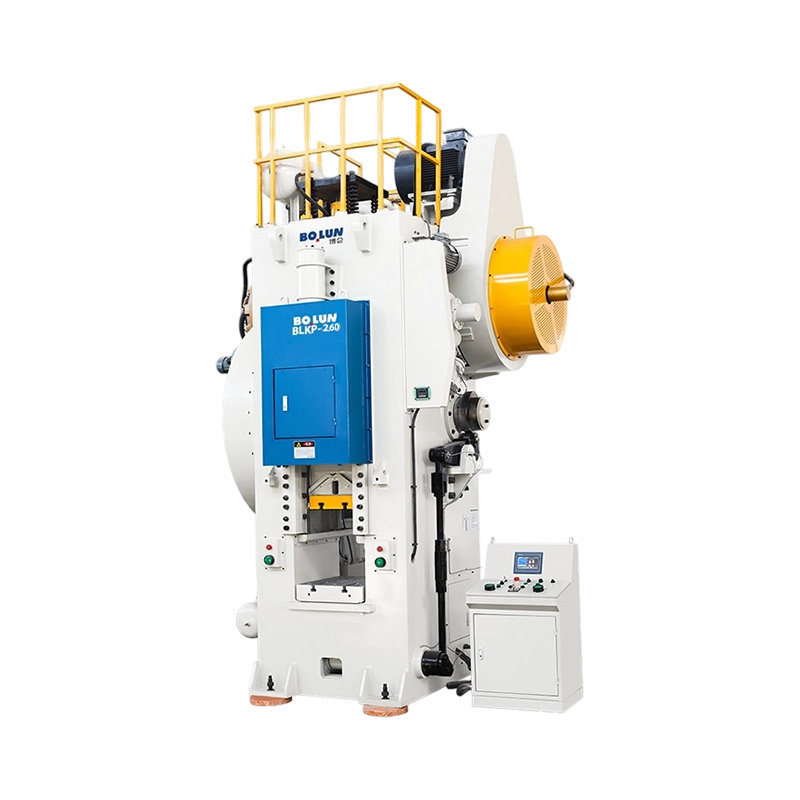
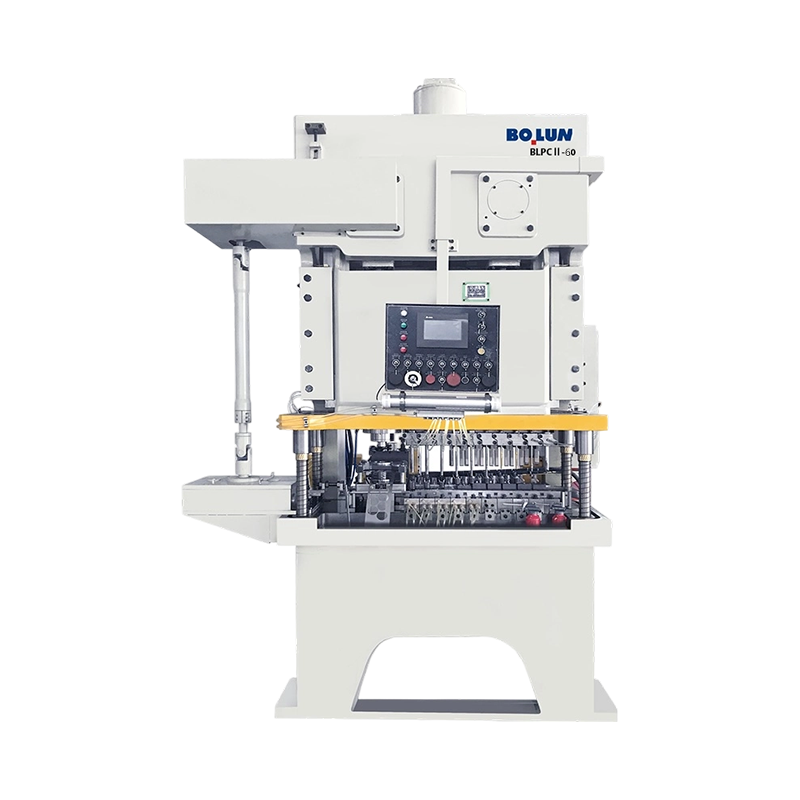
BLKP-260 Agile Precision Cold Forging Toggle Type Power Press
One of the main benefits of cold forging is the ability to shape material with limited waste. Cutting-based manufacturing removes material to create a component, producing chips and requiring additional machining operations. Cold forging instead displaces material inside a die, allowing manufacturers to use a higher proportion of the original blank.
Improved material utilization can have a major impact on production economics, particularly when processing stainless steel, alloy steel, copper alloys, aluminum alloys, or other materials with significant raw-material cost. The exact savings depend on part geometry and process design, but near-net-shape forming can reduce the amount of secondary machining required.
Cold-forged parts can also benefit from favorable grain flow and work hardening. Because the material is displaced rather than cut away, the grain structure can follow important features of the component. This may improve strength and functional performance when the tool, material, and process are properly designed.
Compared with a general-purpose mechanical press, the toggle-type configuration of the BLKP-260 is more specifically suited to controlled forming near bottom dead center. A general-purpose press may perform many operations effectively, but it may not provide the same combination of controlled final-stage movement, concentrated forming force, and precision die-height management.
Compared with a larger press, the BLKP-260 can offer a more economical solution for smaller components. A machine with excessive capacity may occupy more floor space, require more energy, and impose higher tooling and installation costs than necessary. Selecting a press that is appropriately sized for the product can improve overall line efficiency.
The BLKP-260 is suitable for forming small metal components used in electronic assemblies. Potential applications include terminals, connector parts, shielding elements, clips, contact components, and small structural pieces. These parts often require consistent dimensions, clean surfaces, and reliable repeatability over large production volumes.
Electronic hardware may be produced from copper alloys, brass, stainless steel, aluminum, or other materials selected for conductivity, corrosion resistance, or mechanical performance. The press allows process engineers to adjust speed and forming conditions to suit the material and tooling requirements.
Small hardware products often involve high-volume production and strict expectations for interchangeability. The BLKP-260 can support forming operations for small brackets, sleeves, pins, washers, collars, rivet-like components, and related products. Its worktable and slide dimensions are appropriate for compact dies used in these applications.
Where a part requires several forming stages, the press may be incorporated into a progressive, transfer, or sequential production arrangement, subject to tooling design and automation requirements. The PLC system can help coordinate the operating cycle with external feeding or transfer equipment.
Precision metal components used in machinery, appliances, vehicles, electrical equipment, and industrial assemblies often require repeatable shape and controlled surface condition. Cold forging can reduce the need for later machining, while the toggle motion can support controlled final forming.
Typical operations may include upsetting, heading, coining, embossing, sizing, flattening, shallow extrusion, and precision calibration. Each application must be evaluated through forming simulations, die trials, material testing, and force calculations before full-scale production.
The following table summarizes the principal specifications provided for the BLKP-260. Certain values belong to the broader press series and should be confirmed for the exact machine configuration, electrical standard, automation package, and customer order.
| Specification | BLKP-260 Value |
|---|---|
| Press type | Cold forging toggle-type power press |
| Nominal capacity | 2600 kN |
| Nominal pressure stroke | 4 mm |
| Slide stroke | 120 mm |
| Standard listed speed | 40 strokes per minute |
| Variable operating range described | Up to 50 strokes per minute |
| Maximum die height | 370 mm |
| Maximum upper-die weight | 500 kg |
| Worktable size | 500 × 600 × 100 mm |
| Slide bottom size | 400 × 420 mm |
| Working-face height | 700 mm |
| Die-height adjustment | 15 mm |
| Air pressure | 0.55 MPa |
| Main motor | 25 kW × 4 pole |
| Mold pad capacity | 100 kN |
| Ram stroke | 50 mm |
| Die-height indication accuracy | 0.1 mm |
| Control system | PLC-based control |
The producer, Zhejiang Bolun High-Precision Machinery Co., Ltd., is based in Zhejiang, a major manufacturing region in China with a strong industrial foundation in machine tools, metal forming equipment, precision machining, and component production. The company has approximately two decades of experience in machinery manufacturing and integrates research and development, design, production, sales, and service.
This integrated structure is important for specialized forming equipment. A press is not simply a collection of purchased components. Its reliability depends on the relationship between frame design, drive mechanism, slide guidance, die-height adjustment, lubrication, electrical control, assembly accuracy, and final inspection. Coordinating these functions within one manufacturing organization can improve communication and reduce gaps between design intent and production results.
The company emphasizes precision processing equipment and a complete production environment covering basic design, core component development, machining, assembly, and testing. Such a full-chain approach can support better control of critical components and provide greater flexibility when customers require special specifications or non-standard functions.
Customization is particularly valuable in cold forging because different products may need different slide strokes, speeds, die arrangements, ejection systems, feeding methods, sensors, guarding, and control sequences. A manufacturer with design and engineering capability can evaluate these requirements as an integrated system instead of treating them as isolated accessories.
The first stage of manufacturing a precision press is mechanical design. Engineers must evaluate the expected forming force, load distribution, frame stiffness, drive geometry, slide guidance, die seating, vibration behavior, and service conditions. Toggle-linkage presses require careful analysis because the motion and force characteristics change significantly throughout the stroke.
Design work may include structural calculations, kinematic analysis, tolerance allocation, bearing selection, lubrication planning, and maintenance access review. The objective is to produce a machine that can withstand repeated high-load cycles while preserving alignment and controlled movement.
Critical press components require appropriate machining accuracy and surface quality. The slide, guides, linkage parts, worktable, die-support surfaces, shafts, and adjustment mechanisms must be produced within controlled tolerances. Precision machining helps reduce uneven contact, excessive clearance, vibration, and premature wear.
Stable machining processes also make it easier to maintain consistency across machines in the same product series. This is important for customers operating multiple presses or planning future expansion, because standardized components simplify spare-parts management and maintenance training.
Assembly quality directly affects press performance. A precisely machined component can still perform poorly if it is installed with incorrect alignment, insufficient preload, contaminated surfaces, or improper lubrication. The assembly process therefore requires careful sequencing, measurement, tightening control, and inspection.
For a toggle press, alignment of the linkage, slide, guides, die-support surfaces, and lower ejection system is especially important. Correct assembly helps distribute forming loads evenly and reduces the risk of localized stress or abnormal wear.
The PLC control system must be integrated with the mechanical operation, pneumatic supply, safety devices, sensors, and optional automation. Electrical design includes control-panel construction, signal management, operating modes, fault indication, emergency stopping, and communication with auxiliary equipment.
Good electrical integration improves usability and helps operators identify abnormal conditions before they develop into larger production problems. It also supports repeatable operating procedures by storing or applying defined cycle parameters where the control configuration permits.
The producer states that it maintains a finished-product inspection system designed to exceed ordinary industry requirements. Inspection should cover major mechanical dimensions, movement accuracy, die-height adjustment, pressure and pneumatic functions, motor operation, control logic, safety functions, and trial cycling.
Testing under controlled conditions helps reveal issues related to vibration, noise, temperature rise, lubrication, timing, and control response. Final inspection is also an opportunity to verify that the machine conforms to the agreed technical specification before shipment.
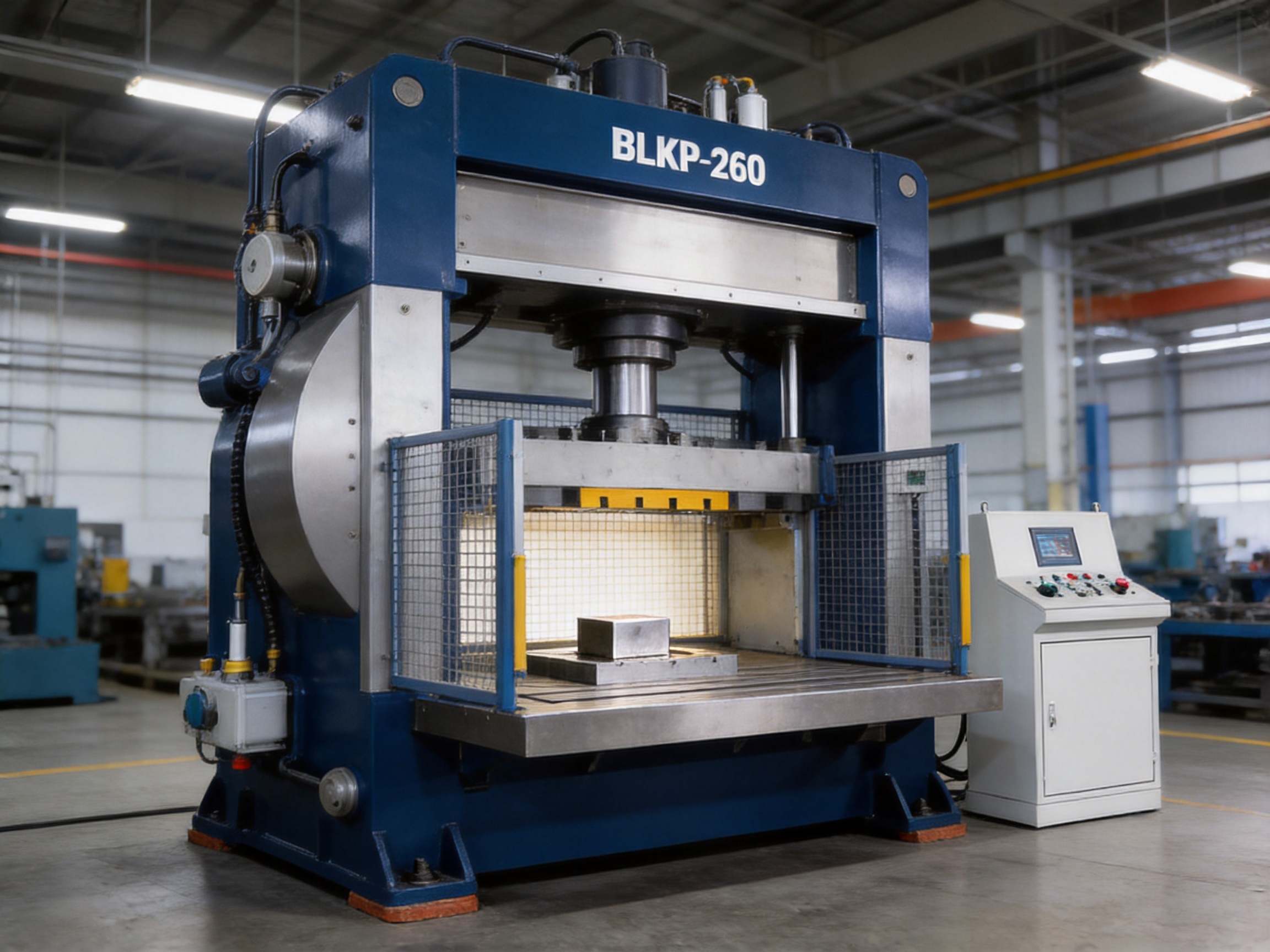
Cold forging presses operate under repeated mechanical stress. Reliability depends not only on maximum capacity but also on the consistency of the load path, the quality of bearings and guides, the effectiveness of lubrication, the rigidity of the structure, and the discipline of preventive maintenance.
The BLKP-260 is designed for high-intensity industrial use, and its toggle mechanism is intended to manage the forming motion in a controlled way. When operated within the specified capacity and maintained according to the manufacturer’s recommendations, the press can provide a stable foundation for long-term production.
Machine service life is also influenced by process conditions. Excessive off-center loading, unsuitable die height, inadequate lubrication, incorrect blank size, poor alignment, or frequent overload can reduce the life of even a well-built press. Operators should therefore treat machine setup, tooling design, lubrication, and inspection as parts of one reliability program.
The company provides customer-oriented service covering pre-sales consultation, in-sales support, and after-sales assistance. This type of service is valuable when selecting a press because the most suitable model depends on more than nominal force. Application review should include the material, blank dimensions, forming sequence, target output, die structure, automation plan, and quality requirements.
The BLKP-260 can be used as a stand-alone machine or integrated into a broader manufacturing cell. A typical line may include a material preparation system, blank feeder, lubrication unit, press, die, part ejection mechanism, inspection station, and collection equipment.
Automation can improve cycle consistency and reduce manual handling. It may also support safer production by keeping operators away from the die area during routine operation. The PLC provides a foundation for coordinating the press with external devices, although the complete automation strategy must be engineered for the specific product and workplace.
For manufacturers producing several part families, programmable speed and die-height monitoring can support faster changeovers. A documented setup procedure can include die height, speed, lubrication timing, ejection timing, feeder position, and inspection criteria. Recording these parameters helps reduce dependence on individual operator memory.
Data collection can also be added to a production system where required. Cycle counts, alarm history, downtime causes, maintenance records, and quality results can support continuous improvement. The press itself is one part of a larger manufacturing system, and its value increases when mechanical capability is matched with disciplined production management.
A power press must be installed, commissioned, and operated in accordance with applicable occupational safety regulations. Appropriate guarding, emergency stops, interlocks, die-area protection, lockout procedures, and operator training are essential.
Before production begins, the user should verify the foundation, leveling, electrical supply, compressed-air quality and pressure, grounding, lubrication, and access clearances. The 0.55 MPa air-pressure specification should be matched by a suitable plant-air system capable of providing stable pressure under operating conditions.
Die installation should be performed with lifting equipment rated for the tool weight. For the BLKP-260, the listed maximum upper-die weight is 500 kg. The lifting method must account for the actual center of gravity and approved lifting points rather than relying only on the nominal weight.
Operators should be trained to recognize abnormal noise, vibration, die movement, changes in forming force, incomplete ejection, oil or air leakage, and repeated dimensional defects. Early detection can prevent equipment damage and reduce unplanned downtime.
Preventive maintenance should include regular inspection of toggle links, pins, bearings, slide guides, die-height adjustment components, ejection mechanisms, fasteners, lubrication points, and pneumatic elements. The frequency should be determined by operating hours, load conditions, environment, and manufacturer guidance.
Lubrication is particularly important in high-load forming equipment. The correct lubricant, quantity, and application interval should be used. Excess lubricant can attract contamination, while insufficient lubrication may increase friction and heat. Maintenance personnel should maintain clear records of lubrication and component replacement.
Die-support surfaces should be kept clean and free from scale, chips, and foreign material. Even a small particle under a die can affect parallelism and create uneven loading. Before each die change, the mounting surfaces and alignment features should be inspected.
Electrical cabinets and sensors should be protected from dust, moisture, and excessive temperature. PLC programs and configuration data should be backed up according to the site’s maintenance policy. A planned spare-parts inventory for wear components, sensors, seals, and electrical protection devices can reduce recovery time after a fault.
The economic value of a cold forging press is determined by the total production result rather than purchase price alone. Material savings, cycle time, tool life, labor requirements, energy consumption, maintenance, scrap rate, and product quality all influence the cost per part.
The BLKP-260 contributes to this equation through controlled forming, variable speed, substantial capacity, and support for repeatable setup. The toggle mechanism may reduce unnecessary impact during the critical forming stage, while the precision die-height indicator helps operators maintain consistent conditions.
Cold forging can also reduce downstream machining. When the forged shape is close to the final geometry, fewer turning, milling, drilling, or finishing operations may be needed. This can shorten the manufacturing route and reduce work-in-process inventory.
For high-volume products, even a small improvement in material utilization or cycle stability can produce significant annual savings. Manufacturers should calculate the expected return using actual blank cost, production volume, part weight, scrap rate, tool cost, labor, and secondary processing requirements.
When evaluating the BLKP-260, buyers should begin by defining the product and process requirements. Important information includes material grade, blank size, finished dimensions, forming stages, required force, target production volume, dimensional tolerances, surface requirements, and expected cycle time.
The die package should be reviewed at the same time as the press. The maximum die height, 15 mm adjustment range, upper-die weight, table dimensions, slide bottom dimensions, lower ejection capacity, and required clearances must all be compatible with the proposed tool.
Buyers should also clarify whether the application requires automatic feeding, part detection, lubrication, transfer, special guarding, remote diagnostics, additional sensors, or customized control functions. These requirements can influence the final machine configuration and delivery schedule.
Factory acceptance testing should be based on an agreed checklist. The checklist may include empty cycling, rated-speed operation, die-height indication, control functions, safety devices, ejection movement, pneumatic pressure, noise, vibration, and sample-part production when appropriate.
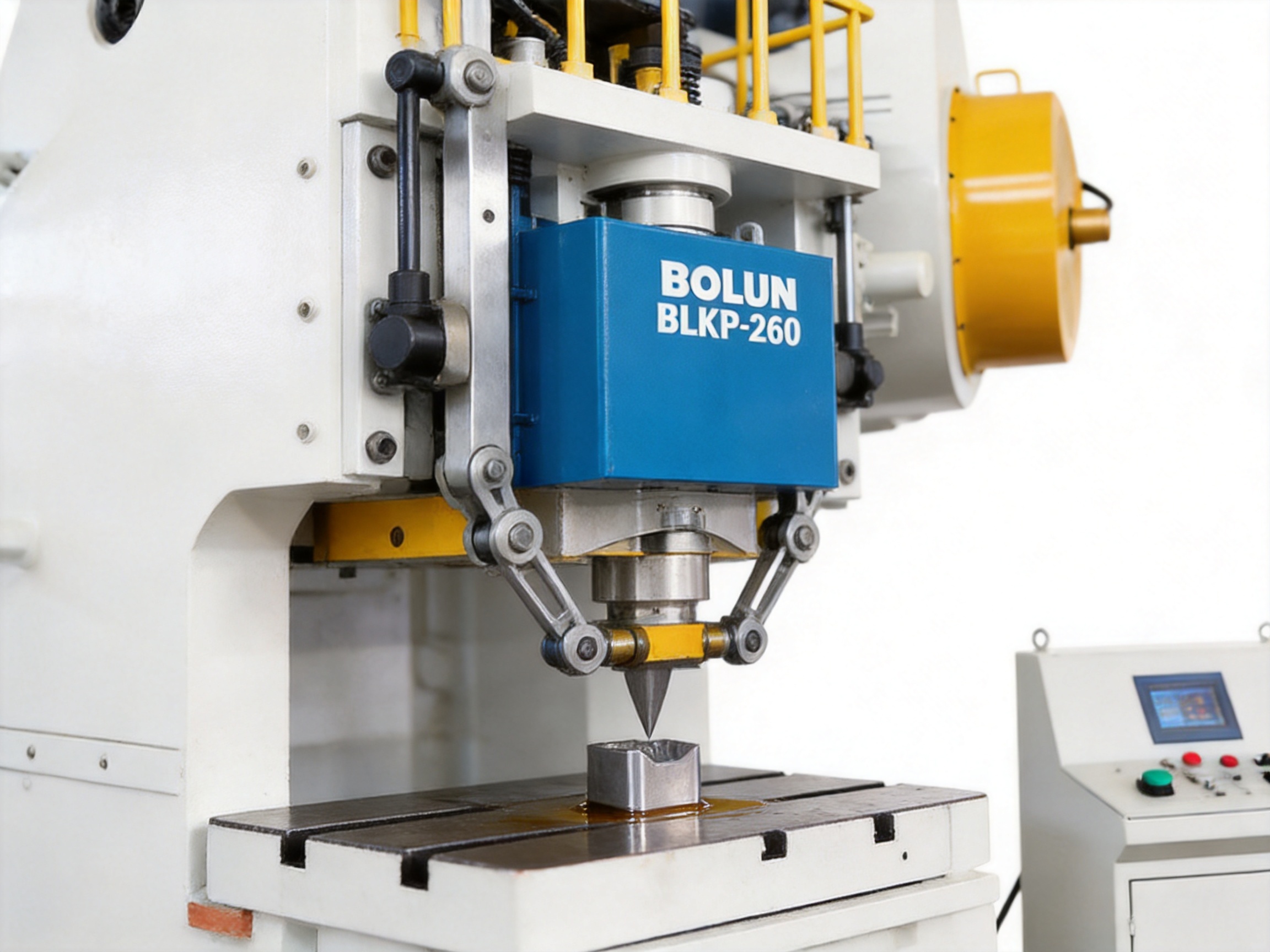
The BLKP-260 is a toggle-type power press designed for precision cold forging and related metal-forming operations. It has a nominal capacity of 2600 kN and is intended for applications requiring controlled forming near bottom dead center.
The toggle mechanism reduces slide speed near bottom dead center while increasing mechanical advantage in the final forming stage. This can support controlled material flow, stable forming, reduced impact, and improved repeatability for small precision components.
The product description identifies variable-speed operation up to 50 strokes per minute. The listed standard specification for the BLKP-260 is 40 strokes per minute. The actual permissible speed should be confirmed for the final machine configuration and selected according to material, die design, lubrication, automation, and process requirements.
The slide stroke is 120 mm. This provides movement for die clearance, loading, forming, ejection, and part removal, subject to the specific tooling arrangement.
The worktable measures 500 × 600 × 100 mm. The slide bottom size is 400 × 420 mm, and both dimensions should be considered when designing or selecting a die.
Yes. The machine is described as having a digital die-height indicator with 0.1 mm accuracy. This supports setup verification, changeover repeatability, and monitoring of tooling position.
The BLKP-260 uses a PLC control system. The PLC can manage operating logic and coordinate selected machine functions, safety signals, speed settings, ejection, lubrication, and auxiliary equipment according to the configured system.
The listed mold pad capacity is 100 kN, with a ram stroke of 50 mm. The lower ejection arrangement must be matched to the die and workpiece design.
The press may be suitable for materials commonly used in cold forging, including selected steels, stainless steels, copper alloys, brass, and aluminum alloys. Material suitability depends on strength, ductility, blank dimensions, lubrication, tooling, forming ratio, and process design. Trial forming and engineering review are recommended before production approval.
The manufacturer provides non-standard design and manufacturing services. Possible customization areas may include tooling support, feeding, ejection, sensors, guarding, control functions, working dimensions, and integration with production-line equipment. Custom requirements should be reviewed during the quotation and technical-confirmation stages.
Cold forging displaces material inside a die rather than removing large quantities as chips. It can therefore improve material utilization, reduce waste, preserve favorable grain flow, and reduce secondary machining for suitable component geometries.
Yes, it can serve as the core press in an automated or semi-automated production cell. The suitability of a particular automation arrangement depends on blank feeding, part transfer, ejection, lubrication, die design, safety systems, and the communication requirements of the complete line.
The BLKP-260 Agile Precision Cold Forging Toggle Type Power Press is designed for manufacturers that require a combination of high forming force, controlled motion, production flexibility, and precision setup. Its 2600 kN nominal capacity supports demanding cold forging applications, while the toggle linkage concentrates controlled mechanical advantage near the most important part of the stroke.
With a 120 mm slide stroke, a 500 × 600 mm worktable, variable-speed capability, digital die-height indication, PLC control, 100 kN mold pad capacity, and a 50 mm lower ram stroke, the machine is equipped for a broad range of small-part forming applications. Its configuration is particularly relevant to electronics hardware, small industrial hardware, precision metal components, and other products where dimensional consistency and efficient material utilization are important.
The machine’s competitiveness also depends on the manufacturing strengths behind it. Integrated design, precision component machining, controlled assembly, electrical integration, final inspection, customization capability, and customer service all contribute to the practical value of a forming press. When combined with suitable tooling, correct lubrication, preventive maintenance, and disciplined process control, the BLKP-260 can provide a reliable platform for efficient and repeatable cold forging production.
1. Manufacturer-provided BLKP-260 product description and technical specification data.
2. Manufacturer-provided cold forging toggle-type power press series information.
3. General principles of mechanical power press design, forming force, slide motion, and die-height adjustment.
4. General cold forging process engineering practices for material flow, lubrication, tooling, and dimensional control.
5. General industrial guidance for power press guarding, preventive maintenance, operator training, and production-line safety.
6. General manufacturing engineering references concerning near-net-shape forming, material utilization, and secondary machining reduction.


A production manager at a mid-size metal component plant recently faced a probl...
A fastener plant in Taizhou receives a request from an automotive tier-one supp...
A buyer comparing a 45-ton open-gap press for a bracket line often receives two...
Two presses can both carry a 200-tonne nameplate and still produce very differe...
What Is a Power Press? A power press — also called a stamping press or punch pr...
Power press machines are classified in two main ways: by frame construction, w...
Contact Us

topbolun@gmail.com

+86-575-83362228

+86-13735238388
+86-18667502750

+86-575-83362999

+8618667502750

No.1 Linjiang Road East, Xiaren, Jinting Town, Shengzhou City, Zhejiang Province, China
Ready to Begin?
Get in Touch

Now!

ZHEJIANG BOLUN
 English
 中文简体