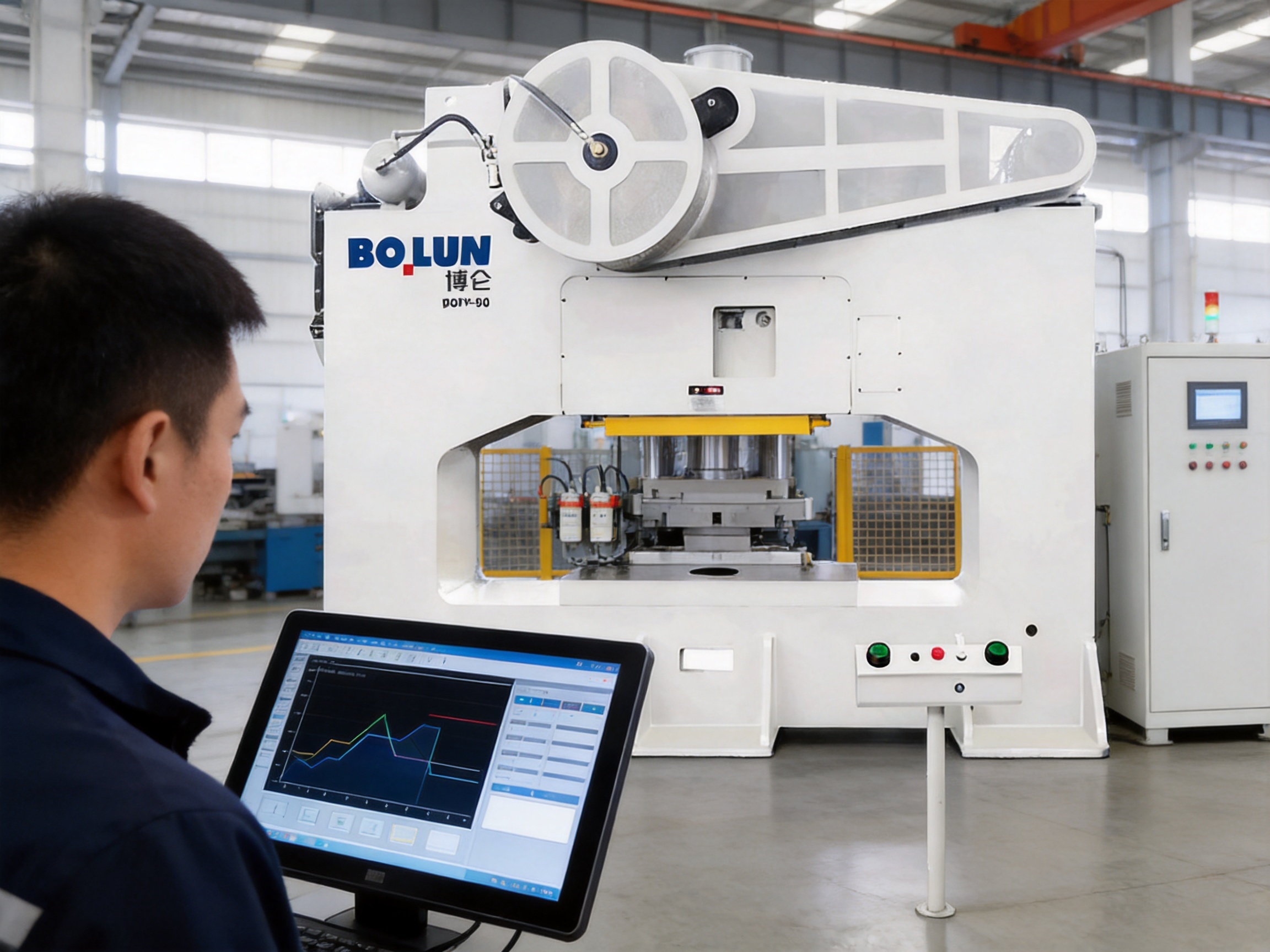
Modern metal-forming operations require more than a machine that can simply deliver high force. Manufacturers need equipment that combines structural rigidity, controllable motion, dependable safety, flexible die installation, efficient production, and straightforward integration with automation. The BLPY-90 flexible closed-type single-point wide-door power press is designed to meet these requirements in demanding industrial environments where precision, accessibility, and productivity must work together.
With a nominal capacity of 900 kN, the BLPY-90 is suitable for a broad range of stamping, forming, blanking, bending, and shallow-drawing applications. Its closed-type construction supports stable force transmission and helps reduce deformation during operation. At the same time, its wide-door configuration creates an exceptionally open working area between the uprights. This design is especially valuable for large or irregularly shaped workpieces, oversized dies, multi-station tooling, and production lines that use mechanical transfer systems, robots, conveyors, or other peripheral equipment.
The press is developed for manufacturers that require a balance between robust performance and production flexibility. Instead of limiting the operator to a narrow die-loading area, the wide-door structure provides improved access to the table and slide. This can simplify die installation, maintenance, inspection, and material handling. For plants that frequently change products or operate multiple tooling configurations, this accessibility can contribute directly to shorter setup times and better equipment utilization.
The machine also incorporates a programmable logic controller and touch-screen interface. These control technologies enable operators to manage essential production functions through a centralized and intuitive operating system. A responsive dry-type clutch-brake unit and high-efficiency dual solenoid valve support accurate slide control, dependable stopping, and stable production cycling. Together, these features make the BLPY-90 a practical solution for precision stamping lines that require both repeatability and adaptable operation.
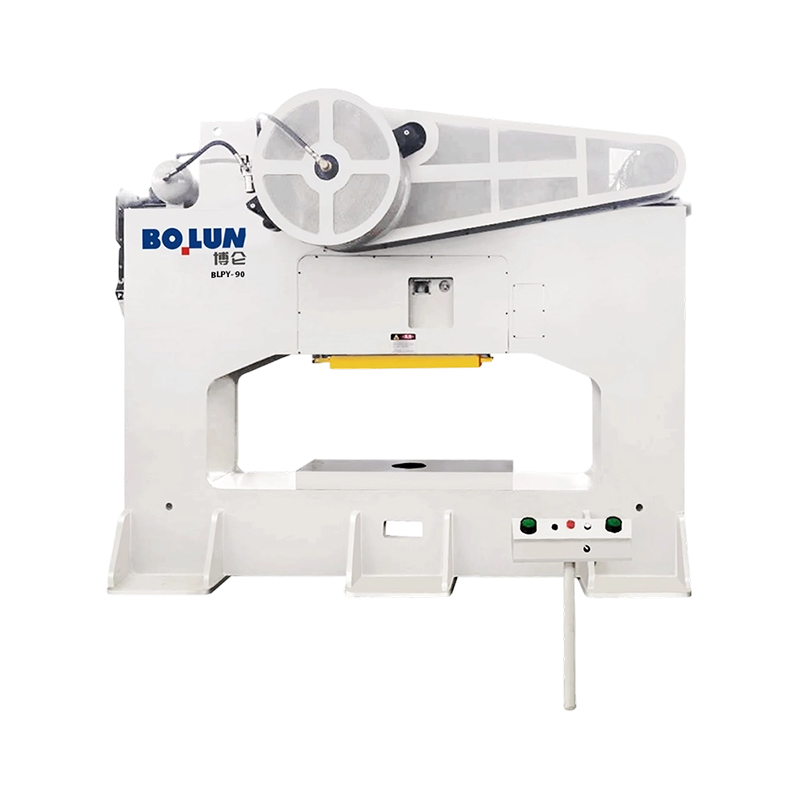
BLPY-90 Flexible Closed-Type Single-Point Wide-Door Power Press
The BLPY-90 belongs to the closed-type single-point wide-door power press category. It is engineered for applications where the forming force must be applied consistently through a stable slide mechanism while the working area remains accessible for tooling and automation. The machine’s nominal capacity is 900 kN, giving it sufficient force for many medium- to heavy-duty sheet-metal operations.
A single-point press transmits slide motion through a central driving arrangement. This configuration is widely used in general stamping because it offers a direct and controllable force path. When combined with a closed frame and carefully manufactured drive components, the single-point design can support reliable slide movement and consistent forming results. It is particularly suitable for dies that are designed around a central load distribution pattern.
The closed-type structure provides an important advantage over more open press configurations. By enclosing the working structure between the side frames or uprights, the machine can achieve greater resistance to operational deflection. This helps maintain the relationship between the die, slide, and worktable during pressing. Better structural stability can contribute to improved dimensional consistency, longer die life, reduced vibration, and more predictable product quality.
The wide-door design gives the BLPY-90 a distinctive advantage over conventional closed presses with restricted access. The distance between the columns is listed as 2,600 mm for the BLPY-90 configuration. This generous opening provides room for larger dies and supports the installation of automated feeding, transfer, and unloading systems. It can also make it easier for technicians to inspect the tooling and reach critical service areas.
For manufacturers producing different components on the same machine, flexibility is often as important as rated force. A press that accommodates a wider range of dies can reduce the need for specialized equipment. The BLPY-90 is therefore positioned not only as a force-generating machine but also as a versatile production platform for evolving manufacturing requirements.
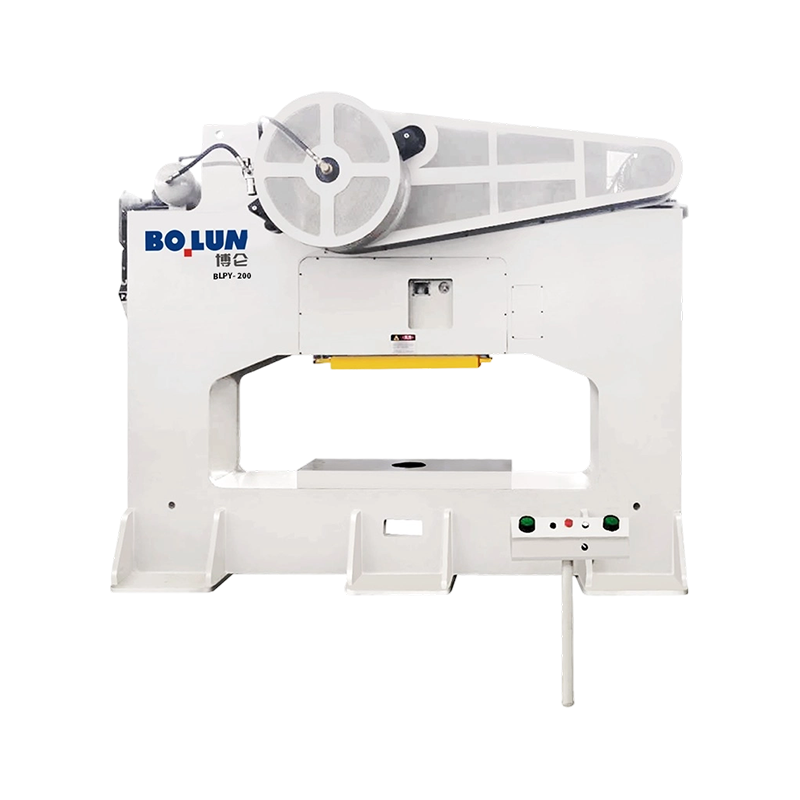
The following table summarizes the available specifications for the BLPY-90 and the related BLPY-200 configuration listed in the same product series. The BLPY-90 data is the primary reference for the product discussed in this article.
| Specification | Unit | BLPY-90 | BLPY-200 |
|---|---|---|---|
| Nominal Capacity | kN | 900 | 2000 |
| Nominal Pressure Stroke | mm | 5 | 6 |
| Slide Stroke | mm | 180 | 200 |
| Strokes per Minute | S.P.M. | 35–55 | 20–50 |
| Maximum Die Height | mm | 420 | 460 |
| Die Height Adjustment | mm | 80 | 110 |
| Worktable Size | mm | 1150 × 600 | 1300 × 850 |
| Slide Bottom Size | mm | 1000 × 470 | 1130 × 630 |
| Distance Between Columns | mm | 2600 | 2950 |
| Height of Working Face | mm | 685 | 1045 |
| Main Motor | kW × pole | 11 × 4 | 18.5 × 4 |
| Press Precision Classification | Standard | GB/JIS Class 1 | GB/JIS Class 1 |
The 900 kN nominal capacity provides a useful operating range for industrial stamping applications. The nominal pressure stroke is specified at 5 mm, while the slide stroke is 180 mm. These values are important when selecting dies because they influence the available forming travel, working position, and production method. The machine should always be matched to the actual force, energy, stroke, speed, and die requirements of the intended process.
The stated slide speed range of 35 to 55 strokes per minute offers a balance between production output and process control. Higher speeds may be appropriate for repetitive blanking or shallow forming operations, while lower speeds can be selected for applications that require more careful material movement, feeding, or monitoring. The suitable operating speed depends on the material, tooling design, forming depth, lubrication, feed system, and quality requirements.
The maximum die height is 420 mm, with 80 mm of die-height adjustment. This adjustment range gives users flexibility when setting different tools and compensating for tooling variations. Proper die-height adjustment is essential for obtaining the correct forming position and ensuring that the press operates within its recommended mechanical conditions.
The worktable measures 1,150 mm by 600 mm, while the slide bottom measures 1,000 mm by 470 mm. These dimensions help manufacturers evaluate die compatibility before installation. The table and slide surfaces provide a stable interface for tooling, while the wide opening between the columns creates additional clearance for tooling access and automated equipment.
The main motor is rated at 11 kW with a four-pole configuration. Motor selection is coordinated with the press drive and intended operating characteristics. A properly sized drive system can support stable cycling, effective energy use, and dependable operation under the required production load.
The most recognizable advantage of the BLPY-90 is its wide-door architecture. In many conventional presses, the space between the uprights can limit the size of dies, transfer devices, or workpieces that can be installed. Restricted openings can also make maintenance more difficult because operators and technicians have less room to access the die area.
The wide-door structure addresses these limitations by creating a substantially open working zone. This open configuration is beneficial when dies are wide, when the material path requires side access, or when the production line includes feeders and transfer systems. It also provides more freedom when planning the layout of auxiliary devices around the press.
Die installation can become more efficient when the operator has improved visibility and physical access. Technicians can position lifting equipment, align the tool, inspect bolting areas, and connect auxiliary devices with fewer obstructions. The ability to approach the die from a more open direction can reduce setup complexity and help prevent accidental interference during installation.
Accessibility is also important for cleaning and maintenance. Stamping operations may generate scrap, lubricants, metal particles, and other residues. A more open working area can make it easier to remove debris, inspect the die, check fasteners, and verify the condition of guide components. These activities support consistent production and can reduce the risk of avoidable downtime.
The wide-door design does not mean that the machine sacrifices the benefits of a closed-type press. Instead, it combines an enclosed, stable structural concept with a larger functional opening. This combination is one of the principal reasons the product can compete effectively with narrower machines in applications that require both rigidity and accessibility.
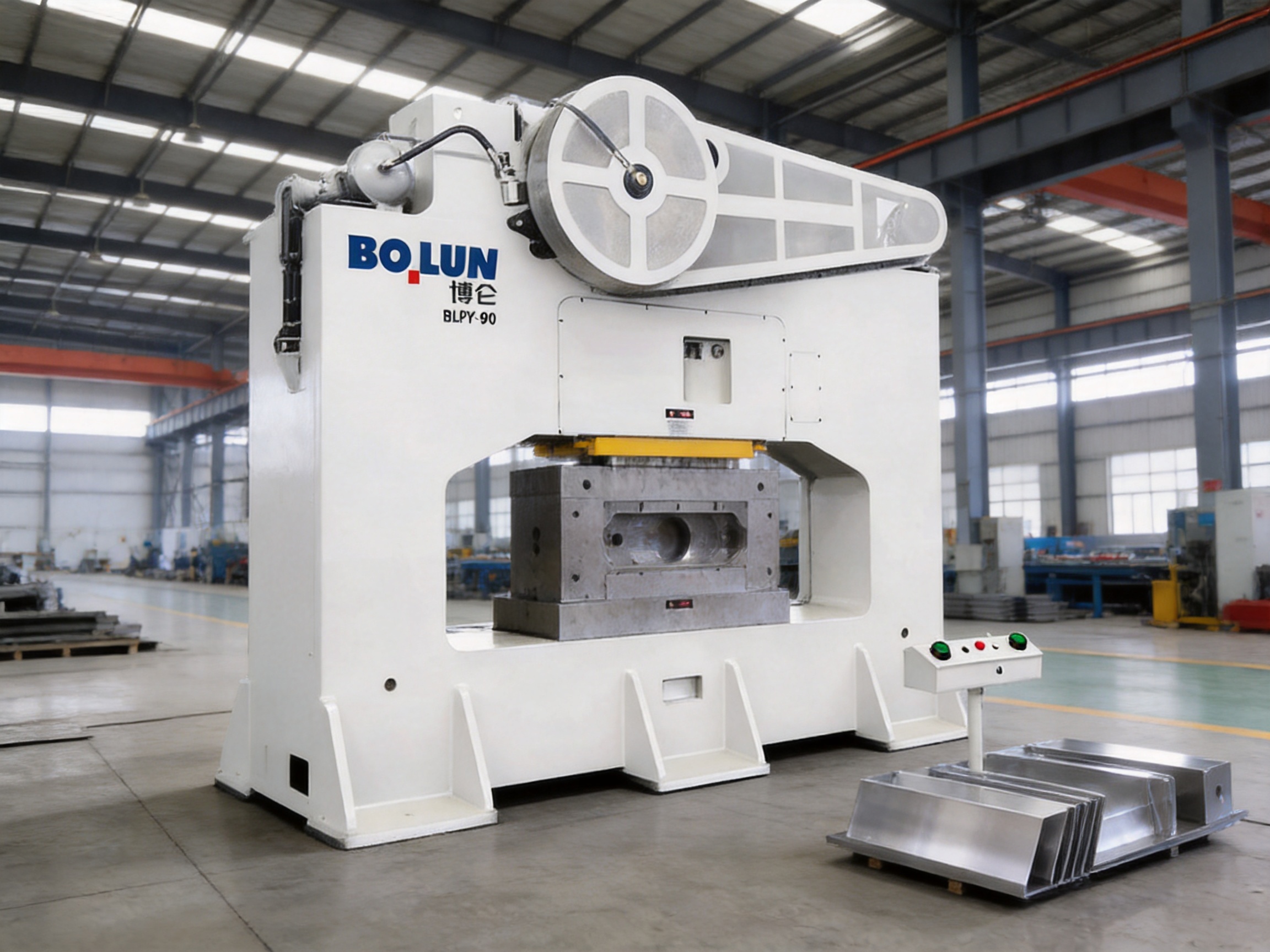
Precision stamping depends on the ability of the press to maintain stable relationships between the slide, die, table, and workpiece. Even small deviations can influence part dimensions, edge quality, forming uniformity, and tool wear. For this reason, structural strength and manufacturing accuracy are central factors when evaluating a power press.
The BLPY-90 uses a closed-type press structure classified according to GB/JIS Class 1 in the supplied specifications. This classification indicates a precision-oriented design and manufacturing approach. The practical result for users is a machine platform intended to support repeatable operation when correctly installed, adjusted, loaded, and maintained.
A stable frame helps absorb the forces generated during forming. When the structure resists excessive deflection, the tooling can operate under more consistent alignment conditions. This is particularly important when the press is used for progressive dies, compound dies, precision blanking, or products with close dimensional tolerances.
The machine’s nominal pressure point is specified at a short stroke distance of 5 mm. This type of rating allows users to understand where the press delivers its nominal forming force within the stroke cycle. Engineers should consider the force curve of the actual forming process rather than relying only on the nominal capacity. Correct process planning helps prevent overload and improves the service life of both the press and the die.
Precision is also affected by the condition of the clutch-brake system, the quality of slide adjustment, the flatness and alignment of the die, the stability of the foundation, and the consistency of the material feed. The BLPY-90’s control and drive systems are designed to support these requirements, but overall performance remains dependent on proper application engineering and regular maintenance.
Compared with less rigid or less precisely manufactured machines, a precision closed-type press can offer more consistent production conditions. This may reduce the frequency of dimensional corrections, tooling adjustments, and rejected parts. It can also allow manufacturers to pursue more demanding applications that would be difficult to control on a lower-quality machine.
The BLPY-90 is equipped with a programmable logic controller integrated with a touch-screen interface. This combination provides a modern operating platform for managing press functions and production parameters. The PLC can coordinate signals from the machine’s operating controls, clutch-brake system, sensors, protective devices, and peripheral equipment.
A touch-screen interface improves access to machine information. Operators can view operating conditions, select operating modes, monitor production parameters, and respond to prompts through a centralized display. A well-organized interface can reduce the time required to identify machine status and can support consistent operating procedures across different shifts.
PLC-based control also creates opportunities for automation integration. A press line may include a decoiler, straightener, servo feeder, transfer unit, robot, inspection system, scrap conveyor, or part-removal device. These systems must exchange signals in a coordinated sequence. The programmable control architecture helps provide the communication and interlocking functions required for safe and repeatable operation.
Control flexibility is valuable when manufacturers produce multiple products. Different dies may require different speeds, timing arrangements, feed intervals, or operating modes. Subject to the machine’s approved operating parameters, programmable control can make it easier to configure the press for different production tasks without extensive mechanical changes.
The interface can also support troubleshooting. When a machine stops because of a safety condition, sensor signal, or control issue, clear status information can help maintenance personnel locate the cause more efficiently. Faster diagnosis can reduce downtime and improve the effectiveness of preventive maintenance programs.
Although digital control offers significant advantages, operators still require appropriate training. The touch screen should be used according to approved procedures, and all safety circuits must remain active. Control convenience should never replace proper guarding, lockout procedures, die-setting practices, and operator awareness.
The clutch-brake unit is one of the most important functional assemblies in a mechanical power press. It controls the connection between the drive system and the slide, allowing the machine to start, stop, and cycle in a controlled manner. The BLPY-90 uses a highly responsive dry-type clutch-brake unit designed to support precise slide movement and stopping.
Fast response is valuable in production because the slide must begin and end its movement at predictable points. Accurate stopping helps protect dies, maintain production timing, and support safe operating procedures. It also contributes to consistent part quality when the forming process depends on a defined slide position.
A dry-type design can offer practical maintenance benefits when correctly specified and serviced. It avoids the need for a liquid operating medium within the friction interface and can provide a clean, responsive transmission arrangement. As with any clutch-brake system, performance depends on correct adjustment, inspection, ventilation, friction-surface condition, and compliance with the manufacturer’s maintenance schedule.
The dual solenoid valve is another important element in the press control system. High-efficiency valve operation supports reliable control of the clutch-brake circuit. A dual-valve arrangement can provide monitoring and redundancy functions suitable for industrial press applications, depending on the exact safety architecture and configuration supplied with the machine.
Stable braking performance is especially important when a press is used with automated feeding or transfer equipment. The press and the peripheral device must remain synchronized. Unpredictable stopping or excessive variation in slide position can disturb the material path, damage the die, or create production interruptions. The responsive clutch-brake and programmable control system work together to support this synchronization.
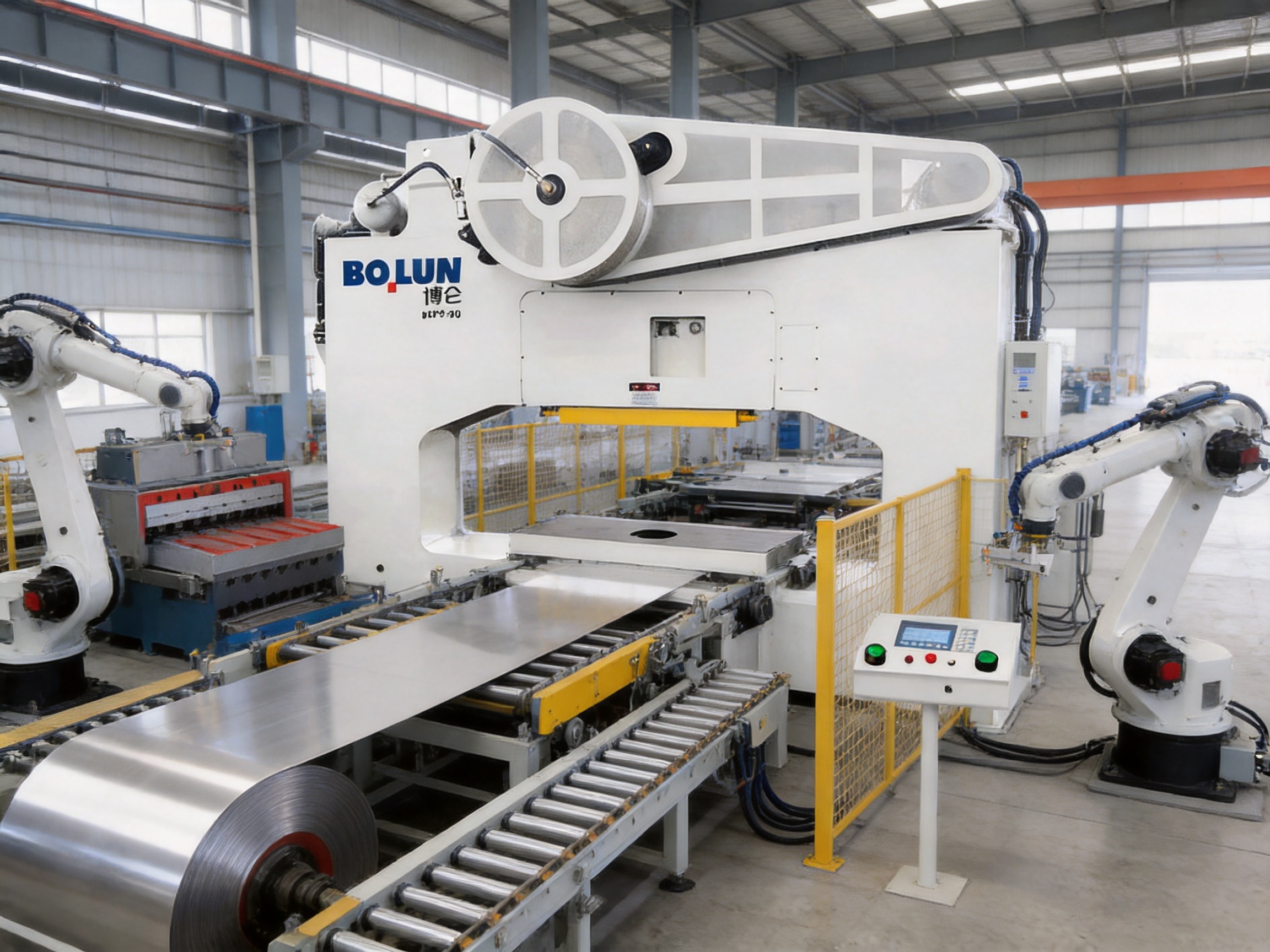
The BLPY-90 is designed with automation compatibility in mind. Its wide working opening gives production engineers more freedom to add peripheral equipment without creating unnecessary interference around the press. This is a major advantage for manufacturers seeking to improve labor efficiency, production consistency, and workplace organization.
A coil-fed line may connect the press with a decoiler, straightener, servo feeder, and scrap-handling system. In this arrangement, the press must receive material at precisely controlled intervals. The PLC can coordinate the press cycle with feed signals and permissive conditions, while the touch-screen interface can provide an accessible means of monitoring the operating status.
For larger components or more complex forming sequences, the press may be combined with a transfer system or industrial robot. The wide-door layout can provide the physical clearance required for grippers, transfer bars, sensors, and part-positioning equipment. This arrangement can reduce manual handling and support a more continuous production flow.
Automation can also improve product consistency. Manual loading and unloading may introduce variations in placement, orientation, and cycle timing. A properly engineered automated system can deliver repeatable material positioning and reduce the risk of operator fatigue. The result may be improved process stability, especially during long production runs.
However, integration must be planned carefully. The press, tooling, feeder, robot, and safety system must be evaluated as a complete production cell. Timing, interface signals, emergency-stop functions, guarding, access doors, light curtains, and maintenance modes must be coordinated. Before commissioning, the entire line should be tested at low speed and under controlled conditions.
The wide-door press can also support semi-automated production. Some manufacturers may prefer manual die loading with automated feeding, or manual unloading with a controlled press cycle. The machine’s flexibility allows users to choose an automation level that reflects their production volume, product mix, workforce, and investment plan.
The BLPY-90 can be considered for a variety of industrial forming applications. Its 900 kN capacity and 180 mm slide stroke make it suitable for many medium-sized sheet-metal components. The exact suitability depends on the material type, thickness, tensile strength, forming depth, die design, required production rate, and actual force curve.
Automotive component production is one potential field of application. Brackets, reinforcements, interior structural parts, covers, and other stamped components may benefit from the press’s stable working structure and wide tool access. Automotive production often requires repeatability, automation compatibility, and rapid die changes, making these product characteristics especially relevant.
The machine may also be used in electrical and electronic equipment manufacturing. Enclosures, panels, mounting parts, covers, and support components often require controlled blanking, bending, or shallow forming. The touch-screen control system and repeatable slide operation can help manufacturers maintain consistent dimensions across large batches.
Appliance manufacturing is another possible application area. Metal panels, brackets, hinges, internal supports, and reinforcement parts may require a combination of forming accuracy and efficient production. The wide-door configuration can simplify the handling of relatively broad dies and support automated material flow.
Industrial equipment manufacturers can use the press for components such as machine guards, mounting plates, structural brackets, housings, and reinforcement members. Because product designs may change frequently in industrial equipment production, a flexible machine platform can be more useful than a press optimized for only one dedicated part.
Hardware and general metal-product manufacturers may also benefit from the equipment. Applications can include blanking, bending, embossing, forming, and other operations that fall within the press’s capacity and tooling conditions. Before production begins, the user should confirm that the required tonnage, energy, speed, shut height, die dimensions, and material-feed method are suitable.
One of the principal competitive advantages of the BLPY-90 is the combination of a closed structure and a wide working opening. A narrow conventional press may provide sufficient force but restrict die access and automation space. An open-frame machine may provide accessibility but offer less structural stability for certain high-load applications. The wide-door closed-type concept seeks to combine the strengths of both approaches.
The second advantage is production flexibility. A machine that can accept broader tooling and a wider range of peripheral equipment can remain useful as product requirements change. This can reduce the pressure to purchase separate machines for every product family. It may also allow manufacturers to reorganize production lines more easily when demand changes.
The third advantage is control integration. Some older presses rely on limited relay controls or basic manual operation. The BLPY-90’s PLC and touch-screen interface provide a more adaptable foundation for modern production management. The system can support clearer operating procedures, improved monitoring, and more convenient connection with automated equipment.
The fourth advantage is slide stopping and cycling performance. The responsive dry-type clutch-brake unit and dual solenoid valve are intended to provide precise movement control. This can be valuable for processes where the slide position, stopping response, and cycle timing influence product quality and tooling safety.
The fifth advantage is the company’s ability to combine standardized machine platforms with non-standard customization. A manufacturer may require special feeding equipment, modified table arrangements, particular automation interfaces, or other production-specific functions. A supplier with internal engineering, manufacturing, assembly, and service capabilities is better positioned to address these requirements than a company that only resells standard equipment.
Competitive value should not be judged by purchase price alone. Total cost of ownership includes installation, commissioning, energy consumption, die-change time, maintenance, spare parts, training, downtime, product quality, and service response. The BLPY-90’s design features can contribute to value across these areas when the machine is correctly selected and integrated.
The manufacturer behind the product is Zhejiang Bolun High-Precision Machinery Co., Ltd., a machinery enterprise based in Zhejiang, China. The company has approximately two decades of experience in machinery manufacturing and focuses on high-precision forming equipment. Its activities cover research and development, product design, production, sales, and service.
This integrated structure is important for power press production. A press is not a simple collection of purchased components. Its performance depends on the relationship between the frame, drive system, slide, table, clutch-brake, control cabinet, safety functions, lubrication system, and finishing processes. When these stages are managed within a coordinated manufacturing system, the supplier can exercise stronger control over product consistency.
The company operates with a full-chain production concept that covers basic design, core component development, precision processing, assembly, testing, and final delivery. Advanced machining resources support the production of accurately manufactured components. Precision processing is particularly important for guide surfaces, mounting interfaces, drive components, and structural connections that influence the final press performance.
Engineering capability is another important strength. Different industries have different forming requirements. Some customers need a standard press for a common die, while others require modifications for a special component, automated line, unusual material, or non-standard production sequence. The company’s design team provides non-standard customization and one-stop design and manufacturing services to address these needs.
The company also emphasizes international production management practices while maintaining a manufacturing base in China. This combination can help it serve customers with different technical expectations, documentation requirements, and quality procedures. A global industrial customer typically needs more than equipment delivery; it also needs technical communication, installation support, operating guidance, and long-term service.
The company’s approach is based on technological development and a “Technology First” strategy. Investment in design, processing, assembly, intelligent equipment, and digital production can improve the quality and competitiveness of the final press. For customers, these capabilities create confidence that the machine is supported by an established industrial organization rather than assembled without a comprehensive engineering system.
Quality assurance is essential for any power press because the machine must operate under repeated high mechanical loads. The manufacturer describes quality as a central part of its production philosophy and maintains a finished-product inspection system intended to exceed basic industry requirements.
Inspection should begin with individual components and continue through assembly and final testing. Structural parts must be checked for dimensions, interfaces, and finish. Drive and transmission components require appropriate verification of fit, alignment, and operating condition. Electrical and control systems should be tested for correct signal response, operating logic, and safety functions.
Final press inspection should include operational cycling, slide movement, clutch-brake response, control-system performance, and relevant precision checks. The purpose is to identify issues before shipment and confirm that the completed machine performs as intended. Consistent inspection also provides a foundation for customer acceptance and future service reference.
The GB/JIS Class 1 precision classification stated for the product series indicates that dimensional and operational accuracy is treated as a significant design objective. Nevertheless, machine accuracy at the customer’s facility also depends on transportation, foundation conditions, leveling, installation, die alignment, lubrication, and operating practices. A precision machine must be installed and maintained as a precision system.
Quality control also has a direct relationship with service life. Components that are correctly manufactured and assembled can reduce premature wear, unexpected vibration, and repeated adjustment. Stable quality helps manufacturers plan maintenance rather than responding only to emergency breakdowns.
Industrial customers often evaluate a press supplier according to the support available before and after purchase. The manufacturer provides a customer-oriented service system covering pre-sales consultation, in-sales support, and after-sales guarantees. This broad support model is important because press selection is closely connected with tooling, material flow, automation, and factory layout.
During the pre-sales stage, technical consultation can help determine whether the BLPY-90 is suitable for the intended application. Important questions include the material grade, thickness range, maximum blank size, forming method, production speed, die weight, die dimensions, automation plan, and required safety functions. Early technical evaluation reduces the risk of selecting a machine that is either insufficient or unnecessarily oversized.
During project implementation, the supplier may support layout planning, machine configuration, interface definition, installation coordination, and commissioning. When a press is integrated into an automated line, communication between the press supplier, die maker, automation provider, and end user is particularly important.
After installation, operators and maintenance personnel need clear guidance on machine operation, lubrication, inspection, die setting, fault response, and safe working procedures. Training can help users obtain better productivity while protecting the equipment and the workforce.
Customization is another important support capability. Special product requirements may involve table modifications, automation interfaces, control adaptations, die-handling provisions, material-feed arrangements, or other mechanical and electrical changes. Customization should be based on a documented technical specification so that the effects on capacity, speed, safety, and maintenance are fully understood.
A long-term service relationship can also support spare-parts planning and preventive maintenance. Properly maintained clutch-brake components, valves, sensors, drive parts, lubrication systems, and control devices can help preserve the machine’s performance over many years of production.
Before installation, the user should confirm that the factory floor, foundation, access routes, lifting equipment, electrical supply, ventilation, and working clearances meet the machine’s requirements. The wide-door structure provides valuable working access, but sufficient space must still be reserved around the press for die handling, maintenance, material flow, and safe operator movement.
Foundation preparation is especially important for precision equipment. The press should be positioned on a stable foundation and leveled according to the manufacturer’s instructions. Incorrect leveling can affect slide movement, die alignment, vibration, and long-term wear. After installation, the machine should be inspected and tested before full-speed production begins.
Die selection and installation must remain within the specified worktable, slide, die-height, and load limits. The die should be securely mounted, correctly aligned, and checked for interference throughout the entire slide movement. Operators should confirm that the die does not exceed the permitted dimensions or create an unbalanced loading condition.
Production speed should be selected according to the material and forming process rather than simply using the highest available rate. A slower speed may be appropriate during setup, for deep or complex forming, or when material handling requires additional time. Once stable operation has been confirmed, the speed can be optimized for productivity and quality.
Routine maintenance should include inspection of the clutch-brake system, lubrication points, fasteners, electrical connections, sensors, valves, slide guides, and safety devices. Any unusual noise, vibration, heat, stopping behavior, or change in product quality should be investigated promptly.
Safety procedures must be established for normal operation, die setting, troubleshooting, cleaning, and maintenance. Guards and interlocks should not be bypassed. Lockout and isolation procedures should be followed whenever personnel enter hazardous areas or work on the machine.
A power press creates value through the parts it produces, not only through its rated capacity. The BLPY-90 can support productivity by combining an appropriate force range with flexible tooling access, programmable operation, and automation compatibility. These features can help manufacturers reduce setup delays and maintain more consistent cycles.
Wide-door access may reduce the time required for die changes and maintenance interventions. When technicians can reach the working area more easily, activities such as tool positioning, inspection, cleaning, and adjustment may be completed more efficiently. Over many production cycles, small time savings can create a meaningful increase in annual equipment utilization.
Automation integration can reduce manual handling and help maintain consistent cycle timing. This may improve labor productivity and reduce the risk of handling-related damage. It can also support safer production by separating personnel from repetitive loading and unloading tasks when the complete cell is properly guarded.
Precision and repeatability may reduce scrap and rework. Every rejected part represents material cost, processing time, energy consumption, and lost capacity. A stable press, accurate die, reliable feeding system, and disciplined process-control program can work together to improve first-pass yield.
Maintenance costs should also be considered. Durable structural construction, accessible service areas, dependable control components, and an organized spare-parts strategy can help reduce unplanned downtime. The actual result depends on operating conditions and maintenance discipline, but these design and support factors are important when comparing competing presses.
Energy use is influenced by the motor, operating speed, duty cycle, material process, and production schedule. Efficient production planning can help ensure that the press is used at an appropriate rate and that idle time is minimized. Selecting a press with the correct capacity is generally preferable to operating a significantly oversized machine for applications that do not require its full capability.
Manufacturers considering the BLPY-90 should begin by defining the complete production requirement. The required nominal force is only one factor. The evaluation should include material properties, sheet thickness, blank dimensions, forming depth, tooling dimensions, die weight, required speed, production volume, and the intended automation level.
The die should be checked against the worktable size of 1,150 mm by 600 mm, the slide bottom size of 1,000 mm by 470 mm, the maximum die height of 420 mm, and the available die-height adjustment of 80 mm. The opening between the columns should also be evaluated in relation to the die and the planned material-handling equipment.
The buyer should request confirmation of the actual force curve, allowable eccentric load, slide parallelism, table and slide accuracy, operating modes, safety functions, electrical requirements, and installation conditions. These details help ensure that the machine is technically appropriate for the application.
Where automation is planned, the specification should identify the feeder type, transfer method, robot interface, material direction, cycle signals, emergency-stop arrangement, and access protection. Early coordination reduces the possibility of costly modifications after delivery.
Finally, the customer should evaluate the supplier’s engineering resources, manufacturing capabilities, inspection procedures, documentation, training, spare-parts support, and service response. A power press is a long-term production asset, so the quality of the supplier relationship can be as important as the initial machine specifications.
The BLPY-90 has a nominal capacity of 900 kN. The nominal pressure stroke is specified as 5 mm. The actual suitability for a particular forming operation depends on the force and energy requirements of the die and material.
The wide-door design provides a large opening between the uprights. It improves access for die installation, maintenance, inspection, material handling, and automation equipment. It is especially useful for wide dies, large workpieces, and transfer or robotic systems.
Yes. The machine is designed with PLC control, a touch-screen interface, and a wide working area that can support integration with feeders, robots, transfer systems, conveyors, and other peripheral equipment. The complete line must be engineered and tested as a coordinated safety system.
The slide stroke is 180 mm. The listed operating range is 35 to 55 strokes per minute. The correct speed depends on the material, die design, forming process, feed system, and product-quality requirements.
The maximum die height is listed as 420 mm for the BLPY-90, with 80 mm of die-height adjustment. Users should verify the complete die dimensions, mounting arrangement, and operating clearance before installation.
The BLPY-90 uses a programmable logic controller with a touch-screen interface. This system supports coordinated machine control, operating-mode selection, status monitoring, and communication with suitable peripheral equipment.
The clutch-brake system controls the connection between the drive and the slide and allows the press to start and stop in a controlled manner. The BLPY-90 uses a responsive dry-type clutch-brake unit and a dual solenoid valve to support accurate slide movement and stopping.
Potential industries include automotive components, electrical equipment, appliances, industrial machinery, hardware, metal enclosures, brackets, panels, reinforcements, and general sheet-metal production. Final suitability must be confirmed through application engineering.
The manufacturer provides research, design, production, sales, and service within an integrated organization. Its engineering capabilities include non-standard customization and one-stop design and manufacturing services for products requiring special specifications or functions.
Buyers should verify material and tooling requirements, force and energy demand, die dimensions, slide stroke, operating speed, table size, die height, automation interfaces, safety functions, electrical requirements, foundation conditions, installation support, training, warranty, and spare-parts availability.
The BLPY-90 flexible closed-type single-point wide-door power press is designed for manufacturers that need a combination of force, precision, accessibility, and automation readiness. Its 900 kN nominal capacity supports a broad range of industrial forming applications, while the 180 mm slide stroke and 35–55 strokes-per-minute operating range provide useful production flexibility.
Its greatest distinguishing feature is the wide-door structure. By providing an exceptionally open working area, the machine simplifies die installation, improves maintenance access, and creates additional space for feeders, transfer systems, robots, and other peripheral equipment. This makes it a strong alternative to conventional narrow-opening presses that may be more difficult to integrate into modern production lines.
The closed-type structure, GB/JIS Class 1 precision classification, PLC control, touch-screen interface, responsive dry-type clutch-brake, and dual solenoid valve further strengthen the machine’s industrial value. These systems are designed to support stable slide movement, controlled stopping, repeatable production, and dependable automation coordination.
The manufacturer adds value through integrated research and development, precision processing, assembly, inspection, customization, and customer service. Its experience in high-precision forming equipment and its commitment to technology, quality control, and full-chain production provide a strong foundation for serving international industrial customers.
For organizations seeking a flexible press platform for medium- to heavy-duty stamping, the BLPY-90 offers a well-balanced combination of structural stability and production accessibility. When correctly selected, installed, integrated, and maintained, it can support higher equipment utilization, improved product consistency, more efficient die handling, and a stronger long-term manufacturing process.
1. Manufacturer-supplied product specifications for the BLPY-90 flexible closed-type single-point wide-door power press.
2. Manufacturer-supplied technical comparison data for the BLPY-90 and BLPY-200 press series.
3. General engineering principles for mechanical power press selection, die installation, and stamping-process planning.
4. General guidance on programmable logic controller applications in industrial machinery.
5. General guidance on clutch-brake systems, press automation, machine guarding, and industrial maintenance.
6. General principles of precision manufacturing, structural rigidity, equipment commissioning, and total cost of ownership analysis.


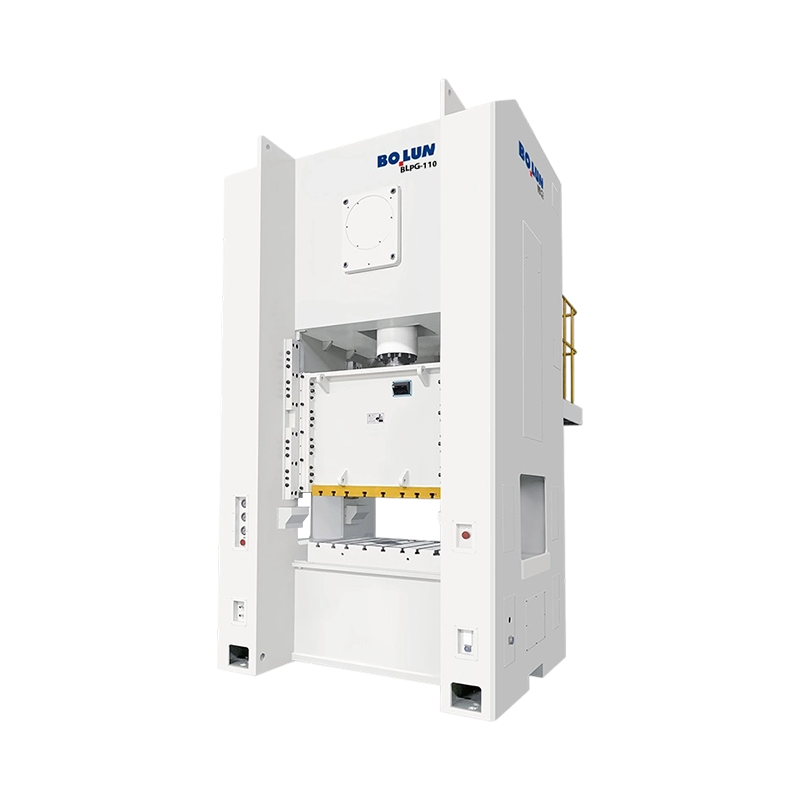
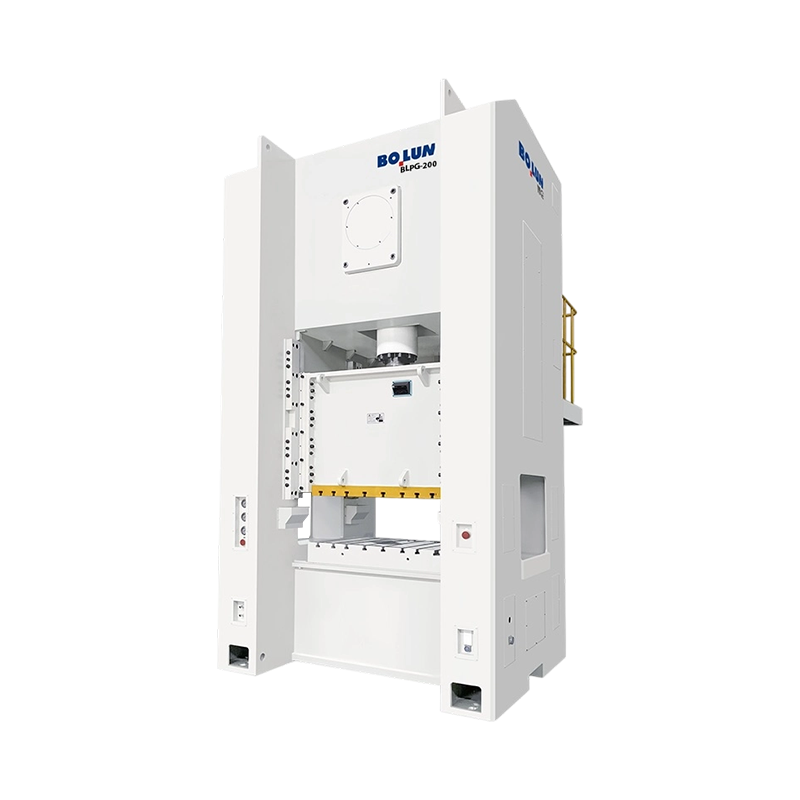
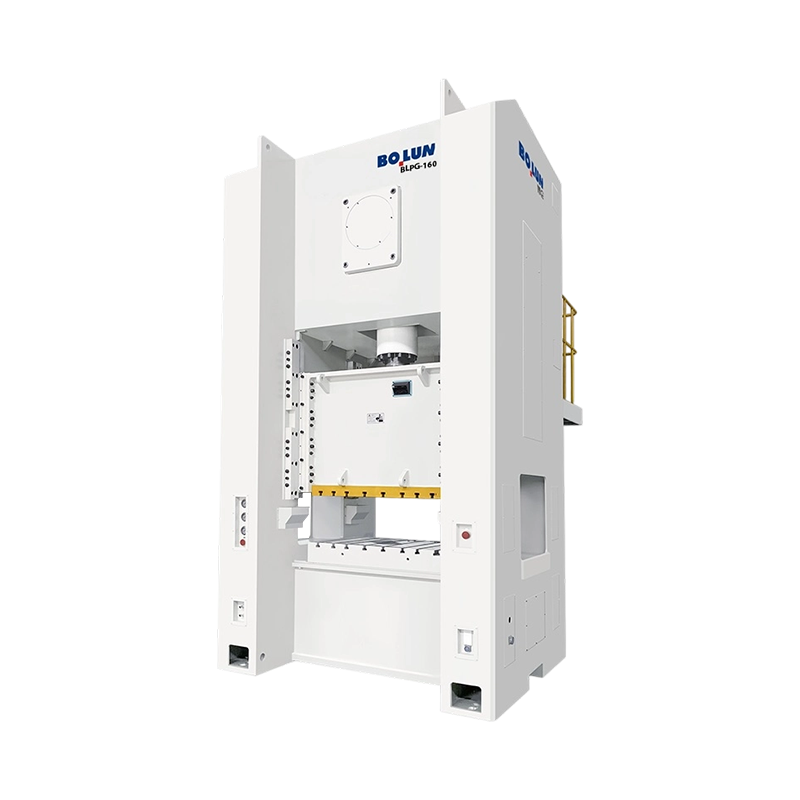
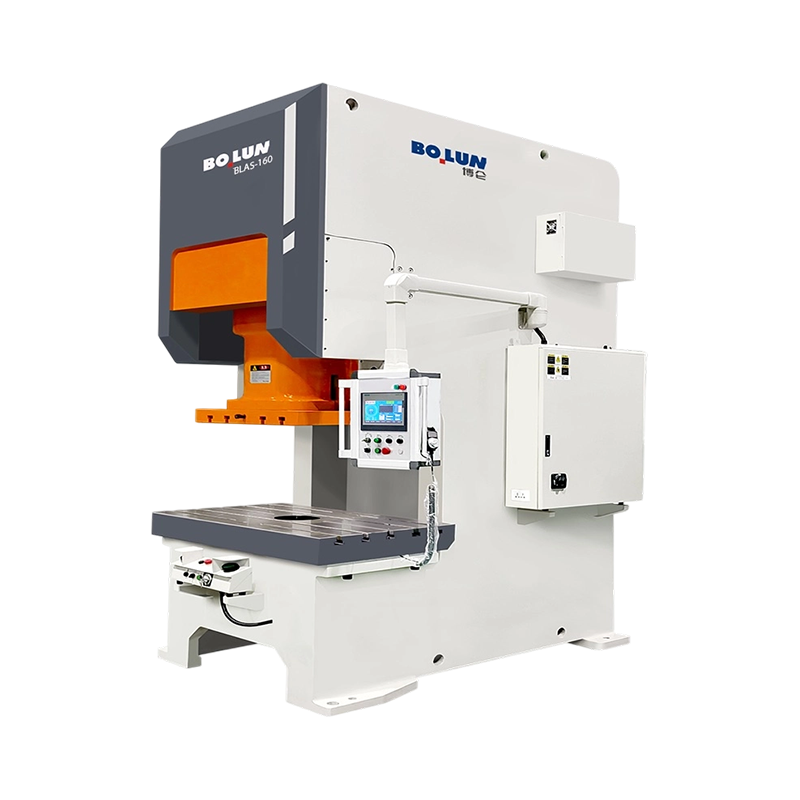
Two presses can both carry a 200-tonne nameplate and still produce very differe...
What Is a Power Press? A power press — also called a stamping press or punch pr...
Start With the Purchase Decision, Not the Definitions A procurement engineer co...
A buyer comparing a 45-ton open-gap press for a bracket line often receives two...
A tooling engineer quotes a new bracket program and specifies a 160-ton press. ...
Power press machines are classified in two main ways: by frame construction, w...
Contact Us

topbolun@gmail.com

+86-575-83362228

+86-13735238388
+86-18667502750

+86-575-83362999

+8618667502750

No.1 Linjiang Road East, Xiaren, Jinting Town, Shengzhou City, Zhejiang Province, China
Ready to Begin?
Get in Touch

Now!

ZHEJIANG BOLUN
 English
 中文简体