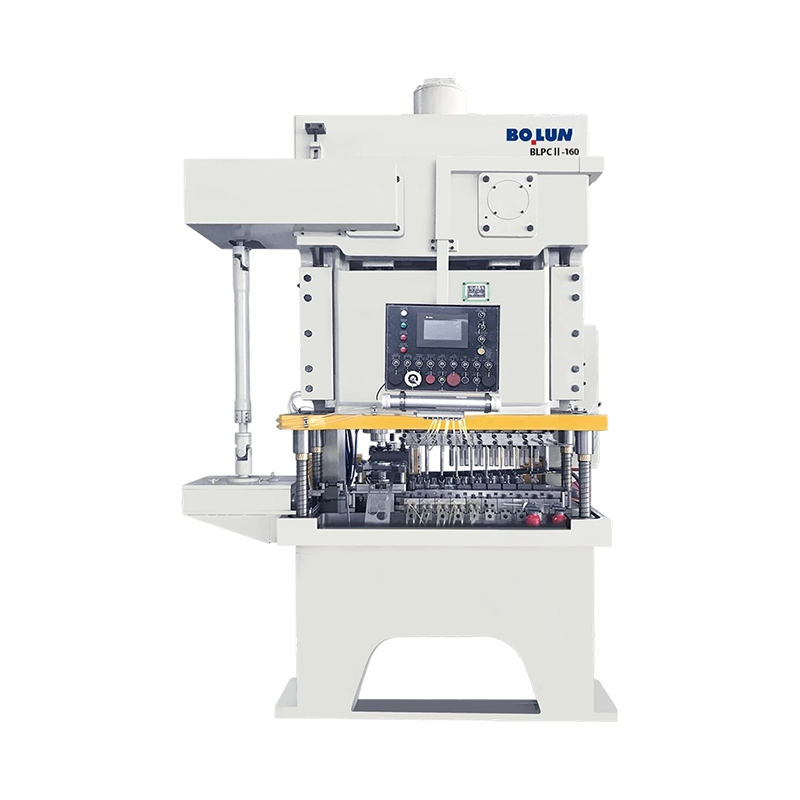
The BLPS-35 is a high-performance open-gap deep-throat power press designed for precision metal forming, stamping, blanking, piercing, bending, and other demanding production operations. With a nominal capacity of 350 kN, a maximum operating speed of 180 strokes per minute, a 780 × 340 mm worktable, and a deep-throat range of 500–1200 mm, it provides a practical combination of forming force, working clearance, production speed, and dimensional stability.
Modern stamping operations increasingly require more than a powerful drive system. Manufacturers need equipment that can maintain repeatable accuracy, accommodate specialized tooling, support rapid production cycles, and remain stable under continuous industrial use. The BLPS-35 addresses these requirements through a vibration-damping structural design, uniform load distribution, adjustable die height, a rigid open-gap frame, and a carefully matched 3 kW main motor.
This machine is intended for manufacturers that need reliable forming performance without the restricted access often associated with conventional press frames. Its deep-throat configuration gives operators and automation systems more room to position larger or irregularly shaped workpieces. At the same time, the open-gap structure allows convenient die installation, material feeding, inspection, and part removal.
Manufactured by Zhejiang Bolun High-Precision Machinery Co., Ltd., the BLPS-35 reflects a broader engineering approach that combines precision design, controlled production, strict inspection, customization capability, and service support. The machine is suitable for metal component manufacturers, appliance producers, automotive supply chains, electrical equipment manufacturers, hardware factories, and other industrial users requiring dependable high-speed forming equipment.
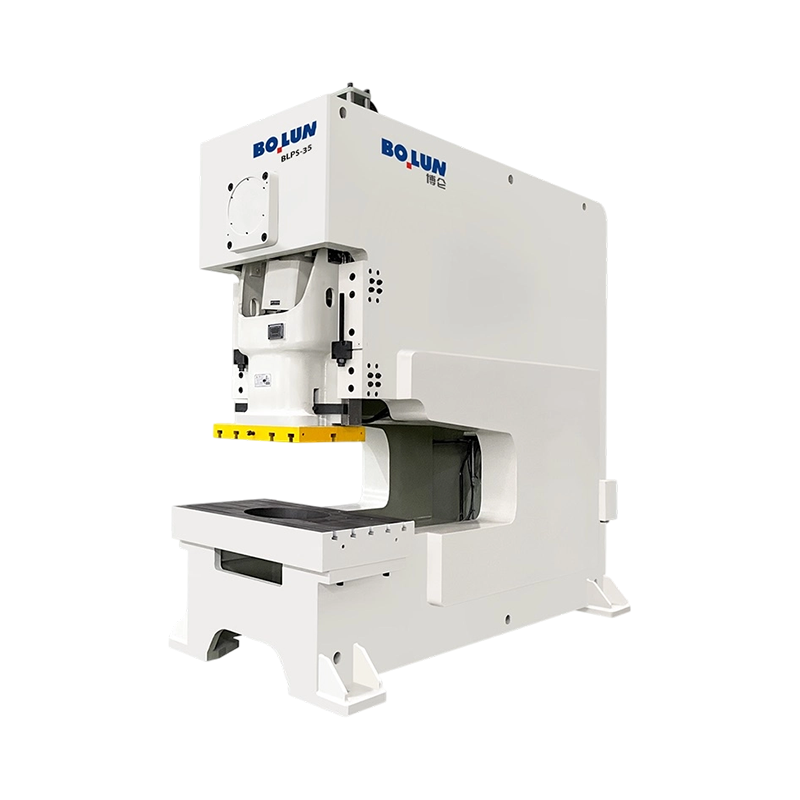
BLPS-35 Versatile High-Stability Open-Gap Deep-Throat Power Press
The BLPS-35 is part of a family of open-type power presses developed for applications where forming accuracy, accessible tooling, and efficient material handling are equally important. Its 350 kN nominal capacity places it in a versatile range for medium-duty industrial stamping and forming work. It is powerful enough for many demanding sheet-metal operations while remaining compact and accessible compared with much larger closed-type presses.
The machine’s open-gap construction creates a broad working area around the die. This arrangement is particularly useful when parts must be loaded from the front, side, or through an automated feeding line. It also simplifies tooling changes and improves visibility during setup. For manufacturers producing different components on the same press, this flexibility can reduce changeover difficulties and help make better use of available floor space.
A deep throat is one of the defining features of the BLPS-35. With a throat depth ranging from 500 to 1200 mm, the press provides substantial clearance from the centerline of the frame. This clearance is valuable when forming large panels, extended components, offset shapes, or workpieces that must be positioned well inside the frame. It also offers greater freedom for auxiliary devices, feeding systems, sensors, and specialized molds.
The press is designed to deliver consistent motion at operating speeds of up to 180 strokes per minute. High speed alone does not guarantee productivity. If the structure vibrates excessively, if the slide loses repeatability, or if the load is not distributed evenly, production quality can decline rapidly. The BLPS-35 therefore emphasizes structural stability and controlled load transmission as important parts of its performance profile.
The following table summarizes the principal specifications identified for the BLPS-35 model. Actual configuration, electrical standards, tooling, guarding, and optional automation should be confirmed according to the customer’s production requirements and destination-market regulations.
| Specification | BLPS-35 |
| Machine type | Open-gap deep-throat power press |
| Nominal capacity | 350 kN |
| Nominal pressure stroke | Approximately 2.3 mm |
| Operating speed | 95–180 strokes per minute |
| Slide stroke | Approximately 30 mm |
| Maximum die height | Up to 250 mm |
| Die height adjustment | Approximately 50 mm |
| Throat depth | 500–1200 mm |
| Worktable size | 780 × 340 mm |
| Main motor | 3 kW, four-pole configuration |
| Air pressure | 0.55 MPa |
| Punch accuracy | GB/JIS Class 1 |
These specifications make the BLPS-35 suitable for operations that require a combination of moderate-to-high forming force and a relatively fast cycle rate. The exact suitability of the press depends on material type, thickness, tooling design, stroke requirements, required tonnage at the working position, and the production cycle selected by the user.
A nominal capacity of 350 kN gives the BLPS-35 a useful operating range for many precision stamping applications. It can support processes such as blanking, piercing, shallow drawing, bending, embossing, trimming, flattening, and progressive forming when the tooling and material conditions are correctly matched to the machine.
Nominal capacity should not be interpreted as an unlimited force available at every point of the slide stroke. Press selection must always consider the force curve of the machine, the working position, the type of operation, and the requirements of the die. Engineers should verify the required tonnage before production, especially for operations involving high-strength steel, thick plate, deep forming, or unusually large contact areas.
Within its intended range, the BLPS-35 offers a balanced solution for manufacturers that need more force than a small benchtop or light-duty press can deliver but do not require the size, cost, and floor space of a large closed-type production press. This balance can be especially valuable for subcontractors and factories that produce multiple product families in medium or high volumes.
The capacity also provides room for future production development. A press that is selected too close to the minimum force requirement may experience excessive loading, premature wear, or reduced process stability. By choosing an appropriate capacity margin, users can improve reliability and accommodate modest changes in material grade, part geometry, or tooling design.
The BLPS-35 can operate at up to 180 strokes per minute, with a stated operating range of approximately 95–180 strokes per minute for the high-speed configuration. This speed supports efficient production of small and medium-sized components, especially where the operation involves repetitive blanking, piercing, or shallow forming.
High-speed stamping requires careful coordination between the press, die, feeder, lubrication system, material handling equipment, and operator controls. A fast machine cannot compensate for poor tooling alignment or inconsistent feeding. For this reason, the press’s value lies not simply in its maximum stroke rate, but in its ability to maintain stable operation while the production line is running at an appropriate speed for the application.
The vibration-damping structure helps reduce unwanted movement that can affect tooling, workpieces, and operator comfort. Lower vibration may also support more consistent die alignment and reduce the risk of quality variation over long production runs. This is particularly important for precision components with tight dimensional requirements or visible surface areas.
Manufacturers can select a practical speed based on material properties and tooling requirements rather than always operating at the maximum. A slower setting may be preferred for deeper forming, delicate materials, more complex transfer movements, or operations where surface quality is the primary concern. The available speed range allows production teams to balance output and process control.
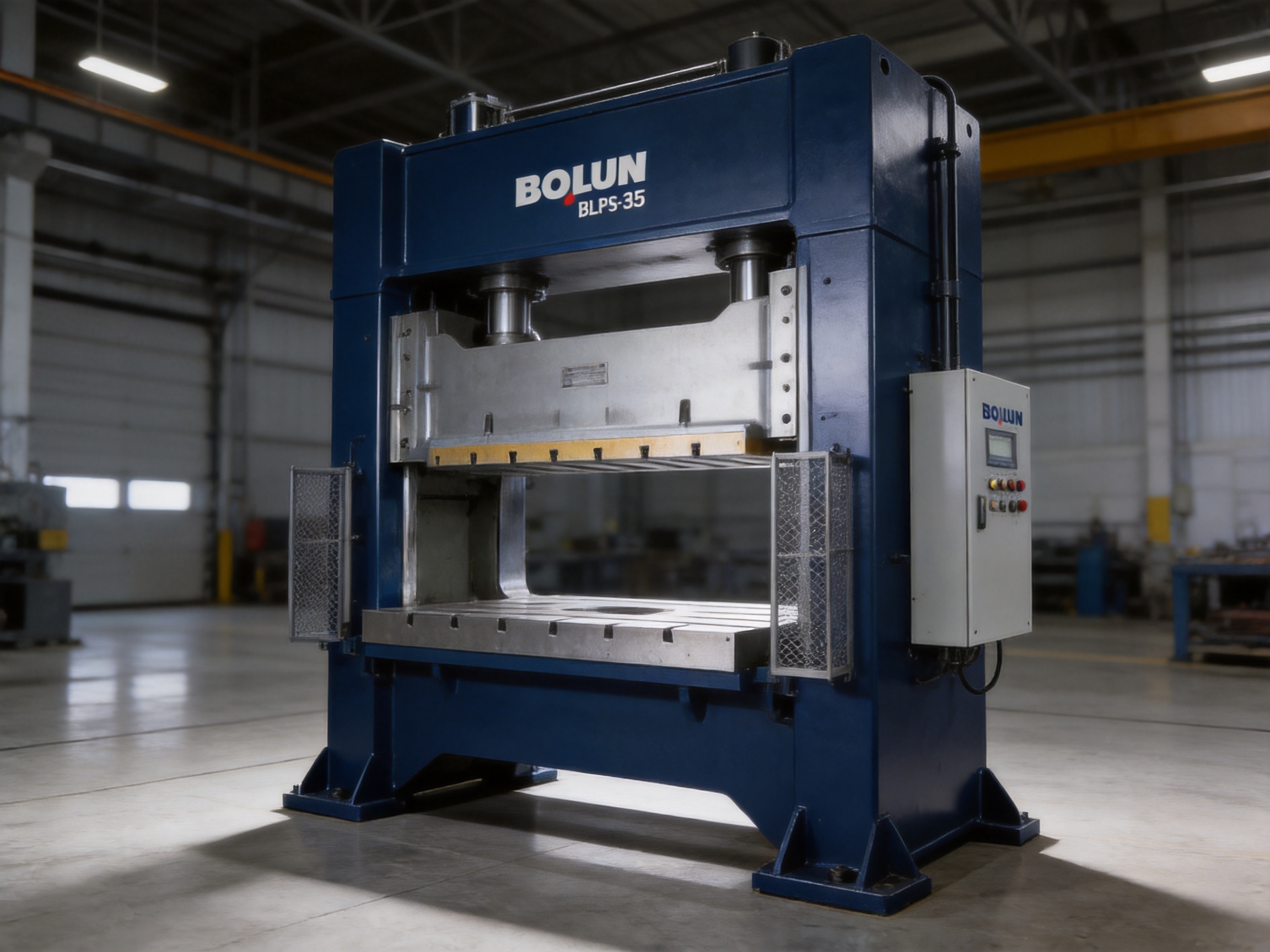
Uniform load distribution is a major advantage in any mechanical power press. When forming force is transferred unevenly through the frame, slide, bolster, or die, the result can include deflection, uneven wear, inconsistent parts, and increased stress on tooling. The BLPS-35 is designed to distribute working loads more evenly across its structure, helping maintain stable forming conditions.
The open-gap design must be engineered carefully because the frame geometry can influence stiffness and load behavior. A well-designed open frame provides excellent access, but it must also resist deformation during operation. The BLPS-35 combines the advantages of an open structure with a stability-focused design intended to preserve accuracy under repeated loading.
Vibration damping further supports structural performance. During high-speed operation, the press generates dynamic forces from the movement of the slide, the engagement of the die, and the return of the mechanism. If these forces are not controlled, they may contribute to noise, fatigue, tooling movement, and inconsistent part quality. A vibration-damping structure helps absorb or control these effects.
For manufacturers, this stability can produce several practical benefits. Tooling may remain aligned for longer periods, adjustment intervals may be reduced, and operators may experience fewer production interruptions related to vibration or movement. Stable machine behavior also makes it easier to establish repeatable process parameters and maintain consistent quality across batches.
The 500–1200 mm deep-throat configuration is one of the most distinctive advantages of the BLPS-35. In a conventional press, the throat depth determines how far a workpiece can extend into the frame before contacting or approaching the rear structure. A deeper throat provides more room for large, long, or irregular parts.
This feature can be valuable in the production of panels, brackets, electrical housings, appliance components, hardware fittings, and other parts that require a large positioning area. It can also simplify operations in which a workpiece must be rotated, indexed, or supported by an auxiliary device during forming.
Greater clearance can improve material handling in both manual and automated production. Operators have more space to place and retrieve material, while feeders and transfer systems can be positioned with fewer mechanical restrictions. This may shorten loading paths and reduce the likelihood of contact between the workpiece, tooling, and machine frame.
Deep-throat clearance is also useful when a manufacturer uses specialized molds with an offset forming area. Instead of redesigning a die solely to fit within a limited frame, the production engineer may be able to use a more suitable tool layout. This can expand the range of products that can be manufactured on one machine.
Compared with a standard open press with a shorter throat, the BLPS-35 offers greater flexibility for component positioning. Compared with a large closed-type press, it may provide easier access and lower complexity for applications that do not require a fully enclosed four-column or straight-side structure.
The BLPS-35 is equipped with a 780 × 340 mm worktable. This size provides a useful mounting area for a broad range of dies and fixtures while keeping the machine suitable for factories that need efficient use of floor space. The worktable is large enough for many medium-sized stamping tools and compact enough to support flexible production layouts.
A practical worktable must provide more than surface area. It must offer adequate support for the die, maintain alignment during loading, and work effectively with the slide bottom and shank arrangement. The BLPS-35 is designed around a coordinated worktable and slide system so that the upper and lower tooling components can be installed and operated as a working set.
For manufacturers running several products, table size is an important consideration during tooling planning. A worktable that is too small can restrict die design and force unnecessary modifications. A table that is excessively large may increase machine size and cost without providing a real production benefit. The BLPS-35 occupies a practical middle ground for many general-purpose precision forming applications.
The table can also support the integration of positioning guides, sensors, lubrication equipment, and material-handling accessories, subject to the final machine configuration. Users should confirm the table loading requirements, mounting-hole arrangement, die weight, and safety clearances before ordering specialized tooling.
The BLPS-35 offers a maximum die height of up to 250 mm, according to the product specification. This extended height allows compatibility with a wider range of specialized molds and forming tools. It can be particularly useful when a die includes multiple stages, springs, guide systems, ejectors, sensors, or other components that increase the overall tool height.
Die height flexibility reduces the need to redesign existing tooling simply to fit the press. It can also make it easier for users to transfer a proven mold from another compatible production line. For factories that operate multiple tools, a press with a practical die-height range can increase equipment utilization and reduce the number of dedicated machines required.
The die-height adjustment range is approximately 50 mm. This adjustment supports fine positioning between the upper and lower tooling components and helps operators establish the correct working clearance. Proper adjustment is essential for preventing excessive contact, ensuring complete forming, and protecting the die from unnecessary impact.
Tooling engineers should still evaluate the actual closed height, required stroke, shut height, guide-post arrangement, and available adjustment before installation. The press should never be operated outside the manufacturer’s stated limits. Correct tool setup is essential for both production quality and machine safety.
The BLPS-35 uses a 3 kW main motor in a four-pole configuration. The motor is matched to the press mechanism to provide the drive power required for the specified operating range and forming performance. A correctly selected motor helps the press maintain dependable operation while avoiding unnecessary energy consumption or excessive mechanical stress.
Motor power should always be considered together with the press’s mechanical transmission, stroke, speed, load curve, and duty cycle. The purpose of a power press is not simply to use the largest available motor. Instead, the drive system must convert motor power into controlled slide movement and usable forming force with appropriate efficiency and reliability.
For production managers, the 3 kW motor offers a reasonable balance between operating capability and energy demand for this press class. The actual energy consumption will depend on stroke rate, load, operating time, auxiliary systems, and production conditions. Regular maintenance of the drive system, lubrication points, bearings, and moving components can help preserve efficiency throughout the machine’s service life.
Electrical configuration should be confirmed before shipment. Voltage, frequency, control-panel requirements, guarding interlocks, emergency-stop arrangements, and applicable local standards may vary by destination. The manufacturer can provide configuration guidance for international installations and project-specific requirements.
The BLPS-35 is specified with GB/JIS Class 1 punch accuracy. This indicates a precision-oriented design intended for repeatable forming work. Accuracy in a power press depends on the combined performance of the frame, slide guidance, drive mechanism, die installation, adjustment system, foundation, and operating procedure.
A precision machine must maintain its behavior over repeated cycles rather than deliver accuracy only during initial setup. The press’s rigid construction and vibration-damping features help create a stable platform for tooling. When combined with properly maintained dies and consistent material feeding, these features can support dependable dimensional results.
Accuracy is especially important in components that must fit into assemblies, align with holes or fasteners, or meet strict visual and functional requirements. Inconsistent press movement may result in burr variation, uneven bends, incomplete embossing, or dimensional drift. Stable operation helps reduce these risks and supports more predictable quality control.
Users should understand that machine accuracy does not replace correct process engineering. Die wear, material variation, lubrication differences, temperature, foundation movement, and improper adjustment can all affect the final product. The best results are achieved when machine precision is supported by good tooling design, inspection procedures, and preventive maintenance.
Many general-purpose open-type presses provide basic stamping capability, but not all offer the same combination of deep-throat clearance, high-speed operation, vibration control, and adjustable tooling capacity. The BLPS-35 is differentiated by the way these features work together as one production system.
First, its 350 kN capacity provides a stronger forming platform than many light-duty open presses. This gives manufacturers more flexibility when working with thicker materials, larger dies, or operations that require greater force. The additional capacity can also provide a useful operating margin for future product development.
Second, the maximum speed of 180 strokes per minute supports efficient repetitive production. A lower-cost machine may have a simpler drive system or a narrower practical speed range, limiting productivity when the tooling and material are suitable for faster cycling.
Third, the deep-throat range of 500–1200 mm provides more working clearance than a conventional compact-frame press. This is a major benefit for long or irregular workpieces and for production lines that use automated feeding or transfer equipment.
Fourth, the stated maximum die height of up to 250 mm allows a wider range of molds to be installed. This can reduce tooling restrictions and improve the machine’s usefulness across multiple product families.
Finally, the vibration-damping structure and uniform load distribution are important for long-term process consistency. A press that is merely powerful may not provide the same precision or tooling stability as a machine designed to control dynamic behavior during high-speed production.
Closed-type power presses are valuable for applications requiring high rigidity, large capacities, or fully enclosed frame structures. However, they can also involve greater equipment size, more complex tooling access, and higher investment. The BLPS-35 offers an alternative for manufacturers whose applications can benefit from an open working area and deep access without requiring a closed straight-side frame.
Open-gap construction allows faster visual access to the die area. Operators can inspect material position, remove formed parts, and perform setup tasks with fewer structural obstructions. This can be useful in mixed-production environments where tooling changes occur frequently.
The open structure may also simplify integration with front-loading systems, side feeders, manual workstations, and compact automation. While every automation project requires a detailed engineering review, the accessible frame provides a practical starting point for production-line design.
Investment and floor-space considerations may also favor an open press for suitable applications. A manufacturer does not need to purchase a substantially larger closed press when the required force and tooling conditions can be met by a 350 kN open-gap machine. The result may be a more economical and flexible production cell.
At the same time, selection must be based on the actual forming process. Users requiring extremely high rigidity, very large dies, heavy drawing operations, or high-capacity production should compare the BLPS-35 with closed-type equipment and verify all engineering requirements. The advantage of this model is its balanced application range, not the claim that one frame style is appropriate for every process.
The BLPS-35 can be used in a wide variety of industrial forming applications. Its capacity, worktable, speed, and throat depth make it suitable for medium-sized parts and specialized tools where repeatability and accessible operation are important.
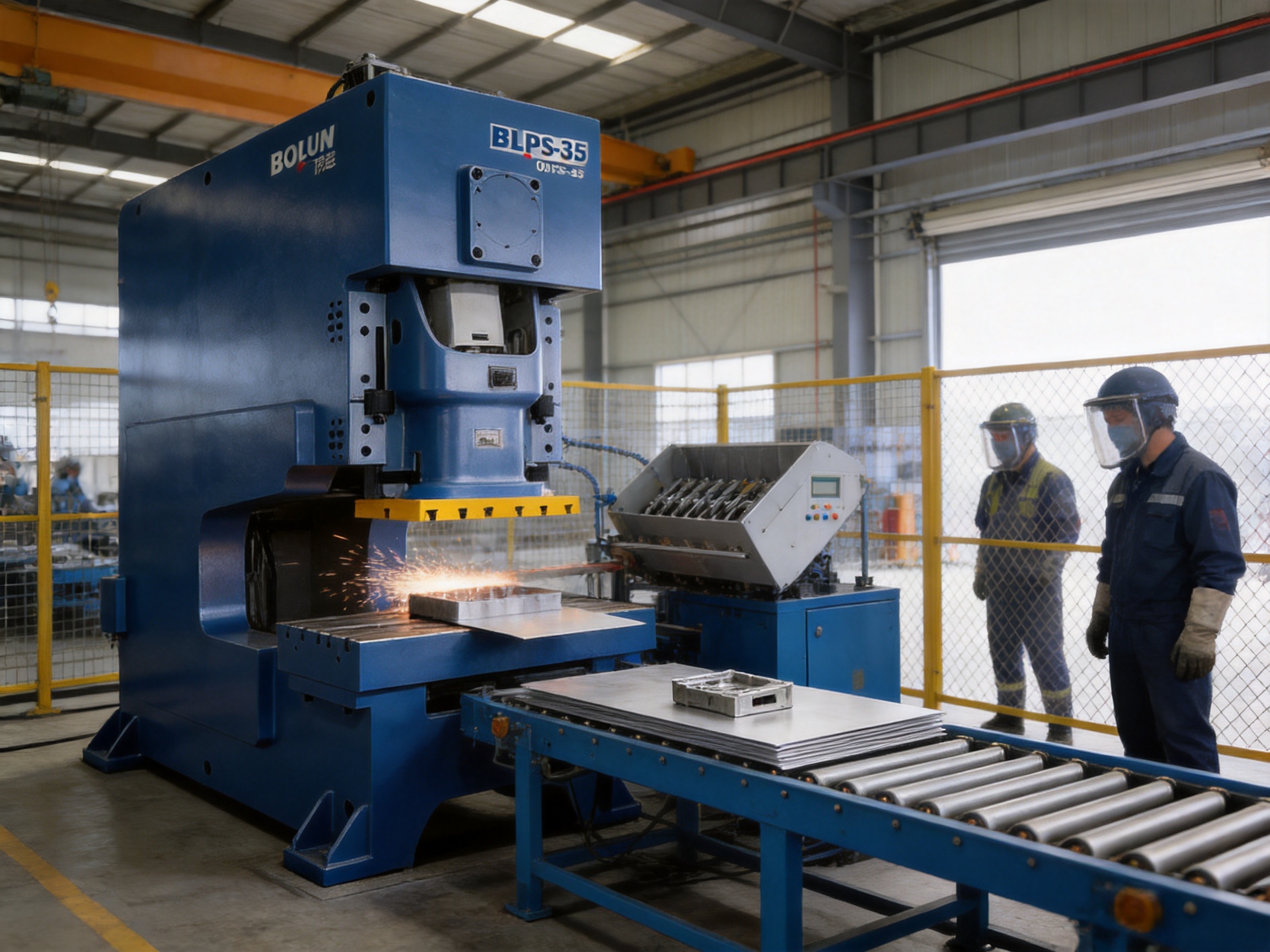
Automotive suppliers may use this class of press for brackets, reinforcement parts, small panels, clips, fittings, and other stamped components. The deep throat can assist with parts that have extended geometry, while the high cycle rate supports repetitive production. Actual suitability depends on material grade, thickness, die type, and required forming force.
Electrical equipment manufacturers often require accurately formed brackets, terminals, enclosures, support plates, and mounting components. The BLPS-35 can support blanking, piercing, bending, and embossing processes used in these product categories. Its precision-focused design is beneficial where hole location, bend position, and repeatable surface quality are important.
Appliance manufacturers and subcontractors may use the press for hardware, covers, brackets, panels, hinges, and internal support components. The open-gap layout provides convenient access for loading and unloading, while the extended die height supports tools with multiple operating elements.
Hardware factories can use the BLPS-35 for hinges, fastener components, stamped fittings, handles, decorative parts, and general sheet-metal products. The machine’s versatility is valuable when a factory serves different customers and must change tooling regularly.
Manufacturers producing custom metal components can benefit from a press that accommodates a range of dies without requiring a separate machine for every product. The BLPS-35 can serve as a flexible production asset for both standard and customized forming operations.
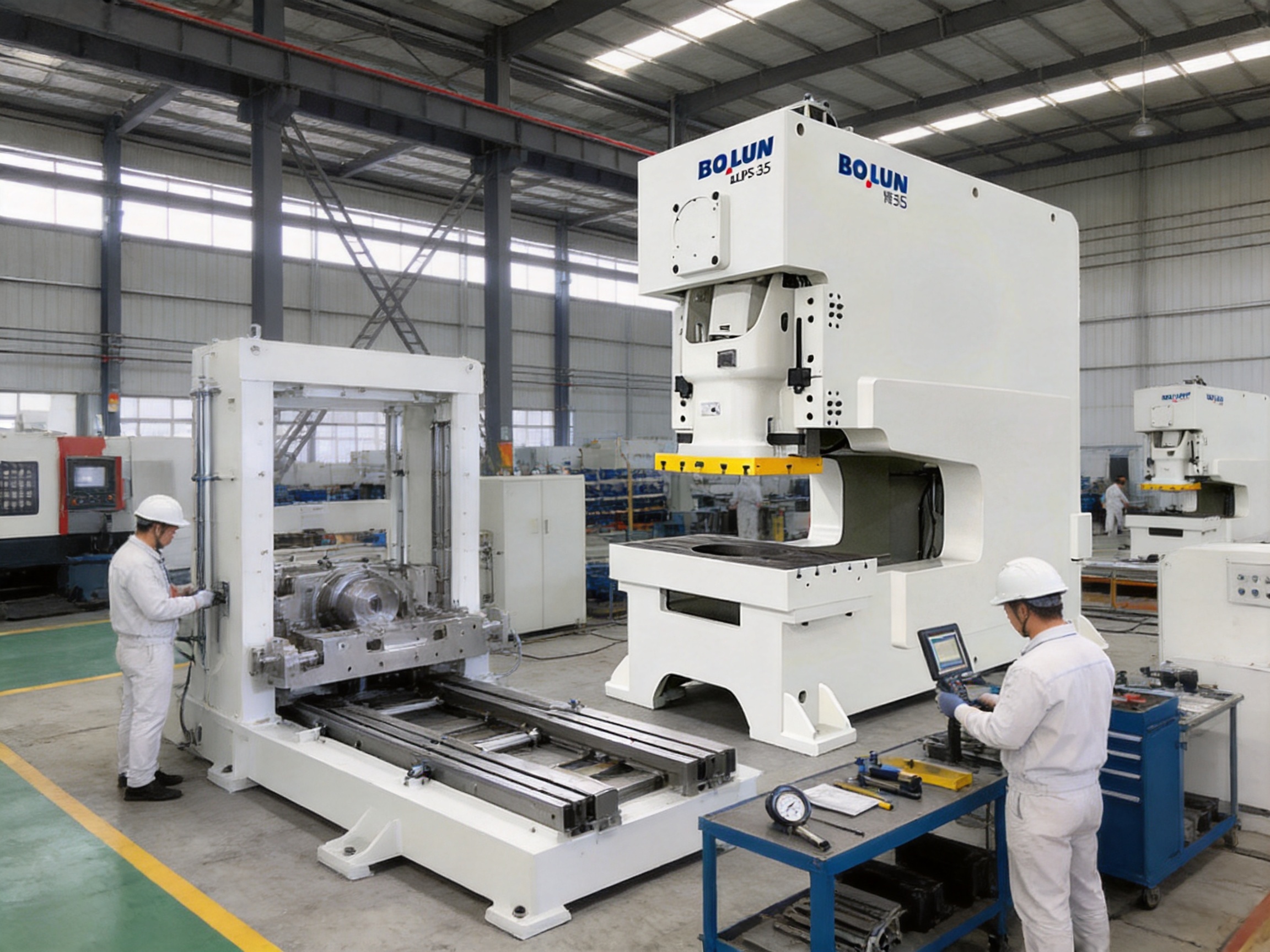
The performance of a power press depends heavily on how it is designed, processed, assembled, inspected, and supported. Zhejiang Bolun High-Precision Machinery Co., Ltd. combines research and development, engineering design, production, sales, and service within one organization. This integrated structure supports communication between technical departments and helps connect customer requirements with manufacturing execution.
The company is located in Zhejiang, a major center of Chinese precision manufacturing. With approximately two decades of experience in machinery manufacturing, it has developed expertise in forging and casting machinery, precision processing, equipment assembly, and industrial machine-tool solutions.
Its manufacturing approach includes advanced precision-processing equipment and a production environment covering key stages from basic design and core-component development to final assembly. This full-chain capability can be particularly valuable for customers requiring special specifications, non-standard configurations, or application-specific functions.
Engineering begins with understanding the customer’s forming process. The required material, thickness, part dimensions, die structure, production volume, operating speed, automation level, and quality target all influence press selection. A responsible manufacturer should evaluate these conditions before recommending a configuration.
Bolun’s design team provides one-stop design and manufacturing services for products with special specifications and functions. This capability allows the company to respond to applications that do not fit a simple standard catalog. Customers may require changes to electrical systems, guarding, die-height arrangements, feeding interfaces, worktable features, control functions, or other production details.
Non-standard customization is especially important for international industrial customers. Different regions may require different electrical standards, safety systems, documentation, control interfaces, or installation conditions. A manufacturer with both engineering and production resources can coordinate these requirements more efficiently than a supplier that only resells standard equipment.
Precision processing is essential for press-frame components, slide assemblies, guides, shafts, tables, and other parts that influence machine accuracy. Dimensional errors or poor surface finish in these components can affect alignment, friction, load transfer, and service life.
A mature production system uses appropriate machining methods, process controls, inspection points, and assembly procedures to ensure that parts meet design requirements. The goal is not only to produce an accurate component but also to ensure that all components work together as a complete press.
Bolun emphasizes advanced precision-processing equipment and a finished-product inspection system intended to exceed ordinary industry requirements. Each process and component is subjected to quality control so that the completed machine can maintain stable precision and service performance under intensive operating conditions.
For customers, this approach reduces the risk associated with purchasing equipment based solely on nominal tonnage or speed. A press should be judged by its complete manufacturing quality, including frame stability, guide accuracy, drive reliability, assembly consistency, inspection records, and service support.
Final assembly is where individual components become an operating production system. Technicians must correctly align the frame, drive mechanism, slide, guides, table, adjustment system, electrical controls, lubrication points, and safety devices. Incorrect assembly can reduce accuracy even when every individual component meets its drawing specification.
Testing should verify basic mechanical operation, slide movement, adjustment function, control response, lubrication, emergency-stop behavior, and abnormal noise or vibration. Where applicable, the machine should also be evaluated for repeatability and operating stability at selected speeds.
A systematic final inspection gives customers greater confidence that the press is ready for installation and commissioning. Inspection documentation can also assist the customer’s maintenance department, quality team, and production engineers during acceptance and future troubleshooting.
The company’s quality philosophy treats finished-product inspection as a central part of manufacturing rather than a final formality. This reflects the importance of reliability in industrial equipment, where downtime can affect labor efficiency, delivery schedules, tooling investment, and customer commitments.
Power presses are rarely used as isolated machines in modern factories. They are often connected to feeders, straighteners, transfer systems, sensors, conveyors, safety light curtains, die protection devices, lubrication systems, and production-management procedures. A successful installation therefore requires coordination between the press and the complete work cell.
The manufacturer’s customization capability allows the BLPS-35 to be considered for a broader range of production environments. Depending on the project, customers may discuss material-feeding arrangements, guarding, control-panel requirements, interface points, working height, electrical specifications, and other integration details.
Customization should be completed before production so that the press, die, and automation equipment are designed to work together. Customers should provide accurate drawings, material information, cycle requirements, tooling data, and factory conditions during the technical review stage.
International customers also benefit from clear communication regarding installation, commissioning, operator training, spare parts, maintenance, and warranty support. These services help reduce the time between delivery and stable production.
The value of a power press extends across its entire service life. Initial price is only one part of the total ownership cost. Maintenance requirements, spare-parts availability, technical support, operator training, production reliability, and upgrade possibilities also influence the long-term return on investment.
Bolun provides customer-oriented support covering pre-sales consultation, in-sales assistance, and after-sales service. During the pre-sales stage, technical personnel can help customers identify a suitable capacity and configuration. During production and delivery, communication can focus on specifications, documentation, inspection, and installation preparation.
After commissioning, users need practical guidance on operation, lubrication, die setup, adjustment, inspection, and routine maintenance. Proper training helps operators avoid incorrect loading, unsuitable speed settings, overloading, and other conditions that may affect safety or machine life.
Preventive maintenance should include regular inspection of the drive system, fasteners, guides, lubrication points, electrical components, safety systems, and tooling interfaces. Maintenance intervals should be established according to operating hours, production loads, environmental conditions, and the manufacturer’s recommendations.
Before operation, the worktable, slide, die, and surrounding area should be checked for cleanliness and obstructions. The die must be correctly installed and secured, and the working height must be adjusted within the permitted range. Operators should verify that the material path is clear and that all safety devices are functioning correctly.
During production, the selected speed should match the material, tooling, lubrication, and part geometry. Maximum speed should be used only when the complete process has been validated at that rate. If unusual noise, vibration, heat, or part-quality variation occurs, production should be stopped for inspection.
Lubrication is important for reducing friction and wear in moving assemblies. The correct lubricant and application interval should be followed. Excessive or insufficient lubrication can both create problems, so maintenance personnel should use the manufacturer’s instructions rather than relying on guesswork.
Tooling should be inspected regularly for wear, cracks, loose components, damaged springs, blocked passages, and alignment problems. A damaged die can place abnormal loads on the press and create a safety risk. Maintaining the tool is therefore part of protecting the machine.
Operators should also maintain accurate production records. Recording speed, material, die identification, adjustment settings, maintenance events, and quality results can help identify trends before they develop into serious downtime or product defects.
Customers should begin with the part and process rather than selecting a press based only on a catalog number. Important questions include the material type, thickness, tensile strength, part dimensions, forming method, required tonnage, die size, die height, stroke, production rate, feeding method, and quality tolerance.
The required force should be calculated by the tooling or process engineer. The calculation should consider cutting perimeter, material shear strength, bending conditions, drawing force, friction, stripping force, and safety margin where appropriate. The resulting force must be compared with the press’s usable capacity at the required working position.
The die should fit the 780 × 340 mm worktable and the available slide mounting area. The die height should remain within the stated limit, and the required stroke should be compatible with the machine. The throat depth should be sufficient for the complete workpiece and any required feeding or support equipment.
Factory conditions must also be reviewed. This includes available floor area, foundation strength, power supply, compressed air, ventilation, ambient temperature, material storage, operator access, and safety clearance. A technically suitable press can still perform poorly if it is installed on an inadequate foundation or operated without appropriate environmental preparation.
Installation should be carried out by qualified personnel according to the manufacturer’s instructions. The machine should be positioned on a suitable foundation, leveled correctly, connected to the appropriate electrical supply, and checked before operation. Any anchoring or vibration-control requirements should be addressed during the installation plan.
Compressed air requirements should be considered because the stated air pressure is 0.55 MPa. The factory air supply should be clean, stable, and suitable for the machine’s pneumatic components. If air quality is poor, filtration and moisture control may be required.
Commissioning should begin with inspection and low-risk testing. Technicians should verify controls, emergency stops, lubrication, slide movement, die adjustment, sensor operation, and feeding alignment before moving to production speed. Trial production should confirm part quality and machine behavior under actual working conditions.
Documentation should be retained for machine specifications, electrical diagrams, maintenance procedures, inspection results, spare parts, and operator training. Clear documentation improves communication between production, maintenance, quality, and safety departments.
The BLPS-35 has a nominal capacity of 350 kN. The actual suitability for a particular operation depends on the required force at the working position, material characteristics, die design, stroke, and production conditions.
The press has a throat-depth range of approximately 500–1200 mm. This provides increased clearance from the frame centerline, allowing more flexible positioning of large, long, offset, or irregular workpieces.
The stated operating range for the BLPS-35 is approximately 95–180 strokes per minute. The appropriate speed should be selected according to the material, die, lubrication, feeding system, and required quality level.
The worktable is approximately 780 × 340 mm. Customers should confirm the complete tooling dimensions, mounting arrangement, die weight, and clearances before finalizing a die design.
The maximum die height is specified as up to 250 mm, with approximately 50 mm of die-height adjustment. The actual installation must remain within the permitted operating range and should account for the complete tool assembly.
The BLPS-35 uses a 3 kW main motor in a four-pole configuration. Electrical voltage, frequency, control requirements, and local compliance details should be confirmed for the destination installation.
Potential applications include automotive components, electrical hardware, appliance parts, metal fittings, brackets, stamped plates, general hardware, and other precision metal-forming products. Application suitability should be confirmed through a technical review.
The open-gap structure provides convenient access for die installation, workpiece loading, inspection, and part removal. It can also simplify integration with manual or automated feeding equipment and support faster tooling changes.
Vibration damping helps control dynamic movement generated during high-speed operation. This can support better tooling stability, reduced unwanted movement, more consistent forming results, and improved operator working conditions.
The manufacturer provides non-standard design and manufacturing capabilities. Customers can discuss application-specific requirements such as electrical standards, guarding, automation interfaces, tooling conditions, control functions, and other special specifications.
Customers should review material type and thickness, required force, stroke, speed, die dimensions, die height, workpiece size, feeding method, throat clearance, power supply, compressed air, safety requirements, installation space, and after-sales support.
The BLPS-35 is a versatile open-gap deep-throat power press designed for manufacturers that require dependable force, accessible tooling, extended working clearance, and stable high-speed performance. Its 350 kN nominal capacity, maximum speed of 180 strokes per minute, 780 × 340 mm worktable, up to 250 mm die height, and 500–1200 mm throat depth provide a flexible platform for a wide range of precision forming applications.
Its advantages are not limited to individual specifications. The machine combines uniform load distribution, vibration-damping construction, practical die adjustment, an accessible open frame, and a precision-oriented design. Compared with generic open presses, it provides greater capacity and working clearance. Compared with many closed-type alternatives, it offers easier access and a potentially more flexible production layout for suitable applications.
The machine is supported by the engineering and manufacturing capabilities of Zhejiang Bolun High-Precision Machinery Co., Ltd. The company integrates research and development, precision processing, assembly, inspection, customization, sales, and service. Its experience in machinery manufacturing and its emphasis on quality control provide a foundation for supplying industrial equipment to customers in China and international markets.
For manufacturers seeking a reliable precision press machine, the BLPS-35 is a strong candidate for medium-duty and high-speed metal-forming work. Final selection should always be based on a detailed review of the material, tooling, required tonnage, production speed, factory conditions, and safety standards. When correctly specified, installed, and maintained, the BLPS-35 can support consistent production, flexible tooling use, and long-term manufacturing efficiency.
1. Manufacturer product specification for the BLPS-35 open-gap deep-throat power press.
2. Manufacturer technical information for the BLPS series power press range.
3. General principles of mechanical power press selection, die compatibility, and forming-force calculation.
4. Industrial guidance on stamping-process safety, guarding, emergency-stop systems, and operator training.
5. Engineering practices for preventive maintenance of mechanical presses and metal-forming equipment.
6. General quality-management principles for precision machinery manufacturing, assembly, inspection, and service.


A buyer comparing a 45-ton open-gap press for a bracket line often receives two...
What Is a Power Press? A power press — also called a stamping press or punch pr...
Understanding Mechanical Power Presses and Their Essential Functions A mechani...
A tooling engineer quotes a new bracket program and specifies a 160-ton press. ...
In the fields of metal forming, sheet metal fabrication, blanking, and punching,...
Power press machines are classified in two main ways: by frame construction, w...
Contact Us

topbolun@gmail.com

+86-575-83362228

+86-13735238388
+86-18667502750

+86-575-83362999

+8618667502750

No.1 Linjiang Road East, Xiaren, Jinting Town, Shengzhou City, Zhejiang Province, China
Ready to Begin?
Get in Touch

Now!

ZHEJIANG BOLUN
 English
 中文简体