
In modern sheet metal forming, manufacturers increasingly need equipment that can combine force, rigidity, precision, die capacity, and long-term stability in one integrated platform. Large-format progressive dies, wide panels, heavy-gauge components, and high-volume stamping programs all place demanding loads on press structures. A press used for these applications must not only deliver enough nominal capacity; it must also maintain accuracy under eccentric loading, provide generous working space, support heavy tooling, and operate with dependable consistency over long production cycles. The BLPE-250 Robust Wide-Bed Closed-Type Double-Point Press was engineered for exactly this environment.
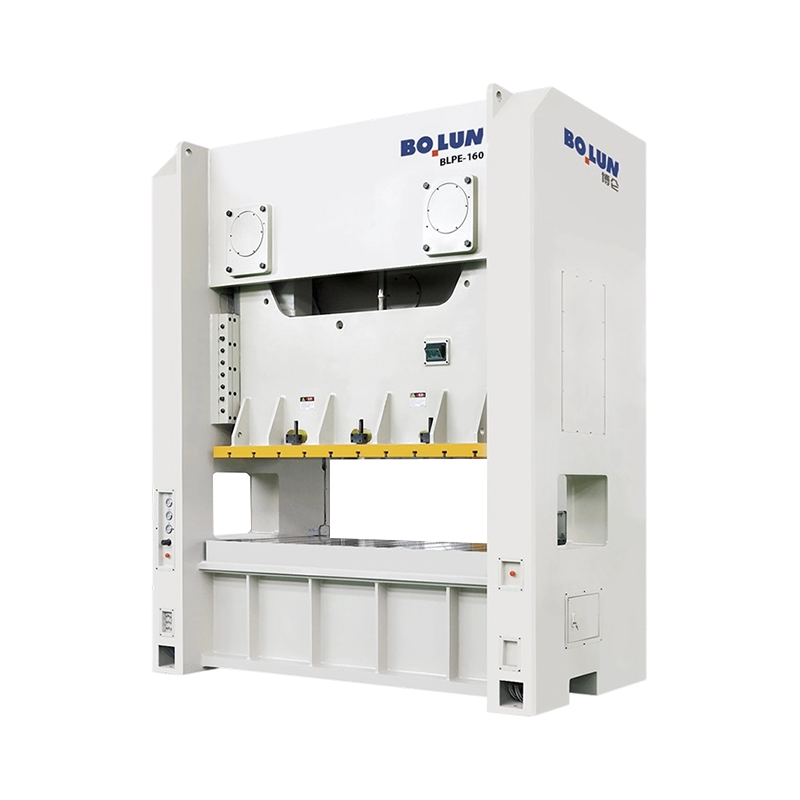
This machine belongs to the closed-type power press family and is specifically designed as a closed-type double-point press. With a nominal capacity of 2500 kN, a wide 2800 mm distance between columns, a 2500 x 1000 mm worktable, a maximum die height of up to 605 mm, and a 22 kW main motor, the press is positioned for large-scale sheet metal forming where conventional smaller presses may limit productivity or die design freedom. Its closed high-rigidity frame, robust balance device, and wide-bed configuration make it especially suitable for large-format progressive tooling and applications where off-center loads must be controlled with precision.
BLPE-250 Robust Wide-Bed Closed-Type Double-Point Press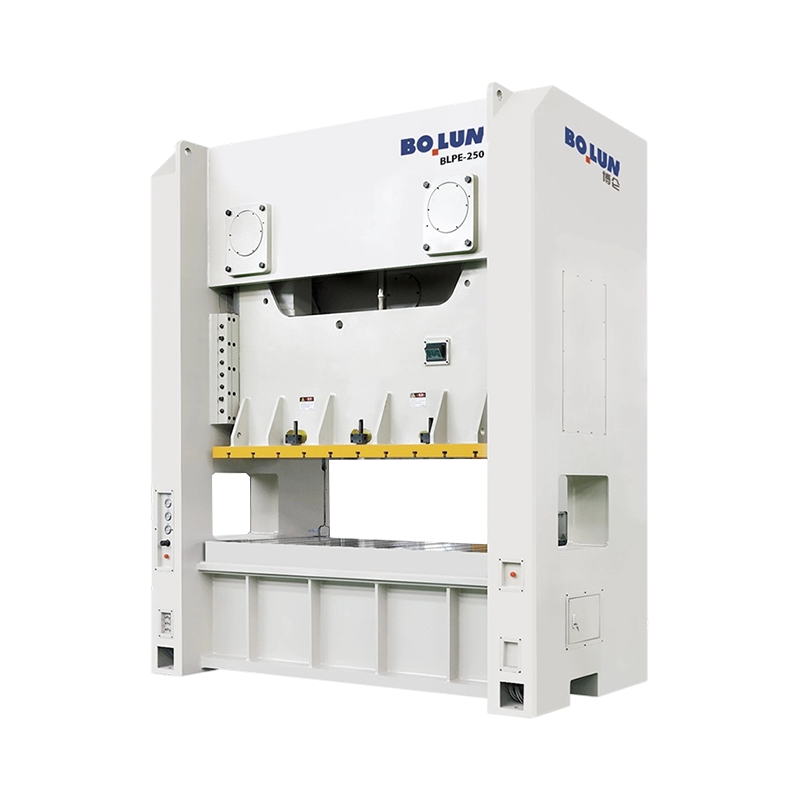
Power presses are commonly divided into open-type presses, closed-type presses, and other specialized press structures. Open-type presses are popular for accessibility and general-purpose work, especially where front access to the die area is important. However, when a manufacturer moves toward wider dies, higher loads, tighter forming accuracy, and more demanding production stability, the closed-type structure becomes a strong advantage. The BLPE-250 is built around this principle: rigidity and controlled force transmission are prioritized to support large, accurate, and repeatable stamping processes.
The machine’s double-point layout further improves its suitability for broad workpieces. A single-point press applies driving force through one main connection point, which can be appropriate for smaller or centered operations. In contrast, a double-point press distributes force across a wider area, helping maintain slide parallelism and reducing the tendency toward deflection when working with large dies. For users running progressive dies, transfer dies, or wide panel tooling, this can translate into better part consistency and improved die life.
Compared with many conventional open-frame machines, the BLPE-250 offers stronger resistance to frame deformation. In stamping, even minor deflection can lead to inconsistent forming depth, accelerated die wear, burr formation, dimensional drift, and unstable production. The closed-type frame creates a more rigid load path, enabling the machine to withstand high working forces with better structural stability. This is a crucial advantage when a plant is producing components that require repeatable geometry over long runs.
The wide-bed design gives the BLPE-250 another competitive strength. Many presses with sufficient tonnage may still restrict manufacturers because their column spacing or table size does not allow the installation of large dies. The BLPE-250 provides a 2800 mm distance between columns and a 2500 x 1000 mm worktable, giving die designers and production engineers more room to work. This makes it easier to accommodate longer progressive layouts, wider strip materials, and larger sheet metal parts.
The BLPE-250 is defined by a combination of high capacity, wide working dimensions, structural rigidity, and balanced operation. Each feature supports the others. A 2500 kN nominal capacity provides the force needed for demanding forming operations, but capacity alone is not enough. The press must also keep that force aligned, controlled, and repeatable. The closed-type high-rigidity frame provides the foundation, while the double-point drive and balance device help ensure stable motion and accurate force delivery.
| Parameter | Specification | Production Significance |
|---|---|---|
| Product Type | Closed-Type Double-Point Press | Suitable for wide dies, large panels, and high-rigidity forming requirements |
| Nominal Capacity | 2500 kN | Provides strong forming force for large-scale sheet metal applications |
| Distance Between Columns | 2800 mm | Allows installation of wide tooling and large-format progressive dies |
| Worktable Size | 2500 x 1000 mm | Supports large dies and broad workpiece layouts |
| Maximum Die Height | Up to 605 mm | Accommodates taller and heavier tooling configurations |
| Main Motor Power | 22 kW | Delivers dependable power for consistent production cycles |
| Frame Structure | Closed-Type High-Rigidity Frame | Improves deformation resistance and accuracy under load |
| Stability Feature | Robust Balance Device | Helps maintain smooth slide movement and accuracy under off-center loads |
The 2500 kN capacity places the machine in a heavy-duty class suitable for production environments where force requirements exceed the limits of general-purpose presses. This capacity is valuable for automotive components, appliance panels, electrical cabinet parts, metal enclosures, brackets, structural sheet components, and other formed parts that require consistent pressure across a large die area.
The 2800 mm column spacing is one of the most important features for practical production. Tooling engineers often face a conflict between required press force and available die space. A machine may have the tonnage needed for the job but lack the horizontal clearance required for a long progressive die. The BLPE-250 reduces this compromise by combining substantial force with a wide opening, allowing manufacturers to design tooling around the part and process rather than being constrained by the press frame.
The 2500 x 1000 mm worktable reinforces this advantage. A large worktable provides firm support for expansive dies, helping maintain die stability and alignment. This is especially important when the tooling includes multiple stations, guide systems, material feeding paths, and part discharge arrangements. A worktable that is too small can force complex compromises in die layout, while a sufficiently large table can improve process reliability and simplify production engineering.
The maximum die height of up to 605 mm helps support taller tooling structures. In high-volume stamping, dies may include complex forming sequences, cushioning features, guide pillars, stripping systems, feeding clearances, and part handling structures. Additional die height capacity gives manufacturers more flexibility when using advanced tooling. It also supports heavier tooling, which is common in wide-bed applications.
The 22 kW main motor provides the drive foundation for consistent production. In a stamping plant, motor performance affects cycle reliability, productivity, and operational confidence. The BLPE-250 is designed to deliver stable working power for heavy-duty forming conditions, reducing the risk of performance instability during continuous operation.
A closed-type press frame forms a box-like structure around the working area. This design naturally resists spreading and deformation better than an open-front frame. When a press applies forming force, the frame experiences elastic deflection. If deflection becomes excessive, the slide and bolster may no longer remain parallel under load. This can cause one side of the die to close more than the other, resulting in uneven forming, inconsistent cutting clearance, and accelerated tooling damage.
The BLPE-250 uses a closed high-rigidity frame to address these challenges. For large-format dies, the forces applied during operation are often distributed unevenly. A progressive die may perform piercing, bending, drawing, trimming, and forming at different stations at the same time. The load is therefore rarely perfectly centered. A rigid closed frame reduces the influence of these eccentric loads and helps preserve process accuracy.
In comparison with many open-type presses, the closed structure provides better long-term dimensional stability. Open-type presses may be easier to access, but their C-frame design can be more susceptible to angular deflection under high load. This is acceptable for many smaller operations, but it becomes a limitation when producing precision parts with wide dies. The BLPE-250 is designed for users who prioritize forming consistency, die protection, and high-load stability over simple open access.
Competitors may offer machines with similar nominal tonnage, but the practical value of a press is determined by how it performs under real production loads. If a press frame deflects significantly, the theoretical capacity does not translate into stable output. The BLPE-250’s closed-type frame is a direct response to this issue. It is intended to provide a more reliable foundation for high-tonnage, wide-bed stamping.
Frame rigidity also contributes to lower maintenance pressure. When a press maintains better alignment, tooling experiences more uniform contact, guide components are less stressed, and operators can spend less time correcting process drift. Over time, this can improve production efficiency and reduce hidden costs associated with die adjustment, part rejection, and unexpected downtime.
The double-point press configuration is particularly valuable for wide forming operations. Instead of applying motion through a single central point, the double-point system distributes driving action across two points. This supports better slide balance across a wide bed and helps maintain parallelism during the working stroke.
For a press with a 2500 x 1000 mm worktable and 2800 mm column spacing, this configuration is highly relevant. Wide dies often impose loads across a broad area. If a press uses a single drive point, the slide may be more sensitive to eccentric loading, particularly when the active forming stations are offset from the center. A double-point design reduces this weakness by spreading the driving force and improving control over the slide motion.
The BLPE-250’s robust balance device further enhances this effect. Off-center loads are common in production, especially in progressive die operations. At one station, material may be pierced; at another, it may be formed; at another, it may be trimmed or separated. These simultaneous actions produce uneven force distribution. The balance device helps the press maintain stable movement and accuracy even under these challenging conditions.
Compared with competitors that rely on simpler slide control systems, the BLPE-250 offers a stronger solution for manufacturers who need repeatability. Stable slide behavior helps preserve tool alignment, reduces uneven die wear, and supports consistent part quality. In high-volume production, even small improvements in repeatability can create major value because they reduce scrap and rework across thousands or millions of parts.
The double-point configuration also supports larger die installation. When dies become wider and heavier, the slide must carry and control the tooling with precision. A balanced two-point drive arrangement is better suited to this requirement than many narrower or single-point systems. This makes the BLPE-250 a strong option for factories that are expanding from smaller press work into more complex large-format stamping.
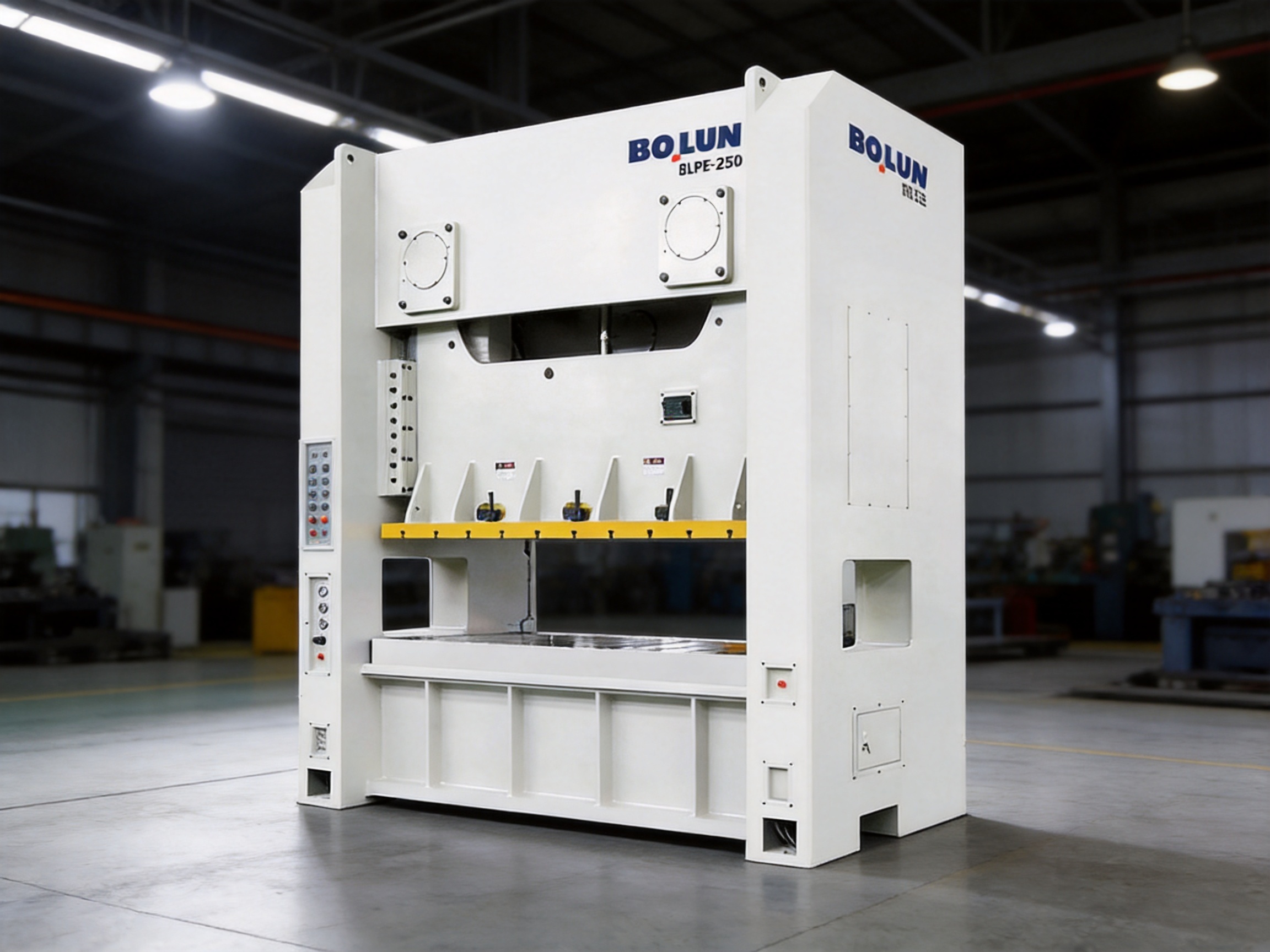
One of the defining strengths of the BLPE-250 is its wide-bed design. The distance between columns reaches 2800 mm, and the worktable measures 2500 x 1000 mm. These dimensions are central to the machine’s identity. They enable the press to support tooling that would be difficult or impossible to install on smaller machines.
Large-format progressive dies are commonly used when manufacturers need efficient, repeatable, high-volume production. A metal strip advances through the die, and multiple operations are performed at different stations with each press stroke. This method can produce complex components rapidly, but the die itself may be long, heavy, and structurally demanding. The BLPE-250’s working space allows such dies to be integrated with fewer restrictions.
For production engineers, a larger table and wider column spacing create flexibility. Die layouts can be optimized for process stability instead of compressed to fit a limited press opening. Toolmakers can include proper station spacing, strong guiding systems, and effective material flow paths. Feed systems and part ejection arrangements can also be planned more naturally. These advantages contribute to smoother production and better part quality.
When compared with presses that offer similar capacity but smaller work areas, the BLPE-250 can provide a significant practical advantage. In many cases, a press is selected not only by tonnage but also by die compatibility. If the machine cannot accept the die, its capacity is irrelevant. The BLPE-250 combines high force with generous dimensions, making it a more versatile solution for large stamping projects.
The wide-bed structure also supports production growth. A manufacturer may begin with medium-sized tooling but later need to run larger products or more advanced progressive dies. Choosing a press with greater working space can protect future investment. The BLPE-250 gives factories room to expand their forming capabilities without immediately requiring a larger machine platform.
Off-center loading is one of the most persistent challenges in stamping. Ideally, the force applied during forming would be perfectly centered under the slide. In reality, this is rarely the case. A progressive die may generate high load in one area and lower load in another. A large panel die may involve uneven material flow. A trimming operation may apply force along one edge. These conditions can create tilting forces that affect slide parallelism and die alignment.
The BLPE-250 addresses this challenge through its closed-type frame, double-point configuration, and robust balance device. These features work together to maintain accuracy. The closed frame resists deformation, the double-point arrangement improves force distribution, and the balance device stabilizes slide movement. This is especially important for large tooling, where even a small angular error can produce measurable quality problems across the width of the part.
Competitor presses with less rigid structures may require more frequent adjustment when exposed to eccentric loading. Operators may need to compensate for uneven forming, adjust die clearances, or slow production to prevent defects. The BLPE-250 is designed to reduce this burden by maintaining stronger mechanical stability. For a production facility, this can mean higher uptime, more predictable output, and better process confidence.
Accuracy under off-center load also protects dies. Dies are expensive assets, especially large progressive dies. If a press applies uneven force or allows slide misalignment, cutting edges, forming surfaces, guide posts, bushings, and stripping components may wear unevenly. Over time, this increases maintenance cost and can shorten die life. A more stable press helps preserve tooling investment.
For customers producing parts with tight dimensional requirements, stable off-center performance is not optional. It is a core requirement. The BLPE-250 is suitable for applications where part repeatability and die protection are directly linked to profitability.
The BLPE-250’s 2500 kN nominal capacity gives it the strength required for demanding sheet metal operations. Capacity is essential when working with thicker materials, larger part areas, complex forming geometries, or dies that combine multiple operations in one stroke. A press with insufficient capacity may struggle, operate near its limit, or produce inconsistent results. The BLPE-250 provides a stronger foundation for heavy-duty work.
The 22 kW main motor supports continuous operation by delivering dependable power to the press system. In industrial production, consistency is as important as peak capability. A machine must repeat its work reliably through shift after shift. The motor capacity is matched to the machine’s heavy-duty purpose, supporting stable pressure delivery for large-scale forming tasks.
Production consistency depends on the interaction of multiple factors: frame rigidity, slide control, motor performance, die support, and manufacturing quality. The BLPE-250 is not simply a high-force machine; it is designed as an integrated forming platform. Its wide bed, closed frame, and balancing features make the available force more usable and more stable.
When compared with lower-cost presses that emphasize only nominal tonnage, the BLPE-250 offers deeper production value. A machine that lists a high capacity but lacks rigidity, working space, or stable slide guidance may not perform well in demanding applications. The BLPE-250 is engineered around real stamping conditions, where die size, eccentric load, continuous running, and precision all matter.
This makes the machine well suited to manufacturers seeking to reduce process variation. Stable production leads to fewer rejected parts, fewer interruptions, and more predictable scheduling. In competitive industries, these operational advantages can be as important as the purchase price of the press itself.
The BLPE-250 is produced by Zhejiang Bolun High-Precision Machinery Co., Ltd., a machinery manufacturer located in Zhejiang, one of China’s important regions for precision manufacturing. The company has developed through two decades of experience in the machinery manufacturing industry and has grown into a modern enterprise integrating research and development, design, production, sales, and service.
This background matters because a power press is not a simple commodity. Its performance depends on engineering judgment, machining precision, assembly discipline, material control, inspection procedures, and service capability. A high-rigidity closed-type press requires careful structural design and accurate processing to ensure that the frame, slide, bolster, drive components, and guiding elements work together as intended.
The company’s manufacturing philosophy emphasizes technical innovation, quality control, and customer-oriented solutions. It has built a full-chain production system covering stages from basic design and core component development to final machine assembly. This integration helps maintain control over quality and allows engineering improvements to be implemented more effectively.
Advanced precision processing equipment is an important part of this capability. For a heavy-duty press, large structural parts must be machined accurately so that the assembled machine maintains proper alignment. Slide movement, die mounting surfaces, guiding systems, and frame interfaces all depend on precise manufacturing. Poor machining accuracy can create problems that cannot be solved through adjustment alone. The manufacturer’s emphasis on precision processing supports the BLPE-250’s high-rigidity concept.
The company also provides non-standard customization capabilities. This is valuable for customers with special production requirements, such as unique die dimensions, particular automation layouts, special feeding systems, or process-specific configurations. A press used in modern manufacturing often needs to integrate with coil lines, transfer equipment, safety systems, and plant-specific workflows. Engineering flexibility enables the machine to be adapted more closely to the customer’s actual production environment.
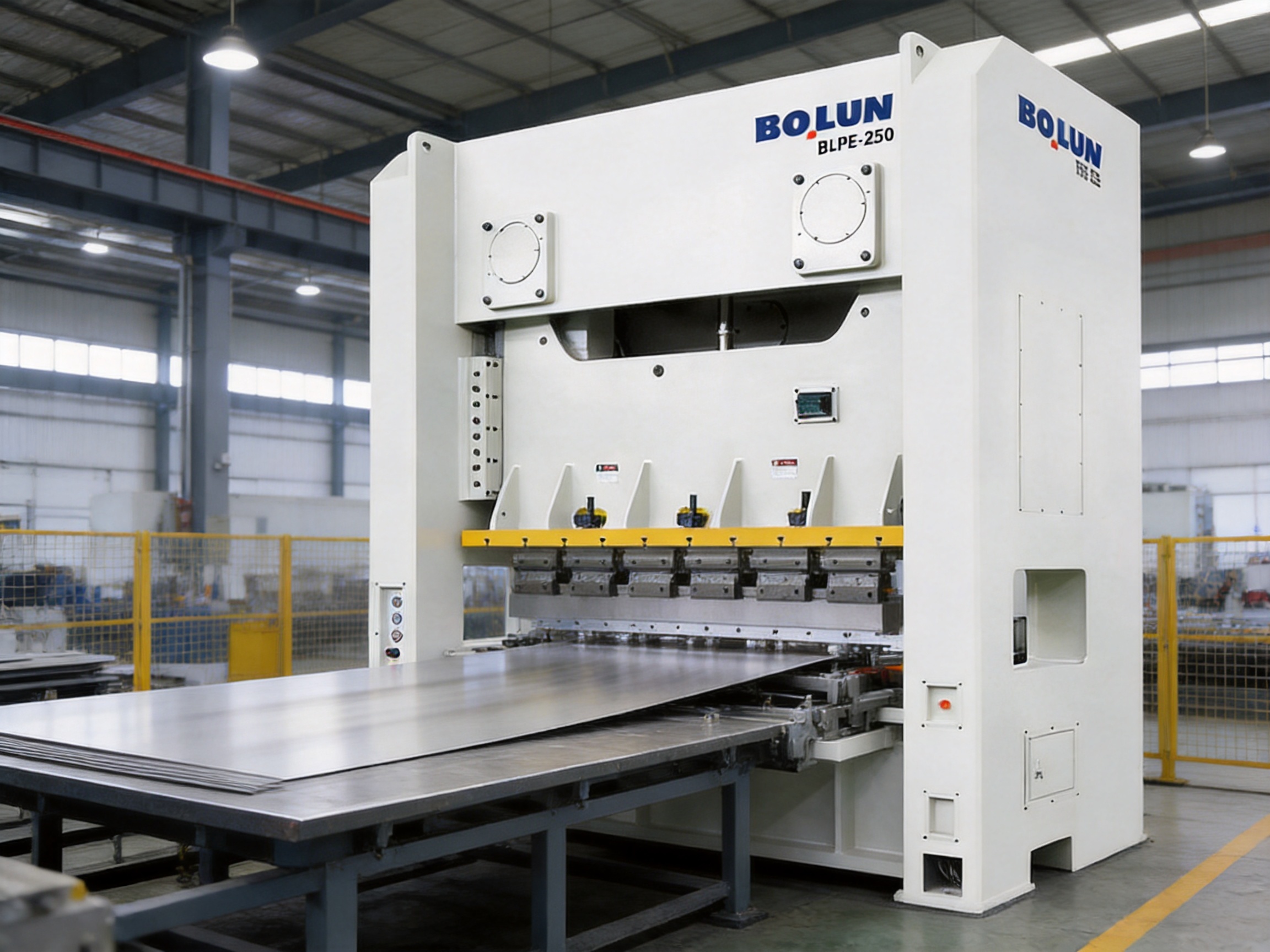
Quality in press manufacturing is achieved through systematic control rather than final inspection alone. Zhejiang Bolun High-Precision Machinery Co., Ltd. has developed a professional production management system based on years of industry accumulation. This system supports stable manufacturing from design planning through machining, assembly, testing, and delivery.
The company actively adopts advanced international production management experience and combines it with the realities of China’s manufacturing environment. This approach helps create a practical, efficient, and disciplined production system. For customers, the result is a machine that reflects not only design capability but also manufacturing consistency.
Finished product inspection is a key part of the company’s quality philosophy. The company has established inspection standards that exceed ordinary industry expectations, checking processes and components to ensure stable precision and long service life under high-intensity operating conditions. For a machine like the BLPE-250, this is essential because the press is intended for demanding workloads and large tooling.
Inspection must focus on the characteristics that affect real production performance: frame alignment, working table accuracy, slide movement stability, component fit, drive reliability, and overall assembly quality. A closed-type double-point press can only deliver its full advantages if manufacturing and assembly are controlled carefully. Even strong design can be undermined by poor execution. The manufacturer’s commitment to rigorous quality control helps ensure that the BLPE-250 performs as expected.
Another important strength is the company’s customer-oriented service system. It covers pre-sales consultation, in-sales support, and after-sales guarantees. In power press purchasing, technical communication before the sale can prevent mismatches between machine and application. Support during production and installation helps the customer move smoothly into operation. After-sales service protects long-term productivity and builds confidence in the equipment investment.
The company’s core philosophy, “Accumulate Richly and Break Forth Thinly; Pressure is Power,” reflects a long-term approach to technical accumulation and industrial performance. This philosophy is relevant to the BLPE-250 because a press is itself a machine that converts controlled pressure into productive power. The product embodies the idea that strength must be guided by precision, discipline, and engineering experience.
The BLPE-250’s competitive advantages can be understood in practical production terms. First, it offers a strong combination of tonnage and working space. Some competitors may provide high nominal capacity but have narrower column spacing or smaller tables. Others may provide wide tables but lack sufficient rigidity or force. The BLPE-250 combines 2500 kN capacity, 2800 mm column spacing, and a 2500 x 1000 mm worktable, creating a balanced solution for large-format operations.
Second, the closed-type frame gives it a structural advantage over many open-type presses used for less demanding applications. Open-type machines can be effective and economical, but their structural layout is not ideal for wide, high-load, precision forming. The BLPE-250’s closed frame improves resistance to deformation, supporting better accuracy and longer die life.
Third, the double-point configuration makes the press more suitable for wide tooling than many single-point alternatives. In large dies, slide parallelism is critical. A double-point drive helps distribute motion and reduce the influence of eccentric forces. This feature is especially valuable for progressive dies, where loads vary across the die length and width.
Fourth, the robust balance device improves stability under off-center loads. Many real stamping operations do not produce symmetrical loads. A press that cannot manage this will require more frequent correction and may produce inconsistent parts. The BLPE-250’s balancing capability supports smoother operation and more reliable output.
Fifth, the manufacturer’s full-chain production system and customization capability provide an advantage beyond the machine’s standard specifications. Customers often need more than a standard press. They need engineering support, application evaluation, layout coordination, and service. Zhejiang Bolun High-Precision Machinery Co., Ltd. has positioned itself as a provider of complete industrial machine tool solutions rather than a simple equipment seller.
Finally, the company’s emphasis on rigorous inspection and long-term quality supports lifecycle value. The lowest initial price is not always the best purchasing decision. In heavy-duty stamping, downtime, scrap, die damage, and production instability can quickly outweigh small savings. A press with stronger rigidity, better alignment, and more reliable support can deliver better total value over its service life.
The BLPE-250 is suitable for manufacturers involved in large-scale sheet metal forming. Its structural features make it particularly valuable for parts that require broad forming areas, wide dies, or multiple forming stations. While specific applications depend on tooling and process design, the machine’s characteristics align well with industries such as automotive components, home appliances, electrical equipment, metal cabinets, hardware manufacturing, industrial enclosures, and structural sheet metal products.
In automotive-related production, wide and stable presses are often needed for brackets, reinforcement parts, panels, and other formed components. Large progressive dies can improve productivity by combining multiple operations in a single automated sequence. The BLPE-250 provides the space and stability needed for such tooling.
In appliance manufacturing, sheet metal parts often require consistent forming quality and attractive surface results. Dimensional repeatability is important because stamped parts must assemble smoothly with other components. A rigid closed-type press helps maintain the process stability needed for high-volume appliance production.
In electrical cabinet and enclosure manufacturing, workpieces may be broad and require accurate punching, bending, and forming. A wide table and generous column spacing make it easier to handle larger dies and wider sheet layouts. The BLPE-250 gives manufacturers the capacity to produce these parts more efficiently.
In hardware and general industrial manufacturing, the press can support heavy-duty production programs where durability and flexibility are important. Its ability to accommodate large dies gives factories more options when planning product families and future expansion.
The industrial value of the BLPE-250 is not limited to making individual parts. It can contribute to improved production systems. By supporting large progressive dies, it may reduce the number of separate operations required. By improving stability, it can reduce adjustment time. By protecting tooling, it can reduce maintenance cost. By supporting high-volume consistency, it can improve delivery reliability.
A power press must combine force and control. Force without control can damage tooling, produce inconsistent parts, and create operational risk. Control without sufficient force limits the range of applications. The BLPE-250 is designed around the balance of these two priorities. Its 2500 kN nominal capacity delivers strength, while its closed frame, double-point layout, and balance device provide control.
The wide-bed design reflects an understanding of real die engineering. Large parts and progressive operations require space. By providing 2800 mm between columns, the machine gives tool designers more freedom. This can improve not only die fit but also die function. Better station spacing, stronger die structures, and improved material flow can all contribute to better production outcomes.
The high-rigidity frame reflects a long-term view of machine performance. A press may appear accurate when new, but the true test is how it performs under continuous load. Structural strength and manufacturing quality determine whether the machine can maintain alignment over time. The BLPE-250 is built for heavy-duty operation where stability must be maintained through repeated cycles.
The balance device reflects attention to the realities of eccentric loading. Stamping is rarely ideal. Materials vary, die stations load differently, and production conditions change. A machine that can manage uneven forces is more forgiving and more reliable. This gives operators and engineers a stronger process window.
The result is a press that supports productivity not through speed claims alone, but through stable, repeatable, and reliable forming. In many factories, the biggest productivity losses come from adjustment, troubleshooting, scrap, and downtime. A robust press platform helps reduce these hidden losses.
Modern manufacturers are under pressure to improve productivity, reduce waste, stabilize quality, and adapt quickly to new product requirements. Equipment selection plays a major role in meeting these goals. A press like the BLPE-250 supports modern manufacturing by enabling large tooling, improving process repeatability, and providing a strong foundation for high-volume production.
The manufacturer’s commitment to intelligent and digital stamping equipment development also aligns with future industry needs. As factories become more connected, forming equipment must be ready to integrate with monitoring, automation, and production management systems. While the BLPE-250’s core value lies in mechanical strength and rigidity, the company’s broader focus on intelligent manufacturing supports long-term competitiveness.
Customization capability is especially important in modern production. Few factories are identical. Floor space, material flow, die standards, safety practices, automation strategies, and product requirements differ from customer to customer. A manufacturer with strong design and engineering teams can help adapt equipment to these realities. This reduces the risk of mismatch and improves the return on investment.
Modern manufacturing also values reliability. High-speed production is valuable only if it remains stable. A press that frequently stops for adjustment or produces inconsistent parts can disrupt the entire production schedule. The BLPE-250’s structural concept is aimed at dependable long-cycle performance, which supports leaner and more predictable manufacturing.
Another modern goal is lifecycle cost control. Buyers increasingly evaluate machines not only by purchase price but also by operating cost, maintenance demand, tooling impact, energy use, service support, and resale value. The BLPE-250’s robust design and manufacturer support system contribute to this broader value calculation.
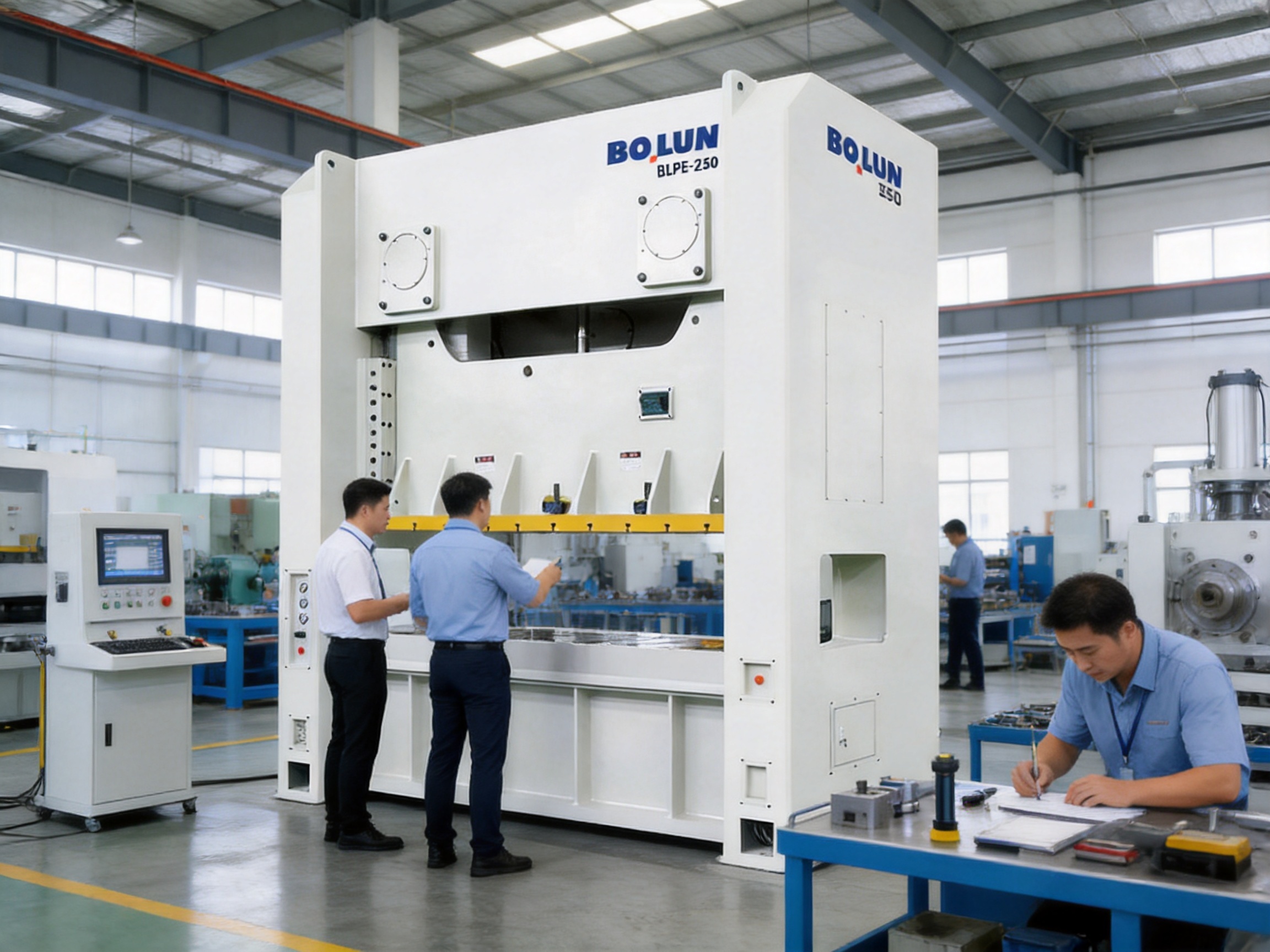
When evaluating the BLPE-250, production teams should begin by analyzing their parts, materials, die dimensions, required tonnage, and long-term product plans. A press should be selected not only for current production but also for future flexibility. The wide-bed layout and 2500 kN capacity make the machine a strong candidate for manufacturers planning to expand into larger dies or more complex forming programs.
Tooling compatibility is one of the most important considerations. The 2500 x 1000 mm worktable and 2800 mm column distance should be compared with current and planned die sizes. Manufacturers should also consider die height requirements, especially for complex tooling. The BLPE-250’s maximum die height of up to 605 mm provides useful space for taller die structures.
Production engineers should also consider load distribution. If operations involve off-center loads, progressive dies, or multiple forming stations, the closed-type double-point structure becomes highly relevant. The machine’s robust balance device can help maintain stability where simpler machines may struggle.
Factory layout should also be reviewed. Large presses require proper foundation planning, material feeding space, coil handling, part removal, operator access, and safety arrangements. The manufacturer’s engineering and service teams can support these discussions, helping the customer align the press with the complete production system.
Maintenance planning is another factor. A high-quality press should be operated with disciplined lubrication, inspection, alignment checks, and tooling maintenance. The BLPE-250’s rigid structure can reduce certain sources of wear, but all heavy-duty production equipment benefits from proper preventive maintenance. A strong after-sales support system helps customers maintain performance over time.
The BLPE-250 can provide several operational benefits when properly matched to the application. The first is improved die compatibility. Its wide dimensions allow manufacturers to run tooling that smaller presses cannot accept. This can open new production opportunities and reduce the need for outsourcing large-format stamping work.
The second benefit is improved forming stability. The closed high-rigidity frame and double-point arrangement support better control under load. This can reduce part variation and help maintain dimensional accuracy over long runs.
The third benefit is tooling protection. Stable press motion and reduced deflection can help dies operate under more uniform conditions. Since large progressive dies are costly, protecting them can significantly improve production economics.
The fourth benefit is production efficiency. A press that supports multi-station progressive dies can reduce secondary operations, shorten production routes, and improve throughput. Even when cycle speed is not the only focus, fewer interruptions and less adjustment time can improve overall productivity.
The fifth benefit is future flexibility. The machine’s wide bed and strong capacity can support a wider range of jobs. This helps manufacturers adapt to changing customer requirements and new product designs.
The sixth benefit is confidence in supplier capability. The company’s integrated manufacturing system, precision processing capability, inspection standards, and service structure provide support beyond the machine itself. For industrial buyers, this supplier strength can reduce purchasing risk.
The BLPE-250 is a closed-type double-point power press. It belongs to the closed-type power press category and is designed for heavy-duty, wide-bed sheet metal forming applications.
The machine has a nominal capacity of 2500 kN, making it suitable for demanding forming operations, large dies, and heavy-duty production requirements.
The 2800 mm column spacing provides generous clearance for wide dies and large-format progressive tooling. This allows manufacturers to install tooling that may not fit into narrower presses.
The worktable measures 2500 x 1000 mm. This large table supports expansive dies and helps provide a stable platform for broad sheet metal forming operations.
The closed-type frame improves rigidity and deformation resistance. This helps maintain alignment under load, improves part consistency, and supports longer die life compared with less rigid structures.
A double-point press distributes driving force across a wider area of the slide. This helps maintain slide parallelism and improves stability when working with wide dies or off-center loads.
The BLPE-250 provides a maximum die height of up to 605 mm, giving manufacturers flexibility for taller and more complex die structures.
The robust balance device helps maintain smooth and accurate slide movement, particularly under off-center load conditions. This is important in progressive die work where force distribution changes across stations.
Compared with many open-type presses, the BLPE-250 offers higher structural rigidity, better resistance to deflection, stronger support for wide tooling, and improved stability under demanding forming loads.
Industries such as automotive components, home appliances, electrical cabinets, metal enclosures, industrial hardware, and large-format sheet metal manufacturing can benefit from the machine’s capacity, rigidity, and wide working area.
Zhejiang Bolun High-Precision Machinery Co., Ltd. uses a full-chain production system, advanced precision processing equipment, rigorous finished product inspection, and a customer-oriented service system to support machine quality and long-term reliability.
Yes. The manufacturer has non-standard customization capabilities and a design team that can provide one-stop design and manufacturing services for customers with special specifications or functional requirements.
The BLPE-250 Robust Wide-Bed Closed-Type Double-Point Press is a heavy-duty forming solution for manufacturers that need more than basic tonnage. It combines 2500 kN nominal capacity with a 2800 mm distance between columns, a 2500 x 1000 mm worktable, a maximum die height of up to 605 mm, and a 22 kW main motor. These features make it especially suitable for large-format sheet metal forming and progressive die production.
Its key advantage lies in the integration of strength, space, and stability. The closed-type high-rigidity frame improves resistance to deformation. The double-point configuration supports wide tooling and slide parallelism. The robust balance device helps maintain accuracy under off-center loads. Together, these features give the machine practical advantages over many open-type, single-point, or narrower competitor presses.
The value of the machine is also strengthened by the capabilities of Zhejiang Bolun High-Precision Machinery Co., Ltd. With two decades of industry experience, integrated R&D and production, precision processing equipment, non-standard customization capabilities, rigorous inspection systems, and customer-focused service, the company provides a manufacturing foundation that supports the machine’s performance claims.
For factories seeking to improve large-format stamping capacity, protect tooling investment, stabilize production quality, and prepare for future product growth, the BLPE-250 offers a compelling combination of heavy-duty engineering and practical production value. It is not simply a press with high force; it is a structured forming platform designed to convert pressure into reliable, repeatable, and profitable manufacturing performance.
Altan, T., and Tekkaya, A. E. Sheet Metal Forming: Processes and Applications. ASM International.
Boljanovic, V. Sheet Metal Forming Processes and Die Design. Industrial Press.
Kalpakjian, S., and Schmid, S. R. Manufacturing Engineering and Technology. Pearson.
Society of Manufacturing Engineers. Tool and Manufacturing Engineers Handbook: Forming. SME.
Wick, C., Benedict, J. T., and Veilleux, R. F. Tool and Manufacturing Engineers Handbook: Material and Part Handling in Manufacturing. SME.


What Is a Power Press? A power press — also called a stamping press or punch pr...
In the fields of metal forming, sheet metal fabrication, blanking, and punching,...
Moscow & St. Petersburg Trade Mission Yields Strong Market Insights and Surg...
Power press machines are classified in two main ways: by frame construction, w...
Understanding Mechanical Power Presses and Their Essential Functions A mechani...
As the manufacturing industry moves steadily toward automation and smart product...
Contact Us

bolunpress@gmail.com

+86-575-83362228

+86-15158259588

+86-575-83362999

+86-15158259588

Hangzhou Office Add: No. 332 Wangjiang East Road, Shangcheng District

No.1 Linjiang Road East, Xiaren, Jinting Town, Shengzhou City, Zhejiang Province, China
Ready to Begin?
Get in Touch

Now!

ZHEJIANG BOLUN
 English
 中文简体
中文简体