
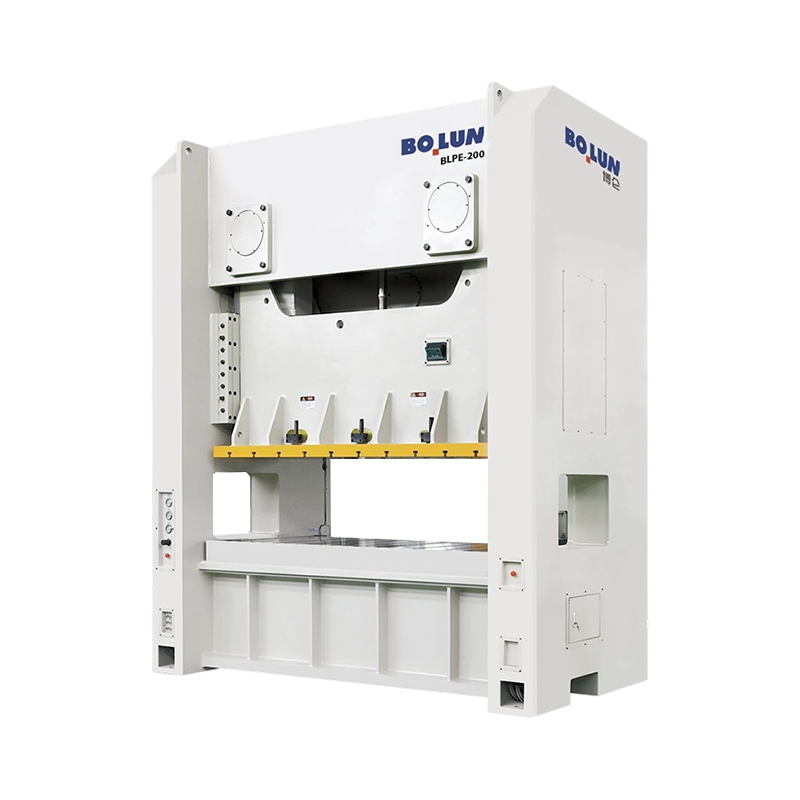
In modern metal forming, manufacturers are under constant pressure to improve productivity, reduce downtime, maintain dimensional accuracy, and integrate stamping equipment into automated production lines. The BLPE-160 High-Efficiency Agile Closed-Type Double-Point Press is designed for exactly this environment. With a nominal capacity of 1600 kN, a high-rigidity closed frame, a balanced double-point slide structure, and a high-speed operating capability of up to 85 strokes per minute in H-type configuration, this press is built for demanding precision stamping applications in automotive components, precision hardware, electronic parts, and other high-volume manufacturing sectors.
The machine belongs to the closed-type double-point press category, a configuration widely preferred when forming accuracy, slide stability, and frame rigidity are critical. Compared with many conventional open-type presses and lower-rigidity stamping machines, a closed-type double-point press offers stronger resistance to deflection, more even force transmission, and better support for continuous operation under demanding load conditions. The BLPE-160 is especially suitable for production lines requiring repeatable accuracy, stable tonnage delivery, responsive clutch-brake performance, and compatibility with automated feeding, transfer, and monitoring systems.
For manufacturers seeking to upgrade from older mechanical presses or expand high-speed stamping capacity, the BLPE-160 represents a practical balance between productivity, accuracy, structural strength, and operational reliability. Its 1800 × 760 mm worktable provides a suitable platform for a wide range of dies, while its dry clutch brake system supports responsive control and safer, more consistent machine operation. The heat-treated steel frame is engineered to reduce vibration and maintain JIS Class 1 accuracy, helping manufacturers reduce scrap, extend die life, and improve production consistency.
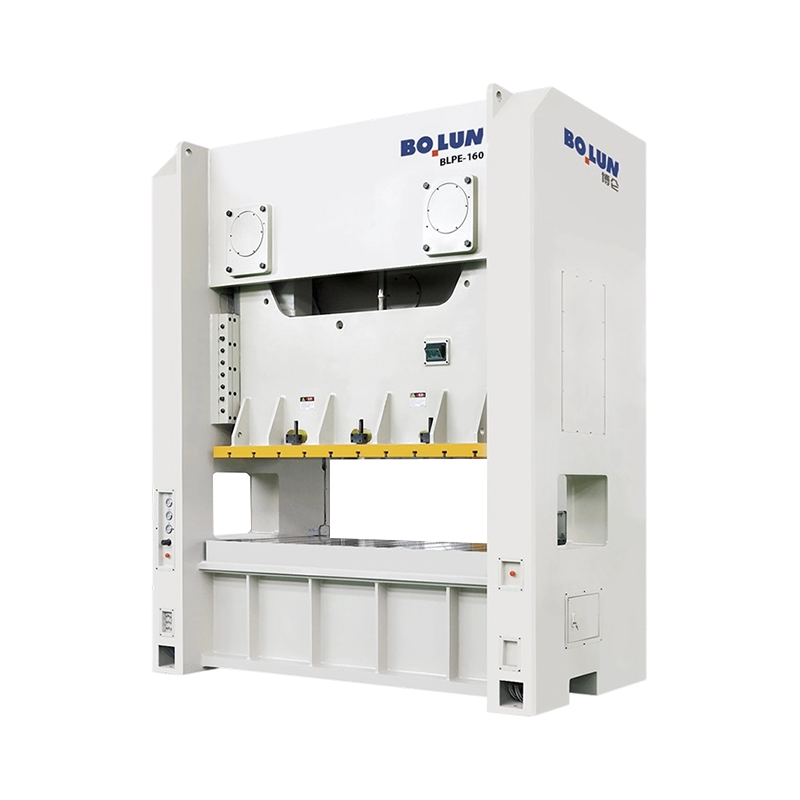
BLPE-160 High-Efficiency Agile Closed-Type Double-Point Press
The BLPE-160 is not merely a press with a large capacity rating. It is a production-oriented forming platform intended for high-speed precision stamping. In industrial stamping, press selection directly affects output efficiency, die performance, dimensional control, maintenance frequency, operator safety, and final part quality. A machine may appear similar in rated capacity, but differences in frame design, slide guidance, drive structure, clutch-brake response, manufacturing precision, and assembly quality can produce substantial differences on the factory floor.
The closed-type double-point structure of this press makes it particularly suitable for longer dies, progressive dies, multi-station stamping operations, and production tasks where balanced force distribution across the slide is essential. In a single-point press, the main driving force is delivered through one connection point, which may be sufficient for smaller dies or narrower parts. However, when the tooling is wider or the forming load is distributed across a larger area, double-point drive architecture provides more stable slide movement and reduces the risk of uneven loading. This helps maintain parallelism between the slide and the bolster, improving part consistency and protecting the die.
In automotive stamping, components such as brackets, connectors, clips, reinforcement pieces, and precision structural parts often require repeatable forming accuracy over long production runs. In electronics and precision hardware manufacturing, tolerances can be even more demanding, and the cost of inconsistent forming can be significant. By delivering stable operation at high speed, the BLPE-160 supports manufacturers that need both volume and accuracy, not one at the expense of the other.
The BLPE-160 delivers a nominal capacity of 1600 kN, making it suitable for medium-to-heavy precision stamping operations. Its double-point design allows force to be transmitted more evenly across the slide, reducing the likelihood of eccentric load effects and helping the machine maintain forming accuracy throughout continuous operation. The closed frame provides a rigid mechanical foundation, helping reduce deformation under load when compared with open-back designs of similar nominal capacity.
The press can reach up to 85 strokes per minute in H-type configuration. This speed capability is important for manufacturers operating progressive dies or automated production systems where every stroke contributes to output volume. Higher stroke rates, however, are valuable only when the press can maintain stability. The BLPE-160 addresses this requirement through a high-rigidity frame, heat-treated steel construction, vibration-reducing design, and precise assembly practices.
The 1800 × 760 mm worktable gives users practical die installation space for a range of production tasks. A generous table size supports tooling flexibility and allows manufacturers to run parts requiring more complex die layouts. The sensitive dry clutch brake system provides responsive machine control, supporting controlled engagement and stopping. In automated production, clutch-brake responsiveness is essential for synchronization with feeders, straighteners, decoilers, transfer systems, sensors, and safety equipment.
Another defining feature is the machine’s emphasis on maintaining JIS Class 1 accuracy. Accuracy standards matter because stamping presses are not evaluated only by tonnage or speed. Slide parallelism, repeatability, frame rigidity, dynamic stability, and motion precision all influence the final stamped product. A press with strong accuracy retention reduces production instability, helps extend die life, and supports consistent output across long shifts.
| Item | BLPE-160 Feature | Production Value |
|---|---|---|
| Press Type | Closed-type double-point press | Improves slide balance and supports stable forming over wider dies |
| Nominal Capacity | 1600 kN | Suitable for medium-to-heavy precision stamping applications |
| Maximum Speed | Up to 85 strokes per minute in H-type configuration | Supports high-output automated production |
| Frame Structure | High-rigidity heat-treated steel frame | Reduces vibration and improves long-term accuracy retention |
| Accuracy Level | Designed to maintain JIS Class 1 accuracy | Helps reduce scrap and improve dimensional consistency |
| Worktable Size | 1800 × 760 mm | Provides practical space for progressive and precision tooling |
| Clutch Brake | Sensitive dry clutch brake system | Enables responsive control and stable operation in automation |
| Application Areas | Automotive components, precision hardware, electronic parts | Meets the needs of high-speed, high-accuracy stamping industries |
In mechanical press design, frame structure is one of the most important factors influencing performance. Open-type presses are often convenient for general-purpose stamping because they provide easy access from multiple sides and can be economical for smaller applications. However, the open frame naturally has limitations in rigidity. Under heavy load or eccentric load, the frame may deform more noticeably, causing variation in slide position and affecting part accuracy.
A closed-type frame surrounds the working area with a more complete structural loop. This design resists deflection more effectively and improves the alignment between the slide and the bed. For precision stamping, especially when using progressive dies, this difference can be decisive. If the slide does not remain parallel to the die surface, the die can experience uneven wear, parts can be formed inconsistently, and production may suffer from burrs, dimensional deviation, or premature tool failure.
The BLPE-160 uses a high-rigidity steel frame that is heat-treated to improve dimensional stability and reduce internal stress. Heat treatment is important because large steel structures can retain residual stresses after welding, casting, machining, or fabrication. If these stresses are not properly managed, the frame may distort over time or under repeated operating loads. By applying appropriate heat treatment and precision finishing processes, the press can maintain stable geometry during long-term use.
This structural approach gives the BLPE-160 an advantage over competitors that rely primarily on basic frame mass rather than optimized rigidity, stress relief, and precision machining. A heavy machine is not automatically a precise machine. What matters is how the structure is designed, processed, assembled, inspected, and maintained. The BLPE-160 focuses on controlled rigidity, vibration resistance, and accuracy retention, which are crucial for high-efficiency stamping environments.
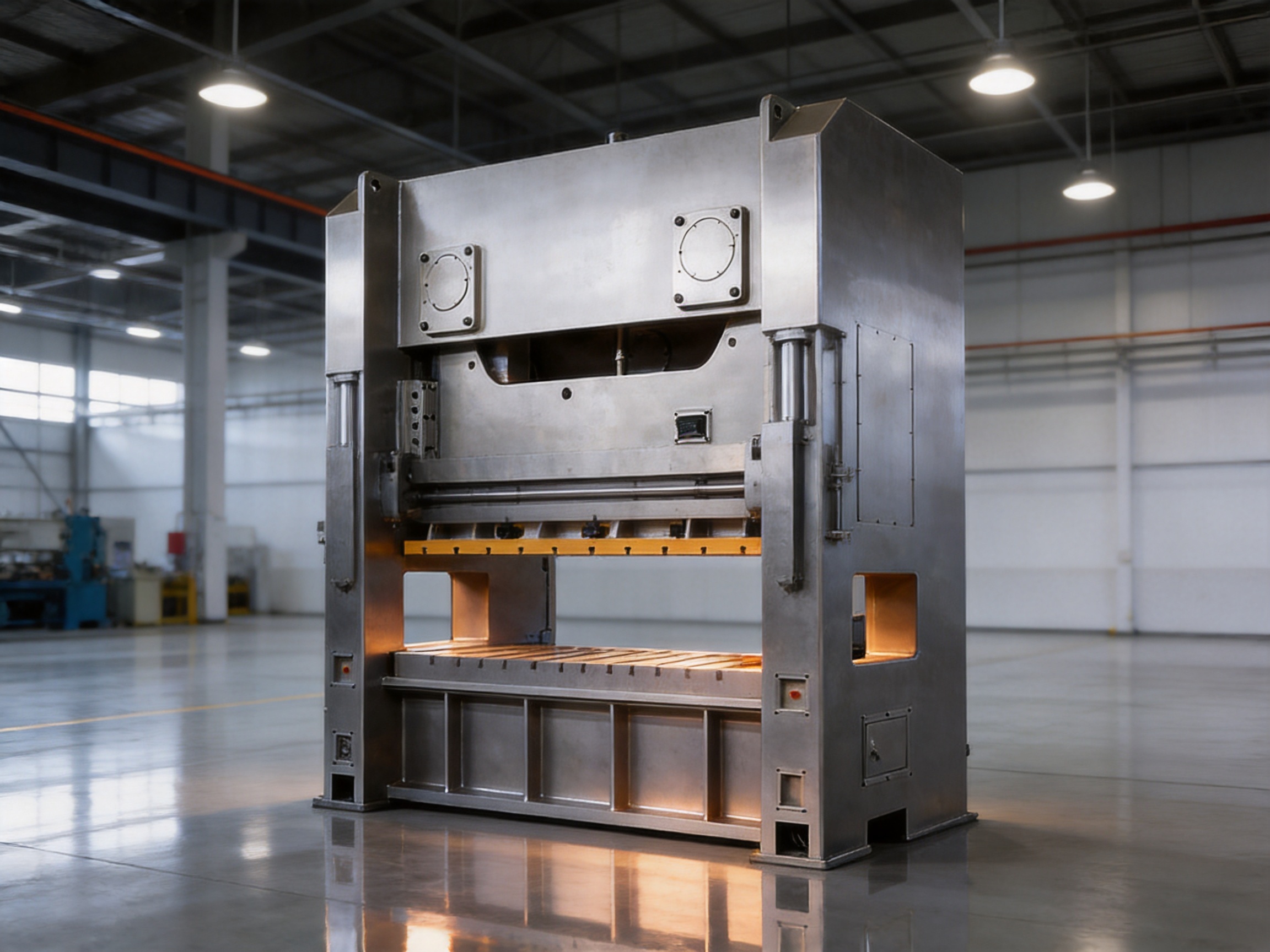
The double-point structure is a central advantage of the BLPE-160. In stamping, the slide must move with high repeatability and remain properly aligned throughout the stroke. If the load is not centered, the slide may tilt slightly, causing uneven pressure on the die. This problem becomes more significant with wider tooling, long progressive dies, or stamping processes that distribute forming force across multiple stations.
By applying force through two points, the press improves load distribution across the slide. This helps maintain slide parallelism and reduces the negative effects of eccentric loading. The result is more stable forming, improved die protection, and better dimensional consistency. For manufacturers running high-speed progressive dies, the double-point structure can help reduce downtime associated with die adjustment, tool wear, and quality variation.
Compared with competing single-point machines of similar nominal tonnage, the BLPE-160 offers stronger suitability for wider dies and more demanding production layouts. A single-point press may perform well in simpler applications, but when production requires high repeatability across a larger die area, the double-point mechanism provides a stronger mechanical foundation. This is especially valuable in sectors where parts must meet strict quality standards, such as automotive and electronic component manufacturing.
The double-point structure also supports smoother high-speed operation. At elevated stroke rates, dynamic forces increase, and any imbalance becomes more noticeable. A stable two-point driving arrangement contributes to smoother motion and better control of slide behavior. This is not only a matter of part accuracy; it also affects noise, vibration, die life, bearing life, and operator confidence.
Speed is one of the most visible performance indicators for a stamping press. A maximum operating speed of up to 85 strokes per minute in H-type configuration allows the BLPE-160 to support efficient continuous production. In a high-volume stamping plant, increasing strokes per minute can significantly improve output, especially when combined with automated feeding and part handling systems.
However, speed has value only when the press can maintain accuracy, safety, and reliability. Running a low-rigidity press at high speed may create vibration, increase wear, reduce part consistency, and raise maintenance costs. The BLPE-160 is designed to avoid this trade-off by combining speed capability with a rigid frame, double-point force transmission, responsive clutch-brake control, and precision manufacturing practices.
For automated production lines, stable high-speed performance improves the efficiency of the entire system. Feeders, coil lines, transfer equipment, sensors, and downstream handling devices depend on predictable press timing. A responsive dry clutch brake system helps the press start and stop accurately, while stable mechanical movement supports synchronization. This is especially important in progressive stamping, where each stroke must align precisely with the feed pitch.
Compared with lower-grade high-speed presses that may focus mainly on stroke rate, the BLPE-160 emphasizes balanced production performance. It aims to deliver speed, accuracy, structural integrity, and controllability together. This makes it a strong choice for manufacturers that cannot afford frequent line stoppages, unstable quality, or excessive die maintenance.
The press is equipped with a 1800 × 760 mm worktable, which provides practical space for a variety of dies used in precision stamping. Worktable size affects the range of tooling that can be installed and the types of production processes that can be supported. For manufacturers using progressive dies, multi-station tools, or complex forming layouts, sufficient bed area is essential.
A larger worktable also improves production flexibility. When a factory invests in a press, it often expects the machine to support multiple products over its service life. The BLPE-160’s worktable dimensions allow users to adapt to changing production requirements, install different die configurations, and handle both current and future stamping projects. This adaptability increases long-term equipment value.
The double-point slide structure complements the worktable size. A wide table is most useful when the slide can apply force evenly across the tooling area. If the press structure cannot maintain balanced pressure, a larger table may not translate into better performance. The BLPE-160 combines table capacity with double-point loading and a closed frame, creating a more complete solution for precision tooling.
In competitive comparison, some presses may offer similar nominal tonnage but less practical tooling space, weaker slide guidance, or lower rigidity. The BLPE-160’s configuration is designed for manufacturers who need not only rated power but also functional die support, stable forming geometry, and dependable operation over long production runs.
The sensitive dry clutch brake system is another important feature of the BLPE-160. In a mechanical press, the clutch and brake control the engagement and stopping of the press drive. Responsiveness, reliability, and repeatability are essential for safe and efficient operation. A high-quality clutch brake system allows the machine to respond accurately to control signals, which is especially important in automated stamping lines.
Dry clutch brake systems are valued for their responsive behavior, relatively straightforward maintenance, and suitability for frequent cycling. In production environments where speed and timing accuracy matter, clutch-brake performance directly affects line synchronization. A slow or inconsistent system can cause feed errors, misalignment, part defects, or safety risks. The BLPE-160’s sensitive system helps maintain consistent operational control.
For operators and production managers, responsive control improves confidence. The press can be integrated more effectively with safety devices, automation systems, and monitoring equipment. This supports a more stable production rhythm and reduces the likelihood of interruptions. In comparison with machines using less refined control systems, the BLPE-160 offers a stronger foundation for modern automated manufacturing.
The clutch brake system also contributes to die protection. If the press can stop and respond accurately, it is easier to prevent damage during abnormal feeding, misalignment, or sensor-triggered interruptions. This can reduce tooling repair costs and protect production schedules. In high-volume stamping, avoiding a single major die crash can justify significant investment in better machine control.
Accuracy is not a one-time measurement taken during machine installation. In real production, accuracy must be maintained under repeated loading, high-speed operation, thermal variation, and long working hours. The BLPE-160 is designed to maintain JIS Class 1 accuracy, reflecting its focus on stable performance and precision forming. For users, this means more consistent parts, reduced adjustment time, and better confidence in production quality.
Vibration control is closely connected to accuracy. Excessive vibration can affect the slide motion, reduce tooling life, loosen components, increase noise, and create unstable production conditions. The high-rigidity heat-treated frame of the BLPE-160 helps reduce vibration and improve operating stability. The double-point structure also contributes by distributing force more evenly and minimizing dynamic imbalance.
Long-term reliability depends on the entire machine system: frame, drive mechanism, slide guidance, clutch brake, lubrication, electrical control, machining quality, assembly precision, and inspection standards. A press that performs well when new but loses accuracy quickly can create high hidden costs. The BLPE-160 is built with attention to structural stability and precision manufacturing, helping users achieve more predictable long-term performance.
Compared with competitors that may prioritize low upfront cost, the BLPE-160 offers stronger value through reduced scrap, lower maintenance pressure, stable productivity, and longer tooling life. For manufacturers calculating total cost of ownership, these advantages can be more important than the initial purchase price. A reliable press protects production continuity and supports customer delivery commitments.
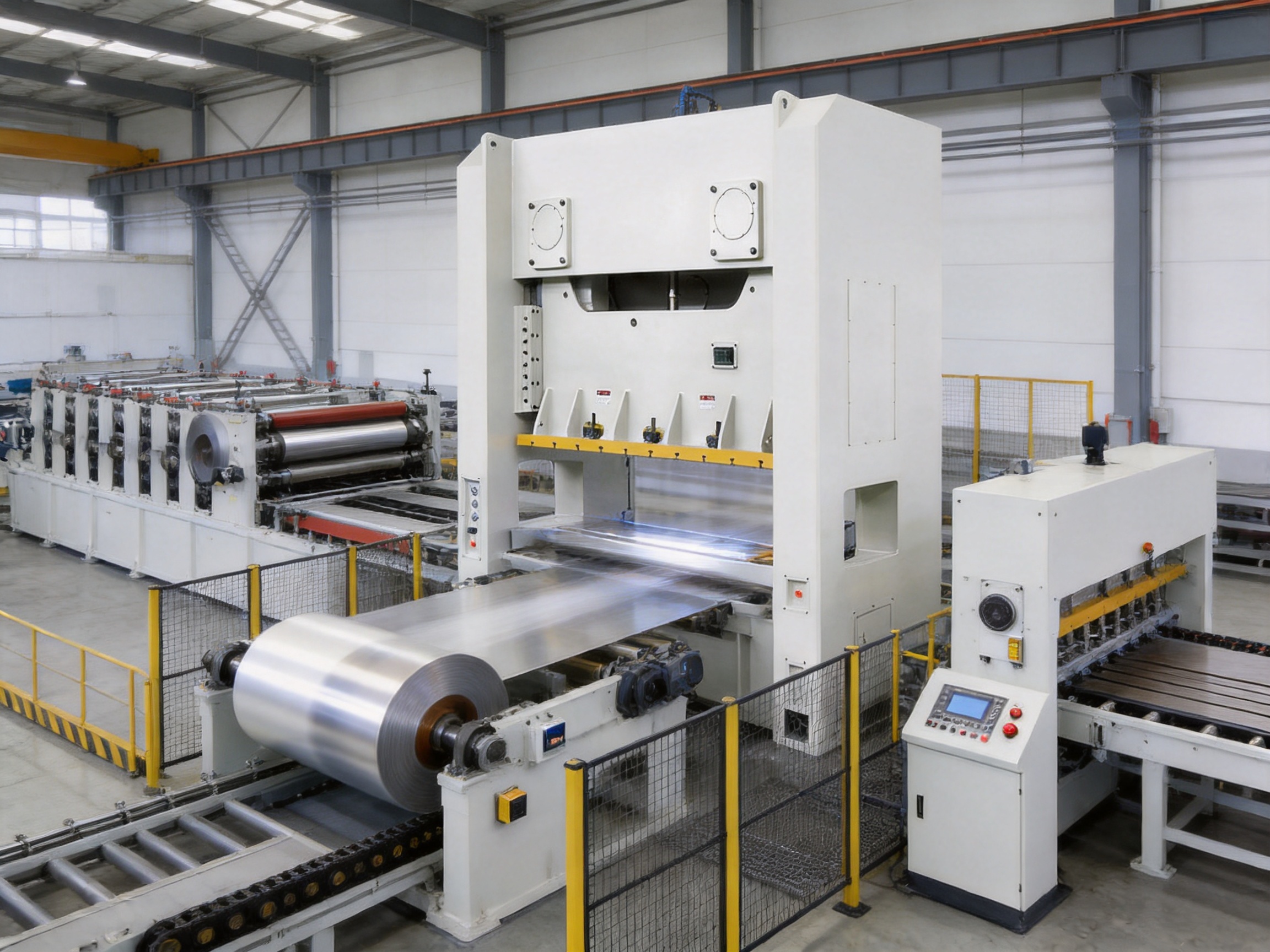
The automotive industry demands high repeatability, efficient output, and strict process control. Many stamped automotive parts must meet exact dimensional requirements because they are assembled into larger systems. Even small variations can cause fit problems, noise, durability issues, or downstream assembly delays. The BLPE-160 is well suited for automotive component stamping because it combines 1600 kN capacity, stable double-point force distribution, and high-speed production capability.
Typical applications may include brackets, mounting plates, reinforcement parts, clips, washers, connectors, shields, and various precision structural elements. These components often require progressive die stamping, piercing, bending, forming, and trimming operations. The 1800 × 760 mm worktable supports complex tooling layouts, while the closed frame helps maintain alignment under load. The machine’s high-speed capacity helps manufacturers meet large production volumes without compromising stability.
Automotive suppliers also face strict quality audits and production traceability requirements. Equipment stability plays an important role in meeting these expectations. A press that can maintain accuracy over long production runs reduces the frequency of dimensional drift and process correction. This helps suppliers improve first-pass yield, reduce inspection burden, and maintain customer confidence.
In comparison with general-purpose presses, the BLPE-160 provides a more specialized solution for precision automotive stamping. Its rigidity, slide stability, responsive control, and high-speed operation align with the needs of modern automotive production lines, particularly those seeking to automate and standardize output.
Precision hardware manufacturing includes a wide range of products such as metal fittings, fastener-related components, hinges, clips, lock parts, small structural pieces, and industrial accessories. These products are often produced in large quantities and require consistent forming quality. The BLPE-160 supports these applications by offering stable slide motion, strong frame rigidity, and reliable operation at high speeds.
In precision hardware, tooling costs can be significant, and die life directly affects profitability. A rigid press helps reduce uneven die loading and premature wear. The double-point structure of the BLPE-160 is especially useful when dies include multiple stations or when part geometry requires balanced force across a wider area. This supports cleaner forming, more consistent punching, and improved edge quality.
High productivity is also important. Hardware parts are often price-sensitive, so production efficiency can determine competitiveness. With up to 85 strokes per minute, the BLPE-160 helps manufacturers increase throughput while maintaining process control. When combined with automated coil feeding, scrap removal, and part collection, the press can become the core of an efficient production cell.
Compared with less rigid mechanical presses, the BLPE-160 can reduce the need for frequent die adjustment and quality correction. This advantage becomes more visible over long production runs, where small improvements in stability can produce substantial savings in time, material, and labor.
Electronic parts manufacturing often requires extremely precise metal stamping. Connectors, terminals, shielding parts, contact components, spring elements, and micro-precision hardware must be produced with tight tolerances and clean edges. Although the BLPE-160 is a powerful 1600 kN press, its precision-oriented design also makes it relevant for electronic component manufacturers using larger progressive dies or producing high volumes of precision metal parts.
Electronic components frequently require high-speed production because part sizes may be small and order quantities large. High stroke rates improve productivity, but only if feed accuracy, slide stability, and die alignment remain consistent. The BLPE-160’s closed frame and double-point structure help maintain the mechanical stability needed for precision stamping at speed.
Many electronic parts are made from thin materials, where excessive vibration or poor alignment can cause burrs, deformation, or inconsistent contact geometry. A rigid and accurate press helps maintain clean forming conditions. The responsive dry clutch brake system also supports integration with high-precision feeders and sensor systems, allowing a more controlled production process.
For manufacturers competing in electronics supply chains, quality consistency and delivery speed are both essential. The BLPE-160 supports these goals by combining productivity with accuracy retention, making it a strong alternative to lower-rigidity machines that may struggle to maintain precision during continuous operation.
The BLPE-160 offers several practical advantages over many conventional presses. First, its closed-type frame provides stronger rigidity than typical open-type designs. This improves resistance to deflection and supports more accurate forming. Second, the double-point structure offers better force distribution than single-point machines, especially for wider dies and multi-station tooling. Third, the machine supports high-speed operation while maintaining a focus on vibration reduction and accuracy.
Another advantage is its suitability for automation. Modern factories increasingly rely on automated feeding, transfer, inspection, and data monitoring systems. A press must be predictable and responsive to work effectively in such environments. The BLPE-160’s sensitive dry clutch brake system and stable mechanical structure support automated production line integration. This gives it an edge over older machines that may lack the control response and consistency required for modern manufacturing.
Compared with competitors that may focus mainly on capacity ratings, the BLPE-160 provides a more comprehensive performance package. Nominal capacity is important, but it does not guarantee production quality. A superior press must combine tonnage, rigidity, speed, accuracy, control, and long-term reliability. The BLPE-160 is designed around this broader understanding of stamping productivity.
The press also offers value through reduced hidden costs. Poor press stability can lead to scrap, die damage, downtime, maintenance labor, inconsistent quality, and customer complaints. A machine that maintains precision and runs reliably can improve profitability even if its initial investment is higher than lower-grade alternatives. For manufacturers focused on long-term production competitiveness, these operational savings are highly significant.
The performance of a precision press depends not only on design, but also on the manufacturing strength of the company that produces it. Zhejiang Bolun High-Precision Machinery Co., Ltd. is located in Zhejiang, a major center of precision manufacturing in China. With two decades of experience in machinery manufacturing, the company has developed into a modern enterprise integrating research and development, design, production, sales, and service.
The company’s manufacturing philosophy emphasizes technical innovation, process control, and long-term quality. It has built a full-chain production system that covers product design, core component development, precision processing, machine assembly, inspection, and service support. This integrated capability allows the company to control quality throughout the production process rather than relying only on final inspection.
Advanced precision processing equipment plays an important role in producing high-performance presses. Large press frames and key mechanical components require accurate machining to ensure alignment, parallelism, and motion stability. If machining quality is poor, even a strong design cannot achieve its intended performance. Bolun’s production system focuses on precise processing, careful assembly, and rigorous quality verification to support stable machine accuracy.
The company also has non-standard customization capability. This is important because stamping manufacturers often have unique requirements related to tooling size, automation layout, production speed, safety systems, or factory space. A supplier with strong design and manufacturing capability can provide solutions that match the user’s production reality, rather than offering only standard equipment. This customer-oriented approach increases the practical value of the BLPE-160 and related press products.
Research and development are central to the company’s competitiveness. In press manufacturing, innovation may involve structural optimization, vibration reduction, drive system improvement, control integration, lubrication design, safety enhancement, and automation compatibility. The BLPE-160 reflects this engineering focus through its closed-type double-point structure, high-speed capability, and accuracy-oriented frame design.
The company’s design team provides one-stop design and manufacturing services for products with special specifications and functions. This capability is valuable in industries where production requirements are becoming more complex. Customers may need presses adapted for specific progressive dies, coil feeding systems, robotic transfer lines, safety guarding, monitoring devices, or plant layout restrictions. A flexible engineering team can help improve overall production efficiency by designing equipment around the customer’s process needs.
Compared with suppliers that offer limited customization, Bolun’s engineering capability gives customers greater flexibility. Instead of forcing users to adapt their production process to a standard machine, the company can support tailored solutions. This approach is especially beneficial for manufacturers developing new products or upgrading from manual and semi-automatic processes to automated stamping lines.
Design strength also affects maintainability. A well-engineered press should allow practical maintenance access, reliable lubrication, stable component operation, and clear adjustment procedures. These factors reduce downtime and make the machine easier to manage over its service life. By combining production experience with customer feedback, the company can continuously improve machine usability and performance.
Quality control is described as the lifeline of the company, and this principle is essential in high-precision machinery. A stamping press contains numerous components that must work together under repeated dynamic load. If one critical element is poorly processed, installed, or inspected, the entire machine’s performance can be affected. For this reason, strong process control is required from material preparation through final assembly.
The company has established a finished product inspection system that exceeds industry standards. Such inspection may include dimensional verification, assembly accuracy checks, slide movement testing, clutch-brake response evaluation, noise and vibration observation, lubrication system confirmation, safety function testing, and trial operation. This helps ensure that each press delivered to customers can perform reliably under demanding production conditions.
Quality control also includes attention to components and intermediate processes. Waiting until final inspection to find problems is inefficient and risky. A mature production management system checks quality at each stage, reducing rework and improving consistency. For a machine like the BLPE-160, which must maintain JIS Class 1 accuracy, process discipline is especially important.
Compared with lower-cost competitors that may rely on simplified inspection or inconsistent process management, Bolun’s quality philosophy supports stronger long-term machine value. Customers benefit from more stable precision, longer service life, and fewer unexpected production interruptions. In high-volume stamping, these benefits directly affect profitability.
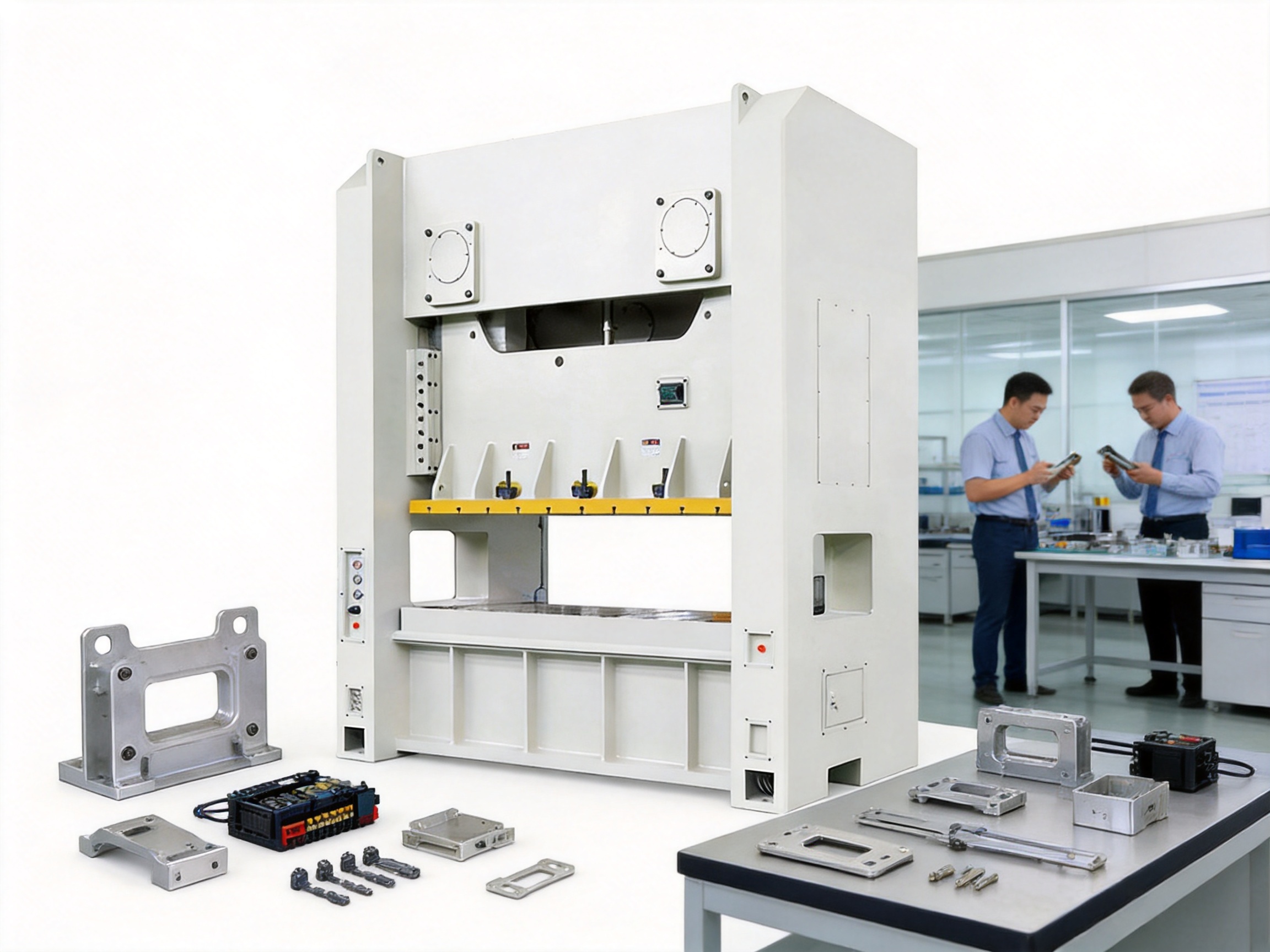
The BLPE-160 is well suited for automated production line integration. In modern stamping plants, a press is often connected with decoilers, straighteners, servo feeders, die protection sensors, part conveyors, scrap systems, robotic transfer devices, and centralized control systems. The press must operate predictably and communicate effectively with surrounding equipment to maintain line efficiency.
The machine’s high-speed capability supports continuous automated production, while its responsive dry clutch brake system contributes to accurate timing. Stable slide motion helps ensure that each feed cycle aligns properly with the die. The closed frame and double-point structure reduce mechanical instability that could otherwise interfere with automation accuracy. These characteristics make the BLPE-160 a practical foundation for automated stamping cells.
Automation also increases the importance of reliability. In a manual production setting, operators may detect and correct small issues quickly. In automated production, problems can escalate rapidly if the press does not stop accurately or if sensors are not properly integrated. A stable and responsive press helps reduce these risks. The BLPE-160’s control-oriented design supports safer and more dependable automated operation.
For manufacturers pursuing intelligent and digital stamping production, a mechanically stable press is the starting point. Digital monitoring can collect data, but the underlying machine must be precise and reliable. The company’s future-oriented focus on intelligent and digital stamping equipment aligns with the needs of factories upgrading toward smart manufacturing.
Safety is a fundamental concern in press operation. A powerful mechanical press must be equipped and operated with proper guarding, control systems, emergency stop functions, and maintenance procedures. While safety depends on the complete production environment, press design plays an important role. Responsive clutch-brake performance, stable mechanical movement, and reliable control integration all contribute to safer operation.
The BLPE-160’s sensitive dry clutch brake system supports accurate start and stop behavior. This is important for both normal production and abnormal situations. When connected with appropriate safety systems and die protection devices, responsive stopping can help reduce the risk of equipment damage and improve operator protection. Stable operation also reduces unexpected machine behavior, supporting a safer working environment.
Production confidence is closely related to safety and reliability. Operators and managers need to trust that the press will perform consistently. A machine that vibrates excessively, drifts in accuracy, or responds unpredictably creates stress and increases the risk of mistakes. The BLPE-160’s rigid frame, double-point slide support, and quality manufacturing help create a more controlled production environment.
Compared with aging presses or machines built with lower process standards, the BLPE-160 offers improved confidence for both operators and production engineers. It is designed for modern manufacturing environments where safety, productivity, and quality must be managed together.
When evaluating press equipment, purchase price is only one part of the investment decision. Total cost of ownership includes installation, training, energy use, maintenance, spare parts, downtime, scrap, die wear, quality losses, and production efficiency. A lower-cost press may become expensive if it causes frequent stoppages, inconsistent parts, or premature tooling damage. The BLPE-160 provides value by addressing these hidden cost factors.
Its rigid closed frame and double-point structure help reduce forming inconsistency and die stress. This can lower scrap rates and extend die life. Its high-speed capability improves output per unit time, supporting better equipment utilization. Its dry clutch brake system improves control responsiveness, reducing the risk of feed errors and supporting automation. Its accuracy-oriented manufacturing helps maintain stable performance over long use.
For factories running high-volume production, even small improvements in uptime and yield can create major financial benefits. A press that reduces scrap by a small percentage or prevents frequent die adjustments can save substantial material, labor, and time. The BLPE-160 should therefore be considered not only as a machine purchase, but as a long-term production asset.
Compared with competitors offering basic press configurations, the BLPE-160’s value lies in its combination of productivity, precision, durability, and automation readiness. This makes it especially suitable for manufacturers that compete on quality and delivery reliability rather than only on lowest equipment cost.
Equipment performance is also influenced by the supplier’s service system. Zhejiang Bolun High-Precision Machinery Co., Ltd. provides customer-oriented support covering pre-sales consultation, in-sales support, and after-sales guarantees. This service approach is important because press selection, installation, commissioning, and maintenance require technical understanding.
During pre-sales consultation, customers may need help evaluating capacity requirements, die compatibility, automation plans, and production goals. A knowledgeable supplier can help prevent incorrect machine selection and improve project success. During the sales and delivery process, technical coordination helps ensure that machine configuration aligns with the customer’s plant requirements. After installation, service support helps maintain stable operation and resolve problems efficiently.
The company’s experience in machinery manufacturing and its one-stop design capability improve its ability to support customers with special requirements. For manufacturers outside China, international management perspective and practical communication are important. The company’s willingness to work with global partners reflects its commitment to broader industrial cooperation and long-term customer relationships.
Strong service support differentiates the BLPE-160 from machines supplied without comprehensive technical backing. A precision press is a long-term asset, and the supplier’s ability to provide guidance, parts, and technical assistance contributes significantly to customer satisfaction.
The company’s development has been shaped by two decades of accumulation in machinery manufacturing. From early challenges to its current role in high-precision forming equipment, it has established a professional, mature, and efficient production management system. Its core philosophy, “Accumulate Richly and Break Forth Thinly; Pressure is Power,” reflects a practical industrial spirit: technical strength is built over time, and pressure becomes a force for improvement.
This philosophy is visible in the BLPE-160. The press is not designed as a superficial specification product. It reflects accumulated experience in frame rigidity, drive balance, accuracy control, and production reliability. The company’s commitment to quality and credit first supports its goal of providing stable industrial machine tool solutions to global customers.
The company promotes a work style characterized by steadiness, rigor, openness, and mutual support. In precision machinery manufacturing, these values matter. Steadiness supports careful process control. Rigor supports quality inspection and assembly accuracy. Openness supports technical learning and international cooperation. Mutual support strengthens service and customer relationships.
Looking forward, the company plans to deepen its presence in high-end, precision, and advanced manufacturing fields. It will continue to follow global machinery trends, invest in intelligent and digital stamping equipment, optimize resources, stabilize product quality, and enhance industrial chain competitiveness. This direction aligns with the needs of manufacturers seeking smarter, more efficient, and more reliable stamping solutions.
The BLPE-160 is a closed-type double-point mechanical power press designed for high-efficiency precision stamping. It is suitable for automated production lines and applications that require stable slide movement, balanced force distribution, and consistent forming accuracy.
The press has a nominal capacity of 1600 kN, making it suitable for medium-to-heavy precision stamping tasks in industries such as automotive components, precision hardware, and electronic parts manufacturing.
The double-point structure distributes force more evenly across the slide. This reduces the risk of slide tilting, improves forming stability, supports wider dies, and helps maintain part accuracy during high-speed production.
In H-type configuration, the BLPE-160 can reach up to 85 strokes per minute. This speed supports efficient continuous production, especially when the press is integrated with automated feeding and handling systems.
The closed-type frame offers higher rigidity than many open-type press designs. It resists deformation under load, reduces vibration, improves slide-to-bed alignment, and helps maintain precision over long production runs.
The machine is suitable for automotive component manufacturing, precision hardware production, electronic parts stamping, and other high-speed precision forming applications that require stable operation and repeatable accuracy.
The BLPE-160 supports automation through stable high-speed operation, responsive dry clutch brake control, a rigid structure, and predictable slide movement. These features make it suitable for integration with decoilers, straighteners, feeders, sensors, conveyors, and transfer systems.
Its main competitive advantages include a high-rigidity heat-treated closed frame, double-point force distribution, up to 85 strokes per minute, JIS Class 1 accuracy orientation, a 1800 × 760 mm worktable, and strong manufacturing support from an experienced precision machinery company.
JIS Class 1 accuracy indicates a strong focus on precision and machine alignment. Maintaining this level of accuracy helps reduce scrap, improve dimensional consistency, protect dies, and support reliable high-volume production.
The BLPE-160 is manufactured by Zhejiang Bolun High-Precision Machinery Co., Ltd., a company located in Zhejiang, China, with two decades of experience in precision machinery manufacturing, integrated R&D, production, sales, and service capabilities.
The BLPE-160 High-Efficiency Agile Closed-Type Double-Point Press is designed for manufacturers that require more than basic stamping capacity. It combines 1600 kN nominal force, a rigid heat-treated closed frame, double-point slide stability, a 1800 × 760 mm worktable, responsive dry clutch brake control, and high-speed capability of up to 85 strokes per minute in H-type configuration. These features make it a powerful solution for high-speed precision stamping in automotive, hardware, electronic, and automated manufacturing environments.
Its advantages over conventional and competing presses come from the integration of rigidity, accuracy, speed, and control. The closed frame helps resist deformation. The double-point structure improves force balance. The dry clutch brake system supports responsive operation. The accuracy-oriented design helps maintain stable forming quality. Together, these features reduce hidden production costs and improve long-term manufacturing efficiency.
Behind the machine is a company with strong manufacturing foundations, advanced processing capability, integrated R&D, non-standard customization strength, rigorous quality inspection, and a customer-oriented service system. Zhejiang Bolun High-Precision Machinery Co., Ltd. has developed its expertise through two decades of industrial accumulation and continues to focus on high-end, precision, intelligent, and digital stamping equipment.
For manufacturers upgrading production capacity, improving part quality, or building automated stamping lines, the BLPE-160 offers a balanced and reliable solution. It is not only a press for today’s production requirements, but also a platform for future precision manufacturing growth.
Altan, T., and Tekkaya, A. E. Sheet Metal Forming: Processes and Applications. ASM International.
Society of Manufacturing Engineers. Mechanical Press Handbook: Principles of Press Selection, Operation, and Maintenance.
Japanese Industrial Standards Committee. Accuracy Standards and Inspection Principles for Metal Forming Machinery.
Kalpakjian, S., and Schmid, S. R. Manufacturing Engineering and Technology. Pearson Education.
Schuler Group. Metal Forming Handbook. Springer.
Boljanovic, V. Sheet Metal Forming Processes and Die Design. Industrial Press.


What Is a Power Press? A power press — also called a stamping press or punch pr...
In the fields of metal forming, sheet metal fabrication, blanking, and punching,...
Power press machines are classified in two main ways: by frame construction, w...
Understanding Mechanical Power Presses and Their Essential Functions A mechani...
As the manufacturing industry moves steadily toward automation and smart product...
In modern manufacturing, cold forging is widely used in the automotive, aerospac...
Contact Us

bolunpress@gmail.com

+86-575-83362228

+86-15158259588

+86-575-83362999

+86-15158259588

Hangzhou Office Add: No. 332 Wangjiang East Road, Shangcheng District

No.1 Linjiang Road East, Xiaren, Jinting Town, Shengzhou City, Zhejiang Province, China
Ready to Begin?
Get in Touch

Now!

ZHEJIANG BOLUN
 English
 中文简体
中文简体