
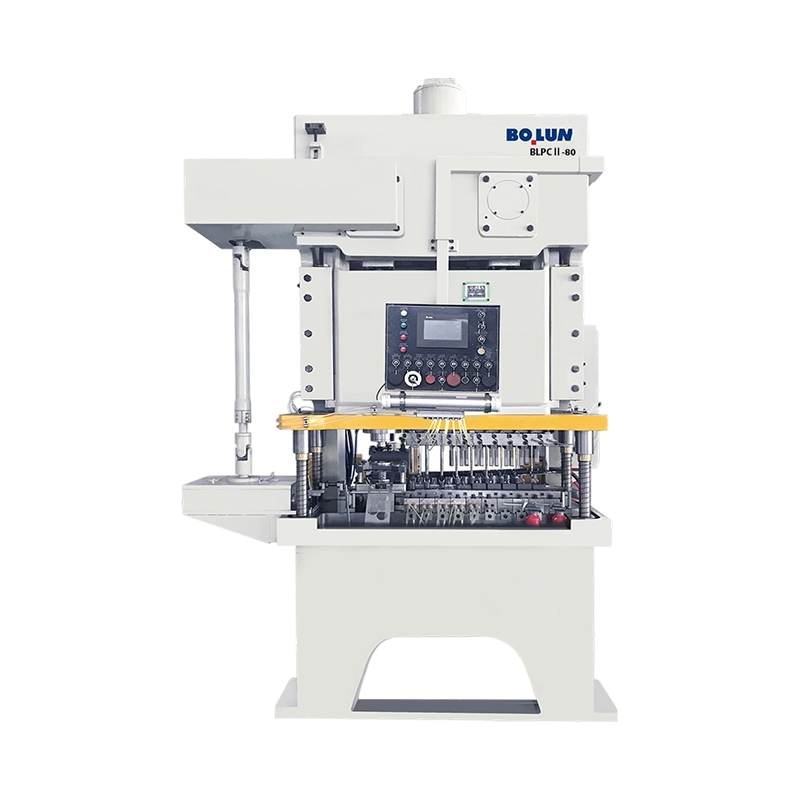
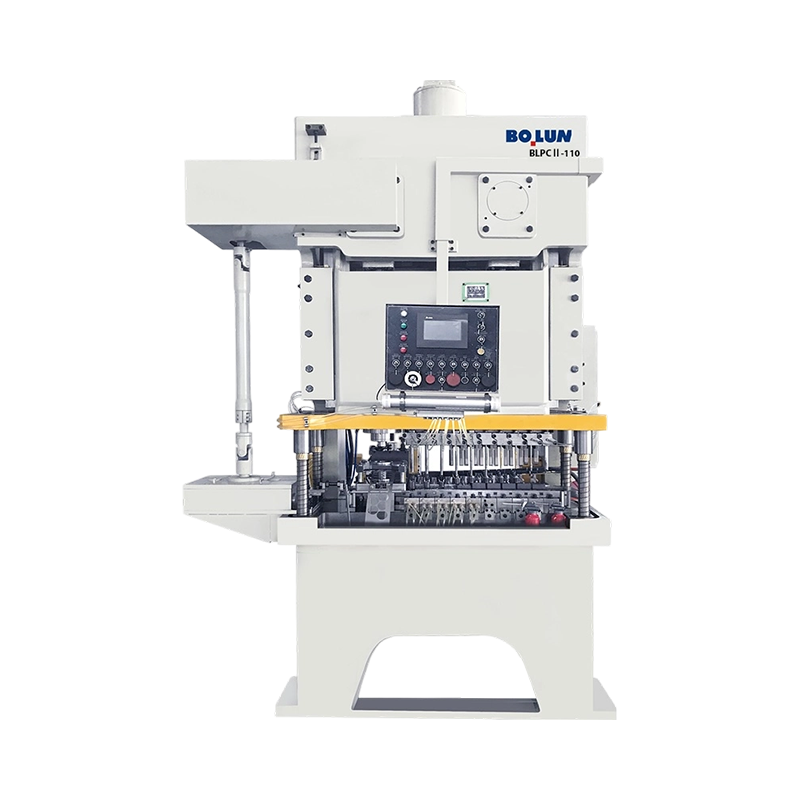
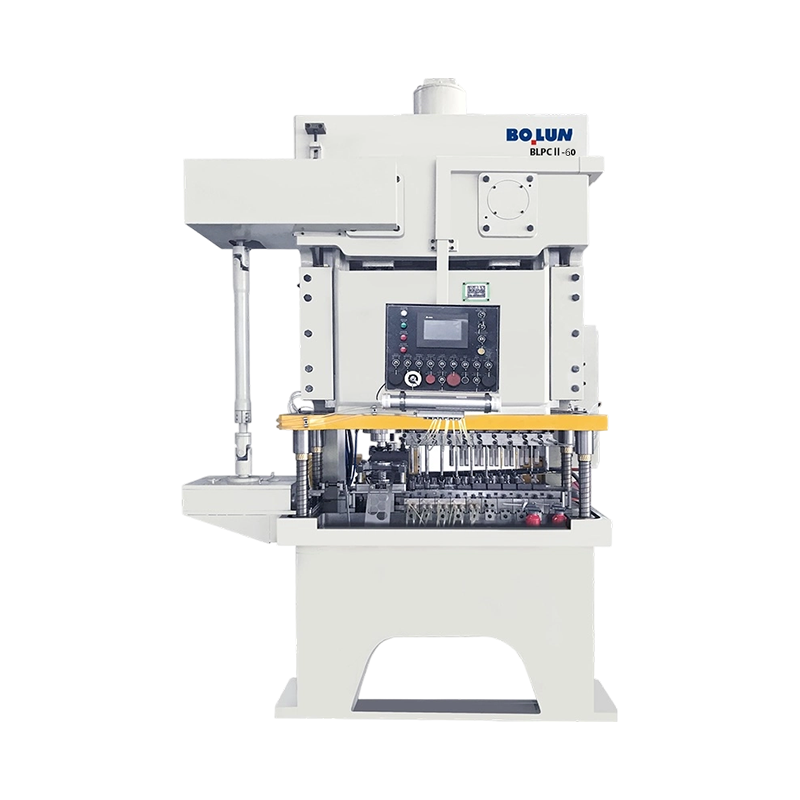
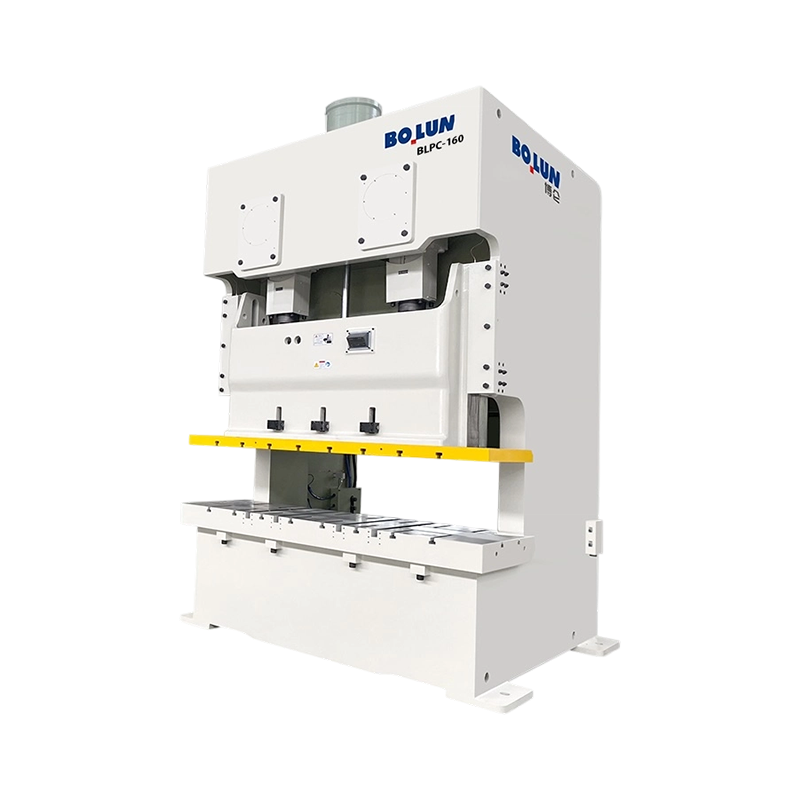
Modern stamping manufacturers are under constant pressure to produce smaller, more accurate, and more consistent components at higher speeds while maintaining stable die performance and safe operation. The BLPC-110 high-efficiency agility open-type double-point power press is designed for precisely this environment. With a nominal capacity of 1100 kN, a double-point slide drive, high-speed capability up to 100 strokes per minute, a dry clutch brake, hydraulic overload protection, electric automatic lubrication, and inverter-controlled motor speed adjustment, this press provides a balanced solution for factories that require speed, precision, accessibility, and dependable production output.
The machine belongs to the open-type double-point power press category, a structural class that combines the operational convenience of an open-frame machine with the improved lateral stability of a double-point drive. In practical production, this means the operator benefits from better access to the working area, while the slide receives force through two driving points rather than a single central point. For long dies, progressive dies, and applications where off-center loading may occur, this design helps improve slide balance and stamping consistency.
BLPC-110 High-Efficiency Agility Open-Type Double-Point Power Press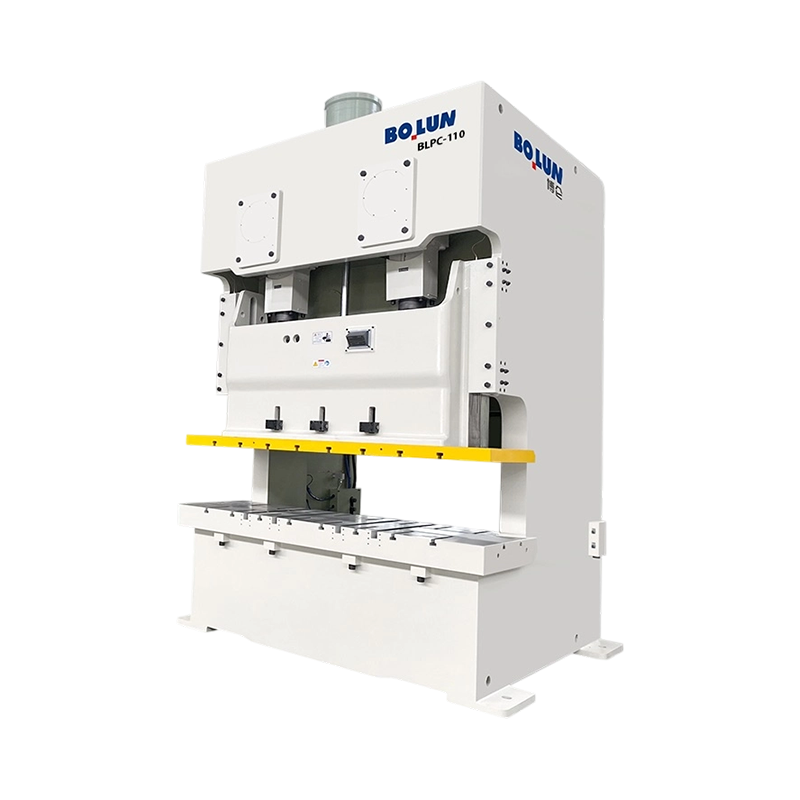
For manufacturers working in electrical components, automotive subcomponents, metal hardware, appliance parts, precision brackets, terminals, connectors, and other high-volume stamped products, the BLPC-110 offers a strong combination of agility and industrial strength. It is not merely a press with a capacity number; it is a production platform designed to reduce idle time, improve motion control, protect tooling, and support continuous manufacturing with repeatable accuracy.
The BLPC-110 is positioned as the most nimble model in its open-type double-point series. Its nominal capacity of 1100 kN gives it the strength needed for a wide range of medium and small precision stamping operations, while its maximum speed capability of up to 100 S.P.M. makes it suitable for high-volume output. This combination is especially valuable for factories that require a press faster than conventional low-speed machines but more stable than ordinary open-type single-point presses.
In many stamping workshops, the limitation is not only capacity. The real production bottleneck often lies in stroke rate, setup convenience, die protection, lubrication reliability, and the ability to maintain accuracy during long production runs. A press that can stamp quickly but lacks stable slide guidance may produce inconsistent parts. A press that is accurate but difficult to adjust may reduce daily productivity. A press that is powerful but lacks overload protection may expose the user to expensive tooling damage. The BLPC-110 addresses these issues through an integrated mechanical and control design.
Its double-point mechanism distributes force more evenly across the slide bottom. This is particularly important when dies are wide, when material feed direction requires good left-right balance, or when the operation produces force away from the exact center of the slide. Compared with a typical single-point open press, the double-point structure is better suited for maintaining parallelism between the slide and the worktable under demanding production conditions. For component manufacturers, this translates into improved dimensional repeatability, reduced tool wear, and more stable part quality.
The open-type frame also provides practical advantages. It allows convenient material feeding, die installation, maintenance access, and operator visibility. While closed-type presses can offer excellent rigidity for heavy forming, they may be less convenient for certain production layouts. The BLPC-110 offers a useful balance: more stability than a traditional single-point open press, while retaining the accessibility and operational flexibility associated with open-type machines.
The BLPC-110 is built around a nominal capacity of 1100 kN. This capacity range is well suited for stamping smaller precision metal parts and moderate-duty forming processes. The press supports a slide stroke configuration listed at 180 mm and a high-speed configuration reaching up to 100 strokes per minute. Its maximum die height is listed at 400 mm or 435 mm depending on the configuration, and the die height adjustment is 100 mm. These parameters allow the press to accommodate a wide range of tooling heights and production requirements.
The worktable size is 1800 x 650 x 130 mm, providing a generous surface for progressive dies and multi-station tooling within the 1100 kN class. The slide bottom size is 1400 x 500 x 70 mm, allowing broad die support and effective load distribution. The throat depth of 330 mm supports practical feeding and tooling arrangements, while the distance between columns of 1510 mm provides a useful working span for die installation and production handling.
The press is equipped with a main motor listed as 11 kW with four poles and variable-speed capability. This inverter-supported drive system allows the operator to adjust the stroke speed according to the process. In a modern stamping line, speed flexibility is essential. Thin material blanking may require high speed, while forming, bending, or trial runs may require slower, more controlled operation. The ability to adjust speed improves process matching and supports safer die setup.
Safety and equipment protection are strengthened by a high-sensitivity dry clutch brake and a hydraulic overload protector. The dry clutch brake enables responsive engagement and stopping, which is critical in high-cycle operation. The hydraulic overload protector helps prevent excessive load from damaging the press or die set. When stamping conditions exceed the safe load threshold, overload protection can reduce the risk of catastrophic mechanical damage and shorten recovery time.
| Item | BLPC-110 Specification |
| Product Type | Open-Type Double-Point Power Press |
| Nominal Capacity | 1100 kN |
| Nominal Pressure Stroke | 5 mm / 3 mm configuration |
| Slide Stroke | 180 mm / 110 mm configuration |
| Strokes per Minute | 35-65 S.P.M. / 50-100 S.P.M. configuration |
| Maximum Die Height | 400 mm / 435 mm configuration |
| Die Height Adjustment | 100 mm |
| Throat Depth | 330 mm |
| Worktable Size | 1800 x 650 x 130 mm |
| Slide Bottom Size | 1400 x 500 x 70 mm |
| Height of Working Face | 830 mm |
| Distance Between Columns | 1510 mm |
| Main Motor | Variable-speed 11 kW x 4P |
| Die Height Adjuster Motor | 1.1 kW |
| Air Pressure | 0.55 MPa |
| Punch Accuracy | GB Level 1 / JIS Class 1 |
| Overall Dimension | 1745 x 2000 x 3059 mm |
| Press Weight | 14 tons |
| Mold Pad Capacity | 36 x 2 kN |
| Ram Stroke | 70 mm |
| Effective Cushion Area | 350 x 235 x 2 groups |
The most distinctive advantage of this press is the double-point slide drive. In a conventional open-type single-point press, force is transmitted through one driving point. This can be sufficient for compact dies and centered loads, but it may become less ideal when the die is wide or when stamping force is not perfectly centered. Off-center load may cause slide tilting, uneven tool wear, inconsistent clearance, and increased risk of part defects.
The BLPC-110 addresses these concerns by using a double-point structure that supports the slide from two points. This helps distribute the forming load over a wider area and improves lateral stability. For production engineers, the benefit is not only theoretical. Better slide balance can support more consistent burr height, improved hole position accuracy, more uniform bending angles, and longer die service life. When a press runs at higher speed, small stability improvements become increasingly important because dynamic effects are amplified cycle after cycle.
Compared with many competing open-frame presses that emphasize only accessibility, the BLPC-110 delivers a stronger combination of access and balanced power transmission. Compared with many slower mechanical presses, it provides higher output potential for smaller precision parts. Compared with machines that lack integrated lubrication or overload protection, it offers a more complete production package designed to reduce operational risk.
The open-type structure remains valuable because it simplifies daily factory work. Operators and tooling technicians can access the die area more easily. Material feeding equipment can be arranged conveniently. Maintenance inspection can be performed with less obstruction. For factories changing dies frequently or running multiple part families, these accessibility advantages can create significant productivity gains over time.
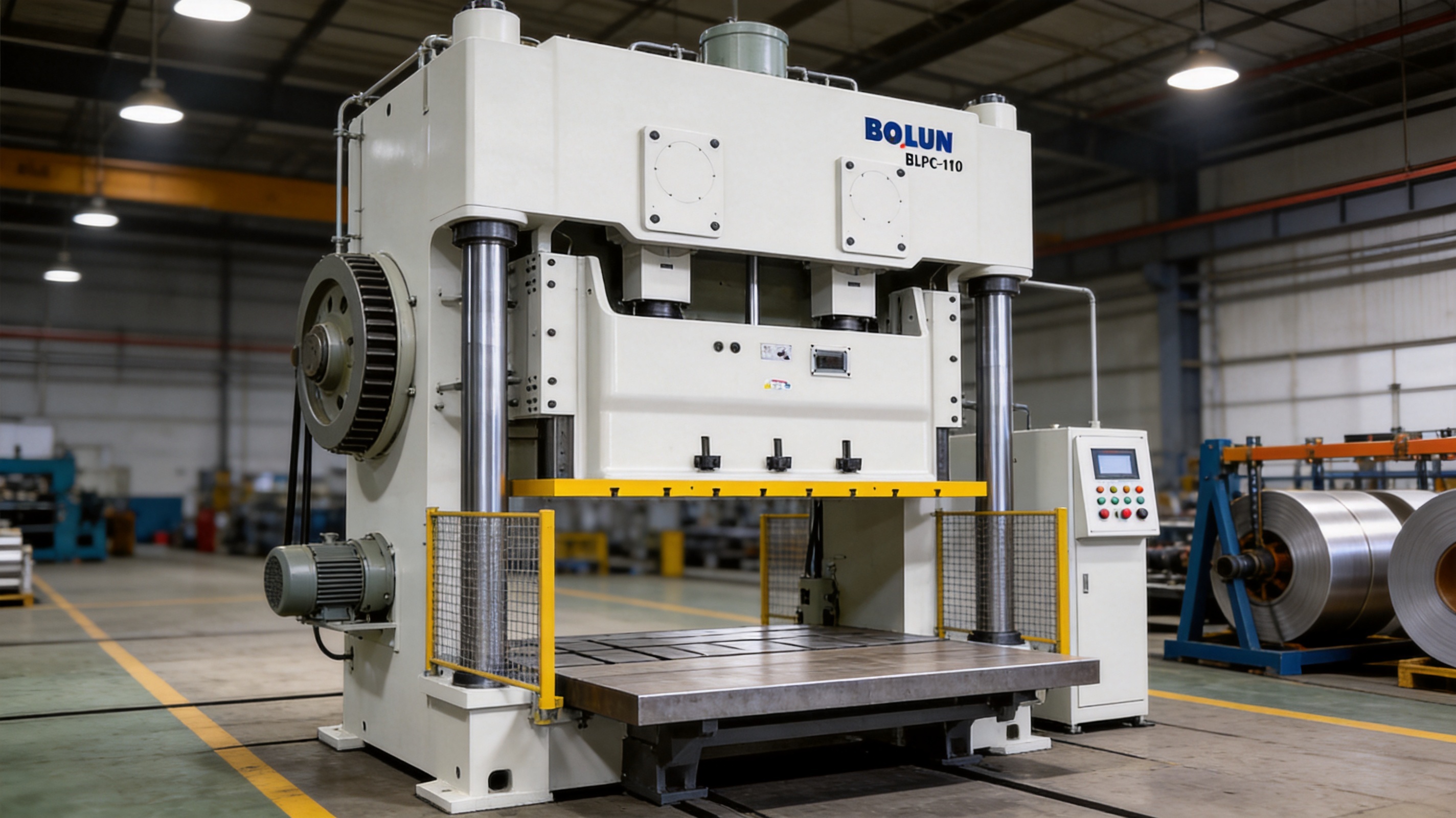
One of the strongest advantages of the BLPC-110 is its high-speed capability. With the configuration capable of reaching up to 100 strokes per minute, the press can support high-volume production of smaller precision components. In many factories, even a modest increase in stroke rate can produce a large improvement in monthly output. When the press is integrated with proper feeding, straightening, and coil handling systems, its speed potential becomes an important competitive advantage.
High speed alone is not enough. A press must be capable of maintaining reliable motion, stable lubrication, accurate stopping, and consistent die protection while running quickly. The BLPC-110 combines its high-speed capability with a high-sensitivity dry clutch brake, hydraulic overload protection, electric automatic lubrication, and variable-speed motor control. This integrated design allows the press to operate as a controlled production system rather than simply a fast mechanical frame.
Inverter-based speed adjustment is especially useful for practical manufacturing. During die tryout, the operator may use a lower speed to observe material behavior and confirm feed accuracy. During stable production, speed can be increased to meet output targets. For delicate parts, the process can be optimized to avoid excessive vibration or material deformation. For less sensitive blanking operations, higher speed may be used to improve throughput. This flexibility helps manufacturers match machine behavior to the actual stamping task.
Compared with presses that use fixed-speed motors or limited speed control, the BLPC-110 provides broader process adaptability. This is important for factories that produce many different components rather than one permanent product. In a competitive market, manufacturers often need to accept changing orders, shorter delivery cycles, and varied die requirements. A flexible press helps the workshop respond quickly without sacrificing accuracy.
The specification lists punch accuracy as GB Level 1 and JIS Class 1. This accuracy grade is an important indicator for users who require stable and repeatable production. Precision stamping depends on more than tool design. It also depends on slide motion, frame rigidity, bearing quality, lubrication, die height control, and the ability of the press to resist deformation under load.
The BLPC-110 supports precision through its double-point slide structure and controlled adjustment system. The 100 mm die height adjustment range allows the user to set tooling accurately for different dies. The die height adjuster motor improves setup convenience and supports repeatable adjustment. With a maximum die height of up to 435 mm in the high-speed configuration, the machine can accommodate a practical range of die assemblies used in precision stamping.
In stamping, small variations can lead to large quality problems. If the slide does not remain parallel to the bolster, cutting clearance may vary across the die. Uneven clearance can increase burrs, reduce punch life, or cause uneven forming. The double-point design helps reduce these risks by improving slide balance across the working area. This is particularly beneficial for progressive dies, where multiple stations must operate in sequence and alignment errors can accumulate.
The hydraulic overload protector also contributes indirectly to precision. When a material misfeed, double sheet, foreign object, or incorrect die setting causes excessive load, the overload system helps protect the press and tooling. Without overload protection, a single abnormal event can damage precision die components, distort the machine, or create expensive downtime. With protection in place, users gain an additional safety layer that supports long-term accuracy and machine value.
Safety is a critical concern for any power press, especially when operating at high speed. The BLPC-110 uses a high-sensitivity dry clutch brake designed for responsive operation. A reliable clutch brake system is essential for controlling press engagement, stopping motion, and supporting safe production sequences. In high-cycle stamping, clutch brake performance affects not only safety but also productivity and operator confidence.
The hydraulic overload protector provides another important safety and protection feature. Press overload can occur for several reasons, including improper die setup, material thickness variation, incorrect feeding, stacked material, or foreign matter in the die. By providing overload protection, the machine reduces the risk of severe mechanical damage and helps operators restore production more efficiently after abnormal conditions.
Automatic lubrication also supports safer operation. Insufficient lubrication can cause overheating, accelerated wear, abnormal noise, and eventual mechanical failure. The electric automatic lubrication system helps deliver lubrication more consistently to critical points, reducing dependence on manual lubrication routines. In a busy production environment, this reduces the chance of human error and supports stable operation over long shifts.
Compared with low-cost machines that rely heavily on manual maintenance and basic protection systems, the BLPC-110 provides a more mature safety foundation. This matters for manufacturers seeking reliable production, lower maintenance risk, and a safer workplace. A press that protects its own moving parts and tooling is also a press that protects production schedules and customer commitments.
The quality of a power press depends heavily on the manufacturing capability of the company that builds it. Zhejiang Bolun High-Precision Machinery Co., Ltd. is located in Zhejiang, one of China’s important centers for precision manufacturing. With approximately two decades of industry experience, the company has developed into a modern manufacturer integrating research and development, design, production, sales, and service.
The company’s strength lies in its complete manufacturing chain and its understanding of forming equipment. Power presses are not simple machines. They require strong castings or welded structures, accurate machining, careful assembly, reliable transmission components, strict quality inspection, and application knowledge. A manufacturer must control both the physical structure and the dynamic performance of the machine. Bolun’s production system is built around these requirements.
Technological innovation is described as the core engine of the company’s development. This is reflected in the BLPC-110 through its integrated design choices: a double-point drive for balanced force transmission, an inverter-equipped motor for speed control, a dry clutch brake for responsive operation, a hydraulic overload protector for machine and die safety, and an electric automatic lubrication system for long-term reliability. These are not isolated features; together they create a production-oriented press.
The company also emphasizes non-standard customization capability. This is important because stamping users often have specific requirements for die space, automation integration, feeding direction, safety devices, production rhythm, and workshop layout. A manufacturer with design and customization capability can better support real industrial applications rather than only supplying standard catalog machines.
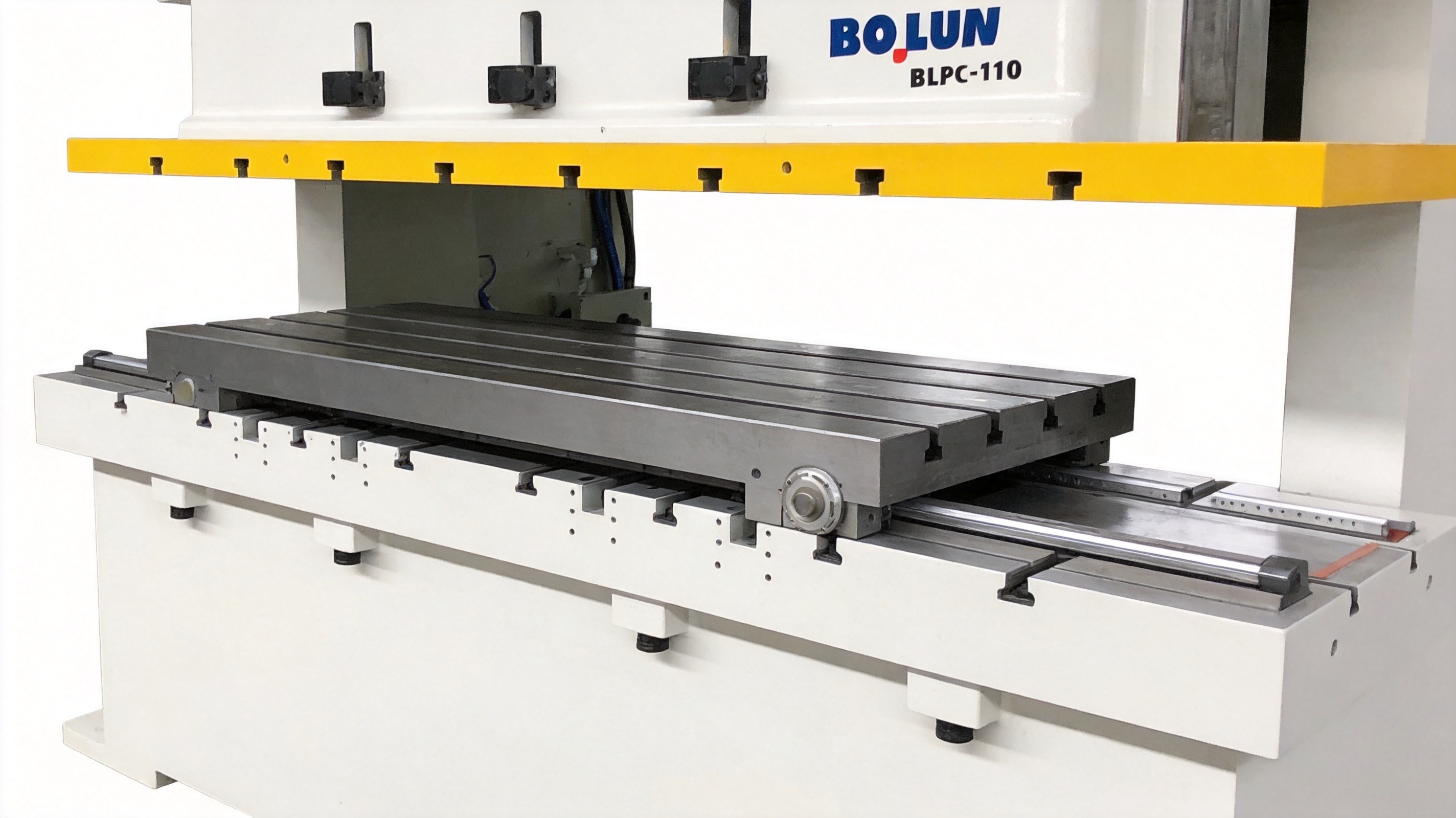
Manufacturing a high-precision press requires a disciplined production process. The frame and major components must be machined accurately so that the slide, bolster, crank mechanism, and guide systems work together with minimal error. Precision processing equipment is essential for maintaining dimensional consistency. The company’s industrial environment covers stages from basic design and core component development to final machine assembly, enabling closer control over the complete production process.
Quality control is especially important for machines that will run at high speed. Dynamic loads, repeated impact forces, vibration, and thermal changes can expose weaknesses in material, machining, assembly, or lubrication. A press may appear acceptable during a simple inspection but fail to maintain accuracy under long production cycles if it is not manufactured properly. Therefore, rigorous inspection of every process and component is a major advantage.
The company has established a finished product inspection system that exceeds ordinary industry expectations. For users, this means the machine is not only assembled but also checked as a complete operating system. Key areas such as slide accuracy, clutch brake response, lubrication function, die height adjustment, air pressure requirements, overload system performance, and general motion stability must all be verified before delivery.
The company’s quality philosophy is based on stable precision and long service life under high-intensity operating conditions. This aligns with the needs of stamping factories. A press must operate for years, often under demanding shift schedules. The initial purchase price is only part of the cost. Long-term cost is affected by maintenance, downtime, spare parts, die life, energy use, and output stability. A well-built press can reduce the hidden costs that often make cheaper machines more expensive over time.
The company’s core philosophy may be summarized as turning pressure into power through accumulated expertise and disciplined execution. This philosophy is relevant to the power press industry because press manufacturing itself is a demanding field. A machine must withstand repeated force, yet it must move with accuracy. It must be strong, yet adjustable. It must be productive, yet safe. These requirements create pressure on design, production, and service teams.
The BLPC-110 reflects this philosophy by combining strength and agility. Its 1100 kN capacity gives it forming power. Its speed capability gives it production agility. Its double-point structure gives it balance. Its lubrication and overload systems give it durability. Its variable-speed motor gives it adaptability. Each of these characteristics responds to a practical pressure faced by stamping manufacturers.
In a competitive environment, customers do not only ask whether a press can stamp a part. They ask whether it can stamp the part repeatedly, safely, quickly, and economically. They ask whether the press can support future products. They ask whether the supplier can provide advice, customization, and service. The company’s integrated approach to R&D, design, production, sales, and support helps answer these needs.
When compared with a conventional single-point open-type press, the BLPC-110 offers superior force distribution across the slide. This is the most direct advantage. Single-point presses may be suitable for centered loads, but they can be less effective for wider dies and off-center operations. The double-point drive improves stability, helping reduce uneven wear and improve finished part consistency.
When compared with lower-speed open presses, the BLPC-110 provides higher output potential. Its ability to reach up to 100 S.P.M. in the high-speed configuration allows manufacturers to improve productivity for suitable parts. Higher speed can reduce the cost per part when material feeding, die design, and quality control are properly matched to the press.
When compared with machines that have limited speed control, the BLPC-110’s inverter-equipped main motor gives operators better control over production rhythm. Fixed-speed presses can force users to compromise between safety, quality, and output. Variable speed allows the user to start slowly, verify setup, and then increase speed after the process is stable.
When compared with basic presses that lack advanced protection, the hydraulic overload protector and automatic lubrication system provide meaningful operational advantages. Tooling is expensive, and downtime is costly. A machine that helps protect dies and maintain lubrication can reduce the risk of unexpected stoppages. Over time, this may provide better economic value than a machine selected only for a lower purchase price.
When compared with certain closed-type presses, the BLPC-110 offers better accessibility and easier operational handling. Closed-type presses may be preferred for heavier loads and maximum rigidity, but they can be less convenient for some medium-duty precision stamping applications. The BLPC-110 provides a practical balance for users who need stability without sacrificing open-frame convenience.
The BLPC-110 is particularly suitable for high-volume production of smaller precision components. Typical applications may include electrical terminals, connector parts, relay components, small brackets, appliance hardware, automotive clips, precision washers, metal shells, light structural components, and progressive die stamping of thin to medium-gauge materials. The exact suitability depends on part geometry, material grade, thickness, die design, and required forming load.
Progressive die applications can benefit strongly from the press’s double-point stability. In progressive stamping, the strip moves through multiple stations, and each station performs a different operation such as piercing, blanking, bending, embossing, or forming. Stable slide motion is important because errors in one station can affect subsequent stations. The large worktable and slide bottom support wider tooling layouts within the capacity class.
For blanking and piercing, the press’s speed capability supports efficient production. For bending or shallow forming, adjustable speed and stable slide movement help improve process control. For operations involving cushion use, the listed mold pad capacity of 36 x 2 kN, ram stroke of 70 mm, and effective cushion area of 350 x 235 x 2 groups provide additional functional support depending on the tooling arrangement.
Manufacturers who produce multiple part families can benefit from the machine’s die height adjustment and accessible open-type design. Faster setup, easier inspection, and convenient integration with feeding equipment all help improve workshop efficiency. In modern production, flexibility is often as valuable as maximum speed.
A modern power press is often part of a larger production system. Coil feeders, straighteners, decoilers, transfer systems, conveyors, sensors, safety devices, and control interfaces may all be involved. The BLPC-110’s open-type structure and adjustable speed make it suitable for integration into automated stamping lines where production rhythm and access are important.
In automated coil-fed stamping, the press must synchronize with the feeder. If the press runs too fast for stable feeding, misfeeds may occur. If it runs too slowly, productivity is lost. Variable speed provides a practical way to optimize this balance. During setup, lower speed can be used to confirm feed length and die progression. During production, speed can be increased within the safe operating range.
The high-sensitivity clutch brake supports controlled cycling, which is important for automation. Reliable stopping and engagement help the press coordinate with external systems. Automatic lubrication supports long production runs by reducing the need for frequent manual intervention. Overload protection adds a layer of security in case of abnormal feeding or material conditions.
For factories moving toward intelligent manufacturing, stable mechanical equipment remains the foundation. Digital monitoring and automation cannot compensate for weak mechanical structure. The BLPC-110 provides a strong mechanical base for future production upgrades, especially for users planning to improve efficiency, reduce manual handling, and increase process consistency.
Operator convenience has a direct effect on productivity. A machine that is difficult to adjust, inspect, or maintain may reduce the efficiency of the entire workshop. The BLPC-110 supports operator convenience through its open-type access, powered die height adjustment, automatic lubrication, and clear specification structure.
The height of the working face is listed at 830 mm, which supports practical operator access and material handling in many workshop layouts. The distance between columns of 1510 mm and worktable size of 1800 x 650 mm provide usable space for die installation and handling. These physical dimensions are important for tooling technicians, who must install, align, clamp, inspect, and remove dies safely and efficiently.
Maintenance efficiency is improved by automatic lubrication. Regular lubrication is one of the most important maintenance tasks on a mechanical press. If lubrication is neglected, wear increases and accuracy can decline. An electric automatic lubrication system helps ensure that critical points receive lubricant consistently. This can extend component life and reduce the probability of avoidable breakdowns.
The hydraulic overload protector also supports maintenance efficiency by reducing damage severity during abnormal events. Instead of allowing overload force to damage the machine or die, the system provides protection that can make troubleshooting and recovery more manageable. This improves uptime and supports long-term reliability.
The economic value of the BLPC-110 comes from several factors working together. First, its speed capability can increase output for suitable parts. Second, its double-point stability can improve quality and reduce scrap. Third, its overload protection can reduce risk of die and machine damage. Fourth, its automatic lubrication can reduce maintenance-related downtime. Fifth, its variable-speed system can improve process flexibility and reduce the need for multiple specialized machines.
In stamping production, small efficiency gains often produce large annual savings. For example, reducing scrap by a small percentage can save material and rework cost. Reducing die wear can lower tooling maintenance expenses. Increasing stroke rate can improve delivery capacity. Reducing unplanned downtime can help meet customer schedules. A press that contributes to all these areas creates value beyond its purchase specification.
Compared with a cheaper but less integrated press, the BLPC-110 may provide stronger lifetime value. The lowest initial price does not always lead to the lowest production cost. When users consider die protection, accuracy, maintenance, speed, and support, a more capable machine can be the more economical choice.
The company’s service system also adds value. Customer-oriented support covering pre-sales consultation, in-sales assistance, and after-sales guarantees helps users select suitable equipment, install it properly, and maintain stable operation. For international buyers, supplier responsiveness and technical understanding are essential parts of purchasing confidence.
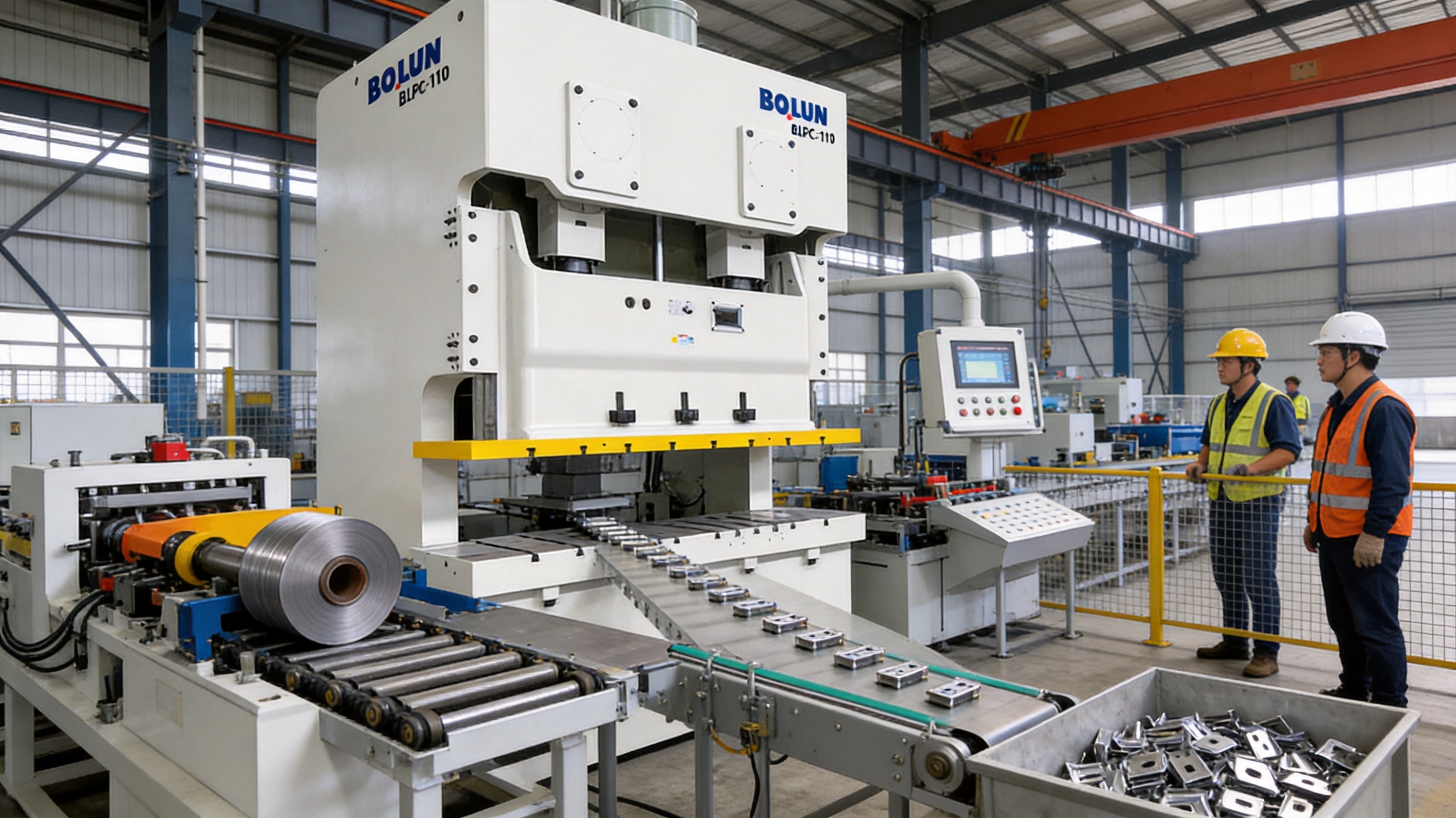
Zhejiang Bolun High-Precision Machinery Co., Ltd. has built its identity around high-precision forming equipment. The company’s location in Zhejiang gives it access to a mature manufacturing environment, skilled industrial resources, and supply-chain advantages. Its experience in machinery manufacturing allows it to understand both the design requirements of presses and the practical needs of stamping users.
The company integrates research and development, design, production, sales, and service. This integrated structure is important because it helps reduce communication gaps between engineering, manufacturing, and customer support. When a customer has a special requirement, the design team can evaluate feasibility, production can implement the solution, and service personnel can support the machine in use.
The company also adopts advanced international production management experience and combines it with China’s local manufacturing strengths. This combination supports efficient production, quality control, and competitive delivery capability. For global customers, this means access to machinery that combines manufacturing scale with technical refinement.
Its philosophy of rigorous, open, and mutually supportive work culture supports long-term development. A press manufacturer must be reliable not only at the time of sale but throughout the equipment life cycle. Customers need spare parts, technical answers, maintenance guidance, and sometimes customization for future production. A stable and professional organization is therefore a major advantage.
The BLPC-110 is a strong choice for manufacturers that need a high-efficiency, stable, and accessible power press for precision stamping. Its 1100 kN capacity places it in a useful range for many smaller and medium-sized components. Its double-point structure improves slide stability compared with single-point open presses. Its speed capability of up to 100 S.P.M. supports high-volume production. Its inverter-controlled motor provides adaptable operation. Its dry clutch brake supports responsive control. Its hydraulic overload protector helps protect the machine and tooling. Its automatic lubrication system supports long-term reliability.
The press is not designed around one isolated advantage. Its strength is the combination of features that matter in real production. Speed without stability can create quality issues. Stability without accessibility can slow setup. Power without protection can increase risk. The BLPC-110 balances these factors in a practical and production-oriented way.
For users seeking to upgrade from older open-type single-point machines, the BLPC-110 can provide improved die support and higher production capability. For users seeking an alternative to more enclosed machines for certain applications, it offers easier access and operational flexibility. For users building automated stamping lines, it provides the mechanical foundation and speed control needed for efficient integration.
Before selecting any power press, users should evaluate their actual stamping requirements. Key factors include material type, material thickness, part shape, die size, forming force, required stroke, production speed, feed method, safety requirements, workshop space, and future production plans. The BLPC-110 is best suited for applications within its nominal capacity and die space range, especially where high speed and double-point stability are valuable.
Users should also consider whether the 35-65 S.P.M. or 50-100 S.P.M. configuration better matches their process. The appropriate choice depends on part requirements and tooling. Higher speed is valuable, but only when the die, material feeding, and quality control are designed for it. The availability of different stroke and die height configurations helps users select a machine more closely aligned with their production needs.
For progressive die users, worktable size and slide bottom size should be checked against the die layout. For forming applications, the available stroke, die height, and cushion data should be reviewed carefully. For automation integration, the press should be considered together with feeder capacity, coil handling equipment, control system, and safety devices. The manufacturer’s engineering and sales support can assist in evaluating these details.
The BLPC-110 is best suited for high-volume precision stamping of smaller and medium-sized metal components. It is especially useful for applications requiring good lateral slide stability, fast production speed, and convenient access to the die area.
A double-point press drives the slide through two points, helping distribute force more evenly across the slide. This improves stability for wide dies, progressive dies, and operations where the load may not be perfectly centered. The result can be better part consistency, reduced tool wear, and improved process reliability.
A speed of up to 100 strokes per minute means the press can support high-output production when the die, feeding system, material, and process are suitable. This can significantly improve productivity for parts designed for high-speed stamping.
The inverter-controlled motor allows speed adjustment. Operators can use slower speeds during setup, inspection, and trial stamping, then increase speed during stable production. This improves flexibility and helps match press operation to different dies and materials.
Hydraulic overload protection helps protect the press and tooling when abnormal load occurs. This may happen due to misfeeding, double material, incorrect die setup, or foreign objects. The system reduces the risk of severe damage and helps improve production safety.
Automatic lubrication helps ensure that critical moving parts receive lubricant consistently. This reduces wear, supports stable operation, lowers maintenance risk, and helps preserve machine accuracy over long production periods.
Yes, the BLPC-110 is well suited for many progressive die applications within its capacity and die space limits. Its double-point design, wide worktable, stable slide structure, and high-speed capability are beneficial for multi-station stamping.
The open-type structure provides better access to the working area, making die installation, adjustment, inspection, material feeding, and maintenance more convenient. This can reduce setup time and improve daily production efficiency.
The manufacturer integrates research and development, design, production, sales, and service. It has long experience in machinery manufacturing, advanced processing capability, non-standard customization ability, strict inspection systems, and customer-oriented service support.
No. Speed is one important advantage, but the BLPC-110 also emphasizes stability, accuracy, safety, die protection, lubrication reliability, and process flexibility. Its value comes from the complete combination of these features.
The BLPC-110 high-efficiency agility open-type double-point power press is a practical and competitive solution for modern precision stamping. It combines 1100 kN nominal capacity with high-speed operation, double-point slide stability, variable-speed control, dry clutch brake performance, hydraulic overload protection, automatic lubrication, and accessible open-type design. These features make it especially valuable for manufacturers seeking reliable output, consistent quality, safer operation, and improved production efficiency.
In comparison with ordinary single-point open presses, the BLPC-110 provides improved slide balance and better support for wide or progressive dies. In comparison with less integrated machines, it provides stronger protection and maintenance advantages. In comparison with many slower presses, it offers better productivity potential. Its design responds to the real needs of stamping factories: speed, accuracy, flexibility, safety, and long-term durability.
Behind the machine is a manufacturer with deep experience in high-precision forming equipment, a complete production system, advanced processing capability, rigorous inspection standards, customization strength, and a global service mindset. For companies looking to improve stamping productivity while maintaining precision and reliability, the BLPC-110 represents a strong equipment choice and a valuable step toward more efficient manufacturing.
Altan, T., and Tekkaya, A. E. Sheet Metal Forming: Processes and Applications. ASM International.
Kalpakjian, S., and Schmid, S. R. Manufacturing Engineering and Technology. Pearson Education.
Suchy, I. Handbook of Die Design. McGraw-Hill Education.
Smith, D. A. Die Design Handbook. Society of Manufacturing Engineers.
International Organization for Standardization. Safety of Machinery and Mechanical Presses: General Principles and Related Standards.
Japan Industrial Standards Committee. Standards Related to Press Accuracy and Mechanical Press Performance.


Understanding Mechanical Power Presses and Their Essential Functions A mechani...
What Is a Power Press? A power press — also called a stamping press or punch pr...
In the fields of metal forming, sheet metal fabrication, blanking, and punching,...
Power press machines are classified in two main ways: by frame construction, w...
As the manufacturing industry moves steadily toward automation and smart product...
In modern manufacturing, cold forging is widely used in the automotive, aerospac...
Contact Us

bolunpress@gmail.com

+86-575-83362228

+86-15158259588

+86-575-83362999

+86-15158259588

Hangzhou Office Add: No. 332 Wangjiang East Road, Shangcheng District

No.1 Linjiang Road East, Xiaren, Jinting Town, Shengzhou City, Zhejiang Province, China
Ready to Begin?
Get in Touch

Now!

ZHEJIANG BOLUN
 English
 中文简体
中文简体