
In modern sheet metal forming, a power press is no longer judged only by its nominal tonnage. Manufacturers increasingly evaluate rigidity, speed stability, slide adjustment convenience, safety architecture, mold adaptability, energy control, long-term precision retention, and the supplier’s ability to support customized production. The intelligent-adjust open-type single-point power press described here is designed around these expectations. With a nominal capacity of 600 kN, a high-rigidity heat-treated steel frame, an electrically controlled slide adjustment system, inverter-driven speed control, and a complete safety configuration, it provides a strong solution for precision stamping, blanking, bending, shallow drawing, trimming, piercing, and progressive die operations.
The machine is especially valuable for factories that require a productive yet accessible open-frame press. Its open-type structure offers excellent operator visibility and easy die loading, while the single-point drive provides a practical balance of force transmission, speed, and mold versatility. The 900 x 520 mm worktable and 270 mm throat depth support a wide range of industrial molds, including complex tools used for hardware, electrical components, appliance parts, automotive accessories, metal packaging parts, and precision sheet metal assemblies. The 5.5 kW main motor, paired with inverter speed control, allows the machine to reach up to 165 strokes per minute, helping production teams respond to changing batch sizes and process requirements.
Beyond the machine itself, the value of the product is strongly connected to the manufacturing capabilities behind it. Zhejiang Bolun High-Precision Machinery Co., Ltd. integrates research and development, design, production, sales, and service into a unified system. The company’s background in precision forming equipment, its mature production management, its capability for non-standard customization, and its strict finished-product inspection process allow the press to be delivered as a dependable industrial asset rather than merely a machine tool. The result is a product positioned for manufacturers who need not only press force but also repeatability, reliability, safety, and long-term operating value.
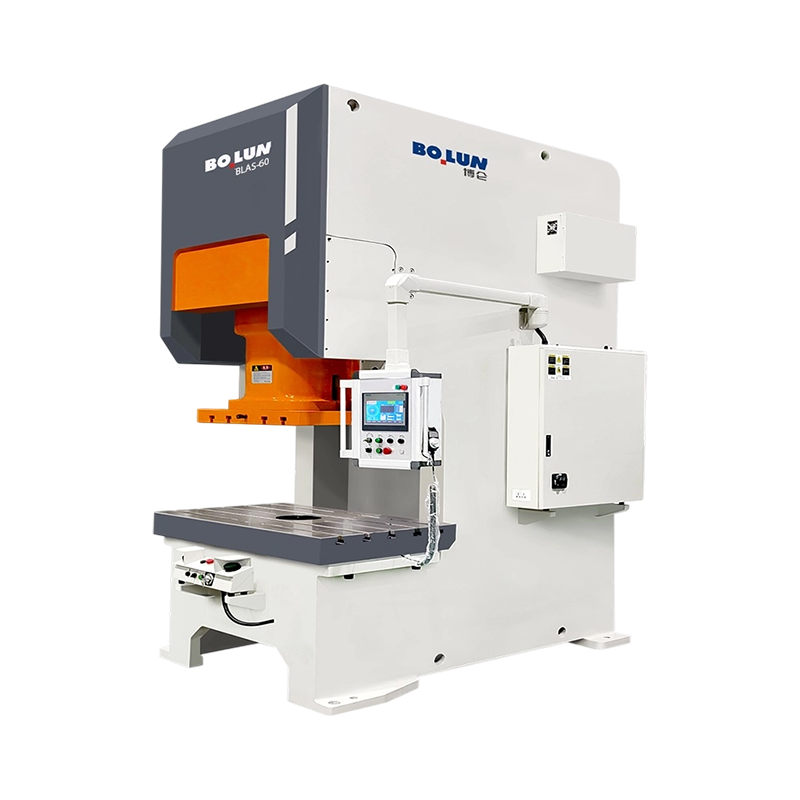
BLPA-60 Intelligent-Adjust Open-Type Single-Point Power Press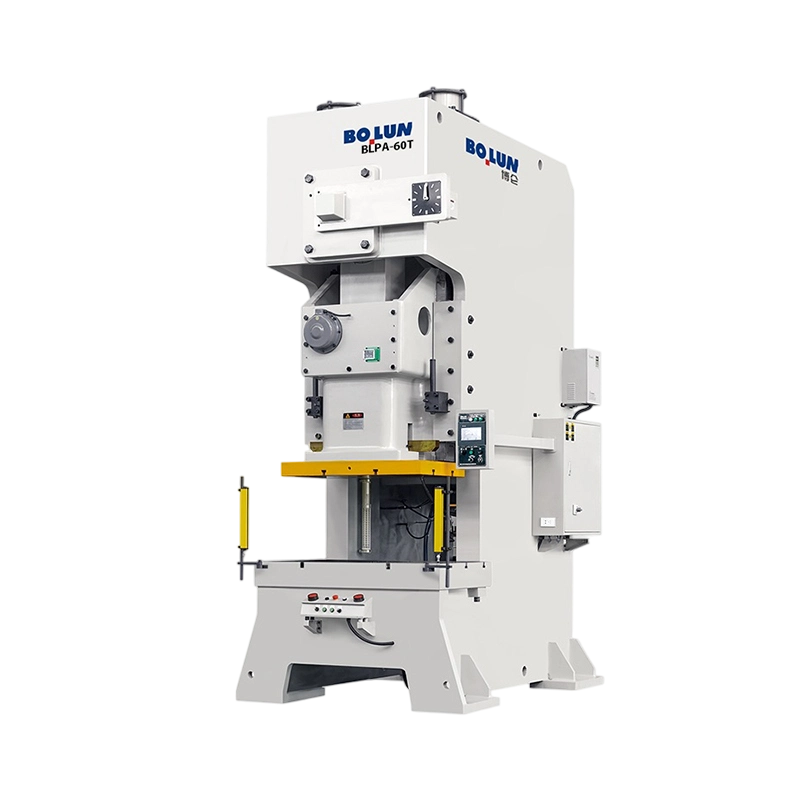
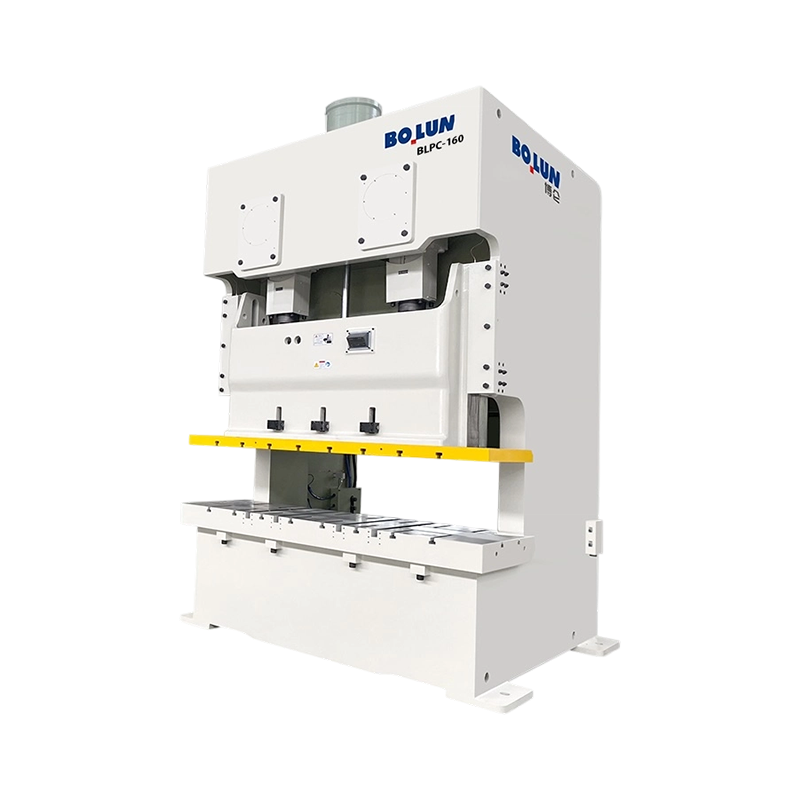
This intelligent-adjust open-type single-point power press is built for manufacturers that need efficient metal forming within a compact and operator-friendly press format. Open-type power presses are widely used because they provide convenient access to the working area from the front and sides. This improves die installation, die adjustment, material feeding, maintenance, and visual monitoring during production. For workshops running frequent die changes or producing multiple product categories, this accessibility can reduce preparation time and improve operational flexibility.
The 600 kN nominal capacity makes the press suitable for a broad middle range of stamping work. It is powerful enough for many general industrial components while remaining efficient for high-speed production of small and medium-sized metal parts. Compared with lower-capacity presses, it gives users greater forming margin and better compatibility with larger dies. Compared with very large straight-side presses, it offers easier operation, reduced floor-space demand, and a more economical investment for applications that do not require extremely high tonnage or multi-point forming.
The “intelligent-adjust” feature is one of the machine’s most important differentiators. Traditional open-type presses often depend heavily on manual adjustment, especially when setting die height or adapting the slide position for a new mold. Manual adjustment can be time-consuming and inconsistent, particularly when operators must repeat the process several times per shift. This model uses an electric slide adjustment device powered by a 0.2 kW motor, allowing the operator to adjust the slide more conveniently and accurately. For factories with frequent mold changes, this can improve setup repeatability and reduce downtime between production jobs.
The machine is also designed for production stability. Its heat-treated steel frame provides strength and resistance to deformation under repeated loading. Uniform load distribution reduces local stress concentration, while vibration control contributes to better part quality and improved tool life. In stamping operations, even small variations in frame deflection can influence burr height, hole precision, bending angle, and die wear. A rigid and stable press structure therefore becomes a direct contributor to product consistency.
The following table summarizes the main characteristics of the intelligent-adjust open-type single-point power press based on the provided product data. These values illustrate the machine’s capacity, working envelope, speed capability, adjustment system, drive configuration, and safety structure.
| Item | Specification or Feature | Operational Meaning |
|---|---|---|
| Nominal capacity | 600 kN | Suitable for medium-duty stamping, blanking, bending, piercing, trimming, and forming applications. |
| Press type | Open-type single-point power press | Provides convenient access, good visibility, and efficient force transmission for many single-station and progressive die processes. |
| Frame structure | High-rigidity heat-treated steel frame | Improves load distribution, reduces vibration, and supports long-term precision retention. |
| Worktable size | 900 x 520 mm | Accommodates complex industrial molds and provides a practical working area for various sheet metal parts. |
| Throat depth | 270 mm | Allows deeper material entry and improves flexibility for larger blanks and more complex dies. |
| Main motor | 5.5 kW | Provides reliable driving power for continuous production. |
| Speed control | Inverter speed control | Enables adjustment of production speed according to material, die, process, and output requirements. |
| Maximum speed | Up to 165 strokes per minute | Supports high productivity for suitable stamping applications. |
| Slide adjustment | Electric slide adjustment device | Improves die setup convenience and adjustment repeatability. |
| Slide adjustment motor | 0.2 kW | Provides controlled mechanical adjustment without relying solely on manual operation. |
| Clutch and brake | Sensitive dry clutch brake | Supports responsive control, safer stopping, and stable operating cycles. |
| Overload protection | Hydraulic overload protector | Helps protect the press and die set from damage caused by overload conditions. |
| Safety system | Photo-electronic safety devices | Improves operator protection by monitoring the working area during operation. |
The foundation of any mechanical power press is its frame. The frame must absorb repeated impact loads, maintain geometric stability, resist twisting, and preserve the alignment between the slide and the worktable. This product uses a high-rigidity steel frame treated to improve structural stability. Heat treatment is critical because it helps reduce residual stress created during fabrication and machining. A frame with uncontrolled residual stress may gradually deform during use, especially under heavy cyclic loading. By improving material stability before final assembly, the press can better maintain accuracy over long production periods.
In competitive comparison, some economy-class open-type presses may use lighter frames to reduce cost. Such machines can perform basic stamping, but they may suffer from higher vibration, larger deflection, faster precision loss, and more frequent maintenance requirements when pushed into demanding production. The intelligent-adjust model emphasizes frame rigidity as a core advantage. Uniform load distribution reduces localized stress, while vibration reduction helps protect dies and improve finished-part quality. In a high-output stamping environment, this difference becomes measurable through reduced scrap, fewer adjustment interventions, and longer tool service life.
Frame rigidity also affects operator confidence. When a press runs smoothly with lower vibration and stable slide movement, operators can better monitor feeding, part discharge, and die behavior. Maintenance teams also benefit because a stable frame reduces abnormal wear on guide surfaces, drive components, and foundation connections. In this sense, rigidity is not simply a structural feature; it is an operational advantage that influences quality, uptime, safety, and cost.
One of the machine’s strongest advantages is its electric slide adjustment device. Die height setting is a repeated task in stamping workshops. Every mold requires the correct relationship between slide position, die height, bottom dead center, and material thickness. If the adjustment is inconvenient or imprecise, setup time increases and the risk of die damage rises. Electric slide adjustment reduces dependence on purely manual methods and allows the operator to reach the desired setting more efficiently.
The 0.2 kW slide adjustment motor is not intended to be a large drive system; instead, it provides controlled movement for positioning. This controlled adjustment is valuable when operators need small, repeatable changes. In production environments where dies are frequently replaced, even a few minutes saved per setup can accumulate into significant monthly productivity gains. Faster setup also supports smaller batch production, where the economic pressure from changeover time is high.
Compared with competitors that offer manual slide adjustment as standard, an electric adjustment system improves usability and reduces operator fatigue. It also helps standardize setup procedures across different shifts. When a workshop depends on experienced operators to manually “feel” the adjustment, results may vary. Electric adjustment helps make the process more predictable and more suitable for standardized production management.
The press is driven by a 5.5 kW main motor with inverter speed control. This is a major advantage for modern stamping production because the ideal press speed varies according to part geometry, material thickness, lubrication condition, die complexity, feeding system, and quality requirements. A fixed-speed press may force the user to choose between productivity and process stability. Inverter control allows the speed to be adjusted, helping the production team optimize the balance between output and quality.
For simple blanking or piercing tasks, the press may operate at higher speed, reaching up to 165 strokes per minute when process conditions allow. For forming operations with more material flow, or for dies requiring more careful feeding and part removal, operators can reduce speed to improve stability. This flexibility helps one machine cover a wider range of jobs. It also supports better integration with coil feeders, straighteners, transfer devices, or manual feeding systems.
In practical terms, adjustable speed can improve die life. Excessive speed may increase heat, friction, impact, and abnormal wear. By selecting an appropriate speed, operators can reduce stress on cutting edges, springs, guide pins, stripper plates, and forming surfaces. Adjustable speed also assists troubleshooting. When a new die is being tested, the press can run at a lower speed during trial operation and then increase gradually after the process is confirmed.
Compared with conventional presses that provide limited speed variation, inverter-controlled operation offers better process adaptability and energy management. It also reflects the broader trend toward intelligent and digital stamping equipment. Factories are increasingly expected to produce many part types with short lead times. A press that can adapt its speed to the job is better suited to this environment than a machine designed only for one narrow production condition.
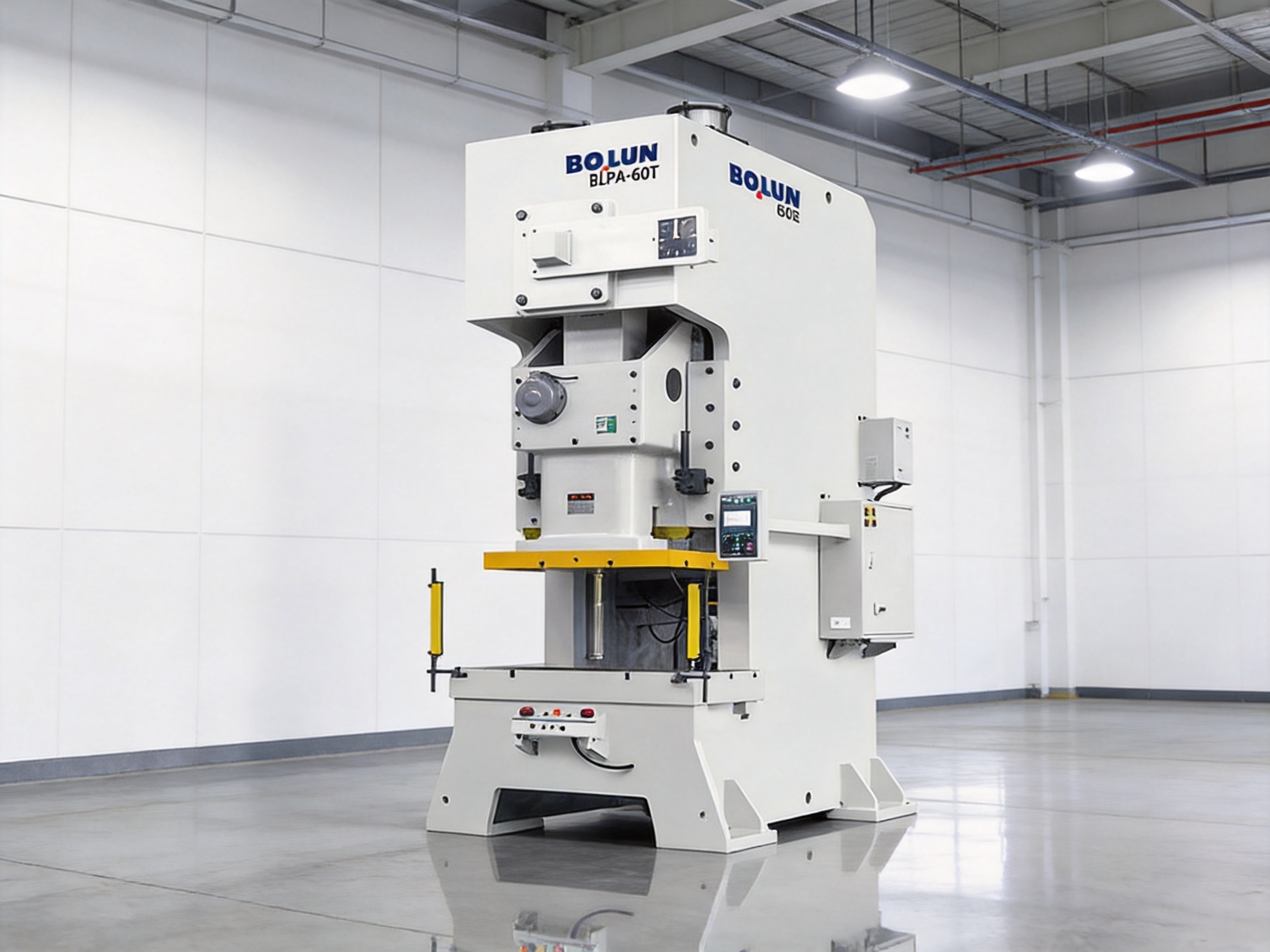
The 900 x 520 mm worktable gives the press a strong advantage in mold compatibility. A larger table supports more complex die structures, broader material strips, wider fixture layouts, and stronger die clamping arrangements. In many stamping operations, the mold footprint is not determined only by part size. It may also include guide pillars, feeding channels, scrap discharge zones, spring systems, sensors, and auxiliary positioning elements. A generous worktable helps accommodate these features without forcing the user to redesign tooling around a restricted press area.
The 270 mm throat depth further increases flexibility. In an open-type press, throat depth determines how far material or a die feature can extend into the machine from the front opening. A deeper throat improves the ability to process wider blanks or parts that require more internal clearance. For workshops serving multiple industries, this additional space can prevent the press from being limited to only small parts.
Compared with smaller open-type presses, the combination of a 600 kN nominal capacity, large worktable, and deeper throat creates a broader processing window. This means the user can retain the machine for more types of orders as product requirements change. In competitive manufacturing, equipment flexibility directly supports business flexibility. A press that can accept more dies and materials reduces the need to purchase separate machines for every new job.
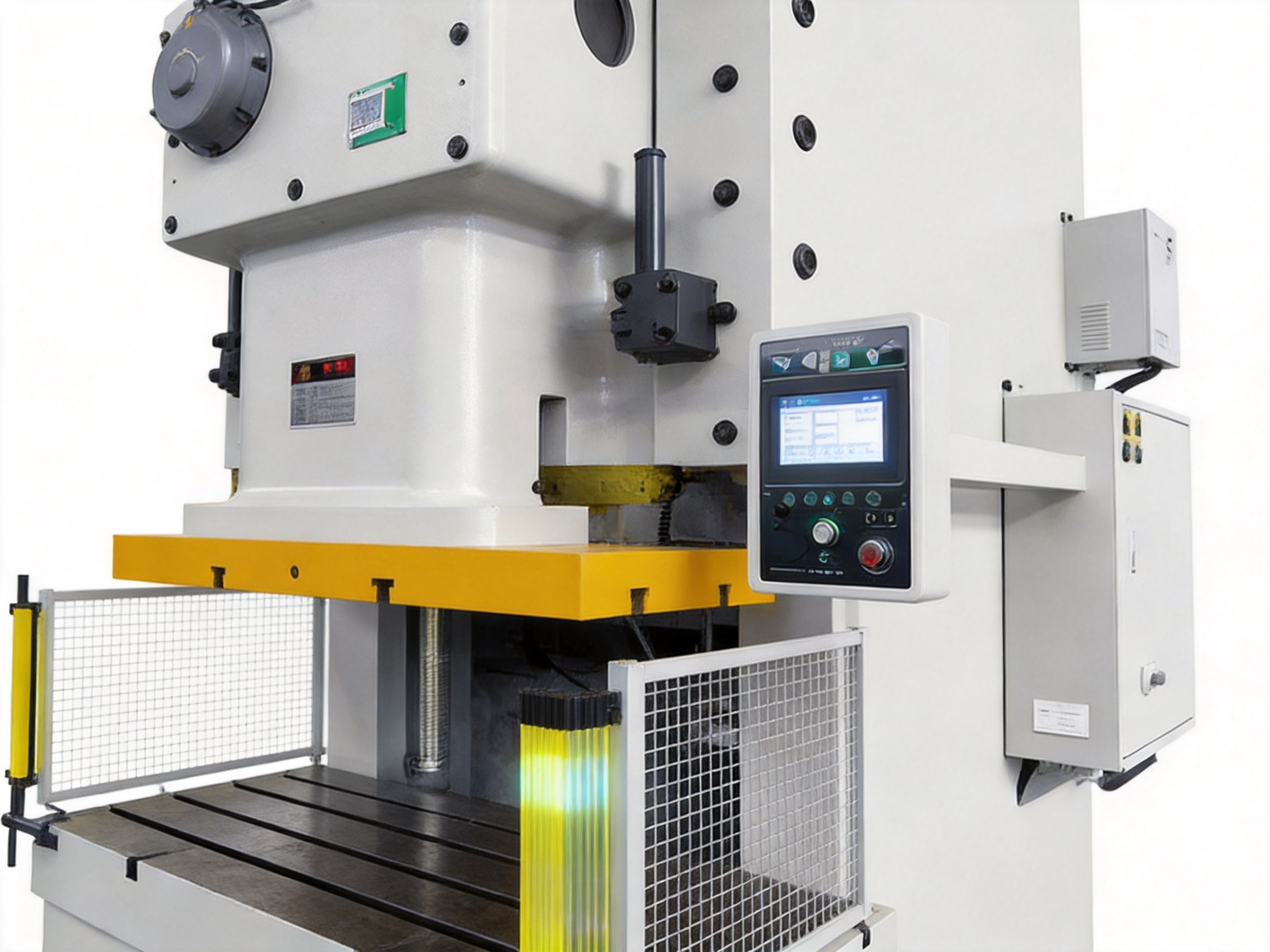
Stamping presses must be productive, but they must also be safe. This machine integrates a sensitive dry clutch brake, hydraulic overload protection, and photo-electronic safety devices. Together, these features create a safety architecture that addresses the main risks of mechanical pressing: uncontrolled motion, overload damage, and operator exposure to the working area.
The dry clutch brake provides responsive control of slide motion. Accurate engagement and stopping are important for cycle consistency and for safe operation. A sensitive clutch brake helps the operator start and stop the machine more reliably, especially during setup, inching, and single-stroke operations. It also contributes to smoother production rhythm during continuous operation.
The hydraulic overload protector is essential for protecting both the machine and the die. Overload can occur because of double feeding, incorrect material thickness, misaligned blanks, scrap blockage, die failure, or improper setup. Without effective overload protection, a press may transmit excessive force into the frame, crankshaft, connecting rod, slide, and die components. Hydraulic overload protection helps reduce the risk of catastrophic damage and makes recovery easier after abnormal load conditions.
Photo-electronic safety devices improve operator protection by monitoring access to the danger zone. In modern manufacturing, safety systems are not optional accessories; they are part of responsible production management. They help reduce the probability of injury, support compliance with safety practices, and strengthen confidence among operators and supervisors. When safety devices are combined with proper guarding, training, maintenance, and operating procedures, the press becomes better suited to professional industrial environments.
The competitive advantage of this press can be understood through several dimensions: rigidity, adjustment efficiency, speed flexibility, safety, mold compatibility, production support, and manufacturing credibility. Many presses in the market may offer similar nominal tonnage, but tonnage alone does not determine production value. A 600 kN press with weak frame stability, slow adjustment, limited speed control, and basic safety features may cost less at purchase but cost more over its operating life.
First, the high-rigidity heat-treated frame gives the machine an advantage in precision retention. In repetitive stamping, deflection and vibration are hidden sources of cost. They can cause burr variation, dimensional drift, die misalignment, noise, and premature tool wear. A rigid frame supports a more stable slide-to-bolster relationship, which helps maintain consistent forming conditions. This is especially important when using progressive dies or when producing parts with tight tolerances.
Second, the electric slide adjustment system improves changeover efficiency. Competitor machines with manual adjustment may be acceptable for low-frequency setup, but they are less suitable for flexible manufacturing environments. The intelligent-adjust design reduces setup effort and makes die changes more systematic. This helps factories operate with shorter lead times and more frequent product switching.
Third, inverter speed control gives the press broader process adaptability. Some low-cost mechanical presses operate within a narrow speed range or rely on mechanical changes that are inconvenient in daily production. Inverter control allows the operator to select suitable speed conditions for different dies and materials. This improves production planning and helps the machine remain useful across multiple applications.
Fourth, the safety package is a meaningful differentiator. A sensitive dry clutch brake, hydraulic overload protector, and photo-electronic safety devices demonstrate that the machine is designed for real production environments where reliability and operator protection matter. Safety-related downtime, equipment damage, and injury risks can all create significant costs. A press designed with safety from the beginning provides better long-term value than a machine that treats safety as an afterthought.
Fifth, the large worktable and throat depth allow the machine to handle more complex industrial molds. Competitors with smaller working areas may restrict die design or force customers to select larger and more expensive equipment. This press provides a practical middle ground: strong capacity and generous working space while preserving the accessibility of an open-type structure.
The quality of a power press is determined not only by its design but also by the manufacturing system that produces it. Zhejiang Bolun High-Precision Machinery Co., Ltd. has developed into a modern enterprise focused on high-precision forming equipment. With two decades of experience in machinery manufacturing, the company has built a mature production management system and an integrated capability covering research and development, design, production, sales, and service.
This integrated structure is important because power presses require coordination across multiple disciplines. Mechanical design must align with machining capability. Electrical control must support the intended operating logic. Safety systems must be integrated into the production workflow. Assembly must preserve geometric accuracy. Inspection must verify both static and dynamic performance. When these capabilities are separated or weakly coordinated, product consistency may suffer. An integrated manufacturer can control more of the value chain and respond more effectively to customer requirements.
The company emphasizes technological innovation as a core engine of development. This is reflected in its focus on full-chain production, non-standard customization, and international management concepts adapted to the local manufacturing environment. Full-chain production means that the company can control major stages from design and component development to final assembly and inspection. Non-standard customization allows the manufacturer to adjust products for special specifications, functions, and production needs. International management perspective supports systematic quality control, process discipline, and continuous improvement.
Advanced precision processing equipment is another important strength. Press components such as frames, slides, bolsters, crankshafts, connecting rods, and guide structures require accurate machining. If machining accuracy is poor, assembly compensation cannot fully correct the problem. Precision equipment enables better flatness, parallelism, perpendicularity, bore alignment, and surface quality. These factors influence slide movement, die alignment, load transmission, and long-term reliability.
A high-quality power press begins with design. Engineers must calculate the load path, select appropriate materials, determine frame geometry, evaluate stress concentration, design drive components, define safety systems, and ensure maintainability. The intelligent-adjust open-type single-point power press reflects this engineering approach through its rigid frame, controlled slide adjustment, speed-controlled main drive, and protective systems.
After design, fabrication and heat treatment play a central role. Steel structures must be welded or formed with attention to stress control. Heat treatment helps stabilize the structure before final machining. This step is especially important for press frames because repeated load cycles can reveal hidden stress problems. A properly stabilized frame is less likely to distort during machining, assembly, or long-term operation.
Precision machining follows. The contact surfaces between the worktable, slide, guides, and drive components must be accurately processed. In a stamping press, alignment errors can lead to uneven loading on dies and guides. Precision machining helps ensure that the slide travels correctly and that the die closes evenly. This contributes directly to part quality and die life.
Assembly requires skilled technicians and controlled procedures. Components such as the clutch brake, motor, transmission system, slide adjustment mechanism, overload protector, electrical cabinet, lubrication system, and safety devices must be installed and adjusted in a coordinated way. Poor assembly can undermine even a well-designed machine. A mature production management system helps standardize these operations and reduce variation from one machine to another.
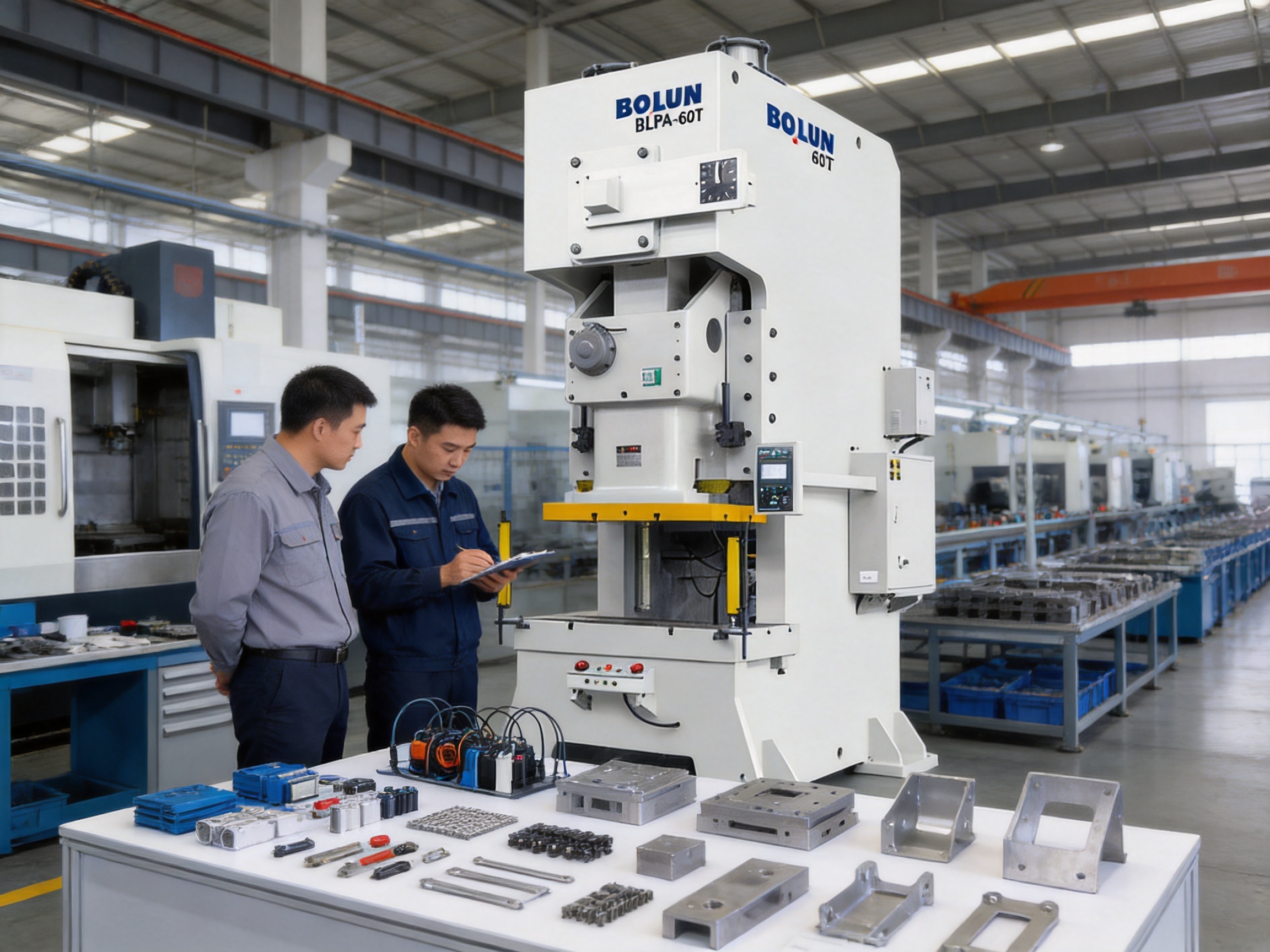
Final inspection is the last barrier before delivery. The company emphasizes a finished product inspection system exceeding industry standards. For a power press, inspection may include appearance checks, dimensional verification, running tests, slide motion checks, clutch and brake response, overload protection verification, noise and vibration observation, lubrication confirmation, electrical safety inspection, and precision evaluation. Such inspection provides confidence that the delivered press can perform reliably under high-intensity production conditions.
Not every customer uses a press in the same way. Some factories prioritize speed, while others prioritize heavy forming, special die installation, feeding automation, safety layout, or integration with existing production lines. The manufacturer’s non-standard customization capability is therefore a major advantage. By relying on a robust design team and production system, the company can provide one-stop design and manufacturing services for products with special specifications and functions.
Customization may involve working height preferences, feeding system compatibility, electrical control requirements, safety device configuration, die cushion options, production monitoring needs, or special tooling interfaces. When a manufacturer can discuss these requirements during the planning stage, the final press is more likely to match the customer’s real production conditions. This reduces the need for later modification and improves commissioning efficiency.
One-stop service also reduces communication cost. Instead of coordinating separately with designers, machine builders, component suppliers, and service providers, customers can work with a single manufacturer responsible for the overall solution. This is particularly valuable for overseas customers or factories establishing new stamping lines. A complete support system covering pre-sales consultation, in-sales support, and after-sales guarantees helps customers select the right equipment, install it properly, and maintain performance after commissioning.
The intelligent-adjust open-type single-point power press is suitable for many industrial applications. In hardware manufacturing, it can be used for brackets, clips, washers, fasteners, hinges, locks, and small structural components. In the electrical and electronics sector, it can support terminals, connector parts, shielding pieces, small frames, and metal contact components. In home appliance production, it can process panels, supports, covers, reinforcing plates, and functional stamped parts. In automotive accessory manufacturing, it can be used for medium-duty brackets, mounting plates, covers, and precision sheet metal items.
The machine is also useful for progressive die operations where continuous strip feeding is required. Its adjustable speed helps synchronize with feeding equipment, while the open frame provides visibility during trial runs. The large worktable supports progressive die layouts that include multiple stations, pilots, cutters, forming sections, and scrap channels. For factories producing large volumes of small and medium parts, this combination of speed, accessibility, and working area is highly practical.
For bending and forming, the press offers stable force delivery and convenient adjustment. Operators can adapt the slide setting for different material thicknesses and die heights. For blanking and piercing, high rigidity helps maintain cutting clearance and reduce burr inconsistency. For trimming and shaping, the steady frame and responsive clutch brake support controlled operation. Although every application must be evaluated according to material, thickness, die design, and required force, the press provides a flexible platform for a wide range of stamping tasks.
A modern press does not work alone. It must integrate with material handling, feeding, lubrication, scrap removal, quality inspection, maintenance planning, and operator workflows. This model’s open-type structure makes integration easier for many production settings. Coil feeding lines can be arranged in front of the press, while operators retain good visibility of the die area. Manual feeding applications benefit from the open access, provided that proper safety devices and procedures are used. Part collection and scrap discharge can be arranged according to die design and plant layout.
Inverter speed control supports production coordination. If the feeder or downstream collection system requires a certain pace, the press speed can be adjusted accordingly. During trial production, lower speed helps engineers observe material flow and die action. During stable mass production, speed can be increased within safe and process-appropriate limits. This supports a smoother transition from die tryout to full production.
Maintenance integration is also important. A press that is easier to access is easier to inspect and service. Operators and maintenance staff can more conveniently observe the slide area, worktable, clutch brake components, lubrication points, and safety devices. Regular inspection helps detect issues before they become serious failures. In this way, the open-type design supports not only production but also preventive maintenance.
The economic value of the press comes from more than its purchase price. A lower-cost press may appear attractive at first, but if it requires more adjustment time, produces more scrap, damages dies more often, or suffers from higher downtime, its total cost of ownership may be higher. The intelligent-adjust open-type single-point power press is designed to create value through stable precision, faster setup, flexible speed control, safety protection, and broad mold compatibility.
Faster die setup improves machine utilization. If a factory changes dies frequently, electric slide adjustment can reduce unproductive time. Even small time savings per changeover become significant across multiple shifts and many production days. Better setup repeatability also reduces the probability of producing defective parts at the start of a run.
Stable frame rigidity helps reduce scrap and tool wear. Scrap reduction has a direct financial impact because it saves material, labor, energy, and inspection time. Tool wear reduction is also important because dies are expensive assets. Extending die life and reducing emergency repairs can significantly improve production economics.
Adjustable speed improves process efficiency. Instead of running every job at one compromise speed, the operator can choose conditions that match the material and die. This can increase output for simple parts and improve quality for more sensitive operations. Over time, the ability to optimize speed for each job contributes to higher overall productivity.
Safety systems protect people and assets. Accidents, overload events, and uncontrolled machine conditions can create severe financial and human costs. A press equipped with responsive braking, overload protection, and photo-electronic safety devices supports safer production and reduces the risk of costly interruptions.
Choosing a power press is also choosing a long-term equipment partner. Stamping presses often operate for many years, and their performance depends on technical support, spare parts availability, service knowledge, and continuous improvement. A supplier with deep manufacturing experience and integrated capabilities can provide better guidance before purchase and better support after delivery.
Zhejiang Bolun High-Precision Machinery Co., Ltd. is located in Zhejiang, a major center of China’s precision manufacturing. The company’s two decades of industry accumulation have helped it develop expertise in forging and casting machinery as well as high-precision forming equipment. Its production management system is described as professional, mature, and efficient, supporting the goal of delivering superior industrial machine tool solutions to global customers.
The company’s philosophy, “Accumulate Richly and Break Forth Thinly; Pressure is Power,” reflects a focus on steady capability building and practical industrial performance. In the context of this press, that philosophy is visible in the emphasis on rigid structure, reliable control, safety, and customer-oriented service. The company’s commitment to quality and credit first is important for customers who need dependable equipment rather than short-term purchasing convenience.
Looking forward, the company’s focus on intelligent and digital stamping equipment aligns with global manufacturing trends. Customers increasingly require machines that are safer, more flexible, more precise, easier to maintain, and easier to integrate into automated production lines. The intelligent-adjust open-type single-point power press is a step in that direction, combining mechanical strength with practical adjustment and control features.
To obtain the best performance from the press, users should follow disciplined operating practices. First, the die should be properly designed for the press capacity, worktable size, shut height, and feeding direction. The nominal force must not be exceeded, and the required forming force should be calculated with adequate safety margin. Second, the slide adjustment should be performed carefully during setup, using the electric adjustment system to reach the correct die height and confirming clearance before production.
Third, speed should be selected according to the actual operation. Higher speed is suitable only when feeding, part quality, die stability, lubrication, and safety conditions are confirmed. For new dies, trial operation should begin at lower speed. Fourth, safety devices should never be bypassed. Photo-electronic protection, clutch brake function, emergency stop systems, and guarding should be checked regularly. Fifth, operators should monitor noise, vibration, temperature, lubrication, part quality, and scrap flow during production. Any abnormal condition should be investigated immediately.
Preventive maintenance is equally important. Regular lubrication, fastening checks, clutch brake inspection, electrical cabinet inspection, overload protector verification, guide clearance checks, and worktable cleaning help preserve accuracy and reliability. Because the press is a high-speed cyclic machine, small maintenance problems can become large failures if ignored. A disciplined maintenance schedule protects the investment and supports stable production.
It is an open-type single-point mechanical power press with intelligent electric slide adjustment. The open-type structure provides convenient access and visibility, while the single-point drive is suitable for many medium-duty stamping applications.
The nominal capacity is 600 kN. This capacity makes the press appropriate for a broad range of blanking, piercing, bending, trimming, and forming tasks involving small and medium-sized metal parts.
Electric slide adjustment improves die setup convenience and repeatability. It reduces dependence on manual adjustment, helps shorten changeover time, and supports more standardized production procedures across different operators and shifts.
Inverter speed control allows operators to adjust the press speed according to die design, material thickness, feeding method, and quality requirements. This flexibility supports both high productivity and stable forming conditions.
The press can reach up to 165 strokes per minute when the die, material, feeding system, and safety conditions are suitable. Actual operating speed should always be selected according to process requirements.
The machine includes a sensitive dry clutch brake, hydraulic overload protector, and photo-electronic safety devices. These features help improve cycle control, protect the press and die from overload damage, and enhance operator safety.
The high-rigidity heat-treated steel frame improves load distribution, reduces vibration, and supports long-term precision retention. This helps improve part consistency, reduce die wear, and support stable high-frequency operation.
It can be used for hardware parts, electrical components, appliance parts, automotive accessories, brackets, washers, clips, terminals, covers, mounting plates, and many other precision sheet metal components.
Its advantages include stronger frame rigidity, electric slide adjustment, inverter speed control, comprehensive safety protection, large worktable capacity, and support from an experienced precision machinery manufacturer. These factors can reduce downtime, improve quality, and lower long-term operating cost.
A power press depends on accurate design, stable fabrication, precision machining, careful assembly, and strict inspection. Zhejiang Bolun High-Precision Machinery Co., Ltd. provides integrated R&D, design, production, sales, and service capabilities, helping customers obtain a complete and reliable equipment solution.
The intelligent-adjust open-type single-point power press is a strong choice for manufacturers seeking a practical combination of capacity, speed, precision, safety, and die adaptability. Its 600 kN nominal capacity, 900 x 520 mm worktable, 270 mm throat depth, 5.5 kW inverter-controlled drive, electric slide adjustment, high-rigidity heat-treated frame, sensitive dry clutch brake, hydraulic overload protector, and photo-electronic safety devices create a balanced platform for demanding stamping production.
Its advantages over many competitor machines are not limited to one specification. The product stands out through the combined effect of structural stability, adjustment efficiency, process flexibility, operator protection, and broad mold compatibility. These advantages help manufacturers improve output, reduce setup time, protect tooling, maintain quality, and support safer production management.
The manufacturing strength behind the product further increases its value. With two decades of machinery manufacturing experience, integrated research and development, precision processing capability, non-standard customization, mature production management, and strict finished-product inspection, Zhejiang Bolun High-Precision Machinery Co., Ltd. provides more than a press; it provides an industrial forming solution. For factories investing in reliable stamping capacity and long-term production efficiency, this machine offers a compelling balance of performance, practicality, and support.
Schuler GmbH. Metal Forming Handbook. Springer, 1998.
Altan, Taylan, and A. Erman Tekkaya. Sheet Metal Forming: Processes and Applications. ASM International, 2012.
Kalpakjian, Serope, and Steven R. Schmid. Manufacturing Engineering and Technology. Pearson Education, latest edition.
Society of Manufacturing Engineers. Tool and Manufacturing Engineers Handbook: Forming. SME, reference edition.
International Organization for Standardization. Safety of Machinery and Mechanical Press Safety Standards, relevant editions.
Japan Industrial Standards Committee. Mechanical Press Accuracy and Inspection Practice, relevant JIS references.


Understanding Mechanical Power Presses and Their Essential Functions A mechani...
What Is a Power Press? A power press — also called a stamping press or punch pr...
In the fields of metal forming, sheet metal fabrication, blanking, and punching,...
Power press machines are classified in two main ways: by frame construction, w...
As the manufacturing industry moves steadily toward automation and smart product...
In modern manufacturing, cold forging is widely used in the automotive, aerospac...
Contact Us

bolunpress@gmail.com

+86-575-83362228

+86-15158259588

+86-575-83362999

+86-15158259588

Hangzhou Office Add: No. 332 Wangjiang East Road, Shangcheng District

No.1 Linjiang Road East, Xiaren, Jinting Town, Shengzhou City, Zhejiang Province, China
Ready to Begin?
Get in Touch

Now!

ZHEJIANG BOLUN
 English
 中文简体
中文简体