
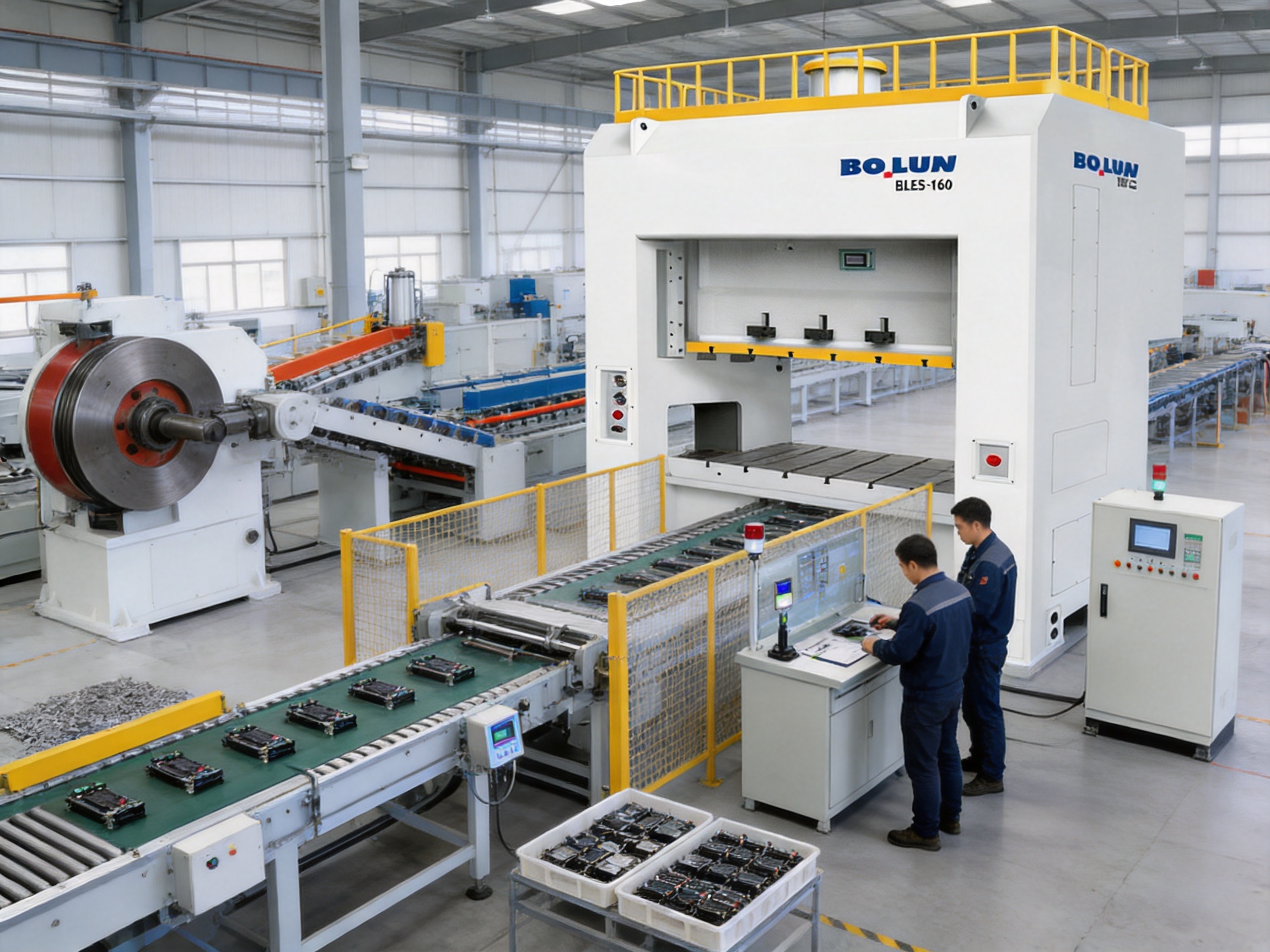
Modern stamping production requires more than high nominal capacity. Manufacturers must achieve repeatable dimensional accuracy, stable operation, low vibration, efficient die changes, and consistent output over long production cycles. These demands are especially important in the electronics, precision hardware, automotive component, appliance, and general metal-forming industries, where small variations in shape, hole position, flatness, or surface quality can cause downstream assembly problems.
The BLES-160 Agile Precision Closed-Frame Double-Point Servo Power Press is designed to address these requirements through a combination of servo-driven slide control, a rigid closed-frame structure, double-point actuation, flexible motion programming, and high-precision manufacturing. With a nominal capacity of 1600 kN, a maximum operating speed of approximately 55 strokes per minute, and a worktable measuring 1800 × 760 mm, it provides a practical balance between forming force, production speed, tooling flexibility, and precision.
This article examines the machine’s operating concept, technical specifications, production advantages, manufacturing strengths, quality systems, application potential, and comparison with conventional press technologies. It also explains how a precision press manufacturer can create value beyond the machine’s rated tonnage by integrating engineering, component production, assembly, inspection, customization, and after-sales service into one coordinated process.
Stamping is often associated with simple cutting or bending operations, but modern forming processes are considerably more demanding. A single die may perform blanking, piercing, drawing, coining, embossing, bending, and forming in a sequence that must remain synchronized with material feeding and part transfer. The press must therefore maintain stable force, controlled motion, accurate alignment, and predictable behavior during every cycle.
In high-volume production, even a small deviation can become significant. If a press produces several dozen strokes per minute, a slight difference in slide position or forming speed can affect thousands of components during one shift. Tool wear, material variation, temperature changes, vibration, and inconsistent lubrication can further increase the risk of dimensional drift.
A precision power press must consequently deliver several capabilities at the same time:
• Sufficient nominal force for the intended material and forming process.
• A rigid structure that resists deflection under load.
• Stable slide guidance and balanced force distribution.
• Adjustable motion suited to different dies and materials.
• Reliable operation at the required production speed.
• Repeatable accuracy over extended operating periods.
• Practical access for die installation, maintenance, and process adjustment.
The BLES-160 is developed around these principles. Rather than treating the press as only a force-generating machine, its design considers the complete forming process, from die setup and material movement to slide motion, noise control, precision verification, and continuous production.
The BLES-160 is a closed-frame, double-point, servo-driven power press with a nominal capacity of 1600 kN. Its closed-frame configuration creates a rigid working envelope around the die area. Compared with more open structural arrangements, this configuration is intended to improve resistance to deformation and support stable die alignment during demanding operations.
The double-point drive applies force through two connection points rather than relying on a single central point. This arrangement is beneficial when working with wide dies or components that require balanced slide movement. By distributing the driving force across the slide, the design helps reduce tilting tendencies and supports more uniform contact between the upper and lower tooling.
The servo system directly controls the slide motion. This is a major distinction from a conventional fixed-motion mechanical press, in which the crank mechanism determines most of the slide’s operating characteristics. Servo control allows the machine to use programmed motion curves for different forming requirements. The supplied product information identifies nine built-in motion curves, including precision blanking and pulsing modes.
These motion options can be used to tailor the relationship between slide position, speed, dwell, and forming force. A rapid approach may improve productivity, while a slower forming segment can support material flow and reduce impact. A dwell period can assist forming stability, and a pulsing motion can help manage particular operations where controlled intermittent movement is advantageous.
The BLES-160 is rated at approximately 55 strokes per minute. Actual output depends on the die, material, feed system, stroke requirements, forming depth, part geometry, and operating conditions. Nevertheless, the rated speed gives the machine a strong position for automated stamping applications where both accuracy and throughput are important.
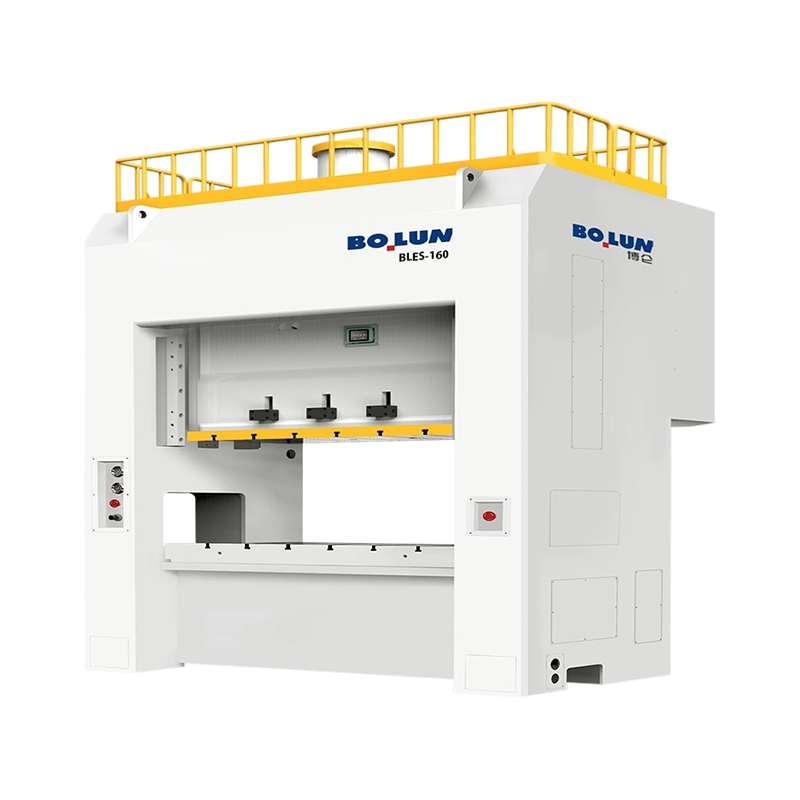
BLES-160 Agile Precision Closed-Frame Double-Point Servo Power Press
The following table summarizes the main specifications of the BLES-160 model based on the supplied product information.
| Parameter | BLES-160 Specification |
|---|---|
| Press type | Closed-frame double-point servo power press |
| Nominal capacity | 1600 kN |
| Nominal pressure stroke | 6 mm |
| Continuous working energy | 9000 J |
| Slide stroke | 180 mm |
| Strokes per minute | Approximately 55 S.P.M. |
| Maximum die height | 450 mm |
| Die height adjustment | 100 mm |
| Side opening | 700 × 450 mm |
| Worktable size | 1800 × 760 mm |
| Slide bottom size | 1600 × 650 mm |
| Press accuracy | JIS B 6402 Class 1 |
| Air pressure | 0.55 MPa |
| Press structure | One-piece structure |
The 1600 kN capacity gives the machine a substantial operating range for precision blanking, progressive stamping, forming, and multi-stage die work. Capacity selection should always be based on the complete process calculation, including material type, thickness, tensile strength, cutting perimeter, forming load, stripping force, dynamic effects, and the recommended safety margin.
The 180 mm slide stroke provides useful forming travel while maintaining a production speed of approximately 55 strokes per minute. The relationship between stroke length and speed is important. A longer stroke can provide more room for forming and material transfer, but it also increases the distance the slide must travel during each cycle. The BLES-160 balances these factors for applications that require both adequate tooling clearance and high output.
The 450 mm maximum die height accommodates a broad range of tooling arrangements. The 100 mm die height adjustment enables operators to adapt the press to different die sets and production requirements. Correct die height adjustment is essential for protecting tooling, maintaining forming accuracy, and achieving reliable shut height control.
The side opening of 700 × 450 mm improves access to the die area. This can simplify tooling installation, inspection, cleaning, maintenance, and the integration of feeding or transfer equipment. For automated lines, side accessibility can also support the layout of material handling systems and peripheral devices.
The most important technological feature of the BLES-160 is its servo-driven slide system. In a traditional mechanical press, the slide follows a fixed kinematic path determined by the crankshaft, eccentric mechanism, or connecting rod arrangement. Although such systems are productive and reliable, their motion profile is comparatively difficult to adapt to different forming processes.
A servo-driven press changes this relationship by allowing the slide movement to be managed electronically. Instead of using one fixed motion for every job, the operator or process engineer can select an appropriate programmed curve. The machine can accelerate, decelerate, dwell, or vary its forming speed according to the requirements of the die and material.
This flexibility provides several possible production benefits:
• Slower motion through the critical forming zone can improve material control.
• Controlled deceleration can reduce shock when the tool contacts the workpiece.
• Dwell or holding motion can support operations that benefit from additional forming time.
• Faster return movement can help reduce non-forming time within the cycle.
• Adjustable motion can assist the processing of materials with different mechanical properties.
• Programmable movement can reduce the need to compromise between quality and productivity.
For precision blanking, the motion curve can be selected to support a more controlled entry into the material. For delicate components, the system may be configured to reduce abrupt changes in speed. For forming operations, the motion can be adapted to promote more consistent material flow and reduce the possibility of cracking, wrinkling, or excessive springback.
The nine built-in motion curves provide a practical starting point for production optimization. These curves are not a replacement for engineering analysis, correct die design, or proper material preparation. However, they give production teams more process options than a conventional fixed-stroke press and make it easier to match press behavior to the characteristics of a particular component.
Structural rigidity is central to press accuracy. During stamping, the machine frame, slide, bolster, die, and drive components all experience force. If the structure deflects unevenly, the die may not close uniformly, resulting in dimensional variation, uneven tool wear, burrs, misalignment, or part deformation.
The closed-frame configuration forms a rigid load path around the working area. This arrangement is particularly useful for precision applications because it helps maintain the relationship between the slide and the worktable under load. A stable frame can also contribute to improved repeatability when the press operates continuously over long production periods.
Double-point drive technology complements the closed frame. Wide dies can generate uneven loading if force is concentrated in one area. Two drive points distribute the movement across the slide, helping to reduce angular displacement and improve balance. This is valuable for progressive dies, transfer tooling, and large-area components where uniform pressure is required across the working surface.
The BLES-160 worktable measures 1800 × 760 mm, while the slide bottom measures 1600 × 650 mm. These dimensions provide a useful die-mounting area for electronic components, precision hardware, and other parts that require multi-station tooling. The exact die arrangement must be evaluated according to shut height, feed direction, pilot release, scrap removal, material width, and the required space for sensors and safety devices.
A rigid structure does not eliminate the need for proper tooling practice. Die alignment, mounting bolt condition, bolster cleanliness, material centering, lubrication, and preventive maintenance remain essential. The advantage of a rigid press is that it provides a more stable foundation for those practices.
The BLES-160 is specified to maintain JIS B 6402 Class 1 precision. This designation provides a recognized reference for evaluating the geometric and operating accuracy of press equipment. In a production environment, such precision is meaningful because it supports consistent die closure, reliable part dimensions, and predictable process results.
Precision should be understood as a system characteristic rather than a single number. It depends on the interaction of the frame, slide guidance, drive mechanism, worktable, die mounting, control system, material feed, and tooling. A press may have a high nominal capacity, but if the structure is not sufficiently stable or the slide is not properly guided, the available force alone will not deliver accurate parts.
The servo-controlled slide contributes to repeatability by allowing the machine to execute a defined motion profile. When the same curve, speed, position, and operating parameters are used consistently, the press can reduce variation caused by uncontrolled changes in slide movement. This is particularly important for operations where a small difference in forming speed changes the final geometry of the component.
Stable precision also supports longer die life. Uneven loading can increase wear on punches, guide components, inserts, and cutting edges. Balanced double-point operation and controlled slide movement can help distribute working conditions more evenly, although actual die life depends on material, lubrication, clearance, heat treatment, maintenance, and the design of the tooling.
For continuous production, regular inspection remains necessary. Typical checks may include slide parallelism, die height, worktable flatness, guide condition, fastener torque, lubrication, sensor operation, and sample part dimensions. Combining machine precision with a disciplined inspection plan helps maintain product quality over time.
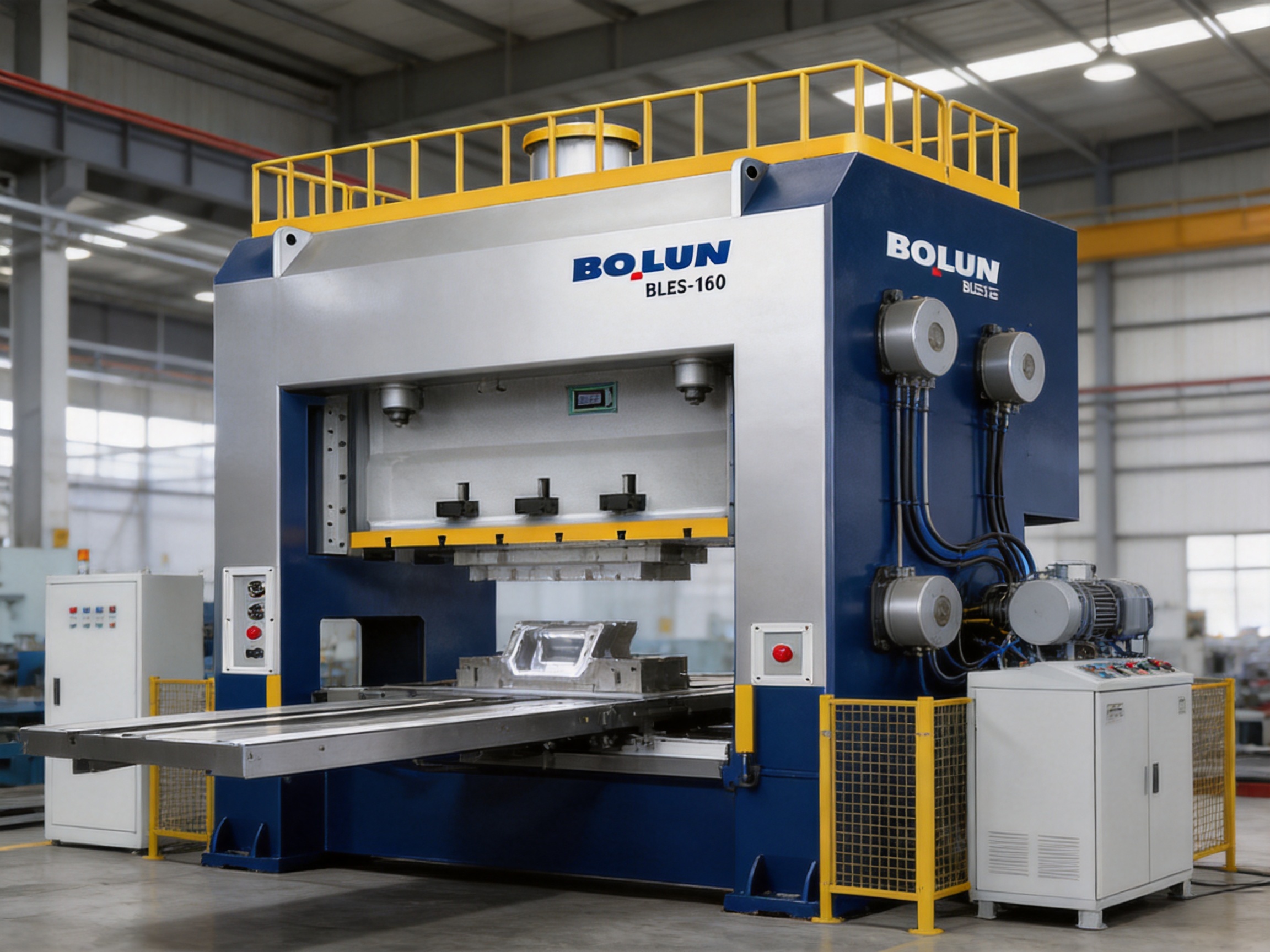
Pressroom vibration affects more than operator comfort. Excessive impact can influence die life, fastener stability, feed accuracy, component quality, and the service life of nearby equipment. Noise and vibration may also make it more difficult for operators to identify abnormal conditions such as tool interference, material misfeed, or mechanical wear.
The BLES-160’s servo motion system is designed to support smoother changes in slide speed. By controlling acceleration and deceleration rather than relying only on a fixed mechanical cycle, the press can reduce abrupt movement in suitable applications. The supplied product description identifies reduced vibration and noise as benefits of the built-in motion curves.
A quieter and more stable machine can create a better working environment, but the final result depends on the complete installation. Foundation design, leveling, anchoring, die balance, material feeding, lubrication, and surrounding equipment all influence measured vibration and noise. The press should therefore be installed according to the manufacturer’s requirements and checked under actual production conditions.
Operating stability is also connected with thermal behavior. High-speed continuous stamping produces heat in motors, bearings, controls, and other components. A well-designed production system must manage heat generation through suitable component selection, ventilation, lubrication, monitoring, and maintenance. Stable thermal conditions help reduce changes in mechanical behavior and improve long-run consistency.
Conventional mechanical presses remain valuable for many applications, especially where the tooling and material are well matched to a fixed crank motion. They are often recognized for simple operating principles, established maintenance practices, and high productivity in repetitive work. However, their fixed motion can limit process flexibility when a component requires different forming speeds or dwell behavior.
The BLES-160 offers several potential advantages in comparison with a conventional fixed-motion press.
A conventional press generally repeats the same slide movement on every cycle. The servo system provides multiple motion options, allowing the machine to be adjusted for blanking, forming, drawing-related operations, pulsing, or other specialized requirements. This flexibility can reduce the need to select one compromise motion for all dies.
Electronic and precision hardware components often have narrow dimensional tolerances, small features, and demanding surface requirements. Controlled motion can help reduce impact and improve the consistency of the forming stage. The machine’s precision specification and double-point structure further support stable tooling conditions.
Servo control creates more opportunities to optimize the relationship between quality and productivity. The press can be evaluated at different curves and speeds to find a suitable balance for a specific part. A process engineer may be able to reduce forming speed only where it is necessary while maintaining higher speed during approach and return movement.
Controlled acceleration and deceleration may reduce abrupt loading compared with a fixed, highly aggressive motion profile. Lower shock can help protect tooling and reduce vibration, particularly when the selected motion curve is matched correctly to the die.
Because the BLES-160 can use different motion curves and supports a substantial die area, it can be applied to a broader range of precision stamping jobs than a press configured only for one fixed production cycle. This can improve equipment utilization when a factory produces multiple component families.
These advantages should not be interpreted as an automatic guarantee of lower cost or higher output in every application. Press selection must consider the full production process, including die technology, automation, material, operator training, maintenance, and the required quality level. The value of servo technology is greatest when the production team actively uses its programmability.
Open-type presses are often selected for accessibility and relatively straightforward tooling arrangements. Their open front and side areas can be convenient for certain operations, but structural rigidity and deflection behavior must be carefully evaluated for high-precision or wide-die applications.
A closed-frame press provides a more enclosed load path and is generally suited to applications where structural stability and die alignment are important. The closed structure of the BLES-160 is particularly relevant to precision stamping, where uncontrolled frame movement can influence part dimensions and tool wear.
Single-point presses apply the drive force through one central connection. They can be effective for narrower dies and balanced loading conditions. Double-point presses use two connection points, making them more suitable for wide dies and processes where balanced slide movement is important. The BLES-160 combines the double-point arrangement with a closed frame to provide a strong platform for large or multi-station tooling within its working range.
Hydraulic presses offer independent control of force and slide position and can be suitable for deep drawing, slow forming, and specialized processes. However, they may operate at lower cycle rates in applications where a mechanical or servo mechanical press is more productive. The BLES-160 is aimed at high-speed precision stamping where the combination of mechanical force transmission and electronic slide control is beneficial.
Servo presses may involve a higher initial investment than basic fixed-motion equipment. The justification comes from process flexibility, quality improvement, die protection, production versatility, and the possibility of reducing defects or setup limitations. A total-cost evaluation should include energy use, tooling life, rejected parts, changeover time, maintenance, and the value of production capability—not only the purchase price.
The BLES-160 is suitable for a range of high-accuracy stamping applications. Its intended uses include electronic components, precision hardware parts, and high-speed automated stamping lines. The machine can also be considered for other products that require controlled forming force and repeatable slide movement within the stated capacity and dimensional range.
Electronic components may include shielding parts, brackets, terminals, connector elements, clips, covers, and small formed housings. These products often require accurate holes, narrow profiles, flat surfaces, and clean cutting edges. Progressive dies combined with automated feeding can take advantage of the press’s cycle speed and motion control.
Precision hardware components may be used in assemblies where dimensional consistency is essential. Examples can include mounting pieces, fastening parts, small reinforcement elements, spring-related components, and formed brackets. The closed-frame structure and controlled slide motion can support stable production when the die is correctly designed and maintained.
Automated stamping lines depend on coordination among the press, feeder, straightener, decoiler, transfer equipment, sensors, lubrication system, scrap handling equipment, and quality inspection devices. The BLES-160’s approximately 55 strokes per minute provide a suitable basis for high-throughput lines, subject to the requirements of the specific part and die.
Precision blanking requires controlled material separation and stable tooling conditions. The available precision blanking motion curve can help production teams investigate an appropriate slide profile for the selected material, clearance, and die configuration. Accurate results also depend on sharp tooling, correct clearance, adequate rigidity, and effective material support.
Components with several bends or forming steps may benefit from programmable movement. The machine’s worktable and slide dimensions allow space for suitable progressive or compound tooling, while the adjustable die height supports different tool configurations. Final suitability must be confirmed by analyzing the die layout and forming loads.
The performance of a precision press is closely connected to the manufacturer’s production capabilities. Zhejiang Bolun High-Precision Machinery Co., Ltd. describes itself as an integrated enterprise covering research and development, design, production, sales, and service. This integrated model can provide advantages when complex machinery requires coordination between engineering, machining, assembly, testing, and customer support.
A press manufacturer with internal design and production resources can respond more effectively to application-specific requirements. Instead of treating every project as a standard machine sale, the manufacturer can evaluate special die dimensions, feeding arrangements, control functions, safety systems, production speeds, and non-standard operating conditions. This is particularly valuable for customers building automated lines or producing parts with unusual forming characteristics.
The company’s stated manufacturing approach includes a full-chain production system, advanced precision processing equipment, core component development, and final machine assembly. A full-chain approach supports closer control of critical relationships, such as frame machining accuracy, slide guidance, drive alignment, worktable geometry, servo integration, and final operating performance.
Research and development is important in servo press technology because the machine combines mechanical engineering, electrical control, motion programming, materials behavior, and production process knowledge. A strong engineering team can develop motion curves, improve drive coordination, refine machine structures, and adapt control functions to practical stamping requirements.
R&D also supports product evolution. As manufacturers request higher speeds, lower noise, better energy management, more complex automation, and improved data collection, the press must develop beyond its basic force rating. Continued technical work enables the manufacturer to respond to these changing expectations.
Precision machining provides the dimensional foundation for a stable press. Frame surfaces, slide interfaces, guide locations, worktable areas, and drive connection points must be produced and inspected carefully. Machining quality affects assembly alignment, load distribution, movement smoothness, and long-term wear behavior.
Advanced processing equipment can improve repeatability between components and reduce the risk of cumulative dimensional error. However, machining is only one stage. The final machine must still be assembled, adjusted, lubricated, tested, and inspected as a complete system.
Servo presses require accurate integration of mechanical and electrical systems. The drive, slide, encoder or position feedback system, control cabinet, safety circuits, lubrication, pneumatic equipment, and operator interface must work together reliably. Assembly technicians must understand not only how to install components but also how to verify synchronization, clearance, alignment, and operating response.
Integrated assembly enables the manufacturer to inspect the press under operating conditions rather than evaluating isolated parts alone. This helps identify issues related to vibration, slide movement, temperature, control response, noise, and repeatability before shipment.
Different customers may require different worktable dimensions, feeding directions, die protection functions, blank detection, transfer systems, automation interfaces, or safety arrangements. The company states that it provides non-standard customization and one-stop design and manufacturing services. This capability can shorten the gap between a standard machine and a production-ready solution.
Customization should be based on a documented technical review. The customer and manufacturer should confirm material specifications, component drawings, die data, cycle targets, automation requirements, utility conditions, quality standards, and acceptance criteria before production begins.
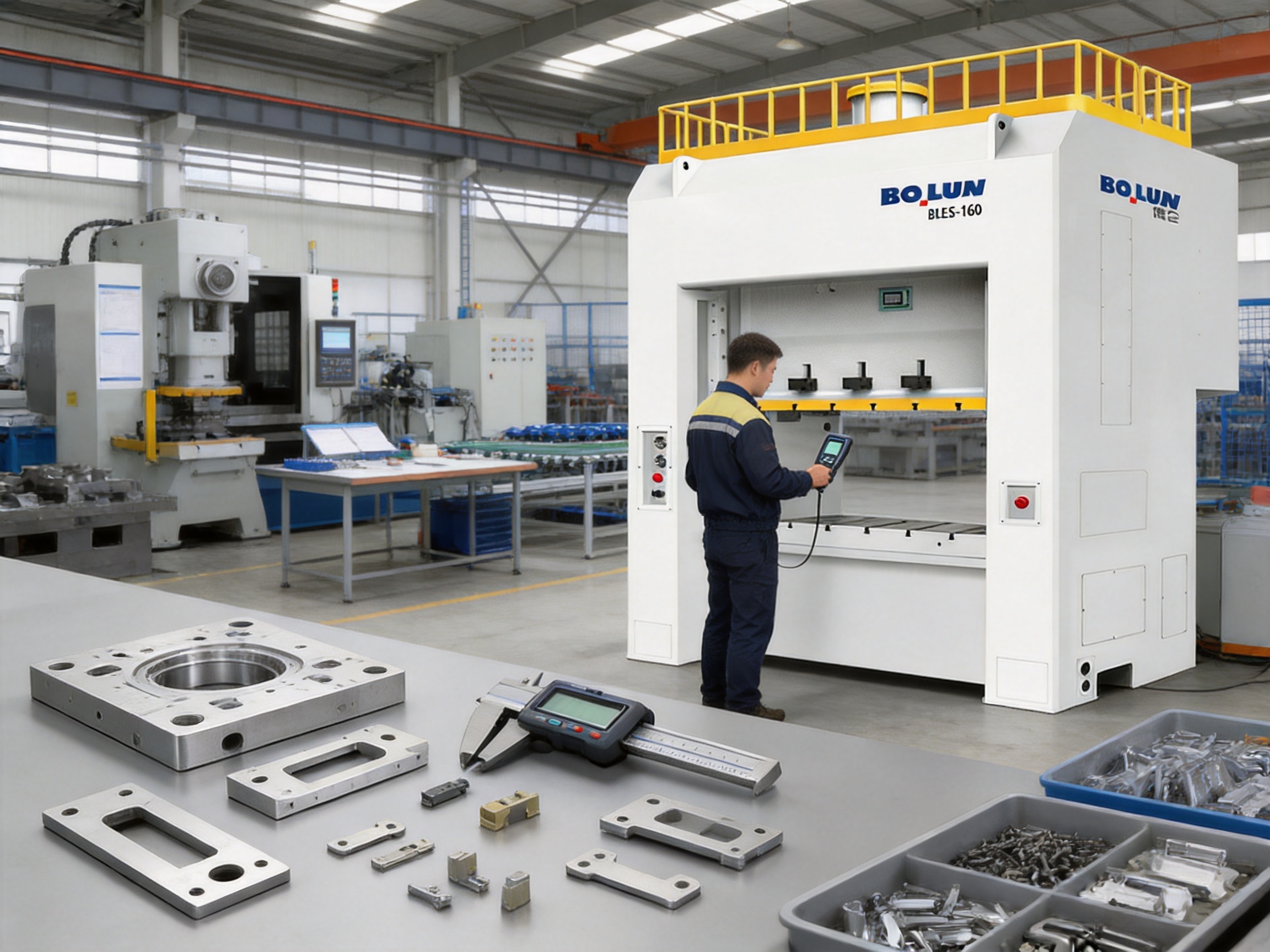
Quality control is especially important for high-precision forming machinery because many performance characteristics cannot be judged by visual inspection alone. The machine must be checked for geometric accuracy, slide behavior, load stability, control response, safety performance, and production repeatability.
The manufacturer describes a finished-product inspection system that evaluates processes and components against demanding standards. A comprehensive system may include incoming inspection of purchased components, in-process checks during machining, assembly verification, electrical testing, lubrication inspection, alignment checks, dry-cycle testing, and final acceptance testing.
For the BLES-160, important inspection areas may include:
• Verification of the nominal operating parameters.
• Worktable and slide dimensional accuracy.
• Slide parallelism and movement stability.
• Die height adjustment performance.
• Correct operation of servo motion curves.
• Control system response and fault detection.
• Pneumatic pressure performance at 0.55 MPa.
• Safety circuit and emergency stop operation.
• Noise and vibration behavior under suitable test conditions.
• Repeatability during continuous or simulated production cycles.
Inspection records are valuable because they create a performance baseline for the machine. When the equipment is installed at the customer’s facility, those records can help distinguish between original machine condition and changes caused by installation, tooling, material, or maintenance.
A quality-centered manufacturer also recognizes that after-sales support is part of product quality. Installation guidance, operator training, troubleshooting, spare parts, maintenance recommendations, and technical consultation all influence the machine’s actual service life and productivity.
Correct installation is necessary to obtain the benefits of a precision press. Before delivery, the customer should prepare the foundation, material handling route, electrical supply, compressed air, lifting equipment, ventilation, safety barriers, and space for maintenance access.
The foundation must be capable of supporting the machine and absorbing operational forces. The press should be leveled accurately, and anchoring should follow the manufacturer’s technical instructions. A poorly prepared foundation can increase vibration, affect alignment, and make it difficult to maintain precision.
Tooling preparation is equally important. The die should be checked for overall height, mounting pattern, guide condition, feed direction, lubrication needs, scrap discharge, and compatibility with the worktable and slide bottom. Operators should confirm that the die does not interfere with the side opening or other machine components throughout the complete slide cycle.
Before automatic production begins, the line should be tested at low speed. The team should verify material feeding, pilot release, sensor signals, die protection, lubrication, scrap removal, and emergency functions. The selected motion curve should be evaluated with sample material, and the process should be adjusted gradually rather than immediately operating at maximum speed.
Documentation should include the approved die parameters, stroke settings, speed, motion curve, die height, material specifications, lubrication settings, inspection requirements, and response procedures for abnormal conditions. Recording these settings makes future changeovers more reliable.
Preventive maintenance protects the accuracy and availability of the press. Maintenance intervals should follow the manufacturer’s recommendations and be adjusted according to operating hours, load, environment, material, and production intensity.
Daily or shift-based checks may include lubrication level, air pressure, abnormal sounds, oil or air leakage, loose fasteners, sensor condition, die area cleanliness, and safety device operation. Operators should report any change in vibration, noise, temperature, or slide movement immediately.
Periodic maintenance may include inspection of guide components, drive connections, pneumatic equipment, electrical cabinets, cooling systems, servo components, and adjustment mechanisms. The worktable and slide bottom should be kept clean so that dies can be mounted accurately and securely.
Tooling maintenance is directly connected with press performance. Dull punches, damaged guide posts, uneven die clearance, and inadequate lubrication can increase load and vibration. If the die is not maintained, the resulting production problems may be incorrectly attributed to the press.
Data-based maintenance can further improve reliability. Production teams can track cycle counts, alarm history, temperature, lubrication consumption, part quality, and maintenance actions. Trends in these data may reveal developing problems before they cause an unplanned stoppage.
Efficiency in stamping should be evaluated broadly. It includes production speed, material utilization, tooling life, setup time, energy consumption, defect rate, operator time, and machine availability. A press that operates quickly but produces excessive rejects may not be efficient in practical terms.
Servo control can support process efficiency by allowing the machine to use a motion profile matched to the operation. The press does not necessarily need to run with the most aggressive movement throughout the entire cycle. A controlled forming segment combined with efficient return movement may provide a better overall balance.
Improved precision can also contribute to material efficiency. Stable tooling conditions may reduce dimensional rejects, burr-related rework, and the need for repeated adjustments. More flexible motion programming can help a production team optimize a die rather than redesigning it solely to accommodate a fixed press movement.
Energy performance depends on the complete servo system, operating pattern, load, speed, and auxiliary equipment. Customers should request a process-specific evaluation rather than relying on general assumptions. The most useful comparison considers energy per acceptable component under actual production conditions.
The BLES series includes models from BLES-160 through BLES-800, with nominal capacities ranging from 1600 kN to 8000 kN. The larger models provide increased capacity and larger working dimensions, but the BLES-160 is a practical choice when the required forming load, die size, and production rate fit within its specifications.
Model selection should begin with the component and die rather than the machine name. Important questions include:
• What material is being processed?
• What are the material thickness and width?
• What is the maximum cutting or forming load?
• What is the required production rate?
• What is the die height and overall die footprint?
• Is a progressive, compound, transfer, or single-operation die required?
• How much space is needed for feeding and scrap discharge?
• Does the process require dwell, pulsing, slow forming, or precision blanking?
• What automation, inspection, and safety interfaces are needed?
• What precision standard and acceptance tests apply?
For the BLES-160, the 1600 kN nominal capacity, 1800 × 760 mm worktable, 160 mm slide stroke, and approximately 55 S.P.M. rating create a balanced specification for high-accuracy, medium-to-large precision stamping work. The final selection must still be confirmed through load analysis and die trials.
Industrial machinery is a long-term investment. The quality of the initial technical discussion can influence the machine’s performance years after installation. A manufacturer that provides support before, during, and after the sale can help customers avoid mismatches between machine capability and production requirements.
Pre-sales support may include technical consultation, die review, capacity calculation, layout planning, automation discussion, and configuration recommendations. During production, the manufacturer can coordinate machine construction, customization, inspection, documentation, and delivery preparation.
After installation, support may involve commissioning, operator training, process adjustment, spare parts, maintenance advice, troubleshooting, and improvement recommendations. This service approach is especially important for servo presses because the customer must understand how to select and use the available motion functions effectively.
Zhejiang Bolun High-Precision Machinery Co., Ltd. states that its service system covers pre-sales consultation, in-sales support, and after-sales guarantees. Its location in Zhejiang places it within one of China’s important manufacturing regions, providing access to industrial supply chains, machining resources, engineering talent, and export logistics.
The BLES-160 competes in a market that includes fixed-motion mechanical presses, hydraulic presses, open-type presses, and other servo-driven closed-frame machines. Its competitive position is based on the combined value of several features rather than one isolated specification.
First, the 1600 kN nominal capacity gives the machine substantial forming capability while remaining focused on precision production. Second, the double-point closed-frame structure supports wide-die stability and balanced loading. Third, the servo-driven slide enables motion flexibility that is not normally available on a basic mechanical press. Fourth, the approximately 55 S.P.M. rate supports high-speed automated production. Fifth, the JIS B 6402 Class 1 precision specification provides a recognized accuracy target.
Another competitive factor is manufacturing integration. Customers often need more than a machine frame and drive. They need a supplier capable of discussing tooling, automation, non-standard dimensions, controls, inspection, commissioning, and service. A manufacturer with design, production, customization, and quality capabilities under one organization can reduce coordination complexity.
The best competitive comparison should be based on the customer’s actual production economics. It should examine acceptable parts per hour, setup time, die life, maintenance requirements, machine availability, energy use, quality stability, and service response. When these factors are included, a servo press can provide value beyond the initial equipment quotation.
Potential buyers should prepare a detailed technical package before requesting a quotation. This package should include part drawings, material information, tolerance requirements, production quantities, die drawings if available, target cycle time, feeding method, and factory utility conditions.
The supplier should then review the application and confirm whether the BLES-160 is suitable. The review should address capacity, pressure stroke, slide stroke, die height, worktable dimensions, side opening, automation interface, safety requirements, and the most appropriate motion curve.
A machine acceptance plan should be agreed in advance. It may include dimensional checks, dry-cycle testing, continuous operation, speed verification, motion curve verification, safety tests, and sample production. If the customer has special precision requirements, those should be defined using measurable inspection methods.
Training should cover machine operation, die setup, motion curve selection, parameter protection, alarm handling, lubrication, daily inspection, and emergency procedures. Operators should understand that servo flexibility must be used carefully. Changes to speed, dwell, and motion behavior can affect forming load and die performance.
Finally, the customer should establish a maintenance and spare-parts plan before production begins. Critical consumables and replacement parts should be identified, and responsibility for routine inspections should be assigned clearly.
The BLES-160 is a closed-frame, double-point servo power press with a nominal capacity of 1600 kN. It is intended for high-accuracy stamping, precision blanking, forming, and automated production applications.
The stated speed is approximately 55 strokes per minute. Actual production speed depends on the die, material, forming operation, feed system, stroke requirements, and selected motion curve.
Double-point operation distributes the driving force through two connection points. This helps support balanced slide movement, particularly when using wide dies or tooling that requires uniform loading across the working area.
A closed frame provides a rigid load path around the die area. This can help reduce structural deflection and support stable alignment during high-load precision stamping.
The servo system directly controls slide movement and allows the use of multiple programmed motion curves. A conventional fixed-motion mechanical press generally follows a predetermined crank-driven movement with less flexibility during approach, forming, dwell, and return.
The product information identifies nine built-in motion curves, including precision blanking and pulsing modes. The appropriate curve should be selected according to the material, tooling, part geometry, and process objective.
The BLES-160 has a worktable measuring 1800 × 760 mm and a slide bottom measuring 1600 × 650 mm. These dimensions should be compared with the complete die layout and automation requirements before purchase.
The maximum die height is 450 mm, with a die height adjustment range of 100 mm. Final suitability depends on the die’s actual height, mounting arrangement, feed equipment, and required operating clearance.
The press is specified at JIS B 6402 Class 1 precision. Buyers should confirm the applicable inspection items, measurement methods, and acceptance conditions for their specific project.
Typical applications include electronic components, precision hardware, precision blanking, progressive stamping, and high-speed automated production lines. Other applications may be suitable after technical review.
The manufacturer states that it provides non-standard customization and one-stop design and manufacturing services. Customization should be discussed during the technical planning stage and documented in the final specification.
Customers should prepare an appropriate foundation, electrical supply, compressed air, lifting and transportation arrangements, safety space, ventilation, maintenance access, and integration points for feeders or other automation equipment.
No. Servo control can improve motion flexibility and process control, but die sharpness, clearance, alignment, lubrication, guide condition, and regular inspection remain essential for safe and accurate production.
The comparison should include capacity, accuracy, motion flexibility, structure, speed, die compatibility, energy use, tooling life, automation capability, inspection standards, customization, maintenance, and service support. Purchase price alone does not represent total production value.
The BLES-160 Agile Precision Closed-Frame Double-Point Servo Power Press is designed for manufacturers that require a combination of force, speed, flexibility, and repeatable precision. Its 1600 kN nominal capacity, approximately 55 strokes per minute, 1800 × 760 mm worktable, 180 mm slide stroke, and JIS B 6402 Class 1 precision specification create a strong foundation for demanding stamping operations.
The machine’s most significant advantage is the combination of servo-driven slide control with a rigid double-point closed-frame structure. Programmable motion curves allow production teams to adapt slide behavior to different materials and forming processes, while the structural arrangement supports balanced loading and stable die conditions. These features can provide meaningful advantages over conventional fixed-motion or less rigid press configurations when the application requires process flexibility and high dimensional consistency.
Product performance is also supported by the manufacturer’s broader capabilities. Research and development, precision processing, integrated assembly, customization, quality inspection, and customer service create a complete equipment development system. For customers seeking a precision press machine supplier, these capabilities are important because long-term results depend on the entire relationship between machine, tooling, process, operator, maintenance, and technical support.
With suitable die engineering, correct installation, disciplined maintenance, and effective use of servo motion functions, the BLES-160 can serve as a productive platform for electronic components, precision hardware, precision blanking, and automated stamping lines. Its value lies not only in its rated capacity, but also in its ability to provide controlled, repeatable, and adaptable forming performance for modern manufacturing.
1. Zhejiang Bolun High-Precision Machinery Co., Ltd. Product technical information for the BLES series closed-frame double-point servo power press.
2. Zhejiang Bolun High-Precision Machinery Co., Ltd. Corporate information concerning research and development, manufacturing, customization, inspection, and service capabilities.
3. JIS B 6402, Accuracy requirements and inspection principles for mechanical power presses.
4. General principles of mechanical metal stamping, blanking, bending, and forming process engineering.
5. Industrial press installation, safety, maintenance, and die setup practices for automated production environments.


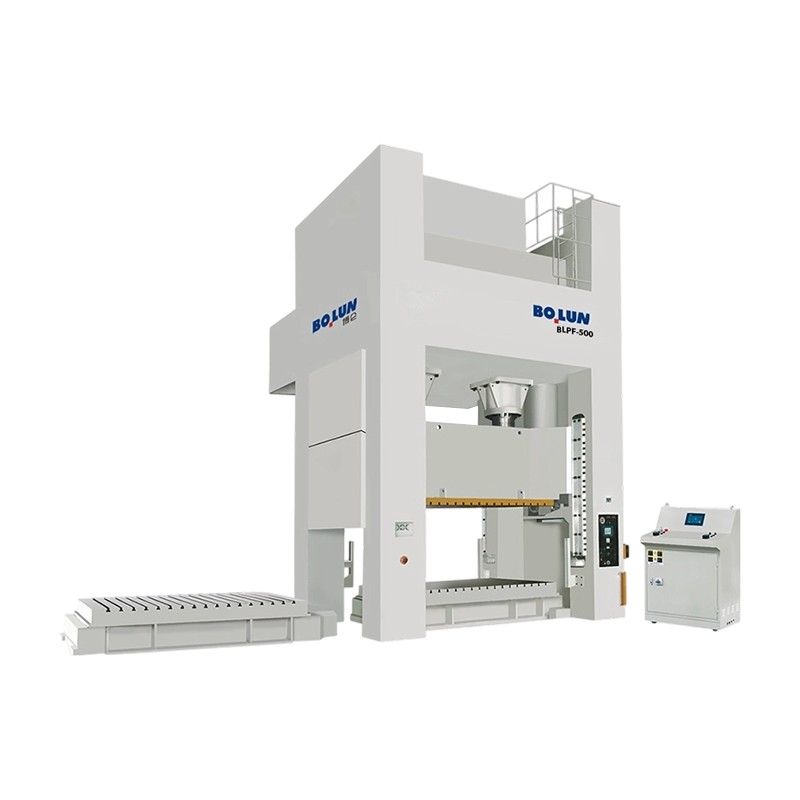
What Is a Power Press? A power press — also called a stamping press or punch pr...
Power press machines are classified in two main ways: by frame construction, w...
Understanding Mechanical Power Presses and Their Essential Functions A mechani...
In the fields of metal forming, sheet metal fabrication, blanking, and punching,...
As the manufacturing industry moves steadily toward automation and smart product...
In modern manufacturing, cold forging is widely used in the automotive, aerospac...
Contact Us

bolunpress@gmail.com

+86-575-83362228

+86-15158259588

+86-575-83362999

+86-15158259588

Hangzhou Office Add: No. 332 Wangjiang East Road, Shangcheng District

No.1 Linjiang Road East, Xiaren, Jinting Town, Shengzhou City, Zhejiang Province, China
Ready to Begin?
Get in Touch

Now!

ZHEJIANG BOLUN
 English
 中文简体
中文简体