
Modern sheet metal manufacturers increasingly require forming equipment that can combine high pressing force, deep working access, reliable production performance, and flexible die compatibility. Large panels, structural components, cabinet parts, appliance shells, and automotive-related stampings often exceed the practical working range of conventional compact presses. In these applications, a machine must provide more than nominal tonnage. It must also offer a sufficiently deep throat, a rigid frame, a stable slide mechanism, effective overload protection, responsive clutch-brake control, and a worktable capable of supporting heavy tooling.
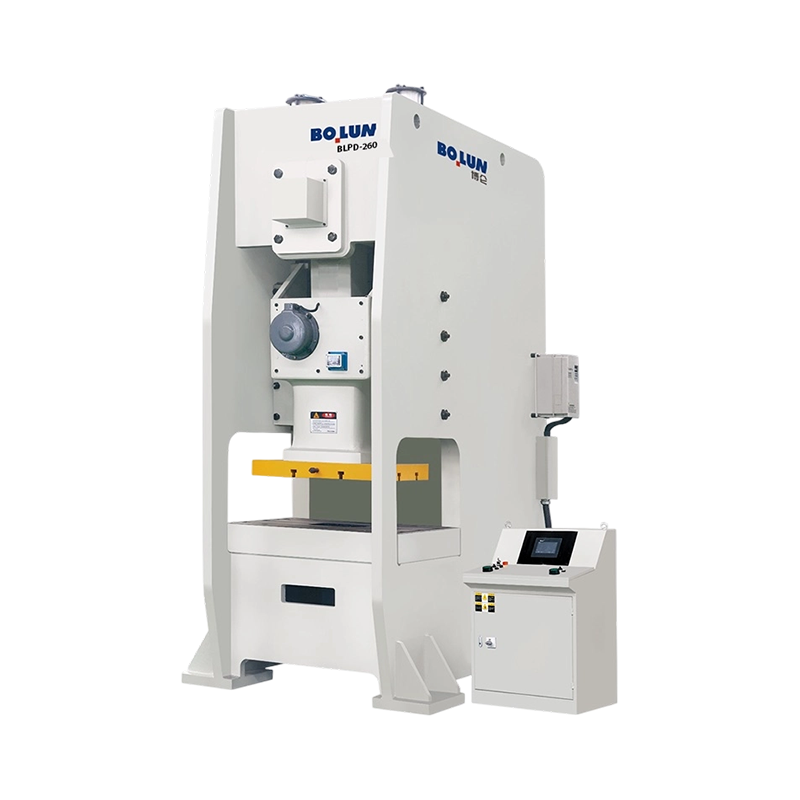
The BLPS-60 Deep-Access Open-Gap Deep-Throat Power Press is designed for this class of production requirement. With a nominal capacity of 600 kN, a throat-depth range of 500–1200 mm, a 900 × 520 mm worktable, and a 5.5 kW high-torque main motor, the machine provides a balanced solution for high-load stamping and forming operations involving wide or deep workpieces. Its open-gap configuration improves access to the die area, while its deep-throat structure allows operators and production engineers to work with larger-format sheet metal than would be practical on a shallow-frame press.
Manufactured by Zhejiang Bolun High-Precision Machinery Co., Ltd., the BLPS-60 reflects a production philosophy based on frame rigidity, controlled deformation, process integration, quality inspection, and application-specific engineering. The machine is intended for users who need dependable forming performance in demanding industrial environments rather than a basic entry-level punching machine.
In a conventional open-type power press, the throat depth determines how far a workpiece can extend from the centerline of the machine while still remaining properly supported and positioned for forming. A shallow throat may be adequate for small brackets, washers, terminals, and compact stamped components. However, it becomes restrictive when the production process involves wide panels, long blanks, deep drawing zones, or components with multiple forming locations.
A deep-throat press provides greater clearance between the front of the frame and the working line of the slide. This additional access can simplify the handling of larger sheets and reduce the need for repeated repositioning. It can also support tooling layouts that would be difficult to install on a conventional shallow press. For manufacturers working with cabinet doors, appliance panels, automotive structural parts, large covers, and extended reinforcement components, deep access can directly influence productivity and die utilization.
The BLPS-60 provides a listed throat-depth range of 500–1200 mm. This range is a significant part of the machine’s design identity. It gives production planners more freedom when selecting blank sizes, die layouts, and workpiece orientations. Instead of forcing a large component into a compact working envelope, the operator can use the available depth to position the sheet more naturally and maintain better access around the die.
Deep access is also valuable when the forming process includes secondary operations. A workpiece may need to be rotated, aligned, inspected, or transferred between forming stages. A larger open working area can make these activities easier to organize, particularly when the machine is integrated with manual loading, mechanical feeding, or a broader stamping line.
The BLPS-60 is rated at 600 kN nominal capacity. This capacity places the machine in a useful range for medium-to-heavy sheet metal stamping. It is suitable for operations where a lower-capacity press would operate too close to its limit, while a much larger press would introduce unnecessary investment, floor-space requirements, and energy consumption.
The machine combines the 600 kN force rating with a 5.5 kW, four-pole main motor. The motor is selected to provide the torque necessary for demanding press cycles while maintaining a practical balance between power consumption and production capability. The motor’s high-torque characteristics are especially relevant during forming operations that place substantial resistance on the slide and crank mechanism.
| Item | BLPS-60 Specification or Design Feature | Production Significance |
|---|---|---|
| Product type | Open-gap deep-throat power press | Supports broad workpiece access and deep-format tooling |
| Nominal capacity | 600 kN | Suitable for high-load stamping and forming applications |
| Throat depth | 500–1200 mm | Provides extended reach for wide panels and structural parts |
| Worktable size | 900 × 520 mm | Accommodates substantial dies and large-format workpieces |
| Main motor | 5.5 kW × 4 pole | Provides practical drive torque for continuous industrial operation |
| Clutch-brake system | Dry clutch-brake with high response sensitivity | Supports controlled starting, stopping, and repeatable cycling |
| Overload protection | Hydraulic overload protection device | Helps protect the press and tooling from excessive forming loads |
| Frame construction | Reinforced, heat-treated, welded steel frame | Improves rigidity and reduces elastic deformation under load |
| Accuracy classification | GB/JIS Class 1 punch accuracy | Provides a defined precision target for industrial stamping work |
| Air pressure requirement | 0.55 MPa | Defines the listed operating pressure for pneumatic functions |
The published series data also shows that the BLPS family is available in a broad capacity range, from 250 kN to 4000 kN, with different vertical and horizontal configurations, stroke characteristics, table dimensions, slide dimensions, and motor ratings. This wider series capability indicates that the BLPS-60 is part of a developed product platform rather than an isolated machine design. Customers can therefore evaluate the 600 kN model alongside other capacity classes when planning a standardized pressroom or future production expansion.
Final working parameters should always be confirmed against the selected configuration, die design, material grade, sheet thickness, operating speed, and application-specific load curve. Nominal capacity is not a substitute for calculating the actual force required by a particular stamping operation.
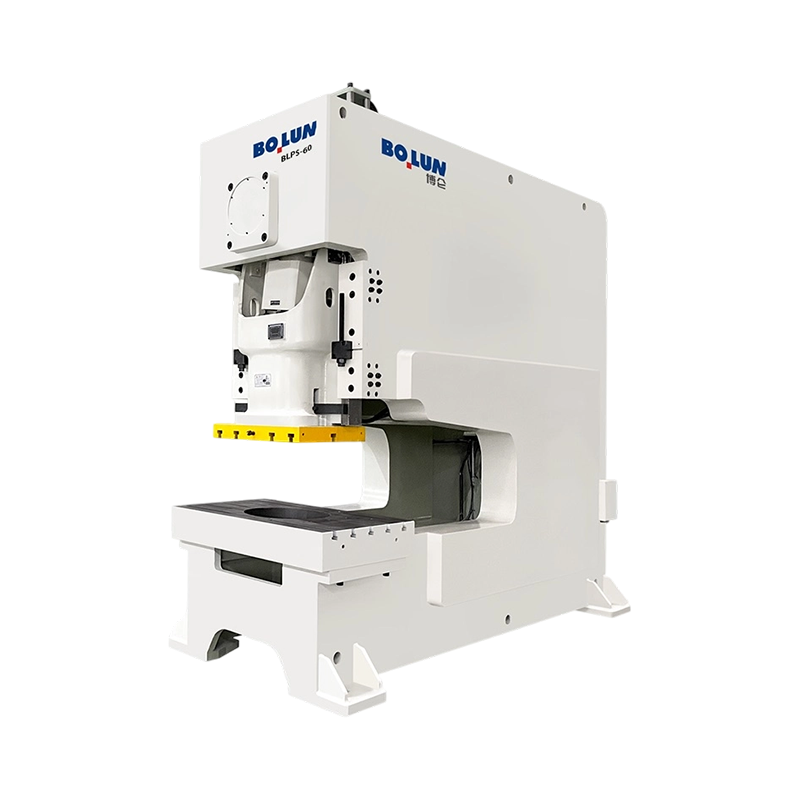
BLPS-60 Deep-Access Open-Gap Deep-Throat Power Press
Frame rigidity is one of the most important performance factors in a mechanical power press. During stamping, the slide transfers force through the die and workpiece into the table and frame. If the frame flexes excessively, the die can experience alignment changes, the workpiece can show dimensional variation, and the machine can be exposed to unnecessary stress. Repeated elastic deformation may also accelerate wear on guide surfaces, bearings, connecting parts, and tooling.
The BLPS-60 uses a reinforced, heat-treated, welded steel frame. Each part of this description relates to a practical engineering objective. Reinforcement increases the structural resistance of the frame. Heat treatment helps stabilize the steel and reduce residual stress associated with fabrication. Welded construction allows the frame to be formed as an integrated load-bearing structure with carefully arranged ribs, plates, and support areas.
A properly engineered welded frame can provide a strong combination of strength, manufacturability, and adaptability. It allows the manufacturer to optimize material distribution around the throat, uprights, table, and upper structure. For a deep-throat machine, this is particularly important because the extended throat creates a larger structural span. The frame must retain sufficient stiffness while providing the reach required by the application.
Reduced elastic deformation benefits several aspects of production. It can help maintain more consistent die closure, reduce uneven loading, and support repeatable part dimensions across a production run. It may also reduce the risk of localized die wear caused by non-uniform contact. These benefits are particularly valuable when the tooling includes multiple forming stations, fine blanking features, piercing sections, or close-tolerance alignment requirements.
Compared with a lightly built machine that provides similar nominal tonnage on paper, a rigid reinforced frame can offer a more stable working platform under real production loads. The difference becomes more visible when the press operates continuously, when the tooling is heavy, or when the workpiece occupies a large area of the available table.
A 600 kN nominal force rating gives the BLPS-60 a useful position between compact general-purpose presses and very large high-capacity machines. It can serve manufacturers that need more force than a small press can reliably provide but do not require the investment or footprint of a multi-thousand-kilonewton system.
The capacity is suitable for a wide range of operations, including blanking, piercing, bending, shallow forming, embossing, flanging, and other die-based processes, provided that the selected die and material are within the machine’s calculated operating limits. The machine’s deep-throat format also makes it appropriate for applications where the workpiece extends significantly from the central pressing area.
For production managers, capacity selection should be based on more than the maximum force needed at a single point in the cycle. The required tonnage should be evaluated together with the pressure-stroke position, material properties, die geometry, operating speed, blank dimensions, and expected production frequency. A machine that is appropriately sized for the load can provide a better balance of safety, service life, energy use, and productivity.
The BLPS-60 is designed to support demanding production without relying on an unnecessarily oversized machine. This can reduce the cost of installing a new line, simplify foundation planning, and make better use of factory floor space. At the same time, the reinforced structure and overload protection provide safeguards against the unpredictable load conditions that can occur when material thickness varies or a workpiece is improperly positioned.
The open-gap structure is one of the key advantages of the BLPS-60. Compared with a closed-frame press, an open-gap configuration generally offers easier side access to the die area. This can simplify loading and unloading, improve visibility, and support the processing of larger or irregularly shaped workpieces.
Open access is especially useful for manufacturers that work with different product families on the same machine. A press may be required to process a narrow bracket in one shift and a broader panel or structural component in the next. The ability to approach the die from a more accessible working envelope can shorten setup time and make manual handling more practical.
The open-gap concept also supports tooling flexibility. Dies can be positioned with greater freedom, and production engineers may be able to use layouts that would be limited by the side columns of a closed machine. For deep-throat applications, the combination of side access and extended reach creates a useful working environment for large-format sheet metal.
At the same time, an open-gap press must be engineered carefully to control frame deflection. The BLPS-60 addresses this requirement through its reinforced welded steel construction and structural treatment. The objective is to provide the practical access benefits of an open press while maintaining the stiffness needed for high-load forming.
Operator access should always be integrated with appropriate guarding, interlocking, emergency-stop functions, safe die-setting procedures, and plant-level risk assessments. The open design improves access to the work area, but it does not remove the need for disciplined safety engineering.
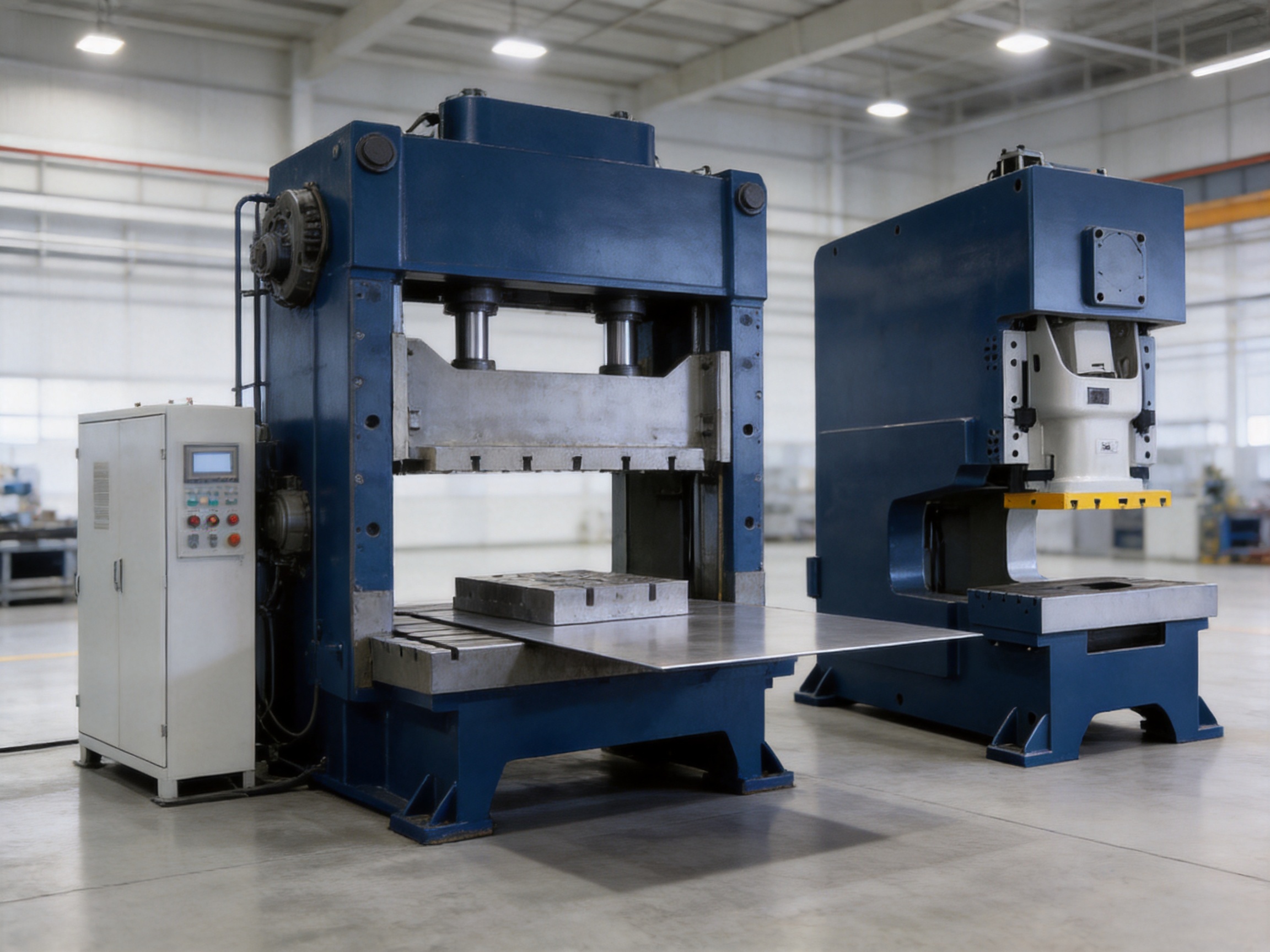
The clutch-brake system controls the connection between the drive mechanism and the slide cycle. It influences how quickly the machine can start, stop, and respond to operator or control commands. In production environments, clutch-brake performance affects not only safety but also cycle repeatability, setup efficiency, and the operator’s ability to control the press accurately.
The BLPS-60 is equipped with a dry clutch-brake system described as having high response sensitivity. This design supports rapid engagement and disengagement, allowing the press to respond efficiently during normal operation, inching, adjustment, and stopping sequences.
A responsive clutch-brake can be valuable in several situations. During die setup, the operator may need controlled movement of the slide to verify shut height, alignment, or clearance. During production, repeatable cycling helps maintain a consistent relationship between the slide, die, and workpiece. In an abnormal condition, a responsive stopping system can help reduce exposure to continued machine motion, subject to the machine’s approved safety controls and operating procedures.
The dry design can also offer practical maintenance advantages when properly managed. It avoids the need for an oil bath within the clutch-brake assembly and allows the condition of friction components to be inspected according to the manufacturer’s service schedule. Maintenance personnel should still monitor wear, adjustment, contamination, response time, and air-system performance.
For high-volume stamping, the clutch-brake system must work consistently over many cycles. Variations in engagement or stopping behavior can lead to production interruptions, inconsistent part quality, or increased mechanical stress. The BLPS-60’s responsive clutch-brake arrangement is therefore an important part of its overall production value, complementing the rigid frame and hydraulic overload device.
Press overload can occur for several reasons. A die may be incorrectly adjusted, a workpiece may be misaligned, material thickness may be greater than expected, or a foreign object may enter the die space. Even a well-designed process can experience unexpected resistance. Without effective protection, an overload can damage the die, slide, crankshaft, connecting components, frame, or table.
The BLPS-60 uses a hydraulic overload protection device to help limit the consequences of excessive forming force. This system is intended to act as a protective layer between the forming process and the machine’s primary structural and drive components. When the load exceeds the permitted condition, the hydraulic protection mechanism can respond to reduce the risk of severe mechanical damage.
Hydraulic overload protection is particularly relevant to deep-throat machines because large-format dies and workpieces can create complex load distributions. A die may not be loaded uniformly across the table, and an off-center force can place additional stress on the structure. Protection against abnormal loads helps improve the resilience of the press in real-world production.
The protection system should not be treated as permission to operate outside the machine’s rated limits. It is a safeguard, not a substitute for correct die design, load calculation, material control, regular inspection, and operator training. The machine should be configured so that the overload device is correctly adjusted and maintained in accordance with the manufacturer’s instructions.
When combined with a rigid frame and a responsive clutch-brake, hydraulic overload protection contributes to a more complete risk-control strategy. The frame supports stable load transmission, the clutch-brake controls motion, and the hydraulic system provides a response to abnormal force conditions.
The BLPS-60 has a listed worktable size of 900 × 520 mm. This table provides a substantial platform for medium-to-large dies and supports the machine’s intended use in wide-format stamping. The worktable dimensions should be evaluated together with the slide bottom size, die height, shank-hole specification, and the available throat depth when selecting tooling.
A worktable is more than a flat support surface. Its rigidity, dimensional stability, mounting arrangement, and relationship to the slide directly affect die performance. Heavy dies require a stable foundation that can resist deflection and maintain alignment during repeated cycles. If the table is undersized or poorly matched to the die, the press may not deliver the expected accuracy or service life.
The BLPS series data includes different table sizes and slide-bottom dimensions across the capacity range. This indicates that tooling compatibility changes with the selected model. For the BLPS-60, customers should verify the actual slide-bottom dimensions, die height range, shank-hole diameter, and any table slots or mounting details before finalizing a die purchase or transfer.
Proper die compatibility can improve setup speed and reduce the risk of mechanical interference. It can also help production teams standardize tooling, develop repeatable setup procedures, and reduce trial-and-error during changeovers. The deep throat adds another dimension to this compatibility assessment, especially when the die includes extended forming areas or when the sheet must project deeply into the machine.
For manufacturers running multiple products, the BLPS-60 can be included in a tooling strategy that separates operations by force, access, and die footprint. Its 600 kN capacity and deep working reach make it a practical candidate for dies that are too demanding for compact presses but do not justify assignment to the largest equipment in the plant.
Automotive manufacturing frequently involves large stamped panels, brackets, reinforcement members, underbody parts, and structural components. These parts may require a combination of blanking, piercing, bending, and forming. The BLPS-60’s extended throat can support components with significant reach, while its 600 kN capacity provides a suitable force level for many medium-sized automotive-related operations.
The machine may be used for prototype production, secondary forming, replacement-part manufacturing, and lower- or medium-volume production. Its open access can be helpful when components have irregular shapes or when loading and unloading methods vary between product families.
Cabinet and enclosure manufacturers often process wide sheet metal blanks that must be bent, pierced, embossed, or formed into rigid housings. The deep-throat configuration can make it easier to position panels and perform operations that require the workpiece to extend into the press.
Consistent die closure and stable load transmission are important for cabinet components because dimensional errors can affect door fit, mounting-hole alignment, frame assembly, and final appearance. The BLPS-60’s rigid frame and responsive control system support repeatable operation when the process is properly engineered.
Appliance production may include panels, brackets, covers, reinforcement parts, and internal supports. These components often demand clean forming, repeatable hole placement, and efficient changeover between product models. A 600 kN press with a relatively large worktable can handle a variety of dies without requiring the manufacturer to assign every operation to a much larger machine.
The deep-access format is useful for large appliance panels and components where a shallow throat would require awkward handling or multiple repositioning steps. This can help improve workflow organization and reduce unnecessary manual movement.
Beyond automotive, cabinet, and appliance production, the BLPS-60 may be considered for agricultural equipment parts, industrial covers, construction-related sheet components, lighting housings, machinery guards, and custom metal products. Its suitability depends on material, thickness, die design, force requirements, and production speed.
Because the BLPS product family extends to higher capacity classes, manufacturers can also use the same general equipment platform as their product range grows. A standardized machine family can simplify operator training, spare-parts planning, maintenance procedures, and production engineering.
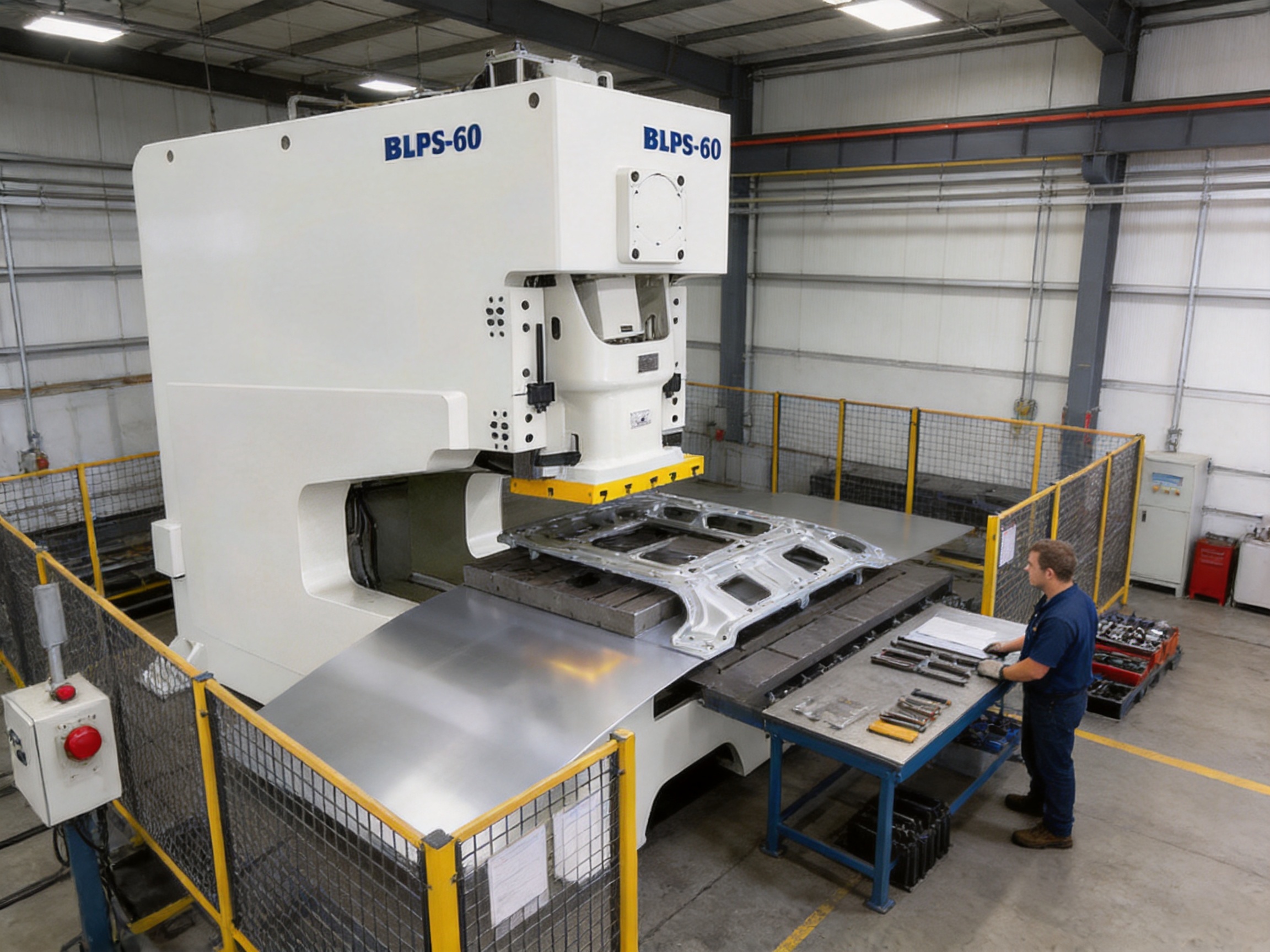
Product comparisons should be based on verified specifications, application requirements, service support, and total operating cost rather than on nominal tonnage alone. Within that framework, the BLPS-60 offers several practical advantages over conventional shallow-throat or lightly constructed power presses.
The 500–1200 mm throat-depth range is a clear advantage when processing wide panels and components that require deep access. A conventional press with a shallow throat may force the operator to reposition the workpiece, use a smaller die, or divide an operation into multiple stages. The BLPS-60 can help reduce these limitations by offering a larger working reach.
The 600 kN rating provides a useful balance between force and machine scale. Users can obtain high-load forming capability without immediately moving to a much larger press. This can reduce capital expenditure, floor-space use, foundation requirements, and auxiliary equipment demands.
The reinforced, heat-treated, welded frame is intended to reduce elastic deformation and maintain stability during high-load cycles. This is an important differentiator from machines that may achieve similar nominal capacity but use less substantial structural design or provide limited information about frame treatment.
The combination of a responsive dry clutch-brake and hydraulic overload protection gives the machine two complementary protective and control functions. The clutch-brake manages motion, while the hydraulic device helps respond to excessive load. Together, they support safer and more controlled production than a basic press with limited overload safeguards.
The 900 × 520 mm worktable allows the machine to support tooling that may be impractical on smaller presses. A larger table can also provide more flexibility in die arrangement and workpiece positioning, assuming the die weight and dimensions remain within the machine’s approved limits.
The BLPS series covers a broad range of capacities and configurations. This can be advantageous for customers who require more than one press or anticipate future capacity expansion. A common product platform may make it easier to build a consistent production environment instead of combining unrelated machine designs from multiple sources.
These advantages should be evaluated against the exact requirements of the application. No press is universally superior for every operation. A closed-frame press may be preferable for certain high-precision or exceptionally high-load processes, while a smaller open press may be more economical for compact parts. The BLPS-60 is specifically strong where deep access, medium-to-heavy force, open working conditions, and robust construction are priorities.
The performance of a power press depends heavily on how it is designed and manufactured. Zhejiang Bolun High-Precision Machinery Co., Ltd. describes its operations as integrating research and development, design, production, sales, and service. This integrated approach can help connect customer requirements with engineering decisions and final machine inspection.
Frame fabrication is a central manufacturing stage. Steel plates and structural components must be prepared, aligned, welded, stress controlled, and inspected. Heat treatment is used to improve structural stability and reduce the effects of residual stress. The objective is to create a frame that remains dimensionally reliable during machining, assembly, and operation.
Precision machining follows the structural fabrication process. Critical mounting surfaces, guide areas, bearing locations, table interfaces, and drive-related components require controlled machining to establish the geometry of the press. Accuracy at these stages influences the alignment between the slide and table and affects the machine’s ability to maintain stable die conditions.
Component development and assembly must be coordinated carefully. The clutch-brake, overload protection system, drive mechanism, slide, adjustment mechanism, electrical controls, pneumatic elements, and structural frame all contribute to the final performance. A press cannot be optimized by treating each component as an isolated product. The systems must work together within defined tolerances and operating parameters.
Bolun states that it maintains a full-chain production system covering basic design, core component development, precision processing, and final machine assembly. Such vertical integration can provide advantages in design coordination, production traceability, customization, and quality feedback. It may also make it easier to adapt machine dimensions or functions to special production requirements.
The company also emphasizes non-standard customization capabilities. This is relevant to manufacturers that need special table dimensions, modified throat arrangements, unique die interfaces, additional automation preparation, or other application-specific features. Any customization must be reviewed through engineering analysis because changes to the frame, slide, drive, or control system can affect machine performance and safety.
High-load stamping equipment must maintain quality over time, not merely pass an initial assembly check. Quality control therefore needs to cover raw materials, welded structures, machined components, purchased parts, assembly procedures, electrical systems, hydraulic protection, pneumatic circuits, and final performance testing.
Bolun describes a finished-product inspection system that applies rigorous control to each process and component. A comprehensive inspection approach can help identify dimensional deviations before the machine reaches the customer. It can also support more consistent assembly of critical parts such as slide guides, crank mechanisms, table surfaces, clutch-brake units, and overload systems.
The listed punch accuracy classification is GB/JIS Class 1. This provides a reference point for evaluating precision performance. Actual results depend on installation quality, foundation stability, die condition, material behavior, lubrication, operating speed, and maintenance. The classification should therefore be understood as part of a broader quality system rather than an independent guarantee of every finished part.
Precision management begins during design and continues through final inspection. Digital drawings, machining controls, dimensional verification, assembly procedures, test cycles, and documentation all contribute to the finished result. For international customers, clear technical records and consistent inspection standards can also simplify acceptance procedures and commissioning.
Production customers should request the appropriate inspection documents, test data, installation requirements, and acceptance criteria before purchase. These documents help align the machine supplier, die builder, installer, and end user around measurable expectations.
Long service life is influenced by load level, cycle frequency, lubrication, die balance, installation, operator practice, and maintenance quality. A machine designed for high-load operation must be assembled with attention to alignment and component loading. The reinforced frame of the BLPS-60 provides a strong foundation, but service life also depends on how the machine is used.
Operating below the maximum rated conditions where possible can reduce stress and extend component life. Dies should be balanced properly, and off-center loads should be evaluated before production. The machine should not be used for operations that exceed its rated force, stroke, speed, die height, or workpiece limitations.
Routine maintenance should include inspection of the clutch-brake system, hydraulic overload protection, lubrication points, drive components, guide surfaces, fasteners, electrical connections, pneumatic supply, and safety devices. Wear components should be replaced according to condition and service recommendations rather than being left until failure.
Installation is equally important. The foundation must meet the required load and vibration conditions. The machine should be leveled accurately, connected to suitable power and air supplies, and commissioned by qualified personnel. Poor leveling or an unstable foundation can introduce vibration, alignment changes, and uneven loading even when the press itself is correctly manufactured.
Bolun’s service philosophy covers pre-sales consultation, in-sales support, and after-sales guarantees. For customers operating internationally, service planning should include spare-parts availability, response procedures, remote technical assistance, operator training, and access to maintenance documentation.
Productivity is shaped by the full production cycle, including loading, die setup, pressing, unloading, inspection, and changeover. A press that is powerful but difficult to access may not deliver the best practical output. The BLPS-60 addresses productivity through a combination of deep access, open structure, suitable table dimensions, responsive motion control, and protection against abnormal loads.
The extended throat may reduce the number of times a large workpiece must be repositioned. Fewer repositioning steps can reduce handling time and lower the risk of alignment errors. Open access can also improve visibility during setup, allowing operators to verify die conditions and workpiece positioning more conveniently.
A responsive clutch-brake supports controlled cycling and adjustment. This can be useful when changing dies, confirming the first part, or making controlled corrections during setup. Once the process is approved, repeatable press cycling can support consistent production rates.
Hydraulic overload protection may reduce downtime after an unexpected load event. Although the protection system does not eliminate the need for process discipline, it can help prevent a single mistake from becoming a major mechanical failure. Reduced damage can protect delivery schedules and decrease repair costs.
The machine’s capacity also supports production planning. Parts that previously required a larger press may be assigned to the BLPS-60 if engineering calculations confirm suitability. Conversely, the machine can be reserved for deep-access operations while smaller presses handle compact components. This kind of equipment allocation can improve overall pressroom efficiency.
Before purchasing or assigning the BLPS-60 to a production task, manufacturers should define the full process requirement. Important factors include material type, yield strength, tensile strength, sheet thickness, blank size, forming method, required tonnage, stroke position, die height, die weight, part dimensions, production volume, and desired cycle rate.
The force calculation should account for the entire operation. Blanking and piercing forces depend on material shear strength, perimeter, and thickness. Bending and forming forces depend on geometry, tool radius, friction, material behavior, and forming depth. If several operations occur simultaneously in a compound or progressive die, their combined force must be evaluated.
Workpiece reach should be compared with the machine’s throat depth and table dimensions. The die must fit within the available table and slide area, and its mounting arrangement must be compatible with the press. The selected die height must fall within the machine’s permitted range, with sufficient adjustment capacity for safe and accurate setup.
Production speed must also be considered. The series data lists different strokes-per-minute ranges for various BLPS configurations. The actual recommended speed for the BLPS-60 will depend on the selected stroke, material, die, lubrication, feeding method, and load. High-speed operation should never be selected solely to maximize a catalog value if it compromises safety, part quality, or machine life.
Customers should discuss application details with the manufacturer before final configuration. This is particularly important for custom tooling, unusual materials, off-center loading, automation, or processes that approach the upper end of the machine’s rated capability.
Zhejiang Bolun High-Precision Machinery Co., Ltd. is located in Zhejiang, a major Chinese manufacturing region with a strong industrial base and extensive supply-chain capability. The company reports approximately two decades of experience in machinery manufacturing and positions itself as an enterprise focused on high-precision forming equipment.
Its stated capabilities include research and development, mechanical design, production, sales, and technical service. This combination enables the company to address a project from initial process discussion through machine delivery and after-sales support. For customers purchasing specialized equipment, a single coordinated supplier can reduce communication gaps between design, manufacturing, and service teams.
The company emphasizes technology-first development, precision processing equipment, non-standard customization, and an international management perspective. These strengths are relevant to power press customers because industrial stamping applications often differ significantly from one factory to another. A machine supplier must understand not only the press itself but also the material flow, tooling, production volume, factory conditions, and quality objectives of the end user.
Bolun also describes a mature production management system developed through experience in forging and casting machinery. A structured management system can support production scheduling, component control, assembly consistency, and final testing. It can also provide a foundation for continuous improvement when field feedback identifies opportunities to refine the machine or service process.
The company’s stated quality philosophy places emphasis on stable precision and long service life under high-intensity operating conditions. This philosophy aligns with the BLPS-60’s intended application: demanding industrial stamping where equipment reliability directly affects production continuity and customer delivery performance.
Not every manufacturer can use a standard machine without modification. Some require special table arrangements, custom throat dimensions, dedicated die interfaces, part-ejection systems, feeding equipment, or automation preparation. Bolun’s stated non-standard design and manufacturing capabilities provide a basis for discussing such requirements.
Customization should begin with a technical review. The customer should provide drawings, material specifications, cycle requirements, die information, loading methods, and factory constraints. The supplier can then evaluate whether the requested changes affect the frame, force distribution, slide travel, control system, safety devices, or service requirements.
The BLPS-60 may also be incorporated into a broader production system. Depending on the application, this could include sheet feeders, decoilers, straighteners, transfer devices, sensors, part conveyors, lubrication systems, or robotic handling. Integration requires coordination of cycle timing, safety circuits, material positioning, and emergency-stop functions.
Automation can increase productivity, but it should not be added without considering die access, changeover requirements, maintenance, and operator interaction. The open-gap structure may support flexible access during setup, while automation can be used during stable high-volume production. A well-planned system should allow both efficient production and safe intervention.
Successful installation begins with site preparation. The customer should confirm the foundation, machine positioning, access routes, lifting equipment, electrical supply, compressed-air system, ventilation, lighting, and surrounding safety space. The listed air-pressure requirement is 0.55 MPa, but the plant should also verify air quality, flow, filtration, and connection specifications.
After positioning, the machine must be leveled and connected according to the manufacturer’s instructions. Mechanical, electrical, pneumatic, and hydraulic systems should be inspected before the first operating cycle. Safety functions should be tested individually and as part of the complete control system.
Commissioning should include no-load operation, controlled cycling, clutch-brake verification, slide adjustment, die-height confirmation, overload-protection checks, and trial production with an approved die. The first parts should be inspected for dimensions, forming quality, burrs, cracks, surface damage, and repeatability.
Operators should be trained in normal operation, setup, die installation, safe adjustment, emergency procedures, lubrication points, inspection routines, and fault reporting. Maintenance personnel should receive additional training in clutch-brake service, hydraulic protection, electrical troubleshooting, and replacement of wear components.
Good training protects both people and equipment. It also helps the manufacturer obtain better production results because operators understand how to use the machine within its design limits.
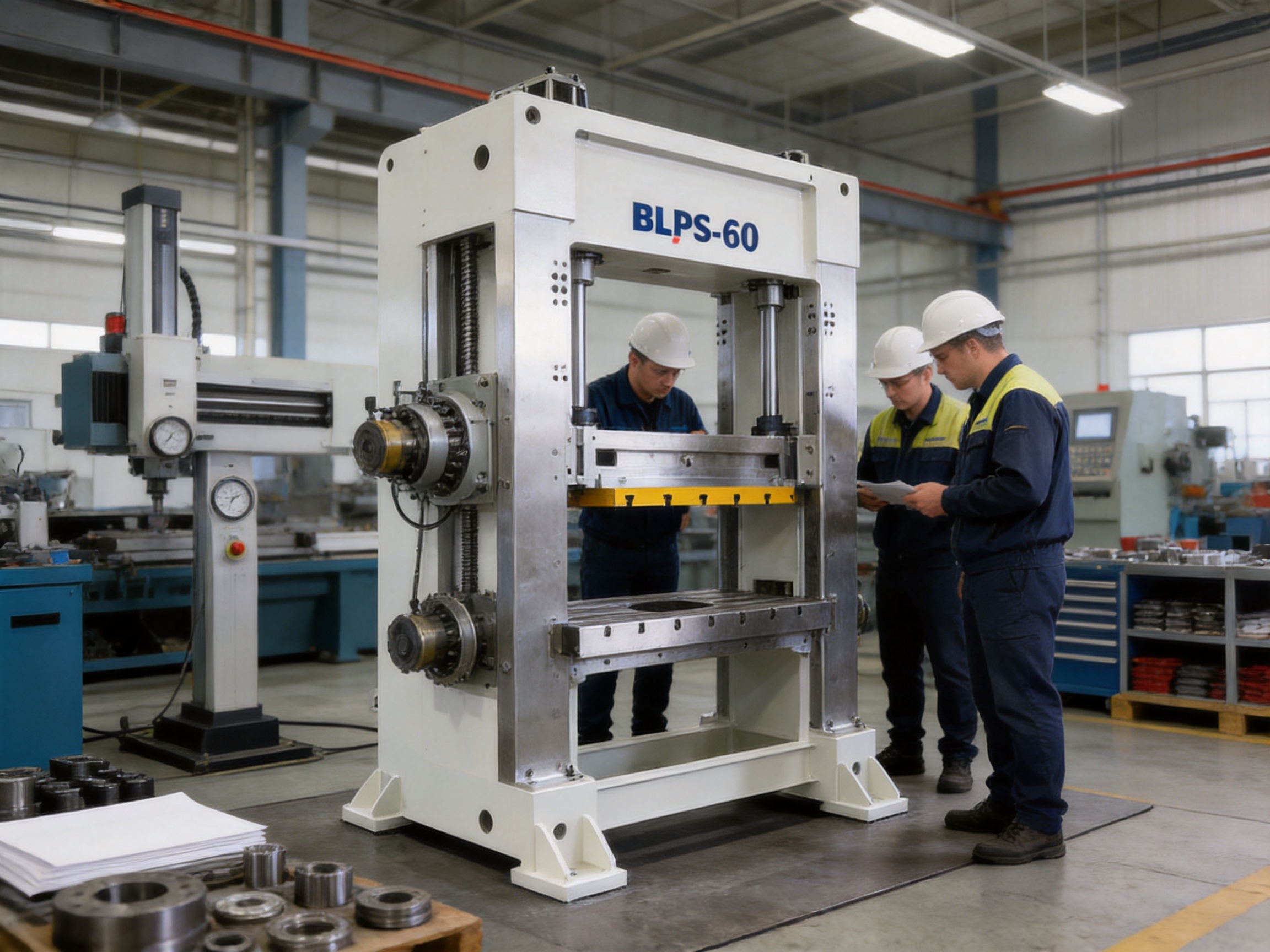
Preventive maintenance should be planned around operating hours, cycle count, production intensity, and environmental conditions. A maintenance schedule may include daily checks, weekly inspections, monthly service, and periodic detailed overhauls. The exact intervals should follow the manufacturer’s recommendations and the customer’s operating experience.
Daily checks may include examining lubrication, air pressure, unusual noise, vibration, leaks, fastener condition, die alignment, and safety-device status. Operators should report changes in clutch-brake response, stopping behavior, slide movement, or overload-device operation immediately.
Periodic maintenance should include inspection of friction elements, hydraulic lines, seals, guide surfaces, crank and connecting components, electrical terminals, control cabinets, and pneumatic valves. The worktable and slide mounting areas should be kept clean so that chips, scale, or debris do not interfere with die seating.
Maintenance records are valuable for identifying trends. Repeated overload events, rising vibration, increasing stopping time, or recurring alignment problems may indicate a process or mechanical issue that requires investigation. Documented service history also assists with warranty discussions, spare-parts planning, and future equipment upgrades.
Correct lubrication is essential. Too little lubrication can increase wear and heat, while incorrect lubricant or excessive application can contaminate components. Only approved lubricants and service procedures should be used.
A power press is a high-energy machine and must be operated under a comprehensive safety program. The BLPS-60’s dry clutch-brake and hydraulic overload protection contribute to machine control, but safe operation also depends on guarding, interlocks, emergency stops, die protection, safe work procedures, and trained personnel.
Before production begins, the operator should confirm that the die is correctly installed, fastened, aligned, and adjusted. The work area should be clear of tools and loose materials. The machine should not be operated if protective devices are bypassed, damaged, or not functioning correctly.
Hands and body parts must remain outside the danger zone during automatic or manual operation. Appropriate feeding tools, sensors, barriers, or automation should be used where necessary. Lockout and tagout procedures must be followed during maintenance, die changes, inspection, and troubleshooting.
Material handling should also be considered. Large-format sheet metal can have sharp edges and significant weight. Suitable gloves, lifting devices, supports, and team-handling procedures may be required. The deep-throat press improves access but does not eliminate the hazards associated with large workpieces.
Safety requirements may vary according to the country, industry, machine configuration, and applicable standards. Customers should conduct a site-specific risk assessment and ensure that the delivered machine is installed and operated according to applicable regulations.
The purchase price is only one part of a press investment. Total cost of ownership includes installation, foundation work, tooling compatibility, energy consumption, maintenance, spare parts, downtime, operator training, and service support. A machine that appears inexpensive initially may become costly if it has limited access, frequent alignment problems, difficult maintenance, or inadequate protection against overload.
The BLPS-60 can provide economic value by combining a substantial force rating with a deep-access structure. If one machine can handle operations that would otherwise require multiple setups or a larger press, the customer may achieve savings in labor, handling time, and equipment utilization.
The 5.5 kW main motor provides a practical power level for the 600 kN capacity class. Actual energy consumption depends on cycle rate, load, motor efficiency, idle time, auxiliary systems, and production scheduling. Efficient process planning should consider whether the machine is used continuously, intermittently, or in combination with automated feeding.
Durability also affects cost. A rigid frame, properly maintained clutch-brake, and effective overload protection can help reduce unplanned repairs and extend the useful life of tooling and machine components. The strongest economic result comes when the machine is correctly sized, correctly installed, and operated within its engineering limits.
The BLPS-60 has a nominal capacity of 600 kN. The actual suitable force for a specific process must be calculated from the material, thickness, die geometry, operation type, pressure-stroke position, and production conditions.
The listed throat-depth range is 500–1200 mm. This deep-access range is intended to support large-format sheet metal, wide panels, and components that require extended reach into the press.
Potential applications include automotive component production, electrical cabinet manufacturing, appliance parts, industrial enclosures, machinery components, agricultural equipment, and general sheet metal fabrication. Suitability depends on the specific material, die, force requirement, and production method.
The listed worktable size for the BLPS-60 is 900 × 520 mm. Die weight, slide-bottom dimensions, mounting details, and clearance should be verified before selecting tooling.
The open-gap design provides broad access to the die area and can simplify the handling of wide, deep, or irregular workpieces. It may also give production engineers greater flexibility in die positioning and setup.
The hydraulic overload protection device is designed to respond when forming loads exceed the permitted condition. It helps reduce the risk of serious damage to the die and press. It should be treated as a protective safeguard, not as permission to exceed rated operating limits.
The machine uses a dry clutch-brake system with high response sensitivity. It is intended to support controlled engagement, stopping, adjustment, and repeatable press cycling.
The BLPS-60 is equipped with a listed 5.5 kW, four-pole main motor. The final electrical configuration should be confirmed with the supplier according to the customer’s plant requirements.
The manufacturer states that it provides non-standard design and manufacturing services. Possible customization must be reviewed through an engineering assessment because changes to the frame, working dimensions, controls, die interfaces, or automation functions can affect performance and safety.
The BLPS-60 can be evaluated for integration with feeders, transfer systems, conveyors, sensors, or robotic handling. Automation compatibility depends on the die, material flow, cycle timing, safety architecture, and required production volume.
Customers should confirm force requirements, throat depth, table dimensions, die height, slide dimensions, shank-hole details, stroke, operating speed, motor and power requirements, air pressure, safety functions, installation conditions, maintenance support, and acceptance-test criteria.
Use the machine within its rated limits, balance dies correctly, avoid excessive off-center loading, maintain lubrication, inspect the clutch-brake and overload system, keep the table and die area clean, follow preventive maintenance schedules, and train operators thoroughly.
The BLPS-60 Deep-Access Open-Gap Deep-Throat Power Press is designed for manufacturers that require more reach and structural strength than a conventional compact power press can provide. Its 600 kN nominal capacity, 500–1200 mm throat-depth range, 900 × 520 mm worktable, and 5.5 kW high-torque motor create a practical platform for medium-to-heavy sheet metal stamping.
Its principal advantages come from the combination of features rather than from any single specification. The open-gap architecture improves access, the deep throat supports large-format workpieces, the reinforced heat-treated welded frame helps control deformation, the dry clutch-brake enables responsive machine control, and the hydraulic overload protection adds a valuable layer of protection against abnormal forming loads.
The machine is supported by Zhejiang Bolun High-Precision Machinery Co., Ltd.’s stated strengths in integrated research and development, precision processing, machine assembly, customization, quality control, and customer service. These capabilities are important for customers that need a press adapted to a particular production process rather than a generic machine selected only by tonnage.
For automotive components, cabinets, appliances, industrial enclosures, and general fabrication, the BLPS-60 offers a balanced approach to deep-access stamping. Its final suitability should be confirmed through engineering calculations, die evaluation, site assessment, safety review, and acceptance testing. When correctly matched to the application and maintained according to recommended procedures, it can serve as a dependable foundation for high-load, repeatable, and efficient sheet metal production.
1. Zhejiang Bolun High-Precision Machinery Co., Ltd. Product information for the BLPS series open-type power presses.
2. Zhejiang Bolun High-Precision Machinery Co., Ltd. BLPS-60 technical description and application information.
3. General mechanical power press design principles covering frame rigidity, slide guidance, clutch-brake operation, and overload protection.
4. Industrial sheet metal stamping engineering references covering blanking force, forming force, die selection, and press capacity calculation.
5. General occupational safety guidance for mechanical power presses, die setting, lockout procedures, guarding, and operator training.
6. Manufacturing engineering references concerning welded steel structures, heat treatment, precision machining, and dimensional inspection.


Understanding Mechanical Power Presses and Their Essential Functions A mechani...
What Is a Power Press? A power press — also called a stamping press or punch pr...
In the fields of metal forming, sheet metal fabrication, blanking, and punching,...
Power press machines are classified in two main ways: by frame construction, w...
As the manufacturing industry moves steadily toward automation and smart product...
In modern manufacturing, cold forging is widely used in the automotive, aerospac...
Contact Us

bolunpress@gmail.com

+86-575-83362228

+86-15158259588

+86-575-83362999

+86-15158259588

Hangzhou Office Add: No. 332 Wangjiang East Road, Shangcheng District

No.1 Linjiang Road East, Xiaren, Jinting Town, Shengzhou City, Zhejiang Province, China
Ready to Begin?
Get in Touch

Now!

ZHEJIANG BOLUN
 English
 中文简体
中文简体