
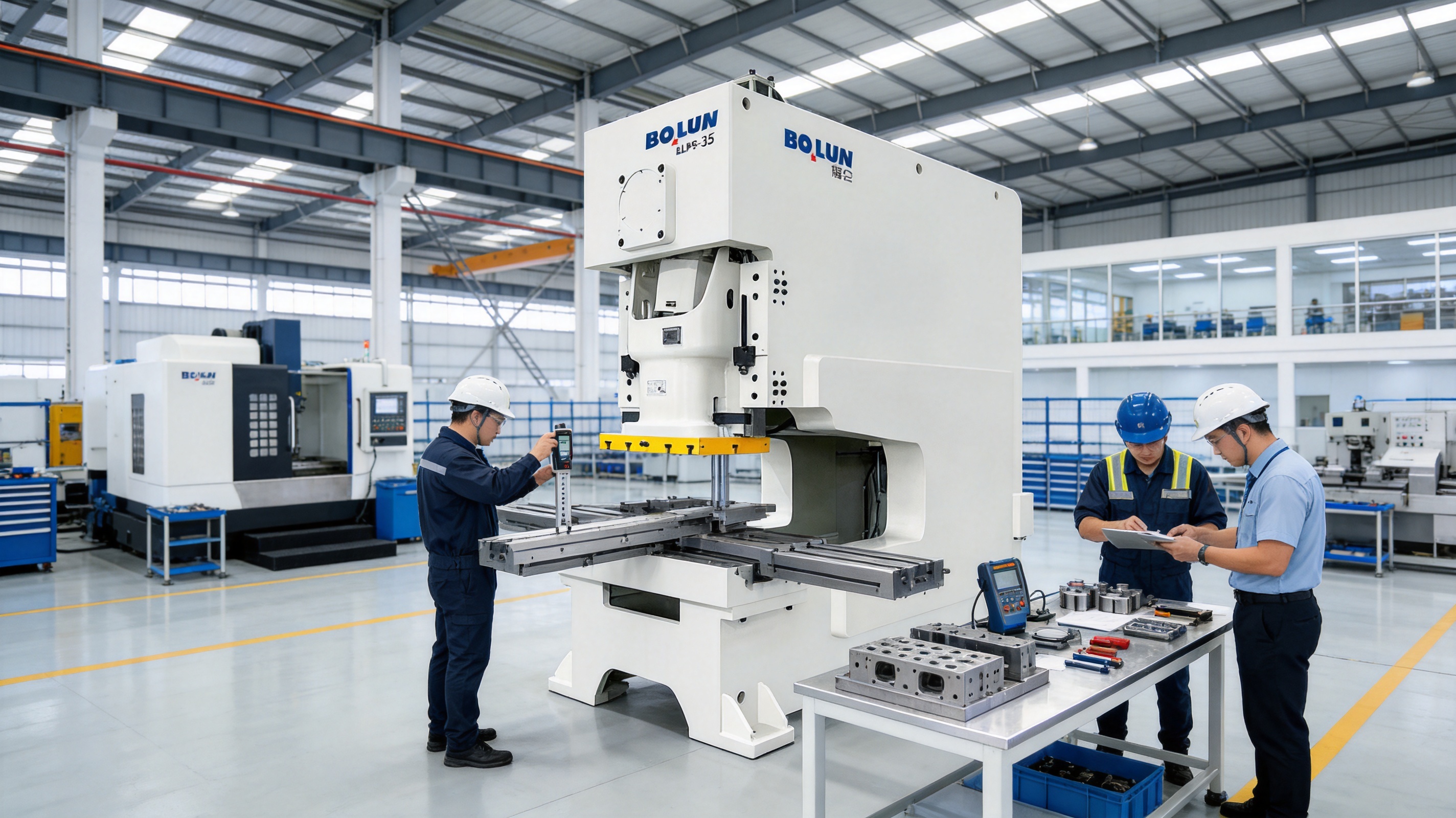
Modern metal-forming operations increasingly require more than simple pressing force. Manufacturers need equipment that combines reliable tonnage, stable accuracy, high production speed, flexible die compatibility, convenient material access, and dependable long-term operation. The BLPS-35 open-gap deep-throat power press is designed around these requirements. With a nominal capacity of 350 kN, a maximum published speed of 180 strokes per minute, a worktable measuring 780 × 340 mm, and a deep-throat configuration ranging from 500 to 1200 mm, it is suited to demanding precision forming applications where working clearance and repeatability are essential.
The press is positioned between compact, general-purpose stamping equipment and larger heavy-duty production machines. This makes it particularly valuable for manufacturers that require meaningful forming capacity without sacrificing operating speed or accessibility. Its open-gap structure provides practical access to the die area, while its deep-throat design allows operators and automated systems to handle workpieces farther from the centerline of the frame. As a result, the machine can support specialized tooling, larger or irregularly positioned components, and production processes that would be restricted by a conventional shallow-throat press.
The BLPS-35 is manufactured by Zhejiang Bolun High-Precision Machinery Co., Ltd., a Chinese machinery company with two decades of experience in forging and casting equipment, precision forming machinery, research and development, production, sales, and service. The company combines in-house technical development, precision processing, quality inspection, assembly, customization, and customer support into an integrated manufacturing system. This integrated approach is important because the performance of a power press depends not only on its rated capacity, but also on the accuracy of its frame, the quality of its drive system, the consistency of its assembly, and the discipline of its inspection procedures.
The BLPS-35 is an open-gap deep-throat power press developed for precision metal forming, punching, blanking, bending, shallow drawing, embossing, and other operations that benefit from stable force transmission and generous working clearance. Its nominal capacity is 350 kN, equivalent to approximately 35 metric tons of nominal pressing force. This capacity provides a useful balance for medium-duty forming work, especially where a compact machine would be underpowered and a larger press would introduce unnecessary cost, floor-space demands, or energy consumption.
The press is described as a versatile, high-stability model. These characteristics are reflected in its uniform load distribution and vibration-damping structure. Uniform load distribution helps reduce localized stress within the frame and tooling system. A vibration-damping structure helps control disturbances generated by the reciprocating slide, rotating drive components, and repeated impact between the tool and workpiece. Together, these design considerations support consistent production quality and help the machine maintain its operating behavior at high speed.
The published product configuration includes a 780 × 340 mm worktable and a maximum die height of up to 250 mm. These dimensions allow the machine to accommodate a broad range of dies while preserving sufficient space for setup and workpiece positioning. The table is large enough for many progressive, compound, bending, and forming tools used in medium-sized components. At the same time, the 350 kN capacity remains appropriate for applications where the required force is substantial but does not justify moving to a much larger frame.
The main motor is rated at 3 kW with a four-pole configuration. The motor drives the press mechanism through the machine’s power transmission system and supplies the energy needed for repeated slide movement. A four-pole motor is commonly selected for a combination of operating stability and suitable rotational characteristics. For production managers, the 3 kW rating also provides a practical reference for evaluating electrical installation requirements, operating costs, and compatibility with the available factory power system.
| Specification | Published BLPS-35 Value |
|---|---|
| Machine type | Open-gap deep-throat power press |
| Nominal capacity | 350 kN |
| Nominal pressure stroke | 2.3 mm |
| Slide stroke | 40 mm |
| Slide speed range | 95–180 strokes per minute |
| Maximum die height | 250 mm |
| Die-height adjustment | 50 mm |
| Throat depth range | 500–1200 mm |
| Worktable size | 780 × 340 × 70 mm |
| Slide-bottom size | 380 × 320 × 50 mm |
| Working-face height | 800 mm |
| Distance between columns | 505 mm |
| Shank-hole diameter | 40 mm |
| Main motor | 3 kW × 4 poles |
| Air pressure | 0.55 MPa |
| Punch accuracy classification | GB (JIS) Class 1 |
The table summarizes the principal published parameters associated with the BLPS-35 configuration. Actual machine selection should always be confirmed against the final technical quotation, because options, regional standards, control systems, safety equipment, and tooling requirements can influence the delivered specification. Buyers should also verify the relationship between nominal pressure stroke, slide stroke, operating speed, die height, and the intended forming process before placing an order.
The nominal pressure stroke of 2.3 mm indicates the point in the slide cycle at which the rated nominal capacity is available. This specification is important because a mechanical power press does not necessarily deliver its maximum rated force throughout the entire stroke. Tool designers should calculate forming force according to the actual process, material, die geometry, and position of maximum resistance. Selecting a press based only on nominal tonnage can lead to poor results if the working force is required too far from the rated pressure point.
The 40 mm slide stroke is suited to a wide range of high-speed punching and forming applications. A relatively compact stroke can support rapid cycling while limiting unnecessary slide travel. This can be advantageous in blanking, piercing, shallow forming, and progressive die operations where the tool does not require a long vertical movement. The published speed range of 95–180 strokes per minute gives the machine flexibility for different materials, die designs, feeding systems, and production targets.
Maximum speed should not be treated as a universal production setting. The correct operating speed depends on material thickness, tool balance, lubrication, part geometry, feed accuracy, noise requirements, and the thermal behavior of the drive system. Nevertheless, the ability to operate up to 180 strokes per minute gives the BLPS-35 a strong position in applications that require a high output rate. It also gives manufacturers room to increase production as process stability improves.
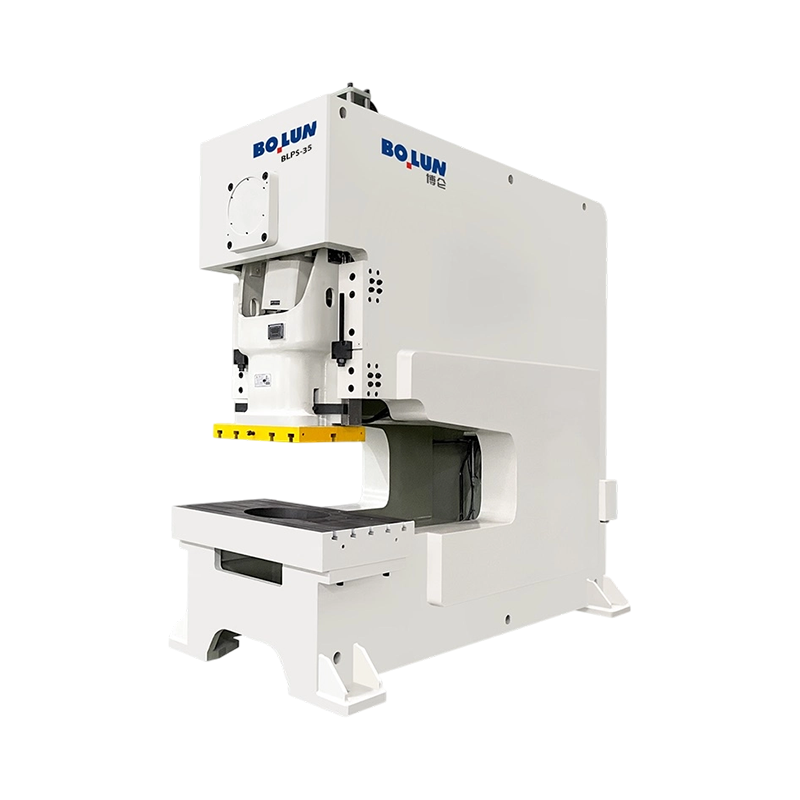
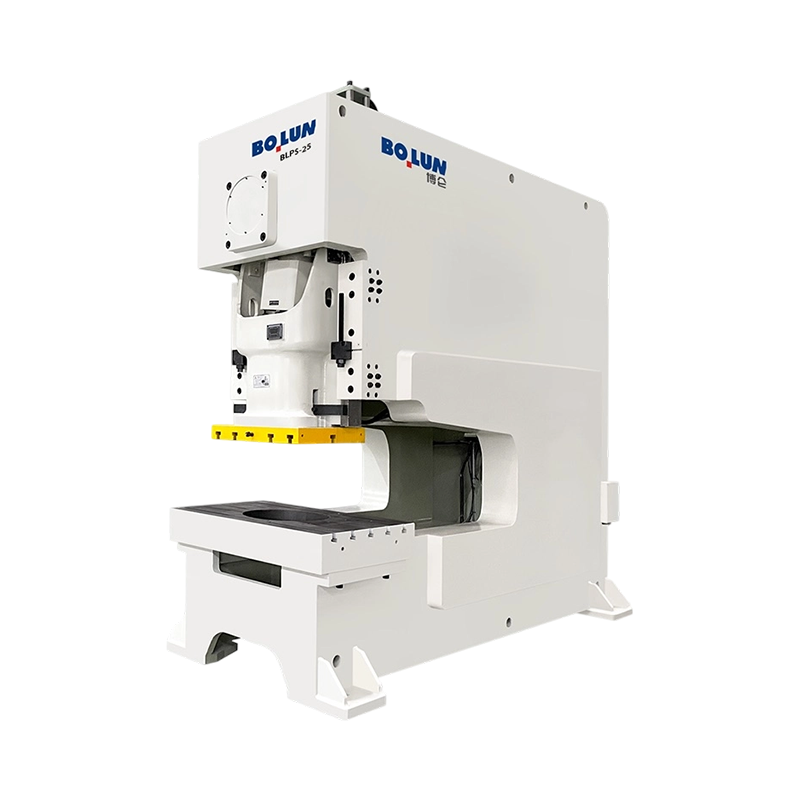
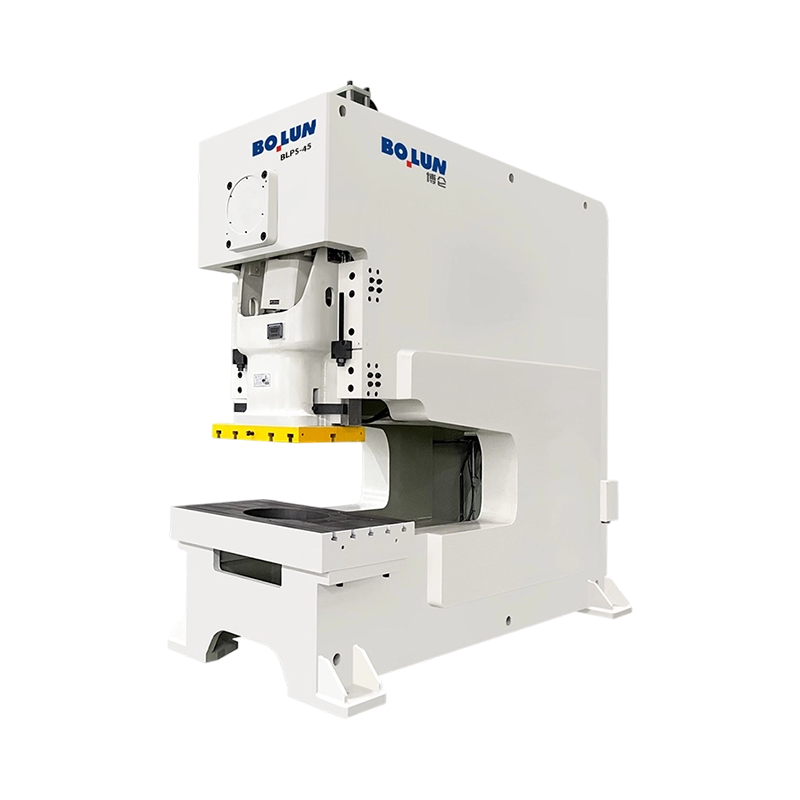
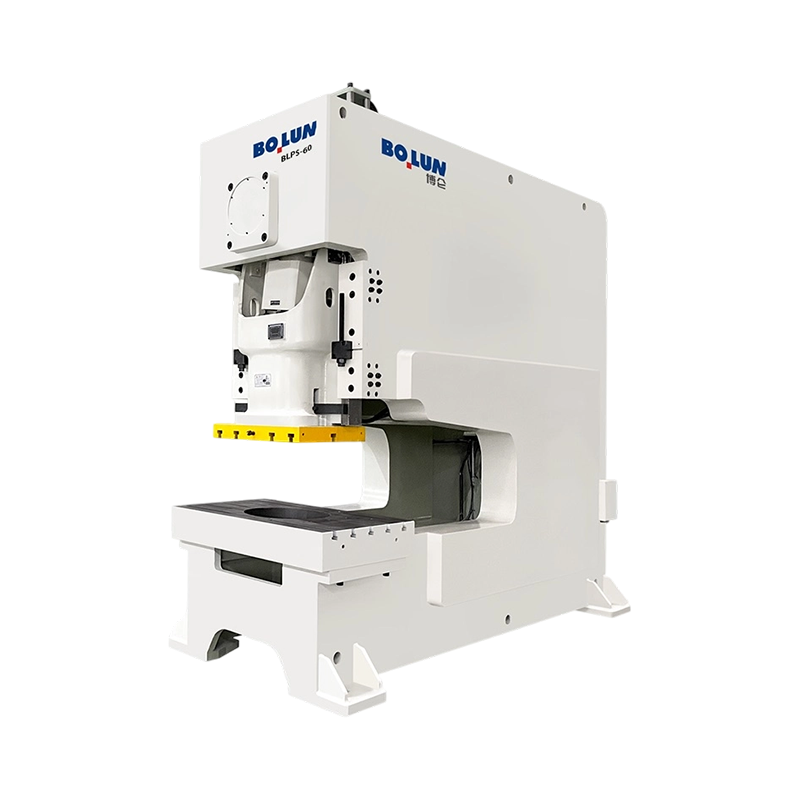
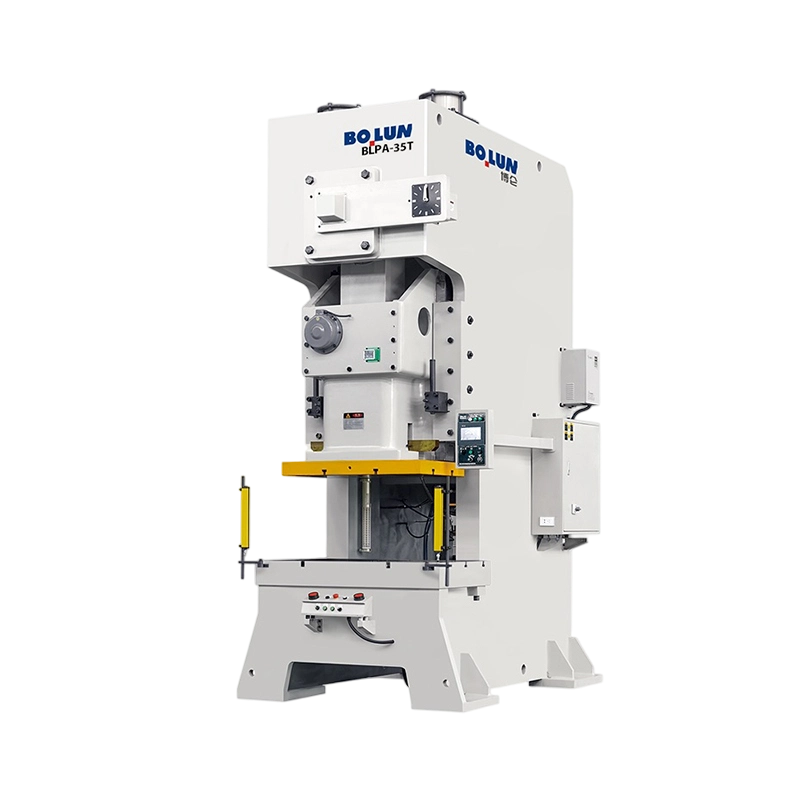
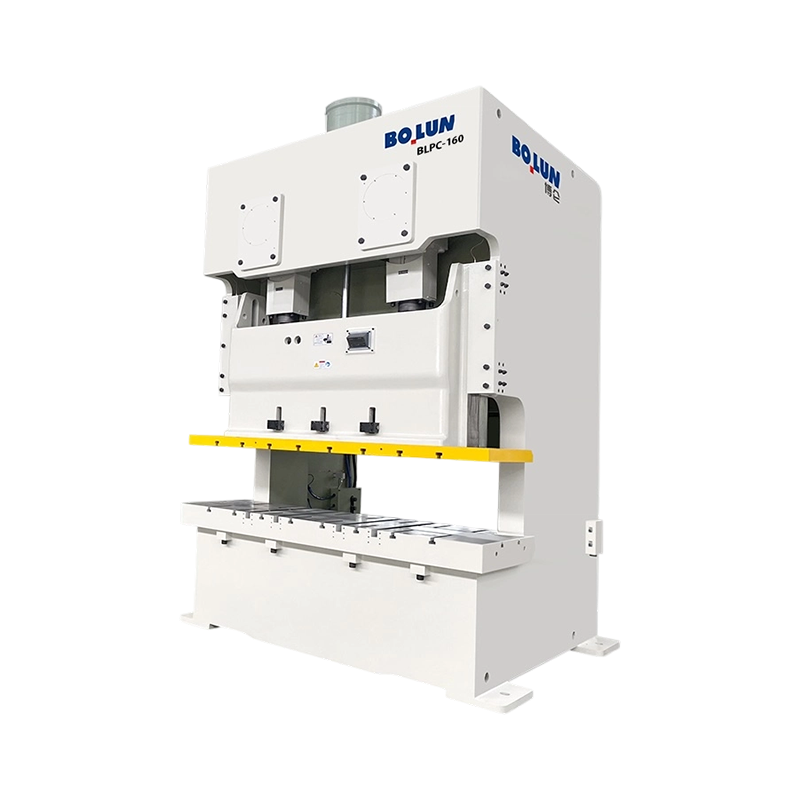
BLPS-35 Versatile High-Stability Open-Gap Deep-Throat Power Press
The open-gap structure is one of the most important characteristics of the machine. Unlike a closed-frame press, an open-gap press provides more accessible working space around the front and sides of the die area. This arrangement simplifies die installation, part loading, inspection, adjustment, and maintenance. Operators can approach the tooling with fewer physical restrictions, while production engineers can design material-flow paths that are more convenient for manual or automated handling.
Open access is particularly valuable when the workpiece is larger than the die itself, when the component must be rotated during a secondary operation, or when a process involves side loading and unloading. It can also reduce the time required to replace tooling. Faster changeover is directly connected to productivity because the machine spends more time producing parts and less time waiting for setup activities.
The deep-throat configuration further expands the usable working envelope. With a throat depth range of 500–1200 mm, the BLPS-35 is designed for applications that need substantial clearance from the frame center. This is useful for positioning wide sheets, long blanks, offset components, and specialized dies. It can also provide additional space for feeders, transfer devices, sensors, guarding systems, or auxiliary tooling mounted near the working area.
Compared with a conventional shallow-throat press of similar nominal capacity, a deep-throat machine can offer greater freedom in how material is presented to the die. This does not mean that every component should be placed at the maximum available throat distance. Force distribution, deflection, tooling layout, and the manufacturer’s operating guidelines must always be respected. However, the larger clearance can substantially improve handling convenience and expand the range of feasible applications.
Deep-throat capability is especially useful in industries producing covers, panels, brackets, appliance components, electrical enclosures, automotive subcomponents, and other parts with extended dimensions. It may also support operations in which the finished part must remain connected to a strip during progressive forming before final separation. The press gives the tooling designer more room to manage strip travel and auxiliary functions.
The open-gap and deep-throat features together provide a practical advantage over machines that offer force but limited accessibility. A press may have an adequate tonnage rating and still be difficult to use if the die area is cramped or material access is restricted. The BLPS-35 addresses this issue by combining a medium-duty force rating with a working configuration intended for flexibility.
High production speed is valuable only when it is accompanied by consistent motion and controlled vibration. An unstable press may produce more cycles per minute on paper but create excessive noise, premature die wear, poor part quality, or frequent stoppages. The BLPS-35 is designed with a vibration-damping structure and uniform load distribution to help maintain accuracy during repeated operation.
Vibration control benefits both the machine and the tooling. Excessive vibration can increase stress on bearings, guides, fasteners, electrical components, and the foundation. It can also cause movement between die components, leading to burrs, dimensional variation, cracking, or uneven forming. By damping vibration at the structural level, the press can provide a more controlled platform for precision tools.
Uniform load distribution is equally important. When the forming force is transferred more evenly through the frame, the risk of localized deformation is reduced. A stable frame helps keep the upper and lower die surfaces aligned and allows the slide to approach the workpiece with predictable movement. This is especially important in operations using close clearances, multiple punches, fine blanking-style tool arrangements, or parts with tight dimensional requirements.
The published punch accuracy classification is GB (JIS) Class 1. This indicates that the machine is built to a recognized precision standard rather than being intended solely as a basic production press. Accuracy classification should be considered together with foundation quality, installation, die condition, material consistency, lubrication, and maintenance. A high-quality machine creates the necessary foundation for precision, but the entire production system must be controlled if the finished parts are to remain within tolerance.
The combination of a 40 mm slide stroke and a speed range reaching 180 strokes per minute makes the BLPS-35 suitable for high-cycle operations. At the upper end of the range, the press may support efficient production of small or medium-sized parts, provided that the die, feeder, material, and safety system are all designed for the selected speed. For more demanding forming tasks, operators can reduce speed to improve material flow, reduce impact, or allow additional time for part removal and inspection.
This adjustability is one of the machine’s practical strengths. A press that can work across a broad speed range can serve different products without requiring separate machines for every process. The same equipment may be used for fast piercing during one production order and slower forming or bending during another. This flexibility improves equipment utilization and can reduce the total cost of ownership for manufacturers with diverse product requirements.
Tooling compatibility is a major factor in the selection of any power press. The BLPS-35 offers a maximum die height of up to 250 mm and a die-height adjustment of 50 mm. These specifications provide space for a variety of dies while allowing the operator to establish the correct relationship between the slide, die set, material, and working position.
The 780 × 340 mm worktable provides a stable mounting surface for appropriate tooling. Its 70 mm table thickness contributes to structural support and helps resist deformation under working loads. The corresponding slide-bottom size is 380 × 320 × 50 mm, providing a defined interface between the slide and the upper die assembly. Toolmakers can use these dimensions when developing die plates, mounting arrangements, guide systems, and shank configurations.
The 40 mm shank-hole diameter is suitable for compatible punch tooling and die assemblies. Correct shank fit is essential for maintaining alignment and preventing unwanted movement during operation. A properly mounted tool also helps distribute force more evenly and reduces the likelihood of impact damage. Before installation, the die should be checked for weight, balance, mounting dimensions, shut height, stroke requirements, and compatibility with the press’s safety and control systems.
Die-height adjustment enables manufacturers to accommodate tools with different closed heights. It also supports fine process adjustment when a die requires a particular approach position or when the forming result must be optimized through controlled setup. A 50 mm adjustment range gives useful flexibility while remaining appropriate for the machine’s size and capacity.
Tool changes should be performed according to documented procedures. The press must be isolated from hazardous energy sources, the slide secured as required, and the die supported during installation and removal. After mounting, the operator should verify alignment, fastener security, feed timing, sensor position, lubrication, and the initial manual or low-speed cycle. These steps help protect both the machine and the tooling while reducing the risk of producing defective parts during startup.
The BLPS-35 can be used for blanking and general stamping operations involving sheet metal components. Its 350 kN capacity provides adequate force for many medium-sized blanks, depending on material type, thickness, perimeter length, clearance, and die design. The open working area supports convenient sheet loading and unloading, while the deep throat can assist with larger blanks or offset material positioning.
Blanking quality depends on more than force. Punch and die clearance, cutting-edge condition, material hardness, lubrication, and slide alignment all influence the result. The press’s stable structural design provides a suitable foundation for maintaining die alignment and reducing movement during the cutting event. When the process is correctly engineered, manufacturers can achieve consistent edges, controlled burr height, and repeatable part dimensions.
Piercing operations often demand high repeatability because hole position may affect assembly, fastening, or downstream forming. The BLPS-35’s precision-oriented construction and stable slide movement can support multi-hole dies, compound tools, and progressive operations. The 40 mm shank-hole size and worktable dimensions allow the machine to be configured for a variety of punch arrangements within the limits of the selected die.
For high-speed piercing, the feed system must remain synchronized with the press cycle. Material must be supported correctly to prevent vibration or distortion. Operators should also monitor punch wear because worn punches increase force requirements and can create unacceptable burrs. The machine’s high-speed capability is most effective when paired with disciplined tooling maintenance and accurate material feeding.
Bending operations can benefit from the press’s adjustable speed and accessible die area. The operator can select a speed appropriate to the material and bend geometry, while the open-gap design makes it easier to position long or irregular workpieces. The deep throat provides additional clearance when the blank extends well beyond the center of the machine.
Shallow forming and embossing are also suitable applications. These processes require careful control of material flow and tool clearance. A stable press helps maintain consistent contact between the forming surfaces. Depending on the part design, the BLPS-35 may be used for stiffening ribs, shallow contours, raised marks, flanges, and other formed details.
Progressive dies perform multiple operations as strip material advances through a sequence of stations. The BLPS-35 can be considered for progressive production where the required force, die dimensions, feed pitch, and operating speed fall within the machine’s capability. Its deep-throat design can be valuable when the die or strip arrangement requires additional longitudinal space.
Progressive die success depends on accurate feed control, reliable pilot release, consistent strip support, and precise timing. The press provides the mechanical platform, but the complete system may include a decoiler, straightener, feeder, sensors, scrap-handling equipment, and guarding. Integrating these components allows the machine to operate as part of an efficient automated production cell.
Electrical enclosures, brackets, terminals, covers, hardware components, and appliance parts often require repeated punching and forming. These products may be produced in a variety of materials and thicknesses, making process flexibility valuable. The BLPS-35 can serve manufacturers that need one press to handle several product families without moving immediately to a large, high-capacity machine.
Its worktable and throat arrangement can support dies for medium-sized components, while the 350 kN force rating provides useful capacity for many common sheet-metal operations. The specific suitability of the machine depends on the forming calculation and the geometry of the tool. Manufacturers should confirm the required force, energy, shut height, stroke, and production speed for every part before final approval.
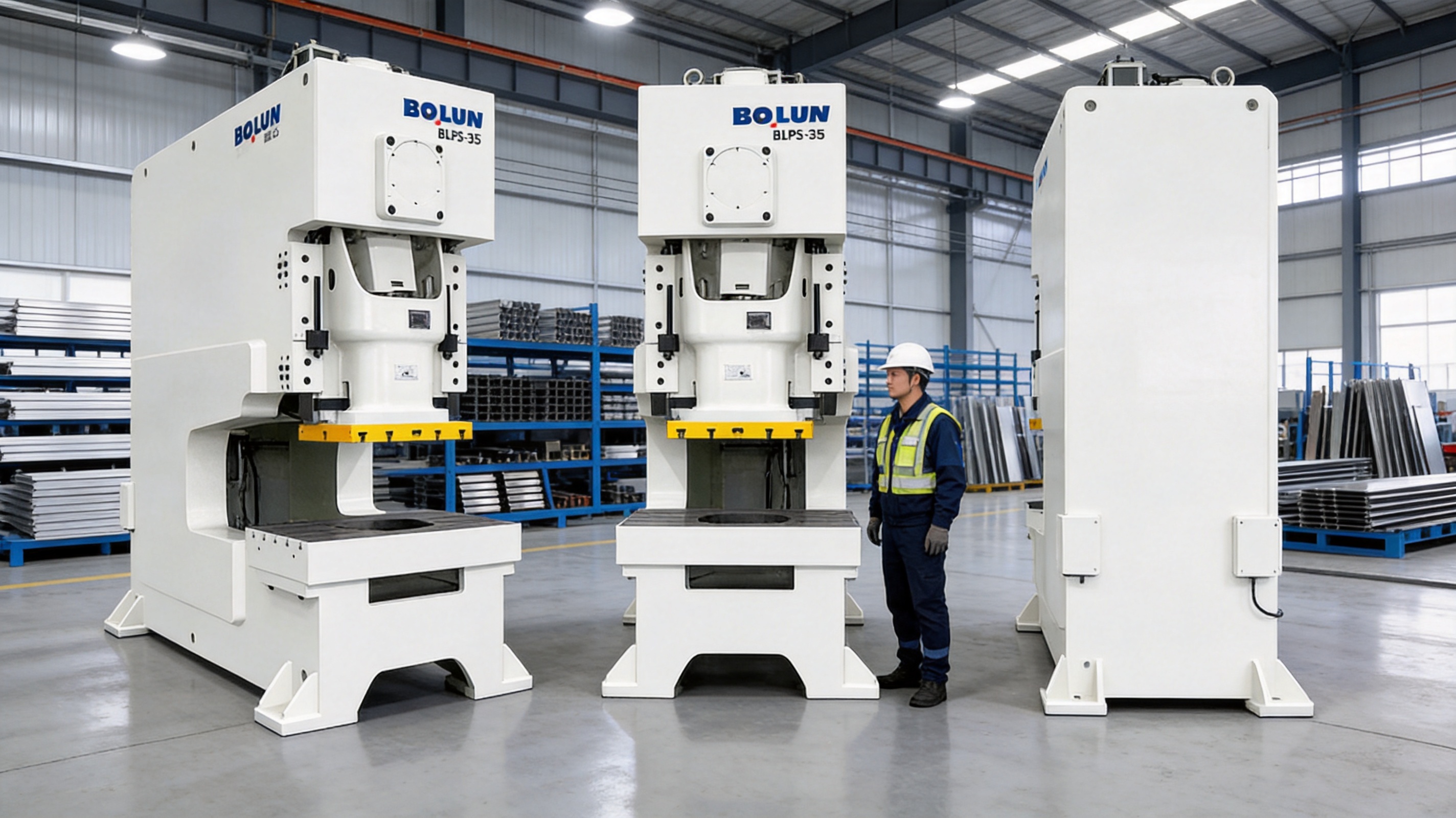
When comparing the BLPS-35 with other power presses, buyers should evaluate the entire operating profile rather than focusing on tonnage alone. A competitor’s machine may offer a similar nominal capacity, but the practical value can differ significantly depending on throat depth, table size, speed range, structural stability, die adjustment, serviceability, and customization capability.
One important advantage of the BLPS-35 is its combination of medium-duty force and deep-throat access. Many compact presses are easy to install but restrict the usable working envelope. Conversely, some large presses offer substantial capacity but require more floor space, higher investment, and greater operating resources. The BLPS-35 occupies a useful middle ground by providing 350 kN of force together with a throat-depth range that can accommodate applications normally associated with more spacious machines.
Another advantage is the balance between speed and stability. A machine that reaches a high cycle rate but experiences excessive vibration can increase maintenance costs and reduce product consistency. The BLPS-35 is designed to address this concern through vibration damping and uniform load distribution. This provides a stronger foundation for high-speed stamping than a basic structure that has not been optimized for repeated dynamic loading.
The 780 × 340 mm worktable also contributes to its competitive position. A larger or more practical table can reduce tooling compromises and provide more room for material support. The 250 mm maximum die height broadens tooling compatibility, while the 50 mm adjustment range simplifies setup between different die assemblies. These features can reduce the need for custom adapters or extensive modifications.
Accessibility is another point of differentiation. Open-gap construction makes it easier to inspect the die, remove scrap, load materials, and perform adjustments. In manual or semi-automatic production, this can improve operator efficiency. In automated production, the available space can simplify the placement of feeders, sensors, transfer units, and guarding. Better accessibility can also reduce setup and maintenance time over the life of the machine.
The machine’s potential for customization further strengthens its position. Zhejiang Bolun High-Precision Machinery Co., Ltd. maintains non-standard design and manufacturing capabilities, allowing special specifications and functions to be addressed during the engineering process. Depending on the application, customization may involve tooling interfaces, feeding arrangements, electrical controls, safety systems, working dimensions, or other production requirements. Every modification must be confirmed technically, but the ability to discuss a tailored solution is valuable for manufacturers with specialized processes.
Competitive evaluation should also include after-sales support, spare-parts availability, commissioning, operator training, maintenance documentation, and response time. A machine’s purchase price is only one component of its total cost. A supplier that can provide engineering guidance, installation support, and long-term service may deliver greater value than a lower-priced machine with limited support.
The performance of the BLPS-35 is supported by the manufacturing capabilities of Zhejiang Bolun High-Precision Machinery Co., Ltd. The company integrates research and development, design, production, sales, and service. This structure allows technical decisions to be connected across the product lifecycle. Design engineers can consider manufacturability, production teams can provide feedback on assembly, quality teams can verify critical characteristics, and service personnel can communicate field experience back to the development process.
The company has developed a full-chain production system covering basic design, core component development, precision processing, and final machine assembly. Such integration can improve control over critical interfaces. In a power press, the relationship between the frame, slide, guides, drive system, table, die-height mechanism, and control system is central to performance. When these elements are engineered and assembled within a coordinated system, the risk of dimensional mismatch and inconsistent quality can be reduced.
Advanced precision-processing equipment supports the production of components that require accurate dimensions and controlled surface quality. Machined surfaces in guide areas, mounting locations, bearing seats, and die interfaces must be produced consistently to support alignment and repeatability. Precision processing also contributes to the service life of components by helping maintain proper contact, load distribution, and lubrication conditions.
The company’s production environment covers the stages from initial design through machine assembly. This creates opportunities for process verification at several points. Incoming components can be checked before assembly, machined parts can be inspected against drawings, subassemblies can be tested before integration, and the completed machine can undergo final inspection. A systematic approach is essential for equipment intended to work under high-intensity, repetitive operating conditions.
Bolun’s design team also provides non-standard customization. Industrial customers often have requirements that do not fit a standard catalog model. They may need a special worktable, an altered feeding direction, a specific automation interface, a different safety arrangement, or a customized control sequence. The ability to design and manufacture special configurations enables the supplier to address production needs more precisely than a one-size-fits-all approach.
The company emphasizes a “Technology First” development strategy. In practical terms, this means placing engineering capability, process innovation, intelligent equipment, and continuous improvement at the center of its growth. For customers, the benefit is the potential to obtain equipment that is not only mechanically capable but also adaptable to evolving manufacturing requirements.
Quality control is essential for power presses because small inaccuracies can be repeated thousands of times during production. If the slide is misaligned, the die is not mounted correctly, or the frame deflects unpredictably, defects may appear across an entire batch. The supplier therefore maintains a finished-product inspection system intended to exceed basic industry requirements.
Inspection should cover the machine’s structural condition, dimensional accuracy, movement, pressure behavior, electrical functions, safety devices, lubrication, and operating noise. Critical components and assemblies should be checked before the machine is released. The purpose is not merely to confirm that the press starts and stops, but to verify that it operates consistently under conditions representative of real production.
The GB (JIS) Class 1 punch accuracy classification provides a reference point for precision expectations. Buyers should request the applicable inspection method, tolerance definitions, test conditions, and acceptance criteria when preparing a purchase contract. Clear documentation ensures that the supplier and customer share the same understanding of machine performance.
Quality also depends on material traceability and process discipline. A modern manufacturer should control drawings, revisions, component specifications, assembly procedures, inspection records, and nonconformance handling. These systems help ensure that a machine built today meets the same technical requirements as another machine built under the same model designation.
Long service life requires attention to more than the frame. Bearings, guides, fasteners, electrical components, lubrication passages, and adjustment mechanisms must all be selected and assembled correctly. Regular maintenance then becomes the customer’s responsibility. Proper lubrication, periodic inspection, correct die mounting, and avoidance of overload are necessary to preserve the original accuracy of the machine.
Installation begins with a suitable foundation and a properly prepared working area. The floor must support the machine’s static and dynamic loads, and the press should be leveled according to the supplier’s instructions. Adequate clearance is required around the machine for die changes, material handling, inspection, maintenance, and emergency access.
Electrical installation should be completed by qualified personnel. The available voltage, frequency, grounding, disconnect arrangement, motor protection, and control-circuit requirements must match the final machine specification. The published 3 kW motor rating is a useful planning reference, but the complete electrical load may include controls, lubrication, die-height adjustment, safety equipment, feeders, and optional accessories.
The published air-pressure requirement is 0.55 MPa. The factory air supply should be clean, stable, and appropriately filtered. Pressure fluctuations can affect pneumatic safety devices or auxiliary functions. Buyers should confirm whether the machine requires a dedicated air preparation unit, drainage system, pressure monitoring, or additional pneumatic capacity for integrated automation.
Commissioning should include inspection of the machine after transport, verification of level and anchoring, connection of utilities, testing of lubrication, checking of controls, and confirmation of all safety functions. The press should first be operated without a die or at a controlled low speed, followed by a careful test with the selected tooling. Abnormal noise, vibration, heating, leakage, or movement should be investigated before production begins.
Operators should be trained in machine controls, die installation, speed selection, emergency stopping, material handling, inspection, lubrication, and fault reporting. Training is especially important when the machine is integrated into an automated line. Everyone working near the press must understand the guarding system and the procedures for clearing jams or performing maintenance.
Safe operation requires suitable guarding and compliance with applicable local regulations. The press should not be operated with safety devices bypassed or removed. Operators should use appropriate personal protective equipment, keep hands away from the die area, and follow lockout and isolation procedures during adjustment and maintenance.
Preventive maintenance helps preserve accuracy, availability, and safety. Daily checks may include lubrication level, unusual noise, vibration, air pressure, fastener condition, die security, and the operation of emergency devices. Operators should report changes in machine behavior immediately rather than waiting for a failure.
Periodic maintenance should examine the slide, guides, drive components, bearings, transmission elements, electrical connections, control cabinet, adjustment system, and structural fasteners. Wear should be measured against the supplier’s recommendations. Lubricants should be replaced or replenished using the correct grade and schedule. Contaminated or insufficient lubrication can increase friction, temperature, and wear.
Tooling maintenance is equally important. A dull punch or damaged die can increase forming force and transfer abnormal loads to the press. Regular sharpening, clearance inspection, alignment checks, and cleaning help protect both the die and the machine. Scrap accumulation should be controlled because trapped material can interfere with the next cycle and create a sudden impact.
Manufacturers should maintain records of operating hours, production volume, die changes, lubrication, inspections, repairs, and replaced parts. These records help identify trends and support planned maintenance. They also assist service technicians when troubleshooting a recurring problem.
When maintained correctly, a stable press can provide many years of service. The BLPS-35’s structural design, precision-oriented manufacturing, and adjustable operating range provide a foundation for reliability, but actual service life depends on correct application and disciplined operation. Avoiding overload is particularly important. The press should never be used beyond its rated capacity or outside the operating conditions approved by the supplier.
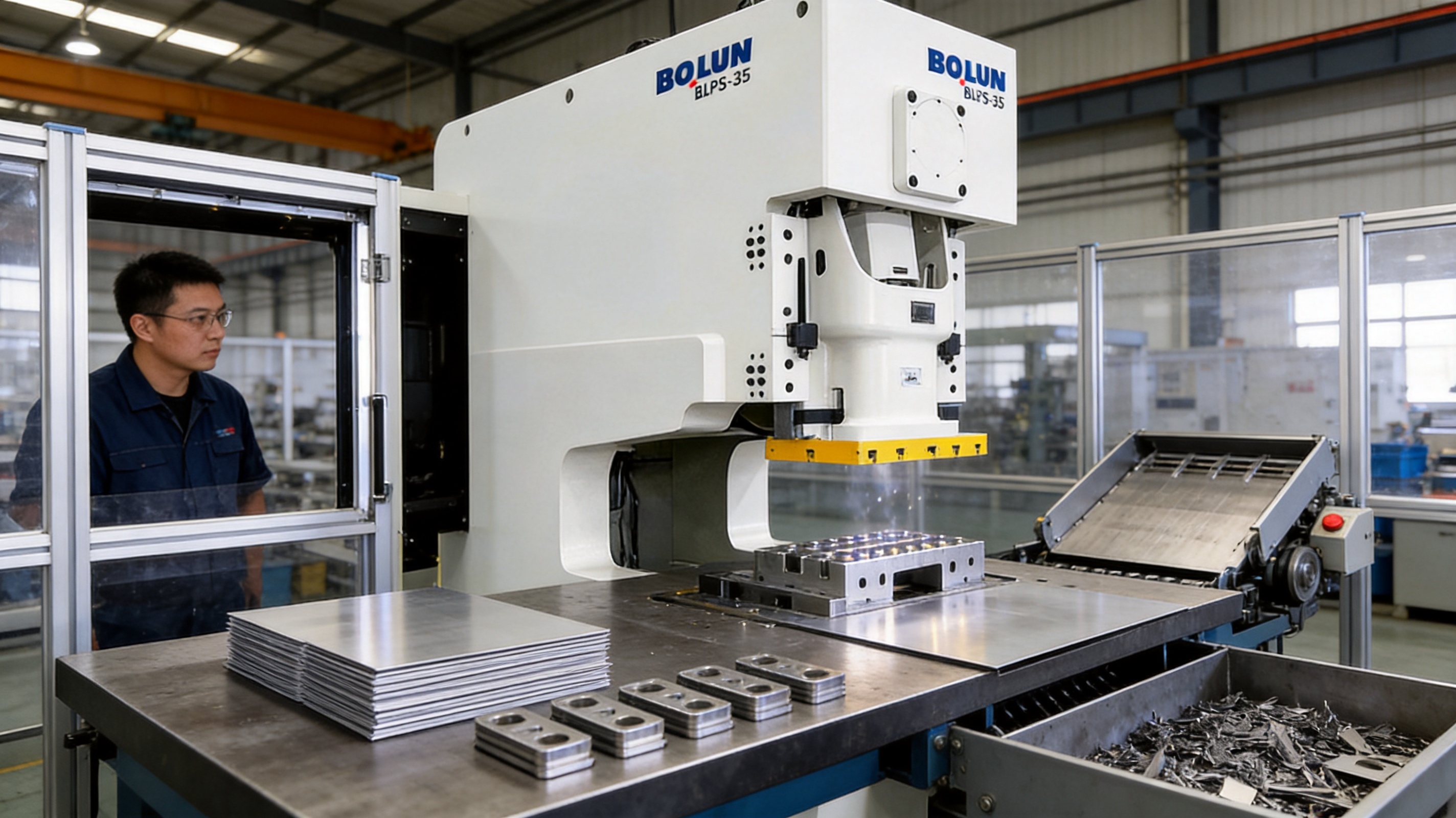
The 3 kW main motor gives the BLPS-35 a practical power profile for its capacity class. Energy consumption during production depends on cycle rate, load, acceleration, idle time, lubrication systems, auxiliary equipment, and the operating pattern of the plant. A press that is properly matched to the process can reduce wasted energy associated with oversized equipment.
Productivity should be evaluated in parts per hour rather than strokes per minute alone. The actual output depends on the number of operations per stroke, feed length, material loading, die change time, scrap rate, inspection requirements, and downtime. The BLPS-35’s high-speed capability can support strong output, but the best production result comes from balancing speed with quality and equipment stability.
Deep-throat access may also contribute to productivity by simplifying material handling. If operators can position large blanks more easily, loading time may be reduced. If an automated feeder can be placed without interfering with the frame, the line may operate more smoothly. Open access can also shorten die-change and inspection activities.
Total cost of ownership includes the initial purchase, shipping, installation, tooling, automation, energy, maintenance, spare parts, training, downtime, and eventual refurbishment. A machine with useful flexibility may provide a better return because it can support several product families. The BLPS-35’s capacity, table dimensions, throat depth, die-height range, and speed range make it a candidate for manufacturers seeking a versatile production asset rather than a machine dedicated to only one part.
Before purchasing, the buyer should prepare a complete process specification. This should include material type, thickness, tensile strength, blank size, part geometry, operation type, required force, production volume, die dimensions, feed direction, speed target, accuracy tolerance, and automation requirements.
Force calculations should include cutting force, bending force, forming force, stripping force, friction, and any simultaneous operations. A safety margin should be applied according to engineering practice. If the calculated force is close to the machine’s nominal capacity, the buyer should consult the supplier because the position of maximum force and the energy requirement may affect suitability.
The die should be checked against the 780 × 340 mm worktable, 380 × 320 mm slide-bottom size, 250 mm maximum die height, 50 mm adjustment range, and 40 mm shank-hole diameter. The table and slide must provide adequate support without excessive overhang. Tool weight and center of gravity must also be considered.
Material handling should be reviewed in relation to the 500–1200 mm throat-depth range and 505 mm distance between columns. The buyer should confirm whether the intended sheet, strip, or component can be loaded without interference. If a feeder or transfer unit is planned, the machine layout should be reviewed before ordering.
Finally, the customer should confirm electrical, pneumatic, safety, inspection, and documentation requirements. Questions about voltage, control language, guarding standards, spare parts, installation, training, warranty, and service response should be resolved in writing. A clear technical agreement reduces the risk of misunderstanding and ensures that the delivered press matches the production objective.
Zhejiang Bolun High-Precision Machinery Co., Ltd. presents itself as a full-service industrial machinery manufacturer rather than only a machine assembler. Its activities include research and development, design, production, sales, installation support, and after-sales service. This broad capability is useful when a customer needs assistance with machine selection, tooling integration, customized functions, or production optimization.
The company’s location in Zhejiang places it within one of China’s important manufacturing regions. Its experience in machinery production provides access to industrial supply chains, engineering resources, precision-processing equipment, and manufacturing talent. The company combines local production strengths with an international management perspective, allowing it to serve customers in different markets and industrial sectors.
Bolun emphasizes quality, technical innovation, and customer-oriented service. Its service structure covers pre-sales consultation, in-sales support, and after-sales guarantees. Pre-sales engineering helps define the correct machine and options. In-sales support can assist with production coordination, inspection, and delivery. After-sales service can support installation, training, troubleshooting, spare parts, and maintenance.
For international customers, communication and documentation are important parts of machine quality. Clear operating manuals, electrical drawings, maintenance instructions, spare-parts lists, inspection records, and training materials help customers use the equipment effectively. These documents should be requested and reviewed as part of the procurement process.
The published nominal capacity is 350 kN. This is the rated pressing force of the machine at the specified nominal pressure stroke. The actual suitability of the press depends on the forming operation, material, die geometry, and position at which peak force occurs.
The published speed range for the BLPS-35 configuration is 95–180 strokes per minute. The appropriate production speed must be selected according to the material, die design, feed system, lubrication, quality requirements, and safety conditions.
Deep throat refers to the clearance from the front of the frame toward the central working area. The BLPS-35 is listed with a throat-depth range of 500–1200 mm. This provides additional space for wide or extended workpieces, specialized tooling, and material-handling equipment.
The published worktable size is 780 × 340 × 70 mm. These dimensions should be compared with the die base, mounting holes, material support requirements, and allowable overhang before tooling is installed.
The maximum die height is listed as 250 mm, with a die-height adjustment range of 50 mm. The final usable die height should be confirmed with the selected tooling and the required slide position.
The BLPS-35 is suitable for many medium-duty stamping, blanking, piercing, bending, shallow forming, embossing, and progressive-die applications. It is especially useful when the process requires a combination of 350 kN capacity, high cycle speed, open access, and deep working clearance.
The published main motor specification is 3 kW × 4 poles. The complete electrical installation may include additional loads for controls, lubrication, adjustment mechanisms, safety equipment, feeders, and optional accessories.
The manufacturer provides non-standard design and manufacturing capabilities. Potential customization may involve working dimensions, tooling interfaces, feeding systems, controls, safety arrangements, or special functions. Each request must be reviewed by the supplier’s engineering team for technical feasibility.
The published air-pressure requirement is 0.55 MPa. The customer should provide a clean and stable compressed-air supply and confirm the final pneumatic requirements with the supplier.
The BLPS-35 uses a structure intended to promote uniform load distribution and vibration damping. It is also listed with a GB (JIS) Class 1 punch accuracy classification. Installation quality, die condition, maintenance, material consistency, and operating practices are also essential to achieving precision results.
Its open-gap and deep-throat design can support integration with feeders, sensors, transfer devices, and other automation equipment, provided the final layout is engineered correctly. The buyer should discuss automation interfaces, control signals, guarding, cycle timing, and safety requirements with the manufacturer.
The buyer should verify the required forming force, material specifications, die dimensions, die height, stroke, speed, throat clearance, table size, electrical supply, air supply, safety standards, automation requirements, installation conditions, training, spare parts, warranty, and service arrangements.
The BLPS-35 open-gap deep-throat power press is designed for manufacturers that need reliable medium-duty force together with high-speed operation and generous working clearance. Its 350 kN nominal capacity, speed range up to 180 strokes per minute, 780 × 340 mm worktable, 250 mm maximum die height, 50 mm die adjustment, and 500–1200 mm throat-depth range make it a versatile option for precision stamping and forming applications.
Its strongest advantage is the combination of features. The machine is not defined by tonnage alone. Open access improves handling and setup. Deep throat expands the working envelope. Vibration damping supports stable operation. Uniform load distribution helps protect accuracy and tooling. Adjustable speed allows the press to serve different production requirements. The 3 kW main motor offers a practical power configuration for its capacity class.
The manufacturing strengths of Zhejiang Bolun High-Precision Machinery Co., Ltd. further support the product. The company integrates design, research and development, precision processing, assembly, inspection, customization, sales, and service. Its full-chain production system and quality-focused management approach are intended to provide customers with dependable equipment for demanding industrial environments.
For manufacturers comparing power presses, the BLPS-35 should be evaluated as a complete production solution. The most important questions concern process suitability, tooling compatibility, accessibility, stability, automation potential, maintenance, and lifetime support. When these factors are matched correctly, the BLPS-35 can serve as a productive and adaptable foundation for modern metal-forming operations.
1. Zhejiang Bolun High-Precision Machinery Co., Ltd., BLPS Series Power Press Technical Data.
2. General principles of mechanical power press selection, tooling compatibility, and rated-force evaluation.
3. GB and JIS guidance concerning press accuracy, inspection, and precision metal-forming equipment.
4. Industrial practices for stamping die design, blanking-force calculation, and progressive-die production.
5. Occupational safety principles for mechanical presses, machine guarding, lockout procedures, and maintenance.
6. Manufacturing engineering practices for vibration control, structural load distribution, and precision machine assembly.


Understanding Mechanical Power Presses and Their Essential Functions A mechani...
What Is a Power Press? A power press — also called a stamping press or punch pr...
In the fields of metal forming, sheet metal fabrication, blanking, and punching,...
Power press machines are classified in two main ways: by frame construction, w...
As the manufacturing industry moves steadily toward automation and smart product...
In modern manufacturing, cold forging is widely used in the automotive, aerospac...
Contact Us

bolunpress@gmail.com

+86-575-83362228

+86-15158259588

+86-575-83362999

+86-15158259588

Hangzhou Office Add: No. 332 Wangjiang East Road, Shangcheng District

No.1 Linjiang Road East, Xiaren, Jinting Town, Shengzhou City, Zhejiang Province, China
Ready to Begin?
Get in Touch

Now!

ZHEJIANG BOLUN
 English
 中文简体
中文简体