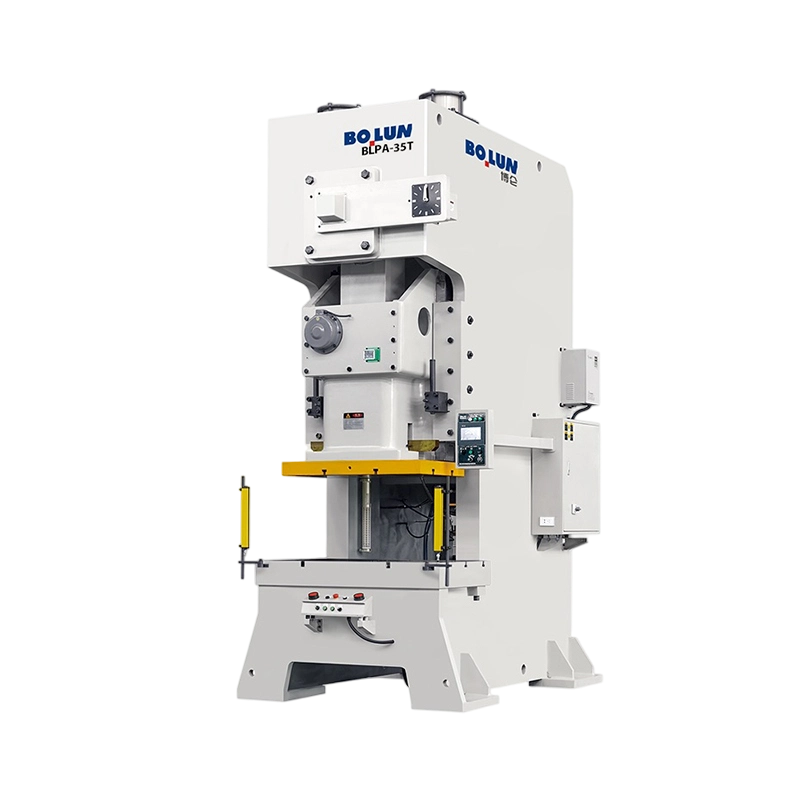
The BLPD-160 is a 1600 kN semi-closed single-point power press developed for demanding drawing, forming, stamping, and continuous production applications. Combining a high-rigidity frame, balanced operating characteristics, adjustable slide movement, and practical tooling clearance, it is designed to provide dependable forming performance across a wide range of industrial tasks. Its 16.8-ton press structure supports stable operation under heavy loads, while its 200 mm slide stroke and 980 × 800 mm worktable provide a useful working platform for medium- and large-sized dies.
Modern stamping operations require more than nominal pressing force. Manufacturers need repeatable motion, stable frame behavior, quick die setup, efficient production cycles, operator-friendly controls, and a machine structure capable of maintaining performance over long service periods. The BLPD-160 addresses these requirements through an integrated mechanical and electrical configuration. An electric slide adjustment system assists in fast mold setup, while a digital die height indicator helps operators establish and verify the required tooling position with greater clarity and accuracy.
The machine is part of a broader range of semi-closed single-point power presses covering capacities from 800 kN to 6300 kN. Within this range, the BLPD-160 occupies a versatile position. It offers substantially more forming capacity than compact 800 kN and 1100 kN models while remaining more space-conscious and energy-conscious than very large presses intended for the heaviest industrial work. This balance makes it suitable for manufacturers seeking a strong general-purpose press rather than a machine designed for only one specialized operation.
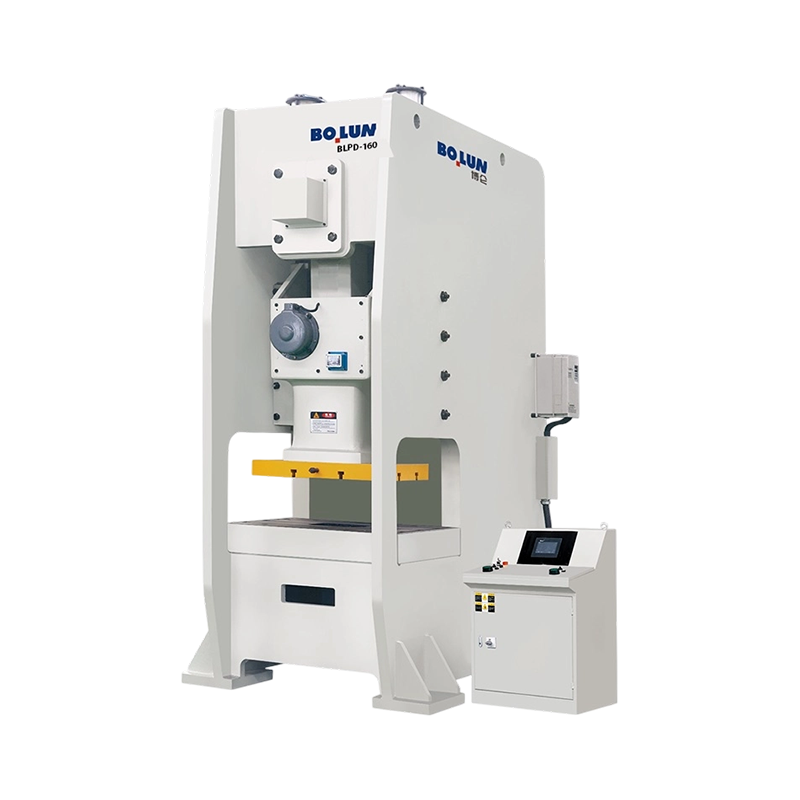
BLPD-160 Versatile Balanced-Stability Semi-Closed Single-Point Power Press
A power press converts motor-driven mechanical energy into controlled linear movement at the slide. The slide carries the upper die, and the worktable supports the lower die. When the material is placed between the tooling, the slide moves through its programmed stroke, applying forming force at the appropriate position. In a single-point press, the slide force is transmitted through a central connection, providing a straightforward and widely used arrangement for a broad range of stamping operations.
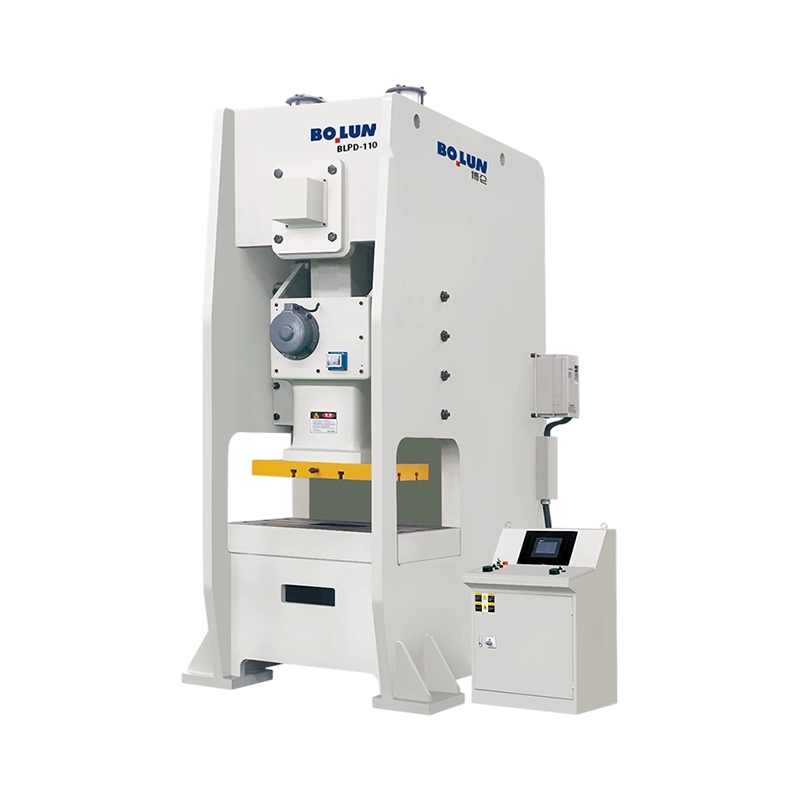
The BLPD-160 uses a semi-closed frame configuration. This structure provides a practical combination of working access, frame strength, and resistance to deformation. Compared with an open-sided press, a semi-closed construction can offer improved structural support around the working zone. Compared with a fully closed four-column or straight-side arrangement, it can provide a more accessible operating area for certain tooling and material-handling requirements.
The nominal capacity of the BLPD-160 is 1600 kN. This rating places the machine in a useful middle-to-heavy production category. It is suitable for operations that require more force than light-duty blanking or small-part stamping but do not require the extremely high capacity of a 3150 kN, 4000 kN, 5000 kN, or 6300 kN press. The 1600 kN rating should always be evaluated together with material type, thickness, die design, forming depth, speed, and the position of the working load within the stroke.
The BLPD-160 is available in vertical and horizontal operating configurations within the documented model range. For the BLPD-160, the listed vertical and horizontal versions share the principal worktable dimensions and major capacity specifications. The vertical configuration is associated with a 200 mm slide stroke and a production range of approximately 20 to 50 strokes per minute. The horizontal configuration uses a 90 mm slide stroke and a higher operating range of approximately 40 to 70 strokes per minute. This distinction gives users an opportunity to select the motion profile that better matches their tooling and production requirements.
The vertical version is particularly suitable for deeper forming, drawing, and applications in which additional slide travel is useful. The horizontal version can be advantageous when a shorter stroke and faster cycling are more important. The correct selection depends on the required die travel, material transfer method, forming depth, part geometry, and target production rate.
The following table summarizes the principal specifications supplied for the BLPD-160 models. Where the source data identifies separate vertical and horizontal configurations, both values are shown. Final machine configuration, safety equipment, electrical standard, and optional accessories should be confirmed during technical quotation and order review.
| Specification | Unit | BLPD-160 V | BLPD-160 H |
|---|---|---|---|
| Nominal capacity | kN | 1600 | 1600 |
| Nominal pressure stroke | mm | 6 | 3 |
| Slide stroke | mm | 200 | 90 |
| Strokes per minute | S.P.M. | 20–50 | 40–70 |
| Maximum die height | mm | 460 | 510 |
| Die height adjustment | mm | 100 | 100 |
| Worktable size | mm | 980 × 800 × 140 | 980 × 800 × 140 |
| Slide bottom size | mm | 850 × 550 × 90 | 850 × 550 × 90 |
| Height of working face | mm | 900 | 900 |
| Distance between columns | mm | 930 | 930 |
| Main motor | kW × pole | 15 × 4 | 15 × 4 |
| Die height adjustment motor | kW | 1.1 | 1.1 |
| Required air pressure | MPa | 0.55 | 0.55 |
| Punch accuracy | — | GB/JIS Class 1 | GB/JIS Class 1 |
| Overall dimensions | mm | 1600 × 2200 × 3500 | 1600 × 2200 × 3500 |
| Press weight | ton | 16.8 | 16.8 |
| Mold pad capacity | kN | 100 | 100 |
| Ram stroke | mm | 80 | 80 |
| Effective cushion area | mm² | 650 × 420 | 650 × 420 |
These specifications show why the BLPD-160 can be considered a versatile production press. The 980 × 800 mm worktable allows substantial tooling space, and the 930 mm distance between columns provides useful access for dies and material. The 850 × 550 mm slide bottom gives the upper die a stable mounting area. Together, these dimensions allow the machine to support a wide range of stamping tools without moving immediately into the footprint and operating cost associated with a much larger press.
Structural stability is one of the most important factors in a power press. During forming, the machine frame is exposed to high compressive and bending forces. If the structure deflects excessively, several problems may occur: die alignment can change, product dimensions can vary, tooling wear can accelerate, and localized stress can affect machine service life. A high-rigidity frame helps control these effects by resisting deformation and distributing working loads through the press body.
The BLPD-160 has a listed press weight of 16.8 tons. This mass is not simply a measure of size. In a correctly engineered press, substantial structural mass can contribute to reduced vibration, improved stability, and smoother force transmission. A heavier and more rigid frame may remain more settled during repeated cycles than a lightweight structure operating near its maximum capacity. This is particularly valuable in continuous production, where small deviations can accumulate into quality losses over time.
The balanced-stability concept of the BLPD-160 relates to the coordinated design of the frame, drive system, slide, worktable, and tooling area. A press must maintain appropriate alignment between the upper and lower die while the slide moves under load. Stable guiding and a rigid working zone reduce the likelihood of uneven contact, one-sided loading, and excessive deflection. These factors are important for blanking, bending, shallow drawing, and forming operations that depend on repeatable die engagement.
The semi-closed construction offers an effective compromise between rigidity and accessibility. It surrounds the working zone with a supportive frame while retaining a practical layout for die installation, inspection, and material handling. The 900 mm working-face height also provides a useful operating elevation for many production arrangements. Actual ergonomic suitability depends on the factory layout, feeding equipment, guarding, and operator workflow, but the specified dimensions give users a clear starting point for planning.
Compared with lower-capacity presses that may have limited structural reserves, the BLPD-160 is better positioned for heavier forming work and larger dies. Compared with oversized presses, it can provide the required force without obliging the customer to install a machine with significantly greater mass, floor space, and infrastructure demands. This balance is one of the machine’s principal advantages over both undersized and unnecessarily oversized alternatives.
The vertical BLPD-160 provides a 200 mm slide stroke. This travel is useful for forming and drawing operations that require greater die opening, material clearance, or forming depth. A longer stroke can simplify part removal, improve access for feeders and transfer devices, and accommodate tooling arrangements in which the upper die must move a meaningful distance away from the lower die between cycles.
The vertical model operates at approximately 20 to 50 strokes per minute. The actual achievable speed depends on the selected stroke, material behavior, die complexity, lubrication, feeding method, part geometry, and production requirements. Shorter and less demanding operations may be performed toward the upper end of the range, while deeper drawing or more complex forming may require slower operation for quality and safety.
The horizontal BLPD-160 provides a 90 mm slide stroke and a listed range of approximately 40 to 70 strokes per minute. This makes it a useful choice for applications in which a shorter motion is adequate and higher cycling speed is a priority. In practice, the higher-speed configuration can support productive blanking, bending, and repetitive shallow-forming operations when the tooling and material-handling system are designed accordingly.
One advantage of offering both configurations is that the user can match press behavior to the process rather than forcing every application into one standard operating profile. A deep-drawing operation may benefit from the longer vertical stroke, while a repetitive blanking operation may benefit from the shorter, faster horizontal cycle. This flexibility can improve equipment utilization across a factory with varied production orders.
The nominal pressure stroke is listed as 6 mm for the vertical model and 3 mm for the horizontal model. This specification indicates the reference point within the slide movement at which the nominal capacity is defined. Press users should not assume that the full nominal capacity is available at every position of the stroke. Die design and process planning should take the press force curve into account and ensure that the required forming load occurs within the machine’s rated operating conditions.
Tooling compatibility is central to press selection. A press may have sufficient nominal force but still be unsuitable if its die height, worktable dimensions, slide area, or column spacing do not accommodate the intended tool. The BLPD-160 addresses these practical requirements with a 980 × 800 × 140 mm worktable, an 850 × 550 × 90 mm slide bottom, and a 930 mm distance between columns.
The worktable provides a stable base for lower-die mounting and material positioning. Its 140 mm thickness contributes to a substantial working platform, while the 980 × 800 mm plan area gives production engineers room to evaluate die footprint, feed direction, scrap discharge, and auxiliary components. The upper slide area is sized to correspond with the working table, supporting a practical relationship between the upper and lower tooling elements.
The maximum die height is listed as 460 mm for the vertical model and 510 mm for the horizontal model. Die height adjustment is 100 mm for both configurations. This adjustment range helps operators compensate for different die sets and establish the required shut height. It also assists in setup changes when a plant uses multiple tools on the same press.
Electric slide adjustment reduces the physical effort and time associated with die-height changes. Rather than relying exclusively on manual adjustment, the operator can use the integrated adjustment drive to position the slide more efficiently. The digital die height indicator adds a clear reference for setup verification. These features are especially valuable in job-shop environments or factories with frequent product changeovers, where setup time directly affects machine availability and production cost.
A 100 kN mold pad capacity and an effective cushion area of 650 × 420 mm support forming operations requiring controlled material movement or reverse force beneath the workpiece. The listed ram stroke is 80 mm. These specifications should be reviewed with the die designer before purchase because the effectiveness of a cushion or pad depends on the required force profile, stroke, pressure distribution, blank-holder arrangement, and part geometry.
Compared with presses that offer limited adjustment or unclear mechanical references, the BLPD-160 provides a more practical setup environment. Its combination of adjustment travel, electric operation, and digital indication can reduce trial-and-error during die installation. Better setup repeatability can also help reduce material waste during the first production pieces after a tooling change.
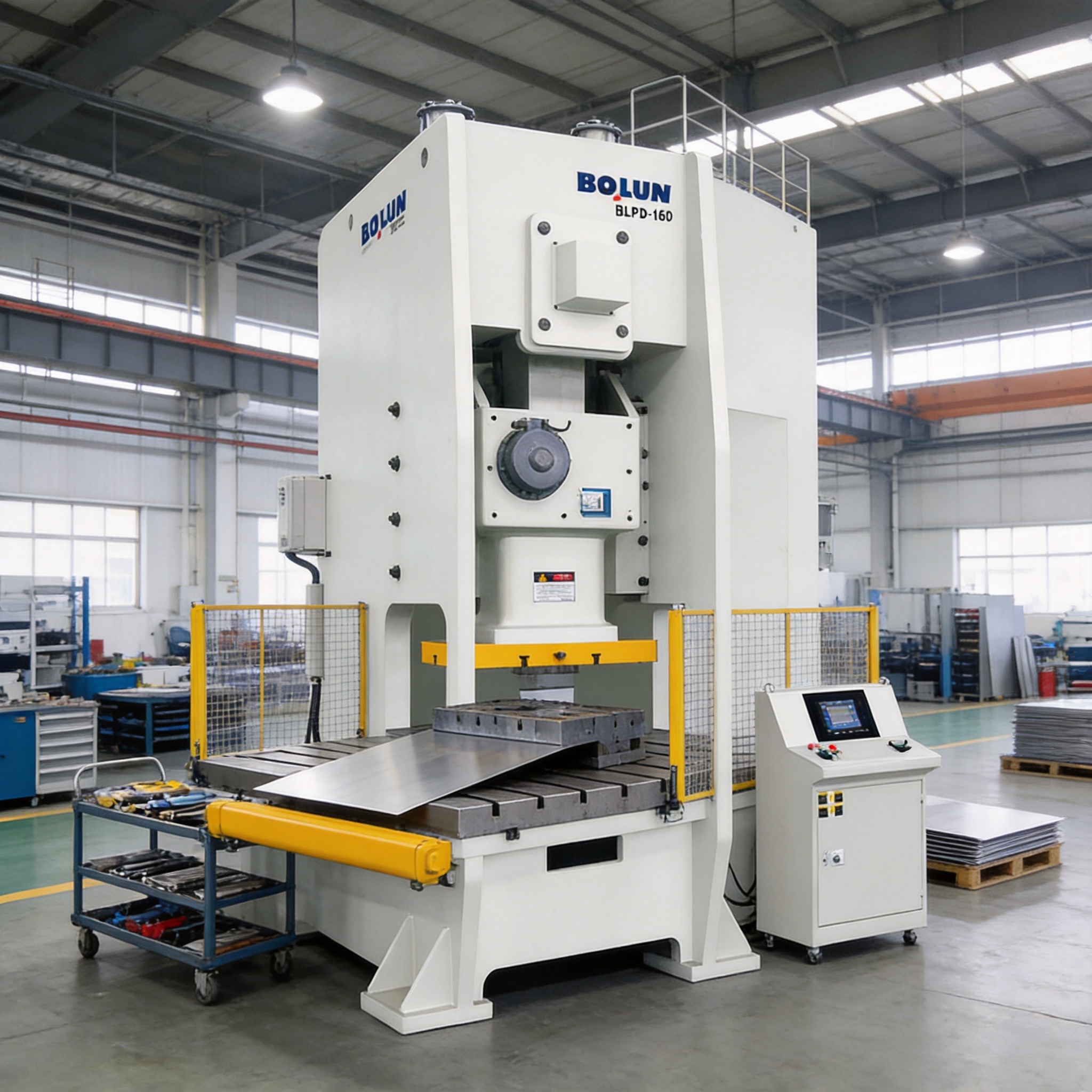
The BLPD-160 is equipped with a 15 kW, four-pole main motor. The motor supplies the energy required to operate the press drive through repeated cycles. A correctly selected motor must deliver stable performance during acceleration, forming, return, and continuous operation. The four-pole configuration is commonly associated with a practical balance between rotational speed, torque characteristics, and industrial operating suitability.
In heavy-load forming, motor performance cannot be evaluated only by nominal power. The press drive, flywheel, clutch and brake system, crank mechanism, transmission components, lubrication, and control system all influence how effectively the available energy is converted into slide movement. The BLPD-160’s 15 kW motor is matched to the 1600 kN press class and is intended to maintain stable working behavior under demanding production conditions.
The die height adjustment system uses a separate 1.1 kW motor. Separating the adjustment drive from the main press motor allows setup movement to be controlled independently from production cycling. This arrangement supports more convenient die installation and adjustment while avoiding the need to use the primary drive for positioning operations.
The main motor and adjustment motor should be evaluated as part of the complete electrical installation. Factory planners should confirm voltage, frequency, control-panel requirements, grounding, compressed-air availability, and local safety regulations before commissioning. The stated air-pressure requirement is 0.55 MPa, and the customer should ensure that the plant air system can maintain the required pressure under operating conditions.
Precision stamping depends on the interaction of several elements: frame rigidity, slide guidance, die quality, material consistency, lubrication, press adjustment, feeding accuracy, and operator procedure. The BLPD-160 is listed with punch accuracy meeting GB/JIS Class 1. This provides a defined quality reference for the press itself, although final part accuracy will also depend on the complete production system.
Stable precision is particularly important when the press is used for repeated forming operations. A small change in slide alignment or die height can influence wall thickness, bend angle, hole position, edge condition, or surface quality. By combining a rigid frame with electric adjustment and digital die-height indication, the machine is designed to help users maintain a consistent setup from one production run to the next.
The machine’s 16.8-ton structure can help reduce unwanted movement and vibration during heavy-load operation. Reduced vibration may support better die life, more stable cutting conditions, and improved operator confidence. However, users should remember that press accuracy cannot compensate for poorly designed tooling, incorrect material preparation, inadequate lubrication, or operation beyond the rated process envelope.
For quality-critical work, production teams should establish a documented setup procedure. This may include recording die height, slide position, cushion settings, material specifications, lubrication parameters, stroke rate, and inspection results. The digital indicator can serve as one part of this repeatability system. When the same tooling is installed again, recorded setup data can help reduce adjustment time and shorten the period needed to reach acceptable production quality.
Compared with basic presses that depend heavily on manual adjustment and operator memory, the BLPD-160 offers a more structured setup environment. This can be an important competitive advantage for manufacturers seeking to standardize production across multiple shifts or facilities.
Open-type presses are often selected for their accessibility and relatively compact construction. They can be suitable for light stamping, small components, and simple tooling. However, when the operation requires higher force, larger dies, deeper forming, or better resistance to working-load deflection, a lightweight open press may not provide enough structural reserve.
The BLPD-160 offers 1600 kN of nominal capacity and a 16.8-ton frame. Its semi-closed structure is intended to provide stronger support around the working area than many compact open-frame machines. This can make it a more appropriate choice for heavier forming and larger tooling. The trade-off is that the BLPD-160 requires a larger installation area and more substantial handling arrangements, but the additional structure is justified when process stability is more important than minimum footprint.
Closed-type presses provide substantial rigidity and are valuable for large dies, high forming loads, and demanding production lines. Nevertheless, purchasing a press with significantly more capacity than the application requires can increase capital cost, energy consumption, foundation requirements, maintenance obligations, and floor-space usage.
The BLPD-160 presents a more balanced option for manufacturers whose applications fall within the 1600 kN range. It supplies a meaningful forming capacity while maintaining a more manageable footprint than very large industrial presses. Its 980 × 800 mm table and 930 mm column spacing provide useful tooling room without moving directly into the scale of a large multi-point or heavy straight-side press.
Manual die-height adjustment may be adequate where tooling changes are rare. In a flexible production environment, however, repeated manual adjustments can consume time and introduce variation. The BLPD-160’s electric adjustment system makes setup changes more efficient, and its digital die height indicator provides a direct reference for the selected position.
This combination can improve changeover consistency, particularly when several operators use the same press. It can also support better production planning because setup tasks become more predictable. The productivity advantage is not limited to faster adjustment; it also includes reduced setup uncertainty and fewer trial pieces during tooling installation.
An undersized press may initially appear economical, but operating near or beyond its practical limits can create quality and maintenance risks. Excessive loading may increase deflection, vibration, clutch and brake stress, tooling wear, and unplanned downtime. Selecting an appropriately rated machine gives the process more working margin.
The BLPD-160 is suitable for customers who require a serious forming platform but do not need the capacity of the largest models in the range. Its nominal capacity, frame mass, worktable dimensions, and motor power are coordinated for applications that demand reliable medium-to-heavy stamping performance.
The BLPD-160 can be applied to a broad range of metal-forming operations. Potential uses include blanking, bending, shallow drawing, embossing, piercing, coining, and general forming. The exact suitability of the machine depends on the material, thickness, die construction, required tonnage, speed, and shape of the finished component.
In automotive and transportation supply chains, a press in this capacity class may be used for brackets, structural fittings, reinforcement parts, covers, and formed sheet-metal components. In appliance manufacturing, it may support production of panels, mounting pieces, housings, and internal structural elements. In electrical and electronics equipment production, it can be used for metal brackets, enclosures, terminals, and hardware components when the required force and tooling dimensions fall within the machine’s operating range.
General hardware manufacturers may use the BLPD-160 for repetitive blanking and forming of steel, stainless steel, aluminum, and other suitable sheet materials. The vertical version may be considered for deeper forming where the 200 mm stroke provides useful clearance and travel. The horizontal version may be considered for faster repetitive operations where a 90 mm stroke is sufficient.
The machine can also support contract manufacturers and job shops. These businesses often handle multiple components, materials, and die sets rather than one standardized product. Electric adjustment and digital die-height indication are valuable in this environment because they help the press adapt to changing production requirements.
Before selecting the machine for a specific application, engineers should calculate the required forming force, including allowances for friction, material variation, work-hardening behavior, and safety margin. They should also verify the die’s maximum dimensions, shut height, cushion requirements, feed direction, part-removal method, and expected cycle rate.
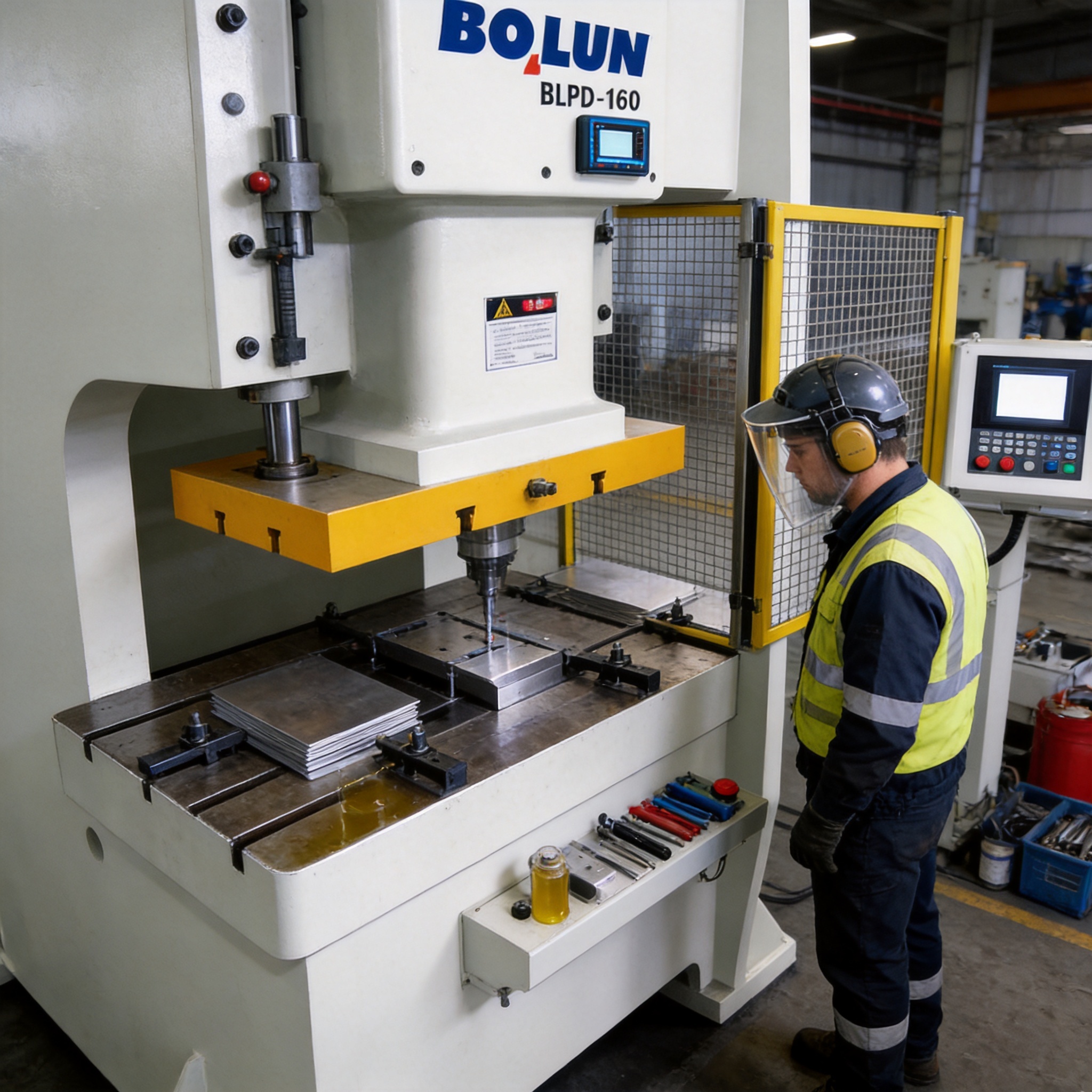
The manufacturer is a specialized Chinese producer of high-precision machinery with approximately two decades of experience in machinery manufacturing. Its capabilities cover research and development, design, production, sales, and service. This integrated structure is important for complex industrial equipment because the performance of a power press depends on how well mechanical design, machining, assembly, electrical systems, inspection, and customer support work together.
A manufacturer that controls multiple stages of the production chain can improve communication between departments and respond more effectively to technical requirements. Design engineers can communicate directly with machining and assembly teams, while service personnel can provide field feedback to product development. This type of feedback loop supports continuous improvement in areas such as frame design, tooling compatibility, adjustment systems, safety integration, and maintenance access.
The company emphasizes a technology-first development strategy. Its production resources include precision processing equipment and an industrial environment covering basic design, core component development, and final machine assembly. Such an end-to-end approach is relevant to the BLPD-160 because the machine requires accurate relationships between the frame, slide, crank mechanism, die-height system, cushion, drive system, and control components.
Non-standard customization is another stated capability. Industrial customers do not always require a standard catalog configuration. They may need a different electrical standard, special feeding interface, modified table arrangement, customized die-height range, automation connection, material-handling adaptation, or special safety enclosure. A manufacturer with design and production customization experience can review these requirements as part of a complete equipment solution rather than treating the press as an isolated standard machine.
Customization should be managed through a formal technical specification. The customer should provide material details, part drawings, die information, production targets, preferred automation, plant conditions, and applicable safety standards. The manufacturer can then determine whether the requested changes are compatible with the press structure, drive system, control architecture, and certification requirements.
Power-press quality begins with design but is realized through production discipline. A high-rigidity frame must be manufactured with appropriate material preparation, machining accuracy, stress control, and inspection. Large structural members require careful handling because residual stress and machining sequence can influence long-term stability. Precision surfaces must be processed and checked according to their function within the complete assembly.
The manufacturer states that it operates a finished-product inspection system exceeding ordinary industry requirements. Quality control is applied to processes and components, not only to the final machine. This is a significant strength because defects in a single subsystem can affect the performance of the entire press. Inspection should therefore cover frame dimensions, slide movement, die-height adjustment, drive operation, electrical functions, pneumatic conditions, lubrication, and safety-related systems.
Precision machining equipment supports the production of components requiring controlled dimensions and alignment. In a press, machining accuracy is important for the working table, slide bottom, guide surfaces, bearing seats, transmission components, and interfaces for adjustment mechanisms. Accurate assembly then ensures that the individual components perform as an integrated system.
Final assembly is also a critical stage. The press must be assembled so that the slide, frame, drive, clutch and brake, cushion, adjustment mechanism, and electrical control system work together. Trial operation can reveal abnormal noise, vibration, leakage, temperature rise, incomplete adjustment movement, or irregular cycling. Identifying these conditions before shipment supports more reliable installation at the customer’s factory.
A mature production-management system helps coordinate procurement, machining, inventory, assembly, testing, and shipping. It also assists with traceability and documentation. For international customers, clear technical records, inspection results, manuals, spare-parts information, and commissioning guidance can be as important as the machine’s mechanical specifications.
Industrial forming requirements continue to change. Customers may process new materials, introduce higher-strength sheet, reduce part weight, increase production speed, or connect presses to automated lines. These changes require equipment manufacturers to combine established mechanical principles with updated control, monitoring, and production methods.
The manufacturer’s research and development capability supports the ongoing development of forging and forming equipment. Its design team provides services for products with special specifications and functions. For customers considering a BLPD-160, this means that the initial discussion can address the actual production process rather than focusing only on catalog values.
Important design questions include the required force at the nominal pressure stroke, the necessary slide travel, the target strokes per minute, die height, workpiece transfer, cushion or pad action, lubrication, scrap removal, operator access, and integration with upstream or downstream machines. A proper technical review can prevent a mismatch between the press and the die.
For automated production, the press may need to communicate with feeders, destackers, transfer units, robots, sensors, conveyors, and quality-inspection systems. Automation compatibility should be discussed before the machine is finalized. The BLPD-160’s worktable, slide movement, frame opening, and control requirements should be considered together with the intended automation layout.
Installation begins with site preparation. The customer should review the press weight of 16.8 tons, overall dimensions of approximately 1600 × 2200 × 3500 mm, foundation requirements, transport route, lifting capacity, ceiling clearance, electrical supply, and compressed-air connection. The final installation plan should account for maintenance access and safe movement of dies and raw material.
The machine requires an air pressure of 0.55 MPa according to the supplied specification. The plant air system should provide clean, adequately filtered air at a stable pressure. Moisture, contamination, and pressure fluctuation can affect pneumatic components and machine availability. The customer should confirm whether additional filtration, drying, or local regulation is required.
During commissioning, technicians should verify machine leveling, anchoring, electrical connections, lubrication, slide movement, die-height adjustment, digital indication, cushion function, emergency systems, and operating modes. The press should be run initially without production material, followed by controlled testing with the intended die and material.
Operators should be trained in normal operation, die installation, adjustment procedures, inspection, emergency response, lubrication checks, and basic fault reporting. Training should emphasize that nominal capacity is not a universal allowance for every die position or process. Operators must follow approved setup data and never bypass guarding or safety devices.
Preventive maintenance helps preserve press accuracy and reduce unexpected downtime. A maintenance program for the BLPD-160 should include routine inspection of lubrication points, fasteners, electrical connections, pneumatic lines, clutch and brake functions, slide guidance, die-height adjustment, cushion components, and abnormal noise or vibration.
Lubrication is particularly important for moving and loaded components. The correct lubricant, quantity, and interval should follow the manufacturer’s operating documentation. Insufficient lubrication may increase wear and heat, while excessive or unsuitable lubrication may contaminate tooling or interfere with electrical and pneumatic components.
The slide and die-height adjustment system should be checked regularly. Operators should confirm that the adjustment moves smoothly and that the digital indicator corresponds correctly to the actual setup. Any unusual movement, inconsistent reading, or unexpected mechanical resistance should be investigated before continuing production.
Tooling condition also affects press reliability. A damaged or poorly aligned die can impose uneven loads on the slide and frame. Regular die inspection, correct mounting, appropriate clearance, and balanced loading help protect both the tooling and the machine. When a process involves eccentric loading, engineers should evaluate whether the die arrangement is suitable for the single-point press configuration.
Maintenance records should include operating hours, inspections, adjustments, replaced parts, lubrication, faults, and corrective actions. These records can reveal trends before they become serious failures. They also help the manufacturer’s service team diagnose problems more efficiently when technical assistance is required.
Power presses contain significant stored and moving energy. Safe operation requires appropriate guarding, control systems, emergency-stop functions, die protection, and operator training. The exact safety package may vary according to customer requirements, local regulations, and the selected machine configuration. These details should be confirmed during procurement rather than assumed.
Operators should keep hands and loose clothing away from the die area and use approved handling tools for material and dies. Lockout and tagout procedures should be followed before maintenance, die changes, cleaning, or inspection inside hazardous areas. The press should not be operated if safety devices are damaged, bypassed, or not functioning correctly.
Die installation must be performed by trained personnel. The die should be suitable for the press capacity, shut height, table and slide dimensions, and operating stroke. Bolting, clamping, alignment, and cushion settings must be checked before production. A controlled test cycle should be completed after every die change.
Safety is also linked to process design. Feeding and discharge systems should be arranged so that operators do not need to reach into the die area during normal production. If automation is added, the system should be assessed as a complete cell, including access doors, interlocks, sensors, emergency stops, and restart procedures.
The decision between the vertical and horizontal BLPD-160 configurations should be based on the process rather than on speed alone. The vertical model offers the longer 200 mm slide stroke and is more suitable when die opening, forming depth, or material clearance is important. Its listed operating range of 20 to 50 strokes per minute provides a practical balance for forming and drawing operations.
The horizontal model provides a 90 mm stroke and a listed range of 40 to 70 strokes per minute. It may be preferable for faster blanking, bending, shallow forming, or production in which a shorter slide travel is sufficient. The maximum die height is listed as 510 mm, compared with 460 mm for the vertical version.
Both configurations share a 1600 kN nominal capacity, 980 × 800 mm worktable, 850 × 550 mm slide bottom, 930 mm column spacing, 15 kW main motor, 100 kN mold pad capacity, and 100 mm die-height adjustment. This common platform simplifies product-family planning for manufacturers that may later add related models.
Customers should supply the following information when requesting a final recommendation: material grade, thickness, blank size, finished-part dimensions, estimated forming force, die footprint, die height, required stroke, target output, feeding arrangement, cushion requirements, electrical standard, and factory environmental conditions. This information allows the equipment supplier to confirm the correct configuration and identify any required options.
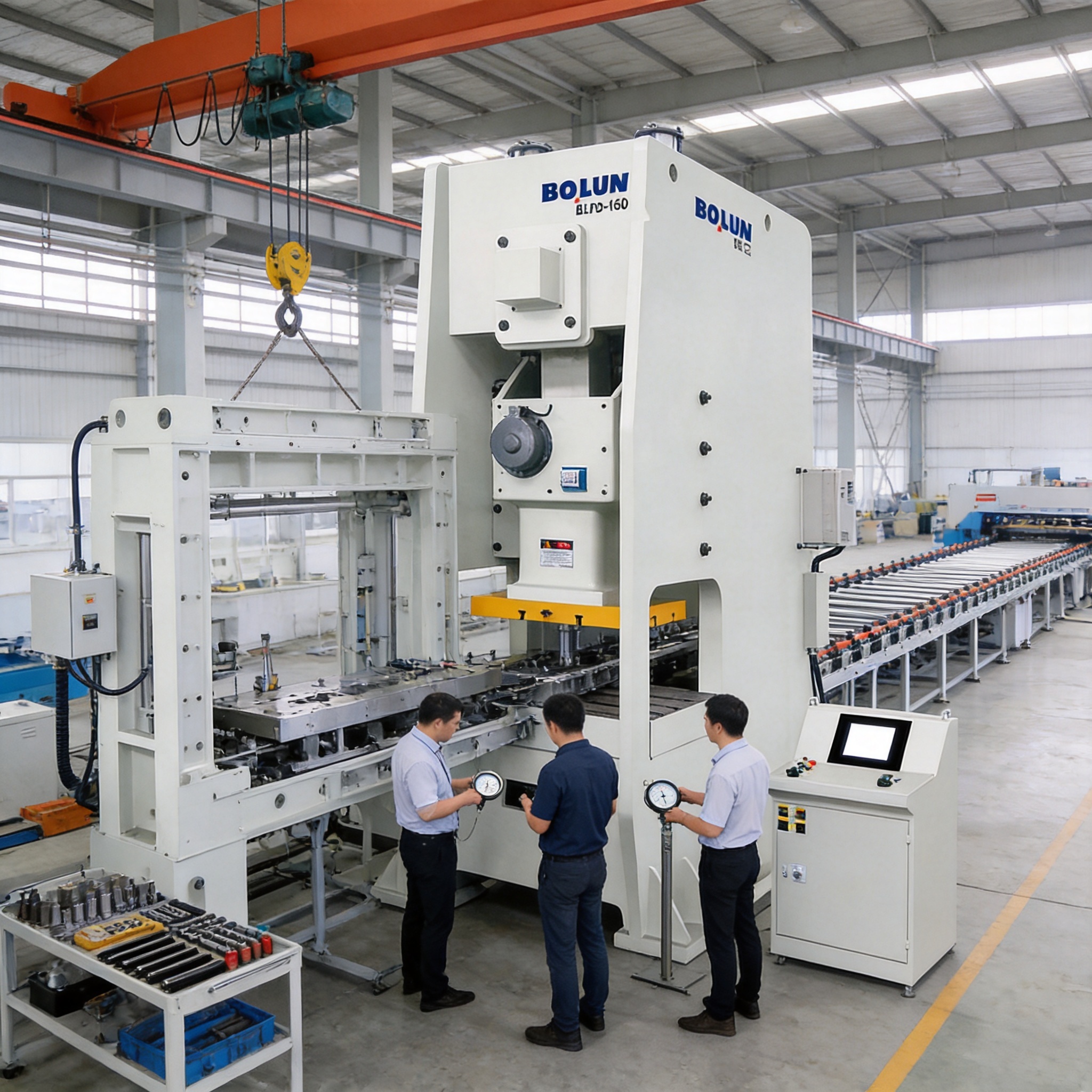
The value of a power press extends beyond its purchase price. Production managers should consider setup time, usable capacity, cycle stability, maintenance requirements, tooling flexibility, energy use, operator workload, service support, and expected operating life. The BLPD-160 is designed to create value in each of these areas through a balanced specification.
Its 1600 kN capacity allows manufacturers to handle a wider range of parts than a smaller press. The 980 × 800 mm worktable and 930 mm column spacing support practical die sizes. The electric adjustment system and digital indicator can reduce setup effort. The 16.8-ton high-rigidity frame supports stable forming. The 15 kW main motor provides the drive power required for continuous industrial operation.
For a job shop, these features can improve the range of work that can be accepted. For a dedicated production line, they can support reliable operation across repeated cycles. For a growing manufacturer, the BLPD-160 can serve as a central machine for medium-to-heavy forming while leaving room to add smaller or larger presses as product requirements change.
Purchasers should evaluate total cost of ownership rather than comparing only nominal tonnage. A press that reduces setup variation, supports more tooling, and maintains stable production may provide better long-term value than a lower-priced machine with limited adjustment or insufficient structural capacity.
The manufacturer combines machinery experience, precision-production capability, product customization, and an integrated service structure. Its stated business activities include research and development, design, manufacturing, sales, and service. This combination is valuable for customers who need more than a standard machine delivery.
Its location in Zhejiang places it within one of China’s important manufacturing regions. The company has developed experience in forging and casting machinery and has invested in precision processing and production management. These capabilities support the manufacture of large, rigid, mechanically coordinated equipment such as the BLPD-160.
The manufacturer’s quality philosophy emphasizes inspection of processes and components, stable precision, and long service life under high-intensity conditions. Its customer-oriented service system covers pre-sales consultation, in-sales support, and after-sales assistance. For international buyers, this full-cycle support can help reduce the risks associated with equipment selection, installation, commissioning, and long-term maintenance.
The company also promotes an engineering culture based on careful accumulation, technical development, rigorous production, and continuous improvement. Such values are appropriate for power-press manufacturing, where reliability is built through detailed design and disciplined execution rather than through one isolated feature.
Before purchasing a BLPD-160, buyers should prepare representative parts and tooling data. A technical evaluation should confirm that the machine can provide the required forming force at the relevant point in the stroke. It should also verify that the die fits within the worktable and slide dimensions and that the die height falls within the available adjustment range.
Customers should request clarification on the standard machine configuration, optional equipment, electrical controls, guarding, documentation, spare parts, warranty terms, installation responsibilities, and commissioning support. If the machine will be integrated into an automated line, communication protocols and interface responsibilities should be defined in advance.
A factory acceptance test may include no-load cycling, slide movement, adjustment operation, digital indicator verification, cushion or pad performance, safety-function checks, noise and vibration observation, and production testing with an approved die. The acceptance criteria should be written into the technical agreement.
After delivery, the customer should maintain a commissioning record and establish a preventive-maintenance schedule. This creates a clear baseline for future service and helps ensure that the machine continues to operate within its intended specifications.
The BLPD-160 has a nominal capacity of 1600 kN. This rating identifies the machine’s designated forming-force class. The actual permissible force at a specific die position depends on the press force curve, die design, material, process, and operating conditions.
The vertical configuration has a 200 mm slide stroke, while the horizontal configuration has a 90 mm slide stroke. The vertical version is better suited to applications requiring greater travel, while the horizontal version may be preferable for shorter and faster cycles.
The listed speed range is 20 to 50 strokes per minute for the vertical model and 40 to 70 strokes per minute for the horizontal model. Actual production speed should be selected according to material, die design, forming depth, feeding system, lubrication, and quality requirements.
The worktable is 980 × 800 × 140 mm for both the vertical and horizontal BLPD-160 configurations. Customers must still verify die footprint, clamping requirements, feed direction, and auxiliary equipment before final approval.
Yes. The BLPD-160 includes an electric slide or die-height adjustment system. The listed adjustment range is 100 mm, and a digital die-height indicator supports setup verification.
The main drive uses a 15 kW, four-pole motor. A separate 1.1 kW motor is listed for die-height adjustment.
The maximum die height is listed as 460 mm for the vertical model and 510 mm for the horizontal model. The applicable die-height range should be confirmed with the tooling drawing and final machine configuration.
The BLPD-160 has a listed press weight of 16.8 tons. This weight should be considered when planning transportation, lifting, foundation, installation, and factory access.
The machine is designed for stable drawing and forming operations, especially when the selected configuration, die, material, cushion settings, and forming force are properly matched. Engineers should complete a process and die review before confirming suitability for deep or complex drawing.
Potential industries include automotive components, appliance manufacturing, electrical equipment, general hardware, sheet-metal fabrication, transportation parts, and contract stamping. The suitable application depends on the material, part size, die requirements, and required force.
It provides substantially greater nominal capacity, a heavier 16.8-ton frame, a larger worktable, and a semi-closed structure intended for improved support during heavier forming. A smaller open press may occupy less space, but it may not provide the same working margin or tooling capacity.
The manufacturer provides non-standard design and manufacturing services. Customization should be reviewed through a formal technical specification covering tooling, automation, electrical requirements, safety systems, working conditions, and production targets.
The listed air-pressure requirement is 0.55 MPa. The customer should verify plant-air quality, filtration, drying, pressure stability, and connection requirements before installation.
The supplied information lists punch accuracy as GB/JIS Class 1. Finished-part accuracy will also depend on tooling, material, lubrication, feeding, process parameters, and inspection methods.
Buyers should verify force requirements, die dimensions, die height, required stroke, cycle speed, material characteristics, cushion or pad needs, automation interfaces, factory utilities, safety requirements, installation conditions, documentation, spare parts, and service arrangements.
The BLPD-160 semi-closed single-point power press is designed for manufacturers that require a stable, flexible, and high-capacity forming platform. Its 1600 kN nominal capacity, 16.8-ton high-rigidity frame, 200 mm vertical stroke, 980 × 800 mm worktable, electric adjustment system, digital die-height indicator, and 15 kW main motor create a balanced solution for a wide range of stamping and forming operations.
Its main advantage over lighter alternatives is the combination of structural strength, tooling space, and working capacity. Its advantage over unnecessarily large presses is the practical balance between force, footprint, operating flexibility, and production cost. The availability of vertical and horizontal configurations allows the user to select longer travel for forming or faster cycling for shorter-stroke work.
The manufacturer strengthens this product offering through integrated research, design, machining, assembly, inspection, customization, and service capabilities. Its focus on precision processing, quality control, production management, and customer support provides a foundation for reliable industrial equipment delivery.
For customers seeking a press that can support varied tooling, repeatable setup, stable heavy-load operation, and future production development, the BLPD-160 is a strong candidate. The final selection should always be based on a complete engineering review of the intended parts, dies, materials, cycle requirements, safety conditions, and factory infrastructure.
1. Manufacturer-supplied BLPD Series Power Press Technical Specification.
2. Manufacturer-supplied BLPD-160 Product Description and Configuration Information.
3. General Principles of Mechanical Power Press Design and Metal Forming Equipment.
4. Industrial Press Setup, Die-Height Adjustment, and Preventive-Maintenance Practices.
5. General Guidance for Stamping Process Planning, Tooling Compatibility, and Press Safety.


Two presses can both carry a 200-tonne nameplate and still produce very differe...
What Is a Power Press? A power press — also called a stamping press or punch pr...
Start With the Purchase Decision, Not the Definitions A procurement engineer co...
A tooling engineer quotes a new bracket program and specifies a 160-ton press. ...
When you are planning to produce medium or small metal parts in high volumes, t...
A fastener plant in Taizhou receives a request from an automotive tier-one supp...
Contact Us

topbolun@gmail.com

+86-575-83362228

+86-13735238388
+86-18667502750

+86-575-83362999

+8618667502750

No.1 Linjiang Road East, Xiaren, Jinting Town, Shengzhou City, Zhejiang Province, China
Ready to Begin?
Get in Touch

Now!

ZHEJIANG BOLUN
 English
 中文简体