
In modern stamping, forming, blanking, and light-to-medium-duty forging operations, manufacturers need equipment that combines speed, rigidity, accuracy, usability, and long-term reliability. The BLPA-35 Versatile High-Stability Open-Type Single-Point Power Press is designed for this exact production environment. With a nominal capacity of 350 kN, a compact open-type structure, adjustable stroke speed, stable load transmission, and operator-friendly electronic control, this press provides a practical balance between productivity and precision.
Unlike general-purpose mechanical presses that may sacrifice stability for speed or accessibility for rigidity, this open-type single-point power press is engineered to provide a more balanced forming solution. It supports efficient mold installation, convenient workpiece access, accurate press timing, and reliable repeated output under continuous operation. For factories producing metal components, electrical parts, appliance hardware, automotive small parts, brackets, terminals, connectors, and precision stamped components, this machine offers a strong combination of performance and value.
Its key strengths come from three major areas: a high-stability structural design, intelligent speed and operation control, and a manufacturing background supported by advanced precision machining, strict inspection, and customization capability. Zhejiang Bolun High-Precision Machinery Co., Ltd. has developed this press within a wider system of research, design, production, assembly, inspection, and service, allowing the machine to meet demanding industrial requirements while remaining practical for everyday production.
BLPA-35 Versatile High-Stability Open-Type Single-Point Power Press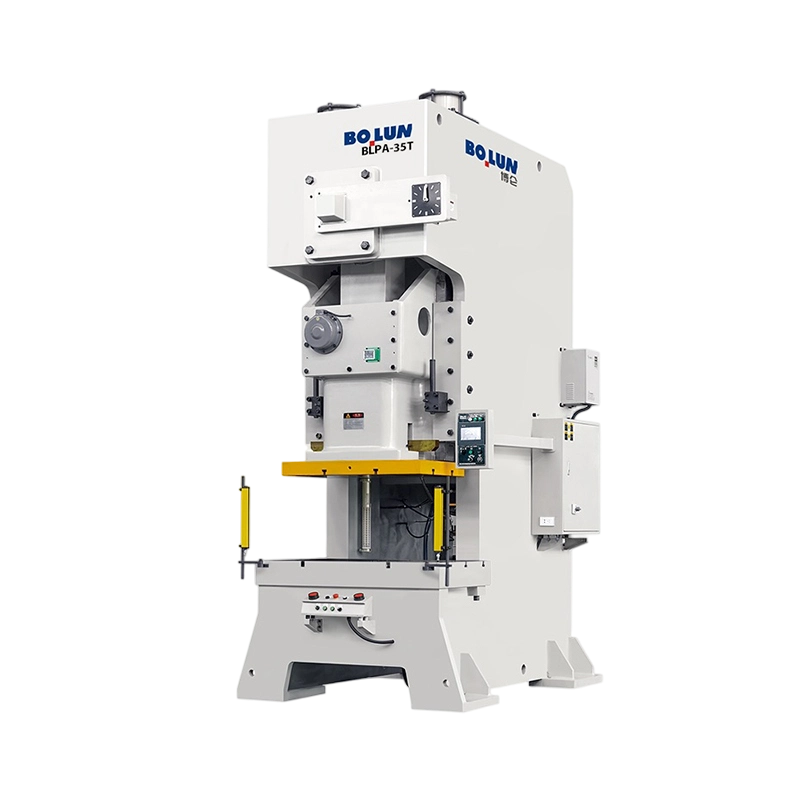
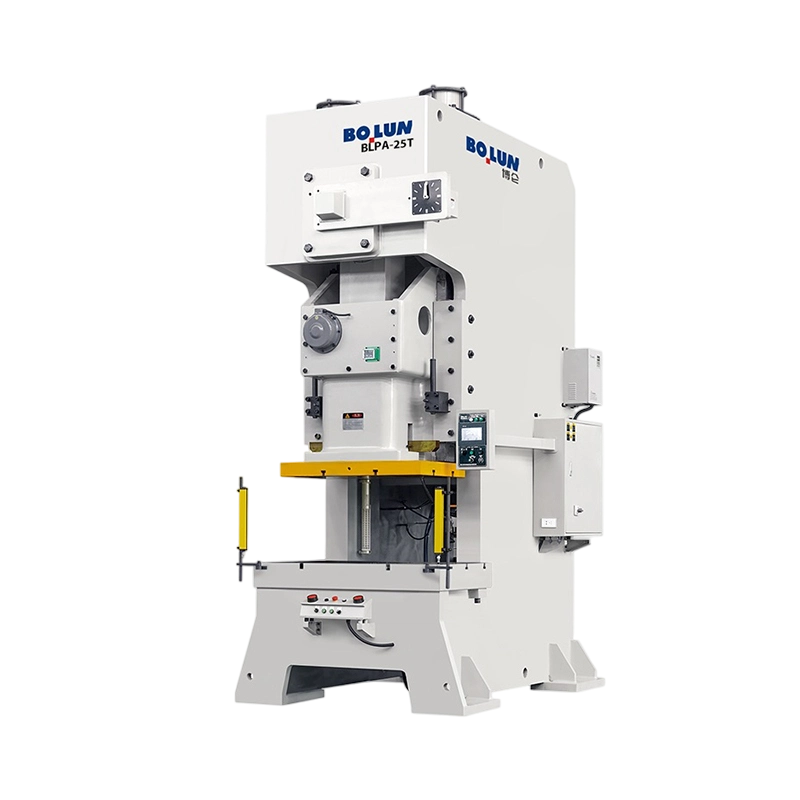
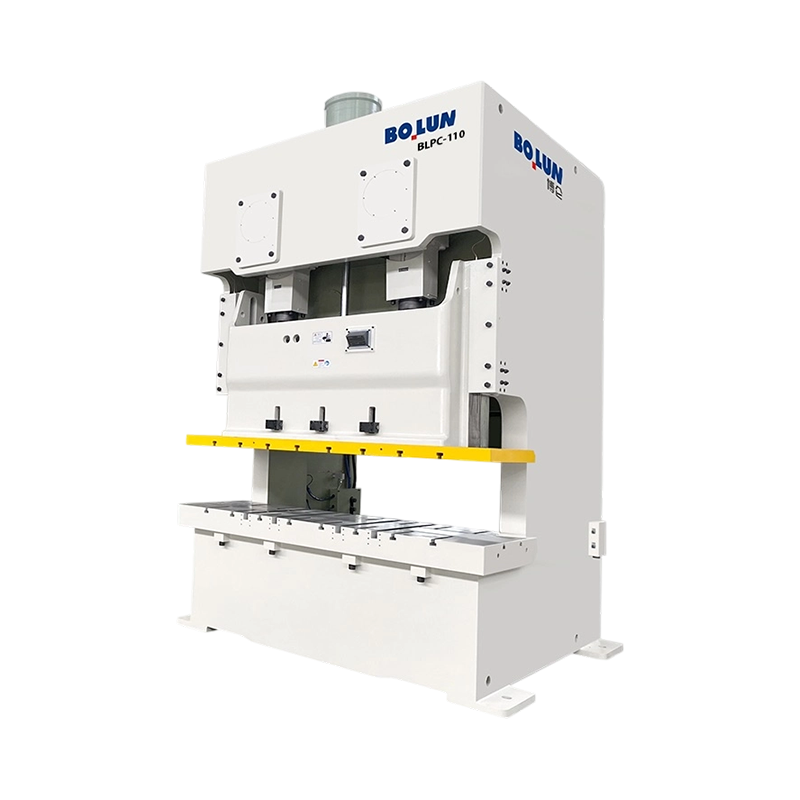
The BLPA-35 is an open-type single-point power press positioned between light-duty and medium-duty press applications. Its 350 kN nominal capacity allows it to handle a broad range of forming and stamping tasks while keeping the equipment footprint manageable. The open-type frame gives operators better access to the working area, making it easier to install dies, feed materials, remove parts, inspect tooling, and integrate auxiliary equipment.
The single-point drive structure is especially suitable for applications where force must be transmitted centrally and consistently through the slide. For many stamping applications, this design provides a dependable solution that is simpler to maintain than more complex multi-point structures while still delivering strong forming performance. The machine is suited for blanking, bending, shallow forming, punching, embossing, trimming, and progressive die operations within its rated capacity.
One of the most important characteristics of this model is its balanced rigidity. The frame, slide, worktable, drive components, and supporting structures are designed to distribute load evenly and reduce unnecessary vibration. In high-speed stamping, vibration can reduce precision, shorten tool life, increase noise, and create unstable production conditions. By improving rigidity and reducing vibration, the BLPA-35 helps maintain repeatability over long production runs.
The machine also incorporates an advanced touch screen interface and a main motor paired with an inverter. This combination allows operators to adjust the strokes per minute according to the process, material, and die condition. Rather than being limited to a fixed-speed operation, users can fine-tune the press to match actual production needs. This is valuable when working with materials of different thicknesses, tensile strengths, surface requirements, and forming behaviors.
The electronic rotary cam switch improves timing control for auxiliary equipment. In automated or semi-automated stamping lines, feeders, conveyors, lubrication units, sensors, part ejectors, and safety devices must coordinate with the press cycle. Precise timing reduces misfeeds, improves safety, and supports more consistent part quality. This makes the machine suitable not only for stand-alone operation but also for production cells requiring reliable synchronization.
The following table summarizes representative technical data for the BLPA-35 configuration. Actual specifications may vary according to selected options, production requirements, and customized engineering solutions.
| Item | Representative Specification | Production Value |
| Model | BLPA-35 | Open-type single-point power press for precision stamping and forming |
| Nominal Capacity | 350 kN | Suitable for a broad range of light-to-medium-duty metal forming work |
| Nominal Pressure Stroke | 1.6 mm | Supports accurate rated-force delivery near the working zone |
| Speed Range | Adjustable speed-changing operation, commonly 110–180 strokes per minute depending on configuration | Allows optimization for different materials, dies, and production rhythms |
| Stable Speed Reference | About 85 strokes per minute | Provides a dependable operating point for continuous production |
| Slide Stroke | 40 mm | Appropriate for punching, blanking, bending, and many shallow forming operations |
| Maximum Die Height | 235 mm | Allows flexible die installation within the machine envelope |
| Die Height Adjustment | 55 mm | Helps operators set up different tooling efficiently |
| Worktable Size | 800 × 400 × 70 mm | Provides stable support for compact and medium-size molds |
| Slide Bottom Size | 360 × 250 × 50 mm | Supports secure die mounting and accurate slide transmission |
| Throat Depth | Standard deep open-throat design, representative value about 205 mm | Improves access for tooling, feeding, and workpiece handling |
| Main Motor | Variable-speed motor system with inverter control, representative rating 3.7 kW | Enables efficient speed adjustment and energy-conscious operation |
| Air Pressure | 0.55 MPa | Supports pneumatic clutch, brake, and related operating systems |
| Press Precision | GB/JIS Class 1 reference | Provides a recognized precision basis for industrial stamping |
| Overall Dimensions | Approximately 1380 × 900 × 2400 mm | Compact enough for efficient workshop layout |
| Press Weight | Approximately 3 tons | Contributes to frame stability and vibration resistance |
The most obvious advantage of the BLPA-35 is its balanced approach to rigidity, access, and speed. Some competitor presses emphasize only low purchase cost and may use lighter frames, limited machining accuracy, or simplified control systems. These machines can perform basic pressing tasks, but they often struggle with repeatability when production speed increases or when tooling requires stable slide motion. The BLPA-35 is designed to provide a more dependable foundation for long-term precision production.
The open-type structure offers convenient access to the working area while maintaining strong support through a reinforced frame. In many workshops, operators must frequently change dies or handle different part types. A press with poor accessibility slows down setup, increases labor intensity, and raises the possibility of installation errors. The open frame of this machine makes die installation and material feeding more practical, which helps reduce downtime and improve production flexibility.
Compared with low-rigidity open presses, this model focuses on reducing deformation under load. Frame deformation is one of the hidden causes of part inconsistency. Even small deflections can affect clearance between punch and die, create uneven wear, and change final part dimensions. A high-stability structure protects tooling accuracy and reduces the risk of rejected parts. This advantage becomes especially important when processing thin sheet metal, precision components, or parts with tight dimensional tolerances.
Another competitive advantage is vibration control. Vibration is not merely an issue of operator comfort; it affects die life, feeding accuracy, part burrs, noise level, and maintenance intervals. The BLPA-35 distributes load across structural components in a balanced way, helping to reduce shock during repeated cycles. Better vibration behavior supports cleaner cutting, more stable forming, and smoother high-speed operation.
The press also offers a strong capacity-to-footprint ratio. With a nominal capacity of 350 kN and an approximate press weight of 3 tons, it delivers meaningful forming capability without requiring excessive floor space. For factories that must optimize every square meter of production area, this compact but capable design can be more attractive than oversized equipment that wastes space or smaller presses that lack sufficient force margin.
Precision in a power press is not created by one component alone. It is the result of frame quality, slide accuracy, transmission stability, worktable flatness, die mounting precision, control timing, and assembly discipline. The BLPA-35 is designed with these relationships in mind. Its Class 1 precision reference provides a reliable basis for customers who need predictable results in batch production.
The slide is a critical element because it transfers motion and force to the die. If the slide movement is unstable or poorly guided, stamped parts may show inconsistent edges, distorted shapes, excessive burrs, or uneven forming marks. The BLPA-35 uses a structure intended to maintain stable slide movement through repeated cycles, helping the die work under more controlled conditions.
Stable die height adjustment is also important. The 55 mm adjustment range gives operators practical flexibility for different dies. Accurate die height setting reduces setup time and improves the first-piece qualification rate. In competitive production environments, the ability to change dies quickly and correctly can have a major impact on delivery speed and cost control.
Worktable stability supports the lower die and affects overall forming accuracy. The 800 × 400 × 70 mm worktable provides a suitable base for many compact and medium-size molds. A stable table reduces the chance of uneven contact and helps maintain correct die alignment. Combined with the 360 × 250 × 50 mm slide bottom, the press provides a controlled mounting relationship between upper and lower tooling.
Repeatability is especially important in progressive die work. A progressive die may complete several operations in one continuous feed sequence. Any instability in slide motion, feeding coordination, or timing can accumulate into part defects. The electronic rotary cam switch and adjustable speed system help coordinate the machine with feeding and auxiliary systems, allowing the press to operate more consistently in automated sequences.
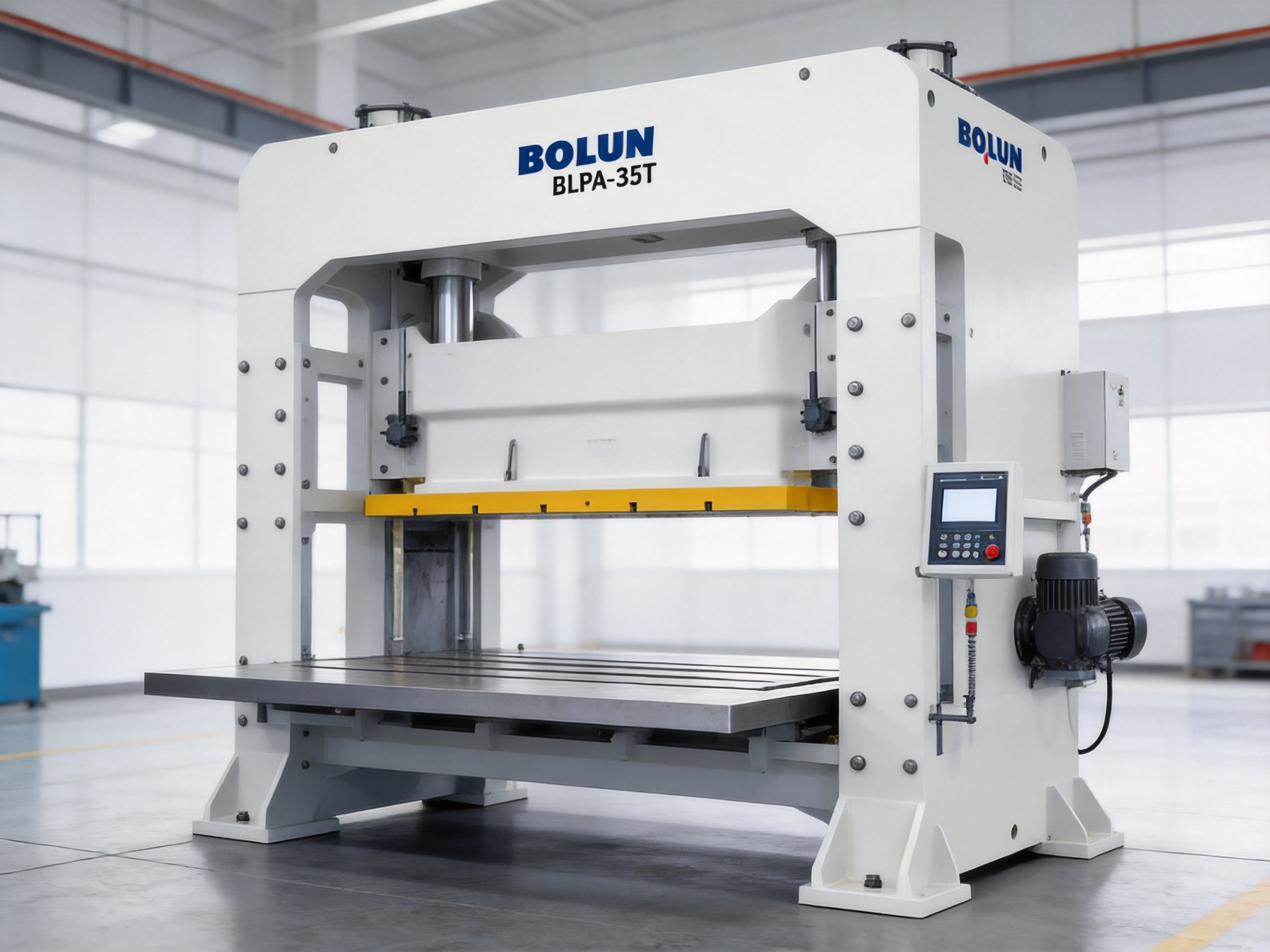
The BLPA-35 uses a touch screen interface to improve operator interaction. A clear interface allows operators to monitor operating parameters, adjust machine settings, and respond quickly to production needs. Compared with older presses that rely only on mechanical buttons and limited indicators, a touch screen system provides better visibility and reduces the learning curve for trained operators.
The inverter-controlled main motor is a major practical advantage. Different stamping tasks require different speeds. Thin materials and simple punching operations may benefit from higher speeds, while forming operations, sensitive materials, or complex die movements may require slower and more controlled cycles. By adjusting speed, the operator can balance output, part quality, tool protection, and safety.
Fixed-speed competitor machines may force users to compromise. Running too fast can damage tools, increase defects, or create feeding problems. Running too slowly can reduce productivity and raise unit costs. An adjustable speed system gives users control over the process, making the same machine useful for a wider range of production tasks.
The electronic rotary cam switch further improves process coordination. In a press line, accurate timing determines when feeding starts, when lubrication activates, when parts are ejected, when sensors check position, and when safety interlocks respond. Mechanical cam systems may become less accurate over time or require more manual adjustment. Electronic timing improves repeatability and makes production settings easier to manage.
For manufacturers pursuing intelligent production, these control features are important stepping stones. Even when the press is used in a traditional workshop, the combination of touch screen operation, inverter control, and electronic timing creates a more modern operating experience. When integrated into automated cells, these features support higher efficiency and better process control.
A press is only as reliable as the manufacturing system behind it. Zhejiang Bolun High-Precision Machinery Co., Ltd. is located in Zhejiang, a region known for precision manufacturing and industrial supply chain strength. The company has developed through approximately two decades of experience in machinery manufacturing and has built capabilities covering research and development, design, production, sales, and service.
The company’s manufacturing approach is based on a full-chain production concept. Instead of depending only on final assembly, it emphasizes control over design, core component processing, machine assembly, inspection, and service support. This approach helps reduce inconsistency between batches and allows the company to respond more effectively to customer-specific requirements.
Advanced precision processing equipment plays an important role in the production of high-quality presses. Large structural components require accurate machining to ensure correct alignment and stable assembly. Surfaces that support the slide, worktable, transmission components, and die mounting areas must be processed with care. If these areas are inaccurate, the finished press may never reach the expected level of precision, no matter how good the design appears on paper.
The company also emphasizes non-standard customization capability. In real factories, customers often have special requirements: unusual part dimensions, special feeding directions, automation interfaces, safety arrangements, worktable modifications, production line height limits, or process-specific die conditions. A manufacturer with design and customization strength can adapt equipment to the customer’s actual production environment rather than forcing the customer to adjust every process around a standard machine.
Bolun’s production management system combines practical manufacturing experience with modern management methods. This matters because press quality depends on many controlled steps: material selection, welding or casting quality, stress treatment, machining sequence, assembly accuracy, lubrication routing, electrical installation, pneumatic system testing, control calibration, and final inspection. A mature management system helps keep these steps consistent and traceable.
Quality control is one of the strongest differentiators between a reliable press manufacturer and a low-cost supplier. The BLPA-35 benefits from a finished product inspection system designed to exceed ordinary industry expectations. Each machine must perform not only at delivery but also under long-term industrial conditions where loads, vibration, dust, oil, and continuous cycling are part of daily operation.
Inspection begins with component-level discipline. Structural components must meet dimensional requirements; machined surfaces must be accurate; transmission parts must be assembled correctly; electrical and pneumatic systems must function safely; and lubrication points must be verified. Any weakness at the component stage can become a production problem after installation at the customer’s site.
Final machine inspection evaluates the assembled press as a working system. This includes checking slide motion, control response, speed stability, clutch and brake performance, electrical cabinet operation, pneumatic pressure behavior, safety functions, die height adjustment, and general machine condition. These checks help ensure that the press delivered to the customer is ready for industrial use.
Compared with competitors that may only perform basic outgoing checks, a more rigorous inspection system reduces the customer’s risk. It helps prevent unexpected installation delays, early failure, inconsistent operation, and additional maintenance cost. For customers purchasing equipment for continuous production, this reliability is often more valuable than a slightly lower initial price.
Long service life is also supported by stable manufacturing quality. A press experiences repeated impact loads during operation. If components are poorly aligned or materials are not properly processed, wear may accelerate. By focusing on accurate manufacturing and assembly, the BLPA-35 is positioned to deliver dependable performance over extended use.
The BLPA-35 is suitable for many industries that require reliable metal forming and stamping. In electrical component manufacturing, it can produce terminals, contact pieces, shields, brackets, and connector parts. These components often require clean edges and repeatable dimensions, making press stability important.
In household appliance production, the machine can process small panels, clips, supports, mounting plates, and formed hardware. Appliance manufacturing often involves large batch quantities and frequent part changes. The press’s open structure and die adjustment capability help support this variety.
In automotive and motorcycle component production, the machine can be used for smaller brackets, washers, clips, retainers, light structural parts, and precision blanks. Although larger automotive parts may require higher-capacity presses, many supporting parts fall within the 350 kN range and benefit from fast, repeatable production.
In hardware and general metal goods manufacturing, the BLPA-35 can handle punching, bending, blanking, trimming, and shallow forming operations. Its compact footprint makes it suitable for workshops that operate multiple presses in parallel. The adjustable speed system allows different jobs to be scheduled on the same machine with fewer compromises.
For mold testing and trial production, the press provides practical accessibility. Engineers and technicians can observe the die area, make adjustments, and verify forming results more conveniently than with more enclosed structures. This can shorten development cycles and improve communication between tooling and production teams.
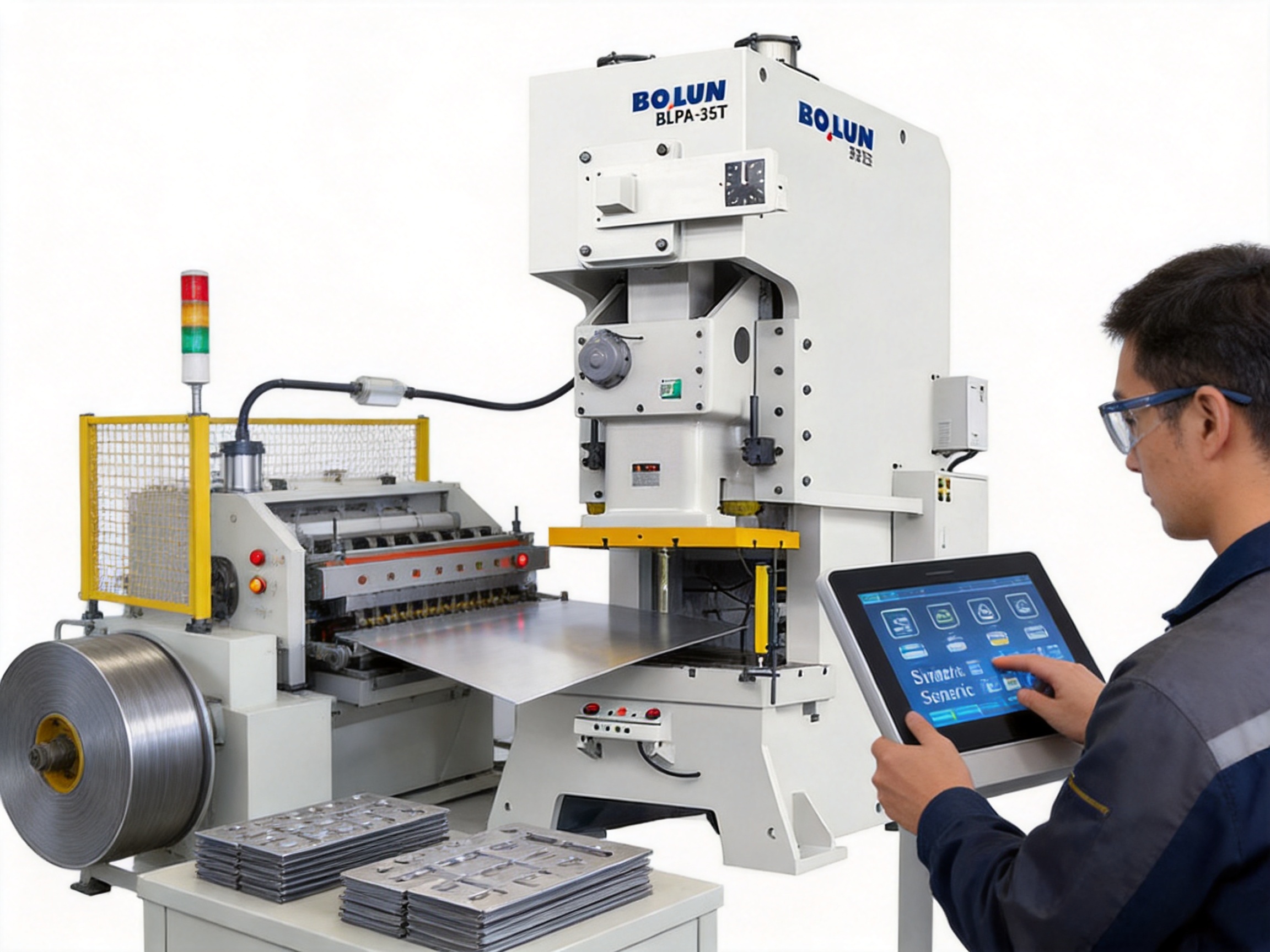
Production cost is not determined only by the purchase price of a machine. It includes installation time, operator training, setup efficiency, energy consumption, maintenance demand, tool life, scrap rate, downtime, and the ability to adapt to new orders. The BLPA-35 is designed to create value across these factors.
Adjustable speed contributes directly to efficiency. Operators can run faster when the process allows and slow down when quality or tool protection requires it. This flexibility helps avoid the common problem of using one fixed setting for every job. Better matching between speed and process improves both output and part quality.
Reduced vibration can lower hidden costs. Excessive vibration may loosen fasteners, damage tooling, increase noise, reduce precision, and require more frequent maintenance. A stable press structure protects the customer’s tooling investment and reduces interruptions.
The open working area improves setup efficiency. Die change and alignment are time-consuming tasks in stamping workshops. Better access reduces operator effort and can shorten changeover time. When a factory processes many small batches, this advantage becomes particularly valuable.
The touch screen interface supports clearer operation. Operators can view settings and machine status more easily, while supervisors can standardize operating procedures. Better interface design reduces mistakes and supports more consistent production behavior across different shifts.
The machine’s compact dimensions also create layout value. A press that delivers 350 kN of capacity without occupying excessive space allows factories to design more efficient production cells. Multiple presses can be arranged with feeders, conveyors, inspection stations, or robotic handling systems while preserving material flow.
Safety is essential in power press operation. While every press must be installed and operated according to local safety regulations and appropriate guarding requirements, the BLPA-35 supports safe and controlled operation through stable mechanical design, reliable control systems, and coordinated timing capabilities.
The pneumatic operating system with a representative air pressure of 0.55 MPa supports controlled clutch and brake function. Reliable clutch and brake performance is critical for safe press cycling. Consistent response helps operators and automation systems work with predictable machine behavior.
Maintenance is supported by practical machine design. An open-type press generally allows easier access to key areas for inspection, cleaning, lubrication, and adjustment. This reduces the burden on maintenance personnel and helps preventive maintenance become part of normal workshop routine.
Inverter control may also reduce mechanical stress compared with abrupt fixed-speed operation. Controlled acceleration and speed management can contribute to smoother operation, especially when the machine is adjusted for different processes. This helps protect both machine components and dies.
Long-term usability is also supported by the manufacturer’s service orientation. The company provides a customer-oriented service system covering pre-sales consultation, in-sales support, and after-sales guarantees. This is important because correct press selection, installation guidance, tooling compatibility, operator training, and maintenance support all influence the real success of a stamping project.
When customers compare power presses, the listed capacity is often the first specification they notice. However, capacity alone does not define performance. Two machines with the same nominal force can behave very differently in actual production. The BLPA-35 stands out because it combines rated capacity with structural stability, speed flexibility, interface modernization, manufacturing discipline, and service support.
Against low-cost competitors, its advantages appear in repeatability, vibration resistance, control convenience, and quality assurance. Against oversized machines, it offers a more efficient and economical solution for parts that do not require excessive tonnage. Against older mechanical presses, it provides improved speed control, electronic timing, and a more modern operating experience.
The machine is especially attractive for manufacturers who need a dependable mid-range press rather than a basic entry-level machine. It is also suitable for customers upgrading from older equipment and seeking better productivity without completely changing their production system. Because it supports both stand-alone and integrated use, it can be adopted gradually into more automated production strategies.
In global manufacturing, flexibility is increasingly important. Orders may change, product designs may evolve, and batch sizes may vary. A press that can adapt to different speeds, dies, and auxiliary equipment gives factories more resilience. The BLPA-35 supports this flexible production philosophy while maintaining a solid mechanical foundation.
It is best suited for precision stamping, blanking, bending, punching, trimming, shallow forming, and light-to-medium-duty metal forming tasks. It is commonly applicable to hardware, electrical components, appliance parts, small automotive components, and general metal products.
The open-type structure provides convenient access to the die area, making tooling installation, feeding, inspection, and maintenance easier. The single-point drive delivers centralized force transmission, which is suitable for many compact and medium-size stamping operations.
Adjustable speed allows operators to match the press cycle to the material, die design, part shape, and quality requirement. Faster speeds can improve output for simple operations, while slower speeds can protect tooling and improve control during more sensitive forming processes.
Lower vibration improves part consistency, protects dies, reduces noise, supports feeding accuracy, and helps extend machine life. In high-cycle stamping, vibration control is a key factor in stable long-term production.
The electronic rotary cam switch controls the timing of auxiliary equipment such as feeders, lubrication devices, ejectors, sensors, and automation systems. Accurate timing helps reduce misfeeds and improves coordination in automated or semi-automated production.
Ordinary fixed-speed presses may force operators to use the same speed for different jobs, which can reduce quality or productivity. The BLPA-35 provides inverter-based speed adjustment, giving users more control over process optimization.
Yes. Its electronic timing, stable slide movement, and adjustable speed make it suitable for integration with feeders and auxiliary systems. Proper engineering and safety design are required for any automated line installation.
The press is supported by precision machining, full-chain production control, mature assembly procedures, strict finished product inspection, non-standard customization capability, and a service system covering consultation, support, and after-sales needs.
Nominal capacity is important, but real production performance also depends on frame rigidity, slide accuracy, speed control, vibration behavior, die adjustment, worktable stability, inspection quality, and service support. These factors determine long-term value.
The manufacturer has non-standard customization capability and can provide design and manufacturing support for special specifications or functional requirements, depending on the customer’s process and technical feasibility.
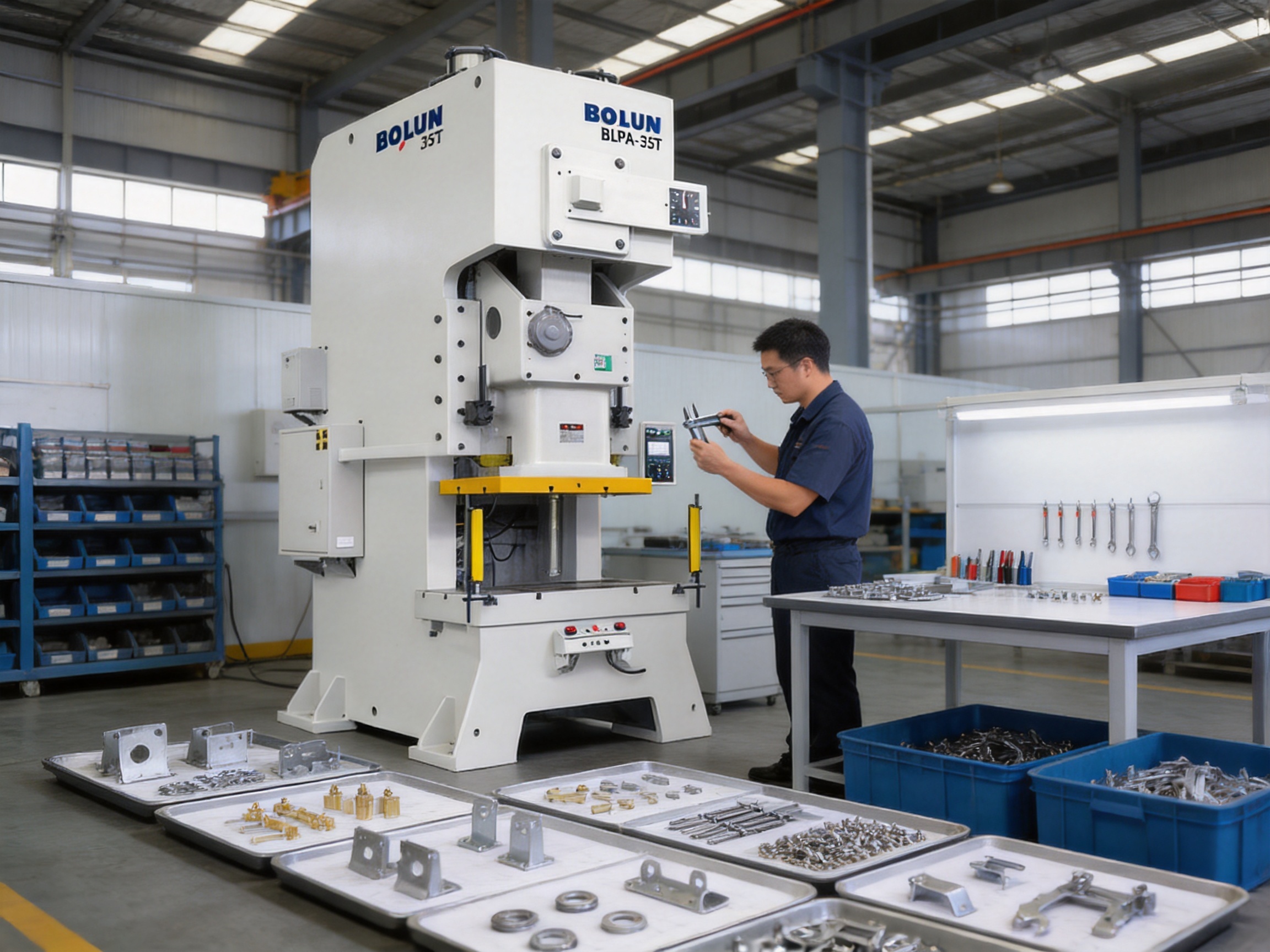
The BLPA-35 Versatile High-Stability Open-Type Single-Point Power Press offers a well-balanced solution for manufacturers requiring reliable forming capability, practical accessibility, adjustable speed, and stable precision. Its 350 kN nominal capacity places it in an effective range for many metalworking applications, while its open structure and compact footprint make it suitable for flexible production environments.
Its competitive strength lies not only in specifications but also in the engineering philosophy behind the machine. High stability, reduced vibration, precise timing, intelligent operation, and strong manufacturing control all contribute to better long-term value. For customers comparing ordinary low-cost presses, older fixed-speed machines, or oversized alternatives, this model provides a practical path toward higher productivity and more consistent quality.
Supported by the manufacturing experience and precision equipment capabilities of Zhejiang Bolun High-Precision Machinery Co., Ltd., the press reflects a modern approach to industrial machine tool production. The company’s focus on research, design, customization, inspection, and service helps ensure that customers receive not just a machine, but a dependable forming solution for evolving production needs.
1. Mechanical Press Design and Application Principles, Industrial Forming Equipment Technical Manual.
2. Sheet Metal Stamping Process Control, Manufacturing Engineering Reference Series.
3. Precision Press Inspection and Acceptance Guidelines, GB/JIS Class 1 Related Practice Notes.
4. Variable-Speed Drive Applications in Mechanical Press Systems, Industrial Automation Handbook.
5. Metal Forming Tooling Stability and Die Life Improvement, Precision Manufacturing Review.


What Is a Power Press? A power press — also called a stamping press or punch pr...
In the fields of metal forming, sheet metal fabrication, blanking, and punching,...
As the manufacturing industry moves steadily toward automation and smart product...
In modern manufacturing, cold forging is widely used in the automotive, aerospac...
Manufacturing & Metalworking A direct, practical look at how mechanical pre...
Power Press Technology Overview: From Fundamentals to Equipment Selection In the...
Contact Us

bolunpress@gmail.com

+86-575-83362228

+86-15158259588

+86-575-83362999

+86-15158259588

Hangzhou Office Add: No. 332 Wangjiang East Road, Shangcheng District

No.1 Linjiang Road East, Xiaren, Jinting Town, Shengzhou City, Zhejiang Province, China
Ready to Begin?
Get in Touch

Now!

ZHEJIANG BOLUN
 English
 中文简体
中文简体