
In modern metal forming, manufacturers face a demanding combination of requirements: higher forming accuracy, larger part dimensions, thicker materials, better energy control, safer operation, and stable output across long production cycles. The BLES-315 closed-frame double-point servo power press is designed for this environment. With a nominal capacity of 3000 kN, continuous working energy of 30,000 J, a 300 mm slide stroke, and a maximum die height of 550 mm, it serves heavy-duty stamping, deep forming, and precision forming applications where conventional press solutions may struggle to maintain accuracy, stability, and process flexibility.
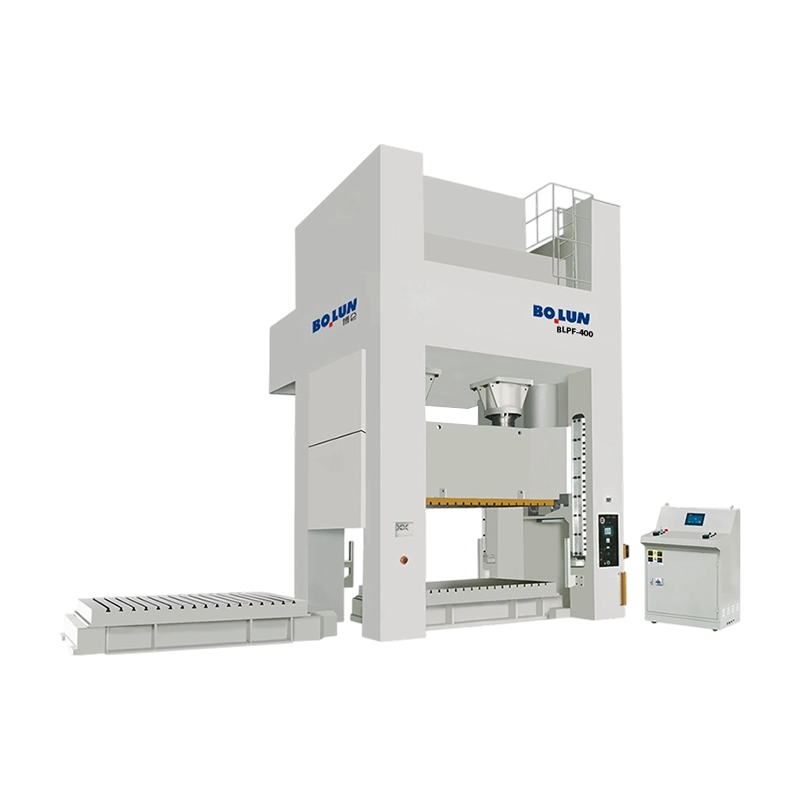
This machine belongs to the closed-frame double-point servo power press category, a configuration preferred for large workpieces and demanding forming operations. The closed straight-side frame provides superior rigidity compared with open-type presses, while the double-point drive supports a wide slide area and helps maintain balanced load distribution. For automotive structural parts, appliance panels, thick-gauge sheet metal components, and large precision-formed parts, these features directly influence part quality, die life, production efficiency, and operator safety.
Zhejiang Bolun High-Precision Machinery Co., Ltd. develops and manufactures high-precision forming equipment with an integrated system covering research and development, design, production, assembly, inspection, sales, and service. The company’s long-term experience in forging and forming machinery supports the design of machines that are not only powerful, but also practical for industrial production. The BLES-315 reflects this approach by combining a rigid mechanical structure, servo-driven process control, high working energy, hydraulic overload protection, and safety-oriented braking design into one production-ready platform.
BLES-315 Industrial Powerhouse Closed-Frame Double-Point Servo Power Press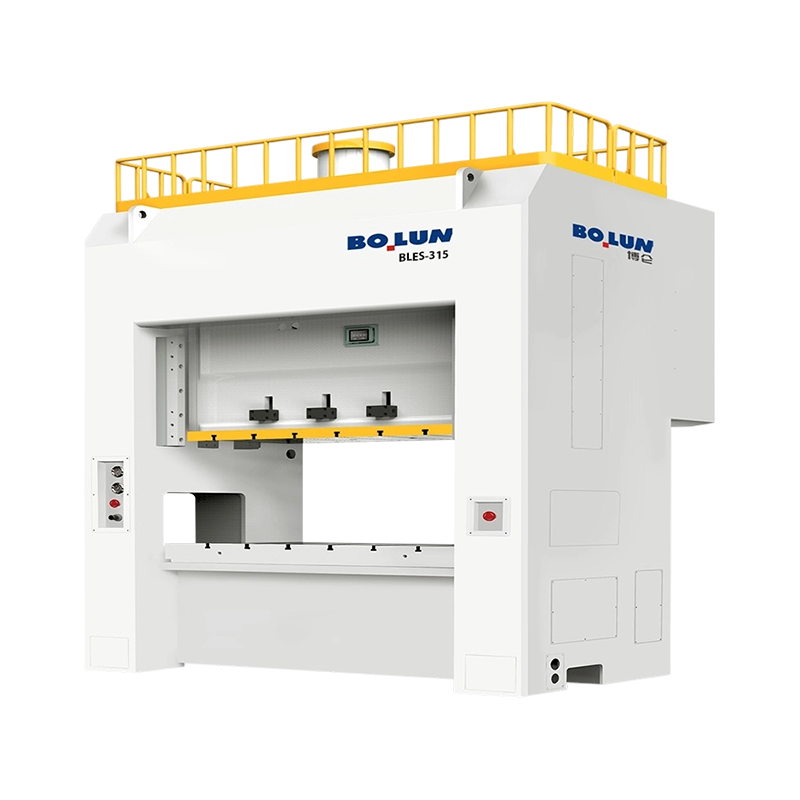
Power presses are commonly divided into open-type power presses, closed-type power presses, and other specialized power press systems. Open-type presses are often used for smaller parts, lighter tonnage, and applications requiring easy access from multiple sides. However, when part dimensions increase, material thickness rises, or forming depth becomes more demanding, open-frame structures can experience greater deflection. This may lead to uneven forming, reduced die life, and lower repeatability.
The BLES-315 is positioned as a closed-frame double-point servo power press for higher-tonnage and high-precision forming. Its closed-frame structure provides a stronger load path than open-type alternatives. The machine is engineered to maintain frame stability under high load, which is essential for parts requiring consistent geometry, tight tolerance control, and repeatable forming conditions. This makes it especially useful for manufacturers seeking to move from general stamping toward higher-value production involving complex forming, large panels, or structural components.
Compared with many conventional mechanical presses, the BLES-315 also benefits from servo press technology. A servo press can deliver more flexible slide motion than a traditional fixed-motion press. Instead of relying only on a standard crank motion profile, a servo-driven press allows better control of forming speed and movement characteristics. This can improve material flow, reduce forming defects, support low-speed forming near the bottom dead center, and provide more adaptable operation for different die sets and material grades.
The combination of high structural rigidity and servo-controlled forming is particularly important for heavy-duty precision applications. A press may have high nominal capacity, but if its frame is not sufficiently rigid or its motion control is limited, real production results may still be inconsistent. The BLES-315 addresses this by integrating power, energy, stroke length, die height capacity, and structural stability into a balanced machine platform.
The BLES-315 delivers a nominal capacity of 3000 kN, which places it in a strong position for large-scale industrial forming. Nominal capacity is a key measure of the maximum pressing force available near the rated position in the stroke. For applications involving thick-gauge steel, automotive reinforcement parts, deep drawn components, or high-strength sheet materials, adequate nominal capacity helps ensure that the press can complete the forming process without overloading the machine or compromising part quality.
Continuous working energy is another critical specification. The BLES-315 provides 30,000 J of continuous working energy. This is highly relevant in operations where forming is not defined only by maximum force, but also by the energy required to deform the material across the working stroke. Some forming processes, especially deep forming and large-area deformation, consume substantial energy. A press with insufficient energy may slow, stall, or produce inconsistent results. The 30,000 J output supports stable forming in demanding operations.
The 300 mm slide stroke provides room for deep forming applications. A longer stroke allows the slide to travel through a greater distance, supporting dies that require deeper draw depth or larger opening space. This is particularly valuable for parts such as large appliance panels, automotive body and structural elements, and thick sheet metal parts requiring progressive deformation. Combined with a maximum die height of 550 mm, the machine provides practical flexibility for a range of large die configurations.
The BLES-315 is designed for approximately 35 strokes per minute. In heavy-duty forming, the objective is not always the highest possible speed. Stability, energy control, material flow, and die protection are often more important than extremely high stroke counts. The specified operating speed supports a balance between production efficiency and forming quality. In applications where controlled low-speed forming is required, servo drive capability helps optimize the slide motion for process needs.
The worktable size for the BLES-315 is 2500 mm by 1000 mm, while the slide bottom size is 2200 mm by 900 mm. These dimensions are important for large dies and wide parts. The double-point configuration helps support this wider slide area by applying driving force through two points, reducing the risk of uneven slide movement during off-center or distributed loads. This is one of the main reasons double-point presses are preferred for larger panels and long workpieces.
| Item | BLES-315 Specification | Production Significance |
| Press Type | Closed-frame double-point servo power press | High rigidity and stable forming for large precision parts |
| Nominal Capacity | 3000 kN | Supports heavy-duty stamping and forming operations |
| Nominal Pressure Stroke | 7 mm | Defines rated force position for forming load control |
| Continuous Working Energy | 30,000 J | Provides energy reserve for large deformation and thick materials |
| Slide Stroke | 300 mm | Suitable for deep forming and large die opening requirements |
| Strokes per Minute | Approximately 35 SPM | Balances productivity with forming stability |
| Maximum Die Height | 550 mm | Allows use of larger and taller die sets |
| Die Height Adjustment | 120 mm | Improves die setup flexibility and production changeover |
| Side Opening | 900 mm by 600 mm | Supports material handling and die access |
| Worktable Size | 2500 mm by 1000 mm | Accommodates large dies and wide workpieces |
| Slide Bottom Size | 2200 mm by 900 mm | Provides broad forming support for large parts |
| Punch Accuracy | JIS B 6402 Level 1 | Indicates high accuracy standard for press performance |
| Air Pressure | 0.55 MPa | Supports pneumatic auxiliary systems |
The closed-frame design is one of the most important advantages of this machine. In a closed-frame press, the structure surrounds the working area with strong uprights and a connected frame, creating a more stable load path than a C-frame or open-type structure. When the press applies force, the frame resists bending and deformation. Reduced frame deflection leads to better alignment between the slide and worktable, which directly improves part accuracy.
For high-tonnage forming, frame rigidity is not only a mechanical feature; it is a production advantage. When deflection is reduced, dies experience more uniform contact, cutting edges remain better aligned, and forming surfaces apply pressure more consistently. This can reduce burrs, wrinkles, cracks, uneven draw depth, and premature die wear. For manufacturers producing expensive components or using costly die sets, improved rigidity can translate into lower maintenance cost and higher yield.
Compared with many competing presses that may prioritize nominal capacity without equal attention to frame stability, the BLES-315 is designed as a high-rigidity straight-side machine. The straight-side frame supports stable load distribution, especially under high-tonnage and low-speed forming conditions. This is important because some forming processes generate large, sustained loads rather than short, quick stamping impacts. A robust frame helps maintain precision during these demanding load cycles.
In large-panel forming, off-center loads may occur when the material flow is uneven or when the die geometry applies pressure across a wide area. A less rigid machine may tilt or deflect, causing inconsistent dimensions from one side of the part to the other. The BLES-315’s closed-frame double-point configuration helps minimize these issues by providing stronger guidance and more balanced slide support.
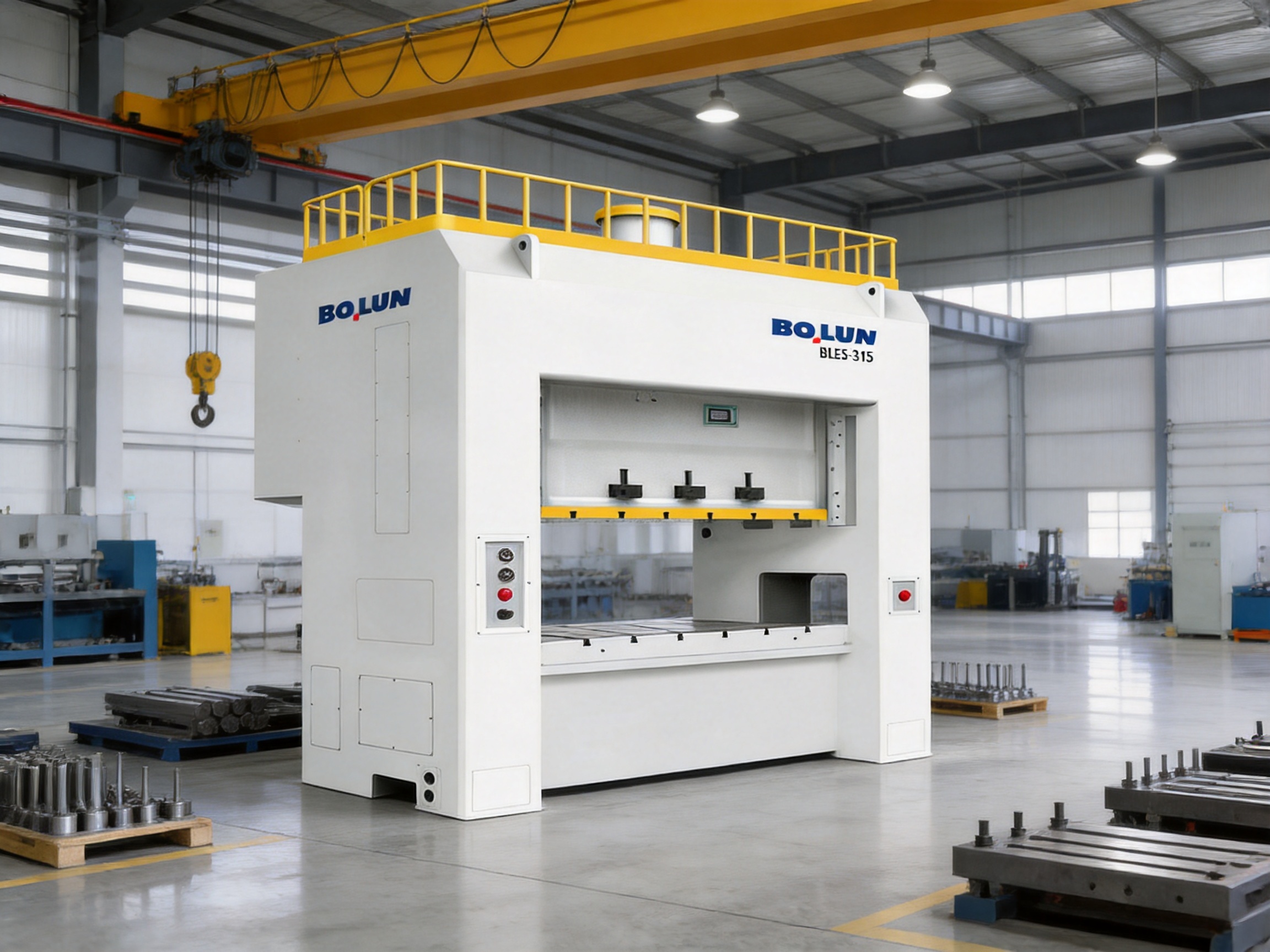
The double-point drive is another key feature that separates this press from simpler single-point machines. A single-point press applies force through one central point, which can be suitable for smaller or centrally loaded parts. However, when dies become wider or forming loads are distributed across a large surface, a single-point drive may be less effective at maintaining slide parallelism.
The BLES-315 uses a double-point configuration to support the slide across a broader span. This improves the press’s ability to handle large worktable areas and wide dies. For parts such as automotive structural panels, appliance shells, reinforcement plates, and large sheet metal components, the double-point drive helps keep the slide movement stable and consistent.
In practical manufacturing, the value of double-point stability appears in multiple ways. First, it improves part consistency by reducing uneven pressure distribution. Second, it helps protect dies because the upper and lower die halves remain more accurately aligned. Third, it reduces the risk of abnormal wear on guiding elements. Fourth, it supports process flexibility by allowing manufacturers to use larger dies and more complex tooling designs.
When comparing presses, buyers often focus on tonnage. However, tonnage alone does not determine forming quality. A 3000 kN single-point machine and a 3000 kN double-point closed-frame machine may perform very differently on large workpieces. The BLES-315 is engineered for applications where load distribution, slide stability, and working area are as important as maximum force.
Servo press technology offers major advantages over traditional mechanical press systems. In a conventional press, slide motion is largely fixed by the mechanical drive geometry. Operators can adjust speed within certain limits, but the stroke profile remains relatively constant. This can be acceptable for simple blanking or shallow forming, but it becomes restrictive when different materials and complex forming processes require different motion characteristics.
The servo-driven nature of the BLES-315 allows more precise control of slide movement. During forming, the slide can be controlled to slow down near the working portion of the stroke, allowing the material to flow more smoothly. This is especially beneficial for deep drawing and forming of high-strength materials, where excessive speed can lead to cracking, tearing, or surface defects. Controlled motion can also improve lubrication performance and reduce shock loading on the die.
Servo control helps optimize energy use. Instead of operating with a fixed motion pattern regardless of the application, the press can be matched more closely to the forming requirement. For heavy-duty forming, this means the available 30,000 J of continuous working energy can be applied in a controlled and process-oriented manner. For manufacturers, this can improve productivity while reducing unnecessary mechanical stress.
Another competitive advantage of servo technology is process versatility. A factory may need to produce different components in different batch sizes. Some parts may require fast approach and slow forming; others may need dwell-like control near the bottom of the stroke; still others may require smoother acceleration and deceleration to protect sensitive tooling. A servo press gives manufacturers more options than a traditional fixed-motion mechanical press.
In global manufacturing, flexibility is increasingly valuable. Product lifecycles are shorter, part designs change faster, and production lines must adapt quickly. A servo power press like the BLES-315 gives manufacturers a platform that can serve multiple product types without requiring a completely different machine for every forming process.
The 30,000 J continuous working energy of the BLES-315 is especially significant for large deformation applications. In metal forming, force and energy are related but not identical. A press may be able to generate a high peak force, but if it lacks sufficient energy through the stroke, it may not perform well in operations requiring sustained deformation. Deep drawing, large-panel forming, and thick-gauge forming often demand both force and energy.
High working energy supports controlled material flow. During deep forming, sheet metal must move from the flange area into the die cavity without tearing or wrinkling. If the forming action is unstable, material may flow too quickly in one area and too slowly in another. The BLES-315’s energy reserve, combined with servo motion control, helps provide a more stable forming condition.
For large appliance panels, energy capacity can influence surface quality. Panels often have broad visible surfaces where defects are unacceptable. Uneven forming can create waviness, distortion, or stress marks. The BLES-315 supports smoother forming, helping manufacturers produce parts that meet both dimensional and appearance requirements.
For automotive structural components, high working energy contributes to the ability to form stronger and thicker materials. Modern vehicles often use high-strength steel and reinforced structures to improve safety and reduce weight. These materials can be more difficult to form than mild steel. A press used in such applications must provide sufficient energy while maintaining precision and die alignment.
The BLES-315 is suitable for a wide range of heavy-duty forming applications. In the automotive industry, it can be used for structural components, reinforcement parts, brackets, chassis-related sheet metal parts, and larger formed panels. Automotive manufacturers and suppliers require repeatability because small dimensional deviations can create assembly problems later in the production chain. The press’s rigidity and servo control help support that requirement.
In the household appliance industry, the machine can be applied to large panels, covers, frames, and formed shells. Appliance parts often require a combination of size, surface quality, and dimensional consistency. Since many appliance panels are visible to end users, surface defects can lead to rejection. Controlled forming and stable slide movement help reduce the risk of these defects.
In general sheet metal fabrication, the BLES-315 is appropriate for thick-gauge forming, large brackets, industrial enclosures, heavy-duty stamped parts, and components used in machinery manufacturing. Its worktable size and die height make it practical for dies that would be too large for smaller presses. The double-point structure is valuable when parts require long or wide tooling.
The press can also support production environments that require frequent die changes or multiple product families. The 120 mm die height adjustment provides setup flexibility, allowing operators to adapt the machine to different tooling conditions. When paired with good production planning, this can reduce downtime and improve equipment utilization.
Industrial presses operate under high force, and safety is a primary concern. The BLES-315 integrates hydraulic overload protection to help protect the press and tooling from excessive load conditions. Overload situations may occur because of incorrect material thickness, misfed blanks, die obstruction, setup errors, or unexpected forming resistance. Without proper protection, overload can damage the press frame, drive system, slide, or die set.
Hydraulic overload protection helps reduce the risk of serious mechanical damage. When overload is detected, the system can respond to protect the machine. This feature is particularly important in high-tonnage presses, where the cost of die or machine damage can be substantial. It also contributes to more stable long-term operation, reducing unplanned downtime.
The machine also includes a safety loss-of-power brake system. In industrial settings, power interruption can create hazardous conditions if the slide cannot be safely controlled. A brake system designed for loss-of-power safety helps improve operator protection and machine reliability. This is especially important in continuous production environments where operators, feeders, transfer systems, and peripheral equipment may work close to the press cycle.
Reliability is not only a matter of individual components. It depends on the design philosophy, manufacturing accuracy, assembly quality, inspection standards, and after-sales support. Zhejiang Bolun emphasizes a finished product inspection system that exceeds common industry expectations, with quality control across processes and components. This approach supports long service life under high-intensity operating conditions.
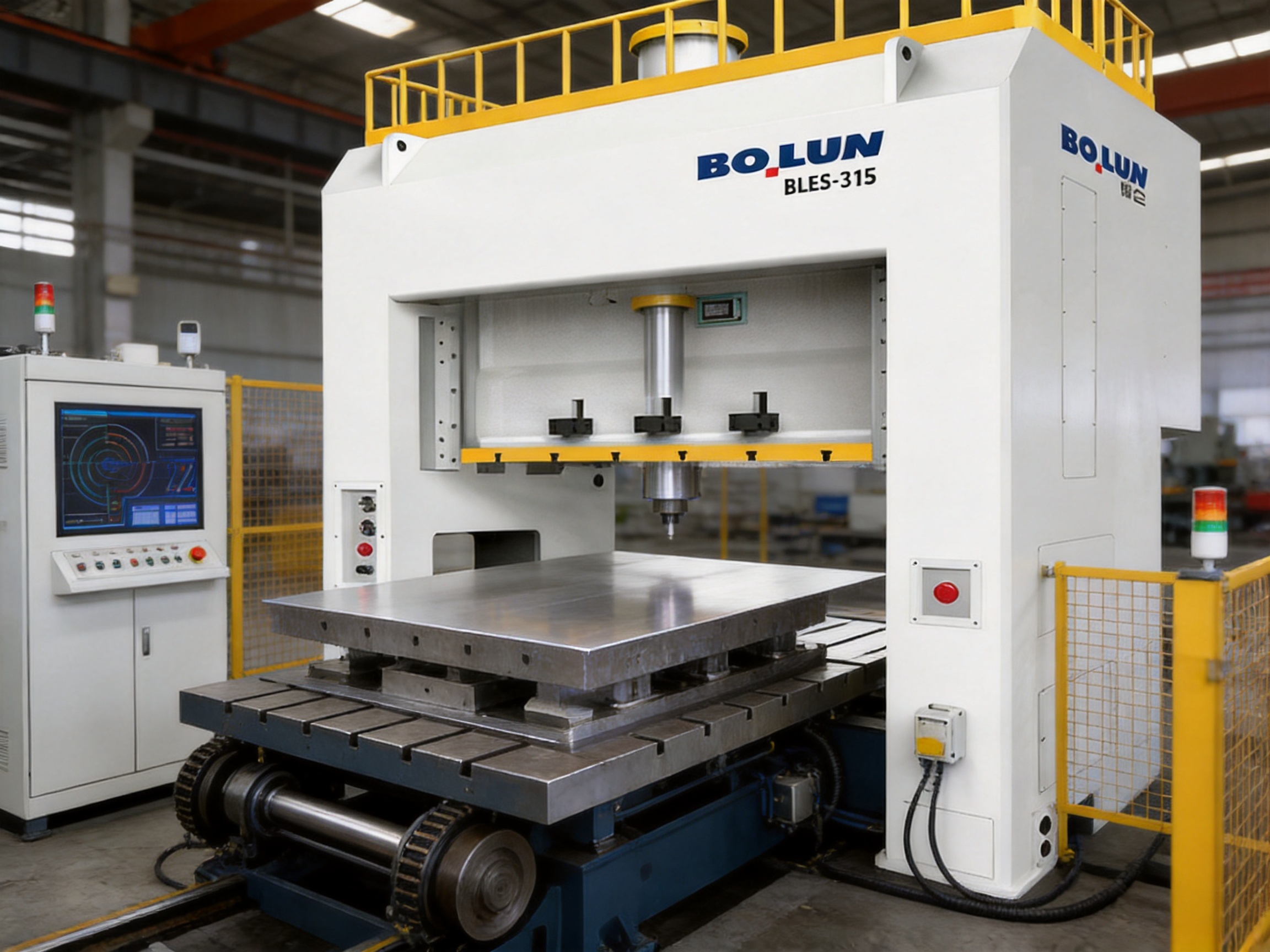
A high-quality press begins long before final assembly. It depends on engineering design, material selection, precision machining, structural welding or fabrication, heat treatment where required, component inspection, assembly alignment, electrical integration, hydraulic system control, and final performance testing. Zhejiang Bolun High-Precision Machinery Co., Ltd. has developed a full-chain production system that supports these requirements.
The company is located in Zhejiang, a region known for precision manufacturing and industrial supply chain strength. This environment provides access to skilled labor, mature machining resources, component suppliers, and engineering knowledge. However, regional advantages alone are not enough. The company has built its competitiveness through two decades of experience in machinery manufacturing, with a focus on high-precision forming equipment.
Research and development are central to the company’s manufacturing process. The design team works on machine structure, drive systems, forming performance, safety functions, and customization options. For customers with special specifications or non-standard production needs, the company provides one-stop design and manufacturing services. This capability is especially important because many stamping operations require presses matched to specific dies, product dimensions, automation layouts, and material requirements.
Precision processing equipment supports the accuracy of key components. In a press, the accuracy of large structural surfaces, guideways, slide surfaces, and mounting interfaces can directly affect performance. Poor machining accuracy can lead to misalignment, uneven wear, vibration, and inconsistent forming. By controlling machining and assembly quality, the company helps ensure that the BLES-315 achieves stable precision in real production.
Assembly is another critical stage. Even well-designed components can fail to perform if they are not assembled with proper alignment and inspection. The BLES-315 requires careful integration of mechanical, hydraulic, pneumatic, electrical, and servo control systems. Each subsystem must work reliably under heavy load. The company’s production management system is designed to support mature and efficient assembly practices.
Quality control in press manufacturing must be systematic. It cannot rely only on final appearance or basic movement testing. A power press is a long-life industrial asset, and its real quality is proven through years of operation. Therefore, inspection must address component accuracy, structural integrity, drive performance, slide alignment, safety response, energy delivery, and forming stability.
Zhejiang Bolun follows a quality-first philosophy. The company performs rigorous quality control on processes and components to ensure stable precision and long service life. For a machine like the BLES-315, this means attention to frame rigidity, slide guidance, worktable flatness, drive synchronization, hydraulic protection, brake performance, and control system stability.
The specification of JIS B 6402 Level 1 punch accuracy indicates that the machine is designed to meet a recognized press accuracy level. Accuracy standards help buyers evaluate whether a press is suitable for precision forming. In practical terms, higher accuracy can improve die life, part repeatability, and downstream assembly quality.
Quality control also contributes to safety. A press that maintains alignment and operates reliably is less likely to create unexpected hazards. Hydraulic overload protection and loss-of-power braking must be tested and integrated correctly. Electrical and control systems must respond predictably. For production managers, this reliability supports both worker safety and production continuity.
The BLES-315 offers several advantages compared with many competing press solutions in the same general tonnage range. First, its closed-frame straight-side structure provides higher rigidity than open-type presses. This makes it more suitable for high-tonnage forming, large dies, and precision applications where deflection control matters.
Second, the double-point drive provides better support for wide slides and large worktables than many single-point presses. This is valuable for large parts and distributed forming loads. Manufacturers using wide dies can benefit from improved slide parallelism and load balance.
Third, servo technology provides greater process flexibility than conventional mechanical drive systems. Instead of being limited to a fixed motion profile, users can adapt slide movement to material behavior and forming requirements. This supports improved part quality, reduced die shock, and broader application coverage.
Fourth, the 30,000 J continuous working energy makes the press suitable for demanding deformation processes. Some competitors may advertise similar tonnage but offer lower energy capacity or less stable energy delivery. For deep forming and thick-gauge applications, working energy is a decisive factor.
Fifth, the machine’s 300 mm stroke and 550 mm maximum die height give it practical versatility for larger tooling. Manufacturers do not purchase a press only for one simple number; they need a complete working envelope. The BLES-315 provides a strong combination of force, energy, stroke, die height, table size, and slide size.
Sixth, integrated hydraulic overload protection and safety braking improve operational reliability. These features help protect the machine, die, and operators in demanding production environments. Safety and protection systems are sometimes treated as secondary features, but in high-tonnage production they are essential to total equipment value.
Seventh, the manufacturer’s customization capability gives customers more than a standard machine. Production lines often require adaptation for automation, feeding equipment, die specifications, plant layout, and process requirements. A manufacturer with non-standard customization experience can provide better long-term value than a supplier offering only fixed configurations.
Automotive structural components demand a combination of strength, dimensional accuracy, and repeatability. Parts may be formed from high-strength steel or other materials that resist deformation. The press used for these components must provide enough capacity and energy while maintaining stable slide guidance.
The BLES-315 is well suited to such requirements because its 3000 kN capacity supports heavy forming loads, while its 30,000 J working energy helps complete large deformation processes. The 300 mm slide stroke and 550 mm maximum die height make it practical for deeper forming operations, which are common in structural components with complex profiles.
Servo control is especially valuable in automotive forming. High-strength materials can be sensitive to forming speed and strain distribution. By controlling slide motion, manufacturers can improve material flow and reduce the likelihood of cracking or springback-related problems. Stable forming also supports better repeatability across batches.
The double-point closed-frame structure supports wide dies used for automotive parts. Structural components may not always be perfectly centered in the die, and forming loads can vary across the part geometry. The BLES-315’s rigid frame and balanced slide support help reduce uneven deformation and improve final part accuracy.
Large appliance panels require smooth surfaces, consistent dimensions, and stable forming quality. Visible panels must avoid wrinkles, dents, stretch marks, and distortion. Because these parts are often broad and relatively thin compared with their size, they can be sensitive to uneven pressure and unstable material flow.
The BLES-315 supports appliance panel production by combining a large worktable with stable forming force. The 2500 mm by 1000 mm worktable allows large dies to be installed, while the 2200 mm by 900 mm slide bottom provides broad upper die support. The double-point drive helps maintain even pressure across the work area.
Servo motion can be adjusted to reduce sudden impact and improve forming smoothness. This can help protect surface quality and reduce scrap. In large-panel production, even a small reduction in rejection rate can generate significant savings because material cost, coating requirements, and downstream handling costs are often high.
For thick-gauge sheet metal components, the press’s high energy and rigid structure are also important. Thick materials require more forming force and can place greater stress on dies and the machine frame. The BLES-315 is designed for these heavier conditions, making it more versatile than lighter-duty presses.
When selecting a power press, manufacturers should evaluate not only purchase price but total ownership value. A lower-cost machine may become expensive if it causes frequent downtime, produces inconsistent parts, damages dies, or cannot adapt to new production requirements. The BLES-315 is designed to provide long-term value through stability, flexibility, safety, and manufacturing quality.
Operational efficiency begins with reliable production. A rigid machine that maintains alignment reduces the need for repeated adjustments. Servo control helps optimize forming conditions and can reduce trial-and-error during process development. Hydraulic overload protection reduces the risk of catastrophic damage, and safety braking improves production confidence.
Die life is another major factor in ownership cost. Dies for large automotive or appliance components can be expensive. Poor press alignment or excessive shock can accelerate die wear. By supporting balanced load distribution and controlled slide motion, the BLES-315 helps protect tooling investment.
Flexibility also affects long-term value. As market demands change, a factory may need to produce new parts or adopt new materials. A servo press with a strong working envelope can be adapted more easily than a conventional press with limited motion control. The BLES-315 gives manufacturers room to develop processes for future applications.
Modern forming plants often use automated feeders, transfer systems, die cushions, lubrication systems, material handling equipment, and digital production monitoring. A press must be compatible with this broader manufacturing environment. The BLES-315’s closed-frame structure, side opening, worktable dimensions, and control capability support integration into advanced production layouts.
The 900 mm by 600 mm side opening supports access for material handling and auxiliary equipment. In automated production, access and layout flexibility can influence cycle time and maintenance efficiency. Large worktable dimensions also support tooling designs that include sensors, guides, and automation interfaces.
Servo control can contribute to automation stability. When slide motion is controlled more precisely, feeding and transfer operations can be synchronized more effectively. This reduces the risk of misfeeds and improves line reliability. For manufacturers pursuing intelligent manufacturing, machine controllability is a key foundation.
Zhejiang Bolun has indicated a strategic direction toward intelligent and digital stamping equipment. This aligns with global trends in manufacturing, where data, automation, and process control are becoming increasingly important. A machine like the BLES-315 can serve as a strong mechanical foundation for more advanced production systems.
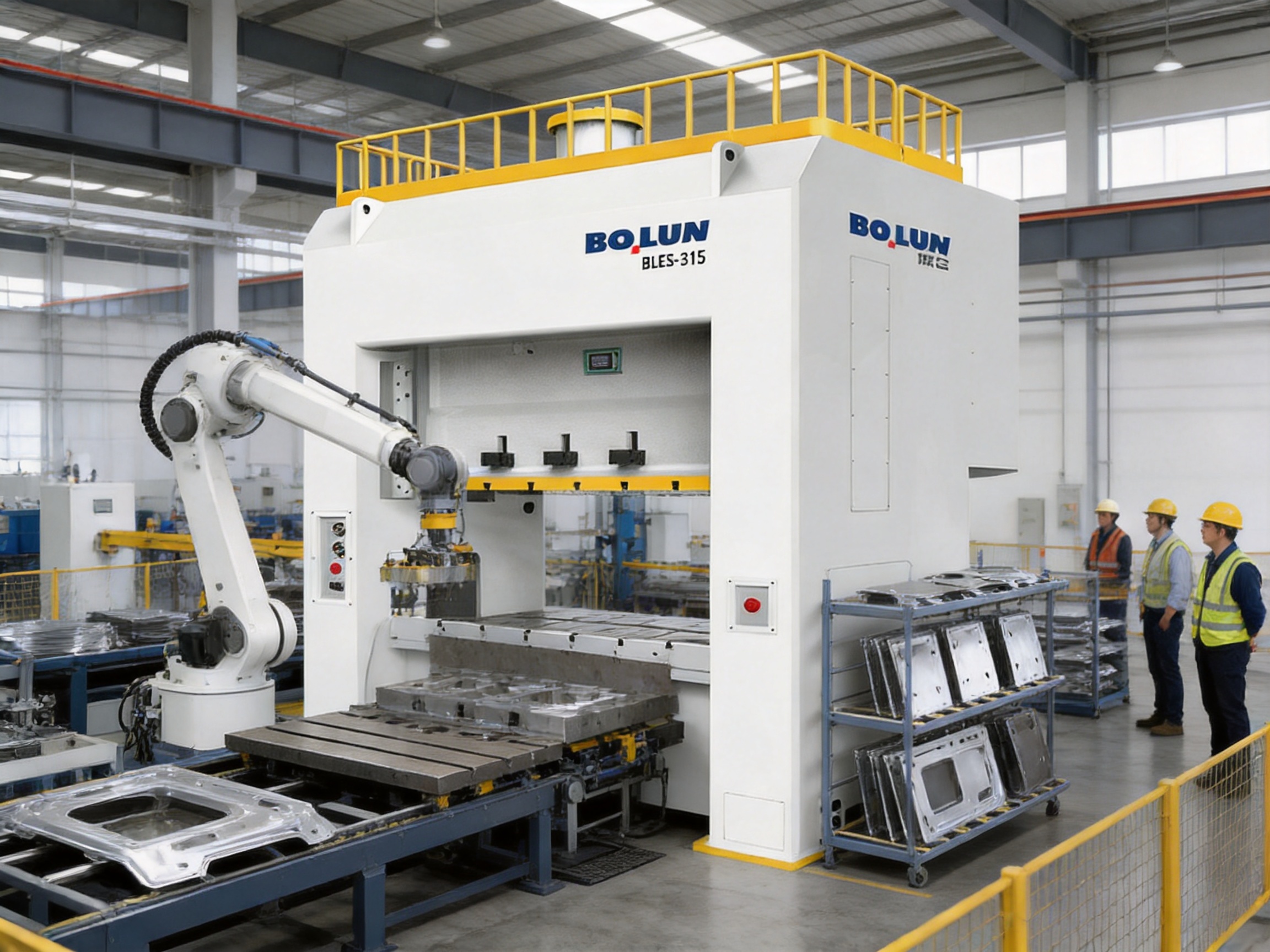
Not every production requirement can be satisfied by a standard machine. Customers may need special worktable dimensions, automation interfaces, control functions, safety configurations, or process-specific adaptations. Zhejiang Bolun’s non-standard customization capability is an important advantage for such cases.
The company’s design team can provide one-stop design and manufacturing services for special specifications and functions. This helps customers avoid the problem of forcing a standard machine into a non-standard production process. Instead, the press can be selected or adapted according to the customer’s actual die, material, part, and production line requirements.
Customization is particularly valuable in industries such as automotive parts, appliances, industrial machinery, and high-precision sheet metal production. In these fields, part geometry and process requirements can vary greatly. A supplier with engineering capability can help evaluate tonnage, energy, stroke, die height, table size, feeding direction, safety needs, and future expansion.
Good engineering support also reduces project risk. A power press is a major investment, and incorrect selection can lead to years of production limitations. By working with a manufacturer that understands forming processes and machine design, customers can make more informed decisions.
Industrial equipment value depends heavily on service. A press must be installed, commissioned, maintained, and sometimes upgraded over its service life. Zhejiang Bolun provides a customer-oriented service system covering pre-sales consultation, in-sales support, and after-sales guarantees. This full-cycle support helps customers move from initial planning to stable production.
Pre-sales consultation helps determine whether the machine is suitable for the customer’s application. This may include analysis of part size, material thickness, die requirements, forming force, energy needs, production speed, and factory layout. Accurate consultation reduces the risk of selecting an underpowered or unsuitable press.
In-sales support helps manage technical communication, manufacturing progress, delivery preparation, and installation planning. For large presses, logistics and installation must be carefully coordinated. The machine foundation, power supply, air supply, safety area, and peripheral equipment must be prepared properly.
After-sales support helps maintain long-term performance. Presses operate under repeated high loads, so regular maintenance and technical assistance are important. A responsive service system can reduce downtime and extend equipment life. For global customers, communication capability and technical documentation are also important factors.
The strongest industrial machines are not defined by one impressive specification alone. They are defined by balance. The BLES-315 provides a balanced combination of force, energy, rigidity, slide stroke, die height, table size, servo control, safety protection, and manufacturing quality. This balance makes it a practical solution for manufacturers who need dependable heavy-duty precision forming.
A press with high tonnage but poor rigidity may produce inaccurate parts. A press with rigidity but limited stroke may not support deep forming. A press with large dimensions but insufficient energy may struggle with thick materials. A press with mechanical strength but limited control may be unable to optimize forming for modern materials. The BLES-315 addresses these challenges through integrated design.
For companies comparing equipment options, the machine offers clear competitive strengths: closed-frame stability, double-point slide support, servo flexibility, strong working energy, deep forming capacity, large die accommodation, safety systems, and manufacturer-backed engineering support. These features make it suitable for demanding industrial environments where productivity and quality must be maintained over time.
The BLES-315 is a closed-frame double-point servo power press. It is designed for heavy-duty precision forming, large sheet metal components, deep forming processes, automotive structural parts, appliance panels, and thick-gauge forming applications.
The machine has a nominal capacity of 3000 kN. This high capacity supports demanding forming operations that require significant pressing force.
The closed-frame structure provides high rigidity and stable load distribution. Compared with open-type presses, it reduces frame deflection and helps maintain better alignment between the slide and worktable, improving part accuracy and die life.
A double-point drive supports a wider slide and helps distribute force more evenly across large dies. This is especially useful for large panels, long parts, and applications where forming loads are spread across a broad area.
Servo technology allows better control of slide motion. The slide can move quickly during approach, slow down during forming, and operate with a motion profile suited to the material and die. This improves material flow, reduces shock, and can lower the risk of cracking, wrinkling, or surface defects.
The BLES-315 provides 30,000 J of continuous working energy. This energy level supports large deformation processes, deep drawing, and thick-gauge sheet metal forming.
The machine has a 300 mm slide stroke and a maximum die height of 550 mm. These dimensions make it suitable for deeper forming operations and larger die sets.
The press is suitable for automotive manufacturing, appliance production, machinery manufacturing, industrial sheet metal fabrication, and other sectors requiring large, precise, and heavy-duty formed components.
The BLES-315 integrates hydraulic overload protection. This helps protect the press and die from excessive loads caused by misfeeds, material variation, setup errors, or unexpected forming resistance.
A high-quality press depends on design, machining, assembly, inspection, and service. Zhejiang Bolun High-Precision Machinery Co., Ltd. provides integrated manufacturing, non-standard customization, quality control, and customer support, helping customers obtain a machine matched to real production needs.
The BLES-315 closed-frame double-point servo power press is engineered for manufacturers that require more than basic stamping force. It provides 3000 kN nominal capacity, 30,000 J continuous working energy, a 300 mm slide stroke, a 550 mm maximum die height, a large worktable, double-point slide support, servo motion control, hydraulic overload protection, and a safety loss-of-power brake system. These features combine to support heavy-duty forming, deep drawing, large-panel production, and precision applications.
Its competitive advantage lies in the integration of structure and control. The closed-frame straight-side body provides rigidity, the double-point mechanism supports wide dies, and servo technology gives process flexibility. Together, these characteristics help improve forming quality, protect dies, reduce production risk, and expand application possibilities.
Behind the machine is Zhejiang Bolun High-Precision Machinery Co., Ltd., a manufacturer with two decades of machinery industry experience, advanced precision processing capability, a full-chain production system, non-standard customization strength, and a quality-focused inspection philosophy. For factories seeking a reliable heavy-duty press for modern forming applications, the BLES-315 represents a strong and balanced investment in productivity, precision, and long-term manufacturing value.
Japanese Industrial Standards Committee. JIS B 6402: Mechanical Presses Accuracy Standards.
Altan, T., and Tekkaya, A. E. Sheet Metal Forming: Processes and Applications. ASM International.
Schuler GmbH. Metal Forming Handbook. Springer.
Boljanovic, V. Sheet Metal Forming Processes and Die Design. Industrial Press.
Kalpakjian, S., and Schmid, S. Manufacturing Engineering and Technology. Pearson.
Society of Manufacturing Engineers. Fundamentals of Tool Design.


What Is a Power Press? A power press — also called a stamping press or punch pr...
In the fields of metal forming, sheet metal fabrication, blanking, and punching,...
As the manufacturing industry moves steadily toward automation and smart product...
In modern manufacturing, cold forging is widely used in the automotive, aerospac...
Manufacturing & Metalworking A direct, practical look at how mechanical pre...
Power Press Technology Overview: From Fundamentals to Equipment Selection In the...
Contact Us

bolunpress@gmail.com

+86-575-83362228

+86-15158259588

+86-575-83362999

+86-15158259588

Hangzhou Office Add: No. 332 Wangjiang East Road, Shangcheng District

No.1 Linjiang Road East, Xiaren, Jinting Town, Shengzhou City, Zhejiang Province, China
Ready to Begin?
Get in Touch

Now!

ZHEJIANG BOLUN
 English
 中文简体
中文简体