
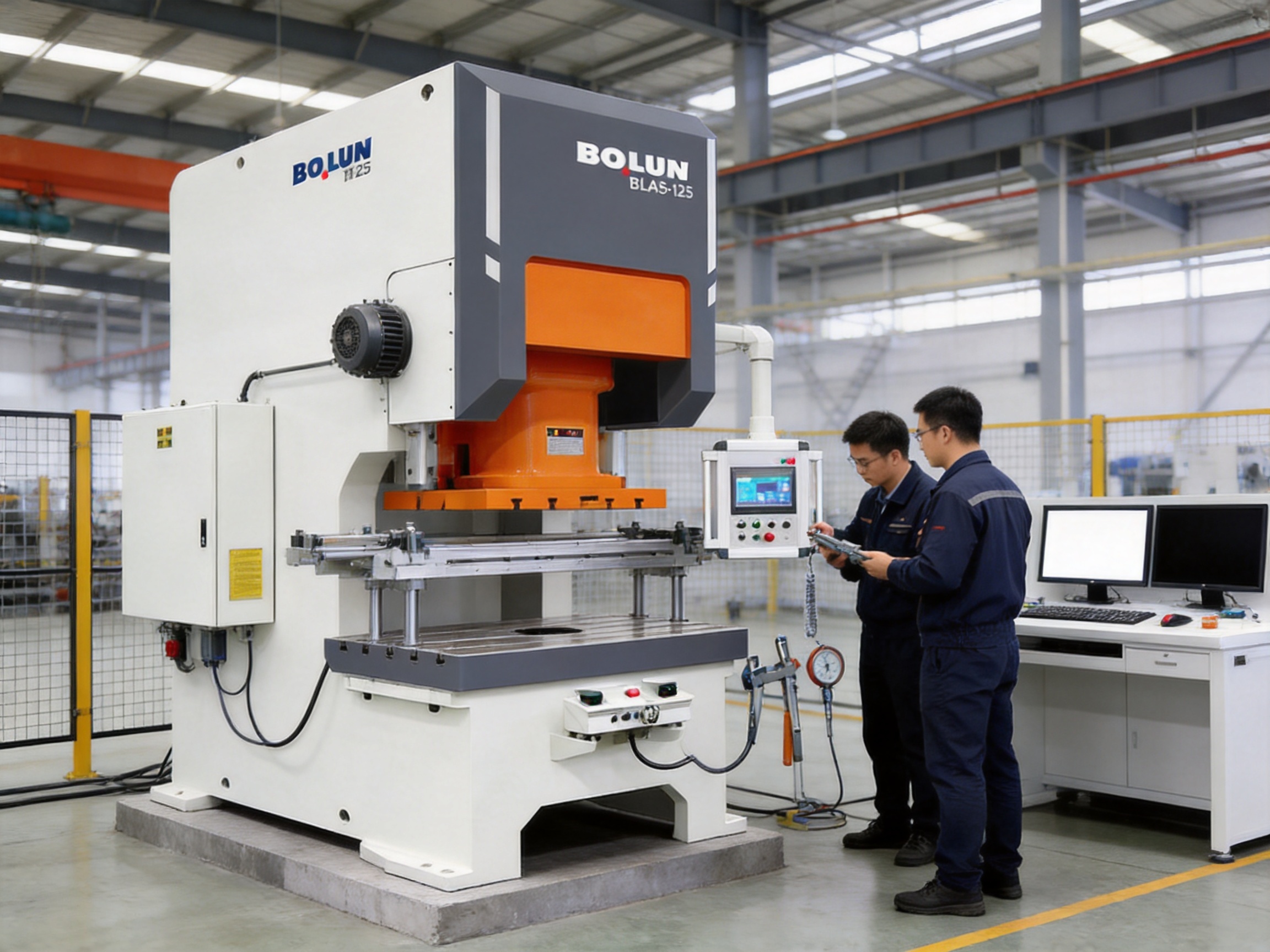
Modern metal forming manufacturers require equipment that combines high pressing force, accurate motion control, dependable safety, and efficient production. The BLAS-125 deep-drawing open-type single-point servo power press is designed to address these requirements in demanding stamping, drawing, stretching, blanking, bending, and forming operations. With a nominal capacity of 1,250 kN, an extended slide stroke of 180 mm, and a throat depth of 350 mm, it provides a balanced combination of force, working space, controllability, and production flexibility.
Unlike a conventional mechanical press that operates with a comparatively fixed motion profile, a servo-driven press can be managed with greater precision throughout the forming cycle. The high-torque direct-drive motor supports controlled slide movement and helps maintain stable forming conditions. This is particularly valuable in deep-drawing applications, where material flow, forming speed, dwell behavior, and return movement can influence surface quality, dimensional consistency, tool life, and the risk of cracks or wrinkles.
The open-type construction provides convenient access to the die area from multiple directions. This arrangement is suitable for manual loading, unloading, transfer systems, robotic handling, and integration with auxiliary production equipment. At the same time, the machine incorporates protective systems intended for high-intensity industrial operation, including a safety loss-of-power brake and a hydraulic overload protector.
This article examines the construction, performance, applications, technical specifications, manufacturing strengths, quality systems, and operating advantages of this deep-drawing servo power press. It also explains how the equipment can support manufacturers seeking a more productive and controllable alternative to traditional stamping machinery.
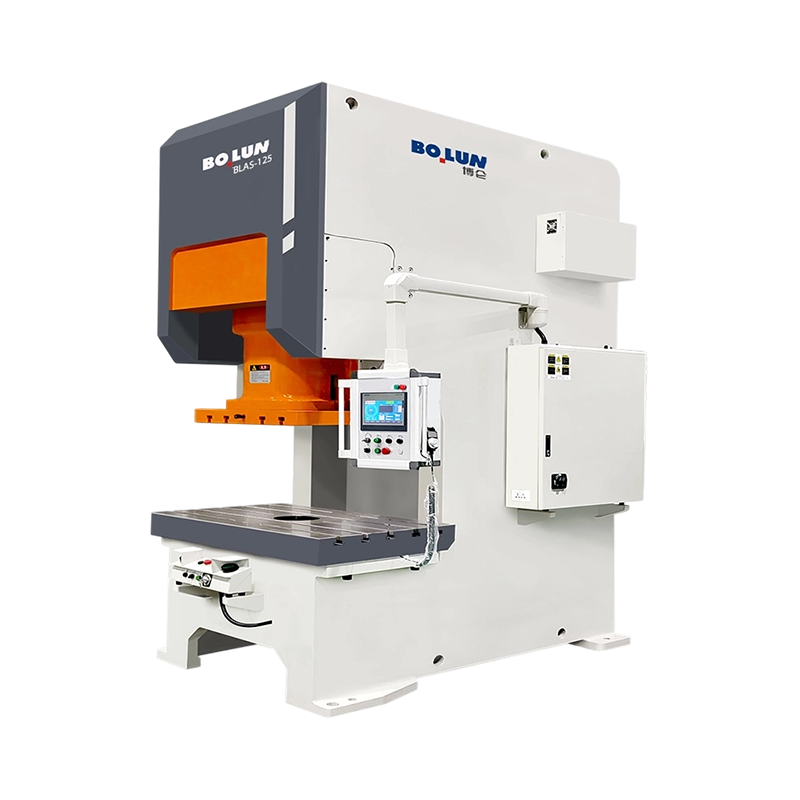
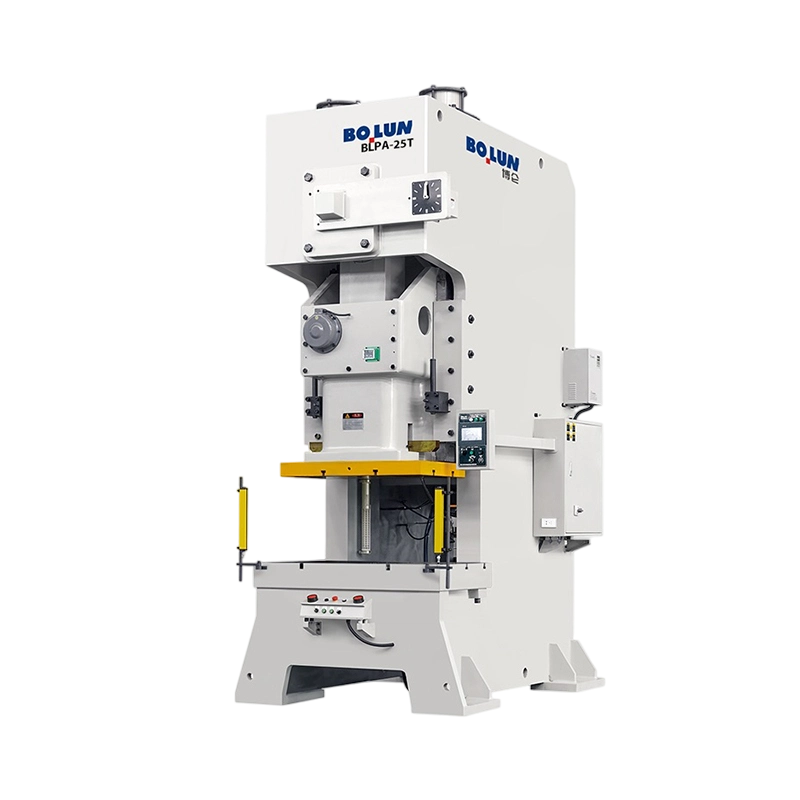
BLAS-125 Deep Drawing Open-Type Single-Point Servo Power Press
The BLAS-125 is an open-type single-point servo power press developed for industrial forming work that demands substantial force and a relatively long slide movement. Its 1,250 kN nominal capacity allows it to process a broad range of metal components, while the 180 mm slide stroke creates sufficient vertical travel for deeper forming operations than many short-stroke stamping presses.
The machine is categorized as an open-type single-point servo power press because the slide is driven through a single central point and the front of the working area remains open. This configuration provides a practical balance between structural strength and operator accessibility. It is appropriate for production environments where dies must be changed regularly, workpieces need to be positioned from the front, or material handling equipment must access the tool area.
Its 350 mm throat depth is an important feature for users working with larger blanks, wider dies, or components requiring greater clearance between the front of the frame and the working line. A deeper throat can make die installation more convenient and expand the range of parts that can be formed without requiring a larger press frame.
The press is also equipped with a worktable measuring 1,150 mm by 680 mm, with a listed table thickness of 120 mm. The slide bottom measures 650 mm by 520 mm, with a listed thickness of 80 mm. These dimensions provide a substantial tool-mounting platform for medium- and large-size dies. The distance between columns is 660 mm, supporting practical access to the die space while contributing to the open-front operating concept.
The most important performance characteristics of the BLAS-125 include its 1,250 kN nominal capacity, 180 mm slide stroke, approximately 65 strokes per minute, 350 mm maximum die height, 90 mm die-height adjustment range, and 350 mm throat depth. Together, these specifications define a press suitable for both forming depth and production throughput.
The approximately 65 strokes-per-minute rating gives manufacturers a useful production speed for repetitive stamping work. In actual operation, the best speed depends on the material, die design, drawing depth, lubrication, blank-holder settings, part geometry, and required forming quality. Servo control allows the motion profile to be adapted to the process rather than forcing every application to use an identical mechanical cycle.
The maximum die height is listed as 350 mm, while the die-height adjustment range is 90 mm. This adjustment capability helps users accommodate tooling with different shut heights and fine-tune the working position during setup. A properly adjusted die height improves forming consistency, reduces unnecessary machine movement, and supports efficient tool changeover.
Deep drawing is more sensitive to motion behavior than many basic blanking or piercing operations. During drawing, the sheet must flow from the flange area into the die cavity while avoiding excessive thinning, tearing, wrinkling, galling, or uneven deformation. The motion of the slide influences the rate at which the material enters the die, the pressure applied to the blank holder, and the time available for the material to redistribute.
The BLAS-125 uses a high-torque direct-drive servo motor to deliver controlled slide motion. Direct drive reduces the need for multiple mechanical transmission stages between the motor and the forming motion. This can support responsive control, accurate positioning, and a more adaptable operating profile. The high torque available from the drive is especially useful when the press must maintain forming force through demanding portions of the stroke.
A servo press can be programmed or adjusted to perform different sections of the cycle at different speeds. For example, the slide may approach the material quickly, slow down during initial contact, move at a controlled speed during drawing, dwell briefly at the bottom position, and return efficiently after forming. The exact motion profile depends on the production process, but the principle is consistent: the press can be matched more closely to the behavior of the material and the tooling.
Uniform material flow is one of the principal advantages of servo-controlled forming. If the slide moves too quickly during a sensitive portion of the drawing cycle, the material may experience excessive strain or unstable flow. If the movement is too slow in an unsuitable region, productivity may decline without producing a corresponding quality benefit. Servo motion gives the operator and process engineer greater ability to find an effective balance.
Controlled motion can also help reduce variation between production cycles. When the slide follows a repeatable electronic motion profile, the forming conditions can remain more consistent across batches. This is beneficial for components with strict dimensional requirements, visible surfaces, or multiple forming stages.
Deep-drawing operations may benefit from a controlled dwell at or near the bottom of the stroke. A dwell can allow material stresses to stabilize, support improved shape retention, or give the tooling time to complete a forming action. The usefulness of dwell depends on the part and die design, but a servo press is generally better suited to this type of controlled cycle behavior than a conventional fixed-motion press.
Controlled acceleration and deceleration can also reduce sudden mechanical shocks. Smoother motion may help protect dies, reduce vibration, and improve the working environment around the machine. It can be especially valuable when forming high-strength steels, stainless steels, aluminum alloys, or other materials that respond differently to changes in forming speed.
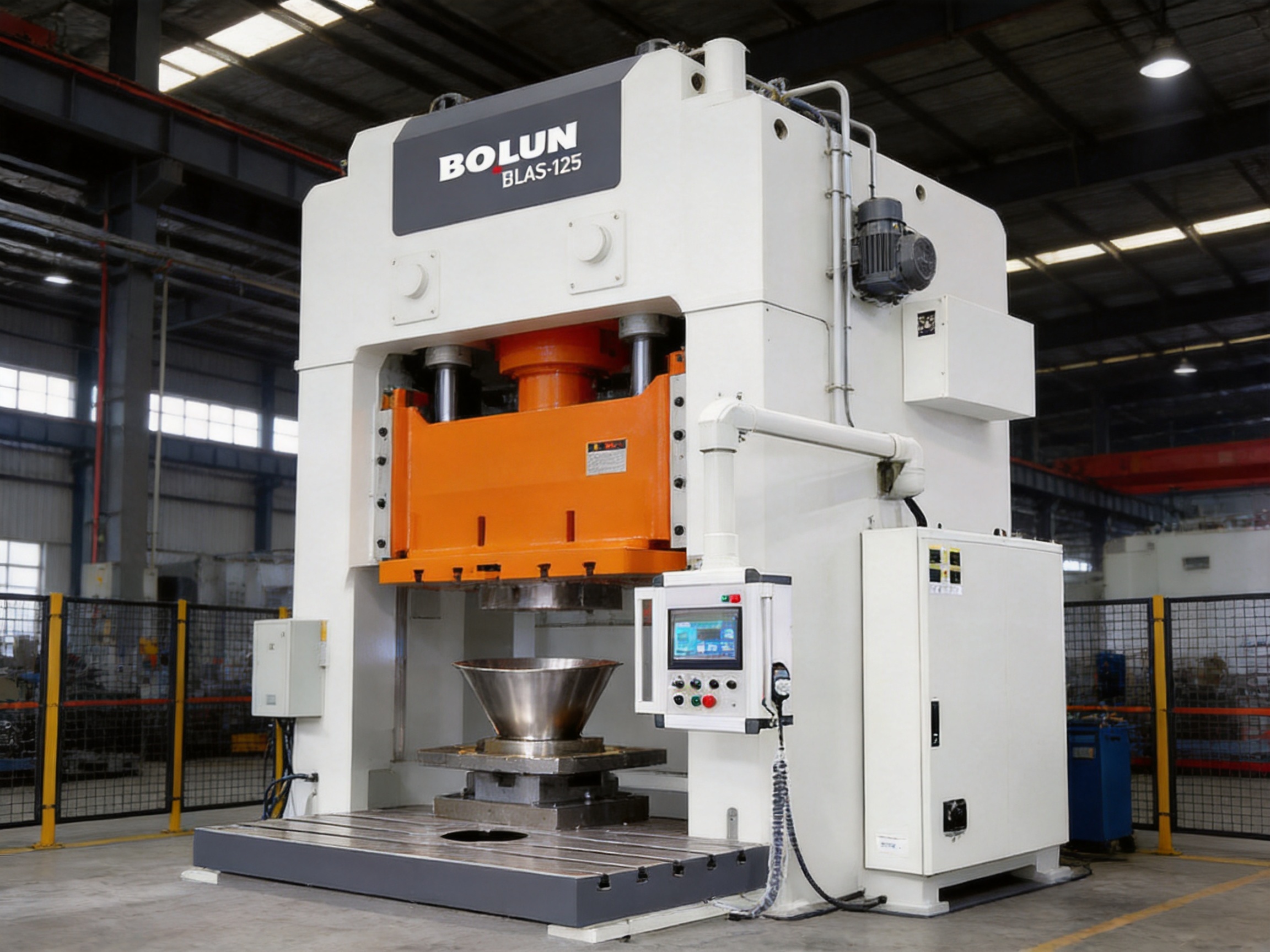
The open-type frame is designed to provide practical access while supporting the required forming force. The 350 mm throat depth gives the BLAS-125 additional reach into the frame, which is useful when processing larger workpieces or installing tools that require more clearance. A larger throat area can also simplify operator visibility during setup and inspection.
The 1,150 mm by 680 mm worktable provides a stable foundation for dies, support plates, and auxiliary tooling. The listed table thickness of 120 mm contributes to rigidity at the working surface. A rigid table helps limit unwanted deflection under load, which is important for maintaining tool alignment and part accuracy.
The slide bottom size of 650 mm by 520 mm offers a compatible mounting area for a wide range of forming dies. The shank hole diameter is listed as 50 mm, allowing suitable tooling to be installed according to the machine’s mounting arrangement. Before purchasing or installing a die, users should verify the complete interface requirements, including die height, shank dimensions, mounting holes, guide arrangements, press capacity, and allowable load distribution.
Die-height adjustment is an essential function in a multi-product stamping environment. Different dies may have different shut heights, cushion requirements, and forming positions. The BLAS-125 provides a 90 mm die-height adjustment range and uses a 0.75 kW die-height adjuster for setup changes.
Accurate adjustment helps ensure that the slide reaches the intended lower position without excessive interference between the upper and lower die components. It also supports repeatable setup when a tool is removed and later reinstalled. For manufacturers operating several product families, this flexibility can reduce setup time and make the machine more adaptable.
The listed height of the working face is 845 mm. This dimension places the working area at a practical level for many loading, unloading, inspection, and die-maintenance activities. Actual ergonomic suitability depends on the operator’s position, the workpiece size, the material-handling system, and the factory layout.
Because the front of the press is open, the machine can be used with manual handling or automated systems. A manufacturer may configure the press with conveyors, feeders, transfer mechanisms, robots, or custom loading devices. The open-front layout can simplify the integration of these systems, although the final design must always preserve the required guarding and safety distances.
The following table summarizes the principal specifications provided for the BLAS-125 model. These values should be reviewed with the supplier during technical clarification, especially when preparing a customized machine, selecting tooling, or planning an automated line.
| Parameter | Unit | BLAS-125 Value |
|---|---|---|
| Nominal capacity | kN | 1,250 |
| Nominal stroke rating | mm | 5 |
| Continuous work energy | J | 6,000 |
| Slide stroke | mm | 180 |
| Strokes per minute | S.P.M. | Approximately 65 |
| Maximum die height | mm | 350 |
| Die-height adjustment | mm | 90 |
| Throat depth | mm | 350 |
| Worktable size | mm | 1,150 × 680 × 120 |
| Slide bottom size | mm | 650 × 520 × 80 |
| Distance between columns | mm | 660 |
| Height of working face | mm | 845 |
| Shank hole diameter | mm | 50 |
| Die-height adjustment motor | kW | 0.75 |
| Cushion capacity | kN | 63 |
| Cushion working stroke | mm | 80 |
| Effective cushion area | mm² | 490 × 350 |
| Punch accuracy | / | JIS B 6402 Level 1 |
| Air pressure | MPa | 0.55 |
The nominal capacity indicates the maximum rated pressing force under the applicable machine conditions. It should not be interpreted as permission to apply maximum force indiscriminately at every position of the stroke. The actual allowable force depends on the force-distance characteristics of the press, the die, the material, and the forming process. Engineering verification is necessary for each application.
The BLAS-125 is listed with a cushion capacity of 63 kN, an 80 mm cushion working stroke, and an effective cushion area of 490 mm by 350 mm. A cushion system is particularly important in drawing operations because it can support the blank holder or perform a controlled counterforce function beneath the workpiece.
During deep drawing, the cushion helps manage the flange area as the punch moves into the die. Appropriate cushion force can prevent excessive wrinkling while still allowing the material to flow into the cavity. If the force is too high, the sheet may be restricted excessively and tear. If the force is too low, the flange may wrinkle or lose dimensional stability. The available cushion capacity gives process engineers an important control parameter.
The cushion area also affects how force is distributed beneath the tooling. A broad effective area can provide more uniform support when the die design is compatible with the available cushion arrangement. Correct setup should consider cushion pressure, tool stiffness, blank-holder design, lubrication, material thickness, and the geometry of the formed part.
A properly adjusted cushion can improve flange control, reduce wrinkles, support more consistent wall formation, and improve repeatability between cycles. When combined with servo slide control, the cushion creates an opportunity to coordinate upper and lower forming actions more precisely.
This coordinated approach can be advantageous for components with nonuniform shapes, changes in draw depth, or demanding appearance requirements. It may also reduce the need for excessive corrective operations after forming, although the final result depends on the complete die and process design.
The BLAS-125 is suitable for applications where a substantial forming force and extended stroke are required. Typical applications may include deep-drawn metal housings, appliance components, automotive and transportation parts, electrical enclosures, lighting components, cookware, hardware, and general industrial sheet-metal products.
The exact suitability of the press depends on the material grade, blank size, thickness, draw ratio, number of operations, die design, required dimensional tolerances, and production volume. A technical review should be completed before selecting the press for a new component.
Deep drawing is the primary application highlighted for this model. The combination of a 180 mm slide stroke, 350 mm throat depth, 63 kN cushion capacity, and servo-controlled motion provides a practical foundation for drawing and stretching operations. The operator can focus on controlling material flow rather than relying solely on a fixed-speed mechanical cycle.
Stretching and shaping operations often require smooth motion and stable force application. The high-torque drive can support demanding portions of the stroke, while the open work area makes it easier to install specialized tooling. Components that require gradual deformation or controlled contact may benefit from a programmable servo motion profile.
Although the machine is particularly well suited to drawing, it can also be used for blanking and piercing when the die, material, and operating conditions are within the rated limits. For high-speed blanking, the selected cycle speed should consider shock, vibration, die life, scrap removal, and the energy required by the operation.
The press can support bending and forming operations that require a stable slide position and sufficient working space. Servo control can be useful when a part requires a controlled approach, a forming dwell, or a precisely repeated return position.
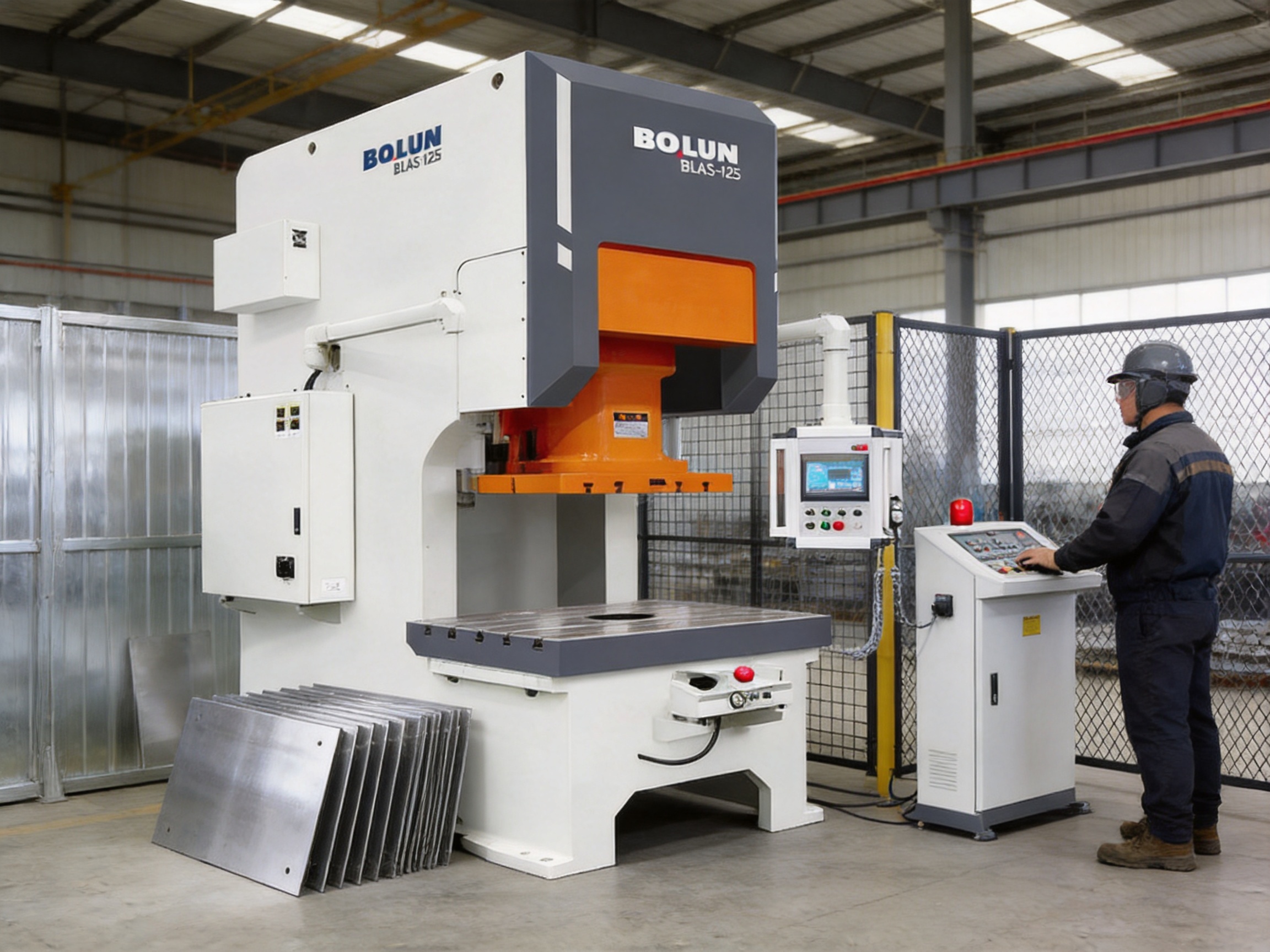
Traditional mechanical presses remain valuable for many applications, especially high-volume operations based on simple and repeatable die actions. However, a servo press can offer several advantages when the process requires flexible motion, improved forming control, or rapid product changeover.
A conventional crank-driven press generally follows a fixed mechanical relationship between the motor rotation and slide position. Its speed changes according to the crank angle, but the operator has limited ability to define an entirely different motion profile. Servo technology allows the slide movement to be tailored more closely to the forming requirements.
For deep drawing, this flexibility can support slower movement through the critical forming zone and faster movement during non-forming portions of the cycle. Such a profile may improve material flow and reduce unnecessary time spent away from the working area.
Manufacturers increasingly produce more product variations in smaller batches. A press that can adapt its movement to different materials and dies can be more useful than a machine optimized for only one fixed operation. The BLAS-125 can support process adjustment through its servo-driven operating concept, enabling users to refine speed, position, and cycle behavior for different products.
Controlled acceleration and deceleration can reduce abrupt motion changes. Lower shock may help reduce vibration transmitted to the frame, die, and surrounding equipment. It can also contribute to a quieter and more stable working environment, although actual noise and vibration depend on the tooling, material, foundation, speed, and operating method.
A smoother, more controlled forming cycle can reduce unnecessary impact on tooling. When the die experiences less shock and more stable loading, the potential for premature wear may be reduced. Tool life is influenced by many factors, including die material, surface treatment, lubrication, alignment, maintenance, and material cleanliness, but press motion is an important part of the overall system.
Complex parts may require different speeds at different stages of the stroke. A servo press can be more suitable for these operations because the motion can be configured around the part’s deformation behavior. This can help manufacturers pursue more challenging geometries without immediately resorting to multiple additional forming machines.
Safety is an essential consideration for every power press installation. The BLAS-125 includes a safety loss-of-power brake and a hydraulic overload protector, two important systems for protecting personnel, tooling, and the machine during abnormal conditions.
A loss-of-power brake is intended to help stop or hold the slide when electrical power is interrupted. This is important because an uncontrolled slide movement can create serious hazards during operation, inspection, or maintenance. The brake should be incorporated into a complete safety system that includes guarding, control interlocks, emergency stops, safe setup procedures, and regular inspection.
Users must follow the supplier’s instructions for brake testing and maintenance. A brake is a protective device, not a substitute for lockout and isolation procedures. During maintenance, the machine should be disconnected, isolated, and secured according to applicable workplace safety requirements.
The hydraulic overload protector helps protect the press and tooling if the forming load exceeds the permitted level. Excessive load can result from incorrect die height, improper material placement, double-sheet feeding, insufficient clearance, material variation, or a tooling malfunction.
By providing overload protection, the system can help limit damage to critical machine and die components. The protector must be correctly adjusted and maintained. Operators should never bypass, disable, or improperly reset overload protection in order to continue production.
Safe operation also depends on appropriate guarding, two-hand controls or other approved initiation systems, emergency stop functions, die-area access control, electrical safety, operator training, and regular inspection. The final guarding and control arrangement should comply with the regulations applicable at the installation site.
The product information lists punch accuracy as JIS B 6402 Level 1. This indicates that the machine is designed with a precision-oriented standard for press performance. Actual production accuracy depends not only on the press, but also on die quality, alignment, material properties, lubrication, temperature, foundation stability, and operator setup.
Precision begins with frame rigidity and continues through the slide guidance, drive system, table, die mounting, and control system. A rigid structure helps keep the upper and lower tool components aligned under load. Accurate guidance reduces unwanted lateral movement. A stable drive system supports repeatable slide positioning and consistent cycle behavior.
For customers producing appearance-critical or dimensionally demanding components, repeatability is often as important as nominal force. Consistent slide movement, stable cushion behavior, reliable die-height adjustment, and regular preventive maintenance all contribute to a more repeatable production process.
Manufacturers should establish inspection procedures for the incoming material, first-off parts, process samples, and finished products. Important checks may include wall thickness, flange condition, wrinkles, cracks, surface marks, dimensional accuracy, hole position, springback, and burr formation.
Process data can also be used to identify changes before they become major quality problems. Variations in load, slide position, cushion pressure, lubrication, or cycle time may indicate die wear, material inconsistency, or machine adjustment problems. A disciplined monitoring system can improve the long-term value of the press.
The manufacturer behind this equipment integrates research and development, design, production, sales, and service. Its stated manufacturing approach is based on long-term experience in machinery production, precision processing capability, non-standard customization, and a full-chain production system.
For a high-force forming machine, the quality of the final product depends on much more than assembly. The frame must be designed for the intended load. Critical components must be manufactured within suitable tolerances. Drive, control, lubrication, safety, and hydraulic systems must be integrated correctly. Final testing must confirm that the machine performs as intended before shipment.
An integrated engineering organization can coordinate structural design, mechanical transmission, servo control, hydraulic protection, electrical systems, and customer-specific requirements. This is valuable when the press must be adapted to a particular die, material, automation line, or factory layout.
The manufacturer’s stated ability to provide non-standard design and manufacturing services can support customers with special specifications or functions. Examples may include customized table arrangements, automation interfaces, safety configurations, die cushions, electrical standards, control languages, or production-line integration. Each custom feature should be reviewed through a formal technical specification before manufacture.
Precision processing equipment supports the production of frame components, machined interfaces, guide elements, mounting surfaces, and other parts that influence machine accuracy. Stable machining practices help reduce variation between components and improve the consistency of final assembly.
Component quality control is equally important. Bearings, motors, hydraulic parts, electrical controls, sensors, brakes, and fasteners must be selected and inspected according to the design requirements. A well-organized supplier qualification and incoming inspection process helps protect the reliability of the completed machine.
A full-chain production system can cover basic design, core component development, fabrication, machining, assembly, testing, packaging, and delivery. This type of management improves traceability and gives the manufacturer greater control over key stages of production.
When design and production teams work closely together, engineering changes can be evaluated more efficiently. Manufacturing feedback can be incorporated into future designs, while production data can help identify areas for improvement in assembly, inspection, and serviceability.
The following process represents the major stages required to build a precision servo power press. The exact procedures and inspection records should be confirmed with the manufacturer for a specific order.
Production begins with a review of the required capacity, stroke, die dimensions, material, cycle rate, automation method, electrical standard, safety requirements, and factory conditions. This stage ensures that the selected press is properly matched to the customer’s application.
The frame, worktable, slide, columns, throat area, and other load-bearing components are designed around the rated force and operating conditions. Structural analysis and engineering calculations can be used to evaluate stiffness, stress distribution, deflection, and the suitability of critical interfaces.
Steel and other structural materials are prepared, cut, welded, and stress-relieved according to the production process. Proper fabrication practice is important because residual stress and distortion can influence later machining and final alignment.
Key surfaces are machined to provide accurate interfaces for the table, slide guides, drive components, die mounting, and related systems. The quality of these surfaces contributes to alignment, repeatability, and long-term service performance.
Mechanical, electrical, servo, hydraulic, lubrication, and safety components are installed in a controlled sequence. Assembly technicians must verify clearances, torque values, cable routing, hydraulic connections, lubrication paths, and sensor positions.
The servo drive and control system are configured to coordinate slide movement, positioning, speed control, braking, overload protection, emergency functions, and operator commands. The control interface should be reviewed for usability and compatibility with the customer’s production process.
The machine is operated without forming material to verify basic movement, abnormal noise, vibration, lubrication, positioning, brake operation, and control response. No-load testing provides an opportunity to correct problems before force is applied.
Load testing and accuracy checks evaluate machine behavior under specified operating conditions. The testing program may include slide alignment, repeat positioning, die-height adjustment, cushion operation, overload protection, and compliance with the applicable precision standard.
Before shipment, the press should undergo final inspection covering appearance, safety devices, electrical systems, hydraulic systems, accessories, spare parts, labels, manuals, and test records. Clear documentation supports installation, commissioning, training, and future maintenance.
Servo technology can provide energy advantages in applications where the motor does not need to operate at a constant high output throughout the entire cycle. The drive can respond to the actual movement and forming requirements, potentially reducing energy consumption during portions of the cycle that require less power.
Energy performance depends on the forming process, programmed motion, duty cycle, material, speed, and production schedule. A deep-drawing operation that uses a controlled speed profile may also reduce rejected parts, die damage, and rework. These indirect efficiency benefits can be as important as direct electrical savings.
Production efficiency is also influenced by setup time. The open front, die-height adjustment, accessible table, and adaptable motion profile can help manufacturers handle multiple products. Faster and more repeatable changeovers may improve equipment utilization, particularly in flexible manufacturing environments.
Before installation, the customer should confirm foundation requirements, machine weight, floor loading, working clearances, electrical supply, compressed air, hydraulic service requirements, ventilation, lighting, material flow, and safety-zone layout. The listed air pressure for the machine is 0.55 MPa, but the complete air supply specification should be confirmed before commissioning.
The press should be leveled carefully and installed on a suitable foundation. Poor leveling can affect alignment, vibration, die performance, and long-term machine stability. The surrounding area should provide sufficient space for die handling, maintenance access, product movement, and safe operator circulation.
Commissioning should include a structured inspection of all mechanical and electrical connections. The operator should be trained in startup, shutdown, setup, manual movement, automatic operation, emergency procedures, die change, lubrication, overload response, and basic troubleshooting.
When installing a die, users should verify that its shut height, weight, dimensions, center of load, shank, mounting holes, guide system, and cushion requirements are compatible with the press. The die should be positioned centrally and secured using approved hardware.
The first trial should be conducted at a cautious speed with appropriate inspection intervals. The operator should confirm that the slide, die, cushion, material, and ejection system work together without interference. Production speed can then be increased gradually after the process has been validated.
Regular maintenance is essential for preserving precision, safety, and production availability. Maintenance schedules should cover lubrication, slide guides, drive components, hydraulic systems, brake function, electrical cabinets, sensors, fasteners, cushion components, and safety devices.
Lubrication must be applied according to the manufacturer’s specified type, quantity, and interval. Too little lubrication can increase wear and heat, while excessive or unsuitable lubricant can contaminate the work area or affect components.
Hydraulic overload protection should be inspected and tested at defined intervals. Hydraulic hoses, fittings, seals, pressure settings, and fluid condition should be checked for leakage or deterioration. Any abnormal pressure behavior should be investigated before production continues.
The loss-of-power brake is a critical safety component. Its response, holding function, wear condition, and electrical interface should be verified according to the maintenance instructions. Brake testing should be documented and performed by trained personnel.
Operators should monitor unusual noise, vibration, temperature, movement, oil leakage, inconsistent positioning, or changes in forming quality. Early detection can prevent minor issues from becoming major failures. Maintenance records should include inspection dates, findings, corrective actions, replacement parts, and responsible personnel.
The BLAS-125 offers a combination of characteristics that can distinguish it from less flexible or less specialized alternatives. Its 1,250 kN force rating supports demanding forming work. Its 180 mm slide stroke and 350 mm throat depth provide useful working clearance. Its high-torque direct-drive servo motor supports controllable movement. Its cushion system contributes to deep-drawing process control. Its open-type frame supports convenient tooling and material access.
Compared with a basic mechanical press of similar capacity, the servo configuration can offer more freedom to adjust the forming cycle. Compared with a smaller press, the BLAS-125 provides greater force and a larger working envelope. Compared with an overly large press, it may offer a more practical balance between capacity, footprint, tooling compatibility, and investment for medium-to-heavy forming applications.
The competitive value also comes from manufacturing support. A supplier with in-house design, precision processing, assembly, inspection, customization, and after-sales service can provide more coordinated assistance than a supplier that only assembles standard equipment. This is particularly important when the machine must be integrated into a specialized production line.
Customers should evaluate the complete ownership value rather than comparing nominal tonnage alone. Important factors include forming quality, productivity, repeatability, die life, energy use, setup time, safety, service response, spare-parts availability, operator training, and the supplier’s ability to support future modifications.
Before ordering, the customer should provide drawings or samples of the intended products, material type, material thickness, blank dimensions, required production rate, number of operations, die information, automation requirements, and quality standards.
The technical discussion should confirm the maximum forming force, force position, slide stroke, speed profile, cushion force, cushion stroke, die height, throat depth, table dimensions, slide mounting, shank arrangement, electrical supply, air pressure, safety standard, and environmental conditions.
Customers should also ask for details about acceptance testing, installation support, training, warranty coverage, preventive maintenance, spare parts, remote assistance, and service response. A clear technical agreement reduces uncertainty and helps ensure that the press is delivered in a configuration suitable for the intended application.
For special materials or difficult geometries, forming simulation, trial tooling, sample production, or a process feasibility review may be appropriate. These steps can identify potential problems before the machine and die are committed to full production.
The rated nominal capacity is 1,250 kN. The actual allowable force for a specific operation depends on the press force curve, slide position, tooling, material, and forming method. Users should verify the complete load requirement before production.
The model combines a 180 mm slide stroke, a 350 mm throat depth, a 63 kN cushion, and high-torque servo-driven slide movement. These features support controlled material flow, suitable working clearance, and adjustable forming behavior.
The servo motor allows the slide motion to be controlled more flexibly than a fixed mechanical motion profile. The operator or process engineer can adjust movement behavior for approach, forming, dwell, and return sections of the cycle, subject to the machine control system and application requirements.
The listed production speed is approximately 65 strokes per minute. The appropriate operating speed depends on the die, material, draw depth, lubrication, quality requirements, and safety conditions. Deep-drawing work may require a slower or specially programmed cycle.
The throat depth is 350 mm. This provides clearance between the front of the frame and the working line, helping accommodate larger tools and workpieces within the permitted dimensions.
The listed worktable size is 1,150 mm by 680 mm, with a table thickness of 120 mm. Die compatibility must be checked using the complete table, mounting, load, and working-height requirements.
Yes. The listed cushion capacity is 63 kN, with an 80 mm working stroke and an effective cushion area of 490 mm by 350 mm. The cushion should be matched carefully to the die and forming process.
The machine information identifies a safety loss-of-power brake and a hydraulic overload protector. These systems must be used together with proper guarding, emergency stops, training, inspection, and lockout procedures.
The open-type layout can support manual loading, robotic handling, feeders, conveyors, and other automation systems. The automation design must be reviewed to ensure compatibility with the machine controls, die, cycle speed, guarding, and safety requirements.
The listed punch accuracy is JIS B 6402 Level 1. Actual production accuracy also depends on tooling, material, alignment, maintenance, foundation, lubrication, and process control.
The manufacturer states that it provides non-standard customization and one-stop design and manufacturing services. Possible modifications should be discussed during the engineering stage and documented in the final technical specification.
Customers should verify force requirements, stroke, die height, throat depth, table and slide dimensions, cushion specifications, automation interfaces, electrical requirements, safety standards, installation conditions, acceptance testing, training, service, warranty, and spare-parts support.
The BLAS-125 deep-drawing open-type single-point servo power press is designed for manufacturers that need substantial forming force together with controlled, adaptable slide movement. Its 1,250 kN capacity, 180 mm stroke, 350 mm throat depth, open-front construction, 63 kN cushion, and approximately 65 strokes-per-minute rating make it a practical choice for a wide range of industrial forming applications.
Its high-torque direct-drive servo motor is especially valuable for deep drawing and stretching, where controlled speed, consistent pressure, and stable material flow can influence final quality. The safety loss-of-power brake and hydraulic overload protector provide additional protection for high-intensity production, while the listed JIS B 6402 Level 1 punch accuracy reflects a precision-focused design approach.
The machine’s value is strengthened by the manufacturer’s integrated capabilities in research, design, precision processing, assembly, inspection, customization, sales, and service. This full-chain approach can help customers obtain equipment that is better matched to their products, tooling, factory conditions, and long-term production goals.
For manufacturers evaluating a new forming machine, the most important step is to match the press to the complete process rather than focusing on tonnage alone. When the die, material, cushion, servo motion, safety systems, maintenance program, and automation strategy are considered together, this press can provide a strong platform for accurate, flexible, and reliable metal forming.
1. Product technical information for the BLAS-125 open-type single-point servo power press.
2. JIS B 6402, Machine tools and presses: accuracy and performance considerations.
3. General principles of sheet-metal forming, deep drawing, blank-holder control, and material flow.
4. Industrial power press safety, safeguarding, emergency stop, brake, and overload protection practices.
5. Servo-drive applications in metal forming and programmable press motion control.
6. Quality management principles for precision machinery manufacturing, assembly, inspection, and service.


What Is a Power Press? A power press — also called a stamping press or punch pr...
Understanding Mechanical Power Presses and Their Essential Functions A mechani...
In the fields of metal forming, sheet metal fabrication, blanking, and punching,...
Power press machines are classified in two main ways: by frame construction, w...
As the manufacturing industry moves steadily toward automation and smart product...
Power Press Technology Overview: From Fundamentals to Equipment Selection In the...
Contact Us

bolunpress@gmail.com

+86-575-83362228

+86-15158259588

+86-575-83362999

+86-15158259588

Hangzhou Office Add: No. 332 Wangjiang East Road, Shangcheng District

No.1 Linjiang Road East, Xiaren, Jinting Town, Shengzhou City, Zhejiang Province, China
Ready to Begin?
Get in Touch

Now!

ZHEJIANG BOLUN
 English
 中文简体
中文简体