
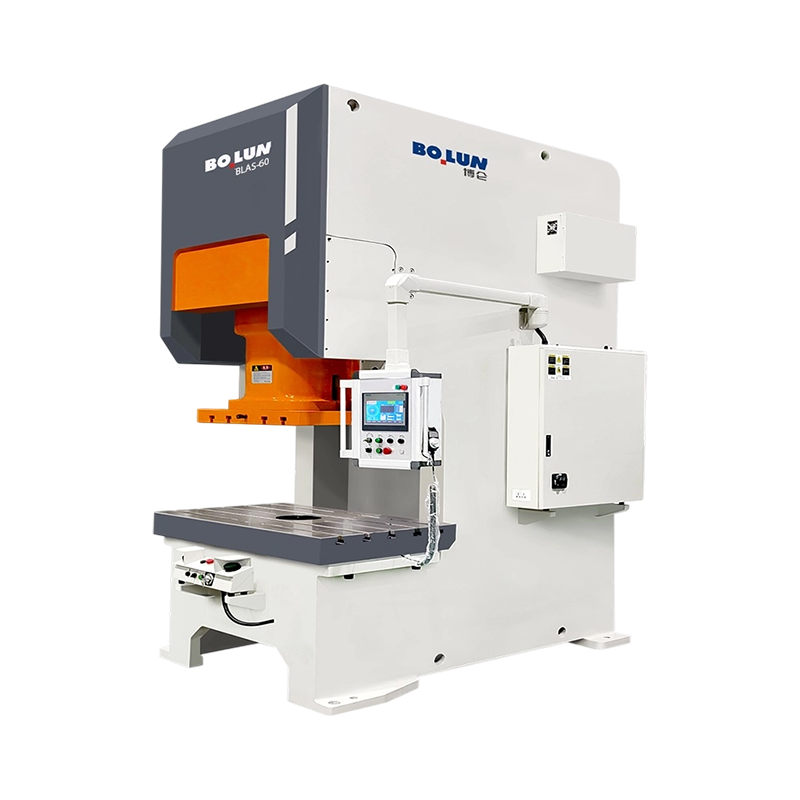
In modern sheet-metal forming, manufacturers demand a press that combines speed, precision, safety, durability, and flexible mold accommodation. The BLPA-60 Intelligent-Adjust Open-Type Single-Point Power Press is designed for exactly this environment. With a 600 kN nominal capacity, a high-rigidity heat-treated steel frame, electric slide adjustment, inverter-controlled high-speed operation, and multiple integrated safety protections, it offers a strong production solution for factories seeking stable output, reduced setup time, and dependable stamping quality.
BLPA-60 Intelligent-Adjust Open-Type Single-Point Power Press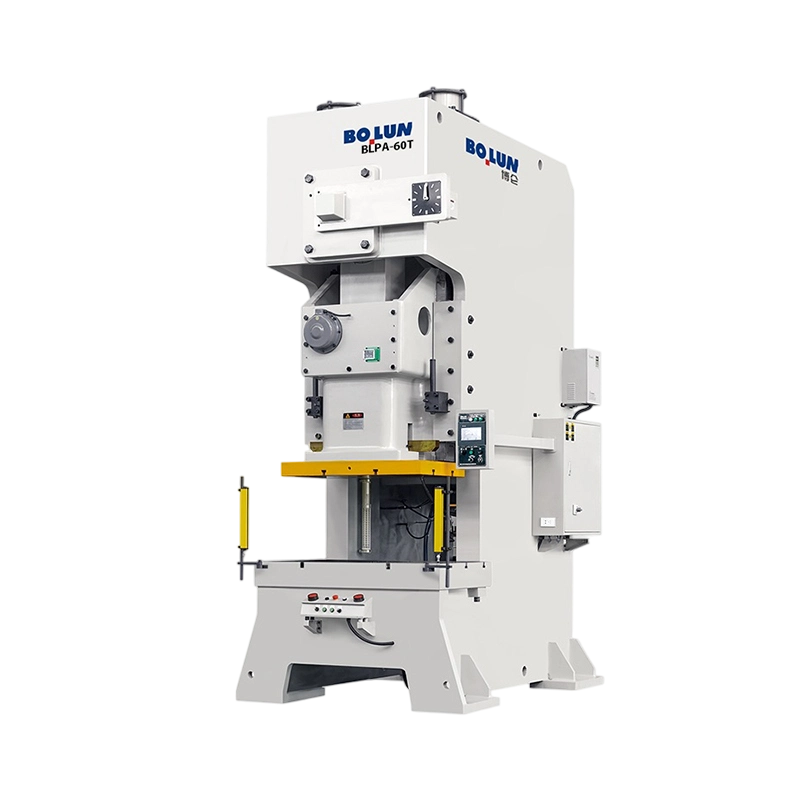
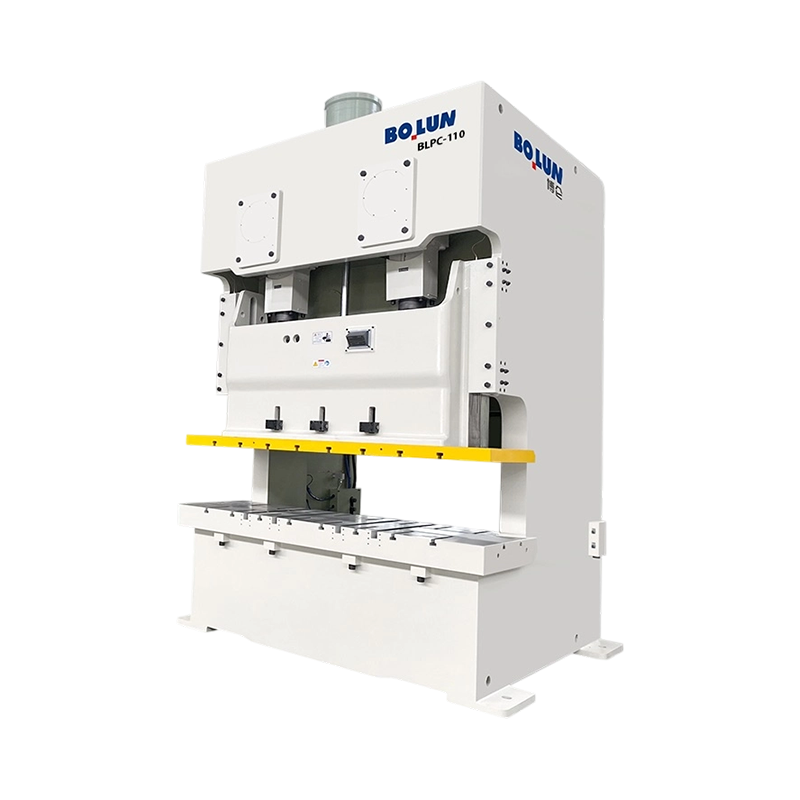
The BLPA-60 Intelligent-Adjust Open-Type Single-Point Power Press belongs to the open-type single-point power press category. It is engineered for stamping, blanking, bending, shallow drawing, forming, trimming, and other general metal-forming applications where a compact yet powerful open-frame press is required. Its open-type structure provides excellent accessibility for operators, die installation, material feeding, part removal, and integration with peripheral automation equipment.
At its core, this model delivers a nominal force of 600 kN, making it suitable for medium-duty stamping operations across automotive components, electrical appliance parts, hardware products, instrument components, light industrial fittings, and precision sheet-metal parts. The machine is driven by a 5.5 kW main motor equipped with inverter speed control, enabling the press to reach up to 165 strokes per minute. This high stroke rate helps manufacturers improve productivity while maintaining stable motion control.
A key feature of this model is its intelligent-adjust capability. The electric slide adjustment device is powered by a 0.2 kW motor, allowing more convenient and accurate slide positioning compared with purely manual adjustment systems. This contributes to shorter die setup time, better repeatability, and improved operational convenience, especially in factories that change molds frequently or process multiple product types on the same line.
The machine also features a large 900 x 520 mm worktable and a 270 mm throat depth. These dimensions make it practical for complex industrial molds and wider sheet-metal parts. The spacious table improves mold layout flexibility, while the throat depth supports a broader range of part geometries. Combined with the rigid frame and high-speed drive, the press is designed to deliver reliable performance in demanding production environments.
The BLPA-60 is not merely a general-purpose press with a standard capacity rating. Its value lies in the balanced integration of rigidity, intelligent adjustment, worktable size, drive efficiency, and safety systems. These characteristics help manufacturers build stable, efficient, and safer stamping processes.
| Item | Specification or Feature | Production Value |
|---|---|---|
| Press Type | Open-type single-point power press | Easy access for die installation, feeding, and operation |
| Nominal Capacity | 600 kN | Suitable for medium-duty stamping and forming applications |
| Frame Structure | High-rigidity heat-treated steel frame | Improves load distribution, reduces vibration, and supports precision |
| Slide Adjustment | Electric slide adjustment with 0.2 kW motor | Reduces setup time and improves adjustment convenience |
| Worktable Size | 900 x 520 mm | Accommodates larger and more complex molds |
| Throat Depth | 270 mm | Supports broader part handling and die layout flexibility |
| Main Motor | 5.5 kW | Provides reliable forming power for continuous production |
| Speed Control | Inverter speed control | Enables flexible speed adjustment and smoother operation |
| Maximum Stroke Rate | Up to 165 strokes per minute | Supports high productivity for suitable processes |
| Clutch and Brake | Sensitive dry clutch brake | Enhances response, control, and operational safety |
| Overload Protection | Hydraulic overload protector | Protects machine and tooling from abnormal loads |
| Safety Devices | Photo-electronic safety devices | Improves operator protection and risk prevention |
Frame rigidity is one of the most important foundations of press performance. During stamping, the frame must withstand dynamic impact, off-center loading, vibration, and repeated stress cycles. A weak or poorly processed frame can cause deformation, inconsistent shut height, uneven die wear, excessive vibration, and part quality variation. The BLPA-60 addresses these concerns through a high-rigidity steel frame that is heat-treated to improve dimensional stability and structural strength.
The heat-treated steel frame is designed for uniform load distribution. In practical production, uniform load distribution helps reduce localized stress concentration and minimizes the risk of frame distortion. This is especially important when operating at high stroke rates or when using molds that generate uneven forming loads. By reducing vibration and maintaining structural stability, the machine helps users achieve more consistent stamped parts and longer tool service life.
Compared with many lower-cost presses that use lighter frame structures or insufficient post-weld stress relief, the BLPA-60 offers stronger mechanical stability. This advantage becomes clear in continuous production, where thousands of strokes are performed every shift. A robust frame does not only improve the first day of production; it protects accuracy over years of operation. For factories that value long-term performance rather than short-term equipment cost alone, this structural strength is a major competitive advantage.
The open-type configuration also provides excellent accessibility while maintaining the necessary rigidity for 600 kN forming operations. Operators can approach the work area more easily, and automation systems such as feeders, straighteners, conveyors, robotic pickers, or coil lines can be arranged more conveniently around the machine. This makes the press suitable for both manual and semi-automatic stamping lines.
One of the distinguishing features of the BLPA-60 is its electric slide adjustment device. Powered by a 0.2 kW motor, this system helps operators adjust the slide more efficiently than traditional manual systems. In stamping operations, slide adjustment is directly related to die setting, shut height control, production changeover, and final part accuracy. When adjustment is slow or inconvenient, every mold change consumes additional labor time and increases the risk of setting errors.
Electric adjustment is particularly valuable for workshops producing different part numbers in small and medium batches. In such production environments, frequent die changes are common, and setup time has a direct impact on total equipment effectiveness. By making adjustment easier and more repeatable, the BLPA-60 helps users reduce non-productive time between jobs.
This feature also improves operator ergonomics. Instead of relying heavily on manual force and repetitive mechanical adjustment, operators can perform slide positioning with better control. This reduces physical effort and supports more standardized procedures. In a competitive manufacturing environment where labor efficiency and process consistency matter, these improvements can lead to measurable production benefits.
Compared with competitors that rely on basic manual slide adjustment in similar press classes, the intelligent-adjust design gives the BLPA-60 a practical advantage. It does not overcomplicate the machine, but it adds a meaningful level of convenience that supports modern manufacturing requirements. The result is a press that remains straightforward to operate while offering improved setup efficiency.
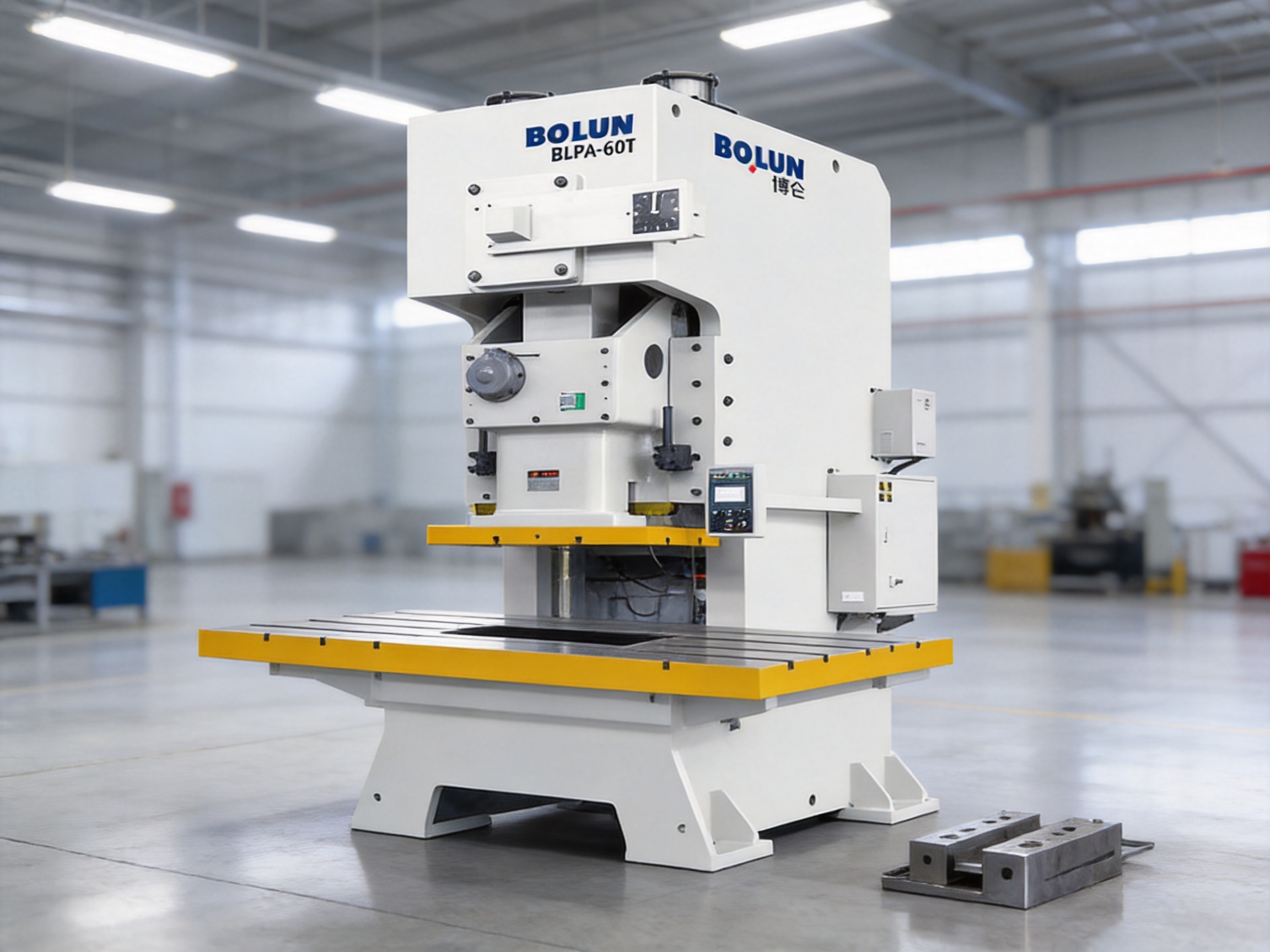
The BLPA-60 is equipped with a 900 x 520 mm worktable, giving manufacturers more space for tooling and workpiece handling. A larger table expands the range of molds that can be installed and helps accommodate complex stamping layouts. This is especially useful for parts that require broader die bases, guide systems, strip feeding devices, or auxiliary fixtures.
The 270 mm throat depth further improves application flexibility. Throat depth determines how far the material or die can extend from the front opening toward the press centerline. A deeper throat allows users to process wider parts or position molds more flexibly. For manufacturers handling varied sheet-metal components, this additional space can help avoid unnecessary equipment limitations.
In many factories, press selection is not only about nominal tonnage. A machine with sufficient force but limited worktable size may restrict die design and reduce future production flexibility. By combining 600 kN capacity with a spacious worktable and practical throat depth, the BLPA-60 provides a balanced platform for many medium-scale industrial stamping requirements.
This design is also advantageous for companies that expect product variation. As customer demand changes, tooling dimensions and part shapes may also change. A press with more generous workspace offers better adaptability, reducing the possibility that a factory will need to purchase another machine simply because a future mold is slightly larger or more complex.
The BLPA-60 uses a 5.5 kW main motor with inverter speed control, supporting up to 165 strokes per minute. This combination gives the machine both power and flexibility. High stroke speed is important for productivity, especially in operations such as blanking, piercing, small part forming, and progressive die stamping where each stroke produces one or more finished or semi-finished parts.
Inverter control allows the press speed to be adjusted according to the specific die, material thickness, feeding method, and part requirements. This is more flexible than fixed-speed systems, which may force users to run either too fast for a delicate process or too slow for efficient production. With inverter control, the press can be optimized for different jobs.
Smoother speed control also contributes to improved machine behavior. Controlled acceleration and deceleration can reduce mechanical shock, improve coordination with feeding equipment, and support better production rhythm. For factories integrating the press into automated lines, speed adjustability is essential. The press must match the timing of coil feeders, strip straighteners, part conveyors, lubrication systems, and inspection devices.
Compared with conventional presses that offer limited speed adjustment, the inverter-controlled BLPA-60 provides a more modern production platform. It supports both efficiency and process control, helping users balance speed with quality. For many manufacturers, the ability to tune machine speed is a key factor in reducing scrap and stabilizing output.
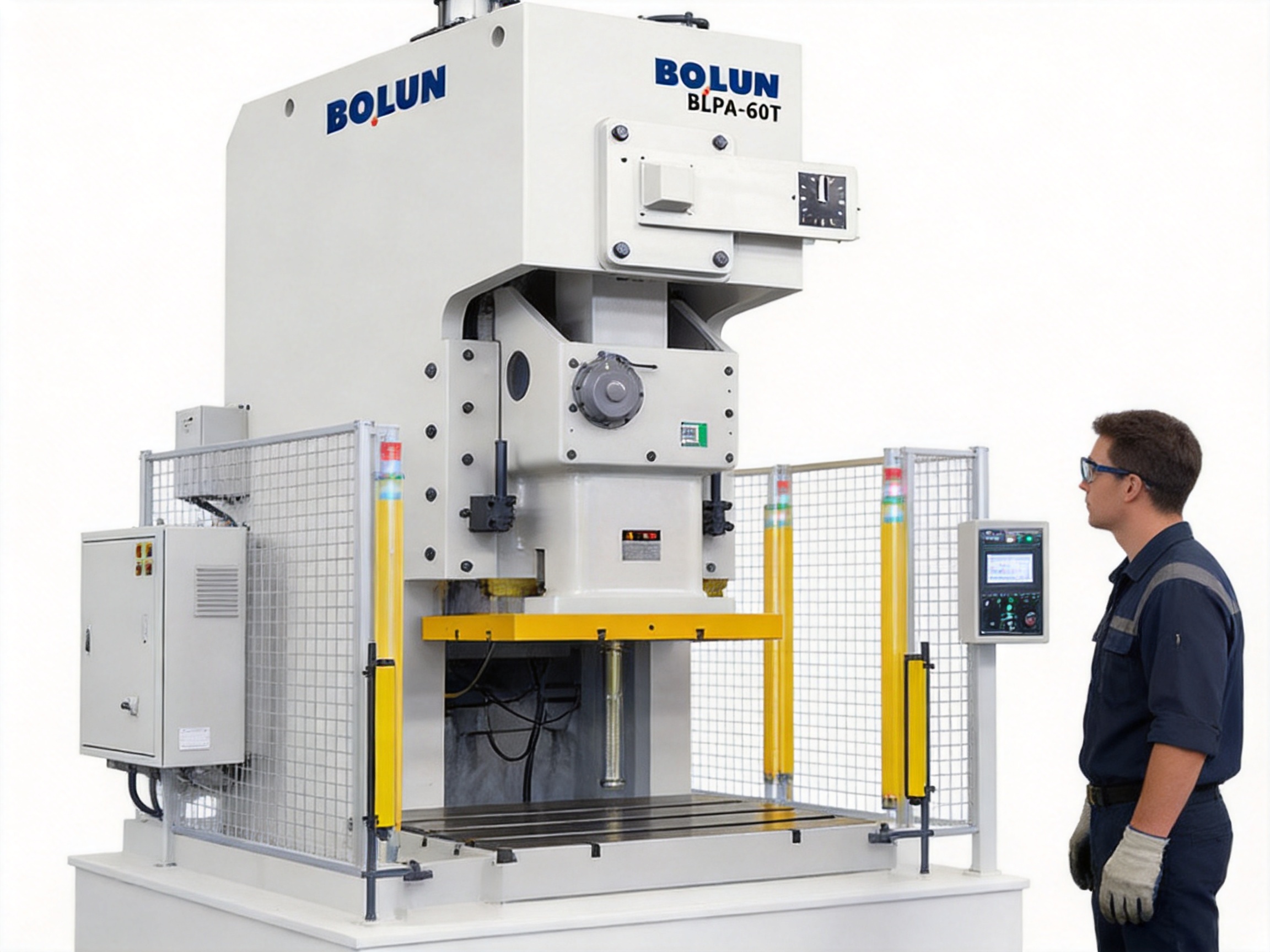
Power presses operate under high mechanical force, so safety is not optional. The BLPA-60 incorporates several safety and protection systems, including a sensitive dry clutch brake, a hydraulic overload protector, and photo-electronic safety devices. These features help protect operators, tooling, and the machine itself.
The dry clutch brake provides responsive engagement and stopping performance. In press operation, reliable clutch and brake response is essential for safe control of the slide motion. A sensitive system helps reduce delay and improves machine controllability. This is especially important during setup, inching, single-stroke operation, and emergency stopping.
The hydraulic overload protector is designed to prevent damage caused by abnormal loads. Overloads can occur due to incorrect material thickness, misfed strips, double blanks, die obstruction, improper adjustment, or tooling failure. Without adequate overload protection, excessive force can damage the press frame, crank mechanism, slide, connecting components, or mold. By incorporating hydraulic overload protection, the BLPA-60 helps reduce repair risk and downtime.
Photo-electronic safety devices provide an additional layer of operator protection. These devices can detect intrusion into hazardous areas and help prevent dangerous operation when the operator’s hands or objects are in the protected zone. In modern manufacturing, such safety measures are increasingly important for compliance, workforce protection, and responsible factory management.
Compared with presses that provide only basic mechanical safeguards, the BLPA-60 offers a more complete safety-oriented configuration. This is especially valuable for factories that must meet higher internal safety standards or operate in export-oriented supply chains where customers audit production conditions.
The BLPA-60 stands out in the open-type single-point power press market through a combination of mechanical strength, intelligent adjustment, speed flexibility, safety protection, and practical working space. Many competitors may offer one or two of these features, but the competitive value of this model comes from their integration into one balanced machine.
Presses with purely manual adjustment often require more time and physical effort during mold setup. The electric slide adjustment of the BLPA-60 shortens this process and improves convenience. For factories with frequent changeovers, this advantage can significantly improve machine utilization. Less setup time means more production time, faster order response, and lower labor cost per part.
The heat-treated high-rigidity frame gives the machine a foundation for consistent precision. Lower-cost frames may appear acceptable during light testing, but under continuous impact loading they can show vibration, deformation, and accuracy loss. The BLPA-60 is designed for stable load distribution and vibration reduction, helping maintain part quality and protect tooling.
With inverter speed control and a maximum speed of up to 165 strokes per minute, the press can support both high-output operations and more controlled forming processes. Fixed-speed competitors may limit process optimization, while the BLPA-60 allows users to adapt speed to different materials and dies.
The 900 x 520 mm worktable and 270 mm throat depth provide flexibility for die selection and part handling. A press with the same tonnage but a smaller table may restrict mold options. The BLPA-60 offers a practical balance between machine size and usable working area.
The sensitive dry clutch brake, hydraulic overload protector, and photo-electronic safety devices provide stronger operational security. These systems help reduce accidents, tooling damage, and downtime. In competitive production, safety features are not merely compliance items; they support stable, uninterrupted manufacturing.
A machine is only as strong as the organization that designs, builds, tests, and supports it. Zhejiang Bolun High-Precision Machinery Co., Ltd. brings two decades of machinery manufacturing experience, integrated R&D, production, sales, and service capabilities, and a strong emphasis on precision forming equipment. This manufacturing background adds value beyond the specifications printed on a product sheet.
The BLPA-60 is produced by Zhejiang Bolun High-Precision Machinery Co., Ltd., a company located in Zhejiang Province, one of China’s important centers for precision manufacturing. The company has developed through approximately two decades of experience in machinery manufacturing and has grown into a modern enterprise focused on high-precision forming equipment. Its operations integrate research and development, design, production, sales, and service.
This integrated model is important because press manufacturing requires close coordination among engineering design, material processing, machining accuracy, assembly skill, electrical control, safety configuration, and final testing. If any one stage is weak, the final machine can suffer from instability, poor accuracy, or reduced service life. By controlling the full process, the company can maintain higher consistency and respond more effectively to customer requirements.
The company emphasizes technological innovation as a core engine of development. Its “Technology First” strategy is reflected in full-chain production capabilities, non-standard customization, and an international management perspective. These strengths allow the company to design and manufacture machines that address specific production challenges rather than offering only generic equipment.
For the BLPA-60, this manufacturing strength is visible in the choice of a heat-treated rigid frame, the integration of electric slide adjustment, the use of inverter speed control, and the adoption of multiple safety systems. These elements require not only component selection but also system-level engineering. The frame must support the motion system; the motor and inverter must match production load requirements; the clutch and brake must coordinate with safety control; and the overload protection must respond reliably under abnormal conditions.
Power press manufacturing depends on precision processing. Critical components such as the frame, slide, crankshaft, connecting rod, worktable, guide surfaces, and transmission parts must be accurately machined and assembled. Even small errors can lead to uneven force transmission, accelerated wear, vibration, or inconsistent product quality.
Zhejiang Bolun High-Precision Machinery Co., Ltd. owns advanced precision processing equipment and benefits from a mature industrial environment. This supports the machining of key components and helps ensure dimensional accuracy. Precision processing also contributes to smoother slide movement, better alignment, and more stable die operation.
Assembly is equally important. A press is a dynamic system, and its components must work together under repeated impact. Proper assembly procedures, inspection steps, lubrication considerations, and alignment verification all affect machine life. A mature production management system helps standardize these processes and reduce variation between machines.
The company’s experience in forging and casting machinery also supports its understanding of heavy mechanical structures. Presses must be strong, but they must also be carefully balanced. Excessive weight without proper design does not guarantee precision. The manufacturer’s goal is to combine structural strength, accurate machining, and controlled assembly into a machine that performs reliably under real production conditions.
Quality is described as the lifeline of the company, and this philosophy is particularly relevant in power press manufacturing. A press may operate for many years in high-intensity conditions, so quality control cannot be limited to surface appearance or simple functional checks. It must cover material selection, processing accuracy, component fit, motion performance, electrical systems, safety devices, and final operation testing.
The company has established a finished product inspection system that exceeds industry standards. Rigorous quality control is applied to processes and components to ensure stable precision and long service life. For the BLPA-60, such inspection helps verify that the high-rigidity frame, slide adjustment mechanism, drive system, clutch brake, overload protector, and photo-electronic safety devices function as intended.
Strong inspection practices also reduce hidden risks for customers. In a production facility, downtime is expensive. A minor defect in a press can stop an entire stamping line, delay customer deliveries, waste material, or damage expensive tooling. By controlling quality before shipment, the manufacturer helps customers reduce operational uncertainty.
Compared with competitors that may rely on minimal final checks, a more rigorous inspection culture provides long-term value. Buyers of power presses should consider not only the machine’s visible features but also the quality system behind those features. A well-inspected press is more likely to maintain stability after installation and during continuous use.
Manufacturers often face production requirements that differ from standard catalog conditions. Material thickness, part shape, die height, feeding method, safety layout, automation level, and workshop space can vary greatly from one customer to another. A press supplier with non-standard customization capability can provide more practical solutions.
Zhejiang Bolun High-Precision Machinery Co., Ltd. relies on a robust design team to provide one-stop design and manufacturing services for products with special specifications and functions. This capability is important for customers who need more than a standard machine. For example, a customer may require integration with a coil feeding line, specific control interfaces, customized guarding, special table arrangements, or production line layout support.
The BLPA-60 itself provides a strong standard platform, but the manufacturer’s customization ability increases its application value. When a press can be matched to the customer’s actual workflow, the result is better efficiency and fewer compromises. This is especially important for factories upgrading from manual stamping to semi-automatic or automated production.
Customization also supports long-term cooperation. As a customer’s production grows, new tooling, automation, and safety requirements may appear. A manufacturer with engineering depth can provide technical consultation, upgrades, and new equipment solutions that align with the customer’s development path.
The BLPA-60 is suitable for a broad range of stamping applications where medium tonnage, open-frame accessibility, and high-speed operation are required. Its design supports both general metalworking and more specialized component production. The following application areas illustrate its practical value.
Many automotive and motorcycle parts require blanking, piercing, forming, and trimming. Brackets, covers, clips, washers, reinforcement plates, small structural parts, and mounting components can often be produced on presses in this capacity range. The BLPA-60’s rigidity and speed make it suitable for repeated production of such parts, while the large worktable supports more complex tooling.
Household appliance and electrical equipment manufacturers often require metal panels, brackets, connectors, covers, and stamped shells. These products demand consistent dimensions and efficient production. The inverter-controlled speed and stable frame support both productivity and quality control.
Hardware factories produce items such as hinges, plates, fasteners, brackets, locks, clamps, and tool components. These products may involve progressive dies or single-operation dies. The BLPA-60’s accessible open-type structure and electric slide adjustment help reduce setup burden when switching between product types.
Precision sheet-metal components used in instruments, meters, enclosures, and electronics often require stable stamping conditions. While ultra-fine electronics may require specialized high-precision presses, many supporting metal parts can benefit from the BLPA-60’s controlled speed, rigid frame, and reliable safety configuration.
Light industrial production includes household goods, packaging hardware, metal fittings, decorative components, and small formed parts. The machine’s high stroke rate can help improve output, while its safety systems support responsible operation in busy workshops.
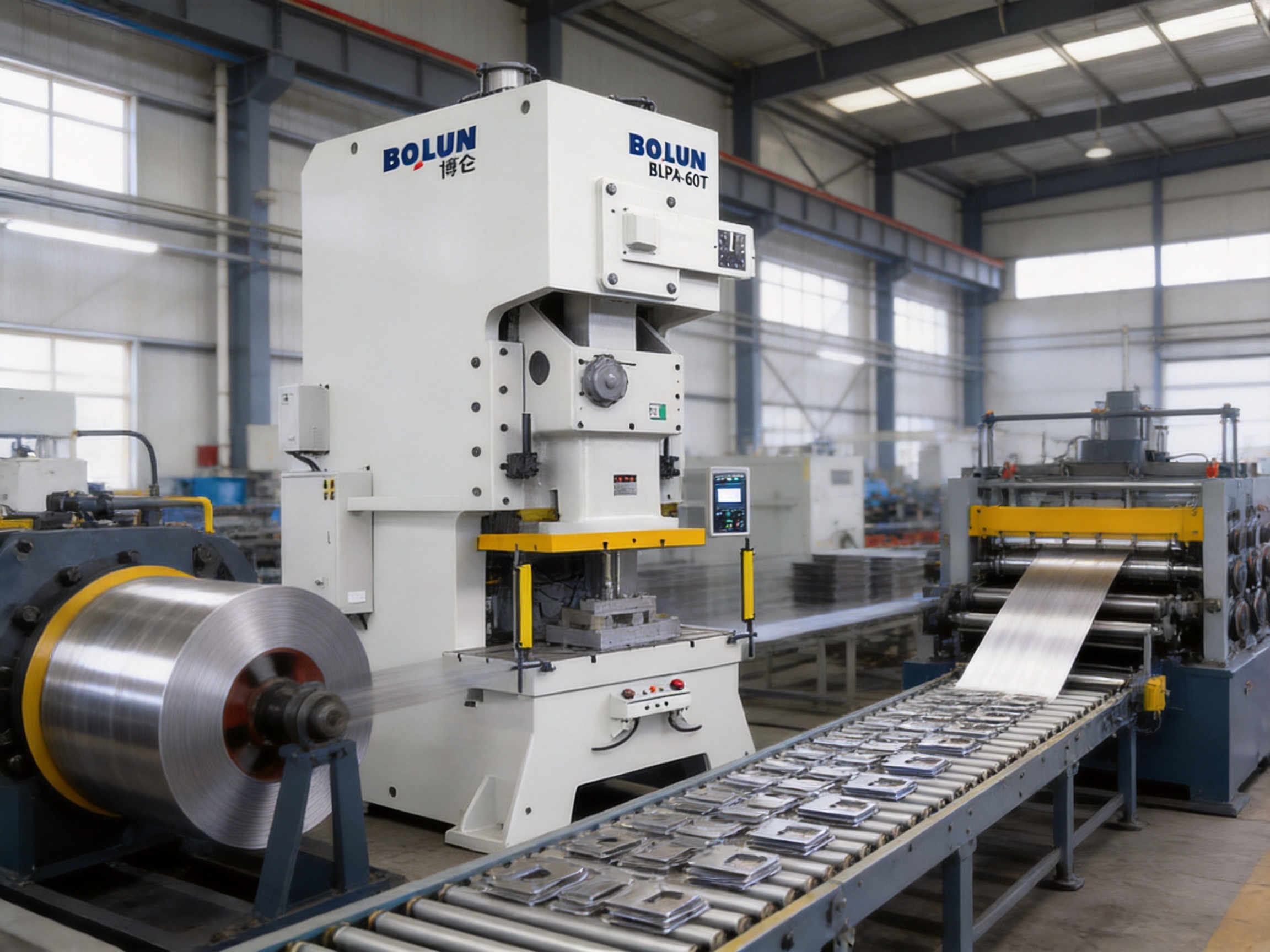
Modern stamping workshops are increasingly moving toward automation, digital management, and flexible manufacturing. A power press must therefore be more than a standalone machine. It should be capable of cooperating with feeders, straighteners, decoilers, lubrication systems, conveyors, robots, safety guards, and inspection equipment. The BLPA-60’s open-type structure, inverter speed control, large worktable, and stable frame make it suitable for such integration.
In a coil-fed line, the press speed must coordinate with material feeding. If the press runs too fast for the feeder, misfeeds may occur. If it runs too slowly, productivity is lost. Inverter speed control allows adjustment to match line conditions. The photo-electronic safety devices and responsive clutch brake also support safer operation when multiple systems work together.
For progressive die stamping, consistent slide motion and frame stability are critical. Each stroke moves the strip through several forming stations, and any vibration or misalignment can affect part accuracy. The BLPA-60’s rigid frame and overload protection help maintain stable operation and reduce risks associated with strip feeding errors.
For manual or semi-automatic operations, operator access and safety are key. The open-type design allows easy loading and unloading, while the safety devices help reduce hazards. The electric slide adjustment also simplifies changeovers, making the machine practical for workshops with varied products and frequent mold changes.
Purchasing a power press is not simply a matter of buying capacity. The real cost of ownership includes installation, setup time, operator training, energy use, tool wear, downtime, maintenance, scrap rate, production speed, safety performance, and service support. The BLPA-60 creates economic value by addressing several of these factors.
First, its high stroke rate can increase output for suitable products. More strokes per minute can translate into more parts per hour, provided that feeding, tooling, and material handling are properly matched. For high-volume production, even small speed improvements can accumulate into significant annual output gains.
Second, electric slide adjustment reduces changeover time. In factories with many product types, time spent setting dies is time not spent producing parts. Faster, more convenient adjustment improves equipment utilization and reduces labor inefficiency.
Third, the rigid frame and overload protection help protect tooling. Dies are often expensive, and damage can be more costly than machine maintenance. By reducing vibration and protecting against abnormal loads, the press helps extend die life and reduce unexpected repair expenses.
Fourth, safety features reduce accident risk. Workplace accidents can cause human injury, production interruption, legal costs, compensation, and reputation damage. Investing in a press with stronger safety systems supports both ethical responsibility and business continuity.
Fifth, the manufacturer’s inspection and service system helps reduce uncertainty. A press from a company with mature production management, quality control, and customer-oriented service can provide better long-term reliability. For many buyers, this support is as important as the machine’s initial price.
A good press should be productive, but it should also be manageable for operators and maintenance teams. The BLPA-60 supports operator convenience through its open-type access, electric slide adjustment, clear functional configuration, and safety devices. These features help reduce the difficulty of daily operation and setup.
Maintenance teams benefit from a machine designed with practical industrial use in mind. The hydraulic overload protector helps prevent severe damage in abnormal situations, while the dry clutch brake provides responsive mechanical control. Inverter speed control can reduce unnecessary stress by allowing the press to run at appropriate speeds rather than forcing a single operating condition for all jobs.
Regular maintenance remains essential. Users should follow proper lubrication schedules, inspect clutch and brake function, verify safety device operation, check fasteners, monitor abnormal noise or vibration, maintain electrical components, and ensure that dies are installed correctly. A high-quality press performs best when supported by disciplined maintenance practices.
The company’s customer-oriented service system, covering pre-sales consultation, in-sales support, and after-sales guarantees, can help users establish proper operating and maintenance procedures. This service approach is valuable for customers who want to maximize machine life and production reliability.
Closed-type presses provide strong rigidity for heavier or more precision-demanding applications, but open-type single-point presses remain highly important because of their accessibility, flexibility, and efficiency for many medium-duty stamping tasks. The BLPA-60 represents this category well. It delivers the convenience of an open frame while incorporating enhanced rigidity and modern safety features.
For many factories, open-type presses are easier to install, easier to operate, and easier to integrate into existing workshops. They are often suitable for small and medium-sized parts, general hardware, appliance components, electrical fittings, and diverse sheet-metal products. Their accessibility reduces handling difficulty and supports faster production flow.
The BLPA-60 improves on traditional open-type press limitations by emphasizing frame strength, heat treatment, vibration reduction, and safety. This makes it a practical choice for manufacturers who want open-frame convenience without accepting weak structural performance or outdated control features.
Zhejiang Bolun High-Precision Machinery Co., Ltd. has built its development around precision machinery manufacturing, technical accumulation, and customer-focused industrial solutions. The company’s history reflects perseverance, technical improvement, and the establishment of a professional, mature, and efficient production management system.
Its philosophy, “Accumulate Richly and Break Forth Thinly; Pressure is Power,” expresses a commitment to long-term capability building and disciplined progress. In the machinery industry, this approach matters. High-quality equipment cannot be created through short-term assembly alone; it requires accumulated know-how in design, materials, processing, quality control, and customer application.
The company actively adopts advanced international production management experience and combines it with China’s local manufacturing environment. This supports a scientific, humane, and efficient management system. For customers, the result is a supplier that understands both modern quality expectations and practical production realities.
Looking forward, the company plans to deepen its presence in high-end, precision, and advanced manufacturing fields. It will continue investing in intelligent and digital stamping equipment, optimizing corporate resources, stabilizing product quality, and enhancing the value of the industrial chain. This direction aligns with global trends in smart manufacturing, automation, and precision forming.
When selecting a power press such as the BLPA-60, buyers should consider several practical factors. Nominal capacity is important, but it is only one part of the decision. Buyers should also evaluate worktable size, throat depth, slide adjustment method, speed control, safety configuration, frame rigidity, maintenance requirements, tooling compatibility, and supplier support.
The BLPA-60 is most suitable for users who need a medium-capacity press with high-speed capability, convenient setup, and a large working area. It is especially attractive for factories processing multiple product types, using medium-sized dies, or seeking better speed control than fixed-speed presses can offer.
Buyers should also analyze their material thickness, forming force requirements, die size, production volume, automation level, and safety standards. If the process involves off-center loading, high-volume operation, or frequent die changes, the machine’s rigidity, electric adjustment, and overload protection become even more valuable.
It is also wise to discuss special requirements with the manufacturer before purchase. Because Zhejiang Bolun High-Precision Machinery Co., Ltd. has non-standard customization capabilities, customers can consult about configuration adjustments, line integration, safety guarding, and production layout. Early technical communication helps ensure that the final equipment matches real production conditions.
The BLPA-60 is an intelligent-adjust open-type single-point power press. It is designed for medium-duty stamping, blanking, forming, trimming, bending, and related sheet-metal processing applications.
The machine has a nominal capacity of 600 kN, making it suitable for many industrial stamping operations involving medium forming loads.
The press uses an electric slide adjustment device powered by a 0.2 kW motor. This improves setup convenience, reduces manual effort, and helps shorten mold changeover time compared with traditional manual adjustment systems.
The heat-treated high-rigidity steel frame improves structural stability, supports uniform load distribution, reduces vibration, and helps maintain precision during repeated stamping cycles.
The press can reach up to 165 strokes per minute, depending on the process, tooling, material, and feeding conditions.
Inverter speed control allows users to adjust the operating speed for different dies, materials, and production requirements. This improves flexibility, supports automation coordination, and helps balance productivity with quality.
The BLPA-60 includes a sensitive dry clutch brake, hydraulic overload protector, and photo-electronic safety devices. These systems improve operational control, protect the machine and tooling, and help reduce operator risk.
The machine has a 900 x 520 mm worktable and a 270 mm throat depth. These dimensions provide practical space for complex molds and broader part handling.
It can be used in automotive parts, motorcycle components, appliance manufacturing, hardware production, electrical fittings, instrument components, and light industrial sheet-metal processing.
The BLPA-60 offers a stronger combination of rigid frame construction, electric slide adjustment, inverter speed control, generous workspace, overload protection, and safety devices. It also benefits from the manufacturing experience, quality control, and customization capabilities of Zhejiang Bolun High-Precision Machinery Co., Ltd.
The BLPA-60 Intelligent-Adjust Open-Type Single-Point Power Press is a capable and well-balanced solution for manufacturers seeking higher efficiency, better setup convenience, stronger safety, and reliable stamping performance. Its 600 kN capacity, heat-treated high-rigidity frame, electric slide adjustment, 900 x 520 mm worktable, 270 mm throat depth, 5.5 kW inverter-controlled drive, and maximum speed of up to 165 strokes per minute position it as a strong choice for medium-duty industrial forming.
Its advantages over competitors are practical rather than theoretical. The electric slide adjustment reduces setup burden. The rigid frame supports accuracy and vibration control. The inverter drive improves speed flexibility. The large workspace expands tooling options. The safety systems protect operators, tooling, and the machine. Together, these features help customers achieve stable productivity and long-term value.
Behind the product is a manufacturer with deep experience in precision forming equipment, integrated R&D and production capability, advanced processing resources, rigorous inspection systems, and a willingness to support customized solutions. For factories upgrading their stamping capacity or building more efficient production lines, the BLPA-60 offers a dependable combination of mechanical strength, intelligent operation, and manufacturing confidence.
Altan, T., and Tekkaya, A. E. Sheet Metal Forming: Processes and Applications. ASM International.
Kalpakjian, S., and Schmid, S. R. Manufacturing Engineering and Technology. Pearson Education.
Groover, M. P. Fundamentals of Modern Manufacturing: Materials, Processes, and Systems. Wiley.
Society of Manufacturing Engineers. Tool and Manufacturing Engineers Handbook: Forming. SME.
International Organization for Standardization. Safety of Machinery and Mechanical Press Safety Principles.
Boljanovic, V. Sheet Metal Forming Processes and Die Design. Industrial Press.
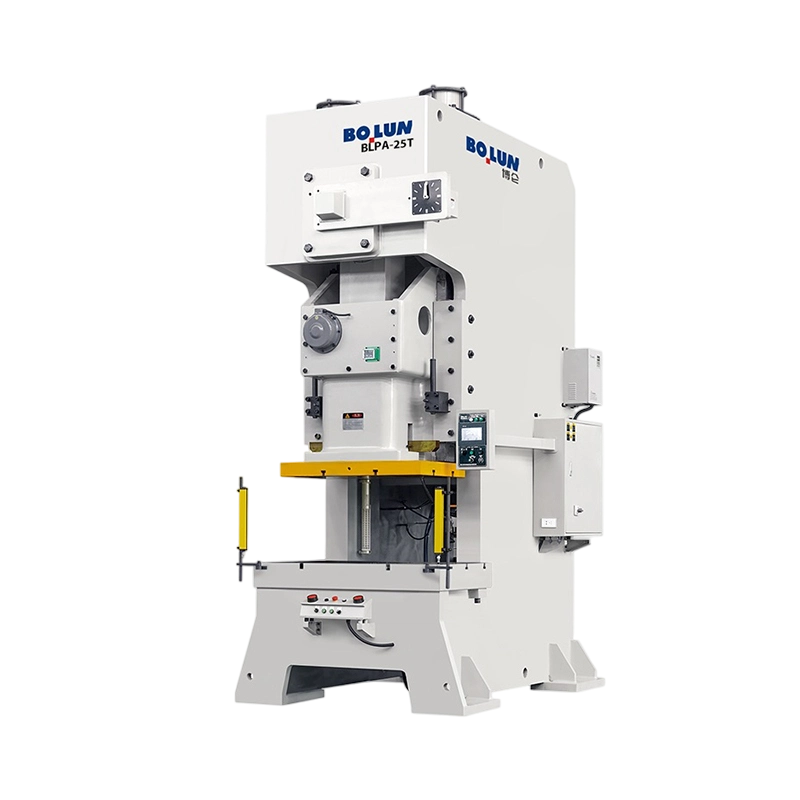


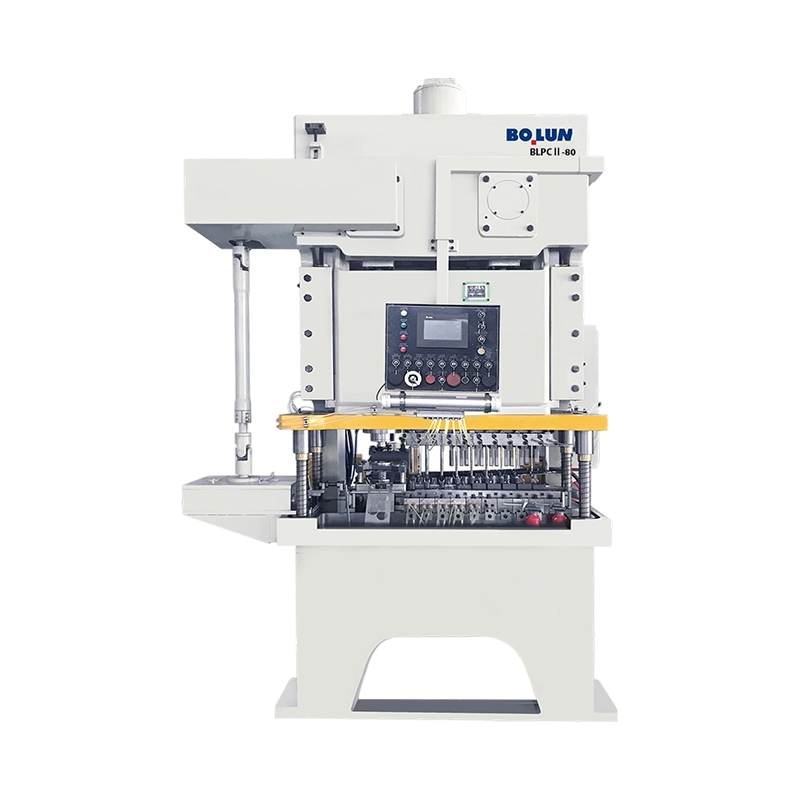
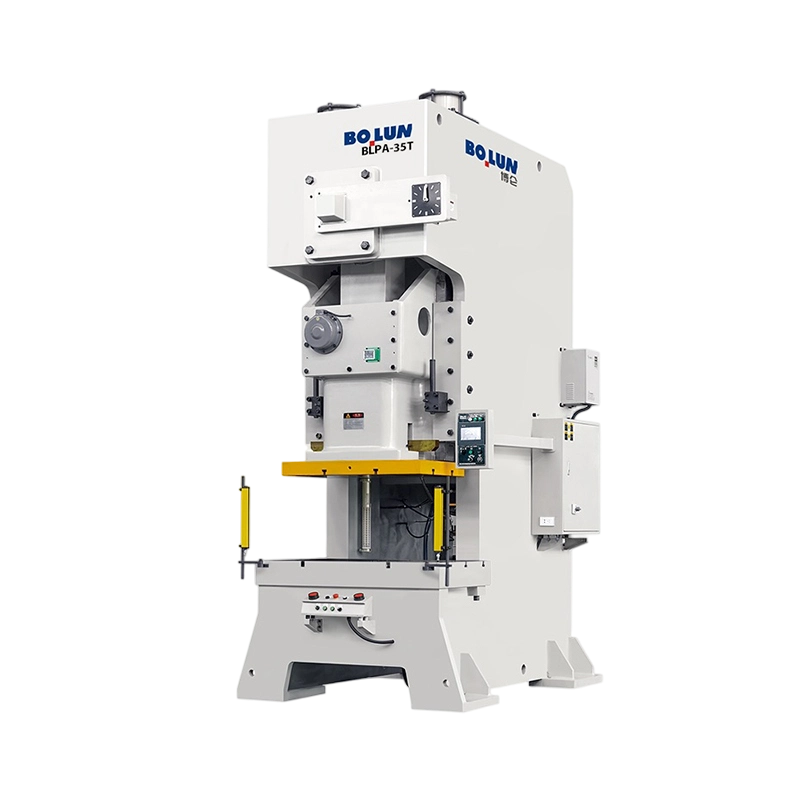
Understanding Mechanical Power Presses and Their Essential Functions A mechani...
What Is a Power Press? A power press — also called a stamping press or punch pr...
In the fields of metal forming, sheet metal fabrication, blanking, and punching,...
Power press machines are classified in two main ways: by frame construction, w...
As the manufacturing industry moves steadily toward automation and smart product...
In modern manufacturing, cold forging is widely used in the automotive, aerospac...
Contact Us

bolunpress@gmail.com

+86-575-83362228

+86-15158259588

+86-575-83362999

+86-15158259588

Hangzhou Office Add: No. 332 Wangjiang East Road, Shangcheng District

No.1 Linjiang Road East, Xiaren, Jinting Town, Shengzhou City, Zhejiang Province, China
Ready to Begin?
Get in Touch

Now!

ZHEJIANG BOLUN
 English
 中文简体
中文简体