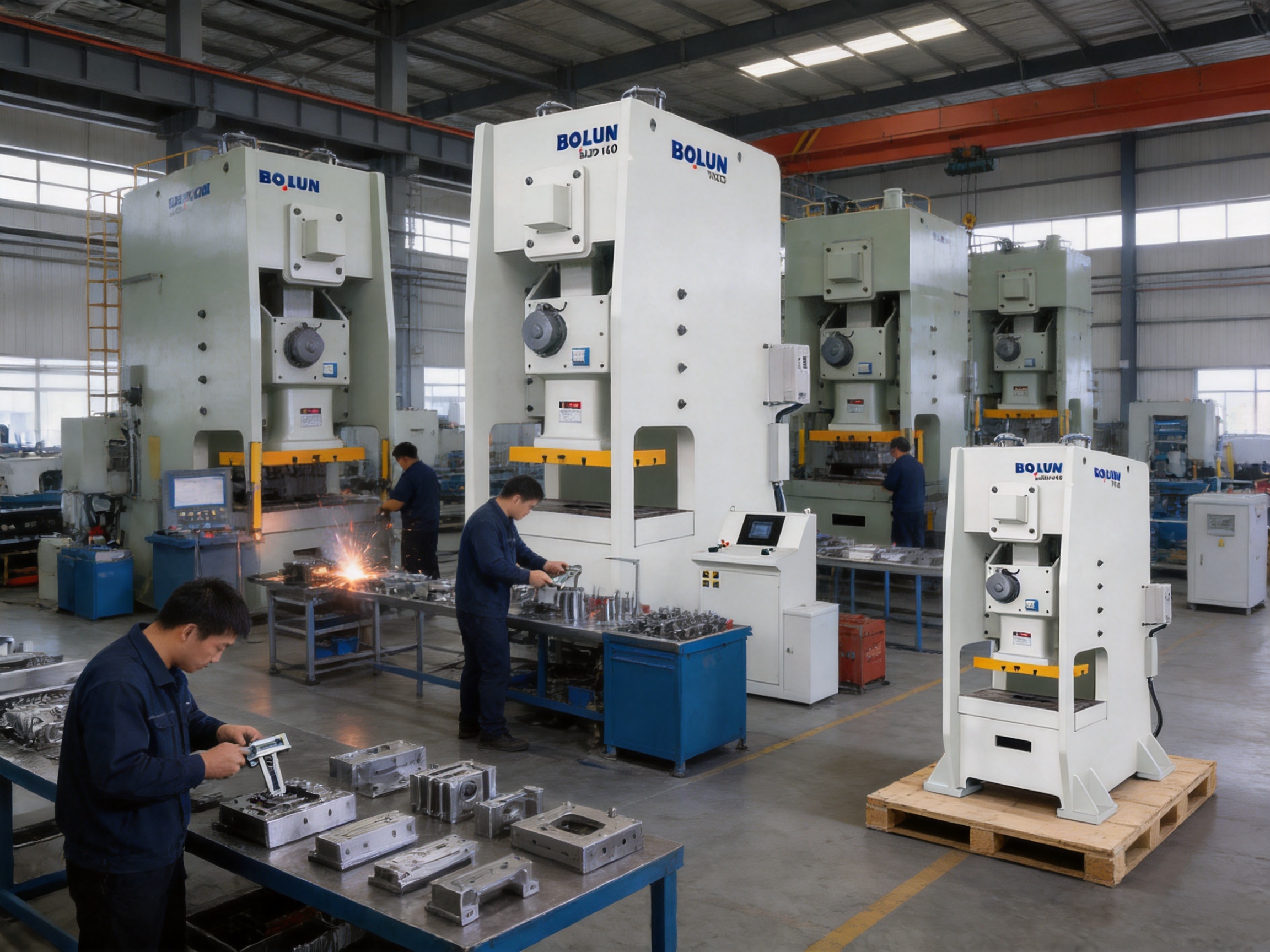
Modern stamping and forming operations require more than nominal force alone. A production press must combine structural rigidity, controlled motion, convenient die adjustment, stable precision, practical working dimensions, and dependable operation over long production cycles. When these factors are balanced correctly, manufacturers can improve forming consistency, reduce setup time, protect expensive tooling, and maintain a predictable production rhythm.
The BLPD-160 Versatile Balanced-Stability Semi-Closed Single-Point Power Press is designed around this principle. With a nominal capacity of 1600 kN, a 200 mm slide stroke, a 980 × 800 mm worktable, and a 15 kW main motor, it occupies an important position between medium-duty and high-capacity mechanical stamping equipment. Its 16.8-ton press body provides a substantial structural foundation for drawing, forming, blanking, and related operations that demand reliable force transmission.
This article examines the machine’s main technical characteristics, operating advantages, manufacturing considerations, application potential, and competitive position. It also explains how the production capabilities of Zhejiang Bolun High-Precision Machinery Co., Ltd. support the development of precision forming equipment for customers requiring both standard and customized solutions.
A 1600 kN nominal-capacity press is suitable for a broad range of industrial forming tasks. It provides considerably more working force than compact presses used for light blanking or small components, while remaining more accessible in terms of installation and operating cost than very large presses intended for oversized panels or extremely deep forming applications.
The capacity of 1600 kN corresponds to a force level of approximately 163 metric tons-force. In practical production, the available force must always be considered together with the material type, sheet thickness, tooling design, forming depth, blank size, and the position of the load within the stroke. Nominal capacity is therefore not a universal indicator of what every die can produce. However, it provides a valuable basis for selecting a press for medium-to-heavy forming work.
The BLPD-160 is particularly relevant to manufacturers that need a versatile machine for operations such as:
• Progressive or sequential stamping of medium-sized components.
• Blanking and piercing of steel, stainless steel, aluminum, and other sheet materials.
• Shallow drawing and general forming operations.
• Bending, embossing, coining, and sizing.
• Production of automotive, appliance, electrical, hardware, and general industrial parts.
• Tooling applications that require a comparatively large worktable and sufficient slide clearance.
Because production requirements vary widely, the press should be matched with the actual process conditions rather than selected solely by force rating. The machine’s worktable, slide dimensions, die-height range, stroke length, speed range, and available cushion system all contribute to its suitability for a specific application.
The central advantage of a heavy mechanical press is its ability to transmit force while controlling deflection. During stamping, the frame, slide, crankshaft or eccentric mechanism, connecting components, worktable, and die set are subjected to high and rapidly changing loads. Excessive deflection can lead to dimensional variation, uneven die wear, burr formation, and premature tool damage.
The BLPD-160 is described as a balanced-stability semi-closed single-point press. This design emphasis is important for applications in which forming quality depends on consistent alignment between the slide and the worktable. The press body weighs 16.8 tons, giving it considerable mass relative to its working capacity. A substantial machine structure can help reduce vibration and improve resistance to movement during repeated loading.
Stability is also influenced by the distance between the columns, the proportions of the frame, the worktable thickness, and the design of the slide guidance system. For the BLPD-160, the listed distance between columns is 930 mm. This provides a useful working opening for tooling while maintaining a compact configuration compared with larger 2000 kN and above machines.
The worktable measures 980 × 800 × 140 mm. These dimensions offer a practical die-mounting area for a wide range of medium-sized tools. The 140 mm table thickness provides a strong supporting base, while the slide bottom dimensions of 850 × 550 × 90 mm provide a corresponding mounting surface for the upper die assembly.
Competitor machines in the same capacity class may offer similar nominal force, but the practical value of that force depends on structural behavior. A press that is rated at 1600 kN but has a less rigid frame may produce inconsistent results when the load is uneven or when the die operates close to the edge of the working area. A balanced frame and correctly proportioned table and slide can therefore provide an advantage in real production, especially for tools with multiple forming stations or offset loading conditions.
Mechanical presses generate impact forces at every stroke. If the machine structure, foundation, and drive system are not properly matched, vibration may be transferred to the floor, the tooling, or nearby equipment. The 16.8-ton press weight of the BLPD-160 helps establish a stable operating platform. It also reflects the use of a heavy-duty structure rather than a lightweight frame designed only for intermittent operation.
Machine mass does not eliminate the need for correct installation. The press should be positioned on a suitable foundation, leveled accurately, and installed according to the manufacturer’s technical requirements. Proper anchoring, lubrication, die setup, and scheduled maintenance remain essential to achieving the machine’s expected precision and service life.
A single-point press applies force through a central drive point. This configuration can be effective for general-purpose stamping, but die design and material positioning must be planned carefully. Balanced loading helps limit angular movement and uneven wear. The BLPD-160’s structural arrangement is intended to support stable operation when the tooling and material are correctly configured.
For applications involving substantially eccentric loading, users should evaluate the die layout, press centerline, allowable load distribution, and slide guidance requirements. This engineering review is useful for any press, regardless of manufacturer, and is especially important when a single machine is expected to support multiple die designs.
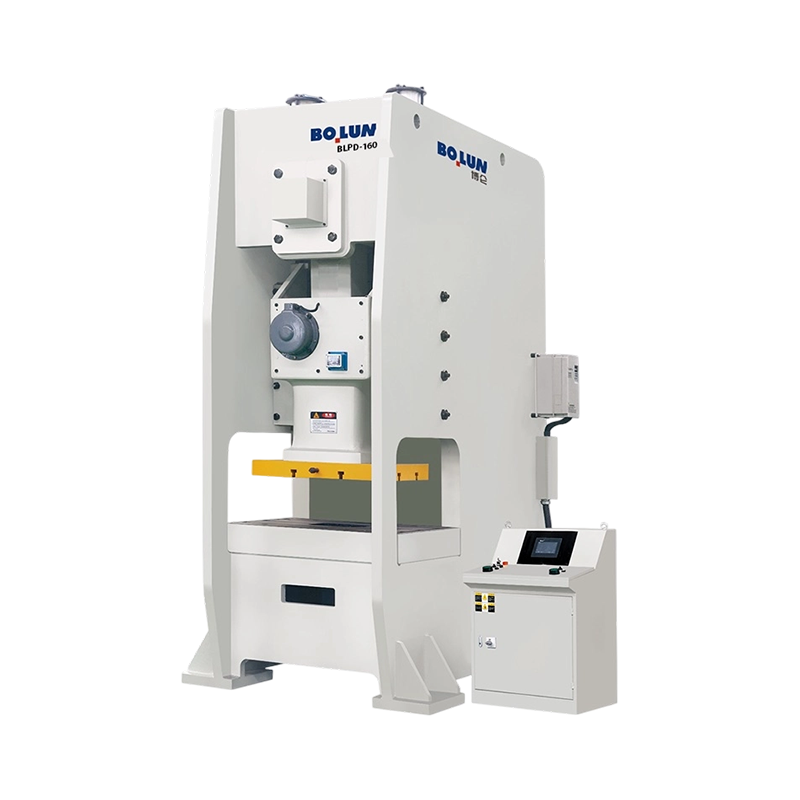
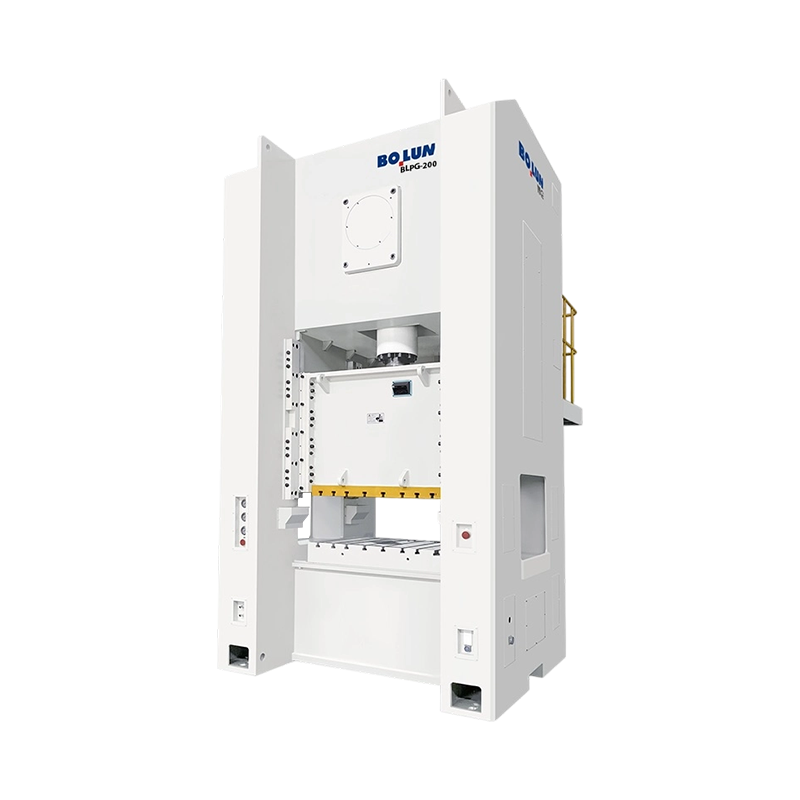
BLPD-160 Versatile Balanced-Stability Semi-Closed Single-Point Power Press
The following table summarizes the primary specifications associated with the BLPD-160 model. The dimensions and operating values should be confirmed against the final machine configuration, electrical standard, safety package, and customer-specific options before purchase.
| Item | Specification |
|---|---|
| Machine model | BLPD-160 |
| Press type | Semi-closed single-point power press |
| Nominal capacity | 1600 kN |
| Nominal pressure stroke | 6 mm |
| Slide stroke | 200 mm |
| Slide speed range | 20–50 strokes per minute |
| Maximum die height | 460 mm |
| Die-height adjustment | 100 mm |
| Worktable size | 980 × 800 × 140 mm |
| Slide bottom size | 850 × 550 × 90 mm |
| Working-face height | 900 mm |
| Distance between columns | 930 mm |
| Main motor | 15 kW, four-pole configuration |
| Die-height adjustment motor | 1.1 kW |
| Air pressure | 0.55 MPa |
| Punch accuracy classification | GB/JIS Class 1 |
| Overall dimensions | Approximately 1600 × 2200 × 3500 mm |
| Press weight | Approximately 16.8 tons |
| Mold pad capacity | 100 kN |
| Ram stroke | 80 mm |
| Effective cushion area | 650 × 420 mm |
These specifications show why the machine can be used as a general-purpose production press. The 200 mm slide stroke gives more vertical movement than many compact high-speed presses, while the 460 mm maximum die height accommodates substantial tooling assemblies. The 100 mm die-height adjustment range allows the press to accept tools of different closed heights and supports more efficient setup work.
The slide stroke is one of the most important specifications when selecting a mechanical press. A longer stroke provides more vertical travel for the upper die and can be valuable for drawing, deep bending, part ejection, and tooling with greater vertical requirements. The BLPD-160 has a 200 mm slide stroke, which provides useful flexibility for operations beyond simple shallow punching.
The machine’s listed operating range is 20 to 50 strokes per minute. This range enables users to balance productivity and process requirements. Higher speeds may be suitable for uncomplicated blanking, piercing, or repetitive forming where the die and material feed system can operate reliably at that rate. Lower speeds can be preferable for drawing, complex forming, thicker materials, or operations in which additional time is needed for material flow and part stabilization.
A broad speed range is often more valuable than a single maximum speed. A machine designed only around maximum output may not provide the control needed for difficult forming operations. Conversely, a press limited to low speed may impose unnecessary production costs on simpler parts. The BLPD-160 supports a more adaptable production strategy by allowing the operating rate to be selected according to the die, material, and target quality.
The nominal pressure stroke is specified as 6 mm. This indicates the point in the slide travel at which the press develops its rated nominal capacity. Users should consider this characteristic when designing dies and calculating forming loads. Operating too far from the rated capacity point may reduce the effective force available for a particular task or place unnecessary stress on the machine and tool.
Correct process planning should include a forming-force calculation, a review of the load curve, and confirmation that the selected material and die design remain within the press’s rated operating envelope. These calculations help avoid overload, protect the frame, and improve tool life.
Tool changeover and die setup have a direct impact on overall equipment effectiveness. A press can have excellent forming performance but still become inefficient if operators spend excessive time aligning the die, setting the closed height, adjusting the slide, and verifying the first-off part.
The BLPD-160 includes an electric slide adjustment system and a digital die-height indicator. The die-height adjustment range is 100 mm, and the dedicated die-height adjustment motor is rated at 1.1 kW. Together, these features support faster and more controlled setup than a purely manual adjustment arrangement.
Electric adjustment allows the slide position to be changed with less physical effort and improved repeatability. The digital indicator gives the operator a visible reference for the selected die height. This can be particularly valuable when several tools are used on the same press or when a tool must be removed and reinstalled at a later date.
Compared with basic presses that depend on manual measurement and repeated trial strokes, the BLPD-160 can help reduce setup uncertainty. The benefit is not limited to time savings. More accurate adjustment can reduce the risk of excessive die closure, insufficient material compression, poor forming depth, or interference between upper and lower tooling.
Manufacturers producing a variety of components often lose capacity during frequent tool changes. A controlled adjustment system helps standardize the setup process. Operators can record die-height settings, verify the digital display, perform a controlled test stroke, and inspect the first part before entering continuous production.
For companies operating multiple shifts, this repeatability can reduce dependence on individual operator experience. Experienced technicians remain important, but a clear adjustment reference makes it easier to transfer setup knowledge between shifts and maintain consistent production conditions.
The machine is listed with a 100 kN mold pad capacity, an 80 mm ram stroke, and an effective cushion area of 650 × 420 mm. These features are relevant to drawing and forming operations in which controlled support is required beneath the workpiece.
A cushion system can help control material flow during drawing, reduce wrinkling, improve part shape, and support more consistent forming results. Its usefulness depends on the selected pressure, stroke, timing, die design, blank-holder arrangement, and material characteristics. The cushion should be configured as part of the complete forming process rather than treated as an independent accessory.
The 650 × 420 mm effective area gives the cushion a useful working footprint for medium-sized dies. A larger effective support area can distribute pressure more evenly across the blank-holder region, provided that the die is designed to use that area correctly.
In comparison with a press that offers only basic slide movement and no practical forming support, the BLPD-160 provides more options for controlling material behavior. This can be an advantage in applications involving shallow shells, covers, brackets, trays, housings, and other formed components.
Good forming results depend on the interaction between the press cushion and the die. If cushion force is too low, the material may wrinkle or fail to follow the intended profile. If it is too high, the material may split, thin excessively, or require greater press force than anticipated. Die engineers should therefore determine the appropriate cushion load through forming analysis, trials, and material testing.
The listed capacity provides a reference point, but final performance depends on the hydraulic, pneumatic, or mechanical configuration of the cushion system, the available adjustment range, and the control method. These details should be confirmed during technical discussions for specialized drawing applications.
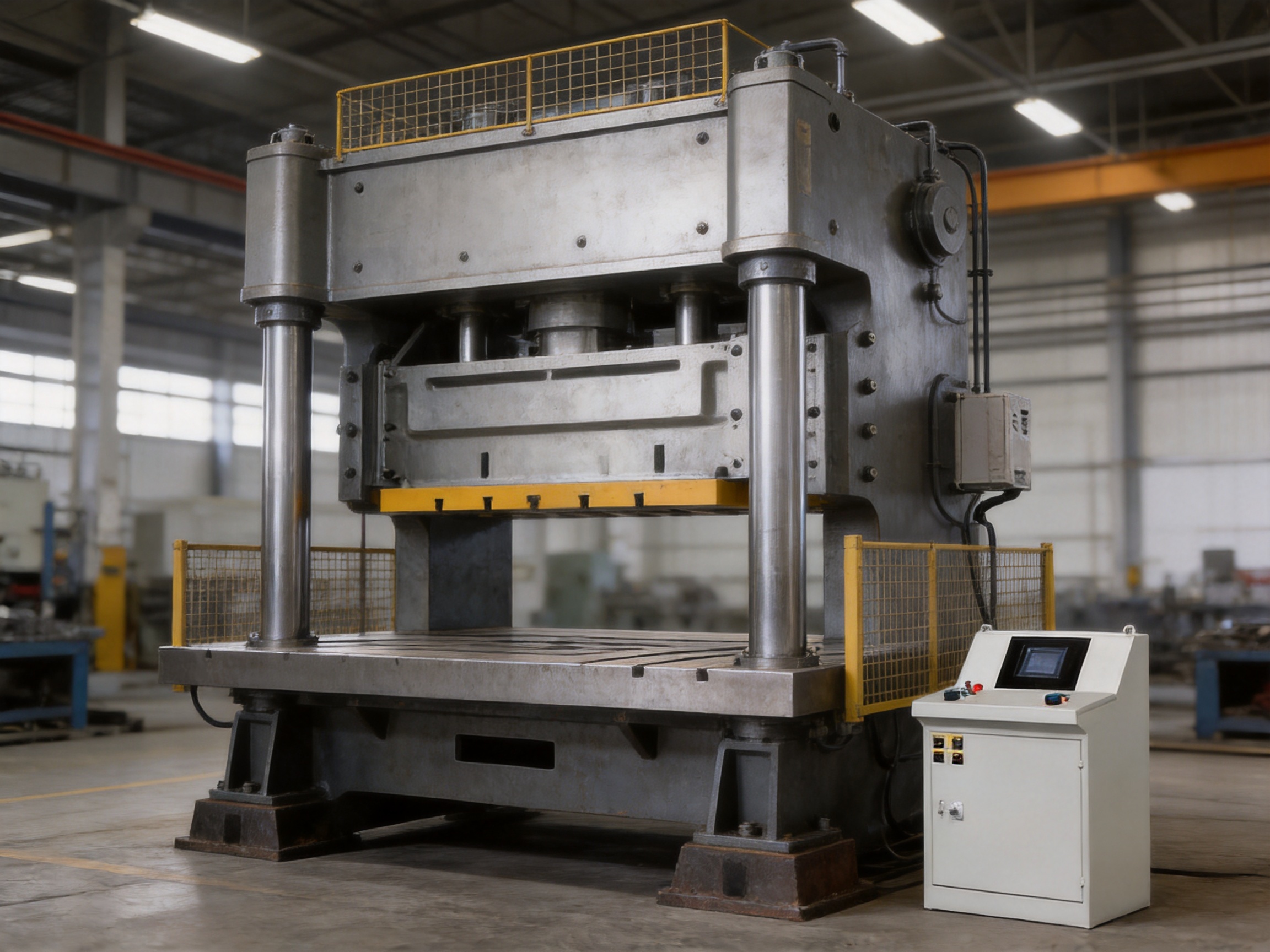
The BLPD-160 uses a 15 kW main motor in a four-pole configuration. The motor supplies the drive power needed to accelerate the press mechanism, maintain the required stroke rate, and recover energy through the machine’s operating cycle.
Motor power should not be evaluated in isolation. A press’s actual production performance is also affected by flywheel capacity, transmission efficiency, mechanical balance, lubrication, die load, material thickness, and operating speed. The 15 kW motor specification is appropriate for a press in this capacity range and supports stable operation for regular industrial production.
For continuous work, the drive system must be matched with the intended duty cycle. A press used for intermittent heavy forming may have different requirements from one used for high-volume blanking. Users should provide information about material, stroke rate, production hours, die type, and load pattern when confirming the final configuration.
Mechanical presses can deliver high forming force with relatively efficient repetitive motion. Once the flywheel and drive system reach operating conditions, the press can perform repeated cycles with consistent mechanical timing. However, energy consumption is influenced by speed, load, motor efficiency, auxiliary systems, idle time, and the number of setup changes.
The BLPD-160’s electric die adjustment system can also contribute to operational efficiency by reducing the time spent on manual setup. Faster changeovers do not directly reduce the energy used during each stroke, but they can increase productive machine utilization and reduce the amount of time the press remains unavailable for production.
The press is listed with a punch accuracy classification of GB/JIS Class 1. This classification provides an important quality reference, but the finished part accuracy will also depend on die construction, material consistency, lubrication, feeding accuracy, slide guidance, machine leveling, and maintenance.
Precision stamping is a complete system. Even a rigid press cannot compensate for a poorly designed die, uneven material thickness, incorrect clearance, or unstable feeding. Conversely, a well-designed die can make full use of a press’s structural precision and adjustment capability.
Several factors support consistent output from the BLPD-160:
• A heavy 16.8-ton frame that helps resist vibration.
• A 980 × 800 mm worktable for stable die support.
• A 200 mm stroke for controlled forming movement.
• Electric slide adjustment for repeatable setup.
• Digital die-height indication for visible process reference.
• A cushion system for forming and material-flow control.
• A four-pole 15 kW motor for stable drive performance.
These features are especially relevant when a customer needs reliable dimensional consistency rather than occasional low-volume operation. A production press should support a controlled process from tool installation to final inspection.
Long-term precision depends on preventive maintenance. Operators should inspect lubrication points, fasteners, slide guidance, die clamping components, pneumatic systems, electrical cabinets, safety devices, and abnormal vibration. Lubricant condition and supply should be monitored according to the maintenance schedule.
Tooling should also be checked regularly. Worn punches, loose inserts, uneven die surfaces, and damaged guide components can create defects that may be incorrectly attributed to the press. Maintaining a clear distinction between machine condition and tool condition helps maintenance teams identify the correct corrective action.
The performance of a power press is closely connected to the capabilities of the company that designs, machines, assembles, tests, and supports it. Zhejiang Bolun High-Precision Machinery Co., Ltd. operates in Zhejiang, a major center of China’s machinery and precision manufacturing industries. The company has developed its business around forging and forming equipment and integrates research and development, design, production, sales, and service.
This integrated structure can provide several advantages to customers. When engineering, machining, assembly, quality inspection, and technical service are connected within one organization, feedback from production and field use can be incorporated into future product improvements. It also allows the manufacturer to coordinate the press structure, drive components, adjustment mechanisms, and optional systems more effectively.
The company reports approximately two decades of experience in the machinery manufacturing industry. This period provides an opportunity to accumulate knowledge in structural design, machining methods, forming applications, process control, and customer support. Experience is particularly important in heavy machinery because the final result depends not only on individual components but also on how the complete system behaves under load.
Not every stamping operation fits a standard catalog configuration. Customers may require special table dimensions, different electrical standards, modified automation interfaces, additional safety equipment, customized cushions, or particular die-height arrangements. The company emphasizes non-standard customization and one-stop design and manufacturing services for products with special specifications and functions.
Customization is most effective when it begins with a clear review of the production process. The manufacturer should understand the workpiece, material, annual volume, die dimensions, target speed, loading method, unloading method, factory layout, safety requirements, and expected future production. This information can then be used to determine whether the standard BLPD-160 configuration is sufficient or whether additional engineering is needed.
A manufacturer with internal design and production capabilities can respond more directly to these requirements than a trading organization that depends entirely on external suppliers. This may simplify communication, improve technical accountability, and reduce uncertainty during installation and commissioning.
Large press components require accurate machining and careful assembly. Table flatness, slide alignment, guide clearance, shaft positioning, bearing installation, and drive-system geometry all affect the machine’s operating behavior. The company states that it owns advanced precision-processing equipment and maintains production capabilities covering basic design, core component development, final machining, and machine assembly.
In practical terms, a strong production system should include controlled machining procedures, process documentation, inspection checkpoints, calibrated measurement equipment, and trained assembly personnel. It should also verify the assembled press through no-load operation, adjustment checks, safety checks, and performance testing before shipment.
Heavy machinery manufacturing cannot rely on visual inspection alone. Critical dimensions and relationships must be measured. Components should be checked for material quality, machining accuracy, surface condition, and assembly fit. This approach helps reduce the risk of hidden defects that could appear only after the press is installed in a customer’s factory.
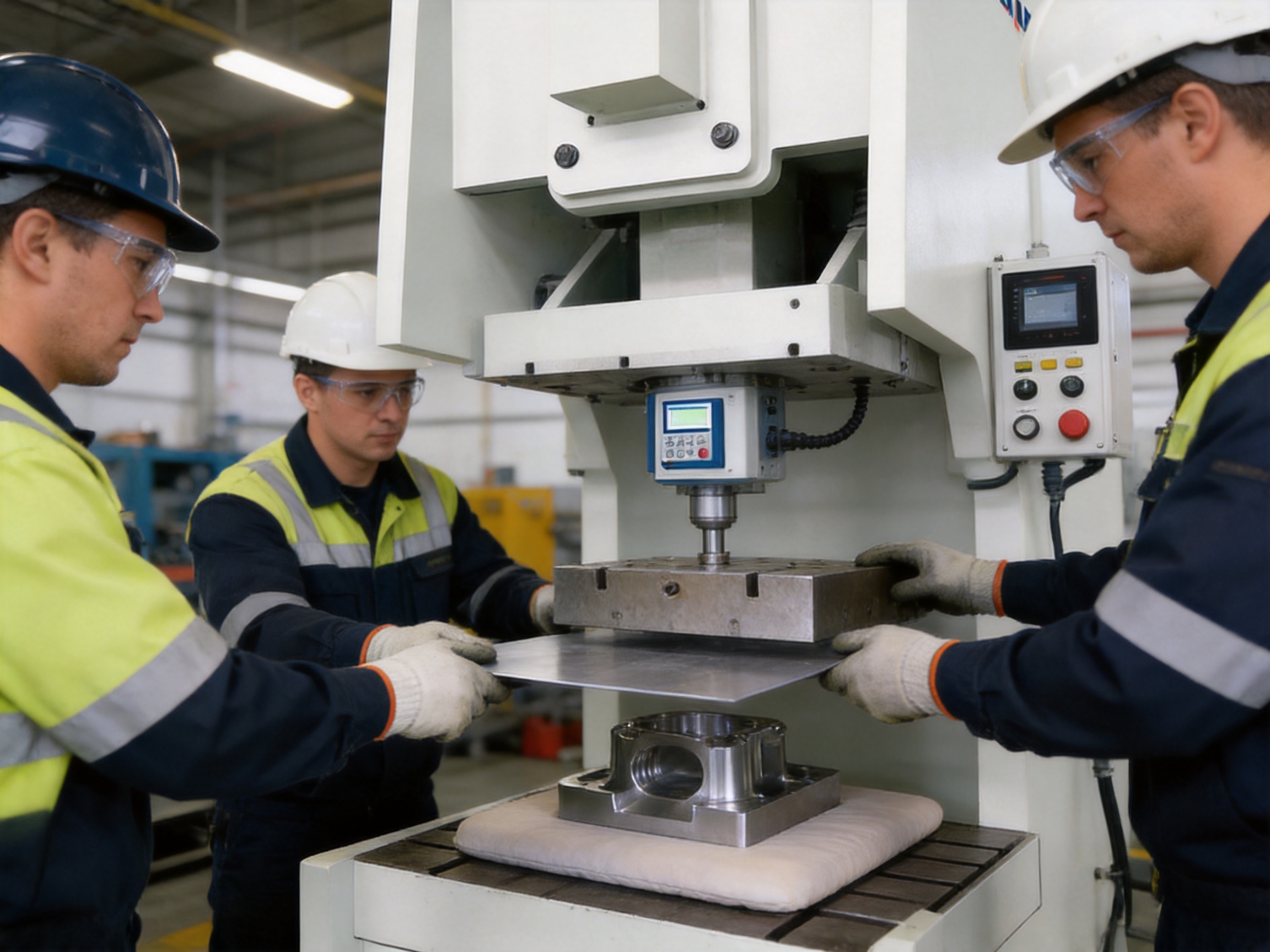
Quality assurance begins with design and continues through procurement, machining, assembly, testing, packaging, installation, and after-sales service. The company describes quality as a central principle and maintains a finished-product inspection system intended to exceed basic industry requirements.
For a machine such as the BLPD-160, a comprehensive inspection program may include verification of the following areas:
• Frame and table dimensions.
• Slide movement and adjustment range.
• Die-height indication accuracy.
• Drive-system operation and motor performance.
• Lubrication and pneumatic functions.
• Cushion movement and rated support conditions.
• Electrical control functions.
• Safety interlocks, emergency stops, and guarding.
• No-load noise, vibration, and abnormal temperature.
• Punch accuracy and alignment according to the applicable standard.
Testing before shipment provides a baseline for commissioning. It also enables the manufacturer to identify assembly problems before the machine reaches the customer’s facility. The final acceptance procedure should be agreed in advance and should reflect the selected configuration and customer requirements.
Technical support before purchase is important because press selection affects the entire production line. The manufacturer can assist with force calculations, die dimensions, table requirements, material conditions, production speed, cushion needs, automation compatibility, and plant installation conditions.
A responsible technical review should also identify limitations. If a particular component requires more force, more stroke, greater eccentric-load resistance, or a different automation system than the standard machine can provide, that issue should be identified early. Transparent engineering advice is more valuable than selecting a machine solely on the basis of a nominal capacity figure.
After delivery, the press must be installed, leveled, connected, tested, and integrated into the customer’s production process. Service support may include installation guidance, operator training, troubleshooting, spare-parts coordination, maintenance recommendations, and assistance with future modifications.
The company provides customer-oriented support covering pre-sales consultation, in-sales assistance, and after-sales guarantees. For international customers, clear documentation is particularly important. Manuals, electrical diagrams, lubrication instructions, spare-parts lists, foundation requirements, and safety procedures should be supplied in an understandable format.
The BLPD-160 competes not only with other 1600 kN presses but also with lower-cost machines that may offer fewer adjustment, forming, and support features. Its advantages become clearer when the complete production process is considered.
At 16.8 tons, the machine has a heavy physical structure designed for demanding forming work. Compared with lighter presses of similar nominal capacity, the additional mass may contribute to improved resistance to vibration and deflection. The benefit is most noticeable in continuous production, uneven loading, and operations where dimensional consistency is important.
The 980 × 800 mm worktable, 850 × 550 mm slide bottom, 460 mm maximum die height, and 200 mm slide stroke provide useful space for medium-sized tooling. This can reduce the need to dedicate the press to only one narrow product family.
The electric slide adjustment and digital die-height indicator distinguish the machine from simpler presses that require more manual intervention. Faster setup can improve utilization, especially where production involves multiple dies or frequent product changes.
The 100 kN mold pad capacity, 80 mm ram stroke, and 650 × 420 mm effective cushion area provide additional forming capability. A press without an appropriately configured cushion may be less suitable for operations involving controlled blank-holder pressure or material flow.
The 20–50 strokes-per-minute range provides flexibility. Users can select a slower operating rate for complex forming and a faster rate for simpler repetitive work, subject to tooling and material limitations. This is more practical than a machine optimized exclusively for either low-speed heavy work or high-speed light stamping.
The manufacturer’s stated design and non-standard production capabilities can be valuable when the customer needs more than a standard machine. Customization may improve compatibility with existing dies, transfer systems, conveyors, feeders, or factory safety requirements.
The BLPD-160 can serve a broad range of industries because its capacity and working dimensions are suitable for many medium-sized metal-forming tasks.
Automotive suppliers may use presses in this range for brackets, reinforcement components, small structural parts, covers, mounting plates, and formed hardware. The actual application depends on material grade, thickness, blank size, forming depth, and production volume.
Appliance manufacturers often require repeatable production of panels, brackets, supports, housings, and internal reinforcement parts. The generous worktable and adjustable die height can support a variety of tools used across different product models.
Electrical equipment makers may use the machine for enclosures, mounting components, terminal supports, brackets, and sheet-metal accessories. These parts often require accurate holes, controlled bends, and consistent dimensions for assembly.
Hardware producers can apply the press to handles, frames, clips, covers, brackets, and structural fittings. The machine’s moderate speed range allows users to select an operating condition appropriate to both simple blanking and more involved forming.
Job shops and contract manufacturers may benefit from the press’s versatility. A general-purpose machine can support short production runs, repeated batches, and customer-specific tooling, provided that each job is reviewed for force, die size, stroke, speed, and safety requirements.
Before ordering, users should prepare a technical information package. This helps the manufacturer confirm that the BLPD-160 is suitable and identify any required options.
The package should include material type, thickness, blank dimensions, finished-part dimensions, forming depth, required holes or bends, estimated forming force, production volume, target cycle time, die dimensions, die weight, die closed height, feeding method, unloading method, and automation requirements.
Customers should also clarify factory conditions, including available power supply, compressed-air quality, floor loading, ceiling height, access for transportation, environmental temperature, and local safety regulations. The listed overall dimensions are approximately 1600 × 2200 × 3500 mm, but final dimensions may change with accessories, guarding, electrical cabinets, lubrication systems, and automation equipment.
Tooling compatibility should be reviewed carefully. The table and slide dimensions must provide sufficient mounting area, and the die height must fall within the machine’s adjustment range. The die should also be compatible with the available cushion area and ram stroke where forming support is required.
• Is the calculated forming force safely below the press capacity?
• Does the load occur near the nominal pressure stroke?
• Is the die height within the 460 mm maximum and 100 mm adjustment range?
• Does the tool fit within the 980 × 800 mm worktable?
• Is the slide bottom sufficient for the upper die?
• Does the process require cushion pressure or a special ram arrangement?
• Is the selected speed appropriate for material flow and part quality?
• Are feeding and unloading systems compatible with the 200 mm stroke?
• What safety devices and control standards are required in the destination market?
• What spare parts and service support will be available after commissioning?
Safety is a basic requirement for every mechanical power press. Operators must be trained in machine controls, die setup, material handling, emergency procedures, and lockout practices. Guarding and safety devices should never be bypassed to increase production speed.
Before each production run, the operator should confirm that the die is securely mounted, the work area is clear, the lubrication system is functioning, the air pressure is available at the specified level, and the emergency stop and protective devices are operational. A slow test cycle should be completed after die installation or adjustment.
Maintenance should follow the manufacturer’s instructions and include scheduled lubrication, inspection of fasteners, checking of electrical connections, examination of pneumatic components, monitoring of unusual noise or vibration, and verification of slide and die-height adjustment functions.
Press overload should be avoided. If the machine stops unexpectedly, the operator should identify the cause rather than repeatedly restarting it. Possible causes may include die interference, material misfeed, excessive forming force, electrical fault, lubrication failure, or activation of a safety device.
Preventive maintenance is generally less costly than corrective repair after a failure. A maintenance log can record operating hours, die changes, lubrication activities, abnormal conditions, replacement parts, and inspection results. This information helps identify recurring issues and allows service teams to plan interventions during scheduled downtime.
Keeping commonly used consumables and recommended spare parts available can also reduce waiting time. The manufacturer should provide guidance on critical parts based on the operating environment, production schedule, and expected service life.
The economic value of a press should be evaluated through total production performance rather than purchase price alone. A lower-priced machine may become expensive if it produces inconsistent parts, requires frequent manual adjustment, limits tooling options, or experiences repeated downtime.
The BLPD-160 can create value in several ways. Its structural capacity allows it to support a wide range of medium-duty tools. Its adjustable slide and digital die-height indication can reduce setup time. Its cushion system can expand the types of forming operations available. Its heavy frame can support stable production when correctly installed and maintained.
Versatility is particularly important for contract manufacturers and factories with changing product requirements. Instead of purchasing separate specialized machines for every part family, a general-purpose press may support more jobs within the same production area. This can improve equipment utilization and simplify production planning.
Return on investment still depends on actual operating conditions. Customers should compare expected production volume, cycle time, labor requirements, die-change frequency, maintenance cost, energy consumption, scrap rate, and service support. A technical and economic assessment will provide a more reliable purchasing decision than a comparison of initial machine prices alone.
The BLPD-160 Versatile Balanced-Stability Semi-Closed Single-Point Power Press is designed for manufacturers seeking a combination of force, stability, tooling flexibility, and setup convenience. Its 1600 kN nominal capacity and 16.8-ton structural weight provide a solid foundation for medium-to-heavy stamping and forming operations.
The 200 mm slide stroke, 20–50 strokes-per-minute speed range, 980 × 800 mm worktable, 460 mm maximum die height, and 100 mm die-height adjustment range make the machine suitable for a broad selection of dies. The electric slide adjustment and digital die-height indicator support more efficient and repeatable setup. The 100 kN mold pad capacity and 650 × 420 mm effective cushion area provide additional capability for forming processes that require controlled material support.
Compared with basic presses, the machine’s main advantages are not limited to rated force. Its value comes from the interaction of structural mass, working dimensions, adjustable motion, forming support, precision classification, and the manufacturing resources behind the equipment.
Zhejiang Bolun High-Precision Machinery Co., Ltd. strengthens this offering through integrated research, design, machining, assembly, inspection, customization, sales, and service. Its experience in forging and forming machinery, precision manufacturing environment, and stated commitment to quality control provide a foundation for serving both standard and specialized customer requirements.
For the best result, users should evaluate the machine together with the intended die, material, forming force, production rate, automation system, and installation environment. When these elements are properly matched, the BLPD-160 can become a dependable production asset for precision stamping, drawing, blanking, bending, and general metal forming.
The nominal capacity is 1600 kN. The usable capacity for a particular operation depends on the forming-force curve, material, die design, load position, and distance from the nominal pressure stroke.
It is a semi-closed single-point power press designed for general stamping, drawing, blanking, bending, and forming applications.
The slide stroke is 200 mm. This provides useful vertical travel for general forming, drawing, part release, and dies with greater height requirements.
The listed speed range is 20–50 strokes per minute. The correct speed should be selected according to the material, die design, forming depth, required quality, and production conditions.
The worktable measures 980 × 800 × 140 mm. The working area should be compared with the actual die base, mounting holes, clamps, and cushion requirements before installation.
Yes. It includes an electric slide adjustment system, a digital die-height indicator, and a 100 mm die-height adjustment range. The maximum listed die height is 460 mm.
The main motor is rated at 15 kW in a four-pole configuration. A separate 1.1 kW motor is specified for die-height adjustment.
It can support suitable drawing and forming operations when the die, material, force calculation, cushion settings, and forming depth are within the machine’s rated limits. Specialized deep-drawing applications should be reviewed with the manufacturer.
The mold pad or cushion provides controlled support beneath the workpiece or blank-holder area. It can help manage material flow, reduce wrinkling, and improve consistency in suitable forming operations.
The listed mold pad capacity is 100 kN. The effective cushion area is 650 × 420 mm, and the ram stroke is 80 mm.
The machine is listed with GB/JIS Class 1 punch accuracy. Actual component accuracy also depends on tooling, material, feeding, lubrication, setup, and maintenance.
The company states that it provides non-standard customization and one-stop design and manufacturing services. Customers should submit detailed information about their parts, dies, production line, electrical requirements, and safety standards for technical evaluation.
Potential applications include automotive components, appliances, electrical hardware, general metal products, industrial equipment, contract stamping, and custom forming operations.
Customers should provide material type and thickness, blank and finished-part dimensions, forming depth, estimated force, die dimensions and weight, die closed height, target speed, production volume, feeding method, unloading method, factory power, compressed-air conditions, and applicable safety regulations.
Operators should use correct die setup, avoid overload, maintain lubrication, monitor abnormal vibration or noise, inspect slide adjustment functions, keep the machine level, and follow the recommended maintenance schedule.
1. General principles of mechanical power press design and operation.
2. Industrial metal stamping and sheet-forming process engineering references.
3. GB and JIS classifications for press and punch accuracy.
4. Standard practices for mechanical press installation, leveling, and foundation preparation.
5. Technical guidance for die design, forming-force calculation, and material-flow control.
6. Preventive maintenance principles for industrial stamping machinery.
7. Manufacturer-provided technical specifications for the BLPD series semi-closed single-point power presses.


Two presses can both carry a 200-tonne nameplate and still produce very differe...
A tooling engineer quotes a new bracket program and specifies a 160-ton press. ...
A fastener plant in Taizhou receives a request from an automotive tier-one supp...
What Is a Power Press? A power press — also called a stamping press or punch pr...
When you are planning to produce medium or small metal parts in high volumes, t...
A buyer comparing a 45-ton open-gap press for a bracket line often receives two...
Contact Us

topbolun@gmail.com

+86-575-83362228

+86-13735238388
+86-18667502750

+86-575-83362999

+8618667502750

No.1 Linjiang Road East, Xiaren, Jinting Town, Shengzhou City, Zhejiang Province, China
Ready to Begin?
Get in Touch

Now!

ZHEJIANG BOLUN
 English
 中文简体