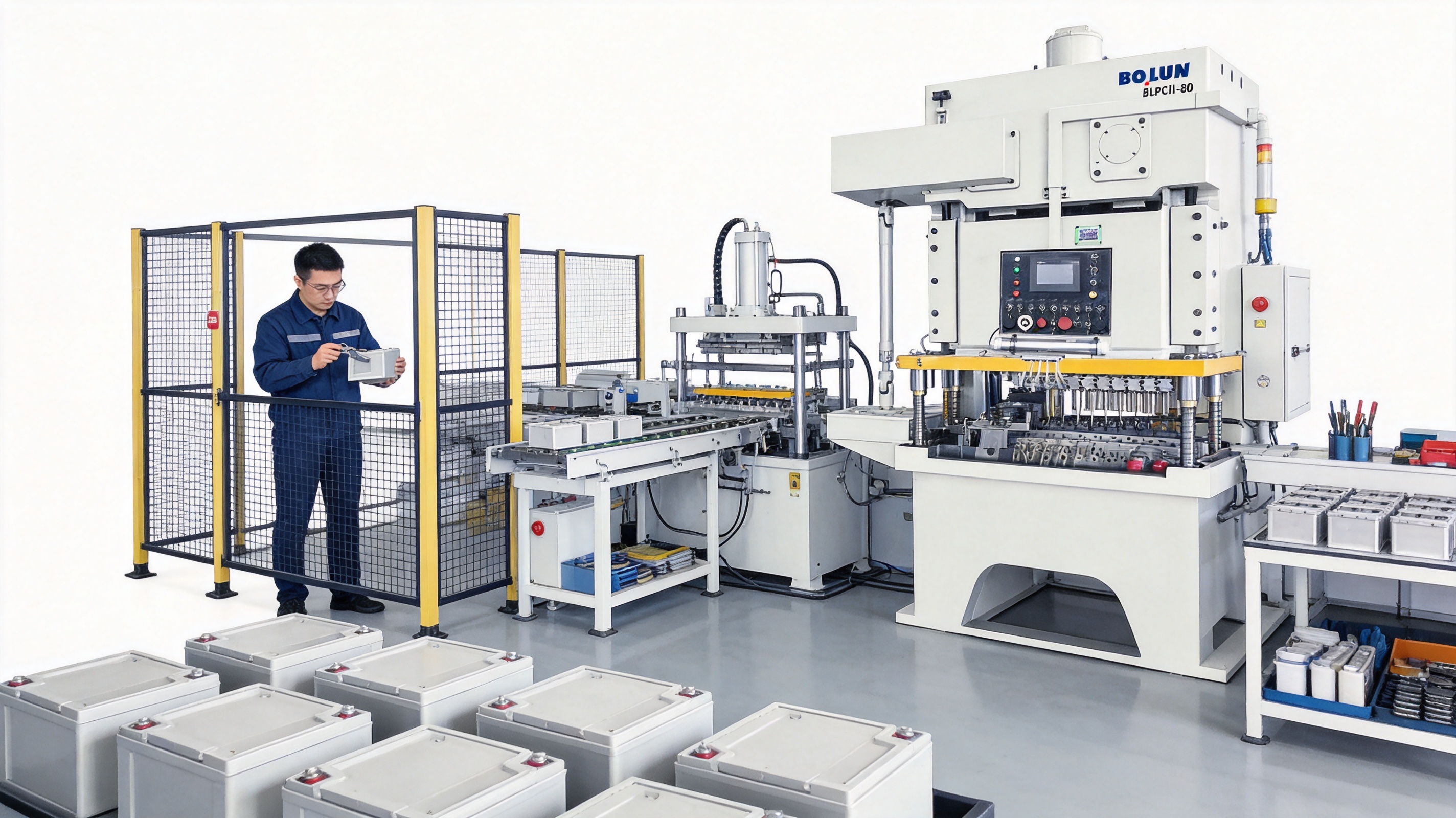
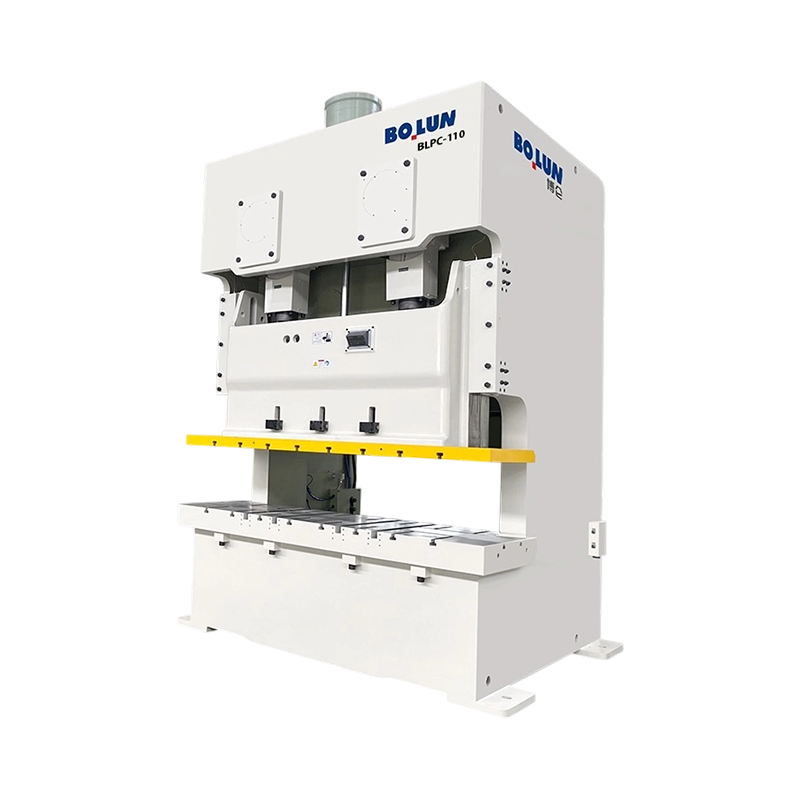
The BLPC2-80 Multi-Spec High-Precision Open-Type Double-Point Battery Power Press is designed for manufacturers that require high forming force, accurate slide movement, broad die compatibility, and dependable production stability. With a nominal capacity of 800 kN, a 180 mm slide stroke, a 1,600 × 610 mm worktable, and a maximum die height of 320 mm, the machine is positioned for demanding stamping and forming operations involving battery housings, energy-storage components, automotive parts, electrical enclosures, and other precision sheet-metal products.
Modern battery manufacturing places exceptional demands on forming equipment. Battery cases and related components often require controlled deformation, repeatable dimensions, clean surfaces, and reliable production over long operating cycles. A press must therefore provide more than nominal force. It must combine frame rigidity, balanced force transmission, accurate slide guidance, suitable die space, efficient lubrication, and stable control of operating parameters. The BLPC2-80 addresses these requirements through an open-type double-point configuration and a structural design intended for high-precision industrial production.
This article examines the machine’s principal specifications, structural advantages, manufacturing value, application range, and suitability for customers comparing high-performance power presses. It also discusses how the machine can support improved productivity and process consistency while explaining the importance of correct die design, installation, maintenance, and operator training.
The BLPC2-80 belongs to a family of open-type double-point battery power presses available in multiple capacities. Within the product range, the BLPCⅡ-63 provides a nominal capacity of 630 kN, the BLPCⅡ-80 provides 800 kN, and the BLPCⅡ-110 provides 1,100 kN. The BLPC2-80 is the middle-capacity model in this group, offering a balance between forming force, working area, operating speed, and overall equipment size.
The machine is especially suitable for production environments where a single-point press may not provide sufficient balance for wide or elongated dies. Its double-point slide arrangement distributes the working load across two connection points, helping support larger tooling and improving stability during forming. This feature is particularly valuable for battery cases and other components with extended dimensions, multiple forming stations, or demanding requirements for parallelism.
The product description identifies the BLPC2-80 as a multi-spec, high-precision, open-type double-point battery power press. The phrase “multi-spec” reflects its ability to accommodate a relatively wide selection of die sizes and configurations. The large worktable, expanded slide-bottom dimensions, adjustable die height, and substantial throat depth give production engineers more flexibility when selecting or modifying tooling.
The open-type frame also provides convenient access to the die area from several directions. This can simplify feeding, part removal, die inspection, setup, and integration with automated transfer systems. In practical production, accessibility can reduce setup time and help operators observe the forming process more easily than they could with a fully enclosed frame.
Although the machine is optimized for battery-related forming work, its capabilities are not restricted to one product type. Subject to material, die, and process requirements, it can be considered for deep-drawn or formed metal housings, electrical cabinets, appliance parts, automotive components, hardware products, and other large or medium-sized sheet-metal workpieces.
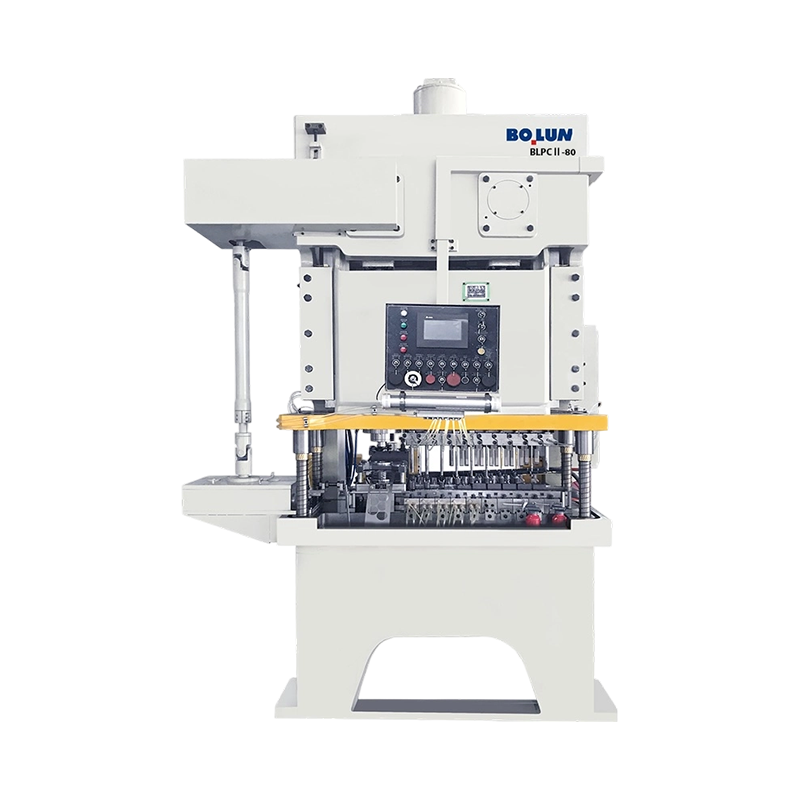
BLPC2-80 Multi-Spec High-Precision Open-Type Double-Point Battery Power Press
The technical specification of a power press provides the foundation for evaluating whether it is appropriate for a particular production process. Force capacity, slide stroke, speed, die height, worktable dimensions, throat depth, and motor power must be considered together. Selecting equipment only by nominal tonnage can result in an unsuitable machine if the die is too large, the stroke is insufficient, or the working height does not match the production line.
The BLPC2-80 has a nominal capacity of 800 kN. This is the maximum rated forming force under the specified nominal pressure stroke condition. The nominal pressure stroke is 5 mm, meaning the rated capacity is associated with a defined position near the bottom of the slide stroke. Process engineers should verify the actual force requirements of each operation and should not assume that the full nominal capacity is available at every point of the stroke.
| Specification | BLPCⅡ-63 | BLPCⅡ-80 | BLPCⅡ-110 |
|---|---|---|---|
| Nominal capacity | 630 kN | 800 kN | 1,100 kN |
| Nominal pressure stroke | 5 mm | 5 mm | 5 mm |
| Slide stroke | 140 mm | 180 mm | 190 mm |
| Strokes per minute | 50–80 S.P.M. | 45–75 S.P.M. | 35–70 S.P.M. |
| Maximum die height | 280 mm | 320 mm | 480 mm |
| Die height adjustment | 50 mm | 80 mm | 90 mm |
| Worktable size | 1,300 × 550 × 120 mm | 1,600 × 610 × 130 mm | 1,970 × 680 × 130 mm |
| Slide bottom size | 1,200 × 500 × 70 mm | 1,450 × 520 × 70 mm | 1,800 × 580 × 70 mm |
| Side opening | 250 × 120 mm | 300 × 140 mm | 320 × 180 mm |
| Throat depth | 285 mm | 310 mm | 350 mm |
| Distance between columns | 1,000 mm | 1,200 mm | 1,550 mm |
| Height of working face | 940 mm | 957 mm | 1,085 mm |
| Maximum die weight | 360 kg | 450 kg | 690 kg |
| Air pressure | 0.55 MPa | 0.55 MPa | 0.55 MPa |
| Power supply | Three-phase, 380 V, 50 Hz | Three-phase, 380 V, 50 Hz | Three-phase, 380 V, 50 Hz |
| Main motor | 7.5 kW × 4 | 11 kW × 4 | 15 kW × 4 |
For the BLPC2-80, the 180 mm slide stroke is a major practical advantage. Compared with the 140 mm stroke of the smaller model, it provides additional vertical travel for deeper forming operations, larger blank holders, and dies requiring greater opening clearance. This extended stroke is especially relevant to battery housings and energy-storage components, where part depth and draw geometry can exceed the requirements of ordinary shallow stamping.
The machine operates at a listed range of 45 to 75 strokes per minute. The actual production speed depends on material behavior, die design, feeding method, forming depth, lubrication, part-removal requirements, and quality targets. A lower speed may be appropriate for deeper or more demanding forming operations, while higher speeds may be used for simpler components when process stability has been confirmed.
The maximum die height is 320 mm, with 80 mm of die-height adjustment. This range provides useful flexibility when installing dies of different construction heights or when adapting tooling for multiple products. The ability to adjust die height can reduce the need for extensive modification of existing tools, although every die must still be checked for shut height, clearance, guide alignment, and rated load.
The 1,600 × 610 mm worktable gives the BLPC2-80 a broad working platform. Its 130 mm table thickness contributes to structural support and provides a stable base for tooling. The 1,450 × 520 mm slide-bottom area complements the table size, allowing the machine to support wide dies and multi-station arrangements within the permitted load and dimensional limits.
The double-point arrangement is one of the most important features differentiating this machine from many conventional single-point open presses. In a single-point design, the slide force is transmitted through one central connection. This can be effective for narrow tooling, but wide dies or unevenly distributed loads may place greater demands on slide rigidity and guide systems.
A double-point slide uses two connection locations to transmit motion and force. When properly adjusted, this arrangement helps maintain more balanced movement across the width of the slide. It is particularly suitable for broad dies, progressive tooling, multiple forming stations, and components whose load is distributed across a large working area.
For battery-case production, balanced slide motion can be valuable because the workpiece may be relatively wide and the die may include several functional areas. Better load distribution can help reduce angular deflection, uneven die wear, and variations in wall geometry. It can also provide a more stable foundation for operations that require consistent alignment between upper and lower tooling.
The open-type frame offers another practical advantage. Operators and automation equipment can approach the working area from the front and sides, depending on the layout. This may support straight-through feeding, side feeding, robotic handling, coil-fed arrangements, or custom transfer systems. The specific automation configuration must be engineered according to the workpiece, die, speed, and safety requirements.
Compared with a narrow single-point press, a double-point machine can be a stronger candidate for tooling that is wide relative to its forming force. Compared with a fully enclosed press, an open-type machine can offer more convenient die access and potentially simpler integration with handling equipment. These advantages do not eliminate the need for correct die design, but they expand the range of practical production configurations.
High-precision forming depends heavily on the stiffness of the machine structure. During a stamping cycle, the frame, slide, table, columns, connection points, and die all experience force. If these components deform excessively, the result may be uneven clearance, inconsistent part dimensions, accelerated die wear, surface defects, or reduced tool life.
The BLPC2-80 is described as having a high-rigidity steel frame. A rigid steel frame is intended to resist deformation under repeated forming loads and to maintain the relationship between the slide and worktable. This structural stability is important for precision work because even small changes in alignment can affect the final product, particularly in deep drawing, piercing, blanking, and multi-operation forming.
Frame rigidity also contributes to vibration control. Uncontrolled vibration can affect surface quality, increase noise, loosen tooling, and create fatigue in mechanical components. A stable frame helps the machine absorb and transmit operating forces more predictably. This is especially useful when the press is used over extended shifts or when production involves high-strength materials that generate substantial forming resistance.
Precision should be understood as a complete system rather than as a single numerical claim. The final result depends on frame construction, machining accuracy, slide guidance, die quality, material consistency, lubrication, setup discipline, and maintenance. A high-precision press creates the foundation for accurate production, but the entire process must be managed to realize that capability.
The extended table and slide dimensions of the BLPC2-80 also support stability for large dies. A die that is properly supported over the working area is less likely to experience unwanted movement or local stress concentration. Correct clamping, suitable bolster arrangements, and evenly distributed loading remain essential for safe and accurate operation.
The BLPC2-80 incorporates an electric automatic lubrication system. Lubrication is essential for reducing friction and wear at moving interfaces, including guide surfaces, bearings, joints, and other specified mechanical points. In a production press, consistent lubrication is directly related to reliability, operating smoothness, and service life.
Manual lubrication can be effective when performed correctly, but it depends heavily on operator discipline and timing. Difficult-to-reach points may be missed, and lubricant quantity may vary from one maintenance cycle to another. An automatic system helps deliver lubricant according to a programmed or controlled schedule, reducing the likelihood of irregular lubrication.
Automatic lubrication can also support production continuity. By reducing the number of manual intervention points, it helps operators focus on setup, quality, material handling, and process monitoring. However, an automatic system does not remove the need for inspection. Reservoir levels, lines, filters, pumps, delivery points, and alarms should be checked regularly according to the maintenance plan.
The correct lubricant must be selected for the machine and operating environment. Using an incompatible lubricant, mixing products without confirmation, or ignoring contamination can reduce system effectiveness. Maintenance personnel should follow the equipment documentation and establish inspection records for lubricant condition, consumption, pressure, and distribution.
When combined with a rigid frame and appropriate maintenance, automatic lubrication contributes to the machine’s ability to maintain stable performance over long production periods. It also supports the product’s stated objective of minimizing wear and preserving accuracy during complex forming work.
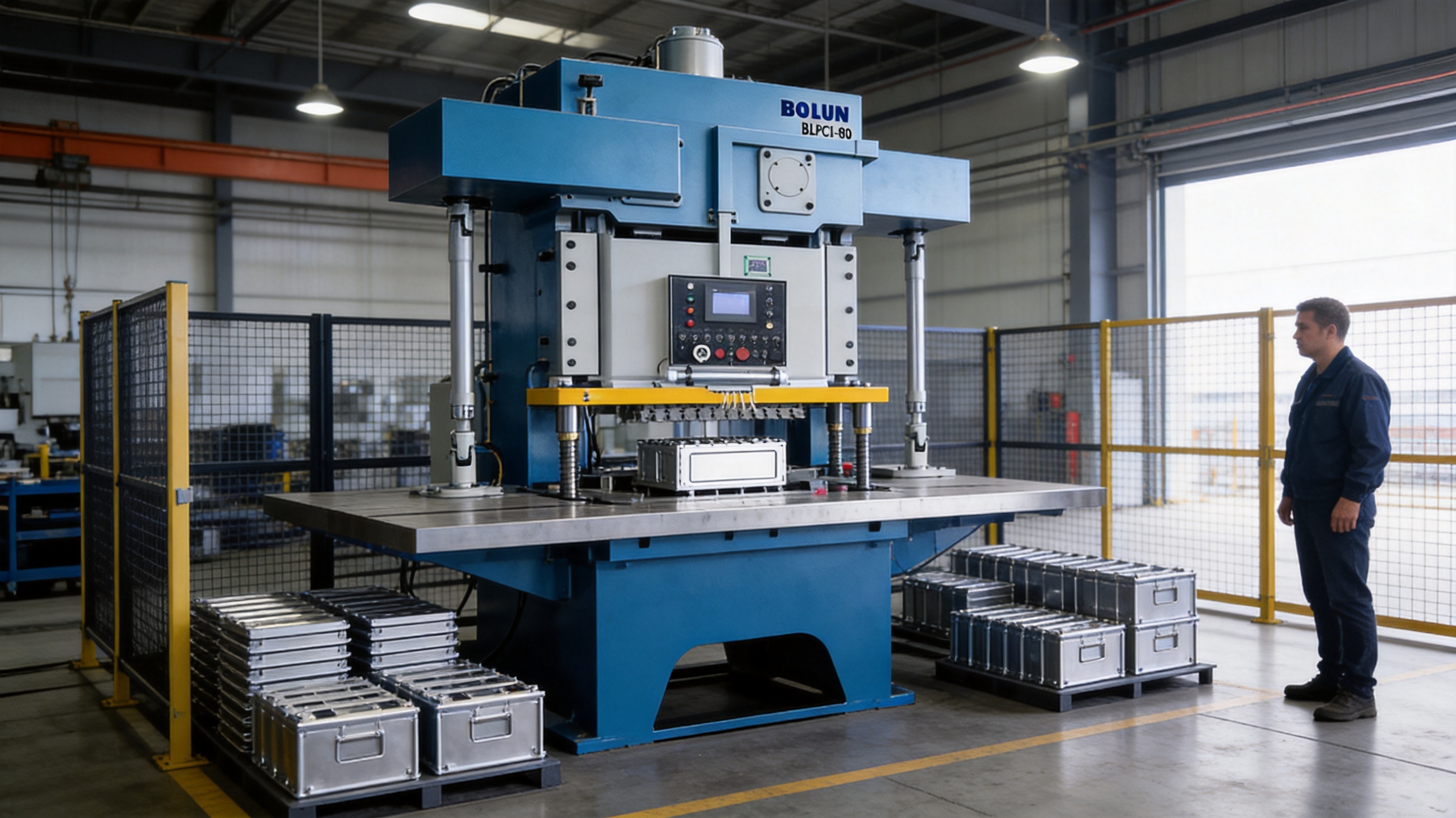
Battery housings require careful control of geometry, surface condition, and dimensional repeatability. Depending on the battery type and design, the housing may need to accommodate internal cells, separators, electrical connections, cooling arrangements, sealing features, or protective structures. The forming process must therefore achieve the required depth and shape without excessive thinning, wrinkling, cracking, or distortion.
The BLPC2-80 is suited to battery-case work because its 800 kN nominal capacity provides a substantial force range, while its 180 mm stroke accommodates deeper forming operations than a shorter-stroke machine. The large worktable and double-point slide also offer a practical platform for wide battery housings and specialized energy-storage components.
Typical operations may include blanking, drawing, shallow forming, bending, embossing, piercing, trimming, and combined multi-operation stamping. The exact process depends on material grade, thickness, geometry, production volume, and required tolerances. Some products may require separate operations, while others may be manufactured with progressive or compound dies.
Battery production often involves materials such as aluminum, coated steel, stainless steel, or other engineered alloys. Each material has different forming behavior. Aluminum may require careful control of lubrication and radii to reduce galling or surface damage. High-strength steel may require increased force and careful management of springback. Stainless steel may require appropriate tooling clearance and lubrication to control friction and work hardening.
The press itself does not determine the entire forming result. Die radii, blank-holder force, draw-bead configuration, material preparation, lubrication, feeding accuracy, and unloading method are equally important. The machine’s role is to provide a stable and accurately controlled platform that allows the tooling and process to perform consistently.
For energy-storage components, production planners should evaluate not only forming depth but also the complete downstream process. Parts may require trimming, deburring, washing, inspection, welding, coating, sealing, or assembly. The open configuration of the machine can make it easier to connect the press with conveyors, transfer mechanisms, and inspection stations, subject to a suitable guarding and safety design.
Manufacturers comparing power presses commonly evaluate force capacity, speed, accuracy, tooling flexibility, ease of maintenance, energy consumption, automation compatibility, and total ownership cost. The BLPC2-80 offers a combination of features that can be attractive where a basic general-purpose press is not sufficient.
With 800 kN of nominal capacity, the BLPC2-80 provides a meaningful increase over the 630 kN model in the same product family. This additional force can support larger workpieces, thicker materials, deeper forming, or dies with more demanding load requirements. It gives production engineers more process margin when a smaller machine would operate too close to its rated limit.
Operating with appropriate reserve capacity can be beneficial because real production conditions vary. Material strength may fluctuate, lubrication may change, and tooling wear may increase forming resistance. Selecting a press with suitable capacity helps reduce the likelihood that minor process variation will immediately create overload risk. The force requirement must still be calculated carefully, and the press should not be intentionally overloaded.
The 180 mm slide stroke is a clear differentiating feature. A longer stroke allows greater die opening and more vertical travel for components with deeper profiles. It can also improve access during loading and unloading, depending on the specific setup. For battery housings and other containers, this additional travel may simplify die design and provide more flexibility in selecting forming stages.
Compared with a shorter-stroke machine, the BLPC2-80 can be more adaptable when a product line includes both shallow and deeper components. This versatility may reduce the need to dedicate separate equipment to each product family, although cycle-time and tooling evaluations are still required.
The 1,600 × 610 mm worktable and 1,450 × 520 mm slide bottom provide a substantial working envelope. This is advantageous for wide dies, multi-cavity arrangements, transfer tooling, and parts requiring several forming or piercing stations. A larger working area can also make future product development easier because new dies may be designed within a wider dimensional range.
In comparison with a compact press, a larger working envelope can reduce the need for extensive die overhang. Proper support of the die can improve stability and help distribute forming loads more evenly. It may also support more efficient material flow when multiple parts are arranged across a strip or sheet.
The 320 mm maximum die height and 80 mm adjustment range give users practical flexibility when setting up tooling. This is useful for manufacturers that operate several dies with different construction heights. It can also support changes in die design, replacement of wear components, and process optimization.
Die-height adjustment should always be performed within the manufacturer’s specified procedure. The operator must confirm that the actual closed height, slide position, die clearance, and safety interlocks are correct before production begins.
The double-point configuration is advantageous for wide and asymmetric tooling. It can help maintain more balanced force transmission across the slide than a single central connection. This may reduce uneven loading and support improved dimensional consistency, provided that the machine and die are correctly aligned.
For competitors offering only narrow single-point presses, the BLPC2-80 may provide a more suitable platform for broad battery housings and large-format components. The benefit is most relevant when the die width and load distribution make slide balance a significant process concern.
The integrated electric automatic lubrication system supports consistent maintenance of specified moving parts. This can help reduce avoidable wear and provide more predictable operation over long production periods. It is particularly useful in environments where the press operates continuously and manual lubrication opportunities are limited.
The manufacturer, Zhejiang Bolun High-Precision Machinery Co., Ltd., is described as an integrated enterprise covering research and development, design, production, sales, and service. This integrated structure is important for industrial equipment because press performance depends on coordination between mechanical design, machining, assembly, testing, application engineering, and after-sales support.
A company with in-house design and production capabilities can respond more effectively to application-specific requirements. Customers may need special worktable arrangements, modified feeding systems, non-standard die interfaces, automation connections, or customized machine functions. A manufacturer that understands the complete equipment architecture is better positioned to evaluate such requests than a supplier that only assembles standard components.
The company’s stated manufacturing approach includes a full-chain production system, precision processing equipment, core component development, and final machine assembly. Each stage contributes to the final performance of the press. The frame must be produced accurately, moving components must be machined to appropriate tolerances, guidance systems must be aligned, and assembly procedures must preserve the intended geometry.
Precision machining is especially important for the table, slide, connecting elements, guide surfaces, and mounting interfaces. Dimensional accuracy at these locations influences die alignment and the repeatability of the forming cycle. Machining quality must be supported by inspection, because even a well-designed machine can lose performance if components are not verified properly.
The company also emphasizes a finished-product inspection system covering processes and components. A comprehensive inspection approach may include dimensional checks, functional tests, lubrication verification, electrical inspection, no-load operation, loaded operation, safety-system checks, and final assembly review. The exact inspection sequence depends on the machine configuration and applicable standards.
Quality control is not limited to final inspection. Process control during fabrication and assembly is equally important. Welding, stress management, machining, surface treatment, component installation, wiring, and commissioning should all be controlled through documented procedures. Early detection of deviations reduces the risk of transferring problems to the finished machine.
The company’s experience in machinery manufacturing, described as extending across two decades, provides a foundation for product improvement and application knowledge. Long-term exposure to different materials, dies, production speeds, and customer requirements can help a manufacturer refine machine structures and service procedures.
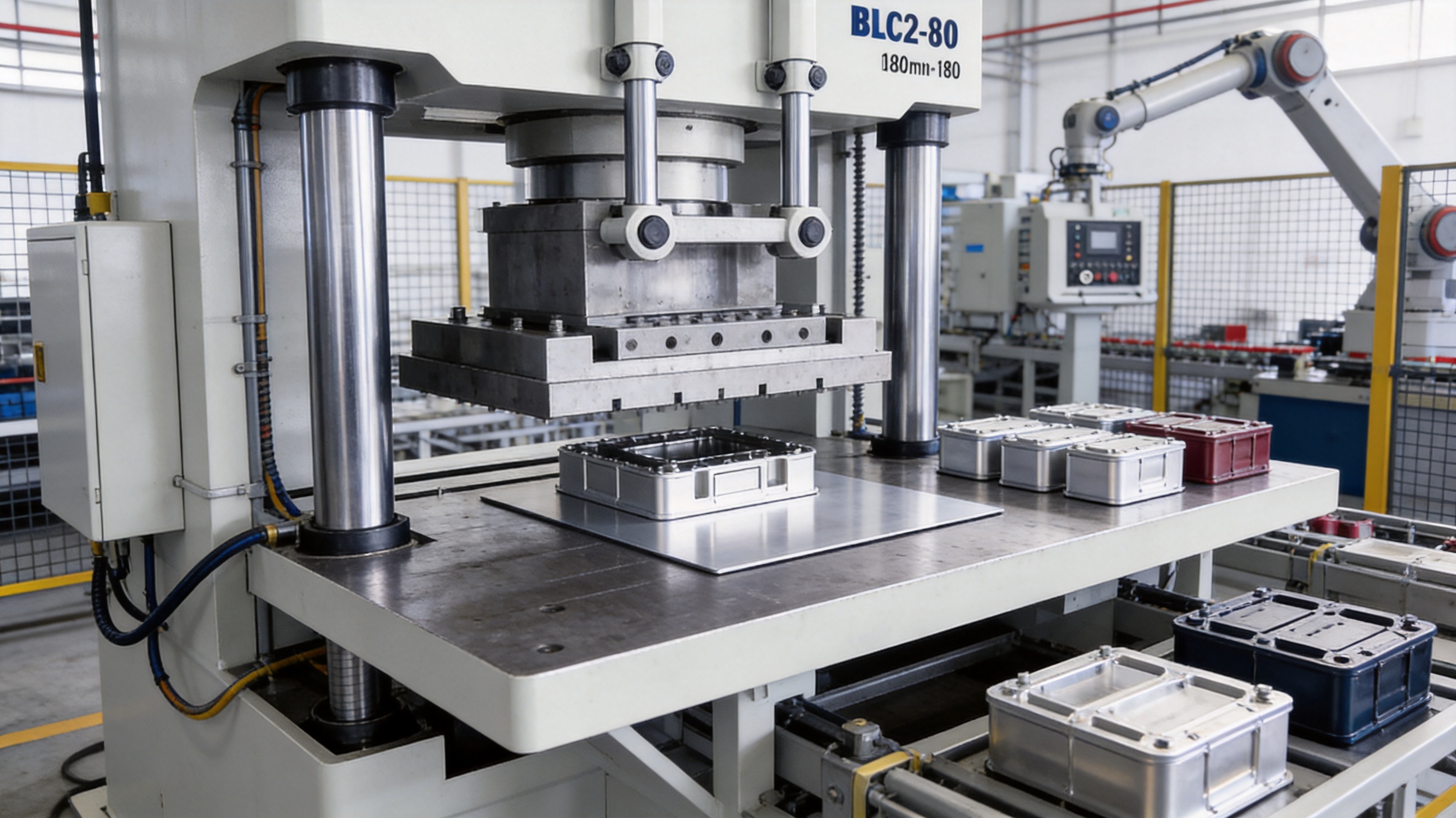
Battery components are not uniform. Their dimensions, materials, forming depth, wall thickness, corner radii, surface requirements, and downstream processes can differ substantially. For this reason, customers often need more than a standard press catalog. They may require assistance with press selection, die compatibility, material trials, feeding, transfer, safety guarding, and line integration.
The manufacturer states that it provides non-standard customization and one-stop design and manufacturing services for products with special specifications and functions. This capability can be valuable for customers developing a new battery housing or adapting an existing line to a different product family.
Customization may involve worktable dimensions, die mounting arrangements, control functions, automated feeding, part discharge, sensors, safety devices, or communication with other production equipment. Any modification must be evaluated against the press frame, drive system, rated force, stroke, speed, and applicable safety requirements.
Application engineering should begin with a clear production definition. Important information includes the material grade, material thickness, blank dimensions, final part dimensions, forming depth, annual production volume, required cycle time, die type, number of operations, acceptable tolerances, and available plant utilities.
For a battery-case application, customers should also provide information about surface finish, sealing requirements, dimensional inspection points, and any restrictions on lubricant or cleaning chemistry. These factors influence die design and the selection of auxiliary equipment.
A reliable supplier should help determine whether the BLPC2-80 is the correct model or whether a smaller or larger machine is more appropriate. The 630 kN model may be sufficient for certain smaller parts, while the 1,100 kN model may be preferable for very large or force-intensive products. The correct selection depends on the actual forming calculation rather than on nominal product category alone.
Successful operation begins with correct installation. The foundation must be suitable for the machine’s weight, operating loads, and vibration characteristics. The installation area should provide enough space for die handling, material loading, product removal, maintenance access, electrical connection, compressed air, and safety guarding.
The listed air pressure for the BLPC2-80 is 0.55 MPa. The plant air system should be capable of supplying the required pressure and flow consistently, with suitable filtration and moisture control. Contaminated or wet compressed air can affect pneumatic components and reduce reliability.
The listed power supply is three-phase, 380 V, 50 Hz. Electrical installation must be completed by qualified personnel and should comply with local regulations. Voltage stability, grounding, overload protection, emergency-stop circuits, and control-panel installation should all be verified before commissioning.
After installation, the press should be checked for level, alignment, lubrication function, electrical operation, slide movement, die-height adjustment, safety functions, and abnormal noise or vibration. Initial operation should proceed at a controlled speed without production material until the machine response has been confirmed.
Die installation requires particular attention. The die must be within the permitted weight and dimensional limits. For the BLPC2-80, the listed maximum die weight is 450 kg. The die should be secured with suitable clamps or mounting arrangements, and the load should be distributed appropriately on the table and slide.
Before production, operators should verify the upper and lower die alignment, shut height, feed position, blank placement, clearance, ejection, and part-removal path. A low-speed trial can help identify interference or material-flow problems before full-speed operation.
Maintenance is essential for preserving precision and extending service life. The automatic lubrication system reduces the burden of routine lubrication, but it does not replace a complete preventive-maintenance program. Operators and maintenance personnel should inspect lubricant levels, delivery lines, visible wear, fasteners, electrical connections, sensors, and safety devices.
Slide guidance and die alignment should be monitored for signs of abnormal wear. Indicators may include unusual noise, inconsistent product dimensions, increasing vibration, visible scoring, or a change in the force required for a familiar operation. Early investigation can prevent minor issues from developing into major failures.
The frame and table should be kept clean and protected from accumulated scrap, lubricant residue, and foreign material. Debris beneath a die can affect height and alignment. Debris in moving areas can damage surfaces or interfere with sensors and guards.
Maintenance records should include inspection dates, lubricant additions, component replacements, abnormal findings, corrective actions, and production hours. A documented history helps identify recurring issues and supports more accurate planning of replacement parts and service intervals.
Tooling maintenance is equally important. A well-maintained press cannot compensate for a damaged or improperly adjusted die. Punches, inserts, guide components, springs, blank holders, and cutting edges should be inspected according to the die manufacturer’s recommendations.
When operating conditions change, such as a new material, higher production speed, or modified die, the maintenance plan may need to be updated. Higher loads or longer cycles can influence lubrication consumption, wear rates, and inspection frequency.
Power presses contain significant mechanical energy and must be operated only by trained personnel. Operators should understand the machine controls, emergency-stop system, die-setting procedure, permissible material, operating limits, and approved methods for clearing faults.
Hands and tools must never be placed in the die area while the machine is capable of cycling. Appropriate guarding, two-hand controls, light curtains, interlocks, or other protective devices should be selected and installed according to the machine configuration and applicable regulations.
Safety procedures should cover normal operation, setup, die change, maintenance, cleaning, jam removal, inspection, and emergency response. Lockout and tagout procedures should be applied before maintenance or any task that requires access to hazardous moving parts.
Operators should monitor abnormal vibration, noise, overheating, lubricant alarms, air-pressure loss, electrical faults, and changes in product quality. The machine should be stopped and inspected when a potentially unsafe condition appears.
Production targets must never take priority over safe operation. Correct training, clear work instructions, routine inspections, and disciplined maintenance are essential to obtaining the benefits of a high-performance press.
The BLPC2-80 is a strong candidate when the production requirement falls between compact general-purpose stamping and very large high-capacity forming. Its 800 kN capacity, 180 mm stroke, broad worktable, and double-point configuration provide a balanced specification for medium-to-large battery housings and related components.
Customers should consider this model when they need a longer stroke than a smaller open press can offer, a wider working area for large dies, or improved load distribution across the slide. It may also be appropriate when a company wants one machine to support several product sizes rather than investing in a narrowly specialized press.
The machine can be evaluated using several practical questions. Is the required forming force below the rated capacity with an appropriate safety margin? Does the part require the full 180 mm stroke? Will the die fit within the table and slide dimensions? Is the die weight within the 450 kg limit? Can the planned feeding and unloading method be integrated with the open frame? Are the available electrical and air supplies compatible?
Production planners should also calculate the expected output using the actual operating speed rather than the maximum listed speed. The suitable strokes per minute may be reduced by deep drawing, complex material handling, manual loading, quality inspection, or downstream operations.
Where the production process is highly automated, the press should be considered as one part of an integrated system. Feeding, blank positioning, lubrication, transfer, inspection, scrap removal, and finished-part handling can all affect the real line capacity.
The value of a power press should be assessed over its service life rather than by purchase price alone. Important factors include production consistency, maintenance requirements, die flexibility, downtime risk, energy use, operator workload, spare-parts availability, technical support, and the ability to adapt to future products.
The BLPC2-80’s broad working range can support product diversification. A manufacturer producing several types of housings or formed components may benefit from a press that accommodates different die sizes and heights. This flexibility can reduce the need for frequent equipment replacement as product requirements evolve.
The high-rigidity frame and automatic lubrication system are also relevant to lifecycle value. Stable structural performance can help preserve accuracy, while consistent lubrication can reduce avoidable wear. Neither feature eliminates maintenance, but both can contribute to predictable long-term operation when supported by appropriate service practices.
The manufacturer’s integrated capabilities in design, manufacturing, inspection, customization, and service can further support total ownership value. A supplier that remains involved after delivery can help customers address setup questions, process changes, spare parts, and future equipment requirements.
The BLPC2-80 has a nominal capacity of 800 kN. The rated capacity is associated with the specified 5 mm nominal pressure stroke. Actual process requirements should be calculated according to material, die design, forming method, and load position.
The machine is designed for battery housings and energy-storage components, but it can also be used for suitable automotive parts, electrical enclosures, appliance components, hardware products, and other sheet-metal forming applications. Product suitability depends on material, dimensions, force, stroke, die design, and production method.
The 180 mm stroke provides additional travel for deeper products and greater die-opening clearance. It is useful for battery housings and other components that require more vertical forming space than a short-stroke press can provide.
The maximum die height listed for the BLPC2-80 is 320 mm, with an 80 mm die-height adjustment range. The actual die installation must be checked against the machine’s operating instructions and the tooling requirements.
The listed maximum die weight is 450 kg. The die must also comply with the permitted dimensions and must be mounted and supported correctly to ensure safe load distribution.
The worktable measures 1,600 × 610 mm, with a listed thickness of 130 mm. The slide bottom measures 1,450 × 520 mm, with a listed thickness of 70 mm.
The double-point design distributes slide force through two connection points. This can improve load balance and support wide or elongated dies, especially when the forming load is distributed across a broad work area.
The open-type configuration provides access that can support feeding, transfer, unloading, and inspection systems. Automation suitability depends on the workpiece, die, cycle time, safety design, and required interface equipment.
No. Automatic lubrication helps deliver lubricant consistently, but the reservoir, delivery lines, pump, lubrication points, filters, and related components still require inspection. The machine also needs regular checks for alignment, wear, fasteners, electrical systems, safety devices, and abnormal operating conditions.
The listed power supply is three-phase, 380 V, 50 Hz. Electrical installation should be completed and verified by qualified personnel in accordance with local requirements.
The listed air pressure is 0.55 MPa. The plant air system should provide clean, dry, and stable compressed air at the required pressure and flow.
The BLPC2-80 provides higher nominal capacity, a longer 180 mm stroke compared with 140 mm, a larger worktable, greater maximum die height, and a larger throat depth. It operates at a listed range of 45–75 strokes per minute, compared with 50–80 strokes per minute for the smaller model.
The 1,100 kN model may be more suitable for larger workpieces, thicker materials, deeper or more force-intensive forming, or dies requiring greater dimensions and die height. The choice should be based on a detailed forming-force and tooling evaluation.
The manufacturer states that it provides non-standard customization and design and manufacturing services for special specifications and functions. Customers should provide detailed information about the product, die, process, automation, and plant utilities so that customization can be evaluated correctly.
Buyers should confirm forming force, stroke, die height, die weight, table size, slide size, throat depth, feeding method, production speed, electrical supply, air pressure, safety requirements, maintenance support, spare parts, installation conditions, and after-sales service.
The BLPC2-80 Multi-Spec High-Precision Open-Type Double-Point Battery Power Press combines an 800 kN nominal capacity with a 180 mm slide stroke, a 1,600 × 610 mm worktable, a 320 mm maximum die height, and a 450 kg maximum die weight. These specifications make it a practical solution for manufacturers producing battery housings, energy-storage components, and other wide or deep-formed sheet-metal products.
Its double-point construction supports balanced force transmission across broad tooling, while the open-type frame provides convenient access for die setup, material handling, and automation integration. The high-rigidity steel frame is intended to support precision and reduce vibration, and the electric automatic lubrication system contributes to consistent mechanical maintenance.
Compared with smaller or more narrowly configured presses, the BLPC2-80 offers a useful combination of force, stroke, working space, die flexibility, and production adaptability. Its advantages are most valuable when the application requires deeper forming, larger dies, balanced slide operation, and stable performance over extended production cycles.
The machine’s long-term value also depends on the manufacturer’s broader capabilities. Integrated research, design, precision processing, assembly, inspection, customization, and service provide a foundation for supporting customers from initial equipment selection through installation and ongoing production. When combined with suitable tooling, correct installation, trained operators, and disciplined maintenance, the BLPC2-80 can serve as a dependable foundation for high-precision industrial forming.
1. Product technical data for the BLPCⅡ series open-type double-point battery power presses.
2. Manufacturer-provided product description for the BLPC2-80 Multi-Spec High-Precision Open-Type Double-Point Battery Power Press.
3. General principles of mechanical power-press design, slide guidance, die-height adjustment, and double-point load distribution.
4. Industrial practices for sheet-metal stamping, deep drawing, battery-housing forming, and die maintenance.
5. General preventive-maintenance principles for mechanical presses, automatic lubrication systems, compressed-air systems, and industrial electrical equipment.
6. General occupational-safety practices for power-press installation, operation, guarding, setup, maintenance, and lockout procedures.


A buyer comparing a 45-ton open-gap press for a bracket line often receives two...
Two presses can both carry a 200-tonne nameplate and still produce very differe...
What Is a Power Press? A power press — also called a stamping press or punch pr...
Understanding Mechanical Power Presses and Their Essential Functions A mechani...
A tooling engineer quotes a new bracket program and specifies a 160-ton press. ...
In the fields of metal forming, sheet metal fabrication, blanking, and punching,...
Contact Us

topbolun@gmail.com

+86-575-83362228

+86-13735238388
+86-18667502750

+86-575-83362999

+8618667502750

No.1 Linjiang Road East, Xiaren, Jinting Town, Shengzhou City, Zhejiang Province, China
Ready to Begin?
Get in Touch

Now!

ZHEJIANG BOLUN
 English
 中文简体