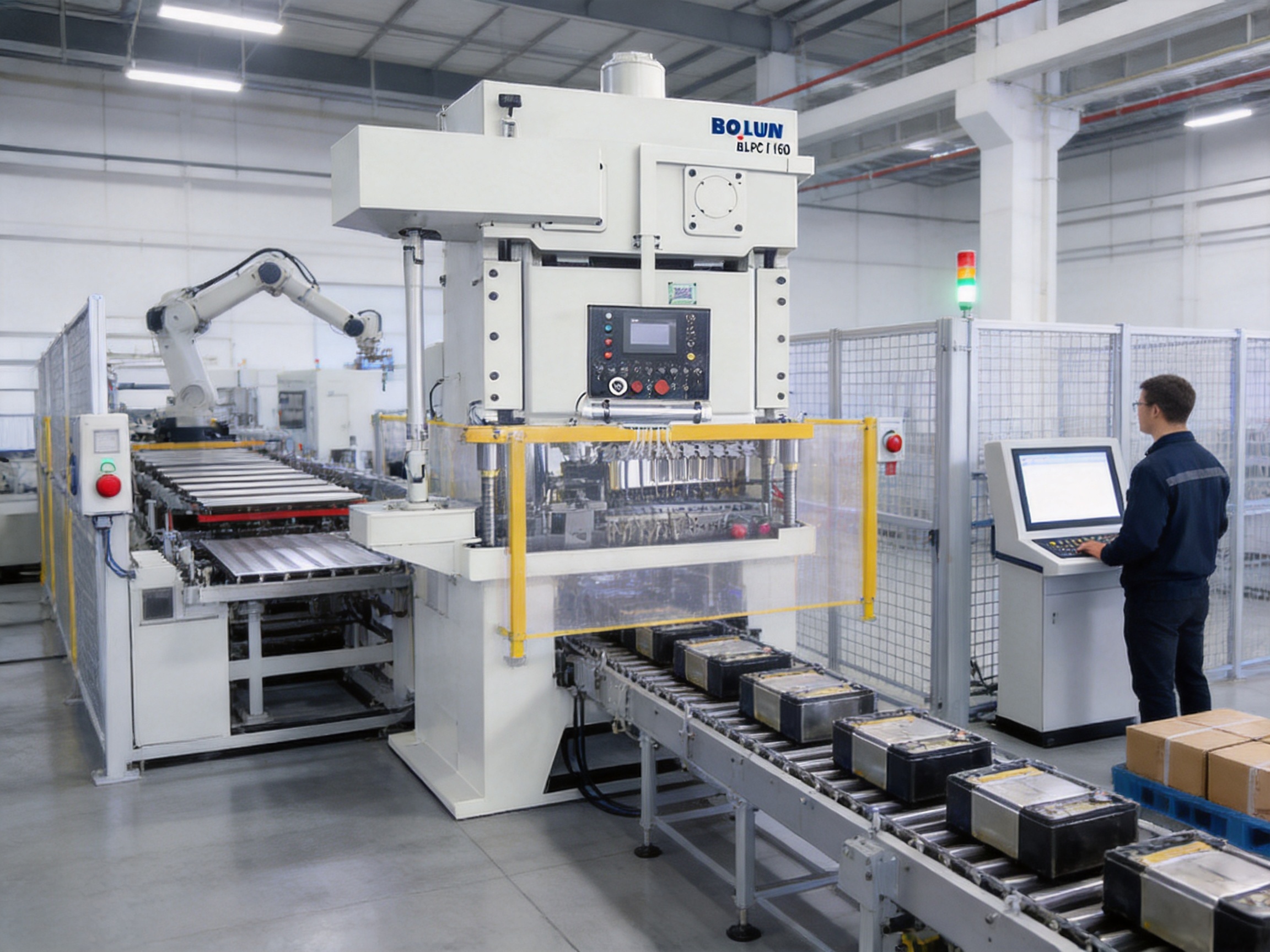
Modern battery manufacturing requires forming equipment that combines high force, repeatable accuracy, rapid production, and reliable operator protection. Battery shells and related structural components are often produced from sheet materials that demand controlled deformation, stable tooling support, and consistent cycle performance. A press that lacks rigidity, load balance, or adequate working space can create dimensional variation, premature die wear, surface defects, and unplanned downtime.
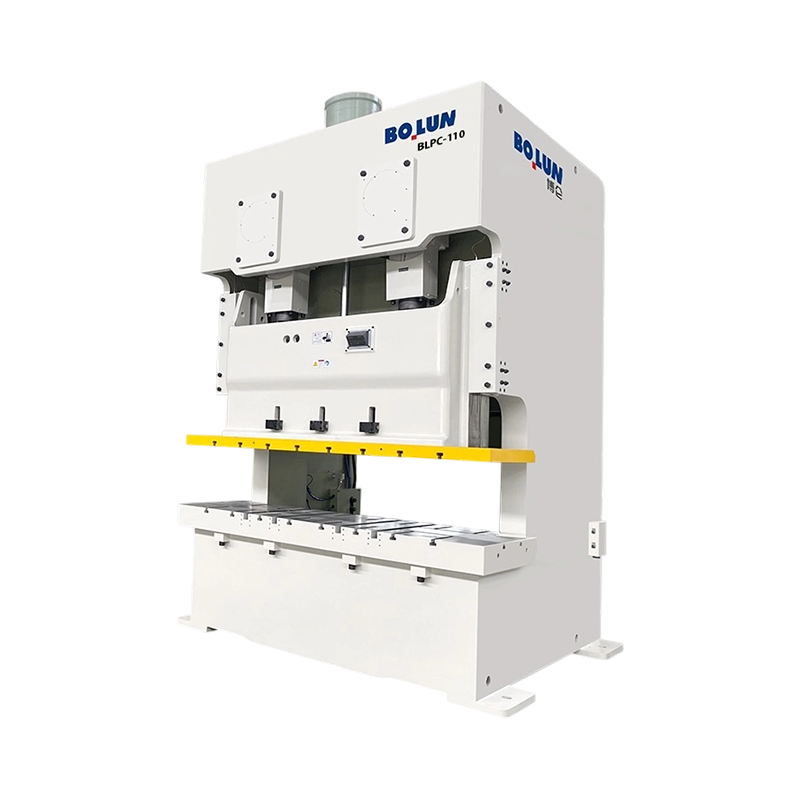
The BLPC2-160 High-Tonnage Ultra-Stable Battery Shell Open-Type Double-Point Battery Power Press is designed for demanding forming applications in the battery component industry. Its open-type double-point architecture is intended to distribute forming loads across two drive points, improving slide stability during large-area pressing operations. The platform is suitable for production environments that require broad tooling access, large dies, multi-station configurations, and dependable operation at medium-to-high production speeds.
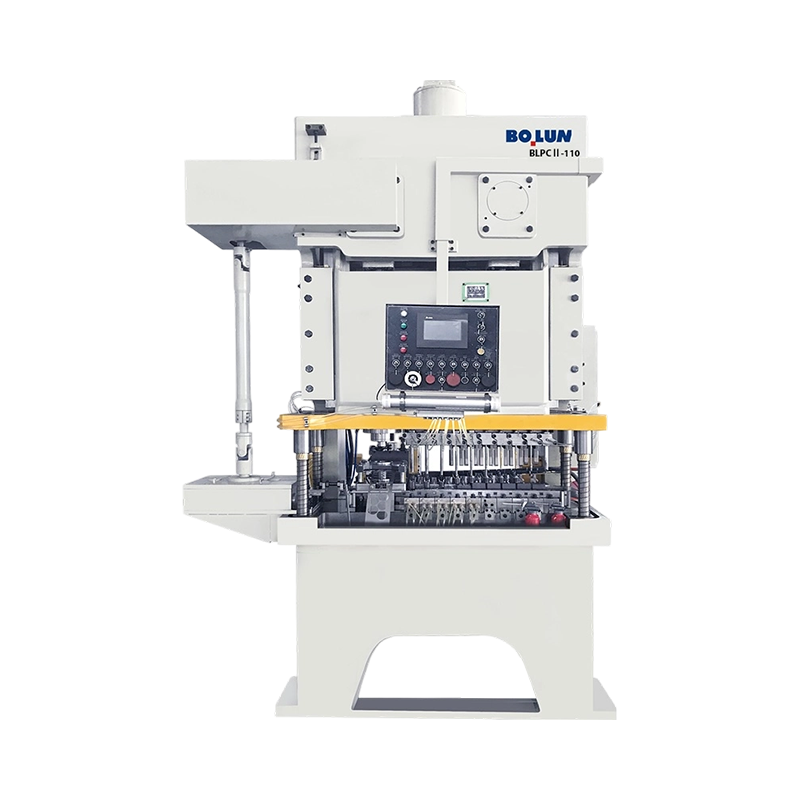
Although the supplied technical information presents detailed data for the BLPC II family in 63-ton, 80-ton, and 110-ton nominal-capacity configurations, the product description identifies this equipment series as a high-tonnage battery shell press. The documented BLPC II-110 configuration provides a nominal capacity of 1,100 kN, a maximum die height of 480 mm, and a worktable measuring 1,970 × 680 mm. These figures demonstrate the working philosophy of the product family: a large forming envelope, stable double-point loading, adaptable stroke rates, and an industrial structure intended for high-load production.
The press is positioned for large-scale battery component forming, particularly applications in which the workpiece has a relatively broad footprint or requires a die set with multiple forming stages. Battery shells, covers, trays, structural panels, reinforcing parts, and other formed sheet-metal components may require a press with more than simple nominal tonnage. The machine must also offer enough table area, die-height capacity, throat depth, and slide travel to accommodate the complete tooling system.
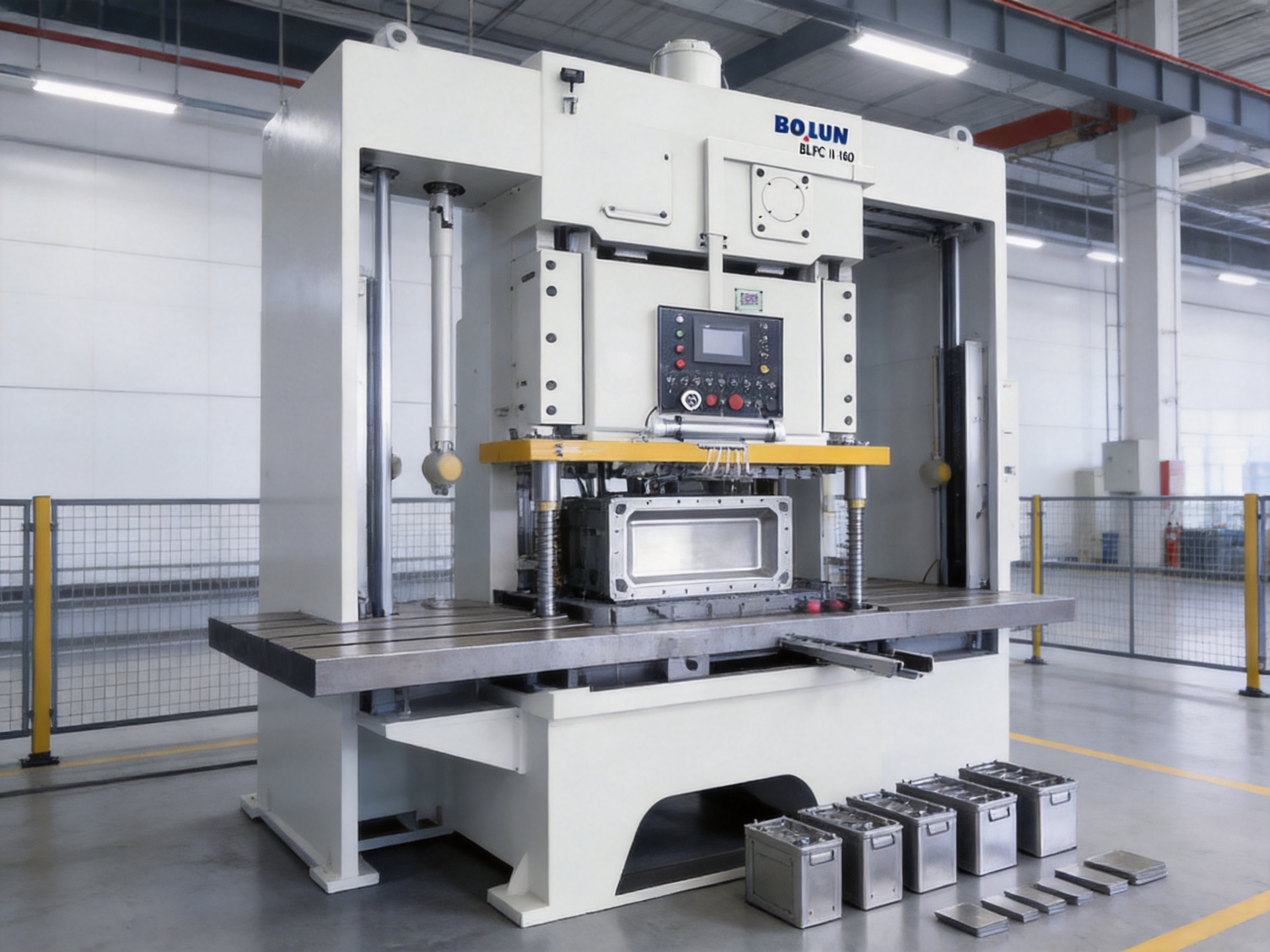
An open-type frame gives the operator and tooling designer improved access around the working area. Compared with a more enclosed configuration, an open front and accessible side structure can simplify die installation, material feeding, inspection, maintenance, and integration with transfer or automation equipment. This is valuable in battery-component production, where tooling changes and process adjustments may be required as product designs evolve.
The double-point drive is one of the most important characteristics of the machine. A single-point press applies force through a central connection, while a double-point press uses two separated force application points. When properly engineered and adjusted, the double-point arrangement helps reduce slide tilting and distributes the forming load more evenly across the working width. This is especially useful when a large die, asymmetric workpiece, or multi-cavity tooling arrangement places uneven resistance on the slide.
The product is therefore not simply a high-force stamping machine. It is a forming platform intended to address the practical challenges of large battery components: broad tooling, changing loads, controlled slide movement, production efficiency, and operator safety.
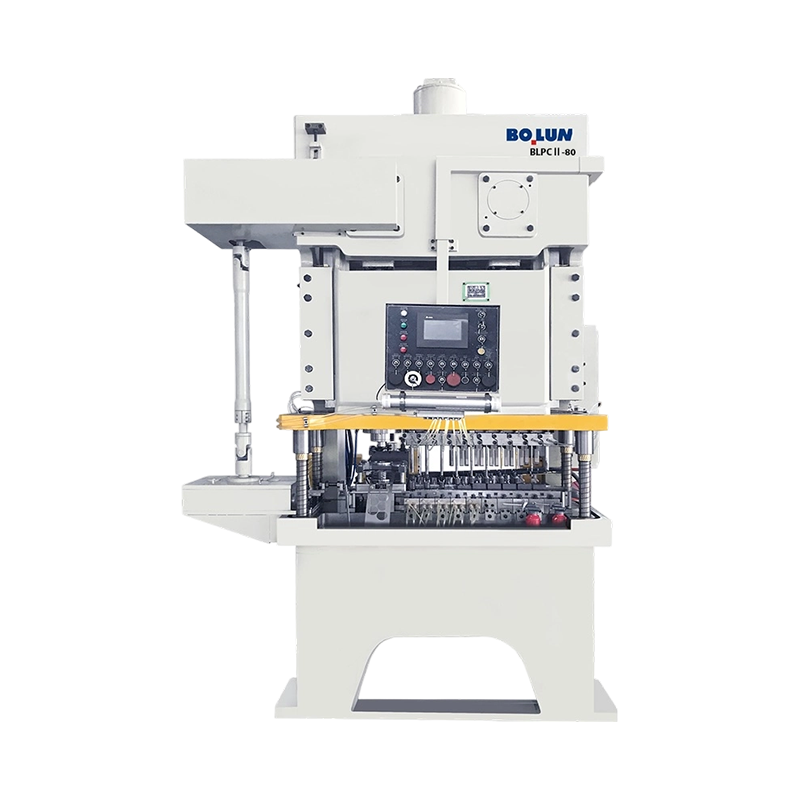
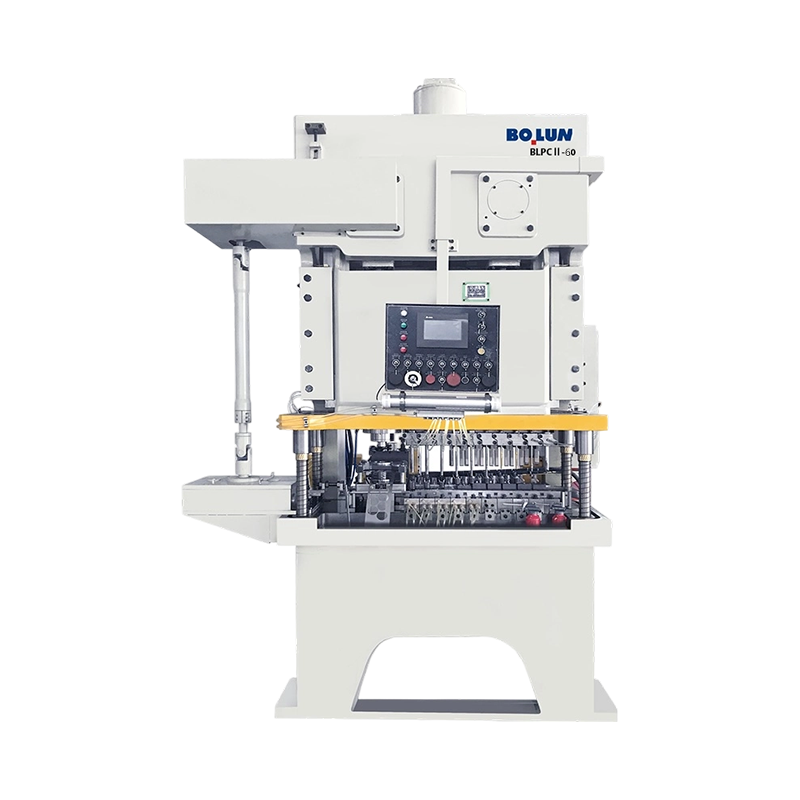
The documented BLPC II family includes three principal configurations: BLPC II-63, BLPC II-80, and BLPC II-110. The available specification sheet lists nominal capacities of 630 kN, 800 kN, and 1,100 kN respectively. The following table summarizes the supplied technical information.
| Technical Item | Unit | BLPC II-63 | BLPC II-80 | BLPC II-110 |
|---|---|---|---|---|
| Nominal capacity | kN | 630 | 800 | 1,100 |
| Nominal pressure stroke | mm | 5 | 5 | 5 |
| Slide stroke | mm | 140 | 180 | 190 |
| Strokes per minute | S.P.M. | 50–80 | 45–75 | 35–70 |
| Maximum die height | mm | 280 | 320 | 480 |
| Die-height adjustment | mm | 50 | 80 | 90 |
| Worktable size | mm | 1,300 × 550 × 120 | 1,600 × 610 × 130 | 1,970 × 680 × 130 |
| Slide bottom size | mm | 1,200 × 500 × 70 | 1,450 × 520 × 70 | 1,800 × 580 × 70 |
| Side opening | mm | 250 × 120 | 300 × 140 | 320 × 180 |
| Throat depth | mm | 285 | 310 | 350 |
| Distance between columns | mm | 1,000 | 1,200 | 1,550 |
| Working-face height | mm | 940 | 957 | 1,085 |
| Maximum weight | kg | 360 | 450 | 690 |
| Air pressure | MPa | 0.55 | 0.55 | 0.55 |
| Power supply | V/Hz | Three-phase, 380 V, 50 Hz | Three-phase, 380 V, 50 Hz | Three-phase, 380 V, 50 Hz |
| Main motor | kW × poles | 7.5 × 4 | 11 × 4 | 15 × 4 |
These figures show a clear increase in working capacity across the range. As nominal capacity rises, the table and slide dimensions also expand, die-height adjustment increases, and the space between columns becomes wider. This scaling is important because a higher-force press is only useful if its tooling envelope can support the intended component size and forming sequence.
Load stability is a decisive factor in large-format stamping. During forming, the resistance generated by the material is not always perfectly centered. Variations may result from the shape of the part, uneven lubrication, progressive tool stations, material thickness, blank positioning, or differences in local deformation. If these forces act through a single central point, the slide can experience tilting or uneven pressure distribution.
The double-point structure addresses this challenge by connecting the drive system to the slide at two separated points. This configuration provides a broader support pattern and helps maintain parallel movement across the working width. It is particularly valuable for dies that are wide, multi-cavity, or arranged with several forming zones.
For battery shell production, stable slide movement can contribute to more consistent wall geometry, flange dimensions, corner formation, and surface quality. It can also reduce the risk of one side of the die closing earlier than the other. When the tool is correctly installed and maintained, balanced drive behavior supports more predictable clearance conditions and may help reduce localized die loading.
The double-point design also offers an advantage when production changes from one component to another. A flexible press should accommodate tooling variations without requiring excessive compensation for slide instability. This flexibility can be valuable for manufacturers producing multiple battery formats or supplying components to different customers.
It is important to distinguish structural stability from process accuracy. The machine structure provides the foundation, but final part quality also depends on die design, material properties, lubrication, blank preparation, alignment, press adjustment, and production control. The BLPC platform is designed to strengthen the mechanical foundation of that process by providing a stable, wide-support forming arrangement.
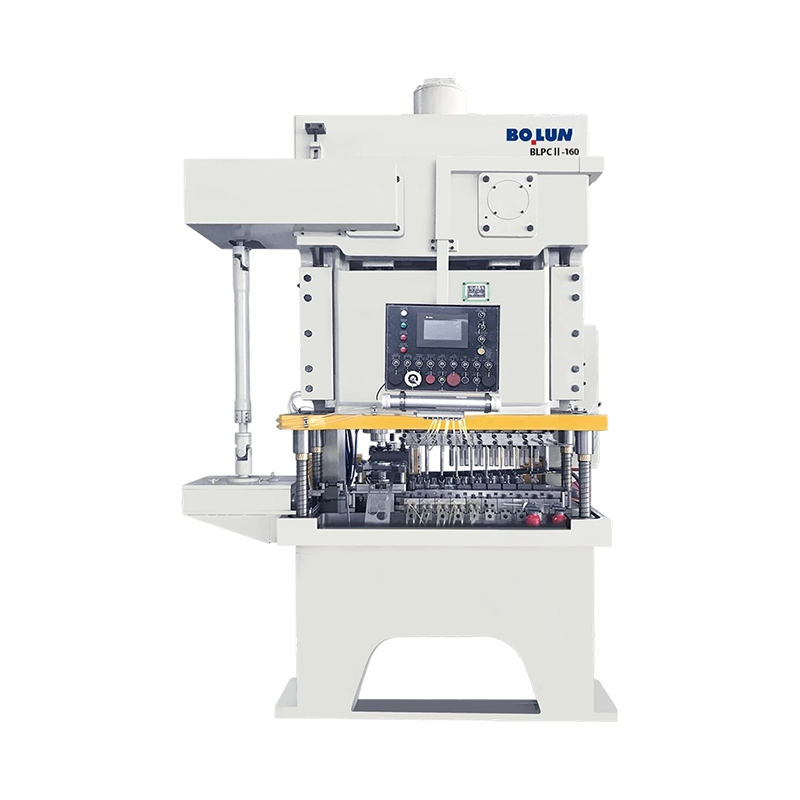
BLPC2-160 High-Tonnage Ultra-Stable Battery Shell Open-Type Double-Point Battery Power Press
Large battery components often require dies with substantial length and width. In addition to the active forming surfaces, the die may include guide systems, blank holders, material supports, sensors, ejectors, trimming areas, or progressive stations. A press with a small table can force the tooling designer to compromise on layout or reduce the number of operations completed in one setup.
The BLPC II-110 configuration provides a worktable of 1,970 × 680 mm and a slide bottom of 1,800 × 580 mm. This broad working area supports large dies and provides space for multi-station tooling arrangements. The 480 mm maximum die height gives tool designers additional vertical room for forming assemblies, guide components, lifters, and other accessories.
The 90 mm die-height adjustment range in the BLPC II-110 configuration allows the machine to accommodate variations in die construction and shut-height requirements. This adjustment is useful when production moves between different tools or when a tool requires precise setup for a particular forming sequence.
The 350 mm throat depth provides a significant distance from the front of the frame to the working line. This dimension can affect the usable forming area and the type of part that can be supported. The 1,550 mm distance between columns further increases the open working width, making the larger configuration suitable for broad components and wide tooling layouts.
In practical production planning, working-envelope dimensions should be evaluated together rather than individually. A large table is not sufficient if the slide bottom is too small. A high die-height capacity is not sufficient if the throat depth restricts the tool. The BLPC design presents a coordinated relationship among table size, slide size, column spacing, throat depth, and die-height adjustment.
Compared with conventional narrow-bed presses, this broader layout can reduce the need to divide a forming operation into too many separate machine stages. Fewer stages may simplify material handling, reduce intermediate storage, and improve process continuity. Whether a specific production line can consolidate operations depends on the part geometry and tooling design, but the machine provides the physical space needed to evaluate that option.
Battery component production must balance output with forming quality. Increasing press speed can improve productivity, but excessive speed may affect material flow, lubrication, die filling, vibration, noise, and part transfer. A fixed-speed machine gives the operator fewer options when different materials or tools require different cycle conditions.
The supplied product description identifies inverter-based speed regulation as part of the operating concept. The documented BLPC II family offers speed ranges of 50–80 strokes per minute for the 63-ton configuration, 45–75 strokes per minute for the 80-ton configuration, and 35–70 strokes per minute for the 110-ton configuration. The lower speed range of the larger configuration reflects the heavier forming load and larger mechanical scale, while still providing useful production flexibility.
Variable speed control allows production engineers to select a suitable operating point rather than forcing every tool to run at the same rate. A shallow forming operation may be able to operate toward the upper part of the range. A deeper draw, heavier material, or more complex transfer sequence may benefit from a slower cycle. This adaptability can support a wider range of battery component designs.
Speed control also helps during die tryout and process development. Engineers can begin at a conservative speed while monitoring material flow, part dimensions, press behavior, and tool response. Once the process is stable, the operating rate can be increased within the machine’s permitted range. This approach reduces the risk of introducing defects before the forming conditions are fully understood.
Productivity should not be measured by strokes per minute alone. A stable machine that produces acceptable parts with fewer interruptions can outperform a faster machine that requires frequent adjustment or generates excessive scrap. The value of variable-speed operation lies in the ability to optimize the complete process: output, quality, tool life, energy use, and safe handling.
The documented BLPC II-110 model is equipped with a 15 kW, four-pole main motor, while the supplied description also refers to an 11 kW main motor in connection with the described battery press configuration. Because the provided materials contain differing model references, purchasers should confirm the exact motor rating and final electrical configuration for the specific machine ordered. This distinction is important for installation planning, energy assessment, and production-line integration.
The motor and drive system provide the mechanical energy required to move the slide through its stroke. In a high-load press, the drive must support repeated cycles while maintaining controlled motion and dependable operation. The double-point mechanism then transfers the drive force to the slide across two support points.
When combined with inverter-based speed regulation, the main drive can provide a more adaptable operating profile than a basic fixed-speed arrangement. The production team can select a cycle rate appropriate to the tool, material, and component geometry. Electrical and mechanical components should be selected and maintained as a coordinated system because drive performance, lubrication, braking, clutch or transmission behavior, and control response all affect the overall press cycle.
For a factory evaluating equipment, the motor rating should be considered alongside the nominal press capacity, duty cycle, speed range, connected load, compressed-air requirements, and automation demands. A press for battery shell forming may operate for extended periods, so thermal behavior, maintenance access, and service support are also important factors in total operating cost.
High-force forming machinery requires a safety system that responds quickly and consistently. The provided product information identifies integrated dual solenoid valve control and a photoelectric safety system. These elements support a layered approach to machine safety, combining control of the pneumatic or braking circuit with presence detection around the working area.
Dual solenoid valve control can provide a redundant control arrangement for the relevant safety-related pneumatic function. Redundancy may help reduce the likelihood that a single valve fault will prevent the safety system from performing its intended role. The actual safety performance depends on the complete circuit design, component selection, testing procedures, and compliance with the applicable standards in the destination market.
A photoelectric safety system uses a protected light field to detect intrusion into a defined hazardous area. If the field is interrupted under the conditions defined by the control system, the machine can initiate a stop or inhibit a cycle. This type of protection is useful for loading, unloading, inspection, and manual operations around the die space.
Safety equipment should never be treated as a substitute for proper risk assessment, guarding, training, lockout procedures, maintenance, and safe work practices. Operators must understand the operating modes, emergency-stop functions, restart conditions, and limits of the protection system. The press should be installed and commissioned according to the requirements of the user’s region and facility.
The combination of photoelectric protection and controlled valve operation gives the machine a stronger safety foundation than a press that relies only on an emergency stop button. A responsive safety system can help reduce exposure to moving tooling and improve the consistency of protective functions during repetitive production.
Battery shells are commonly associated with demanding dimensional and surface requirements. Even when the component appears simple, the forming process may involve deep corners, flanges, openings, embossments, reinforcement features, and tight relationships between multiple surfaces. The press must provide enough force and stroke while maintaining smooth, repeatable movement.
The BLPC platform’s double-point structure is suited to broad shell-forming dies because it supports load distribution across the working width. The large table and slide dimensions provide room for tools that include blank holders, guide systems, sensors, and several forming stations. The variable speed range allows the process team to balance productivity with the material’s forming behavior.
The available slide strokes range from 140 to 190 mm across the documented family. The larger 190 mm stroke of the BLPC II-110 configuration offers additional forming travel for applications that require extended movement. Stroke suitability must always be checked against the actual tool design, draw depth, transfer path, and required clearance.
The machine’s maximum die-height capacity also helps support substantial tooling assemblies. A tool with a taller construction can include more advanced guiding and forming mechanisms, although the final suitability depends on the press shut height and the complete die stack. The adjustable die height provides a practical means of setting the working relationship between the upper and lower tool sections.
For battery manufacturers, these characteristics can support several operational goals:
First, the machine can provide a stable base for large-area forming. Second, it can support tooling layouts that reduce unnecessary handling between operations. Third, its adjustable speed range can accommodate different materials and forming stages. Fourth, the safety system can help protect operators during manual and semi-automatic production. Finally, the open-type layout can simplify access for die changes, inspection, and maintenance.
A conventional single-point press may be appropriate for centered, relatively narrow parts and simple dies. However, large battery components often place higher demands on width, load distribution, and tooling access. When the die is wide or the forming resistance is uneven, the single central drive point may provide less favorable support than a properly adjusted double-point system.
The principal competitive advantage of a double-point design is not merely the number of connection points. It is the way those points support the slide over a wider area. This can help reduce angular movement and improve the consistency of die closure. The benefit becomes more relevant as the tool becomes wider, the workpiece becomes larger, or the forming load becomes less uniform.
Open-type access is another practical distinction. Enclosed presses may offer specific structural benefits, but an open configuration can be advantageous when operators need to access the die from the front or sides. It may also make it easier to integrate feeding equipment, transfer mechanisms, sensors, and inspection systems.
The BLPC platform also compares favorably with basic presses that provide only a narrow fixed operating speed. Battery component production often involves product variations and different forming conditions. Inverter-based speed regulation gives the manufacturer more control over the relationship between cycle time and forming performance.
These advantages should be evaluated together with the total system requirements. A buyer should compare not only nominal tonnage but also slide size, table dimensions, die-height capacity, throat depth, column spacing, motor system, safety architecture, control functions, service support, and customization capability. A machine with a larger nominal capacity but inadequate tooling space may be less suitable than a well-matched double-point press with a balanced working envelope.
The manufacturer, Zhejiang Bolun High-Precision Machinery Co., Ltd., is described as an integrated machinery enterprise covering research and development, design, production, sales, and service. Its stated experience extends across forging and casting machinery, with a focus on high-precision forming equipment and industrial machine-tool solutions.
An integrated structure can provide important benefits when developing specialized presses. Engineering teams can coordinate product design with manufacturing methods, assembly requirements, inspection procedures, and customer service. This reduces the risk of treating the press as a collection of unrelated components. For a battery shell application, such coordination is valuable because the machine may need to be adapted to tooling dimensions, production speed, automation, material characteristics, and plant conditions.
The company emphasizes a technology-first approach, precision processing equipment, core component development, and final machine assembly. These capabilities are relevant to press manufacturing because frame accuracy, guide alignment, slide parallelism, transmission assembly, and control integration all influence long-term performance.
The company also states that it maintains non-standard customization capabilities. Customization may involve worktable dimensions, stroke requirements, die-height arrangements, feeding interfaces, safety configuration, electrical standards, auxiliary equipment, or special functions. Any customized solution should be confirmed through a technical review that includes drawings, load conditions, cycle requirements, installation restrictions, and applicable regulations.
In high-load machinery, manufacturing quality is closely connected to process discipline. A strong design can lose its advantage if machining tolerances are not controlled, welded structures are not properly treated, assemblies are not aligned, or final testing is incomplete. The manufacturer’s stated emphasis on precision processing and finished-product inspection reflects the importance of controlling these stages.
Manufacturing begins with a clear understanding of the required forming process. Engineers need to evaluate nominal force, working stroke, speed, die size, material type, part dimensions, production volume, automation requirements, and factory utilities. For battery component production, the review should also consider whether the process is blanking, bending, shallow drawing, deep drawing, embossing, trimming, or a combination of operations.
A configuration review helps determine whether the selected press provides sufficient capacity without being unnecessarily oversized. It also confirms that the tooling envelope fits the table and slide, that the die height is compatible with the machine, and that the required speed range is realistic for the process.
The frame and major structural components form the load-bearing foundation of the machine. Their manufacture requires controlled fabrication, machining, and inspection. Large structural components must maintain dimensional integrity under repeated high loads. Alignment surfaces, column locations, guide areas, and table mounting surfaces are particularly important.
Precision machining of these areas helps establish the relationship between the lower table, upper slide, columns, drive points, and tooling surfaces. If these relationships are not properly controlled, the machine may experience uneven die contact, excessive wear, or inconsistent forming results.
Assembly is more than the installation of individual parts. The double-point drive must be synchronized, the slide must move correctly across its full stroke, and the guide system must maintain the required relationship between the upper and lower structures. Proper alignment helps ensure that load is shared effectively between the two drive points.
Assembly technicians should verify mechanical clearances, fastener conditions, lubrication paths, drive connections, braking or stopping mechanisms, and adjustment functions. For large presses, the quality of assembly has a direct effect on noise, vibration, service life, and part consistency.
The electrical system integrates the main motor, inverter-based speed regulation, operating controls, safety devices, sensors, and stopping functions. Control integration must be tested as a complete system rather than as isolated components. Speed commands, cycle initiation, emergency stopping, photoelectric protection, and restart conditions should operate in a predictable sequence.
The safety system should be verified under appropriate test conditions before the machine is released for production. Customers should also receive operating instructions, maintenance information, and guidance on periodic safety checks.
Final inspection should cover appearance, dimensions, mechanical movement, operating speed, stopping behavior, die-height adjustment, lubrication, pneumatic functions, electrical operation, and safety response. Where applicable, the machine may also undergo no-load and load-related tests to verify stable operation under representative conditions.
A disciplined final inspection process improves confidence that the press will perform consistently after installation. It also provides an opportunity to identify assembly issues before shipment, when correction is more efficient than field service.
Reliability in a power press depends on the interaction of structural strength, component quality, lubrication, alignment, control performance, and operator practice. The manufacturer describes a finished-product inspection system intended to examine processes and components rigorously. Such a system is important because high-intensity stamping exposes weaknesses quickly.
Quality control should extend from incoming components to final commissioning. Critical components should be checked against specifications. Machined surfaces should be inspected for dimensional accuracy. Moving assemblies should be evaluated for smooth operation and abnormal resistance. Electrical and pneumatic systems should be tested for correct response.
Long-term reliability also depends on preventive maintenance. Operators and maintenance teams should follow recommended schedules for lubrication, fastener inspection, safety-device testing, belt or transmission checks, pneumatic-system inspection, and cleaning. The exact schedule will depend on operating hours, material conditions, production speed, and environmental factors.
Stable machine performance can reduce indirect costs associated with scrap, die damage, unplanned downtime, and frequent adjustment. For battery component suppliers operating under strict delivery requirements, these indirect benefits may be as important as the initial purchase price.
The open-type layout can support integration with feeding, transfer, unloading, inspection, and material-handling equipment. The exact integration method depends on the component, die design, cycle timing, and factory layout. A press intended for automation should be reviewed together with the upstream and downstream equipment rather than treated as a stand-alone unit.
During line planning, engineers should confirm the press working height, table access, column spacing, side openings, material direction, sensor positions, maintenance clearance, and emergency-access requirements. The working-face heights listed for the documented family range from 940 mm to 1,085 mm, which may affect feeder design and operator ergonomics.
Automation can improve repeatability by controlling blank positioning, transfer timing, and unloading. However, automated operation increases the importance of signal communication, protective guarding, fault handling, and safe access. The press control system and line controller must be configured so that a fault in one area produces a safe and clearly understood response.
The large table and slide dimensions of the BLPC II-110 configuration may be particularly useful for multi-station tooling or transfer arrangements. With a 1,550 mm column spacing and broad worktable, the machine provides a substantial physical platform for production systems that require more than a small single-operation die.
Before delivery, the customer should prepare a foundation and plant layout appropriate for the machine’s mass, dimensions, working height, and operating loads. The exact foundation requirements must be confirmed from the final machine drawing. Sufficient space should be provided for die installation, maintenance, electrical access, material handling, and safe operator movement.
The documented power supply is three-phase, 380 V, 50 Hz. Customers in other regions may require an alternative electrical configuration or transformer arrangement. The final power specification should be confirmed before production and installation. The listed air pressure is 0.55 MPa, so the factory should provide a clean and stable compressed-air source with appropriate filtration and drainage.
Commissioning should include leveling, mechanical inspection, electrical connection, pneumatic connection, safety verification, no-load cycling, speed adjustment, and trial production with the intended tool. Operators should be trained in normal operation, setup, fault response, maintenance, and emergency procedures.
Tool installation requires careful attention to die height, slide alignment, fastening, material entry, clearance, and test-cycle conditions. The die should be checked at low speed before regular production begins. Any unusual sound, vibration, resistance, or uneven contact should be investigated immediately.
Preventive maintenance is essential for preserving the advantages of a double-point power press. Lubrication points should be serviced according to the recommended schedule and lubricant specifications. Insufficient lubrication can increase wear, temperature, friction, and noise. Excessive or incorrect lubrication can also create contamination or operational problems.
The slide and drive system should be checked for abnormal movement, looseness, or uneven behavior. Because the machine uses two drive points, maintenance personnel should pay attention to synchronization and parallel movement. Any evidence of slide tilt, uneven die contact, or unusual loading should be assessed before continued high-load production.
Safety devices require regular functional testing. The photoelectric system should be kept clean and correctly aligned. The dual solenoid valve control and associated pneumatic components should be inspected for leaks, response problems, and signs of wear. Emergency-stop devices, guards, and interlocks should be tested in accordance with the site’s safety procedures.
Electrical cabinets should be kept clean and dry. Inverter settings should be protected from unauthorized changes, and cooling paths should remain unobstructed. Maintenance records should document inspections, adjustments, replacement parts, safety tests, and production-related symptoms.
Battery component production rarely follows a single universal format. Different customers may require different shell sizes, materials, tolerances, feeding directions, tool dimensions, cycle speeds, and automation levels. A manufacturer with design and non-standard customization capabilities can review these variables and propose a press configuration that fits the application.
Customization should begin with technical information rather than a general request for more force. The customer should provide part drawings, material specifications, thickness, forming operations, die drawings, target production rate, automation concept, plant utilities, and safety requirements. The press supplier can then assess the appropriate capacity, stroke, die height, working area, speed range, and auxiliary functions.
Support should continue beyond the sale. Pre-sales consultation can help define the equipment. In-sales support can address installation and commissioning. After-sales service can assist with training, maintenance, troubleshooting, and replacement components. This full-cycle approach is important for manufacturers whose production schedules depend on stable press availability.
Manufacturers competing in the battery supply chain must control cost while maintaining quality and delivery performance. A press contributes to competitiveness when it supports efficient tooling, stable cycles, predictable quality, and manageable maintenance.
The BLPC platform offers several characteristics that support this objective. Its double-point structure is appropriate for wide and unevenly loaded dies. Its open configuration provides practical access for tooling and production integration. Its broad table and slide dimensions support large components. Its variable operating range allows process optimization. Its safety features help establish controlled production conditions.
The documented BLPC II-110 configuration is particularly suited to high-capacity forming requirements, with 1,100 kN nominal capacity, 190 mm slide stroke, 35–70 strokes per minute, 480 mm maximum die height, and a 1,970 × 680 mm worktable. These specifications provide a combination of force, travel, speed flexibility, and tooling space that is difficult to achieve with a smaller conventional press.
Competitive value also comes from manufacturing support. A supplier that combines design, processing, assembly, inspection, customization, and service can respond more effectively to specialized production requirements than a supplier focused only on standard machine delivery. The final equipment should still be evaluated through technical documentation, acceptance testing, sample production, and reference checks, but the integrated approach provides a strong foundation.
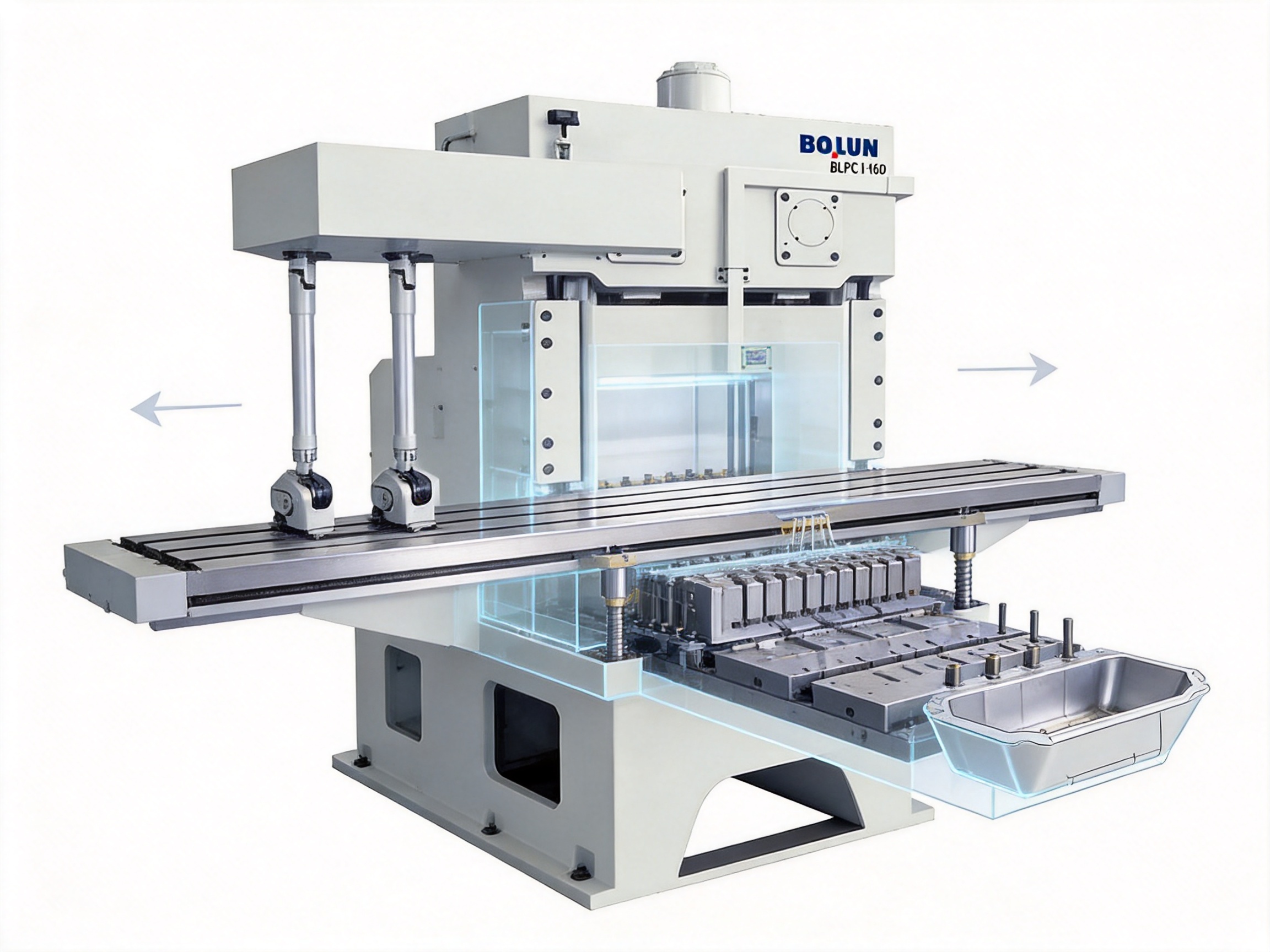
It is described as an open-type double-point battery power press intended for high-tonnage battery shell and component forming. Its architecture uses two drive points to support more balanced slide loading across a broad working area.
The supplied technical table lists the BLPC II-110 configuration with a nominal capacity of 1,100 kN. The product listing uses the BLPC2-160 designation, so the exact capacity and final specification of the ordered model should be confirmed with the manufacturer before purchase.
A double-point structure distributes drive support across two separated locations. This can help reduce slide tilting and maintain more balanced movement when a large or asymmetric die generates uneven forming resistance.
The listed worktable size is 1,970 × 680 × 130 mm. This provides a broad platform for large dies and multi-station tooling configurations.
The BLPC II-110 configuration has a listed maximum die height of 480 mm, with 90 mm of die-height adjustment.
The documented BLPC II-110 speed range is 35–70 strokes per minute. The smaller BLPC II-63 and BLPC II-80 configurations are listed at 50–80 and 45–75 strokes per minute respectively.
The product description identifies inverter-based speed regulation. This allows the operating rate to be adjusted within the machine’s permitted range to suit material behavior, die requirements, production targets, and transfer conditions.
The supplied information identifies dual solenoid valve control and a photoelectric safety system. These features are intended to support responsive stopping and protection around the working area. The complete installation must still comply with applicable safety standards and site procedures.
The open-type layout, broad working area, and accessible structure can support feeding, transfer, unloading, and inspection integration. The exact automation solution must be engineered around the part, die, cycle timing, safety guarding, and factory layout.
The technical table lists a three-phase, 380 V, 50 Hz power supply. Regional alternatives should be confirmed with the manufacturer during the technical review.
The listed air pressure is 0.55 MPa. The customer should provide a clean, stable, properly filtered compressed-air supply and confirm actual consumption requirements before installation.
The selection should consider forming force, material thickness, part size, die dimensions, stroke, die height, cycle rate, automation, working height, safety requirements, and future product plans. Nominal capacity alone should not determine the purchase decision.
The company describes non-standard customization and one-stop design and manufacturing services. Customers should provide complete technical information so the supplier can evaluate the required mechanical, electrical, safety, and automation changes.
Acceptance should cover machine dimensions, electrical and pneumatic functions, slide movement, speed range, die-height adjustment, safety response, stopping performance, lubrication, noise, vibration, and trial forming results with the intended tooling.
The BLPC2-160 High-Tonnage Ultra-Stable Battery Shell Open-Type Double-Point Battery Power Press is designed around the practical demands of large battery-component forming. Its key value lies in the combination of a double-point structure, broad working envelope, adjustable operating speed, substantial die-height capacity, open access, and integrated safety functions.
The documented BLPC II-110 configuration illustrates the capabilities of the larger family, offering 1,100 kN nominal capacity, a 190 mm slide stroke, 35–70 strokes per minute, a 480 mm maximum die height, and a 1,970 × 680 mm worktable. These specifications support large dies and forming processes that require force, space, and stable slide movement.
Against conventional single-point or narrowly configured presses, the platform offers advantages for wide, asymmetrically loaded, and multi-station tooling. Its manufacturing value is reinforced by the supplier’s stated capabilities in engineering, precision processing, assembly, inspection, customization, and after-sales support.
For a battery manufacturer, the final decision should be based on a complete technical review of the part, material, die, production rate, automation plan, factory utilities, and local safety requirements. When properly configured, installed, and maintained, this type of press can provide a dependable foundation for efficient, repeatable, and scalable battery shell production.
1. Product technical information for the BLPC II open-type double-point battery power press family, including nominal capacity, stroke, speed, die-height, table, slide, and motor data.
2. Product description for the high-tonnage battery shell open-type double-point power press.
3. Manufacturer-provided company profile covering machinery research and development, precision manufacturing, customization, inspection, and service capabilities.
4. General principles of mechanical power press design, slide guidance, die setup, load distribution, and forming-process control.
5. General industrial guidance concerning machine guarding, photoelectric protective devices, emergency stopping, pneumatic safety controls, operator training, and preventive maintenance.


A buyer comparing a 45-ton open-gap press for a bracket line often receives two...
Two presses can both carry a 200-tonne nameplate and still produce very differe...
What Is a Power Press? A power press — also called a stamping press or punch pr...
Understanding Mechanical Power Presses and Their Essential Functions A mechani...
A fastener plant in Taizhou receives a request from an automotive tier-one supp...
In the fields of metal forming, sheet metal fabrication, blanking, and punching,...
Contact Us

topbolun@gmail.com

+86-575-83362228

+86-13735238388
+86-18667502750

+86-575-83362999

+8618667502750

No.1 Linjiang Road East, Xiaren, Jinting Town, Shengzhou City, Zhejiang Province, China
Ready to Begin?
Get in Touch

Now!

ZHEJIANG BOLUN
 English
 中文简体