
Cold forging is one of the most demanding forming technologies in modern metal manufacturing. It requires a machine to apply very high force, maintain accurate motion, control material flow, protect expensive tooling, and remove finished components reliably after deformation. These requirements become especially challenging when manufacturers process thick-gauge materials, high-strength alloys, large blanks, or components with complex geometries. The BLKP-650 Robust High-Deformation Cold Forging Toggle Type Power Press is designed for precisely this class of production challenge.
With a nominal capacity of 6,500 kN, the BLKP-650 occupies an important position in the heavy-duty cold forging press range. It combines a toggle-type transmission system, an 8 mm nominal pressure stroke, a high-rigidity frame, a 600 × 700 mm worktable, and an integrated ejector system. Together, these features provide the force concentration, pressure stability, die support, and production reliability required for demanding compression and deep cold forging operations.
The press is manufactured by Zhejiang Bolun High-Precision Machinery Co., Ltd., a Chinese producer of precision forming equipment with experience in forging and casting machinery. The company integrates research and development, engineering design, machining, assembly, inspection, sales, and after-sales service. This integrated structure allows the BLKP-650 to be developed as a complete production solution rather than as an isolated mechanical unit.
The BLKP-650 is a toggle-type power press for cold forging and high-deformation forming applications. Its 6,500 kN nominal capacity allows it to process demanding parts that require a large compressive load during the final stage of forming. The press is particularly suitable for production environments where stable pressure, controlled deformation, and repeatable part removal are more important than simple high-speed free-running motion.
The machine provides an 8 mm nominal pressure stroke. This specification is significant because the pressure stroke represents the portion of the forming cycle in which the press delivers its rated forming pressure. A controlled pressure stroke helps maintain forming force during the critical deformation stage, supporting more consistent material flow and reducing the risk of incomplete filling, dimensional variation, or unstable tool loading.
The BLKP-650 also provides a 160 or 180 mm slide stroke, depending on the selected configuration. This stroke range gives manufacturers flexibility when setting up dies, preparing blanks, and accommodating the movement required by the forming process. The press has a maximum die height of 400 mm and a maximum die weight of 1,000 kg, allowing it to support substantial tooling assemblies for medium- and heavy-duty cold forging.
Its 600 × 700 × 150 mm worktable provides a stable foundation for die installation. The table size is suitable for a broad range of industrial components while maintaining a practical machine footprint. The slide bottom size is 450 × 550 mm, creating an effective working relationship between the upper tooling area and the lower die support surface.
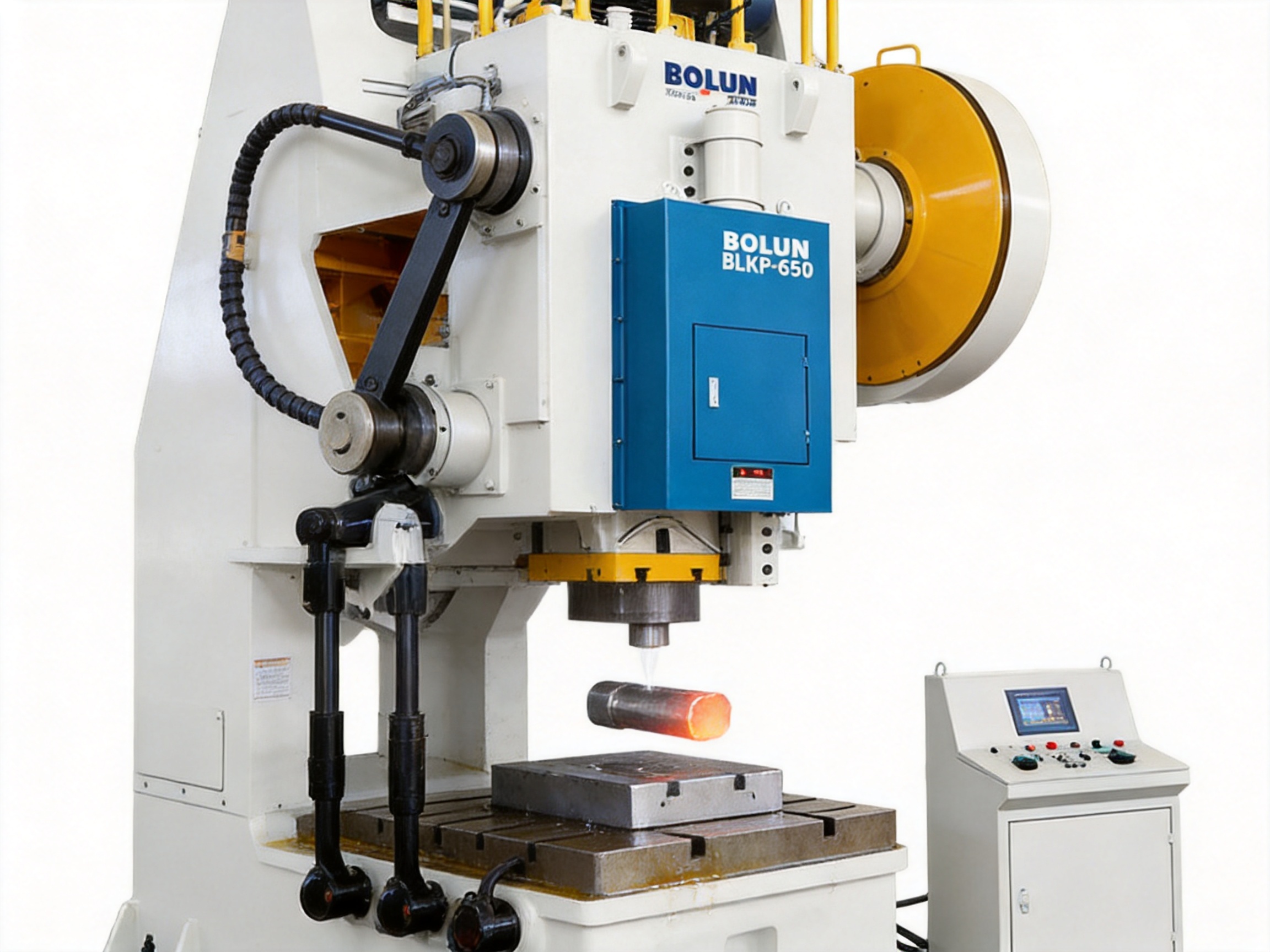
An integrated ejector system is driven by a crankshaft cam and rocker mechanism. This arrangement supports dependable removal of formed parts after the pressing operation. Reliable ejection is essential in automated or semi-automated production because a part that remains in the die can interrupt the cycle, damage tooling, or create a safety hazard. The mechanical ejector system helps coordinate part removal with the main press motion.
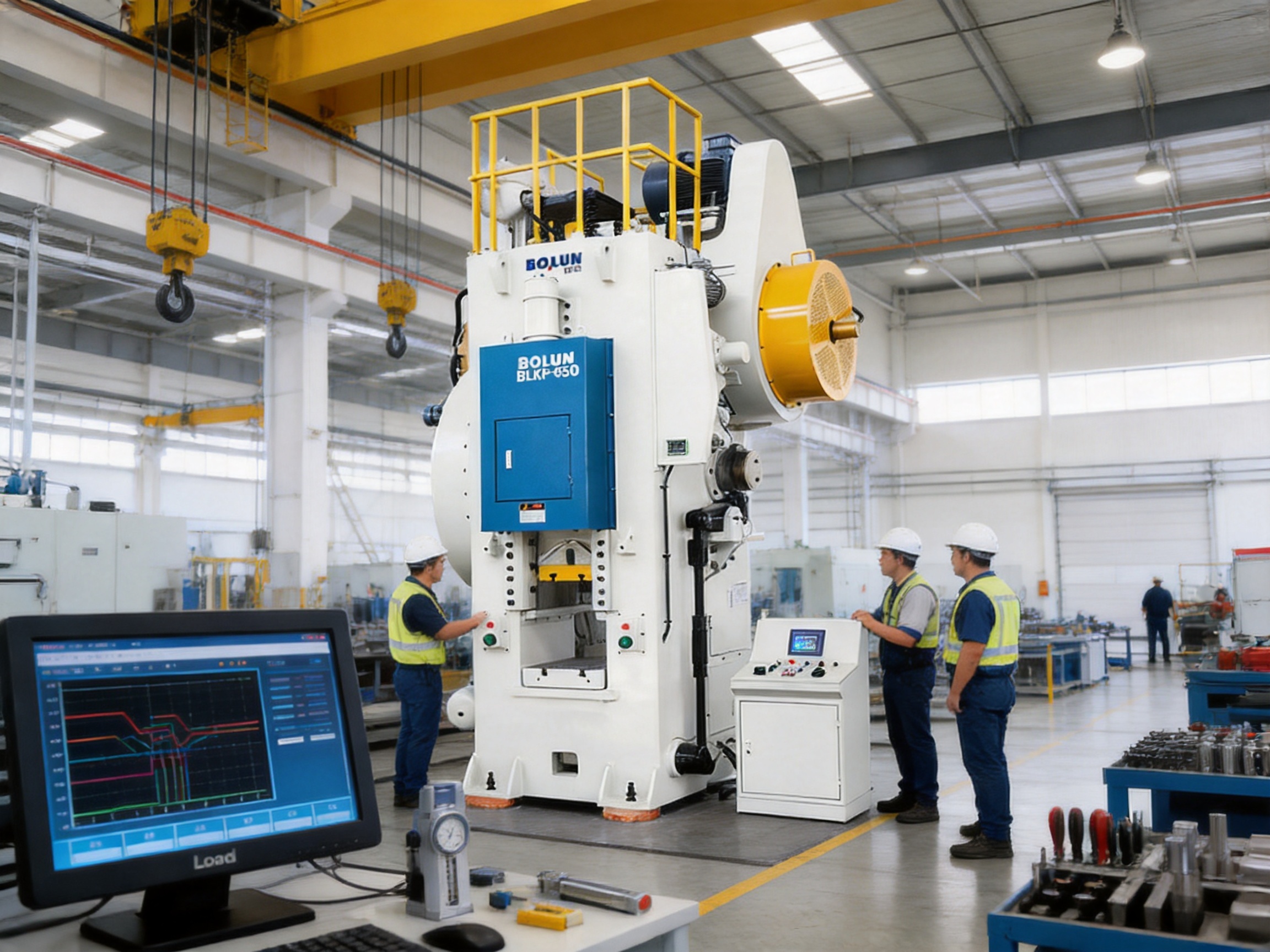
The BLKP-650 is also equipped with a load detection safety system. This system is intended to monitor forming loads and help protect the machine, tooling, and workpiece from abnormal operating conditions. When combined with a high-rigidity frame, load monitoring contributes to controlled operation in processes where small changes in material, lubrication, blank positioning, or tooling condition can significantly affect the forming load.
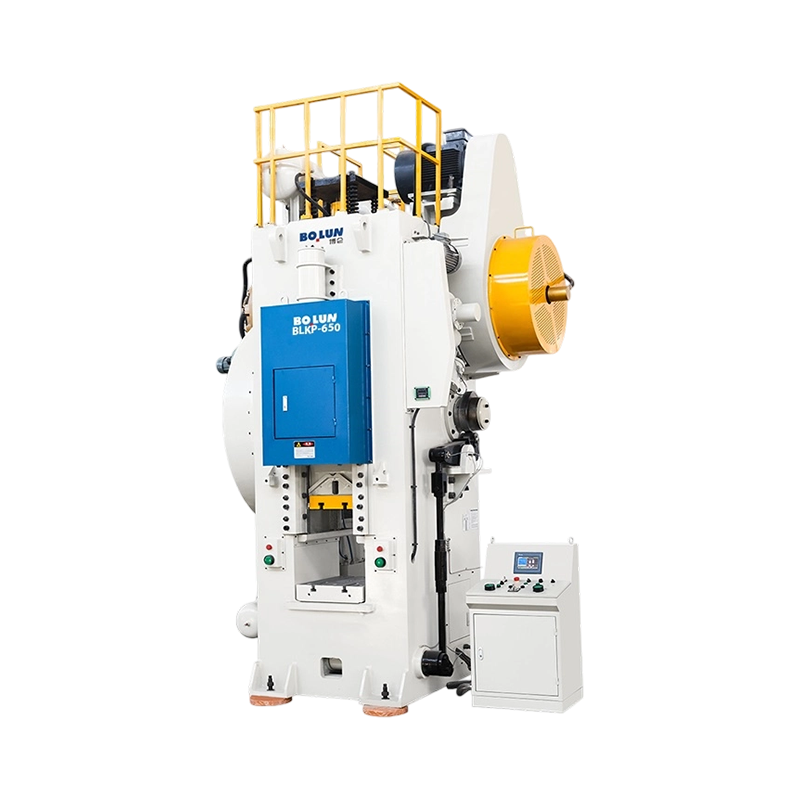
BLKP-650 Robust High-Deformation Cold Forging Toggle Type Power Press
A toggle-type press uses a linkage mechanism to transform the movement of the drive system into controlled slide motion. Compared with a conventional straight-crank arrangement, a toggle mechanism can produce a pronounced mechanical advantage near the end of the slide stroke. This characteristic is valuable in cold forging because the highest forming resistance often occurs when the workpiece approaches its final shape.
In a cold forging operation, the material is formed without being heated to a temperature that would make it readily plastic. The workpiece therefore offers substantial resistance to deformation. The press must apply force in a carefully controlled manner while the die constrains the material. The toggle mechanism helps concentrate force in the lower portion of the stroke, where the final filling and sizing of the component take place.
The BLKP-650’s 8 mm nominal pressure stroke is aligned with this forming principle. Instead of relying only on a rapid impact or a broad motion range, the press supports a defined pressure phase during which forming force is maintained. This can benefit processes involving thick sections, high reduction ratios, and demanding final shapes.
Toggle motion can also reduce unnecessary high-load travel. The slide can move through a larger approach stroke before entering the high-pressure area, then apply concentrated force close to the bottom of the stroke. This arrangement can improve the relationship between productivity, energy use, and forming performance, although actual results depend on die design, material grade, lubrication, blank dimensions, and production settings.
Another advantage is the potential for improved control of final forming position. When the linkage approaches its mechanical dead-center region, slide movement becomes more controlled. This characteristic may help maintain the intended final die position and support repeatability from one cycle to the next. For precision cold forging, repeatable final position is important because it influences part height, material distribution, tooling stress, and downstream machining requirements.
The nominal capacity of the BLKP-650 is 6,500 kN, equivalent to 6.5 meganewtons of rated forming force. This places the press in the heavy-duty segment of the supplied cold forging model range. It is considerably larger than the 2,600 kN and 4,000 kN models, while remaining more compact than the 8,500 kN, 10,000 kN, 12,500 kN, and 20,000 kN machines in the same series.
This capacity makes the BLKP-650 suitable for applications where smaller presses may operate too close to their limits. Operating a press near its maximum capacity for extended periods can increase mechanical stress, reduce process flexibility, and leave little allowance for variation in material or tooling conditions. A 6,500 kN press gives manufacturers greater working margin for suitable components and forming sequences.
Heavy compression forming can include operations in which a billet or preform is compressed into a die cavity, resized to improve dimensional accuracy, or shaped through multiple stages. The BLKP-650 can support production concepts that require substantial force without relying solely on thermal assistance. This can help manufacturers preserve the material properties associated with cold work while reducing or eliminating certain heating operations.
The rated force should always be considered together with the pressure stroke, die geometry, blank size, material strength, friction conditions, and actual load distribution. Nominal capacity is not a universal indication that every part can be produced in one operation. Proper process engineering remains essential. Nevertheless, the combination of 6,500 kN capacity and toggle-type force concentration gives the BLKP-650 a strong foundation for challenging cold forging applications.
Compared with lower-capacity machines, the BLKP-650 offers more capability for thick-gauge components and high-resistance materials. Compared with substantially larger machines, it may provide a more proportionate solution for manufacturers whose parts do not require extreme capacity. Selecting a press that closely matches the process can reduce unnecessary investment in oversized equipment while preserving adequate forming performance.
High-deformation cold forging places severe demands on force stability. The material may initially enter the die with relatively low resistance, but the required load can rise sharply as the cavity fills, wall thickness changes, or the final dimensions are approached. If the press cannot maintain a controlled pressure profile, the result may be uneven filling, excessive springback, die damage, or inconsistent part dimensions.
The BLKP-650 is specified with an 8 mm nominal pressure stroke. This provides a defined portion of the movement for maintaining forming pressure during the critical stage of deformation. The pressure stroke is especially relevant to components that require the material to flow into narrow sections, fill corners, or reach a precise final height.
Stable pressure can improve the consistency of production when the same die set is used for many cycles. It may also help reduce variation caused by small differences in blank volume or lubrication. Although no mechanical press can eliminate the need for process control, a stable forming phase gives engineers a stronger basis for optimizing the die, lubricant, blank dimensions, and cycle parameters.
The press is therefore well suited to operations where the final stage of forming determines product quality. In such operations, maximum speed is not always the most important objective. A controlled and repeatable application of force can be more valuable than a faster but less stable stroke, particularly when the cost of scrapped parts or damaged dies is high.
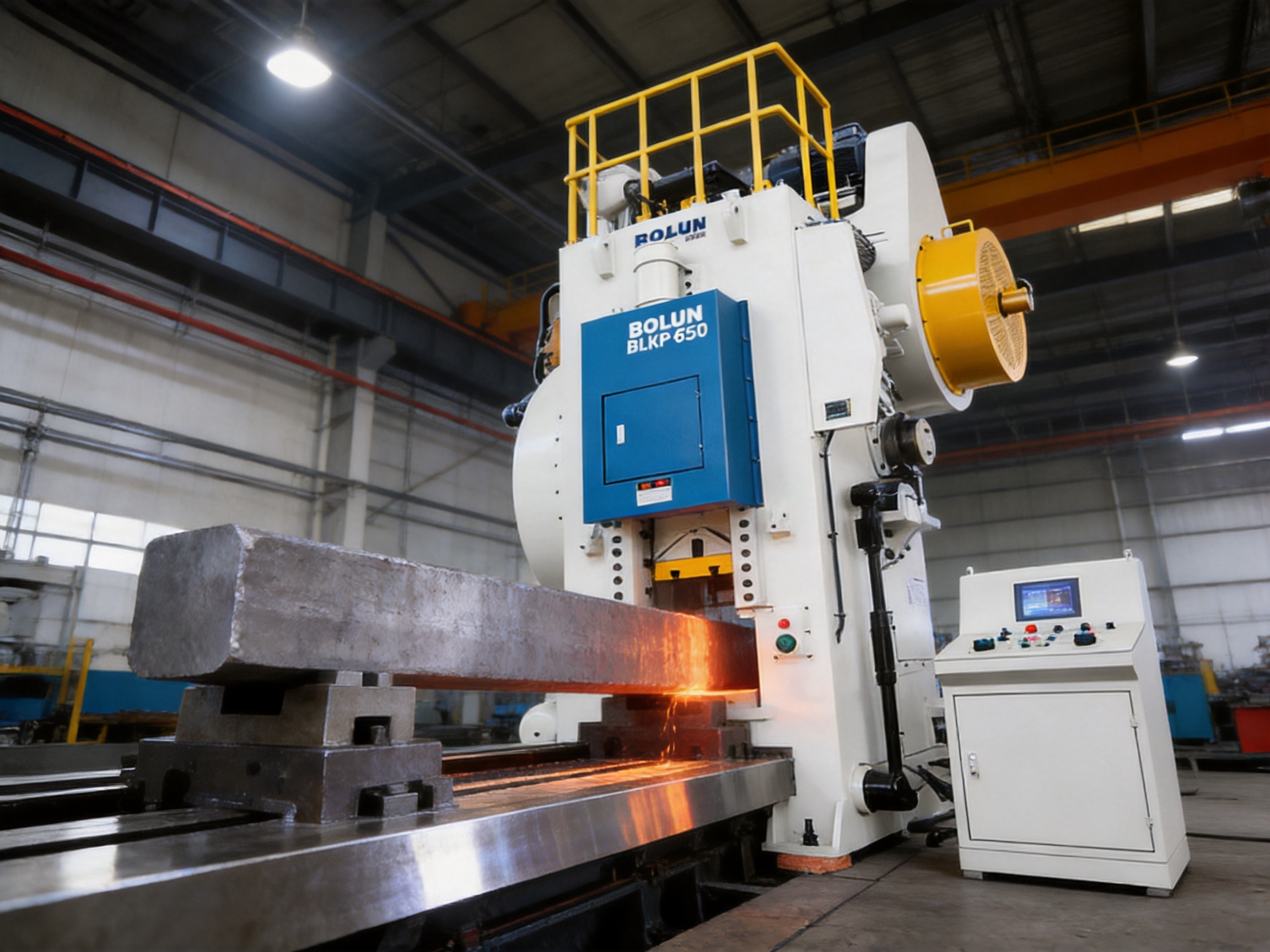
A high-rigidity frame is fundamental to a large cold forging press. During forming, the machine frame, slide, table, die set, and connecting mechanisms are exposed to substantial compressive loads. Any excessive elastic deformation can influence the alignment between the upper and lower dies, change the final position of the workpiece, and increase uneven wear.
The BLKP-650 is designed around a high-rigidity structure intended to support stable operation under heavy forming loads. Structural rigidity helps the press resist deflection and maintain the relative position of the working components. This is important for tools with close clearances, precision dimensions, or high local loading.
Stable machine geometry also contributes to tooling life. When the press and dies remain properly aligned, the forming load can be distributed more evenly. Reduced misalignment may limit localized stress on punches, inserts, guide elements, and die walls. Tool life is influenced by many factors, including material hardness, lubrication, die design, and maintenance, but machine rigidity provides an essential foundation.
For the operator, a rigid frame can also improve process confidence. A machine that maintains its working geometry under load is easier to set up and monitor. It gives production engineers a more predictable platform for developing multi-stage forming sequences and for transferring established processes between production shifts.
The structural design should be understood as part of a wider system. Rigidity alone does not guarantee accuracy. Correct foundation preparation, die installation, lubrication, load distribution, maintenance, and operating procedures are also necessary. The advantage of the BLKP-650 is that its rigid construction supports these process controls rather than undermining them through excessive structural movement.
Part ejection is a critical stage in cold forging. Formed parts can remain tightly held in the die because of friction, elastic recovery, material expansion, or complex cavity geometry. If removal is unreliable, the next blank may be inserted incorrectly or the following stroke may cause severe damage.
The BLKP-650 incorporates an ejector system driven by a crankshaft cam and rocker mechanism. This mechanical arrangement coordinates ejection with the press cycle and provides a repeatable movement for removing the formed component from the lower tooling area.
A cam-driven ejector can be advantageous in high-load production because its movement is mechanically synchronized with the main press. Correct timing helps ensure that the part is released at the appropriate point in the cycle. The rocker mechanism transfers the cam motion into the required ejector movement, allowing the system to operate as an integrated part of the press rather than as an independent accessory.
Reliable ejection can improve cycle stability, especially when the press is connected to feeding, transfer, or collection equipment. It also helps reduce the need for manual intervention. Less manual handling can improve productivity and reduce operator exposure to the die area, provided that the complete production line incorporates appropriate guarding and safety procedures.
The integrated system may also support better die utilization. When parts are removed consistently, the die is less likely to experience repeated impacts from trapped components. This can reduce avoidable damage and help maintain the intended forming conditions over a longer production run.
Cold forging loads can change quickly when a blank is oversized, incorrectly positioned, insufficiently lubricated, or made from a material with unexpected properties. A foreign object in the die or a damaged tool can also create an abnormal load condition. Detecting these changes is an important part of protecting the machine and the tooling.
The BLKP-650 includes a load detection safety system designed to monitor forming loads. By observing the load condition, the system can help identify situations that differ from the expected process profile. Depending on the configured control system and operating procedure, abnormal detection may support press stoppage, operator investigation, or preventive maintenance.
Load detection is valuable because visual inspection alone may not reveal an internal problem until damage has already occurred. A die can begin to crack, a punch can become misaligned, or a blank can enter the cavity incorrectly while the outside of the machine appears normal. Monitoring the load provides an additional source of process information.
The system can also support quality management. When a forming operation has a characteristic load pattern, changes in that pattern may indicate variation in material, lubrication, blank volume, or tool condition. Production teams can use this information alongside dimensional inspection and visual checks to develop a more responsive quality-control program.
Load detection should not be viewed as a substitute for guarding, die inspection, preventive maintenance, or operator training. Instead, it forms one layer in a broader safety and process-control strategy. Its presence on a heavy-duty press is a meaningful advantage over basic machines that offer force production without comparable monitoring capability.
The following table summarizes the principal specifications supplied for the BLKP-650. Some dimensions and operating values are presented within a broader model-series specification format. Final machine configuration, permissible tooling, electrical details, and operating parameters should be confirmed during technical review.
| Specification | BLKP-650 Value | Unit |
|---|---|---|
| Model | BLKP-650 | — |
| Press type | Cold forging toggle type power press | — |
| Nominal capacity | 6,500 | kN |
| Nominal pressure stroke | 8 | mm |
| Slide stroke | 160 / 180 | mm |
| Strokes per minute | 32 | S.P.M. |
| Maximum die height | 400 | mm |
| Maximum die weight | 1,000 | kg |
| Worktable size | 600 × 700 × 150 | mm |
| Slide bottom size | 450 × 550 | mm |
| Height of working face | 1,000 | mm |
| Die height adjustment | 15 | mm |
| Air pressure | 0.55 | MPa |
| Main motor | 75 × 4 | kW × poles |
| Mold pad capacity | 300 | kN |
| Ram stroke | 70 | mm |
The specification table demonstrates how the BLKP-650 combines a large force rating with a practical working envelope. Its 600 × 700 mm table and 450 × 550 mm slide bottom provide space for substantial tooling while keeping the press within a size range appropriate for many industrial forming lines. The maximum die weight of 1,000 kg is also important for production planning because it helps engineers assess die-handling requirements before installation.
The listed speed for the BLKP-650 is 32 strokes per minute. Actual production output will depend on the forming process, feeding method, transfer timing, lubrication, ejection, inspection, and the number of operations required for each component. A press speed figure should therefore be regarded as a machine operating parameter rather than a guaranteed finished-part output.
For a single-stage process with reliable feeding and ejection, the stated speed can provide a productive operating rhythm. For more complex components, the cycle may require multiple blanks, transfer movements, intermediate forming stages, or inspection points. In such cases, the machine’s value lies not only in its nominal speed but also in its ability to sustain a stable cycle under heavy load.
The BLKP-650’s toggle-type motion is particularly relevant to this balance. The press can approach the workpiece through its slide stroke and then concentrate force during the pressure phase. This enables engineers to consider productivity and forming quality together rather than treating them as completely separate objectives.
Production managers should evaluate the machine using the complete process cycle. Important factors include loading and unloading time, die lubrication, blank preparation, ejection, tool change, maintenance, and quality inspection. A press that produces consistent parts with fewer interruptions may deliver a better overall production result than a faster machine that experiences frequent tooling or process problems.
The BLKP-650 can be considered for components that require high compressive force and controlled material displacement. Suitable applications may include thick-section parts, stepped components, hubs, sleeves, collars, connecting elements, high-strength fastener preforms, and other industrial products developed through cold compression and related forming methods.
The actual suitability of a component depends on its material, volume, geometry, reduction ratio, required tolerances, and tooling concept. Engineers must calculate the forming load and confirm that the load remains within the press and die limits. Nevertheless, the machine’s capacity and pressure-stroke characteristics make it appropriate for processes where a lower-capacity press would lack sufficient force margin.
Deep cold forging operations can benefit from high rigidity and stable final-stage pressure. When a component includes a deep cavity, narrow section, or demanding transition, the material must flow in a controlled direction. The press must maintain alignment while the die imposes the required shape. The BLKP-650’s design addresses these requirements through its force capacity, toggle mechanism, and robust structure.
The machine may also be useful in multi-operation production. A manufacturer could use it for a primary compression stage, a sizing operation, or a final calibration step, depending on the part design and tooling arrangement. Because cold forging often involves carefully sequenced deformation, the press can form part of a larger line that includes cutting, heading, preforming, lubrication, transfer, and inspection equipment.
Basic power presses can be effective for lighter stamping and general forming operations, but they may not provide the specific characteristics required for heavy cold forging. The BLKP-650 offers several advantages when compared with a simpler press configuration.
First, its 6,500 kN nominal capacity provides a substantially larger force reserve for high-resistance materials and thick-gauge parts. Second, the toggle-type mechanism concentrates force near the end of the stroke, where final forming pressure is often most important. Third, the defined 8 mm pressure stroke supports controlled deformation during the critical forming stage.
The machine also provides a larger and more robust working platform than many general-purpose presses designed for lighter production. Its 600 × 700 mm worktable, 1,000 kg maximum die weight, and high-rigidity frame enable it to accommodate demanding tooling assemblies.
In addition, the integrated ejector and load detection safety system offer functional advantages over machines that require separate or less coordinated arrangements. A reliable ejector supports production continuity, while load detection adds process information and an additional protective measure.
These advantages do not mean that the BLKP-650 is the correct choice for every application. Smaller parts with low forming loads may be produced more economically on a smaller machine. The BLKP-650 is most valuable when its high force, pressure stability, tooling capacity, and structural strength are directly relevant to the process.
Choosing a press with excessive capacity can create unnecessary capital cost, larger installation requirements, higher energy demand, and reduced flexibility in production planning. An oversized press may also require larger foundations, greater die-handling equipment, and more floor space than the application justifies.
The BLKP-650 offers a middle position within the BLKP model family. It provides 6,500 kN of capacity for serious cold forging work while avoiding the scale of machines rated at 8,500 kN and above. For manufacturers whose components require high force but do not approach the limits of the largest presses, this balance can be commercially attractive.
The machine’s table, slide, die-height, and die-weight specifications also create a practical working envelope. Manufacturers can match their tooling requirements to a press that is large enough for the application without automatically moving to the next capacity class.
Process engineers should compare the calculated forming load, projected tooling dimensions, expected production volume, and future product plans before selecting a capacity. The BLKP-650 is best understood as a precision heavy-duty option for applications that require more than a standard press but do not necessarily need an ultra-large forging machine.
The performance of a heavy-duty precision press depends on the quality of its design, components, machining, assembly, and inspection. Zhejiang Bolun High-Precision Machinery Co., Ltd. describes its manufacturing approach as an integrated system covering research and development, design, production, sales, and service. This structure is important because complex forming equipment requires coordination between mechanical engineering, process planning, machining, electrical control, assembly, and field support.
The company has developed its business around forging and casting machinery and has built an industrial production environment that supports precision processing and final assembly. A complete manufacturing chain allows key components and assemblies to be evaluated as part of the whole machine. It also helps engineers identify how frame design, transmission geometry, slide guidance, die support, lubrication, ejection, and safety systems interact.
Precision machining is particularly important for a press such as the BLKP-650. The frame and working components must be produced within controlled tolerances so that the slide and table remain correctly aligned. Machined surfaces, bearing seats, guide areas, connection points, and mounting interfaces all influence the machine’s long-term performance.
Bolun’s stated production philosophy includes advanced precision processing equipment and a mature industrial environment. These capabilities support the manufacture of high-load components and the controlled assembly of large mechanical systems. They also provide a basis for producing customized machines when a customer requires special specifications or functions.
Customization can be important in cold forging because no two production lines are exactly alike. One customer may need a particular die arrangement, another may require integration with an automatic feeder, and another may need special ejection, monitoring, or control functions. A manufacturer with in-house design and engineering resources can respond more effectively to these requirements than a supplier limited to a fixed standard configuration.
Quality control for a 6,500 kN press must extend beyond the inspection of finished appearance. It should include material verification, component machining, dimensional checks, assembly accuracy, alignment, movement testing, load-related performance, safety functions, and final operating tests.
Bolun states that it has established a finished-product inspection system designed to exceed ordinary industry requirements. The company emphasizes rigorous quality control for each process and component. Such a system is essential for ensuring that the press can maintain stable precision and service life during high-intensity operation.
Inspection of the frame and table is especially important because structural accuracy affects the entire forming process. The slide must travel correctly in relation to the table, and the die mounting surfaces must provide a stable base for tooling. The transmission and toggle mechanism also require careful assembly so that force is transferred smoothly and consistently.
Safety and control functions should be verified as part of final machine testing. The load detection system, emergency functions, guards, interlocks, lubrication arrangements, and ejector timing all contribute to safe operation. A press should not be evaluated solely by whether it reaches its rated capacity; it should also be assessed by how predictably and safely it performs the complete cycle.
For purchasers, it is advisable to request a detailed factory acceptance protocol. This may include dimensional inspection records, no-load running tests, load testing, control-system verification, safety-system checks, and documentation of the supplied motor and electrical components. A clear inspection process improves communication between the equipment supplier and the end user.
Cold forging equipment is closely connected to product design and tooling. A press supplier must understand more than the machine frame. It must also recognize how forming stages, blank volume, die strength, lubrication, ejection, and automation influence the press selection.
Bolun reports that it provides one-stop design and manufacturing services for products with special specifications and functions. This capability can support customers whose production requirements do not fit a standard catalogue machine. Engineering cooperation may include reviewing the component, confirming the required capacity, evaluating the die envelope, discussing the ejection method, and planning the interface with upstream and downstream equipment.
Customization should be based on documented process requirements. Important information includes material grade, blank diameter or dimensions, initial and final volume, target production rate, forming sequence, tooling dimensions, maximum expected forming load, lubrication method, automation arrangement, and environmental conditions. Providing this information allows the supplier to determine whether the BLKP-650 is suitable and which configuration is appropriate.
A well-engineered installation also considers the foundation, machine access, die-changing method, electrical supply, compressed air, ventilation, operator position, and maintenance clearance. These practical issues can influence productivity as much as the press specifications themselves.
The company’s combination of design, production, and service capabilities can simplify project coordination. Instead of dealing with unrelated suppliers for the main machine, special mechanisms, and technical support, a customer may coordinate the major requirements through one engineering partner. The precise scope of this support should be defined in the commercial and technical documentation.
A heavy cold forging press must be installed on a properly prepared foundation. The foundation must support the static weight of the machine and withstand the dynamic forces generated during operation. Leveling and anchoring are critical because even a rigid machine can perform poorly if it is installed on an unsuitable or uneven base.
Before commissioning, the work area should be checked for adequate clearance, lifting access, electrical capacity, compressed-air availability, and safe material flow. The supplied air pressure specification for the BLKP-650 is 0.55 MPa. The actual plant air system should be verified for pressure stability, cleanliness, moisture control, and sufficient flow.
Tool installation requires careful attention to die height, slide alignment, table condition, fastening, and ejector position. The maximum die height is listed as 400 mm, while the die height adjustment is 15 mm. These values should be considered during die design and setup planning. Tooling that exceeds the permissible dimensions or weight can compromise safety and machine performance.
Commissioning should begin with controlled no-load movement. Engineers can verify slide travel, lubrication, ejector timing, control functions, and abnormal noise before introducing a workpiece. Initial forming trials should use conservative settings and carefully inspected blanks. Load data and finished-part dimensions can then be compared with the intended process parameters.
Operator training is another essential part of commissioning. Personnel should understand the press controls, die area safety, load monitoring, lubrication requirements, ejection behavior, emergency procedures, and daily inspection routine. A trained operator can identify changes in sound, vibration, cycle behavior, or load pattern before they develop into major failures.
Heavy-duty cold forging creates demanding conditions for mechanical components and tooling. Regular maintenance is necessary to preserve accuracy and reduce unplanned downtime. The maintenance program should follow the equipment manual and include lubrication, fastening checks, inspection of wear points, cleaning, electrical checks, and verification of safety functions.
The toggle mechanism, crankshaft, rocker system, slide guidance, bearings, and ejector components require particular attention. These systems transmit and control substantial forces. Lubrication must be applied according to the specified grade, quantity, and interval. Insufficient or contaminated lubricant can accelerate wear, increase friction, and alter the motion of the mechanism.
Die alignment should be checked periodically, especially after tool changes or abnormal load events. Signs of uneven wear, cracking, galling, or unexpected part marks should be investigated promptly. The load detection system can assist by identifying changes in the forming cycle, but physical inspection remains necessary.
The high-rigidity frame is designed for stable operation, but it should not be treated as maintenance-free. Fasteners, mounting surfaces, guide elements, and foundation connections should be inspected according to a planned schedule. A preventive approach is generally more economical than waiting for a failure that damages the machine, tooling, or workpiece.
Replacement parts and technical support are also important considerations when purchasing a press. Zhejiang Bolun High-Precision Machinery Co., Ltd. states that its service system covers pre-sales consultation, in-sales support, and after-sales guarantees. Customers should confirm the availability of recommended spare parts, technical documentation, response procedures, and remote or on-site support before finalizing a project.
Cold forging can offer material-efficiency advantages because the process forms a component close to its final shape. Compared with machining from a larger billet, cold forging may reduce material removal and shorten downstream operations. The actual benefit depends on the component geometry, tooling design, allowable flash, dimensional requirements, and process sequence.
The BLKP-650 supports this manufacturing philosophy by providing the force required to shape high-strength materials through controlled compression. A stable forming process can reduce scrap caused by incomplete filling, cracking, dimensional inconsistency, or ejection problems.
Process efficiency also depends on tool life. A rigid press with stable alignment can help reduce uneven die loading. The integrated ejector system can limit interruptions caused by trapped parts, while load detection can help identify abnormal conditions before they produce extensive damage.
The main motor specification for the BLKP-650 is listed as 75 kW × 4 poles. Actual energy consumption will vary according to stroke rate, forming load, idle time, lubrication, production schedule, and auxiliary equipment. Manufacturers evaluating operating cost should assess the complete cycle rather than relying only on motor nameplate power.
Efficient production requires a balance between speed and process stability. Running a machine faster than the tooling or material process can safely support may increase scrap and maintenance costs. The BLKP-650 is intended to deliver controlled heavy forming, so its efficiency should be measured through reliable output, acceptable part quality, tool life, and overall equipment effectiveness.
When introducing a new component, engineers should begin with a complete forming analysis. The first step is to identify the material and its mechanical properties, including strength, ductility, work-hardening behavior, and sensitivity to cracking. The required volume and shape should then be evaluated to determine whether cold forging, warm forging, or a combination of methods is appropriate.
The next step is to calculate the estimated forming load and compare it with the BLKP-650’s 6,500 kN nominal capacity. The calculation should consider friction, lubrication, deformation area, reduction ratio, die geometry, and the pressure required during final filling. A suitable safety margin is necessary because real production conditions vary.
Die dimensions must be checked against the available table and slide area. The tooling weight must remain within the stated 1,000 kg maximum, and the die height must be compatible with the 400 mm maximum die height and available adjustment. The ejector system must also be considered during die design so that finished parts can be removed without interference.
Prototype trials can help validate the selected process. During trials, engineers should record load behavior, part dimensions, surface condition, ejection performance, and die wear. If the load profile differs from the expected result, the team may need to adjust the blank, lubrication, preform geometry, die radii, or forming sequence.
The BLKP-650’s load detection capability can provide useful information during this development work. Comparing load patterns between good and defective parts may help engineers establish process limits and identify early signs of variation.
Purchasing a heavy-duty cold forging press is a long-term manufacturing decision. The buyer should consider not only nominal capacity but also the complete technical and commercial package. Questions should address the machine configuration, included accessories, electrical standards, foundation requirements, die-handling provisions, installation scope, commissioning, training, warranty, and spare parts.
The BLKP-650 should be evaluated against the actual production requirement. Buyers should confirm whether the selected slide stroke, pressure stroke, operating speed, table dimensions, die weight, and ejection arrangement match the proposed tooling. If future products may require greater force or larger dies, that possibility should also be considered during capacity planning.
Factory inspection is another valuable step. A customer or appointed inspector may review machining quality, assembly, alignment, electrical systems, load detection, ejector operation, safety functions, and test documentation. Clear acceptance criteria reduce the risk of misunderstanding after delivery.
Because the BLKP-650 is a specialized machine, technical communication should be precise. Drawings, specifications, process descriptions, die layouts, and utility requirements should be exchanged in writing. Any customized function should be identified in the final technical agreement, including performance expectations and responsibility for interfaces with other equipment.
Zhejiang Bolun High-Precision Machinery Co., Ltd. is located in Zhejiang Province, a major center of Chinese manufacturing and industrial supply. The company has developed its business through long-term involvement in machinery manufacturing and focuses on high-precision forming equipment.
Its stated capabilities include research and development, engineering design, production, sales, and service. This broad structure allows the company to manage the product life cycle from initial concept to after-sales support. For customers purchasing a large press, this continuity can be valuable because machine performance depends on decisions made throughout design, manufacturing, installation, and maintenance.
The company emphasizes a “Technology First” development strategy. Its capabilities include full-chain production, non-standard customization, precision processing, and an international management perspective. These strengths are relevant to the BLKP-650 because heavy cold forging presses require coordinated engineering rather than isolated component production.
Bolun also describes a mature industrial environment covering basic design, core component development, final machining, and machine assembly. Such vertical integration can improve control over critical interfaces and help the manufacturer respond to specific customer requirements. It can also support continuous product improvement based on manufacturing experience and field feedback.
Quality is presented as a central company principle. The stated inspection approach covers processes and components to support precision and service life under high-intensity conditions. This is directly aligned with the expectations for a 6,500 kN cold forging machine, where structural, transmission, and tooling interfaces must remain reliable over long production periods.
The BLKP-650 is a toggle-type power press designed for cold forging and high-deformation compression applications. It is intended for industrial forming processes requiring substantial force and controlled pressure near the end of the slide stroke.
The nominal capacity is 6,500 kN. This capacity places the machine in the heavy-duty segment of the supplied cold forging press range.
The nominal pressure stroke is 8 mm. This pressure phase helps maintain forming force during the critical stage when the workpiece is being heavily deformed or brought to its final dimensions.
The listed slide stroke is 160 or 180 mm, depending on the configuration. The final value should be confirmed in the machine’s technical specification and purchase agreement.
The supplied specification lists 32 strokes per minute for the BLKP-650. Actual finished-part output depends on blank feeding, die design, ejection, lubrication, transfer equipment, inspection, and the complete cycle sequence.
The worktable size is 600 × 700 × 150 mm. The three dimensions should be interpreted according to the manufacturer’s drawing and confirmed during tooling design.
The maximum die weight is listed as 1,000 kg, and the maximum die height is 400 mm. Tooling must also fit within the table and slide dimensions and comply with the machine’s fastening and alignment requirements.
Yes. The BLKP-650 includes an integrated ejector system driven by a crankshaft cam and rocker mechanism. The system is intended to support consistent removal of formed parts after pressing.
Yes. The press is equipped with a load detection safety system. This system helps monitor forming loads and can assist in identifying abnormal process conditions, subject to the configured control functions and operating procedures.
The press can be considered for thick-section components, high-strength material parts, hubs, sleeves, collars, fastener preforms, stepped parts, and other products requiring heavy cold compression. Final suitability must be verified through forming-load calculations and tooling analysis.
Its integrated ejector and controlled press cycle can support integration into automated or semi-automated production lines. The specific automation arrangement, including feeders, transfers, lubrication, sensors, and collection equipment, should be engineered for the individual application.
The supplied model-series information lists the main motor as 75 kW × 4 poles for the BLKP-650. Electrical configuration and regional requirements should be confirmed before ordering.
The listed air pressure is 0.55 MPa. The plant air system should provide suitable pressure, flow, filtration, and moisture control for reliable operation.
Manufacturers should evaluate material, blank size, forming load, deformation ratio, die dimensions, die weight, die height, required cycle time, ejection method, automation, installation conditions, and future production plans. A technical review with the supplier is recommended.
The BLKP-650 is manufactured by Zhejiang Bolun High-Precision Machinery Co., Ltd. in Zhejiang Province, China. The company provides precision forming equipment and related engineering and service capabilities.
The BLKP-650 is a robust solution for manufacturers that require high force, stable final-stage pressure, and dependable operation in demanding cold forging processes. Its 6,500 kN nominal capacity provides substantial forming capability, while the toggle-type mechanism concentrates force where high-deformation operations need it most.
The 8 mm nominal pressure stroke supports pressure stability during critical deformation. The high-rigidity frame helps maintain alignment under load. The 600 × 700 mm worktable and 1,000 kg maximum die weight provide a practical platform for substantial tooling. The crankshaft cam and rocker ejector system supports reliable part removal, and the load detection safety system adds an important layer of process monitoring and protection.
Compared with basic power presses, the BLKP-650 offers a more specialized combination of capacity, force concentration, structural strength, ejection, and load monitoring. Compared with much larger presses, it may provide a more balanced investment for applications that require serious cold forging capability without the full scale of an ultra-high-capacity machine.
Its value is further supported by the manufacturer’s integrated approach to research, design, machining, assembly, inspection, customization, and service. For customers developing demanding forming applications, this combination of machine capability and engineering support can help create a more reliable production system.
As with any heavy industrial press, correct application engineering remains essential. The final decision should be based on verified forming-load calculations, tooling compatibility, material behavior, production objectives, installation conditions, and safety requirements. When these factors are properly addressed, the BLKP-650 can serve as a strong foundation for high-deformation cold forging and precision industrial forming.
1. Product specification information for the BLKP-650 cold forging toggle type power press, supplied by the manufacturer.
2. Model-series technical data covering nominal capacity, pressure stroke, slide movement, die dimensions, worktable size, motor configuration, ejector capacity, and ram stroke.
3. General principles of cold forging, compression forming, material flow, die design, and forming-load evaluation.
4. Industrial press safety practices covering load monitoring, guarding, emergency systems, die installation, and operator training.
5. Manufacturing engineering principles related to precision machining, frame rigidity, mechanical alignment, preventive maintenance, and quality inspection.


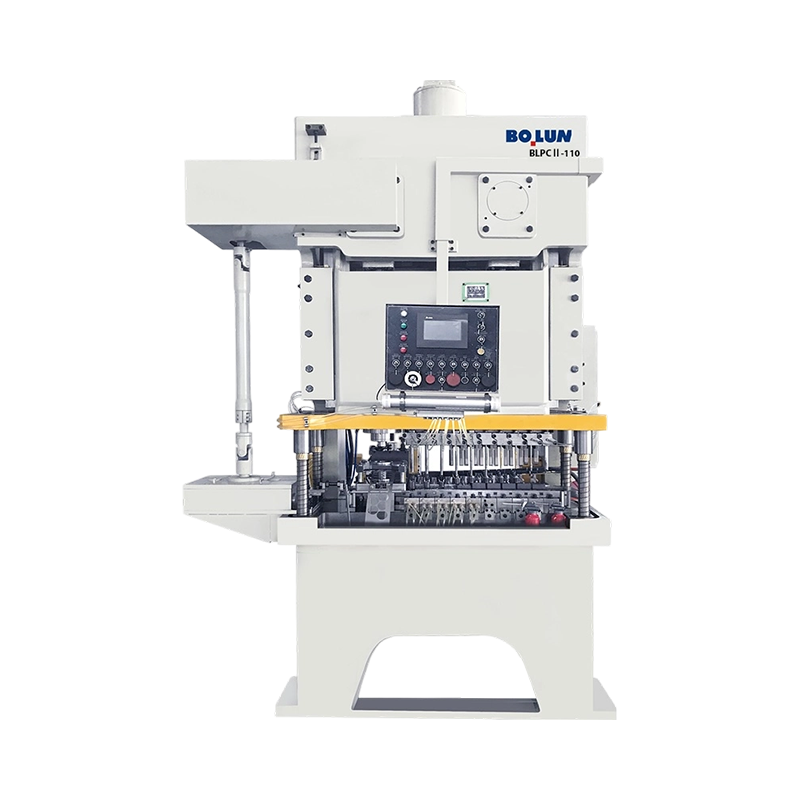
Power press machines are classified in two main ways: by frame construction, w...
What Is a Power Press? A power press — also called a stamping press or punch pr...
Understanding Mechanical Power Presses and Their Essential Functions A mechani...
A cold forging die rarely announces its failure in advance. One day the press r...
In the fields of metal forming, sheet metal fabrication, blanking, and punching,...
As the manufacturing industry moves steadily toward automation and smart product...
Contact Us

bolunpress@gmail.com

+86-575-83362228

+86-15158259588

+86-575-83362999

+86-15158259588

Hangzhou Office Add: No. 332 Wangjiang East Road, Shangcheng District

No.1 Linjiang Road East, Xiaren, Jinting Town, Shengzhou City, Zhejiang Province, China
Ready to Begin?
Get in Touch

Now!

ZHEJIANG BOLUN
 English
 中文简体
中文简体