
In modern stamping, forming, punching, and medium-duty forging operations, manufacturers need a press that combines accessible open-frame handling with the reach and rigidity required for larger or irregular workpieces. The BLPS-45 Robust Large-Capacity Open-Gap Deep-Throat Power Press is designed for exactly this production environment. With a nominal capacity of 450 kN, an enlarged 850 × 440 mm worktable, a reinforced welded steel frame, and a deep-throat configuration, it provides a practical balance between flexibility, power, safety, and long-term stability.
This machine belongs to the open-type power press family, but it is not limited to the simple tasks often associated with ordinary gap-frame presses. Its open-gap deep-throat structure gives operators and tooling engineers more clearance for long sheets, wider blanks, extended parts, and special dies. At the same time, its reinforced, heat-treated, welded steel construction helps reduce elastic deformation under load. For factories that require repeated forming accuracy, stable slide motion, and efficient operation, this power press offers a productive alternative to lighter general-purpose presses.
The product is especially suitable for manufacturers working in metal component production, hardware processing, appliance parts, automotive support parts, electrical fittings, enclosure forming, deep-reach stamping, and custom industrial forming. It is also a strong choice for users who need a medium-capacity machine with more access than a conventional press and more production efficiency than manual or low-power forming equipment.
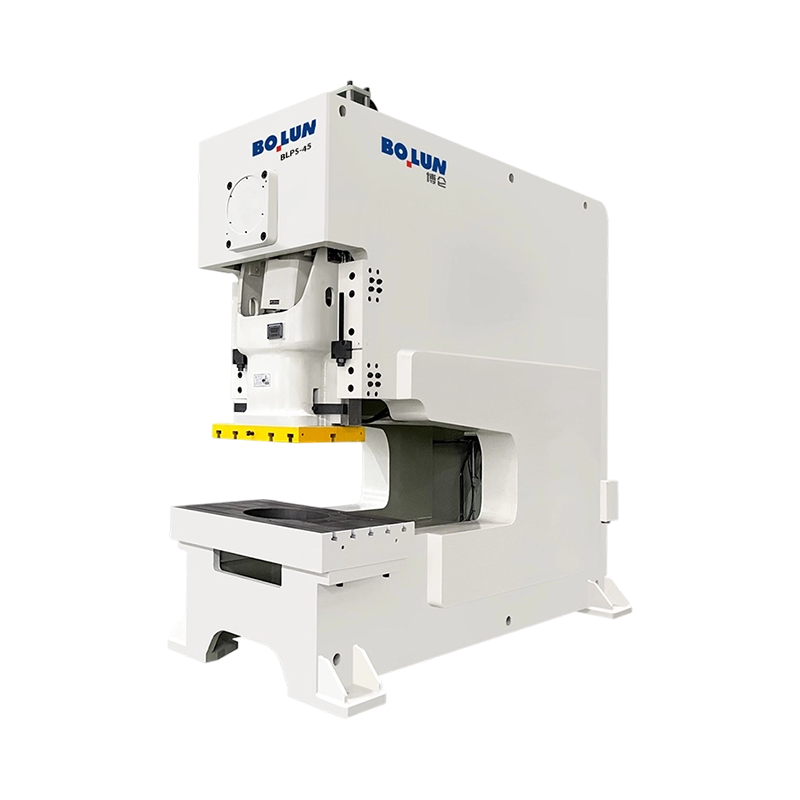
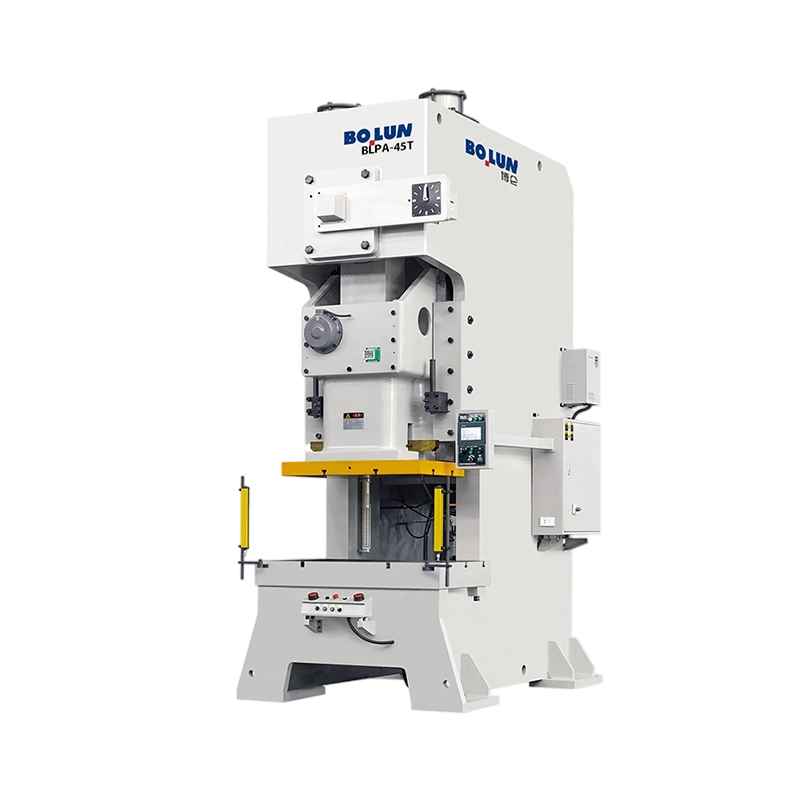
BLPS-45 Robust Large-Capacity Open-Gap Deep-Throat Power Press
The BLPS-45 power press is positioned as a robust large-capacity open-gap deep-throat machine for industrial users who need both reach and force. Its 450 kN nominal force places it in a practical medium-duty class, capable of handling a wide range of stamping and forming applications without requiring the footprint, purchase cost, or operating complexity of a much larger press. For many workshops, this capacity range is ideal because it supports everyday production while allowing expansion into more demanding work.
Compared with ordinary open-type presses, the deep-throat design is a major advantage. A standard press may restrict the distance between the centerline of the slide and the frame, limiting the size or shape of the material that can be processed. In contrast, a deep-throat power press allows the working point to be farther from the frame. This gives production teams greater freedom when processing wide sheets, long strips, panels, brackets, and parts that require off-center access.
Compared with many closed-type presses, the open-gap machine offers easier material feeding, simpler die installation, more convenient visual inspection, and better accessibility for operators. Closed-frame machines are excellent for very high rigidity and heavy-duty precision work, but they can be less convenient when workpieces are long, awkward, or frequently changed. The BLPS-45 provides a flexible middle ground: stronger and more stable than lightweight open presses, yet easier to access than many enclosed-frame alternatives.
This balance is valuable for factories that handle varied production schedules. In modern manufacturing, batch sizes may change quickly, product models may be updated frequently, and customers may request special parts. A press with high accessibility, adjustable die height, reliable protection systems, and a broad working area can help reduce changeover time and support more agile production planning.
The BLPS-45 model is built around a 450 kN nominal capacity, making it capable of delivering strong forming force for medium-duty industrial use. Its slide stroke, die height, worktable size, and motor power are designed to support practical production rather than only laboratory performance. The following table summarizes key product data based on the supplied specification material.
| Item | Specification | Industrial Meaning |
| Model | BLPS-45 | Open-gap deep-throat power press for medium-capacity applications |
| Nominal Capacity | 450 kN | Suitable for stamping, forming, punching, and medium-duty forming operations |
| Nominal Pressure Stroke | 3.2 mm / 2.3 mm depending on configuration | Supports controlled force delivery near the rated working zone |
| Strokes per Minute | 50–95 / 110–180 depending on configuration | Allows selection between stronger forming rhythm and higher-speed productivity |
| Stroke of Slide | 110 mm / 50 mm depending on configuration | Provides practical slide travel for different tooling requirements |
| Maximum Die Height | 270 mm / 300 mm depending on configuration | Supports installation of a variety of dies and fixtures |
| Die Height Adjustment | 80 mm | Improves setup flexibility for different tooling heights |
| Throat Depth | 500–1200 mm range in the series | Enables deep-reach processing for wide or long workpieces |
| Worktable Size | 850 × 440 × 90 mm | Provides a larger support area for dies and workpieces |
| Slide Bottom Size | 430 × 350 × 60 mm | Offers a solid mounting surface for upper tooling |
| Height of Working Face | 800 mm | Practical operating height for workshop integration |
| Distance between Columns | 520 mm | Supports workpiece access and tool installation clearance |
| Diameter of Shank Hole | Ø 40 mm | Compatible with common tooling shank arrangements |
| Main Motor | 4 kW × 4P | Provides efficient drive power for stable production |
| Air Pressure | 0.55 MPa | Supports pneumatic control and clutch-brake operation requirements |
| Punch Accuracy | GB/JIS Class 1 | Reflects a high standard of press accuracy for industrial forming |
One of the most important features of this power press is its reinforced, heat-treated, welded steel frame structure. The frame is the foundation of press performance. If the frame twists, deflects, or accumulates stress during operation, forming accuracy can decline, dies may wear unevenly, and product quality may become inconsistent. For this reason, frame design is not merely a matter of appearance or weight; it directly affects productivity and cost.
The welded steel construction provides a strong base for the machine’s open-gap form. Open-type presses naturally have a different load path from closed-frame presses, because one side remains open for access. This makes reinforcement especially important. By using a reinforced welded frame and heat treatment, the machine is engineered to reduce residual stress and improve stability under repeated impact loading.
In production, the benefits of frame rigidity are visible in several ways. The slide and die remain better aligned during the working stroke. The formed parts show more stable dimensions. The operator can rely on more repeatable machine behavior from batch to batch. Tooling life can also improve because the load is distributed more predictably through the machine structure. Over time, this translates into lower maintenance pressure and more stable output quality.
Compared with low-cost presses that use lighter frame sections or insufficient stress-relief treatment, the reinforced structure gives this machine a meaningful advantage. A cheaper press may seem attractive at the time of purchase, but if it produces unstable parts, requires frequent adjustment, or causes premature die wear, the hidden cost can quickly exceed the initial savings. The BLPS-45 is built for users who evaluate equipment by lifecycle value rather than only purchase price.
The defining feature of this product is its open-gap deep-throat configuration. In practical production, the throat depth determines how far a workpiece can extend into the press before the frame becomes an obstacle. A deeper throat expands the processing zone and allows manufacturers to handle parts that may not fit easily into standard open-back inclinable presses or compact gap-frame presses.
This is particularly useful for sheet metal products, long strip components, panels, frames, and parts that require forming away from an edge. In many workshops, operators face a common limitation: the forming point is located too far inside the workpiece for a standard-throat press. The deep-throat arrangement solves this problem by creating extended reach while preserving open access.
The open-gap structure also supports easier loading and unloading. Operators can see the tooling area clearly, position parts more conveniently, and remove formed pieces without unnecessary obstruction. When paired with proper safety systems, feeding devices, and operating procedures, this accessibility improves workflow and helps reduce non-productive handling time.
For factories processing diversified workpieces, this design reduces dependence on multiple specialized machines. Instead of moving work between several presses because one lacks enough reach and another lacks enough table area, the BLPS-45 can cover a wider application range. This versatility is one of its key competitive strengths.
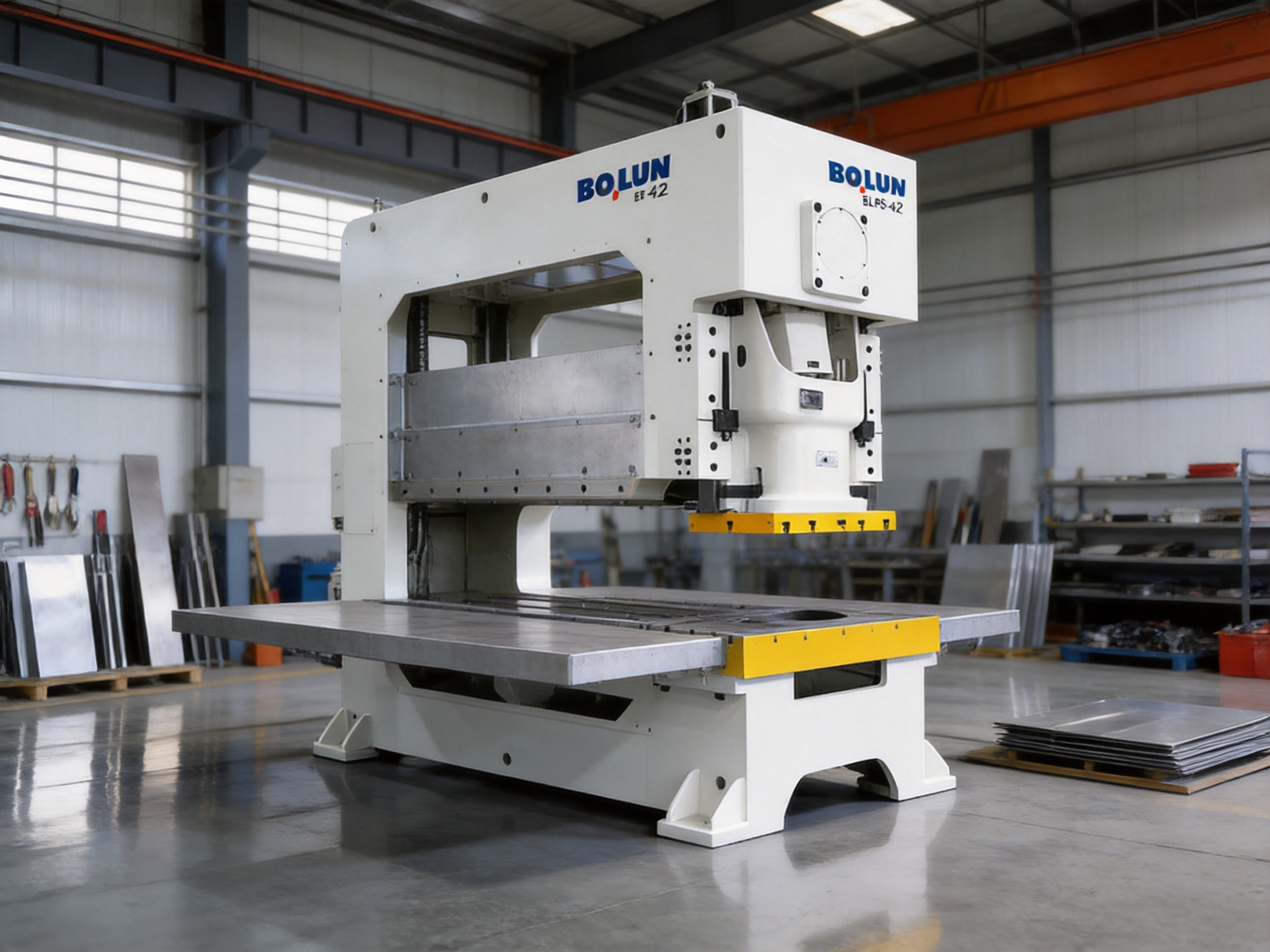
The BLPS-45 is equipped with an 850 × 440 × 90 mm worktable. A large worktable is not simply a convenience; it is essential for stable die support, safe material handling, and flexible process design. When dies are properly supported, the press can transfer force more evenly, reducing the risk of localized deformation or unstable forming.
The 90 mm table thickness also contributes to the sense of robustness expected from a medium-capacity industrial press. A thin or undersized table may limit the types of dies that can be installed, especially when tooling requires a larger footprint or multiple fastening points. The enlarged worktable of this model allows more layout freedom for die designers and maintenance technicians.
The slide bottom size of 430 × 350 × 60 mm provides a solid upper tooling interface. Together with the Ø 40 mm shank hole, the machine can accommodate common press tooling arrangements while still supporting custom tooling strategies. The 80 mm die height adjustment range further improves compatibility with different dies. When production requires frequent changeovers, this adjustability becomes a direct productivity advantage.
Factories often underestimate the value of setup flexibility. A machine that can be adjusted quickly and reliably reduces downtime between jobs. It also helps technical teams test new dies, refine forming parameters, and respond to urgent orders. The BLPS-45 supports this type of flexible production environment through its combination of table area, slide interface, die height capacity, and adjustment range.
The press is driven by a 4 kW main motor. This motor size is well matched to the 450 kN class, providing efficient energy delivery without unnecessary oversizing. In industrial production, the relationship between motor power and mechanical design is important. A machine should have enough power for stable cycling, but excessive power can increase energy consumption and operating cost without improving useful performance.
The specification data indicates different possible configurations for speed and slide stroke, including a lower-speed, longer-stroke configuration and a higher-speed, shorter-stroke configuration. This reflects the practical needs of different forming tasks. Some operations require longer slide travel for deeper forming or more complex die movement. Others benefit from higher strokes per minute when parts are smaller and forming requirements are less demanding.
Production efficiency is not determined by speed alone. A high stroke rate is valuable only when the machine remains stable, the material feeding system is synchronized, the die is suitable, and safety requirements are satisfied. The BLPS-45 is designed to combine useful speed capability with structural rigidity and protection systems, so that productivity does not come at the expense of reliability.
Compared with competitors that focus only on maximum strokes per minute, this product emphasizes balanced performance. The machine’s value lies in its ability to deliver repeatable force, support larger tooling, reach deeper into the workpiece, and protect itself against overload while maintaining practical production rates. For many factories, this balanced engineering approach is more important than a single impressive number in a brochure.
Hydraulic overload protection is a critical feature for industrial power presses. During stamping and forming, overload can occur for many reasons: incorrect material thickness, double feeding, misaligned blanks, die obstruction, improper adjustment, or unexpected changes in material strength. Without reliable overload protection, the press, die, or workpiece may suffer serious damage.
The BLPS-45 integrates a hydraulic overload protection device designed to protect the machine during continuous high-capacity production cycles. This system helps reduce the risk of catastrophic damage by responding when the load exceeds safe limits. For manufacturers, the benefit is not only safety but also cost control. Dies are expensive, downtime is costly, and emergency repairs can disrupt delivery schedules.
Hydraulic overload protection also supports operator confidence. When a machine has protective systems designed for real production risks, operators and supervisors can manage the process with greater assurance. Of course, overload protection does not replace proper training, die maintenance, material control, or safe operating procedures. However, it provides an important technical safeguard in the overall production system.
In comparison with basic mechanical presses that lack advanced overload protection or rely on less responsive systems, this machine offers stronger risk management. For companies that run multiple shifts or high-volume operations, that difference can have a significant impact on equipment availability and long-term operating cost.
The product also incorporates high-sensitivity dual solenoid valve control. In a power press, stop-start response is essential. The press must respond accurately to operating commands, and the control system must support stable clutch and brake performance. A dual solenoid valve arrangement enhances control reliability and contributes to safer, more predictable operation.
High-sensitivity control is especially important when the press is used in repeated production cycles. Operators need consistent response, and automation systems require predictable timing. If a press responds slowly or inconsistently, part quality, feeding accuracy, and safety margins can all be affected. The BLPS-45 is engineered to provide precise stop-start response and operational stability under demanding conditions.
This control advantage matters in both manual and semi-automated production. In manual operations, the operator benefits from clear machine behavior and stable response. In production lines with feeding equipment, timing stability helps synchronize the press with peripheral devices. As manufacturers move toward more intelligent and digital stamping environments, control reliability becomes even more important.
Compared with low-grade control arrangements, high-sensitivity dual solenoid valve control demonstrates a more serious industrial design philosophy. It shows that the machine is not only built to generate force, but also to manage that force responsibly and repeatably.
The supplied specification identifies the press accuracy as GB/JIS Class 1. Accuracy standards are important because they provide a measurable reference for machine performance. In stamping and forming, accuracy affects part consistency, tool wear, assembly fit, and downstream processing. A press that holds better alignment and repeatability can help reduce scrap and rework.
For medium-duty industrial users, Class 1 accuracy is a valuable feature. It supports production of parts that require stable dimensions and consistent forming depth. This is particularly important when components are used in assemblies, where small dimensional variation can affect fit and function. It also matters when progressive or compound dies are used, because die stations must remain properly aligned throughout repeated cycles.
The machine’s accuracy is supported by its structural rigidity, slide guidance, worktable stability, and manufacturing quality control. Accuracy should not be considered as a single isolated specification; it is the result of integrated design and disciplined manufacturing. The reinforced frame helps resist deformation. The slide and table provide tooling support. The control system supports repeatable motion. Quality inspection ensures that the final machine meets the intended performance level.
Compared with competitors that may advertise similar capacity but use lower manufacturing standards, this press offers a more dependable foundation for stable forming quality. In real factories, the difference between a press that merely works and a press that works consistently can determine whether production is profitable.
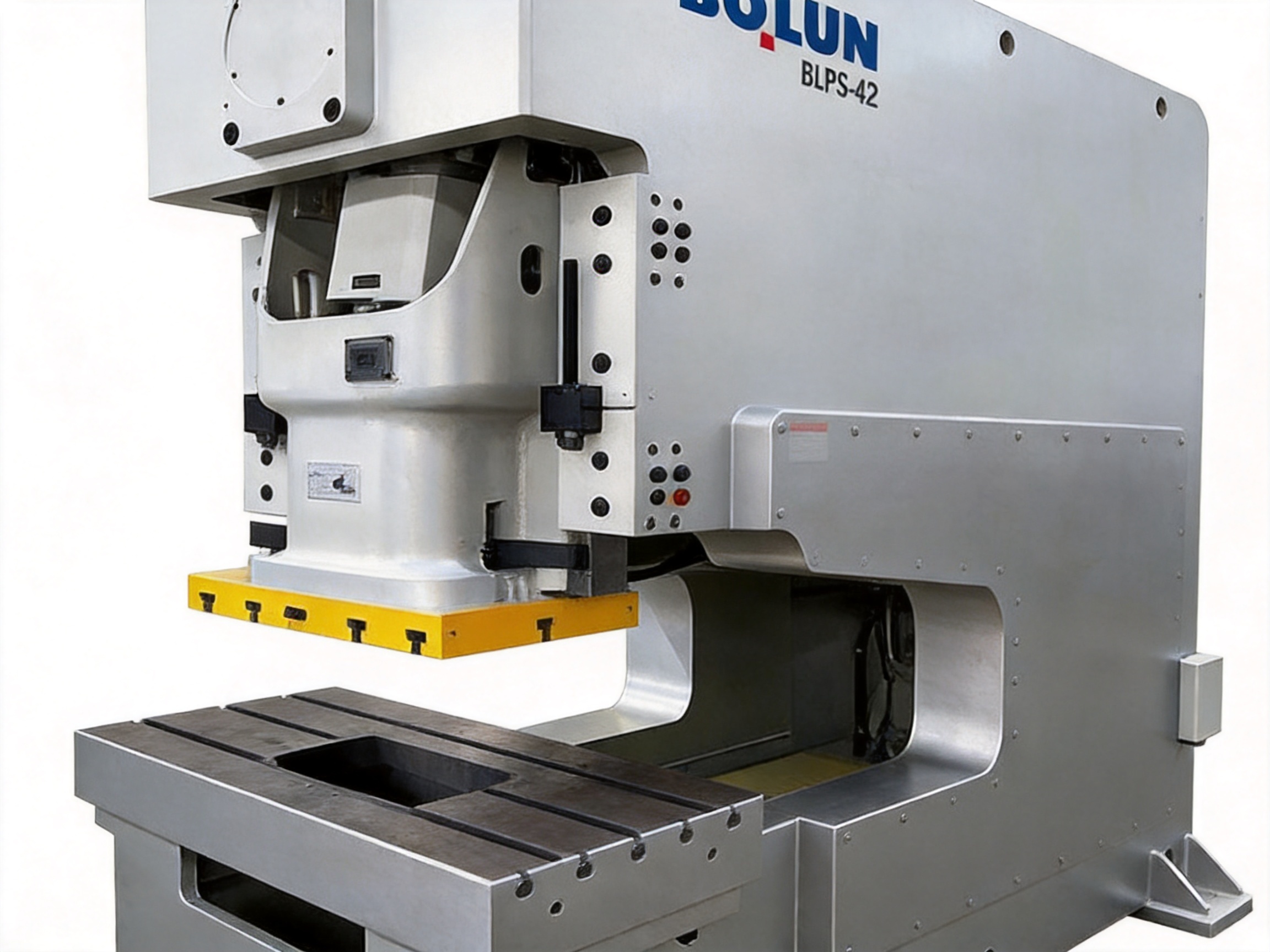
The BLPS-45 power press can serve a broad range of industrial applications. Its 450 kN capacity, open-gap deep-throat access, and enlarged worktable make it suitable for forming parts that require more reach than compact presses can provide. It can be used for punching, blanking, bending, shallow drawing, deep-reach stamping, embossing, trimming, and selected medium-duty forming operations.
In hardware manufacturing, the machine can process brackets, plates, clamps, hinges, reinforcing parts, and shaped fittings. In appliance production, it can support the forming of panels, covers, internal supports, and metal housings. In electrical equipment manufacturing, it can be used for enclosure components, mounting plates, busbar-related support parts, and metal frames. In automotive supply chains, it can handle support brackets, small structural parts, and various stamped components, depending on material and die design.
The deep-throat design is particularly valuable for panel-like workpieces. When a forming feature is positioned far from the edge of a sheet, a standard throat may be insufficient. With greater throat depth, the operator can position the workpiece more effectively. This capability expands the types of parts that can be produced on one machine.
The press is also useful for custom production. Many factories do not produce only one part type; they serve multiple customers with different specifications. A versatile press with good access and adjustment can become a core machine in a flexible manufacturing cell. It helps manufacturers respond to changing orders while maintaining production efficiency.
Ordinary open-type presses are popular because they are accessible, compact, and relatively easy to operate. However, they often have limitations in throat depth, table size, rigidity, and overload protection. The BLPS-45 improves on these common limitations through a more robust industrial configuration.
First, its deep-throat structure provides greater reach. This immediately expands the range of workpieces that can be processed. A typical open-type press may be suitable for small parts near the edge of a sheet, but it can struggle with wider or longer materials. The BLPS-45 is better suited for deep-reach stamping and complex forming where standard access is not enough.
Second, the reinforced welded steel frame provides higher rigidity than many lightweight open presses. This matters because open-frame machines are more exposed to deflection under eccentric or heavy loading. Reinforcement and heat treatment help improve long-term stability and reduce deformation.
Third, the enlarged worktable supports larger dies and provides more stable tooling installation. Many low-cost presses restrict tooling options because the table is too small or too light. The 850 × 440 × 90 mm table gives the BLPS-45 greater practical flexibility.
Fourth, the hydraulic overload protection and dual solenoid valve control provide a stronger safety and reliability foundation. A basic press may perform simple operations, but when production becomes more demanding, protective systems and control response become essential.
Closed-type presses are known for excellent rigidity and are often chosen for high-precision or heavy-duty operations. However, they are not always the best choice for every production requirement. In applications where accessibility, material handling, and tooling change flexibility are priorities, an open-gap deep-throat press can be more efficient.
The BLPS-45 allows easier side access than many closed-frame machines. This can simplify the handling of long or wide workpieces. It can also make die setup, inspection, and maintenance more convenient. For workshops with frequent changeovers, this accessibility can reduce downtime.
In addition, the open-gap design may require less floor space and less handling complexity than a larger closed press selected only to achieve sufficient workpiece clearance. Instead of overinvesting in a large machine, a manufacturer may choose the BLPS-45 to gain deep reach and medium-capacity force in a more practical package.
This does not mean that the BLPS-45 replaces all closed-type presses. Rather, it fills an important production role. It is ideal when the user needs open access, extended throat depth, medium-duty forming force, and stable accuracy. Selecting the right press is always about matching machine structure to production requirements.
The quality of a power press depends not only on its design but also on the manufacturing capability behind it. Zhejiang Bolun High-Precision Machinery Co., Ltd. is located in Zhejiang, a major center of precision manufacturing in China. With about two decades of experience in machinery manufacturing, the company has developed into a modern enterprise integrating research and development, design, production, sales, and service.
The company’s manufacturing approach emphasizes full-chain production capability. This includes basic design, core component development, precision processing, assembly, inspection, and service support. Such integration is important because press performance depends on the coordination of many parts. If design, machining, assembly, and inspection are separated without strong control, quality variation may occur. A full-chain system helps maintain consistency from concept to finished machine.
Advanced precision processing equipment supports the production of accurate components. In a press machine, key surfaces, alignment points, slide interfaces, bearing areas, and tooling surfaces must be processed carefully. Precision machining helps ensure that the machine’s structural strength is matched by accurate geometry. This is essential for achieving stable slide movement and reliable forming results.
The company also emphasizes non-standard customization capabilities. Many customers require special specifications, altered configurations, unique tooling interfaces, or production-line integration. A manufacturer with strong design and engineering teams can respond to these needs more effectively than a supplier limited to standard catalog machines. For users with special forming requirements, customization capability can be a decisive advantage.
Product development in press machinery requires deep knowledge of mechanical structure, material behavior, production safety, tooling requirements, and industrial workflow. The company’s R&D and design capacity supports the development of machines such as the BLPS-45, where open access must be balanced with rigidity and force transmission.
Engineering a deep-throat open-gap press is more complex than simply extending the throat distance. A longer throat increases the structural challenge because the working force acts farther from the frame support. The frame must resist bending and twisting while maintaining slide alignment. This requires careful design of the welded steel structure, reinforcement layout, stress treatment, and assembly process.
The design team must also consider operator ergonomics, die installation, maintenance access, drive efficiency, safety control, and compatibility with production accessories. A successful press is not only a strong machine; it must also be practical on the factory floor. The BLPS-45 reflects this practical engineering orientation through its accessible layout, large worktable, adjustment range, protection system, and production-ready motor configuration.
Compared with manufacturers that rely mainly on copying existing designs, a company with real engineering capability can refine products according to customer feedback and market requirements. This supports continuous improvement and helps machines remain competitive as manufacturing needs evolve.
Consistent machine quality requires disciplined production management. Zhejiang Bolun High-Precision Machinery Co., Ltd. has established a mature production management system supported by industry experience and inspection procedures. The company emphasizes rigorous quality control for processes and components to ensure stable precision and long service life under high-intensity operating conditions.
In press manufacturing, quality control should cover raw material selection, welding quality, heat treatment, machining accuracy, component fitting, electrical and pneumatic systems, final assembly, and test operation. Each stage affects the finished machine. For example, a well-designed frame can still perform poorly if welding distortion is not controlled. A strong slide can still cause accuracy problems if the guiding surfaces are not processed and assembled correctly.
The company’s finished product inspection system is described as exceeding general industry standards. This approach is important because a press must operate safely and reliably after delivery. Factory inspection can identify problems before shipment, reducing installation delays and customer downtime. It also helps ensure that specifications such as accuracy, motion stability, control response, and protective functions are achieved in the final product.
Strong quality control gives the BLPS-45 a competitive advantage. In a market where some suppliers compete mainly on price, disciplined inspection and process control help protect the user’s long-term investment. The press is a production asset, and its real value is measured over years of operation.
Industrial users often need more than a standard machine. They may require special throat depth, worktable modifications, automation interfaces, safety accessories, feeding devices, die support, or line integration. The company’s one-stop design and manufacturing service helps address these needs by connecting engineering support with production capability.
For the BLPS-45, customization can be especially relevant because deep-throat applications are often linked to special workpiece shapes. A customer may need to stamp a feature in the middle of a long part, process wide sheets, or integrate the press with a custom fixture. Engineering support can help evaluate whether the machine configuration, die design, and production method are suitable.
One-stop service also improves communication. Instead of dealing with separate suppliers for design, machine selection, production, and service, customers can work with a manufacturer that understands the full equipment lifecycle. This can reduce project risk and shorten the time from requirement analysis to productive operation.
Customer-oriented support covers pre-sales consultation, in-sales assistance, and after-sales service. Pre-sales consultation helps users choose the correct model and configuration. In-sales support helps coordinate production and delivery details. After-sales service helps maintain machine performance, solve technical issues, and support long-term operation.
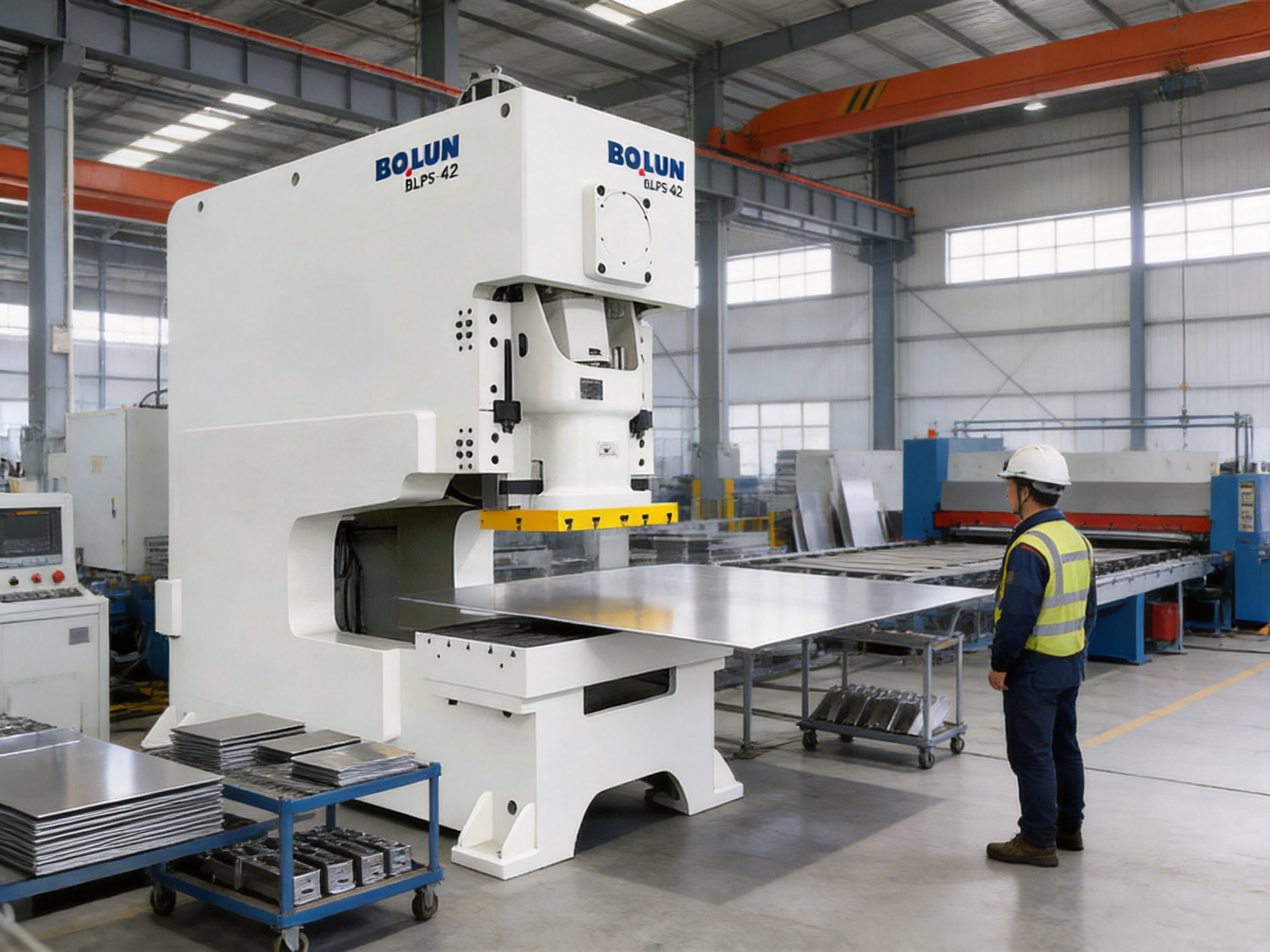
A power press used in industry must withstand continuous production cycles. The machine experiences repeated dynamic loading, vibration, braking, clutch engagement, slide motion, and die impact. Reliability depends on structural strength, component quality, lubrication, control stability, and correct operation.
The BLPS-45 is designed for operational stability under continuous high-capacity production cycles. Its reinforced frame resists deformation. The hydraulic overload device protects the press from excessive load. The dual solenoid valve control supports reliable stop-start behavior. The 4 kW motor provides appropriate drive power. These elements work together to support dependable production.
Reliability has direct financial value. A machine that stops unexpectedly can affect an entire production schedule. If a press is part of a larger process, downtime may also delay welding, assembly, painting, packing, and shipment. By choosing a press designed for stable operation, manufacturers reduce risk across the production chain.
Competitor machines may appear similar in capacity, but real reliability is determined by engineering details and manufacturing discipline. The BLPS-45’s combination of frame design, protection systems, control response, and quality inspection gives it a strong position for users who need more than basic pressing force.
Operator experience is an important part of press performance. A machine that is difficult to access, adjust, or maintain can slow production and increase the chance of mistakes. The open-gap deep-throat design improves visibility and access to the work area. The 800 mm working face height supports practical integration into typical workshop environments.
The distance between columns, worktable size, and slide bottom dimensions provide a usable space for tool installation and workpiece handling. Operators and technicians can approach the die area more conveniently than they could with many more enclosed machine structures. This supports faster setup and easier inspection.
Air pressure of 0.55 MPa aligns with common industrial pneumatic systems, supporting integration with factory compressed air infrastructure. The motor and control system can be incorporated into a production cell with appropriate electrical and safety planning. When used with feeding equipment, guards, light curtains, or other safety devices, the press can become part of a more systematic stamping process.
Good workshop integration also depends on training, maintenance planning, and safe procedures. The machine provides a strong mechanical foundation, but users should implement proper die-setting practices, lubrication schedules, inspection routines, and operator safety training to realize its full benefits.
When evaluating a power press, purchase price is only one part of the total cost. Users should also consider installation, tooling compatibility, energy use, maintenance, downtime, part quality, die wear, operator efficiency, and service support. The BLPS-45 is designed to provide strong lifecycle value through durability, flexibility, and protection.
The 450 kN capacity allows the machine to handle a wide range of medium-duty tasks, reducing the need to purchase multiple smaller machines for different jobs. The deep-throat configuration expands application range. The large worktable supports varied dies. The die height adjustment range reduces setup limitations. These features improve utilization, which is a major factor in equipment return on investment.
Hydraulic overload protection can reduce expensive accident-related costs. A damaged die or press component can be far more expensive than the protective system itself. Stable accuracy can reduce scrap and rework. Reliable control can improve productivity and reduce production interruptions. These factors create value over the machine’s full service life.
Compared with lower-cost competitors, the BLPS-45 is better understood as an investment in stable production. A machine that is cheaper at the beginning but less rigid, less protected, or less accurate may cost more over time. For serious manufacturers, lifecycle value is usually more important than minimum purchase price.
The machinery industry is moving toward intelligent, digital, and more integrated production. Press machines are increasingly expected to work with feeding systems, monitoring devices, digital production planning, and automated safety solutions. Although the BLPS-45 is a mechanical power press at its core, its stable structure and responsive control foundation make it suitable for modern production improvement.
The company has expressed a commitment to high-end, precision, and advanced manufacturing fields, including investment in intelligent and digital stamping equipment. This direction is important for customers who want equipment that can remain relevant as factory systems become more connected. A reliable press with strong mechanical fundamentals is easier to integrate into advanced production than a weak machine that requires constant manual correction.
Intelligent manufacturing does not eliminate the need for strong mechanical design. On the contrary, digital systems depend on mechanical stability. Sensors, controllers, and production software can only optimize a process if the machine responds consistently. The BLPS-45’s rigid frame, accurate slide action, and stable control system provide the physical foundation required for process improvement.
For manufacturers planning gradual modernization, this press can serve as a dependable base machine. It can be used in current production while leaving room for future integration with improved feeding, monitoring, guarding, or workflow systems.
Before selecting the BLPS-45, buyers should evaluate their material type, thickness, forming method, die design, required production speed, workpiece size, and safety requirements. The nominal capacity of 450 kN is suitable for many medium-duty tasks, but actual application suitability depends on the forming force calculation and die conditions.
Throat depth requirements should be carefully reviewed. If the forming point is far from the workpiece edge, the deep-throat design is a major advantage. If the parts are very small and do not require deep reach, a different open-type press may also be considered. If the work requires extremely high rigidity under heavy eccentric loads, a closed-type press may be more appropriate. Correct machine selection depends on matching the press to the process.
Buyers should also consider die height and stroke requirements. The BLPS-45 offers practical die height capacity and adjustment, but tooling dimensions must be confirmed before purchase. Worktable size and slide bottom size should be checked against die layout and fastening needs. Production speed should be selected according to material feeding method, part complexity, and safety control.
Finally, buyers should evaluate supplier capability. A good press manufacturer should provide technical consultation, accurate specifications, manufacturing quality, inspection records, and after-sales support. Zhejiang Bolun High-Precision Machinery Co., Ltd. offers integrated design, production, and service capabilities, which can help reduce purchasing risk and improve long-term satisfaction.
The BLPS-45 is an open-gap deep-throat power press with a nominal capacity of 450 kN. It is designed for stamping, forming, punching, and medium-duty industrial forming applications that require extended reach and good accessibility.
The deep-throat design allows the forming point to be located farther from the frame, making it easier to process wide sheets, long parts, panels, and workpieces with features positioned away from the edge.
It offers greater throat depth, a larger worktable, stronger reinforced welded steel construction, hydraulic overload protection, and high-sensitivity dual solenoid valve control. These features make it more suitable for demanding industrial production than many basic open-type presses.
The reinforced, heat-treated, welded steel frame improves rigidity and helps reduce elastic deformation under load. This supports stable accuracy, longer die life, and more consistent forming results.
The BLPS-45 is equipped with an 850 × 440 × 90 mm worktable, providing a practical support area for medium-duty dies and larger workpieces.
The machine integrates hydraulic overload protection and high-sensitivity dual solenoid valve control. These systems help protect the press, improve stop-start response, and support safer operation when combined with proper guards, training, and operating procedures.
It can be used in hardware manufacturing, sheet metal processing, appliance component production, electrical enclosure manufacturing, automotive support parts, and custom industrial forming operations.
Yes. Its open access, deep throat, large worktable, and die height adjustment make it suitable for varied jobs. The manufacturer also has non-standard customization capability, which can support special production requirements.
It indicates that the machine is built to a recognized high accuracy standard for press equipment. For users, this supports stable part quality, better repeatability, and improved tooling performance.
If the application requires open access, easy handling of long or wide workpieces, flexible die setup, and medium-duty forming force, the BLPS-45 can be more practical and cost-efficient than a larger closed-type press. However, for very heavy or highly eccentric precision loads, a closed-type press may still be preferred.
The BLPS-45 Robust Large-Capacity Open-Gap Deep-Throat Power Press is a strong solution for manufacturers that need flexible access, extended reach, stable forming force, and reliable industrial performance. Its 450 kN nominal capacity, reinforced heat-treated welded steel frame, enlarged 850 × 440 mm worktable, 80 mm die height adjustment, hydraulic overload protection, and dual solenoid valve control create a well-balanced machine for medium-duty stamping and forming operations.
Its competitive advantage lies not in one isolated specification, but in the integration of practical features. The deep-throat structure expands workpiece capability. The large table improves tooling support. The reinforced frame enhances rigidity. The protection and control systems improve reliability and safety. The manufacturing strength behind the product adds further value through precision processing, quality control, engineering support, and customization capability.
For factories seeking to improve productivity, reduce process limitations, and invest in a durable forming machine, this open-gap deep-throat power press offers a compelling combination of accessibility, strength, and lifecycle value. It is particularly well suited to manufacturers who need a press that can handle varied industrial work while maintaining stable accuracy and dependable operation.
Boljanovic, V. Sheet Metal Forming Processes and Die Design. Industrial Press.
Altan, T., and Tekkaya, A. E. Sheet Metal Forming: Fundamentals. ASM International.
Kalpakjian, S., and Schmid, S. R. Manufacturing Engineering and Technology. Pearson.
Society of Manufacturing Engineers. Tool and Manufacturing Engineers Handbook: Forming. SME.
Japanese Industrial Standards Committee. Standards Related to Mechanical Press Accuracy and Inspection.
National Standards of the People’s Republic of China. Standards Related to Mechanical Press Performance and Safety.


What Is a Power Press? A power press — also called a stamping press or punch pr...
In the fields of metal forming, sheet metal fabrication, blanking, and punching,...
As the manufacturing industry moves steadily toward automation and smart product...
In modern manufacturing, cold forging is widely used in the automotive, aerospac...
Manufacturing & Metalworking A direct, practical look at how mechanical pre...
Power Press Technology Overview: From Fundamentals to Equipment Selection In the...
Contact Us

bolunpress@gmail.com

+86-575-83362228

+86-15158259588

+86-575-83362999

+86-15158259588

Hangzhou Office Add: No. 332 Wangjiang East Road, Shangcheng District

No.1 Linjiang Road East, Xiaren, Jinting Town, Shengzhou City, Zhejiang Province, China
Ready to Begin?
Get in Touch

Now!

ZHEJIANG BOLUN
 English
 中文简体
中文简体