
In modern metal forming, heavy-tonnage production is no longer judged only by force. Manufacturers need repeatable accuracy, stable slide motion, reliable overload protection, long service life, and enough working space to support complex dies and large components. The BLPF-400 Precision-Stable Closed-Type Double-Point Eccentric Gear Power Press is designed for this demanding environment. With a nominal capacity of 4000 kN, a rigid closed-frame structure, a double-point drive arrangement, and an eccentric gear transmission system, it provides a balanced solution for medium-to-large precision stamping, forming, and drawing applications.
This article examines the BLPF-400 as a representative heavy-tonnage closed-type power press. It focuses on its mechanical advantages, production value, competitive strengths, safety configuration, and suitability for hardware, appliance, and automotive component manufacturing. It also introduces the manufacturing capabilities of Zhejiang Bolun High-Precision Machinery Co., Ltd., the producer of the machine, emphasizing how advanced design, strict processing, mature assembly procedures, and comprehensive quality control support the long-term performance of the equipment.
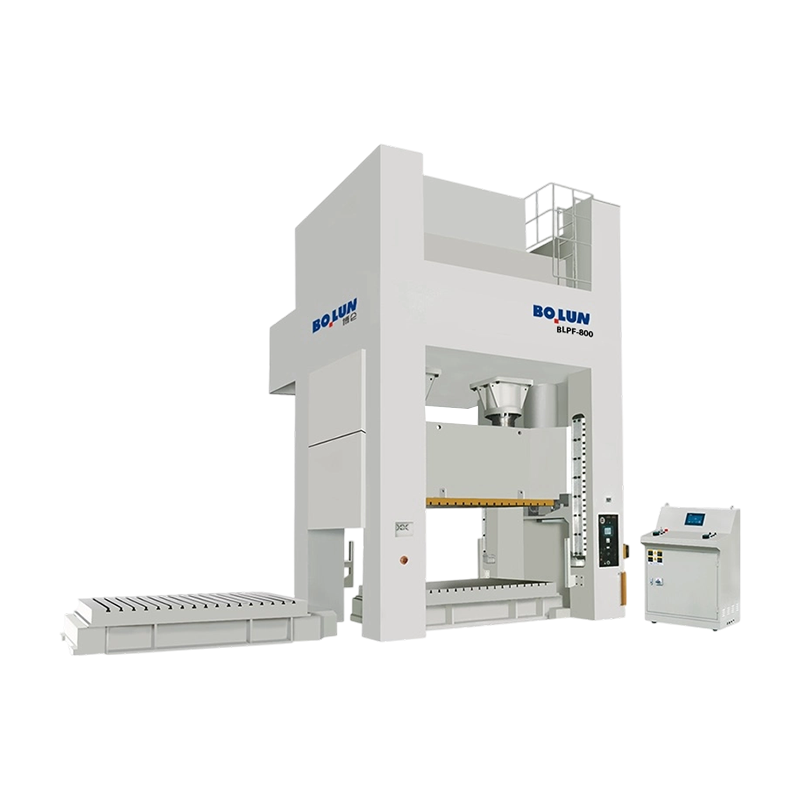
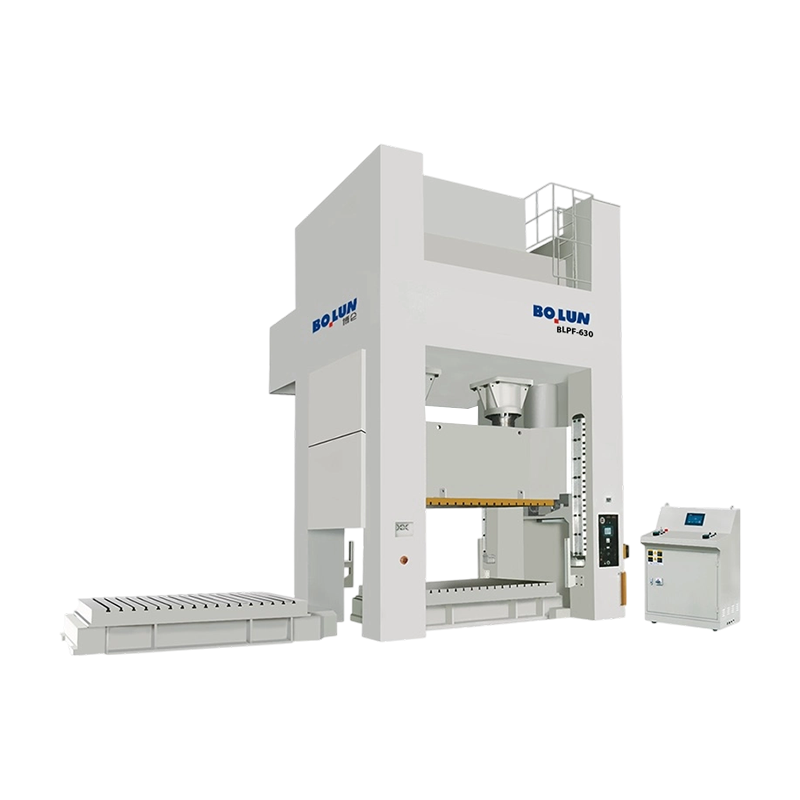
BLPF-400 Precision-Stable Closed-Type Double-Point eccentric gear Power Press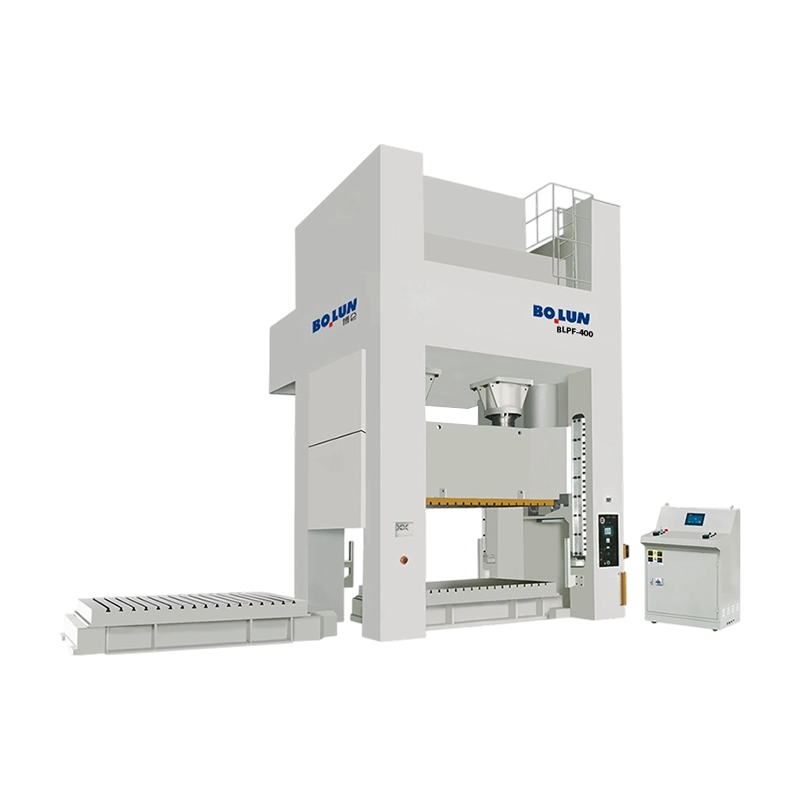
The BLPF-400 belongs to the closed-type power press category and is specifically configured as a closed-type double-point eccentric gear power press. This positioning is important because it distinguishes the machine from open-type presses and lighter mechanical presses that may be suitable for simple blanking but are often limited when larger dies, higher load eccentricity, or tighter forming accuracy are required. In high-value production, frame deflection, slide tilting, and unstable transmission can cause dimensional inconsistency, increased die wear, and lower production yield. The BLPF-400 is built to reduce these risks.
As an entry-level model within a heavy-tonnage series, the BLPF-400 offers 4000 kN of nominal force while maintaining a worktable size of 2800 x 1100 mm. This combination allows users to process larger parts or multi-station tooling without immediately moving to a much larger and more expensive press. For factories upgrading from smaller open-type machines, this model provides a practical transition toward more accurate, more stable, and more automated forming operations.
Its industrial value is especially clear in sectors where repeatability and die protection directly affect profitability. Automotive brackets, structural hardware, large appliance parts, reinforced sheet-metal components, and medium-to-large formed parts all require stable forming energy and accurate guidance. The BLPF-400 is designed for exactly this type of work: not merely pressing metal, but supporting consistent production with controlled motion, high rigidity, and dependable safety functions.
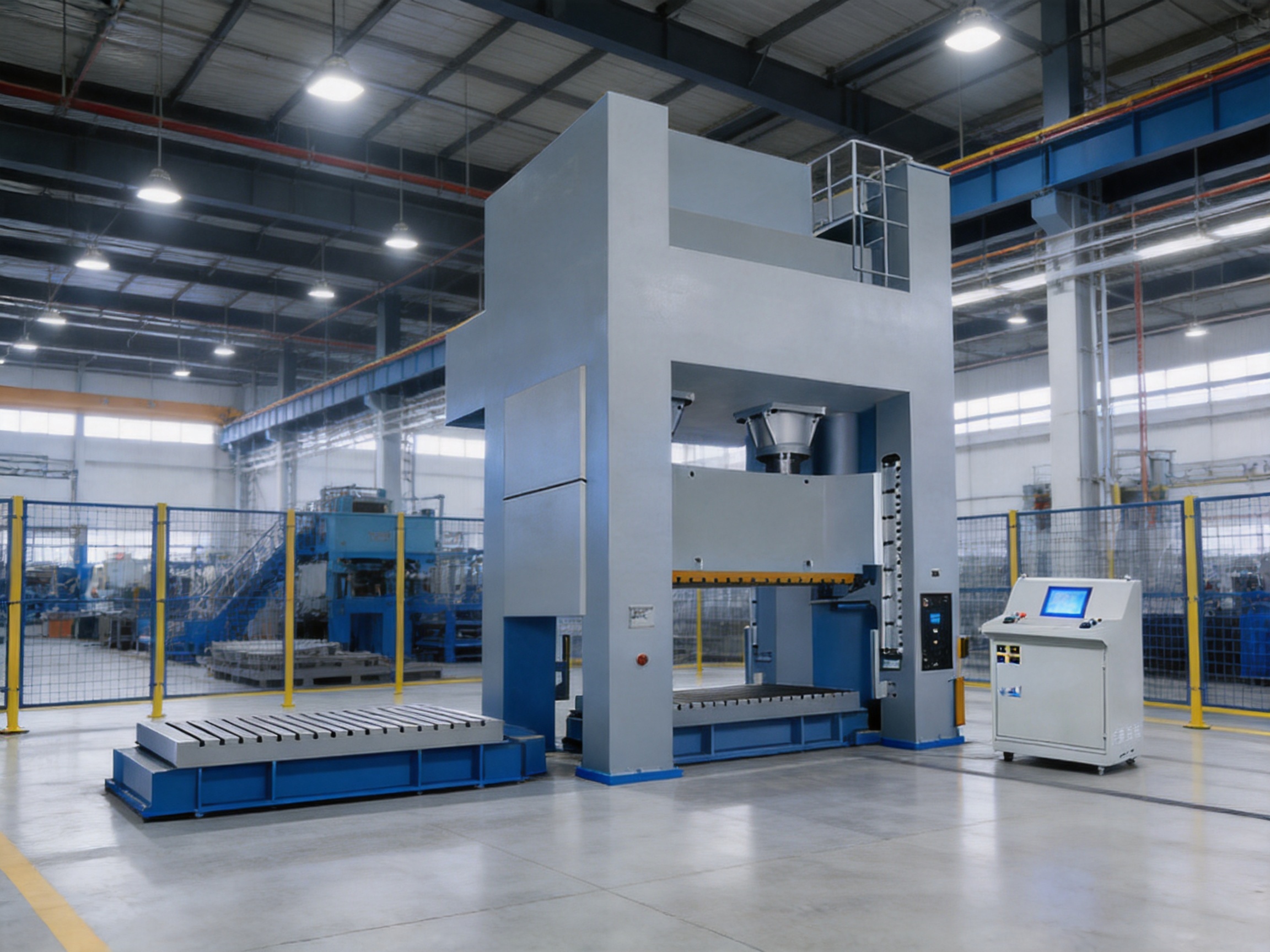
The central design concept of the BLPF-400 is stability under load. A heavy-tonnage press must not only reach its rated force; it must deliver that force through a stable structure and a controlled drive path. The closed-type frame provides a strong body that surrounds the working area and distributes forming forces more evenly than many open-front designs. This is especially useful when the die load is not perfectly centered, a common situation in real production.
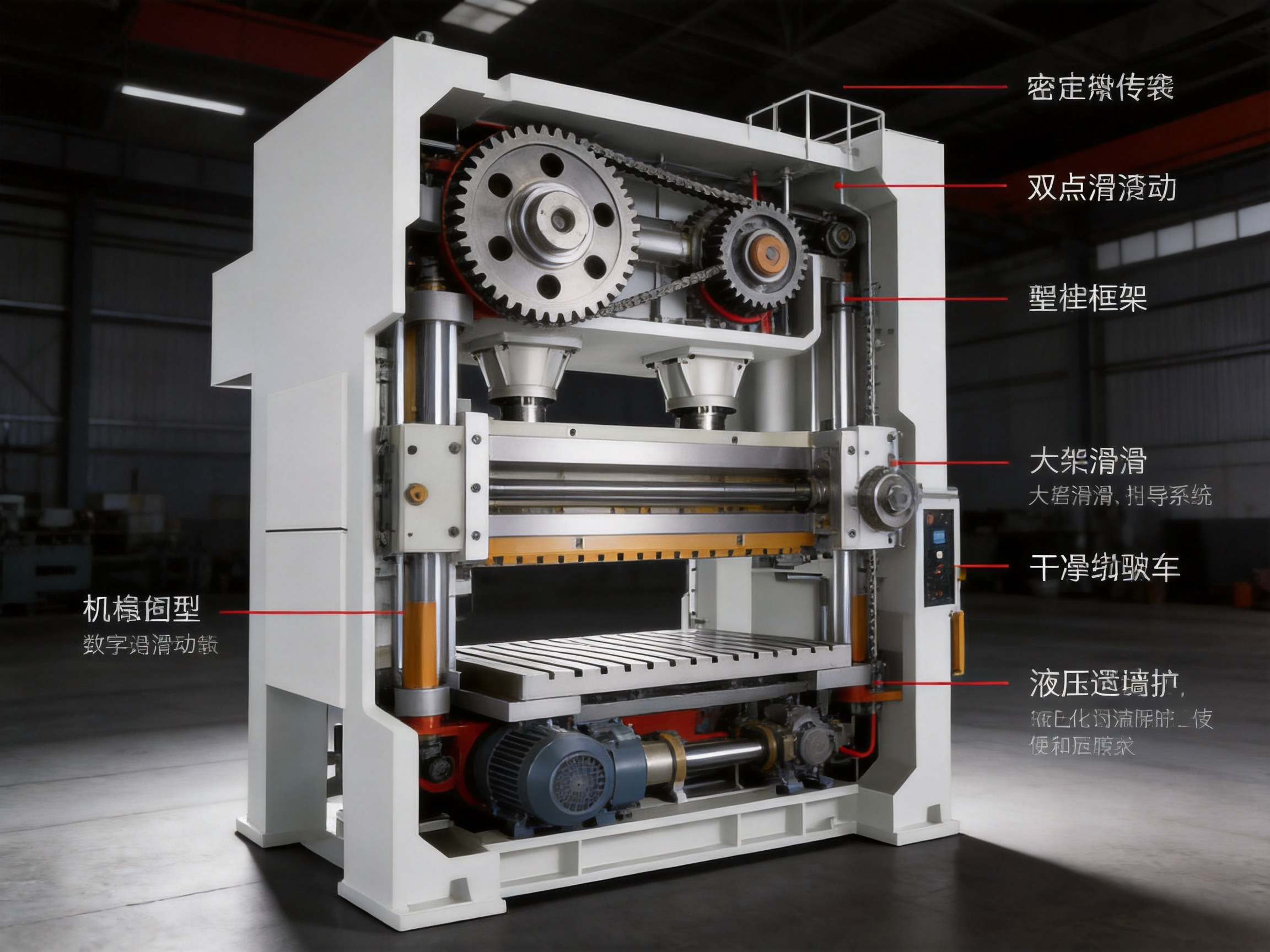
The double-point drive system is another key feature. Instead of applying force through a single central point, the double-point arrangement supports the slide more evenly across a wider working area. This helps improve parallelism between the slide and the bolster, reduces the tendency for slide tilt, and supports larger dies. For customers using progressive dies or wide tooling, this design provides a meaningful advantage over single-point presses of similar nominal capacity.
The eccentric gear drive system is designed to provide high torque and uniform motion. In forming processes, torque delivery and motion smoothness influence part quality, die life, noise, vibration, and press stability. An eccentric gear system can deliver strong energy transfer while maintaining controlled slide travel. For thicker materials, deeper forming, or operations requiring steady pressure near the bottom of the stroke, this characteristic is highly valuable.
The following table summarizes the core parameters of the BLPF-400 and related models in the same heavy-tonnage series. The BLPF-400 column is particularly relevant for users seeking a 4000 kN closed-type double-point eccentric gear press with generous working dimensions.
| Parameter | Unit | BLPF-400 | BLPF-500 | BLPF-630 | BLPF-800 | BLPF-1000 | BLPF-1250 |
| Nominal Capacity | kN | 4000 | 5000 | 6300 | 8000 | 10000 | 12500 |
| Nominal Pressure Stroke | mm | 9 | 10 | 10 | 10 | 13 | 13 |
| Stroke of Slide | mm | 300 | 300 | 400 | 400 | 400 | 400 |
| Strokes per Minute | SPM | 15-30 | 15-30 | 15-25 | 15-25 | 12-20 | 12-20 |
| Maximum Die Height | mm | 650 | 750 | 800 | 850 | 900 | 900 |
| Die Height Adjustment | mm | 250 | 300 | 300 | 300 | 300 | 300 |
| Worktable Size | mm | 2800 x 1100 | 3300 x 1300 | 3300 x 1300 | 3600 x 1400 | 3800 x 1500 | 4000 x 1600 |
| Slide Bottom Size | mm | 2500 x 1100 | 3100 x 1300 | 3100 x 1400 | 3300 x 1400 | 3500 x 1500 | 3700 x 1600 |
| Height of Working Face | mm | 750 | 750 | 750 | 850 | 850 | 850 |
| Distance Between Columns | mm | 3250 | 3750 | 3750 | 4050 | 4250 | 4450 |
| Main Motor | kW x P | 37 x 4 | 45 x 4 | 55 x 4 | 75 x 4 | 90 x 4 | 110 x 4 |
| Air Pressure | MPa | 0.55 | 0.55 | 0.55 | 0.55 | 0.55 | 0.55 |
| Cushion Capacity | kN | 500 | 500 | 800 | 1200 | 1200 | 1200 |
| Cushion Working Stroke | mm | 120 | 120 | 140 | 140 | 180 | 180 |
| Precision Standard | Class | GB/JIS Class 1 | GB/JIS Class 1 | GB/JIS Class 1 | GB/JIS Class 1 | GB/JIS Class 1 | GB/JIS Class 1 |
One of the most important advantages of the BLPF-400 is its closed-type frame. In mechanical press design, frame structure strongly affects rigidity and accuracy. Open-type presses are convenient for access and smaller jobs, but their C-frame geometry can be more vulnerable to angular deflection during heavy or off-center loading. Such deflection may appear minor, but in precision stamping it can cause burr variation, uneven forming depth, die misalignment, or accelerated tool wear.
The closed-type frame of the BLPF-400 creates a more balanced force loop. During stamping, the working load is absorbed through the entire frame structure rather than concentrated in a more flexible throat area. This contributes to better long-term accuracy, especially when processing large panels or components requiring a wide die face. For manufacturers that measure cost not only by machine price but also by part consistency, die service life, and downtime reduction, this structural advantage is significant.
Compared with many lighter presses in the same general force range, the BLPF-400 offers stronger support for demanding production. Its 3250 mm distance between columns and 2800 x 1100 mm worktable create a practical working envelope for larger dies. The 2500 x 1100 mm slide bottom size further improves die support and load distribution. These dimensions allow the user to design tooling with fewer compromises, which can improve productivity and reduce secondary operations.
The double-point drive system is a major differentiator for users working with wide or long dies. In a single-point press, slide force is concentrated at one main drive location. This may be sufficient for compact tooling, but wider dies place greater demands on slide parallelism. If the slide is not evenly supported, the tooling may experience uneven contact, leading to inconsistent part dimensions and premature die maintenance.
By using a double-point configuration, the BLPF-400 distributes drive force more evenly across the slide. This is particularly beneficial when the load center shifts during the forming cycle. Many real stamping processes do not load the press perfectly at the center. A progressive die may punch, bend, and form different areas at different stages, producing uneven resistance. The double-point design helps stabilize the slide under these changing conditions.
For automotive and hardware manufacturers, this translates into more reliable output. Brackets, reinforcement plates, hinge components, and structural stampings often require tight dimensional control across multiple features. When the press slide remains stable, the die can do its work with greater consistency. In this way, the double-point design does not simply increase mechanical strength; it improves the economic performance of the production line.
The eccentric gear drive system of the BLPF-400 is designed to provide high torque and uniform motion. In heavy forming, torque is just as important as nominal capacity. A press may be rated for a certain tonnage, but if the drive system cannot deliver stable energy through the critical portion of the stroke, production quality may suffer. The eccentric gear mechanism supports controlled motion and strong power transmission, which are essential for stamping and forming operations that require force near bottom dead center.
Uniform motion also helps protect tooling. Sudden changes in speed or unstable energy transfer can increase shock loading, vibration, and noise. Over time, these factors may reduce die life, loosen mechanical connections, and increase maintenance requirements. The BLPF-400 is intended to reduce such problems through stable drive behavior, a rigid frame, and a well-matched power system.
Compared with presses that rely on less robust drive arrangements, the eccentric gear structure provides a more suitable foundation for high-load forming. It is especially useful in medium-to-large components where the material may resist deformation over a broader area. The press can apply force smoothly, helping the part form accurately while reducing unnecessary impact on the die and machine body.
Accuracy is one of the most valuable characteristics of a heavy-tonnage press. In the BLPF-400, the high-rigidity frame and precision-oriented manufacturing support GB/JIS Class 1 precision. This is important because users purchasing a heavy press often plan to run expensive dies and high-volume orders. Even small deviations in slide movement, parallelism, or frame response can cause large economic losses when repeated across thousands or millions of parts.
Maintaining precision under load requires more than careful assembly. It depends on material selection, frame processing, machining accuracy, guide design, drive synchronization, and final inspection. Zhejiang Bolun High-Precision Machinery Co., Ltd. emphasizes a finished product inspection system that exceeds common industry expectations. Each process and component is subject to rigorous control, helping ensure that the press maintains stable precision under high-intensity operating conditions.
For the end user, GB/JIS Class 1 precision means greater confidence in repeat production. It reduces the need for frequent die corrections, helps maintain consistent part geometry, and supports more efficient quality control. This is particularly important for customers supplying automotive or high-standard hardware markets, where dimensional consistency and repeatability are essential.
The BLPF-400 offers a worktable size of 2800 x 1100 mm and a slide bottom size of 2500 x 1100 mm. These dimensions create a generous foundation for medium-to-large tooling. In practical production, table area affects far more than part size. It influences die design, feeding method, automation integration, scrap discharge, and maintenance access. A larger table gives engineers more freedom to arrange die stations and auxiliary systems.
The maximum die height of 650 mm and die height adjustment of 250 mm support a broad range of tooling configurations. This flexibility is valuable for factories producing diverse parts or frequently changing product lines. Instead of being locked into a narrow die range, users can adapt the press to different tooling requirements, improving equipment utilization.
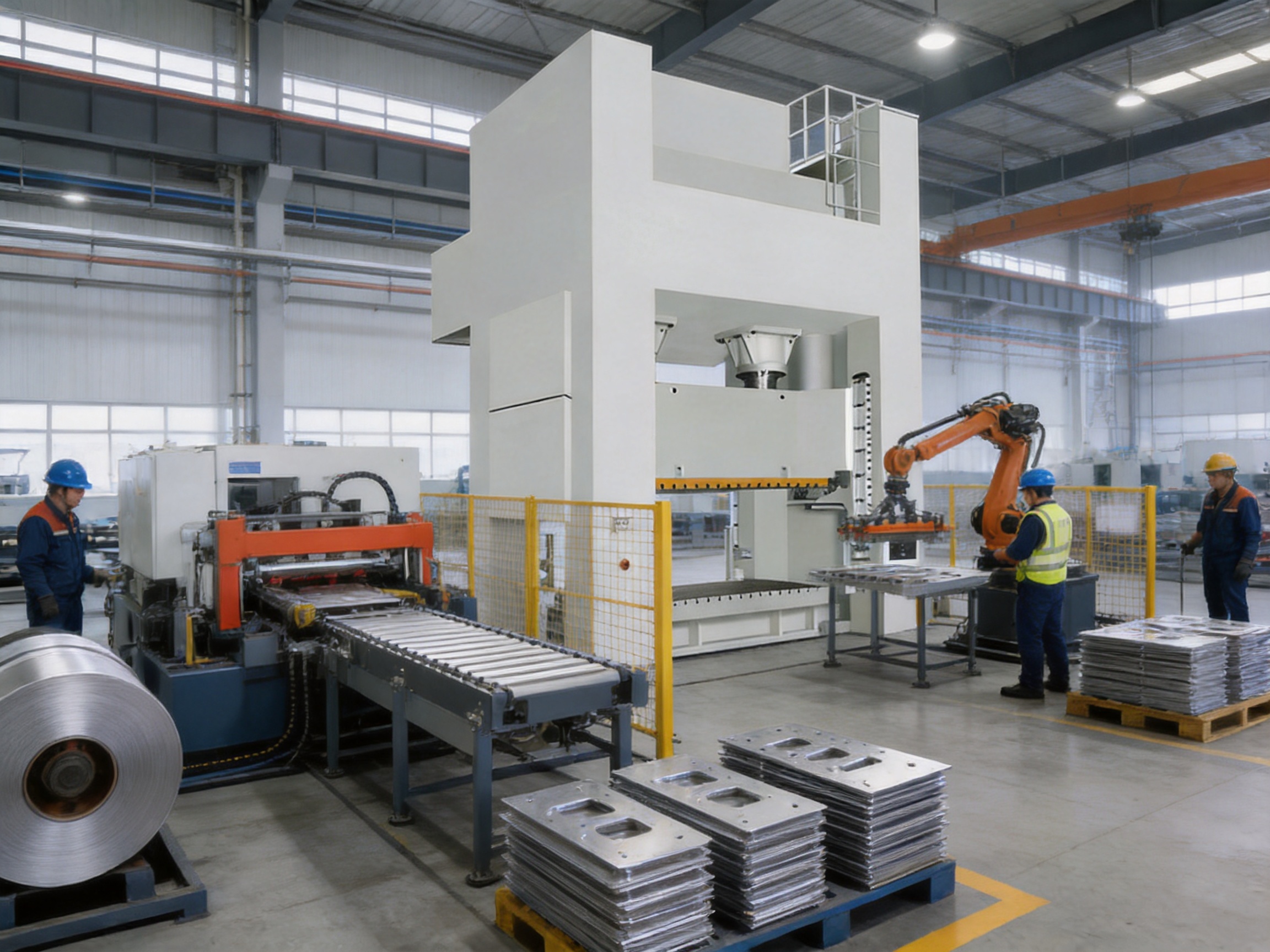
The 750 mm height of the working face also supports practical operation and integration into production lines. When combined with appropriate feeding, transfer, or robotic handling equipment, the machine can become part of a more automated stamping system. For companies aiming to improve labor efficiency and reduce manual handling risks, this compatibility is a major advantage.
The BLPF-400 operates at 15 to 30 strokes per minute. This range is well suited to heavy-tonnage stamping, where quality and stability are often more important than maximum speed. In large-part forming, excessive speed may lead to material flow problems, increased vibration, or reduced die life. A controlled speed range allows the operator to balance productivity with forming quality.
For blanking and simpler forming processes, the upper range can support efficient output. For more complex forming, drawing, or thicker material operations, lower speed can provide better control. This flexibility allows the press to serve multiple production needs without sacrificing stability. In many factories, a machine that can reliably produce a range of parts is more valuable than one optimized for a narrow process window.
Productivity is also enhanced by the dry clutch brake and hydraulic overload protector. These systems help ensure controlled operation and reduce downtime caused by abnormal loading. When a press can stop reliably, protect itself from overload, and return to production quickly after inspection, overall equipment effectiveness improves.
The BLPF-400 is equipped with a highly sensitive dry clutch brake and a hydraulic overload protector. These features are critical in industrial stamping environments. The clutch brake system supports controlled engagement and stopping, helping operators manage the machine safely during single-stroke, continuous, or setup conditions. A responsive brake is especially important in high-tonnage equipment, where moving mass and stored energy are substantial.
The hydraulic overload protector helps protect both the machine and the die from excessive force. Overload can occur due to incorrect material thickness, double feeding, die obstruction, misalignment, or process errors. Without proper protection, overload may damage the press frame, drive system, or expensive tooling. By incorporating overload protection, the BLPF-400 reduces the risk of catastrophic damage and supports safer operation.
Safety is not only a matter of installed components; it also depends on manufacturing quality and system reliability. Zhejiang Bolun’s emphasis on strict inspection and stable assembly supports the dependable function of safety systems. When operators trust the press to respond predictably, they can work more efficiently and with greater confidence.
Compared with open-type presses, the BLPF-400 provides superior structural rigidity for heavy and wide-die applications. Open-type machines may offer easier access, but they are often less suitable for high-force precision work because of frame deflection. The closed-type configuration of the BLPF-400 helps maintain accuracy under heavy load and supports longer die life.
Compared with single-point presses, the double-point drive gives the BLPF-400 an advantage in slide stability and load distribution. This is especially important for wide components, progressive dies, and processes with uneven forming resistance. Users can benefit from improved parallelism, reduced die stress, and better part consistency.
Compared with presses that focus only on nominal capacity, the BLPF-400 provides a more complete production solution. It combines 4000 kN capacity with a large worktable, high-rigidity structure, eccentric gear drive, dry clutch brake, hydraulic overload protection, and GB/JIS Class 1 precision. This integrated balance is more valuable than tonnage alone because successful stamping depends on the interaction of all machine systems.
Compared with lower-cost machines lacking strong process control, the BLPF-400 can reduce hidden production expenses. A cheaper press may appear attractive initially, but if it causes frequent die adjustment, inconsistent output, downtime, or high maintenance cost, the total cost of ownership becomes higher. The BLPF-400 is designed to offer long-term value through stability, accuracy, and protection.
The BLPF-400 is suitable for medium-to-large precision components in the hardware and automotive sectors. In hardware production, it can be applied to reinforced plates, frames, hinges, structural brackets, and formed metal assemblies. These parts often require accurate holes, bends, and formed sections, making press stability essential.
In automotive-related manufacturing, the machine can support production of brackets, reinforcement elements, seat components, chassis-related stampings, appliance-linked vehicle parts, and other formed sheet-metal components. Automotive suppliers must meet strict repeatability requirements, and press accuracy directly influences downstream welding, assembly, and inspection results.
The press may also be used in appliance manufacturing, electrical cabinet production, building hardware, and general industrial sheet-metal forming. Its large table and stable drive make it suitable for customers that process different part families and require one machine to cover multiple production tasks.
Zhejiang Bolun High-Precision Machinery Co., Ltd. is located in Zhejiang, a major center of precision manufacturing in China. With approximately two decades of experience in machinery manufacturing, the company has developed into a modern enterprise integrating research and development, design, production, sales, and service. This integrated capability is important because a power press is not a simple product assembled from standard parts; it is a complete mechanical system requiring deep knowledge of structure, transmission, precision processing, and application requirements.
The company’s development philosophy emphasizes technological innovation and practical industrial experience. Its manufacturing approach covers the full chain from basic design and core component development to final machine assembly. This full-chain capability allows closer control over quality and performance than production models that rely heavily on disconnected outsourcing. For customers, it means better consistency, clearer accountability, and stronger support when special requirements arise.
Bolun’s production management system is described as professional, mature, and efficient. This matters because heavy machinery manufacturing depends on process discipline. Large frames must be processed accurately; mating surfaces must be controlled; drive components must be aligned; and final assembly must be verified through inspection. A strong production management system reduces variation and helps ensure that each press meets the intended standard.
High-precision press manufacturing begins with design, but design intent must be realized through processing. Advanced precision processing equipment allows the company to machine large structural components and critical surfaces accurately. For a closed-type double-point press, this is especially important because guide alignment, table flatness, slide geometry, and drive synchronization all affect final machine performance.
During assembly, the relationship between the frame, slide, crank or eccentric transmission, guide components, clutch brake, and overload protection system must be carefully controlled. Any accumulated error can reduce accuracy or cause abnormal wear. Therefore, disciplined assembly is a competitive advantage. The BLPF-400 benefits from a manufacturing environment that emphasizes rigorous procedures, inspection, and stable quality.
Another strength is non-standard customization capability. Many customers do not need only a standard machine; they need a press that fits their die, material, automation method, plant layout, and production goals. Bolun’s design team provides one-stop design and manufacturing services for special specifications and functions. This allows customers to align the press more closely with actual production needs, improving return on investment.
Quality control is central to the value of any heavy-tonnage press. A machine such as the BLPF-400 is expected to operate under high load for many years. If manufacturing quality is inconsistent, problems may not appear immediately but can emerge through vibration, guide wear, oil leakage, clutch issues, poor repeatability, or frame deformation. Strong quality control reduces these risks.
Bolun has established a finished product inspection system intended to exceed ordinary industry standards. Rigorous checks are performed on processes and components to ensure stable precision and long service life. This approach is especially important for customers who run high-volume orders or expensive dies. Reliable machine quality protects not only the press investment but also the customer’s production schedule and market reputation.
The company also provides a customer-oriented service system covering pre-sales consultation, in-sales support, and after-sales guarantees. For heavy machinery, service capability is a major part of product value. Customers may require help with model selection, foundation planning, tooling compatibility, installation, training, maintenance, and troubleshooting. A manufacturer with structured service support can reduce commissioning risk and improve operational confidence.
Global manufacturing is moving toward intelligent, digital, and automated production. Stamping equipment must be ready for this transition. While the BLPF-400 is fundamentally a robust mechanical press, its stable structure and predictable motion make it suitable for integration with automated feeding systems, transfer devices, sensing systems, and production monitoring solutions.
Automation requires stable machine behavior. A robot, feeder, or transfer mechanism depends on repeatable slide movement and reliable stopping positions. The dry clutch brake, controlled stroke range, and rigid structure support this type of integration. When combined with appropriate line equipment, the BLPF-400 can help reduce manual labor, improve safety, and increase production consistency.
Bolun’s strategic focus on intelligent and digital stamping equipment further strengthens the product’s future value. Manufacturers investing in heavy presses often plan for long service lives. Choosing a machine from a company actively improving intelligent manufacturing capabilities helps protect that investment as production requirements evolve.
When evaluating a heavy-tonnage press, purchase price is only one part of the decision. Total cost of ownership includes die life, maintenance frequency, energy efficiency, downtime, scrap rate, operator safety, spare parts support, and production flexibility. The BLPF-400 is positioned to deliver value across these areas.
Its high-rigidity closed frame can reduce die misalignment and part variation. Its double-point drive can reduce uneven loading on wide tooling. Its eccentric gear system can provide stable torque and motion. Its overload protector can prevent severe damage from process errors. Its large worktable can support diverse tooling. Each of these factors can reduce hidden costs over the life of the machine.
For companies producing medium-to-large parts, the ability to maintain consistent quality can be more profitable than marginally higher speed or lower initial cost. Scrap, rework, die repair, and unplanned downtime often cost far more than customers expect. A stable press like the BLPF-400 helps control these costs by creating a more predictable forming environment.
Before selecting the BLPF-400, users should evaluate part size, material thickness, required forming force, die dimensions, production speed, automation requirements, and plant foundation conditions. The nominal capacity of 4000 kN should be matched with the actual forming load, including safety margin. The 2800 x 1100 mm worktable should be compared with die layout and feeding requirements.
Users should also consider maximum die height, die height adjustment, cushion capacity, and working stroke. The BLPF-400 provides a 650 mm maximum die height, 250 mm adjustment, 500 kN cushion capacity, and 120 mm cushion working stroke. These values make it suitable for many forming applications, but each production process should be reviewed carefully to ensure compatibility.
Customers planning future expansion may compare the BLPF-400 with larger models in the same series. The series extends to 5000 kN, 6300 kN, 8000 kN, 10000 kN, and 12500 kN models, with larger worktables and higher motor power. This gives manufacturers a clear upgrade path while retaining a similar design philosophy and precision standard.
The BLPF-400 stands out because it combines heavy-tonnage capacity with practical production dimensions and precision-focused engineering. It is not simply a large press; it is a stable forming platform designed for demanding industrial environments. The closed-type structure improves rigidity, the double-point drive supports wide tooling, and the eccentric gear transmission delivers controlled high-torque performance.
Its safety and protection systems further increase its value. The dry clutch brake supports reliable operation, while the hydraulic overload protector reduces the risk of serious mechanical and tooling damage. The GB/JIS Class 1 precision standard indicates a commitment to accuracy and repeatability, both of which are essential for modern manufacturing.
Backed by Zhejiang Bolun High-Precision Machinery Co., Ltd., the machine benefits from a manufacturer with experience in design, production, customization, inspection, and service. This combination of product engineering and manufacturing strength gives the BLPF-400 a competitive position among closed-type power presses for medium-to-large precision components.
The BLPF-400 is a closed-type double-point eccentric gear power press with a nominal capacity of 4000 kN. It is designed for medium-to-large precision stamping and forming applications.
A closed-type frame offers higher rigidity and better force distribution than many open-type designs. This helps reduce frame deflection, improve stamping accuracy, protect dies, and maintain consistent part quality under heavy loads.
The double-point drive distributes force more evenly across the slide. This improves slide stability and is especially useful for wide dies, progressive tooling, and operations where the load is not perfectly centered.
The eccentric gear drive provides strong torque transmission and smooth slide motion. This helps the press perform reliably during heavy forming operations, particularly near the bottom of the stroke where forming force is most critical.
The BLPF-400 is suitable for hardware manufacturing, automotive components, appliance parts, structural sheet-metal parts, reinforced panels, brackets, and other medium-to-large precision formed components.
The machine provides a 2800 x 1100 mm worktable, a 2500 x 1100 mm slide bottom, a 650 mm maximum die height, and a 250 mm die height adjustment range.
The BLPF-400 includes a highly sensitive dry clutch brake and a hydraulic overload protector. These systems help improve operational control and protect the machine and die from abnormal overload conditions.
The BLPF-400 operates at 15 to 30 strokes per minute, offering a practical balance between productivity and forming stability for heavy-tonnage stamping operations.
The press is designed to maintain GB/JIS Class 1 precision, supporting accurate and repeatable production under demanding industrial conditions.
Zhejiang Bolun High-Precision Machinery Co., Ltd. integrates research and development, design, production, sales, and service. The company emphasizes full-chain production, advanced processing equipment, non-standard customization, strict inspection, and customer-oriented support.
The BLPF-400 Precision-Stable Closed-Type Double-Point Eccentric Gear Power Press is a strong solution for manufacturers that require more than basic pressing force. Its 4000 kN capacity, closed-type high-rigidity frame, double-point slide drive, eccentric gear transmission, large working area, and safety protection systems make it well suited to demanding medium-to-large stamping and forming applications.
Its advantages over many common alternatives are clear. Compared with open-type presses, it offers better rigidity and load stability. Compared with single-point designs, it provides better support for wide tooling and off-center loads. Compared with machines focused only on tonnage, it delivers a more complete balance of precision, safety, flexibility, and long-term production value.
The machine’s value is strengthened by the manufacturing background of Zhejiang Bolun High-Precision Machinery Co., Ltd. With long experience in machinery manufacturing, advanced processing capability, strict quality control, customization services, and a complete support system, the company provides not only a press but also a dependable industrial equipment solution. For manufacturers seeking stable precision, reliable forming power, and sustainable production performance, the BLPF-400 is a highly practical choice in the heavy-tonnage closed-type power press market.
1. Altan, T., and Tekkaya, A. E. Sheet Metal Forming: Fundamentals. ASM International.
2. Lange, K. Handbook of Metal Forming. Society of Manufacturing Engineers.
3. Schuler GmbH. Metal Forming Handbook. Springer.
4. Society of Manufacturing Engineers. Fundamentals of Tool Design.
5. International standards and industry practices related to mechanical power press accuracy, safety, and forming performance.
6. Product technical data and company manufacturing information provided for the BLPF heavy-tonnage closed-type double-point eccentric gear power press series.


What Is a Power Press? A power press — also called a stamping press or punch pr...
In the fields of metal forming, sheet metal fabrication, blanking, and punching,...
As the manufacturing industry moves steadily toward automation and smart product...
In modern manufacturing, cold forging is widely used in the automotive, aerospac...
Manufacturing & Metalworking A direct, practical look at how mechanical pre...
Power Press Technology Overview: From Fundamentals to Equipment Selection In the...
Contact Us

bolunpress@gmail.com

+86-575-83362228

+86-15158259588

+86-575-83362999

+86-15158259588

Hangzhou Office Add: No. 332 Wangjiang East Road, Shangcheng District

No.1 Linjiang Road East, Xiaren, Jinting Town, Shengzhou City, Zhejiang Province, China
Ready to Begin?
Get in Touch

Now!

ZHEJIANG BOLUN
 English
 中文简体
中文简体