
Modern sheet metal manufacturing increasingly demands equipment that can combine speed, accuracy, accessibility, and adaptability within a limited production footprint. The BLPS-25 Compact Precision Open-Gap Deep-Throat Power Press has been developed to answer that requirement with a practical and efficient structure designed for stamping wide sheet metal parts, electronic components, hardware fittings, appliance parts, electrical accessories, and specialized formed products that require extended reach beyond the capability of standard open-type presses.
As an open-gap deep-throat power press, the BLPS-25 belongs to the open-type power press family, yet it provides an important structural advantage over conventional C-frame or ordinary open-back presses: its extended throat depth. With a throat depth range from 500 mm to 1200 mm, the press allows operators and automated feeding systems to process larger sheet materials while maintaining a compact overall configuration. This makes it especially valuable for manufacturers who need to stamp or pierce large panels, long strips, and wide workpieces without moving directly to a larger, more expensive closed-type press.
The machine offers a nominal capacity of 250 kN, a slide stroke of 80 mm, a worktable size of 720 x 320 x 70 mm, and a main motor rated at 2.2 kW with four poles. Its stroke speed range of 70 to 110 strokes per minute for the standard configuration and up to 180 strokes per minute in high-speed operation gives users the flexibility to balance productivity and forming stability. Combined with GB/JIS Class 1 punch accuracy, a rigid steel frame, dry clutch brake performance, manual slide adjustment, and 0.55 MPa air pressure operation, the BLPS-25 is positioned as a compact yet highly capable solution for precision stamping workshops.
BLPS-25 Compact Precision Open-Gap Deep-Throat Power Press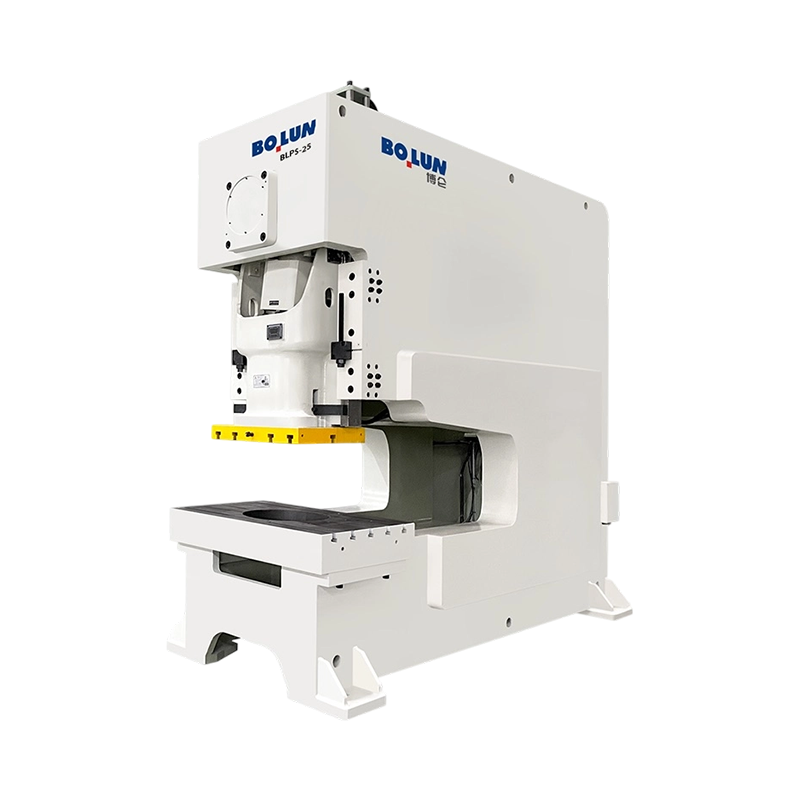
Power presses are generally divided into open-type power presses, closed-type power presses, and other specialized power press configurations. Open-type presses are widely appreciated for their accessibility, lower setup complexity, convenient die handling, and suitability for a broad range of medium and light stamping operations. Closed-type presses, on the other hand, usually provide higher structural rigidity for heavy-duty forming but require a larger investment, more floor space, and more complex material handling.
The BLPS-25 occupies a strategically important position between ordinary open-type presses and larger, heavier closed-type systems. It gives manufacturers the open access and operational convenience of an open-type press while adding an extended throat depth that dramatically improves reach. For operations involving large sheet materials, this design reduces the need for oversized machines and enables more efficient use of production space.
Compared with standard open-gap presses, the BLPS-25 offers a deeper working area from the slide center to the frame. This allows the die to reach further into the sheet, making it possible to perform punching, notching, embossing, trimming, and shallow forming operations on wider parts. In many workshops, this capability can reduce the number of repositioning steps and improve dimensional consistency because the workpiece can be handled with fewer interruptions.
Compared with many competing deep-throat presses, the BLPS-25 emphasizes compactness, precision, and stable high-speed performance. Its 250 kN nominal capacity is well matched to light and medium stamping tasks, while the 2.2 kW main motor helps control energy consumption. The result is a machine that does not merely pursue size or force, but instead offers a balanced combination of output, accuracy, economy, and installation convenience.
The BLPS-25 Compact Precision Open-Gap Deep-Throat Power Press is designed for high-speed stamping of large sheet metal components in industries where workpiece width and repeatability are important. Its deep-throat structure allows operators to process parts that would be difficult or impossible on a standard throat press of similar capacity. This is particularly useful in the production of electrical cabinets, lighting components, appliance panels, metal brackets, decorative hardware, ventilation parts, automotive accessories, and electronic component plates.
The machine is built around a high-rigidity steel frame engineered to resist deformation during stamping. Frame rigidity is a critical factor for punch accuracy, die life, and part consistency. When the frame deflects excessively, the punch and die alignment may shift under load, causing burrs, uneven edges, die wear, and inconsistent dimensions. The BLPS-25 addresses this issue with a reinforced open-gap structure that supports stable pressing performance while preserving accessibility.
The nominal capacity of 250 kN provides sufficient punching and forming force for a wide range of metal sheet applications. For manufacturers working with thin to medium-gauge steel, aluminum, brass, copper, and other sheet materials, this capacity is suitable for many common production tasks. The machine is not intended to replace large closed-frame presses for heavy forming, but it provides an efficient and economical solution where extended reach and high productivity are the main requirements.
The BLPS-25 uses a dry clutch brake system that responds sensitively and supports safe, controlled operation. In stamping production, clutch and brake performance directly affects stopping accuracy, cycle response, operator safety, and machine reliability. A responsive brake enables better control over slide motion and helps the press support continuous, single-stroke, or inching operation according to production needs.
| Item | BLPS-25 Specification | Production Value |
| Press Type | Open-gap deep-throat power press | Combines open access with extended reach for wide sheet processing |
| Nominal Capacity | 250 kN | Suitable for light and medium stamping, punching, trimming, and forming |
| Nominal Pressure Stroke | 3.2 mm | Supports precise force delivery near the working zone |
| Strokes per Minute | 70 to 110 SPM, with high-speed capability up to 180 SPM depending on configuration | Improves productivity for repetitive stamping operations |
| Slide Stroke | 80 mm | Provides practical working motion for common dies and sheet metal processes |
| Maximum Die Height | 230 mm | Allows installation of compact and medium-sized tooling |
| Die Height Adjustment | 50 mm | Supports die setup and production changeover flexibility |
| Throat Depth | 500 to 1200 mm | Enables processing of wide materials beyond standard press reach |
| Worktable Size | 720 x 320 x 70 mm | Provides stable support for tooling and workpieces |
| Slide Bottom Size | 350 x 300 x 50 mm | Supports secure die mounting and stable force transmission |
| Working Face Height | 800 mm | Convenient for manual operation and integration with feeding equipment |
| Distance Between Columns | 478 mm | Supports practical access to the die area |
| Shank Hole Diameter | 40 mm | Compatible with common die mounting requirements |
| Main Motor | 2.2 kW x 4 poles | Balances power output with energy efficiency |
| Die Height Adjustment Method | Manual operation | Simple, reliable, and easy to maintain |
| Air Pressure | 0.55 MPa | Supports clutch and brake function |
| Punch Accuracy | GB/JIS Class 1 | Supports stable precision manufacturing |
The defining feature of the BLPS-25 is its deep-throat layout. In a power press, throat depth refers to the distance from the slide centerline to the press frame. A deeper throat means that the press can reach further into a sheet or panel. For large workpieces, this is a decisive advantage because the stamping location may be far from the edge of the material.
Ordinary open-type presses often force manufacturers to limit part size, redesign tooling, or perform multiple repositioning steps. Each repositioning operation introduces potential error, consumes operator time, and increases the risk of surface scratches or deformation. With a throat depth range of 500 mm to 1200 mm, the BLPS-25 allows deeper access into wide materials, helping operators perform accurate stamping operations with fewer handling steps.
For example, a manufacturer producing electrical enclosure panels may need to punch holes, louvers, or mounting slots across a broad surface. A standard press with a shallow throat may not reach the center of the panel. A closed-type large bed press could solve the problem, but it may be expensive and unnecessarily large for the required tonnage. The BLPS-25 provides a more efficient alternative by delivering extended reach in a compact open-gap format.
The deep-throat design also supports flexible production planning. A workshop can use the same machine for standard smaller parts and occasional wide-sheet operations. This improves equipment utilization and reduces the need to invest in multiple presses for different workpiece sizes. In competitive manufacturing environments, such flexibility can directly improve return on investment.
The BLPS-25 offers several practical advantages over conventional open-type power presses. The most obvious advantage is the extended throat depth, but its competitiveness is not limited to reach. The machine also provides a balanced performance profile that includes speed, precision, stability, energy efficiency, and ease of use.
First, the deep-throat configuration expands the working envelope without requiring a much larger frame. This allows the press to handle wider sheet materials while maintaining a compact installation footprint. In factories where floor space is expensive, this is a significant advantage. Operators can achieve more processing capability within the same workshop area.
Second, the BLPS-25 supports fast stamping cycles. Its stroke rate range of 70 to 110 strokes per minute suits normal production, while high-speed operation can reach up to 180 strokes per minute depending on configuration and application. Many ordinary open-gap presses operate at lower speeds or lose stability at higher speeds. The BLPS-25 is designed to maintain reliable performance under repetitive production conditions.
Third, the machine’s precision class supports consistent output. GB/JIS Class 1 punch accuracy is important for manufacturers producing parts that must fit into assemblies or meet repeatable dimensional tolerances. Precision stamping reduces secondary finishing work and helps lower total production cost.
Fourth, the dry clutch brake provides responsive operation and contributes to safety and control. In comparison with older or less responsive clutch systems, a sensitive dry clutch brake can improve slide stopping behavior, reduce uncertainty during setup, and support controlled production cycles.
Fifth, the manual die height adjustment system is simple and robust. While automated adjustment is useful in some high-changeover environments, manual adjustment remains attractive for compact presses because it reduces mechanical complexity, lowers maintenance burden, and gives operators direct control during die setup.
Closed-type presses are widely recognized for their strength and symmetry, especially in high-tonnage forming. However, they are not always the most economical or practical choice for every application. For many light and medium stamping operations involving wide sheets, the BLPS-25 can provide a more appropriate balance of performance and cost.
A closed-type press often requires more floor space, heavier foundations, larger handling systems, and higher initial investment. If the production task does not require high forming tonnage, using a large closed-frame machine may lead to unnecessary energy consumption and underutilized capacity. The BLPS-25 offers 250 kN of nominal force with a compact frame, making it better suited for workshops that need extended reach rather than excessive tonnage.
Open access is another important benefit. Operators can install dies, inspect workpieces, remove scrap, and adjust feeding more conveniently on an open-gap press. This can reduce setup time and make short-batch production more efficient. For companies serving multiple customers or producing varied components, changeover efficiency can be just as important as maximum capacity.
The BLPS-25 also allows easier integration into existing production lines. Its working face height of 800 mm is practical for manual loading and can be coordinated with feeders, straighteners, decoilers, and supporting tables. Because the machine is compact, it can often be installed in spaces where larger closed-type equipment would be difficult to accommodate.
One of the main engineering challenges in any open-gap power press is controlling frame deflection. Since the frame is open on one side, it can experience angular deformation during pressing. A well-designed open-gap press must therefore use a strong frame structure, proper material selection, accurate machining, and reliable assembly procedures to ensure stable alignment.
The BLPS-25 uses a high-rigidity steel frame designed to preserve punch and die alignment under load. This is especially important in a deep-throat press because the extended throat increases the leverage effect during stamping. Without sufficient rigidity, a deep-throat machine could suffer from reduced accuracy and increased tooling wear. The BLPS-25 addresses this by combining a reinforced structural design with precision manufacturing and quality control.
Stable frame performance produces several benefits. It improves part consistency, reduces burr formation, extends die life, lowers noise and vibration, and supports higher operating speeds. In precision component manufacturing, these advantages directly affect profitability. A machine that maintains alignment over long production runs reduces scrap and decreases the frequency of die maintenance.
Rigidity is not only about thickness or weight. It also depends on the internal distribution of material, the geometry of the frame, the quality of welding or casting, stress-relief treatment, and the accuracy of machined surfaces. Zhejiang Bolun High-Precision Machinery Co., Ltd. emphasizes full-chain manufacturing control, allowing key structural and mechanical aspects to be managed from design through final assembly.
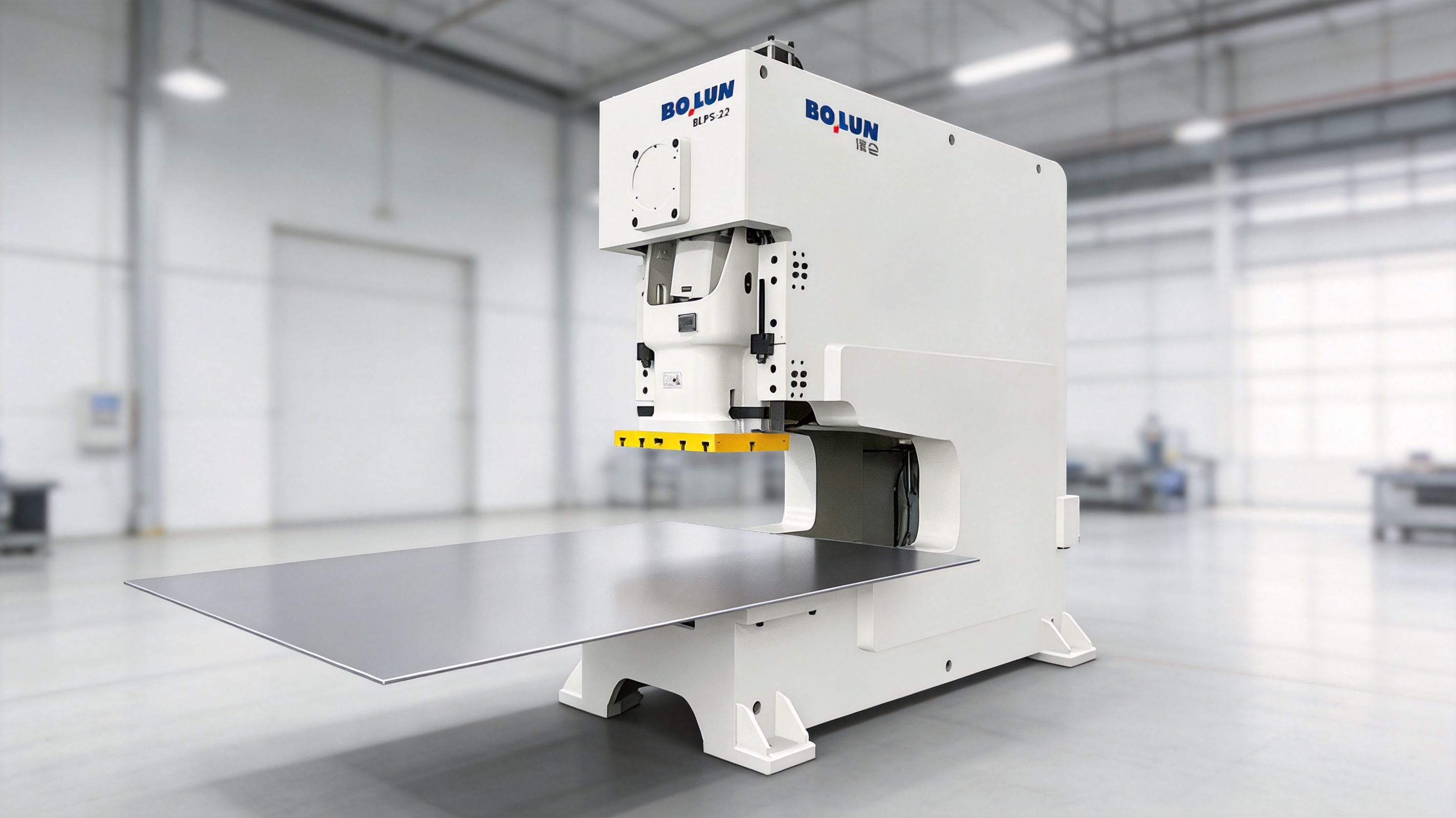
Production speed is a central factor in stamping economics. Every increase in stable strokes per minute can improve output, reduce unit cost, and enhance delivery capability. The BLPS-25 is built for agile, efficient operation, with stroke speeds suitable for repetitive stamping of light and medium sheet metal parts.
The listed standard stroke speed of 70 to 110 strokes per minute already provides strong productivity for many applications. In high-speed operation, the machine can reach up to 180 strokes per minute depending on the selected version, die design, material characteristics, feeding system, and production conditions. This speed range makes the machine suitable for hardware parts, electronic terminals, small brackets, washer-type components, and repeated piercing or blanking tasks.
Speed alone is not enough. A competitive press must maintain accuracy, feeding synchronization, braking response, and vibration control at production speed. The BLPS-25’s combination of rigid frame design, suitable motor power, dry clutch brake, and precision slide movement helps create a reliable production rhythm.
Compared with competitors that may advertise high speed but lack stable frame performance, the BLPS-25 focuses on usable speed. Usable speed means the press can operate efficiently while maintaining acceptable part quality, die life, and operator confidence. In actual production, this matters more than theoretical maximum speed.
The BLPS-25 is equipped with a 2.2 kW four-pole main motor. This motor sizing is practical for a 250 kN compact press and contributes to energy-conscious manufacturing. In many factories, energy cost is a major long-term expense. Oversized machines may consume unnecessary power, especially when used for light or medium applications that do not require large tonnage.
By matching motor power to the press capacity and intended applications, the BLPS-25 helps manufacturers avoid inefficient production. The machine provides enough power for its working range while supporting lower operating cost compared with larger equipment used for the same task. This is particularly beneficial for companies running multiple presses across long shifts.
Energy efficiency also includes mechanical efficiency. Stable drive transmission, appropriate flywheel design, clutch response, and reduced vibration can help convert motor power into productive stamping force. A well-built press does not simply rely on a large motor; it uses mechanical design to deliver force effectively.
The BLPS-25 is designed for practical shop-floor usability. Its open-gap structure provides convenient access to the die area, which is valuable during die installation, alignment, material feeding, inspection, and maintenance. Operators can approach the working area more easily than with enclosed or larger-frame machines.
The manual slide adjustment device supports controlled die setup. For many small and medium manufacturers, simple mechanical adjustment is preferred because it is easy to understand, reliable, and inexpensive to maintain. Operators can adjust die height within a 50 mm range to suit different tooling requirements.
The maximum die height of 230 mm and slide stroke of 80 mm provide flexibility for common stamping dies. The 40 mm shank hole diameter supports typical die mounting arrangements. The worktable size of 720 x 320 x 70 mm and slide bottom size of 350 x 300 x 50 mm create a stable platform for tooling, enabling secure alignment and repeatable press action.
The working face height of 800 mm supports ergonomic handling. This is especially important for semi-automatic and manual production, where operators repeatedly load, position, and remove workpieces. Comfortable working height can reduce fatigue and improve consistency over long production shifts.
The BLPS-25 is suitable for a wide range of industries requiring precision sheet metal stamping. Its deep-throat reach is particularly beneficial where the stamped feature is located away from the edge of the sheet. This includes large panels, long strips, enclosure plates, metal frames, and parts with distributed holes or formed features.
In the hardware industry, the machine can be used for brackets, hinges, clips, small plates, fastening components, and decorative stamped parts. The speed range supports repeated production, while the precision class helps maintain consistent dimensions.
In the electronics industry, the BLPS-25 can support the production of shielding plates, connector components, mounting plates, terminal-related parts, and small precision metal elements. High repeatability is important in this field because parts often enter automated assembly processes.
In appliance manufacturing, the press can process panels, ventilation openings, mounting holes, support structures, and formed sheet metal elements. The deep-throat design is useful when holes or features must be produced in the middle of a wide panel.
In lighting and electrical equipment production, the machine can create holes, slots, and embossed features in housings, bases, supports, and channel components. Its compact size and extended reach help manufacturers handle varied product sizes without relying on overly large equipment.
In automotive accessory and metal fabrication workshops, the press can perform punching, trimming, and light forming on custom components. While heavy automotive structural forming may require higher-tonnage closed-type presses, many accessory and support parts fit well within the BLPS-25’s working range.
Zhejiang Bolun High-Precision Machinery Co., Ltd. is based in Zhejiang, a region known for advanced precision manufacturing and strong industrial supply chains. With approximately two decades of machinery manufacturing experience, the company has developed into a modern equipment manufacturer integrating research and development, design, production, sales, and service.
The company’s strength lies not only in producing standard machines but also in controlling the full manufacturing chain. This includes design verification, structural fabrication, machining, component preparation, assembly, inspection, and customer support. Such control is important for power press manufacturing because press performance depends on the accuracy and reliability of every major component.
The company emphasizes technical innovation as a core growth engine. Its production system supports both standard equipment and non-standard customization. For customers with special throat depth, die space, feeding direction, production speed, or automation requirements, this customization capability is an important competitive advantage.
Advanced precision processing equipment allows critical parts to be machined with accuracy. In a power press, surface flatness, parallelism, shaft alignment, slide guide precision, and mounting accuracy all affect final performance. By investing in precision processing, the manufacturer improves the machine’s ability to deliver stable operation over years of use.
Bolun also adopts international production management concepts while adapting them to China’s manufacturing environment. This combination supports efficient production, cost competitiveness, and consistent quality. The company’s stated philosophy, “Accumulate Richly and Break Forth Thinly; Pressure is Power,” reflects a long-term approach to technical development and industrial reliability.
The production of a high-quality power press requires a disciplined manufacturing process. The BLPS-25 benefits from a systematic approach that begins with engineering design and continues through final inspection. Each stage influences the final performance of the machine.
During the design stage, engineers evaluate the machine’s capacity, throat depth, frame stiffness, slide movement, clutch and brake coordination, worktable size, and tooling interface. For a deep-throat press, structural analysis is especially important because the extended throat increases the demand for frame rigidity. Proper design helps reduce deformation and ensures that the press can maintain accuracy under repeated loading.
Material selection and frame preparation are also critical. The frame must be strong enough to withstand cyclic loading and stable enough to maintain geometry over long service life. Quality steel, proper fabrication procedures, and controlled processing help create a durable foundation for the machine.
Precision machining follows structural preparation. The worktable, guide surfaces, slide mounting areas, shaft seats, and connection surfaces must be machined accurately. Even small deviations can affect slide movement and die alignment. Advanced machining equipment helps ensure that the machine’s core geometry meets design requirements.
Assembly is another key stage. Skilled technicians align moving components, install drive systems, fit clutch and brake mechanisms, adjust slide motion, verify lubrication paths, and inspect operating response. In a power press, assembly quality can determine whether a machine operates smoothly or develops premature wear.
Final inspection includes checks for accuracy, motion stability, brake response, noise, vibration, air pressure function, motor performance, and general safety. The company’s finished product inspection system is designed to exceed industry standards, ensuring that machines delivered to customers can perform reliably under demanding production conditions.
Quality is especially important in press equipment because failure can cause production delays, tooling damage, scrap, and safety risk. The BLPS-25 is supported by a quality philosophy that treats every process and component as part of the final machine’s performance.
Strict quality control begins with incoming materials and continues through fabrication, machining, assembly, and testing. Key components must meet dimensional and functional requirements. Structural parts must be stable. Moving parts must fit correctly. The clutch and brake system must respond reliably. The final machine must meet accuracy standards before shipment.
GB/JIS Class 1 punch accuracy provides customers with confidence in the machine’s precision. For manufacturers producing repeatable stamped parts, this standard helps ensure that the press can support stable dimensional control. It also supports die life because proper alignment reduces abnormal wear.
Reliability is not only a result of strong components but also of appropriate design simplicity. The BLPS-25 uses a practical manual die height adjustment system and a well-established mechanical press structure. This reduces unnecessary complexity and makes maintenance more straightforward. In many production environments, easier maintenance means less downtime and lower lifetime cost.
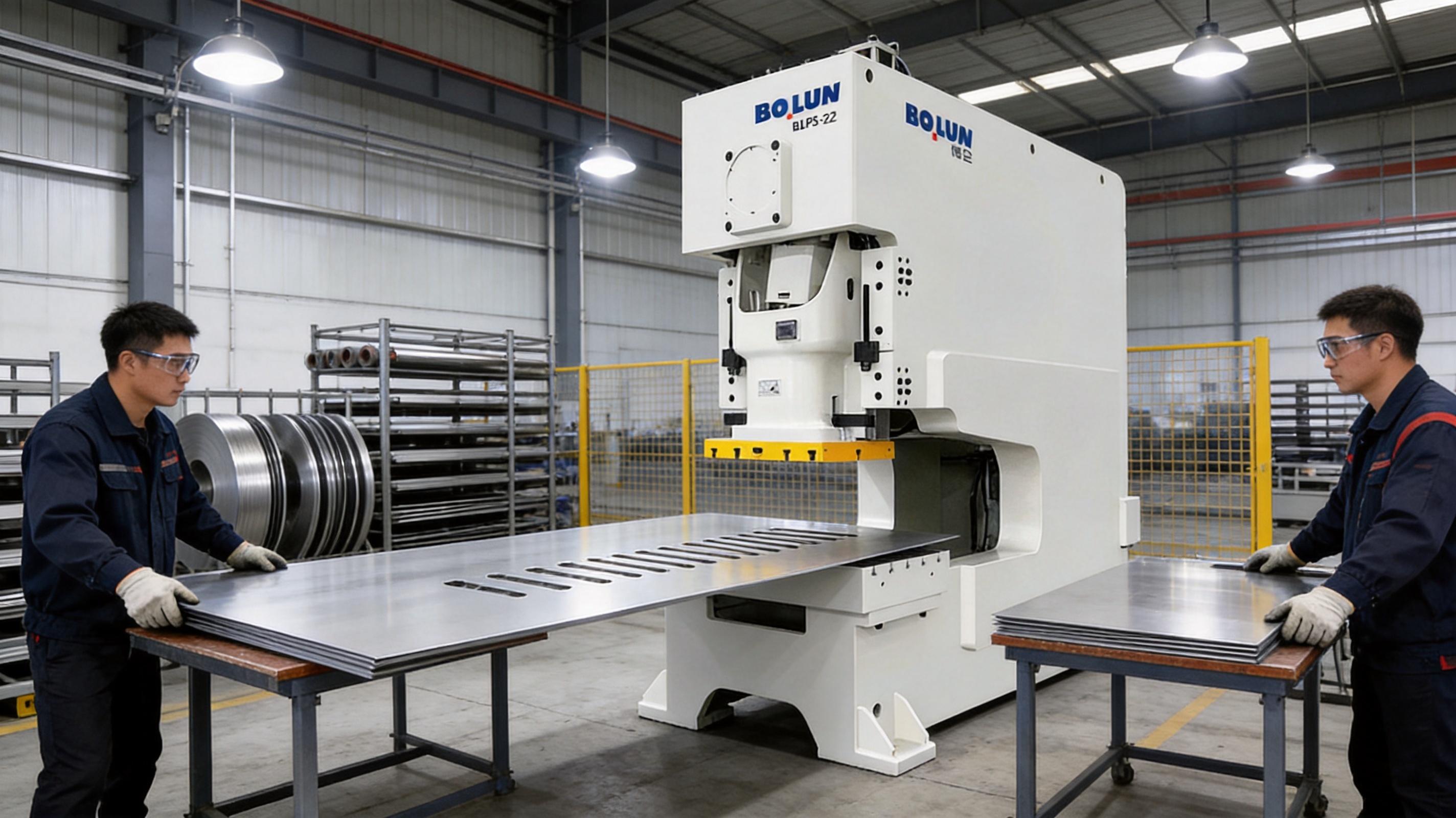
When compared with typical competing presses, the BLPS-25 stands out in several areas. Many conventional open-type presses provide easy access but limited throat depth. Many large presses provide extended working range but require higher investment and more space. Some high-speed presses offer rapid cycling but may not provide enough reach for wide sheet applications. The BLPS-25 combines extended reach, compact design, practical speed, and precision in one machine.
Its 500 mm to 1200 mm throat depth is a major advantage for wide sheet processing. This reduces the need for multiple machines or oversized equipment. Competitors with shallower throat dimensions may force users to compromise product design or use inefficient manual repositioning.
The BLPS-25 also offers a favorable relationship between capacity and energy use. Its 250 kN nominal force and 2.2 kW motor are suitable for the intended work range. Competing solutions may require larger motors and heavier frames even when the actual stamping task does not demand them, increasing operating cost.
The machine’s open-gap layout improves production accessibility. Compared with closed-type presses, die changes and material handling can be easier. Compared with lower-cost ordinary open presses, the BLPS-25 provides a more specialized working range for wide materials and high-speed precision operations.
Another competitive factor is manufacturing support. A machine is only as reliable as the company behind it. Zhejiang Bolun High-Precision Machinery Co., Ltd. provides integrated design, production, inspection, sales, and service capability. This supports customers from equipment selection through installation, operation, and after-sales assistance.
Manufacturers today often face changing order sizes, varied component designs, and increasing pressure for short delivery cycles. Equipment flexibility is therefore a major advantage. The BLPS-25 supports flexible use because it can process both normal-size parts and wider workpieces requiring extended throat depth.
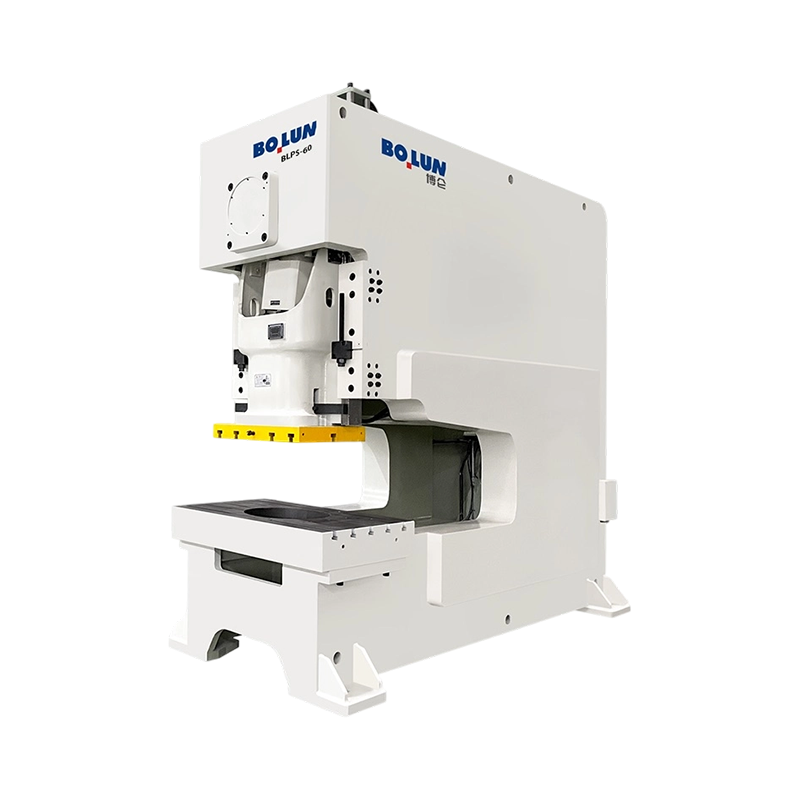
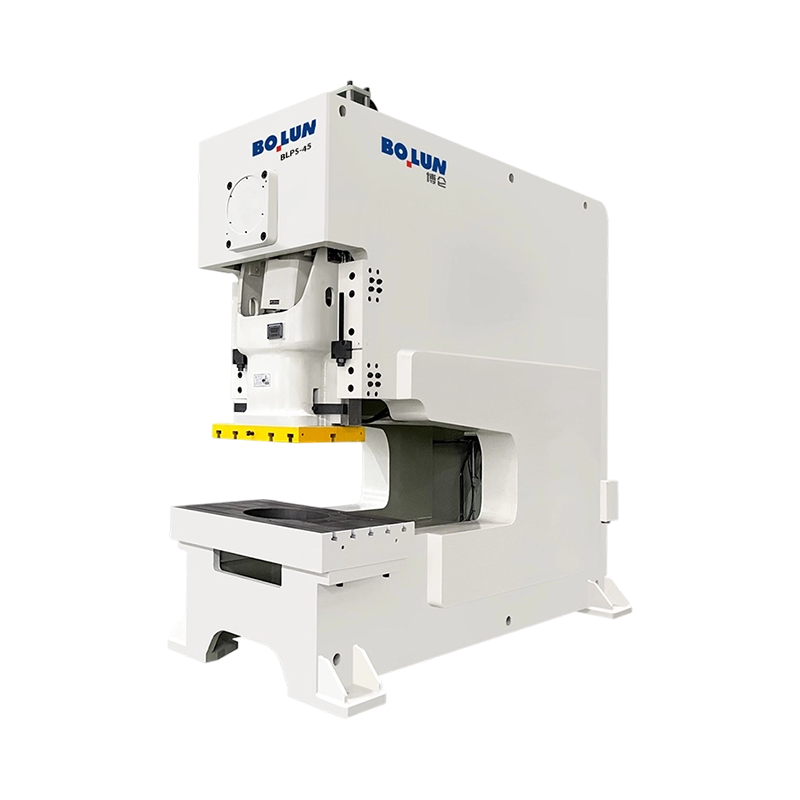
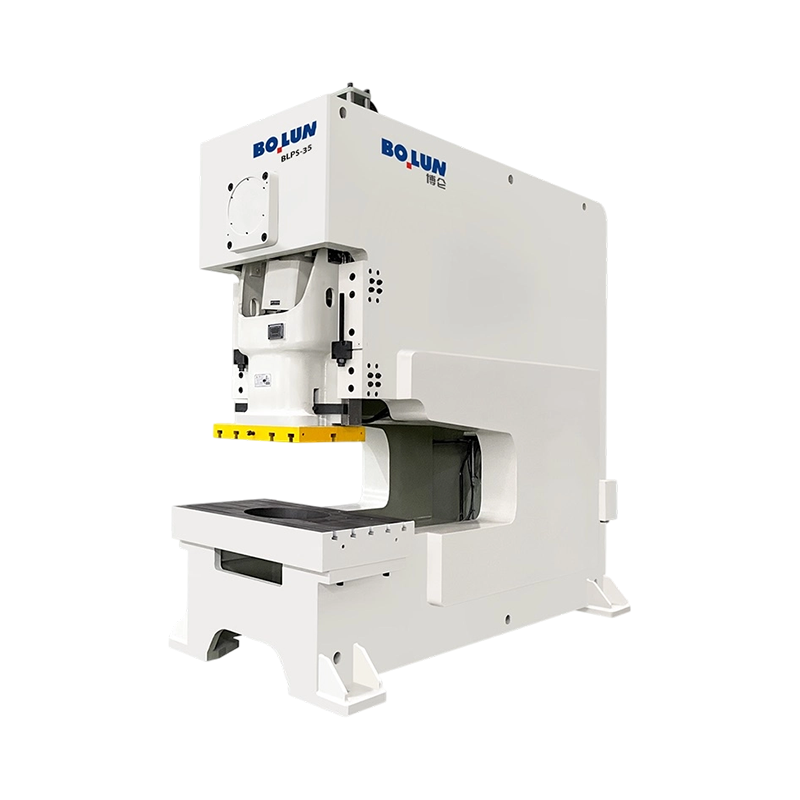
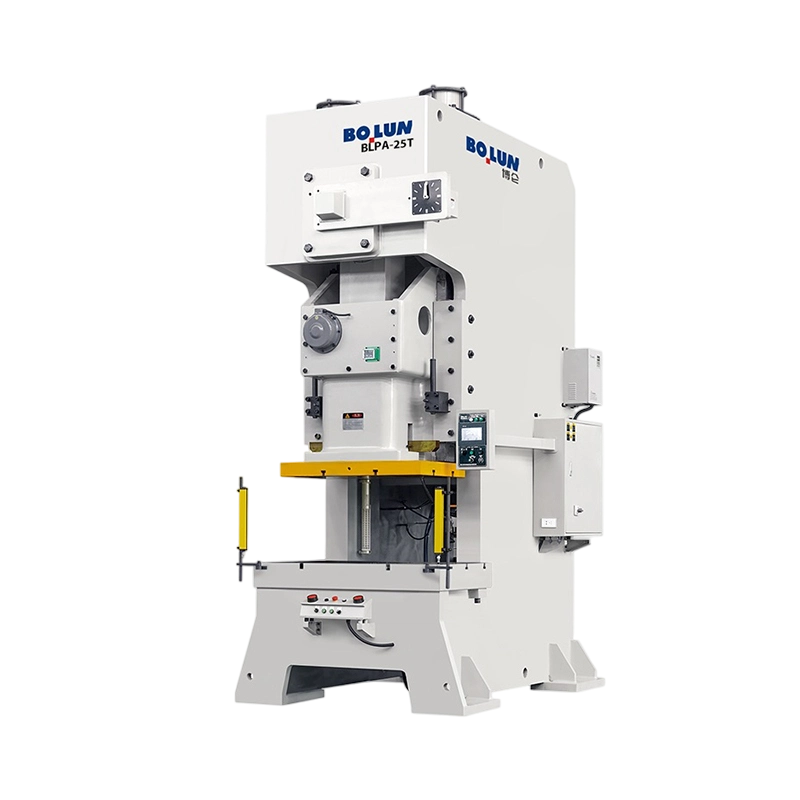
The product family includes multiple capacity levels, such as BLPS-25, BLPS-35, BLPS-45, BLPS-60, BLPS-80, BLPS-125, BLPS-160, BLPS-200, BLPS-260, BLPS-315, and BLPS-400. This product range allows customers to select a press capacity and working space according to production requirements. The BLPS-25 serves as a compact entry point in the series, while larger models support heavier operations and larger tables.
The manufacturer’s non-standard customization capability allows further adaptation. Customers may require special throat depth, feeding systems, safety devices, automation interfaces, different working heights, customized table dimensions, or application-specific tooling support. The company’s design and manufacturing teams can provide one-stop service for such special specifications.
This flexibility is especially valuable for factories producing components for multiple industries. A workshop may need to stamp small hardware today, wide electrical panels tomorrow, and custom metal parts next week. A deep-throat open-gap press helps support varied production without excessive reconfiguration.
Although the BLPS-25 can be used in manual or semi-automatic production, it can also be integrated with feeding equipment where suitable. Stamping productivity often improves when presses are paired with decoilers, straighteners, roll feeders, air feeders, or custom sheet positioning devices.
The compact open-gap structure provides accessible loading and unloading areas. The 800 mm working face height can coordinate with common auxiliary equipment. The stroke speed range supports continuous production when feeding is synchronized properly. For coil-fed parts, stable press timing and clutch response are important for accurate feeding and reduced scrap.
In wide sheet applications, supporting tables, positioning fixtures, or robotic handling systems may be used to improve repeatability. The deep-throat reach allows automation systems to access stamping positions further inside the sheet. This can be useful for producing panels with repeated hole patterns or distributed formed features.
Automation integration should always consider die design, material thickness, part geometry, feeding accuracy, safety guarding, and production speed. The BLPS-25 provides a strong foundation for such systems because it combines mechanical reliability with accessible working space.
Power press safety depends on proper machine design, correct installation, operator training, tooling condition, protective devices, and disciplined production procedures. The BLPS-25’s dry clutch brake contributes to controlled slide movement, which is essential for safe operation and setup.
A sensitive clutch brake allows the machine to respond predictably to control input. During die setup or single-stroke operation, predictable response helps operators work with greater confidence. The air pressure requirement of 0.55 MPa supports pneumatic control functions associated with clutch and brake operation.
The open-gap structure improves visibility around the die area, allowing operators to monitor material positioning and stamping results more easily. However, open access must be matched with appropriate safety measures such as guards, two-hand controls, light curtains, emergency stops, safe die design, and proper operating procedures according to the user’s local regulations.
Reliable machine construction also supports safety. Excessive vibration, unstable slide movement, or poor braking response can create operational risk. The BLPS-25’s rigid frame and precision manufacturing help reduce these concerns when the machine is properly maintained and used within its rated capacity.
Long-term value in a power press is determined by more than purchase price. It includes reliability, ease of maintenance, part quality, energy consumption, die life, downtime, and service support. The BLPS-25 is designed to provide a favorable total cost of ownership for manufacturers needing compact deep-throat stamping capability.
Its mechanical structure is practical and accessible, making routine inspection and maintenance easier. Operators and maintenance personnel can check lubrication, fasteners, slide condition, clutch and brake response, worktable surfaces, and die mounting areas with relative convenience. Easy access helps prevent small issues from developing into major failures.
Manual die height adjustment reduces the number of powered adjustment components and simplifies troubleshooting. The 2.2 kW motor helps keep energy use moderate. Precision frame and slide alignment support longer die life by reducing abnormal contact and uneven loading.
Service support from the manufacturer further improves long-term value. The company provides customer-oriented services covering pre-sales consultation, in-sales support, and after-sales guarantees. Pre-sales consultation helps customers choose the correct model and configuration. In-sales support helps with production planning and equipment preparation. After-sales service supports installation, operation, maintenance, and troubleshooting.
The economic benefits of the BLPS-25 are visible in multiple areas. The first is reduced equipment investment compared with larger machines when the application requires reach rather than high tonnage. A compact deep-throat press can perform tasks that might otherwise require a much larger press simply because of workpiece size.
The second benefit is improved productivity. With stroke rates suitable for high-volume stamping, the machine can produce many parts per shift when paired with appropriate dies and feeding methods. Higher productivity reduces unit cost and improves delivery speed.
The third benefit is reduced scrap and rework. Precision punching and stable machine alignment help maintain consistent part dimensions. Fewer rejected parts mean lower material waste and lower labor cost.
The fourth benefit is better space utilization. Factory floor space has real value. A compact press that handles wide sheets helps manufacturers use their workshop more efficiently. This may delay or avoid the need for facility expansion.
The fifth benefit is improved operational flexibility. A machine that can process both ordinary parts and wider materials improves equipment utilization. Instead of leaving a specialized large machine idle, manufacturers can rely on the BLPS-25 for varied production tasks within its capacity range.
The BLPS-25 is ideal for manufacturers who require an open-type power press with extended reach, moderate capacity, and stable precision. It is especially suitable for small and medium-sized factories, sheet metal workshops, electronics component producers, hardware manufacturers, lighting equipment suppliers, appliance part producers, and customized metal fabrication companies.
The machine is also suitable for companies upgrading from ordinary small open presses. If a manufacturer frequently encounters workpieces that exceed the throat depth of standard presses, the BLPS-25 provides a targeted solution without forcing a move to a large closed-type machine.
It is also a strong option for production departments that handle diverse orders. The deep-throat structure allows greater application range, while the compact configuration keeps the machine manageable for normal workshop operation.
Before selecting the BLPS-25, manufacturers should evaluate material type, sheet thickness, required punching force, die dimensions, part size, required throat depth, expected production speed, feeding method, safety requirements, and available floor space. A 250 kN press is highly useful for many operations, but the force requirement must be calculated according to the material shear strength, perimeter of the cut, material thickness, and forming characteristics.
The required throat depth should be determined by the farthest stamping position from the sheet edge. If the part requires punching or forming near the center of a wide panel, the 500 mm to 1200 mm throat depth range may be decisive. Users should also confirm whether supporting tables or positioning fixtures are needed for large sheets.
Die height and slide stroke should be checked against tooling design. The BLPS-25 provides a maximum die height of 230 mm, an 80 mm slide stroke, and 50 mm die height adjustment. These specifications are suitable for many compact stamping dies, but complex forming dies may require additional review.
Production speed should be matched with feeding accuracy and die life. Running at high strokes per minute can increase output, but only if material feeding, scrap removal, lubrication, and operator safety are properly controlled. The manufacturer can assist customers in selecting suitable configurations and support equipment.
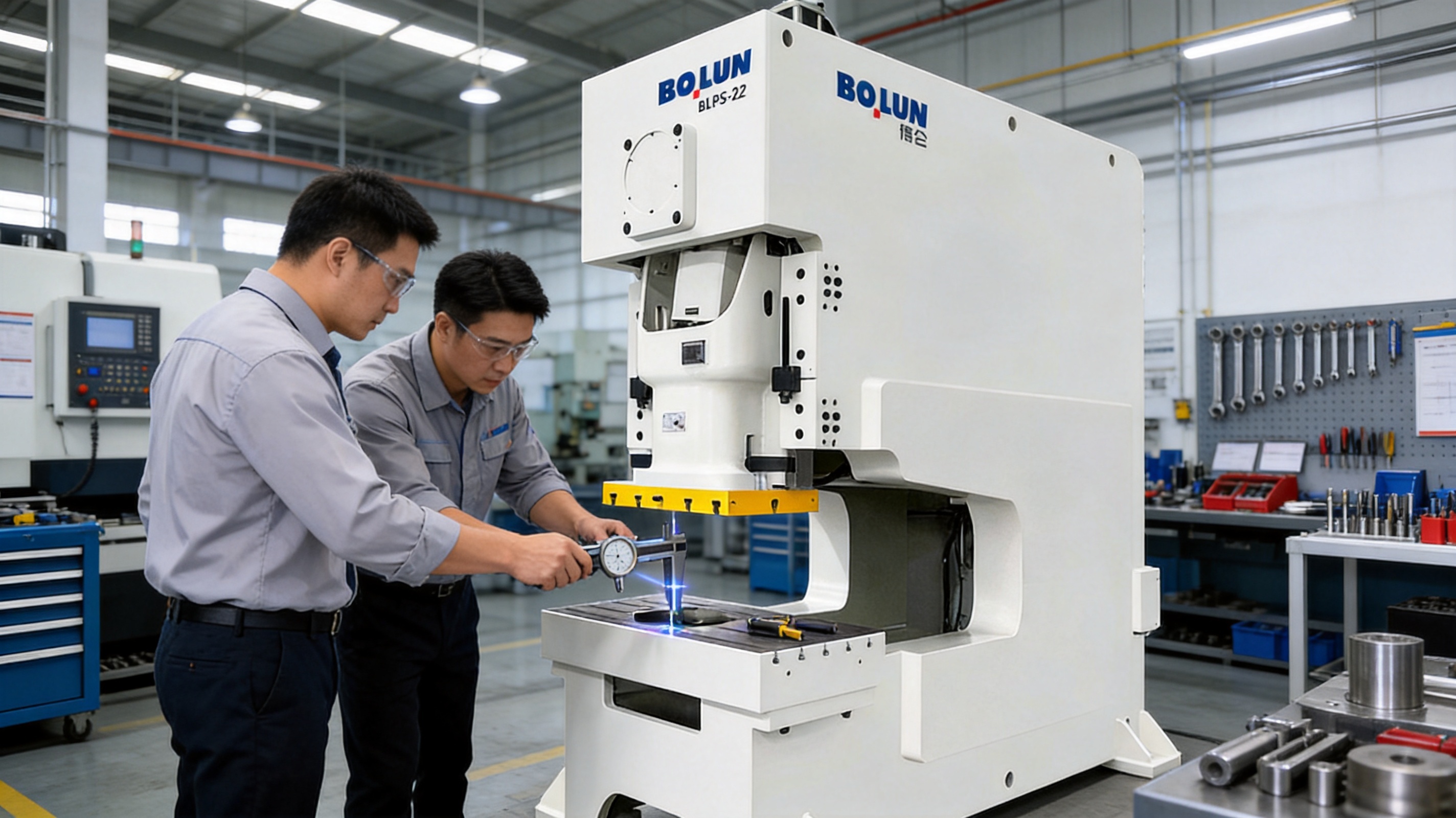
The BLPS-25 is a compact precision open-gap deep-throat power press. It belongs to the open-type power press category and is designed to provide extended throat depth for wide sheet metal stamping.
The deep-throat design allows the press to reach farther into wide sheet materials. This makes it possible to stamp, punch, or form areas that ordinary shallow-throat presses cannot access.
The nominal capacity is 250 kN, which is suitable for many light and medium sheet metal stamping operations.
It is suitable for hardware, electronics, electrical equipment, appliance components, lighting parts, sheet metal fabrication, enclosure panels, and customized metal part production.
The standard stroke speed range is 70 to 110 strokes per minute. Depending on configuration and application conditions, high-speed operation can reach up to 180 strokes per minute.
If the application requires extended reach but not high forming tonnage, the BLPS-25 can be more economical, compact, and easier to operate than a larger closed-type press.
Yes. The machine is designed with high-rigidity construction and GB/JIS Class 1 punch accuracy, supporting consistent stamping quality and repeatable dimensions.
Yes. It has a maximum die height of 230 mm, a slide stroke of 80 mm, and a 50 mm die height adjustment range, allowing it to support many common stamping dies within its working capacity.
The BLPS-25 uses a 2.2 kW four-pole main motor, providing a practical balance between power output and energy efficiency.
Zhejiang Bolun High-Precision Machinery Co., Ltd. integrates research and development, design, production, sales, and service. Its strengths include precision processing, full-chain manufacturing control, non-standard customization capability, and rigorous quality inspection.
The BLPS-25 Compact Precision Open-Gap Deep-Throat Power Press is a practical and competitive solution for manufacturers that need extended reach, accurate stamping, compact installation, and efficient production. Its 250 kN nominal capacity, 500 mm to 1200 mm throat depth, 70 to 110 strokes per minute standard speed range, 2.2 kW main motor, rigid steel frame, dry clutch brake, and GB/JIS Class 1 punch accuracy give it a balanced performance profile for wide sheet metal applications.
Its greatest advantage is the ability to process larger and wider materials without the cost and space requirements of a much larger closed-type press. Compared with ordinary open-type presses, it provides far greater reach. Compared with oversized alternatives, it offers better economy and practical accessibility. Compared with low-rigidity competitors, it emphasizes stability, precision, and long-term reliability.
Behind the product is a manufacturer with strong industrial experience, advanced manufacturing processes, precision machining capability, customization strength, and a quality-oriented service system. For factories seeking to improve productivity, reduce handling complexity, expand stamping capability, and maintain precise output, the BLPS-25 represents a well-engineered investment in modern sheet metal production.
Boljanovic, V. Sheet Metal Forming Processes and Die Design. Industrial Press.
Altan, T., and Tekkaya, A. E. Sheet Metal Forming: Processes and Applications. ASM International.
Kalpakjian, S., and Schmid, S. R. Manufacturing Engineering and Technology. Pearson.
Degarmo, E. P., Black, J. T., and Kohser, R. A. Materials and Processes in Manufacturing. Wiley.
Society of Manufacturing Engineers. Tool and Manufacturing Engineers Handbook: Forming. SME.
Japanese Industrial Standards Committee. Mechanical Press Accuracy and Inspection Guidelines.
GB Standards for Mechanical Press Accuracy and Safety Inspection.


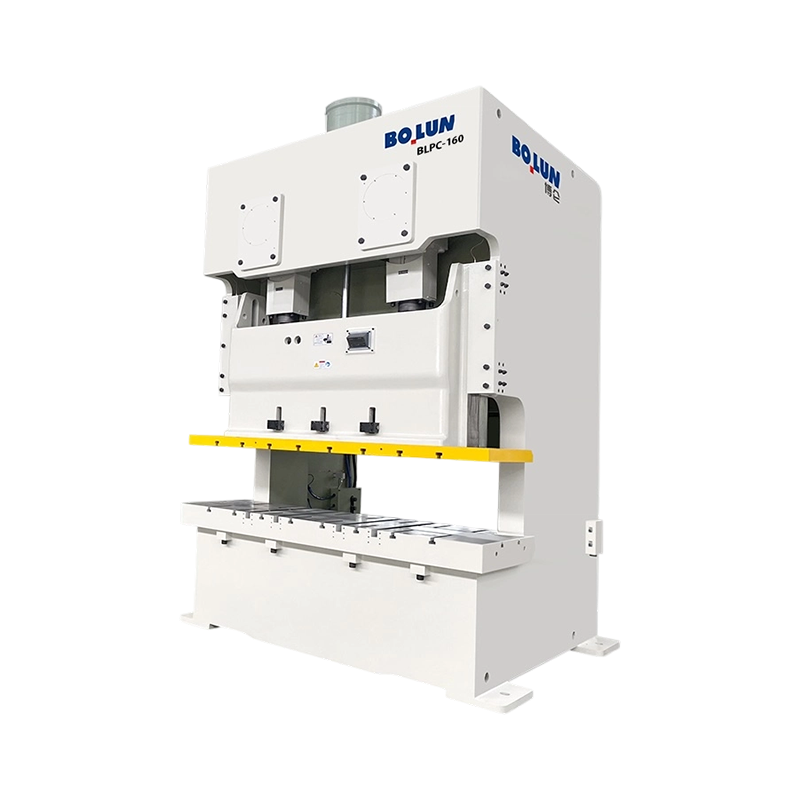
Understanding Mechanical Power Presses and Their Essential Functions A mechani...
What Is a Power Press? A power press — also called a stamping press or punch pr...
In the fields of metal forming, sheet metal fabrication, blanking, and punching,...
Power press machines are classified in two main ways: by frame construction, w...
As the manufacturing industry moves steadily toward automation and smart product...
In modern manufacturing, cold forging is widely used in the automotive, aerospac...
Contact Us

bolunpress@gmail.com

+86-575-83362228

+86-15158259588

+86-575-83362999

+86-15158259588

Hangzhou Office Add: No. 332 Wangjiang East Road, Shangcheng District

No.1 Linjiang Road East, Xiaren, Jinting Town, Shengzhou City, Zhejiang Province, China
Ready to Begin?
Get in Touch

Now!

ZHEJIANG BOLUN
 English
 中文简体
中文简体