
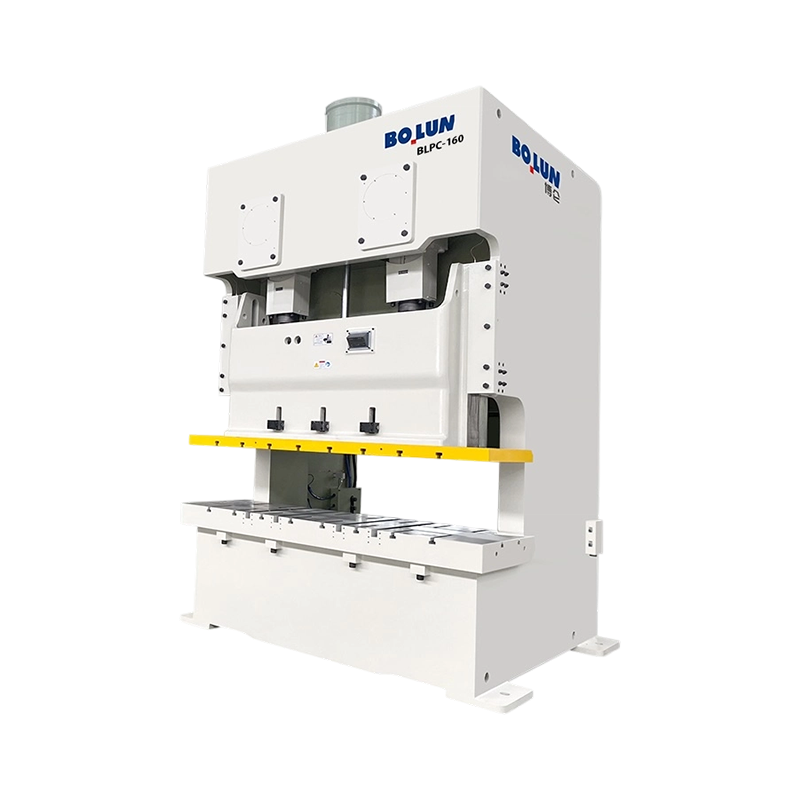
In the rapidly expanding battery manufacturing sector, the demand for stable, efficient, and precise stamping equipment continues to rise. Battery shells and related thin-wall metal components require repeatable forming accuracy, clean force transmission, reliable die protection, and sustained productivity under continuous operation. The BLPC2-63 Precision-Agile Open-Type Double-Point Battery Power Press is designed for this demanding environment. With a nominal capacity of 630 kN, a maximum working speed of up to 80 strokes per minute, and a 1300 × 550 mm worktable, the machine is engineered to support high-speed production of small-format battery shells and similar precision parts.
The product belongs to the open-type power press category, but its double-point structure gives it a performance profile that goes beyond conventional single-point open presses. By distributing forming force through two driving points, the BLPC2-63 helps improve slide balance, reduce eccentric loading influence, and maintain dimensional consistency across multi-station dies. For manufacturers producing battery cases, caps, covers, brackets, and other thin metal components, these advantages can translate into improved part quality, lower scrap rates, and more stable long-run operation.
Behind the equipment is Zhejiang Bolun High-Precision Machinery Co., Ltd., a machinery manufacturer located in Zhejiang, China, with approximately two decades of accumulated experience in high-precision forming equipment. The company integrates research and development, design, production, sales, and service, emphasizing full-chain production control, non-standard customization capability, strict inspection, and customer-oriented support. The BLPC2-63 reflects this manufacturing philosophy by combining structural rigidity, operational agility, protection systems, and production practicality in a compact yet capable stamping solution for battery industry applications.
BLPC2-63 Precision-Agile Open-Type Double-Point Battery Power Press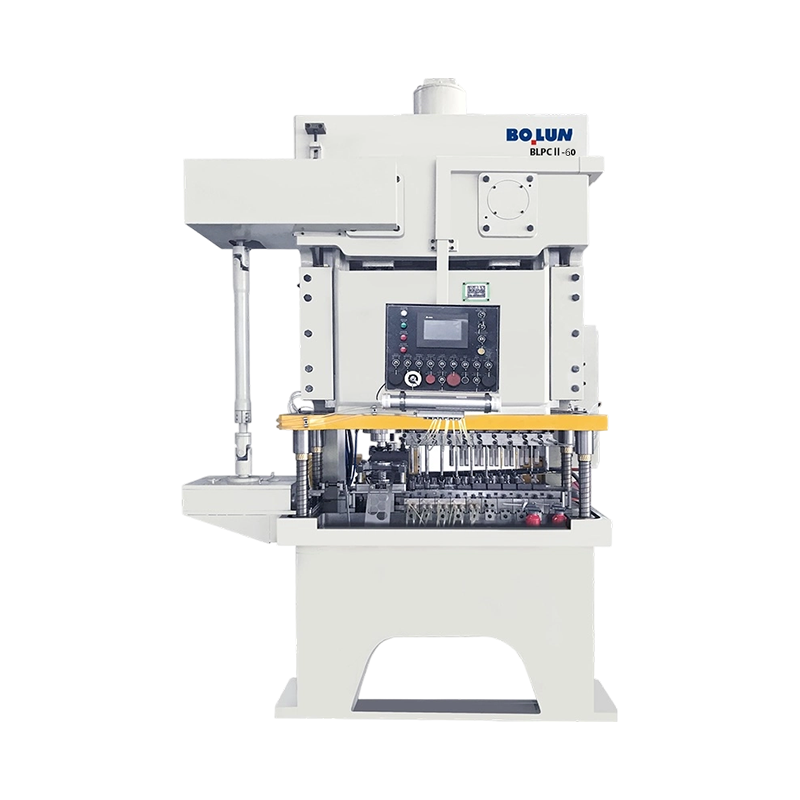
The BLPC2-63 is developed primarily for high-speed stamping of small-format battery shells. In battery component production, the forming process often involves thin metal sheets, narrow tolerance requirements, multi-step forming actions, and frequent use of precision progressive dies or multi-station dies. Any imbalance in slide movement, insufficient press rigidity, delayed clutch response, or overload event can affect product quality and tooling life. The machine addresses these concerns through a combination of double-point force transmission, open-type accessibility, dry clutch-brake response, and hydraulic overload protection.
The 630 kN nominal capacity provides the forming force required for many small and medium thin-wall battery shell applications. While the exact forming load depends on material grade, sheet thickness, die design, lubrication, drawing depth, and blank size, a 630 kN press gives manufacturers a useful balance between capacity and operating economy. It is large enough to perform demanding battery shell operations, yet compact and agile enough for efficient workshop layout and high-frequency production.
The machine speed of up to 80 strokes per minute is another important feature. In battery manufacturing, production volumes can be very high, and every increase in stable press speed can improve total output. However, speed alone is not enough. A press must maintain accuracy, slide stability, and safety at that speed. The BLPC2-63 is positioned as a precision-agile machine, meaning that it emphasizes not only fast cycling but also dependable movement control and stable forming conditions.
The 1300 × 550 mm worktable provides sufficient area for precision dies used in battery component production. Many battery shell stamping processes rely on multi-station die layouts to perform blanking, drawing, trimming, piercing, flanging, and calibration steps in sequence. A practical worktable size gives die designers more freedom and helps factories improve production flow by consolidating operations where appropriate.
The following table summarizes key product characteristics and their practical production value.
| Feature | Specification or Description | Production Value |
|---|---|---|
| Press Type | Open-type double-point battery power press | Combines operator accessibility with improved slide balance for precision dies |
| Nominal Capacity | 630 kN | Suitable for small-format battery shell and thin-wall component forming |
| Maximum Speed | Up to 80 strokes per minute | Supports high-volume production while maintaining stamping efficiency |
| Worktable Size | 1300 × 550 mm | Accommodates precision multi-station dies for battery component manufacturing |
| Drive Structure | Double-point force transmission | Improves force balance across the slide and reduces eccentric load sensitivity |
| Clutch-Brake System | Dry clutch-brake | Provides responsive engagement and stopping performance |
| Protection System | Hydraulic overload protection | Protects tooling and machine components during abnormal load conditions |
| Application Focus | Small-format battery shells and precision metal components | Matches the needs of battery, electronics, and thin metal forming industries |
One of the defining advantages of the BLPC2-63 is its double-point structure. In a conventional single-point press, the slide receives force from one central driving point. This arrangement can be effective for many general stamping tasks, but it may become less ideal when long dies, wide dies, or multi-station progressive dies are used. If forming resistance is uneven across the die area, the slide may experience tilting tendency, uneven wear, or inconsistent pressure distribution.
A double-point press distributes the driving force through two points. This configuration supports better slide parallelism, especially across the width of the worktable. For battery shell production, where thin materials are drawn or formed into accurately shaped components, slide balance is critical. A small deviation in pressure distribution can cause wall thickness variation, uneven drawing marks, flange distortion, or dimensional inconsistency. The double-point design helps reduce these risks by improving mechanical symmetry during the stamping cycle.
Another benefit is improved suitability for progressive dies. Battery shell manufacturing often uses dies that perform several operations across a sequence of stations. The forming load may not be concentrated at the center; instead, different stations impose different loads at different positions. A double-point press is better prepared for this real-world load distribution. It can support more stable forming force over the die area, helping maintain die alignment and part accuracy.
Compared with many general-purpose open-type presses, the BLPC2-63 therefore offers a stronger foundation for precision battery component work. It retains the accessibility of an open press while delivering a higher level of slide control than many single-point alternatives. This combination is particularly valuable for factories seeking productivity without moving immediately to larger or more expensive closed-type equipment.
Open-type presses are widely valued because they provide convenient access to the working area. Operators, maintenance personnel, and die setters can approach the machine more easily than with some closed-frame designs. This accessibility can reduce die change time, simplify inspection, and improve production flexibility. For battery component factories handling multiple part models or frequent die adjustments, ease of access is a practical advantage.
However, open-type machines must be carefully engineered to maintain rigidity and accuracy. The BLPC2-63 is positioned in the precision open-type category, which means its structure is designed to support stable forming rather than only basic punching. The double-point configuration further strengthens its practical precision by reducing the negative effects of unbalanced die loads.
In comparison with ordinary C-frame or single-point presses used for general metalworking, the BLPC2-63 is more closely aligned with the needs of high-speed, precision, and repeatable thin-wall stamping. It is not simply a press that can stamp battery parts; it is a press developed around the battery shell production scenario. This distinction matters because battery component manufacturers need stable output over long production runs, not occasional precision under ideal conditions.
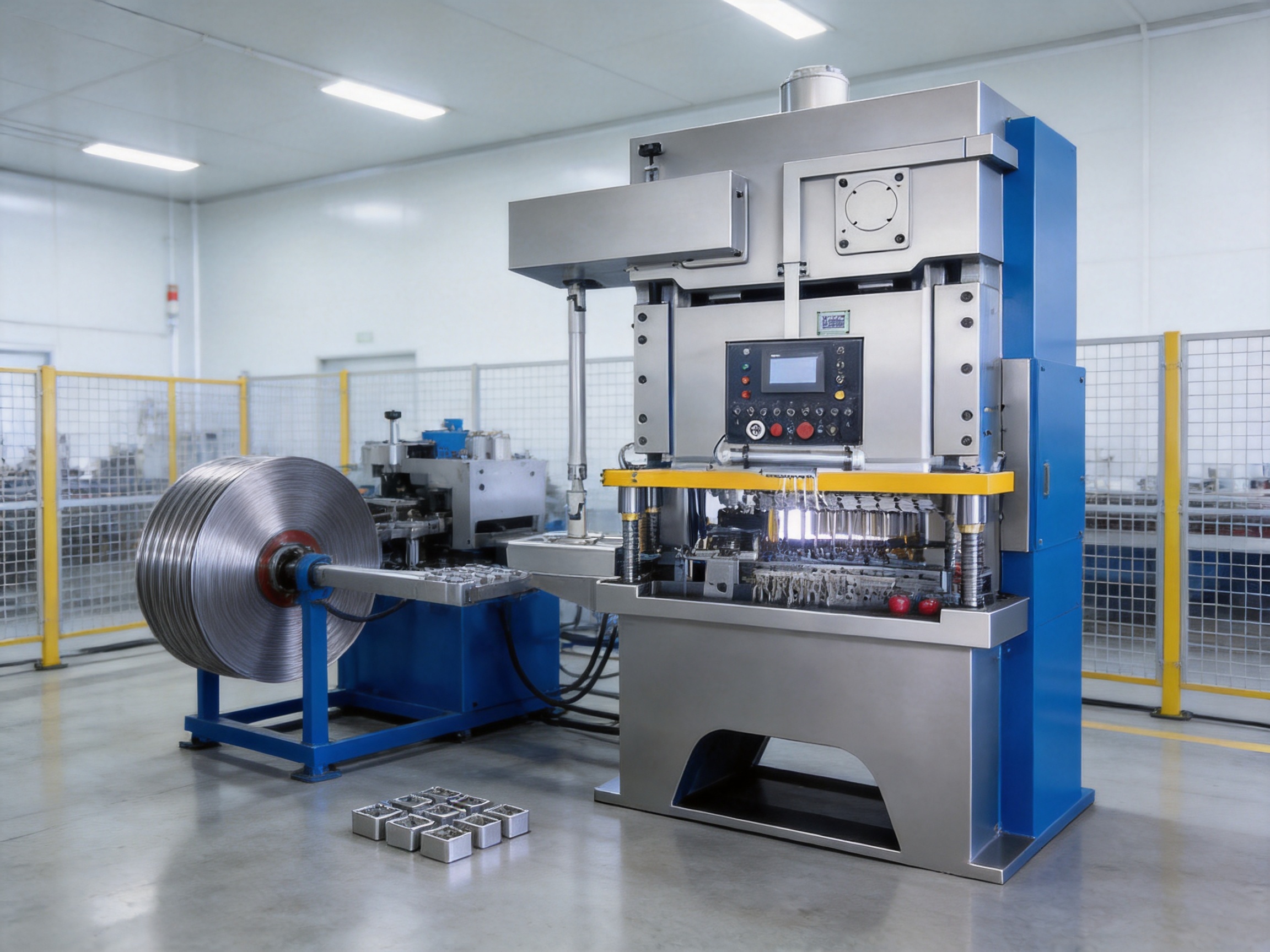
With operating speeds of up to 80 strokes per minute, the BLPC2-63 can contribute significantly to production efficiency. In high-volume battery component manufacturing, total output is often determined by the stable running speed of the press line. A machine capable of fast cycling can reduce unit production time and improve capacity utilization, provided that feeding, die design, lubrication, material quality, and downstream handling are properly matched.
The value of speed becomes especially clear in multi-station stamping. When several forming steps are integrated into a progressive die, every stroke produces a finished or semi-finished part after the line reaches continuous operation. A stable 80 strokes per minute can therefore represent substantial daily output. For factories supplying battery manufacturers, electronics producers, or component assembly plants, this productivity can help meet delivery schedules and reduce production bottlenecks.
At the same time, the machine’s agility should not be confused with uncontrolled speed. Stamping at high speed requires strong coordination among the clutch-brake system, slide movement, die protection, feeding accuracy, and overload response. The BLPC2-63 incorporates a dry clutch-brake system for responsive engagement and stopping. This helps the press start and stop more effectively, supporting operational control during production setup, troubleshooting, or emergency response.
Compared with less responsive press systems, a well-configured dry clutch-brake mechanism can improve operator confidence and reduce downtime associated with delayed stopping. In high-speed battery shell stamping, fast and predictable stopping is essential because small errors can quickly multiply across dozens or hundreds of strokes. A responsive system supports safer and more controlled production management.
Tooling is one of the most valuable assets in precision stamping. Battery shell dies may include drawing stations, cutting edges, forming inserts, guide components, and calibration sections. Damage to these components can lead to high repair costs, long downtime, and delayed customer deliveries. The BLPC2-63 includes a hydraulic overload protection device to help protect both tooling and the press during abnormal load events.
Overload conditions can occur for many reasons. Material thickness may vary beyond expected limits. A double blank may enter the die. Lubrication may fail. A foreign object may be present. Feeding may be misaligned. A formed part may fail to discharge properly. In each case, the press may experience a forming load higher than the intended value. Without appropriate overload protection, the die or machine structure may suffer damage.
Hydraulic overload protection acts as a safeguard. When the load exceeds the set threshold, the system can respond to reduce the risk of severe mechanical damage. For continuous battery shell production, this protection is not merely a safety feature; it is an economic advantage. It helps reduce tooling accidents, shortens recovery time, and protects the consistency of production.
Compared with presses lacking effective overload protection, the BLPC2-63 offers greater confidence in long-duration manufacturing. This is particularly important in automated or semi-automated stamping lines, where production may continue at high speed and errors must be detected and contained quickly. The hydraulic overload protection system contributes to a more stable and resilient production environment.
The 1300 × 550 mm worktable is a practical size for battery shell stamping applications. It provides enough space for many precision dies while keeping the machine suitable for efficient workshop arrangement. For manufacturers that need to process different battery shell formats or related components, the worktable area supports flexibility in die design and production planning.
In progressive stamping, the die length can be considerable because multiple stations are arranged in sequence. Each station performs a specific operation, and the strip advances step by step. A larger worktable helps accommodate this layout, especially when guide systems, sensors, scrap channels, and feed clearances are included. The BLPC2-63’s worktable size therefore supports not only the die body but also the practical needs of production integration.
Open-type accessibility further supports die setup and adjustment. During trial production, engineers often need to inspect the formed part, measure dimensions, adjust die clearance, verify feeding, and check lubrication. Easier access to the working area can shorten setup cycles and improve troubleshooting efficiency. When production involves frequent product changes or customized customer orders, this flexibility becomes a competitive advantage.
The press is also suitable for precision multi-station dies used in battery component manufacturing. This compatibility allows manufacturers to reduce separate handling between operations, improve part consistency, and increase production flow. When properly integrated with coil feeding equipment, straighteners, lubricators, and part collection systems, the BLPC2-63 can serve as the core forming unit in an efficient battery shell stamping line.
The BLPC2-63 offers several advantages when compared with ordinary open-type single-point presses and general-purpose stamping equipment. First, the double-point structure provides better slide balance. This is especially useful for wide or multi-station dies, where eccentric loads are common. A more balanced slide can reduce uneven die wear and help maintain consistent part dimensions.
Second, the machine is designed specifically for battery shell stamping rather than general metal stamping alone. This application focus gives it stronger relevance for manufacturers that require high-speed precision forming of thin-wall components. Instead of adapting a general press to a demanding battery process, users receive a machine whose specification profile is already aligned with that process.
Third, the combination of 630 kN capacity and up to 80 strokes per minute provides a practical balance of force and speed. Some competitor machines may offer higher nominal capacity but lower speed, or higher speed with insufficient forming stability. The BLPC2-63 is positioned to serve small-format battery shell production where both output and accuracy are required.
Fourth, the dry clutch-brake system provides responsive operation. In a high-speed stamping environment, response time matters. Operators need predictable machine behavior during setup and production. A responsive clutch-brake system supports safer control and can reduce time lost during production interruptions.
Fifth, hydraulic overload protection enhances tooling safety. In precision stamping, die damage can be more costly than press downtime itself. By incorporating overload protection, the machine helps preserve tooling investment and reduce the risk of catastrophic production interruption.
Finally, the company’s manufacturing background strengthens the product value. Zhejiang Bolun High-Precision Machinery Co., Ltd. emphasizes precision processing equipment, mature production management, strict inspection, non-standard customization, and integrated service. These strengths can make a practical difference in press quality, customization accuracy, and long-term customer support.
A precision power press is only as reliable as the manufacturing system that produces it. The BLPC2-63 benefits from the company’s integrated approach to machinery production. Zhejiang Bolun High-Precision Machinery Co., Ltd. combines research and development, design, production, sales, and service within a modern enterprise structure. This integration allows technical knowledge to move efficiently from customer requirements to engineering design and from manufacturing feedback to product improvement.
The company is located in Zhejiang, a region known for precision manufacturing capability and mature industrial supply chains. This location supports access to skilled personnel, machining resources, component suppliers, and manufacturing experience. Over approximately two decades, the company has developed a professional production management system and has built experience in forging and casting machinery as well as high-precision forming equipment.
Advanced manufacturing begins with design. For a double-point battery power press, engineering decisions affect rigidity, dynamic behavior, slide guidance, crank mechanism performance, overload protection reliability, and service accessibility. The company’s design team supports both standard and non-standard equipment requirements, allowing the press to be adapted to special customer needs when necessary. This is valuable in battery manufacturing, where new cell formats and component designs can create unique forming requirements.
The company also emphasizes full-chain production control. This means attention is given to stages from basic design and core component development to final machine assembly. Such control helps ensure that each critical part meets the intended performance standard. For a precision press, dimensional accuracy, material quality, machining consistency, assembly alignment, and inspection procedures all affect final performance. A weakness in any one stage can reduce machine stability.
Quality inspection is another key strength. The company has established a finished product inspection system that exceeds common industry expectations, applying rigorous quality control to processes and components. For customers, this supports stable precision and long service life under high-intensity operating conditions. In battery shell stamping, where machines may run continuously for long shifts, quality control is essential.
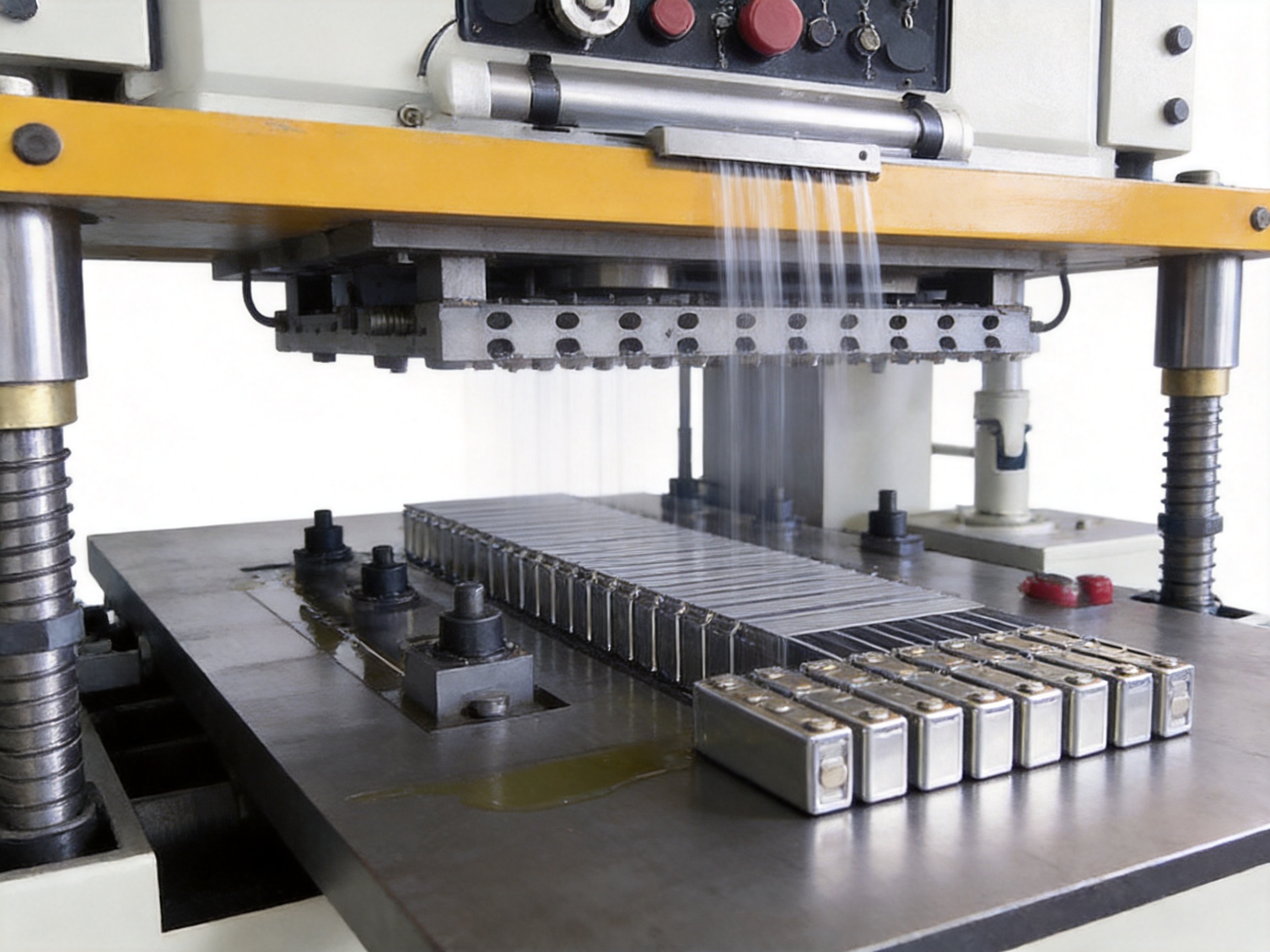
The performance of a power press depends heavily on the precision of its structural components and moving systems. The frame must resist deformation. The slide must travel accurately. The drive system must transmit force consistently. The worktable must support the die without distortion that would affect forming accuracy. The clutch-brake system must engage and stop reliably. The overload protection must respond properly when required.
Bolun’s manufacturing philosophy focuses on stable precision and long service life. This involves careful control of machining, assembly, and inspection. Precision processing equipment enables the company to produce key parts with controlled tolerances. Mature assembly methods help maintain alignment among the frame, slide, crankshaft, connecting components, and worktable. Inspection procedures verify that the finished machine is ready for demanding production.
For customers, this manufacturing discipline can result in lower vibration, more consistent slide behavior, reduced maintenance issues, and longer die life. While nominal specifications such as capacity and speed are important, real production value comes from repeatability. A press that maintains stable accuracy over millions of strokes provides far greater value than a machine that only performs well during initial testing.
The company’s approach to quality also supports customer confidence in continuous production. Battery component manufacturers often work under tight delivery schedules. Unexpected downtime can affect the entire supply chain. By emphasizing inspection, component quality, and structural reliability, the BLPC2-63 is designed to reduce operational uncertainty.
Battery technology is evolving quickly. Different battery formats, shell materials, thicknesses, shapes, and production strategies may require different press configurations or auxiliary systems. A manufacturer that offers non-standard customization can help customers adapt equipment to specific production goals. Zhejiang Bolun High-Precision Machinery Co., Ltd. has a design team capable of providing one-stop design and manufacturing services for products with special specifications and functions.
This customization capability is a significant advantage over suppliers that provide only fixed, catalog-based machines. In real factories, the press may need to match existing dies, feeding lines, safety devices, foundation conditions, automation systems, or production data requirements. A supplier with engineering flexibility can help resolve these practical challenges.
For the BLPC2-63, customization discussions may involve die interface requirements, automation compatibility, feeding direction, safety guarding, lubrication integration, part collection methods, or production line layout. While the standard machine already provides strong battery shell stamping capability, the ability to tailor solutions increases its value for customers with specialized processes.
This is particularly important for manufacturers entering new battery component markets. Early production may involve trial dies, changing product dimensions, and evolving customer specifications. A responsive equipment partner can support process improvement, reduce implementation risks, and help factories move from development to stable mass production more efficiently.
The primary application of the BLPC2-63 is high-speed stamping of small-format battery shells. These components require precision forming because they often serve as protective enclosures, structural bodies, or functional parts within battery assemblies. Dimensional accuracy affects downstream assembly, sealing, electrical performance, and mechanical reliability.
Beyond battery shells, the machine can also be suitable for related thin metal components in battery and electronics industries. Potential applications include caps, covers, lids, brackets, conductive pieces, retaining components, shielding parts, and other precision stamped parts made from suitable sheet materials. The double-point structure and high-speed operation make it appropriate for multi-station die work where consistent pressure distribution is important.
The machine may also serve manufacturers producing small precision metal parts outside the battery sector. Industries such as electronics, small appliance components, hardware, automotive small parts, and electrical connectors may benefit from a press that combines open-type accessibility with double-point slide balance. However, its strongest advantage remains in battery-related thin-wall forming, where its design intent is most directly aligned.
For production managers, equipment decisions are measured by output, reliability, quality, maintenance requirements, and cost effectiveness. The BLPC2-63 supports these priorities in several ways. Its speed of up to 80 strokes per minute improves production capacity. Its double-point structure supports part consistency and die stability. Its hydraulic overload protection helps reduce tooling risk. Its open-type design improves access for setup and maintenance.
Production managers also value predictable performance. A press that requires frequent adjustment can consume labor and disrupt scheduling. By providing stable force distribution and precision-oriented construction, the BLPC2-63 helps reduce process variation. This supports more consistent quality control and easier production planning.
Maintenance teams benefit from a machine designed with practical operation in mind. Open access can simplify inspection and routine service. A responsive clutch-brake system helps during adjustment and troubleshooting. Overload protection can prevent severe failures that would otherwise require extensive repair. Together, these features support a lower-risk operating environment.
Quality managers benefit from improved dimensional consistency in stamped parts. Battery shells and thin-wall components are sensitive to uneven forming pressure. Better slide balance can help reduce variation across the die. When paired with proper die design and process control, the BLPC2-63 contributes to stable part quality over long production runs.
The purchase price of a press is only one part of its total cost. Over time, manufacturers must also consider energy use, maintenance, tooling damage, scrap rate, downtime, setup time, and productivity. The BLPC2-63 is designed to create value across these cost factors.
Higher stable production speed can reduce unit cost by increasing output per hour. Improved slide balance can reduce part defects and die wear. Hydraulic overload protection can prevent expensive tooling damage. Open-type accessibility can shorten setup and maintenance time. Precision manufacturing can support longer machine life and fewer unexpected failures.
Compared with a lower-cost general-purpose press that lacks double-point stability or overload protection, the BLPC2-63 may provide better economic performance in demanding battery shell production. A cheaper press that produces higher scrap, damages dies, or cannot maintain speed under real production conditions can become more expensive over time. For professional manufacturers, long-term reliability and process stability often matter more than the lowest initial investment.
The global stamping industry is moving toward intelligent, digital, and highly controlled production systems. Battery manufacturing in particular requires traceability, consistency, and scalable output. Equipment must be ready to integrate with automation, feeding systems, safety control, and production monitoring. While the BLPC2-63 is fundamentally a mechanical power press, its design philosophy aligns with these modern manufacturing expectations.
Zhejiang Bolun High-Precision Machinery Co., Ltd. has stated its intention to continue investing in intelligent and digital stamping equipment. This direction is important because future production lines will increasingly rely on data, sensors, automation, and predictive maintenance. A company with an international management perspective and active technical development is better positioned to support customers as their factories evolve.
For battery component manufacturers, this means the press can be considered not only as a standalone machine but also as part of a broader production system. When combined with automatic feeding, die monitoring, safety guarding, lubrication control, and part handling, the BLPC2-63 can become a core element of an efficient stamping cell.
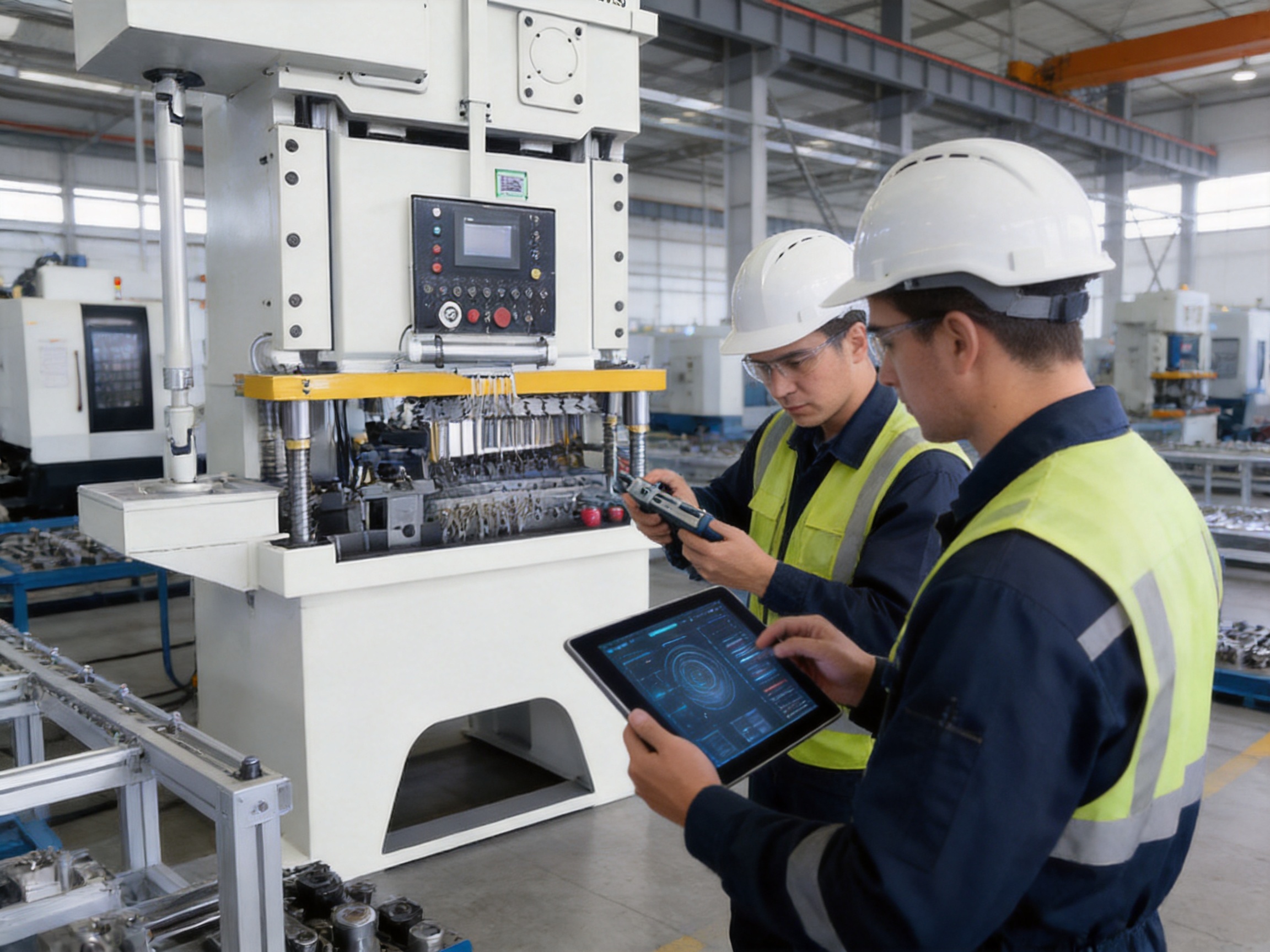
Reliable equipment must be supported by reliable service. The company provides a customer-oriented service system covering pre-sales consultation, in-sales support, and after-sales guarantees. This full-cycle approach helps customers select appropriate equipment, manage delivery and installation, solve technical questions, and maintain long-term production performance.
Pre-sales support is important because correct press selection depends on part material, thickness, forming process, die size, production volume, and automation requirements. A technical discussion before purchase can prevent mismatched equipment and reduce future problems. For battery shell stamping, this consultation can include evaluation of nominal capacity, table size, speed requirements, and die compatibility.
In-sales support helps ensure that the machine configuration matches the customer’s order and production plan. Communication during manufacturing and delivery can improve project coordination. After-sales support is essential for installation, operation training, maintenance advice, and troubleshooting. A strong service system can reduce downtime and increase customer confidence.
The company’s philosophy of being steadfast, rigorous, open, and mutually supportive is reflected in this service orientation. In industrial machinery, partnership matters. Customers are not simply buying a machine; they are relying on a supplier to support production continuity and process improvement.
Quality is described as the lifeline of the company. This is a meaningful principle in the power press industry because machine failures can affect safety, production schedules, tooling, and customer relationships. A strict quality philosophy requires attention to every component and every process. It also requires a long-term commitment to improvement rather than short-term cost reduction.
The company’s core philosophy, “Accumulate Richly and Break Forth Thinly; Pressure is Power,” expresses a belief in deep preparation, disciplined progress, and transformation of challenges into strength. In the context of the BLPC2-63, this philosophy appears in the combination of accumulated manufacturing experience, precision design, and focused application development.
For customers, quality and credit first means that the supplier aims to deliver dependable machines and maintain trust. In competitive machinery markets, technical specifications can appear similar on paper. The difference often lies in manufacturing execution, inspection standards, service response, and long-term reliability. These are areas where the company seeks to distinguish itself.
Battery manufacturers and their suppliers face pressure to improve output, reduce costs, and maintain strict quality standards. Component production must keep pace with cell assembly and pack manufacturing. Even small dimensional errors in stamped battery parts can create downstream issues. Therefore, the stamping press used for shell production must deliver both speed and precision.
The BLPC2-63 supports competitiveness by enabling efficient high-speed stamping with balanced force transmission. Its double-point structure helps improve forming stability. Its worktable supports multi-station dies. Its clutch-brake system supports responsive operation. Its overload protection helps protect tooling. Its open-type design supports accessibility and flexibility.
These features help manufacturers improve productivity without sacrificing control. They also support the transition from manual or low-speed production to more automated, high-volume manufacturing. As battery demand grows in electric mobility, energy storage, consumer electronics, and industrial applications, suppliers with efficient stamping capacity will be better positioned to compete.
The BLPC2-63 is especially suitable for manufacturers that produce small-format battery shells or precision thin metal components in medium to high volumes. It is also a strong option for factories that use multi-station dies and require better slide balance than a conventional single-point open press can provide. Companies seeking a practical balance between accessibility, productivity, and precision should consider this machine.
It may be particularly valuable for manufacturers upgrading from ordinary general-purpose presses. If existing equipment has problems with uneven forming, die wear, low speed, or insufficient overload protection, the BLPC2-63 can offer a more specialized solution. It is also suitable for production environments where die change access and maintenance convenience are important.
Before purchase, users should evaluate their part drawings, material specifications, die dimensions, required production speed, feeding method, and quality targets. The company’s consultation and customization capability can support this evaluation and help determine whether the standard machine configuration or a tailored solution is most appropriate.
The BLPC2-63 is mainly designed for high-speed stamping of small-format battery shells and related precision thin-wall metal components. It is suitable for production processes requiring stable forming force, accurate slide movement, and compatibility with multi-station dies.
The double-point structure distributes force through two driving points instead of one. This improves slide balance, reduces the influence of eccentric loading, and helps maintain consistent forming pressure across the die area. For battery shell stamping, this contributes to better dimensional stability and reduced die wear.
The nominal capacity is 630 kN. This capacity is suitable for many small-format battery shell stamping operations, depending on material type, thickness, die design, and forming depth.
The machine can operate at speeds of up to 80 strokes per minute. This speed supports high-volume production when combined with proper die design, feeding equipment, and process control.
The worktable measures 1300 × 550 mm. This size provides practical space for precision multi-station dies used in battery component manufacturing.
The BLPC2-63 is equipped with a hydraulic overload protection device. This system helps protect the press and tooling when abnormal loads occur, reducing the risk of severe die damage and production downtime.
The dry clutch-brake system provides responsive engagement and stopping performance. This supports controlled operation during production, setup, adjustment, and emergency stopping situations.
Compared with ordinary single-point open presses, the BLPC2-63 offers better slide balance because of its double-point structure. It is also more focused on precision battery shell stamping, provides high-speed operation, and includes hydraulic overload protection for tooling security.
Yes. Zhejiang Bolun High-Precision Machinery Co., Ltd. has non-standard customization capability and a design team that can provide one-stop design and manufacturing support for special specifications and functions. This is useful for customers with unique die, automation, or production layout requirements.
A precision press depends on accurate machining, reliable components, careful assembly, and strict inspection. The manufacturer’s advanced processing equipment, full-chain production system, mature management, and quality control directly influence machine stability, service life, and production reliability.
The BLPC2-63 Precision-Agile Open-Type Double-Point Battery Power Press is a specialized solution for high-speed stamping of small-format battery shells and precision thin metal components. Its 630 kN nominal capacity, up to 80 strokes per minute operating speed, 1300 × 550 mm worktable, dry clutch-brake system, and hydraulic overload protection create a balanced combination of productivity, precision, safety, and practicality.
Its greatest structural advantage is the double-point design, which improves force distribution across the slide and supports stable operation with precision multi-station dies. This makes the machine more suitable for demanding battery shell production than many conventional single-point open presses. At the same time, its open-type configuration provides accessibility for die setup, maintenance, and production flexibility.
The value of the machine is strengthened by the manufacturing capability of Zhejiang Bolun High-Precision Machinery Co., Ltd. With approximately two decades of machinery industry experience, integrated R&D and production, advanced precision processing, non-standard customization capability, strict inspection systems, and customer-focused service, the company provides more than a press; it provides a production solution built around reliability and long-term customer value.
For manufacturers seeking to improve battery shell stamping efficiency, reduce quality variation, protect tooling, and build more competitive production capacity, the BLPC2-63 is a strong candidate. It represents a practical step toward high-speed, precision, and intelligent stamping production in the modern battery manufacturing supply chain.
Altan, T., and Tekkaya, A. E. Sheet Metal Forming: Processes and Applications. ASM International.
Kalpakjian, S., and Schmid, S. R. Manufacturing Engineering and Technology. Pearson Education.
Society of Manufacturing Engineers. Tool and Manufacturing Engineers Handbook: Forming. SME.
Boljanovic, V. Sheet Metal Forming Processes and Die Design. Industrial Press.
Lange, K. Handbook of Metal Forming. McGraw-Hill.
International Organization for Standardization. Safety of Machinery and Mechanical Press Standards.
ASM International. Metals Handbook: Forming and Forging.


Understanding Mechanical Power Presses and Their Essential Functions A mechani...
What Is a Power Press? A power press — also called a stamping press or punch pr...
In the fields of metal forming, sheet metal fabrication, blanking, and punching,...
Power press machines are classified in two main ways: by frame construction, w...
As the manufacturing industry moves steadily toward automation and smart product...
In modern manufacturing, cold forging is widely used in the automotive, aerospac...
Contact Us

bolunpress@gmail.com

+86-575-83362228

+86-15158259588

+86-575-83362999

+86-15158259588

Hangzhou Office Add: No. 332 Wangjiang East Road, Shangcheng District

No.1 Linjiang Road East, Xiaren, Jinting Town, Shengzhou City, Zhejiang Province, China
Ready to Begin?
Get in Touch

Now!

ZHEJIANG BOLUN
 English
 中文简体
中文简体