
In large-scale metal forming, the difference between ordinary output and stable high-value production often depends on the press at the center of the line. A power press used for automotive body panels, appliance structures, large brackets, deep-drawn shells, and heavy industrial components must deliver more than force. It must provide rigidity, accuracy, repeatability, controlled slide motion, safe operation, and long-term reliability under continuous loading. The BLPF-800 Ultra-High Tonnage Industrial Closed-Type Double-Point Eccentric Gear Power Press is designed for precisely this demanding environment.
This machine belongs to the closed-type double-point eccentric gear power press category, with a nominal capacity of 8000 kN. It is engineered for heavy-duty forming of large structural components and for production systems where die size, process stability, and forming force are all critical. With a 3600 × 1400 mm worktable, a 75 kW main motor, a high-rigidity frame, eccentric gear transmission, a 1200 kN cushion capacity, a touch-screen control interface, and an anti-overrun safety device, the press provides a strong platform for modern stamping, deep drawing, and structural forming applications.
For manufacturers comparing open-type power presses, conventional closed-type presses, and other power press configurations, this model represents a specialized solution for high-tonnage, large-format, precision-oriented production. It is particularly suitable for automotive manufacturing, home appliance production, and heavy industrial stamping, where large dies and consistent forming results are essential for productivity and cost control.
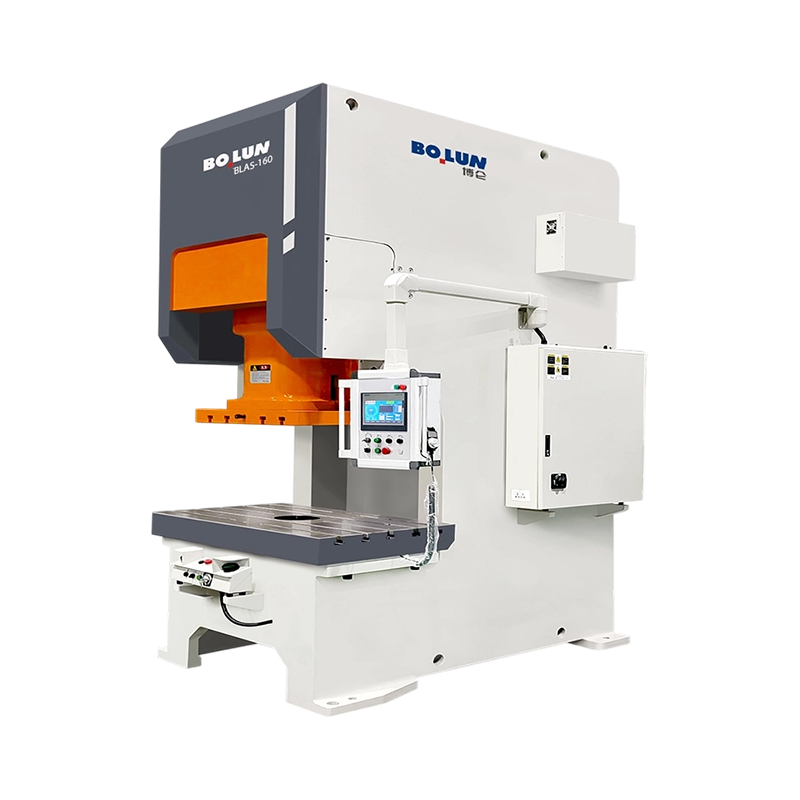
BLPF-800 Ultra-High Tonnage Industrial Closed-Type Double-Point eccentric gear Power Press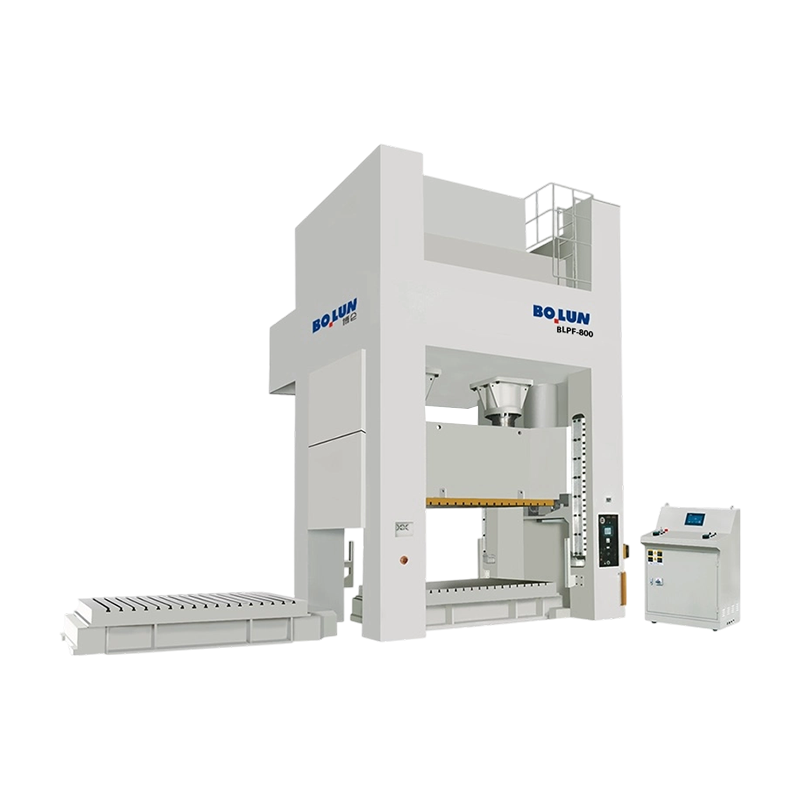
Power presses can generally be divided into open-type power presses, closed-type power presses, and other special-purpose press structures. Open-type presses are often valued for accessibility and convenience in smaller or medium operations, but their frame structure may be less suitable for very high tonnage and large eccentric loading. Closed-type power presses, by contrast, are commonly selected for stronger frame integrity, better deformation resistance, and higher suitability for demanding forming operations.
The BLPF-800 is positioned in the closed-type double-point eccentric gear power press segment. This positioning is important because large stamping dies often require balanced force distribution across a wide slide area. A double-point structure helps distribute load more evenly than a single-point configuration, reducing the risk of uneven slide movement, localized die wear, and inconsistent forming quality. The closed-type frame further enhances stability by enclosing the working structure and improving resistance to deflection during high-load operation.
Compared with smaller open-back presses or lighter closed-type machines, this press is intended for industrial users who need a robust machine capable of supporting large dies and complex forming operations. The combination of 8000 kN nominal capacity and a large worktable makes it suitable for panels, structural reinforcements, appliance components, and other products requiring both force and working area.
In competitive production environments, a press must serve as a dependable production asset rather than merely a piece of machinery. The BLPF-800 is designed to reduce uncertainty in forming, improve operational confidence, and support stable production planning. Its value lies not only in its high tonnage but also in how that force is delivered, controlled, and supported by the machine structure.
The main technical features of the BLPF-800 show that it is built for high-capacity, large-die forming. The 8000 kN nominal force provides the power required for heavy stamping and deep drawing tasks. The 3600 × 1400 mm worktable offers generous space for large industrial dies, helping manufacturers process wide and long parts without compromising die arrangement. The 75 kW main motor provides the driving power required for demanding forming cycles, while the eccentric gear transmission system supports strong mechanical energy transfer.
The 1200 kN cushion capacity is a key feature for deep drawing and forming processes that require controlled blank holding or material flow. In applications such as automotive panels and appliance shells, material control during forming can determine whether the final component has wrinkles, cracks, thickness variation, or surface defects. A capable cushion system helps maintain forming stability and improves part consistency.
The touch-screen interface improves operator interaction by making machine settings, monitoring, and operational feedback more accessible. The anti-overrun safety device adds another layer of protection by helping prevent unsafe or uncontrolled motion. Together, these systems support safer and more efficient use in production environments.
| Feature | Specification or Description | Production Value |
|---|---|---|
| Press Type | Closed-type double-point eccentric gear power press | High rigidity and balanced force distribution for large dies |
| Nominal Capacity | 8000 kN | Suitable for heavy-duty stamping, forming, and deep drawing |
| Worktable Size | 3600 × 1400 mm | Accommodates large industrial dies and wide structural parts |
| Main Motor Power | 75 kW | Provides strong drive capacity for high-tonnage operation |
| Cushion Capacity | 1200 kN | Supports controlled material flow in complex forming processes |
| Transmission System | Eccentric gear transmission | Delivers stable mechanical force transfer |
| Control Interface | Touch-screen interface | Improves operation, monitoring, and parameter adjustment |
| Safety System | Anti-overrun safety device | Enhances operational protection and risk control |
The closed-type frame is one of the most important structural advantages of this press. In high-tonnage forming, press deformation directly affects die life, product accuracy, and process repeatability. If the frame deflects excessively under load, the slide may not remain parallel to the worktable, resulting in uneven forming pressure, accelerated die wear, and dimensional inconsistency. The closed-type structure provides a strong load-bearing architecture that resists deformation and maintains better alignment during demanding operations.
Compared with open-type press structures, a closed frame generally offers superior rigidity. Open-type presses provide convenient access from multiple sides, which can be useful for smaller parts and simpler operations. However, when tonnage rises and die size increases, the open structure may become more vulnerable to angular deflection. A closed-type machine is better suited for maintaining geometric stability when large dies apply force across broad areas.
The BLPF-800 is specifically designed for high-tonnage forming of large structural components. Its rigid frame helps support stable load distribution, which is essential when producing components that require consistent thickness, smooth surfaces, and accurate contours. In automotive and appliance manufacturing, even small deviations can create downstream assembly problems. Better rigidity helps prevent those problems at the source.
For manufacturers evaluating equipment investment, frame rigidity is not only a technical point but also an economic factor. A press with stronger rigidity can reduce die maintenance, improve quality yield, lower scrap rates, and extend the useful life of both tooling and machinery. These advantages can produce significant savings over years of operation.
The double-point design is another competitive strength of the BLPF-800. In a single-point press, force is transmitted through one main point, which may be sufficient for smaller dies or parts with relatively centralized loading. However, large dies often require force to be distributed across a wide slide area. If the force is not balanced, the die may experience uneven closure, and the finished part may show inconsistent dimensions or surface quality.
A double-point press distributes driving force through two points, helping maintain better slide balance over a wider working area. This is especially important for parts such as automotive panels, reinforcement structures, appliance housings, and large metal shells. The two-point configuration helps control slide parallelism and reduces the risk of tilting under off-center loads.
In real production, forming loads are rarely perfectly symmetrical. Material thickness variation, die geometry, blank placement, lubrication conditions, and draw depth can all create uneven forces. A double-point structure gives the machine a stronger foundation for handling these variations. It improves process stability and allows the press to perform reliably even when operating conditions are complex.
Compared with competing machines that rely on lighter drive structures or insufficient slide support, the BLPF-800 offers better suitability for high-value parts where dimensional consistency matters. Balanced forming reduces correction work, supports smoother downstream assembly, and improves the reliability of mass production.
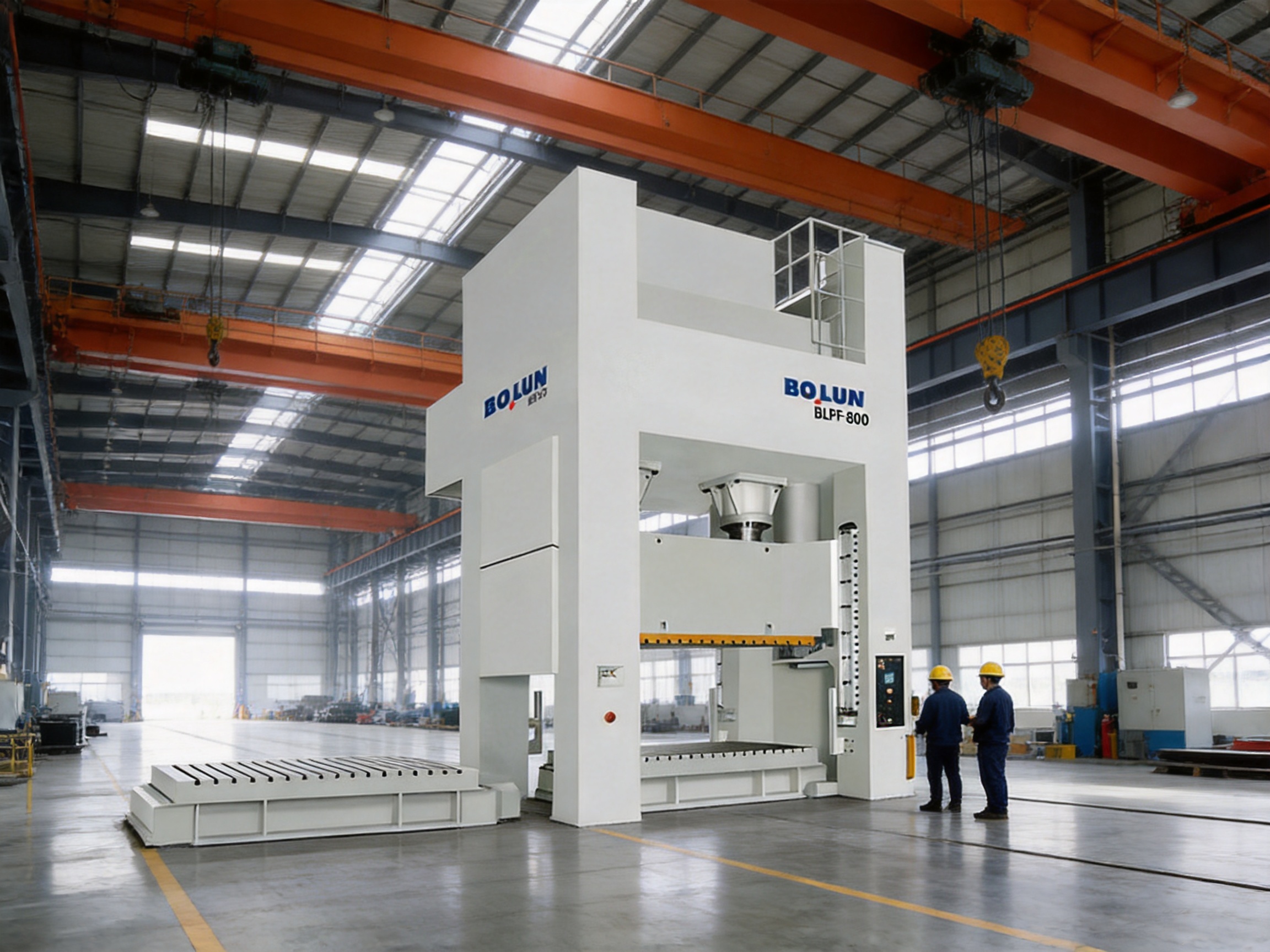
The eccentric gear transmission system is central to the mechanical performance of the press. In mechanical power presses, the transmission system converts motor energy into controlled slide motion and forming force. A well-designed eccentric gear mechanism provides strong mechanical advantage, stable motion characteristics, and reliable energy transfer, especially under high-load conditions.
The BLPF-800 uses an eccentric gear transmission combined with a high-rigidity frame structure. This combination helps ensure that force is not only generated but also delivered effectively to the workpiece. In heavy industrial stamping, power delivery must be consistent over repeated cycles. Instability in transmission can lead to vibration, noise, premature component wear, and inconsistent forming results.
Compared with less robust transmission designs, an eccentric gear system offers advantages in mechanical reliability and force control. It is suitable for applications where the machine must repeatedly generate high forming pressure while maintaining predictable slide motion. The gear transmission also supports stable load distribution during high-tonnage operation, which is essential for protecting dies and maintaining production quality.
The 75 kW main motor provides the power foundation for the system. When paired with the eccentric gear drive, it enables the press to perform demanding forming tasks while maintaining operational stability. This is particularly valuable for manufacturers running large dies, thick materials, or deep drawing processes that require strong energy input.
A press with high tonnage but limited worktable size may not meet the needs of large-part manufacturers. The 3600 × 1400 mm worktable of the BLPF-800 is designed to accommodate large industrial dies used in automotive body panels, appliance manufacturing, and structural forming. This broad working area increases production flexibility and allows manufacturers to handle a wider range of part sizes.
Large worktable capacity is especially important when producing parts with complex contours or extended dimensions. Automotive panels and appliance components often require dies that include forming, trimming, guiding, blank holding, and material control features. These dies can be large and heavy, requiring a press bed that supports both their size and operational load.
The spacious worktable also supports better die layout and maintenance access. Operators and tooling engineers can install and align large dies more confidently, reducing setup difficulties. Efficient die change and alignment contribute directly to production uptime. In industries where model changes and product variations are common, the ability to handle multiple die types becomes a competitive advantage.
Compared with competing presses that provide similar tonnage but smaller die space, the BLPF-800 offers greater practical utility for large-format forming. The worktable size helps manufacturers avoid unnecessary limitations and supports future product development where larger or more complex components may be required.
Deep drawing and complex forming require more than vertical force. They require control over how the sheet metal flows into the die cavity. If the material flows too freely, wrinkles may occur. If it is restrained too tightly, cracks or thinning may appear. The cushion system is therefore a critical feature for producing high-quality formed components.
The BLPF-800 includes a 1200 kN cushion capacity, supporting processes that need controlled material flow. This capability is particularly valuable for automotive body parts, appliance panels, large covers, and structural shells. In these applications, the cushion can help regulate blank holding force and improve forming results.
Compared with presses that lack sufficient cushion capacity, this machine provides greater process control. Operators and engineers can better manage material behavior during forming, improving the chance of achieving accurate, defect-free parts. This reduces scrap, improves first-pass yield, and makes production more predictable.
The cushion function also supports flexibility. Different materials and part geometries require different forming conditions. High-strength steel, stainless steel, aluminum, and other sheet materials may respond differently under pressure. A strong cushion system allows manufacturers to adapt forming parameters to specific applications, supporting broader production capability.
Modern press operation requires clear information, convenient adjustment, and reliable monitoring. The integrated touch-screen interface of the BLPF-800 improves the interaction between operator and machine. Instead of relying only on traditional mechanical controls, the operator can access machine status, operating parameters, and control settings through a more intuitive interface.
This improves production efficiency in several ways. First, settings can be reviewed and adjusted more conveniently. Second, operators can monitor operating conditions more clearly. Third, training and daily operation become easier because the interface supports structured information display. In a production line where downtime is costly, better control visibility can help identify issues sooner and reduce response time.
Compared with older press designs that provide limited digital feedback, a touch-screen control system improves transparency. It supports more standardized operation and helps reduce dependence on individual operator experience. This is especially important for manufacturers that operate multiple shifts or manage diverse production teams.
Digital control does not replace mechanical strength; it complements it. The BLPF-800 combines a strong mechanical foundation with improved control convenience, giving manufacturers both power and usability. This balance is important for modern factories seeking stable output, safe operation, and efficient management.
Safety is a central requirement in all power press applications, especially in high-tonnage equipment. The greater the force and energy involved, the more important it becomes to control motion, prevent abnormal operation, and protect personnel and equipment. The BLPF-800 includes an anti-overrun safety device to enhance operational safety.
Anti-overrun protection helps prevent the slide or moving components from exceeding safe operational limits. This reduces the risk of mechanical damage, die collision, and unsafe operating conditions. In heavy-duty stamping, such protection is especially important because the cost of a failure can be extremely high. A single serious machine or die incident can interrupt production, damage expensive tooling, and create safety hazards.
Compared with basic machines that rely heavily on operator attention alone, integrated safety devices provide an additional safeguard. They support more reliable operation and help manufacturers maintain safer production environments. Safety systems also contribute to compliance with internal plant standards and industrial safety expectations.
A safe press is also a productive press. When operators trust the equipment and control systems, production can proceed with greater confidence. Reducing risk helps reduce downtime, maintenance emergencies, and unplanned production losses.
The automotive industry is one of the most demanding markets for large power presses. Vehicle components must meet strict dimensional, surface, and structural requirements. Pressed parts may need to fit into complex assemblies, support welding processes, and maintain performance under road vibration, temperature changes, and structural loads. The BLPF-800 is well suited for such demands because of its high tonnage, large worktable, rigid frame, and controlled forming capability.
Automotive applications may include body panels, structural reinforcements, brackets, covers, inner panels, and formed shells. Many of these parts require large dies and balanced pressure distribution. The double-point structure helps maintain slide stability, while the cushion system supports deep drawing and material flow control. The large table accommodates dies used for wide or long vehicle components.
In automotive production, repeatability is critical. A part that is acceptable once but inconsistent over thousands of cycles is not suitable for mass manufacturing. The BLPF-800 is designed to support stable high-volume output by combining mechanical strength with controlled operation. Its design helps reduce variation, which is essential for downstream robotic welding, assembly fixtures, and final product quality.
Compared with less rigid or smaller presses, this model gives automotive manufacturers more confidence when handling large parts and high-force operations. It supports efficient production of components where precision, repeatability, and structural integrity are required.
Home appliance manufacturing also benefits from large, stable, and precise forming equipment. Appliance products such as washing machines, refrigerators, air conditioners, ovens, and large household devices often include formed panels, covers, frames, and structural shells. These components must be visually acceptable, dimensionally accurate, and suitable for efficient assembly.
The BLPF-800 provides the forming capacity and table size required for many appliance components. Its cushion system can assist in forming panels that require smooth surfaces and controlled material flow. The rigid frame helps maintain consistent pressure distribution, which is important for visible exterior parts where surface defects can lead to rejection.
Appliance manufacturing often involves competitive cost pressures and large production quantities. Equipment reliability and cycle consistency therefore have direct economic value. A press that reduces defects and supports stable operation can improve production yield and reduce the cost per part.
Compared with equipment that is less suitable for large panels, the BLPF-800 helps appliance manufacturers expand production capability and improve part quality. Its combination of working area, tonnage, and control makes it suitable for both structural and appearance-related components.
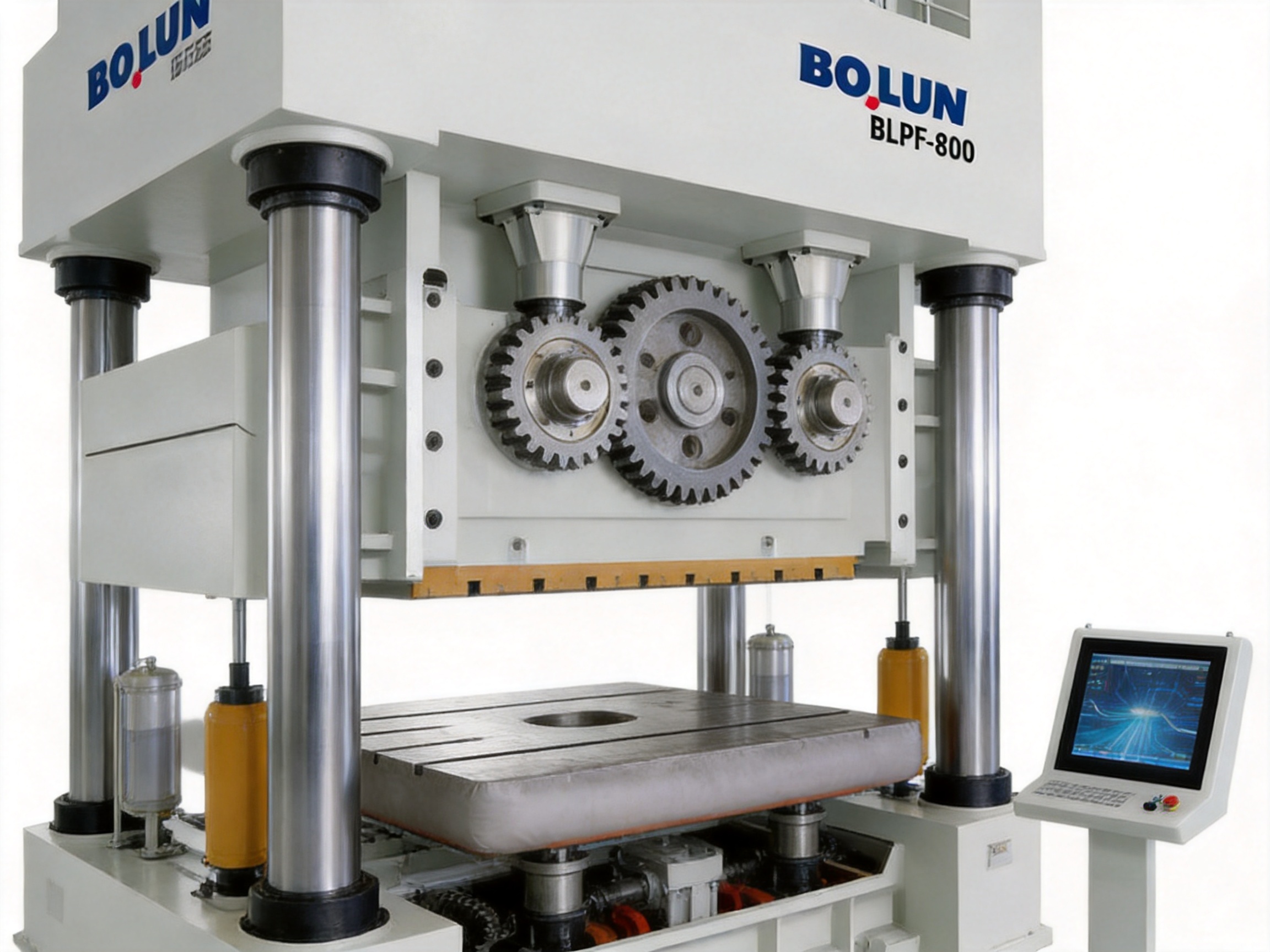
Beyond automotive and appliances, the BLPF-800 can support heavy industrial manufacturing sectors that require forming of large structural components. These may include metal enclosures, machinery parts, industrial covers, equipment panels, transportation structures, and other heavy-duty formed products. Such applications often involve thick materials, large dies, and demanding forming conditions.
Heavy industrial users need equipment that can handle load variation and continuous production. The high-rigidity frame and eccentric gear transmission of this press provide a strong basis for such work. The 8000 kN nominal capacity supports substantial forming loads, while the large table size makes it possible to process components beyond the range of smaller presses.
In heavy industry, downtime can disrupt entire production schedules. A robust press can reduce unexpected interruptions by providing stable mechanical performance. The BLPF-800’s design is therefore valuable not only for individual part quality but also for production continuity.
Compared with general-purpose power presses, this machine is better matched to large-format, high-tonnage, industrial forming. It gives manufacturers a platform for expanding into more demanding products and for meeting customer requirements in advanced manufacturing supply chains.
Open-type power presses remain useful in many production environments, especially for smaller parts, easy access, and lower-to-medium forming requirements. However, when the application involves large dies, high tonnage, and demanding dimensional control, a closed-type machine such as the BLPF-800 provides significant advantages.
The first advantage is structural rigidity. The closed frame resists deflection more effectively under large loads. This helps maintain slide-to-bed alignment and reduces forming variation. The second advantage is load distribution. The double-point structure supports wide dies and helps balance pressure over the work area. The third advantage is suitability for deep drawing and complex forming, supported by the 1200 kN cushion capacity.
Open-type presses can be more accessible, but that accessibility may come at the cost of frame stiffness. For high-tonnage production, rigidity and stability are often more important than open access. The BLPF-800 is designed for manufacturers who prioritize forming quality, die protection, and long-term reliability.
Another competitive advantage is scalability. As manufacturers move toward larger parts or stronger materials, equipment limitations become more visible. A high-capacity closed-type press provides room for production growth and process development.
Not all closed-type presses offer the same performance. Some machines may have closed frames but insufficient table size, limited cushion capacity, less refined control systems, or drive structures not optimized for high-tonnage operation. The BLPF-800 distinguishes itself through the combined strength of its core features.
Its 8000 kN nominal capacity places it in the ultra-high tonnage range for demanding forming tasks. The 3600 × 1400 mm worktable provides practical capability for large dies. The eccentric gear transmission delivers stable power, and the double-point design helps maintain balanced slide motion. The cushion capacity adds forming control, while the touch-screen interface and anti-overrun safety device improve usability and operational protection.
Competitors may emphasize one or two strong features, but the value of this press lies in system integration. Force, rigidity, table size, cushion control, transmission stability, operator interface, and safety protection are combined into one production platform. This integrated approach helps manufacturers avoid the compromise of purchasing a machine that is powerful but difficult to control, large but insufficiently rigid, or modern in controls but weak in mechanical design.
For buyers, the true measure of a press is not only the specification sheet but also production performance over time. The BLPF-800 is designed to deliver stable, repeatable results under heavy industrial conditions.
The performance of a heavy-duty power press depends heavily on the manufacturer’s engineering and production capability. Zhejiang Bolun High-Precision Machinery Co., Ltd. is located in Zhejiang, a region known for precision manufacturing in China. With two decades of experience in machinery manufacturing, the company has developed into a modern enterprise focused on high-precision forming equipment. It integrates research and development, design, production, sales, and service.
The company’s strength is based on industry accumulation, technical improvement, and a professional production management system. High-tonnage presses require careful design, precise machining, controlled assembly, and rigorous inspection. Any weakness in these stages can affect the final machine’s rigidity, alignment, service life, and operational stability. The company’s full-chain production system supports control over key processes from basic design to core component development and final machine assembly.
Advanced manufacturing also requires the ability to customize. Many industrial users have special requirements for die size, forming process, line integration, automation, or safety configuration. The company’s non-standard customization capability allows it to address specific production needs rather than forcing customers into a single standard solution. This is especially valuable for manufacturers producing specialized components or upgrading existing production lines.
International management awareness is another strength. By adopting advanced production management experience and adapting it to China’s local manufacturing environment, the company has built a scientific, efficient, and practical management system. This supports stable quality and improved delivery capability.
A power press is only as reliable as the precision of its components and the quality of its assembly. Large frame parts, gears, slide mechanisms, bed structures, and drive components must be manufactured and assembled with strict dimensional control. Zhejiang Bolun High-Precision Machinery Co., Ltd. owns advanced precision processing equipment and operates within a mature industrial environment, allowing it to manage each stage of production with technical depth.
Precision processing helps ensure that the press frame, slide, transmission components, and working surfaces align correctly. In high-tonnage forming, minor manufacturing errors can become major operational problems after repeated loading. Accurate machining supports smooth motion, lower wear, better force transfer, and longer service life.
The company emphasizes quality as a lifeline. It has established a finished product inspection system that exceeds common industry standards. Rigorous quality control is applied to every process and component to ensure stable precision and long service life under high-intensity operating conditions. This matters greatly for customers because a press is a long-term capital investment. Reliability over years of use is more valuable than short-term price advantage.
Compared with suppliers that focus only on basic assembly, a manufacturer with strong process control can deliver machines with better consistency. This reduces installation risk, shortens commissioning time, and improves customer confidence during production startup.
The development of a high-tonnage press begins long before manufacturing. It starts with engineering analysis, structural planning, drive design, safety consideration, and process understanding. Zhejiang Bolun High-Precision Machinery Co., Ltd. relies on a robust design team to provide one-stop design and manufacturing services for products with special specifications and functions.
This design capability is important because customers in automotive, appliance, and heavy industrial sectors often have different production priorities. One customer may need a press optimized for deep drawing. Another may need large die accommodation. Another may require integration with feeding, transfer, or automated handling systems. A capable engineering team can evaluate these needs and provide practical solutions.
Customization does not simply mean changing dimensions. It may involve adjusting machine structure, control logic, safety configuration, cushion function, or auxiliary systems. The manufacturer’s ability to provide non-standard customization is therefore a major competitive advantage. It allows buyers to obtain equipment that fits their production strategy rather than adapting production to equipment limitations.
The company’s philosophy of technological innovation supports continued product improvement. As global manufacturing moves toward intelligent and digital stamping equipment, investment in design and development becomes increasingly important. Press buyers benefit from a supplier that understands both traditional mechanical strength and modern control requirements.
For industrial equipment, service is part of the product. A power press must be selected, installed, commissioned, operated, maintained, and sometimes upgraded over its lifetime. Zhejiang Bolun High-Precision Machinery Co., Ltd. provides a customer-oriented service system covering pre-sales consultation, in-sales support, and after-sales guarantees.
Pre-sales consultation helps customers identify the correct equipment configuration based on part type, material, production volume, die size, and forming process. This stage reduces the risk of choosing a machine that is too small, too limited, or not suited to the application. In-sales support helps ensure that production, delivery, and installation requirements are coordinated. After-sales service supports long-term operation, maintenance planning, and problem resolution.
This service model is especially important for high-tonnage presses because installation and operation require technical coordination. Customers may need guidance on foundation preparation, die matching, lubrication, safety procedures, and operator training. A responsive manufacturer can help shorten the time from equipment arrival to productive operation.
Compared with competitors that focus primarily on selling machines, a supplier with full-service capability provides greater long-term value. Customers gain not only equipment but also technical partnership.
The BLPF-800 contributes to production efficiency through several mechanisms. Its high tonnage allows manufacturers to process demanding parts in a stable manner. Its large worktable reduces limitations related to die size. Its cushion capacity supports improved forming quality and lower scrap. Its touch-screen control improves operational convenience. Its safety system reduces risk. Its rigid frame and double-point structure help maintain die alignment and part consistency.
These features affect cost in practical ways. Better forming quality reduces defective parts. Stable slide motion helps protect dies, which are often expensive assets. Strong frame rigidity reduces the risk of alignment-related problems. Convenient controls reduce setup and adjustment time. Safety protection reduces the probability of costly incidents. Over the lifetime of the machine, these factors can outweigh initial purchasing differences.
In competitive industries, manufacturers often seek the lowest cost per qualified part rather than the lowest equipment price. A robust and stable press supports that goal by improving yield, reducing downtime, and enabling reliable high-volume production. The BLPF-800 is therefore best understood as a productivity investment.
It is also a strategic asset. By owning a press capable of large-format, high-tonnage forming, a manufacturer can pursue more demanding orders and respond to future market needs. This flexibility can create business opportunities that smaller or less capable equipment cannot support.
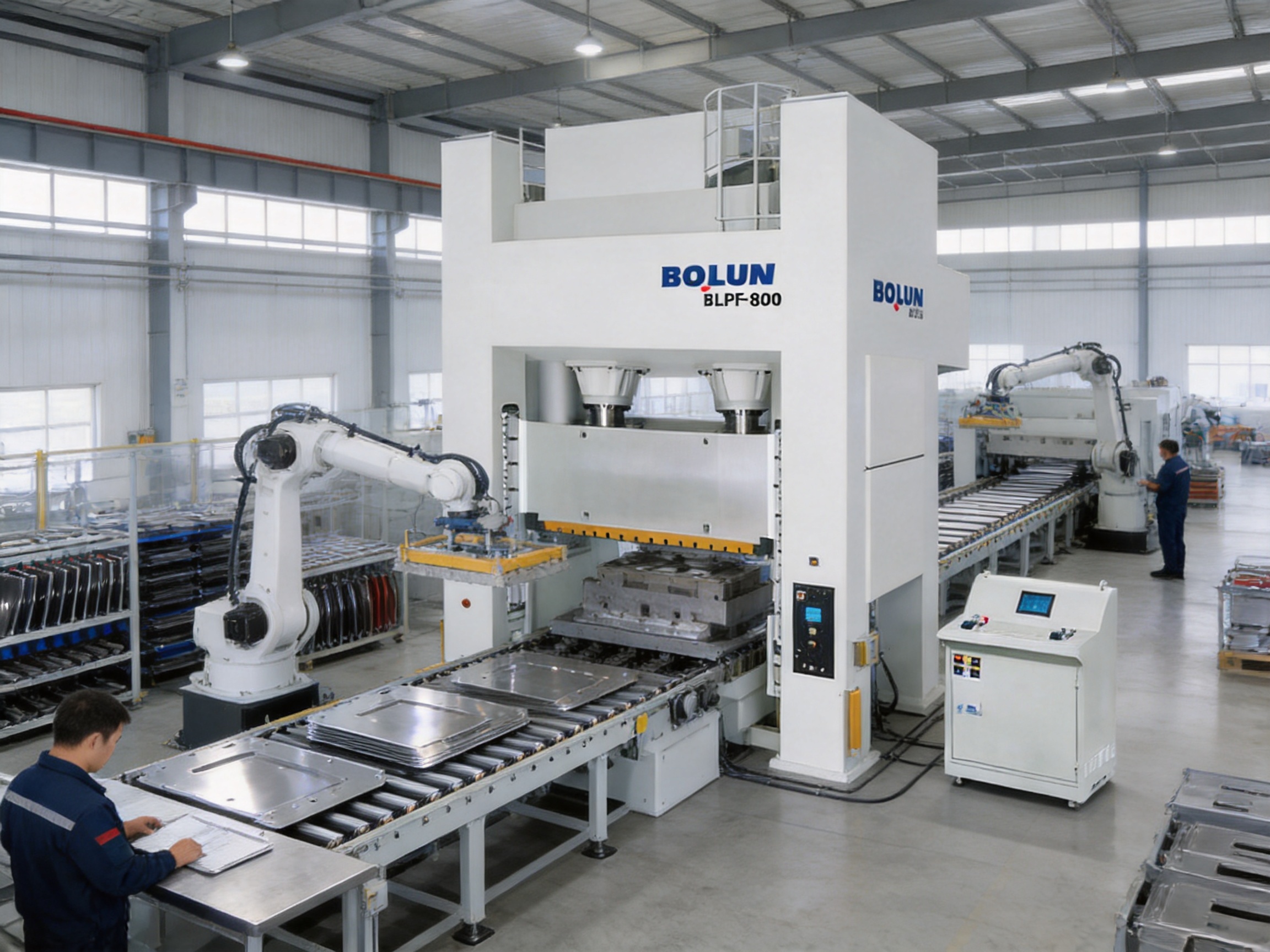
Modern stamping plants increasingly focus on intelligent manufacturing, digital control, line coordination, and quality traceability. While the BLPF-800 is fundamentally a powerful mechanical forming machine, its control interface and safety systems make it suitable for integration into more modern production environments. Touch-screen operation supports clearer human-machine interaction, while reliable mechanical design supports consistent output.
Production lines may include feeding equipment, die change systems, blank handling devices, conveyors, transfer mechanisms, or robotic loading and unloading. A stable press platform is necessary for successful integration. If the press itself is inconsistent, automation cannot fully solve quality problems. The BLPF-800 provides the mechanical foundation required for dependable line operation.
As manufacturers move toward digital production management, equipment that provides clearer operational status and easier parameter management becomes increasingly valuable. The press’s control system supports this trend by improving monitoring and adjustment. Future upgrades and line-level improvements are easier when the core machine already supports structured operation.
For factories planning long-term growth, choosing a press with strong mechanical capacity and modern control convenience helps protect investment. The BLPF-800 can serve both current production needs and future manufacturing development.
The BLPF-800 stands out because it combines high force, large working space, structural rigidity, balanced drive design, forming control, operator convenience, and safety. Many presses can provide one or two of these qualities. Fewer machines combine them in a way that directly supports demanding industrial production.
Its 8000 kN nominal capacity makes it suitable for heavy forming tasks. Its closed-type frame helps maintain stability. Its double-point structure improves large-die performance. Its eccentric gear transmission provides reliable mechanical force delivery. Its 3600 × 1400 mm worktable supports large dies. Its 1200 kN cushion capacity improves deep drawing and material flow control. Its touch-screen interface improves operation. Its anti-overrun safety device adds protection.
The machine is also supported by a manufacturer with experience, production capability, quality control, customization strength, and service awareness. This combination matters because equipment performance depends on both design and execution. A powerful specification is only meaningful if the machine is manufactured, assembled, inspected, and supported properly.
For automotive, appliance, and heavy industrial manufacturers, this press offers a practical route to stronger production capability. It supports complex forming processes, improves reliability, and gives factories a platform for large-scale, high-value production.
The BLPF-800 is a closed-type double-point eccentric gear power press. It is designed for ultra-high tonnage industrial forming, large-die stamping, deep drawing, and structural component production.
The press has a nominal capacity of 8000 kN, making it suitable for heavy-duty forming tasks that require substantial force and stable load support.
The closed-type frame provides high rigidity and improved resistance to deformation under load. This helps maintain alignment between the slide and worktable, improves part consistency, and protects dies during high-tonnage operation.
The double-point structure distributes force more evenly across a wide slide area. This is especially useful for large dies and wide components, helping reduce slide tilt and improve forming quality.
The eccentric gear transmission provides stable mechanical power delivery and supports reliable slide motion under heavy loads. It is well suited for repeated high-force forming cycles.
The press can be used for automotive body panels, structural reinforcements, appliance panels, industrial covers, large brackets, deep-drawn shells, and other large formed metal components.
The large worktable accommodates large industrial dies and supports the production of wide or long parts. It increases process flexibility and allows manufacturers to handle more demanding die layouts.
The cushion capacity supports controlled material flow during deep drawing and complex forming. It helps reduce defects such as wrinkles, cracks, and uneven thinning.
The touch-screen interface allows operators to access settings, monitor status, and adjust parameters more conveniently. It supports clearer operation and more efficient production management.
The press includes an anti-overrun safety device, which helps prevent unsafe motion beyond operational limits and improves equipment and personnel protection.
Compared with open-type presses, the BLPF-800 provides stronger rigidity, better high-tonnage stability, improved large-die support, and greater suitability for complex industrial forming.
High-tonnage presses require precise design, machining, assembly, and inspection. Zhejiang Bolun High-Precision Machinery Co., Ltd. supports the product with advanced processing equipment, full-chain production capability, customization services, and rigorous quality control.
The BLPF-800 Ultra-High Tonnage Industrial Closed-Type Double-Point Eccentric Gear Power Press is designed for manufacturers that need more than a basic forming machine. It provides a complete high-capacity forming platform for large structural components, automotive parts, appliance panels, and heavy industrial products. Its 8000 kN nominal capacity, large worktable, high-rigidity closed frame, double-point structure, eccentric gear transmission, 1200 kN cushion capacity, touch-screen interface, and anti-overrun safety device make it a strong solution for demanding production environments.
Its competitive value comes from the balance between mechanical power and process control. The machine is not only strong; it is designed to deliver that strength with stability, safety, and repeatability. Compared with open-type presses and less integrated closed-type alternatives, it offers better support for large dies, high-force forming, and complex production requirements.
Behind the machine is a manufacturer with deep experience in precision machinery, advanced production processes, non-standard customization capability, strict quality control, and a customer-oriented service system. This manufacturing foundation strengthens the long-term value of the equipment and helps customers build reliable, high-efficiency forming operations.
For factories seeking to improve forming capacity, reduce process risk, enhance product quality, and prepare for future industrial manufacturing demands, this ultra-high tonnage closed-type double-point eccentric gear power press is a compelling investment in production strength and long-term competitiveness.
Altan, T., and Tekkaya, A. E. Sheet Metal Forming: Fundamentals and Applications. ASM International.
Boljanovic, V. Sheet Metal Forming Processes and Die Design. Industrial Press.
Kalpakjian, S., and Schmid, S. R. Manufacturing Engineering and Technology. Pearson Education.
Lange, K. Handbook of Metal Forming. Society of Manufacturing Engineers.
Marciniak, Z., Duncan, J. L., and Hu, S. J. Mechanics of Sheet Metal Forming. Butterworth-Heinemann.
Society of Manufacturing Engineers. Tool and Manufacturing Engineers Handbook: Forming. SME.


Contact Us

bolunpress@gmail.com

+86-575-83362228

+86-15158259588

+86-575-83362999

+86-15158259588

Hangzhou Office Add: No. 332 Wangjiang East Road, Shangcheng District

No.1 Linjiang Road East, Xiaren, Jinting Town, Shengzhou City, Zhejiang Province, China
Ready to Begin?
Get in Touch

Now!

ZHEJIANG BOLUN
 English
 中文简体
中文简体