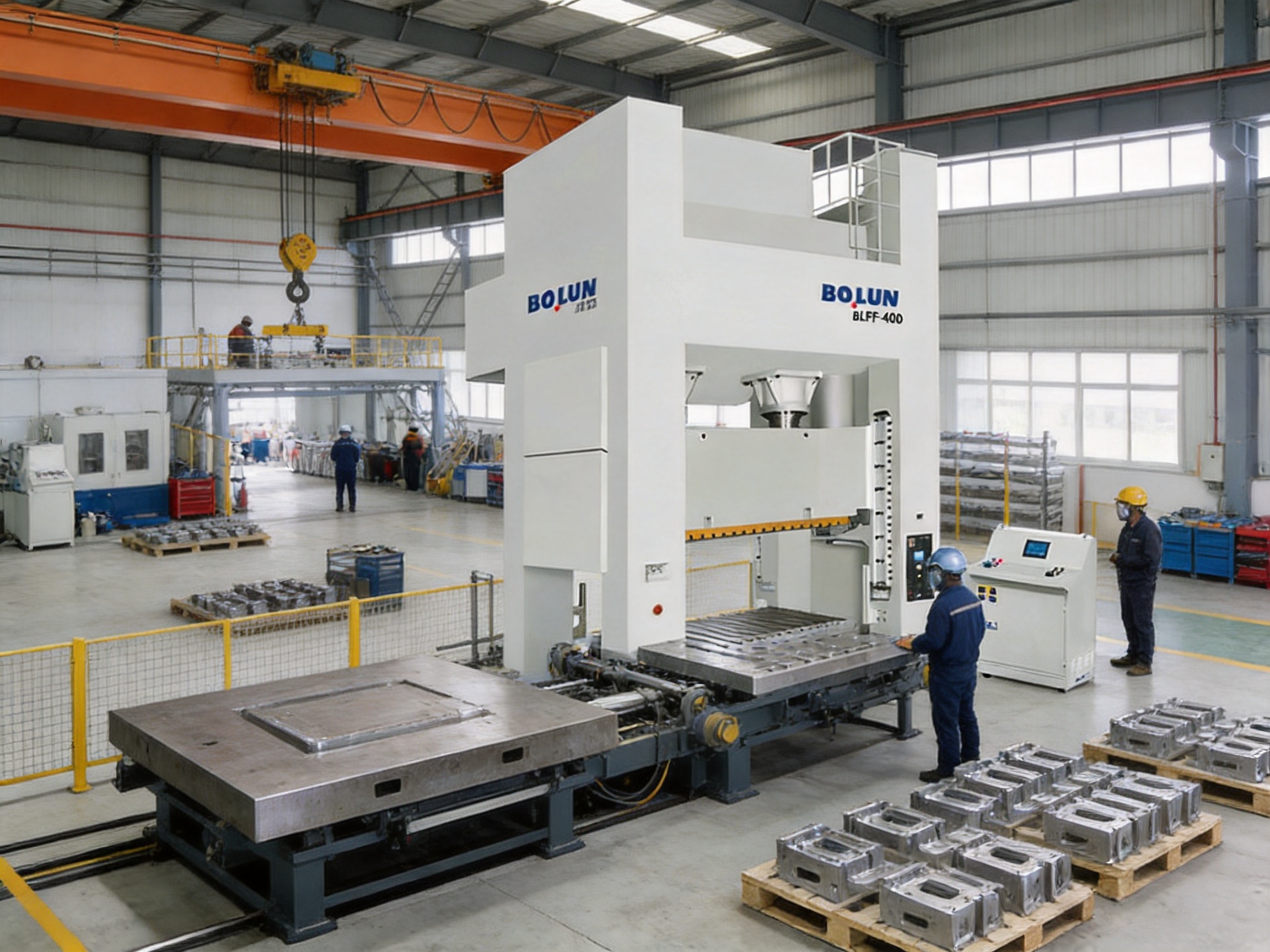
The BLPF-400 Precision-Stable Closed-Type Double-Point Eccentric Gear Power Press is a heavy-tonnage mechanical press designed for demanding stamping, forming, and production applications. With a nominal capacity of 4,000 kN, a large 2,800 × 1,100 mm worktable, and a rigid closed-type double-point structure, it provides the working strength, dimensional stability, and production flexibility required for medium-to-large metal components.
Developed for manufacturers that need dependable performance under high forming loads, the BLPF-400 combines an eccentric gear drive system, a high-rigidity frame, a sensitive dry clutch brake, hydraulic overload protection, and a production-oriented slide arrangement. These features make it suitable for automotive components, hardware products, structural metal parts, appliance components, and other precision-formed products.
Unlike a basic single-point press, the double-point configuration distributes the forming force across two drive points. This helps reduce slide tilting, improves die alignment, and supports the use of wider dies. The closed frame further increases structural stiffness compared with open-frame equipment, helping the press maintain accuracy when the workpiece and tooling require substantial forming force.
The BLPF-400 is the entry model in a larger heavy-tonnage series that also includes BLPF-500, BLPF-630, BLPF-800, BLPF-1000, and BLPF-1250 configurations. This series approach allows manufacturers to select a suitable capacity while maintaining a consistent equipment concept, manufacturing philosophy, and operating structure.
Heavy-duty stamping is not determined by nominal capacity alone. A press must also maintain frame rigidity, guide accuracy, transmission balance, slide stability, and safe overload behavior throughout the production cycle. The BLPF-400 is designed around these requirements rather than treating tonnage as the only performance indicator.
Its 4,000 kN nominal capacity provides considerable forming force for medium-to-large workpieces. The machine can be used for operations such as blanking, bending, shallow drawing, forming, embossing, and progressive or transfer-related processes, depending on the selected die and production configuration.
The rated nominal pressure is reached at a defined point in the slide stroke. For the BLPF-400, the nominal pressure stroke is 9 mm. This specification is important because mechanical presses deliver their maximum rated force near the bottom of the stroke rather than uniformly across the entire slide movement. Correct die design and process planning must therefore account for the force curve and the actual forming position.
The slide stroke is 300 mm, providing a substantial working movement for large dies and formed parts. A 300 mm stroke can support a wide range of applications while allowing sufficient vertical clearance for component removal, material feeding, and tooling access.
The available speed range is 15 to 30 strokes per minute. This adjustable range enables users to balance productivity with forming requirements, material behavior, tooling life, and operator or automation conditions. Lower speeds may be selected for difficult forming operations or large workpieces, while higher speeds can be used for suitable blanking and repetitive stamping processes.
Heavy-tonnage production also benefits from controlled operating speed because it allows manufacturers to manage impact, noise, heat generation, and die stress. A suitable speed setting can contribute to more consistent parts and longer tooling service life.
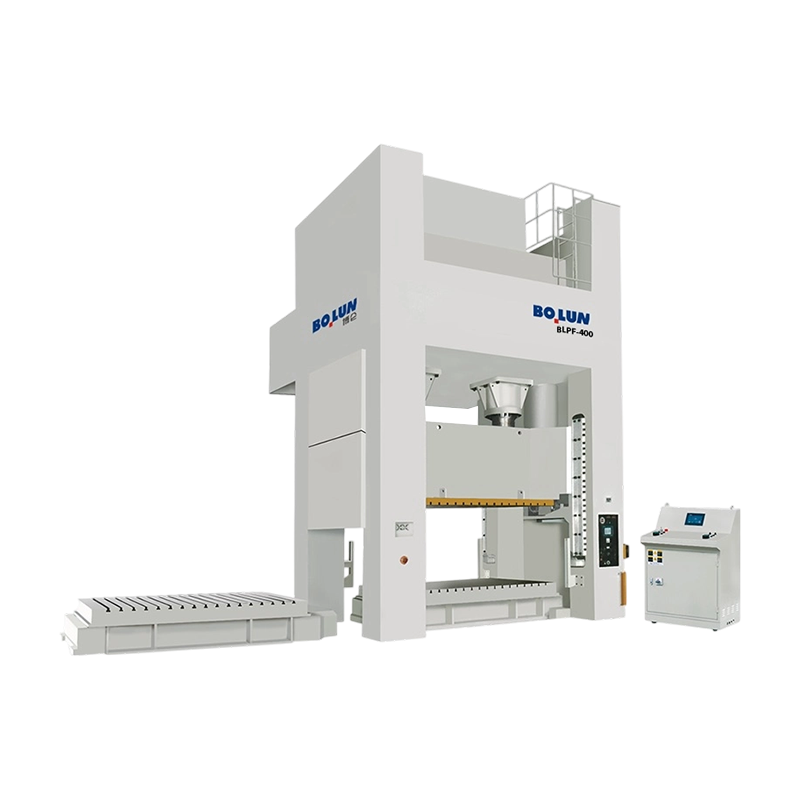
BLPF-400 Precision-Stable Closed-Type Double-Point eccentric gear Power Press
The closed-type frame is one of the defining features of the BLPF-400. In a closed press structure, the frame surrounds the working area and forms a continuous load path between the upper and lower sections of the machine. This arrangement is generally more resistant to deformation than an open-side structure when high forming forces are applied.
Frame stiffness is particularly important in large-die applications. If the frame or slide deforms excessively, the actual clearance between the die components can vary across the working area. This may result in uneven material flow, inconsistent part dimensions, premature die wear, burr variation, or damage to the tooling. A rigid closed structure helps minimize these risks.
The double-point design uses two separated drive and connection points between the transmission system and the slide. Compared with a single-point arrangement, this configuration is better suited to wide dies and broad workpieces. The two-point layout helps distribute force across the slide and reduces the tendency of the slide to rotate or tilt under eccentric loading.
Slide stability is especially valuable when the forming load is not perfectly centered. Large components often have uneven shapes, offset forming areas, or multiple operations taking place at different locations. A double-point press can provide better support for these conditions when the die, material flow, and load distribution are correctly engineered.
The double-point structure also offers practical benefits for tooling. Wider dies can be accommodated more effectively, and the alignment between upper and lower die sections can remain more consistent during repeated cycles. This can help manufacturers improve part repeatability and reduce the frequency of manual die correction.
Compared with smaller open-type presses, the BLPF-400 is therefore positioned for applications that demand greater working width, higher load capacity, improved resistance to deflection, and more stable long-term production.
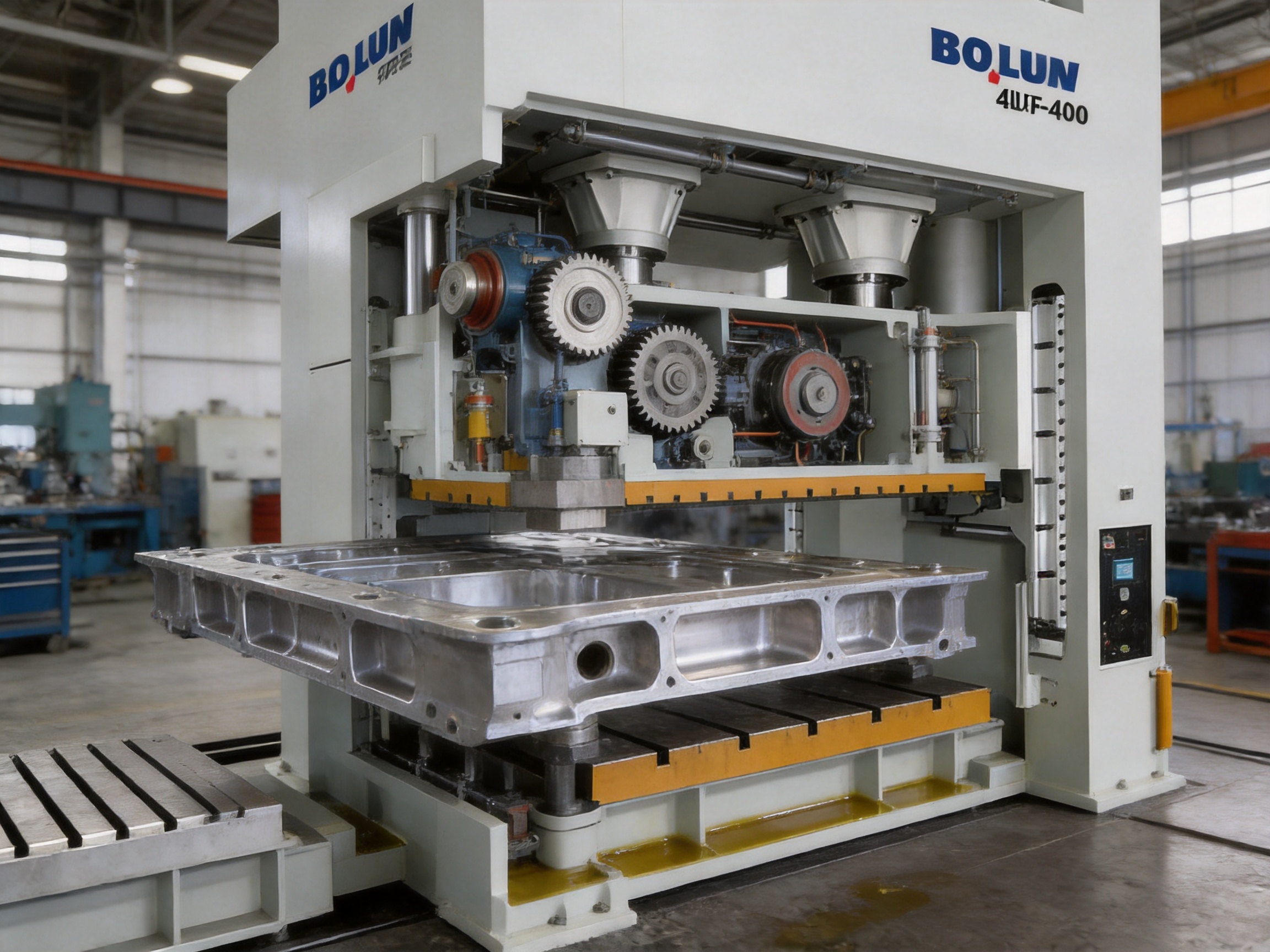
The BLPF-400 uses an eccentric gear drive system. This drive arrangement is intended to provide the torque required for heavy forming operations while maintaining controlled slide movement through the working cycle.
High torque is important when processing thick sheet, high-strength steel, structural components, or other materials that require substantial forming force. The transmission system must transfer power efficiently from the main motor to the slide without excessive vibration, shock, or loss of motion control.
The eccentric gear mechanism also contributes to the characteristic motion of a mechanical power press. The slide moves through a defined stroke profile, allowing the die to approach the workpiece, complete the forming action, and return for the next cycle. The motion profile can support efficient production while preserving the mechanical advantage needed near the bottom of the stroke.
Uniform movement is valuable for both tooling and parts. Irregular motion can increase impact loads, accelerate wear, and create inconsistent material flow. A stable drive system helps the operator maintain predictable process conditions across repeated cycles.
The transmission design also supports the machine’s suitability for large and complex stamping work. High-torque mechanical drives can provide the energy and force response needed for operations in which the material must be displaced, compressed, bent, or drawn within a large die set.
To obtain the best results, users should match die design, material thickness, blank shape, lubrication, press speed, and forming sequence to the capacity of the machine. The presence of a strong transmission system does not eliminate the need for correct process engineering; instead, it provides a robust foundation for well-designed production processes.
The BLPF-400 is specified with a press structure precision corresponding to GB and JIS Class 1 requirements. Precision classification is significant because heavy presses must retain acceptable accuracy despite repeated high-load operation.
Precision is influenced by multiple factors, including the frame, slide guides, worktable, connecting mechanisms, die height adjustment, foundation, installation quality, lubrication, and maintenance. A high-rigidity frame helps create a stable base, but the complete production system must also be managed correctly.
For manufacturers, stable press accuracy can reduce the need for frequent adjustments. It may also improve the consistency of hole locations, formed profiles, flange dimensions, bend angles, and other critical characteristics. In automotive and hardware production, these improvements can reduce rework and help maintain compatibility between components.
The large worktable measures 2,800 × 1,100 mm on the BLPF-400. This provides a broad working surface for large dies and gives tooling designers greater freedom when arranging forming stations, guide elements, material supports, and ejector systems.
The slide bottom size is 2,500 × 1,100 mm. The relationship between the worktable and slide dimensions should be considered when selecting a die. The tooling must remain within the allowable working envelope and must be adequately supported across its contact areas.
The distance between columns is 3,250 mm. This wide opening helps support the processing of large components and provides more usable space for die installation and material handling. It can also improve access during tooling setup, inspection, cleaning, and maintenance.
The working face height is 750 mm. This height can help integrate the press into a production line while allowing practical access for die servicing and workpiece handling. Final installation planning should still consider foundation design, automation height, operator access, guarding, and local workplace requirements.
The following table summarizes the principal specifications of the BLPF-400. The same table also shows the capacity range of the related heavy-tonnage series, allowing users to compare the BLPF-400 with larger models when planning future production requirements.
| Specification | Unit | BLPF-400 | BLPF-500 | BLPF-630 | BLPF-800 | BLPF-1000 | BLPF-1250 |
|---|---|---|---|---|---|---|---|
| Nominal Capacity | kN | 4000 | 5000 | 6300 | 8000 | 10000 | 12500 |
| Nominal Pressure Stroke | mm | 9 | 10 | 10 | 10 | 13 | 13 |
| Slide Stroke | mm | 300 | 300 | 400 | 400 | 400 | 400 |
| Strokes per Minute | S.P.M. | 15–30 | 15–30 | 15–25 | 15–25 | 12–20 | 12–20 |
| Maximum Die Height | mm | 650 | 750 | 800 | 850 | 900 | 900 |
| Die Height Adjustment | mm | 250 | 300 | 300 | 300 | 300 | 300 |
| Worktable Size | mm | 2800 × 1100 | 3300 × 1300 | 3300 × 1300 | 3600 × 1400 | 3800 × 1500 | 4000 × 1600 |
| Slide Bottom Size | mm | 2500 × 1100 | 3100 × 1300 | 3100 × 1400 | 3300 × 1400 | 3500 × 1500 | 3700 × 1600 |
| Height of Working Face | mm | 750 | 750 | 750 | 850 | 850 | 850 |
| Distance Between Columns | mm | 3250 | 3750 | 3750 | 4050 | 4250 | 4450 |
| Main Motor | kW × poles | 37 × 4 | 45 × 4 | 55 × 4 | 75 × 4 | 90 × 4 | 110 × 4 |
| Air Pressure | MPa | 0.55 | 0.55 | 0.55 | 0.55 | 0.55 | 0.55 |
| Cushion Capacity | kN | 500 | 500 | 800 | 1200 | 1200 | 1200 |
| Cushion Working Stroke | mm | 120 | 120 | 140 | 140 | 180 | 180 |
The maximum die height of the BLPF-400 is 650 mm, with a die height adjustment range of 250 mm. These dimensions allow the press to accommodate a variety of die constructions and product geometries.
Die height flexibility is important for manufacturers that operate multiple tools on the same press. Different products may require different die stacks, guide systems, lifters, material supports, and forming inserts. A suitable adjustment range makes it easier to configure the press for different jobs without requiring extensive mechanical modification.
Accurate die height adjustment also supports repeatable setup. When a tool is removed and later reinstalled, controlled adjustment can help production personnel return the press to a known working condition. This can reduce setup time and improve consistency between production batches.
Tool compatibility must be verified before installation. Users should confirm die weight, shut height, bolster and slide dimensions, clamping arrangements, feed direction, center of pressure, allowable eccentric load, and the required cushion configuration. These checks are essential for safety and for protecting both the press and the tooling.
For large progressive or compound dies, the worktable and slide dimensions provide a foundation for broad tool layouts. For deep forming or complex assemblies, the available die height and slide stroke should be assessed together with the required material travel and clearance.
The BLPF-400 is specified with a cushion capacity of 500 kN and a cushion working stroke of 120 mm. A cushion system can assist with drawing, reverse forming, blank holding, part ejection, and controlled support beneath the workpiece.
During drawing operations, the cushion can help regulate material flow. Proper control of the blank holder force can reduce wrinkling while avoiding excessive restriction that could cause tearing. The correct setting depends on material grade, thickness, blank shape, lubrication, die radius, drawing ratio, and process sequence.
A cushion can also improve part removal after forming. Controlled upward movement from beneath the workpiece may help release the component from the die and prepare it for transfer or manual handling. This is valuable in large dies where direct access to the formed part may be limited.
The 500 kN cushion capacity gives the BLPF-400 useful support for medium-to-large forming operations. However, the actual required capacity should be calculated for each die. The press, cushion, die, and workpiece must operate as a coordinated system.
Cushion performance also depends on pressure stability, response time, sealing condition, calibration, and maintenance. Regular inspection of the cushion circuit and related components is necessary to maintain consistent forming results.
The BLPF-400 uses a highly sensitive dry clutch brake. In a mechanical press, the clutch and brake system controls the connection between the drive motor and the slide mechanism as well as the stopping action of the slide.
A responsive clutch brake supports controlled starting, stopping, inching, and single-cycle operation. This is important during die setup, trial production, troubleshooting, and normal operation. The system should allow authorized operators to control the machine safely and predictably.
Brake response is also important because the slide must stop within the required operating conditions when the control system receives a stop signal. Actual stopping performance depends on the machine configuration, maintenance condition, operating speed, control system, and applicable safety standards.
Dry clutch brake systems require appropriate inspection and adjustment. Friction surfaces, air pressure, seals, control valves, and timing should be checked according to the manufacturer’s maintenance instructions. Contamination, excessive wear, incorrect pressure, or delayed servicing can affect response and shorten component life.
When integrated with suitable guarding, emergency stops, two-hand controls, presence-sensing devices, and safety interlocks, the clutch brake provides an important part of the press operating system. Safety equipment must be selected and validated for the specific installation and local regulations.
Heavy forming tools can experience overload because of incorrect material placement, excessive blank thickness, die malfunction, foreign objects, misalignment, or a process condition outside the original design. The BLPF-400 includes a hydraulic overload protector to help protect the press from damaging overload events.
The overload protector is intended to respond when the forming force exceeds the permitted condition. By relieving or managing excessive pressure, it can reduce the risk of damage to the frame, slide, drive system, die, and connecting components.
Hydraulic overload protection is particularly valuable in automated production, where a small material-feed error can otherwise create a large mechanical impact. It can also provide additional protection during die tryout and the initial commissioning of a new tool.
Overload protection is not a replacement for correct capacity selection. The press must still be chosen according to the calculated forming force, tonnage distribution, energy requirement, eccentric loading, and production speed. Operators should never intentionally use the protector as a routine method of running beyond the press rating.
Maintenance personnel should monitor hydraulic pressure, seals, valves, hoses, response behavior, and reset performance. Any repeated overload event should be investigated to identify the cause rather than simply resetting the system and continuing production.
The performance of a large power press depends on manufacturing quality as much as on its published specifications. The manufacturer behind the BLPF series operates an integrated structure covering research and development, engineering design, production, sales, and service.
This integrated approach supports better coordination between product design and manufacturing. It allows engineering teams to consider production capability, machining access, assembly requirements, inspection methods, and serviceability during the design stage.
The company maintains a production system that includes basic design, core component development, precision processing, and final machine assembly. For a high-tonnage press, this full-chain capability can be valuable because the frame, transmission, slide, guides, cushion, clutch brake, hydraulic protection system, and electrical controls must work together as one machine.
Precision processing equipment and an established industrial environment provide the foundation for producing large structural components. Large frames and worktables require controlled machining, accurate reference surfaces, and careful assembly. Errors in one stage can influence alignment, guide behavior, die setup, and long-term stability.
Manufacturing experience accumulated over approximately two decades supports the development of forming equipment for industrial users. Experience is particularly important for heavy machinery because many performance factors are learned through repeated design verification, assembly refinement, field feedback, and service support.
The company also emphasizes non-standard customization. This capability can help users whose production requirements do not match a standard catalog configuration. Possible areas for engineering discussion may include worktable dimensions, automation interfaces, cushion arrangements, electrical control requirements, die handling, feeding direction, safety systems, and special forming functions.
Customization should be based on a documented technical specification. Before ordering, users should provide information about material type, thickness, blank dimensions, component size, required force, production speed, die details, automation method, factory utilities, environmental conditions, and applicable compliance requirements.
Quality control for a large press should cover more than visual inspection. Structural accuracy, machining quality, assembly alignment, hydraulic performance, clutch brake response, electrical function, and operating stability all affect the final result.
The manufacturer describes a finished-product inspection system intended to exceed ordinary industry requirements. A comprehensive inspection approach can include checks on major components, dimensional relationships, pressure systems, lubrication, movement, safety functions, and trial operation.
Frame and worktable inspection are important because these components establish the geometry of the working area. Machined surfaces must provide a reliable foundation for die installation and alignment. The slide and guide system must also operate smoothly through the complete stroke.
Transmission inspection is necessary to verify that gears, eccentric mechanisms, shafts, bearings, and connecting components operate correctly under load. Unusual vibration, noise, temperature rise, or backlash may indicate an assembly or lubrication issue that should be corrected before shipment.
Hydraulic and pneumatic systems require pressure and leakage checks. The specified working air pressure for the BLPF-400 is 0.55 MPa. The customer’s plant must provide an appropriate and stable air supply, with suitable filtration and drainage where required.
Final machine testing should confirm slide movement, speed range, stop function, die height adjustment, cushion operation, overload protection, lubrication, control logic, and emergency functions. Documentation of testing can help the customer establish a baseline for commissioning and future maintenance.
A disciplined quality system also supports traceability. Records for key components, inspection results, assembly stages, and final tests can make it easier to investigate issues and provide technical assistance after installation.
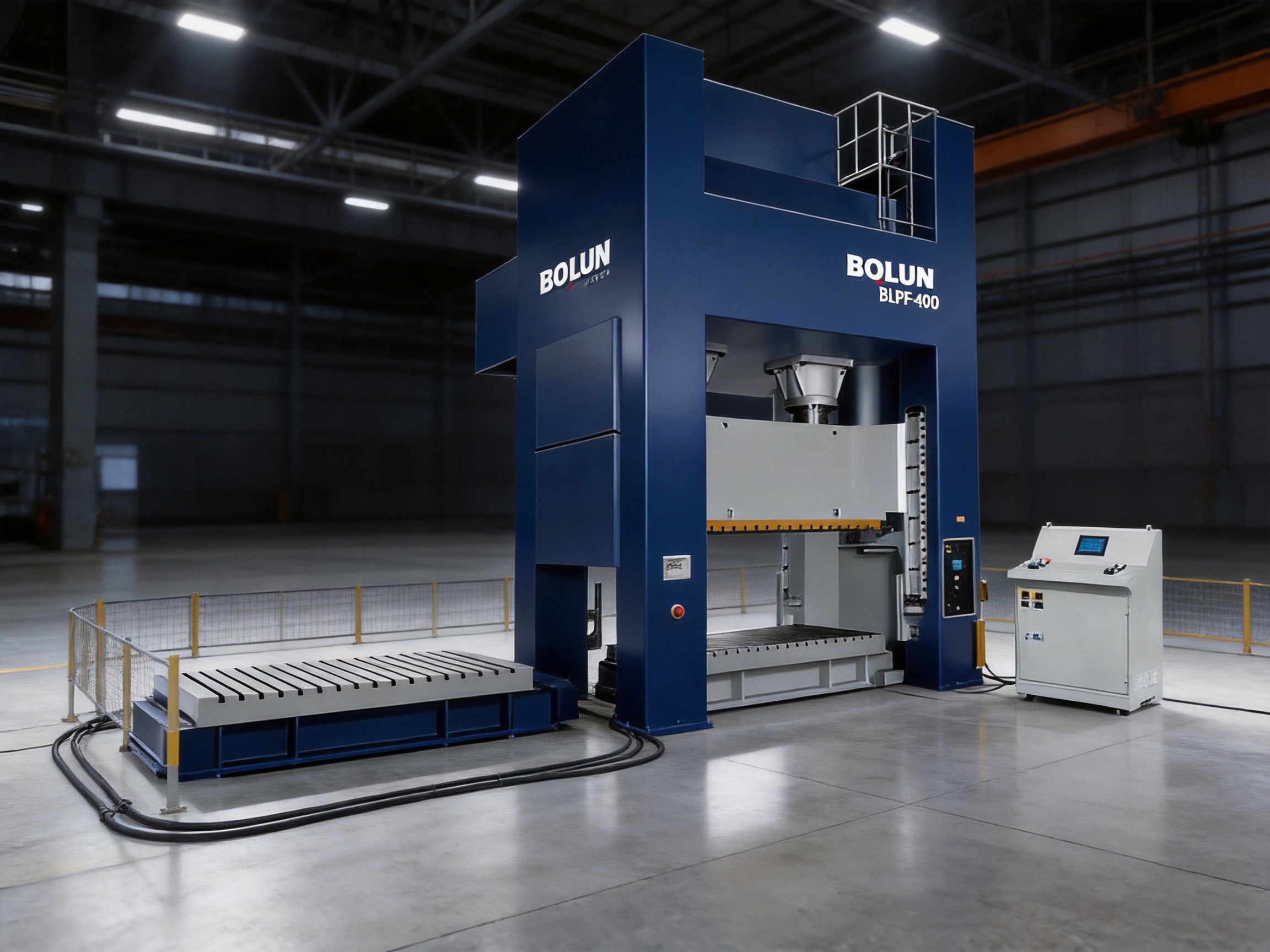
When compared with conventional open-type or single-point presses in the same general application area, the BLPF-400 offers several structural advantages.
The closed frame provides a more enclosed and rigid load path. This can help reduce deflection during high-load operations, particularly when the die is wide or the workpiece requires substantial forming force.
The double-point slide arrangement is well suited to broad tooling. It helps distribute the drive force across two points and can reduce slide twisting compared with a single-point arrangement.
The combination of a 4,000 kN capacity, large worktable, wide column spacing, and substantial slide stroke supports the production of larger components than many general-purpose presses.
The hydraulic overload protector adds a layer of protection for the press and die. This is particularly useful in automated lines and during the commissioning of new tooling.
The 15–30 strokes-per-minute range enables users to select a suitable speed for the process. This flexibility can help balance output, forming quality, material behavior, tooling life, and operating conditions.
The 500 kN cushion and 120 mm working stroke support forming processes that require controlled force beneath the workpiece. This extends the machine’s usefulness beyond simple blanking.
These advantages should be evaluated together with total cost of ownership, installation requirements, die compatibility, service availability, energy consumption, operator training, and compliance. No press is appropriate for every application, and the final selection should be based on engineering calculations and production trials.
The BLPF-400 is suitable for industrial applications in which large, accurately formed metal parts are produced repeatedly.
In automotive manufacturing, potential applications include structural brackets, reinforcement members, body-related components, chassis parts, suspension-related components, and other stamped products that require broad dies and stable forming conditions. The precise application depends on material grade, thickness, part geometry, and die design.
In the hardware sector, the machine may be used for large brackets, frames, support plates, equipment housings, formed panels, and industrial fittings. The high capacity allows manufacturers to process heavier materials or larger parts than would be practical on a smaller press.
Appliance and electrical equipment manufacturers may use a machine of this class for cabinets, structural panels, mounting parts, reinforcement pieces, and other sheet-metal components. The broad table can support dies with multiple forming or piercing stations.
General engineering manufacturers can also benefit from a heavy press when product demand changes frequently. The adjustable die height and speed range support different tooling requirements, while the double-point layout can provide a more consistent working platform for large dies.
Before confirming an application, engineers should calculate the required tonnage, energy, stroke, speed, cushion force, die height, and load distribution. The maximum nominal capacity should not be treated as the recommended force for every operation. A suitable safety margin is necessary.
A 4,000 kN press requires careful preparation before delivery and installation. The factory floor must support the machine’s weight and dynamic loads, and the foundation must be designed according to the approved installation documents.
Important preparations include access for transportation, lifting equipment, foundation dimensions, anchor arrangements, electrical power, compressed air, ventilation, lighting, drainage, safety guarding, and material-handling space.
The 0.55 MPa air pressure specification should be reviewed alongside actual plant conditions. The air supply must provide sufficient flow and stability for the clutch brake and related pneumatic functions. Water, oil, dust, and pressure fluctuations should be controlled through appropriate plant air treatment.
After installation, the press should be leveled and aligned according to the manufacturer’s procedures. Lubrication systems, hydraulic circuits, pneumatic circuits, electrical controls, and safety devices should be checked before the first production cycle.
Commissioning should begin with no-load movement, followed by controlled testing with tooling. The die should be installed using approved lifting and clamping methods. Operators should verify slide movement, stopping behavior, die height, cushion operation, material feeding, and overload protection before increasing production speed.
Training should cover startup and shutdown, single-cycle and continuous operation, emergency stopping, die setup, lubrication, inspection, basic troubleshooting, and prohibited operating conditions. Only trained and authorized personnel should operate or maintain the machine.
Preventive maintenance is essential for preserving press precision and availability. A maintenance program should be based on operating hours, stroke count, load conditions, environmental conditions, and the manufacturer’s recommendations.
Daily checks may include lubrication level, air pressure, hydraulic condition, unusual sound, vibration, oil leakage, brake response, emergency stops, and visible damage. Operators should report abnormalities immediately rather than continuing operation until a failure occurs.
Periodic inspections should cover gear condition, bearings, connecting components, slide guides, die height adjustment, cushion components, hydraulic overload protection, clutch brake surfaces, pneumatic valves, electrical cabinets, sensors, and safety devices.
Lubrication is especially important for gears, bearings, guides, and other moving components. The correct lubricant, quantity, cleanliness, and interval should be followed. Over-lubrication can be as undesirable as insufficient lubrication because it may cause heat, leakage, contamination, or seal problems.
Press accuracy should be checked at planned intervals and after major repairs, collisions, overload events, or foundation changes. Measuring slide parallelism, table condition, guide clearance, and other relevant parameters can help identify deterioration before it affects product quality.
Tooling maintenance should be coordinated with press maintenance. A damaged die, uneven die height, blocked lubrication passage, or worn guide component can create loading conditions that affect the press. Good die maintenance therefore contributes to machine reliability.
Industrial press buyers often require more than a standard machine. Production lines may include decoilers, straighteners, feeders, transfer systems, robots, die carts, scrap conveyors, sensors, and factory information systems. The press must be coordinated with these elements.
The manufacturer’s design and engineering capabilities support discussion of special specifications and functions. Custom engineering may address the working area, control logic, automation communication, safety architecture, cushion requirements, material handling, and production monitoring.
Pre-sales support should begin with application analysis. The customer can provide drawings, material information, production targets, die data, and line layout details. Engineers can then assess whether the BLPF-400 is suitable or whether a larger model in the series would be more appropriate.
During production and delivery, technical coordination helps confirm interfaces and installation requirements. After installation, commissioning assistance and operator training can support the transition from delivery to stable production.
After-sales service is also important for a large machine because downtime can affect an entire manufacturing line. A customer-oriented service structure should include troubleshooting support, maintenance guidance, spare-parts coordination, inspection advice, and assistance with future upgrades.
The BLPF-400 is a strong candidate when the application requires approximately 4,000 kN nominal capacity, a large closed working area, double-point support, and controlled forming performance. It is particularly appropriate when a smaller open press would lack rigidity, table space, or load capacity.
Buyers should begin by identifying the largest and most demanding product planned for the machine. The required force should be calculated using material properties, thickness, shear length, bending geometry, drawing conditions, and forming stages. The selected capacity should include a suitable engineering margin.
The die envelope should then be compared with the 2,800 × 1,100 mm worktable, 2,500 × 1,100 mm slide bottom, 650 mm maximum die height, and 250 mm adjustment range. Column spacing, feeding direction, transfer access, and maintenance clearance should also be reviewed.
For forming work, the 500 kN cushion capacity and 120 mm cushion stroke must be compared with the required blank-holder or ejection force. If the process requires a greater cushion capacity or different motion profile, the customer should discuss a suitable configuration before ordering.
Production speed should be evaluated against part quality and tooling requirements. Although the machine provides 15–30 strokes per minute, the best operating speed may be lower for deep forming, high-strength materials, large dies, or complex automated handling.
Finally, the buyer should review installation, safety, maintenance, training, spare parts, service response, and total ownership cost. A press is a long-term production asset, so purchasing decisions should consider reliability and support as well as initial price.
The nominal capacity is 4,000 kN. This rating identifies the press’s rated forming force at the specified nominal pressure stroke. Actual process requirements must be calculated for each die and material.
Double-point means that the slide is driven and supported through two separated connection points. This helps distribute force across the slide, reduce tilting, and support wider dies more effectively than many single-point arrangements.
A closed-type frame provides a continuous and rigid load path around the working area. It is designed to resist deformation under high forming loads and can contribute to better die alignment and dimensional consistency.
The BLPF-400 worktable measures 2,800 × 1,100 mm. The slide bottom measures 2,500 × 1,100 mm. Die dimensions, clamping, load distribution, and maintenance clearances should be confirmed before installation.
The specified operating range is 15–30 strokes per minute. The appropriate speed depends on the material, die, forming operation, automation system, product quality requirements, and tooling life.
The press includes a 500 kN cushion with a 120 mm working stroke, which can support suitable drawing and forming operations. The actual suitability depends on the required blank-holder force, drawing ratio, material, die design, and process calculation.
The machine includes a sensitive dry clutch brake and a hydraulic overload protector. The complete installation should also include suitable guarding, emergency stops, control safety functions, die protection, and other devices required by the application and local regulations.
The specified air pressure is 0.55 MPa. The customer should provide clean, stable compressed air with suitable treatment and sufficient flow for the machine’s pneumatic functions.
Special specifications and functions can be discussed through the manufacturer’s engineering and non-standard customization capabilities. Customization should be based on complete information about the product, die, material, production line, utilities, safety requirements, and factory conditions.
The BLPF-400 provides higher capacity, a closed rigid frame, double-point support, a larger working area, and better suitability for wide and heavy dies. A smaller open-type press may be more economical for light work, but it may not provide the same structural stability or working envelope.
Maintenance should include regular lubrication, inspection of the clutch brake, checking of hydraulic and pneumatic systems, verification of overload protection, examination of guides and gears, inspection of safety devices, and periodic accuracy checks. Maintenance intervals should follow the technical documentation and operating conditions.
The BLPF-400 Precision-Stable Closed-Type Double-Point Eccentric Gear Power Press is engineered for manufacturers that require substantial forming force, large-die capability, and stable production performance. Its 4,000 kN nominal capacity, 300 mm slide stroke, 2,800 × 1,100 mm worktable, 15–30 strokes-per-minute range, and 500 kN cushion provide a versatile foundation for demanding metal-forming applications.
The combination of a closed high-rigidity frame and double-point eccentric gear drive distinguishes the machine from more basic press configurations. These features help support wide dies, reduce slide tilting, maintain load stability, and improve the repeatability of complex stamping and forming work.
The sensitive dry clutch brake contributes to controlled operation, while the hydraulic overload protector adds protection against unexpected forming conditions. Die height adjustment, a substantial working stroke, and an integrated cushion expand the press’s usefulness across automotive, hardware, appliance, and general industrial production.
Its value is further supported by an integrated manufacturing organization with capabilities in research and development, design, precision processing, assembly, inspection, customization, and service. This combination of product engineering and manufacturing control is important for a heavy machine tool intended to operate under high loads for many years.
For customers comparing power presses, the BLPF-400 should be evaluated not only by nominal tonnage but also by frame structure, slide support, table dimensions, precision, overload protection, cushion capability, maintenance planning, customization, and service. When correctly matched with the die, material, production line, and installation environment, it can provide a dependable platform for precision-stable heavy-duty forming.
1. Product technical data for the BLPF heavy-tonnage closed-type double-point eccentric gear power press series.
2. Manufacturer-provided company information covering research and development, precision processing, production management, inspection, customization, and customer service.
3. General principles of mechanical power press design, including frame rigidity, slide guidance, crank and eccentric transmission, clutch-brake operation, and overload protection.
4. General engineering practices for stamping die selection, press capacity calculation, die height verification, cushion-force planning, and metal-forming process development.
5. General industrial guidance for power press installation, machine guarding, operator training, preventive maintenance, and production-line safety.


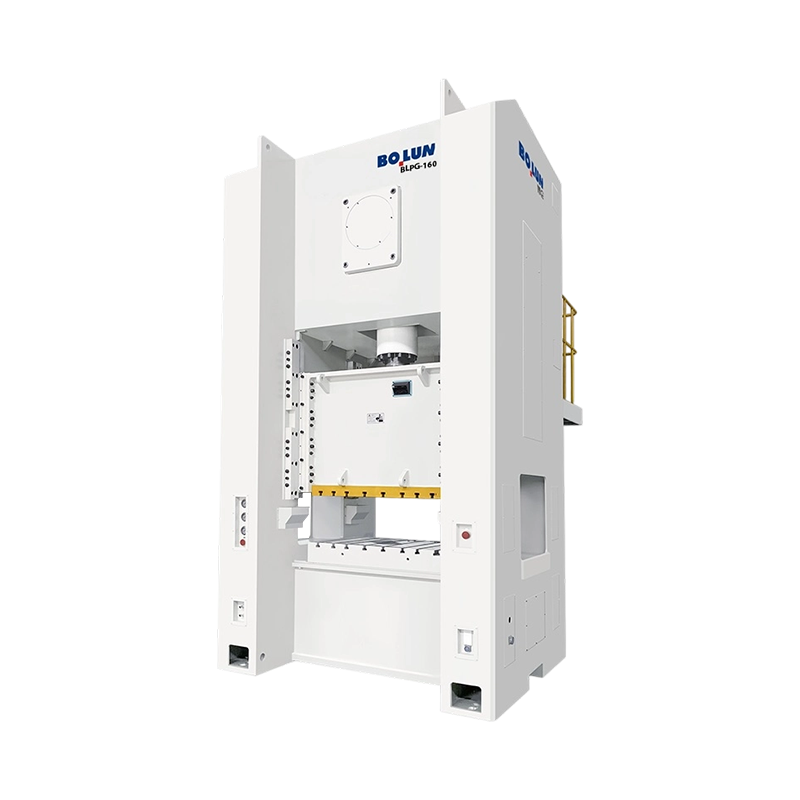
Two presses can both carry a 200-tonne nameplate and still produce very differe...
What Is a Power Press? A power press — also called a stamping press or punch pr...
A buyer comparing a 45-ton open-gap press for a bracket line often receives two...
Start With the Purchase Decision, Not the Definitions A procurement engineer co...
A tooling engineer quotes a new bracket program and specifies a 160-ton press. ...
Power press machines are classified in two main ways: by frame construction, w...
Contact Us

topbolun@gmail.com

+86-575-83362228

+86-13735238388
+86-18667502750

+86-575-83362999

+8618667502750

No.1 Linjiang Road East, Xiaren, Jinting Town, Shengzhou City, Zhejiang Province, China
Ready to Begin?
Get in Touch

Now!

ZHEJIANG BOLUN
 English
 中文简体