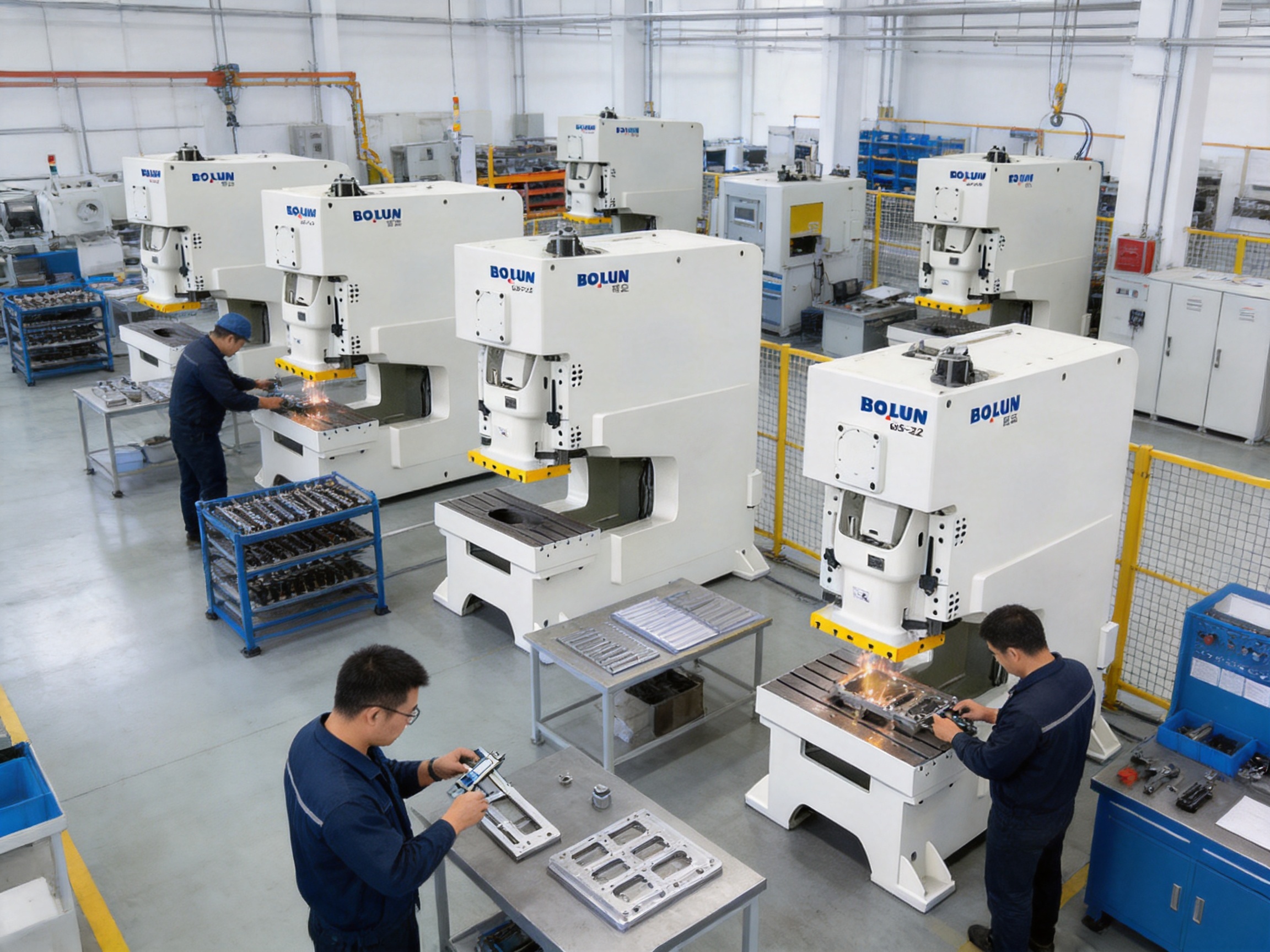
Modern sheet metal manufacturers are under constant pressure to produce more parts in less floor space while maintaining dimensional accuracy, reliable cycle times, and controlled operating costs. The BLPS-25 Compact Precision Open-Gap Deep-Throat Power Press is designed for this exact production environment. It combines a 250 kN nominal capacity with an unusually extended throat-depth range of 500 mm to 1200 mm, allowing manufacturers to process wide workpieces that may be difficult to handle on conventional compact presses.
The machine is intended for stamping applications involving hardware components, electronic parts, fittings, brackets, covers, terminals, and other formed sheet metal products. Its open-gap configuration provides improved access to the die area, while the deep-throat structure increases the usable working envelope without requiring a full-size, high-capacity press. This combination gives the machine a practical advantage for manufacturers that need reach and accessibility but cannot justify the footprint or energy demand of a much larger machine.
With a high-rigidity steel frame, a sensitive dry clutch-brake system, manual slide adjustment, a 2.2 kW main motor, and a maximum operating rate of up to 180 strokes per minute in the high-speed configuration, the BLPS-25 is positioned as a flexible production tool rather than a basic general-purpose punch press. It is compact in capacity and footprint, yet specialized in reach, precision, and production adaptability.
The primary value of the BLPS-25 comes from the way it balances four requirements that are often difficult to achieve in one machine: compact installation, extended throat depth, high-speed operation, and precision forming. Many compact presses are limited by a short throat depth, while many deep-throat machines occupy considerable floor space and require substantially higher investment. The BLPS-25 addresses this gap by providing a 500 mm to 1200 mm throat-depth range within an open-gap press platform.
The machine is particularly suitable for customers that stamp relatively wide parts but do not need the very high tonnage associated with heavy plate forming. Typical applications may include large or elongated sheet metal components, electrical cabinets and internal panels, electronic hardware, appliance fittings, lighting components, communication equipment parts, and general industrial brackets.
A nominal capacity of 250 kN provides useful forming force for many light- and medium-duty stamping operations. The actual suitability of the machine depends on material type, thickness, die design, forming depth, blank shape, and the position of the load within the stroke. As with any mechanical press, the required tonnage should be calculated from the complete stamping process rather than from material thickness alone.
The open-gap design also improves working access. Operators can approach the die area more easily from the front and sides, which can simplify die installation, inspection, adjustment, and part removal. This is especially valuable in short-run work, frequent tool changes, and production environments where operators handle a variety of component sizes.
Throat depth is one of the most important practical dimensions in a power press. It determines how far a workpiece can extend into the machine from the front working area. A press with insufficient throat depth may have enough tonnage but still be unable to reach the required punching or forming location.
The BLPS-25 is specified with a throat-depth range from 500 mm to 1200 mm. This is considerably more flexible than many conventional compact open presses, which are commonly optimized for smaller workpieces and shallow reach. The extended range enables the machine to support wide blanks, elongated panels, and components requiring operations positioned far from the front edge.
This design can reduce the need to reposition a workpiece during a stamping cycle. Fewer repositioning operations may contribute to better repeatability, lower handling time, and reduced risk of part damage. In appropriate applications, a single tooling arrangement can reach multiple areas of a large sheet component, improving process efficiency.
The deep-throat design also provides more freedom when developing progressive, compound, or single-operation dies. Tool designers can take advantage of the available working envelope to position features and guide material more effectively. This can be useful when a product contains multiple holes, louvers, slots, embossments, or other features distributed across a broad sheet area.
It is important to distinguish deep throat depth from overall press size. A long reach does not automatically mean that the machine has unlimited capacity over the entire work area. The load must remain within the machine’s rated operating conditions, and die design must account for force distribution, deflection, clearance, and workpiece support. Nevertheless, the BLPS-25 provides a valuable reach advantage for appropriately selected applications.
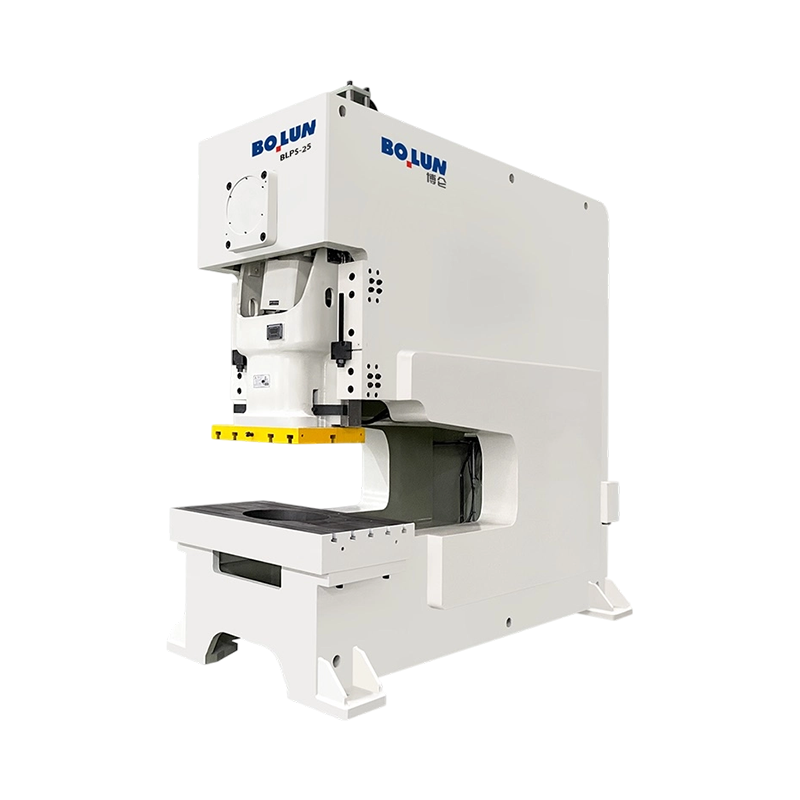
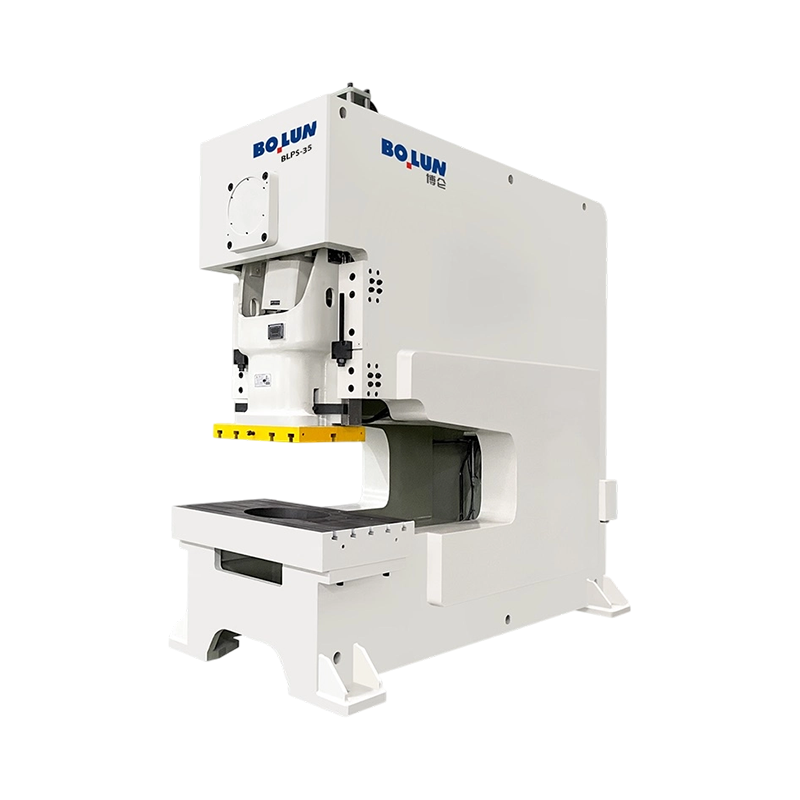
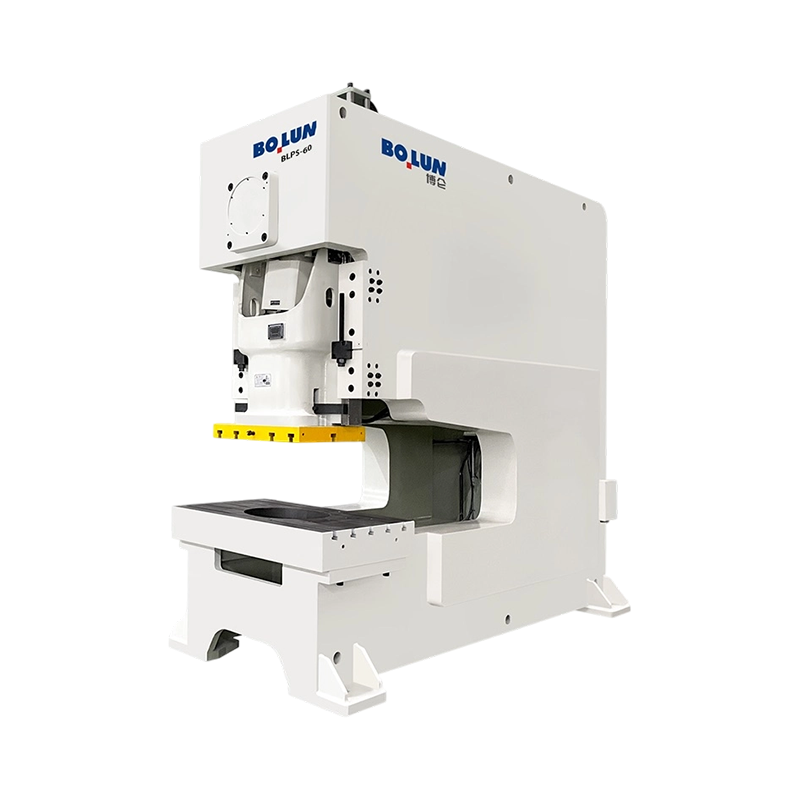
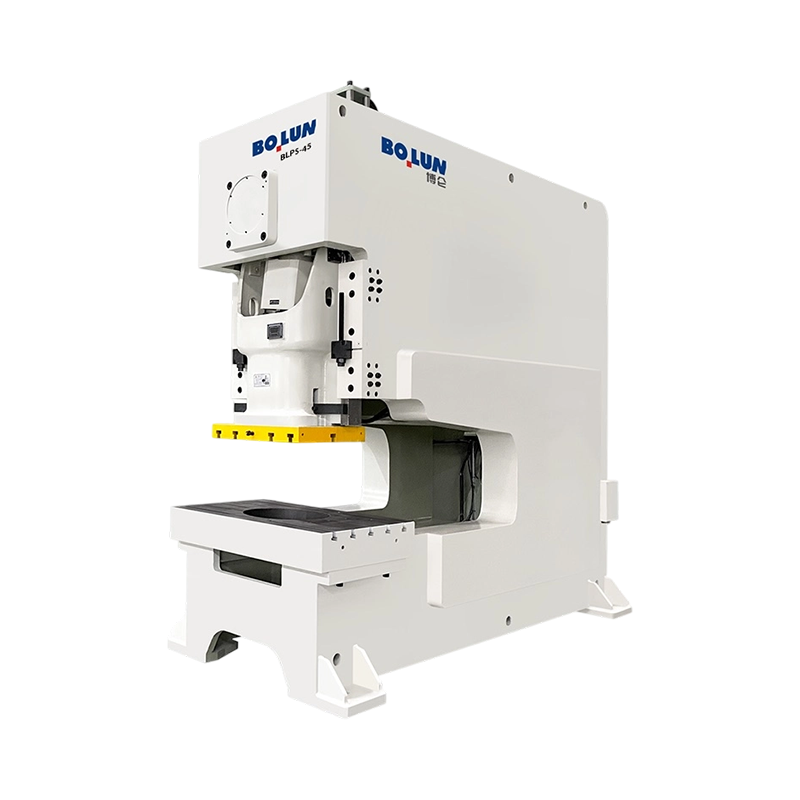
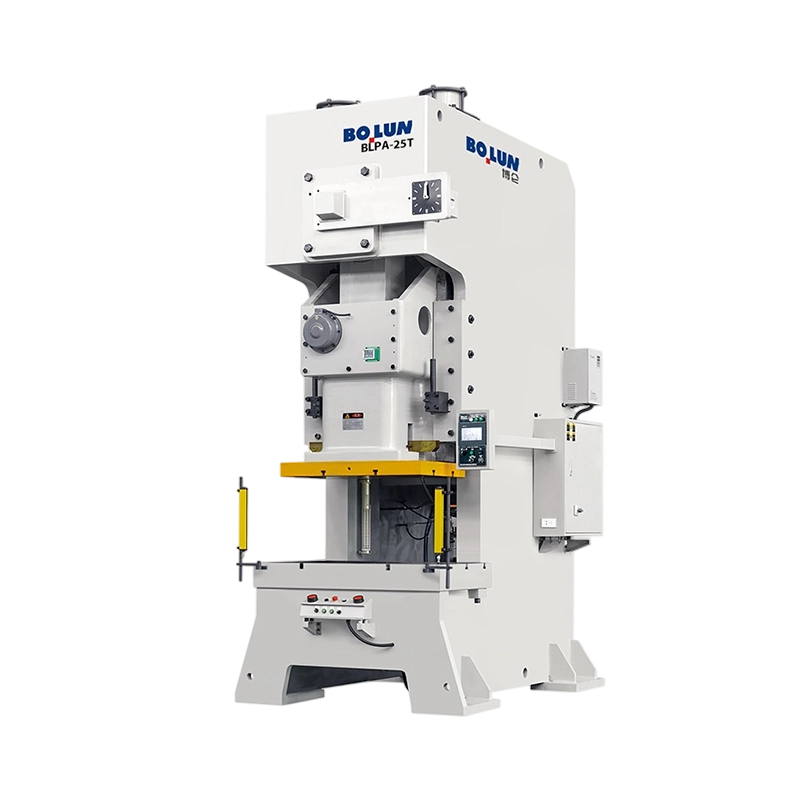
BLPS-25 Compact Precision Open-Gap Deep-Throat Power Press
Press-frame rigidity has a direct effect on stamping quality. When a frame deflects excessively under load, the upper and lower die surfaces may not remain properly aligned. Excessive deflection can contribute to uneven clearances, accelerated die wear, burr formation, dimensional variation, and inconsistent part quality.
The BLPS-25 uses a high-rigidity steel frame intended to maintain structural stability during repeated stamping cycles. A rigid frame helps transfer drive energy more efficiently from the crank mechanism to the slide and die. It also supports more consistent alignment between the slide, worktable, and installed tooling.
Structural stiffness is especially important for a deep-throat press. Because the machine reaches farther into the work area, the frame must manage the forces generated during off-center or distributed operations. The design objective is not merely to provide a long opening, but to preserve dependable mechanical behavior throughout the usable stamping zone.
For production managers, frame rigidity has benefits beyond immediate part accuracy. Stable operation can reduce the frequency of die correction, minimize unplanned adjustments, and extend the usable life of punches, dies, guide components, and other tooling elements. It may also support more predictable maintenance planning because the machine is less likely to develop quality problems caused by progressive structural movement.
The press frame is supported by the broader manufacturing system used by the producer. According to the supplied company information, the manufacturer maintains capabilities covering product research and development, design, production, sales, and service. Its manufacturing approach includes precision processing equipment, core component development, final assembly, and inspection. These capabilities are important when producing equipment where structural accuracy and assembly consistency influence long-term performance.
The BLPS-25 is described as capable of reaching up to 180 strokes per minute in high-speed operation. The model data lists BLPS-25 configurations with operating ranges of 70–110 strokes per minute for the V configuration and 95–180 strokes per minute for the H configuration. This gives users a choice between a longer-stroke configuration and a higher-speed configuration according to the requirements of the die and production process.
High-speed operation is valuable in applications involving repetitive piercing, blanking, shallow forming, and other operations where the die can safely operate at elevated cycle rates. A higher stroke rate can increase output without requiring a larger machine, provided that material feeding, part removal, lubrication, die strength, and operator safety systems are properly coordinated.
The maximum speed should not be interpreted as a universal operating recommendation for every die. Actual production speed depends on the stroke length, material properties, blank size, forming depth, tooling construction, feed arrangement, required accuracy, and machine operating mode. Deep drawing, significant bending, or complex transfer operations may require a lower speed than simple blanking or punching.
The availability of multiple operating ranges is useful because it allows manufacturers to match the machine to different production requirements. A high-speed configuration can be selected for repetitive electronic or hardware components, while a lower-speed or longer-stroke setting may be preferable for operations requiring additional forming travel.
Production speed is also affected by setup time and material handling. A fast press that requires frequent repositioning or lengthy die changes may not deliver the expected output. The BLPS-25’s open access and extended working envelope can help improve the complete production cycle, not just the number of strokes per minute.
A reliable clutch-brake system is central to the safe and productive operation of a mechanical power press. The BLPS-25 is equipped with a sensitive dry clutch brake designed to provide responsive engagement and stopping control during production and setup activities.
In a stamping environment, the clutch controls the transmission of drive power to the crank mechanism, while the brake brings the slide to a controlled stop. Responsive operation supports accurate cycle control and allows the operator to manage the press more effectively during die testing, adjustment, and normal production.
The dry design avoids the need for an oil bath in the clutch-brake assembly. This can simplify certain aspects of maintenance and reduce the risk of oil-related contamination around the press working area. However, all clutch-brake components still require inspection, adjustment, and maintenance according to the machine manual and applicable safety requirements.
A sensitive clutch-brake system can also support better coordination with feeding equipment, sensors, and production controls. When the press stops and restarts consistently, the overall process becomes easier to manage. This consistency is particularly important for high-speed stamping, where timing errors can quickly result in tool damage or defective parts.
Safety performance depends on the complete machine installation, including guarding, emergency stops, control circuits, light curtains where applicable, two-hand controls, die protection, and operator training. The clutch-brake system is an important component, but it should always be considered as part of a complete press-safety system.
The BLPS-25 uses manual slide adjustment. The supplied specification identifies manual operation for the die-height adjuster on the BLPS-25, while larger members of the product family may use powered adjustment systems. Manual adjustment is a practical choice for a compact press intended for straightforward tooling arrangements and applications where dies are not changed continuously throughout every shift.
Manual adjustment can reduce machine complexity, initial cost, and maintenance requirements. It also gives the operator direct control over the setting of the slide and die height. For small and medium-sized tools, this arrangement can be adequate for achieving the required shut height and forming position.
The model has a maximum die height of 230 mm and a die-height adjustment range of 50 mm. These dimensions should be checked against the complete die assembly, including upper and lower die shoes, guide components, stripper plates, workpiece supports, and any feeding or ejection accessories.
Correct slide adjustment is essential for protecting the die and maintaining part quality. The operator should establish the correct shut height, verify clearance, check the stroke setting, and perform a controlled test cycle before beginning full production. A clearly documented setup procedure can reduce adjustment errors and improve repeatability between production runs.
For customers requiring automatic die-height adjustment or highly automated changeovers, a larger configuration or customized option may be more appropriate. The manufacturer’s stated non-standard customization capability may allow the machine platform to be adapted for special production requirements, subject to engineering review.
The BLPS-25 has a worktable size of 720 mm by 320 mm by 70 mm. The slide bottom size is listed as 350 mm by 300 mm by 50 mm. These dimensions provide a useful reference for die designers and production engineers when planning tooling, locating holes, supports, and clamping arrangements.
The distance between columns is listed as 478 mm. This dimension helps determine the maximum practical width of tooling and workpieces that can be placed between the frame members. The machine also has a shank-hole diameter of 40 mm, which should be matched to the selected punch-holder arrangement and die design.
The table height is specified as 800 mm from the floor. A consistent working-face height can make the machine easier to integrate with material handling tables, inspection stations, conveyors, and operator work areas. Ergonomics should be evaluated together with the height and weight of the material being loaded.
Tooling compatibility is one of the strongest factors in selecting a power press. Before ordering, the customer should confirm the die’s maximum dimensions, total weight, shut height, required stroke, guide arrangement, punch shank, die clearance, and mounting method. The press should never be selected only on the basis of nominal tonnage.
The open-gap construction makes die access more convenient than a fully enclosed frame in many applications. Operators and maintenance personnel can generally inspect the tooling more easily, while designers have more freedom to provide side access for stock, strip, or finished parts.
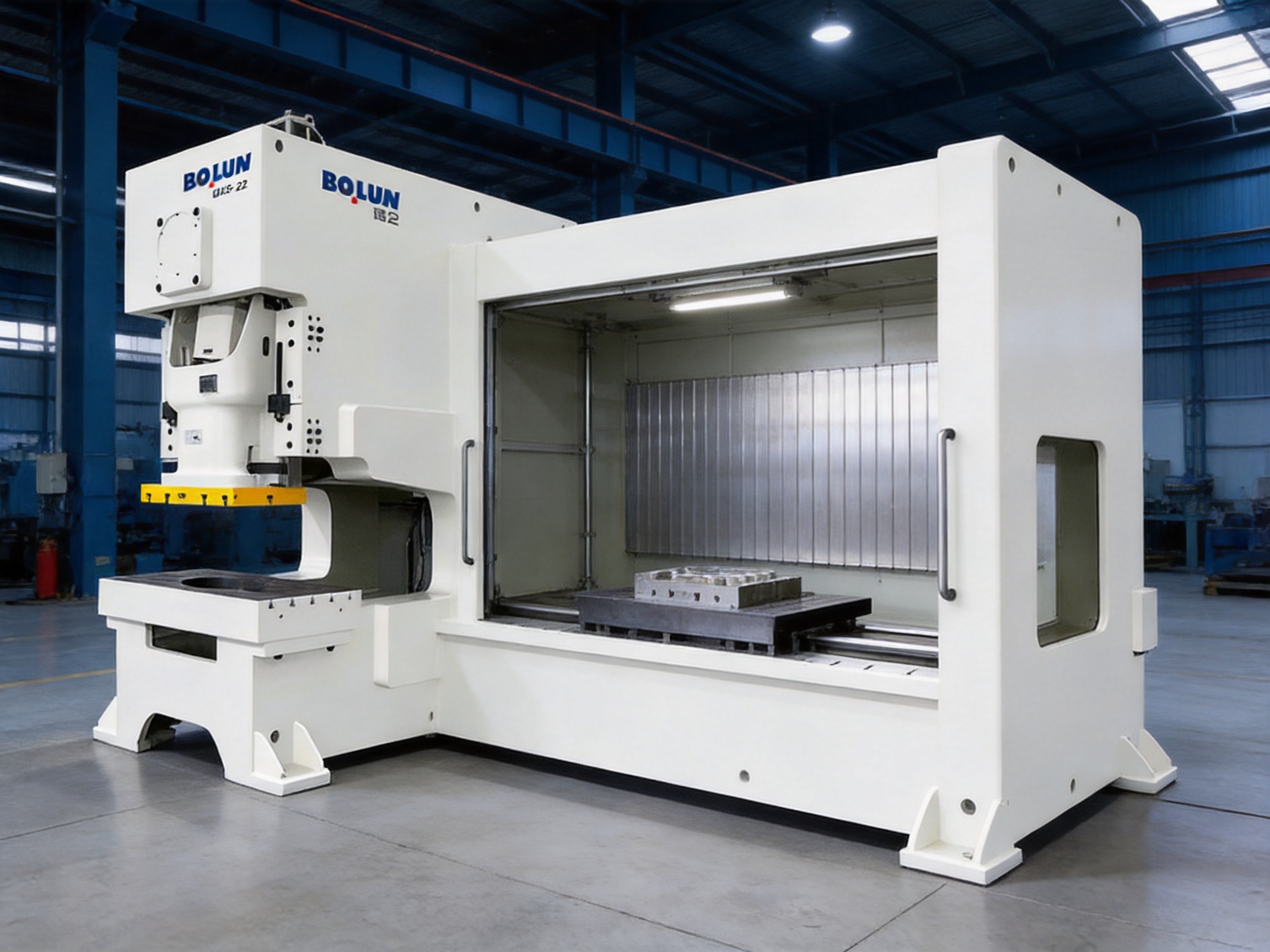
The supplied specification identifies punch accuracy as GB/JIS Class 1. This indicates that the machine is designed for a precision-oriented stamping environment rather than only rough, low-tolerance production. The actual quality achieved in production depends on machine condition, die precision, material consistency, lubrication, setup accuracy, and process control.
Precision stamping begins with the machine’s structural and mechanical design. A rigid frame, accurately guided slide, stable drive system, and correctly adjusted clutch-brake assembly all contribute to repeatable movement. These features help maintain the intended relationship between the punch, die, and workpiece over successive cycles.
Precision also depends on manufacturing discipline. The manufacturer describes a production system that covers basic design, core component development, precision processing, machine assembly, and final inspection. An integrated process can improve communication between design and production teams, reduce assembly variation, and make it easier to trace quality issues back to their source.
According to the company information provided, finished machines undergo inspection that is intended to exceed ordinary industry requirements. Quality control reportedly covers both components and processes, with the goal of maintaining stable precision and long service life under demanding operating conditions. Such controls are especially relevant for presses used in high-cycle production.
Customers should nevertheless establish their own acceptance criteria. Typical checks may include slide parallelism, table flatness, shut-height accuracy, clutch-brake response, stroke verification, vibration, noise, electrical safety, and test-part dimensional results. A documented factory acceptance test can help ensure that the delivered machine is suitable for the intended die and material.
The BLPS-25 is equipped with a 2.2 kW, four-pole main motor. Compared with higher-tonnage machines, this motor size supports a relatively efficient installation for applications within the machine’s rated capacity. Lower connected power can help reduce the electrical infrastructure required at the production site, although total energy consumption also depends on operating speed, duty cycle, auxiliary equipment, and production volume.
Space efficiency is another important advantage. A manufacturer may need deep reach but have limited floor area, particularly in workshops with several presses, inspection stations, material racks, and assembly cells. The BLPS-25 allows the customer to obtain an extended throat capability without automatically moving to a much larger high-tonnage press.
Compact equipment can also simplify internal logistics. Shorter material travel paths, easier access for maintenance, and reduced distance between the press and inspection area can improve the layout of a small or medium-sized factory. In a high-mix production environment, this may contribute to faster changeovers and better use of available floor space.
Space efficiency should not be confused with insufficient working clearance. The press must be installed with suitable access around the frame, electrical cabinet, lubrication points, clutch-brake components, and die area. Adequate clearance is necessary for safe operation, maintenance, and eventual removal of major components.
Compared with a conventional compact open press with a shallow throat, the BLPS-25 offers greater reach into wide workpieces. This can reduce the need for secondary positioning or multiple operations. It may also allow a larger die to be used within a single machine, depending on the die dimensions and load requirements.
Compared with a large high-tonnage press, the BLPS-25 generally offers lower initial investment, lower motor power, and a smaller installation footprint. It is more suitable when the required forming force is moderate but the workpiece width or reach requirement is significant.
Compared with a fully enclosed straight-side press, the open-gap design provides easier front and side access. This can benefit manual loading, die setup, visual inspection, and production of parts with unusual shapes. The trade-off is that the machine must be used within the structural and load conditions appropriate to its open-frame design.
Compared with a basic mechanical punch press, the BLPS-25 provides a more specialized combination of deep throat, precision classification, high-speed capability, and modern production support. Its value is not based on a single specification, but on how these characteristics work together in a complete stamping process.
The producer, Zhejiang Bolun High-Precision Machinery Co., Ltd., is described as a manufacturer with approximately two decades of experience in machinery manufacturing. Its business covers research and development, engineering design, production, sales, and service. This integrated structure is valuable because press performance depends on coordination across many technical disciplines.
The company reports a technology-first development strategy. Its capabilities include precision processing equipment, core component development, basic design, final machine assembly, and non-standard customization. These capabilities support the production of equipment that must combine heavy structural components with fine mechanical alignment and reliable control functions.
Vertical integration can provide several benefits. First, engineering teams can maintain closer control over critical dimensions and interfaces. Second, production problems can be communicated more quickly between machining, assembly, and quality departments. Third, customers may receive more practical support when requesting special throat dimensions, tooling interfaces, feeding arrangements, or other application-specific modifications.
The company also describes an international management perspective combined with local manufacturing resources. For global customers, this can be important when machines must be prepared for different electrical standards, documentation requirements, factory layouts, operator practices, and service expectations.
Manufacturing capability is ultimately demonstrated through repeatable results. A strong supplier should be able to provide clear specifications, transparent acceptance procedures, traceable quality documentation, practical maintenance guidance, and responsive technical support. These service elements are as important as the machine’s frame and motor when the press becomes part of a long-term production system.
Stamping lines are rarely identical. One customer may need manual loading and unloading, while another may require a decoiler, straightener, pneumatic feeder, mechanical feeder, conveyor, sensor system, or automatic part collection. The BLPS-25 can serve as the central press in a range of production arrangements, provided that the accessories are correctly selected and synchronized.
The manufacturer states that it provides one-stop design and manufacturing services for products requiring special specifications and functions. This suggests that the press platform may be considered for customized applications rather than limited exclusively to standard catalog configurations.
Potential customization discussions may involve electrical voltage, control language, safety guarding, material feed direction, die protection, counterbalance arrangements, lubrication systems, worktable modifications, or integration with automation. Every modification must be evaluated against the press’s structural capacity, cycle rate, safety design, and maintenance requirements.
Integration planning should begin before the purchase order is finalized. The customer should provide material dimensions, coil or sheet weight, expected production rate, die information, part drawings, loading method, desired automation level, and available factory utilities. This allows the supplier to recommend a configuration that is technically suitable rather than relying on assumptions.
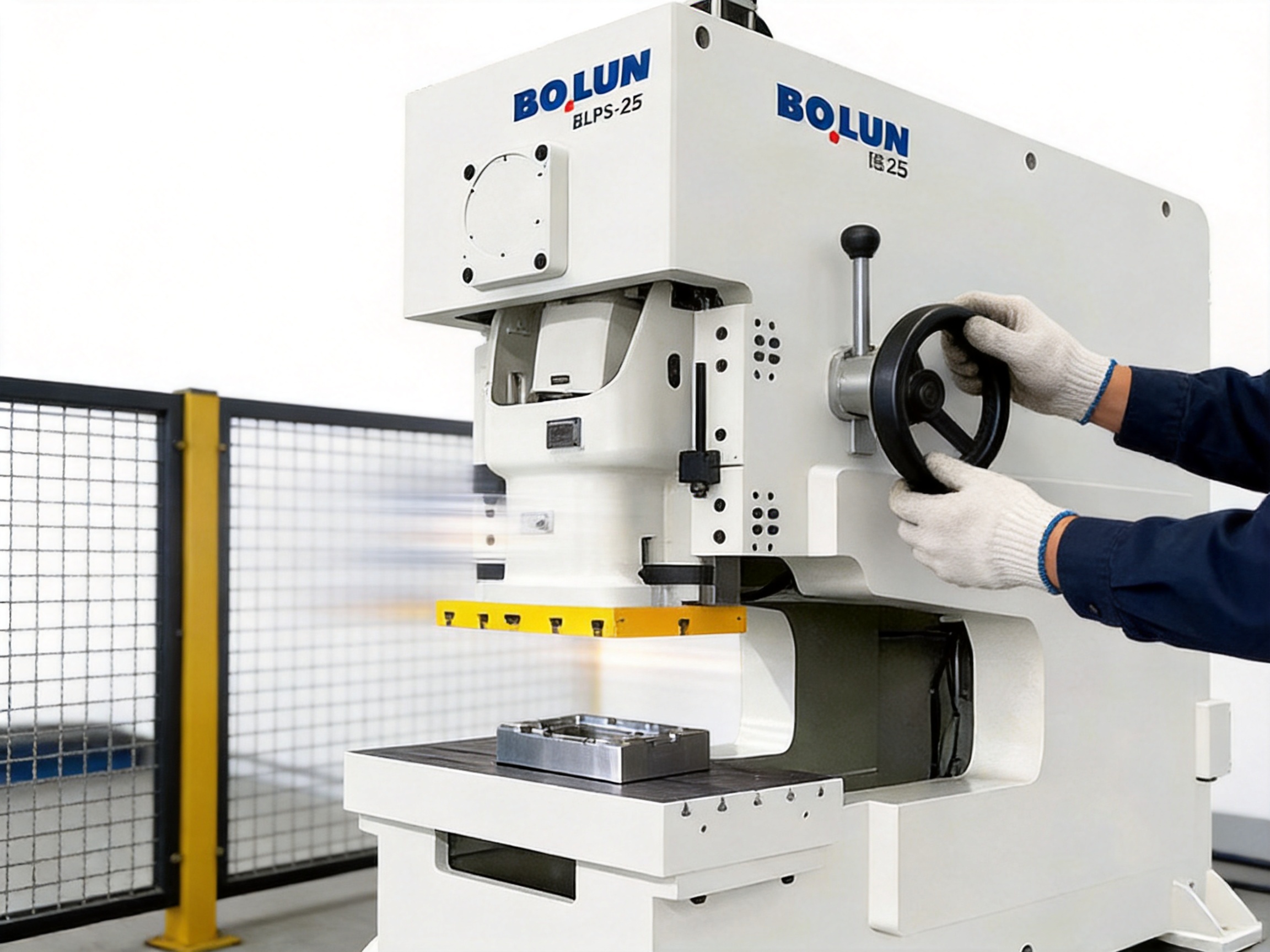
The combination of precision, high speed, and open access makes the BLPS-25 suitable for many electronic and electrical hardware applications. These may include brackets, terminal supports, shielding components, connector hardware, small enclosures, clips, and mounting plates. Such parts often require consistent holes, slots, bends, and formed features over repeated cycles.
Hardware producers can use the press for hinges, hooks, supports, reinforcing plates, fastener-related components, and other products manufactured from coil or sheet stock. The extended throat can be useful when the blank is broad or when several operations are distributed across a larger component.
Light-gauge appliance fittings, lamp brackets, reflector parts, mounting components, and internal support structures may benefit from a press that offers more reach than a small standard punch press. The machine can support production where force requirements are moderate but access and repeatability are important.
Industrial equipment manufacturers often produce brackets, covers, mounting panels, cable supports, and protective components in changing volumes. The BLPS-25 can be useful for these mixed-production environments because its open design supports relatively straightforward die changes and manual or semi-automatic operation.
Before installation, the customer should verify the foundation, floor loading, machine orientation, lifting method, electrical supply, compressed-air supply, ventilation, and clearance for maintenance. The specified air pressure is 0.55 MPa. The actual installation should include suitable filtration, regulation, and drainage to protect pneumatic components.
The machine should be leveled accurately according to the supplier’s instructions. Leveling affects table alignment, slide movement, lubrication distribution, and long-term structural behavior. An incorrectly installed press may show quality variation even if the machine passed factory inspection.
Operators should be trained in die installation, stroke adjustment, die-height setting, clutch-brake operation, emergency procedures, lubrication, and safe material handling. No production run should begin until the die is securely mounted and the press has been tested at low speed or in a controlled setup mode.
Routine checks should include fastener condition, lubrication points, air pressure, brake response, unusual vibration, abnormal noise, slide alignment, electrical connections, and safety-device operation. Preventive maintenance is particularly important for high-speed stamping because small mechanical problems can develop rapidly when the machine operates at elevated cycle rates.
| Item | BLPS-25 Specification |
|---|---|
| Machine type | Compact precision open-gap deep-throat power press |
| Nominal capacity | 250 kN |
| Nominal pressure stroke | 3.2 mm |
| Strokes per minute | 70–110 S.P.M. in V configuration; 95–180 S.P.M. in H configuration |
| Slide stroke | 80 mm in V configuration; 30 mm in H configuration |
| Maximum die height | 230 mm |
| Die-height adjustment | 50 mm |
| Throat depth | 500–1200 mm |
| Worktable size | 720 × 320 × 70 mm |
| Slide bottom size | 350 × 300 × 50 mm |
| Height of working face | 800 mm |
| Distance between columns | 478 mm |
| Shank-hole diameter | 40 mm |
| Main motor | 2.2 kW × 4 poles |
| Die-height adjustment | Manual operation |
| Air pressure | 0.55 MPa |
| Punch accuracy | GB/JIS Class 1 |
The strongest competitive advantage of the BLPS-25 is its combination of moderate capacity and exceptional reach. Customers do not always need a larger tonnage rating; they may need a press that can access a wide part, maintain accuracy, and operate efficiently in a limited workspace. The BLPS-25 is designed around this requirement.
Its high-speed configuration can support productive repetitive stamping, while the alternative configuration offers a longer slide stroke for processes requiring additional travel. The open-gap frame provides access for setup and handling, and the high-rigidity structure supports stable die alignment.
The machine’s 2.2 kW motor and compact format may also offer an economical alternative to installing a much larger press for moderate-force applications. When combined with the manufacturer’s ability to provide design, production, inspection, customization, and service, the machine becomes more than a standalone piece of equipment. It can form part of a carefully planned production solution.
For buyers comparing suppliers, the most important evaluation should include more than the headline tonnage or maximum speed. Frame quality, die compatibility, clutch-brake response, inspection standards, documentation, parts availability, technical support, and customization capability all influence the machine’s total value.
The BLPS-25 is a compact precision open-gap deep-throat power press designed for sheet metal stamping. It is intended for applications requiring moderate forming force, extended reach, accessible tooling, and repeatable production cycles.
The nominal capacity is 250 kN. Users should confirm the required tonnage for each specific die and material because actual force requirements depend on blank size, material strength, thickness, operation type, and forming conditions.
The throat-depth range is specified as 500 mm to 1200 mm. This extended reach allows the press to work with wider or more elongated components than many standard compact presses.
The supplied information identifies up to 180 strokes per minute for the high-speed H configuration. The V configuration is listed at 70–110 strokes per minute. Actual production speed should be selected according to the die, material, stroke, feeding method, safety requirements, and required part quality.
The BLPS-25 uses manual die-height or slide adjustment. This arrangement is suitable for many standard tooling applications and can reduce mechanical complexity. Customers requiring powered adjustment should discuss alternative models or customized configurations.
The main motor is rated at 2.2 kW and uses a four-pole configuration. The electrical supply and control requirements should be confirmed with the supplier before installation.
Potential users include manufacturers of electronic hardware, electrical components, general hardware, appliance fittings, lighting parts, industrial brackets, panels, covers, and other light- to medium-duty stamped sheet metal products.
It can be suitable for wide or elongated components when the required tonnage, die dimensions, material support, and load position remain within the machine’s design limits. Its 500–1200 mm throat depth is specifically intended to improve reach for such applications.
Customers should check material type and thickness, blank dimensions, die weight, die height, required stroke, production speed, tonnage, throat depth, table size, slide dimensions, shank diameter, electrical requirements, air supply, safety equipment, and automation needs.
The manufacturer reports integrated capabilities in research and development, design, precision processing, component development, assembly, inspection, customization, sales, and after-sales service. These capabilities are intended to support consistent machine quality and application-specific solutions.
All open-gap presses require appropriate guarding, emergency-stop systems, operator controls, die protection, and safe operating procedures. The machine must be installed and operated in accordance with the supplier’s instructions and applicable local regulations.
Maintenance should include regular lubrication, inspection of fasteners and guides, clutch-brake checks, air-system maintenance, electrical inspection, safety-device testing, and monitoring for abnormal noise or vibration. A preventive maintenance schedule should be established before production begins.
The BLPS-25 Compact Precision Open-Gap Deep-Throat Power Press is designed for manufacturers that need more reach than a conventional compact press can provide without moving to a much larger and more expensive machine. Its 250 kN capacity, 500–1200 mm throat depth, high-rigidity steel frame, accessible open-gap structure, sensitive dry clutch brake, manual slide adjustment, and high-speed configuration create a practical platform for specialized sheet metal stamping.
Its advantages are particularly relevant to electronic hardware, industrial components, general hardware, appliance fittings, lighting parts, and other applications where wide material access and repeatable production are important. The machine’s value is strengthened by the manufacturer’s stated capabilities in precision processing, integrated design and production, quality inspection, non-standard customization, and customer service.
For the best result, the press should be selected as part of a complete process evaluation. Die design, material flow, speed, safety, feeding, inspection, and maintenance must all be considered. When correctly matched to the application, the BLPS-25 can provide a balanced solution that combines compact installation with deep working reach, reliable stamping control, and efficient high-speed production.
1. Supplied BLPS Series basic technical data, including capacity, stroke, speed, die height, throat depth, worktable dimensions, motor power, air pressure, and accuracy specifications.
2. Supplied product description for the BLPS-25 Compact Precision Open-Gap Deep-Throat Power Press.
3. Supplied company profile describing research and development, precision processing, production management, quality inspection, customization, and customer service capabilities.
4. General mechanical press engineering principles concerning frame rigidity, clutch-brake operation, die-height adjustment, stamping speed, tooling compatibility, and preventive maintenance.
5. General sheet metal stamping production practices concerning material handling, die selection, tonnage calculation, operator safety, and process verification.


A buyer comparing a 45-ton open-gap press for a bracket line often receives two...
What Is a Power Press? A power press — also called a stamping press or punch pr...
Start With the Purchase Decision, Not the Definitions A procurement engineer co...
Understanding Mechanical Power Presses and Their Essential Functions A mechani...
A tooling engineer quotes a new bracket program and specifies a 160-ton press. ...
In the fields of metal forming, sheet metal fabrication, blanking, and punching,...
Contact Us

topbolun@gmail.com

+86-575-83362228

+86-13735238388
+86-18667502750

+86-575-83362999

+8618667502750

No.1 Linjiang Road East, Xiaren, Jinting Town, Shengzhou City, Zhejiang Province, China
Ready to Begin?
Get in Touch

Now!

ZHEJIANG BOLUN
 English
 中文简体