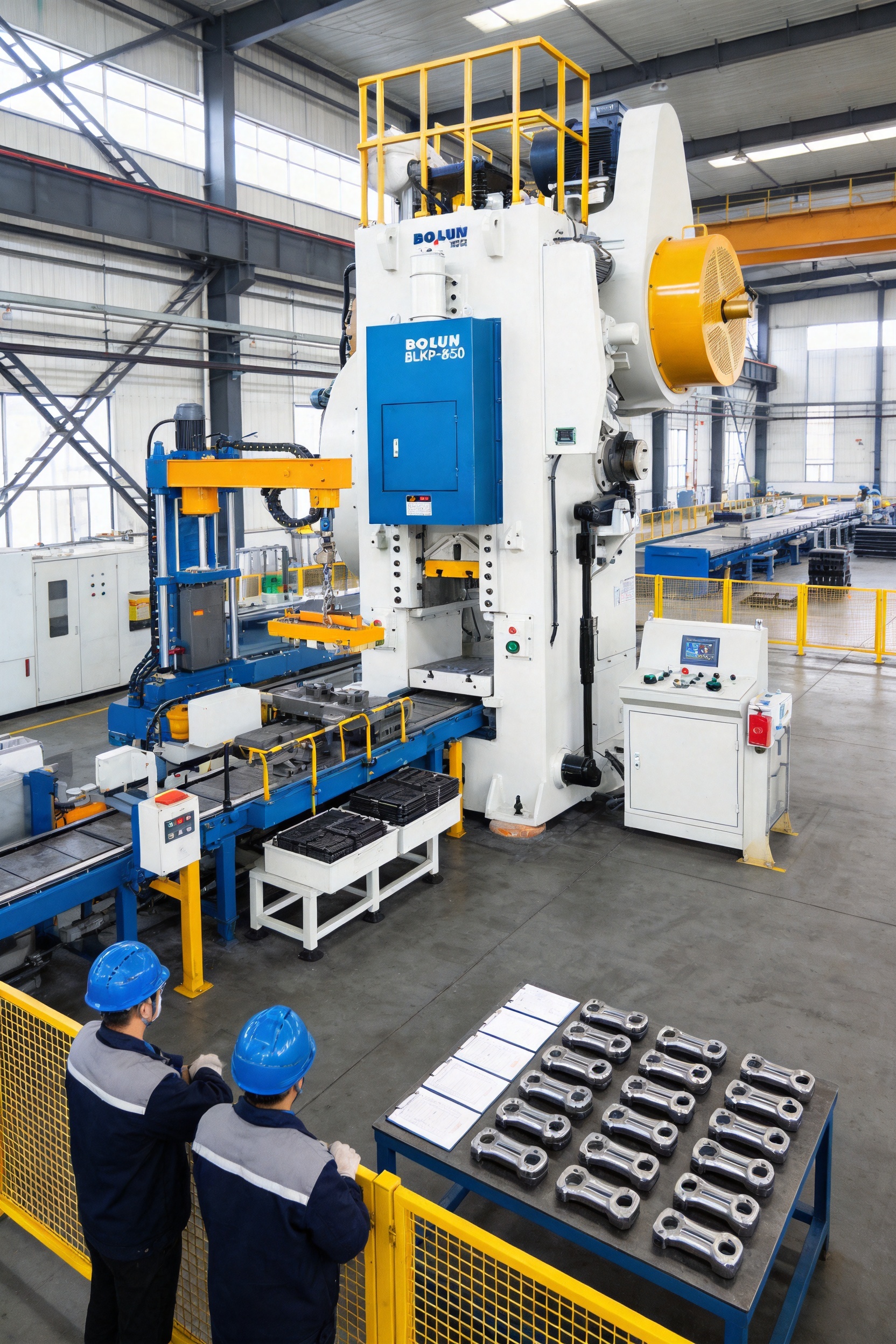
Modern cold forging requires more than high nominal force. A production press must deliver controlled forming motion, structural rigidity, repeatable pressure, reliable lubrication, operator protection, and long-term stability under demanding working conditions. When these requirements are combined in one machine, manufacturers can produce complex metal components with improved dimensional consistency, reduced material waste, and dependable cycle performance.
The BLKP-850 industrial-strength heavy-duty cold forging toggle type power press is designed for precisely this type of production environment. With a nominal capacity of 8,500 kN, the machine is suitable for high-load cold forging operations used in automotive, transportation, industrial machinery, hardware, and other heavy manufacturing sectors. Its toggle-type transmission system supports controlled forming at low speed, while its rigid frame and reinforced worktable provide the structural foundation required for repeated high-pressure forming.
This article examines the operating concept, technical configuration, manufacturing strengths, production advantages, safety features, maintenance considerations, and application value of the 8,500 kN cold forging press. It also explains how the machine compares with conventional mechanical presses and why the manufacturer’s integrated engineering and quality-control capabilities are important when selecting heavy-duty forming equipment.
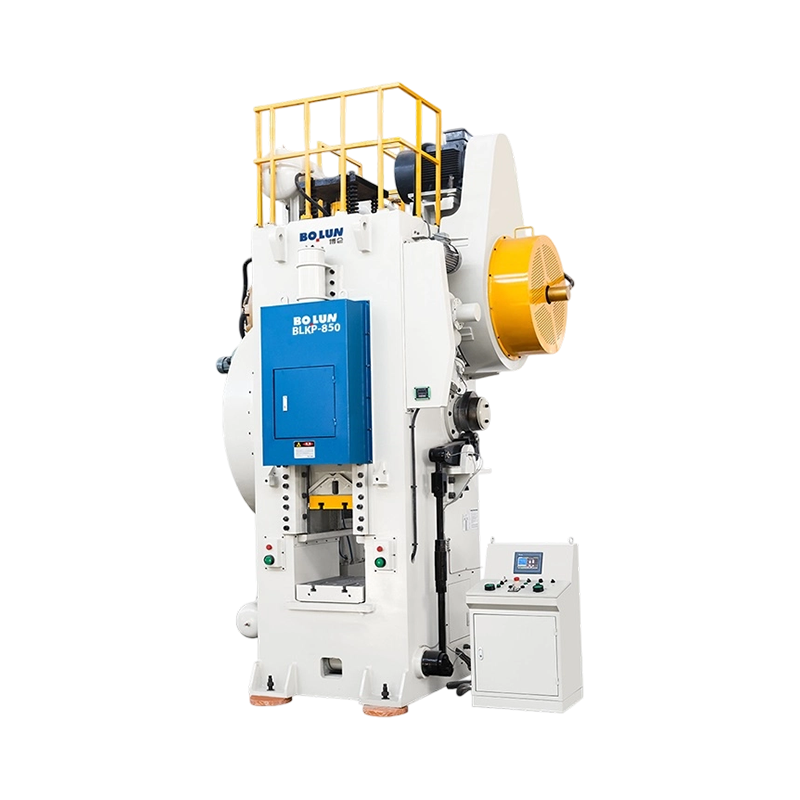
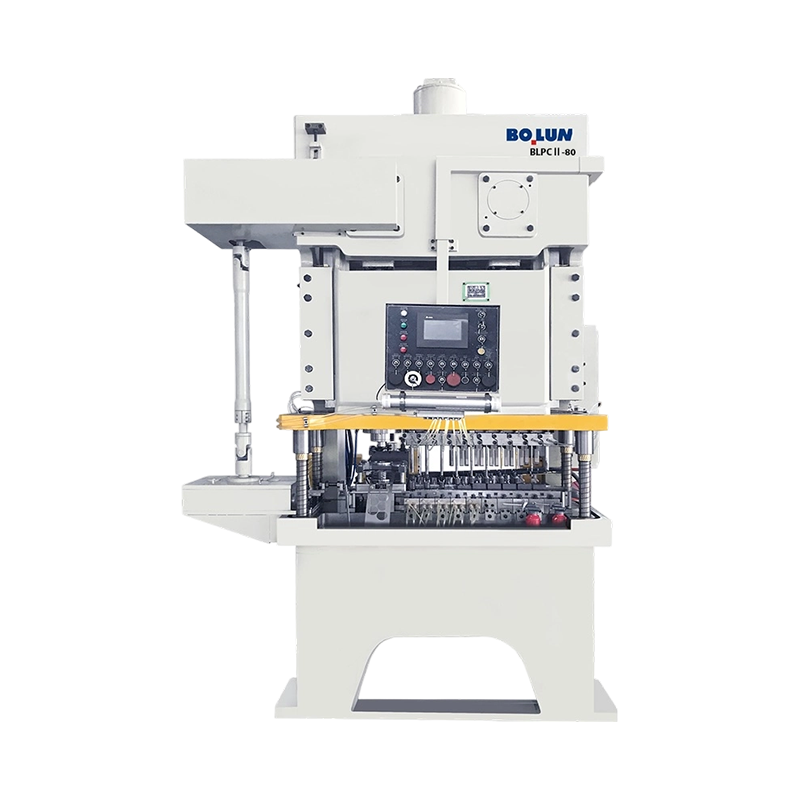
BLKP-850 Industrial Strength Heavy-Duty Cold Forging Toggle Type Power Press
Cold forging is a metal-forming process in which a workpiece is shaped at or near room temperature. Unlike machining, which removes material to obtain a final geometry, cold forging displaces material within a die cavity. This process can improve material utilization, enhance surface finish, increase strength through work hardening, and reduce the number of secondary operations required after forming.
However, cold forging places exceptional demands on production equipment. The material may resist deformation strongly, particularly when the workpiece has a complex profile, a large cross-sectional area, or a high-strength alloy composition. The press must therefore withstand significant forming forces without excessive deflection. Any instability in the frame, slide, die support, or transmission system can affect product accuracy and shorten die life.
High-load cold forging also requires controlled motion. Maximum force alone does not determine whether a press is appropriate for a particular operation. The speed at which the force is applied, the ability to maintain pressure during the critical forming stage, and the repeatability of the slide position all influence the final part. A press that combines force with carefully managed motion can provide better process control than a machine that simply operates at a high speed.
The BLKP-850 addresses these requirements with an 8,500 kN nominal capacity, an 8 mm nominal pressure stroke, and a toggle transmission mechanism. This configuration is intended for applications where high forming pressure and controlled low-speed action are more important than rapid, light-duty stamping cycles.
The machine is a cold forging toggle type power press designed for continuous industrial operation. Its frame is engineered for high rigidity, allowing it to support large forming loads while limiting deformation during the working cycle. The worktable measures 600 × 700 mm and incorporates a 180 mm thick bolster. This substantial working platform helps distribute forming pressure and provides a stable mounting surface for heavy dies and tooling assemblies.
The nominal capacity of 8,500 kN places the machine in a high-force production class. This capacity gives users the ability to process demanding components that would exceed the practical range of smaller presses. It also provides a useful operating margin for processes in which forming resistance varies due to material tolerances, lubrication conditions, temperature, or die geometry.
The nominal pressure stroke is 8 mm. This value represents the nominal portion of the slide movement in which the press develops its rated forming pressure. In a properly designed cold forging process, the pressure stroke is a critical parameter because it defines how the machine applies force near the end of the forming cycle.
The slide stroke is 180 mm, providing clearance for workpiece loading, die installation, and component ejection. The maximum die height is 400 mm, while the slide bottom size is 450 × 550 mm. These dimensions allow the press to accommodate substantial tooling arrangements while maintaining a compact and practical working envelope for heavy forming applications.
| Parameter | BLKP-850 Specification | Production Significance |
|---|---|---|
| Machine type | Cold forging toggle type power press | Supports high-load forming with controlled motion |
| Nominal capacity | 8,500 kN | Suitable for demanding industrial forging operations |
| Nominal pressure stroke | 8 mm | Defines the rated high-pressure forming range |
| Slide stroke | 180 mm | Provides die clearance and working travel |
| Strokes per minute | Approximately 25–40 S.P.M. | Balances productivity with heavy-duty forming requirements |
| Maximum die height | 400 mm | Accommodates substantial dies and tooling packages |
| Maximum die weight | 1,000 kg | Supports heavy forging dies and fixtures |
| Worktable size | 600 × 700 × 180 mm | Provides a rigid, reinforced die-support platform |
| Slide bottom size | 450 × 550 mm | Offers a suitable mounting area for upper tooling |
| Working face height | 1,030 mm | Supports practical loading and production ergonomics |
| Die height adjustment | 15 mm | Allows setup correction and tooling alignment |
| Air pressure | 0.55 MPa | Provides the specified pneumatic operating condition |
| Main motor | 75 kW × 4 poles | Supplies drive power for heavy-duty operation |
| Mold pad capacity | 300 kN | Supports lower tooling and forming assistance |
| Ram stroke | 70 mm | Provides controlled lower-ejection or supporting motion |
The approximately 25–40 strokes-per-minute range reflects the machine’s intended balance between production output and high-load forming control. Actual operating speed may depend on the workpiece, tooling design, material grade, lubrication method, loading arrangement, and required forming sequence.
The toggle mechanism is one of the most important features of this type of press. A toggle transmission uses linked mechanical members to convert rotational drive into controlled slide movement. As the linkage approaches its extended position, mechanical leverage increases, enabling the press to generate substantial forming force during the critical portion of the stroke.
This operating principle provides several advantages for cold forging. First, the slide can approach the workpiece at a practical production speed and then transition into a slower, more forceful forming phase. This is useful when the material must be displaced gradually into a die cavity. The controlled motion can help reduce sudden impact loading, improve material flow, and protect tooling from unnecessary shock.
Second, a toggle system can provide strong force multiplication near the bottom of the stroke. This enables the press to apply high forming pressure within a relatively short nominal pressure stroke. For difficult-to-deform materials, such force concentration can be more valuable than a simple high-speed slide movement.
Third, toggle action can contribute to improved repeatability when the mechanism, frame, tooling, and control system are properly maintained. Repeatable end-of-stroke behavior helps manufacturers maintain consistent dimensions across production batches.
Compared with a conventional general-purpose mechanical press, a toggle press is often better suited to operations that require controlled bottom-stroke forming and high pressure near the end of the movement. A conventional press may be effective for blanking, bending, or lighter stamping, but a specialized toggle press can offer greater process suitability for high-resistance cold forging.
The toggle design does not eliminate the need for proper process engineering. Die alignment, material preparation, lubrication, blank dimensions, and cycle settings remain essential. Nevertheless, the mechanism provides a strong mechanical foundation for processes in which controlled pressure application is a central requirement.
High-force forming creates large loads throughout the machine structure. These loads pass through the die, worktable, bolster, frame, slide, connecting members, and drive system. If any part of the load path lacks sufficient stiffness, elastic deflection can affect die alignment and product geometry.
The BLKP-850 is built around an ultra-rigid industrial frame intended to maintain stability during repeated heavy-duty cycles. The reinforced structure supports the 8,500 kN nominal capacity while helping the machine resist distortion under pressure. This is especially important in cold forging because even small changes in die position can influence filling, flash formation, surface quality, and dimensional accuracy.
The 180 mm thick worktable and bolster provide additional support beneath the lower die. A substantial bolster helps distribute load across the working area and reduces localized stress concentration. It also provides a stable foundation for large dies weighing up to 1,000 kg.
Structural rigidity offers benefits beyond product quality. It can contribute to longer die service life by reducing uneven contact and misalignment. It can also reduce vibration and noise associated with unstable load transfer. Over time, these benefits may lower maintenance requirements and reduce production interruptions.
For manufacturers comparing equipment, frame construction should be evaluated together with rated capacity. Two presses may have similar nominal tonnage but different practical performance if their frames, bolsters, slide guides, and transmission components are not equally robust. A heavy-duty machine should therefore be assessed as a complete load-bearing system rather than by capacity alone.
Cold forging becomes more challenging when materials have high yield strength, limited room-temperature ductility, or complex flow characteristics. Automotive and heavy machinery components may require alloy steels or other engineering materials selected for strength and wear resistance. These materials can demand high forming pressure and careful control of deformation.
The BLKP-850 is designed to support such applications through the combination of high capacity, toggle leverage, rigid construction, and controlled pressure movement. The machine’s operating concept helps the forming process progress in a more deliberate manner, which can improve the ability of the material to flow into the die without excessive impact.
Controlled forming may also assist with multi-stage operations. In a multi-stage cold forging process, the workpiece passes through several forming steps, each of which changes its geometry. Consistency in slide travel and pressure behavior helps maintain predictable intermediate dimensions and improves the likelihood that the final operation will produce an acceptable component.
Typical applications may include high-strength fasteners, automotive drivetrain components, steering and suspension parts, bearing-related components, industrial connectors, structural hardware, and other forged parts requiring high mechanical performance. The actual suitability of the machine depends on the material, blank size, die design, forming ratio, and production method.
Because cold forging is sensitive to lubrication, die temperature, and material preparation, users should validate each process through engineering trials. The press supplies the necessary forming platform, but optimized production requires coordination among machine settings, tooling, raw material, and quality-control procedures.
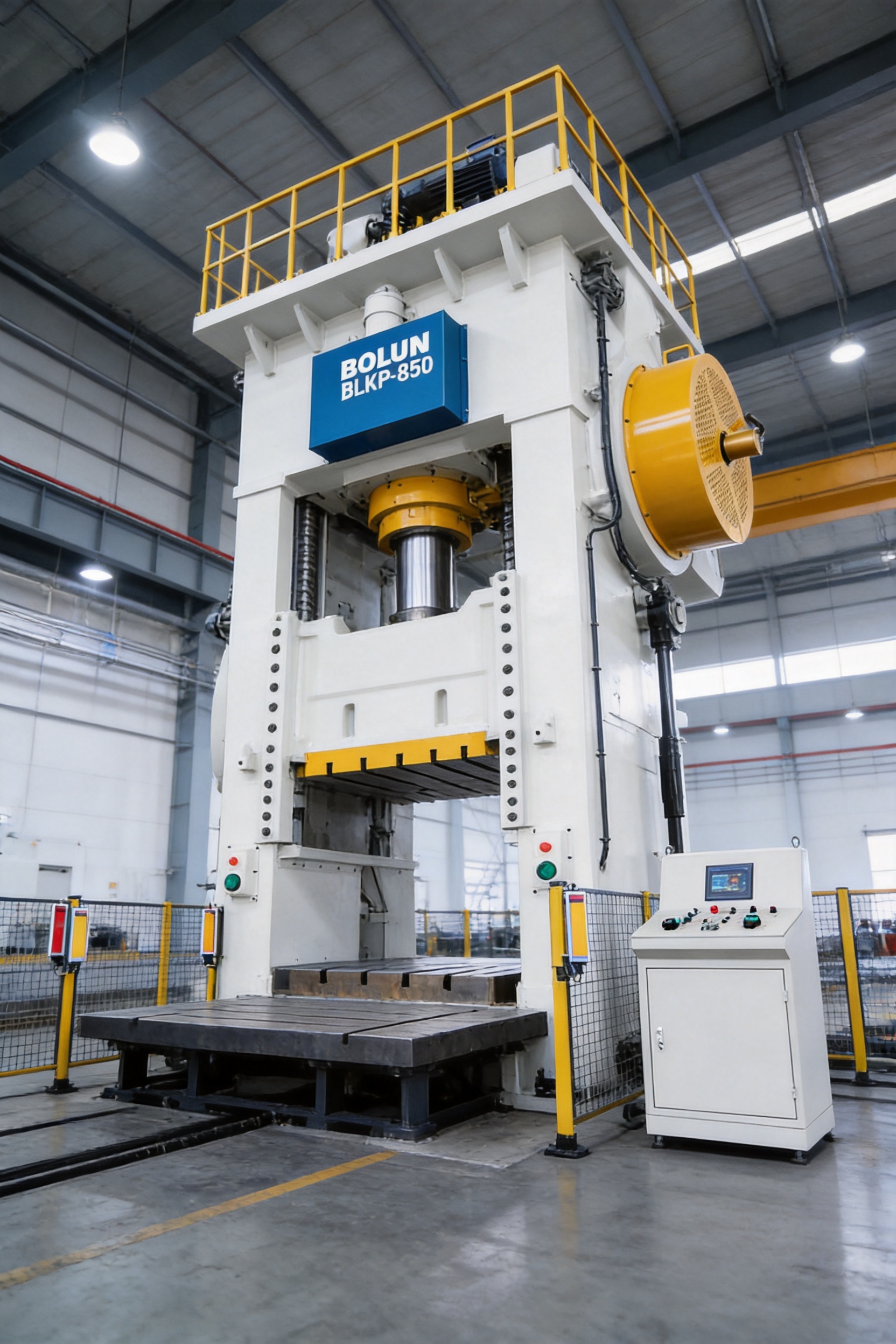
Industrial users typically evaluate a forging press according to both its maximum force and its ability to maintain a productive cycle over long operating periods. A machine that provides high capacity but experiences frequent stoppages may be less valuable than a stable press with predictable availability.
The BLKP-850 offers an operating range of approximately 25–40 strokes per minute. This range is appropriate for a heavy-duty machine where forming force, tooling protection, and process stability must be balanced with output. The optimum speed depends on the component and may be reduced for large blanks, complex dies, difficult materials, or operations with demanding ejection requirements.
Stable cycle performance can improve production planning. When each cycle follows a predictable sequence, operators can establish more reliable output expectations, material replenishment schedules, inspection intervals, and preventive-maintenance plans. Consistency also makes it easier to identify abnormal conditions such as lubrication failure, die wear, material variation, or alignment problems.
The 180 mm slide stroke provides working clearance while supporting a practical die arrangement. A maximum die height of 400 mm allows the press to accept substantial tooling packages without requiring excessive alteration to the machine. The 15 mm die height adjustment further supports setup correction when different dies or replacement tooling are installed.
Production efficiency also depends on loading and unloading methods. For higher-volume lines, the press may be integrated with transfer equipment, robotic handling, automatic lubrication, blank feeding, or post-forging inspection. The machine’s rigid structure and defined working envelope provide a base for such system integration, subject to the final line design and customer requirements.
Tooling is a major investment in cold forging. Dies must withstand high pressure, repeated impact, thermal variation, and friction. A press that provides stable and accurate die support can help protect this investment.
The BLKP-850 worktable measures 600 × 700 mm and has a 180 mm thick bolster. This configuration provides a broad and reinforced support area for large lower dies. The maximum die weight is listed as 1,000 kg, giving users flexibility when selecting heavy-duty tooling systems.
The slide bottom measures 450 × 550 mm, allowing the upper die assembly to be mounted on a substantial surface. Correct upper and lower die alignment is essential because uneven loading can cause premature wear, cracking, poor filling, and dimensional inconsistency. The machine’s structural design helps establish the stable platform required for accurate alignment, while final results still depend on tooling workmanship and setup procedures.
The 300 kN mold pad capacity and 70 mm ram stroke provide additional support for lower tooling functions. Depending on the process design, the lower mechanism may assist with workpiece support, ejection, positioning, or controlled movement during forming. This can be particularly useful in operations where the finished component must be released from the die without damaging the part or tooling.
Tooling selection should consider not only the maximum dimensions but also the force distribution, die material, surface treatment, lubrication channels, ejection method, and expected production volume. The press is capable of supporting heavy tooling, but the complete die assembly must be engineered for the intended load and cycle conditions.
Lubrication is essential in cold forging because friction between the workpiece and die can significantly increase forming resistance. Poor lubrication may cause galling, surface defects, die wear, unstable material flow, and excessive energy consumption. A reliable lubrication system is therefore a core part of long-term press performance.
The machine incorporates recursive lubrication to support consistent lubrication circulation during operation. By maintaining a regular lubrication process, the system helps deliver lubricant to relevant moving components and reduce friction within the mechanical transmission and other service points.
Reliable lubrication contributes to several operational benefits. It can reduce wear on moving parts, support smoother mechanical motion, limit heat generation, and help preserve the accuracy of the drive system. It also supports longer service intervals when the correct lubricant, quantity, filtration, and maintenance schedule are used.
Lubrication should not be treated as a set-and-forget function. Operators and maintenance personnel should inspect oil levels, pressure, flow, filters, seals, pipes, and distribution points according to the equipment service plan. Abnormal noise, temperature increase, leakage, or inconsistent motion may indicate a lubrication problem that should be addressed before continued heavy production.
For the forging process itself, workpiece and die lubrication must also be managed separately. The machine’s mechanical lubrication system protects the press, while process lubrication supports material flow and die performance. Both systems are necessary for reliable cold forging.
Heavy-duty presses contain powerful moving components and must be operated with strict attention to safety. The BLKP-850 includes a photoelectric safety system designed to help protect operators by detecting intrusion into a monitored area around the working zone.
Photoelectric protection can help prevent a cycle from starting or can initiate a safety response when the light field is interrupted, depending on the control configuration and applicable safety circuit. This type of protection is particularly valuable during manual loading, die setup, inspection, and maintenance activities.
Safety equipment must be considered part of an integrated system. Operators should receive training in machine operation, emergency procedures, lockout and isolation practices, die handling, and safe material loading. Guards, emergency stops, control interfaces, and photoelectric devices should be checked regularly to confirm that they operate correctly.
Safety requirements vary by country, industry, and installation environment. Users should complete a site-specific risk assessment and ensure that the press is installed, commissioned, and operated in accordance with applicable regulations and internal safety procedures.
Good safety design also supports productivity. When operators can work with greater confidence and a clear understanding of machine protection functions, the risk of avoidable incidents and unplanned interruptions is reduced. A safe operating culture is therefore both a compliance requirement and a business advantage.
The performance of a heavy forging press depends on the quality of its engineering, materials, machining, assembly, testing, and after-sales support. The manufacturer behind this equipment combines research and development, design, production, sales, and service within one industrial organization. This integrated structure can improve communication between departments and support more consistent product development.
Two decades of experience in machinery manufacturing provide a foundation for understanding the practical requirements of forging and forming equipment. Experience is especially valuable in high-force machinery because performance depends on many interconnected factors, including frame geometry, transmission design, component tolerances, lubrication routing, control logic, assembly accuracy, and commissioning procedures.
The company operates with a technology-first development strategy and maintains capabilities in precision processing, core component development, machine assembly, and non-standard equipment customization. These capabilities are important for customers whose production requirements cannot be met by a standard catalog configuration.
A full-chain production system allows design decisions to be reviewed against actual manufacturing conditions. Engineers can consider machining access, welding or fabrication requirements, component availability, assembly sequence, inspection points, and serviceability during the design stage. This can help reduce the risk of producing a theoretically effective but difficult-to-manufacture machine.
Advanced precision-processing equipment supports the production of components that require controlled dimensions and accurate interfaces. In a heavy-duty press, these include guide elements, transmission components, mounting surfaces, shafts, housings, and other parts that influence alignment and motion. Precision manufacturing is particularly important when a machine must repeatedly transfer high loads without excessive clearance or uneven contact.
The company also provides non-standard design and manufacturing services. This can be valuable when customers require special die dimensions, automation interfaces, production speeds, ejection arrangements, safety configurations, or electrical specifications. Customization should be based on a clear technical review so that the final system remains structurally sound and serviceable.
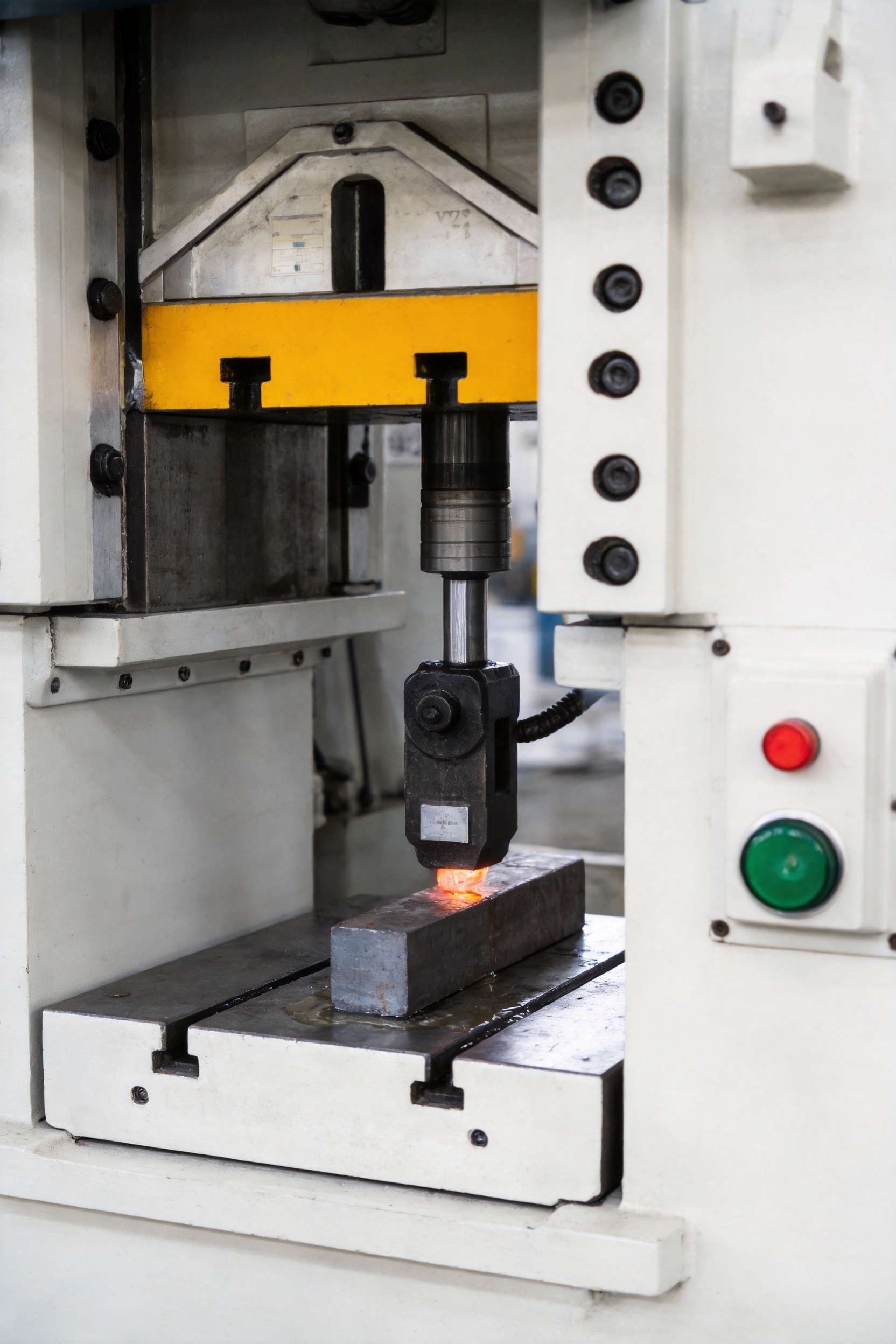
Quality control for a heavy-duty power press must extend beyond visual inspection of the completed machine. It should cover raw materials, fabricated structures, machined components, purchased parts, assembly accuracy, lubrication performance, safety functions, electrical systems, and final machine operation.
The manufacturer describes a finished-product inspection system intended to exceed ordinary industry requirements. Such a system may include dimensional checks, component verification, assembly inspections, load-related evaluations, motion tests, lubrication checks, and safety-function testing. The exact inspection plan should be confirmed for each order and configuration.
Quality control is particularly important for the frame and working surfaces. The worktable and slide must maintain appropriate alignment so that the die loads are distributed correctly. Machined interfaces should be inspected for flatness, parallelism, and dimensional conformity. Guide and transmission components should be checked for proper installation and movement.
Final commissioning is also essential. Before shipment or acceptance, the press should be evaluated for abnormal vibration, noise, oil leakage, control response, emergency functions, photoelectric protection, slide movement, pressure behavior, and overall operating stability. Documentation of inspection results can support customer acceptance and future maintenance.
A strong quality system provides value throughout the machine’s service life. It reduces the probability of early failures, simplifies troubleshooting, supports spare-parts planning, and helps customers maintain stable production. For a press used in continuous high-load forging, reliability is not an optional feature; it is a central part of the equipment’s economic value.
Manufacturers often compare heavy-duty toggle presses with general-purpose mechanical presses, hydraulic presses, or smaller forging machines. Each type has strengths, and the appropriate choice depends on the application. However, the BLKP-850 offers a particularly useful combination for high-load cold forging.
Compared with a standard stamping press of lower capacity, the BLKP-850 provides substantially greater forming force and a stronger load-bearing structure. This allows it to process larger or higher-strength workpieces and provides more room for difficult forming operations.
Compared with a conventional mechanical press with a simpler crank mechanism, the toggle system offers greater leverage near the end of the stroke. This can provide more controlled pressure application during the most demanding part of the forming cycle. It may also reduce the need to operate at excessive drive force throughout the entire stroke.
Compared with a hydraulic press, a mechanical toggle press may offer a more defined and repeatable mechanical cycle for high-volume production. Mechanical transmission can provide efficient cycle operation, while the toggle geometry concentrates force where it is most needed. Hydraulic systems remain valuable for applications requiring flexible force profiles, long dwell times, or very slow controlled movement, but they may not always provide the same production characteristics for a particular cold forging line.
Compared with a smaller cold forging machine, the BLKP-850 offers a larger worktable, greater die capacity, higher nominal force, and a more substantial structural platform. This makes it suitable for components that require heavier tooling or higher forming resistance.
| Evaluation Area | BLKP-850 Heavy-Duty Toggle Press | Potential Limitation of a General-Purpose Alternative |
|---|---|---|
| Forming force | 8,500 kN nominal capacity | Lower-capacity machines may not handle demanding workpieces |
| End-of-stroke pressure | Enhanced by toggle leverage | Simple mechanisms may provide less specialized force concentration |
| Structural support | Ultra-rigid frame with 180 mm bolster | Less rigid structures may experience greater deflection |
| Tooling capability | Up to 1,000 kg die weight and 400 mm die height | Smaller machines may restrict die size and mass |
| Cold forging suitability | Designed for high-load forming | Stamping-oriented equipment may be less suitable for difficult materials |
| Process stability | Controlled motion, lubrication, and safety integration | Additional systems may be required on basic machines |
| Customization | Supported by non-standard design capability | Standardized equipment may offer limited adaptation |
These comparisons should be interpreted as application guidelines rather than universal claims. A properly selected alternative may be suitable for a particular process. The key advantage of the BLKP-850 is that its main design features are aligned with the specific requirements of high-load cold forging.
The machine is suitable for a broad range of components requiring strong and repeatable cold forming. Automotive production is one important application area. Forged automotive parts often require high strength, consistent dimensions, and reliable surface quality. Examples may include drivetrain components, steering parts, suspension hardware, fasteners, and other structural or functional parts.
Heavy machinery manufacturers can use high-capacity cold forging for industrial connectors, pins, shafts, bushings, special fasteners, and wear-resistant components. These parts may require high forming force because of their material grades or cross-sectional dimensions.
The press may also support production in agricultural machinery, rail-related equipment, energy systems, construction hardware, and general industrial manufacturing. Its large die capacity allows it to work with substantial tooling arrangements, while the toggle mechanism supports forming processes that require high pressure near the end of the stroke.
Potential application suitability should be verified through a technical review. Important factors include material composition, blank volume, part geometry, required forming stages, die strength, lubrication method, target production rate, ejection requirements, and acceptable dimensional tolerances.
A heavy-duty press must be installed on a foundation capable of supporting its static and dynamic loads. The foundation design should account for machine mass, operating forces, vibration, floor conditions, anchoring, access, and surrounding production equipment. Installation should be performed according to the manufacturer’s technical documentation and local engineering requirements.
Before commissioning, the machine should be inspected for shipping damage, loose connections, oil levels, electrical integrity, pneumatic supply, safety devices, and correct alignment. The work area should provide sufficient space for die handling, material movement, maintenance access, and emergency response.
Initial commissioning should proceed in stages. Operators may begin with low-speed or no-load checks before progressing to die installation and trial forming. Slide movement, ram motion, lubrication circulation, photoelectric safety response, emergency stops, and control functions should all be confirmed.
Trial production should use approved tooling and suitable test material. The first parts should be inspected for dimensions, surface condition, die filling, flash, cracks, and other forming defects. Process parameters can then be adjusted before the machine enters full production.
Correct installation has a direct effect on long-term performance. Even a well-designed press can experience avoidable problems if the foundation is inadequate, the die is misaligned, the electrical supply is unstable, or the machine is operated outside its specified conditions.
Preventive maintenance is essential for equipment operating under high mechanical loads. A maintenance program should include daily, weekly, monthly, and periodic inspections based on operating hours and production intensity.
Daily checks may include oil level, visible leakage, unusual noise, abnormal vibration, safety-device status, air pressure, and work-area cleanliness. Operators should report changes in machine behavior immediately rather than waiting for a failure.
Periodic maintenance may include inspection of transmission parts, fasteners, guides, bearings, seals, electrical connections, pneumatic components, lubrication filters, and safety circuits. Die-support surfaces should be cleaned and checked for damage or contamination that could affect alignment.
Lubricant selection and replacement intervals should follow the specified service instructions. Contaminated or degraded lubricant can reduce the effectiveness of the lubrication system and accelerate component wear. Filters and distribution lines should be inspected to ensure that oil reaches the required locations.
Maintenance personnel should use proper lockout and isolation procedures before entering hazardous areas or working on the machine. Heavy dies must be handled with lifting equipment suitable for their weight, and all replacement components should meet the required technical specifications.
The value of a high-capacity press includes more than the machine itself. Customers may require assistance with model selection, process evaluation, die dimensions, installation, commissioning, operator training, troubleshooting, spare parts, and future upgrades.
An integrated manufacturer with design, production, sales, and service capabilities can provide more coordinated support. Technical information from the production site can be communicated directly to engineering and service teams, helping reduce delays during problem solving.
Custom engineering is particularly useful when a customer needs a special worktable arrangement, modified die space, automated loading, dedicated ejection, additional monitoring, or integration with an existing production line. The manufacturer’s experience in non-standard equipment can support these projects from concept development through final assembly.
After-sales service should include clear documentation, recommended maintenance schedules, spare-parts guidance, safety instructions, and technical communication channels. For export customers, service planning should also consider local regulations, electrical standards, language requirements, and availability of qualified maintenance personnel.
A high-capacity forging press represents a significant capital investment, but its economic value should be assessed across the entire production lifecycle. Important factors include output, uptime, material utilization, die life, maintenance cost, energy consumption, product quality, labor requirements, and the ability to produce higher-value components.
Cold forging can reduce material waste compared with machining processes that remove large amounts of stock. It may also reduce the number of secondary operations and improve component strength through favorable grain flow and work hardening. When the press operates consistently, these process advantages can contribute to lower unit cost.
The BLKP-850’s structural strength and controlled toggle action can support stable production of demanding components. Stable production reduces scrap and rework, while reliable lubrication and safety integration can help limit unplanned downtime.
Customers should evaluate the machine according to their actual production plan. A technical return-on-investment study should consider the expected annual volume, component value, current outsourcing costs, tooling investment, labor requirements, and future product development. The right machine is not necessarily the smallest or largest option; it is the one that provides the appropriate capacity and flexibility for the intended production portfolio.
Before ordering an 8,500 kN cold forging press, buyers should prepare detailed information about the target components and process. This helps the manufacturer verify that the machine, tooling, automation, and safety systems are properly matched.
The material grade and mechanical properties should be identified, including yield strength, tensile strength, hardness, ductility, and surface condition. Blank dimensions, weight, lubrication method, and preforming requirements should also be documented.
Tooling information should include die height, die footprint, total die weight, guide arrangement, ejection method, and expected service life. The machine’s 400 mm maximum die height, 1,000 kg maximum die weight, 600 × 700 mm worktable, and 450 × 550 mm slide bottom should be compared with the complete tooling package rather than with individual die components alone.
Production requirements should include target strokes per minute, annual volume, working shifts, automation level, inspection frequency, and future product variations. Buyers should also confirm foundation requirements, electrical specifications, air supply, factory space, lifting capacity, and maintenance resources.
Finally, customers should request technical documentation covering the machine layout, operating conditions, safety functions, maintenance schedule, installation requirements, warranty terms, and spare-parts recommendations.
The press has a nominal capacity of 8,500 kN. This places it in a high-force class suitable for demanding cold forging and heavy forming applications.
The toggle mechanism provides controlled slide movement and increased mechanical leverage near the end of the stroke. This supports high-pressure forming and can improve the handling of difficult-to-deform materials.
The nominal pressure stroke is 8 mm. This is the rated portion of the slide movement associated with the machine’s nominal forming pressure.
The worktable measures 600 × 700 mm and has a 180 mm thick bolster. This provides a stable platform for heavy cold forging dies.
The maximum die height is 400 mm, and the maximum listed die weight is 1,000 kg. Final suitability should be confirmed based on the complete die assembly, center of gravity, handling method, and loading arrangement.
The listed operating range is approximately 25–40 strokes per minute. The practical speed depends on the component, material, die design, lubrication, ejection system, and required forming quality.
Yes. Its high capacity, rigid structure, controlled toggle motion, and heavy die-support capability make it suitable for many automotive cold forging applications, including selected drivetrain, steering, suspension, and fastener components. Each application should be verified through process engineering and trials.
The main motor specification is listed as 75 kW with a four-pole configuration. The final electrical arrangement should be confirmed in the technical order documentation.
Yes. A photoelectric safety system is integrated to help protect operators around the working area. Users must also provide appropriate guarding, training, risk assessment, emergency procedures, and maintenance practices.
Lubrication reduces friction and wear in the press mechanism and supports stable movement during repeated heavy-duty cycles. The machine incorporates recursive lubrication, while the forging process itself also requires appropriate workpiece and die lubrication.
Customization may be available for special worktable arrangements, die requirements, automation interfaces, ejection systems, controls, and other non-standard functions. The final configuration should be determined through a detailed engineering review.
Customers should evaluate foundation strength, floor space, lifting access, electrical supply, air pressure, die-handling equipment, safety zones, maintenance access, and integration with upstream and downstream production equipment.
The toggle press provides a defined mechanical cycle and strong leverage near the end of the stroke, which can be advantageous for high-volume cold forging. Hydraulic presses may be preferable for applications requiring flexible force profiles, long dwell times, or very slow controlled movement. Selection depends on the process.
Reliable production depends on correct die alignment, suitable material preparation, effective process lubrication, routine machine lubrication, preventive maintenance, safety inspections, and operation within the specified capacity and speed range.
The 8,500 kN cold forging toggle type power press is engineered for manufacturers that require high forming force, controlled motion, rigid support, and dependable operation. Its combination of an ultra-rigid industrial frame, 8 mm nominal pressure stroke, 180 mm slide stroke, 600 × 700 mm worktable, 180 mm bolster, and toggle transmission gives it a strong foundation for demanding cold forging applications.
Its advantages are especially relevant when producing components from difficult-to-deform materials or when large, heavy dies must be used repeatedly in continuous production. The machine’s controlled end-of-stroke forming behavior can support material flow and tooling protection, while recursive lubrication and photoelectric safety features contribute to operational reliability.
The manufacturer’s strengths extend beyond the machine specification. Integrated research and development, precision processing, component manufacturing, assembly, quality inspection, customization, and customer service provide a complete foundation for industrial equipment delivery. This full-chain approach is valuable when customers require stable performance, special configurations, or long-term technical support.
For automotive, heavy machinery, industrial hardware, and other high-load applications, the BLKP-850 offers a practical combination of force capacity, tooling capability, structural stability, and process control. With correct installation, die design, lubrication, maintenance, and operator training, it can serve as a productive foundation for modern high-strength cold forging operations.
1. Metal Forming Fundamentals, technical principles of cold forging, die design, material flow, and forming pressure.
2. Mechanical Press Design and Operation, reference guidance on crank, toggle, and power transmission systems.
3. Industrial Machine Tool Safety Practices, principles for guarding, photoelectric protection, emergency stopping, and operator training.
4. Forging Lubrication and Die Life Management, technical guidance on friction control, die wear, and production stability.
5. Quality Management for Heavy Machinery Manufacturing, recommendations for inspection, assembly verification, commissioning, and preventive maintenance.
6. General Engineering Principles for Cold Forged Automotive Components, considerations for material selection, tooling, dimensional control, and production validation.


When you are planning to produce medium or small metal parts in high volumes, t...
A cold forging die rarely announces its failure in advance. One day the press r...
Start With the Purchase Decision, Not the Definitions A procurement engineer co...
A fastener plant in Taizhou receives a request from an automotive tier-one supp...
A mid-size fastener manufacturer recently faced a familiar problem: its CNC lat...
A production manager at a mid-size metal component plant recently faced a probl...
Contact Us

topbolun@gmail.com

+86-575-83362228

+86-13735238388
+86-18667502750

+86-575-83362999

+8618667502750

No.1 Linjiang Road East, Xiaren, Jinting Town, Shengzhou City, Zhejiang Province, China
Ready to Begin?
Get in Touch

Now!

ZHEJIANG BOLUN
 English
 中文简体