
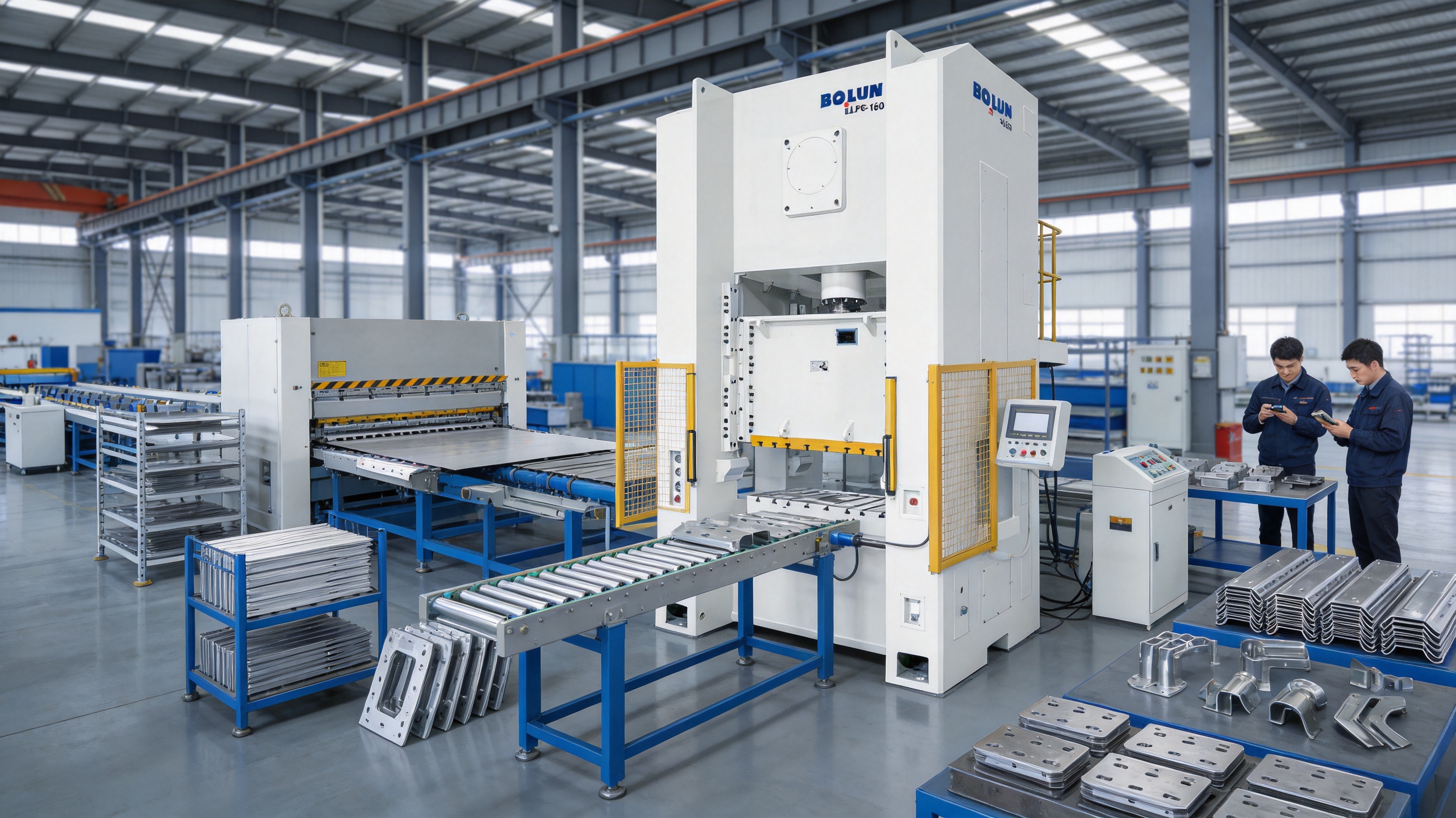
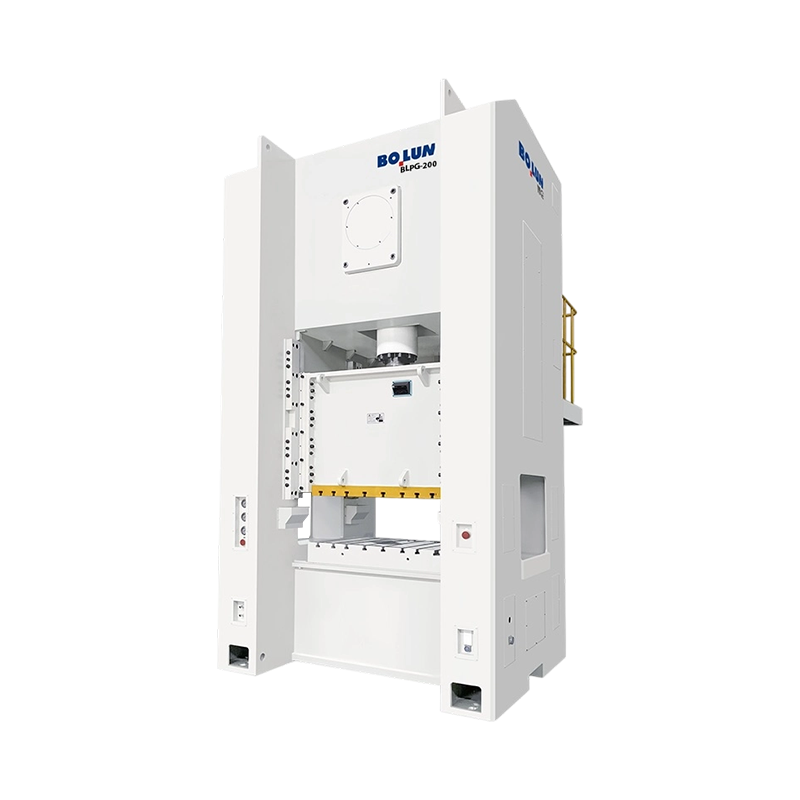
Modern metal forming requires more than a high nominal tonnage. Manufacturers need a power press that can maintain structural stability, repeatable accuracy, safe operation, efficient die changes, and reliable performance throughout long production cycles. The BLPG-160 Versatile Stable-Frame Closed-Type Single-Point Wide-Door Power Press is designed to address these requirements in one integrated machine platform.
With a nominal capacity of 1600 kN, an 800 × 700 mm worktable, a 15 kW main motor, electric slide adjustment, a die height indicator, photoelectric safety protection, and dual solenoid valve control, the BLPG-160 is positioned for demanding precision stamping, forming, and drawing applications. Its closed-type frame supports controlled force transmission, while its wide-door arrangement improves access to the working area during tooling, maintenance, and material handling operations.
This article examines the machine’s mechanical configuration, production advantages, operating characteristics, safety systems, manufacturing strengths, and suitability for different industrial applications. It also explains how the machine compares with less specialized press designs and why production companies may select a stable closed-type press for medium-to-high-load forming work.
A power press converts motor-driven mechanical motion into controlled forming force. Depending on the die design and material, the machine may be used for blanking, piercing, bending, shallow drawing, embossing, forming, trimming, and other sheet-metal operations. The press must apply force accurately while preserving alignment between the slide, die, worktable, and frame.
In simple applications, a basic open-frame press may be sufficient. However, as stamping loads increase, the rigidity and geometry of the frame become increasingly important. A closed-type press surrounds the working zone with a more enclosed structural arrangement. This configuration helps control frame deformation and supports better alignment under load compared with lighter open structures used for lower-capacity applications.
The BLPG-160 belongs to the closed-type single-point press category. Its 1600 kN nominal capacity makes it suitable for a broad range of production tasks that require considerably more force than small or general-purpose presses can provide. At the same time, its dimensions and operating specifications are practical for manufacturers that need a substantial production machine without immediately moving into the largest industrial press classes.
Single-point drive architecture is especially useful when the tooling arrangement and production process are organized around a central slide connection. It provides a direct and recognizable force path between the drive system and slide. When combined with a stable frame, appropriate die setup, and correct operating parameters, this configuration can support consistent forming results over repeated cycles.
The BLPG-160 is engineered for precision stamping, forming, and drawing applications requiring stable performance under medium-to-high load conditions. The machine’s nominal capacity is 1600 kN, equivalent to approximately 160 metric tons of nominal pressing force. This capacity gives production engineers considerable flexibility when selecting materials, part sizes, die designs, and process sequences.
The standard product description identifies an 800 × 700 mm worktable. This table area provides a practical platform for a variety of stamping dies and forming tools. The table is large enough to support many medium-sized components while remaining compatible with production layouts that prioritize accessibility, operator visibility, and efficient material movement.
The main motor is rated at 15 kW. A high-torque drive of this class enables the press to maintain effective mechanical operation across its designated stroke and speed conditions. Motor selection is important because a stamping machine must not only generate force at the bottom of the stroke but also accelerate and decelerate the slide consistently during repeated cycles.
Electric slide adjustment simplifies die-height setup. Instead of relying exclusively on manual mechanical adjustment, operators can use an electrically driven system to position the slide more efficiently. The die height indicator provides an additional reference for setup verification, helping production personnel reproduce tooling positions and reduce adjustment errors.
The wide-door design is another important feature. A wide working opening improves access when dies are installed, removed, inspected, cleaned, or adjusted. It also supports easier feeding and unloading of workpieces, particularly when the tooling or material has a relatively large footprint.
| Specification | BLPG-160 Reference Value | Production Significance |
| Press type | Closed-type single-point power press | Supports rigid, controlled forming operations |
| Nominal capacity | 1600 kN | Suitable for medium-to-high-load stamping and forming |
| Worktable size | 800 × 700 mm | Provides a stable platform for medium-sized dies |
| Main motor | 15 kW | Provides consistent drive power for repeated operation |
| Drive adjustment | Electric slide adjustment | Improves setup convenience and positioning efficiency |
| Setup reference | Die height indicator | Supports repeatable tooling alignment |
| Safety equipment | Photoelectric protection and dual solenoid valves | Strengthens operator protection and control reliability |
| Primary applications | Precision stamping, forming, drawing, blanking, and bending | Supports diverse metal-forming processes |
Frame rigidity is one of the most important factors in a high-capacity power press. During forming, the machine frame is subjected to substantial compressive and dynamic forces. If the structure deforms excessively, the result may include uneven die loading, dimensional inconsistency, premature tool wear, increased noise, and reduced service life for mechanical components.
The stable-frame design of the BLPG-160 is intended to control these effects. A stable structure helps keep the slide and worktable in a predictable relationship during the working portion of the cycle. This is valuable when manufacturing parts with close dimensional tolerances or when the tool includes multiple forming features that must remain accurately aligned.
Compared with a lighter open-frame machine, a closed-type press generally offers a more controlled load path. The enclosed structural arrangement can distribute force through the frame more effectively and provide better resistance to deflection. This advantage becomes increasingly important when the die applies force over a broad area or when the production process requires repeated operation near the machine’s rated capacity.
Frame stability also influences tool life. A die is a precision system with closely matched components, guided movements, cutting edges, and forming surfaces. Excessive press deflection can create uneven contact and localized stress. By supporting better alignment, a rigid press helps reduce unnecessary shock and wear on tooling components.
It is important to understand that frame stability does not eliminate the need for correct die design, proper lubrication, suitable material selection, and appropriate load distribution. Instead, it provides a stronger foundation on which these process controls can operate effectively.
When a press repeatedly handles high loads, small structural movements can accumulate into significant maintenance concerns. Stable force transmission helps protect the slide connection, guide elements, drive components, and worktable. It can also reduce the risk of inconsistent bottom-dead-center conditions caused by changing mechanical relationships under load.
The BLPG-160 is therefore suitable for manufacturers that need more than occasional high-force operation. Its design is relevant to continuous production environments in which repeatability, uptime, and predictable maintenance are central business requirements.
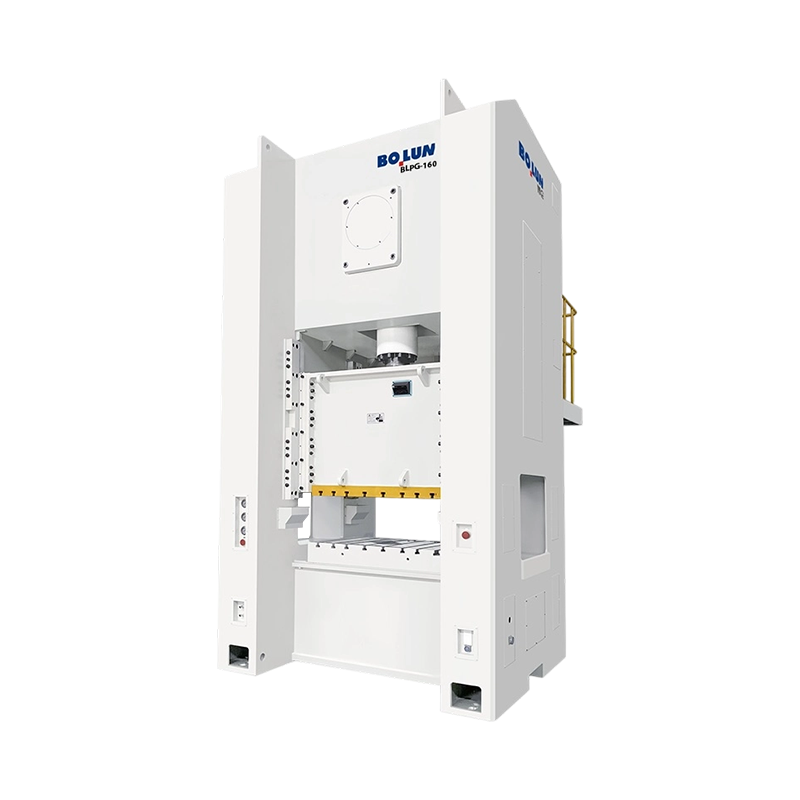
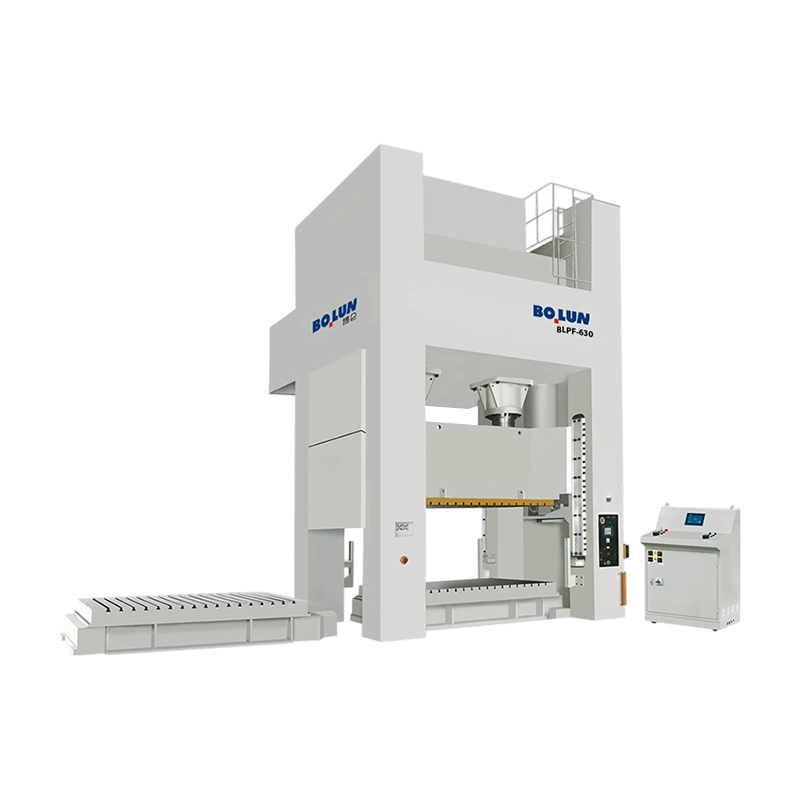
BLPG-160 Versatile Stable-Frame Closed-Type Single-Point Wide-Door Power Press
Accessibility is often underestimated when purchasing a power press. A machine may have sufficient tonnage and working area, but if the die opening is difficult to reach, setup time can increase and maintenance tasks can become unnecessarily complicated. The wide-door design of the BLPG-160 addresses this practical production concern.
A wide working opening allows operators and maintenance technicians to approach the tooling area more directly. This can be beneficial when installing a die, checking guide pins, inspecting fasteners, clearing scrap, or verifying the position of material guides. Better access can also reduce the need to work from awkward angles, improving the efficiency and quality of setup procedures.
Die changes are a major part of many stamping operations. Manufacturers producing multiple components on the same press may change tooling several times per shift or production day. A more accessible press can shorten the time required for these transitions, especially when combined with lifting equipment, standardized die carts, and clearly documented setup procedures.
The wide-door arrangement also benefits material handling. Depending on the production method, the machine may receive blanks, coils, pre-cut sheets, or partially formed components. Adequate access supports manual loading for lower-volume work and provides more space for integration with feeders, transfer devices, conveyors, or automated unloading systems.
During die tryout, operators need to observe the tooling and material path carefully. A wide opening improves visibility of the working zone, making it easier to identify interference, misalignment, incomplete forming, or abnormal material movement. Better visibility supports faster troubleshooting and reduces the likelihood that a minor setup issue will become a damaged die or rejected production batch.
Accessibility must always be used together with approved safety procedures. The wide door is not a substitute for guarding, interlocks, lockout procedures, or controlled setup modes. Its value lies in making authorized setup and maintenance activities more efficient within a properly managed safety system.
Correct die height is essential for reliable stamping. The relationship between the upper die, lower die, slide, worktable, and material determines whether the tool can complete its intended operation without excessive interference or insufficient forming pressure.
The BLPG-160 includes electric slide adjustment to make this setup process more convenient. Electric adjustment can reduce manual effort and enable faster positioning than purely manual systems. It is particularly useful when different dies require different shut heights or when operators need to make controlled changes during die tryout.
The die height indicator provides a practical reference for setup verification. Operators can record the appropriate setting for a specific tool and use the reference during future production runs. This supports repeatability between shifts and reduces dependence on memory or informal adjustment methods.
Accurate die-height control can also help protect tooling. If the slide is positioned incorrectly, the die may experience excessive impact, insufficient clearance, uneven contact, or incomplete forming. A clear adjustment system helps production personnel establish the correct working relationship before the press enters full-speed operation.
Many manufacturers do not produce one part continuously. They may use the same press for automotive components, appliance parts, electrical enclosures, hardware, brackets, and general industrial products. Each part may require a different die height, stroke condition, or material-handling arrangement.
A press that supports efficient adjustment is better suited to this type of flexible production. The BLPG-160 can serve as a central machine for several product families, provided that each application remains within the machine’s rated capacity, working envelope, speed, and safety requirements.
Electric adjustment also supports more orderly production documentation. A manufacturer can associate tooling identification, die-height settings, stroke data, lubrication requirements, and inspection criteria in a setup record. This approach improves repeatability and helps reduce variation when operators or production shifts change.
The 15 kW main motor provides the primary drive power for the BLPG-160. In a mechanical power press, motor performance affects more than simple starting capability. The drive system must support acceleration, continuous cycling, energy transmission, and recovery from changing load conditions.
A high-torque motor is valuable when the press operates under demanding forming conditions. Forming loads can vary during the stroke, especially when a die combines piercing, bending, drawing, or embossing actions. The drive system must deliver stable motion while the mechanical system manages these changes.
Consistent drive performance can help reduce fluctuations in production. If slide motion varies excessively, the resulting parts may show changes in forming depth, edge quality, burr formation, or dimensional accuracy. Stable mechanical operation supports the repeatability that modern manufacturers expect from a production press.
Motor sizing must always be considered together with the press cycle, material thickness, die design, stroke, and speed. The listed motor rating is an important reference, but actual production planning should be based on engineering validation of the complete process. A suitable application review helps ensure that the press is not routinely operated outside its intended conditions.
Efficient operation is not measured only by motor power. It also depends on cycle time, setup time, scrap rate, maintenance interruptions, and the percentage of machine capacity used productively. A press that completes each cycle consistently and minimizes avoidable adjustment can provide better overall productivity than a nominally faster machine that experiences frequent stoppages.
The BLPG-160’s combination of appropriate motor power, electric adjustment, accessible tooling space, and safety control can contribute to a balanced production system. The best results are achieved when the machine is integrated with suitable feeders, die-protection devices, lubrication systems, inspection methods, and preventive maintenance planning.
Power presses involve substantial mechanical energy, and safety must be considered a primary design requirement. The BLPG-160 incorporates photoelectric safety protection and dual solenoid valves to strengthen operational reliability and help protect personnel during production.
Photoelectric safety protection creates a monitored zone around the hazardous working area. If the light field is interrupted during a protected operating condition, the control system can initiate the required safety response according to the machine’s approved configuration. This type of protection is particularly useful when operators load, unload, or inspect parts near the die area.
Dual solenoid valves provide a redundant control arrangement for pneumatic functions. Redundancy can improve control reliability by reducing dependence on a single valve component. In safety-related systems, the design goal is to support controlled operation and reduce the consequences of a component fault.
These features do not replace operator training, physical guarding, emergency-stop systems, die protection, lockout and tagout procedures, or regular safety inspections. Instead, they form part of a broader safety architecture that should be evaluated according to applicable regulations and the specific production layout.
Safety requirements are different during automatic production, manual setup, die adjustment, cleaning, and maintenance. The press should be operated only through approved modes and procedures for each task. Operators must understand the function of the photoelectric protection system, the conditions under which it is active, and the correct response to an alarm or interruption.
Maintenance personnel should inspect protective devices, wiring, pneumatic components, emergency stops, and control functions at defined intervals. Safety systems are effective only when they are correctly installed, maintained, tested, and not bypassed.
The BLPG-160’s accessible wide-door arrangement can support safer authorized maintenance by giving technicians better access and visibility. However, all work inside the hazardous area must be conducted under controlled isolation and with appropriate mechanical and electrical safeguards.
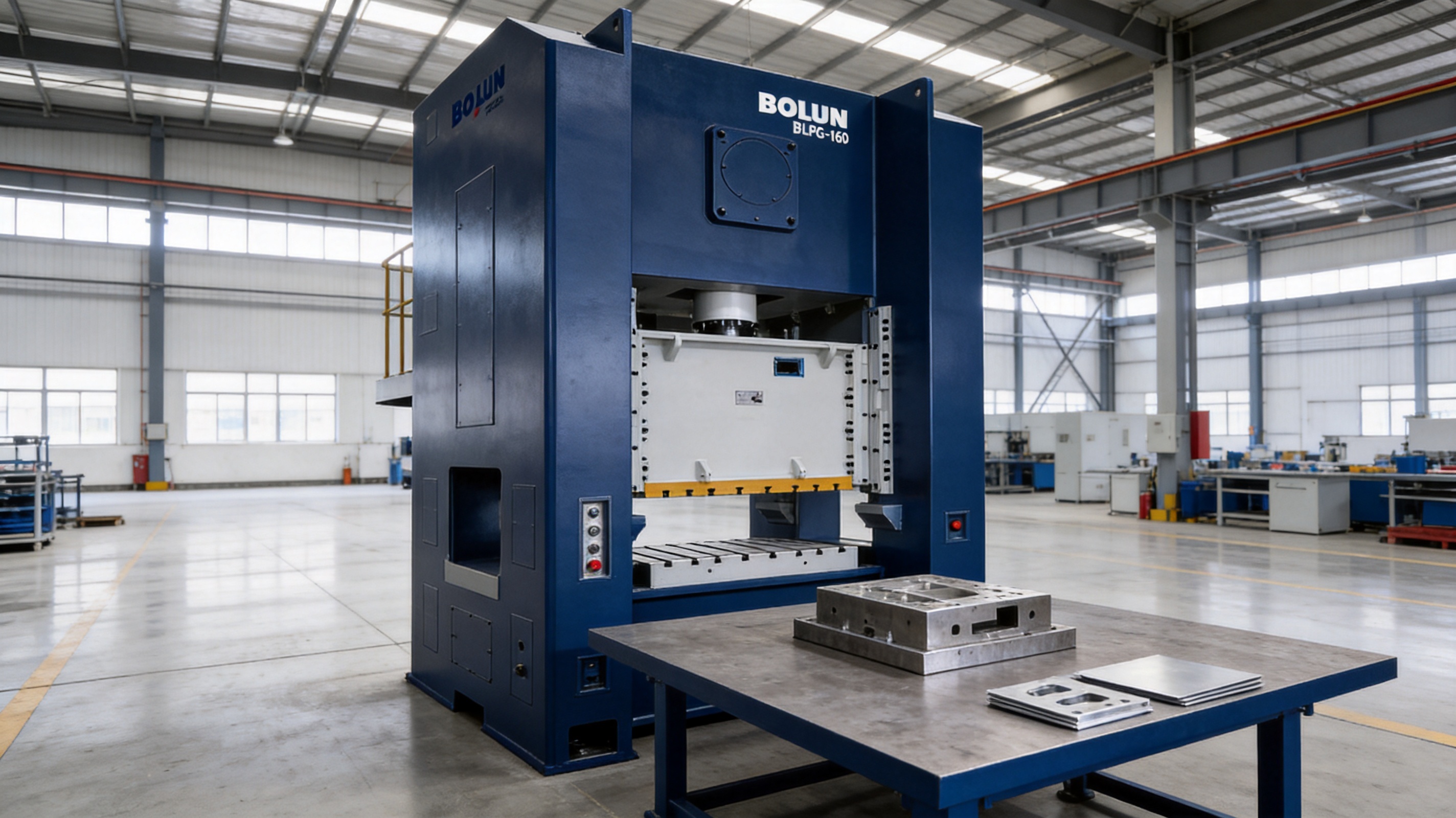
Product performance depends on manufacturing quality as much as on the published specification. A power press is a system of large structural parts, precision-machined surfaces, drive elements, adjustment mechanisms, electrical controls, pneumatic components, and safety devices. Each part must be produced and assembled accurately for the complete machine to perform reliably.
Zhejiang Bolun High-Precision Machinery Co., Ltd. has developed its manufacturing capabilities through approximately two decades of experience in machinery production. The company integrates research and development, engineering design, manufacturing, sales, and service. This integrated structure allows product requirements to move through a connected process rather than being separated among unrelated suppliers.
The company’s manufacturing approach includes advanced precision-processing equipment and a production environment covering basic design, core component development, machining, final assembly, and inspection. Such vertical integration can help improve control over key dimensions, component compatibility, and assembly quality.
For a high-capacity press, large structural components require careful fabrication and machining. The frame, worktable, slide, guide surfaces, and connection points must be produced with attention to geometry and repeatability. Precision processing helps ensure that the assembled machine provides the alignment required for stable die operation.
Different manufacturers may have significantly different requirements. One customer may need a press for blanking and piercing, while another may focus on drawing, bending, or multi-operation forming. Die dimensions, material characteristics, automation interfaces, production speed, and factory layout can all influence the final equipment configuration.
The company states that it provides non-standard customization capabilities and one-stop design and manufacturing services for products with special specifications and functions. This capability can be valuable when a standard machine must be adapted to a particular die, feeding system, control requirement, or production environment.
Customization should be approached through a formal technical review. The customer and manufacturer should confirm nominal force, pressure-stroke requirements, die height, slide stroke, worktable dimensions, column spacing, side openings, motor requirements, control interfaces, safety devices, and installation conditions before production begins.
Quality control for a power press should cover both individual components and complete machine performance. Component inspection may include dimensional verification, surface condition, material certification, machining accuracy, and assembly fit. Final inspection may include slide movement, adjustment operation, control response, safety-system performance, lubrication, pneumatic functions, and trial cycling.
The company describes a finished-product inspection system intended to exceed ordinary industry requirements. A rigorous inspection culture can help identify defects before shipment and improve confidence in long-term operation. It also provides valuable production records for service, troubleshooting, and future process improvements.
High-quality inspection is particularly important for large presses because transportation, installation, and commissioning can be complex. A machine that has been tested systematically before delivery gives the customer a stronger starting point for site acceptance and production validation.
When comparing power presses, buyers should evaluate the complete operating package rather than focusing only on nominal tonnage. The BLPG-160 offers several practical advantages over less specialized or less rigid press designs.
The closed-type frame is a major advantage for applications that demand stable load handling. It is better suited to controlled forming and precision work than a lightweight press intended mainly for low-load operations. The structure supports a more predictable relationship between the slide and worktable during production.
At 1600 kN, the BLPG-160 occupies a useful position for manufacturers that require substantial force but do not need the very large footprint or investment associated with extreme-capacity presses. This makes it a practical choice for expanding production lines, general industrial stamping, and specialized component manufacturing.
The wide-door design can shorten setup and maintenance activities by providing more direct access to the working area. Compared with a machine with a restricted opening, the BLPG-160 may offer better operator visibility and easier handling of dies and workpieces.
Electric slide adjustment and a die height indicator support faster and more repeatable tooling setup. These features are especially useful for manufacturers that operate multiple dies or change products frequently.
Photoelectric protection and dual solenoid valves contribute to a more complete safety and control package. Their inclusion demonstrates that the machine is designed not only for force generation but also for controlled industrial operation.
The manufacturer’s experience in design, processing, assembly, inspection, and non-standard customization can provide an advantage when the customer’s requirements extend beyond a basic catalog configuration. This is important for production lines that involve special die dimensions, automation connections, or unusual material-handling conditions.
A press should be evaluated over its entire service life. Documentation, spare parts, troubleshooting support, training, and after-sales response can have a direct impact on total cost of ownership. A manufacturer with integrated technical and service capabilities may be better positioned to support the machine after installation.
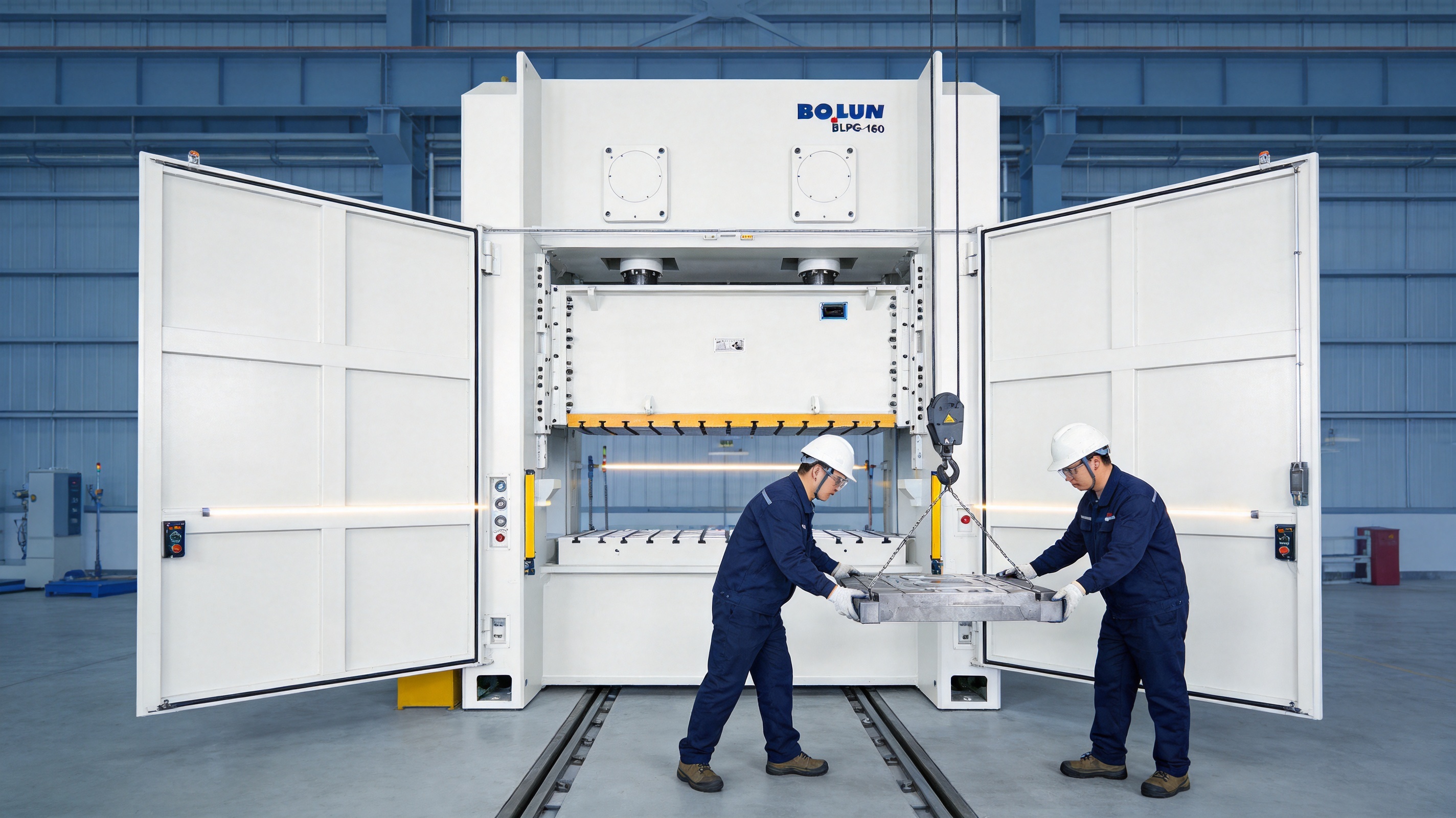
The BLPG-160 can be used across several industrial forming categories, subject to engineering confirmation and die validation. Its capacity and worktable dimensions make it suitable for a wide range of medium-sized components.
The machine can support the production of brackets, reinforcement parts, structural fittings, shields, covers, and other formed metal components. Automotive applications often require repeatable dimensions, stable tooling alignment, and reliable continuous cycling. The closed frame and setup features are relevant to these demands.
Manufacturers of appliances, cabinets, housings, panels, and electrical components may require blanking, bending, piercing, and shallow drawing operations. The 800 × 700 mm worktable provides a practical base for many medium-size dies, while the wide opening supports convenient handling during tool changes.
Industrial hardware companies may use the press for brackets, mounting plates, structural pieces, flanges, and formed fittings. These products often involve multiple material grades and thicknesses, making reliable adjustment and process control important.
The press may also be appropriate for selected parts used in metal furniture, storage equipment, commercial displays, and workplace systems. Depending on the material and die design, operations may include bending, punching, embossing, and forming.
When the die and material are properly matched, the stable structure can support precision blanking and forming work. The actual achievable tolerance depends on material properties, tooling accuracy, lubrication, machine installation, process parameters, and inspection practices. The press provides the mechanical foundation, but the complete manufacturing system determines final part quality.
A high-capacity press should be installed on a properly prepared foundation. The foundation must be capable of supporting the machine weight and managing operational forces. Installation planning should include floor strength, leveling, anchoring, access for delivery, overhead clearance, electrical supply, pneumatic supply, ventilation, and space for maintenance.
Before commissioning, the customer should confirm that the press has arrived without transport damage. Electrical cabinets, safety devices, pneumatic components, lubrication points, fasteners, and exposed machined surfaces should be inspected. The machine should then be leveled and connected according to the manufacturer’s technical instructions.
Initial commissioning should begin with controlled checks at low speed or in setup mode. Operators and technicians should verify slide movement, stop functions, adjustment operation, die-height indication, photoelectric protection, dual solenoid valve response, lubrication, and emergency controls before full production cycling.
Tool installation should follow an approved procedure. The die must be compatible with the worktable, slide bottom, die height, stroke, and rated load. Fasteners must be correctly selected and tightened. The material path should be checked for interference, and the complete cycle should be tested without production material before the first trial run.
Preventive maintenance is essential for protecting the investment in a power press. A maintenance program should include routine cleaning, lubrication, inspection of fasteners, checking of electrical connections, examination of pneumatic components, and testing of protective devices.
Operators should monitor abnormal noise, vibration, temperature, slide behavior, oil or air leakage, inconsistent adjustment, and changes in part quality. Early signs of mechanical or electrical problems should be reported before they develop into major failures.
The working area should be kept free of scrap and excess material. Accumulated debris can interfere with sensors, obstruct material movement, damage tooling, or create trip and access hazards. Cleaning should be performed under the correct safety and isolation procedures.
Die maintenance is also closely connected to press reliability. A damaged or poorly lubricated die can transfer abnormal loads to the machine. Regular die inspection, correct lubrication, and proper material preparation reduce unnecessary stress on the press and improve product consistency.
| Maintenance interval | Typical checks | Purpose |
| Every shift | Clean work area, inspect for abnormal noise, verify safety devices, check visible leaks | Identify immediate operating risks |
| Weekly | Inspect fasteners, lubrication points, die area, pneumatic connections, and electrical indicators | Prevent small issues from developing |
| Monthly | Review slide adjustment, die-height reference, guards, photoelectric protection, and control response | Maintain setup accuracy and safety performance |
| Periodic service | Detailed inspection of drive components, guide surfaces, valves, wiring, and structural connections | Support long-term reliability |
| After tooling changes | Verify die alignment, stroke clearance, material path, and trial-cycle behavior | Reduce setup-related damage and scrap |
Nominal capacity should not be treated as a target that must be reached on every cycle. The required force depends on material type, thickness, tensile strength, part geometry, cutting perimeter, forming depth, friction, die clearance, and production speed.
For blanking and piercing, the required force is influenced by the material’s shear strength and the total cutting perimeter. For bending, engineers must consider bend length, material thickness, die opening, and the selected bending method. Drawing operations require attention to blank-holder force, draw ratio, lubrication, material flow, and the number of forming stages.
The press should be selected with an appropriate safety margin. Operating close to maximum capacity for every cycle may increase mechanical stress and reduce service life. A technical evaluation should also consider where in the stroke the maximum load occurs, because the rated nominal pressure stroke identifies the region in which the press is designed to deliver its nominal force.
Production engineers should validate the process through die trials and sample inspection. Measurements should include critical dimensions, flatness, hole position, forming depth, edge condition, burr height, and surface quality as appropriate to the part.
The purchase price is only one element of the cost of a power press. Total cost of ownership includes installation, tooling, energy, labor, maintenance, spare parts, downtime, scrap, and eventual refurbishment or replacement.
The BLPG-160 can support cost control through several mechanisms. Its stable frame may help reduce tooling wear and dimensional variation. Electric slide adjustment can shorten setup time. The wide-door configuration can make die changes and maintenance more efficient. Safety systems can reduce operational risk, while a structured manufacturing and service system can support long-term reliability.
Productivity gains often come from reducing non-productive time rather than simply increasing strokes per minute. A press that changes dies efficiently, starts reliably, maintains repeatable settings, and operates safely can provide strong value even when its speed is not the highest available in the market.
Buyers should evaluate the machine according to the complete production requirement. Questions should cover expected annual hours, number of product changes, die size, material range, automation needs, operator skill, maintenance resources, and future capacity expansion.
Customers purchasing a large power press are investing in a long-term production asset. They need confidence that the manufacturer can control the complete process from engineering through final acceptance.
An integrated manufacturer can coordinate structural design, machining, assembly, control integration, safety-system installation, testing, and customer support. This reduces the risk that critical responsibilities will be divided among multiple parties without clear ownership.
Advanced manufacturing equipment is important, but it must be combined with process discipline. Precision machining, controlled welding or frame fabrication, accurate assembly, systematic inspection, and documented testing all contribute to final quality.
The company’s stated focus on technology, customization, quality inspection, and full-chain production reflects the requirements of modern industrial buyers. These capabilities are particularly relevant when a customer needs a press adapted to a specific forming line rather than a generic machine purchased without engineering support.
The BLPG-160 is a closed-type single-point power press designed for precision stamping, forming, drawing, blanking, bending, and related metal-forming operations.
The nominal capacity is 1600 kN. The actual usable capacity for a specific process depends on the material, die design, load position, stroke conditions, cycle rate, and applicable safety margin.
The product description identifies an 800 × 700 mm worktable. Buyers should confirm the final table dimensions, mounting holes, thickness, and other interface details in the technical quotation for the selected configuration.
The wide-door design improves access to the die and worktable area. It can assist with die installation, material handling, inspection, cleaning, maintenance, and setup verification.
Electric slide adjustment allows operators to position the slide more conveniently when setting different dies. It can reduce manual adjustment work and support more repeatable setup when used together with the die height indicator.
The product description identifies integrated photoelectric safety protection and dual solenoid valves. These features should be used together with guarding, emergency-stop systems, approved operating modes, training, and applicable safety procedures.
Potential industries include automotive components, transportation equipment, appliances, electrical products, general hardware, industrial equipment, metal furniture, and other sectors requiring medium-to-high-load sheet-metal forming.
The manufacturer states that it provides non-standard customization and one-stop design and manufacturing services. Customization may involve dimensions, special functions, tooling interfaces, automation integration, control requirements, or production-line arrangements. Each project requires technical confirmation.
Customers should confirm nominal capacity, pressure stroke, slide stroke, strokes per minute, maximum die height, die height adjustment, column spacing, worktable size, slide bottom size, side opening, motor rating, electrical standards, pneumatic requirements, safety equipment, and installation conditions.
It is designed for industrial production and continuous operating conditions, provided that the selected process remains within the machine’s rated parameters and that correct tooling, maintenance, lubrication, safety, and operating procedures are followed.
The BLPG-160 combines a 1600 kN nominal capacity with a stable closed-type frame, an 800 × 700 mm worktable, a 15 kW high-torque motor, electric slide adjustment, a die height indicator, wide-door access, photoelectric protection, and dual solenoid valve control. Together, these features make it a practical platform for manufacturers seeking stable and repeatable performance in medium-to-high-load forming applications.
Its strongest advantages are not limited to tonnage. The machine is designed around the complete production experience: maintaining structural stability under load, improving die accessibility, simplifying setup, supporting operator protection, and providing a foundation for efficient long-term manufacturing.
The manufacturer’s capabilities in research and development, precision processing, customization, assembly, inspection, and after-sales support further strengthen the product proposition. For customers comparing power presses, these manufacturing capabilities are important because reliability depends on the quality of the complete machine, not merely on an individual specification.
For companies producing formed metal components and seeking a durable production asset, the BLPG-160 represents a balanced solution. It offers the force required for demanding applications while retaining practical features that can reduce setup time, support tooling flexibility, and improve day-to-day usability. With correct process engineering, installation, maintenance, and safety management, it can serve as a dependable component of a modern stamping line.
1. General principles of mechanical power press design, force transmission, and frame rigidity.
2. Industrial guidance on sheet-metal stamping, blanking, bending, forming, and drawing processes.
3. Recommended practices for power press installation, commissioning, guarding, and preventive maintenance.
4. Industrial machine-tool quality management and final inspection procedures.
5. Manufacturer-provided product specifications and technical information for the BLPG-160 closed-type single-point power press.
6. Manufacturer-provided information regarding precision machinery research, development, manufacturing, customization, quality control, and service.


Two presses can both carry a 200-tonne nameplate and still produce very differe...
A tooling engineer quotes a new bracket program and specifies a 160-ton press. ...
A fastener plant in Taizhou receives a request from an automotive tier-one supp...
A buyer comparing a 45-ton open-gap press for a bracket line often receives two...
What Is a Power Press? A power press — also called a stamping press or punch pr...
A mid-size fastener manufacturer recently faced a familiar problem: its CNC lat...
Contact Us

topbolun@gmail.com

+86-575-83362228

+86-13735238388
+86-18667502750

+86-575-83362999

+8618667502750

No.1 Linjiang Road East, Xiaren, Jinting Town, Shengzhou City, Zhejiang Province, China
Ready to Begin?
Get in Touch

Now!

ZHEJIANG BOLUN
 English
 中文简体