Cold forging is one of the most demanding metal-forming processes in modern manufacturing. It requires a machine to apply very high forming forces while maintaining accuracy, rigidity, repeatability, and dependable production performance. Components such as automotive fasteners, transmission parts, steering elements, bearing components, heavy-duty pins, sleeves, shafts, and other precision-forming products must often be produced from difficult-to-deform materials. The equipment used for these operations must therefore deliver more than simple pressing force. It must provide controlled motion, strong structural support, efficient energy transmission, safe operation, and a stable production environment.
The BLKP-850 Industrial Strength Heavy-Duty Cold Forging Toggle Type Power Press is engineered for this class of application. With a nominal capacity of 8,500 kN, it occupies a high-capacity position within the BLKP series of cold forging toggle presses. Its configuration combines a rigid industrial frame, a toggle-type transmission mechanism, an 8 mm nominal pressure stroke, a 600 × 700 mm worktable, and a 180 mm thickened bolster. Together, these features provide a platform for high-load forming operations in automotive, machinery, transportation, construction-equipment, and general industrial component production.
Unlike a general-purpose mechanical press designed primarily for blanking or conventional stamping, a cold forging toggle press must manage the final forming stage with exceptional stability. The forming load can rise rapidly near the bottom of the stroke, and even small structural deflections may influence part dimensions, die life, flash formation, and material flow. The BLKP-850 is designed around this reality. Its toggle mechanism supports a controlled low-speed forming phase, while its rigid frame and reinforced work area help preserve the relationship between the die, slide, and worktable under severe loading.
This article examines the machine’s technical configuration, operating advantages, manufacturing strengths, application potential, safety provisions, maintenance considerations, and position compared with more conventional forming equipment. It also explains how Zhejiang Bolun High-Precision Machinery Co., Ltd. supports the product through integrated engineering, precision manufacturing, inspection, customization, and service.
The BLKP-850 is a toggle type power press developed for high-force cold forging. Its nominal capacity is 8,500 kN, equivalent to 8,500 kilonewtons of rated forming force. This level of capacity allows manufacturers to address large or highly resistant workpieces that would exceed the practical range of many medium-sized stamping presses.
In a cold forging operation, the workpiece is formed without heating it to a plasticizing temperature. The material remains comparatively hard, and the die must force it to flow into a carefully designed cavity. This method can produce high-strength components with excellent grain flow, improved material utilization, and reduced machining requirements. However, the process places heavy demands on the press. The machine must withstand substantial peak forces, sustain repeated load cycles, and maintain sufficient alignment for the complete production run.
The BLKP-850 is particularly suited to applications where the final forming action requires a short but powerful pressure stroke. Its nominal pressure stroke is 8 mm. This figure should not be confused with the total slide stroke. The total slide stroke is 180 mm, while the nominal pressure stroke identifies the portion of the motion associated with rated forming pressure. The combination gives the operator or process engineer a relatively broad slide movement for die access and workpiece transfer, together with a concentrated high-pressure forming stage near the bottom of the cycle.
The machine’s 600 × 700 mm worktable provides a substantial die-mounting area for high-capacity tooling. The 180 mm bolster thickness adds support beneath the die set and helps distribute forming loads through the press structure. For cold forging, this support is especially important because the die assembly must remain stable when the forming force increases sharply.
The BLKP-850 is not intended merely to replace a smaller press with a larger nominal number. Its value lies in the relationship between capacity, transmission design, frame rigidity, table support, operating control, and production-oriented safety. These elements must function together if the press is to deliver reliable results in an industrial environment.
The following table summarizes the principal published specifications for the BLKP-850. Where the source data identifies a series-wide specification rather than a model-specific value, the information is presented as supplied.
| Specification | BLKP-850 Value | Unit | Production Significance |
|---|---|---|---|
| Machine type | Toggle type cold forging power press | — | Supports controlled high-force forming and low-speed pressure application |
| Nominal capacity | 8,500 | kN | Provides a high-load forming range for demanding components |
| Nominal pressure stroke | 8 | mm | Defines the rated high-pressure forming portion of the cycle |
| Slide stroke | 180 | mm | Provides working movement for die operation and part handling |
| Strokes per minute | 25–40 | S.P.M. | Allows production speed to be matched to material, tooling, and process requirements |
| Maximum die height | 500 | mm | Accommodates substantial die assemblies |
| Maximum die weight | 1,200 | kg | Supports large and robust cold forging tooling |
| Worktable size | 600 × 700 × 180 | mm | Combines a practical die area with a thickened bolster |
| Slide bottom size | 450 × 550 | mm | Provides the die-facing mounting area at the slide |
| Working-face height | 1,030 | mm | Creates an elevated work position for production integration |
| Die-height adjustment | 15 | mm | Permits fine adjustment for tooling setup |
| Air pressure | 0.55 | MPa | Identifies the stated pneumatic operating requirement |
| Main motor | 75 × 4 | kW × poles | Provides the primary drive power for the heavy-duty press |
| Mold pad capacity | 300 | kN | Supports lower-tool or die-pad force requirements |
| Ram stroke | 70 | mm | Provides movement for the lower ejection or forming system |
The capacity and dimensional combination is important. A press with high nominal force but insufficient die space may be unsuitable for a complex cold forging process. Conversely, a press with a large table but inadequate structural capacity may suffer from excessive deflection or premature wear. The BLKP-850 addresses both requirements by pairing 8,500 kN capacity with a 600 × 700 mm worktable, a 1,200 kg maximum die weight, and a 500 mm maximum die height.
The machine’s stated production range of 25–40 strokes per minute gives manufacturers room to select a suitable operating point. The actual speed used in production will depend on the workpiece, material grade, die design, lubrication system, transfer arrangement, required accuracy, and thermal conditions. A difficult high-reduction forming process may require a conservative speed, while a stable and well-validated process may operate closer to the upper end of the range.
The defining mechanical feature of the BLKP-850 is its toggle-type transmission. A toggle mechanism uses linked members to transform rotary drive into a controlled reciprocating slide movement. As the links approach a nearly straightened position near the bottom of the stroke, the mechanism produces a mechanical advantage that allows a high forming force to be developed over a short distance.
This motion profile is valuable in cold forging because the forming load is not evenly distributed throughout the slide travel. During the approach phase, the die must provide clearance for the workpiece and allow material positioning or transfer. During the final forming phase, the material is forced into the die cavity, and the required pressure can rise sharply. The toggle arrangement provides a comparatively slower movement near the point where the forming force is highest.
Controlled low-speed forming can provide several process benefits. It may improve material flow into complex die sections, reduce sudden impact loading, and give the tooling more time to complete the final forming action. It can also reduce the risk of unstable material movement caused by an excessively rapid closing phase. These benefits are not automatic; they depend on correct die design, material preparation, lubrication, and process setup. Nevertheless, the mechanical characteristics of a toggle press are well matched to the pressure requirements of cold forging.
Compared with a conventional high-speed mechanical press, a toggle press can offer a more favorable force distribution near the bottom of the stroke. A standard crank press may deliver high speed and excellent productivity for many stamping tasks, but its motion and force characteristics may be less suitable for operations that demand extended controlled pressure at the end of the stroke. The BLKP-850 is designed specifically around the latter requirement.
Compared with a hydraulic press, a toggle press may provide a more direct mechanical transmission of drive energy and a more clearly defined cycle. Hydraulic equipment offers highly flexible force and speed control, but its performance depends on pumps, valves, oil temperature, seals, filtration, and hydraulic control systems. For repetitive cold forging, a mechanical toggle press can provide a robust alternative with a compact high-force action and a production rhythm suited to automated operations.
The correct comparison is therefore application-based rather than based only on nominal capacity. A conventional press may be suitable for a shallow stamping operation, while a hydraulic press may be preferable for a very long dwell or unusual forming path. For high-load cold forging that benefits from a concentrated pressure stroke, the toggle configuration offers a strong technical rationale.
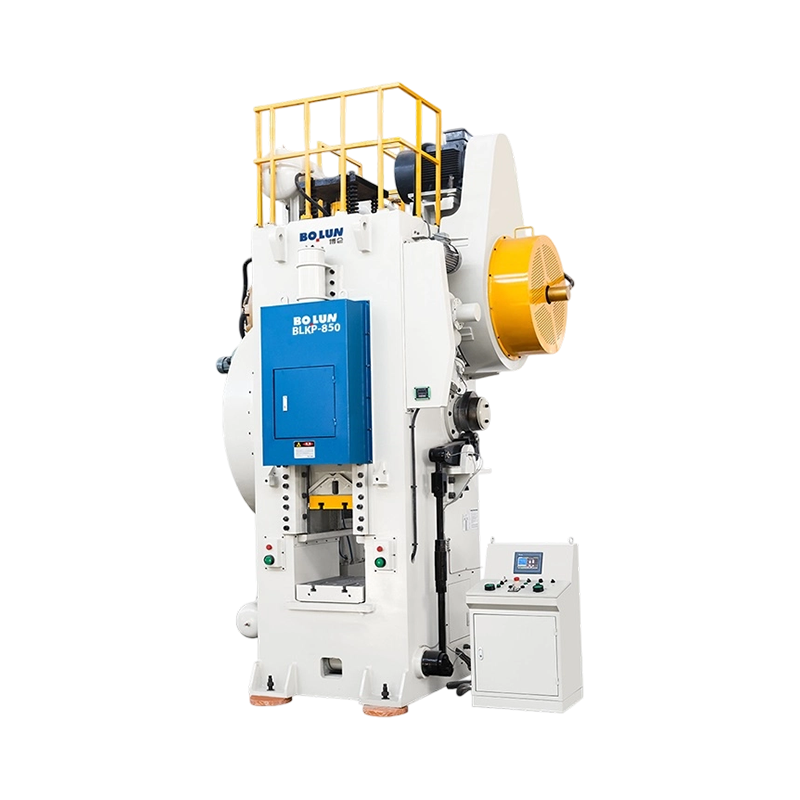
BLKP-850 Industrial Strength Heavy-Duty Cold Forging Toggle Type Power Press
Cold forging exposes a press to repeated high loads that can challenge the frame, bolster, slide, guides, bearings, drive components, and foundation. Structural rigidity is consequently one of the most important factors affecting production quality. If the frame or worktable deflects excessively, the die may not close evenly. Uneven closure can cause dimensional variation, accelerated die wear, flash, cracking, poor surface quality, or unstable material flow.
The BLKP-850 is built on an ultra-rigid industrial frame intended for continuous heavy-duty operation. The frame must transfer forming force through the machine in a controlled manner while limiting deformation. The thickened 180 mm worktable bolster is an important part of this load path. It supports the die set directly and creates a stronger platform for the high-pressure forming stage.
Rigidity is not limited to the frame itself. The slide bottom size of 450 × 550 mm must maintain alignment with the worktable throughout the cycle. The die height and adjustment system must allow the tooling to be positioned accurately. The ram or lower ejection arrangement must also operate without introducing undesirable side loads or timing variation. A heavy-duty press is therefore best understood as a complete structural system rather than a motor and frame alone.
A stable load path can also benefit tool life. Forging dies are expensive precision components, and their service life depends on stress distribution, alignment, lubrication, material condition, and the number of forming stages. Excessive press deflection can place additional localized stress on die corners and inserts. By providing a reinforced work area and a rigid frame, the BLKP-850 is designed to reduce structural instability during demanding forming cycles.
For production managers, structural stability has a direct economic effect. A press that maintains repeatable die closure can reduce adjustment frequency, limit rejected parts, extend intervals between die repairs, and make process validation more reliable. These advantages can be more valuable than a nominal speed increase that is difficult to sustain in real production.
The 600 × 700 mm worktable offers a practical area for die installation, while the 180 mm bolster thickness supports the die against the forming reaction. The table dimensions should be considered together with the 450 × 550 mm slide bottom size. This relationship helps process engineers evaluate die footprint, mounting arrangement, guide-post placement, transfer clearance, and access for maintenance.
The maximum die weight of 1,200 kg also indicates that the machine is intended for substantial tooling. A heavy die set can improve forming stability and durability, but it requires suitable lifting equipment, secure mounting procedures, and a properly prepared foundation. The final installation should always be checked against the approved machine layout, foundation drawing, die specifications, and local safety requirements.
The stated 15 mm die-height adjustment allows fine positioning of the tooling. This adjustment range is not a substitute for correct die design or full setup control, but it can assist with matching the die stack to the machine’s working geometry. Accurate die-height adjustment supports consistent bottom-dead-center conditions and helps the operator establish a repeatable process window.
Cold forging is frequently selected because it can improve material utilization and produce favorable mechanical properties. The process can preserve or redirect grain flow rather than cutting away large amounts of material through machining. However, materials that provide high strength in the finished component can also be difficult to form. High-strength steels, alloy steels, stainless materials, and other engineering alloys may require carefully controlled deformation, intermediate annealing, specialized lubrication, and multiple forming stages.
The BLKP-850 contributes to this process through its high capacity and toggle motion. The 8,500 kN nominal force gives the machine a broad operating range for high-load applications, while the 8 mm nominal pressure stroke focuses the rated pressure in the final forming portion of the movement. The slower action near the bottom of the stroke can help the die complete difficult deformation with less abrupt impact than a fast closing motion.
Process engineers should not interpret press capacity as a guarantee that any material or part can be forged in one operation. The required force depends on material strength, initial billet dimensions, reduction ratio, friction, die geometry, temperature, lubrication, strain distribution, and forming speed. A responsible production plan begins with engineering calculations, simulation where appropriate, sample trials, and inspection of the finished part. The machine provides the force and motion platform; successful cold forging still depends on the complete process system.
For multi-stage cold forging, the press can be integrated with progressive dies, transfer systems, material feeding equipment, part ejection devices, lubrication units, and inspection stations. The available slide stroke, die height, table area, and lower ram stroke should be evaluated as part of the complete line design. When the machine is combined with suitable automation, it can support repeatable cycle timing and reduced manual handling.
One of the major advantages of cold forging over extensive subtractive machining is the potential to achieve near-net-shape parts. By forcing material into the required geometry, manufacturers may reduce chips, shorten machining time, and improve the utilization of expensive alloy stock. The economic result depends on the component and tooling investment, but high-volume production can benefit significantly from a well-designed forging route.
The BLKP-850 is appropriate for production environments in which the cost of tooling and process development can be justified by the output volume and part requirements. Its heavy-duty construction is aimed at sustained industrial service rather than occasional laboratory use. This makes it relevant to automotive suppliers, industrial component manufacturers, and heavy equipment producers seeking a dedicated high-force forming platform.
The published strokes-per-minute range for the BLKP-850 is 25–40 S.P.M. This range should be viewed as a process capability window rather than a fixed production promise. The ideal speed must be determined through commissioning and process validation. Factors such as die filling, lubrication transfer, billet feeding, part ejection, heat generation, operator access, and quality inspection all influence the suitable setting.
For a simple operation with robust tooling and stable material preparation, a higher cycle rate may be practical. For a severe reduction, complex cavity, large billet, or narrow dimensional tolerance, a lower rate may be preferred. Operating at a controlled speed can reduce stress on the die and give the lubrication system more time to perform its function.
The toggle mechanism provides a distinctive cycle profile: relatively rapid movement through portions of the stroke and controlled movement near the pressure point. This can improve productivity without relying on a uniformly high slide speed. In other words, the machine’s efficiency is derived from matching motion to the forming task, not simply from maximizing strokes per minute.
Production planners should also consider planned pauses for die inspection, lubrication-system checks, part-quality verification, and removal of accumulated debris. A machine that operates continuously at a sustainable rate is generally more valuable than one that reaches a higher theoretical speed but requires frequent stoppages or produces inconsistent parts.
Lubrication is fundamental to cold forging. It reduces friction between the workpiece and die, supports material flow, limits galling, reduces forming force, and helps control die temperature. Inadequate lubrication can cause surface defects, increased tool wear, difficult ejection, material pickup, and unstable dimensions.
The BLKP-850 incorporates recursive lubrication as part of its operating configuration. A continuous or recurring lubrication arrangement helps distribute lubricant to relevant machine components and supports stable operation during repeated production cycles. The exact lubricant type, delivery points, filtration arrangement, inspection schedule, and replenishment interval should follow the machine documentation and the lubricant supplier’s recommendations.
Machine lubrication and workpiece or die lubrication are related but distinct. The press’s mechanical components require their own lubrication regime, while the forging interface may require a specialized coating or compound selected for the workpiece material and forming process. Operators should not assume that one system replaces the other. Both must be monitored.
In a heavy-duty environment, maintenance personnel should inspect toggle links, pins, bearings, guides, drive components, fasteners, and lubrication lines at defined intervals. Abnormal noise, temperature, vibration, leakage, or changes in cycle behavior should be investigated promptly. Preventive maintenance protects not only the press but also the expensive dies and the consistency of the finished product.
An integrated lubrication arrangement can reduce the risk of missed manual lubrication points and help standardize maintenance across shifts. It can also support better production records by allowing the maintenance team to document lubrication checks, filter condition, replenishment, and any observed abnormalities.
However, an automatic or recurring lubrication system does not eliminate inspection. Blocked lines, depleted reservoirs, incorrect lubricant viscosity, damaged fittings, or sensor faults can compromise the system. A reliable maintenance program combines automatic support with visual checks, scheduled servicing, condition monitoring, and operator awareness.
A high-capacity press requires a safety system appropriate to its stored energy and operating force. The BLKP-850 is equipped with a photoelectric safety system intended to enhance protection around the working area. Photoelectric protection uses a light curtain or related sensing arrangement to detect intrusion into a defined hazard zone. When correctly installed, configured, and integrated with the press control system, it can help prevent a cycle from continuing when a person enters the protected area.
Safety equipment must be treated as part of the complete machine system. The photoelectric device must be positioned correctly, kept clean, checked regularly, and tested according to the manufacturer’s instructions. It should not be bypassed, obstructed, or treated as a replacement for guarding, lockout procedures, safe die-setting practices, training, and risk assessment.
Before commissioning the press, the user should evaluate the complete production cell. This includes the die area, feeding and transfer equipment, lower ram or ejection system, maintenance access, electrical controls, pneumatic supply, emergency stops, foundation, lifting operations, and material-handling routes. The machine should be operated only by trained personnel who understand the press cycle and the hazards associated with cold forging.
Safety procedures are particularly important during die changes and troubleshooting. The main drive should be isolated, stored energy should be controlled, and the slide or tooling should be mechanically secured where required. Operators should never reach into the die area while the press is energized or rely solely on the control panel to prevent movement.
The inclusion of photoelectric protection is a meaningful advantage compared with older or minimally equipped presses that depend mainly on manual awareness. Nevertheless, the greatest level of protection comes from combining the machine’s built-in devices with a documented safety management system.
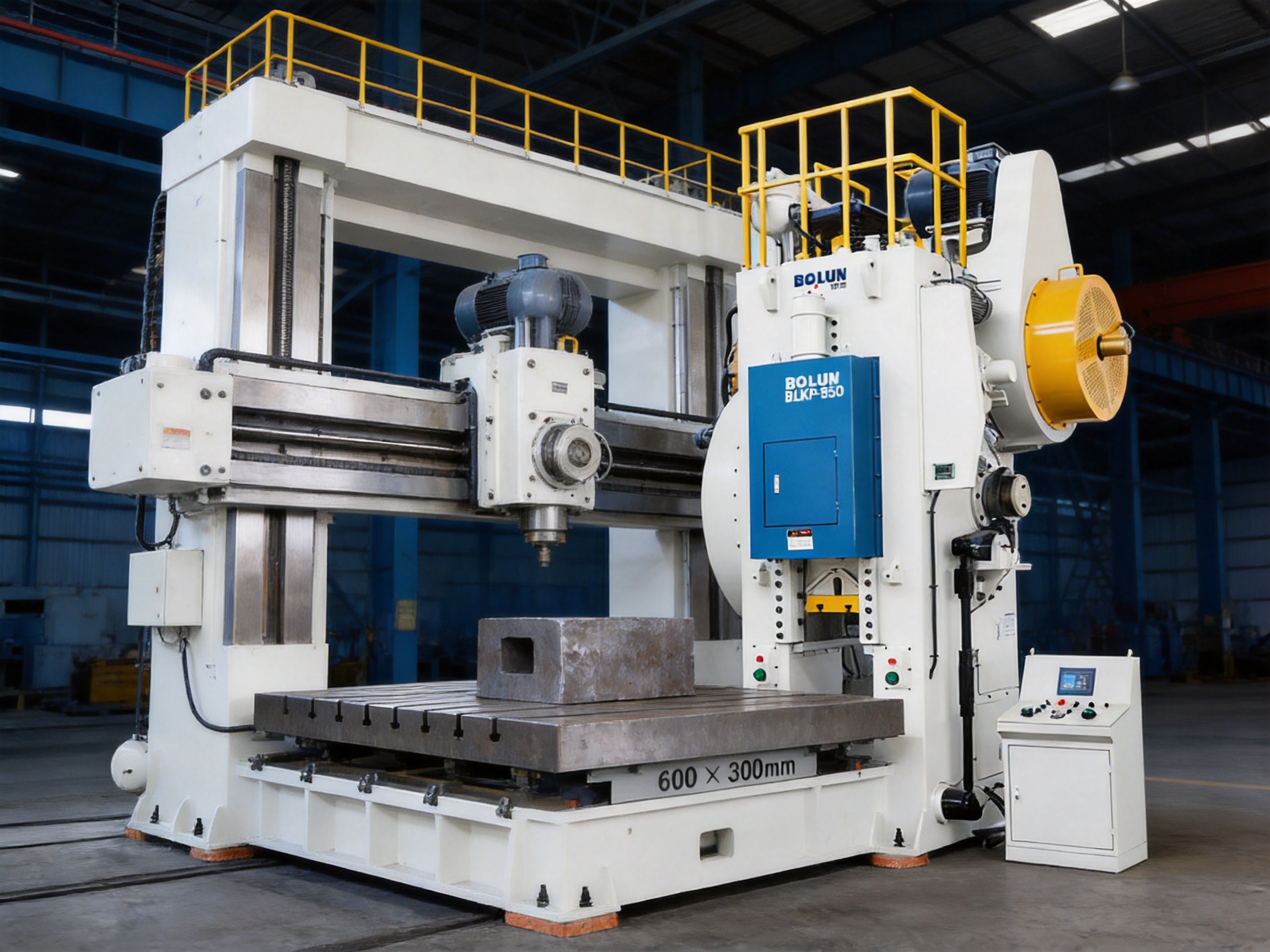
Conventional power presses remain useful for many stamping operations, particularly blanking, bending, shallow drawing, and general sheet-metal work. Their advantages may include relatively simple tooling, high cycle speed, broad availability, and suitability for common production tasks. However, a general-purpose press may not provide the force profile, bolster support, or structural configuration required for severe cold forging.
The BLKP-850 offers several application-specific advantages over a conventional press of comparable working size:
High concentrated forming force: The 8,500 kN nominal capacity is designed for high-load operations that exceed the range of many standard stamping machines.
Toggle-type pressure profile: The mechanism provides increased mechanical advantage and controlled movement near the bottom of the stroke, which is valuable when the final forming stage demands substantial pressure.
Reinforced work area: The 180 mm thickened bolster provides substantial support beneath the die and helps the machine manage repeated high loads.
Large tooling capability: A maximum die weight of 1,200 kg and maximum die height of 500 mm support heavy, complex tooling arrangements.
Cold-forging orientation: The machine is configured for the requirements of cold forming rather than being adapted from a light-duty sheet-metal application.
Production protection: The photoelectric safety system and recurring lubrication support regular industrial operation when maintained and used correctly.
These advantages should be evaluated together with the user’s actual requirements. A high-capacity press has greater installation, tooling, energy, foundation, and maintenance requirements than a smaller machine. The best equipment choice is the one that matches the complete process, not simply the press with the highest force rating.
Hydraulic presses are widely used for deep forming, long dwell operations, calibration, assembly, and processes requiring flexible force control over a long stroke. Their ability to hold force and control movement independently can be useful for unusual geometries or low-volume production.
A toggle mechanical press such as the BLKP-850 has a different performance profile. It is suited to repetitive production where a defined mechanical cycle, concentrated bottom pressure, and high throughput are important. The mechanical linkage can provide efficient force multiplication near the forming position and a repeatable relationship between drive rotation and slide motion.
The choice between the two technologies should consider:
Cycle requirements: Repetitive high-volume cold forging often favors a mechanical cycle, while long dwell or variable stroke processes may favor hydraulics.
Material flow: The toggle press is well suited to a controlled final forming phase, while hydraulic equipment may offer more freedom for slow movement throughout the entire stroke.
Maintenance resources: Hydraulic systems require attention to oil cleanliness, pressure stability, seals, pumps, valves, and temperature. Mechanical presses require attention to links, bearings, gears, clutches, brakes, guides, and lubrication.
Energy and production economics: The most economical solution depends on cycle time, motor loading, utilization rate, tooling, maintenance, and the cost of rejected parts.
For manufacturers producing high volumes of demanding cold-forged parts, the BLKP-850 provides a focused mechanical solution rather than a general-purpose alternative.
The performance of a heavy-duty press depends strongly on the capabilities of the company that designs, builds, tests, and services it. Zhejiang Bolun High-Precision Machinery Co., Ltd. operates as an integrated manufacturer covering research and development, design, production, sales, and service. This structure allows the company to manage the product through multiple stages instead of relying solely on disconnected external assembly.
The company has developed its machinery business over approximately two decades and focuses on forging, casting, and high-precision forming equipment. Its manufacturing approach combines engineering development, precision processing, component production, final assembly, inspection, and customer support. For a high-force press, such integration is valuable because performance depends on the interaction of many parts: frame geometry, transmission alignment, machining accuracy, bearing fits, die mounting surfaces, lubrication passages, electrical controls, and safety devices.
Precision machining is essential for the critical surfaces of a power press. Worktable flatness, slide alignment, guide interfaces, bearing seats, shaft locations, and toggle-link connections must be produced and inspected within appropriate tolerances. Advanced processing equipment and a mature industrial environment allow the manufacturer to control these stages more systematically.
Precision does not mean that every component must be manufactured to the same tolerance. Instead, it means that critical relationships are identified and controlled. For example, the alignment between the slide and worktable is more important to forming quality than a nonfunctional external surface. A capable manufacturer applies engineering judgment to determine which dimensions, geometric tolerances, material properties, and surface conditions have the greatest effect on machine performance.
A full-chain production system can improve traceability and coordination. Engineering changes can be communicated directly to production. Inspection feedback can be returned to design teams. Assembly technicians can identify recurring fit or access issues and contribute to future improvements. This feedback loop is particularly useful for customized equipment, where the machine may need special dimensions, automation interfaces, die arrangements, or control functions.
Bolun’s stated approach includes the development of non-standard solutions. This is important because cold forging lines rarely have identical requirements. One customer may need a particular table arrangement, while another may require transfer automation, special ejection timing, altered working height, additional monitoring, or integration with upstream heading and cleaning equipment. Customization must be managed carefully so that modifications do not compromise frame rigidity, safety, maintainability, or the rated operating range.
Quality control for a high-capacity press should extend beyond visual inspection. A finished machine should be evaluated for dimensions, alignment, movement, lubrication function, safety-system response, electrical performance, operating noise, vibration, and load behavior. The manufacturer describes a finished-product inspection system intended to exceed ordinary industry expectations and to verify each process and component.
For customers, acceptance documentation is an important part of the purchase. It may include dimensional records, functional test results, electrical diagrams, lubrication instructions, safety verification, spare-parts information, and recommended maintenance schedules. Clear documentation supports installation, operator training, troubleshooting, and future audits.
Industrial forming equipment is rarely successful as a stand-alone purchase. The press must be matched with a suitable die, billet, lubrication method, part-transfer system, electrical supply, foundation, and quality-control plan. An experienced equipment builder can help the customer evaluate these relationships before finalizing the order.
Bolun provides design and manufacturing services for products with special specifications and functions. In practical terms, this may involve reviewing the customer’s component drawings, estimated forming force, die dimensions, production rate, material grade, automation concept, workshop restrictions, and future capacity requirements.
A proper engineering review should address at least the following questions:
What is the maximum required forming force, and where does it occur in the stroke?
What is the required die height, die footprint, and total tooling weight?
Does the workpiece require one forming operation or several stages?
How will billets enter the die and finished parts leave it?
What lubrication method is compatible with the material and production rate?
What dimensional tolerances and surface requirements must be achieved?
What foundation, electrical, pneumatic, ventilation, and material-handling provisions are available?
How will the press be guarded and integrated into the customer’s safety system?
What inspection and maintenance records will be required?
Answering these questions early can reduce the risk of ordering a machine that is technically powerful but poorly matched to the intended process.
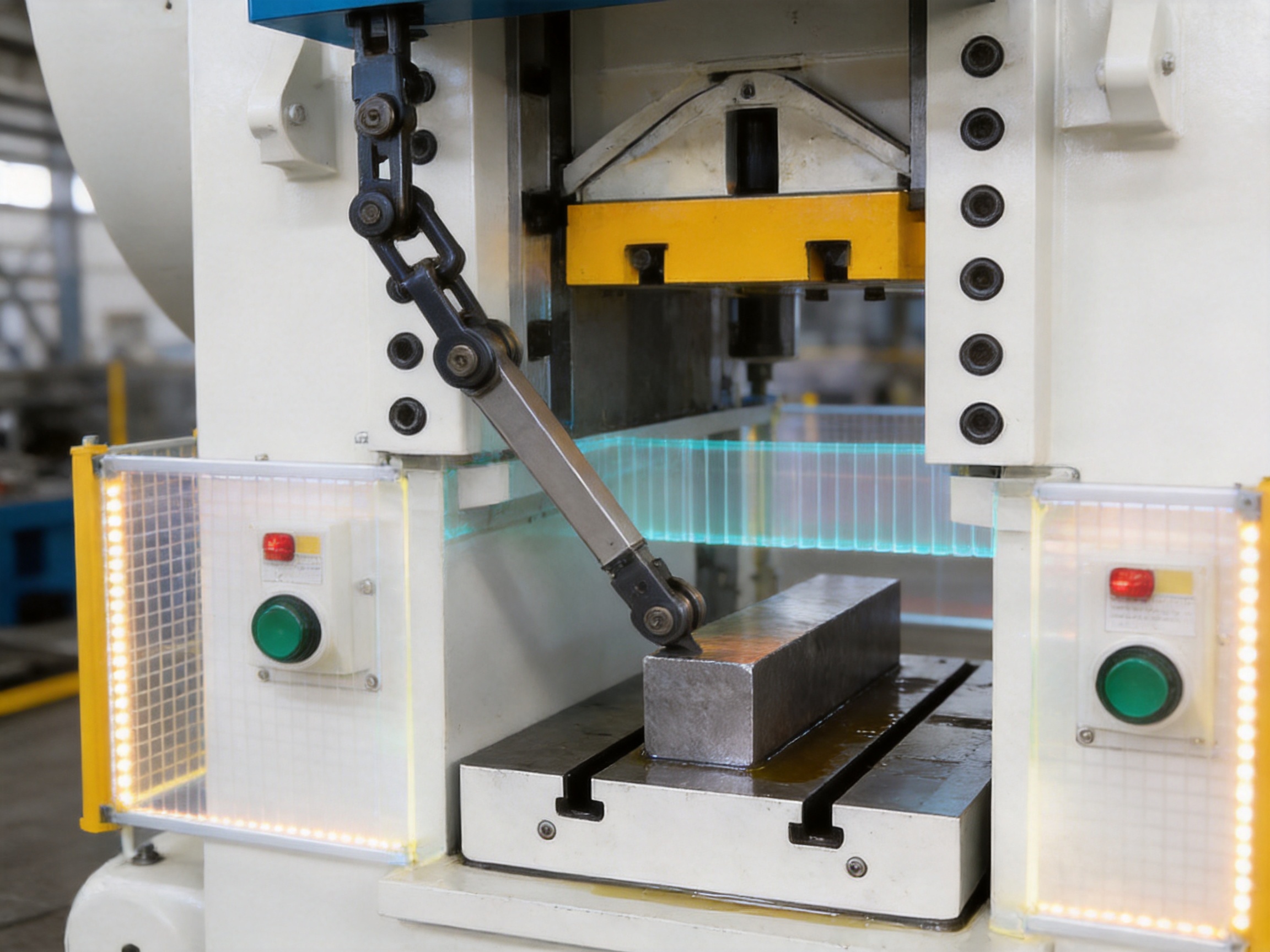
The BLKP-850 can serve manufacturers producing large or highly loaded cold-forged components. Its 8,500 kN capacity and substantial tooling support make it relevant to several industrial sectors.
Automotive production uses cold forging for fasteners, drivetrain components, steering and suspension parts, shafts, sleeves, hubs, and other high-volume products. The process can help produce consistent shapes with favorable grain flow and reduced machining. The BLKP-850 is suited to operations where repeatability and die support are necessary for long production runs.
Construction machinery, agricultural equipment, material-handling systems, and industrial vehicles use pins, bushings, joints, couplings, and high-strength connection components. These parts may require substantial forming force because of their size or material strength. The machine’s large die capacity and reinforced worktable provide a platform for tooling used in such applications.
Industrial hardware manufacturers may use cold forging to produce specialized bolts, nuts, sleeves, collars, fittings, and other components. The press can be considered where high production volume and repeatable force application justify dedicated heavy-duty equipment.
Components for power-generation equipment, rail systems, infrastructure hardware, and other engineered assemblies may benefit from near-net-shape forming. The specific suitability of the BLKP-850 depends on the part’s geometry, material, forming force, and required process stages, but its high-capacity configuration expands the range of components that can be evaluated for cold forging.
A machine with an 8,500 kN nominal capacity requires careful installation. The foundation must support the static weight of the press and the dynamic forces generated during operation. The customer should use the approved foundation design and installation drawings rather than estimating requirements from general machine dimensions.
Leveling is critical. An incorrectly leveled machine may experience uneven loading, abnormal guide wear, alignment problems, or inconsistent die closure. After installation, the press should be checked for table level, slide alignment, die-height setting, fastener condition, lubrication operation, pneumatic supply, electrical connections, and safety-device function.
The workshop layout should provide enough space for die installation, maintenance, inspection, part transfer, material movement, and emergency access. Heavy dies require suitable cranes or lifting devices, and their lifting points must be verified before handling. The maximum die weight of 1,200 kg should never be treated as a casual operating value; lifting equipment and procedures must be rated appropriately and used by trained personnel.
Commissioning should proceed gradually. Initial no-load movement can verify basic motion and control functions. Subsequent trials can confirm lubrication, ejection, safety interlocks, and die operation. Production-speed validation should use approved material and tooling while monitoring force, noise, vibration, temperature, part quality, and cycle stability.
Heavy-duty performance is sustained through disciplined maintenance. The press should be inspected according to a schedule that includes daily operator checks, periodic technical inspections, and planned overhauls based on operating hours and cycle count.
Daily checks may include oil or lubricant level, visible leakage, unusual noise, abnormal vibration, loose fasteners, safety-device condition, air pressure, die mounting, and general cleanliness. Operators should record unusual conditions rather than relying on memory or informal communication between shifts.
Periodic maintenance may include inspection of toggle links and pins, guide clearance, bearings, drive components, electrical cabinets, emergency-stop circuits, photoelectric protection, pneumatic components, foundation fasteners, and die-height adjustment components. The maintenance team should use the manufacturer’s manuals for lubrication grades, tightening values, inspection limits, and replacement procedures.
Cleanliness is also important. Forging residue, lubricant buildup, metal particles, and dust can obstruct sensors, contaminate lubricants, accelerate wear, or create slip hazards. A clean working area makes abnormal conditions easier to detect and supports safer operation.
Planned maintenance is generally more economical than emergency repair. A small change in vibration or lubrication consumption may provide an early warning of a developing problem. Condition-based monitoring, when practical, can help identify bearing wear, misalignment, looseness, or drive irregularities before they result in an extended production interruption.
The quality of a cold-forged part depends on more than press accuracy. Material chemistry, billet preparation, surface condition, lubrication, die design, forming sequence, press settings, ejection, and inspection all contribute to the result. The BLKP-850 provides a stable forming platform, but the manufacturer and user must work together to establish a qualified process.
Typical quality checks may include dimensional measurement, visual inspection, surface-defect evaluation, hardness testing, metallographic examination, and destructive testing where required. For safety-critical automotive or machinery components, the customer may also require traceability by material batch, die condition, production shift, and machine setting.
A stable press can support statistical process control by reducing variation associated with machine movement and structural deflection. When machine-related variation is controlled, engineers can focus more effectively on material, die, lubrication, and transfer variables. This may simplify troubleshooting and improve the reliability of process capability studies.
The press’s high capacity should also be used responsibly. Running a process close to the machine’s limit may increase mechanical stress and reduce the margin for variation in material or lubrication. A properly engineered process includes a practical safety and performance margin rather than treating the rated force as a target that must be reached on every cycle.
The purchase price of a power press is only one part of its economic impact. Total cost of ownership includes installation, dies, energy, labor, lubrication, maintenance, spare parts, downtime, quality losses, and eventual refurbishment. The BLKP-850 can support favorable total economics when it is applied to a suitable high-volume or high-value cold forging process.
Its potential economic advantages include reduced machining after forging, better material utilization, high production repeatability, support for heavy dies, and reduced dependence on manual forming operations. The toggle mechanism may also help align mechanical motion with the pressure requirements of the process, improving the balance between cycle time and forming stability.
The company’s integrated manufacturing and service capability may provide additional value. A supplier able to manage design, production, inspection, customization, and after-sales support can reduce communication gaps during installation and troubleshooting. This is especially important for overseas customers, who may need assistance with documentation, spare parts, remote technical support, and coordination between the press and local production systems.
Any economic evaluation should be based on the specific component. Engineers should compare blank weight, material yield, die life, cycle rate, machining time, labor content, energy consumption, maintenance cost, scrap rate, and expected annual output. The BLKP-850 is most compelling when the process requires its high-force capability and when the customer can use that capability consistently.
Before selecting the machine, the customer should prepare a technical information package. This should include component drawings or three-dimensional models, material specifications, blank dimensions, target production quantity, tolerance requirements, die concept, forming sequence, and automation expectations.
Press selection should also consider future products. The BLKP series includes models from 2,600 kN to 20,000 kN, with different strokes, speeds, worktable dimensions, motors, and tooling capabilities. A customer whose current part requires 8,500 kN may also wish to consider future capacity, product diversification, and the possibility of using common dies or transfer systems.
The BLKP-850 is a logical choice when the process requires:
A nominal force in the high-capacity cold forging range.
A controlled final forming motion supported by toggle mechanics.
A worktable suitable for a 600 × 700 mm die area.
Tooling weighing up to the stated 1,200 kg maximum.
A maximum die height of approximately 500 mm.
Production rates within the stated 25–40 S.P.M. range, subject to process validation.
A reinforced work area with a 180 mm bolster.
Integrated support for recurring lubrication and photoelectric safety protection.
These criteria provide a starting point. Final selection should be confirmed through engineering review, force calculations, tooling evaluation, and, where necessary, forming trials.
Zhejiang Bolun High-Precision Machinery Co., Ltd. is based in Shengzhou City, Zhejiang Province, China, with an office presence in Hangzhou. The company presents itself as a manufacturer serving international customers through product development, engineering, sales, and after-sales support.
International equipment purchasing requires clear communication. Technical drawings, operating manuals, electrical information, spare-parts lists, packing details, installation instructions, and acceptance procedures should be agreed before shipment. Customers should also confirm the applicable electrical standards, language requirements, documentation format, safety regulations, and responsibilities for installation and commissioning.
Remote support can be useful for diagnosing control alarms, lubrication issues, alignment concerns, and replacement-part requirements. For complex installations, the customer may require on-site supervision or local service coordination. These requirements should be discussed during the quotation and contract stages.
The company’s stated philosophy emphasizes technology, quality, customization, and long-term customer service. For a capital machine such as the BLKP-850, these values are relevant because the equipment may remain in service for many years. The supplier’s ability to provide technical guidance, replacement components, process cooperation, and maintenance support can influence the machine’s practical value as much as its initial specification.
Operators should verify that the die, material, lubrication, and machine settings have been approved for the intended process. Die mounting surfaces must be clean, the die must be securely fastened, and the slide and lower ram must be correctly synchronized with the tooling.
The photoelectric safety system should be tested at the beginning of the shift and after any maintenance or adjustment affecting the protected area. The test should confirm that the press responds correctly and that no unauthorized bypass is present.
Operators should listen for changes in the sound of the toggle mechanism, drive, bearings, and ejection system. They should also observe lubricant delivery, part ejection, cycle timing, and the condition of forged components. A sudden change may indicate a die problem, material issue, lubrication failure, or machine fault.
When the press is stopped for an extended period, the machine should be left in the condition recommended by the manufacturer. Exposed surfaces may require protection against corrosion, and the lubrication system may require special attention before restart. Restart procedures should include inspection of guards, controls, emergency stops, air pressure, lubrication, and die security.
The BLKP-850 has a nominal capacity of 8,500 kN. This places it in the high-capacity range of the BLKP cold forging toggle press series and makes it suitable for demanding industrial forming applications.
It is a toggle type power press designed for cold forging. Its toggle transmission provides mechanical advantage and controlled movement near the bottom of the slide stroke.
The slide stroke is the total stated movement of the slide, which is 180 mm for the BLKP-850. The nominal pressure stroke is the rated high-pressure forming portion, stated as 8 mm. These values describe different aspects of the machine’s motion.
The worktable is stated as 600 × 700 × 180 mm. The first two dimensions identify the working area, while the third identifies the thickened bolster dimension.
The stated maximum die weight is 1,200 kg. The customer must still verify the complete die, lifting equipment, mounting method, foundation, and safety procedure before installation.
The maximum die height is stated as 500 mm. Actual suitability depends on the complete die stack, shut height, adjustment position, ejection arrangement, and required working clearance.
The published range is 25–40 strokes per minute. The correct operating speed depends on the workpiece, material, die, lubrication, transfer system, forming force, and quality requirements. Final speed should be established during process validation.
A toggle mechanism can generate high mechanical advantage near the bottom of the stroke and provide controlled low-speed forming in the final pressure stage. This motion profile is useful when the material requires substantial force to fill the die cavity.
The product information identifies recursive lubrication as an integrated feature. The machine lubrication system should be maintained according to the manufacturer’s instructions. Workpiece and die lubrication remain separate process considerations.
The BLKP-850 includes a photoelectric safety system. It must be correctly installed, tested, maintained, and used together with guarding, emergency stops, lockout procedures, training, and a complete workplace risk assessment.
Potential industries include automotive components, heavy machinery, construction equipment, industrial hardware, transportation equipment, and other sectors producing high-strength or high-volume cold-forged parts.
The manufacturer provides non-standard design and manufacturing services. Customization may involve working dimensions, automation interfaces, special functions, tooling arrangements, or other project-specific requirements. All modifications should be reviewed for structural, electrical, safety, and maintenance implications.
The customer should provide part drawings, material information, blank dimensions, required output, forming sequence, estimated force, die dimensions and weight, automation requirements, workshop conditions, electrical requirements, and applicable safety or documentation standards.
The BLKP-850 Industrial Strength Heavy-Duty Cold Forging Toggle Type Power Press is designed for manufacturers that require substantial forming force, controlled pressure application, and stable operation under continuous industrial conditions. Its 8,500 kN nominal capacity, 8 mm nominal pressure stroke, 180 mm slide stroke, 600 × 700 mm worktable, 180 mm bolster, 1,200 kg maximum die weight, and toggle-type transmission create a configuration suited to demanding cold forging processes.
Its principal advantage over a general-purpose power press is the combination of high load capacity and a motion profile adapted to final-stage forming. Its reinforced structure and thickened bolster support die stability, while the recurring lubrication and photoelectric safety system contribute to practical production operation when properly maintained. Compared with hydraulic alternatives, it offers a focused mechanical solution for repetitive operations requiring concentrated bottom pressure and consistent cycle behavior.
The machine’s value is further supported by the manufacturing capabilities of Zhejiang Bolun High-Precision Machinery Co., Ltd. The company integrates research and development, design, precision processing, assembly, inspection, customization, sales, and service. This integrated approach can help customers address the complete equipment project, from initial process evaluation through installation and long-term maintenance.
As with any high-capacity forming machine, successful results depend on correct engineering. Material selection, die design, lubrication, foundation, automation, safety procedures, maintenance, and quality control must all be coordinated. When these factors are properly managed, the BLKP-850 can provide a strong production platform for high-load cold forging and help manufacturers pursue repeatable quality, reduced machining, improved material utilization, and dependable long-term output.
1. Zhejiang Bolun High-Precision Machinery Co., Ltd., BLKP Series Cold Forging Toggle Type Power Press Technical Information.
2. Product specification data for the BLKP-850 Industrial Strength Heavy-Duty Cold Forging Toggle Type Power Press.
3. ASM International, Handbook of Metal Forming.
4. American Society of Mechanical Engineers, Safety Standards for the Construction, Care, and Use of Mechanical Power Presses.
5. International Organization for Standardization, Safety of Machinery: General Principles for Design and Risk Assessment.
6. International Organization for Standardization, Metallic Materials—Cold Forging and Related Forming Process Guidance.
7. Industrial press maintenance and lubrication practices for mechanical forming equipment.


A tooling engineer quotes a new bracket program and specifies a 160-ton press. ...
When you are planning to produce medium or small metal parts in high volumes, t...
A cold forging die rarely announces its failure in advance. One day the press r...
A mid-size fastener manufacturer recently faced a familiar problem: its CNC lat...
A buyer comparing a 45-ton open-gap press for a bracket line often receives two...
Two presses can both carry a 200-tonne nameplate and still produce very differe...
Contact Us

topbolun@gmail.com

+86-575-83362228

+86-13735238388
+86-18667502750

+86-575-83362999

+8618667502750

No.1 Linjiang Road East, Xiaren, Jinting Town, Shengzhou City, Zhejiang Province, China
Ready to Begin?
Get in Touch

Now!

ZHEJIANG BOLUN
 English
 中文简体