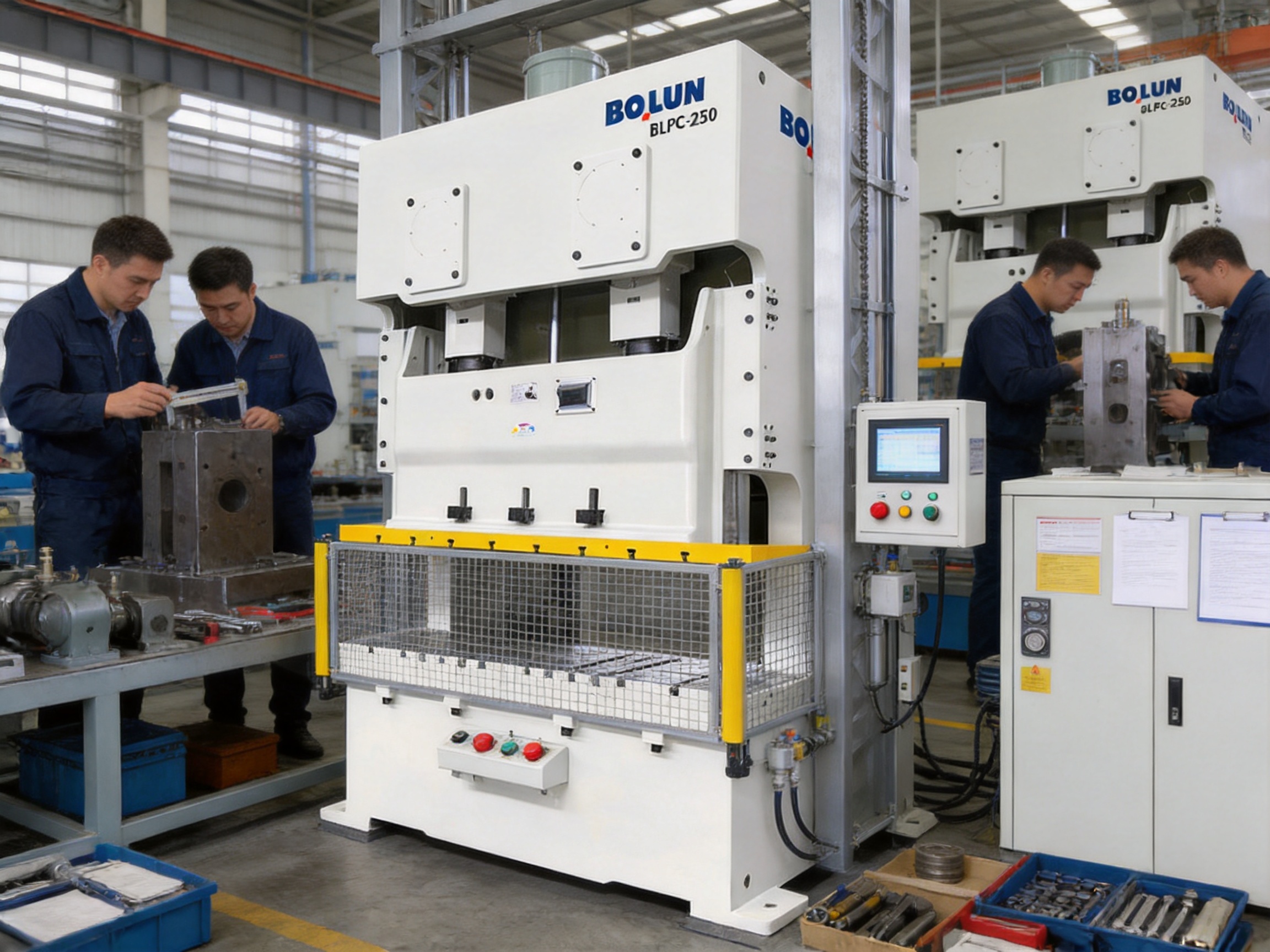
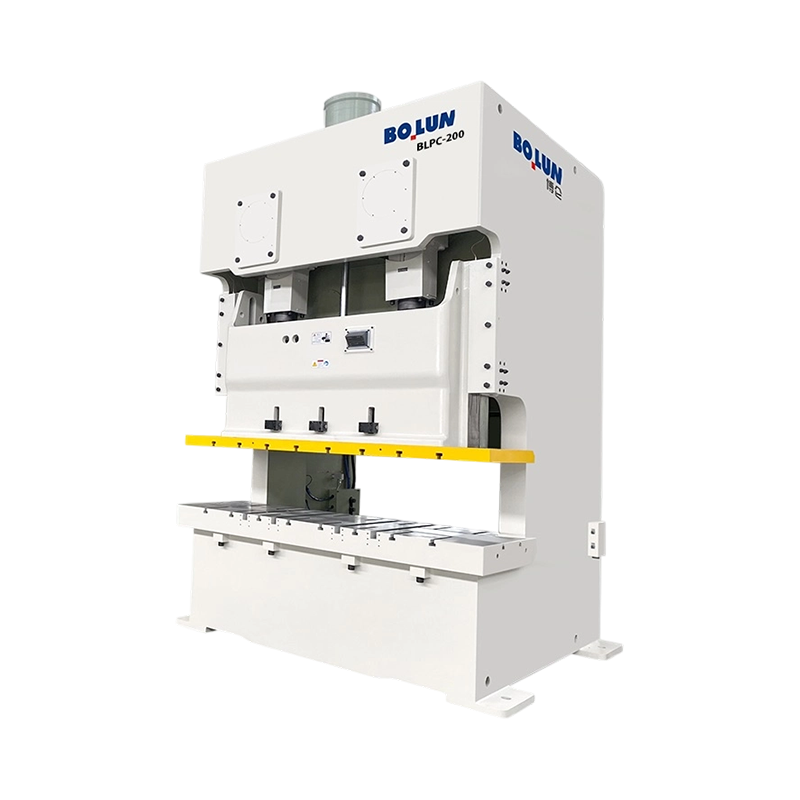
The BLPC-250 is a heavy-duty open-type double-point power press designed for demanding metal-forming, stamping, blanking, piercing, bending, embossing, and shallow-drawing applications. With a nominal capacity of 2,500 kN, a 44-ton machine weight, a large 2,700 × 900 mm worktable, and a maximum die height of 605 mm in its H configuration, it is engineered for production environments where high forming force, large tooling, structural stability, and dependable cycle performance are essential.
Large stamping operations require more than a high tonnage rating. A press must transfer force evenly, maintain alignment under load, accommodate large dies, protect operators, support repeatable production, and remain serviceable over many years of operation. The BLPC-250 addresses these requirements through a rigid open-type frame, double-point slide guidance, hydraulic overload protection, photo-electronic safety equipment, inverter-based speed adjustment, and a touch-screen control interface.
Manufactured by Zhejiang Bolun High-Precision Machinery Co., Ltd., the BLPC-250 forms part of a product range covering open-type, closed-type, and other industrial power press solutions. The manufacturer combines design, precision processing, assembly, inspection, customization, sales, and technical service within an integrated production system. This approach enables the press to be configured around practical production requirements instead of treating the machine as a standard, one-size-fits-all product.
The BLPC-250 belongs to the open-type double-point power press category. Its open structure provides convenient access to the working area from multiple directions, which is valuable when installing dies, feeding sheet material, removing formed parts, or integrating transfer and automation equipment. The double-point drive arrangement supports a broad slide and helps distribute forming loads across the tooling area.
The machine is especially suitable for applications involving large dies, wide components, long sheet parts, and production processes that require a substantial working envelope. The 2,700 × 900 mm worktable provides generous space for tooling and material handling, while the 2,300 × 700 × 95 mm slide bottom offers a large mounting surface for heavy dies.
In its H configuration, the BLPC-250 provides a maximum die height of 605 mm. This value is particularly important for automotive, appliance, hardware, and general sheet-metal applications that use tall or complex tooling. A larger die-height capacity can reduce the need for special risers or extensive tooling modifications, making it easier to accommodate existing dies and future production programs.
The press delivers a nominal capacity of 2,500 kN. This capacity should be evaluated together with the nominal pressure stroke of 7 mm for the V configuration or 3.5 mm for the H configuration. The pressure-stroke rating indicates the point in the slide travel at which the rated nominal force is available. Correct die design and process planning must therefore account for the machine’s rated force position rather than assuming maximum capacity is available throughout the full stroke.
The following table summarizes the principal specifications for the BLPC-250 family data, with specific attention to the BLPC-250 V and H configurations. The H configuration corresponds to the large working envelope associated with the 605 mm maximum die height and 2,700 × 900 mm worktable.
| Parameter | Unit | BLPC-250 V | BLPC-250 H |
| Nominal capacity | kN | 2,500 | 2,500 |
| Nominal pressure stroke | mm | 7 | 3.5 |
| Slide stroke | mm | 280 | 170 |
| Slide strokes per minute | S.P.M. | 20–35 | 30–60 |
| Maximum die height | mm | 550 | 605 |
| Die-height adjustment | mm | 120 | 120 |
| Throat depth | mm | 455 | 455 |
| Worktable size | mm | 2,700 × 900 × 170 | 2,700 × 900 × 170 |
| Slide bottom size | mm | 2,300 × 700 × 95 | 2,300 × 700 × 95 |
| Working-face height | mm | 1,100 | 1,100 |
| Distance between columns | mm | 2,239 | 2,239 |
| Main motor | kW × pole | 22 × 4 | 22 × 4 |
| Die-height adjuster motor | kW | 1.5 | 1.5 |
| Air pressure | MPa | 0.55 | 0.55 |
| Overall dimensions | mm | 2,545 × 3,000 × 4,304 | 2,545 × 3,000 × 4,304 |
| Press weight | ton | 44 | 44 |
| Mold-pad capacity | kN | 140 × 2 | 140 × 2 |
| Ram stroke | mm | 100 | 100 |
| Effective cushion area | mm² | 640 × 470 × 2 group | 640 × 470 × 2 group |
The production data shows that the BLPC-250 is not simply a high-tonnage press with a compact working zone. Its dimensions, table capacity, slide area, throat depth, and press weight are balanced for large-scale forming. The 44-ton construction provides a substantial structural base, while the 22 kW, four-pole main motor supplies the drive power required for the press mechanism and production operation.
Frame rigidity is one of the most important factors in a large mechanical power press. During stamping, the frame is exposed to repeated high loads, impact forces, vibration, and off-center loading. If the structure deflects excessively, the results may include uneven die clearance, inconsistent part dimensions, premature die wear, slide misalignment, and higher maintenance requirements.
The BLPC-250 uses a high-rigidity frame intended to resist deformation during heavy-duty operation. Its 44-ton press weight is a practical indication of the substantial amount of material incorporated into the machine structure. A heavier and more rigid frame can provide improved resistance to vibration and load-induced movement compared with lighter machines of similar nominal capacity.
The open-type construction also offers an important operational advantage. Closed-frame presses can provide excellent rigidity, but their enclosed working areas may be less convenient for certain die-loading, maintenance, and material-handling arrangements. The open configuration of the BLPC-250 offers accessibility while retaining the structural benefits required for a double-point heavy-duty press.
For demanding stamping work, rigidity should not be considered only in relation to the maximum force. The press must also withstand repeated cycles at production speed. The BLPC-250 is designed around this broader requirement, combining frame mass, a large base structure, double-point actuation, and a sizeable slide and worktable.
A double-point press drives the slide at two points rather than relying on a single central connection. This arrangement is well suited to wide dies because it helps distribute the pressing load over a larger area. It can also reduce the tendency of the slide to tilt when the tooling or workpiece produces an uneven load.
For long automotive panels, appliance components, structural brackets, and wide hardware parts, double-point operation can provide an important advantage over narrow single-point equipment. The two-point arrangement supports better use of the full table and slide dimensions, especially when multiple operations are incorporated into one die or when several parts are formed during each cycle.
Load distribution depends on correct die setup, balanced material flow, suitable lubrication, and proper adjustment. The double-point design is therefore not a substitute for sound process engineering, but it provides a stronger mechanical foundation for large and demanding tooling.
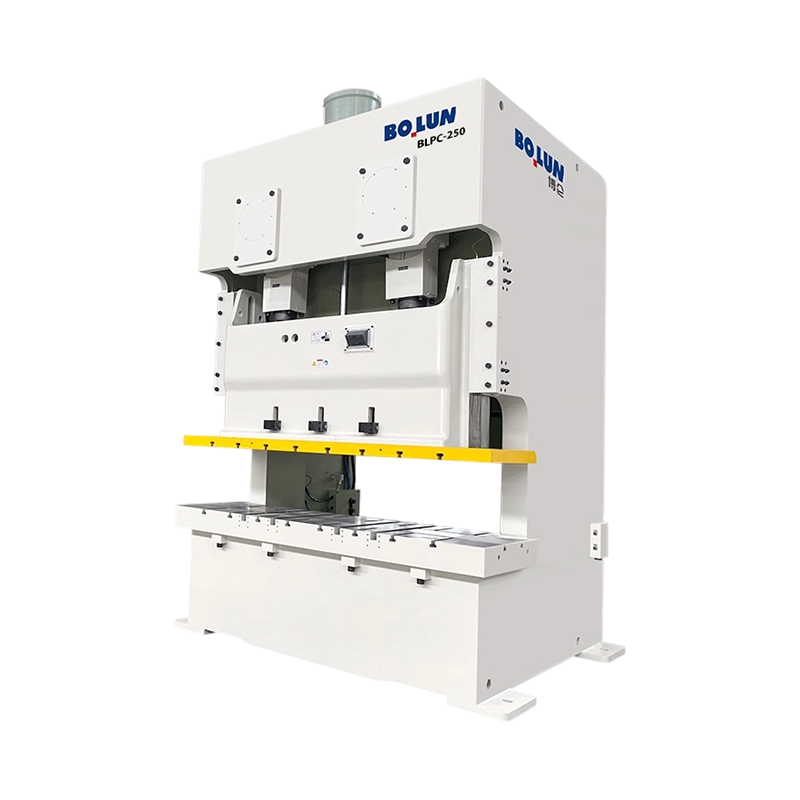
BLPC-250 Robust Heavy-Duty Open-Type Double-Point Power Press
One of the distinguishing characteristics of the BLPC-250 is its ability to accommodate large dies. The H configuration provides a maximum die height of 605 mm, while the worktable measures 2,700 × 900 mm. These dimensions allow manufacturers to consider tooling that would be difficult to install on smaller open-type presses.
Die height affects more than physical installation. It influences the available forming space, the arrangement of die components, the use of guide posts, the accommodation of cushions, and the integration of feeding or part-ejection mechanisms. A press with greater die-height capacity gives the tooling engineer more freedom when designing complex forming systems.
The die-height adjustment range is 120 mm. This adjustment allows the machine to be adapted to different tooling requirements and helps operators establish a suitable shut height. Accurate adjustment is important for protecting the die, maintaining the correct forming position, and achieving stable production results across different jobs.
The worktable includes a thickness of 170 mm, while the slide bottom has a thickness of 95 mm. These dimensions contribute to the machine’s ability to support large and heavy dies. The slide bottom size of 2,300 × 700 mm gives the upper die a broad mounting area, helping users make effective use of the press’s double-point design.
The throat depth of 455 mm allows material and tooling to extend a considerable distance into the press. This is useful for parts with significant front-to-back dimensions and for dies that require space for internal mechanisms. Combined with the broad table, the throat depth makes the machine suitable for a wide range of large-part stamping layouts.
Many production plants operate several tooling generations at the same time. Older dies may have different heights and mounting dimensions from newly developed dies. A press with a wider adjustment range and larger table can reduce the need to rebuild or replace tooling when production requirements change.
The BLPC-250 can support progressive, compound, transfer-compatible, and multi-operation tooling arrangements, subject to process validation and the correct automation configuration. Its open access is also beneficial when dies must be changed regularly or when the production line uses manually loaded blanks and automatically discharged components.
The BLPC-250 is available with different stroke and speed characteristics for the V and H configurations. The V version has a 280 mm slide stroke and a production range of 20 to 35 strokes per minute. The H version has a 170 mm slide stroke and a range of 30 to 60 strokes per minute.
This distinction enables users to select a configuration that better reflects the forming process. Longer stroke operation can be helpful when the die requires greater vertical travel, deeper forming space, or more room for part handling. A shorter stroke with a higher available rate can support faster repetitive stamping when the process does not require the additional travel.
The touch-screen interface is designed to make machine operation more intuitive. Operators can view and adjust relevant production parameters through a centralized control system, reducing dependence on complicated manual controls. A clear interface can also improve changeover efficiency by helping users verify operating settings before starting a new production run.
Inverter speed adjustment provides flexibility in matching press speed to material characteristics, die requirements, and production objectives. A slower speed may be appropriate during die tryout, first-piece validation, or difficult forming. Once the process has been confirmed, the operator may select a higher speed within the permitted operating range to improve productivity.
Speed control should always be coordinated with the material, lubrication, die design, and quality requirements. Increasing strokes per minute is not automatically beneficial if it produces excessive vibration, springback, tearing, heat, or premature tooling wear. The value of inverter adjustment lies in giving production teams more control over this balance.
Repeatability is critical in industrial stamping. The same die must produce consistent parts through long production runs, often across multiple shifts. A controlled press speed, stable frame, accurate die-height setting, and reliable safety circuit all contribute to repeatable operation.
The BLPC-250’s operating system is intended to support consistent machine behavior from one cycle to the next. The touch-screen control arrangement makes it easier to establish standardized settings and gives operators a practical interface for monitoring production. In a well-managed factory, these capabilities can be combined with documented setup procedures, first-piece inspection, preventive maintenance, and process records.
Overload protection is essential for a high-capacity press. A stamping die may encounter excessive resistance because of incorrect material thickness, a feeding error, a misaligned blank, foreign material, an incorrect shut height, or a fault in the tooling. Without an effective protection system, such events can damage the die, slide, connecting components, or frame.
The BLPC-250 incorporates hydraulic overload protection to help safeguard the press and tooling against abnormal forming loads. When the load exceeds the permitted level, the protection system is intended to respond more quickly than a rigid mechanical component would be able to absorb the overload. This reduces the risk of severe damage and supports faster recovery after an abnormal event.
Hydraulic overload protection is particularly valuable in automated production because material-feed errors can occur rapidly. A protection system can limit the consequences of a single mistake and help prevent a minor setup problem from becoming a major repair incident. It also provides additional confidence when the press is used with large, expensive, or complex dies.
Protection equipment does not eliminate the need for proper setup. Operators must still verify die height, material feed, lubrication, blank position, sensors, and press settings. Hydraulic protection should be inspected and maintained according to the manufacturer’s service requirements, and any overload event should be investigated before production resumes.
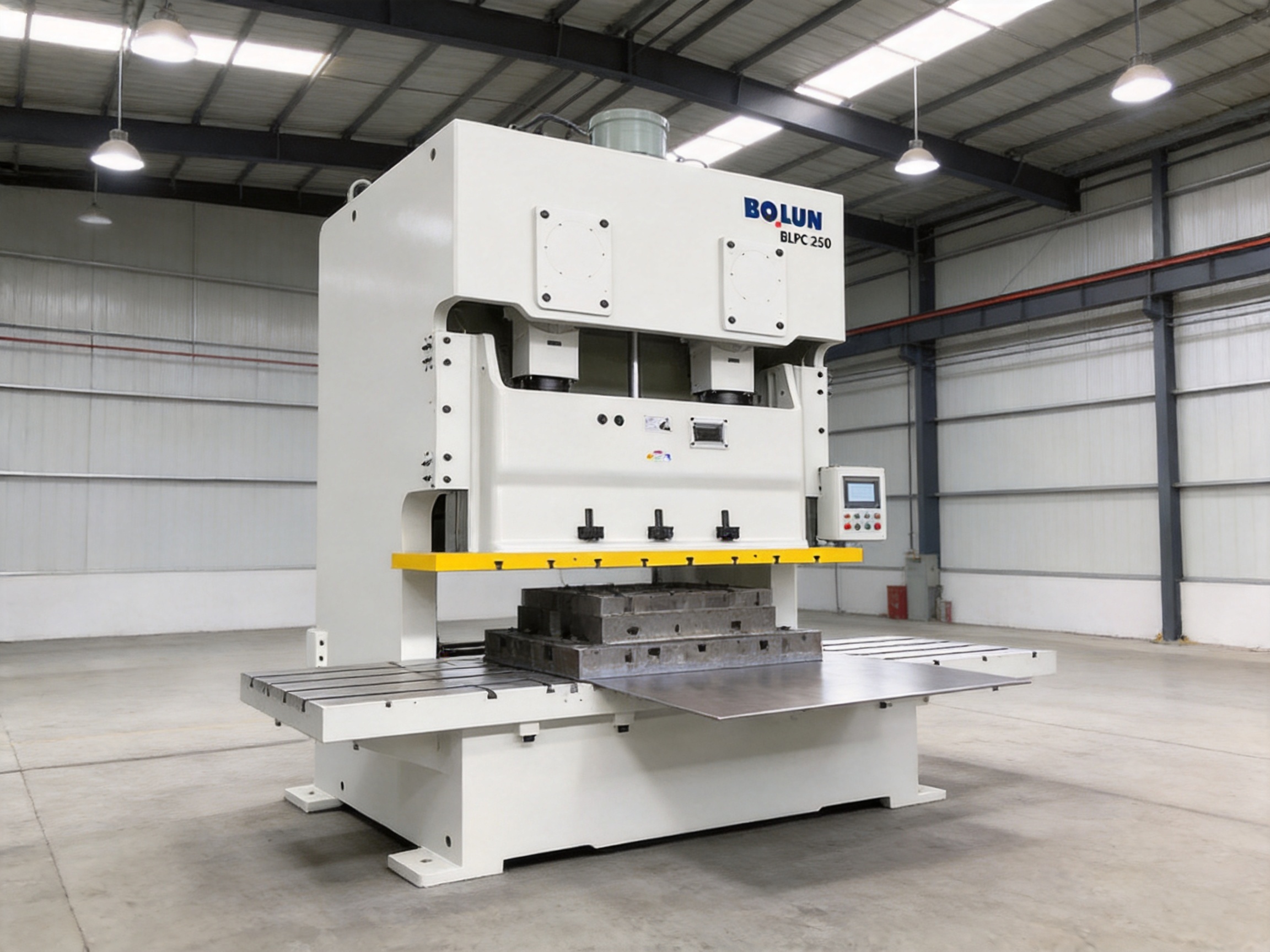
Large mechanical presses require carefully designed safeguarding because the working area contains moving tooling and high stored energy. The BLPC-250 incorporates highly sensitive photo-electronic safety devices intended to detect intrusion into the protected area and interrupt or inhibit hazardous operation in accordance with the machine’s safety system.
Photo-electronic protection creates a monitored safety field near the point of operation. If the field is interrupted under a hazardous condition, the press control system can initiate the appropriate stop or prevent a cycle from beginning. This is especially important for open-type equipment, where operators may have convenient access to the die area during loading, unloading, setup, and maintenance.
Safety performance depends on correct installation, alignment, testing, and integration with the overall control circuit. Operators should never bypass, disable, or obstruct the safety devices. The machine should be installed with suitable guarding, emergency-stop controls, safe access procedures, lockout and isolation practices, and task-specific training.
The combination of photo-electronic safety protection and hydraulic overload protection gives the BLPC-250 two different forms of risk control. The first is primarily intended to protect people from access to the dangerous operating zone. The second is intended to reduce damage to the machine and tooling when abnormal forming loads occur. Both functions are important, but neither replaces a complete workplace safety program.
Die changes require special attention because the press may be stopped but still contain mechanical, pneumatic, or electrical hazards. Before maintenance or tooling work begins, energy sources should be isolated according to approved procedures. The working area should be kept clear, and the machine should be secured against unintended movement.
The open design of the BLPC-250 can make die access more convenient, but convenience must be combined with disciplined safety practices. Photo-electronic devices are most effective during normal production when they are correctly positioned and fully functional. During maintenance, workers must follow the manufacturer’s instructions and applicable local safety regulations.
The BLPC-250 is equipped with a mold-pad capacity of 140 × 2 kN and an effective cushion area specified as 640 × 470 × 2 group. The ram stroke is 100 mm. These features support forming processes in which controlled reaction forces, blank holding, or lower-die cushioning are required.
A cushion system can improve material control during forming. In suitable applications, it helps manage wrinkles, maintain blank-holder pressure, support drawing operations, and improve the consistency of formed surfaces. The use of two cushion groups can help distribute supporting forces across a wider tooling area, which is beneficial for large dies.
Cushion settings must be matched to the material, blank geometry, die design, lubrication, and forming sequence. Excessive cushion force can lead to tearing or higher tool loads, while insufficient force can allow wrinkling or unstable material flow. The press provides the mechanical capacity, but process engineers remain responsible for selecting the correct operating parameters.
The cushion capability also increases the range of components that can be considered for the machine. In addition to simple blanking and piercing, the press can be evaluated for forming operations where lower support and controlled holding pressure are necessary. Final suitability should be verified through tooling trials and load analysis.
The BLPC-250 offers several practical advantages over smaller single-point presses and lighter-duty machines. The first is its 2,500 kN nominal capacity, which provides the force reserve needed for larger blanks, thicker materials, high-strength steels, and multi-operation dies. A press operating near its limit may experience greater mechanical stress and reduced process flexibility, whereas a suitable capacity margin can support more stable production.
The second advantage is the large working area. The 2,700 × 900 mm table and 2,300 × 700 mm slide bottom provide more usable space than many compact presses. This can reduce the need to divide a large operation across multiple machines and may allow several features to be produced in one die.
The third advantage is the double-point arrangement. For wide tooling, two-point drive can offer better load distribution and improved resistance to slide tilting than a narrow single-point configuration. This may contribute to more uniform die clearance and lower localized wear when the process is properly balanced.
The fourth advantage is the frame mass and rigidity. At 44 tons, the BLPC-250 is built for heavy industrial service rather than occasional light stamping. The rigid construction helps provide a stable platform for high-load cycles, large dies, and demanding production schedules.
The fifth advantage is configuration flexibility. The V and H versions provide different combinations of stroke, speed, and maximum die height. This allows a customer to select a machine based on the actual forming process instead of choosing solely according to tonnage.
The sixth advantage is integrated protection and control. Hydraulic overload protection, photo-electronic safety devices, touch-screen operation, and inverter speed adjustment are combined in one production platform. Competitors may offer some of these functions individually, but the value of the BLPC-250 lies in bringing them together with a large, heavy-duty structure.
These advantages should be evaluated against the complete application. A press is not superior simply because it is larger. The correct choice depends on material, part geometry, die dimensions, required speed, factory layout, automation, energy supply, maintenance resources, and applicable safety standards. The BLPC-250 is most advantageous when its capacity and working envelope are used in a sustained industrial production environment.
The BLPC-250 is suited to automotive stamping applications involving large brackets, reinforcement parts, chassis components, structural sheet-metal pieces, and other wide or heavy parts. Automotive production often requires repeatable dimensions, stable die alignment, reliable safety systems, and the ability to operate with automated feeding and transfer equipment.
The large worktable and double-point slide can support dies that combine multiple forming features. Depending on the material and process, a single stroke may include blanking, piercing, bending, embossing, or shallow drawing. The press’s high capacity also provides flexibility for higher-strength materials that require greater forming force.
Appliance manufacturers frequently produce large panels, housings, mounting plates, brackets, and reinforcement components. Such parts may require wide dies and carefully controlled forming conditions to prevent distortion or surface defects. The BLPC-250’s large table, adjustable speed, and rigid frame can support these requirements.
Electrical hardware production may involve steel, stainless steel, aluminum, and other sheet materials. Each material has different forming characteristics. Inverter speed adjustment enables production teams to test and refine cycle conditions, while the cushion system can assist with holding and material-flow control in selected operations.
Industrial hardware producers can use the press for high-volume blanking, piercing, bending, and forming. Examples include mounting components, structural hardware, machine covers, transportation fittings, agricultural equipment parts, and industrial enclosures.
For manufacturers that serve multiple customers, versatility is especially valuable. A machine with substantial die capacity can accept a broader range of tooling, reducing the risk that future contracts will require immediate investment in additional equipment. The BLPC-250 therefore supports both current production and long-term manufacturing expansion.
Zhejiang Bolun High-Precision Machinery Co., Ltd. has developed its machinery business around precision forming equipment and industrial machine tools. The company integrates research and development, design, manufacturing, sales, and service. This integrated structure can improve communication between engineering and production teams and can support more direct responses to application-specific requirements.
The company’s manufacturing philosophy emphasizes technology, high precision, customization, and complete process control. It maintains advanced precision-processing equipment and an industrial production environment covering basic design, core component development, machining, final assembly, testing, and delivery preparation.
For a heavy-duty press, the quality of individual components is only one part of the result. The relationship between the frame, drive system, slide, table, overload protection, control cabinet, safety devices, lubrication system, and adjustment mechanisms determines the behavior of the complete machine. An integrated production system gives the manufacturer greater opportunity to control these interfaces.
Large press components require accurate machining because small errors can influence parallelism, alignment, load distribution, and die life. Precision processing of the frame, slide guides, worktable, connecting parts, and drive-related components is therefore essential. The manufacturer’s focus on high-precision equipment supports the dimensional consistency required during assembly.
Machining quality also affects serviceability. Precisely produced components are easier to inspect, assemble, adjust, and replace. Consistent manufacturing practices can simplify the maintenance process and reduce the possibility that a replacement component will require extensive rework before installation.
Assembly is a critical stage for a large mechanical press. Even accurately machined components must be installed, adjusted, lubricated, and tested correctly. The manufacturer describes a finished-product inspection system that evaluates components and processes to support stable precision and long service life under high-intensity operation.
Inspection should include dimensional verification, slide movement, die-height adjustment, safety-device response, overload-protection function, control-system operation, lubrication performance, pneumatic requirements, and general machine behavior. A structured inspection system helps identify problems before shipment and gives customers greater confidence during installation and commissioning.
Industrial users often require more than a standard catalog specification. They may need different electrical standards, special feeding arrangements, customized table layouts, automation interfaces, additional sensors, altered stroke characteristics, or tooling-specific modifications. Bolun’s non-standard customization capability is intended to address such requirements through engineering and manufacturing coordination.
Customization is most effective when it begins with a complete application review. The customer should provide information about material grade, thickness, blank size, part dimensions, die weight, die height, required output, automation method, factory power supply, environmental conditions, and applicable safety requirements. The manufacturer can then evaluate the proposed configuration and identify any necessary options or limitations.
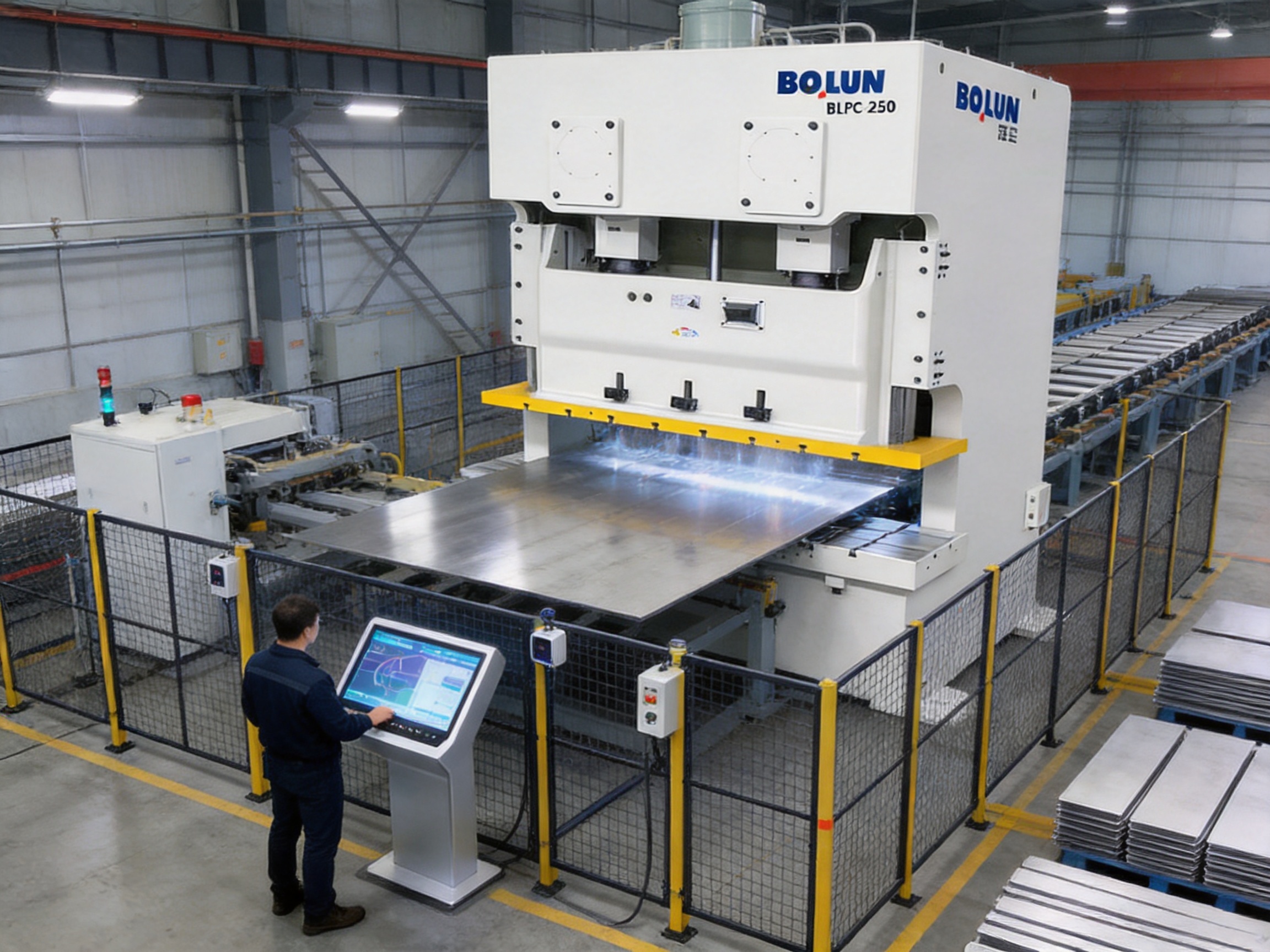
Quality management for a heavy-duty power press must extend throughout the product life cycle. Pre-sales consultation helps establish the correct model and options. Production support ensures that the machine is built to the agreed requirements. Commissioning verifies installation and operation. After-sales service helps maintain performance and resolve issues during long-term use.
The manufacturer emphasizes a customer-oriented service system covering pre-sales, in-sales, and after-sales stages. This approach is valuable for export customers because large presses often require coordinated logistics, foundation preparation, electrical planning, operator training, die trials, and production acceptance.
Preventive maintenance is an important part of service support. A maintenance program for the BLPC-250 should include inspection of lubrication points, hydraulic overload components, pneumatic connections, electrical cabinets, safety devices, slide guides, die-height adjustment components, fastening elements, and abnormal vibration or noise. Maintenance intervals must follow the manufacturer’s instructions and the actual operating conditions.
Spare-parts planning can also reduce downtime. Users should identify critical components, establish replacement procedures, and maintain records of service history. When a press is used in continuous production, the cost of unexpected downtime can exceed the cost of preventive inspection by a wide margin.
The BLPC-250 has overall dimensions of approximately 2,545 × 3,000 × 4,304 mm and a press weight of 44 tons. Before delivery, the customer should confirm that the factory has suitable unloading access, lifting equipment, floor capacity, foundation provisions, working clearance, electrical supply, compressed-air supply, and environmental conditions.
The installation area should provide sufficient space around the press for die changes, material handling, inspection, maintenance, and emergency access. The height of the machine should be checked against overhead cranes, lighting systems, ventilation equipment, roof structures, and any planned automation. Transport routes should be reviewed before shipment because the size and mass of the press can affect door openings, turning radii, and floor transitions.
The specified air pressure is 0.55 MPa. The factory air system should be capable of delivering clean and stable compressed air at the required pressure and flow. Moisture, oil contamination, and pressure fluctuations may affect pneumatic components, so appropriate filtration and preparation should be considered.
Electrical installation should be completed by qualified personnel in accordance with local regulations and the machine’s electrical documentation. The control cabinet, grounding system, emergency stops, safety circuits, and interlocked equipment should be checked before production begins.
The BLPC-250 V and H configurations share the same nominal capacity, table dimensions, press weight, throat depth, main motor rating, and general heavy-duty platform. Their key differences concern slide stroke, operating speed, and maximum die height.
The V configuration provides a 280 mm slide stroke and a maximum die height of 550 mm. Its speed range is 20 to 35 strokes per minute. This arrangement may be appropriate for applications requiring greater slide travel or more vertical forming space within the die.
The H configuration provides a 170 mm slide stroke, a speed range of 30 to 60 strokes per minute, and a maximum die height of 605 mm. It may be preferred when the production process benefits from a shorter stroke and higher cycle rate while still requiring a tall die installation height.
Selection should be based on the complete process rather than on one specification. A die engineer should review the required stroke, shut height, forming depth, material handling path, cushion movement, desired production rate, and automation cycle. The manufacturer can assist in confirming whether the selected configuration is appropriate for the intended die.
Productivity is influenced by several factors, including strokes per minute, part output per stroke, die change time, setup time, material handling, inspection frequency, and unplanned downtime. The BLPC-250 can contribute to productivity through its adjustable operating speed, large die capacity, double-point structure, and suitability for automated integration.
A large press may also reduce the number of operations needed for a component. If several forming features can be incorporated into one die, the manufacturer may reduce intermediate handling, work-in-process inventory, and transfer time between machines. However, this benefit must be balanced against die complexity, tooling investment, and process-development requirements.
Energy consumption, maintenance cost, tooling life, operator efficiency, and production quality should all be considered when calculating total cost of ownership. A machine that produces consistent parts and protects expensive dies may offer better long-term value than a lower-cost press with limited capacity or insufficient rigidity.
The BLPC-250’s inverter speed adjustment also allows users to avoid running every job at a single fixed speed. A carefully selected speed can help balance productivity with forming quality, vibration, noise, tooling life, and energy use. Process optimization should be based on measured production data rather than assumptions.
Before beginning production, operators should confirm that the die is correctly installed, the shut height is within the permitted range, all fasteners are secure, the material-feed path is clear, and the selected stroke and speed are compatible with the tooling.
The photo-electronic safety devices and emergency-stop controls should be tested according to the plant’s safety procedures. Any failure or abnormal response should be reported immediately, and production should not continue with compromised safety equipment.
Operators should monitor unusual noise, vibration, heat, lubrication problems, material misfeeds, slide behavior, and part-quality changes. Early detection can prevent a minor problem from developing into a major mechanical failure or tooling incident.
When an overload protection event occurs, the press should be stopped and the cause identified. Possible causes include incorrect die height, excessive material thickness, double blanks, misfeeding, an obstructed die, damaged tooling, or an incorrect process setting. Resetting the system without investigating the cause is not recommended.
Regular cleaning is also important. Scrap, oil, scale, and debris should not be allowed to accumulate around the die, safety devices, table, control components, or moving mechanisms. A clean working area improves visibility, reduces interference with sensors, and supports safer maintenance.
The BLPC-250 combines high force, large dimensions, structural mass, control flexibility, overload protection, and operator safeguarding in one industrial platform. Its 2,500 kN capacity gives it the strength required for demanding forming operations, while the broad table and slide support large dies and wide workpieces.
Its double-point construction is especially relevant to customers who need to process wide components or use tooling with multiple forming stations. The 44-ton frame provides a stable foundation for repeated production, and the H configuration’s 605 mm maximum die height expands tooling compatibility.
Compared with a smaller press, the BLPC-250 can provide more process margin, a larger working envelope, and better compatibility with heavy tooling. Compared with a less integrated machine, its touch-screen operation, inverter speed control, hydraulic overload protection, and photo-electronic safety devices offer a more complete production package.
The manufacturer’s integrated engineering and manufacturing capabilities further strengthen the product. Design, precision processing, assembly, inspection, customization, and service are connected within one organization. This can be particularly valuable for customers requiring specialized configurations or long-term technical cooperation.
The nominal capacity is 2,500 kN. This rating identifies the press as a heavy-duty machine suitable for demanding industrial stamping applications. The actual suitability for a particular operation depends on material, thickness, die design, pressure-stroke position, and load distribution.
The maximum die height is 550 mm for the BLPC-250 V configuration and 605 mm for the BLPC-250 H configuration. The H version provides the larger die-height capacity described for this product.
The worktable measures 2,700 × 900 × 170 mm. This large table is intended for wide and heavy dies used in automotive, appliance, hardware, and general industrial forming.
The listed press weight is 44 tons. The substantial machine mass supports a rigid structure and helps provide stability during high-load stamping cycles.
The V version has a 280 mm slide stroke, a 20–35 S.P.M. speed range, and a 550 mm maximum die height. The H version has a 170 mm slide stroke, a 30–60 S.P.M. speed range, and a 605 mm maximum die height. The correct selection depends on the required forming travel, die height, and production speed.
Yes. The BLPC-250 incorporates hydraulic overload protection. This system is intended to help reduce damage when abnormal forming loads occur, although correct setup, inspection, and maintenance remain essential.
The machine incorporates highly sensitive photo-electronic safety devices. These devices are intended to monitor access to the hazardous working area and support the press safety circuit. They must be installed, aligned, tested, and maintained correctly.
The open-type structure and large working area can support integration with feeding, transfer, unloading, and material-handling systems. Automation compatibility must be confirmed according to the die, cycle sequence, interface requirements, safety architecture, and customer production layout.
Potential applications include automotive components, appliance panels, electrical hardware, structural parts, transportation equipment, agricultural machinery, machine covers, brackets, and general sheet-metal products. Final application suitability should be verified through technical review and die trials.
Useful information includes the material grade, material thickness, blank size, finished-part dimensions, required force, die weight, die height, required stroke, target production speed, automation method, factory power supply, compressed-air conditions, safety requirements, and applicable national or international standards.
Maintenance should follow the manufacturer’s operating and service instructions. Typical activities include lubrication inspection, safety-device testing, hydraulic-system checks, pneumatic inspection, electrical-cabinet inspection, guide and adjustment checks, fastener verification, cleaning, and monitoring for abnormal noise or vibration.
Its 2,500 kN capacity and rigid heavy-duty structure provide a strong basis for processing demanding materials. However, high-strength material forming requires careful analysis of force, die clearance, radius, lubrication, springback, and forming speed. The specific material and part should be evaluated before production approval.
When comparing the BLPC-250 with competing power presses, buyers should examine more than the headline tonnage. Important questions include whether the rated force is available at the required pressure stroke, whether the frame is rigid enough for the intended load, whether the table can accommodate the die, and whether the slide dimensions match the tooling.
Buyers should also compare the actual speed range, stroke length, die-height adjustment, throat depth, cushion capacity, overload protection, safety equipment, control interface, motor rating, service response, spare-parts availability, and customization capability.
Factory support is another important consideration. A supplier with integrated design, manufacturing, inspection, and technical service can often provide more coordinated assistance than a supplier that outsources most stages of production. Customers should request documentation covering installation, operation, maintenance, safety, electrical requirements, and acceptance testing.
Finally, the customer should consider the complete production line. The press must work effectively with the die, feeder, transfer system, sensors, conveyors, inspection equipment, and factory information systems. A technically capable press delivers the greatest value when the entire process is planned as a coordinated system.
The BLPC-250 is a robust open-type double-point power press developed for large, demanding, and continuous industrial stamping. Its 2,500 kN nominal capacity, 44-ton high-rigidity frame, 2,700 × 900 mm worktable, 2,300 × 700 mm slide bottom, double-point drive arrangement, and large die-height capability provide the physical foundation required for heavy tooling and wide components.
The H configuration is particularly notable for its 605 mm maximum die height, 30–60 strokes-per-minute operating range, and 170 mm slide stroke. The V configuration offers a longer 280 mm stroke and a lower speed range for processes requiring additional travel. Both versions share the advantages of a substantial structure, 22 kW main motor, 120 mm die-height adjustment, 455 mm throat depth, and 140 × 2 kN mold-pad capacity.
Operational flexibility is enhanced by touch-screen control and inverter speed adjustment. Protection is supported by hydraulic overload equipment and photo-electronic safety devices. Together, these features help the machine address the practical demands of modern production: high force, stable operation, tooling protection, operator safety, convenient adjustment, and repeatable output.
The manufacturing strengths of Zhejiang Bolun High-Precision Machinery Co., Ltd. add further value. Through integrated research and development, precision processing, assembly, inspection, customization, and service, the company is positioned to provide complete forming-equipment solutions rather than only a standalone machine. For automotive, appliance, hardware, and general industrial manufacturers seeking a powerful and adaptable press, the BLPC-250 is a strong candidate for evaluation.
1. Zhejiang Bolun High-Precision Machinery Co., Ltd., BLPC Series Open-Type Double-Point Power Press Technical Information.
2. Zhejiang Bolun High-Precision Machinery Co., Ltd., Product and Manufacturing Overview.
3. General principles of mechanical power press selection, die design, and stamping process planning.
4. Industrial guidance on mechanical press safeguarding, photo-electronic protection, emergency stops, and lockout procedures.
5. General engineering references for sheet-metal forming, blanking, bending, drawing, cushion control, and die alignment.


A buyer comparing a 45-ton open-gap press for a bracket line often receives two...
What Is a Power Press? A power press — also called a stamping press or punch pr...
Understanding Mechanical Power Presses and Their Essential Functions A mechani...
In the fields of metal forming, sheet metal fabrication, blanking, and punching,...
Two presses can both carry a 200-tonne nameplate and still produce very differe...
Start With the Purchase Decision, Not the Definitions A procurement engineer co...
Contact Us

topbolun@gmail.com

+86-575-83362228

+86-13735238388
+86-18667502750

+86-575-83362999

+8618667502750

No.1 Linjiang Road East, Xiaren, Jinting Town, Shengzhou City, Zhejiang Province, China
Ready to Begin?
Get in Touch

Now!

ZHEJIANG BOLUN
 English
 中文简体