
Modern metal-forming operations require more than nominal pressing force. Manufacturers must also control vibration, maintain repeatable accuracy, reduce setup time, protect dies, and sustain high production rates over long operating cycles. These requirements are especially important when producing precision hardware, electrical components, automotive parts, appliance components, and other stamped products with demanding dimensional tolerances.
The BLPD-110 Agile Precision Semi-Closed Single-Point Power Press is designed for this production environment. With a nominal capacity of 1,100 kN, the machine combines a semi-closed frame, single-point slide guidance, high-speed operating capability, inverter-controlled drive performance, dry clutch-brake control, and hydraulic overload protection. Its H-type operating range reaches up to 90 strokes per minute, while the V-type configuration is designed for a slower but powerful production range of 30 to 60 strokes per minute.
This combination gives users a practical balance between structural support and productivity. The press is suitable for applications that require a relatively large working area, accurate die alignment, fast repetitive cycling, and stable operation under demanding production schedules. Rather than relying on speed alone, the machine is engineered around the relationship between frame stiffness, drive control, slide movement, die height adjustment, safety, and serviceability.
The machine is part of a broader product family covering nominal capacities from 800 kN to 6,300 kN. Within this range, the BLPD-110 occupies a versatile position. It offers substantially more force and die capacity than smaller precision presses while remaining more compact and easier to integrate than very large industrial stamping systems. This makes it an attractive option for manufacturers seeking a flexible press for medium- to high-volume production.
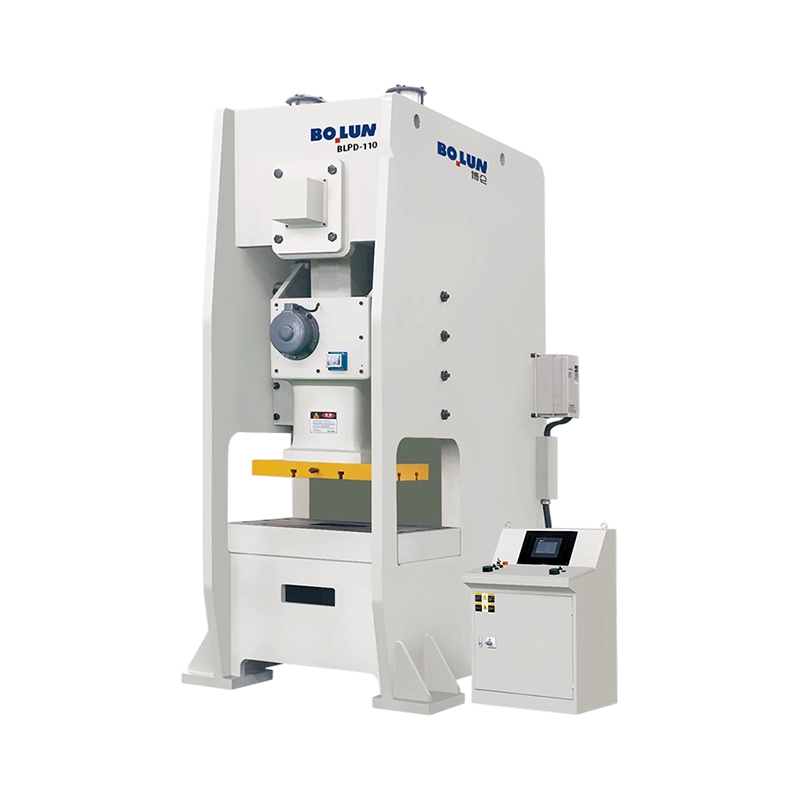
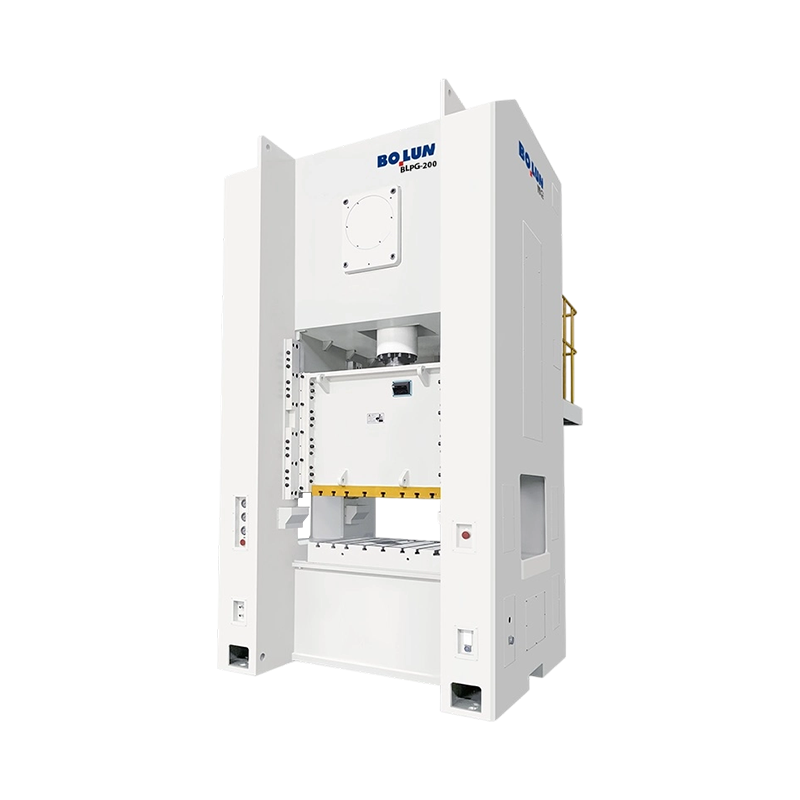
BLPD-110 Agile Precision Semi-Closed Single-Point Power Press
The BLPD-110 is a semi-closed single-point power press intended for precision stamping operations. Its 1,100 kN nominal capacity provides the force required for a wide range of blanking, piercing, forming, bending, shallow drawing, and progressive-die applications, subject to the actual die design, material properties, working position, and permissible load conditions.
A key feature of the product is its semi-closed frame. Compared with more open frame arrangements, a semi-closed structure offers additional support around the working zone while retaining practical accessibility for die installation, material feeding, inspection, and maintenance. The frame is intended to reduce unwanted deformation and vibration, particularly during rapid cycling. This structural approach is valuable when a production line must operate at speed without sacrificing repeatability.
The machine uses a single-point slide drive. A single-point arrangement is appropriate for dies and components that can be effectively centered beneath the slide. It provides a straightforward mechanical configuration and supports consistent force transmission through the main drive system. For precision hardware production, dependable slide movement and controlled die alignment are essential to reduce burr variation, dimensional drift, and premature die wear.
The standard worktable measures 900 by 600 millimeters, with a listed table thickness of 110 millimeters. This working surface accommodates a broad selection of stamping dies and auxiliary tooling. The slide bottom measures 800 by 470 millimeters and has a listed thickness of 80 millimeters. Together, these dimensions provide a useful platform for medium-sized progressive dies, compound dies, transfer-related tooling, and dedicated forming fixtures.
The maximum die height for the BLPD-110 is 360 millimeters in the V configuration and 410 millimeters in the H configuration. The die height adjustment range is 80 millimeters. These dimensions give production engineers room to select tooling with different shut heights and to compensate for die changes during setup. A powered die height adjuster rated at 0.4 kW supports convenient adjustment and helps reduce manual setup effort.
The working face height is 830 millimeters. This height can support practical operator access and ergonomic integration with feeding, inspection, and part-removal equipment. The distance between columns is 880 millimeters, providing a clear working width suited to the machine’s table and slide dimensions.
| Specification | BLPD-110 V Type | BLPD-110 H Type |
|---|---|---|
| Nominal capacity | 1,100 kN | 1,100 kN |
| Nominal pressure stroke | 6 mm | 3 mm |
| Slide stroke | 180 mm | 80 mm |
| Strokes per minute | 30–60 S.P.M. | 60–90 S.P.M. |
| Maximum die height | 360 mm | 410 mm |
| Die height adjustment | 80 mm | 80 mm |
| Worktable size | 900 × 600 × 110 mm | 900 × 600 × 110 mm |
| Slide bottom size | 800 × 470 × 80 mm | 800 × 470 × 80 mm |
| Main motor | 11 kW × 4 pole | 11 kW × 4 pole |
| Die height adjuster | 0.4 kW | 0.4 kW |
| Air pressure | 0.55 MPa | 0.55 MPa |
| Working face height | 830 mm | 830 mm |
| Column distance | 880 mm | 880 mm |
| Press weight | 10.5 tons | 10.5 tons |
The V and H configurations allow the same nominal-capacity platform to address different production priorities. The V type uses a longer slide stroke and a lower speed range, making it suitable for processes requiring more vertical travel, increased forming time, or greater clearance between the die and slide. The H type uses a shorter stroke and higher cycle rate, making it particularly suitable for high-volume blanking, piercing, and shallow forming applications where rapid production is a priority.
Frame behavior directly influences the quality of stamped parts. During every press cycle, the frame, slide, die, table, and drive system are exposed to changing loads. If the structure deflects excessively or vibrates after impact, the result can be inconsistent part dimensions, uneven cutting clearance, accelerated tool wear, and increased noise.
The semi-closed frame of the BLPD-110 is developed to provide greater structural support than a basic open-sided configuration while maintaining access to the die area. This balance is important for production plants that need both precision and operational convenience. A fully enclosed structure may provide strong support but can complicate access, while a highly open frame may simplify handling but provide less resistance to deformation. The semi-closed approach addresses these competing requirements in a practical way.
Reduced vibration is particularly important when the press operates in the H-type range of up to 90 strokes per minute. At higher speed, even small variations in frame response or slide guidance can be repeated hundreds of times per hour. A stable frame helps prevent the accumulation of such errors and supports more consistent results throughout a production run.
The structural design also contributes to die protection. A rigid and stable working platform helps maintain the relationship between the upper and lower die components. Better alignment can reduce localized stress on punches, cutting edges, guide posts, and die inserts. In turn, this may help extend tool life and reduce the frequency of corrective maintenance, although actual results depend on die quality, lubrication, material, clearance, operating load, and maintenance practice.
The 10.5-ton press weight also contributes to installation stability. A heavier machine mass can help resist movement and reduce the transmission of operating forces to the surrounding floor when the press is correctly installed on a suitable foundation. Proper anchoring, leveling, foundation preparation, and commissioning remain essential to achieve the intended performance.
Nominal capacity is only one part of press performance. The press must also maintain suitable load distribution across the slide and table. A single-point press is most effective when the working load is properly centered and the die is designed for the press’s operating conditions. Correct die layout helps avoid excessive eccentric loading, which can affect guide wear, slide alignment, and machine life.
For users, this means that press selection should involve more than comparing tonnage. Die dimensions, feed direction, material thickness, required stroke, working energy, production speed, and load position should all be reviewed. The BLPD-110 provides a useful 1,100 kN platform, but the selected operating mode must match the actual forming process.
The stated punch accuracy is GB and JIS Class 1. This indicates that the machine is designed for a high level of press accuracy according to the referenced classification. Accuracy should be verified during commissioning and maintained through regular inspection of the slide, die height, lubrication system, clutch-brake system, foundation, and tooling.
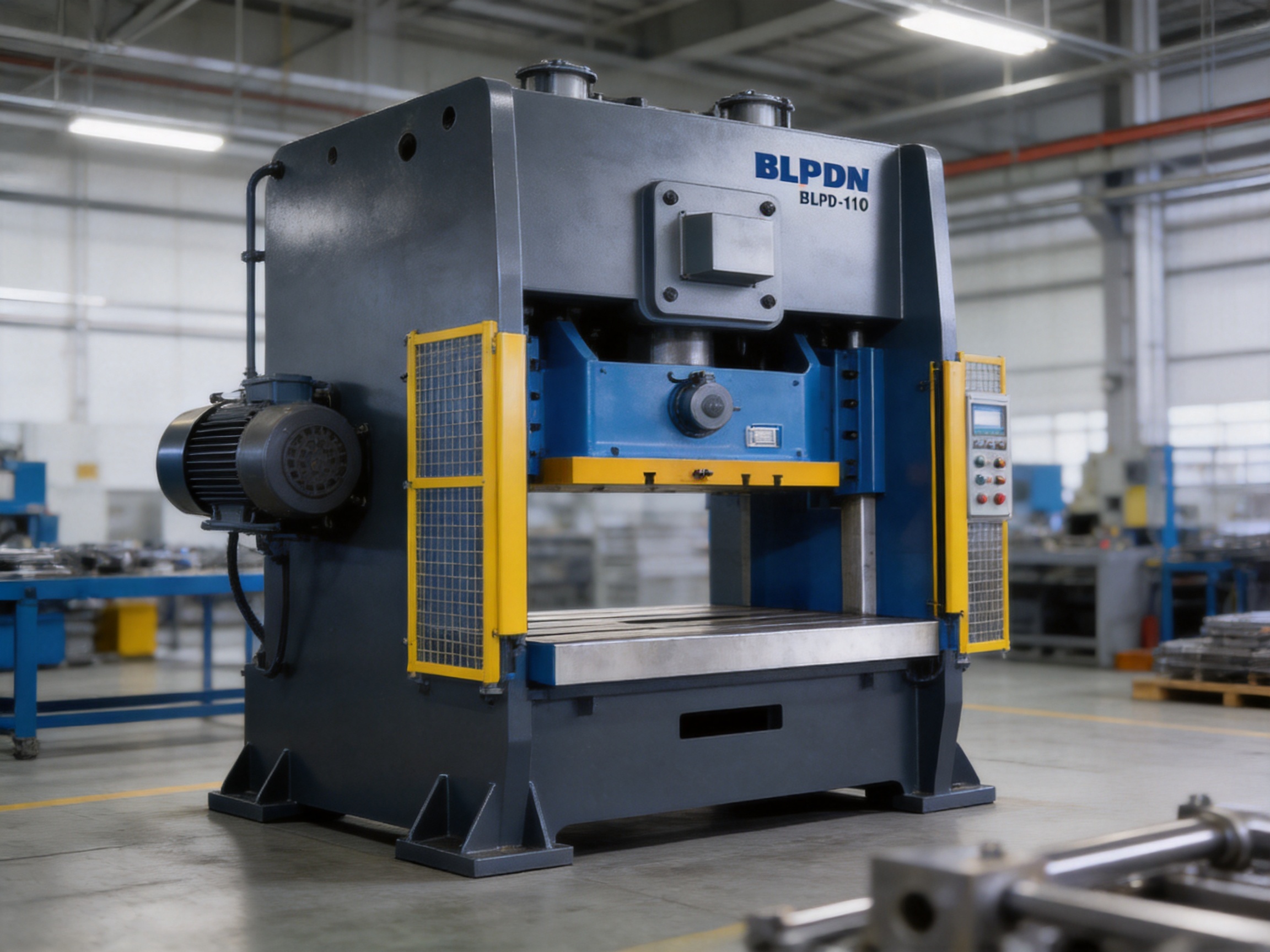
One of the strongest advantages of the BLPD-110 is its ability to combine a medium-high nominal capacity with high cycle productivity. In the H configuration, the listed range is 60 to 90 strokes per minute. At the maximum listed speed, the press can complete up to 90 cycles per minute when the die, material feed, part removal, lubrication, and operating conditions are suitable.
High speed is especially valuable for products manufactured in large quantities. Examples include small brackets, terminals, clips, washers, covers, hardware fittings, and other precision components. When a die produces one or more parts per stroke, a faster press can significantly increase hourly output without requiring additional floor space or another complete production line.
However, productive speed must be understood as stable speed. A press that operates quickly but causes excessive vibration, tool damage, or frequent stoppages may deliver less useful output than a slightly slower machine operating continuously. The BLPD-110 addresses this concern through the combined use of a supported frame, controlled drive system, dry clutch brake, and overload protection.
The V configuration provides a 30 to 60 strokes-per-minute range with a longer 180-millimeter slide stroke. This arrangement may be selected when the process requires additional slide travel or more time for forming. The two available configurations improve production flexibility and allow the customer to align the press with the characteristics of the selected die.
Inverter speed control allows the operator or production engineer to adjust operating speed according to material, die behavior, part geometry, and production requirements. This is more practical than relying on a single fixed speed for every product. During die tryout, a lower speed can be used to observe material flow and confirm tool operation. After the process is validated, speed can be increased within the approved operating range.
Compared with a lower-capacity press, the BLPD-110 offers greater forming force and a larger working platform. This can allow manufacturers to use more robust dies, combine multiple operations, or process thicker and stronger materials, depending on the specific application. Compared with a much larger press, it may require less installation space, less investment in supporting infrastructure, and less operating energy for medium-sized components.
Compared with a basic mechanical press without adjustable speed control, the BLPD-110 offers more process flexibility. Operators can adapt the cycle rate to the die and material rather than accepting a fixed operating condition. Compared with a lightly built high-speed press, the semi-closed structure provides a stronger emphasis on support and vibration control.
These advantages do not mean that one press is suitable for every stamping process. The appropriate comparison should consider actual production data, including required force, energy per stroke, stroke length, part dimensions, material grade, feed speed, die height, and target output. The BLPD-110 is strongest when selected for applications that need a combination of 1,100 kN capacity, precision, medium-sized tooling, and flexible cycle performance.
The BLPD-110 uses an 11 kW main motor with a four-pole configuration. The motor provides the mechanical power required to drive the press transmission system, while inverter control supports adjustable operating speed. This arrangement gives the user a practical tool for balancing production rate and process stability.
Inverter control can be beneficial during several stages of production. During setup, the operator may use a reduced speed to inspect die clearance, feeding alignment, and part ejection. During process optimization, different speeds can be evaluated to determine how the material responds. During normal production, the machine can be operated at a speed suitable for the die and desired output.
Adjustable speed also supports product diversification. A factory may run a short-stroke progressive die at high speed during one shift and a more demanding forming die at a lower speed during another. A single adaptable machine can therefore serve multiple product families, increasing equipment utilization and reducing the need to dedicate one press to only one product type.
Speed adjustment should always remain within the machine’s specified range and the limits approved for the tooling. The die designer and production team should consider lubrication, feed accuracy, material characteristics, noise, vibration, heat generation, and the response of peripheral equipment. Proper adjustment is a productivity feature only when it is combined with disciplined process control.
A mechanical power press must transmit force repeatedly and accurately. The drive system, crank mechanism, slide connection, bearings, guides, and lubrication points all contribute to long-term reliability. A well-maintained transmission reduces backlash, friction, and heat, helping preserve the consistency of the press over time.
Regular maintenance should include inspection of lubrication levels and delivery, fastener condition, guide clearance, abnormal noise, vibration, clutch-brake response, and die height adjustment operation. Preventive maintenance is particularly important in high-cycle applications because small mechanical issues can become major problems when repeated many thousands of times.
The sensitive dry clutch brake system is an important part of the BLPD-110’s operating and safety architecture. A press clutch engages the drive to initiate slide movement, while the brake brings the slide to a controlled stop. The system must respond consistently to control commands and remain reliable under repetitive cycling.
A responsive clutch-brake system supports production efficiency because it helps control the press cycle and improves operator confidence during setup. It also contributes to safety when integrated with the machine’s control circuit, emergency-stop functions, guarding, and applicable safety devices.
Dry clutch-brake systems are widely used in mechanical presses because they can provide fast engagement and braking response. Their performance depends on correct adjustment, clean operating conditions, suitable air pressure, and regular inspection. The BLPD-110 specifies an air pressure of 0.55 MPa. The plant air supply should be clean, stable, and properly maintained so that the clutch-brake system receives the required pressure.
Operators should never bypass safety circuits or attempt unauthorized clutch-brake adjustments. Inspection and servicing should be conducted by qualified personnel according to the machine’s technical documentation and applicable workplace safety requirements.
Die damage and press overload are serious risks in stamping. An incorrect feed, double material, misaligned strip, foreign object, excessive forming load, or unsuitable die setting can create a force above the safe working condition. The BLPD-110 is equipped with a hydraulic overload protector to help protect the press and tooling against sudden excessive load.
The overload protector is designed to respond when the working condition exceeds the permitted threshold. By relieving or limiting overload pressure, it can reduce the risk of damage to critical machine components and expensive dies. This protection is particularly valuable in automated or high-speed production, where a fault can occur rapidly and cause repeated damage if the press does not stop promptly.
Overload protection is not a substitute for correct die engineering. The die must still be designed within the press capacity, load position, energy limitations, and recommended operating range. The material must be fed accurately, and the process must be tested before full-speed production. Even with overload protection, repeated overload events should be investigated rather than treated as normal operation.
The protection system can also reduce downtime. If an abnormal condition occurs, protecting the machine and die may allow the production team to correct the cause without replacing major components. This supports a lower total cost of ownership and improves the reliability of the production schedule.
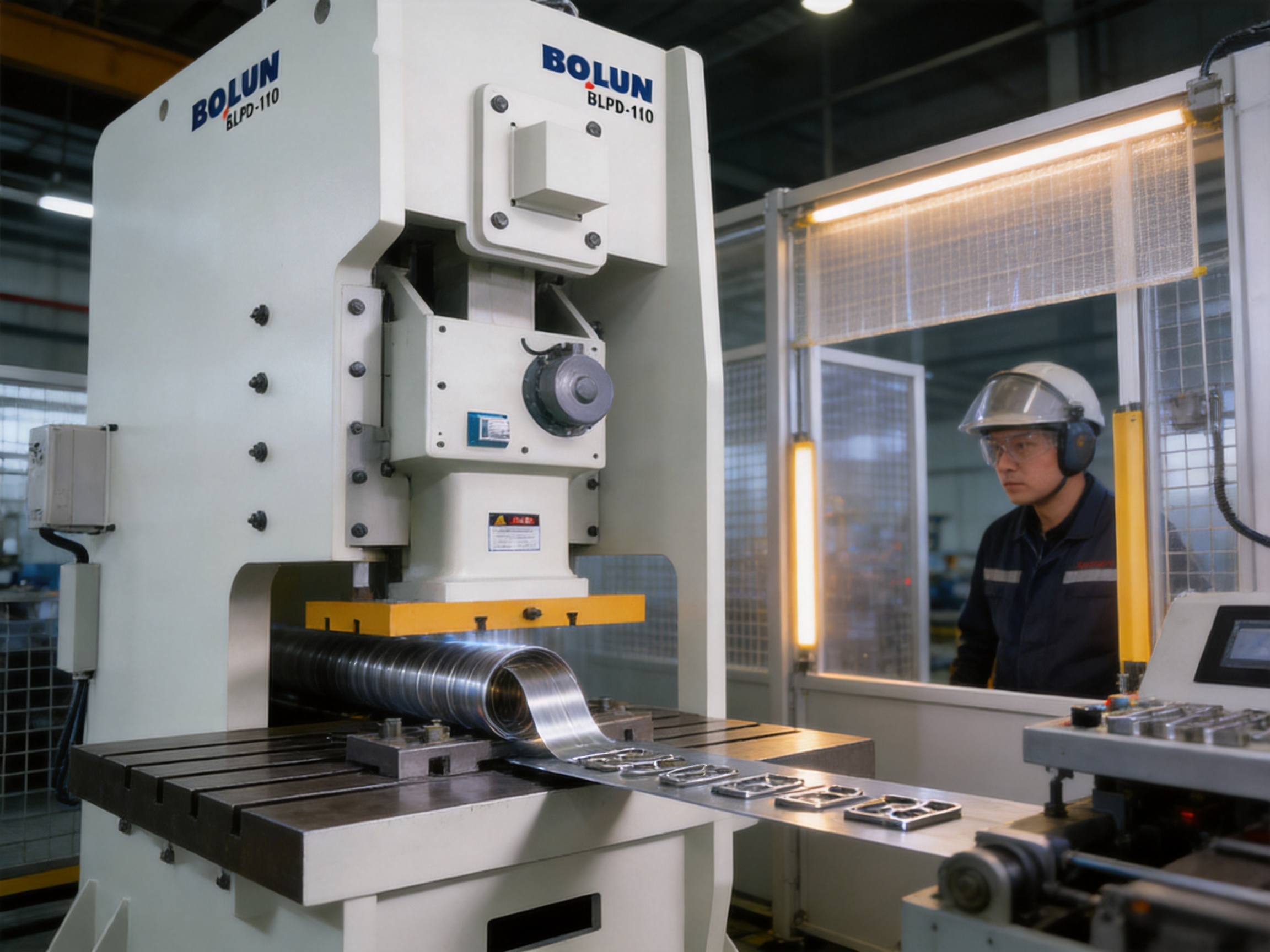
Precision stamping depends on the interaction of the press, die, material, feed system, and inspection process. The BLPD-110 provides a foundation for accurate production through its supported frame, single-point slide configuration, controlled movement, adjustable die height, and JIS Class 1 accuracy reference.
The 1,100 kN nominal capacity gives the press the strength required for many demanding operations, while the 900 by 600 millimeter table supports substantial tooling. The 880-millimeter column distance provides a generous clear width within the working zone. These dimensions help engineers design dies with practical strip layouts, guide arrangements, and material handling access.
Precision also requires consistency over the complete production cycle. The press must return the slide to a repeatable position, maintain appropriate die shut height, and respond consistently to the clutch-brake command. The operator must control lubrication, material quality, feed alignment, and die condition. When these factors are coordinated, the machine can support stable production of parts with repeatable dimensions and clean cutting edges.
The press’s accuracy classification provides an important benchmark for acceptance and maintenance. Customers may establish inspection procedures that include slide parallelism, table and slide flatness, shut-height repeatability, stopping performance, die height adjustment accuracy, and functional tests under load. These checks help confirm that the press continues to meet production requirements after installation.
The BLPD-110 can be considered for progressive dies, compound dies, blanking dies, piercing dies, bending tools, shallow forming tools, and other specialized stamping equipment that fits the specified table, slide, die height, and load requirements.
For a progressive die, the H configuration may be attractive when short stroke and high speed are more important than extended forming travel. For deeper or more complex forming operations that require a longer slide stroke, the V configuration may be more appropriate. Tooling selection should include a review of the nominal pressure stroke and the force curve of the die, not just the maximum rated capacity.
The maximum die height and adjustment range should be checked against the actual die shut height. Sufficient space must also be reserved for feeding equipment, sensors, lubrication, part chutes, scrap removal, and guarding. The die should be properly secured to the table and slide, and the working load should be centered as far as practical.
The BLPD-110 specifications include a mold pad capacity of 63 kN, a ram stroke of 80 millimeters, and an effective cushion area of 500 by 350 millimeters. These features can support forming processes that require controlled material support, blank holding, or part ejection, depending on the detailed machine configuration and die arrangement.
A cushion system can help manage the movement of material during forming. By applying controlled support from beneath the die, it may reduce wrinkling, improve material flow, and assist in removing the finished part. The actual result depends on cushion force, timing, stroke, die geometry, lubrication, and material properties.
The listed cushion capacity should be compared with the required force of the intended process. Engineers should confirm whether the die requires a cushion, ejector, blank holder, or other supporting function and should verify the control method before finalizing the tooling design.
Zhejiang Bolun High-Precision Machinery Co., Ltd. has developed its capabilities around precision forming equipment, industrial machine tools, forging machinery, and casting machinery. The company combines research and development, engineering design, production, sales, and service within one organization.
Its experience spans approximately two decades in machinery manufacturing. This long-term involvement provides a foundation for understanding the practical requirements of stamping plants, including press structure, drive systems, die compatibility, quality control, installation, and after-sales support.
A major strength is the company’s full-chain production approach. The organization is described as maintaining capabilities that extend from basic design and core component development through precision processing, machine assembly, testing, and delivery. This type of integration can improve communication between engineering and production teams, reduce dependence on disconnected suppliers, and support greater control over critical dimensions.
Precision processing equipment and a mature industrial environment are important for power press production. Large frames, tables, slides, connection parts, shafts, housings, and other components must be manufactured and assembled to appropriate tolerances. Accurate machining is especially important where guide relationships, die alignment, bearing seats, and drive geometry influence press performance.
Not every stamping line has the same requirements. Customers may need different electrical standards, safety interfaces, automation connections, die heights, feeding arrangements, working speeds, or special functions. The company’s non-standard customization capability allows it to provide solutions for products with special specifications and operating conditions.
Customization may involve more than changing a single component. A successful customized press must maintain compatibility between the frame, drive, control system, tooling, feeding equipment, guarding, and factory layout. Engineering coordination is therefore essential. The producer’s integrated design and manufacturing model can support this coordination from the initial technical discussion through final commissioning.
For international customers, customization can also include adaptation to local electrical requirements, production practices, safety expectations, and material-handling systems. Such work should be clarified during the quotation and technical review stage so that the final machine matches the customer’s line architecture.
Quality control is central to the reliability of a precision press. The company states that it has established a finished-product inspection system exceeding ordinary industry requirements and applies inspection to processes and components throughout production.
For a machine such as the BLPD-110, effective quality management may include incoming inspection of materials and purchased components, dimensional checks after machining, verification of frame and table geometry, inspection of drive components, assembly checks, electrical testing, pneumatic testing, clutch-brake testing, overload protection verification, and final accuracy inspection.
Process-based inspection is valuable because defects are easier and less expensive to correct before final assembly. Checking components at multiple stages can reduce the possibility that a dimensional error, surface issue, or assembly inconsistency will remain hidden until the machine is commissioned at the customer’s factory.
Final inspection should confirm that the press operates correctly and meets the agreed technical specifications. Documentation can include test records, inspection results, component information, operating instructions, and maintenance recommendations. These records help customers establish a baseline for future service and performance monitoring.
The value of a power press extends beyond its initial purchase price. A machine that is easy to install, maintain, troubleshoot, and support can provide greater value over its operating life. The producer’s service system covers pre-sales consultation, in-sales support, and after-sales assistance.
Pre-sales consultation helps customers select the correct model and configuration. Technical discussions should cover the material, thickness, part dimensions, die type, required force, production speed, stroke, die height, automation, floor conditions, and expected output. This process reduces the risk of selecting a press based only on a nominal tonnage number.
In-sales support may include manufacturing coordination, inspection, packaging, shipping preparation, installation planning, and communication with the customer’s technical team. Good information exchange is particularly important when the press must be integrated with a decoiler, straightener, feeder, transfer unit, sensors, safety light curtains, or centralized production-management system.
After-sales support can include commissioning assistance, operator training, maintenance guidance, troubleshooting, spare-parts communication, and technical consultation. A clear service process helps customers return the press to production efficiently when adjustment or repair is required.
Customers should also establish an internal maintenance plan. Daily inspections may include air pressure, lubrication, abnormal sound, leakage, fastener condition, and safety-device status. Periodic inspections may cover clutch-brake response, guide clearance, die height accuracy, overload protector function, electrical connections, and foundation condition.
The BLPD-110 is suited to manufacturers that need a medium-capacity precision press for repetitive metal-forming operations. Potential applications include electrical and electronic hardware, appliance components, automotive brackets, metal clips, terminals, small structural parts, precision connectors, hardware fittings, and general industrial stampings.
In electrical hardware production, the press can support high-volume manufacture of conductive parts, mounting pieces, terminals, and formed contacts when the die and material are properly matched. The H configuration can be useful for progressive tooling that produces small components at a high rate.
In appliance manufacturing, the machine may be used for brackets, reinforcement parts, covers, and small formed components. The larger worktable and 1,100 kN capacity can provide more tooling flexibility than a small bench-scale or light-duty press.
In automotive component production, the machine may be considered for brackets, clips, supports, reinforcements, and other medium-sized parts. The correct application depends on material strength, thickness, forming depth, required force, and production volume.
For general industrial hardware, the machine can support blanking, piercing, bending, embossing, and shallow forming processes. Its adjustable speed allows users to adapt the process during die tryout and production optimization.
A modern press is often installed as part of a complete production cell. The BLPD-110 can be evaluated for integration with coil-feeding systems, straighteners, automatic lubrication, scrap conveyors, part collectors, sensors, and quality-monitoring equipment.
When integrating automation, the cycle timing of the press must match the feed length, material acceleration, die entry, pilot release, part ejection, and scrap removal. The shorter H-type stroke and higher speed range may benefit fast progressive-die lines, while the V type may provide additional travel for processes with more demanding feed and forming requirements.
Automation should be designed with safety as a primary requirement. Guards, interlocks, emergency stops, presence-sensing devices, and safe access procedures must be coordinated across the entire line. The press control system and peripheral equipment should be reviewed together before installation.
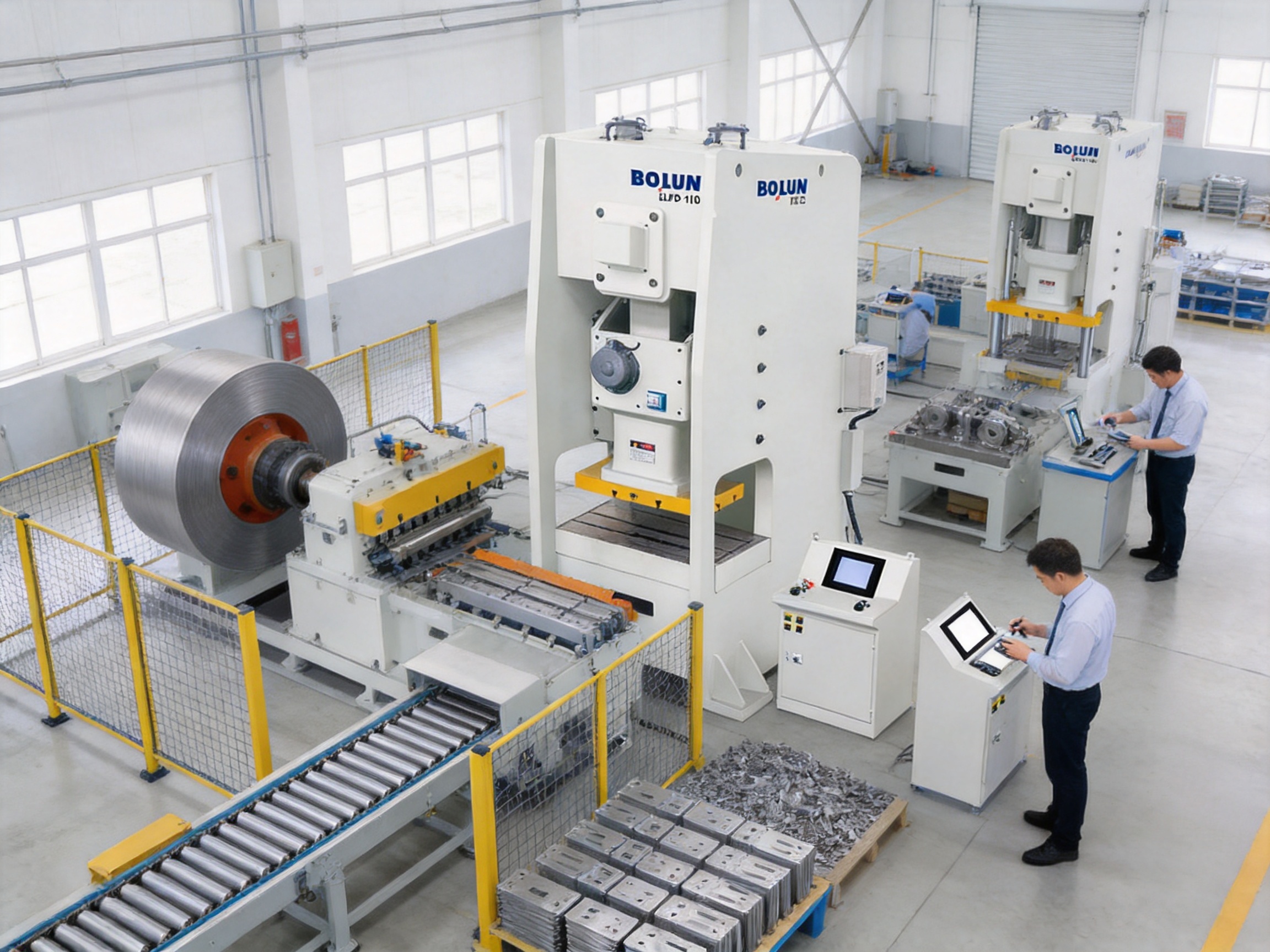
Before delivery, the customer should prepare a suitable installation location. The floor or foundation must be capable of supporting the 10.5-ton press and the dynamic forces generated during operation. The installation area should provide sufficient clearance for die handling, material loading, maintenance, electrical cabinets, air connections, and safe operator access.
The listed overall dimensions for the BLPD-110 are approximately 1,420 by 1,985 by 3,200 millimeters. The exact interpretation of these dimensions should be confirmed with the approved machine layout because orientation, guarding, control cabinets, lubrication equipment, and optional accessories may affect the final footprint.
Incoming electrical power should be checked against the machine configuration and local standards. The compressed-air system should be able to maintain the specified 0.55 MPa pressure under operating conditions. Air filtration and moisture management are important for protecting pneumatic components and supporting consistent clutch-brake behavior.
Commissioning generally includes leveling, anchoring, lubrication, electrical connection, air connection, control-system inspection, die height adjustment, clutch-brake testing, safety-device testing, overload-protection testing, and no-load cycling. Production trials should begin at a controlled speed before moving toward the desired operating rate.
Initial die trials should verify strip alignment, feed timing, slide position, die shut height, part ejection, scrap removal, lubrication, and dimensional results. If abnormal sound, vibration, overheating, or inconsistent stopping occurs, the machine should be stopped and inspected by qualified personnel.
Operating efficiency is influenced by output, uptime, energy use, tooling life, maintenance, changeover time, and product quality. The BLPD-110 supports efficiency through its high-speed H configuration, adjustable inverter control, powered die height adjustment, overload protection, and adaptable working platform.
The ability to adjust speed can reduce trial-and-error during setup. Operators can begin at a conservative rate, confirm stable operation, and increase speed only when the process remains controlled. This approach can lower the risk of damaging new dies or producing large quantities of defective parts during the initial run.
Hydraulic overload protection can reduce the financial impact of accidental overload. A die collision or double-feed event can cause extensive damage in a press without adequate protection. Protecting the machine and die helps preserve production assets, although proper feeding control and operator procedures remain essential.
Die height adjustment can also shorten changeover work. A powered adjustment mechanism reduces the need for manual intervention when installing different dies within the available adjustment range. Faster changeover improves equipment utilization, particularly in plants producing several part numbers in relatively small batches.
Maintenance costs depend on the working environment, operating hours, material, lubrication, die condition, and service quality. A preventive maintenance program can help detect wear before it leads to unplanned downtime. Operators should monitor trends in noise, vibration, stopping response, lubrication, and product quality rather than waiting for a complete failure.
The BLPD-110 offers several advantages when compared with conventional mechanical presses serving similar applications. Its semi-closed frame emphasizes structural support and vibration reduction. Its H configuration offers a speed range of up to 90 strokes per minute. Its V configuration provides a longer stroke for processes requiring additional travel. Its inverter-controlled motor supports process adjustment, and its hydraulic overload protector adds a layer of protection for the press and die.
The 900 by 600 millimeter worktable gives the machine a practical tooling platform without placing it in the class of very large presses. This can help manufacturers handle medium-sized dies while controlling installation requirements. The 1,100 kN capacity provides a useful step above smaller 800 kN models, allowing additional process margin for suitable applications.
The machine’s accuracy reference to GB and JIS Class 1 is another important consideration for customers focused on precision production. Accuracy is not created by one component alone, but the specification indicates that the press is intended for applications where geometric and operational consistency matter.
The combination of performance and adaptability is particularly useful for suppliers serving multiple industries. A press used for only one dedicated operation may deliver excellent output in that application, but a flexible machine can provide greater value when product demand changes. The BLPD-110 can be configured and operated according to different die and material requirements within its technical limits.
The producer’s manufacturing integration adds another competitive advantage. In-house engineering, precision processing, assembly, inspection, customization, and service provide a more coordinated path from customer requirement to finished machine. This can be valuable for customers seeking a supplier capable of supporting both standard and special-purpose press requirements.
Customers evaluating the BLPD-110 should begin by defining the actual stamping process. Important information includes material type, thickness, tensile strength, blank size, part geometry, number of operations, die type, required force, force position, stroke requirement, die shut height, production quantity, and desired cycle rate.
The required press capacity should be calculated using the die’s actual cutting and forming loads, with an appropriate safety margin. The position of the load should be reviewed because off-center forces can affect press behavior. The customer should also confirm whether the V or H configuration better matches the tooling.
For high-volume small-part production, the H type may be preferred because its 60 to 90 strokes-per-minute range can support rapid cycling. For applications requiring a longer 180-millimeter slide stroke and a 30 to 60 strokes-per-minute range, the V type may be more appropriate.
The customer should compare the die’s maximum height with the listed 360- or 410-millimeter maximum die height and confirm that the 80-millimeter adjustment range is sufficient. The table, slide bottom, column distance, and working face height should be compared with the tooling drawings and factory layout.
Finally, automation, safety, air supply, electrical requirements, foundation conditions, maintenance access, spare parts, installation, and operator training should be included in the technical review. A complete evaluation helps ensure that the selected press performs effectively as part of the entire production system.
The nominal capacity is 1,100 kN. The actual usable force for a specific operation depends on the material, die design, working position, stroke, forming process, and applicable load limits.
The V type has a 180-millimeter slide stroke and operates at 30 to 60 strokes per minute. The H type has an 80-millimeter slide stroke and operates at 60 to 90 strokes per minute. The V type is intended for processes requiring more slide travel, while the H type is suited to faster repetitive stamping.
Yes, the worktable, slide dimensions, speed range, and single-point configuration make the press suitable for many progressive-die applications, provided that the die dimensions, load distribution, feed system, and operating conditions are compatible.
The worktable measures 900 by 600 millimeters and has a listed thickness of 110 millimeters.
The maximum die height is listed as 360 millimeters for the V type and 410 millimeters for the H type. The machine provides 80 millimeters of die height adjustment.
The press uses an 11 kW, four-pole main motor. Inverter control allows the operating speed to be adjusted within the specified range.
It is designed to help protect the press and die when an abnormal load exceeds the permitted setting. It can reduce the risk of serious damage caused by events such as double material, feeding errors, or unexpected die obstruction.
The listed air pressure is 0.55 MPa. The customer should provide a clean and stable compressed-air supply and confirm detailed air-quality requirements during technical preparation.
The listed punch accuracy is GB and JIS Class 1. Final performance should be confirmed through commissioning inspection and maintained through suitable operating and maintenance procedures.
Potential industries include precision hardware, electrical components, electronics, appliances, automotive parts, general industrial products, and other sectors requiring repetitive metal stamping.
The producer provides non-standard customization and special-specification design services. Custom requirements should be discussed before production so that the frame, control system, electrical configuration, safety equipment, automation interfaces, and tooling requirements can be coordinated.
Customers should review capacity, force position, material, die dimensions, stroke, speed, die height, worktable size, automation, safety, foundation, electrical supply, air supply, installation access, maintenance requirements, and expected production volume.
The BLPD-110 Agile Precision Semi-Closed Single-Point Power Press is designed for manufacturers that need reliable force, high-speed production, structural stability, and precision control in one medium-capacity platform. Its 1,100 kN nominal capacity, 900 by 600 millimeter worktable, 11 kW inverter-controlled motor, dry clutch-brake system, hydraulic overload protection, and GB and JIS Class 1 accuracy reference make it a strong candidate for demanding stamping environments.
The semi-closed frame provides a practical balance between access and support, helping address vibration and deformation concerns during rapid cycling. The two operating configurations allow users to select either a longer stroke and moderate speed or a shorter stroke and higher production rate. This flexibility enables the same platform to serve different dies, materials, and production objectives.
The machine’s value is further strengthened by the producer’s integrated capabilities in research and development, engineering, precision processing, assembly, inspection, customization, and service. Zhejiang Bolun High-Precision Machinery Co., Ltd. has built its manufacturing approach around technical development, quality control, customer support, and long-term industrial experience.
For companies producing precision hardware and other stamped components, the best equipment decision is based on the complete production process rather than one specification. When the die, material, feeding system, safety equipment, maintenance program, and press configuration are properly matched, the BLPD-110 can support efficient, repeatable, and scalable stamping production.
1. Product Technical Specification Sheet, BLPD Series Semi-Closed Single-Point Power Presses.
2. BLPD-110 Product Description and Configuration Data, Zhejiang Bolun High-Precision Machinery Co., Ltd.
3. General Principles of Mechanical Power Press Selection and Application.
4. Japanese Industrial Standards, Press Accuracy Classification Reference.
5. Industrial Practices for Mechanical Press Safety, Clutch-Brake Inspection, and Overload Protection.
6. Manufacturing Guidance for Progressive Dies, Die Height Selection, and Stamping Process Optimization.


What Is a Power Press? A power press — also called a stamping press or punch pr...
Power press machines are classified in two main ways: by frame construction, w...
Understanding Mechanical Power Presses and Their Essential Functions A mechani...
In the fields of metal forming, sheet metal fabrication, blanking, and punching,...
As the manufacturing industry moves steadily toward automation and smart product...
In modern manufacturing, cold forging is widely used in the automotive, aerospac...
Contact Us

bolunpress@gmail.com

+86-575-83362228

+86-15158259588

+86-575-83362999

+86-15158259588

Hangzhou Office Add: No. 332 Wangjiang East Road, Shangcheng District

No.1 Linjiang Road East, Xiaren, Jinting Town, Shengzhou City, Zhejiang Province, China
Ready to Begin?
Get in Touch

Now!

ZHEJIANG BOLUN
 English
 中文简体
中文简体