
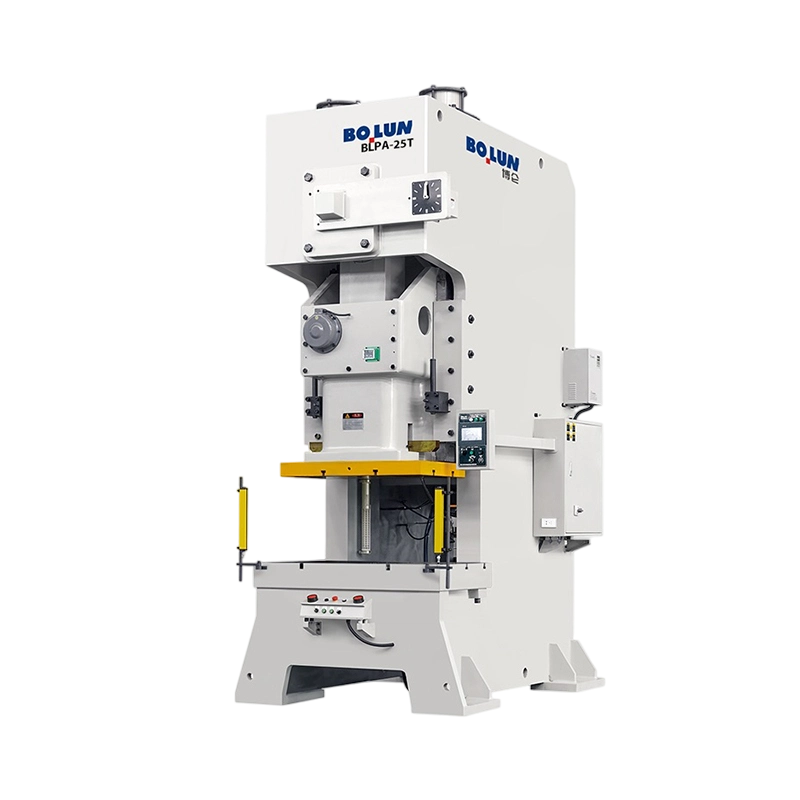
In modern precision stamping, manufacturers need equipment that combines compact structure, reliable output, accurate slide control, fast die setup, and dependable safety protection. The BLPA-25 Compact Precision Open-Type Single-Point Power Press is designed for exactly this type of production environment. With a nominal capacity of 250 kN, it serves manufacturers that produce small and medium precision components requiring repeatable forming accuracy, stable force delivery, and efficient operation across long production cycles.
This machine belongs to the open-type single-point power press category, a press configuration widely valued for accessibility, convenient die loading, easy maintenance, and flexible integration into stamping workshops. Compared with larger closed-type presses, an open-type power press provides more operator access and is often more suitable for small-scale precision work, pilot production, part diversification, and efficient batch manufacturing. Compared with lower-grade conventional open-type presses, the BLPA-25 emphasizes structural rigidity, clutch and brake sensitivity, overload protection, and stable slide performance.
The BLPA-25 is manufactured by Zhejiang Bolun High-Precision Machinery Co., Ltd., a company located in Zhejiang, one of China’s important precision manufacturing regions. With approximately two decades of experience in machinery manufacturing, the company integrates research and development, design, production, sales, and service. Its product philosophy focuses on high-precision forming equipment, strict quality inspection, durable structure, and practical solutions for global industrial users.
For manufacturers evaluating stamping equipment, the central question is not only whether a machine can press metal, but whether it can maintain precision, reduce downtime, protect tooling, support operator safety, and keep total production cost under control. The BLPA-25 answers these needs through a combination of a high-rigidity steel plate frame, stress-relief heat treatment, a highly sensitive dry clutch brake system, a dual solenoid valve, a hydraulic overload protector, a maximum die height of up to 260 mm, and a manual slide adjustment device for quick and accurate die setup.
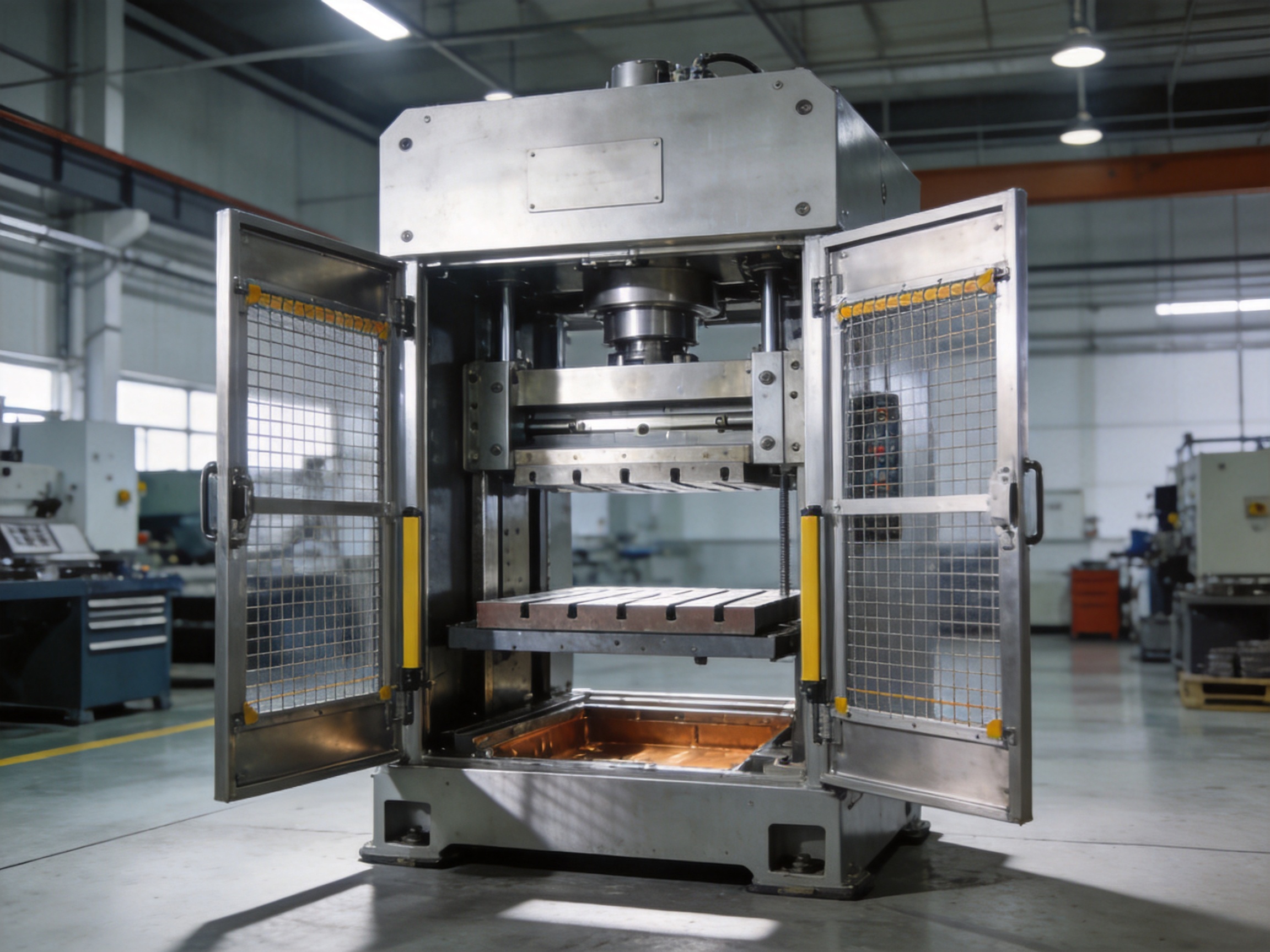
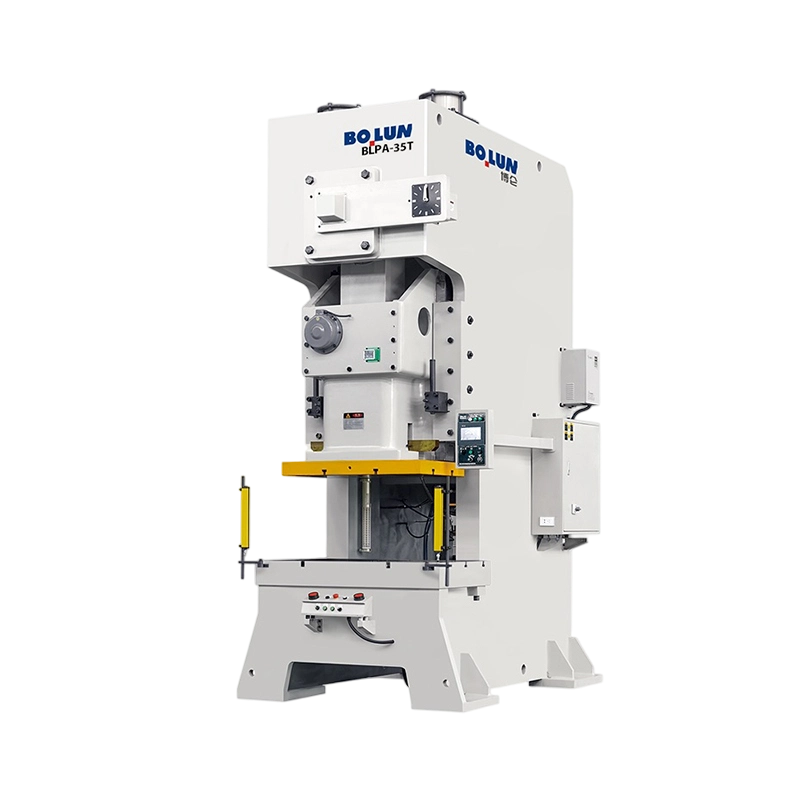
The BLPA-25 is positioned as a compact precision open-type single-point power press for high-efficiency stamping and forming of small-scale precision components. Its 250 kN nominal capacity makes it suitable for operations that require controlled forming force rather than massive tonnage. In many factories, compact presses in this capacity range are used for electrical parts, small hardware, brackets, clips, terminals, light metal components, appliance fittings, automotive subcomponents, and other precision stamped parts.
The open-type single-point configuration is especially useful where accessibility matters. Operators and technicians can approach the working area more conveniently than with many enclosed frame structures. This can simplify die installation, adjustment, inspection, material feeding, and daily maintenance. For workshops that frequently change dies or produce multiple part types, this accessibility can become a major operational advantage.
However, accessibility alone is not enough. Open-type presses must still maintain frame rigidity and slide accuracy. A weak frame can deform under load, causing part inconsistency, die wear, burr formation, dimensional drift, and production instability. The BLPA-25 addresses this challenge through a high-rigidity frame constructed from steel plates that are heat treated to eliminate internal stress. This approach improves long-term structural stability and helps the machine maintain accuracy during repetitive stamping cycles.
The single-point drive arrangement is well matched to smaller precision dies. In a single-point press, the force is delivered through one central connection point, making the mechanism efficient and compact. When the press is properly designed and manufactured, this structure delivers dependable slide motion for many common stamping and forming applications. For small precision components, the combination of compact structure, centralized force, and accurate adjustment is often more practical than using a larger and more expensive machine.
The BLPA-25 is also designed for production environments where safety and uptime are essential. Its dry clutch brake system and dual solenoid valve help ensure reliable engagement and stopping behavior. The hydraulic overload protector helps protect the press and die in abnormal conditions. These systems contribute to a safer and more predictable production process, especially when operators work with expensive tooling or materials that vary in thickness or hardness.
The following table summarizes the main available product information and explains the practical manufacturing value of each feature.
| Item | Specification or Feature | Manufacturing Value |
|---|---|---|
| Product Type | Compact precision open-type single-point power press | Provides accessibility, efficient operation, and suitability for small precision stamping tasks. |
| Nominal Capacity | 250 kN | Delivers reliable forming force for small-scale precision components and light to medium stamping work. |
| Frame Structure | High-rigidity steel plate frame | Improves structural stability, reduces deformation, and supports consistent part quality. |
| Stress Treatment | Steel plates undergo heat treatment to eliminate internal stress | Enhances long-term accuracy and reduces the risk of dimensional instability over extended use. |
| Clutch and Brake | Highly sensitive dry clutch brake system | Supports accurate operation, reliable stopping, and improved safety during stamping cycles. |
| Valve System | Dual solenoid valve | Improves control reliability and contributes to safer machine response. |
| Overload Protection | Hydraulic overload protector | Protects the press and tooling from abnormal overload conditions. |
| Maximum Die Height | Up to 260 mm | Allows compatibility with a practical range of dies for compact precision production. |
| Slide Adjustment | Manual slide adjustment device | Enables quick and precise die setup while reducing unnecessary downtime. |
| Primary Applications | High-efficiency stamping and forming of small-scale precision components | Fits workshops requiring repeatability, flexibility, and stable performance. |
A power press is only as reliable as its frame. In stamping, every cycle imposes dynamic force on the frame, slide, drive system, and die. If the frame lacks rigidity, the press may deflect under load. Even small deformation can affect die alignment, produce inconsistent parts, increase scrap, and shorten tool life. For this reason, the BLPA-25 uses a high-rigidity frame built from steel plates.
The use of steel plates is not merely a matter of material selection. The design, welding, machining, heat treatment, and inspection of the frame determine how well the machine performs under repetitive load. The BLPA-25 frame is engineered to provide the structural strength needed for precision stamping while preserving the open-type advantages of accessibility and compact layout. This balance is important because open-type presses must resist deformation while maintaining an open working area.
Another important factor is the heat treatment used to eliminate internal stress. During fabrication, steel structures can accumulate residual stresses from cutting, welding, forming, and machining. If these stresses are not properly addressed, they can gradually release during operation, causing subtle changes in geometry. In a precision power press, even minor geometry changes may influence slide accuracy, die alignment, and forming consistency. By applying rigorous heat treatment, the BLPA-25 frame gains improved dimensional stability for long-term operation.
This frame design gives the BLPA-25 an advantage over many ordinary open-type presses that prioritize low initial price over long-term stability. In some competing machines, insufficient stress relief or inadequate structural design may lead to performance decline after extended use. The result can be more frequent adjustment, higher tooling maintenance cost, greater scrap rate, and reduced confidence in production accuracy. The BLPA-25 is designed to avoid these problems by treating rigidity and stability as core requirements rather than optional enhancements.
For factories that operate presses over multiple shifts, structural stability becomes a direct economic factor. A machine that maintains alignment reduces troubleshooting time, supports predictable production planning, and allows tooling engineers to work with greater confidence. In this sense, the BLPA-25 frame is not just a mechanical structure; it is the base on which process reliability is built.
The clutch and brake system is one of the most important safety and performance elements in a mechanical power press. It controls the transfer of motion and ensures that the slide can be started and stopped reliably. The BLPA-25 is equipped with a highly sensitive dry clutch brake system, designed to support accurate operation and dependable stopping performance.
A dry clutch brake system offers practical advantages in press operation. It is responsive, suitable for frequent cycling, and can be maintained without the complexity associated with some alternative systems. Sensitivity is especially important in precision stamping because inaccurate stopping or delayed response may affect both operator safety and die protection. When the clutch brake responds properly, production becomes more predictable and the press can be controlled with greater confidence.
The dual solenoid valve further supports safety and control reliability. In press applications, valve performance is closely related to the ability of the machine to respond correctly to operator commands and control signals. A dual solenoid arrangement adds an important layer of control integrity. It helps reduce the risk of uncontrolled motion and supports safer operation in demanding production environments.
When combined, the dry clutch brake system and dual solenoid valve provide an operational advantage over presses with less responsive or less sophisticated control arrangements. Some low-cost machines may rely on simpler systems that can be less precise, slower to respond, or more vulnerable to inconsistent stopping behavior. For small precision components, this difference is significant. Stamping is not only about applying force; it is about applying force at the right moment, in the right position, with controlled motion and reliable stopping.
In practical terms, this system helps protect operators, dies, and workpieces. A press that stops reliably is easier to set up, safer to operate, and less likely to damage tooling during abnormal events. This is particularly valuable when dies are expensive, lead times are long, or part tolerances are strict. By incorporating this clutch and brake architecture, the BLPA-25 supports the production discipline expected in modern precision manufacturing.
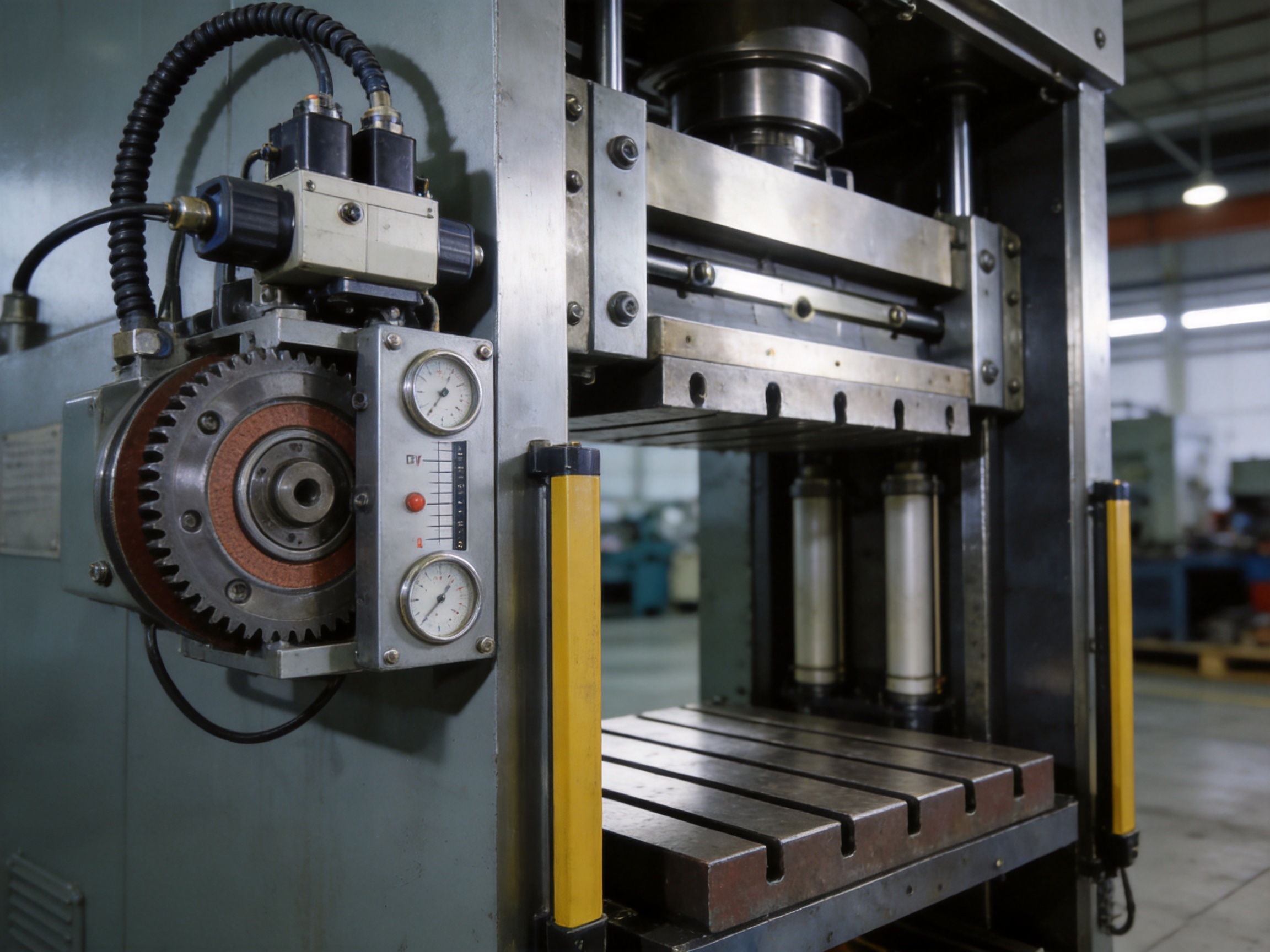
Overload is one of the most damaging events in stamping production. It may occur because of incorrect material thickness, misfed stock, foreign objects in the die area, improper die setup, unexpected material hardness, or process miscalculation. Without effective protection, overload can damage dies, deform press components, affect alignment, and cause costly downtime.
The BLPA-25 uses a hydraulic overload protector to help protect the slide, the press structure, and the die system. This feature is especially important for precision stamping because tooling damage can be far more expensive than a short production interruption. A hydraulic overload protector can respond when abnormal load conditions exceed safe limits, helping reduce the severity of damage and allowing the machine to return to production more efficiently after correction.
Compared with presses that lack advanced overload protection, the BLPA-25 provides a stronger safety margin for real-world production. In an ideal setup, every coil, blank, and die condition would be perfectly controlled. In reality, manufacturing environments involve variation. Operators may change materials, feeders may require adjustment, and dies may experience wear. Overload protection helps manage these uncertainties.
This protection also supports production confidence. When plant managers select a power press, they must consider not only normal operation but also abnormal scenarios. A machine that can better tolerate process variation reduces operational risk. For workshops that handle multiple products, custom jobs, or frequent die changes, this becomes particularly valuable. The BLPA-25 is therefore suitable for manufacturers seeking both flexibility and protection.
Hydraulic overload protection also contributes to the overall lifecycle value of the machine. Reduced risk of major damage means fewer emergency repairs, better preservation of accuracy, and longer service life. While the initial purchase price is always important, the true cost of a press includes downtime, maintenance, tooling repair, scrap, and lost production. By helping prevent overload-related damage, the BLPA-25 can improve total cost performance over time.
Die setup efficiency is a major factor in stamping productivity. A press may have excellent force and structure, but if die adjustment is slow or inaccurate, production efficiency suffers. The BLPA-25 includes a manual slide adjustment device that supports quick and precise die setup. This feature is useful for manufacturers that produce multiple part types or change dies regularly.
The maximum die height of up to 260 mm gives the press practical flexibility within its compact machine class. Die height capability determines whether the press can accommodate different tooling designs. For small precision components, many dies fall within this range, making the BLPA-25 suitable for diverse production requirements. The manual slide adjustment allows operators to set the slide position accurately to match the die and stamping process.
Manual adjustment can be advantageous in compact presses because it is straightforward, reliable, and easy for trained technicians to understand. It avoids unnecessary complexity while still providing the precision needed for setup. In many factories, simple and robust adjustment mechanisms are preferred because they reduce maintenance burden and improve operator familiarity.
Quick die setup has a direct effect on production economics. Every minute spent on adjustment is a minute not producing parts. In high-mix manufacturing, where small batches and frequent changeovers are common, setup time can determine whether a production line remains profitable. By supporting quick and precise die setup, the BLPA-25 helps reduce downtime and improve operational efficiency.
Accurate slide adjustment also affects part quality. If the die height is not set correctly, the press may produce incomplete forming, excessive burrs, uneven dimensions, or premature die wear. The BLPA-25 adjustment design gives operators the control needed to establish correct conditions before production begins. This is a practical advantage over lower-quality presses where adjustment may be coarse, unstable, or difficult to repeat.
The BLPA-25 competes in a market where buyers may compare open-type presses, closed-type presses, and other power press configurations. Its strongest advantage is the combination of compact accessibility, precision-oriented construction, safety systems, and practical adjustability. Rather than depending on a single feature, the machine delivers value through a balanced design.
Compared with many conventional open-type presses, the BLPA-25 offers stronger attention to frame rigidity and stress-relieved structural stability. Ordinary low-cost open-type presses may be adequate for simple punching tasks, but they can become less reliable when consistent precision is required. The BLPA-25 is engineered for high-efficiency stamping of precision components, making it more suitable for manufacturers that care about repeatability and long-term accuracy.
Compared with larger closed-type power presses, the BLPA-25 offers easier access, a smaller footprint, and more practical handling for compact precision jobs. Closed-type presses are often preferred for very high tonnage or applications requiring extremely symmetrical load distribution. However, they can be more expensive, larger, and less convenient for frequent die changes. For many small precision components, using a closed-type machine may be unnecessary and inefficient. The BLPA-25 provides a more economical and accessible solution while still maintaining a rigid and stable frame.
Compared with generic small presses that lack advanced safety elements, the BLPA-25 provides a more complete protection package. The dry clutch brake system, dual solenoid valve, and hydraulic overload protector support safer and more controlled operation. These features are important in workshops where uptime, tooling protection, and operator safety are priorities.
Another competitive advantage is the machine’s suitability for production consistency. Many manufacturers experience hidden costs from inconsistent presses: scrap increases, tooling must be repaired more often, operators spend time making repeated corrections, and quality teams must conduct additional inspections. A stable press reduces these hidden costs. The BLPA-25 is designed to support consistent slide performance, accurate stopping, and reliable die setup, which can improve both productivity and quality control.
The machine also benefits from the manufacturing strength of Zhejiang Bolun High-Precision Machinery Co., Ltd. The company’s background in high-precision forming equipment, non-standard customization, full-chain production, and strict inspection supports the reliability of the final product. A press is not only a purchased machine; it is the result of engineering, machining, assembly, inspection, and service capability. Buyers should therefore evaluate not only specifications but also the manufacturer’s process discipline.
Zhejiang Bolun High-Precision Machinery Co., Ltd. has developed as a modern enterprise serving the high-precision forming equipment market. The company integrates research and development, design, production, sales, and service, allowing it to control multiple stages of the product lifecycle. This integration is important because power press quality depends on coordination between design engineering, material processing, component machining, assembly, inspection, and after-sales support.
The company’s manufacturing philosophy is built on technical innovation and practical industrial experience. With around two decades in the machinery manufacturing industry, it has accumulated knowledge in forging and casting machinery, precision forming equipment, production management, and customer-specific requirements. This background helps the company understand the actual conditions in stamping workshops, where machines must be durable, accurate, safe, and easy to maintain.
One strength of the company is its full-chain production system. In equipment manufacturing, fragmented supply and uncontrolled outsourcing can introduce quality variation. A full-chain approach enables better control over key processes, from basic design and core component development to final machine assembly. This does not simply improve manufacturing efficiency; it also strengthens accountability. When a company controls more of the production process, it can trace quality issues more effectively and optimize the design based on real production feedback.
Another strength is non-standard customization capability. Many stamping manufacturers require special specifications or functions because their parts, dies, materials, or production layouts are unique. A manufacturer with strong customization ability can provide more suitable solutions than a supplier offering only fixed models. Bolun’s design team provides one-stop design and manufacturing services for products with special requirements, helping customers match equipment to actual production needs.
The company also emphasizes advanced precision processing equipment and a mature industrial environment. Precision processing capability matters because the accuracy of a press depends on the accuracy of its components. Slide guides, frame contact surfaces, drive components, adjustment mechanisms, and assembly interfaces must be machined and inspected carefully. Even a well-designed press can perform poorly if manufacturing tolerances are not controlled. By investing in processing equipment and production management, the company supports stable product quality.
Management discipline is another important factor. The company actively adopts advanced international production management experience and combines it with China’s manufacturing environment. This helps create a scientific, efficient, and people-oriented management system. For customers, this means more predictable delivery, better process control, and more consistent product standards.
Quality control is central to the value of the BLPA-25. A power press must operate under repeated impact and dynamic load, often for many years. Initial appearance is not enough to judge quality. The true test is whether the machine maintains precision, safety, and durability after long service in demanding conditions.
Zhejiang Bolun High-Precision Machinery Co., Ltd. has established a finished product inspection system that exceeds common industry expectations. Rigorous quality control is applied to processes and components to ensure stable precision and long service life under high-intensity operating conditions. This approach is essential for power presses because one weak component can affect the performance of the whole machine.
Inspection should be understood as more than final checking. Effective quality control begins with design verification, material control, process planning, machining accuracy, heat treatment confirmation, assembly discipline, functional testing, and final acceptance. When these steps are connected, the manufacturer can deliver machines that perform consistently. The BLPA-25 benefits from this systematic view of quality.
For end users, strong quality control reduces uncertainty. A press that arrives with reliable alignment, correct assembly, responsive controls, and stable operation can be installed and commissioned more efficiently. It also reduces the chance of early failures, which are disruptive and costly. The value of reliable manufacturing becomes clear when production schedules are tight and customers expect consistent part delivery.
Quality also affects safety. Presses operate with high force, and safety systems must function reliably. The clutch brake system, dual solenoid valve, overload protector, slide adjustment mechanism, and frame structure all require proper manufacturing and inspection. By emphasizing rigorous quality control, the manufacturer supports safer operation and more dependable production.
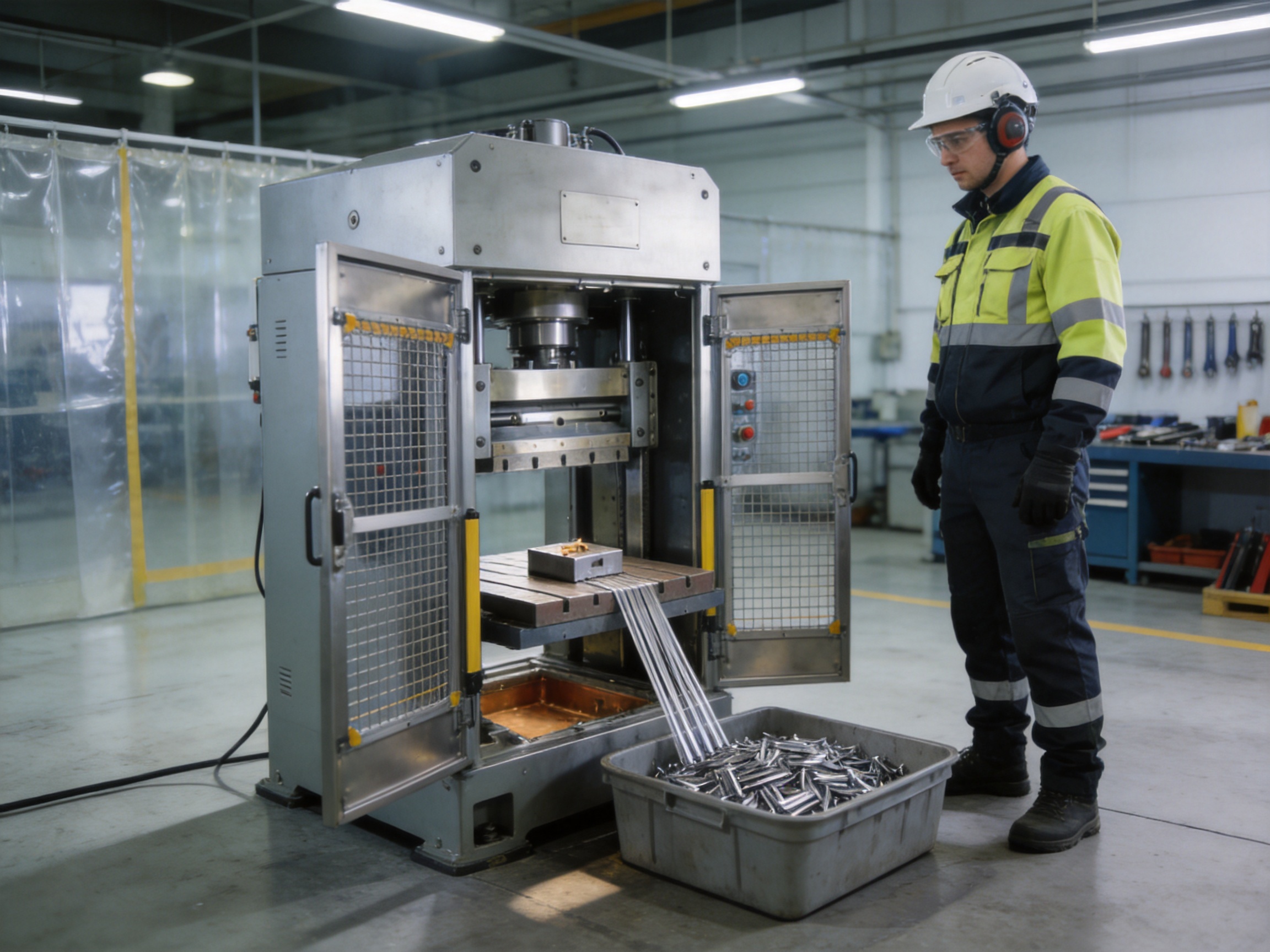
The BLPA-25 is suitable for high-efficiency stamping and forming of small-scale precision components. Typical applications may include small metal brackets, terminals, connectors, clips, washers, appliance components, electrical hardware, communication device parts, light automotive components, instrument parts, and general precision hardware. The exact suitability depends on material type, thickness, die design, stroke requirements, and forming process, but the machine’s 250 kN capacity and compact precision structure make it useful across many light to medium stamping tasks.
In the electronics and electrical industries, small stamped components often require tight dimensional consistency. Terminals, contact pieces, shielding parts, and connector elements must be formed accurately to ensure reliable assembly and function. A stable open-type press can support these requirements by providing repeatable motion and controlled force. The BLPA-25’s frame rigidity and accurate slide adjustment are valuable in this type of work.
In hardware manufacturing, production often involves varied part shapes and frequent die changes. Accessibility and setup speed are important. The open-type structure of the BLPA-25 allows convenient die handling and maintenance, while the manual slide adjustment device helps operators prepare dies efficiently. This makes the machine attractive for workshops that produce multiple part families rather than a single high-volume product.
In appliance and consumer product manufacturing, small stamped parts are often used in assemblies where dimensional stability affects final product quality. Stable press performance helps reduce variation and supports smoother downstream assembly. A press that produces consistent parts can reduce rework and improve line efficiency.
In automotive subcomponent production, even small brackets, clips, or fittings may require reliable quality because they are part of larger systems. While the BLPA-25 is not intended for heavy automotive structural stamping, it can serve precision small-part operations where reliability, safety, and repeatability are essential. Its overload protection and clutch brake system add value where tooling must be protected and production consistency must be maintained.
The machine is also suitable for training, prototype development, and small-batch production in professional manufacturing environments. Because it is compact and accessible, engineers can use it to validate forming processes before moving to larger production lines. However, it is not merely a laboratory press; it is designed for industrial production where durability and efficiency matter.
Efficiency in stamping is measured not only by press speed but by total productive time. A machine that cycles quickly but requires frequent adjustment, suffers overload damage, or produces inconsistent parts may not be efficient in practice. The BLPA-25 improves operational efficiency through stable construction, safe control systems, overload protection, and quick die setup.
Reduced setup time is one major contributor. The manual slide adjustment device helps operators establish die conditions quickly and accurately. In high-mix production, this can significantly reduce non-productive time. Faster setup also improves responsiveness to customer orders, especially when manufacturers must produce small batches with short lead times.
Reduced maintenance disruption is another contributor. A high-rigidity frame and stress-relieved structure help preserve machine geometry. This can reduce the need for repeated correction and alignment work. Hydraulic overload protection helps prevent severe damage during abnormal events. A reliable clutch brake system supports predictable operation and can reduce troubleshooting related to stopping performance.
Quality consistency also improves efficiency. Every defective part consumes material, labor, machine time, and inspection effort. If a press produces consistent results, the entire production process becomes smoother. Operators can focus on production rather than constant correction, and quality teams can rely on more stable process data. The BLPA-25’s precision-oriented structure supports this kind of stable manufacturing environment.
Energy and space efficiency should also be considered. A compact 250 kN open-type press can be a better fit than oversized equipment for small precision parts. Using a machine that matches the application avoids unnecessary floor space consumption and capital expense. It also helps create a more flexible workshop layout, especially where multiple presses are arranged for different product lines.
Power press safety is a critical responsibility for every manufacturing facility. The BLPA-25 includes systems that support safer operation, including a sensitive dry clutch brake system, a dual solenoid valve, and hydraulic overload protection. These features help control motion, improve stopping reliability, and reduce risk during abnormal load conditions.
Safe press operation also depends on proper installation, tooling, guarding, training, and maintenance. A well-designed machine provides a strong foundation, but users must apply appropriate safety procedures. Operators should be trained to understand die setup, slide adjustment, startup checks, emergency procedures, and routine inspection. Maintenance teams should regularly inspect the clutch brake system, valve operation, lubrication, fasteners, electrical controls, and overload protection system.
The open-type structure provides good accessibility, but accessibility must be managed responsibly. Operators should never place hands or tools in the die area during unsafe conditions. Feeding systems, guards, two-hand controls, light curtains, or other safety devices may be selected according to local regulations and application requirements. The BLPA-25’s control features can be integrated into a broader safety system for the workshop.
Hydraulic overload protection contributes to safety by helping prevent destructive overload events, but it should not be treated as a substitute for correct process design. Material thickness, die clearance, die condition, and press capacity must be evaluated before production. The 250 kN nominal capacity should be matched to the stamping operation by qualified personnel.
Compared with basic presses that lack responsive control and overload systems, the BLPA-25 provides a stronger safety platform. This is important for companies seeking to modernize production while reducing operational risk. Safety is not only a compliance matter; it is also a productivity matter. Safe machines reduce accidents, downtime, equipment damage, and workforce uncertainty.
The BLPA-25 can be integrated into various production environments, from standalone manual or semi-automatic operation to more coordinated stamping cells. Its compact open-type structure makes it practical for workshops where space is limited or where operators need convenient access for die changes and process monitoring.
When integrating the press, manufacturers should evaluate material feeding method, part removal, die design, lubrication, guarding, operator workflow, and inspection stations. The machine’s accessibility can simplify these decisions, particularly for small parts. It may be paired with appropriate feeders, straighteners, reels, or manual loading systems depending on the production requirement.
Tooling design is especially important. A well-designed die helps the press perform at its best. Die height, shut height requirements, forming load, material flow, part ejection, and guiding accuracy should be considered before production. The BLPA-25’s maximum die height of up to 260 mm provides flexibility, but every die must still be evaluated for compatibility.
For companies transitioning from low-end equipment to precision-oriented production, the BLPA-25 can serve as a practical upgrade. It offers improved structure and safety without the complexity or footprint of a much larger press. This makes it suitable for manufacturers that want to improve product consistency, reduce hidden costs, and professionalize their stamping operations.
The machine can also support lean manufacturing principles. Quick die setup, stable output, reduced scrap, and compact layout all contribute to leaner production. By matching equipment capacity to actual part requirements, companies can avoid overinvestment while maintaining reliable quality.
When purchasing a power press, buyers often compare capacity, die height, price, and delivery time. These factors are important, but manufacturer capability is equally critical. A press is a long-term production asset. Its performance depends on the manufacturer’s ability to design, fabricate, inspect, and support the machine properly.
Zhejiang Bolun High-Precision Machinery Co., Ltd. brings experience in high-precision forming equipment and machinery manufacturing. Its development from industry accumulation to modern production capability reflects a focus on technological innovation, quality control, and customer-oriented solutions. This background supports the BLPA-25 as more than a catalog product; it is part of a broader manufacturing system.
The company’s design team can provide one-stop services for special specifications and functions. This matters because stamping customers often need more than standard equipment. They may require adaptation to existing dies, workshop layouts, automation plans, or special production processes. A manufacturer with engineering depth can communicate more effectively and provide practical recommendations.
After-sales service is another important consideration. The company provides a service system covering pre-sales consultation, in-sales support, and after-sales guarantees. For industrial equipment, service quality affects installation, commissioning, troubleshooting, maintenance planning, and operator confidence. A supplier that understands customer requirements before and after delivery can help reduce risk.
The company’s philosophy of quality and credit first is especially relevant in international business. Global customers need reliable communication, consistent documentation, dependable production standards, and long-term support. By combining technical capability with a customer-oriented service system, the manufacturer strengthens the value of the BLPA-25 for overseas and domestic buyers.
The economic value of the BLPA-25 should be evaluated across its full service life. Initial purchase cost is only one part of the investment. A press also affects tooling cost, labor efficiency, scrap rate, maintenance expense, floor space utilization, energy use, safety risk, and delivery reliability. A machine with higher stability and better protection can deliver stronger long-term value even if it is not the cheapest option at purchase.
Stable frame construction helps protect part accuracy and tooling alignment. This can reduce scrap and lower quality-related costs. The heat-treated steel plate frame helps maintain structural stability, reducing the risk of performance decline caused by residual stress release. Over time, these advantages can translate into fewer production interruptions and better output consistency.
The clutch brake system and dual solenoid valve support reliable control, which can reduce safety-related risk and improve operational confidence. The hydraulic overload protector helps avoid severe damage when abnormal conditions occur. Tooling damage can be very expensive, especially for precision dies. Preventing or reducing such damage can significantly improve return on investment.
Quick and precise manual slide adjustment improves changeover efficiency. In factories with frequent die changes, saved setup time can accumulate into substantial productivity gains. If a machine allows more production hours per week, its economic value increases without requiring additional floor space or labor.
Finally, the compact nature of the BLPA-25 makes it easier to deploy in workshops that need flexible production capacity. It can be used as a dedicated machine for certain parts or as part of a diversified press lineup. This flexibility supports better asset utilization and helps manufacturers respond to changing customer demand.
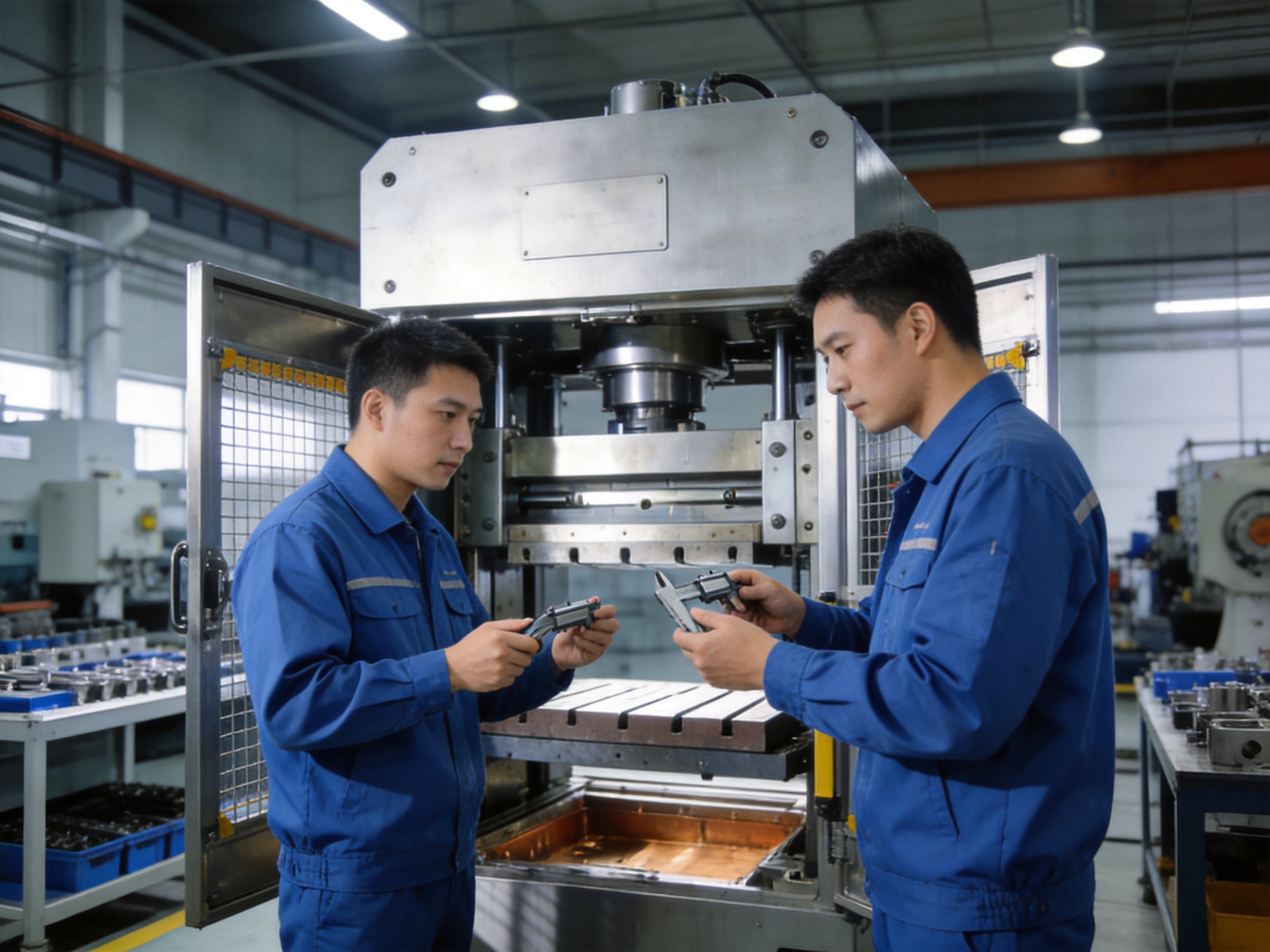
Open-type power presses, closed-type power presses, and other power press designs each have their place in manufacturing. The best choice depends on part size, forming force, precision requirement, tooling design, production volume, safety plan, and budget. The BLPA-25 is most attractive when the application calls for compact size, accessibility, reliable precision, and efficient setup.
Open-type presses are typically easier to access and maintain. They are useful for smaller dies, flexible production, and operations where visibility and die change convenience are important. The BLPA-25 builds on these strengths while addressing the traditional concern of open-type presses: rigidity. Its stress-relieved steel plate frame gives it a stronger foundation for precision work than many basic alternatives.
Closed-type presses offer excellent structural symmetry and are often selected for larger tonnage or demanding applications. However, they may be more expensive and less convenient for smaller jobs. For a manufacturer producing small precision parts, a closed-type press may create unnecessary cost and operational complexity. The BLPA-25 offers a more efficient solution when 250 kN capacity is appropriate.
Other power press types may include specialized or customized designs for unique forming requirements. Such machines can be valuable, but they may not be necessary for standard small-part stamping. The BLPA-25 provides a practical balance: it is specialized enough for precision work but straightforward enough for daily industrial use.
In short, the BLPA-25 is not intended to replace every press type. Its value lies in matching the right machine to the right production need. For small-scale precision stamping, it offers a combination of accessibility, rigidity, control, protection, and setup efficiency that compares favorably with many competing choices.
The BLPA-25 is designed for high-efficiency stamping and forming of small-scale precision components. It is suitable for many light to medium stamping applications where 250 kN nominal capacity is appropriate and where part consistency, die setup efficiency, and machine reliability are important.
The open-type structure provides convenient access to the working area, making die installation, adjustment, inspection, and maintenance easier. The single-point drive is practical for compact precision dies and small component production. This structure offers flexibility and efficiency for workshops with varied production needs.
The machine uses a high-rigidity steel plate frame that undergoes heat treatment to eliminate internal stress. This improves structural stability and helps reduce deformation or dimensional change over time. Stable frame geometry supports consistent slide movement, die alignment, and part quality.
The BLPA-25 includes a highly sensitive dry clutch brake system, a dual solenoid valve, and a hydraulic overload protector. These features help improve motion control, stopping reliability, and protection against abnormal overload conditions. Users should still apply proper guarding, training, and maintenance procedures.
The BLPA-25 supports a maximum die height of up to 260 mm. This allows compatibility with a practical range of dies for compact precision stamping. Die suitability should always be confirmed based on the specific tooling and forming process.
The manual slide adjustment device allows operators to set the slide position quickly and accurately during die setup. This reduces downtime, supports correct die conditions, and helps improve consistency during production. It is especially useful for manufacturers that frequently change dies.
Compared with many low-cost conventional presses, the BLPA-25 offers stronger structural design, heat-treated frame stability, more complete safety controls, hydraulic overload protection, and better setup precision. These advantages can reduce scrap, protect tooling, improve uptime, and support long-term production value.
A closed-type press may be more suitable for larger tonnage, larger dies, or applications requiring extremely high structural symmetry under heavy loads. However, for many small precision components, the BLPA-25 provides a more accessible, compact, and cost-effective solution.
Zhejiang Bolun High-Precision Machinery Co., Ltd. integrates research and development, design, production, sales, and service. The company emphasizes technical innovation, full-chain production, non-standard customization, advanced precision processing equipment, strict inspection, and customer-oriented support.
Yes. The machine is designed for industrial users seeking reliable precision stamping equipment, and the manufacturer provides consultation, support, and service capabilities for global customers. Its compact design, practical features, and safety-oriented configuration make it suitable for a wide range of production environments.
The BLPA-25 Compact Precision Open-Type Single-Point Power Press is a practical and capable solution for manufacturers producing small-scale precision stamped and formed components. Its 250 kN nominal capacity, open-type accessibility, high-rigidity heat-treated steel plate frame, responsive dry clutch brake system, dual solenoid valve, hydraulic overload protector, 260 mm maximum die height, and manual slide adjustment device create a strong balance of precision, safety, efficiency, and usability.
Its advantages over many competing presses come from integration rather than from one isolated specification. The rigid frame supports accuracy. Heat treatment supports long-term stability. The clutch brake and valve system support safe and reliable control. Hydraulic overload protection helps protect tooling and the machine. Manual slide adjustment reduces setup time and improves die matching. Together, these features help manufacturers reduce downtime, improve part consistency, and achieve stronger long-term value.
The machine is further strengthened by the manufacturing capability of Zhejiang Bolun High-Precision Machinery Co., Ltd. The company’s experience in high-precision forming equipment, full-chain production, customization capability, precision processing, strict inspection, and customer-focused service supports the reliability of the product. For buyers evaluating open-type power presses, the BLPA-25 represents a well-balanced choice for compact precision stamping.
In an increasingly competitive manufacturing environment, equipment must deliver more than basic mechanical force. It must support quality, safety, repeatability, flexibility, and cost control. The BLPA-25 is built around these priorities, making it a valuable production asset for workshops seeking dependable high-efficiency stamping performance.
Altan, T., and Tekkaya, A. E. Sheet Metal Forming: Processes and Applications. ASM International.
Kalpakjian, S., and Schmid, S. R. Manufacturing Engineering and Technology. Pearson Education.
Society of Manufacturing Engineers. Tool and Manufacturing Engineers Handbook: Forming. SME.
Boljanovic, V. Sheet Metal Forming Processes and Die Design. Industrial Press.
American National Standards Institute. Safety Requirements for Mechanical Power Presses.
International Organization for Standardization. Machine Tools and Industrial Press Safety Guidance.
Groover, M. P. Fundamentals of Modern Manufacturing: Materials, Processes, and Systems. Wiley.


Understanding Mechanical Power Presses and Their Essential Functions A mechani...
What Is a Power Press? A power press — also called a stamping press or punch pr...
In the fields of metal forming, sheet metal fabrication, blanking, and punching,...
Power press machines are classified in two main ways: by frame construction, w...
As the manufacturing industry moves steadily toward automation and smart product...
In modern manufacturing, cold forging is widely used in the automotive, aerospac...
Contact Us

bolunpress@gmail.com

+86-575-83362228

+86-15158259588

+86-575-83362999

+86-15158259588

Hangzhou Office Add: No. 332 Wangjiang East Road, Shangcheng District

No.1 Linjiang Road East, Xiaren, Jinting Town, Shengzhou City, Zhejiang Province, China
Ready to Begin?
Get in Touch

Now!

ZHEJIANG BOLUN
 English
 中文简体
中文简体