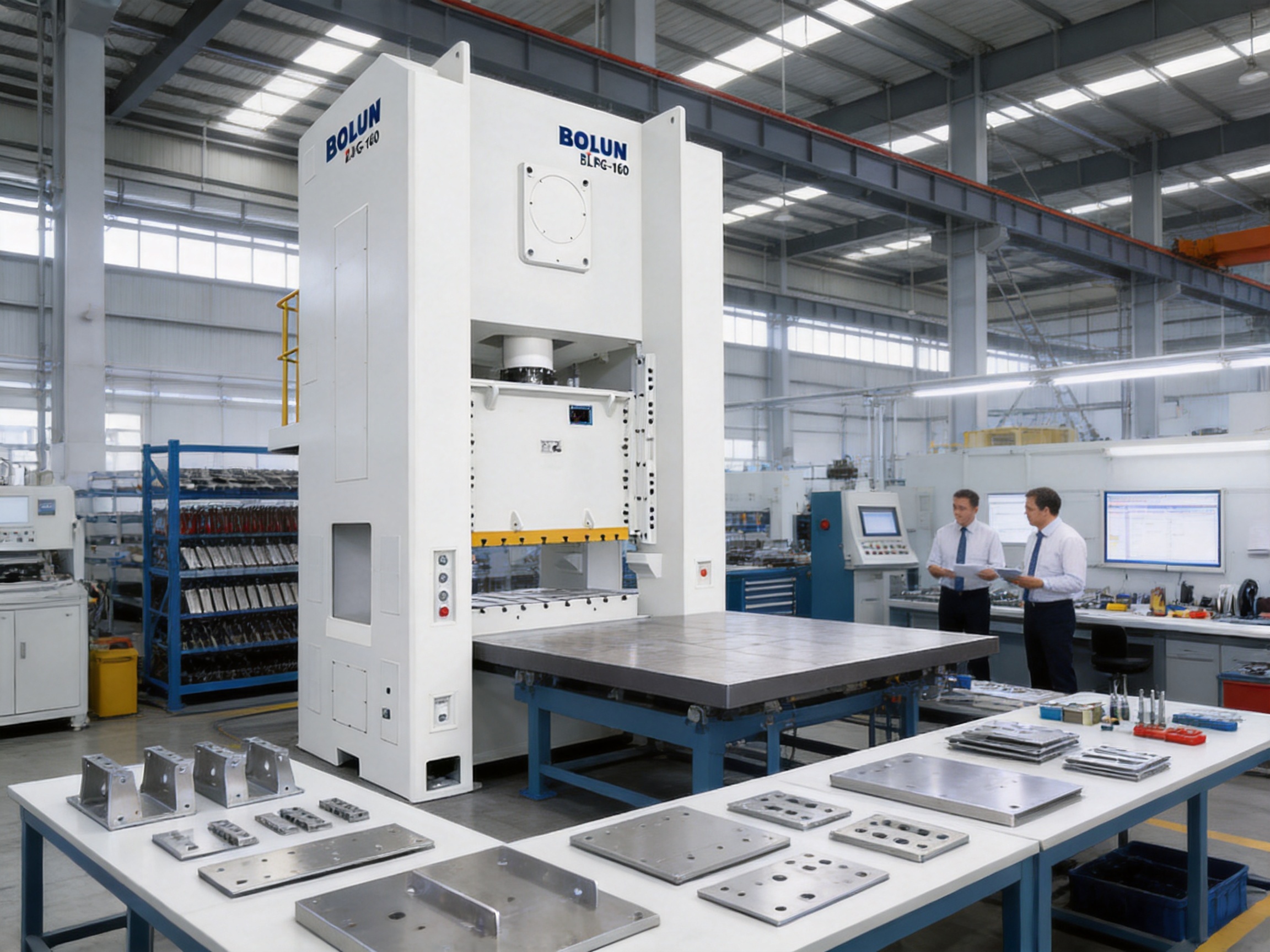
Modern stamping operations require more than a high nominal force rating. A production press must maintain structural stability, deliver repeatable slide movement, accommodate a wide range of dies, protect operators, and remain practical to set up and service. The BLPG-160 Versatile Stable-Frame Closed-Type Single-Point Wide-Door Power Press is designed around these combined requirements. With a nominal capacity of 1600 kN, a spacious 800 × 700 mm worktable, a wide-door frame, electric slide adjustment, and integrated safety functions, it provides a balanced solution for precision stamping, forming, and drawing applications.
The machine is intended for manufacturers that need dependable medium-to-high load performance without moving immediately to a much larger and more expensive press line. Its closed-type frame supports controlled force transmission and improved rigidity, while the single-point slide arrangement is suitable for a broad range of sheet-metal forming and progressive tooling applications. The result is a production platform that combines practical accessibility with the structural characteristics needed for accurate forming work.
A 1600 kN power press occupies an important position between lighter fabrication equipment and very large industrial stamping systems. It offers sufficient capacity for many automotive components, appliance panels, electrical enclosures, metal furniture parts, construction hardware, cookware components, and general industrial stampings. For many factories, this capacity range provides an effective balance between forming capability, floor-space requirements, investment cost, and energy consumption.
Nominal capacity is only one part of press performance. The actual suitability of a machine also depends on the nominal pressure stroke, slide stroke, strokes per minute, die height, adjustment range, table dimensions, frame construction, motor output, and safety system. The BLPG-160 is designed as an integrated system rather than as a force rating alone. Its working features support the complete production cycle, including die installation, adjustment, trial forming, continuous operation, inspection, and routine maintenance.
In a typical stamping process, the press must bring the upper die into alignment with the lower die, apply force at the correct point in the slide cycle, maintain the required shut height, and return the slide quickly enough to meet the production target. Any instability or misalignment can affect part dimensions, tool life, surface quality, and operator confidence. The BLPG-160 addresses these factors through a stable closed frame, controlled slide adjustment, a die height indicator, and a work area sized for substantial tooling.
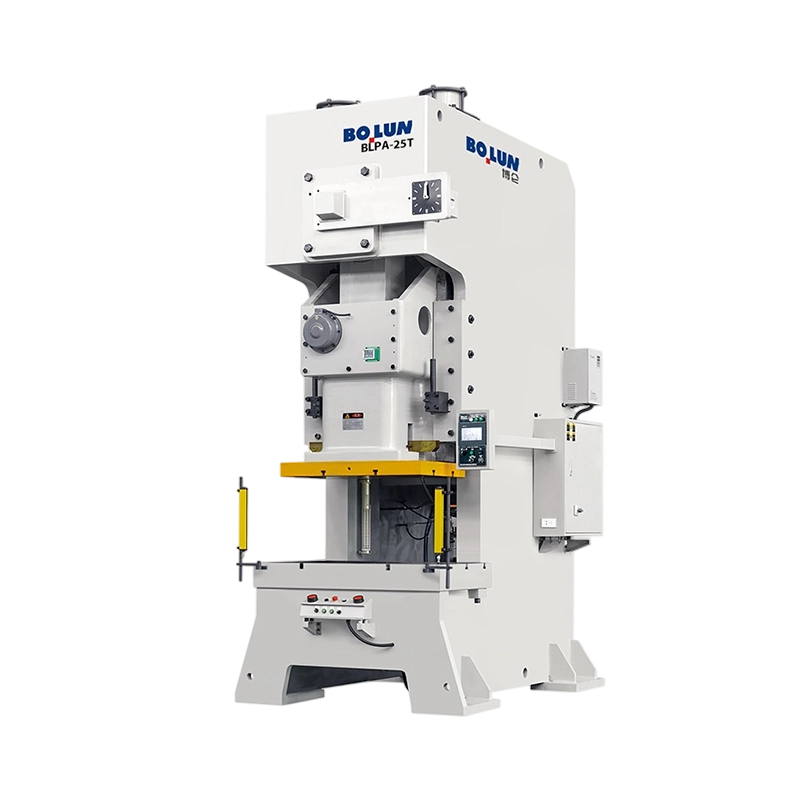
The BLPG-160 is a closed-type single-point wide-door power press with a nominal capacity of 1600 kN. It is suitable for precision stamping, forming, and drawing operations that require stable performance under medium-to-high load conditions. The machine is powered by a 15 kW high-torque main motor and uses an electric system for slide adjustment. An integrated die height indicator helps operators position tooling accurately and repeatably.
The worktable measures 800 × 700 mm, offering a practical platform for a wide selection of dies. This size is large enough for many single-operation dies, progressive tooling systems, blanking tools, bending tools, and forming assemblies, while remaining compact enough for installation in a general-purpose production area. The table design also provides a stable support surface for tooling alignment and workpiece handling.
The wide-door configuration is one of the machine’s most practical characteristics. Compared with narrow-access press designs, a wide-door frame can make die installation, material loading, part removal, inspection, and cleaning more convenient. Improved access can reduce setup time and help maintenance personnel reach critical areas without unnecessary obstruction. It also supports better visibility during trial runs, which is important when operators are verifying feed position, blank placement, and forming results.
Photoelectric safety protection and dual solenoid valves are integrated into the operating system. These features are intended to support safer machine operation by monitoring the working zone and improving control reliability. Safety equipment must always be installed, adjusted, and maintained according to the applicable regulations and the machine’s technical documentation, but the inclusion of these systems demonstrates that production speed is not treated separately from operator protection.
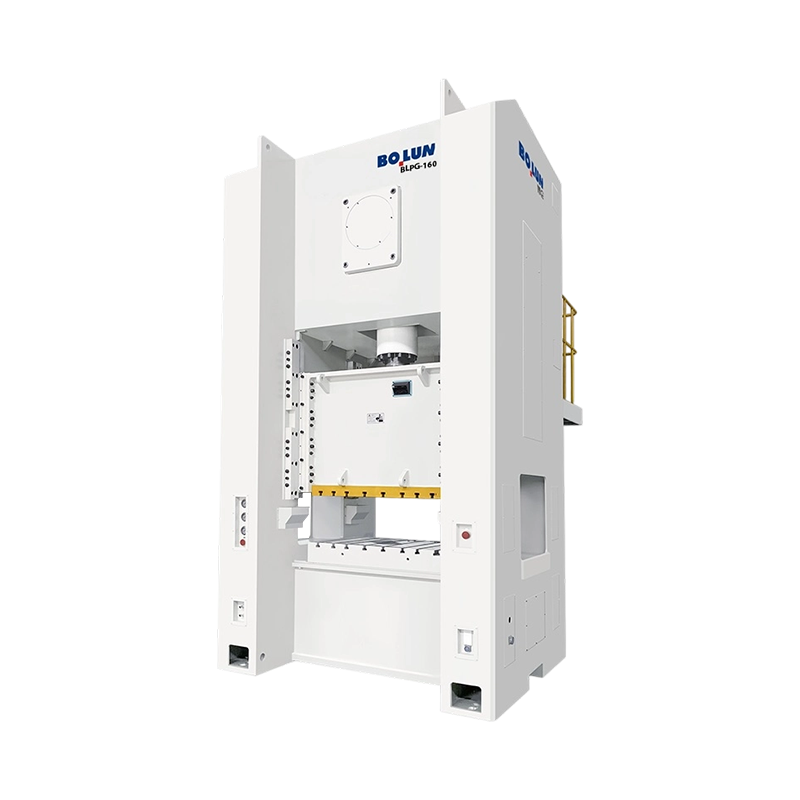
BLPG-160 Versatile Stable-Frame Closed-Type Single-Point Wide-Door Power Press
The closed-type frame is central to the BLPG-160’s performance. A closed frame creates a continuous load-bearing structure around the working area. When the slide applies force to the die, the frame resists the resulting loads and helps preserve the geometric relationship between the slide, tooling, and worktable.
In comparison with more open machine structures, a closed frame can provide improved rigidity and reduced deformation under load. This is particularly valuable in precision stamping, where even small changes in die alignment can influence burr formation, dimensional accuracy, drawing depth, material flow, and tool wear. A stable frame also contributes to more consistent results over long production runs.
Frame stability is especially important for drawing and forming processes. These operations often involve significant changes in material shape and may generate uneven forces as the workpiece moves through the die. A rigid structure helps the press maintain controlled motion and reduces the risk that frame deflection will affect the finished part. Although the final result depends on die design, material properties, lubrication, and process settings, the press frame provides the mechanical foundation for repeatable performance.
The BLPG-160 is described as a stable-frame press, which reflects its intended use in applications where consistent force transmission matters. Stability can also support longer die life. When the slide and table remain properly aligned, the die experiences less unnecessary side loading and uneven contact. This may reduce premature wear on guide components, cutting edges, forming radii, and other high-load areas of the tooling.
A production press is exposed to thousands or millions of operating cycles. During each cycle, the frame, slide, crank mechanism, bearings, connecting components, and die absorb and transmit dynamic loads. A well-designed frame and carefully controlled manufacturing process help distribute these forces more evenly through the machine body.
Stable load distribution can produce several practical benefits. It can help maintain product consistency, reduce vibration, protect tooling, and support smoother machine operation. It also provides a more reliable foundation for automation equipment such as feeders, transfer devices, sensors, and part-removal systems. When the press structure is predictable, peripheral equipment can be configured with greater confidence.
Tool change and die setup are often significant contributors to nonproductive time. Even a high-speed press can lose productivity if operators must spend excessive time positioning tooling, checking clearances, connecting sensors, or correcting alignment. The wide-door design of the BLPG-160 is intended to make these tasks more accessible.
Wide access allows operators to approach the die area more directly. This can make it easier to use lifting equipment, position die components, connect feed systems, and inspect the working zone. It can also simplify the removal of scrap or formed parts during setup. When a tool is installed correctly the first time, the factory can reduce trial cycles and shorten the transition between production orders.
Accessibility also supports preventive maintenance. Technicians need to inspect lubrication points, check fasteners, examine guide components, clean the working area, and identify abnormal wear. A machine that is easier to access encourages more regular inspection. Early detection of problems can prevent unplanned downtime and protect both the press and the die.
For manufacturers producing multiple parts in relatively short batches, setup flexibility is especially valuable. The wide-door configuration helps the machine adapt to changing production schedules rather than being limited to long, uninterrupted runs of one product. This makes the press suitable for subcontracting operations, diversified component manufacturers, and factories serving several industrial sectors.
Correct die height is essential for safe and accurate stamping. The distance between the slide and the table must match the die design, the required shut height, the material thickness, and the process conditions. Incorrect adjustment may cause poor forming, incomplete cutting, excessive tool impact, or damage to the die and press.
The BLPG-160 uses an electric slide adjustment system to support efficient mold positioning. Electric adjustment is more convenient than relying entirely on manual mechanical correction, particularly when the machine is used with multiple dies. Operators can make controlled adjustments during setup and reduce the physical effort required to achieve the target position.
The die height indicator provides a visual reference for the adjustment position. Repeatable position information is useful when a die is removed and later reinstalled, or when the same tool is used on multiple production orders. It can also assist process documentation by allowing setup personnel to record a known working position for future jobs.
In practical production, the combination of powered adjustment and position indication can shorten setup time and improve consistency between operators. It may also reduce the number of trial strokes needed before production begins. However, the die height indicator should be used together with physical measurements, die manufacturer instructions, and appropriate safety procedures. A displayed value is a setup aid, not a replacement for correct die inspection.
Different dies may have different shut heights, guide arrangements, material flows, and operating requirements. A press with useful adjustment capability can accommodate more tooling configurations without extensive mechanical modification. This flexibility is valuable when manufacturers use the same press for blanking, bending, shallow drawing, embossing, piercing, and other operations.
Tooling flexibility also supports gradual factory expansion. A manufacturer may begin with a limited set of dies and add new products over time. The BLPG-160 can serve as a central forming machine for a broader product portfolio, helping the factory use its investment across several applications instead of dedicating the machine to one component only.
The BLPG-160 is equipped with a 15 kW main motor. A high-torque motor supports the press mechanism as it performs repeated slide cycles under demanding forming conditions. Motor selection affects not only the machine’s ability to complete a stroke but also its response during acceleration, deceleration, and operation under varying load.
For stamping applications, consistent mechanical motion is important. A press should not exhibit excessive speed variation or unstable behavior as the load changes within the stroke. The motor and drive system therefore form part of the overall production-control strategy. When the power system, transmission mechanism, frame, and control elements work together, the machine can deliver more predictable cycles.
Production stability is valuable in both short and long runs. During short runs, it helps operators achieve acceptable parts quickly during setup. During long runs, it helps maintain repeatable cycle behavior and reduces process drift. Stable operation can also simplify quality control because the factory is working with a more consistent mechanical process.
Energy use should be considered together with production output. A properly selected press avoids excessive oversizing for the application while retaining enough capacity for the required process. The 1600 kN rating gives the BLPG-160 a substantial working range for medium-to-high load stamping without requiring every job to move to a larger press class.
The 800 × 700 mm worktable is a practical feature for manufacturers that need more than a compact bench-scale stamping area. It provides adequate support for a range of industrial dies, including single-station forming tools, blanking dies, bending dies, piercing tools, and certain progressive applications.
A properly sized worktable contributes to safe and stable tooling installation. The lower die must be supported across a suitable area, with mounting arrangements positioned correctly and sufficient clearance available for the workpiece and scrap path. The table dimensions should always be compared with the actual die footprint, fastening locations, bolster requirements, and production material before purchase or installation.
The press also provides a slide bottom area suited to substantial upper tooling. Together, the worktable and slide support a coordinated die arrangement. When the die is correctly matched to the machine, the press can apply force through the intended working region and reduce unnecessary eccentric loading.
Manufacturers should evaluate not only the table length and width but also the die height range, slide stroke, nominal pressure stroke, side access, and working-face height. A press may have adequate nominal force but still be unsuitable if the die is too large, too tall, or incompatible with the available stroke. The BLPG-160’s design is intended to provide a balanced combination of these parameters for general industrial production.
The BLPG-160 can be used for a broad range of metal-forming operations, provided the die, material, thickness, lubrication, and process force are within the machine’s working limits. Common applications may include blanking, piercing, bending, shallow drawing, embossing, coining, flattening, and progressive stamping.
Automotive suppliers often require repeatable forming for brackets, reinforcement parts, mounting plates, covers, support members, and other sheet-metal components. The closed frame and substantial table area can support tooling used for these parts, while the wide-door configuration assists in die installation and inspection.
Electrical cabinets, switchgear components, appliance brackets, housings, terminal parts, and protective covers may require a combination of piercing, bending, and forming. A versatile power press can be configured for multiple operations, helping manufacturers produce families of parts on shared equipment.
Hardware manufacturers may use the press for brackets, hinges, plates, clips, fittings, and structural accessories. These products often require moderate-to-high forming force and reliable repeatability. The BLPG-160’s capacity makes it suitable for a wide range of such components, subject to process verification.
Selected cookware and consumer-product components may require drawing, shaping, trimming, or embossing. These processes can place different demands on the machine depending on material grade, blank diameter, drawing ratio, and die geometry. The stable frame and controlled slide movement provide a useful foundation for developing these processes.
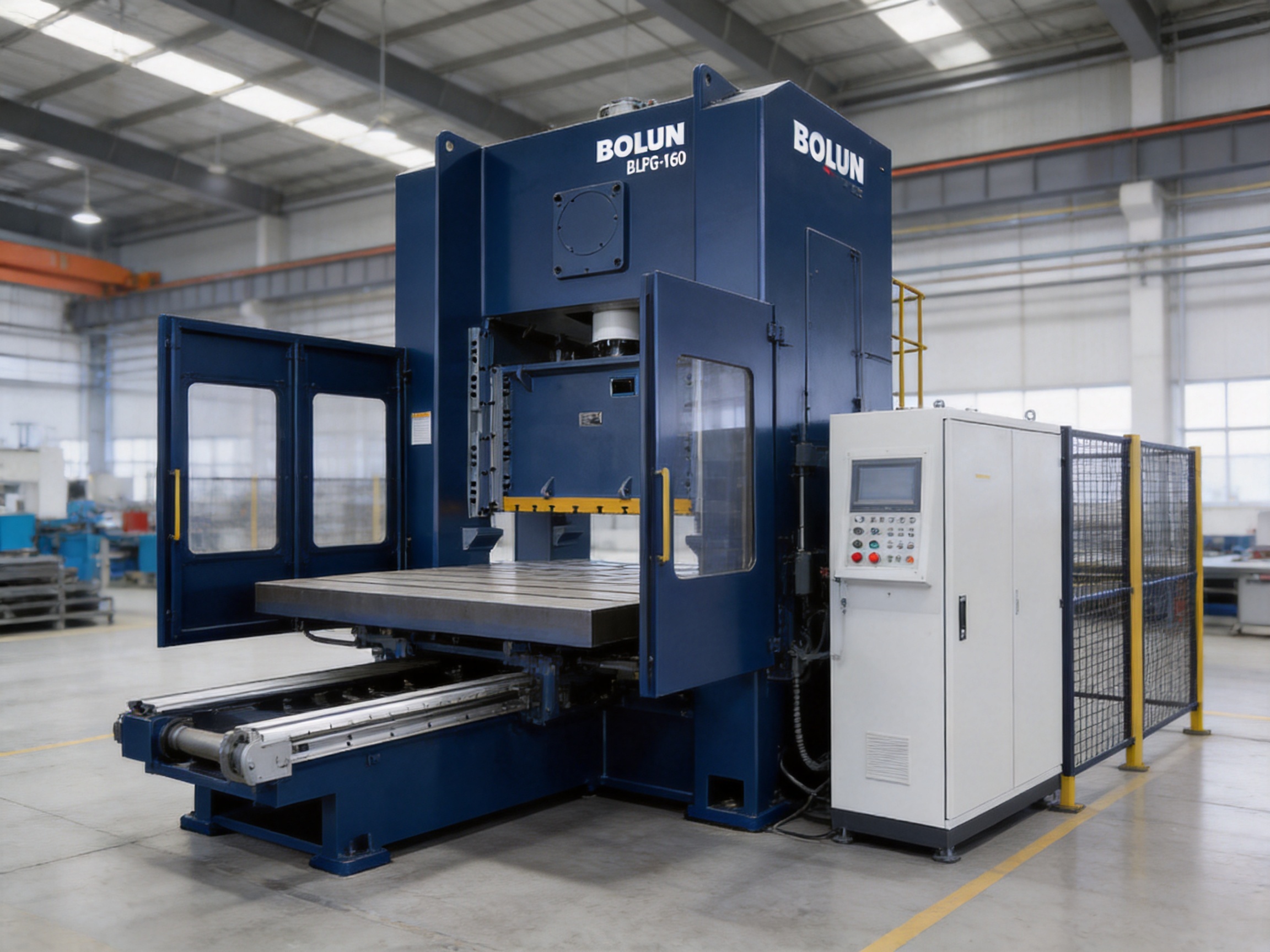
Safety is a fundamental requirement for any mechanical power press. The BLPG-160 includes photoelectric safety protection and dual solenoid valves to support safer control of the working process. Photoelectric protection can help detect an interruption in the monitored area, while dual solenoid valve arrangements can provide additional control redundancy in the pneumatic safety circuit.
These systems are most effective when integrated into a complete safety program. Operators must receive appropriate training, understand the machine’s operating modes, use approved tooling, and follow lockout and maintenance procedures. Guards, emergency stops, control circuits, sensors, and pneumatic components must be inspected regularly.
Safety equipment should not be bypassed to increase production speed. Any modification to the control or protection system must be performed by qualified personnel and validated against the relevant local requirements. The machine’s safety functions are part of the production system and should be treated with the same discipline as tooling accuracy and quality control.
The wide-door design can improve visibility during setup, allowing operators to observe die alignment and material placement more easily. The electric slide adjustment system can reduce the need for repeated manual intervention. A die height indicator can help operators work from documented setup values rather than relying only on estimation. Together, these design elements support a more organized and controlled setup process.
Operational reliability also depends on maintenance. Clean sensors, correctly adjusted valves, adequate lubrication, secure electrical connections, and properly maintained die components are essential. A press with advanced features still requires disciplined daily inspection and scheduled service.
The performance of a precision press begins long before final assembly. It depends on engineering design, material selection, machining accuracy, component inspection, assembly control, testing, and after-sales support. The manufacturer behind the BLPG-160 integrates research and development, design, production, sales, and service within one industrial organization.
Its manufacturing capabilities are supported by two decades of experience in machinery production and a focus on forging and casting equipment. This accumulated experience is relevant because press design requires understanding of both static force and dynamic operation. Frame behavior, transmission loads, slide alignment, die compatibility, and operator access must be considered together.
The company emphasizes a full-chain production system. Such a system can provide closer coordination between basic design, core component development, precision processing, machine assembly, inspection, and final delivery. When these stages are managed as connected activities, engineering decisions can be translated into production controls more effectively.
Precision processing equipment is important for manufacturing components that must maintain accurate geometry and reliable fit. Critical press components may require controlled machining, careful surface preparation, dimensional inspection, and proper assembly sequencing. Manufacturing quality in these areas contributes to slide alignment, transmission smoothness, and long-term service performance.
A mature industrial environment also supports repeatability. Standardized procedures, trained personnel, production documentation, and inspection checkpoints help reduce variation from one machine to another. This is particularly important for industrial buyers that need consistent equipment across multiple production lines or facilities.
Not every stamping operation can be served by a completely standard configuration. Customers may require changes related to tooling dimensions, automation interfaces, control functions, working height, material handling, electrical standards, or production layout. The manufacturer provides non-standard design and manufacturing capabilities for products with special specifications and functions.
Customization is most valuable when it is based on a clear technical assessment. The customer should provide information about material type, thickness, blank size, die dimensions, required force, production rate, feeding method, part removal, and safety standards. This allows the engineering team to determine whether the standard BLPG-160 configuration is appropriate or whether additional modifications are necessary.
Press performance must remain stable under high-intensity operating conditions. The manufacturer therefore places emphasis on finished-product inspection and process quality control. Inspection should cover not only visible appearance but also dimensional accuracy, mechanical operation, electrical functions, safety devices, and machine movement.
A comprehensive inspection approach can include verification of frame condition, slide movement, die height adjustment, motor operation, control response, safety sensor operation, valve performance, lubrication, and general assembly quality. Each of these areas can influence the user’s production experience.
Quality control is also important for long service life. A machine that operates within its rated conditions but is assembled with inconsistent components may experience premature wear or recurring adjustments. By contrast, controlled manufacturing and inspection provide a stronger foundation for reliable use.
Customers should request the appropriate technical documentation, inspection records, operating instructions, spare-parts information, and commissioning guidance for the supplied configuration. These documents help the production team establish correct procedures from installation onward.
The BLPG-160 offers several advantages over less specialized or less rigid alternatives. First, its closed-type frame is better suited to applications where controlled force transmission and stable die alignment are important. A lighter or more flexible structure may be adequate for simple operations, but it can be less appropriate for demanding forming or precision stamping.
Second, the wide-door layout improves practical accessibility. Some competing designs may provide adequate force but make die changes, maintenance, or inspection more difficult. Better access can reduce setup time and improve the daily usability of the machine.
Third, the combination of electric slide adjustment and a die height indicator supports more repeatable setup. Manual adjustment alone may require more operator effort and can increase the risk of inconsistent positioning, especially when several dies are used on the same press.
Fourth, the 1600 kN capacity and 15 kW motor create a useful balance between production capability and machine scale. Manufacturers can obtain substantial forming force without automatically moving to a much larger press with greater space, foundation, and operating requirements.
Fifth, integrated photoelectric safety protection and dual solenoid valves demonstrate a more complete approach to production equipment design. Safety features do not replace correct procedures, but they provide important support for controlled operation.
Open-type presses are often selected for their accessibility and compact structure. They can be useful for lighter work and applications where the required force is relatively low. However, open frames may offer less rigidity under higher loads, depending on the design and construction.
A closed-type press such as the BLPG-160 is generally more appropriate when the application places greater emphasis on frame stability, die alignment, and force control. The continuous frame structure can help reduce deformation and provide a more consistent working relationship between the slide and table.
The choice should always be based on the actual process. For low-force operations, an open-type machine may be economical and sufficient. For precision stamping, drawing, or medium-to-high load forming, the structural advantages of a closed frame can justify the investment.
Larger presses offer higher nominal capacities and may be necessary for very large panels, deep forming, heavy plate, or large multi-station dies. However, a larger machine is not automatically a better choice for every application. Oversized equipment can require more floor space, greater foundation capacity, larger tooling, and higher capital expenditure.
The BLPG-160 is positioned for manufacturers whose processes fit within a 1600 kN working range. It can provide adequate capability while keeping the equipment footprint and operating scale more manageable. Selecting a press that closely matches the process can improve utilization and reduce the cost of unused capacity.
For factories with a mix of products, the 1600 kN class may also function as a flexible middle-capacity resource. It can handle jobs that are too demanding for smaller machines while avoiding the unnecessary use of a large press for moderate components.
Correct installation is essential for achieving the intended performance of the BLPG-160. Before delivery, the buyer should confirm floor conditions, access routes, lifting arrangements, power supply, pneumatic requirements, ventilation, lighting, and space for die handling. The press should be positioned so that operators and maintenance personnel have safe access to the working area and service points.
The foundation or supporting surface must be suitable for the machine’s weight and dynamic loads. Leveling should be completed according to the manufacturer’s instructions. Electrical connections must match the required voltage, frequency, grounding, and protection standards. Pneumatic systems should provide clean and stable air at the required pressure.
During commissioning, technicians should verify slide movement, adjustment operation, die height indication, motor rotation, control-panel functions, emergency stops, photoelectric protection, dual solenoid valve response, lubrication, and abnormal noise or vibration. The first production trial should use an approved die and a controlled process with careful observation.
Commissioning is also an opportunity to train operators. Personnel should learn the correct startup sequence, operating modes, adjustment procedures, die installation requirements, safety checks, shutdown process, and routine inspection tasks. Good training improves both safety and machine utilization.
Preventive maintenance helps protect the press from avoidable downtime. Daily checks may include inspection of the working area, sensors, emergency stops, lubrication status, unusual sounds, air leakage, loose components, and visible damage. Operators should report irregularities before continuing extended production.
Scheduled maintenance should follow the manufacturer’s recommendations and include inspection of moving components, fasteners, electrical connections, pneumatic valves, slide adjustment mechanisms, bearings, guides, and safety devices. Lubricants should be selected and replenished according to the technical requirements of the equipment.
Tooling maintenance is equally important. A damaged or poorly aligned die can place abnormal loads on the press. Before installation, the die should be checked for cracks, burrs, loose parts, damaged guides, and incorrect shut height. The die should be secured properly, and the first cycles should be performed at a controlled speed when appropriate.
Maintenance records are valuable for identifying trends. Recording adjustments, lubrication, part replacements, alarms, and downtime can help the factory plan service before a failure occurs. It also provides useful information when contacting the manufacturer for technical support.
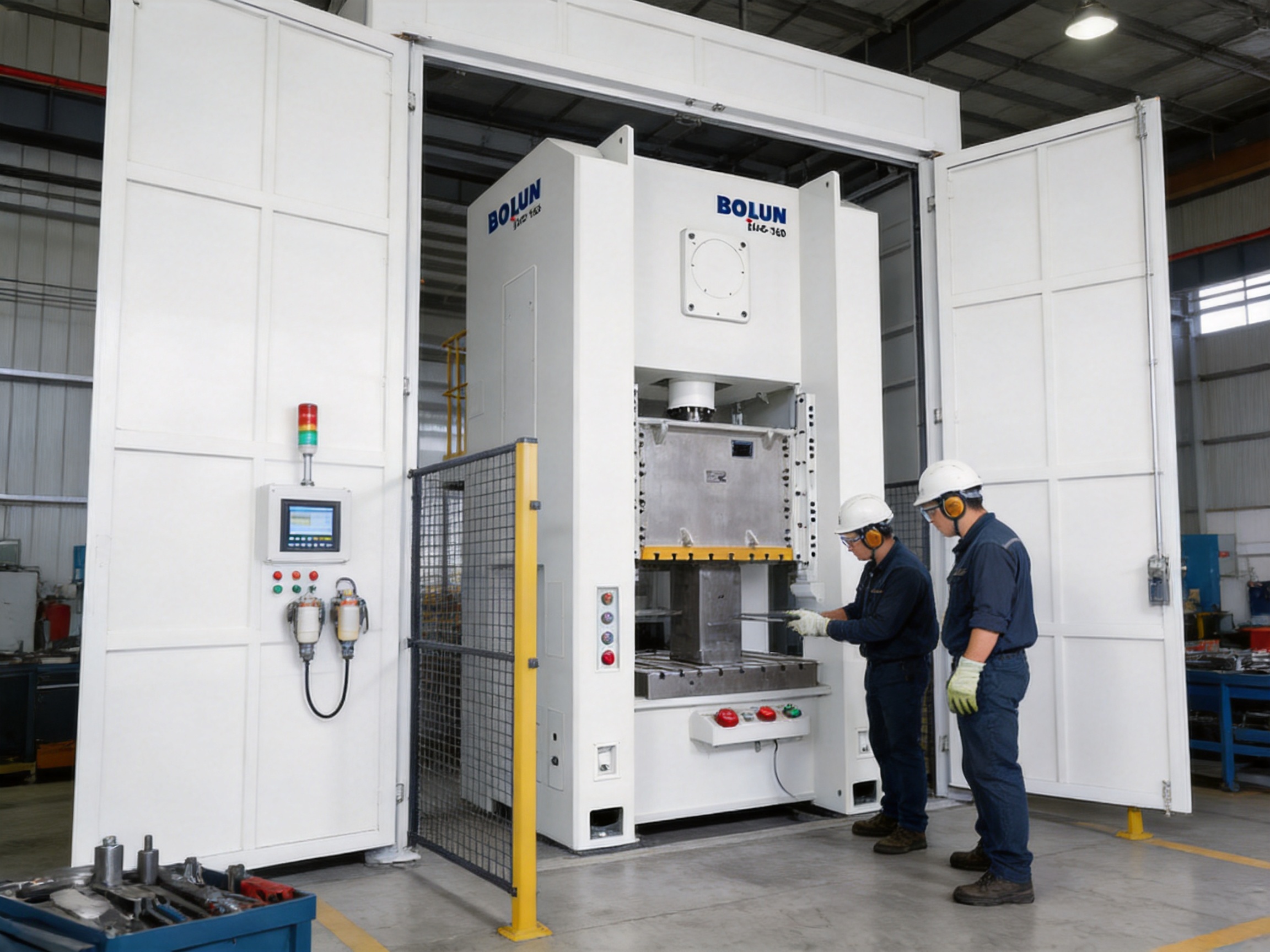
| Item | BLPG-160 Specification |
|---|---|
| Machine type | Closed-type single-point wide-door power press |
| Nominal capacity | 1600 kN |
| Nominal pressure stroke | 3 mm |
| Slide stroke | 90 mm |
| Strokes per minute | Approximately 50–100 S.P.M., subject to operating conditions and configuration |
| Maximum die height | Approximately 555 mm |
| Die height adjustment | 100 mm |
| Distance between columns | Approximately 1300 mm |
| Worktable size | 800 × 700 × 140 mm |
| Slide bottom size | 700 × 700 × 90 mm |
| Side opening | Approximately 600 × 400 mm |
| Height of working face | Approximately 900 mm |
| Main motor | 15 kW, four-pole configuration as listed for the model range |
| Adjustment system | Electric slide adjustment with die height indicator |
| Safety equipment | Photoelectric safety protection and dual solenoid valves |
| Primary applications | Precision stamping, forming, drawing, blanking, bending, piercing, and embossing |
Specifications should be confirmed against the final quotation, technical drawing, electrical configuration, and customer-specific requirements. Model series tables may include multiple variants, and the delivered machine may differ when optional features, regional standards, or customized tooling arrangements are requested.
Before ordering, manufacturers should evaluate the maximum required forming force rather than selecting a machine only from the name of the product. The calculation should consider material strength, thickness, cutting perimeter, drawing conditions, bending geometry, friction, blank-holder requirements, and safety margins.
The die dimensions should be compared with the worktable and slide bottom. The die height should fall within the machine’s permitted range, including adjustment capability. The required slide stroke and operating speed should also be checked. A process requiring a longer stroke or a specialized motion profile may need a different press configuration.
Material feeding and part removal should be considered at the same time. Manual loading may be sufficient for low-volume work, while automatic feeding, coil lines, transfer devices, or robotic handling may be more appropriate for high-volume production. The wide-door structure can support accessibility, but the final automation layout must be engineered around the complete machine and die system.
Customers should also confirm electrical standards, pneumatic requirements, guarding arrangements, language of documentation, spare-parts expectations, installation responsibilities, and training services. Clear technical communication before production helps prevent delays during delivery and commissioning.
The manufacturer is based in Zhejiang, a major center of Chinese machinery and precision manufacturing. Its business integrates research and development, engineering design, production, sales, and service. This integrated structure allows the company to address equipment projects from initial process evaluation through machine delivery and after-sales support.
The company’s stated strengths include advanced processing equipment, core component development, a mature industrial environment, non-standard customization, and a complete manufacturing chain. These capabilities are important for buyers seeking more than a standard catalog machine. They can support special working dimensions, customized control functions, integration with feeding equipment, and application-specific design changes.
Service begins before the order is placed. Technical consultation can help determine whether the BLPG-160 is suitable for the customer’s material, tooling, production rate, and force requirements. During production and delivery, communication about drawings, electrical standards, installation, and inspection can reduce project risk. After installation, training and technical support help the customer establish stable operation.
The company also emphasizes quality, long service life, and customer-oriented support. These priorities are particularly relevant for power presses because the cost of downtime can exceed the initial purchase price of a component or spare part. Reliable equipment, responsive service, and accessible technical information all contribute to the total value of the investment.
The BLPG-160 is designed for manufacturers that need a capable and adaptable power press rather than a machine focused on only one narrow operation. Its 1600 kN capacity supports a broad range of medium-to-high load processes. Its closed frame contributes to stability. Its wide-door construction improves accessibility. Its electric adjustment and die height indicator support efficient setup. Its motor and safety systems help maintain dependable production.
The machine’s value is therefore found in the interaction of its features. A stable frame without convenient setup can limit productivity. A powerful motor without accurate die adjustment can make tooling changes inefficient. A wide access area without safety protection can create unacceptable operating risks. The BLPG-160 combines these elements into a more complete production platform.
For factories that produce varied sheet-metal components, this flexibility can improve equipment utilization. For factories focused on repeat production, the machine’s stability and repeatable setup functions can support consistent output. For companies developing new products, the table size, force rating, and customization capabilities provide a useful foundation for process expansion.
The BLPG-160 is a closed-type single-point wide-door power press. It is designed for precision stamping, forming, drawing, blanking, bending, piercing, and related sheet-metal operations within its rated working conditions.
The nominal capacity is 1600 kN. The actual allowable force and the point in the stroke where that force can be applied must be considered when selecting tooling and developing a process.
The listed worktable size for the BLPG-160 is approximately 800 × 700 × 140 mm. Buyers should confirm the final table details, mounting holes, and any bolster or die-cushion requirements before ordering.
A closed-type frame provides a continuous structural path around the working area. This can improve rigidity, reduce deformation under load, support die alignment, and promote more consistent forming results compared with less rigid structures.
The wide-door design improves access to the die area. It can make tooling installation, material loading, inspection, maintenance, and die changes more convenient and may reduce setup time.
The machine is suitable for drawing applications when the material, blank size, drawing ratio, die design, lubrication, and required force are within the machine’s capabilities. A technical review should be completed for deep or demanding drawing processes.
The BLPG-160 includes electric slide adjustment and a die height indicator. These features help operators position tooling more efficiently and repeat setup conditions more consistently.
The listed main motor output is 15 kW. The final motor and electrical configuration should be confirmed according to the delivered machine, operating conditions, and regional power requirements.
The machine includes photoelectric safety protection and dual solenoid valves. These features must be maintained and used together with guards, emergency stops, operator training, lockout procedures, and all applicable safety requirements.
Customization may be available for special specifications and functions. Potential areas include working dimensions, control systems, automation interfaces, feeding arrangements, electrical standards, and other application-specific requirements. The feasibility of each change should be evaluated by the engineering team.
It can serve as the main press in an automated line when the feeder, transfer system, sensors, die, control interface, and safety architecture are properly integrated. Automation requirements should be discussed before finalizing the machine configuration.
The buyer should provide material type and thickness, blank dimensions, finished-part drawings, target production rate, tooling dimensions, required operations, estimated forming force, feeding method, part-removal method, power standards, and any special safety or automation requirements.
Service life can be supported through correct installation, proper die alignment, regular lubrication, scheduled inspection, timely replacement of worn components, clean safety sensors, correct operating procedures, and avoidance of overload or eccentric loading.
No. The stated strokes-per-minute range is a reference for the model. Actual production speed depends on die design, material handling, stroke requirements, forming load, operator or automation conditions, and the selected operating mode.
Buyers should confirm the final technical specification, machine variant, die height, table and slide dimensions, motor and electrical details, safety configuration, pneumatic requirements, foundation conditions, documentation, delivery scope, warranty, training, and after-sales support.
The BLPG-160 represents a balanced approach to industrial power press design. Its 1600 kN nominal capacity, stable closed frame, 800 × 700 mm worktable, wide-door access, electric slide adjustment, die height indicator, 15 kW motor, and integrated safety features address the practical needs of modern stamping production.
Its main advantage is not a single specification but the combination of structural stability, tooling accessibility, setup efficiency, operational safety, and manufacturing support. These characteristics make it a suitable candidate for manufacturers producing a wide range of sheet-metal components under medium-to-high load conditions.
Supported by an engineering organization with experience in precision machinery, integrated production capabilities, customization expertise, and quality-focused inspection, the machine can serve as a dependable foundation for both established production lines and expanding manufacturing operations. When correctly matched to the process and maintained according to technical requirements, the BLPG-160 can help manufacturers improve repeatability, reduce setup difficulty, protect tooling, and build a more efficient stamping workflow.
1. Manufacturer-provided BLPG-160 product description and technical specification data.
2. Manufacturer-provided company profile and manufacturing capability statement.
3. General principles of mechanical power press design, frame rigidity, and die alignment.
4. Industrial sheet-metal stamping, forming, blanking, bending, and drawing process practices.
5. General occupational safety principles for mechanical power presses and safeguarding systems.
6. Preventive maintenance practices for industrial forming machinery.


Two presses can both carry a 200-tonne nameplate and still produce very differe...
A buyer comparing a 45-ton open-gap press for a bracket line often receives two...
What Is a Power Press? A power press — also called a stamping press or punch pr...
A tooling engineer quotes a new bracket program and specifies a 160-ton press. ...
In the fields of metal forming, sheet metal fabrication, blanking, and punching,...
Start With the Purchase Decision, Not the Definitions A procurement engineer co...
Contact Us

topbolun@gmail.com

+86-575-83362228

+86-13735238388
+86-18667502750

+86-575-83362999

+8618667502750

No.1 Linjiang Road East, Xiaren, Jinting Town, Shengzhou City, Zhejiang Province, China
Ready to Begin?
Get in Touch

Now!

ZHEJIANG BOLUN
 English
 中文简体